

SEO marketing used to be framed as a rankings game. That version is too small now. The real job is to make your brand discoverable when people search, compare, evaluate, and decide, whether that happens on classic search results, inside AI-generated summaries, or across the wider content ecosystem that shapes demand in the first place. Google’s own SEO Starter Guide still defines the core clearly: help search engines understand your content, and help users decide whether your page is the right result for them.
That matters even more now because the search environment has changed. Google is still the web’s biggest traffic referrer in large-scale referral analysis from SparkToro and Datos, yet search journeys are producing fewer straightforward clicks as zero-click behavior and AI summaries become more common in both Bain’s consumer research and SparkToro’s search studies (SparkToro and Datos, Bain & Company, SparkToro zero-click study). So the opportunity is still massive, but lazy SEO is getting squeezed. The brands that win are the ones that connect technical health, search intent, content quality, authority signals, and commercial outcomes into one system.
This article is built for that broader, more useful definition of SEO marketing. The goal is not to dump tactics at you. The goal is to show how modern SEO actually works when you care about traffic quality, revenue, brand visibility, and long-term resilience instead of vanity metrics.
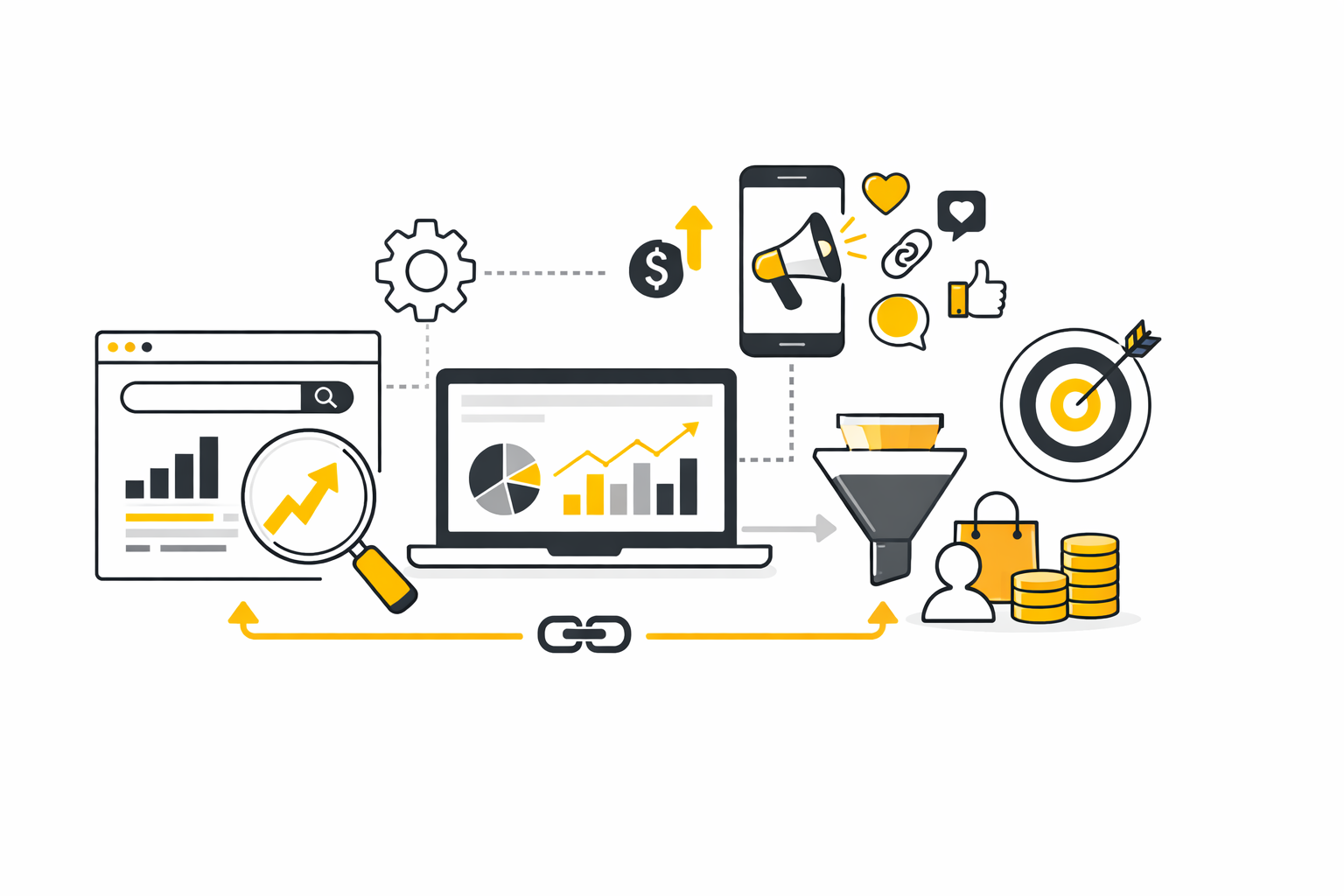
Article Outline
This guide is structured as one continuous article split into six parts so each section can go deep without losing the thread. The order is deliberate: first the case for why SEO marketing still deserves serious attention, then the framework, then the building blocks, then execution, then measurement, and finally the mistakes and shifts that separate durable strategies from short-lived wins. By the end, you should be able to see SEO marketing less as a channel silo and more as an operating system for organic growth.
- Why SEO Marketing Still Matters
- The Modern SEO Marketing Framework
- Core Components of High-Performance SEO Marketing
- How Professionals Implement SEO Marketing
- How to Measure SEO Marketing Performance and ROI
- Common SEO Marketing Mistakes and What Comes Next
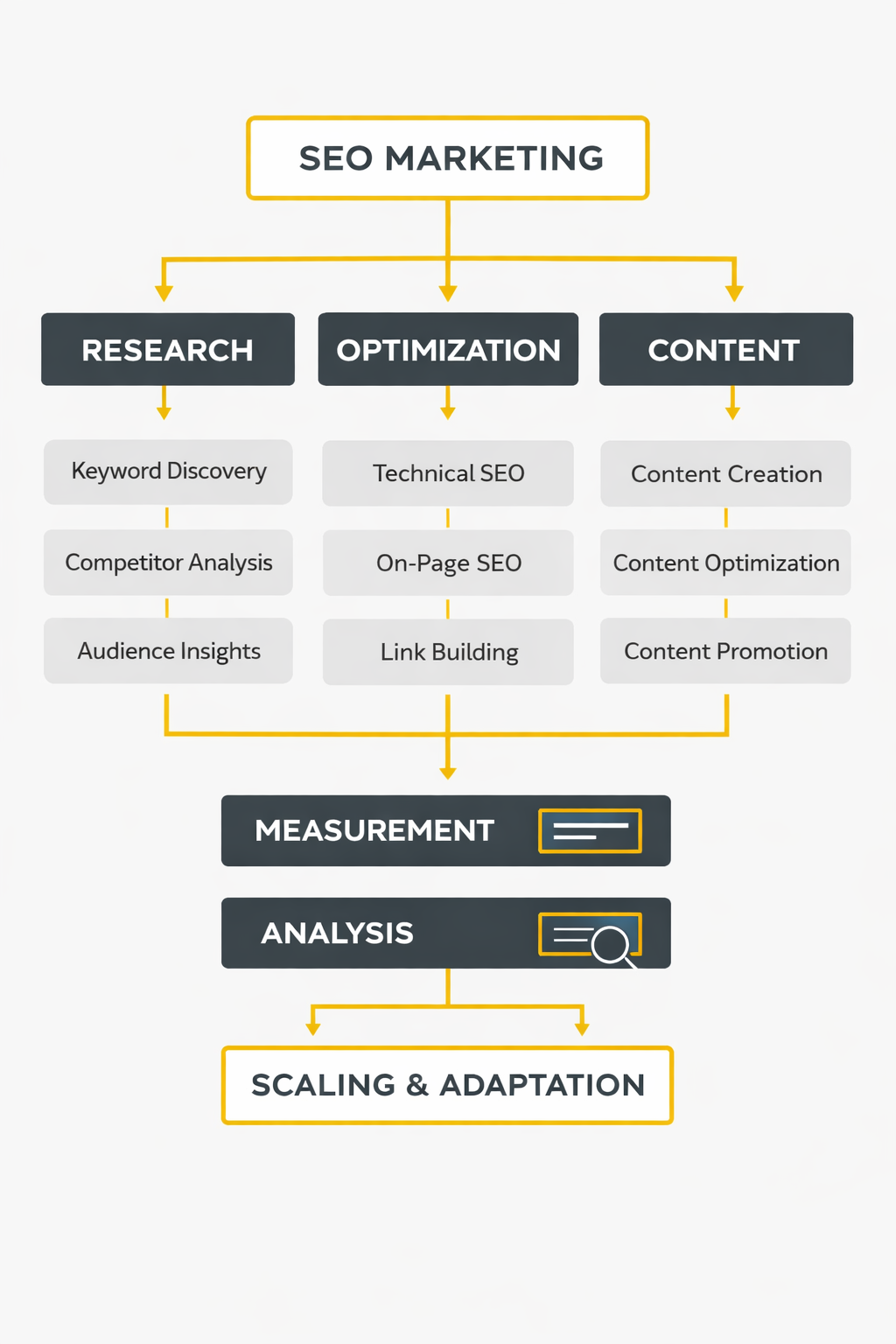
The next part starts with why SEO marketing still matters, because that is where a lot of teams get the strategy wrong. They either treat SEO like a technical checklist or dismiss it because search behavior is changing. Both reactions miss the point, and that is exactly where a smarter framework begins.
Why SEO Marketing Still Matters
A lot of people talk about SEO marketing like it is fading because search is changing. That is the wrong read. Search is not disappearing. It is becoming more compressed, more competitive, and less forgiving for weak content, which is exactly why a serious SEO strategy matters more now, not less. Google still describes SEO as the work of helping search engines understand your content and helping users decide whether your page is the right result, and that basic mission has not changed even as the interface around search keeps evolving (Google SEO Starter Guide, How Google Search Works).
What has changed is the shape of the click path. Large-scale search behavior research found that in 2024 most Google searches ended without a click to the open web, while Bain’s 2025 research found that many users now rely on AI-generated summaries during search and that brands are already feeling the traffic impact (SparkToro zero-click study, Search Engine Land coverage of the same dataset, Bain & Company). That does not make SEO marketing less valuable. It means the old playbook of chasing clicks with thin articles is getting punished, while brands that earn visibility, trust, and strong intent alignment are getting a bigger share of the attention that still moves markets.
SEO Compounds While Paid Traffic Resets
Paid acquisition can work fast, but it resets the moment you stop spending. SEO marketing is different because a page that earns trust, links, relevance, and strong engagement can keep producing qualified visits long after the original work is done. That does not mean SEO is free, because it absolutely is not, but it does mean the economics improve when your best pages keep answering real demand month after month.
This compounding effect is one reason smart teams still invest hard in organic growth even with AI changing the surface layer of search. Search engines continue to crawl, index, and evaluate pages at scale, and Google is explicit that there is no shortcut payment for better rankings, which keeps organic visibility tied to quality, relevance, and implementation discipline rather than pure media spend (How Google Search Works, Google Search Essentials). That matters if you want an asset that can strengthen your pipeline instead of a budget line that vanishes every month.
Search Intent Still Sits Close to Revenue
One of the most practical reasons SEO marketing still matters is simple: search often captures people when they are actively trying to solve something. They are not passively scrolling. They are evaluating options, comparing providers, checking pricing, reading documentation, and looking for proof that your solution is credible enough to trust.
That is why strong SEO work reaches beyond top-of-funnel traffic. The same system can support discovery pages, comparison pages, use case content, product pages, local intent pages, and bottom-of-funnel assets that help turn curiosity into action. When done well, SEO marketing is not just a traffic channel. It becomes a demand capture layer that connects user intent to commercial pages with much less friction.
Visibility Now Matters Even Before the Click
This is where many teams are behind. They still judge SEO marketing only by blue-link clicks, even though search visibility now includes featured formats, branded mentions, rich results, and machine-generated summaries that influence decisions before a user ever lands on a page. Google’s documentation around structured data and rich results makes that point plainly: search appearance changes how content is understood and displayed, which can shape attention before the visit even happens (Structured data markup that Google Search supports, Introduction to structured data markup in Google Search).
That shift forces a broader definition of success. A page may earn fewer raw clicks than it would have a few years ago but still create brand familiarity, qualify buyers, and influence later direct or assisted conversions. In other words, SEO marketing now has to be measured as both a traffic engine and a visibility engine. That distinction is not academic. It changes how you structure pages, how you write answers, and how you prioritize authority signals.
The Modern SEO Marketing Framework
Once you stop treating SEO like a bag of tricks, the structure gets cleaner. Modern SEO marketing works best as a system with four connected layers: technical access, intent-matched content, authority and trust signals, and conversion design. Miss one layer and the rest underperform. Nail all four and the channel becomes much harder for competitors to copy.
This is also where a lot of companies waste time. They over-invest in one layer because it feels familiar. Some teams obsess over content while their indexing is broken. Others clean up technical issues but publish pages nobody actually wants. The real framework is not technical SEO versus content versus CRO. It is the way those elements reinforce each other.
Layer 1: Technical Access
Before a page can rank, it has to be reachable, crawlable, indexable, and understandable. Google’s documentation is blunt on this point: the search process starts with crawling and indexing, and Google does not guarantee that every page will be crawled, indexed, or served just because it exists (How Google Search Works, Page indexing report). That means technical SEO is not a side task for developers to glance at once a year. It is the entry ticket.
In practical terms, this layer covers site architecture, internal linking, canonicals, crawl control, mobile usability, performance, structured data, and clean status codes. None of that is glamorous, but it directly affects whether your best content is even eligible to compete. When SEO marketing looks broken, the first problem is often not the writing. It is that search engines are getting mixed signals about what should be discovered, indexed, and prioritized.
Layer 2: Intent-Matched Content
After technical access comes relevance. This is the part people think they understand, but most content still misses the mark because it targets keywords without matching the real job behind the query. Google’s people-first content guidance keeps circling back to the same standard: create content that helps people rather than content built mainly to manipulate rankings (Creating helpful, reliable, people-first content, Google’s guidance about AI-generated content).
That matters because not every searcher wants the same thing. A query can signal curiosity, evaluation, urgency, local action, or purchase readiness. Strong SEO marketing translates that intent into the right page type, the right depth, the right structure, and the right next step. The keyword is just the entry point. The real win comes from solving the underlying need better than the pages already ranking.
Layer 3: Trust, Authority, and Evidence
Even perfectly targeted content can stall if it does not look trustworthy. Google’s guidance on people-first content and the Search Quality Rater framework both reinforce the importance of trust and strong signals around experience, expertise, and credibility, especially on topics where accuracy matters more (Creating helpful, reliable, people-first content, Search Quality Rater Guidelines overview PDF, 2025 Quality Evaluator Guidelines PDF).
In real SEO marketing, this layer shows up through author clarity, expert input, original evidence, transparent business information, useful references, reviews, third-party mentions, and the overall reputation your site earns across the web. This is also why weak AI-generated filler is such a bad bet. It can imitate surface fluency, but it usually fails at the deeper signals that make a page believable, specific, and worth citing.
Layer 4: Conversion and Journey Design
Traffic without movement is not growth. The final layer of the framework is what happens after visibility: can the page move someone to the next logical step without breaking the experience? That might mean a product trial, a demo request, an email signup, a lead form, or a deeper page in the buying journey.
This layer is where SEO marketing becomes a business function instead of a reporting function. A page should not only rank. It should guide. That is why strong teams pair organic landing pages with clean offers, relevant internal paths, and conversion infrastructure that fits the intent of the visitor. If you need a simple funnel builder or CRM-connected landing flow for that handoff, tools like ClickFunnels, Systeme.io, or Fillout can fit naturally into the implementation side of an SEO program when the goal is turning search demand into measurable action.
The important point is not the tool. It is the connection. SEO marketing works best when ranking, experience, and conversion are designed together instead of handed off between disconnected teams. That is the bridge into the next part, because once the framework is clear, the next step is breaking down the core components that make the system perform.
Core Components of High-Performance SEO Marketing
Once the framework is clear, execution becomes a lot less confusing. SEO marketing is not about doing everything at once. It is about focusing on the components that actually move rankings, visibility, and conversions together. The difference between average and high-performing SEO usually comes down to how well these components are connected, not how many tactics are used.
Search Demand and Topic Mapping
Everything starts with understanding what people are actually searching for and why. Not just keywords, but clusters of related intent that form a complete topic. Google’s own guidance emphasizes that content should satisfy a user’s need, not just match a phrase, which is why topic coverage beats isolated articles every time (Creating helpful, reliable, people-first content).
Strong SEO marketing builds topic maps instead of keyword lists. That means identifying:
- Core commercial queries
- Supporting informational searches
- Comparison and alternative queries
- Long-tail variations tied to real problems
This is how you move from random content to structured authority. When multiple pages reinforce each other, internal links make sense, and search engines understand your site as a source on a subject, not just a collection of posts.
Content That Earns Attention and Retention
Publishing is easy. Holding attention is not. Search engines measure engagement signals indirectly through user behavior, and content that fails to deliver clarity, depth, or usefulness tends to fade over time.
High-performing SEO marketing content typically does a few things consistently:
- Answers the primary question fast, without fluff
- Expands into deeper context for users who want more
- Uses structure that makes scanning easy
- Connects naturally to the next step in the journey
This is also where most AI-generated content fails. It often sounds correct but lacks specificity, original framing, or real insight. Google has made it clear that automation is not the issue, but low-value content is, regardless of how it is produced (Google Search and AI content).
Internal Linking as a Growth Lever
Internal linking is one of the most underused levers in SEO marketing, even though it directly affects crawlability, context, and authority flow. Google explicitly states that links help it discover new pages and understand relationships between them (How Google Search Works).
A strong internal linking system does more than connect pages randomly. It:
- Reinforces topic clusters
- Pushes authority toward priority pages
- Guides users deeper into relevant content
- Reduces reliance on external backlinks alone
This is where strategy beats volume. A smaller site with clean structure often outperforms a larger one with scattered linking.
Authority Signals and External Validation
Backlinks are still part of SEO marketing, but the conversation has matured. It is not about volume anymore. It is about relevance, credibility, and context.
Search engines evaluate signals beyond links, including mentions, brand presence, and overall reputation. The Quality Rater Guidelines emphasize trust and credibility, especially for topics that influence decisions (Search Quality Evaluator Guidelines).
In practice, that means:
- Earning links from relevant, real websites
- Building brand searches over time
- Getting mentioned in credible publications
- Creating content worth referencing
This is slower than shortcut link building, but it aligns with how search engines are evolving.
How Professionals Implement SEO Marketing
This is where everything becomes real. Strategy without execution is just theory. Professional SEO marketing follows a process that turns the framework into repeatable outcomes. It is not chaotic. It is structured, measured, and continuously improved.
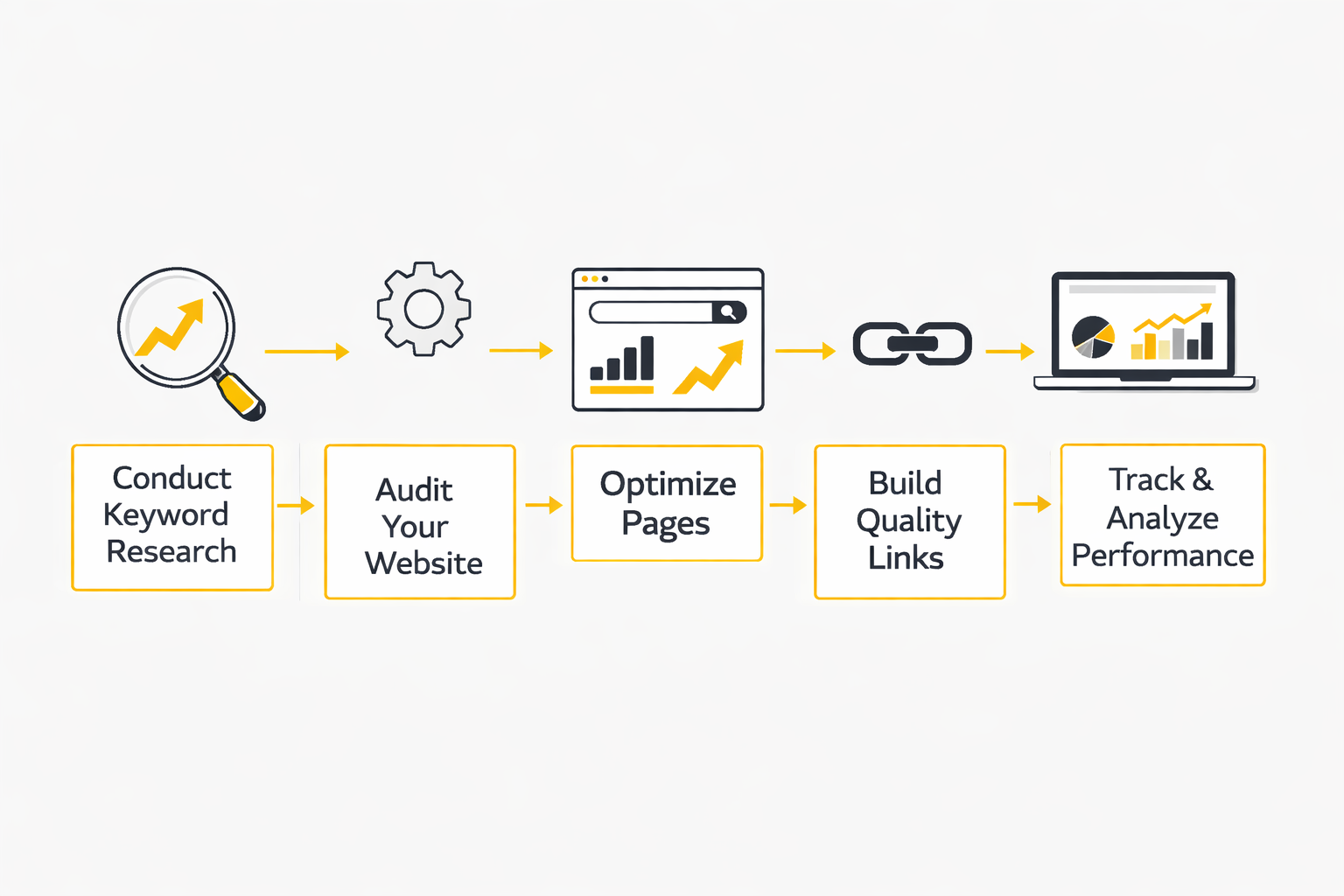
Step 1: Technical Audit and Cleanup
Before creating anything new, professionals fix what is already broken. That includes indexing issues, duplicate content, poor site structure, and performance problems. Google’s indexing systems do not guarantee that every page will be included, which makes cleanup a priority before scaling content (Page indexing report).
This step is not exciting, but skipping it creates long-term drag. If search engines struggle to crawl or understand your site, every future effort becomes less effective.
Step 2: Build a Search Intent Map
Instead of jumping into writing, professionals map intent first. This means grouping keywords into clusters based on what users actually want to accomplish.
A practical structure often looks like this:
- Core landing pages (commercial intent)
- Supporting content (education and awareness)
- Comparison pages (decision stage)
- Conversion pages (action stage)
This mapping ensures that every piece of content has a purpose within the broader SEO marketing system.
Step 3: Create and Publish High-Leverage Content
Once the structure is clear, content creation becomes targeted. Instead of producing random blog posts, professionals focus on pages that can:
- Capture meaningful demand
- Support other pages through internal links
- Drive users toward action
This is where tools can speed up execution. For example, platforms like Systeme.io or ClickFunnels can help connect SEO landing pages directly to conversion flows without needing a complex stack. The goal is not just publishing content, but building pathways from search to outcome.
Step 4: Strengthen Internal and External Signals
After publishing, the work shifts to amplification. This includes:
- Adding internal links from existing pages
- Updating older content to support new pages
- Promoting content through distribution channels
- Earning relevant backlinks over time
SEO marketing does not end at publication. In many cases, that is where the real growth phase begins.
Step 5: Iterate Based on Real Data
Professional SEO is not static. Pages are updated, expanded, restructured, and optimized based on performance data. Google itself emphasizes that content should be maintained and improved over time to stay useful (Creating helpful, reliable, people-first content).
Iteration typically focuses on:
- Improving rankings for near-page-one keywords
- Increasing click-through rates with better titles
- Expanding content to match deeper intent
- Strengthening conversion paths
This is where patience pays off. SEO marketing rarely delivers instant results, but when the system is working, improvements compound.
At this point, the structure, components, and execution process are clear. The next step is understanding how to measure whether SEO marketing is actually working, not just in terms of traffic, but in terms of real business impact.
SEO Marketing Performance: What the Data Actually Tells You
Most people track SEO marketing the wrong way. They look at traffic, rankings, and maybe impressions, then try to draw conclusions from surface-level changes. That is how you end up celebrating growth that does not convert or panicking over drops that do not actually affect revenue.
The goal here is not to collect more metrics. It is to understand which signals actually reflect progress, which ones are just noise, and how to turn data into decisions that improve results over time.
The Metrics That Actually Matter
There is no shortage of SEO data available. Google Search Console, analytics tools, rank trackers, and third-party platforms all give you numbers. The problem is that not all numbers carry the same weight.
The core signals that matter in SEO marketing fall into four categories:
- Visibility (impressions, keyword coverage, SERP features)
- Traffic quality (clicks, engagement, depth of visit)
- Conversion behavior (leads, signups, purchases)
- Authority growth (links, mentions, brand searches)
Each category tells a different part of the story. If you only track one, you get a distorted view.
For example, a page gaining impressions but losing clicks may not be failing. It may be appearing for broader queries or showing up in AI-driven summaries where visibility matters even without a click. That aligns with recent search behavior data showing a large share of searches end without a traditional click while still influencing decisions (SparkToro zero-click study, Bain & Company).
Understanding Click-Through Rate in Context
Click-through rate (CTR) is one of the most misunderstood metrics in SEO marketing. A low CTR is not automatically a problem. It depends on where the page ranks, what the query looks like, and what else appears on the results page.
Google’s own documentation explains that search results can include rich features, structured results, and other elements that affect how users interact with listings (Google Search appearance and rich results). That means a page ranking in position three today is not competing with just two other links. It may be competing with featured snippets, AI summaries, videos, and product listings.
What actually matters is trend direction and intent alignment. If CTR improves after updating titles and descriptions, that is a clear signal. If it drops while impressions increase, it may simply mean you are expanding into broader queries.
From Rankings to Revenue Signals
Rankings still matter, but they are not the end goal. A page moving from position eight to position three can dramatically increase traffic, but only if it targets the right intent.
This is why serious SEO marketing connects rankings to outcomes:
- Are higher rankings bringing in qualified users?
- Are those users taking meaningful actions?
- Are those actions contributing to revenue?
If the answer is no, the issue is not rankings. It is targeting or page design.
This is also where conversion tracking becomes critical. Whether you use tools like Brevo, Moosend, or your own analytics stack, you need to track what happens after the click. Otherwise, you are optimizing for visibility without understanding business impact.
Building a Simple SEO Measurement System
A good SEO marketing system does not need to be complex. It needs to be consistent and connected. At a minimum, your measurement setup should combine:
- Google Search Console for visibility and query data
- Analytics platform for behavior and conversions
- A simple reporting layer that connects pages to outcomes
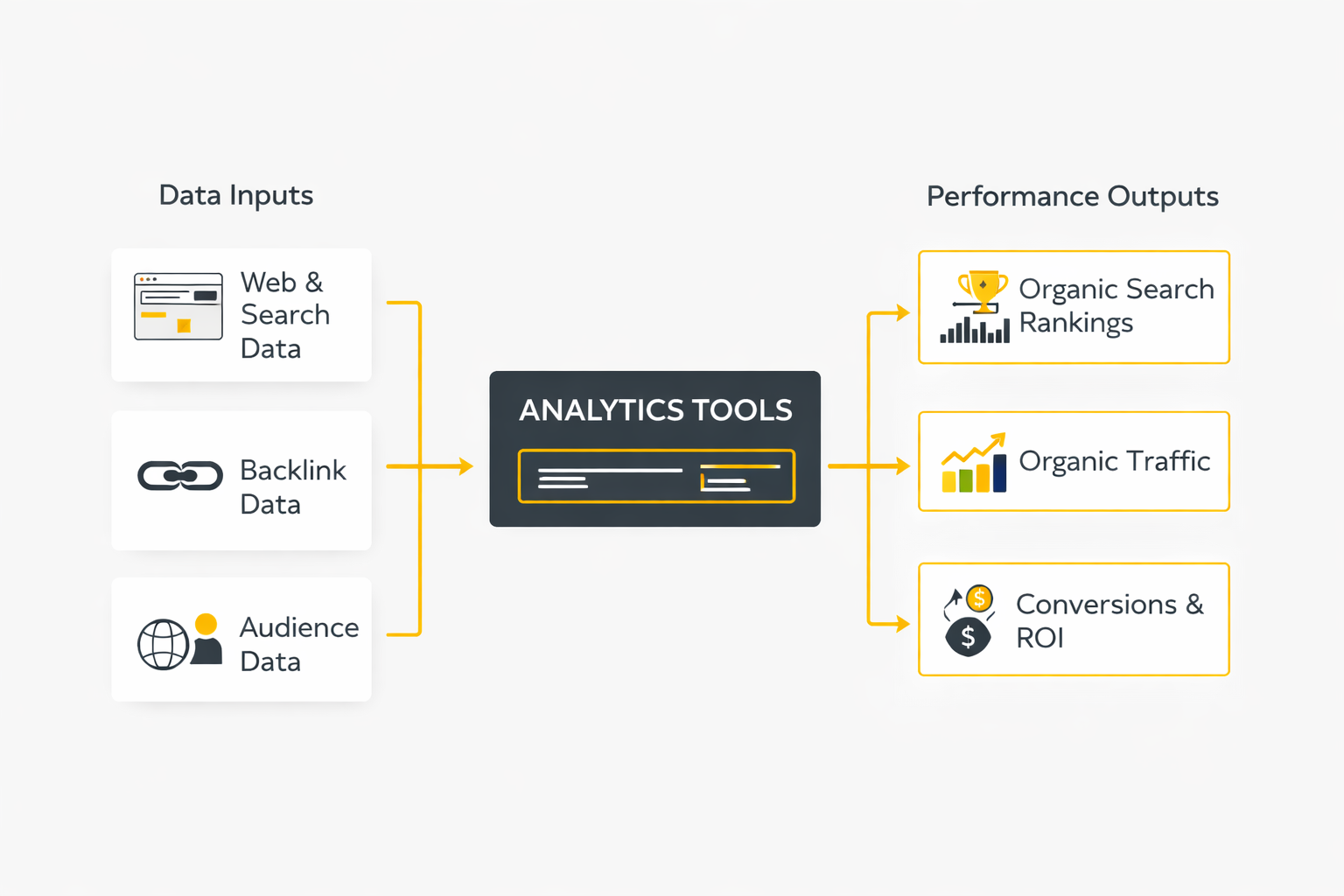
The key is not the tools themselves. It is how you interpret the data together.
A practical way to structure this is:
- Page-level tracking Every important page should have a clear purpose. Track impressions, clicks, and conversions at the page level instead of just site-wide totals.
- Query-level insights Look at which queries are driving impressions and clicks. This helps identify missed intent, content gaps, and opportunities to expand.
- Conversion mapping Tie specific pages to specific actions. A comparison page should lead to a different outcome than an informational guide.
- Trend analysis over time SEO marketing is not about daily fluctuations. It is about direction. Look at 30, 60, and 90-day trends to understand real movement.
Benchmarks That Actually Make Sense
Benchmarks are useful, but only when they are contextual. Generic “good CTR” or “ideal conversion rate” numbers are misleading because performance varies by industry, query type, and competition level.
What matters more is relative improvement:
- Are your pages gaining visibility for the right queries?
- Is traffic becoming more qualified over time?
- Are conversion rates improving as pages are optimized?
- Is your brand being searched more often?
These signals show whether your SEO marketing system is strengthening.
One consistent trend across multiple studies is that search still drives a meaningful share of website traffic compared to other channels, even as the nature of clicks changes (SparkToro and Datos). That reinforces the point: SEO is still a major acquisition channel, but it needs to be evaluated with a broader lens than just raw clicks.
Turning Data Into Action
Data without action is just reporting. The real value of SEO marketing analytics comes from what you change based on what you see.
Here is how strong teams typically respond to data:
- High impressions, low clicks -> Improve titles, meta descriptions, and positioning
- Good rankings, low conversions -> Fix page structure, messaging, or offer
- Low visibility, strong conversion rates -> Expand content and internal links
- Traffic growth without revenue growth -> Re-evaluate intent targeting
Each of these actions ties directly back to the framework from earlier. Technical issues affect visibility. Content affects relevance. Authority affects trust. Conversion design affects outcomes.
At this point, you have the full picture: why SEO marketing matters, how the framework works, how to execute it, and how to measure it. The final step is understanding what usually goes wrong and how the landscape is continuing to shift so you can stay ahead instead of constantly reacting.
Common SEO Marketing Mistakes and What Comes Next
This is the point where a lot of SEO marketing programs either mature or stall out. The basics may be in place. Pages are being published. Rankings are moving. But scaling introduces tradeoffs, and the wrong tradeoff can quietly flatten growth for months before anyone notices.
The biggest mistake is assuming more activity automatically means more progress. More pages, more briefs, more tools, more dashboards, more AI content, more outreach. None of that matters if the system starts drifting away from user value, commercial relevance, or operational discipline. SEO marketing gets stronger when the strategy gets sharper, not when the workflow gets noisier.
The Scaling Trap: Volume Without Advantage
This is the most common wall. A team finds a process that works, then tries to multiply it fast. Suddenly the site has dozens or hundreds of new pages, but they are thinner, more repetitive, and harder to differentiate.
Google’s spam policies now explicitly target scaled content abuse when pages are produced mainly to manipulate rankings rather than help users, regardless of whether the content is created by people, automation, or both (Google spam policies). That is a big deal because it forces a shift from “how much can we publish?” to “what is our actual advantage on this topic?” If your only edge is speed, you do not really have one.
The better move is to scale selectively. Expand where you have product knowledge, proof, distribution, expert insight, proprietary data, or a stronger way to solve the searcher’s problem. That kind of scaling is slower, but it holds up under scrutiny and tends to survive algorithm changes better.
Chasing Rankings Instead of Building Defensibility
A page can rank and still be strategically weak. Maybe it is too easy to copy. Maybe it depends on one fragile keyword. Maybe it attracts the wrong audience. Maybe it has no link to revenue. This is where a lot of SEO marketing effort looks successful in reports while contributing very little to the business.
Defensible SEO comes from assets that competitors cannot easily clone. That might be original research, proprietary workflows, product-backed use cases, strong brand demand, or a site architecture that supports entire topic clusters instead of isolated wins. Google’s core update guidance keeps pushing site owners back toward the same question: is the content genuinely satisfying and helpful compared with the other results available (Google core updates guidance)? That question matters because tactical ranking wins are temporary when there is no deeper moat behind them.
The AI Content Tradeoff Nobody Should Ignore
AI can absolutely help SEO marketing. It can speed up research, improve briefs, help with outline development, support pattern analysis, and reduce production bottlenecks. Used well, it increases leverage. Used lazily, it floods your site with polished sameness.
The risk is not just low engagement. It is strategic dilution. Once your site starts publishing interchangeable content at scale, it becomes harder to send strong trust signals, harder to stand out, and easier to fall into the patterns Google is actively trying to detect and suppress through both spam policy enforcement and broader ranking system improvements (Google spam policies, Google Search and AI content).
So the right question is not whether to use AI. It is where human judgment creates irreplaceable value. In strong SEO marketing teams, AI handles acceleration while humans handle truth, specificity, positioning, evidence, and final quality. That division matters more than ever.
When Technical SEO Becomes a Business Decision
At smaller scale, technical SEO often looks like maintenance. At larger scale, it becomes a resource allocation decision. Faceted navigation, international versions, parameter handling, index bloat, duplicate templates, JavaScript rendering, and internal linking logic all start affecting crawl efficiency and ranking stability in much bigger ways.
That is why expert SEO marketing is rarely just a marketing function. It often requires coordination with product, engineering, analytics, and content operations. The tradeoff is real: every technical improvement competes with other business priorities. But when technical debt blocks discovery or wastes crawl activity on low-value URLs, growth slows in ways content alone cannot fix.
The practical lesson is simple. Do not wait for a crisis. If your site is growing fast, technical governance needs to grow with it. Otherwise the architecture becomes the bottleneck.
Search Is Becoming Broader Than Traditional SEO
This is one of the most important shifts in the whole article. Search behavior is no longer confined to classic search engine results pages. SparkToro’s 2026 analysis argues for thinking of SEO as “search everywhere optimization,” which is directionally useful because people now discover brands across traditional search, social search, AI tools, forums, video platforms, marketplaces, and recommendation systems (SparkToro search everywhere analysis).
That does not mean classic SEO marketing stops mattering. It means the strategy gets wider. Your content has to be understandable, quotable, reference-worthy, and discoverable across multiple surfaces. Bain’s research on AI summaries and zero-click behavior points the same way: influence increasingly happens before the website visit, not only after it (Bain AI search research, Bain on AI agents).
For an expert operator, that changes the brief. You are not just trying to rank pages. You are trying to build a brand and content system that keeps showing up wherever decisions are being shaped.
The Best Strategic Tradeoff: Fewer Pages, Stronger Assets
When teams get serious, they often discover they need fewer new pages than they thought. What they really need is better coverage, tighter architecture, stronger offers, clearer intent mapping, and more disciplined updates to existing winners.
That can feel counterintuitive because publishing more always looks productive. But in SEO marketing, productivity and effectiveness are not the same thing. One improved page with stronger evidence, better conversion design, sharper internal linking, and clearer positioning can outperform ten average pages that add little to the site’s authority.
This is where operational tools can help, but only if they support strategy instead of replacing it. A cleaner funnel handoff through ClickFunnels, Systeme.io, or attribution-friendly link tracking through Dub can strengthen the path from search visibility to measurable action. But none of those tools can rescue weak positioning or thin content. They work best when the underlying strategy is already sound.
What Smart Teams Do Next
The next level of SEO marketing is not mysterious. Smart teams tighten quality standards, reduce duplication, improve page purpose, and treat search visibility as one piece of a broader demand system. They align content with product reality, connect organic traffic to CRM or revenue data, and build assets that deserve attention even if search interfaces keep changing.
That is the real close of the argument. SEO marketing still works, but the lazy version is breaking. The version that wins now is more selective, more evidence-driven, more cross-functional, and much more focused on trust.
The final part will bring everything together with practical closing guidance and the FAQ, including the questions that usually come up when a team is deciding how to prioritize SEO marketing in the real world.
Where SEO Marketing Is Headed Next
By now, the pattern should be clear. SEO marketing is not disappearing. It is expanding. The core mechanics still matter, but the surface layer is shifting toward AI-assisted discovery, multi-platform search behavior, and stronger emphasis on trust signals.
The teams that win are not the ones trying to outsmart algorithms. They are the ones building systems that stay useful regardless of how search interfaces evolve. That means content that can be cited, summarized, reused, and trusted across different environments, not just ranked on a single results page.
This is also why the future of SEO marketing looks a lot like ecosystem building. You are not just publishing pages. You are creating interconnected assets that reinforce each other across:
- Search engines
- AI-generated summaries
- Social discovery platforms
- Email and owned audiences
- Conversion funnels and CRM systems
When those pieces align, your visibility becomes harder to replace. When they do not, you stay dependent on rankings that can shift overnight.
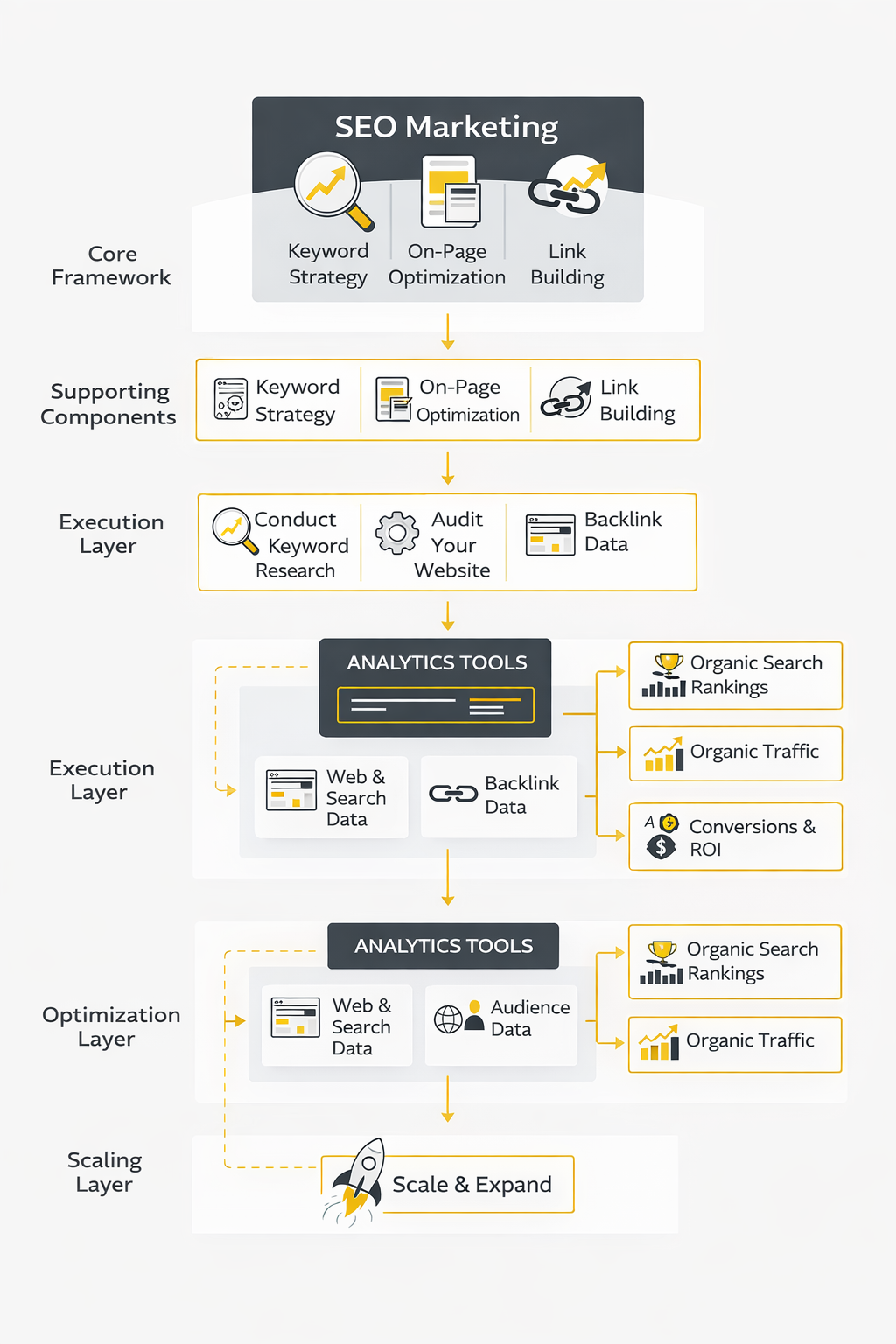
FAQ - Built for Complete Guide
What is SEO marketing in simple terms?
SEO marketing is the process of making your content and website discoverable in search results so that the right people find you at the right moment. It combines technical setup, content strategy, authority building, and conversion design into one system. The goal is not just traffic, but qualified traffic that leads to action.
How long does SEO marketing take to work?
SEO marketing is not instant, and that is part of its strength. Most sites start seeing measurable movement within 3 to 6 months, but meaningful compounding often takes longer. The timeline depends on competition, domain authority, and how well the strategy aligns with real search intent.
Is SEO marketing still worth it in the age of AI?
Yes, but the approach has changed. Research on search behavior shows more users rely on AI summaries and fewer clicks go directly to websites, which means visibility matters even before the visit (Bain & Company, SparkToro zero-click study). Strong SEO marketing adapts by focusing on authority, clarity, and content that gets referenced across platforms.
What is the difference between SEO and content marketing?
SEO marketing focuses on discoverability through search, while content marketing is broader and includes any content used to attract and engage an audience. In practice, strong SEO marketing relies heavily on content, but not all content marketing is optimized for search intent or ranking.
How do I know if my SEO marketing is working?
You should look beyond traffic and track:
- Growth in impressions and keyword coverage
- Improvement in click-through rates
- Increase in qualified traffic
- Conversions tied to organic pages
If visibility increases but conversions do not, the issue is usually intent alignment or page design, not SEO itself.
Do backlinks still matter?
Yes, but not in the old way. It is no longer about volume. Relevance, credibility, and context matter more. A few strong links from trusted sources often outperform large numbers of low-quality links, especially as search engines evaluate broader trust signals.
Can I do SEO marketing without technical knowledge?
You can start without deep technical expertise, but you cannot ignore it long term. Technical SEO affects how search engines access and understand your content. Even basic issues like indexing errors or poor site structure can limit results regardless of how good your content is.
How many articles should I publish per month?
There is no universal number. Publishing more only works if quality and intent alignment stay high. In many cases, improving existing pages and expanding strong topics delivers better results than constantly creating new content.
What tools are essential for SEO marketing?
At a minimum, you need:
- Google Search Console for visibility data
- Analytics platform for user behavior and conversions
- A content and workflow system to manage production
Additional tools can help with automation, email capture, and funnel building. For example, platforms like Brevo or Moosend can support follow-up once traffic converts into leads.
Is local SEO different from general SEO marketing?
Local SEO is a subset of SEO marketing focused on geographic intent. It includes optimizing for map results, local queries, and business listings. The principles are similar, but proximity and local relevance play a much larger role.
What is the biggest mistake beginners make?
The biggest mistake is chasing shortcuts. Whether it is mass-producing low-quality content, buying weak backlinks, or copying competitors without understanding intent, these approaches usually fail over time. SEO marketing rewards consistency, clarity, and real value.
How do I connect SEO traffic to revenue?
You need a clear path from page to action. That means aligning content with offers, using conversion-focused landing pages, and tracking outcomes. Tools like ClickFunnels or Systeme.io can help bridge the gap between organic traffic and actual business results when used correctly.
Work With Professionals
Explore 10K+ Remote Marketing Contracts on MarkeWork.com
Most marketers spend too much time chasing clients, competing on crowded platforms, and losing a percentage of every project to middlemen.
MarkeWork gives you a better way. Browse thousands of remote marketing contracts and connect directly with companies desperate to hire skilled marketers like you, without platform commissions and without unnecessary gatekeepers.
If you're serious about finding better opportunities and keeping 100% of what you earn, explore available contracts and create a profile for free at MarkeWork.com.