

SEO marketing used to be easier to describe. You published a page, added the target phrase in the obvious places, built a few links, and hoped rankings would follow. That version of the story is outdated now, because modern search is shaped by helpful-content systems, richer search results, AI-driven discovery, and a much higher bar for trust and usefulness.
The practical definition is simpler than most people make it sound. SEO marketing is the process of creating, structuring, and improving your website so the right people can find your business through search, trust what they see, and take action when they arrive. Google’s own SEO Starter Guide and Search Essentials make the same point in plain language: create content people actually need, use the words they use, and make the site easy for search engines to crawl and understand. Google for Developers+1
That human-first angle matters even more now. Google’s guidance on helpful, reliable, people-first content is explicit that ranking systems are designed to reward content created to benefit people, not pages built mainly to manipulate rankings. Even with AI changing how results are presented, Google says in its documentation on AI features and your website that the same foundational SEO best practices still apply. Google for Developers+1
The pressure is real, though. SparkToro’s 2024 zero-click search study found that 59.7% of Google searches in the EU ended without a click, which means visibility alone is no longer enough. At the same time, BrightEdge reported in September 2025 that AI search referrals were still under 1% of traffic while organic search remained the primary driver and converted more strongly, so writing SEO off would be a serious mistake. sparktoro.com+1

Article Outline
- What SEO Marketing Means Now
- Why SEO Marketing Still Matters
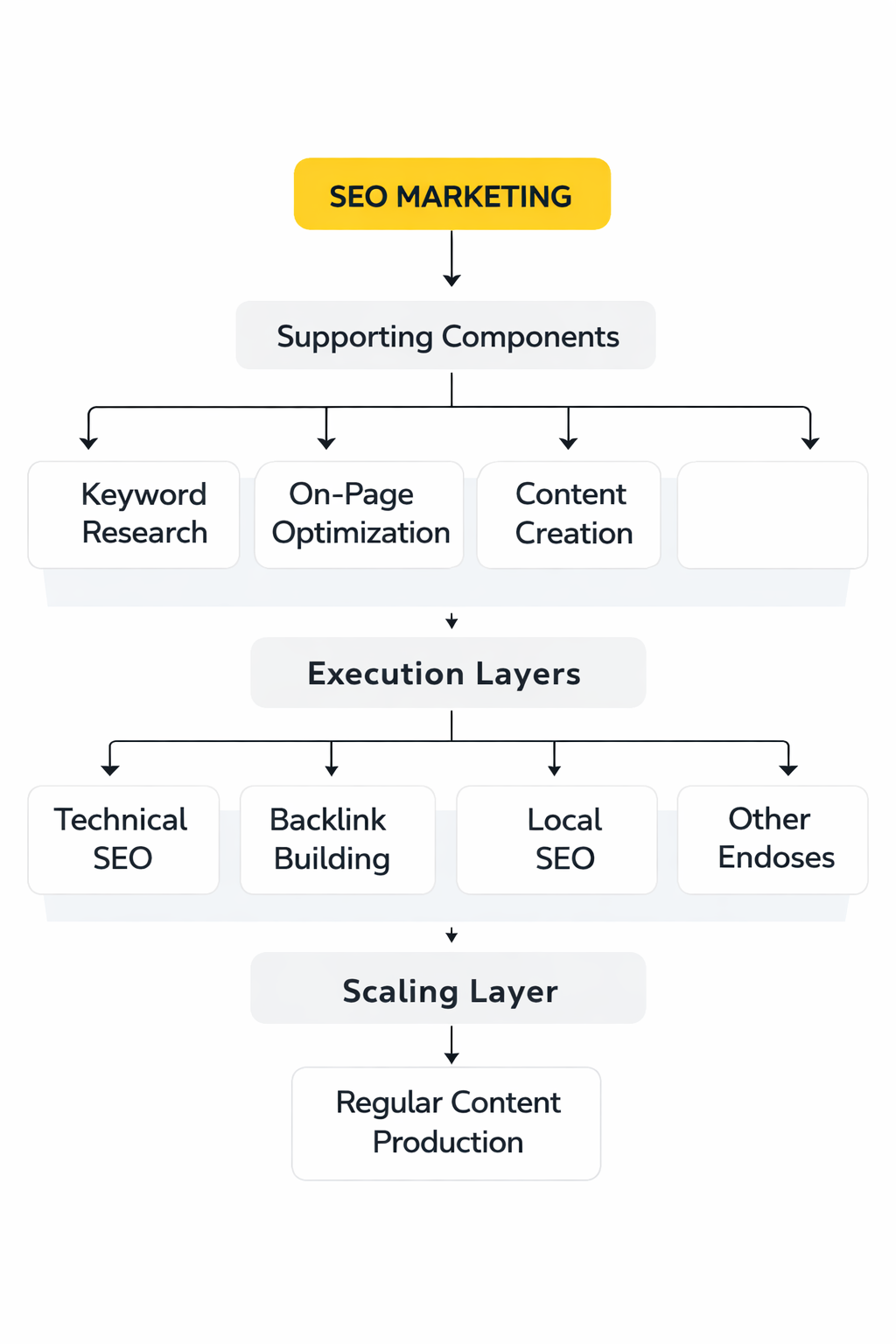
- The Modern SEO Marketing Framework
- Core Components That Drive Results
- Professional SEO Marketing Implementation
- Measuring Performance and Building Long-Term Growth
What SEO Marketing Means Now
At its best, SEO marketing sits at the intersection of audience research, content strategy, technical site health, and conversion thinking. It is not a blogging trick, and it is definitely not a one-time checklist. It is an ongoing marketing discipline that helps search engines discover your pages, understand their purpose, and connect them with people who are already looking for what you offer.
That is why the technical layer and the messaging layer have to work together. Google explains that Search works through crawling, indexing, and serving results, so your site has to be accessible and understandable before your content can compete. Once that foundation is in place, the real differentiator becomes the quality of the page itself: clarity, originality, relevance, and whether the page genuinely solves the visitor’s problem better than the alternatives. Google for Developers+2
There is also a measurement side that serious teams cannot ignore. Google’s Search Console and its Performance report exist for a reason: SEO marketing is not just about publishing more content, but about learning which queries create impressions, which pages earn clicks, and where visibility breaks down. In other words, good SEO marketing connects discoverability with business outcomes, not vanity rankings. search.google.com+2
In the next part, we’ll look at why SEO marketing still matters so much, even in a search environment shaped by AI answers, zero-click behavior, and rising competition for attention.
Why SEO Marketing Still Matters
A lot of people talk about search like it is fading away. That makes for dramatic posts, but it does not match the reality most businesses live in. Search behavior is changing, yes, yet the core opportunity behind SEO marketing is still very much alive: people go to search when they have intent, and intent is where serious buying journeys usually begin.
What has changed is the shape of the click. Google’s own guidance around AI features and websites makes it clear that search is evolving, not disappearing, and that strong pages can still surface across these experiences. At the same time, BrightEdge reported in 2025 that AI search referrals were still less than 1% of referral traffic while organic search remained the primary driver and delivered most conversions, which is exactly why smart companies are not abandoning SEO marketing. They are tightening it up.
That shift matters because weak content gets exposed faster now. If your page is generic, thin, or built around the phrase instead of the problem, you are competing in the noisiest possible environment with the weakest possible advantage. Strong SEO marketing still works because it aligns with what search engines keep rewarding: usefulness, clarity, trust, and a genuinely better answer.
Search Still Captures High-Intent Demand
The biggest reason SEO marketing matters is simple. Search traffic is not just traffic; it is often problem-aware traffic, comparison traffic, and decision-stage traffic. Someone searching for a solution, a provider, a tool, a framework, or a pricing question is usually much closer to action than someone casually scrolling a feed.
That is also why organic traffic tends to be so valuable over time. Google Search Console is built around the idea that you should track the exact queries, clicks, impressions, and positions that connect users to your pages, because those signals tell you where demand already exists. Good SEO marketing does not manufacture interest from thin air. It captures existing intent and channels it toward the right page.
This is where many businesses get lazy. They publish top-of-funnel articles, ignore commercial intent, and then wonder why rankings do not turn into revenue. The better move is to build pages around the moments when a searcher is trying to choose, validate, or move forward.
Visibility Alone Is Not Enough Anymore
There is a harsher reality now, and pretending otherwise helps no one. SparkToro’s 2024 zero-click search study found that in the EU, only 374 clicks out of every 1,000 Google searches went to the open web. That means SEO marketing cannot be treated as a pure rankings game anymore, because impressions without action are not a growth strategy.
This forces a more mature approach. Your title has to earn attention, your page has to deserve the click, and your brand has to create enough trust that the user prefers your result over everything else Google puts on the screen. In practice, that means SEO marketing now overlaps with positioning, editorial judgment, conversion design, and authority building far more than it did a few years ago.
This is not bad news. It is just more demanding news. When the easy clicks disappear, the businesses with real expertise, sharper pages, and clearer offers usually gain ground.
SEO Marketing Compounds in a Way Paid Channels Rarely Do
Paid acquisition can be useful, but it resets the meter every time you stop spending. SEO marketing works differently. A strong page can keep earning impressions, clicks, links, mentions, and conversions long after the original publishing date, especially when it is refreshed and improved instead of left to decay.
Google’s helpful content guidance reinforces this long-game logic. Pages that are created for people, maintained well, and built with genuine expertise are far more likely to hold value than pages churned out for search engines first. That is why SEO marketing is one of the few channels where one smart asset can keep paying you back.
The compounding effect becomes even stronger when content and infrastructure work together. A useful article supports a category page, a category page supports a product or service page, and internal links help authority move through the site in a deliberate way. Over time, that creates an asset base, not just a campaign.
The Modern SEO Marketing Framework
Once you accept that SEO marketing is not a trick but a system, the next question becomes obvious: what does that system actually look like? The cleanest way to think about it is as a framework with four connected layers. Miss one of them, and the rest underperform.
The first layer is demand understanding. You need to know what your audience is searching for, how they phrase those problems, and where intent changes from curiosity to action. The second layer is content architecture, where you decide which pages should exist, what each page is meant to do, and how the whole site supports the journey instead of scattering attention.
The third layer is technical and structural clarity. Google still has to crawl, render, and understand your pages, so speed, indexability, internal linking, canonical logic, mobile usability, and structured data still matter. The fourth layer is performance refinement, where you use real search data to improve titles, fix weak pages, expand winners, and cut what is not helping.
Start With Search Intent, Not Just Keywords
This is the step people rush, and it is the step that usually determines whether everything else works. A keyword on its own is just a label. Real SEO marketing starts when you understand the searcher behind the term: what they want, what they already know, what they fear, and what would make them trust one result over another.
That is why two pages targeting similar phrases can require completely different treatments. One query may need a practical guide, while another needs a product comparison, a pricing page, or a service page with proof and specifics. Google’s Search Essentials repeatedly points site owners back to the same principle: use the words people actually use, and build pages that genuinely help them complete the task.
This sounds basic, but it is where bad SEO marketing starts to collapse. If the intent is commercial and you give the user a fluffy educational article, you miss the moment. If the intent is informational and you push too hard for the sale, you lose trust before the relationship even starts.
Build a Content Structure That Supports Decisions
The strongest SEO marketing strategies are built like systems, not like random publishing calendars. You need a set of pages that cover the topic with purpose: foundational pages for core concepts, supporting pages for subtopics, and bottom-funnel pages for action-oriented intent. That structure helps both users and search engines understand where authority lives and how topics connect.
This is also where internal linking stops being a technical afterthought and becomes a strategic lever. When your articles, service pages, category pages, and comparison pages support each other naturally, the site becomes easier to navigate and easier to interpret. Google’s SEO Starter Guide still treats crawlable links and clear site organization as fundamentals, and for good reason.
A practical business should think in journeys, not isolated posts. Someone may discover you through an educational page, validate you through a comparison page, and convert on a service or product page. Good SEO marketing makes that path feel obvious.
Treat Technical SEO as an Enabler, Not the Whole Game
Technical SEO matters, but the wrong people make it sound like the entire job. It is not. Technical work is what removes friction so your content can compete on merit, which is important, but it does not replace strategy, expertise, or useful pages.
Still, this layer deserves respect. Google’s explanation of how Search works is a reminder that if pages cannot be discovered properly, rendered properly, or interpreted properly, the rest of your effort struggles before it even starts. Indexing issues, duplicate pages, weak internal links, broken canonicals, and messy migrations can quietly destroy otherwise strong SEO marketing.
The smart way to look at technical SEO is this: it is infrastructure. Nobody buys the house because of the wiring alone, but bad wiring can burn the whole thing down. Get the fundamentals right, then let content and positioning do the heavy lifting.
Use Performance Data to Tighten the System
The framework only works if you keep feeding it with real evidence. Search Console exists because assumptions are cheap and performance data is not. When you study clicks, impressions, and average position, you start seeing where a page is close, where it is underperforming, and where there is hidden demand you have not served well enough yet.
This is where SEO marketing becomes much more practical than people expect. Sometimes you do not need a new article at all. Sometimes you need a clearer title, a stronger introduction, a better internal link path, a section that answers the actual question faster, or a service page that finally addresses pricing, process, proof, and objections in one place.
That refinement mindset is what separates professional operators from content factories. They do not just publish and hope. They publish, measure, improve, and stack small wins until the whole system gets stronger.
Core Components That Drive Results
Once the framework is clear, the next step is understanding what actually moves the needle. SEO marketing is not driven by a single tactic. It is the interaction between several core components that reinforce each other over time.
If one of these is missing, results slow down or stall completely. If all of them work together, growth starts to feel predictable instead of random.
Content That Solves Real Problems
Content is still the center of SEO marketing, but not in the way most people approach it. Publishing more articles does not create an advantage anymore. Publishing decisively better answers does.
Google’s own documentation around creating helpful, reliable content emphasizes depth, originality, and usefulness. That translates directly into how you build pages:
- Answer the actual question early, not halfway down the page
- Add context, not fluff
- Include specifics, not vague statements
- Show expertise through clarity, not volume
This is where most sites underperform. They chase keywords instead of building assets. Strong SEO marketing flips that. Each page should exist because it solves something better than what is already ranking.
Authority Signals and Trust
Even the best content struggles if it sits on a site that search engines do not trust. Authority is built through signals that confirm your site is credible, relevant, and worth surfacing.
Google’s systems evaluate a mix of factors tied to expertise and trust, often discussed in the context of E-E-A-T. In practice, that shows up through:
- Mentions and links from relevant websites
- Clear authorship and real-world expertise
- Consistent topical focus across your site
- Brand searches and recognition over time
This is not about gaming links. It is about building something that earns references naturally. In SEO marketing, authority compounds just like content does.
On-Page Structure and Clarity
Search engines are extremely good at parsing pages, but they still rely on structure to understand what matters most. Titles, headings, internal links, and page hierarchy are not cosmetic details. They shape how your content is interpreted.
Google’s SEO Starter Guide still highlights basics like descriptive titles, logical heading structure, and meaningful anchor text because they directly influence understanding. When your structure is clean:
- Users scan faster and stay longer
- Search engines extract meaning more accurately
- Key sections are more likely to surface in rich results
SEO marketing works best when clarity is intentional, not accidental.
Technical Stability and Performance
Technical SEO rarely creates growth on its own, but it can quietly block it. Issues with crawling, indexing, page speed, or mobile usability reduce your chances before your content even gets evaluated.
Google’s explanation of page experience signals shows how factors like load speed and usability influence visibility. In practical terms, this means:
- Pages must load quickly enough to keep users engaged
- Mobile experience cannot be compromised
- Important pages must be indexable and accessible
- Duplicate or conflicting signals must be resolved
Treat this as maintenance, not strategy. But do not ignore it. Good SEO marketing assumes the foundation works.
Professional SEO Marketing Implementation
Understanding components is one thing. Executing them consistently is where most teams break down. This is the part where SEO marketing becomes operational, not theoretical.
The difference between average and high-performing teams is not knowledge. It is process.
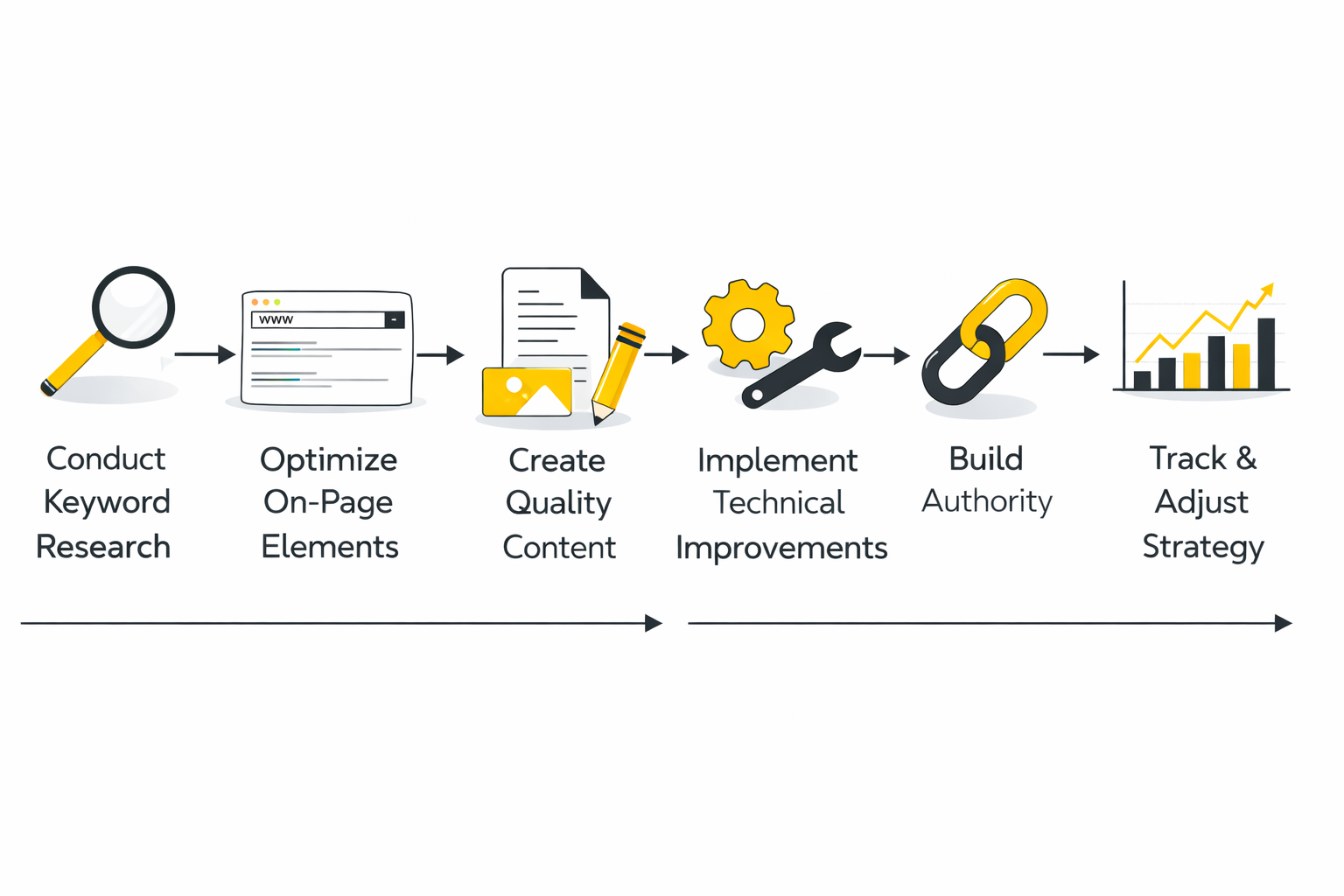
Step 1: Map Demand and Intent
Start with clarity on what people are actually searching for. Not just keywords, but patterns of intent. Informational, navigational, comparison, transactional — each requires a different type of page.
Use tools and data sources to identify:
- Core topics your business should own
- Subtopics that support those areas
- Queries that signal buying intent
Platforms like Systeme.io or ClickFunnels become much more effective when your SEO marketing feeds them qualified traffic instead of random visitors. The goal here is alignment, not volume.
Step 2: Design the Content System
Once demand is mapped, you build the structure that will capture it. This is where you decide what pages exist and how they connect.
A simple but effective model includes:
- Pillar pages for major topics
- Supporting articles for depth
- Conversion pages for action
Each page should have a defined role. If it does not, it probably should not exist. This keeps SEO marketing focused and avoids content sprawl.
Step 3: Create and Publish With Precision
Execution quality matters more than speed. Publishing five weak pages will not outperform one strong page anymore.
Focus on:
- Strong openings that immediately match intent
- Clear structure with logical sections
- Practical depth instead of surface-level coverage
- Natural integration of related topics
This is also where distribution starts. Sharing content through tools like Buffer or building audience channels ensures your pages do not rely purely on search discovery.
Step 4: Build Supporting Signals
Content alone is rarely enough in competitive spaces. You need supporting signals that reinforce credibility.
That includes:
- Earning links from relevant sources
- Promoting content through outreach or partnerships
- Building brand visibility across channels
SEO marketing becomes much stronger when your presence extends beyond your own website. Search engines notice that consistency.
Step 5: Measure, Improve, Repeat
This is where most of the real gains happen. You do not need to guess what works. Search data tells you.
Focus on:
- Pages with impressions but low clicks
- Pages ranking just outside top positions
- Queries you are visible for but not fully answering
Google’s Performance report is built exactly for this. Small improvements in titles, structure, or clarity can create disproportionate gains.
Turning SEO Marketing Into a Repeatable System
At this point, the process becomes cyclical instead of linear. You are not starting from zero each time. You are improving an existing system.
A simplified loop looks like this:
- Identify demand and gaps
- Build or improve the right page
- Strengthen authority signals
- Measure real performance
- Refine based on data
The key is consistency. SEO marketing rewards teams that keep iterating, not teams that look for shortcuts.
In the next part, we will break down how professional implementation differs from basic execution, and what separates average results from dominant positions in competitive search spaces.
Measuring SEO Marketing Performance That Actually Matters
At some point, every SEO marketing effort runs into the same question: is this working, or are we just publishing and hoping? The answer is always in the data, but most people look at the wrong data or interpret it the wrong way.
Raw traffic numbers feel satisfying, but they are incomplete. Rankings look impressive, but they can be misleading. The real job is to connect visibility with outcomes, and that only happens when you understand what each metric is telling you and what action it should trigger next.
The Core Metrics That Tell the Truth
If you strip SEO marketing down to its essentials, there are a handful of metrics that actually matter. Everything else is secondary.
The most useful signals include:
- Impressions – how often your page appears in search results
- Clicks – how often users choose your result
- Click-through rate (CTR) – how compelling your listing is
- Average position – where you typically rank
- Conversions – what users do after they land
Google’s Search Console performance report is built around exactly these signals because they show the full journey from visibility to action. The mistake is treating them separately instead of as a system.
For example, high impressions with low clicks usually means your positioning is weak. Good rankings with poor conversions usually means your page does not match intent. SEO marketing becomes powerful when you diagnose these gaps instead of celebrating surface-level wins.
What the Data Is Really Telling You
Numbers on their own are neutral. They only become useful when you interpret them in context.
Here are a few patterns that show up repeatedly:
- High impressions + low CTR Your page is visible, but it is not attractive. This is usually a title, meta description, or positioning problem. The fix is not more content. It is sharper messaging.
- Decent rankings + low engagement Users click, but they leave quickly. That points to weak introductions, unclear structure, or content that does not deliver on the promise of the search query.
- Strong traffic + low conversions This is one of the most common issues. It means your SEO marketing is attracting the wrong intent or failing to guide users toward action. The solution is often better page design, clearer offers, or stronger alignment with buying-stage queries.
- Low impressions across the board This usually signals a deeper issue with authority, indexing, or topic relevance. It is rarely solved by publishing more of the same content.
Google’s explanation of how search works reinforces this layered interpretation. Visibility, understanding, and ranking are separate steps. Your data often tells you which step is breaking down.
Benchmarks That Actually Help (And What to Ignore)
There is no universal “good” CTR or ranking position because everything depends on the query, the competition, and the result layout. Still, directional benchmarks can help you spot problems faster.
Industry research from multiple SEO platforms consistently shows that top organic positions capture a disproportionate share of clicks, often exceeding 25–30% for position one on standard results pages. That matters because moving from position five to position two can have a larger impact than doubling your content output.
At the same time, the zero-click search trend changes how you interpret success. If more than half of searches end without a click, then visibility alone is not a win. Your SEO marketing needs to compete not just with other websites, but with Google’s own features.
This is why obsessing over average position without context is a mistake. A page ranking third in a crowded SERP with ads, snippets, and AI answers may perform worse than a page ranking fifth in a cleaner environment.
Building a Practical SEO Analytics System
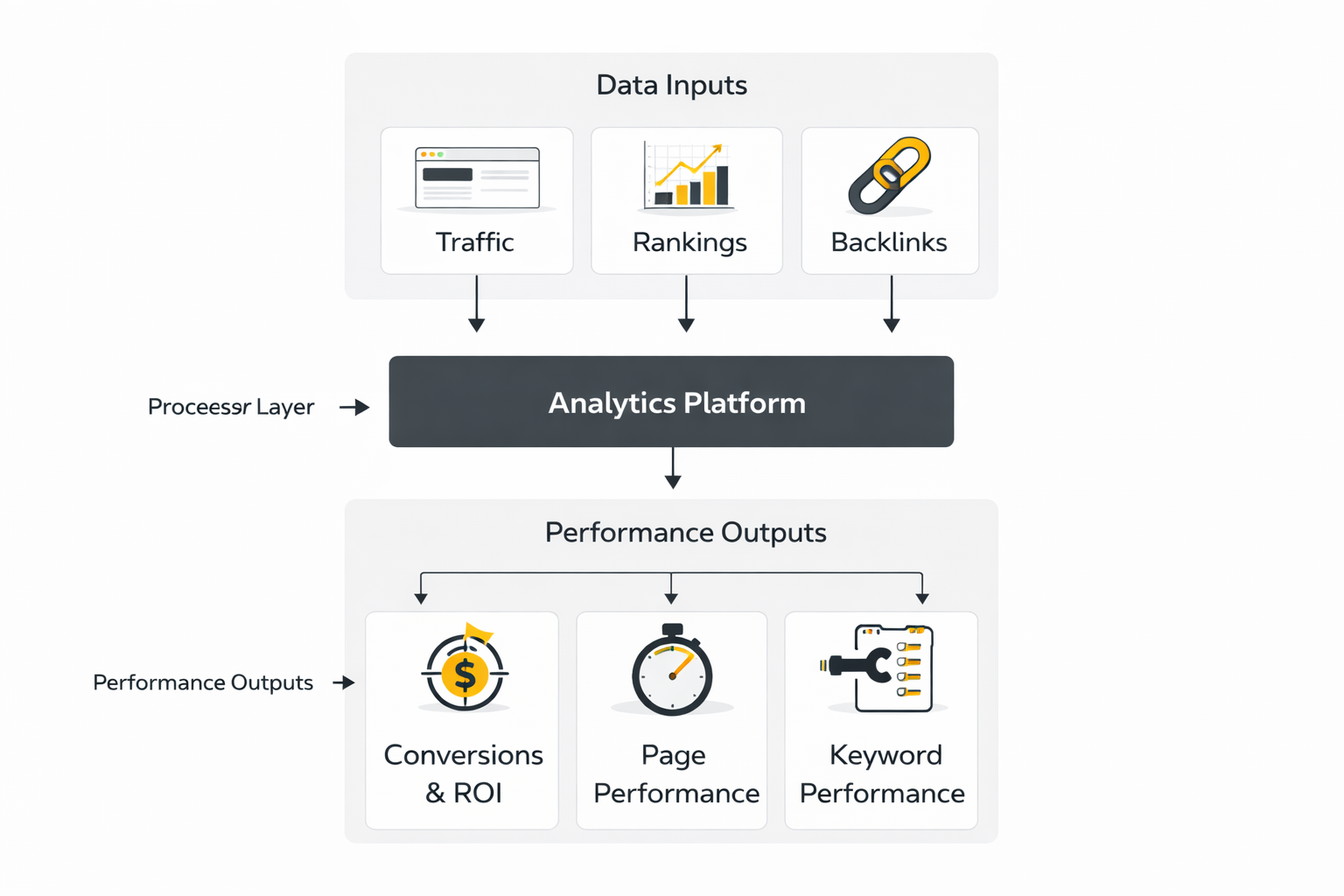
To make SEO marketing actionable, you need a simple system that connects data to decisions. Not dashboards for the sake of dashboards, but a workflow you can actually use.
A practical setup usually includes:
- Google Search Console for query-level data
- Google Analytics or similar for behavior and conversions
- A rank tracking tool for trend visibility
- A simple reporting layer that highlights changes, not just totals
The key is consistency. You are not looking for daily noise. You are looking for patterns over weeks and months.
A useful review cycle looks like this:
- Identify pages gaining impressions but not clicks
- Identify pages close to top positions
- Identify pages with traffic but weak conversion paths
- Prioritize updates based on impact potential
This is where SEO marketing becomes operational. Instead of asking “what should we publish next,” you start asking “what is already working, and how do we push it further?”
Turning Insights Into Action
Data without action is just decoration. The entire purpose of measurement is to guide decisions that improve results.
In practice, that means:
- Rewriting titles and descriptions to improve CTR
- Expanding or restructuring content to better match intent
- Strengthening internal links to boost key pages
- Aligning content with funnels built in tools like ClickFunnels or email systems like Brevo to capture value
This is where many businesses leave growth on the table. They treat SEO marketing as a publishing activity instead of a feedback loop. The advantage comes from closing that loop consistently.
In the next part, we will look at how advanced operators turn these systems into long-term dominance, and what separates stable growth from fragile rankings.
Scaling SEO Marketing Without Breaking What Works
Once your SEO marketing starts producing results, a new problem shows up. Growth creates pressure to publish faster, target more keywords, enter more topic areas, and delegate more of the work. That sounds like progress, but this is exactly where many teams damage the system that got them traction in the first place.
The risk is not moving too slowly. The bigger risk is scaling in a way that lowers quality, weakens focus, and creates a bloated site full of overlapping pages. Google’s guidance on helpful, reliable, people-first content matters even more at this stage because scale amplifies both strengths and weaknesses. If your operating model rewards volume over usefulness, SEO marketing eventually turns into maintenance for a mess you created yourself.
The smarter move is controlled expansion. Add new pages when they strengthen topical coverage, support commercial intent, or open a clear growth path. Do not add them just because a keyword tool says there is search volume.
The Real Tradeoff Between Volume and Depth
This is one of the hardest calls in SEO marketing. Should you publish more pages to expand coverage, or invest more deeply in fewer pages that can actually win? There is no universal formula, but there is a clear pattern: in competitive spaces, depth usually outperforms shallow scale.
Google’s guidance on core updates points site owners back to page quality, relevance, and satisfaction rather than tactical tricks. That matters because a large library of average pages often creates internal competition, diluted authority, and more pages to update later. A smaller set of strong pages usually creates more durable gains.
This does not mean every page needs to be massive. It means every page needs to earn its existence. In practical SEO marketing, the right depth is whatever fully satisfies the query, supports the next step, and leaves the user with fewer reasons to keep searching.
Topical Authority Is Powerful, But Drift Is Expensive
As teams grow, they often confuse topic expansion with authority building. Those are not the same thing. Topical authority comes from consistent relevance and strong coverage around problems your business is actually qualified to solve.
Topic drift happens when a site starts publishing loosely related content just to chase traffic. It looks harmless at first. Then editorial standards slip, internal linking gets messy, conversion paths weaken, and the site becomes harder for both users and search engines to interpret.
That is why smart SEO marketing asks a tougher question before approving content: does this topic strengthen the business, or just increase page count? If it does not deepen trust, support the funnel, or reinforce expertise, it probably belongs somewhere else.
AI Can Accelerate SEO Marketing, But It Can Also Flatten It
AI tools are useful, and pretending otherwise is silly. They can speed up research workflows, help structure drafts, cluster topics, summarize SERP patterns, and support optimization. Google’s guidance on AI-generated content is clear that automation itself is not the issue. The issue is whether the final result is helpful and created for people rather than rankings manipulation.
That distinction matters a lot. AI tends to produce content that sounds complete before it is actually insightful. It fills space well. It does not automatically create originality, judgment, or lived expertise. In SEO marketing, that is dangerous because “good enough” output scales fast and underperforms slowly.
The best use of AI is leverage, not replacement. Use it to move faster on low-value mechanics so human attention can stay on intent, positioning, evidence, editing, and commercial clarity. That is where the edge still is.
Brand Strength Is Becoming a Bigger Ranking Advantage
This point is easy to underestimate until you compete in tougher SERPs. Strong brands get searched for directly, clicked more often, referenced more often, and trusted faster. In a search environment shaped by zero-click behavior and richer result layouts, that trust advantage matters even more.
SparkToro’s 2024 zero-click study showed how little of total search activity actually results in clicks to the open web. That means the click you do earn has to work harder. SEO marketing is no longer just about being present. It is about being the result users are most willing to choose.
This is one reason cross-channel presence matters. Email, social distribution, partnerships, communities, and direct audience building all reinforce branded demand. Tools like Brevo, Moosend, and Buffer can support that broader ecosystem, but only if the underlying message is strong. Software helps distribution. It does not create trust by itself.
The Biggest Risks That Quietly Kill SEO Growth
Most SEO marketing failures do not come from one dramatic mistake. They come from repeated small compromises that slowly erode performance.
The biggest ones tend to be:
- Publishing content with no clear role in the funnel
- Splitting the same intent across multiple weak pages
- Ignoring decaying pages that used to perform
- Chasing trends outside the brand’s actual expertise
- Treating technical debt as someone else’s problem
These are fixable, but only if you catch them early. Once a site becomes cluttered, the cleanup is harder than the original build. That is why discipline matters so much at scale.
What Advanced Teams Do Differently
The gap between average teams and strong teams is rarely secret knowledge. It is usually operational discipline. Advanced teams are better at choosing where not to spend effort.
They tend to do a few things consistently:
- They prioritize pages with clear business value
- They update winners before creating unnecessary new assets
- They connect SEO marketing with CRO, email, and sales enablement
- They maintain tighter editorial standards as output increases
- They use data to make fewer, better bets
This is also where implementation tools start to matter more. If organic traffic is landing on weak forms, slow pages, or vague funnels, you waste momentum. Platforms like Fillout, Cal.com, and Dub can help tighten lead capture, booking flow, and attribution around SEO marketing, but only when they are attached to pages with real intent alignment.
Long-Term SEO Marketing Is Really a Compounding Reputation System
This is the part many people miss. SEO marketing is not just a traffic channel. Over time, it becomes a reputation system. Your pages signal what you know, your structure signals how clearly you think, and your consistency signals whether you are worth trusting.
That is why short-term tactics eventually hit a wall. BrightEdge’s 2025 research on AI search visits and organic performance still found organic search doing the heavy lifting on both traffic and conversions, even as AI-driven discovery grew. The brands that benefit most from that reality are not the ones producing the most pages. They are the ones building the strongest body of evidence.
That is the real strategic takeaway. Strong SEO marketing is not a publishing race. It is a long-term effort to become the most credible, useful, and commercially clear answer in your space.
The final part will bring everything together with practical closing guidance and an FAQ that clears up the questions most businesses still get wrong.
Building Long-Term Growth From an SEO Marketing System
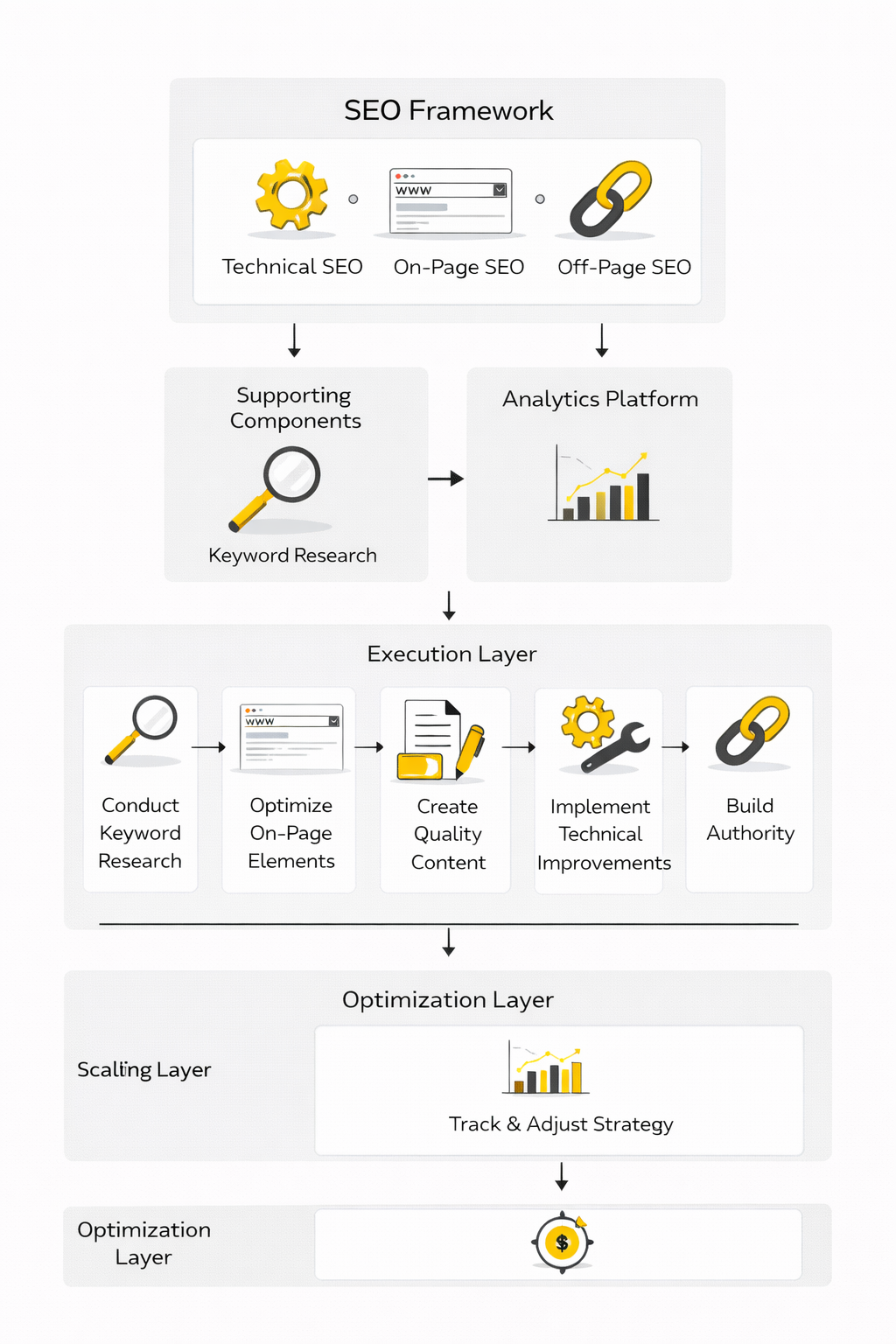
The final piece is seeing SEO marketing as an ecosystem, not a collection of isolated tactics. Content, technical health, authority, conversion paths, analytics, and brand signals all feed each other. When those parts are aligned, growth becomes more stable, updates become less chaotic, and every improvement has a better chance of compounding.
That matters even more now because search is spreading across classic results, richer SERP features, and AI-driven experiences. Google’s guidance on AI features and your website makes the practical point: there is no separate magic trick for this environment, only the same fundamentals executed at a higher standard. Strong SEO marketing still comes down to creating pages people trust, structuring them clearly, and improving them with real performance data.
The upside is that this creates a more defensible business asset. BrightEdge’s 2025 research on AI search visits and organic performance showed AI referrals growing quickly but still accounting for less than 1% of referral traffic while organic search remained the primary driver and produced most conversions. That is the signal serious operators should pay attention to: adapt to the new search landscape, but do not abandon the channel that still carries the commercial weight.
FAQ - Built for Complete Guide
What is SEO marketing in plain English?
SEO marketing is the work of making your website easier to find, easier to understand, and more useful for the people already searching for what you offer. It covers content, site structure, technical accessibility, trust signals, and conversion paths rather than just keyword placement. Google’s SEO Starter Guide and Search Essentials both reinforce that the goal is better visibility through genuinely helpful pages, not shortcuts.
Is SEO marketing still worth it with AI search growing?
Yes, and the current data makes that pretty clear. AI search is growing, but BrightEdge found in 2025 that AI referrals were still under 1% of referral traffic while organic search remained the primary driver and delivered stronger conversions. The smart move is not choosing between AI readiness and SEO marketing, but building content and site systems that work across both.
How long does SEO marketing usually take to show results?
It depends on competition, authority, technical health, and how strong the starting site is, so there is no honest one-size-fits-all timeline. In lower-competition spaces, improvements can show up relatively quickly, while harder markets usually require sustained work across several months before the most meaningful gains appear. The important thing is to track progress through impressions, clicks, CTR, and average position in Search Console, because early visibility gains often show up before traffic and conversions fully follow.
What is the difference between SEO and SEO marketing?
SEO is often used to describe the optimization discipline itself, while SEO marketing is a broader business framing of that work. It includes the technical and editorial side of SEO, but it also connects search visibility to offers, funnels, lead capture, retention, and revenue. That broader view matters because ranking without business alignment is just traffic, while SEO marketing is meant to turn discovery into outcomes.
Do I need a blog to succeed with SEO marketing?
Not always. Some businesses get more value from service pages, solution pages, category pages, comparison pages, or location pages than they do from a large blog. The right page mix depends on search intent, which is why strong SEO marketing starts by mapping what users need at different stages instead of assuming every keyword deserves an article.
Are backlinks still important?
Yes, but not in the cartoonish way they are often discussed. Links still matter because they can function as relevance and trust signals, yet low-quality link chasing is one of the fastest ways to waste time or create risk. Google’s guidance on helpful, reliable, people-first content is a useful reality check here: the strongest SEO marketing tends to earn authority through genuinely strong assets, expertise, and brand recognition rather than manipulation.
What metrics should I watch first?
Start with the metrics that show the full path from search visibility to business value. Search Console’s performance report focuses on clicks, impressions, average CTR, and average position for a reason, and those should be paired with conversion data from your analytics stack. If a page has impressions but no clicks, your messaging is weak; if it has traffic but no conversions, the page or offer is the problem.
Why can a page rank and still fail?
Because ranking is only one part of the job. A page can appear in search, attract some clicks, and still lose because it does not match the user’s real intent, fails to build trust, or offers no clear next step. SEO marketing only becomes commercially useful when the page aligns with the query, answers it better than competitors, and guides the visitor toward a meaningful action.
Does zero-click search mean SEO marketing is losing value?
It means the job is harder, not worthless. SparkToro’s 2024 zero-click study found that only 374 out of every 1,000 Google searches in the EU sent clicks to the open web, which is a serious warning against lazy SEO. The answer is better positioning, stronger brand recognition, sharper page intent, and content worth choosing when a click does happen.
Can AI write my SEO content for me?
AI can absolutely help with speed, organization, ideation, clustering, and draft support, but handing over the whole process is where quality usually drops. Google has said in its guidance on AI-generated content and search that the key issue is usefulness, not whether automation was involved. In practice, good SEO marketing still needs human judgment for intent, originality, evidence, editing, and commercial clarity.
How often should I update SEO pages?
Update pages when the data or the page quality gives you a reason, not because of an arbitrary publishing ritual. If a page is losing clicks, slipping on important terms, becoming outdated, or missing new subtopics users clearly care about, that is a strong update signal. Google’s creating helpful content guidance fits this well because maintaining quality over time is part of keeping a page genuinely useful.
Is technical SEO more important than content?
No, but ignoring technical SEO can quietly sabotage even excellent content. Google still needs to crawl, render, and understand your pages through the processes described in how Search works, so indexability, internal linking, canonicals, and mobile usability still matter. The right way to think about SEO marketing is that technical SEO removes friction while content, trust, and offer strength create the actual advantage.
What tools are most useful for a serious SEO marketing setup?
At minimum, you want Google Search Console, a reliable analytics platform, and a workflow for managing content updates and conversion tracking. If organic traffic is meant to drive leads or sales, tools like Systeme.io, ClickFunnels, Brevo, and Fillout can help turn visibility into captured demand. The real rule is simple: your tool stack should make the system tighter, not more complicated.
What is the biggest mistake businesses make with SEO marketing?
They mistake activity for progress. Publishing more content, buying random links, or obsessing over rankings without fixing intent, structure, trust, and conversion flow is how mediocre results drag on for months. The businesses that win with SEO marketing usually do fewer things better, measure them more honestly, and keep improving pages that already show evidence of traction.
Work With Professionals
Explore 10K+ Remote Marketing Contracts on MarkeWork.com
Most marketers spend too much time chasing clients, competing on crowded platforms, and losing a percentage of every project to middlemen. MarkeWork gives you a better way. Browse thousands of remote marketing contracts and connect directly with companies desperate to hire skilled marketers like you, without platform commissions and without unnecessary gatekeepers.
If you're serious about finding better opportunities and keeping 100% of what you earn, explore available contracts and create a profile for free at MarkeWork.com.