

SEO optimization used to sound simple. Pick a keyword, add it to a page a few times, build a few links, and wait for rankings to climb. That version of SEO is long gone, and that is exactly why so many sites keep publishing more content while getting less traction.
Search is still massive, with Google holding roughly 90% of the global search market in February 2026, and Google’s own business keeps showing how central search remains, with Google Search & Other advertising revenue reaching $54 billion in Q4 2024. At the same time, the click itself is getting harder to win because Bain found many users now rely on AI-written answers and zero-click results for a large share of searches. So the goal is no longer just to rank. The goal is to become the most useful, most trustworthy, and easiest-to-understand result in a search environment that is far more competitive than it was even two years ago.
That shift changes how smart businesses should approach SEO optimization. You need content that deserves to rank, technical foundations that help search engines access and interpret that content, and a site experience strong enough to keep users engaged once they land. If you publish on a custom site, a SaaS platform, or funnel builders like ClickFunnels or Systeme.io, the principle stays the same: search wins go to pages that solve real problems better than the alternatives.
Article Outline
- Why SEO Optimization Still Matters in 2026
- How Modern Search Actually Evaluates Pages
- The SEO Optimization Framework
- Core Components That Move Rankings
- Professional SEO Optimization in Practice
- Measuring SEO Performance and Improving Over Time
Why SEO Optimization Still Matters in 2026
SEO optimization still matters because organic search remains one of the few channels that can compound over time instead of charging you for every visit. Research from BrightEdge showing organic search as the largest trackable web traffic channel lines up with what most serious operators already feel in their numbers: when a page earns visibility, it can keep generating qualified demand long after the publish date. Paid traffic can be useful, but strong organic visibility gives a business leverage.
What changed is the standard required to earn that visibility. Google’s own guidance makes it very clear that people-first content comes before search-engine-first tactics, and its ranking systems overview explains that pages are evaluated through multiple signals rather than one trick or one metric. In plain English, SEO optimization now means building a page that deserves to be surfaced, not just a page that has been mechanically “optimized.”
That also means weak SEO has become more expensive. When searchers get partial answers directly in results, and when AI summaries reduce clicks for softer content, average pages are easier to ignore. The upside is that truly useful pages can still win big, because the sites that combine clarity, depth, technical health, and credibility are easier for both users and search systems to trust.

The SEO Optimization Framework
The cleanest way to think about SEO optimization is this: create something worth finding, make it easy to discover, make it easy to understand, and make it satisfying to use. That sounds obvious, but most underperforming sites fail on at least one of those four steps. They either publish thin content, bury strong content in weak architecture, confuse search engines with messy technical signals, or frustrate users with slow, cluttered pages.
Google’s SEO Starter Guide and Search Essentials support that exact model. First, your pages need to be eligible and accessible. Then they need to communicate relevance clearly through content, structure, and context. After that, they need to deliver a strong experience, because page experience and Core Web Vitals still matter as part of broader ranking and usability signals even though speed alone will not rescue weak content.
This article follows a practical framework built around those realities. We will look at how search engines evaluate pages now, the core components that actually move rankings, how professionals implement SEO optimization across content and technical systems, and how to measure whether the work is driving real business outcomes instead of vanity metrics.
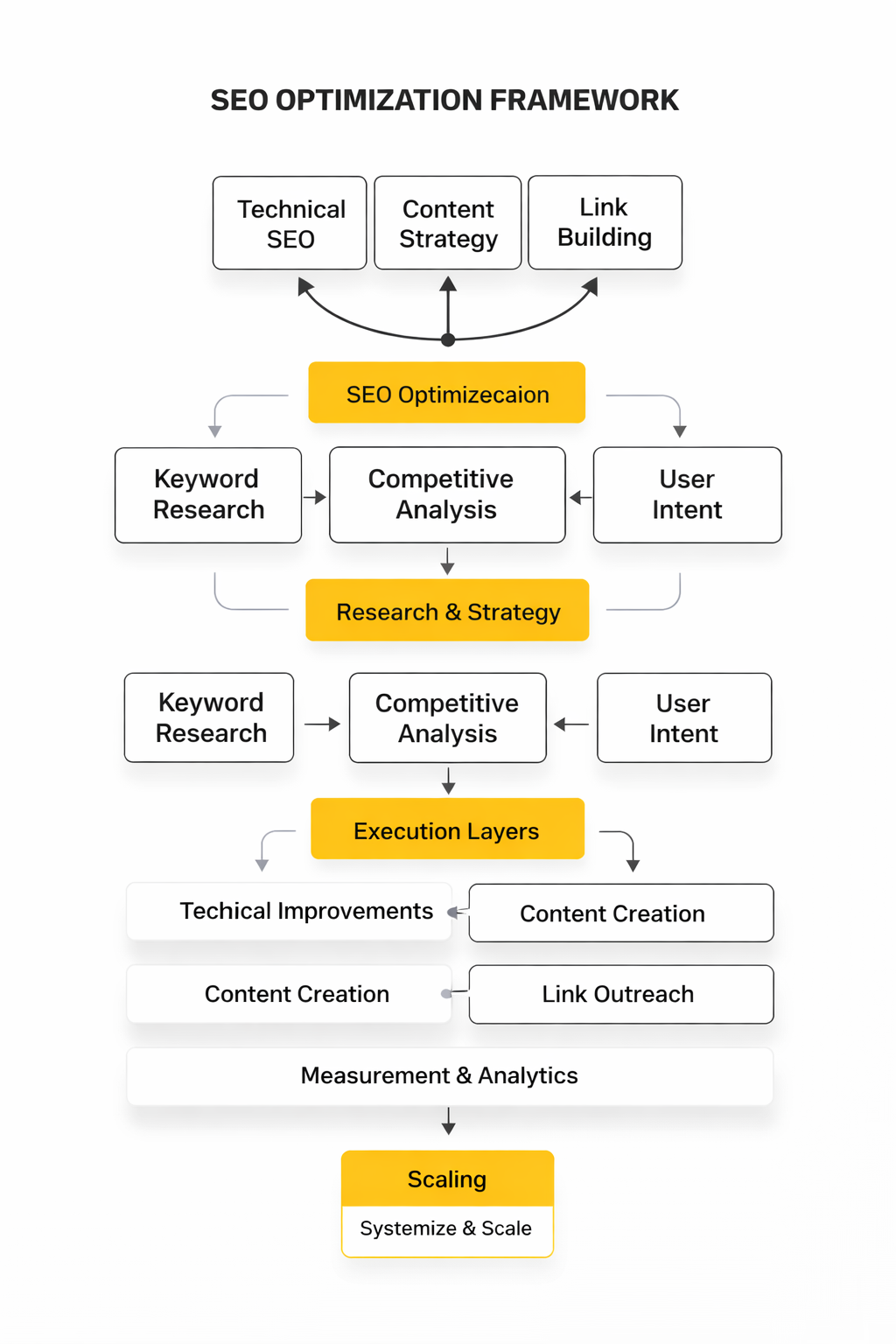
In the next part, we will move from the big picture to the mechanics and break down how modern search actually evaluates pages. That matters because once you understand what search systems are trying to reward, SEO optimization stops feeling mysterious and starts becoming a repeatable operating discipline.
How Modern Search Actually Evaluates Pages
Modern search does not score a page with one master metric and call it a day. Google explains that its core ranking systems evaluate many signals and systems together, which is why SEO optimization feels harder when you chase shortcuts and a lot more manageable when you build around user value. The practical takeaway is simple: rankings usually improve when relevance, usability, clarity, and trust line up at the same time.
That matters because too many SEO conversations still sound stuck in 2018. People argue about single factors when the real job is to help search engines understand what the page is, why it should be surfaced, and whether users are likely to feel satisfied after the click. Strong SEO optimization is really the discipline of reducing uncertainty for both the algorithm and the human on the other side of the query.
Relevance Starts With Search Intent
The first filter is relevance, and relevance starts with intent. Google’s own SEO Starter Guide frames SEO as helping search engines understand content and helping users decide whether a result is worth visiting, which means your page has to match the real purpose behind the query, not just repeat the phrase. When someone searches for seo optimization, they usually do not want a dictionary definition alone. They want a clear explanation, a workable framework, and practical direction they can apply.
This is where weak keyword targeting breaks down. A page can use the primary phrase in the title, headings, URL, and body copy, and still fail because it answers the wrong question or answers the right question too shallowly. Good SEO optimization begins by mapping the keyword to the searcher’s actual need, then structuring the page so that need is addressed fast, clearly, and without fluff.
Helpfulness Is Now the Standard, Not the Bonus
Google’s guidance on helpful, reliable, people-first content makes the current standard obvious: content should exist to help people first, not to manipulate rankings. That shifts the job from “how do I insert the keyword enough times” to “how do I create the best answer on this topic for this audience.” If your content is vague, padded, or obviously assembled just to cover search terms, SEO optimization will eventually stall no matter how clean the rest of the setup looks.
This is also why volume alone has become dangerous. Google’s spam policies explicitly call out scaled content abuse when pages are mass-produced mainly to manipulate rankings rather than help users. So yes, you can publish at scale, but only if each page brings original value, clear purpose, and enough substance to stand on its own.
Search Engines Need Clean Access Before They Can Reward Quality
A brilliant page cannot rank well if search engines struggle to discover it, crawl it, or understand which version should be indexed. Google’s documentation on crawling and indexing and canonicalization makes this point repeatedly: duplicate URLs, weak internal linking, blocked resources, and mixed signals can all dilute visibility. That is why technical SEO optimization is not some separate nerdy layer. It is the delivery system that lets content perform.
Internal links matter more than many teams realize because they help Google find pages and understand how topics relate to one another. Google’s own link best practices and sitelinks guidance both emphasize crawlable links, descriptive anchor text, and logical site structure. In plain language, if your site architecture is messy, your strongest content may never get the full visibility it deserves.
Clarity Affects How Pages Are Interpreted in Search
Search engines do not only read body text. Google can build title links from multiple signals such as the page title, heading elements, and prominent on-page text, which means page presentation and content hierarchy directly affect how your result is understood. SEO optimization is stronger when titles, headings, and primary page themes all point in the same direction instead of competing with each other.
The same is true for snippets and structured signals. Google’s documentation on snippets and meta descriptions explains that it may use your meta description or generate a snippet from on-page content, while its structured data overview shows how markup helps search engines understand entities, context, and page meaning. You cannot force Google to display everything exactly the way you want, but you can make interpretation much easier with clean structure and specific language.
Experience, Expertise, and Trust Shape Competitive Results
Not every query carries the same stakes, but credibility matters across the board. Google’s people-first content documentation explains that search quality raters are trained to look for strong E-E-A-T signals, and while those ratings are not direct ranking inputs, they help Google evaluate whether its systems are surfacing results people can trust. For anyone doing serious SEO optimization, that means thin anonymity, unsupported claims, and generic advice are liabilities.
This is where expert framing starts to separate average pages from durable winners. Clear authorship, firsthand insight, transparent sourcing, and specific explanations all help a page feel more reliable because they reduce doubt. You do not need to sound academic, but you do need to sound like someone who actually knows the terrain and can guide the reader through it.
Reputation Helps, but It Does Not Give You a Free Pass
Authority still matters, but Google has become much more explicit about abuse on strong domains. Its update on site reputation abuse makes it clear that third-party content is not automatically a problem, yet publishing low-value material mainly to exploit a host site’s ranking signals can violate policy. That is a big deal because it tells you something deeper about SEO optimization in 2026: borrowed trust is weaker than earned trust.
For publishers and brands, the lesson is blunt. You cannot slap low-effort pages onto an established site and expect the domain to carry them forever. Search is moving toward a stricter standard where every page has to justify its place, its purpose, and its quality in context.
The SEO Optimization Framework in Action
Once you understand how pages are evaluated, SEO optimization stops looking like a bag of tricks and starts looking like a system. You need the right query targeting, the right depth of answer, the right technical accessibility, and the right signals of credibility working together. Miss one of those pieces badly enough, and the whole page gets weaker even if the other pieces are solid.
That is the foundation for everything that comes next. In the next part, we will move from evaluation to execution and break down the core components that actually move rankings, traffic quality, and organic business results.
Core Components That Move Rankings
Now that you understand how search evaluates pages, the next step is execution. SEO optimization only works when multiple components reinforce each other, and most underperforming sites fail because one of these pieces is missing or weak. You do not need to master everything at once, but you do need to get the fundamentals working together.
Content Depth and Structure
Content is still the center of SEO optimization, but not in the way most people think. It is not about word count or stuffing variations of a keyword into headings. It is about covering the topic in a way that removes friction for the reader and answers the real question behind the search.
Google’s documentation on helpful content makes it clear that depth comes from usefulness, not length. A strong page anticipates follow-up questions, explains concepts clearly, and structures information so it can be scanned quickly. That usually means:
- Clear heading hierarchy that mirrors how people think about the topic
- Short paragraphs that move logically from one idea to the next
- Direct answers early, with deeper explanation layered underneath
- Supporting sections that expand the topic instead of repeating it
When SEO optimization is done well, the reader never feels lost. They move through the page naturally, and that clarity translates into stronger engagement signals.
Internal Linking and Site Architecture
Internal linking is one of the most underused levers in SEO optimization. Google uses links to discover pages and understand relationships between topics, which means your structure directly affects how authority flows across your site.
Good architecture does not happen by accident. It is built intentionally so that important pages are easy to reach, and related topics reinforce each other instead of competing. Practical implementation usually looks like this:
- Group related content into clusters around core topics
- Link from high-authority pages to supporting pages
- Use descriptive anchor text that reflects the destination page
- Avoid orphan pages that have no internal links pointing to them
Google’s own guidance on crawlable links supports this approach. When your structure is clean, your best content gets discovered faster and understood more clearly.
Technical SEO That Supports Visibility
Technical SEO optimization is not about chasing scores. It is about removing obstacles that prevent your content from being properly indexed and interpreted. Even small issues can dilute performance when they stack together.
The fundamentals you cannot ignore include:
- Fast loading pages that pass Core Web Vitals thresholds
- Mobile-friendly layouts that work across devices
- Clean URL structures without duplication issues
- Proper use of canonical tags to consolidate signals
- XML sitemaps and robots directives that guide crawling
Google’s documentation on crawling and indexing shows how these elements directly influence visibility. If your technical layer is unstable, everything built on top of it becomes harder to rank.
On-Page Optimization That Signals Clarity
On-page SEO optimization is where you align your content with how search engines interpret meaning. This is not about forcing keywords into every line. It is about making your page easy to classify and easy to trust.
The core elements include:
- Title tags that clearly describe the page’s purpose
- Headings that reflect the structure of the topic
- Meta descriptions that improve click-through clarity
- Natural keyword usage within context, not repetition
- Structured data where it adds meaningful context
Google’s explanation of title links and snippets shows that it may rewrite your presentation if your signals are unclear. That alone should tell you something: clarity beats cleverness every time.
Professional SEO Optimization in Practice
This is where everything becomes real. Knowing the components is useful, but results come from consistent execution. Professional SEO optimization is less about isolated tactics and more about running a repeatable system.
The process below is how high-performing teams approach it.
Step 1: Define the Target and Intent
Start with a keyword, but do not stop there. You need to understand what the searcher actually wants, what type of content is ranking, and what gaps exist in current results. This step determines everything that follows, so rushing it is a mistake.
Look at the top results and ask:
- What format dominates the page (guides, lists, tools)?
- What questions are being answered repeatedly?
- What is missing or poorly explained?
SEO optimization begins with clarity here. If you misread intent, even perfect execution will underperform.
Step 2: Build the Content Around Value
Once intent is clear, build the page to solve the problem better than existing results. This is where most people either overcomplicate or underdeliver. The goal is not to impress. The goal is to help.
That often means:
- Writing in plain language instead of jargon
- Structuring the page so answers come quickly
- Expanding where competitors are shallow
- Cutting anything that does not add value
If you are using funnel builders or landing page systems like ClickFunnels, this step matters even more. Pages designed for conversion still need to satisfy search intent if you want organic traffic to stick.
Step 3: Optimize Structure and Signals
Now refine the page so search engines can interpret it correctly. This includes titles, headings, internal links, and metadata. You are not changing the meaning of the page. You are making that meaning easier to read.
At this stage:
- Align your title and H1 with the core topic
- Use subheadings to break down sections logically
- Add internal links to and from related pages
- Ensure URLs and canonical signals are clean
This is where SEO optimization becomes technical without becoming complicated. You are aligning signals, not gaming the system.
Step 4: Publish, Index, and Monitor
Publishing is not the finish line. It is the start of the feedback loop. Once your page is live, you need to ensure it is indexed correctly and start tracking how it performs.
Google Search Console becomes essential here because it shows:
- Which queries your page is appearing for
- Click-through rates and impressions
- Indexing status and potential issues
Without this data, you are guessing. With it, you can refine your SEO optimization strategy based on real behavior.
Step 5: Improve Based on Real Data
This is where most people stop too early. SEO optimization compounds when you revisit pages and improve them based on performance. That might mean expanding sections, tightening explanations, or aligning content more closely with emerging queries.
Consistent improvement is what separates pages that rank temporarily from pages that dominate long-term. Even small updates can shift rankings when they directly improve usefulness.
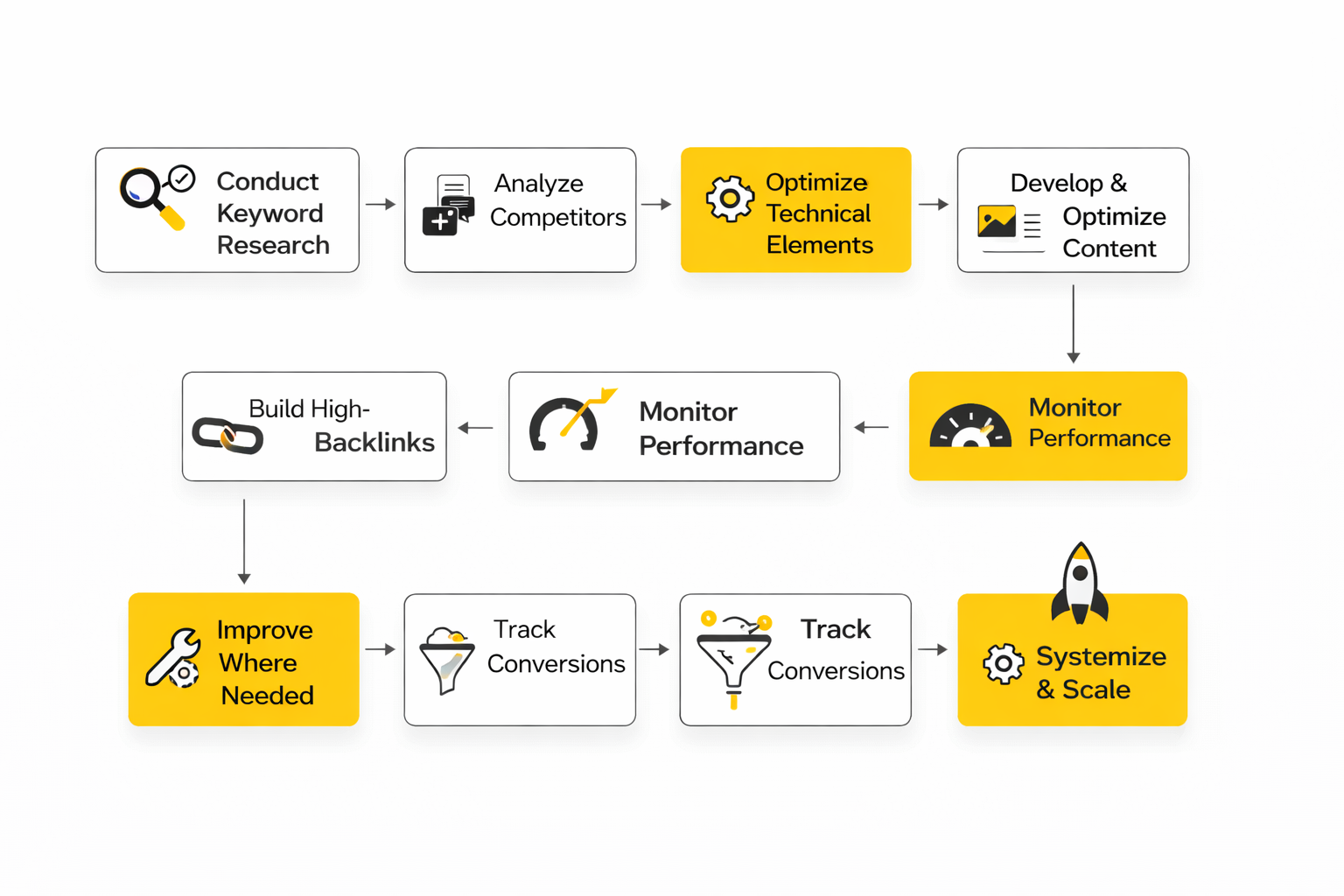
This process is not theoretical. It is how SEO optimization works when treated as a system instead of a checklist. In the next part, we will go deeper into how professionals scale this approach across entire sites without losing quality or control.
Measuring SEO Performance and What the Data Actually Means
SEO optimization without measurement is just guessing with better vocabulary. You can publish great content, fix technical issues, and build strong internal links, but if you are not tracking how those changes affect visibility and behavior, you will not know what is actually working.
The challenge is not lack of data. It is interpreting the right data correctly. Most dashboards overwhelm people with metrics that look impressive but do not translate into better decisions. What matters is understanding which signals reflect real progress and which ones are just noise.
The Core Metrics That Actually Matter
There are dozens of SEO metrics, but only a handful consistently reflect meaningful progress. Google Search Console and analytics platforms provide most of what you need, but the key is knowing what each metric is telling you.
The most important signals include:
- Impressions – how often your page appears in search results
- Clicks – how often users choose your result
- Click-through rate (CTR) – how compelling your result looks
- Average position – where your page tends to rank
- Organic conversions – what traffic actually does on your site
These metrics are not equal. Impressions show potential visibility, but clicks show real interest. Position gives context, but conversions reveal business value. Strong SEO optimization connects all of them instead of focusing on just one.
For example, a page with rising impressions but flat clicks usually has a positioning or messaging problem. A page with strong traffic but weak conversions has a mismatch between intent and offer. The numbers are only useful if they lead you to a specific action.
How to Read Ranking Data Without Misleading Yourself
Ranking data looks simple, but it is easy to misinterpret. Google itself explains that position is an average across multiple queries and contexts, not a fixed slot. That means your “position 5” page might show higher or lower depending on the search, device, and location.
This is why experienced teams do not obsess over single rankings. They look for trends:
- Are impressions increasing over time?
- Are more keywords triggering the page?
- Is CTR improving as visibility grows?
A steady upward trend matters more than a temporary jump. SEO optimization is not about hitting one position. It is about building consistent visibility across related queries.
Click-Through Rate Reveals Content Positioning
CTR is one of the most underrated metrics in SEO optimization. It reflects how well your title and snippet match user expectations. Google’s documentation on snippets shows that it may generate its own description, but your content still influences what appears.
When CTR is low, something is off. It could be:
- A title that is too vague or too generic
- A mismatch between the keyword and the promise
- Stronger competing results with clearer positioning
Improving CTR does not require rewriting the entire page. Often, small changes to titles and descriptions can unlock more clicks from the same rankings. That is one of the fastest wins in SEO optimization when done correctly.
Engagement Signals Show Real Content Quality
Search engines do not publish exact engagement metrics, but user behavior still matters. If people land on your page and immediately leave, that is a strong signal that something is wrong. If they stay, scroll, and interact, your content is doing its job.
This is where tools connected to your site, whether custom analytics or platforms like Buffer for distribution insights or Brevo for audience engagement tracking, can help you see what happens after the click. SEO optimization does not stop at the search result. It extends into how well your page holds attention.
Key engagement indicators to watch:
- Time on page
- Scroll depth
- Pages per session
- Return visits
These metrics do not directly equal rankings, but they strongly correlate with whether your content satisfies the user.
Conversions Are the Real Scorecard
Traffic without action is just vanity. The real measure of SEO optimization is what happens after the visit. Whether your goal is leads, sales, or signups, conversions are where SEO proves its value.
This is where many sites break down. They focus heavily on rankings and traffic but ignore the experience after the click. If your page does not guide users toward a clear next step, you are leaving results on the table.
Platforms like Systeme.io or funnel-focused tools like ClickFunnels are often used here because they combine content with conversion paths. That alignment matters. SEO optimization works best when visibility and conversion strategy are built together, not separately.
Building a Simple SEO Measurement System
You do not need a complicated stack to track performance effectively. What you need is consistency and clarity. A simple system that you actually use will outperform a complex one you ignore.
A practical setup looks like this:
- Track search performance in Google Search Console
- Track user behavior in analytics tools
- Define conversion goals clearly
- Review performance weekly for trends, not daily noise
- Update pages based on real data, not assumptions
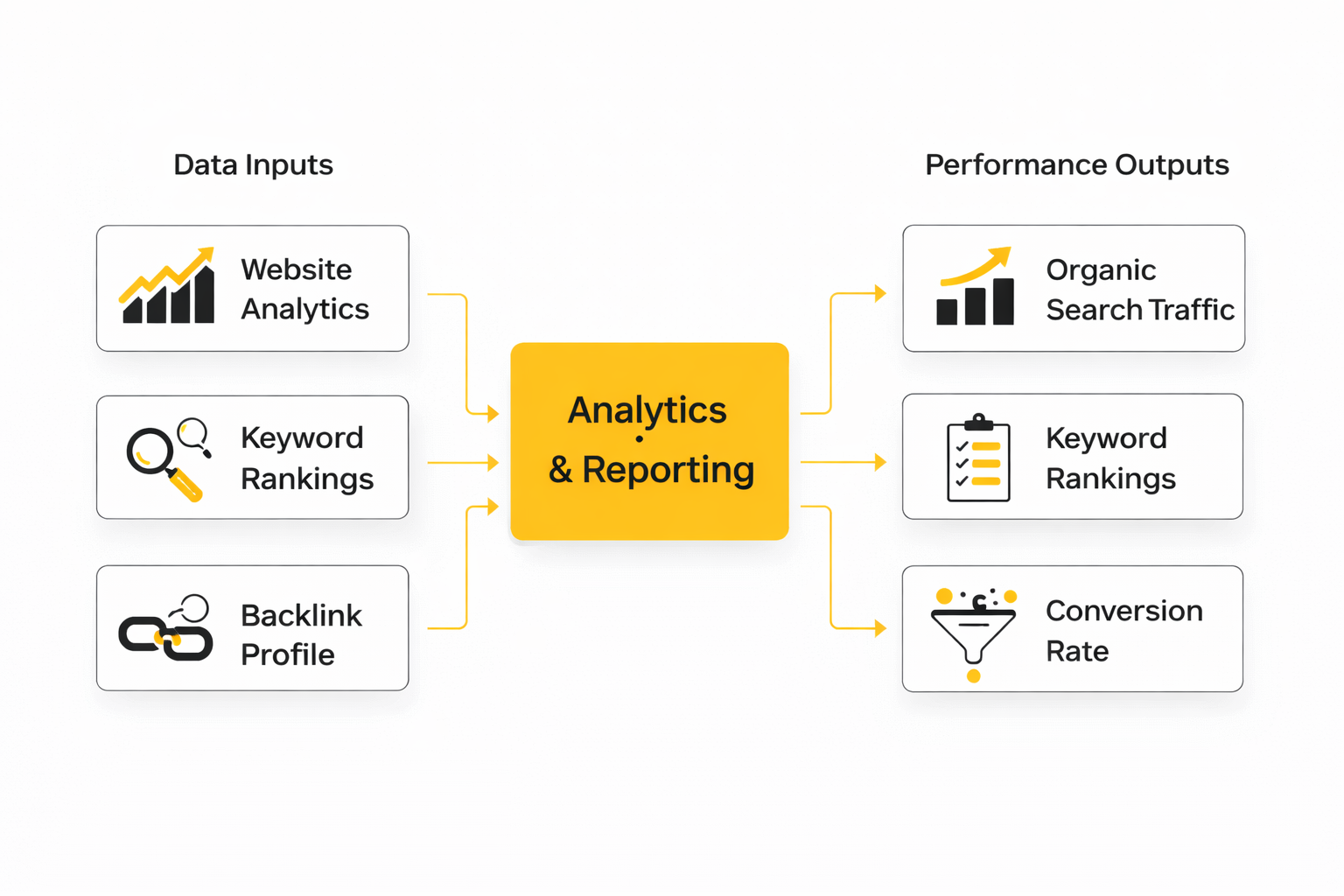
This system works because it connects visibility, behavior, and outcomes. Each layer informs the next, creating a feedback loop that strengthens SEO optimization over time.
What the Data Should Drive You to Do
Data is only useful if it leads to action. Every metric should push you toward a decision, not just a report.
- Low impressions -> expand content or improve indexing
- Low CTR -> rewrite titles and improve positioning
- High traffic, low engagement -> fix content clarity and structure
- High engagement, low conversions -> improve calls to action
This is where SEO becomes a real operating system instead of a marketing tactic. You publish, measure, adjust, and repeat. Over time, that cycle compounds into stronger rankings, better traffic, and more reliable results.
In the next part, we will break down how to scale this process across multiple pages and entire sites without losing quality, which is where most SEO strategies either accelerate or collapse.
Scaling SEO Optimization Without Breaking Quality
This is the point where a lot of SEO strategies start to wobble. It is one thing to optimize a few strong pages by hand. It is something else entirely to scale SEO optimization across dozens, hundreds, or thousands of URLs without creating duplication, weak pages, and internal competition.
The temptation is obvious. Once a page works, teams want to repeat the formula fast. But Google’s spam policies now explicitly target scaled content abuse when pages are produced mainly to manipulate rankings rather than help users, and its broader people-first guidance keeps reinforcing the same message: scale is fine, but only when value scales with it too. That is the tradeoff professionals have to manage.
The Real Risk of Publishing Too Much
More content does not automatically create more organic growth. In fact, it often creates more confusion. When teams publish overlapping pages, weak variations, or thin posts built around every minor keyword version, they spread authority across too many assets and make it harder for Google to understand which page should rank.
This is one of the biggest hidden problems in SEO optimization. You think you are expanding coverage, but you may actually be creating keyword cannibalization, crawl waste, and an overall drop in average page quality. Google’s documentation on consolidating duplicate URLs exists for a reason: multiple similar versions of the same idea can split signals and reduce clarity.
The smarter move is usually to publish fewer, better assets with stronger supporting architecture. That means combining closely related topics where it makes sense, upgrading pages before creating near-duplicates, and treating every new URL as a strategic decision instead of a content quota.
AI Can Accelerate SEO Optimization, but It Can Also Destroy It
AI has changed production speed dramatically, but speed is not the same as usefulness. Google has been very clear that it evaluates content quality rather than how the content was produced, which is good news for smart teams using AI responsibly. The bad news is that a lot of publishers took that as permission to flood the web with mediocre pages.
That approach is getting riskier, not safer. Google’s helpful content guidance and spam policies now work together in a way that punishes low-value scaling much more aggressively than before. So the right question is not whether you should use AI in SEO optimization. The right question is where AI genuinely improves the workflow without replacing expertise, judgment, and editorial standards.
A practical model looks like this:
- Use AI for research organization, outlines, and first-draft support
- Use humans for positioning, depth, fact-checking, and final judgment
- Add firsthand insight, examples, and real specificity before publishing
- Kill anything that sounds generic, padded, or derivative
That balance matters. AI is a multiplier, but it multiplies whatever process you already have. If your standards are weak, it will help you fail faster.
Search Is Fragmenting, So Strategy Has to Get Smarter
SEO optimization is no longer just about ten blue links. Search behavior is now split across traditional results, AI summaries, zero-click answers, forum-style discovery, product surfaces, and platform-native search. Bain’s 2025 findings that about 80% of search users rely on AI summaries for at least 40% of searches and roughly 60% of searches end without progressing to another website make that shift impossible to ignore. At the same time, BrightEdge has reported that organic search still remains the primary driver of referral traffic and the majority of conversions, while AI search traffic is growing fast from a much smaller base.
Those two realities are not contradictory. They tell you that SEO optimization still matters immensely, but the bar for earning a click is higher. Your content has to work in more than one environment. It needs to rank, but it also needs to be citable, extractable, and immediately useful when parts of it are surfaced in summaries.
That changes execution in a few important ways:
- Front-load definitions and direct answers
- Structure content so sections stand alone clearly
- Use precise headings that reflect real subtopics
- Support claims with credible sources and visible expertise
This is not about writing for machines. It is about making your information durable in a search landscape where content gets interpreted, summarized, and compared faster than ever.
Authority Is Built Through Topical Depth, Not Random Reach
A lot of teams still chase SEO optimization by targeting any keyword with volume. That can work for short bursts, but it is a weak long-term model. Google’s ranking systems and helpful content guidance consistently reward pages that feel trustworthy and relevant in context, which is why topical depth usually beats scattered expansion over time. Google for Developers+1
The stronger strategy is to build authority through connected topic coverage. Instead of publishing isolated posts across unrelated areas, you create a clear content system around themes your business can genuinely own. That gives you better internal linking, stronger contextual relevance, and more chances to satisfy the next search a user makes after landing on your site.
This is especially important for smaller brands. You usually will not outpublish giant media sites across every category, but you can absolutely outrank them in focused areas where your expertise is sharper, your pages are clearer, and your content feels more complete.
Conversion Pressure Can Quietly Damage Organic Performance
There is another tradeoff that experienced operators watch carefully: conversion intensity. A page can be technically optimized, well-written, and commercially valuable, then lose organic performance because it pushes too hard, too early, or too often. That is not because Google dislikes conversions. It is because intrusive layouts, weak readability, and constant interruption reduce the quality of the page experience.
This is where SEO optimization and CRO need to cooperate instead of fighting. If your content exists only to funnel readers into popups, lead forms, or aggressive CTAs, satisfaction drops. If your content is helpful first and commercial second, trust rises and conversions often improve anyway because the reader is less resistant.
That balance is especially relevant on landing-page-driven stacks. Tools like ClickFunnels and Systeme.io can absolutely support search growth, but only when the page still behaves like a credible search result and not just a conversion trap. The practical rule is simple: earn attention before you monetize it.
What Professional SEO Teams Do Differently
Professional teams are not usually winning because they know secret ranking hacks. They are winning because their systems are tighter. They choose topics more carefully, publish with stronger quality control, and improve pages after launch instead of abandoning them.
In practice, that usually means:
- Clear editorial standards for what deserves a new page
- Templates that improve consistency without flattening quality
- Search Console and analytics reviews tied to specific update decisions
- Regular pruning, consolidation, and refresh cycles
- Close coordination between content, technical, product, and conversion teams
This is what mature SEO optimization looks like. It is operational discipline. It is much less glamorous than internet marketing makes it sound, but it is exactly why it works.
The Strategic Question That Matters Most
At an advanced level, SEO optimization comes down to one question: are you building a searchable content asset, or are you just producing pages? Those are very different games. One compounds because each page strengthens the system. The other stalls because each page is isolated, disposable, and easy to replace.
That is why the best SEO strategies get narrower before they get bigger. They clarify what the site should be known for, build depth in those areas, measure performance honestly, and expand only when the foundation is already working. In the final part, we will bring everything together with a practical close and answer the most important questions people still have about SEO optimization.
The SEO Optimization Ecosystem Going Forward
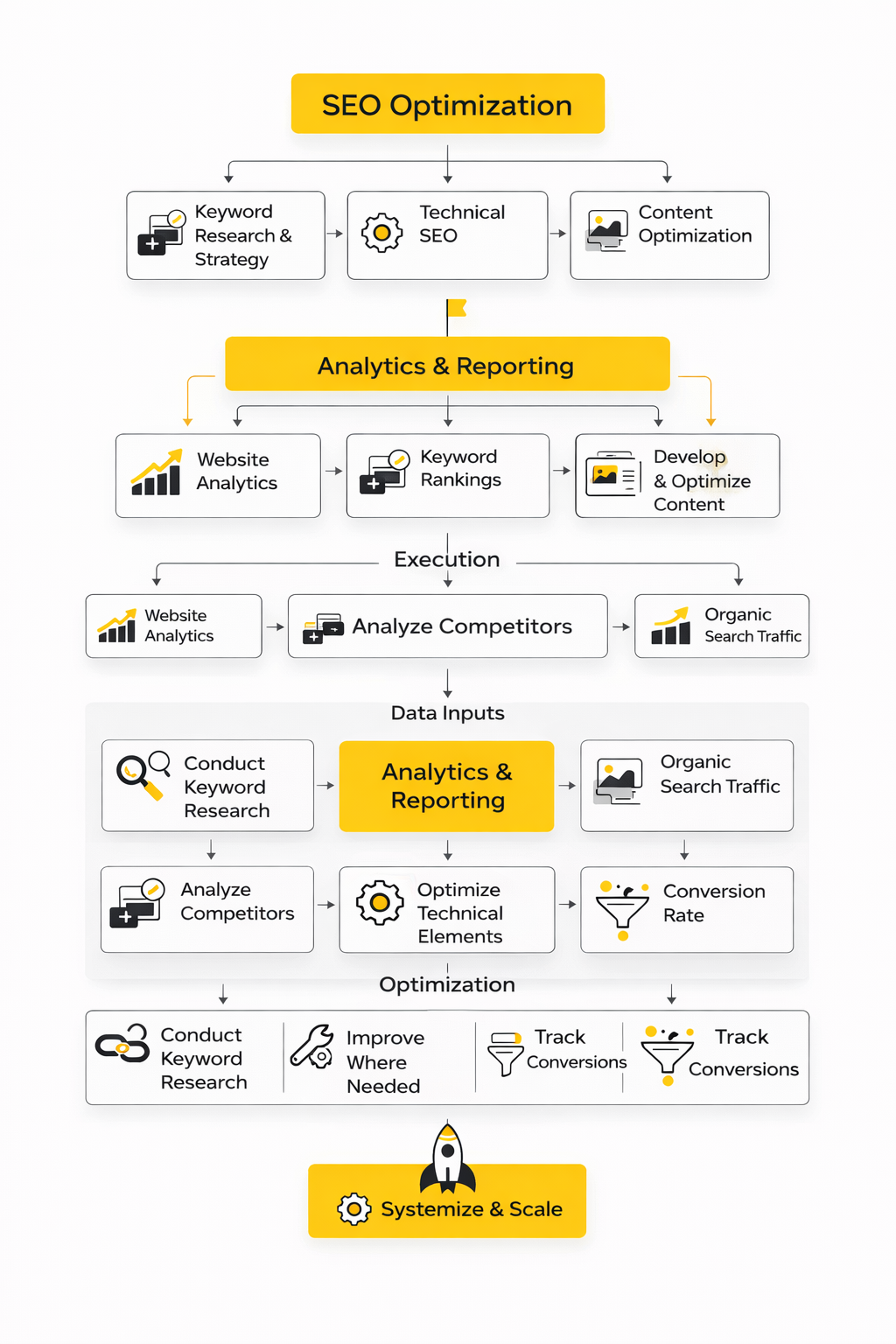
At this point, the big picture should be clear. SEO optimization is not one tactic, one plugin, or one checklist. It is an operating system that connects content quality, technical clarity, topical authority, user experience, and conversion design into one repeatable process.
That matters even more now because search is not shrinking. It is changing shape. Google still controls the overwhelming majority of search share globally through 2026 as shown by Statcounter’s market share data, while BrightEdge’s research on channel share continues to show organic search as the largest trackable traffic source for many websites. At the same time, Bain’s 2025 research on zero-click behavior and BrightEdge’s 2025 AI search report show a more nuanced reality: AI-driven discovery is growing fast, but organic search still drives the bulk of meaningful traffic and conversions.
That is why the winning approach is not “SEO or AI.” It is SEO optimization built to survive in both environments. Pages need to be useful enough to rank, structured enough to be understood, and credible enough to be cited or summarized without losing their value. That is the real system now, and honestly, it is a better one because it rewards substance over tricks.
FAQ About SEO Optimization
What is SEO optimization in simple terms?
SEO optimization is the process of improving a website so search engines can understand it better and users can get more value from it faster. That includes content, technical setup, internal linking, page experience, and conversion flow working together instead of in isolation. Google’s own SEO Starter Guide frames the work around helping search engines crawl, index, and understand content while helping people decide whether a result is worth visiting.
Is SEO optimization still worth it in 2026?
Yes, absolutely, but the reason is a little more sophisticated than it used to be. Organic search still represents a major traffic and demand channel, with BrightEdge reporting organic search as the largest trackable web traffic source, and Google Search remains the dominant search platform by a very large margin based on global market share data. What changed is that weak content gets ignored faster, so SEO optimization is worth it when the work is strategic, useful, and technically solid.
How long does SEO optimization take to show results?
SEO optimization usually takes longer than paid acquisition because search visibility has to be earned and reinforced over time. Google explains in its guide to how Search works that crawling, indexing, and ranking are separate processes, which is one reason results do not appear instantly after publishing. In practice, some improvements show up within weeks, but competitive topics often take months of publishing, refining, and strengthening internal authority before the gains become obvious.
What matters more, content or technical SEO?
This is the wrong fight because the answer is both. Strong content without crawlability, indexing clarity, or sound architecture can underperform, and perfect technical setup cannot rescue weak content that does not satisfy intent. Google’s ranking systems guide and people-first content guidance make it pretty clear that useful search performance comes from multiple systems and signals working together.
How important are keywords now?
Keywords still matter, but not in the old-school stuffing sense. They help you understand intent, shape page targeting, and align language with the way people actually search. What matters more than repetition is relevance and clarity, which is exactly why Google’s helpful content guidance puts so much emphasis on serving people rather than creating pages mainly to manipulate rankings.
Does AI-generated content hurt SEO optimization?
Not automatically. Google has said in its guidance on AI-generated content and Search that the issue is not how content is produced but whether it is high quality and helpful. The real risk appears when AI is used to mass-produce generic pages with little original value, which connects directly to Google’s spam policy updates on scaled content abuse.
What is the biggest SEO mistake most sites make?
The biggest mistake is creating pages without a clear reason for them to exist. That often shows up as thin posts, overlapping topics, random keyword chasing, weak internal linking, or pages that were clearly built for search engines first and humans second. Google’s core updates guidance consistently points site owners back to content quality, originality, usefulness, and overall satisfaction rather than secret technical loopholes.
Are backlinks still important for SEO optimization?
Yes, but the conversation around them is usually too simplistic. Links still help search engines discover pages and understand site relationships, and Google’s documentation on links makes that clear. The bigger issue is that random low-quality link building is a weak strategy compared with earning trust through strong content, clear structure, and genuine reputation.
How do I know whether a page needs to be updated or replaced?
You usually update a page when the topic is still relevant but the execution is weak, outdated, or incomplete. You replace or consolidate when multiple pages compete for the same intent, when a URL has no clear value, or when the architecture itself is causing confusion. Google’s canonicalization guidance supports consolidation logic because duplicate or near-duplicate pages can split signals and reduce clarity.
What metrics should I watch first?
Start with impressions, clicks, click-through rate, position trends, and conversions. Those metrics tell you whether the page is being seen, whether users want it, and whether the traffic is creating business value. Google Search Central documentation and BrightEdge’s channel research both support the bigger point here: visibility matters, but outcomes matter more.
Can SEO optimization work for landing pages and funnels?
Yes, but only if those pages genuinely satisfy search intent. Search users expect clarity, relevance, and enough information to trust the page, so a landing page that jumps straight to the pitch can struggle even if the offer is good. If you build on platforms like ClickFunnels or Systeme.io, the smart move is to combine conversion design with strong informational value instead of forcing one to replace the other.
Do small sites still have a chance against huge brands?
Yes, especially when the small site is more focused, more useful, and more specific. Large brands often win on authority and distribution, but smaller sites can still outperform them in niche areas where the content is better aligned with the query and built around genuine expertise. Google’s people-first content documentation supports that direction because it pushes creators toward depth, usefulness, and originality rather than scale for its own sake.
Is local SEO optimization different from general SEO optimization?
The core principles are the same, but the signal mix changes. Local intent relies much more on location relevance, business information accuracy, and profile completeness, while broader SEO optimization leans more heavily on topic depth, site architecture, and content authority. The underlying lesson is still consistent: your page or profile has to solve the user’s problem clearly in the exact context of the search.
What should I do first if my traffic suddenly drops?
First, do not panic and start rewriting everything blindly. Check whether the drop lines up with indexing issues, technical errors, content changes, or a confirmed Google update, then review Google’s own core updates documentation and Search Console data before making decisions. The right response is usually diagnostic and focused, not dramatic.
Is SEO optimization a one-time project?
No, and treating it like one is one of the fastest ways to plateau. Search changes, competitors improve, user behavior shifts, and your own site evolves, so SEO optimization has to operate as an ongoing system of publishing, measuring, refining, and consolidating. That is also why mature teams tend to outperform one-off campaigns: they keep improving pages after launch instead of assuming the first version is enough.
Work With Professionals
Explore 10K+ Remote Marketing Contracts on MarkeWork.com
Most marketers spend too much time chasing clients, competing on crowded platforms, and losing a percentage of every project to middlemen. MarkeWork gives you a better way. Browse thousands of remote marketing contracts and connect directly with companies desperate to hire skilled marketers like you, without platform commissions and without unnecessary gatekeepers.
If you're serious about finding better opportunities and keeping 100% of what you earn, explore available contracts and create a profile for free at MarkeWork.com.