

Shopify marketing is easy to talk about and surprisingly hard to do well. Most stores do not struggle because they lack channels. They struggle because they spread effort across too many channels, chase tactics before fixing fundamentals, and confuse traffic with demand.
That is why a serious Shopify marketing strategy starts with the store as a system, not a campaign calendar. You need a clear offer, a fast storefront, believable product pages, strong retention flows, and a way to measure what is creating revenue instead of just activity.
The good news is that Shopify gives brands a strong operating layer for growth. The challenge is using it with discipline. This article breaks that work into a practical framework you can actually follow, whether you are trying to get your first reliable sales engine or scale a store that already has momentum.
Article Outline
- Why Shopify Marketing Matters More Than Ever
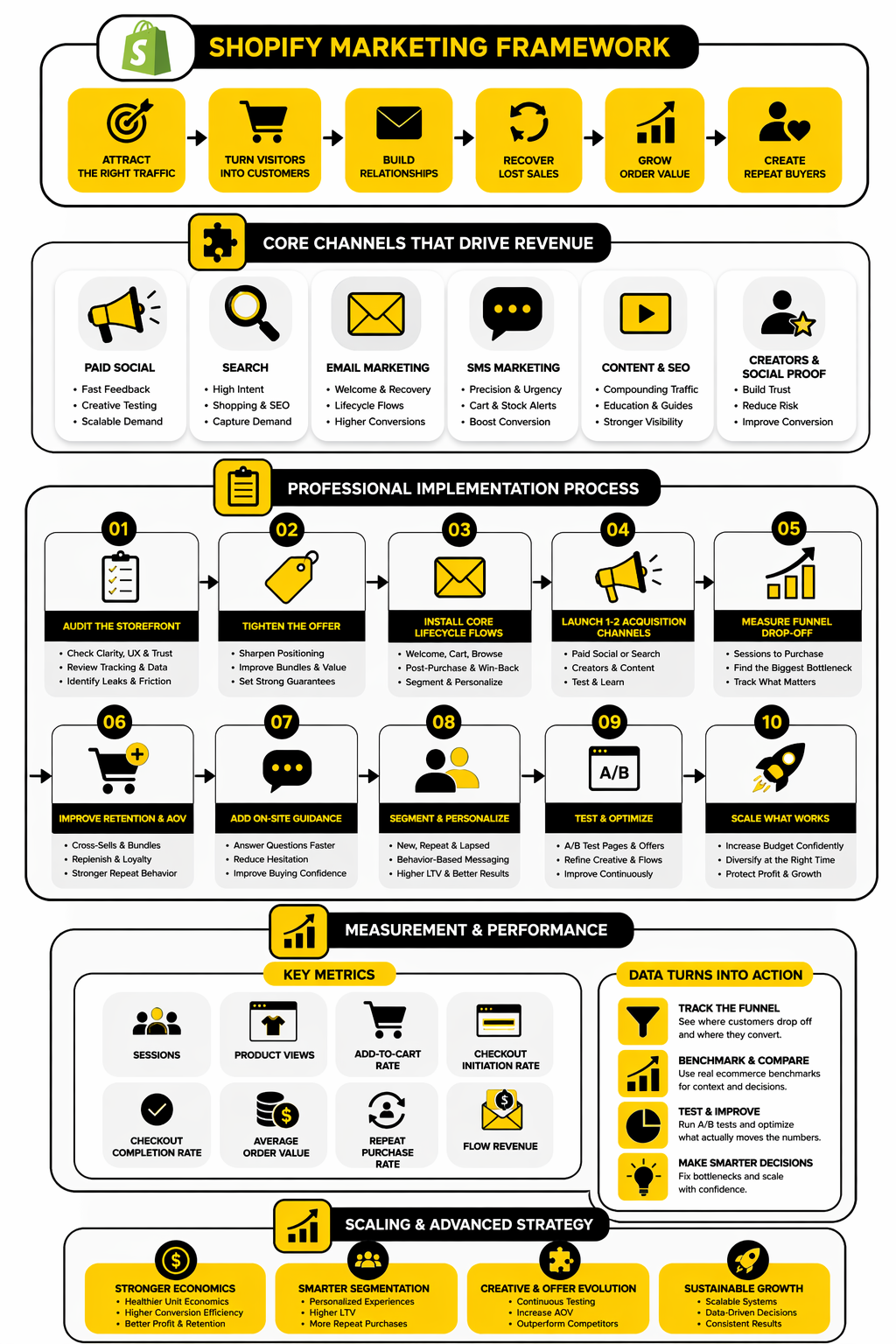
- The Shopify Marketing Framework
- Core Channels That Actually Move Revenue
- Conversion and Retention Systems That Compound
- Professional Implementation for Sustainable Growth
- Common Mistakes, Final Recommendations, and FAQ
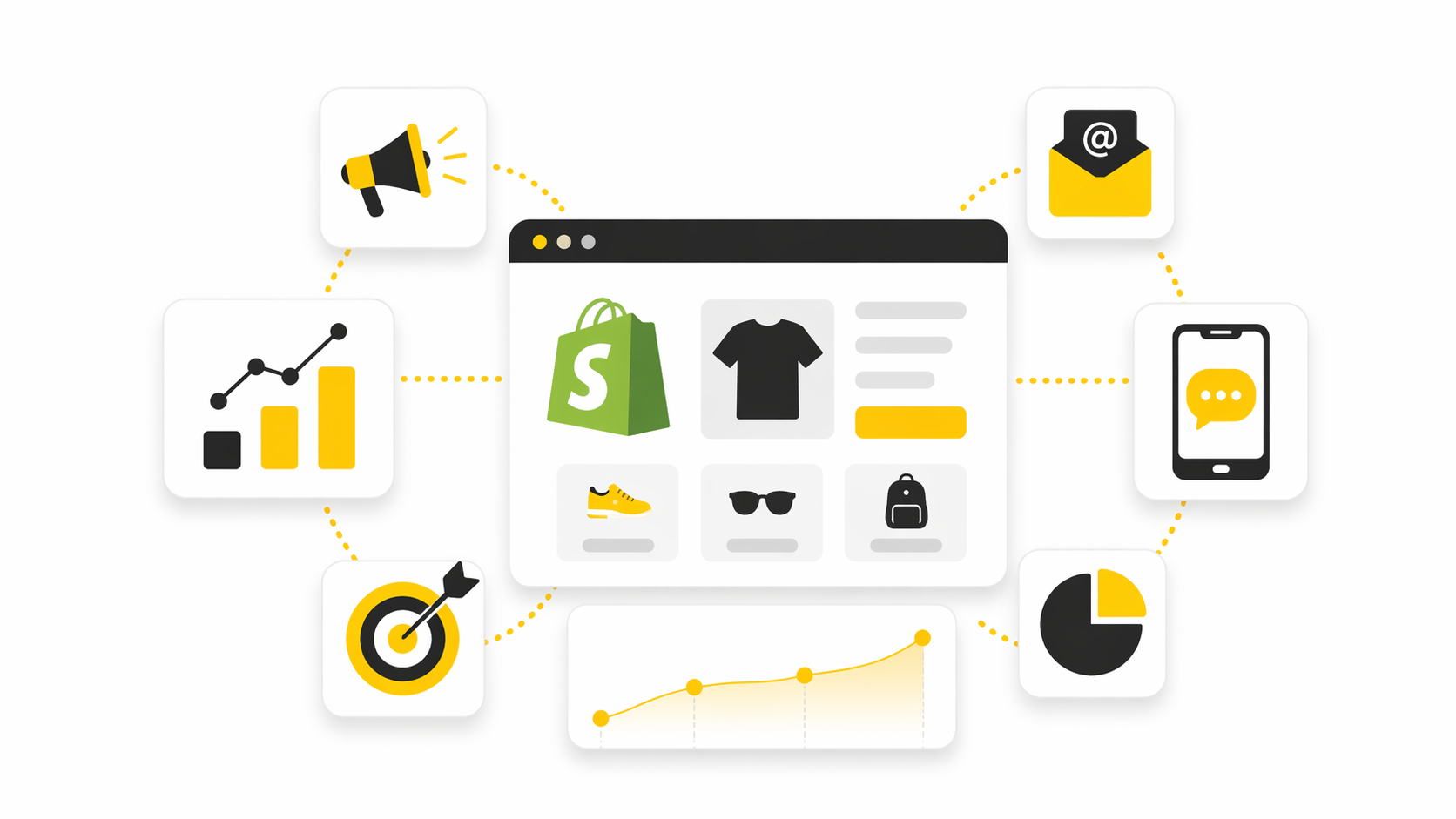
Why Shopify Marketing Matters More Than Ever
Shopify marketing matters because ecommerce has become less forgiving. Paid acquisition is more competitive, customer attention is fragmented, and shoppers compare products, prices, shipping, and trust signals in minutes. A store can have strong products and still underperform if its marketing system is disconnected.
That pressure changes how smart operators think. They stop treating marketing like a layer added after launch and start treating it as the mechanism that connects positioning, traffic, conversion, and retention. In practice, that means your ads, email flows, landing pages, creator content, search visibility, and post-purchase experience all need to reinforce the same promise.
This is also where Shopify has a real advantage. It gives brands one place to manage storefront experience, checkout, product data, apps, customer journeys, and reporting. When that foundation is used properly, Shopify marketing becomes less about random promotion and more about building a growth engine that gets stronger as the store collects more customer insight.
The Shopify Marketing Framework
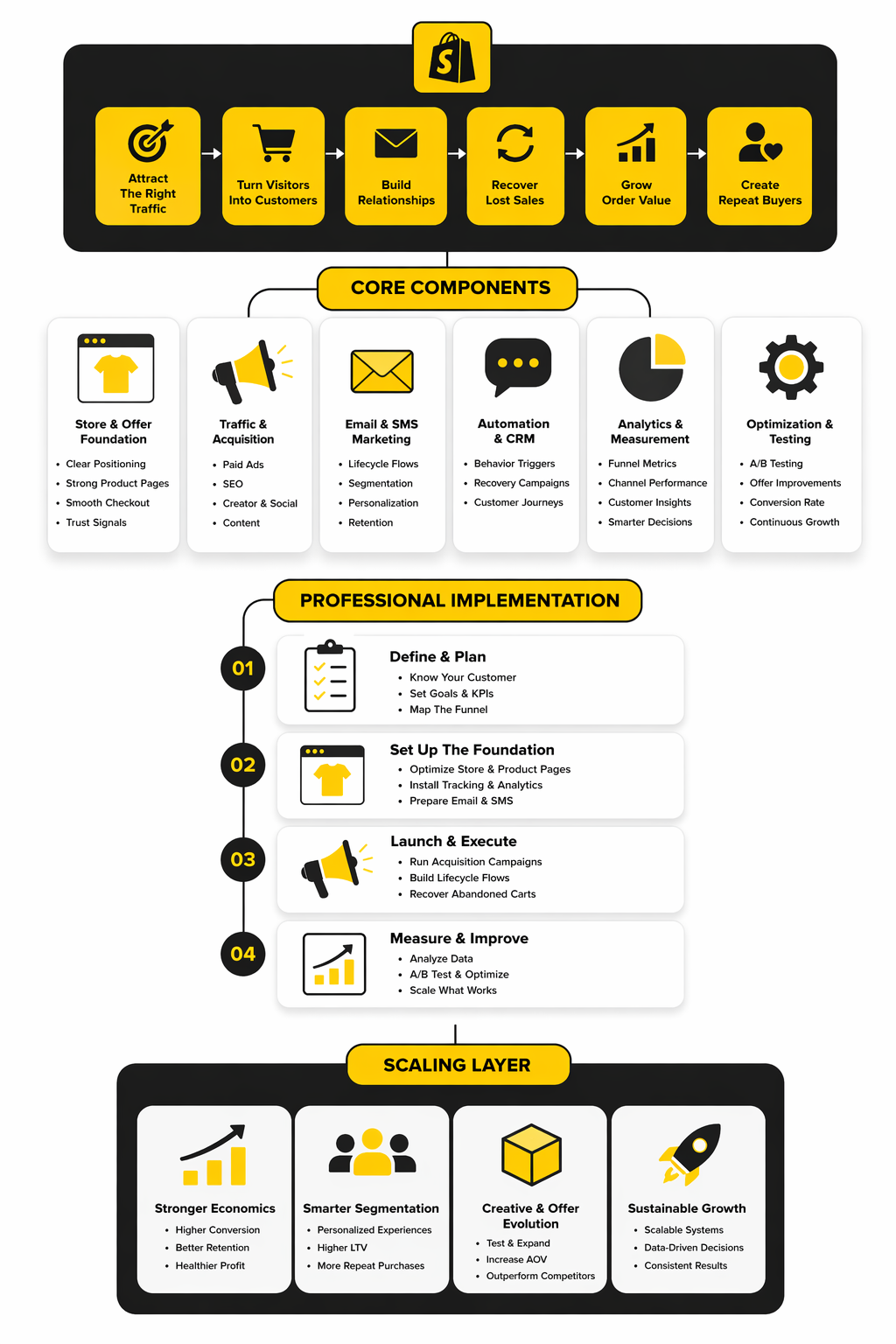
A useful way to think about Shopify marketing is in four layers. First, you create demand by getting in front of the right audience with the right message. Then you capture demand by sending that traffic to pages that make the next step obvious and easy.
After that, you convert demand by removing friction at product page, cart, and checkout level. Finally, you expand customer value through email, SMS, loyalty, upsells, subscriptions, and smart post-purchase follow-up. Most stores focus almost entirely on the first layer, which is exactly why performance becomes unstable.
The strength of this framework is that it forces balance. If traffic is weak, you know where to work. If traffic is healthy but sales lag, you look at merchandising, product page clarity, offer structure, and checkout friction. If first purchases are coming in but margins stay tight, retention becomes the lever that changes the economics.
What the Rest of This Article Will Build Toward
The next sections will move from channel selection into execution. We will look at which Shopify marketing channels deserve the most attention, how to connect them to conversion and retention systems, and what professional implementation looks like when you want growth that holds up beyond one good month.
That matters because tactics only work inside a structure. A discount campaign, an influencer test, or a paid social push can all generate movement, but without the right backend systems they usually create noisy results instead of dependable growth. The goal of the remaining parts is to help you build a Shopify marketing approach that is simpler, sharper, and much more profitable over time.
Core Channels That Actually Move Revenue
The biggest mistake in Shopify marketing is assuming every channel deserves equal effort. It does not. Most stores grow faster when they pick a small number of channels that match their buying cycle, price point, content capability, and margin structure, then build depth before expanding sideways.
That sounds obvious, but it is where a lot of ecommerce teams lose months. They try to run paid social, Google Ads, influencer outreach, SEO, email, SMS, affiliates, and organic social at the same time, which usually creates weak execution everywhere. A better approach is to build around the channels that generate intent, conversion, and repeat purchases in a way your store can actually sustain.
Paid Social for Fast Feedback and Scalable Demand Capture
Paid social still matters because it can generate demand before people are actively searching for a product. For many Shopify brands, that makes Meta one of the fastest ways to test creative angles, offers, product hooks, and audience resonance. The point is not just to buy traffic. The point is to learn which message reliably earns attention and purchases.
This channel works best when the product can be understood quickly and when the ad leads into a landing page that continues the exact same promise. If the ad is bold, the page cannot be vague. If the ad is specific, the page has to prove that specificity with visuals, benefits, reviews, delivery clarity, and a friction-light path to checkout.
Paid social also gets stronger when it is connected to retention instead of treated like a one-click revenue machine. That matters because ecommerce cart abandonment still hovers around 70% in Baymard’s tracked research, so a large share of the value from paid traffic is recovered after the first session through email, SMS, and remarketing rather than at the moment of the first click.
Search Captures Demand That Already Exists
Search plays a different role in Shopify marketing. It captures people who already know the problem they want solved or the product they want to compare. That makes search traffic incredibly valuable, but only when the store structure, product feed quality, and landing page relevance are tight.
For some stores, Google Shopping and branded search are the highest-intent acquisition channels in the entire mix. For others, non-branded search becomes more important as category awareness grows and the brand earns more reviews, backlinks, and product-specific visibility. Either way, search is rarely the place to hide weak positioning because searchers arrive with clearer expectations and less patience.
This is where merchandising and information architecture matter more than many founders expect. Collections need to be understandable, product titles need to reflect real buying language, and pages need to answer the questions a serious buyer has before they bounce. Shopify marketing looks much more effective when search traffic lands on pages built for decision-making instead of generic storefront templates.
Email Is Still One of the Highest-Leverage Assets You Can Build
Email continues to outperform because it monetizes attention you already paid for. It gives you a direct channel to recover abandoned carts, welcome new subscribers, announce launches, educate first-time buyers, and win back lapsed customers without paying again for the same reach. That is not old-school thinking. It is simply good economics.
Recent Shopify coverage on lifecycle performance shows that automated messages convert meaningfully better than many scheduled sends, with welcome and back-in-stock emails among the strongest automated formats. That should immediately change how you allocate effort. Broadcast campaigns matter, but the money usually comes from flows that fire at the right moment with the right context.
This is why strong Shopify marketing teams put real work into lifecycle architecture. They do not just install an email app and send occasional promotions. They build welcome sequences, cart recovery, browse abandonment, post-purchase education, replenishment timing, review requests, and win-back campaigns so every customer action triggers a relevant next step.
SMS Works Best as a Precision Channel, Not a Megaphone
SMS can be extremely effective, but it gets abused all the time. Brands treat it like a louder version of email, then wonder why opt-outs rise and response quality drops. The better way to use SMS is as a tighter, more immediate channel for high-intent moments where speed and visibility actually matter.
That usually means cart recovery, back-in-stock alerts, limited drops, shipping updates, and time-sensitive promotions tied to known customer behavior. Shopify’s enterprise content has highlighted how combining SMS and email in the same lifecycle flow can lift conversion versus email alone, which reinforces the bigger point: the real power comes from orchestration, not from blasting one channel harder.
Execution matters here more than enthusiasm. Consent collection, timing, segmentation, and message clarity have to be handled carefully. For stores that want stronger conversational automation tied to campaigns and lead capture, tools like ManyChat can fit naturally into a broader Shopify marketing system when the goal is to move shoppers into more personalized follow-up.
Content and SEO Build Compounding Returns
Content and SEO are slower than paid channels, but that is exactly why they matter. They create assets that can keep attracting qualified visitors without requiring a new media spend every single day. For a Shopify brand, that can include collection page optimization, product education, comparison content, gift guides, use-case pages, and post-purchase educational content that reduces friction and increases trust.
The reason this channel compounds is simple. Every useful page increases the surface area through which buyers can discover the brand, and every strong content asset can support search, email, social, and creator partnerships at the same time. It is one of the few marketing investments that can improve both acquisition efficiency and conversion quality if executed well.
The trap is publishing filler. Thin content written just to hit a keyword target usually does not help rankings or revenue. Good Shopify marketing content answers real pre-purchase questions, mirrors buyer language, and connects naturally to products, bundles, and collections without feeling forced.
Influencers, Creators, and Social Proof Reduce Perceived Risk
Creator partnerships work because shoppers trust people faster than they trust brand claims. That is especially true for products that benefit from demonstration, transformation, routine integration, or a strong point of view. The creator is not just borrowing attention. They are lending context.
For Shopify marketing, that means creators often do their best work in the middle of the funnel, where customers are trying to decide whether the product is credible, worth the price, and relevant to their lives. A good creator video can do in 30 seconds what a weak product page fails to do in three scrolls. It can show use, texture, contrast, emotion, and proof in a way static copy cannot.
The smart move is to think beyond one-off sponsorships. Strong brands turn creator content into reusable landing page assets, paid ad variations, testimonial systems, and review-style content blocks that improve conversion after the original post is gone. That is where the channel stops being a publicity play and starts becoming infrastructure.
Landing Pages Decide Whether Channels Pay Off
Every acquisition channel eventually runs into the same test: does the landing page deserve the click? This is where a lot of Shopify marketing breaks down, because traffic quality gets blamed for problems caused by page structure, weak merchandising, or unclear offers. Sometimes the channel is not the issue. The page is.
Shopify has published recent ecommerce benchmarks showing that email traffic to landing pages can convert far better than several other traffic sources, which makes sense because the intent is warmer and the message is more controlled. But the lesson is bigger than email. Matching the message, audience, and page structure is what unlocks performance across channels.
This is also why many fast-growing brands invest in better page-building flexibility. Tools like Replo are attractive in Shopify marketing because they let teams build more purposeful landing pages for launches, ads, bundles, and seasonal campaigns without being trapped by rigid theme limitations. When the page experience is stronger, the same traffic often becomes more valuable before you spend a dollar more on acquisition.
Channel Selection Should Follow Store Economics, Not Trends
A healthy Shopify marketing strategy does not start by asking which channel is hottest right now. It starts by asking what the store can support. Product margin, repeat purchase behavior, average order value, creative production speed, and customer decision time all shape which channels are viable.
A store with strong repeat purchase potential can justify more aggressive acquisition because retention improves payback. A store with a high-consideration product may need educational content, search intent capture, and stronger email nurturing before paid social can work at scale. A store with weak margins may need to focus on conversion rate and average order value before trying to buy more traffic.
That is the real point of channel strategy. You are not building a marketing stack to look sophisticated. You are building a revenue system that fits the economics of the business. In the next section, that becomes even more important, because channels only create real leverage when conversion and retention systems are strong enough to turn demand into durable profit.
Conversion and Retention Systems That Compound
Once traffic starts coming in, Shopify marketing stops being a channel problem and becomes a systems problem. This is the point where many stores waste demand because they have acquisition running, but the store experience, lifecycle flows, and measurement are still patched together. Real growth comes when those pieces start reinforcing each other.
The easiest way to think about it is simple. A visitor arrives with a question, the storefront answers it, the offer makes the decision easier, and the backend keeps the relationship alive after the first purchase. When that sequence is built properly, each new customer becomes more valuable than the last wave of traffic.
Start With the Product Page, Not the Ad Account
A lot of teams want to optimize ads first because ad dashboards feel more immediate. In practice, the product page usually decides whether Shopify marketing can scale profitably at all. If the page does not create clarity, trust, and momentum, better traffic just means you pay more efficiently for the same disappointment.
That means every serious implementation starts with the buying surface. The product page has to communicate who the product is for, what problem it solves, why it is different, what it costs, when it ships, and why the buyer should trust the brand right now. If any of that feels fuzzy, the store is forcing the customer to do the mental work that the page should have done.
This is also why design flexibility matters more than people admit. When you need campaign pages, launch pages, bundled offers, or high-conviction storytelling blocks, a more flexible page builder like Replo can make implementation faster because the marketing team can build pages around the conversion goal instead of bending the goal around the theme.
Build the Offer Before You Worry About Volume
Stores rarely have a pure traffic problem in the beginning. More often, they have an offer problem. The product may be good, but the bundle, guarantee, pricing logic, subscription angle, free shipping threshold, or first-order incentive is too weak to create urgency.
That matters because Shopify marketing performs best when the offer is easy to understand and easy to compare against the cost of inaction. A shopper should feel the value structure quickly. They should not need three pages, two popups, and a long FAQ just to understand why this purchase makes sense today.
A strong implementation process treats offers as assets that can be tested and refined. You are not just launching a product. You are deciding how that product is packaged, framed, and made easier to buy across cold traffic, warm traffic, and returning customer segments.
Retention Starts Before the First Purchase Is Complete
This is where many brands get caught. They think retention begins after fulfillment, when in reality it starts before checkout is even finished. The moment someone joins a list, starts a checkout, or places a first order, your Shopify marketing system should already know what sequence comes next.
That sequence should not be generic. New subscribers need a welcome path. Cart abandoners need recovery with context. First-time buyers need reassurance, education, and a reason to come back. Returning customers need a different message entirely because they already know the product, and repeating the same brand introduction just wastes attention.
Good lifecycle marketing feels less like chasing and more like continuity. Email platforms such as Brevo or Moosend become useful here when the goal is to map customer behavior into flows that feel timely instead of repetitive.
The Execution Process That Makes Shopify Marketing Work
Implementation gets much easier when the process is fixed. Without a clear sequence, teams jump between campaigns, creatives, discount ideas, and app installations without ever locking the core system. The better move is to build in layers and only add complexity after each layer is stable.
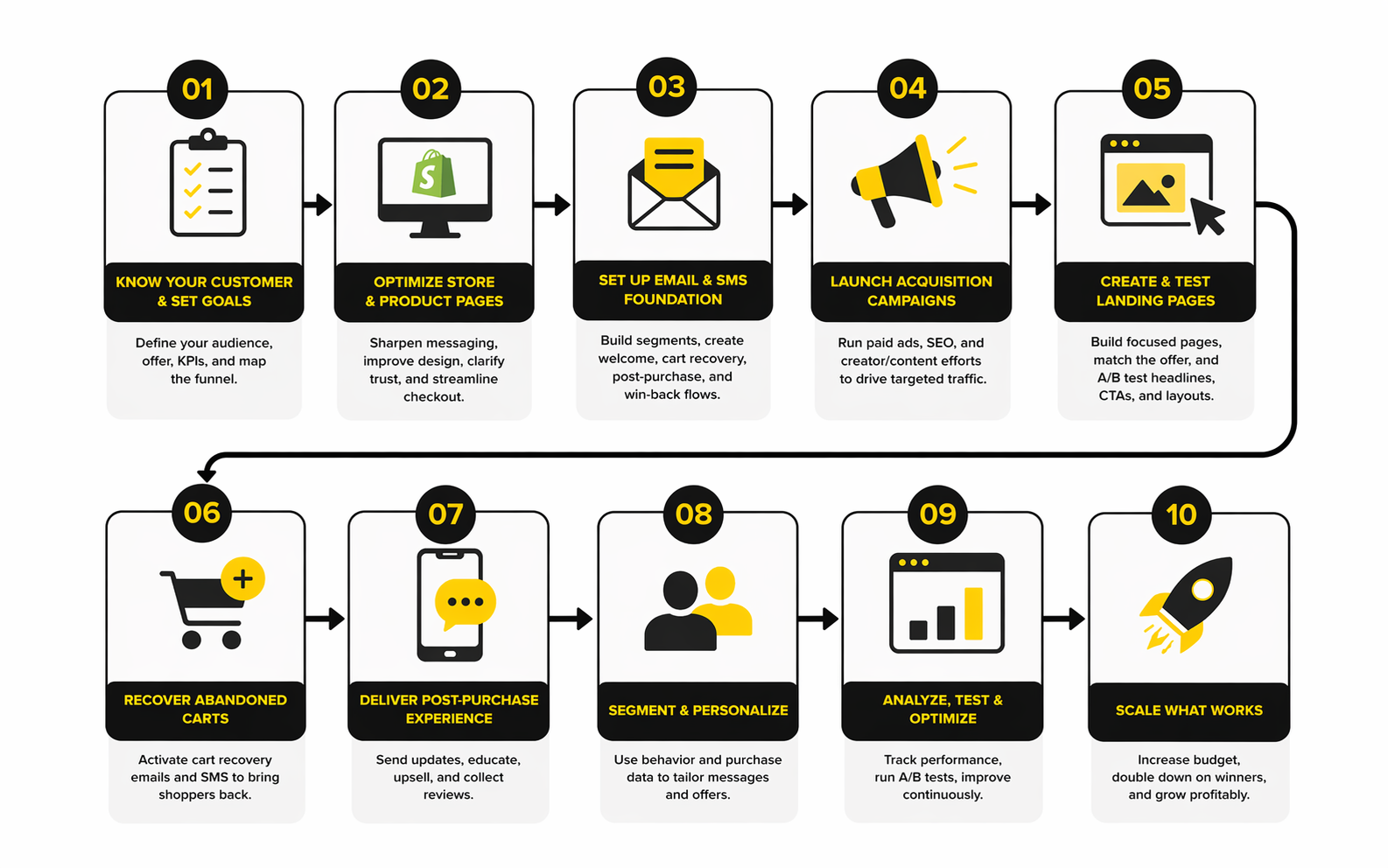
A practical Shopify marketing rollout usually looks like this:
- Audit the storefront
- Tighten the offer
- Install core lifecycle flows
- Launch one or two acquisition channels
- Measure funnel drop-off
- Improve retention and average order value before scaling harder
This order matters because it protects you from scaling chaos. If you buy more traffic before the store converts, you multiply waste. If you launch more channels before lifecycle is live, you leave money sitting in abandoned carts, unconverted subscribers, and one-time buyers who never hear from you again.
What to Audit First
The storefront audit should focus on the places where intent leaks. Look at homepage clarity, collection organization, product page hierarchy, offer framing, mobile experience, cart friction, checkout confidence, and post-purchase continuity. You are not trying to score the site on aesthetics alone. You are trying to find the points where buyer momentum slows down.
The next layer is tracking. Shopify marketing becomes expensive when teams cannot see where the breakdown happens. You need clean attribution logic, channel tagging, and a reporting rhythm that separates vanity metrics from buying behavior so you can tell whether the issue is click quality, add-to-cart rate, checkout completion, or repeat purchase performance.
Then comes lifecycle readiness. Before spending harder on traffic, make sure the store has a working welcome sequence, cart recovery, browse abandonment if relevant, post-purchase follow-up, and a win-back path. These do not need to be massive on day one, but they do need to exist and align with the store’s offer, voice, and customer intent.
Use Automation to Remove Lag, Not Humanity
Automation is valuable because it removes delay. It makes sure leads are followed up, customers get timely nudges, and routine communication happens without manual effort. But automation becomes destructive when it strips away relevance and turns the brand into a machine that keeps sending messages without listening.
That is why the best Shopify marketing systems automate triggers, segmentation, and delivery while keeping the message human. A cart reminder should sound like it belongs to the brand. A post-purchase email should help the customer succeed with the product. A replenishment reminder should arrive when it makes sense, not just because a timer expired.
If the store needs broader automation beyond basic campaigns, tools like GoHighLevel can fit into a more advanced operating stack for lead routing, nurture logic, and multi-step follow-up. The key is using software to increase precision, not to flood the customer with more noise.
Segmentation Is Where the Economics Improve
Once the basics are live, segmentation becomes one of the biggest levers in Shopify marketing. New visitors, engaged subscribers, first-time buyers, repeat buyers, and lapsed customers should not all hear the same thing. Their objections are different, their urgency is different, and the next best action is different.
This is where stores often start to feel sharper. The welcome flow becomes more useful because it reflects source and intent. Cross-sell messaging gets better because it follows real purchase behavior. Win-back becomes more credible because it acknowledges time since last order, product type, and likely reason for churn.
The financial effect is bigger than it first appears. Better segmentation improves conversion, but it also reduces wasted sends, protects deliverability, and makes each acquisition dollar work harder because more customers actually enter a profitable second or third purchase path.
Customer Support and On-Site Guidance Are Part of Marketing
A surprising number of brands separate support from Shopify marketing, which is a mistake. Questions about sizing, delivery, product fit, ingredients, compatibility, or returns are not support problems in isolation. They are conversion barriers, and the brand that removes them faster usually wins.
That is why on-site guidance matters. Live chat, quizzes, guided recommendations, and clear decision support can reduce hesitation before it turns into abandonment. The more complex the catalog or buying decision, the more valuable this layer becomes.
For brands that want a faster way to add always-on assistance, tools like Chatbase can support a more responsive buying experience when it is trained around real customer questions and connected to the store’s actual product logic. Used well, that is not a gimmick. It is a friction-reduction tool.
Professional Implementation for Sustainable Growth
Professional implementation is mostly about discipline. It means resisting the urge to keep adding tactics before the current system earns more responsibility. It means documenting what changed, what was tested, what improved, and what still looks weak instead of relying on memory and momentum.
It also means giving ownership to the right layers. Someone should own merchandising. Someone should own lifecycle. Someone should own creative testing. Someone should own reporting. When Shopify marketing becomes “everyone does a bit of everything,” quality slips and no one can explain why performance moved.
The strongest teams operate with a weekly rhythm. They review funnel metrics, identify the biggest bottleneck, decide which test matters most, launch it cleanly, and then learn from real buyer behavior. That rhythm is what turns a Shopify store from a campaign-driven business into a compounding system.
In the next section, we will look at what that professional setup needs in practice, including how to structure team workflows, choose the right tools, and avoid the implementation mistakes that quietly kill performance even when the store seems busy.
Reading the Numbers That Matter
By this point, Shopify marketing should already feel less like a collection of campaigns and more like an operating system. That means measurement becomes the difference between scaling with confidence and reacting to noise. The goal is not to admire dashboards. The goal is to understand which numbers reveal buyer intent, where revenue is leaking, and what change should happen next.
A lot of store owners look at revenue first and stop there. Revenue matters, obviously, but it is a lagging signal. If you want to improve performance before the month is over, you need to watch the numbers that explain why revenue moved, not just whether it moved.
Start With Funnel Metrics, Not Vanity Metrics
The cleanest way to measure Shopify marketing is to track the customer journey in order. That means looking at sessions, product views, add-to-cart rate, checkout initiation, checkout completion, average order value, repeat purchase rate, and contribution by channel. When those are lined up properly, you stop guessing.
This matters because a single weak number tells a very different story depending on what surrounds it. A low conversion rate with a healthy add-to-cart rate points to checkout friction or pricing shock. A low add-to-cart rate with decent traffic often points to weak product pages, poor offer framing, or mismatched traffic expectations.
Shopify’s own analytics documentation emphasizes this exact point: the platform is built to show sales, sessions, top landing pages, customer behavior, and channel performance in one reporting environment so merchants can connect traffic patterns to store outcomes rather than evaluate each data point in isolation with no context. That is what useful Shopify marketing measurement looks like in practice, not just in theory.
Conversion Rate Needs Context or It Misleads You
Conversion rate is one of the most watched ecommerce metrics for a reason. It tells you how efficiently the store turns visits into orders. But it becomes dangerous when people treat it like a universal score instead of a context-dependent signal shaped by price point, traffic source, product category, device mix, and buying intent.
Recent Shopify benchmark coverage shows how wide the range can be, with examples from global ecommerce datasets landing around 1.6% in one Statista benchmark and 2.95% in another Dynamic Yield benchmark referenced by Shopify. That spread is the point. It tells you not to obsess over a single number without understanding what kind of traffic and offer produced it.
In practical terms, Shopify marketing teams should use conversion rate as a diagnostic layer, not a bragging metric. If your conversion rate is below target, the next question is not “How do I get more traffic?” It is “Where in the buying path are visitors losing conviction?” That is a much more useful question, and it leads to better action.
Add-to-Cart Rate Is Often the Faster Signal
Add-to-cart rate usually reacts faster than purchase conversion when something changes on the store. That is why it is one of the best early indicators for whether new traffic is qualified and whether the product page is doing its job. If add-to-cart improves after a page update or offer change, you know buyer interest moved before full purchase data has even settled.
Healthy ranges vary, but current ecommerce benchmark reporting from Triple Whale suggests that an add-to-cart rate below 5% often signals a product page or offer issue, while 7% to 10% tends to reflect stronger shopper interest. That should not be turned into a rigid law. It should be used as directional guidance that prompts investigation.
For Shopify marketing, the action is straightforward. If traffic is landing but very few people add items to cart, do not jump straight into checkout optimization. Fix page clarity, product imagery, value communication, price presentation, reviews, bundle logic, and mobile usability first. The cart only matters once people actually want what is on the page.
Cart Abandonment Is a Warning Light, Not a Surprise
Cart abandonment is one of the clearest signs that buyer intent exists but the final steps are underperforming. Baymard’s current rolling benchmark puts average documented abandonment at 70.22% across 50 studies, and Shopify’s enterprise content uses that same benchmark to explain why checkout optimization has such an outsized financial impact on ecommerce stores.
That number matters because it reframes the problem. If seven out of ten shoppers who have shown meaningful buying intent still leave, then Shopify marketing cannot be judged on traffic acquisition alone. A store with expensive acquisition and a weak checkout experience is basically paying to create disappointment at scale.
Baymard’s more recent checkout UX benchmark makes the action even clearer by arguing that large ecommerce sites can unlock as much as a 35% improvement in conversion through checkout design changes. The lesson is not that every store will gain 35%. The lesson is that checkout quality is often under-optimized enough to materially change the economics of the whole business.
The Analytics System Should Show You What To Do Next
A good reporting setup does not overwhelm the team with tabs, filters, and disconnected attribution stories. It should answer four questions quickly. Where is traffic coming from, what are those visitors doing, where are they dropping off, and which customer groups are becoming profitable over time.
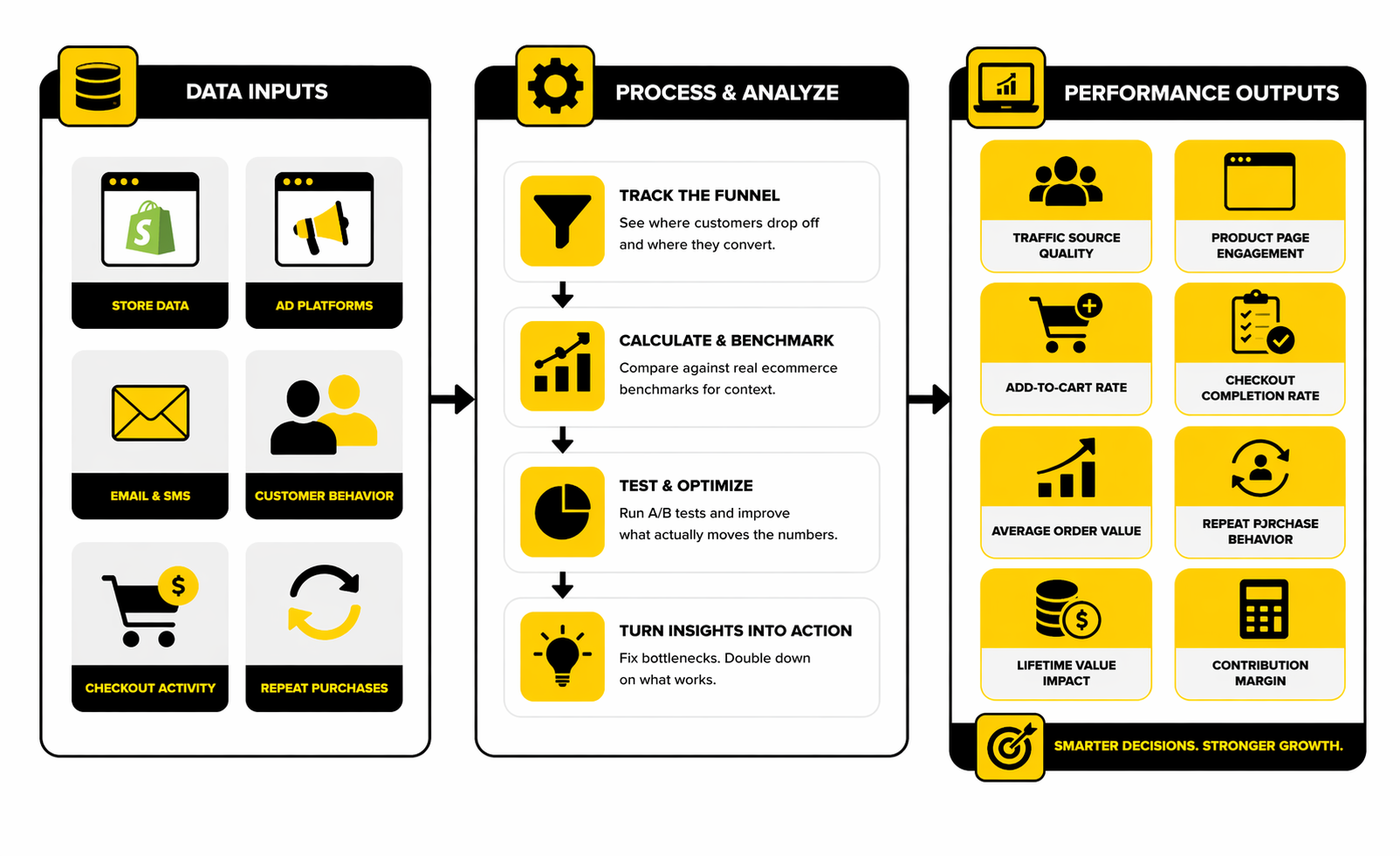
This is the point where your Shopify marketing stack needs to move from observation to decision support. Shopify’s analytics layer is useful because it already centralizes sales, sessions, landing page performance, web behavior, and transaction reporting in one place, which makes it easier to spot patterns before the team starts exporting everything into ten different spreadsheets. But even with strong built-in reporting, the real advantage comes from deciding in advance which metrics trigger action.
A clean operating view usually includes:
- sessions by source and campaign
- product page view rate
- add-to-cart rate
- checkout initiation rate
- checkout completion rate
- average order value
- customer acquisition cost when paid media is active
- revenue by first-touch and last-touch views where possible
- repeat purchase rate by cohort
- email and SMS flow revenue versus campaign revenue
That list works because it connects behavior to money. It tells you whether the problem is awareness, interest, conversion friction, or retention weakness. Most importantly, it stops the team from celebrating traffic spikes that never turn into durable customer value.
Email and SMS Metrics Tell You Whether Retention Is Real
Lifecycle performance needs its own interpretation because strong retention programs do not always look flashy on the surface. Klaviyo’s recent benchmark reporting shows that average email campaign placed order rates across industries sit around 0.16%, with the top 10% at 0.36%. On its own, that number can look underwhelming to someone who does not understand lifecycle economics.
The more important comparison is between campaigns and triggered flows. Klaviyo’s enterprise benchmark content reports average placed order rates of 0.05% for campaigns versus 1.23% for automated flows in mid-market and enterprise brands. That is exactly why automation matters so much in Shopify marketing. Behavior-based messages arrive at moments when customer intent is already present.
This changes the action you should take. If campaign metrics look fine but flow revenue is weak, the issue is not list size. It is lifecycle architecture. Welcome, browse abandonment, cart recovery, post-purchase, replenishment, and win-back flows usually deserve improvement before the brand spends more time designing another broadcast calendar.
Average Order Value Is a Margin Lever, Not Just a Nice Bonus
Average order value gets treated like a secondary KPI, but for many stores it is the fastest way to improve acquisition math without buying more clicks. If your store can raise average order value through bundles, threshold offers, subscriptions, or intelligent cross-sells, you make every channel work harder immediately. That is a direct Shopify marketing advantage because it reduces the pressure on conversion rate and paid media efficiency at the same time.
The trick is interpreting AOV correctly. AOV rising is not automatically good if margins are being destroyed by discounts or if the increase comes from one unusual spike instead of a repeatable pattern. You want to know whether the lift came from stronger merchandising, better bundling, higher-value customers, or promo dependence.
That is why AOV should always be paired with contribution margin and cohort behavior when possible. A store can look stronger on surface-level reporting while quietly training customers to wait for discounts. Shopify marketing gets much more stable when AOV grows because value presentation improved, not because pricing discipline disappeared.
Benchmarks Are Useful Only When They Trigger Better Questions
Benchmarks help because they tell you whether you are far outside a healthy range. They become harmful when they turn into identity. Your store is not failing because it is below some generalized ecommerce average, and it is not great just because one metric looks strong in isolation.
The better use of benchmarks is diagnostic. If your abandonment rate is close to a broad market average, that still does not mean checkout is fine. If your email campaign numbers are normal, that still does not mean lifecycle is strong. If your conversion rate is decent but repeat purchase rate is weak, the real problem may only show up in customer lifetime value six weeks later.
That is the mindset professional Shopify marketing teams use. They read benchmarks as prompts, not verdicts. They ask what the number says about buyer behavior, then they change the page, the offer, the flow, or the channel strategy that sits behind the number.
What the Data Should Drive Next
The point of analytics is action. If conversion is weak, fix the offer and product page hierarchy. If add-to-cart is healthy but checkout completion is poor, reduce friction, improve transparency, and tighten the checkout experience. If first purchase performance is fine but repeat behavior is soft, build stronger post-purchase education, segmentation, and win-back systems.
This is where measurement becomes strategic instead of cosmetic. Shopify marketing gets stronger when every major KPI has an owner, a target range, and a next-step rule attached to it. Otherwise, dashboards become a weekly ritual that feels sophisticated while changing nothing.
The next section will turn that into execution discipline. We will look at the mistakes that distort performance, the habits that keep growth healthy, and how to build a Shopify marketing system that stays sharp as the store scales.
Advanced Strategy, Scaling Risks, and Expert-Level Tradeoffs
The hard part of Shopify marketing is not getting something to work once. The hard part is keeping it profitable as spend rises, channels mature, and the easy gains disappear. That is where strategy matters more than enthusiasm.
Early growth often hides structural weakness. A store can look strong while benefiting from novelty, underpriced acquisition, or a small group of highly responsive customers. Then scale arrives, creative fatigue kicks in, margins tighten, and the business discovers that what looked like a marketing engine was really a narrow pocket of demand.
Scaling Usually Breaks on Economics Before It Breaks on Reach
Most stores do not run out of people to target first. They run into weaker unit economics. As budgets rise, traffic usually gets broader, conversion efficiency tends to soften, and the margin for error gets thinner, which is why Shopify marketing has to be managed against profit logic rather than platform excitement.
That is also why retention becomes such a strategic advantage at scale. Shopify’s enterprise guidance on customer retention frames repeat buyers as the most profitable audience because they already know the brand, tend to convert more easily, and improve the return on earlier acquisition spend through higher lifetime value over time. When that layer is weak, scaling paid channels becomes much riskier because every new customer has to justify acquisition cost almost entirely on the first order.
The more disciplined move is to ask one uncomfortable question before raising budgets: does this store become healthier as volume grows, or does it just become busier? Shopify marketing only scales well when the answer is the first one.
Attribution Gets Messier as the Business Grows
At small scale, attribution can feel relatively straightforward. You launch a campaign, traffic spikes, orders rise, and the connection looks obvious. As the store adds more touchpoints, more creators, more email automation, more branded search, and more repeat customers, that clarity starts to disappear.
Google’s measurement guidance around data-driven attribution and GA4 attribution models reflects this shift. Modern customer paths are multi-touch, cross-device, and increasingly shaped by privacy-preserving measurement, which means Shopify marketing decisions get worse when teams rely on one simplistic source of truth and treat it as absolute.
The practical answer is not to chase perfect attribution, because perfect attribution does not exist. The answer is to use a decision framework that compares directional signals across platform reporting, Shopify analytics, first-party behavior, cohort trends, and blended business outcomes. That is how serious operators avoid making expensive choices based on partial credit assignment.
Privacy Changes Reward First-Party Strength
Privacy changes have made weak operating models more exposed. Google’s analytics documentation highlights cookieless measurement, behavioral modeling, and privacy controls in GA4, which tells you exactly where the market has moved. Brands can no longer assume every interaction will be tracked cleanly forever.
For Shopify marketing, that raises the value of first-party data immediately. Email capture, SMS consent, account creation, quiz responses, zero-party data, post-purchase survey inputs, and clean customer segmentation all become more important when third-party visibility gets less complete. The store that owns more direct customer insight usually makes better decisions faster.
This also affects channel strategy. Brands that overdepend on rented audiences and weak internal data often feel more volatility than brands that have built strong lifecycle programs, clear segmentation, and useful on-site journeys. Privacy pressure does not kill good marketing. It punishes lazy measurement and shallow customer understanding.
Creative Fatigue Is a Real Growth Constraint
At some point, even strong ads stop pulling the same weight. The audience sees the same angles too often, click-through rates soften, conversion costs rise, and the team starts blaming the platform when the real issue is repetition. Shopify marketing at scale is often limited by creative throughput more than media buying sophistication.
That is why the best operators treat creative as a system, not a one-time asset. They continuously test new hooks, new offers, new opening frames, new proof formats, new landing page angles, and new creator integrations. They understand that the job is not to find one winning ad. It is to build a repeatable process that keeps producing new winners.
This is one of the most important scaling truths in ecommerce. If the product is good and the economics are sound, stale messaging becomes one of the fastest ways to choke growth. Strong creative operations protect the business from that plateau.
Channel Diversification Is Good, but Timing Matters
Diversification sounds smart, and in principle it is. In practice, a lot of stores diversify too early. They add channels because they are nervous about concentration risk, but they do it before the core system is stable enough to support more moving parts.
That usually creates a messy middle. Reporting gets murkier, execution quality drops, and the team spends more time coordinating channels than improving the parts that already work. Shopify marketing becomes harder, not stronger.
The better approach is staged diversification. First, make one paid channel and one owned channel work together. Then add search or creator partnerships with a clear role. Then expand into SEO, affiliate structures, or broader automation once the reporting and operations can absorb the complexity. Diversification is powerful when it is earned. It is distracting when it is premature.
Tool Choice Should Follow Operating Complexity
Not every store needs a bigger stack. Some stores simply need to use Shopify and their existing tools better. Others reach a point where more flexible pages, stronger automation, better CRM logic, or cleaner lead routing become genuinely useful.
That is where tool selection should be practical, not aspirational. A more advanced automation environment like GoHighLevel can make sense when the business needs broader workflow control, deeper follow-up sequences, or more centralized campaign operations. A direct scheduling layer such as Cal.com can make sense if the offer includes consultations, demos, or guided buying. A lightweight coordination layer like Anything.com or a process assistant such as Guideless can fit when execution bottlenecks are operational rather than creative.
The key is avoiding the classic mistake of buying software to compensate for unclear strategy. Tools can accelerate strong Shopify marketing. They do not rescue weak positioning, weak offers, or weak operating discipline.
Team Structure Becomes a Performance Variable
As the store grows, the question stops being “what should we try next?” and becomes “who owns the outcome?” This is where a lot of promising brands quietly slow down. The founder is still approving everything, no one fully owns lifecycle, paid media and merchandising are not aligned, and reporting is interpreted differently by every person in the room.
Professional Shopify marketing needs ownership. Someone has to own store conversion. Someone has to own lifecycle revenue. Someone has to own creative testing. Someone has to own acquisition efficiency and channel mix. When that structure is missing, performance usually becomes inconsistent because insights do not turn into decisions fast enough.
This is not about building bureaucracy. It is about making sure real leverage points have real accountability. Growth becomes much easier to protect when responsibilities are clear.
The Biggest Risk Is Mistaking Activity for Progress
This may be the most common expert-level failure mode in Shopify marketing. The team is busy, campaigns are launching, creatives are shipping, flows are firing, dashboards are full, and everyone feels like momentum exists. But the important economic signals are flat or getting worse.
Shopify’s broader DTC coverage has been emphasizing profitability, customer retention, and durable growth over simple top-line excitement, and that emphasis is absolutely correct. Revenue without improving customer quality, margin quality, or retention quality can turn into a very expensive illusion.
That is why mature teams keep coming back to the same questions. Is acquisition getting healthier or harder? Is retention getting stronger or weaker? Is average order value rising for the right reasons? Is the store learning faster than the market around it? Those questions protect Shopify marketing from becoming performance theater.
What Strong Shopify Marketing Looks Like When It Matures
At maturity, Shopify marketing feels calmer, not louder. The store knows its best channels, understands its customer segments, has reliable lifecycle architecture, measures the right things, and tests changes with discipline instead of panic. That does not mean growth becomes easy. It means growth becomes more intelligible.
The strongest brands also develop a better instinct for tradeoffs. They know when to push acquisition and when to protect margin. They know when to simplify the offer and when to expand it. They know when to add a tool, when to ignore a trend, and when to fix a process that is quietly holding the whole business back.
That is the real standard. Not constant motion. Not endless experimentation. Not looking advanced on paper. Just a Shopify marketing system that creates demand, converts it efficiently, retains customers intelligently, and stays economically sound as the company grows.
The final section will bring this together with the most common mistakes, the clearest takeaways, and a practical FAQ that answers the questions store owners usually ask once they are ready to execute seriously.
Common Mistakes and Final Recommendations
The last thing to understand about Shopify marketing is that most failure does not come from a lack of tactics. It comes from broken sequencing. Stores push traffic before the product page is convincing, run email before segmentation is thoughtful, add tools before the operating model is clear, and scale spend before they understand whether the business is actually getting healthier.
Another common mistake is measuring performance too narrowly. Teams obsess over ROAS, click-through rate, or top-line sales while ignoring repeat purchase behavior, checkout completion, contribution margin, and flow revenue. That is how brands end up with busy dashboards and weak economics.
The better path is almost boring, and that is exactly why it works. Tighten the offer, sharpen the storefront, build lifecycle properly, measure the funnel honestly, and only then push harder on acquisition. Strong Shopify marketing usually looks less flashy than people expect, but it compounds much better.
There is also a strategic mindset shift that matters here. You are not trying to win every channel, publish every content format, or install every app. You are trying to build a store that attracts the right people, helps them buy with confidence, and creates enough customer value after the first sale to keep the whole engine profitable.
That is the real finish line. Not more activity. Not more tools. Not more noise. Just a Shopify marketing system that becomes more efficient, more intelligent, and more resilient as the store grows.
FAQ - Built for Complete Guide
What is Shopify marketing in practical terms?
Shopify marketing is the system a store uses to attract visitors, convert them into customers, and bring them back for future purchases. In practice, that includes paid ads, search, creator content, email, SMS, landing pages, merchandising, and retention flows working together rather than separately. The reason this matters is simple: a store rarely grows because of one tactic alone, especially when repeat customers become the most profitable audience over time.
Which channel should a new Shopify store focus on first?
Most new stores should not start with five channels at once. A better starting point is one acquisition channel and one owned channel, usually something like paid social or search paired with email capture and basic lifecycle flows. That gives Shopify marketing enough structure to generate traffic, learn from intent, and retain a portion of that demand instead of paying for every visit again.
Is SEO still worth it for Shopify stores?
Yes, but only if the store is willing to create pages that genuinely help buyers make decisions. SEO works best when collection pages, product pages, comparisons, buying guides, and use-case content answer real questions instead of just chasing keywords. The advantage is that useful content can keep compounding while supporting search visibility, brand trust, and conversion quality at the same time.
How much should I rely on paid ads?
Paid ads are valuable, but they should not carry the whole business alone. As budgets rise, many brands discover that scaling pressure shows up first in weaker economics rather than in a total lack of audience reach, which is why retention and average order value matter so much once acquisition expands. Good Shopify marketing uses paid media as a growth lever, not as a substitute for a weak offer or a weak store experience.
What is a good conversion rate for a Shopify store?
There is no single conversion rate that makes sense for every store, because category, traffic quality, price point, device mix, and buying intent all change the number. Shopify’s current benchmark roundup highlights how ecommerce averages can land in different ranges, including examples around 1.6% in one benchmark and 2.95% in another. The smarter move is to use conversion rate as context and then look at add-to-cart, checkout completion, and repeat purchase behavior to understand what it actually means.
Why do so many shoppers abandon cart on ecommerce stores?
Because intent is fragile, especially near checkout. Baymard’s current benchmark still puts average documented cart abandonment at 70.22%, which shows just how often stores lose people after they have already shown meaningful buying intent. That is why Shopify marketing cannot be judged only by traffic generation, because checkout friction, surprise costs, weak trust signals, and poor UX can destroy value after the hardest part is already done.
How important are email and SMS for Shopify marketing?
They matter more than many founders assume because they monetize attention the store already earned. Klaviyo’s recent enterprise benchmark reporting shows a major gap between average placed order rates from email campaigns and automated flows, which reinforces why triggered lifecycle messages deserve serious attention. Email and SMS are not side channels when implemented well. They are part of the profit system.
Should I use a landing page builder for Shopify?
If the store runs campaigns, launches products often, or needs pages built around specific conversion goals, then yes, it can make sense. Tools like Replo are useful because they let teams build more intentional pages for offers, bundles, seasonal promotions, and paid traffic journeys without relying entirely on theme limitations. The key is using the extra flexibility to improve message match and conversion, not just to make prettier pages.
When does automation become necessary?
Automation becomes necessary as soon as manual follow-up starts creating lag or inconsistency. Welcome flows, cart recovery, post-purchase education, replenishment reminders, and win-back sequences should not depend on someone remembering to send the next message. For stores that need broader workflow control, a platform like GoHighLevel can fit naturally into a more advanced Shopify marketing setup when the process complexity actually justifies it.
How do I know whether my analytics setup is good enough?
A good analytics setup tells you what to do next, not just what already happened. It should show traffic source quality, product page engagement, add-to-cart behavior, checkout progress, average order value, and repeat purchase patterns in a way that helps the team find the biggest bottleneck quickly. Google’s official guidance on attribution in GA4 and its overview of privacy-aware analytics features such as cookieless measurement and behavioral modeling also make it clear that modern measurement is directional and multi-touch, not perfectly precise.
What should I fix first if traffic is coming in but sales are weak?
Start with the product page and the offer before blaming the channel. If people are landing but not adding products to cart, the issue is often page clarity, trust, visual proof, pricing logic, or overall offer strength rather than the traffic source itself. Shopify marketing scales much better when the store earns the click after it receives it.
How many apps should a Shopify store use?
Fewer than most stores currently use. Apps should solve real operating problems such as page flexibility, lifecycle automation, customer support, segmentation, or scheduling, not pile on more complexity because a feature sounds interesting in a demo. The strongest Shopify marketing stacks are usually focused, integrated, and disciplined rather than oversized.
Does creator marketing actually help ecommerce conversion?
Yes, especially for products that benefit from demonstration, social proof, or routine-based use. A strong creator asset can reduce perceived risk faster than a brand-written headline because the shopper sees the product in context rather than as a claim on a page. The best stores then reuse creator assets across ads, product pages, landing pages, and retention systems so the value lasts longer than the original post.
What is the biggest mistake when scaling Shopify marketing?
The biggest mistake is confusing activity with progress. A store can be launching more campaigns, publishing more content, and spending more money while the underlying economics quietly get worse. That is why mature Shopify marketing teams keep coming back to customer quality, retention quality, and profit quality instead of assuming that more motion automatically means better growth.
Work With Professionals
Explore 10K+ Remote Marketing Contracts on MarkeWork.com
Most marketers spend too much time chasing clients, competing on crowded platforms, and losing a percentage of every project to middlemen. MarkeWork gives you a better way. Browse thousands of remote marketing contracts and connect directly with companies desperate to hire skilled marketers like you, without platform commissions and without unnecessary gatekeepers.
If you're serious about finding better opportunities and keeping 100% of what you earn, explore available contracts and create a profile for free at MarkeWork.com.