

Social media marketing is no longer just posting consistently and hoping something works. It now sits across content strategy, audience research, short-form video, community building, analytics, paid distribution, automation, and customer experience. That is why searching for skillshare social media marketing can be useful, but only if you know what skills to learn first and which classes actually fit your goals.
Skillshare works best when you treat it like a skill-building library, not a magic shortcut. Its social media marketing category includes classes built around quick lessons, projects, and creator-led instruction, which makes it useful for learning by doing rather than only watching theory. The real opportunity is building a learning path that connects strategy, content, execution, and measurement into one working system.
Article Outline
This article is split into six parts so each section can go deeper without turning into a scattered list of tips. The structure follows the order a serious marketer, creator, freelancer, or small business owner should use when learning social media marketing. Each part builds on the previous one, so the full guide feels like one practical roadmap.
- Why Skillshare Social Media Marketing Matters Now
- The Learning Framework For Choosing The Right Classes
- Core Skills Every Social Media Marketer Needs
- How To Turn Lessons Into A Working Content System
- Professional Implementation For Brands, Creators, And Agencies
- Tools, Workflows, Mistakes, And FAQ
Why Skillshare Social Media Marketing Matters Now
Social media has become one of the main places people discover brands, evaluate products, and decide who they trust. DataReportal reported 5.79 billion social media user identities worldwide in April 2026, which shows why social media skill is no longer optional for anyone trying to grow online through content, community, or paid campaigns. Pew’s 2025 research also shows how broad platform use has become in the U.S., with YouTube and Facebook still reaching large adult audiences while Instagram, TikTok, WhatsApp, and Reddit continue shaping younger and more segmented audiences.
That matters because the job has changed. A good social media marketer now needs to understand platform behavior, creative formats, customer psychology, analytics, and brand positioning at the same time. The 2025 Social Media Marketing Industry Report highlighted video as a major focus for marketers, while HubSpot’s social media trends research points to social search, AI-assisted workflows, community-led growth, and short-form video as major forces shaping strategy.
Skillshare can help because it gives learners a way to build those skills in smaller, practical blocks. You can study content planning one day, short-form video the next, and analytics after that. The mistake is treating random classes as a strategy; the smarter move is using Skillshare as a structured training library.
The Learning Framework For Choosing The Right Classes
The best way to approach Skillshare social media marketing is to choose classes based on outcomes, not titles. A beginner does not need twenty disconnected classes on Instagram hacks, TikTok trends, and Canva templates. They need a sequence that starts with strategy, moves into content production, then adds analytics, systems, and campaign execution.
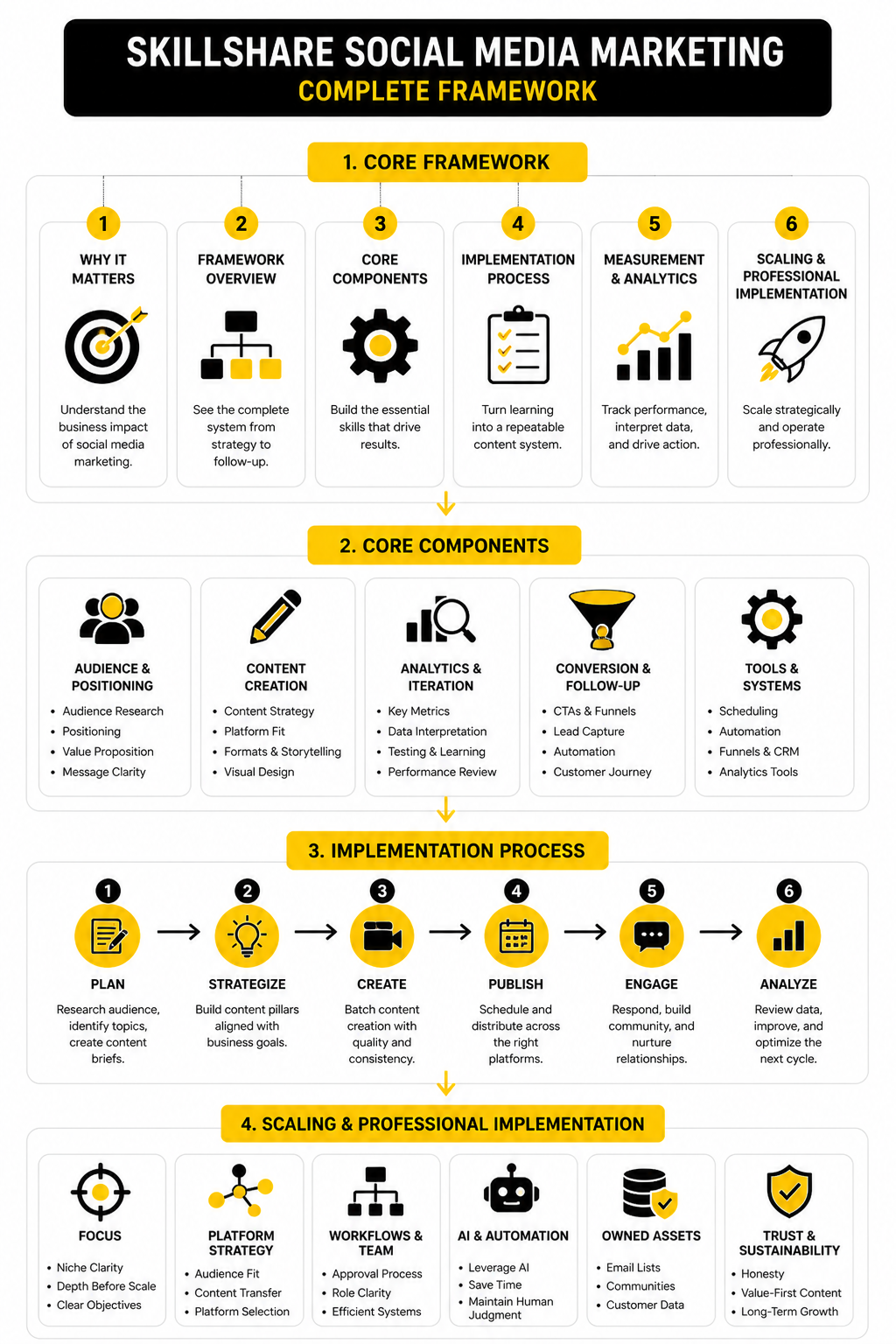
A strong framework has four layers. First, learn audience and positioning so your content has a reason to exist. Second, learn platform-native content creation so your posts fit the way people actually consume media. Third, learn distribution and engagement so the content reaches people and starts conversations. Fourth, learn measurement so you know what to improve instead of guessing.
This is also where tools become useful, but only after the strategy is clear. A scheduling platform like Buffer can support consistency, while a tool like Flick Social can help with hashtag and content planning workflows. The tool is not the strategy, though; it simply makes the strategy easier to execute.
Core Skills Every Social Media Marketer Needs
The next step is deciding what to learn before you get distracted by platform tactics. Skillshare social media marketing classes can be useful, but the strongest results come from stacking skills in the right order. You want a foundation that still works when algorithms change, formats shift, or a new platform becomes popular.
Start with audience research. This means learning how to identify what people care about, what problems they are trying to solve, what objections stop them from buying, and what content they already engage with. Without this layer, every post becomes a guess, and guessing is expensive even when the platform is free.
Then move into content strategy. A useful content strategy connects business goals with audience needs, so every post has a role. Some posts attract new people, some build trust, some create demand, and some move people toward the next step.
Positioning And Audience Clarity
Positioning is the reason someone should pay attention to you instead of the next creator, brand, or agency. It shapes your message, your content pillars, your offers, and even the platforms you choose. A good Skillshare class in this area should help you define the audience, the promise, the angle, and the reason your content matters.
Audience clarity also protects you from copying random trends. Trends can help distribution, but they are not a strategy by themselves. When you know who you are speaking to, you can decide which trends are worth using and which ones will only dilute your brand.
This is where many beginners go wrong. They start with “how do I grow on Instagram?” before they know who they want to attract. A sharper question is “what does my ideal audience need to believe before they trust me enough to follow, subscribe, inquire, or buy?”
Content Creation And Platform Fit
Social media content has to match the platform where it appears. A post that works on LinkedIn may feel too slow for TikTok, while a TikTok-style video may feel too casual for a B2B audience unless the execution is handled carefully. The skill is not simply making content; it is adapting ideas to the behavior of each platform.
Skillshare can help here because many classes focus on practical creative execution. You can learn short-form video structure, caption writing, visual design, content batching, storytelling, and basic editing without needing a full production team. That matters because HubSpot’s 2025 social media research identifies short-form video, community, AI-assisted content, and social search as major themes shaping how marketers create and distribute content.
The key is to avoid learning production tricks in isolation. A better path is to connect every creative skill to a repeatable content system. For example, a video editing class is more useful when you already know your hook style, your audience promise, and the call to action behind each post.
Analytics And Iteration
Analytics is where social media marketing becomes professional. You are not just checking likes because they feel good. You are looking for signals that show whether your content is attracting the right people, earning attention, creating engagement, and supporting the business goal behind the account.
The most useful metrics depend on the objective. Awareness content may focus on reach, watch time, shares, and profile visits. Conversion-focused content may care more about link clicks, inquiries, email signups, booked calls, or purchases.
This is why a serious learning path should include reporting and interpretation. You need to understand what changed, why it might have changed, and what you will test next. A scheduler such as Buffer can help organize publishing, but the real value comes from using performance data to improve the next batch of content.
Conversion And Follow-Up
Social media does not end at the post. If someone comments, clicks, sends a message, downloads a resource, or books a call, the follow-up experience matters. This is where many creators and small businesses lose momentum because attention is created on social but not captured anywhere reliable.
That is why social media marketers should understand simple funnels, landing pages, email capture, and message automation. You do not need to overbuild this at the start. You just need a clear next step for people who are interested.
For creators, consultants, and agencies, tools like ManyChat can support comment-to-DM workflows, while Systeme.io or ClickFunnels can help turn traffic into email subscribers, leads, or buyers. Learn the marketing logic first, then choose the tool that fits the workflow.
How To Turn Lessons Into A Working Content System
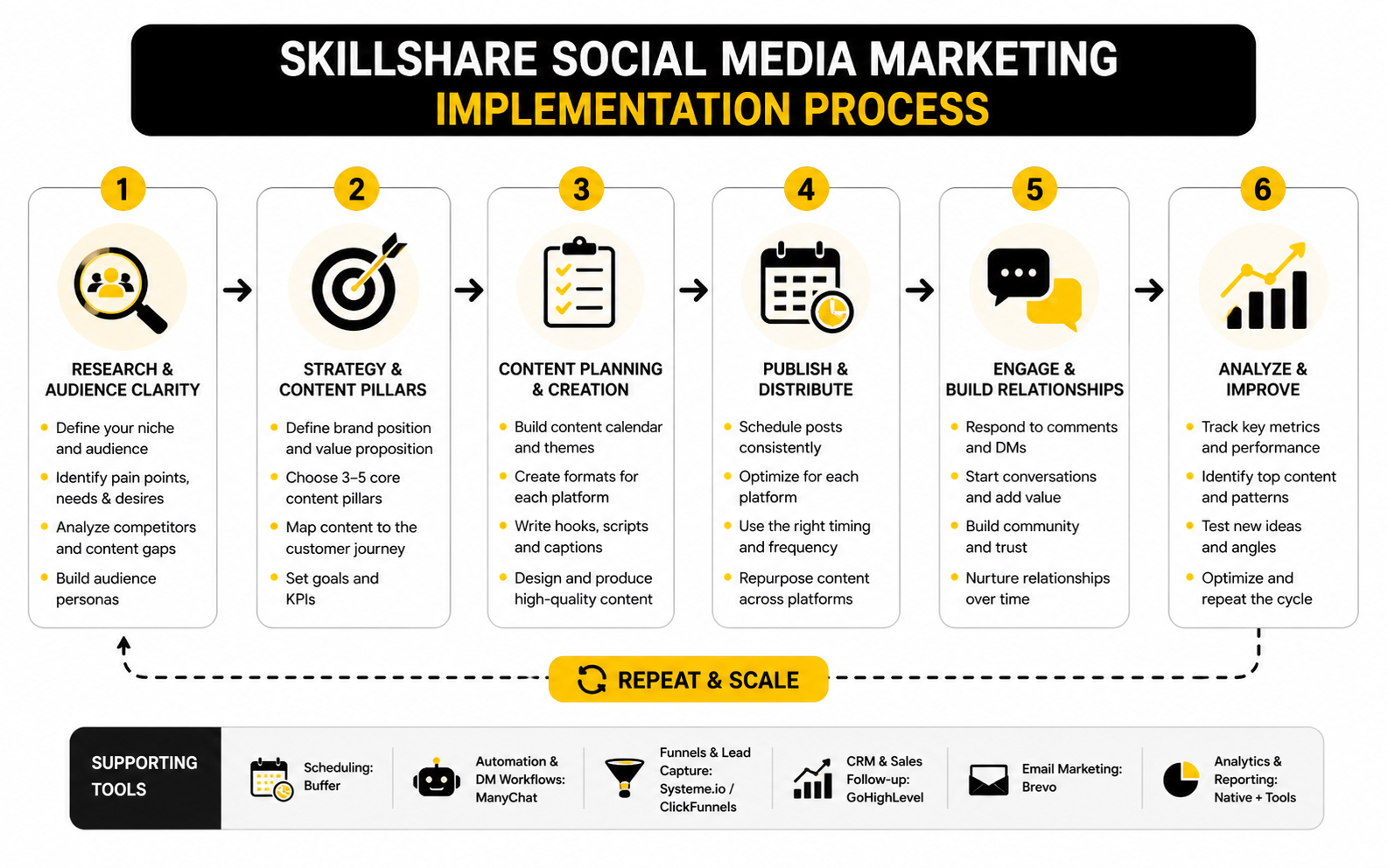
Once the core skills are clear, the next move is implementation. This is where most learners either build momentum or quietly disappear. Watching Skillshare social media marketing classes feels productive, but the real progress comes when you turn each lesson into a repeatable process.
A working content system does not need to be complicated. It needs to help you decide what to publish, create it faster, distribute it consistently, and learn from the results. The goal is not to make social media feel effortless; the goal is to make it manageable enough that you can keep improving without burning out.
Start by choosing one main objective for the next 30 days. That objective might be awareness, audience growth, lead generation, community engagement, or offer validation. When the goal is clear, the content decisions become much easier because every idea can be judged against the same standard.
Step 1: Build A Simple Content Brief
A content brief turns a loose idea into something you can actually create. It should define the audience, the problem, the angle, the platform, the format, the hook, the proof point, and the next step. This keeps your content from drifting into generic advice that sounds fine but does not move anyone.
For example, instead of writing “post about Instagram growth,” a useful brief would clarify who the post is for and what belief it should change. A freelancer, ecommerce founder, local business owner, or creator will not need the same message. The more specific the brief, the easier it becomes to create content that feels relevant.
This is one reason project-based learning works well for social media. Skillshare classes often include assignments, and those assignments should become assets inside your system. Do not complete a project just to finish the class; turn it into a template, swipe file, checklist, or draft you can reuse.
Step 2: Create Content Pillars That Support The Business
Content pillars are not random categories. They are strategic lanes that keep your message consistent while giving you enough variety to publish regularly. A strong set of pillars usually includes education, perspective, proof, connection, and conversion.
Education helps people solve smaller problems and understand your expertise. Perspective shows how you think, which is important because people follow voices, not just information. Proof builds trust through results, demonstrations, process breakdowns, or credible observations.
Conversion content should not feel like begging for sales. It should make the next step obvious for people who are already interested. If your business depends on calls, demos, memberships, courses, or services, your content system needs posts that naturally point people toward that path.
Step 3: Batch Creation Without Making Everything Feel Robotic
Batching is powerful when it protects your energy, but dangerous when it makes every post feel lifeless. The point is not to mass-produce boring content. The point is to separate thinking, writing, recording, editing, and scheduling so each stage gets proper attention.
A practical weekly flow might look like this:
- Research audience questions and competitor patterns.
- Choose 5 to 10 ideas that match your content pillars.
- Write hooks and outlines before creating full posts.
- Record or design the assets in one focused block.
- Schedule the content and leave space for timely posts.
- Review performance at the end of the week.
This process makes Skillshare learning more valuable because every class can improve one part of the workflow. A writing class can sharpen hooks. A video class can improve retention. A design class can improve clarity. A strategy class can improve the whole system.
Step 4: Add Distribution And Engagement Routines
Publishing is not the finish line. Social media rewards content that earns attention and conversation, so engagement needs to be part of the process instead of an afterthought. That means responding to comments, starting useful conversations, repurposing strong ideas, and giving people clear reasons to take the next step.
A tool like Buffer can help you schedule content across platforms, which is useful when consistency is the bottleneck. For creators or brands that rely on Instagram comments and DMs, ManyChat can support automated follow-up when someone asks for a resource, guide, or link. Used properly, automation removes friction without removing the human part of the relationship.
The important word is properly. Automation should never replace trust-building. It should help interested people get the next step faster, while you keep the actual content, positioning, and offers honest.
Step 5: Review Results And Upgrade One Skill At A Time
The fastest way to improve is to review performance with a narrow lens. Do not try to fix your hooks, posting frequency, design, editing, platform choice, and offer at the same time. Pick one constraint, improve it, then measure again.
If reach is weak, look at the hook, topic relevance, format, and platform fit. If engagement is weak, look at clarity, emotional relevance, and whether the post invites a real response. If leads are weak, look at the call to action, offer alignment, landing page, and follow-up.
This is where a learning library becomes a serious advantage. Instead of randomly watching another class, you can choose the next Skillshare lesson based on the specific bottleneck in your system. That is how you turn learning into implementation instead of endless preparation.
Statistics And Data That Actually Matter
Measurement is where skillshare social media marketing stops being a learning project and becomes a business process. The point is not to collect every possible number from every platform. The point is to know which signals matter, what they mean, and what decision they should drive.
A useful analytics system separates vanity metrics from decision metrics. Vanity metrics can still be helpful, but only when they are interpreted correctly. A post with high reach and no relevant engagement may be good for awareness, but weak for trust. A post with fewer views and strong saves, replies, clicks, or inquiries may be far more valuable.
Recent benchmark data also shows why context matters. Rival IQ’s 2025 benchmark report found that engagement rates declined across major platforms, including Facebook, Instagram, TikTok, and X, which means lower engagement does not always mean your content suddenly became worse. The smarter question is whether your performance is improving against your own baseline and whether it is moving the right audience toward the right action.
Build Your Measurement System Around The Funnel
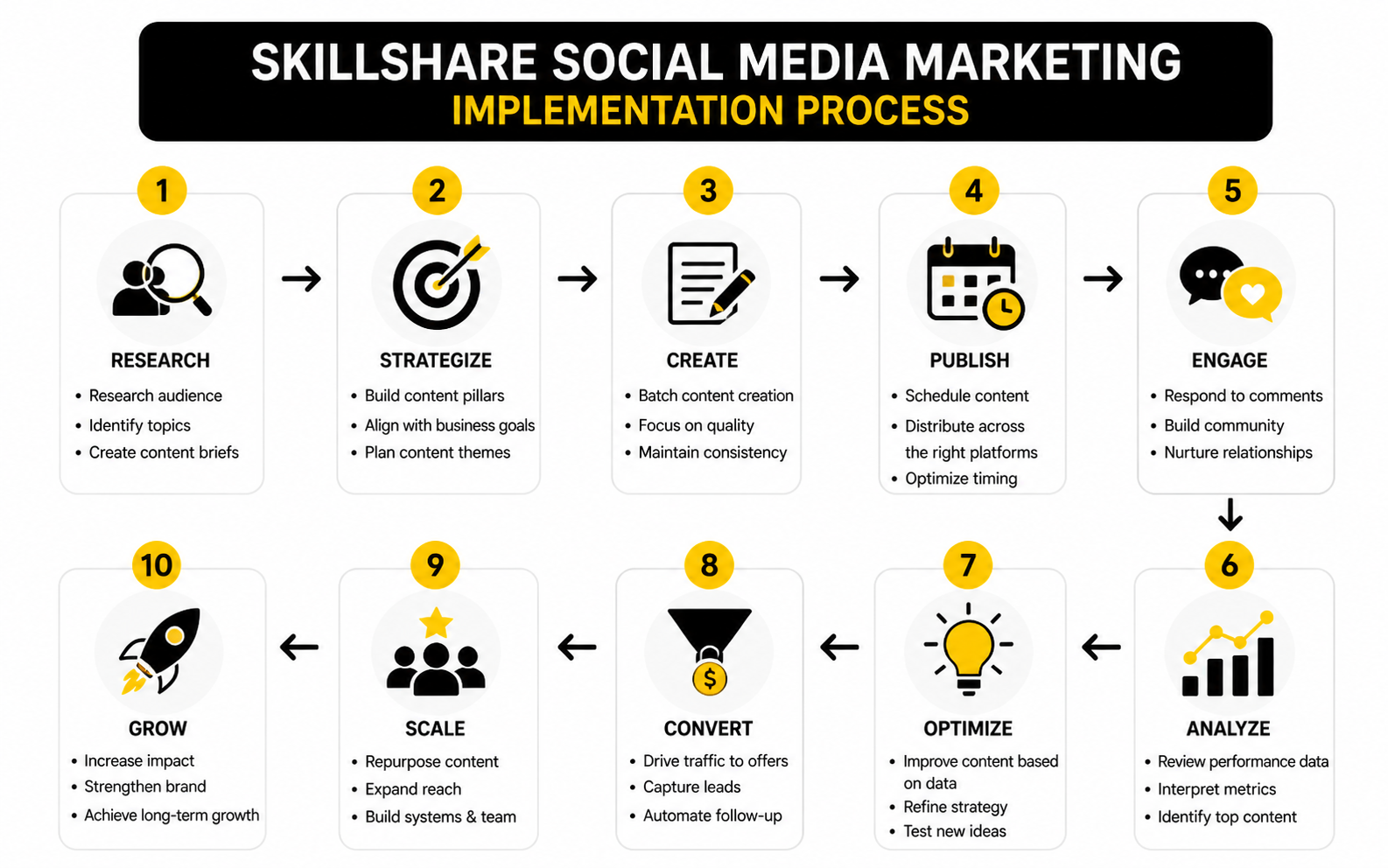
The easiest way to make analytics useful is to map metrics to the customer journey. At the top of the funnel, you measure whether people are discovering you. In the middle, you measure whether they care enough to engage, save, share, follow, or return. At the bottom, you measure whether social activity creates leads, sales conversations, subscribers, or customers.
For awareness, track reach, impressions, video views, profile visits, and follower growth. For trust, track saves, shares, comments, watch time, repeat viewers, and direct messages. For conversion, track link clicks, landing page visits, email signups, booked calls, checkout starts, and purchases.
This is where many marketers get sloppy. They judge every post by the same metric, then wonder why the data feels confusing. A post designed to teach should not be judged the same way as a post designed to sell.
Know The Difference Between Benchmarks And Baselines
Benchmarks show what is happening across a market, industry, or platform. Baselines show what is normal for your own account. Both are useful, but they solve different problems.
Industry benchmarks help you understand whether a platform is getting harder, easier, or more competitive. For example, Emplifi’s 2025 benchmark research reported that Instagram Reels continued to outperform TikTok on average reach engagement in its dataset, while video became a larger share of brand posting activity. That does not mean every brand should blindly post Reels all day. It means video deserves serious testing if your audience is active on Instagram.
Your baseline is more practical day to day. If your average Reel gets 1,000 views and one gets 4,000, study the hook, topic, format, timing, and retention pattern. If your average carousel gets 30 saves and one gets 120, turn that topic into more content, a lead magnet, or a sales angle.
Read Performance Signals Like A Marketer
Good analytics is pattern recognition. A weak hook usually shows up as low early retention, low watch time, or low engagement relative to reach. A weak topic shows up when people see the content but do not react, save, share, or click. A weak offer shows up when content earns trust but does not turn into action.
If reach is low but engagement rate is strong, the content may be relevant but under-distributed. Test stronger hooks, more platform-native formatting, or a different posting time. If reach is high but conversion is low, the post may be attracting broad attention without enough buying intent.
This is why the best marketers do not panic after one post. They look across clusters of content. One post can be noise, but ten posts around the same pillar can reveal whether the message is working.
Track Leading And Lagging Indicators
Leading indicators tell you whether your social media system is moving in the right direction before revenue shows up. These include publishing consistency, hook performance, content output, saves, shares, comments, profile visits, and email signups. They help you improve the machine before judging the final outcome.
Lagging indicators show the business result. These include sales, booked calls, customer acquisition cost, pipeline value, retention, and revenue influenced by social. They matter most, but they usually take longer to measure.
A practical dashboard should include both. Tools like GoHighLevel can help agencies and service businesses connect leads, conversations, appointments, and follow-up in one place, while Brevo can support email and CRM workflows after someone leaves the social platform. The lesson is simple: social metrics matter more when they connect to a follow-up system.
Turn Analytics Into Action
Data should create decisions. If it does not change what you publish, test, improve, or stop doing, it is just decoration. A monthly analytics review should end with a small set of specific actions, not a vague feeling that “we need better content.”
A useful review can answer five questions:
- Which content pillars created the strongest attention?
- Which formats created the deepest engagement?
- Which topics produced the most saves, shares, replies, or clicks?
- Which calls to action moved people forward?
- What will we test next month?
This is the discipline that turns Skillshare lessons into compounding improvement. Learn the skill, apply it to a real content system, measure the signal, and then choose the next lesson based on the bottleneck. That is how social media marketing becomes a professional practice instead of a guessing game.
Professional Implementation For Brands, Creators, And Agencies
At this stage, the conversation moves from learning social media marketing to operating it professionally. That is a different game. A learner can experiment loosely, but a business needs priorities, accountability, workflows, and a clear reason for every major activity.
This is where skillshare social media marketing becomes most useful as a support layer, not the whole system. You use classes to improve specific skills, but the business still needs a strategy that matches its offer, audience, budget, team, and sales process. The sharper your operating model, the easier it is to decide what to learn next.
Professional implementation starts with one uncomfortable truth: more content is not always the answer. Sometimes the bottleneck is weak positioning. Sometimes it is poor follow-up. Sometimes it is a mismatch between the audience you attract and the offer you are trying to sell.
Choose Depth Before Scale
Scaling social media too early creates noise. If your message is unclear, publishing more often only spreads the confusion faster. If your offer is not converting, more reach may simply expose the weakness to a larger audience.
The better move is to prove depth first. Build a small set of content pillars, test them consistently, and learn which messages attract the right people. Once the message is working, then you can scale formats, platforms, creators, ads, and automation.
This is especially important for service businesses and agencies. A local business, coach, consultant, or B2B company does not need viral reach as much as it needs qualified attention. Ten serious inquiries can be more valuable than 100,000 casual views.
Know When To Add Another Platform
Every platform has a cost. Even if posting is free, strategy, creative work, editing, engagement, reporting, and management are not free. Adding another platform too early often weakens the platforms that were already starting to work.
A smart expansion decision should be based on audience fit, content transferability, and operational capacity. If your strongest content is short-form video, expanding from Instagram Reels to TikTok or YouTube Shorts may be realistic. If your strongest asset is expert commentary, LinkedIn or long-form newsletters may deserve more attention.
The tradeoff is simple. More platforms can increase reach, but they also increase complexity. Do not expand because a trend report says a platform is hot; expand because your audience is there and your team can execute well.
Build A Real Approval Workflow
As soon as social media involves more than one person, workflow matters. Without a clear approval system, content gets delayed, feedback becomes vague, and everyone quietly loses confidence in the process. This is where professional marketers separate creative speed from operational chaos.
A simple approval workflow should define who owns strategy, who creates the draft, who reviews brand accuracy, who checks compliance, and who publishes. It should also define what kind of feedback is useful. “Make it pop” is not feedback; “the hook does not match the target audience’s pain point” is feedback.
For agencies, this matters even more. Clients often judge social media work by visible output, but the real value is in the thinking behind the output. A clear workflow helps protect that thinking while keeping delivery predictable.
Balance AI Speed With Human Judgment
AI can speed up research, ideation, repurposing, outlines, and first drafts. That is useful. But AI does not automatically understand your market, your customers, your offer, your voice, or the emotional context behind why people buy.
HubSpot’s 2025 social media research highlights AI-powered strategies as a major trend, but the practical takeaway is not “let AI run your brand.” The takeaway is that marketers who use AI carefully can move faster while still relying on human judgment for positioning, taste, accuracy, and trust.
Use AI for leverage, not laziness. Let it help you draft variations, summarize research, organize content calendars, and repurpose posts. Then have a human sharpen the angle, remove generic language, check claims, and make sure the content sounds like it came from someone with actual experience.
Turn Social Attention Into Owned Assets
One of the biggest risks in social media marketing is building everything on rented attention. Platforms change rules, reach fluctuates, accounts get restricted, and audience behavior shifts. If all your value lives inside the platform, you are vulnerable.
The fix is not to abandon social media. The fix is to use social media as the front door to owned assets: email lists, communities, customer databases, booked calls, and direct relationships. That makes every good post more valuable because it does not end when the feed refreshes.
For simple funnels, Systeme.io can help creators and small businesses capture leads and deliver offers. For higher-volume service businesses, GoHighLevel can connect landing pages, pipelines, calendars, messaging, and follow-up. The tool should match the business model, not the other way around.
Protect Trust As You Scale
Trust is the hardest asset to build and the easiest to damage. Edelman’s 2025 brand trust research points to relevance, responsiveness, and clear action as major trust drivers, which fits what people already feel online. They do not want polished noise; they want useful, honest, timely communication.
This matters when scaling content, creators, automation, and paid campaigns. If your account starts publishing more but becomes less useful, scale has made the brand weaker. If automation makes the experience feel cold or misleading, efficiency has cost you trust.
The professional move is to scale what already works without stripping out the human signal. Keep the voice clear. Keep promises specific. Keep offers honest. And when the data says something is getting attention but hurting trust, do not be afraid to stop doing it.
Tools, Workflows, Mistakes, And FAQ
The final layer is the ecosystem around the work. Skillshare social media marketing can help you learn the skills, but skills need a workflow, and workflows need the right tools, boundaries, and habits. Otherwise, you end up with scattered lessons, half-built systems, and content that never becomes a real growth asset.
A good social media ecosystem connects learning, planning, creation, publishing, engagement, measurement, and follow-up. Each part should support the next one. If one part is missing, the whole system gets weaker.
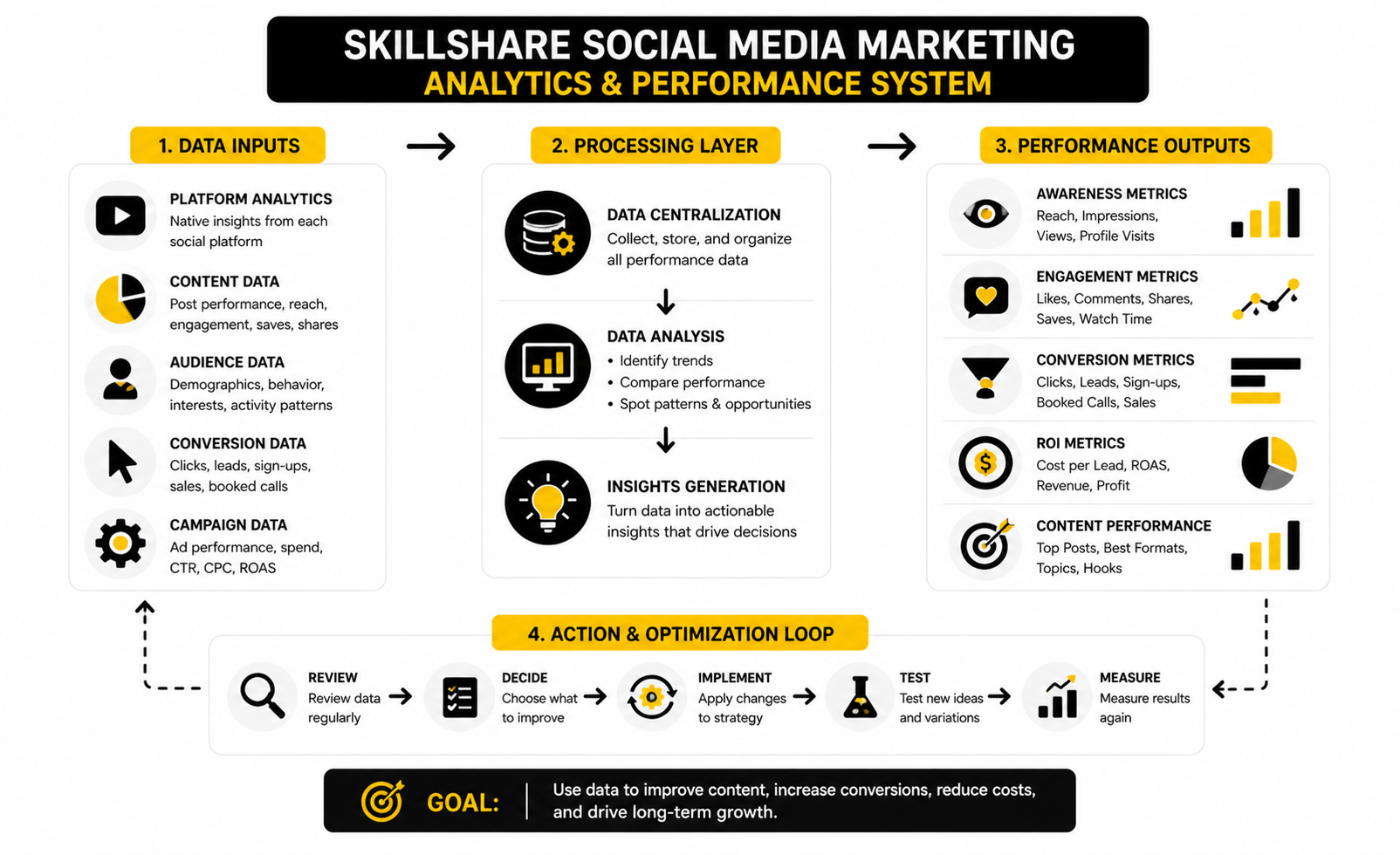
The Practical Tool Stack
You do not need a giant software stack to do good social media marketing. You need a few tools that solve real bottlenecks. Start with planning, publishing, lead capture, follow-up, and reporting before adding advanced tools.
For scheduling and cross-platform publishing, Buffer is a clean choice when consistency is the main problem. For Instagram DM workflows and comment-based lead magnets, ManyChat can help turn attention into conversations. For funnels, email capture, and offer delivery, Systeme.io, ClickFunnels, or GoHighLevel can support different levels of complexity.
The mistake is buying tools before defining the workflow. A tool should make an existing process faster, cleaner, or easier to measure. If the process is unclear, the tool usually becomes another place where work gets lost.
Common Mistakes To Avoid
The first mistake is learning without applying. Watching classes feels good because it creates the sense of progress, but social media skill only improves when you publish, measure, and adjust. Treat every useful lesson as something that must produce a template, post, workflow, or test.
The second mistake is chasing platform hacks instead of building judgment. Tactics matter, but they expire quickly. Audience insight, positioning, creative testing, analytics, and trust-building stay useful much longer.
The third mistake is ignoring the business model. A creator selling digital products, an agency generating leads, and an ecommerce brand building demand should not run the same social media strategy. The content system has to support the way money is actually made.
FAQ - Built For Complete Guide
Is Skillshare good for learning social media marketing?
Yes, Skillshare can be useful for learning social media marketing, especially if you prefer practical classes and project-based learning. It works best when you follow a structured path instead of jumping between random topics. Use it to build specific skills such as content strategy, video creation, copywriting, analytics, branding, and campaign planning.
Is Skillshare social media marketing enough to get a job?
Skillshare alone is not enough to guarantee a job, but it can help you build the skills and portfolio pieces needed to become more competitive. Employers and clients usually care about proof that you can plan, create, publish, measure, and improve real campaigns. Turn class projects into case studies, sample content calendars, audits, and performance breakdowns.
What should beginners learn first?
Beginners should start with audience research, positioning, and content strategy before platform tactics. This gives every post a purpose and helps avoid random content creation. After that, learn platform formats, short-form video, copywriting, analytics, and basic conversion workflows.
How long does it take to learn social media marketing?
You can learn the basics in a few weeks, but becoming good takes consistent practice over months. The speed depends on how often you publish, review data, and improve your work. A focused 90-day learning plan with weekly implementation will teach more than passive watching for a year.
Which platforms should I focus on first?
Start with the platform where your audience already spends time and where your content format fits naturally. If you are strong on video, Instagram Reels, TikTok, or YouTube Shorts may make sense. If you sell expertise or B2B services, LinkedIn may be more useful than chasing every short-form trend.
Should I learn paid ads too?
Yes, but not before you understand organic messaging, content performance, and conversion basics. Paid ads amplify what already exists. If your offer, landing page, or message is weak, ads can make the problem more expensive.
How do I know if a Skillshare class is worth taking?
Choose classes that teach a specific outcome, include practical projects, and match your current bottleneck. A class on hooks is useful if your content gets low watch time. A class on analytics is useful if you publish consistently but do not know what the data means.
What tools do I need as a beginner?
A beginner needs fewer tools than they think. Start with a planning document, a design or editing tool, native platform analytics, and a simple scheduler if consistency is difficult. Add automation, funnels, CRM, and email tools only when you have a clear reason.
How often should I post on social media?
Post often enough to learn from the market without destroying your quality or consistency. For many people, three to five strong posts per week is better than daily content that feels rushed. The better question is whether your schedule gives you enough data to improve.
What metrics matter most?
The most important metrics depend on the goal. For awareness, look at reach, impressions, views, and profile visits. For trust, look at saves, shares, comments, replies, and watch time. For conversion, look at clicks, leads, booked calls, sales, and follow-up performance.
Can AI help with social media marketing?
AI can help with research, ideation, outlines, repurposing, and drafting. It should not replace human strategy, taste, audience understanding, or fact-checking. Use AI to move faster, then use human judgment to make the content specific, credible, and worth publishing.
What is the biggest mistake people make after taking courses?
The biggest mistake is collecting knowledge without building a system. A course should lead to action. After every class, create one asset, publish one test, improve one workflow, or document one insight.
Work With Professionals
Explore 10K+ Remote Marketing Contracts on MarkeWork.com
Most marketers spend too much time chasing clients, competing on crowded platforms, and losing a percentage of every project to middlemen.
MarkeWork gives you a better way. Browse thousands of remote marketing contracts and connect directly with companies desperate to hire skilled marketers like you, without platform commissions and without unnecessary gatekeepers.
If you're serious about finding better opportunities and keeping 100% of what you earn, explore available contracts and create a profile for free at MarkeWork.com.