

A lot of people talk about starting an SMMA agency as if it is a shortcut business. It is not. A real social media marketing agency sits at the intersection of paid media, content, lead generation, reporting, client communication, and increasingly AI-assisted execution, which is exactly why the model still attracts attention from founders and operators who want a service business with room to scale. Consumer attention keeps moving deeper into digital channels, and ad dollars keep following it, with U.S. internet advertising revenue reaching about $258.6 billion in 2024 while connected adults worldwide continue to use social and messaging platforms at massive scale.
That backdrop matters because the market does not reward agencies for calling themselves “full service.” It rewards agencies that can tie platform activity to pipeline, sales, booked calls, or retained customers. Small businesses are still being pushed toward structured marketing plans, market research, and sharper competitive positioning, which creates real demand for agencies that can turn scattered channel activity into a measurable growth system.
Article Outline
- Why SMMA Agencies Still Matter in 2026
- The SMMA Agency Model at a Glance
- How a Winning SMMA Offer Is Built
- Client Acquisition and Positioning
- Service Delivery, Reporting, and Retention
- Scaling an SMMA Agency Without Breaking It
Why SMMA Agencies Still Matter in 2026
The reason an SMMA agency still exists as a category is simple: most businesses do not need more random posting, and they definitely do not need more disconnected tools. They need someone who understands how attention turns into leads, how leads turn into appointments or purchases, and how to keep that system working when algorithms, creative formats, and measurement rules keep changing. Google, Meta, LinkedIn, and other major platforms have all kept pushing marketers toward more integrated, data-driven, and AI-supported campaign management, which increases the value of operators who can connect strategy with execution.
There is also a structural reason this model keeps showing up. Businesses can rarely justify building a full in-house growth team early, but they still need campaign setup, creative testing, messaging, CRM follow-up, and reporting discipline. That gap is where an SMMA agency becomes valuable, especially when it specializes in one niche, one acquisition problem, or one service stack instead of trying to be everything for everyone.

The SMMA Agency Model at a Glance
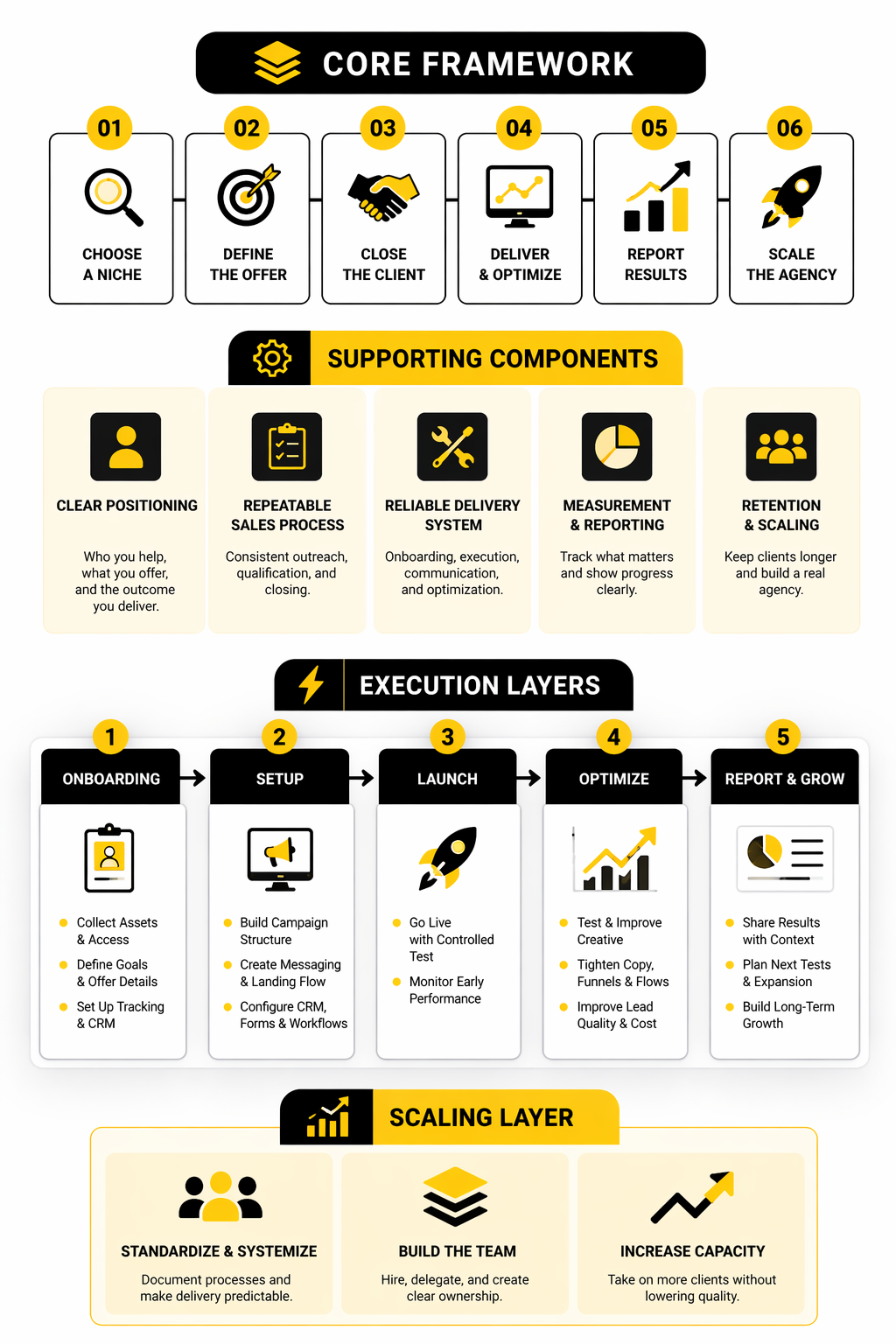
At its core, an SMMA agency helps a business acquire or retain customers through social platforms and the systems around them. That can include paid social, short-form creative, landing pages, lead nurturing, appointment setting, community messaging, remarketing, and performance reporting. The strongest agencies stop selling “social media management” as an isolated task and start selling a business outcome with a clear mechanism behind it.
In practice, the model works best when it is built like a framework. First comes positioning, because a vague agency is hard to trust and even harder to refer. Then comes offer design, because packaging the service around a specific result makes pricing, sales conversations, and delivery dramatically easier. After that comes fulfillment, where campaign execution, automation, creative iteration, and reporting have to work together well enough that retention becomes the natural next step rather than a constant rescue mission.
That is also why the tool stack matters, but only after the business model is clear. Platforms such as GoHighLevel, ManyChat, and Buffer can support lead capture, follow-up, and publishing workflows, but software does not fix weak positioning, weak offers, or weak client expectations. The agency model works when the operating system is built around revenue logic first and tools second.
Service Delivery, Reporting, and Retention
This is the point where an SMMA agency either becomes a real business or stays a sales machine with a churn problem. Getting clients is hard, but keeping them is harder, because retention exposes every weak promise, every vague scope line, and every sloppy handoff. If the client cannot see what is being built, what is being tested, and what is improving, they start filling the silence with doubt.
The agencies that last do not treat fulfillment like a creative free-for-all. They run delivery through a repeatable operating system with clear milestones, clean communication, and obvious accountability. That matters even more now because clients expect faster response times, tighter reporting, and more automation across messaging, CRM, and follow-up than they did a few years ago.
Start With a Tight Onboarding System
A good onboarding process reduces friction before it reduces workload. The first win is not launching ads on day one. The first win is collecting the right assets, access, offers, and business context so the campaign does not get built on guesses.
That means every new client should move through the same intake path. You need business goals, offer details, customer pain points, past campaign history, brand assets, access to ad accounts, lead routing rules, and a definition of what counts as a qualified lead. If those pieces stay fuzzy, everything downstream gets slower and more expensive.
This is also where a unified stack helps. Tools like GoHighLevel are built around capture, nurture, pipeline tracking, and booked appointments, which makes them useful when an SMMA agency wants less tool sprawl and tighter client operations. When onboarding is connected to CRM stages, forms, workflows, and calendars from the start, the agency can see exactly where leads are moving instead of stitching the story together later.
Build the Delivery Stack Around Outcomes
A lot of new agencies build their stack around features. Smart agencies build it around the client journey. The right question is not “Which software looks powerful?” but “What needs to happen from first click to closed deal, and where can it break?”
For most service-based clients, the stack usually needs five things to work together: traffic, conversion, follow-up, scheduling, and visibility. That is why agencies often combine a CRM and automation layer like GoHighLevel, a messaging tool like ManyChat, a publishing and analytics layer like Buffer, and in some cases an AI qualification layer like Chatbase. Each tool has a job, and each job should tie back to revenue, lead quality, or response speed.
That structure keeps the agency honest. When a campaign struggles, you can inspect where the drop happened. Was it weak creative, a weak landing page, slow lead response, poor qualification, or a broken booking sequence? A real SMMA agency does not hide behind vanity metrics when the system is built clearly enough to diagnose the bottleneck.
The Execution Process That Actually Works
Once the offer is defined and onboarding is complete, execution has to become tangible fast. Clients do not need a flood of jargon. They need to feel that there is a professional process, that there is movement every week, and that decisions are being made from signal rather than emotion.
The cleanest way to handle this is to standardize the first 30 days. Not because every client is identical, but because every engagement benefits from the same core rhythm: setup, launch, feedback, optimization, and reporting. That rhythm gives the client confidence and gives the agency a structure to manage workload without reinventing delivery each time.
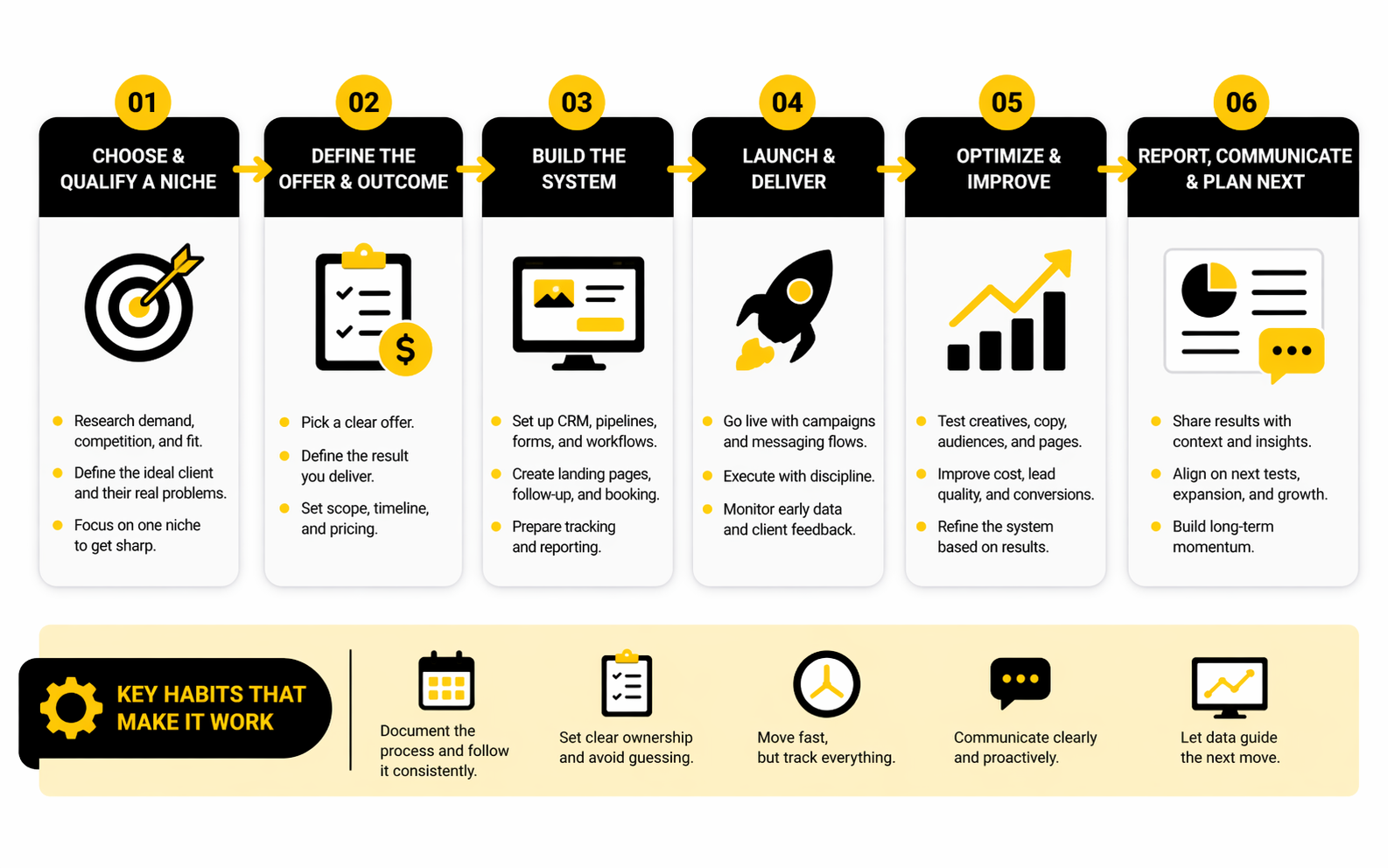
- Confirm the commercial goal
Before anything launches, the agency needs one primary objective. That could be booked appointments, qualified leads, purchases, or reactivation of dormant customers. If the client wants everything at once, the agency has to narrow the target or the campaign turns into noise.
- Map the conversion path
Define what happens after the click. That includes the landing page, form, chatbot, SMS or email follow-up, calendar step, and handoff into the sales process. ManyChat is particularly useful when Instagram or direct-message flows are part of that path, while Chatbase fits when website visitors need qualification before they hit sales.
- Launch the minimum viable campaign
The first version should be clean, not bloated. One clear offer, a small number of creative angles, and one consistent follow-up path is usually stronger than a giant setup with too many moving parts. An SMMA agency gets better data from controlled launches than from overbuilt campaigns that make attribution impossible.
- Track response time and lead quality immediately
This is where many agencies lose clients without realizing it. The ad may work, but if response is slow or low-quality leads flood the sales team, trust starts dropping fast. A connected CRM like GoHighLevel helps agencies watch pipeline movement, automate follow-up, and flag where leads stop converting.
- Optimize on a weekly rhythm
Weekly optimization forces discipline. Creative gets refreshed, copy gets tightened, forms get simplified, workflows get cleaned up, and weak steps get removed. The point is not to “do more marketing.” The point is to remove friction from the system until performance becomes more stable.
Reporting Should Explain, Not Just Display
Most reporting fails because it says what happened but never explains why it matters. Clients do not want a dashboard parade. They want a clear read on what is improving, what is underperforming, and what the agency is doing next.
That is why reporting should be tied to business movement first and platform metrics second. Show lead volume, qualified lead rate, booked calls, cost trends, response times, and sales feedback before diving into impressions or engagement. A tool like Buffer makes it easier to centralize social analytics, but the value still comes from interpretation, not screenshots.
A strong monthly report usually answers three questions. What did we learn? What changed in the system? What are we testing next? When an SMMA agency reports that way, it sounds like a growth partner instead of a vendor defending its invoice.
Retention Comes From Operational Confidence
Retention is not a trick, and it is definitely not just about being nice on calls. Clients stay when they believe the agency is in control of the process, honest about performance, and proactive when something breaks. That belief is earned through consistency.
One of the easiest ways to create that confidence is to make the invisible work visible. Show what was launched, what was tested, what the sales team reported back, what the automations are doing, and what the next decision depends on. Even when results need time, transparency buys patience because the client can see the engine running.
This is also where automation can raise perceived value. A client who sees leads routed instantly, reminders sent automatically, no-show follow-up sequences triggered, and conversations handled through smart flows understands that the agency is building infrastructure, not just posting content. GoHighLevel and ManyChat both fit naturally here because they push the agency closer to repeatable service delivery rather than manual patchwork.
What Professional Implementation Looks Like
Professional implementation is not flashy. It is clean naming conventions, clear ownership, documented workflows, fast communication, and a calm operating cadence. It looks simple from the outside because the chaos has already been handled behind the scenes.
That matters more than most founders realize. Clients can forgive a slow week. They do not forgive confusion. When an SMMA agency knows exactly how new leads are captured, where data lives, who follows up, what gets reported, and when decisions get made, it creates the kind of trust that compounds over time.
And that is the real shift from freelancer mode to agency mode. A freelancer often sells effort. A real agency sells a managed process that keeps working even when there are multiple accounts, multiple team members, and multiple campaigns running at once. The next step is scaling that process without losing the quality that made clients stay in the first place.
What the Numbers Really Mean
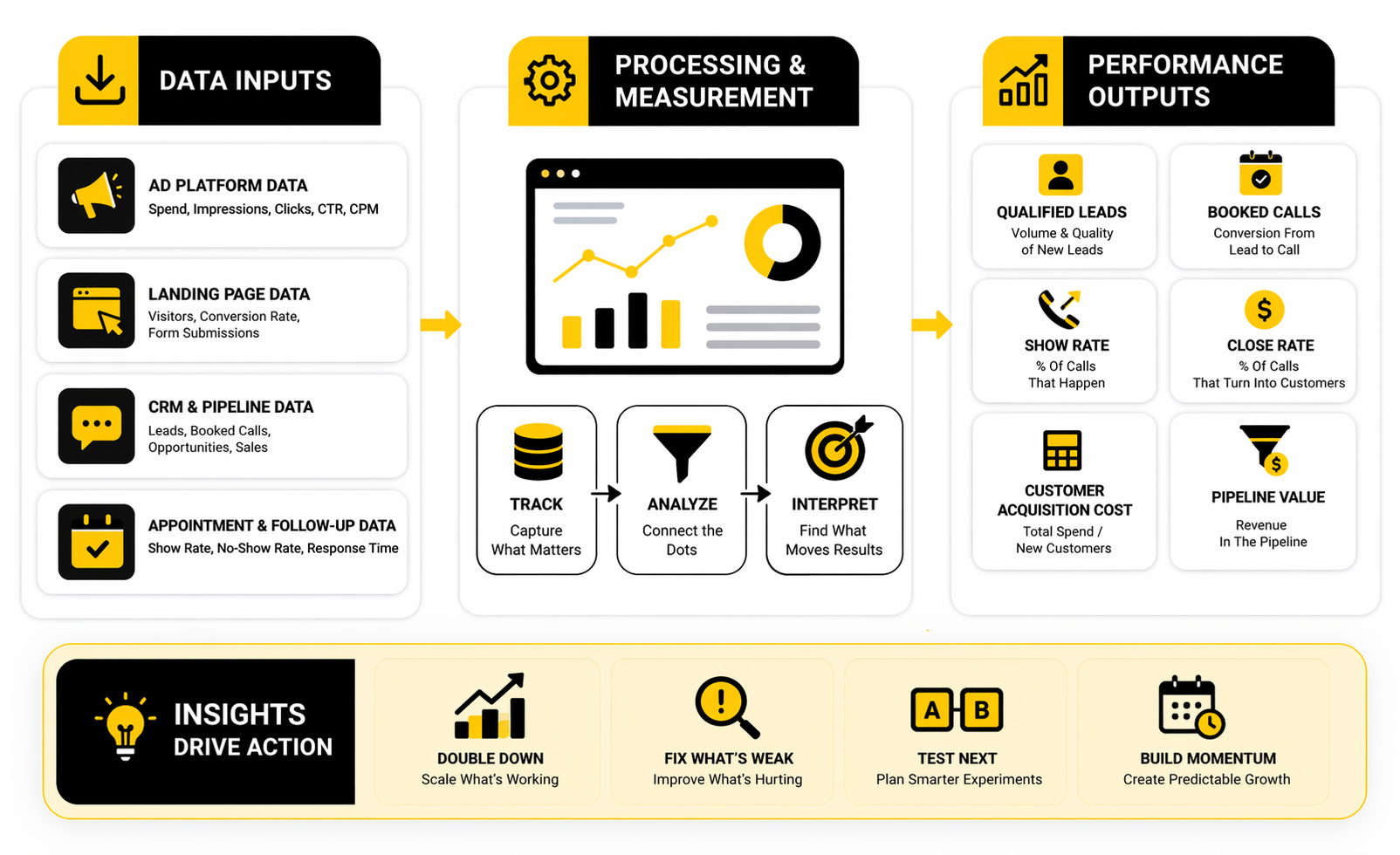
Once an SMMA agency has campaigns running, the conversation shifts from setup to signal. This is where a lot of agencies get exposed, because pulling numbers into a dashboard is easy, but turning those numbers into decisions is the real job. Good measurement is not about collecting more data. It is about knowing which numbers explain performance, which numbers predict problems, and which numbers are just noise dressed up as insight.
That distinction matters because most clients do not buy marketing for impressions or clicks. They buy growth, booked calls, purchases, margin, and predictability. So the analytics system has to connect platform activity to business outcomes in a way that a client can understand and a team can act on.
The First Rule: Separate Signal From Vanity
An SMMA agency should never treat reach, likes, or even click volume as proof that the campaign is working. Those numbers can still be useful, but only as secondary indicators. A campaign can generate cheap traffic and still fail commercially if the leads are weak, the landing page leaks intent, or the sales team cannot convert what comes in.
That is why the best reporting stacks are built in layers. The top layer is business performance, which means revenue, pipeline, qualified leads, booked calls, or customer acquisition cost. The second layer is conversion behavior, which covers click-through rate, landing page conversion rate, form completion rate, and appointment show rate. The third layer is delivery diagnostics, which helps explain why the numbers above are moving.
The Metrics That Actually Deserve Weekly Attention
A useful dashboard for an SMMA agency is tighter than most people think. You do not need fifty widgets. You need a short group of numbers that tell you whether demand is being generated, whether that demand is qualified, and whether the system is turning interest into revenue.
The most practical weekly metrics usually include:
- cost per lead
- qualified lead rate
- booking rate
- show rate
- close rate
- customer acquisition cost
- average order value or average client value
- lead response time
- return on ad spend when direct attribution is clean
- pipeline value created from campaign leads
What makes these numbers powerful is not the labels themselves. It is the sequence. If cost per lead looks healthy but booking rate collapses, the problem probably sits after capture. If booking rate is solid but close rate drops, the issue may be in lead quality or sales execution. If traffic is strong but form completion is weak, the friction is likely on the page rather than in the ad.
Benchmarks Only Matter in Context
This is where a lot of bad advice spreads. People love asking for the average click-through rate, the right cost per lead, or the normal return on ad spend, as if one benchmark can tell the whole story. It cannot. A legal client, a local med spa, a SaaS company, and an e-commerce brand can all run profitable campaigns with totally different numbers.
That does not mean benchmarks are useless. It means benchmarks are directional, not absolute. A smart SMMA agency uses them to spot outliers, not to declare victory or failure in isolation. If the click-through rate is far below normal for that account, that points to a creative or offer problem. If the landing page conversion rate is soft compared with the account’s own history, that points to friction after the click. The benchmark is useful because it triggers investigation, not because it ends the conversation.
How to Read Cost Per Lead Without Fooling Yourself
Cost per lead is one of the most abused numbers in agency reporting. Clients love it because it feels simple. Agencies love it because it is easy to highlight. But by itself, it can be deeply misleading.
A lower cost per lead is only good if lead quality holds up. A campaign that cuts cost per lead in half while sending low-intent prospects into the pipeline is not an improvement. In some cases, a higher cost per lead is exactly what you want because it comes with better fit, higher show rates, and stronger close rates. That is why an SMMA agency should always pair cost per lead with qualified lead rate and downstream conversion.
This is also where process and tooling start to matter. If leads are being captured inside a connected system like GoHighLevel, the agency can track whether cheaper leads actually move through the pipeline or just pile up at the top. That one difference changes reporting from surface-level media analysis into real commercial measurement.
Why Lead Quality Beats Lead Volume
A client almost never needs “more leads” in the abstract. They need more of the right leads. When an SMMA agency focuses too heavily on volume, it can accidentally optimize the campaign toward cheap actions that look good in a report and create chaos for the sales team.
Lead quality is harder to measure, but it is far more important. It usually shows up through a mix of signals: booking rate, show rate, qualification status, sales feedback, and close rate. If those numbers improve, the agency is helping the client buy better demand, not just more noise. That is a serious difference, and it is one of the clearest signs that an agency understands performance beyond the ad manager interface.
For lead-gen accounts, this is where messaging workflows can support measurement too. When an inquiry goes through ManyChat or a structured follow-up flow, the agency can learn which questions filter stronger buyers and which steps are creating drop-off. That gives the numbers more meaning because the campaign is not being judged only at the moment of form submission.
The Most Important Hidden Metric Is Response Time
A lot of campaigns get blamed for weak performance when the real problem starts after the lead arrives. Response time is one of the clearest examples. If a business waits too long to call, text, or qualify a new lead, intent cools off fast and the conversion path becomes much harder.
This matters because an SMMA agency can look terrible on paper when the traffic side is working and the follow-up side is broken. That is why response time should sit close to the top of the reporting stack for service-based clients. If the agency sees strong lead flow and weak conversion, this is one of the first numbers worth checking. It often explains more than another round of creative tweaks ever will.
Automation helps here, but only when it is tied to real workflow design. A setup inside GoHighLevel or ManyChat can reduce lag between inquiry and contact, but the real win is not “automation” as a buzzword. The real win is preserving buyer intent while it is still hot.
A Better Way to Use Attribution
Attribution is one of those topics that sounds clean in a pitch and gets messy in real accounts. Different platforms claim credit differently, customers switch devices, people see creative without clicking, and offline sales feedback often arrives late. A serious SMMA agency has to accept that attribution is directional in many cases, not perfectly absolute.
That does not make it useless. It just means attribution should be triangulated. Use platform-reported conversions, CRM outcomes, sales notes, and time-based patterns together. When all four point in the same direction, confidence goes up. When they conflict, the agency should say so clearly instead of pretending the data is cleaner than it is.
This is one reason many agencies move clients toward more centralized operating systems. A stack built around GoHighLevel plus cleaner campaign tagging and pipeline tracking gives the agency a better chance of seeing where opportunities are actually coming from. Not perfect clarity, but much better than disconnected screenshots from five tools.
The Right Action From the Right Number
Data only becomes useful when it triggers a specific action. A weak click-through rate usually points to creative, hook, or audience mismatch. A poor landing page conversion rate points to page friction, unclear offer language, or too much form resistance. A healthy lead flow with weak booking rates points to follow-up breakdown, weak qualification, or low trust at the handoff.
That is how an SMMA agency should train itself to think. Every core metric needs a likely interpretation and a shortlist of next moves. Otherwise reporting turns into narration instead of management. The client hears numbers, but no one is steering the account.
A practical measurement culture is built on this habit: see the signal, locate the bottleneck, run the next test. That loop is what separates real operators from agencies that hide behind fancy dashboards.
What a Healthy Analytics Culture Looks Like
The healthiest agency-client relationships are not built on perfect numbers. They are built on shared clarity. The client knows what the main goal is, the agency knows which signals matter most, and both sides understand what is being tested next.
That kind of clarity makes data calmer and more useful. The numbers stop feeling like a verdict on every single week and start acting like guidance. Over time, that creates better decisions, better retention, and better trust, because the analytics system is no longer there to impress anyone. It is there to make the next move obvious.
The final stage is scaling that whole operation without losing the quality of service, the consistency of results, or the decision-making discipline that made the agency work in the first place.
Scaling an SMMA Agency Without Breaking It
This is where the model gets real. A small SMMA agency can survive on hustle, fast replies, and founder memory for a while, but that stops working the moment client count rises and delivery starts happening across multiple accounts at once. The agencies that scale well do not just sell more. They reduce handoffs, centralize visibility, and make execution easier to repeat without lowering quality, which is exactly why so many agency operators move toward more unified CRM and workflow systems as they grow. HighLevel’s agency-focused platform and its broader push toward consolidated automation, communication, and reporting are built around that logic. Its white-label CRM and workflow model makes the same point from the client side.
The hard truth is that growth creates new problems faster than most founders expect. More clients mean more approvals, more edge cases, more follow-up failures, more reporting questions, and more chances for one weak process to hurt five accounts at once. If an SMMA agency wants to scale without becoming fragile, it has to stop depending on heroic effort and start depending on systems that make good execution normal.
The First Big Tradeoff: Custom Service vs Standardized Delivery
Every agency founder feels this tension. Custom work helps close deals because it sounds premium and flexible, but too much customization makes delivery slower, harder to train, and harder to measure. Standardization feels less exciting in the sales call, but it is what protects margins and keeps the team from rebuilding the wheel on every new account.
The answer is not to eliminate customization completely. The answer is to standardize the engine and customize the edges. The core workflow should stay consistent across clients, including onboarding, campaign launch rhythm, reporting structure, pipeline stages, and follow-up logic. Then the offer, creative angle, and niche-specific messaging can adapt where it actually matters.
That distinction is one of the biggest maturity signals in an SMMA agency. A founder-led operation often sells bespoke chaos without realizing it. A scalable agency knows exactly which parts of delivery are fixed, which parts are flexible, and why that boundary protects both performance and profitability.
Headcount Does Not Fix Operational Mess
A lot of agencies hire too early for the wrong reason. They feel overloaded, assume the answer is more people, and end up multiplying confusion instead of solving it. When ownership is unclear and systems are messy, every new hire adds communication overhead before they add leverage.
That is why process design usually beats headcount in the early scaling phase. If the workflow for onboarding, approvals, reporting, and client communication is still unstable, adding more account managers or media buyers can actually make the service harder to control. A healthier move is often to tighten task ownership, centralize visibility, and build more reliable automation before expanding the team.
This is also where CRM discipline matters more than founders want to admit. A tool is not the solution by itself, but a system that becomes the team’s trusted source of deal, account, and client context is a real operational advantage. Copper’s guidance on CRM adoption makes the point clearly: the issue is not whether people log in occasionally, but whether the CRM is the place the team actually trusts to understand deals and client relationships. (Copper on CRM adoption)
Tool Sprawl Quietly Kills Margin
One of the fastest ways to weaken an SMMA agency is to let the stack grow account by account. A founder adds one tool for chat, another for landing pages, another for scheduling, another for reporting, another for approvals, and suddenly the agency is paying for overlap while the team is still manually moving information between systems. HighLevel’s recent material on the “agency tech stack of the future” is blunt about this problem: siloed tools slow execution, reduce visibility, and make scale harder than it needs to be. (HighLevel on eliminating siloed tools)
The cost is not just subscription spend. The real cost is delay, error, and duplicated effort. If leads live in one place, comments in another, appointments in another, and approval history in another, the agency loses time every time it needs to explain performance or fix a broken workflow.
That does not mean every agency should force everything into one platform no matter what. It means every additional tool should earn its place. The higher the client count goes, the more expensive unnecessary handoffs become.
Client Communication Becomes a Scaling Risk Faster Than Delivery
Most founders expect fulfillment complexity to be the main issue. In practice, communication often breaks first. As the agency grows, more people touch the account, more approvals are needed, more internal context is lost, and the client starts feeling the seams between team members.
That is why communication needs process, not just personality. Content approvals, status updates, reporting cadences, and feedback loops all need a defined home and a defined owner. Buffer’s collaboration workflow is a good example of where this becomes operationally useful rather than just convenient, with approval flows, permissions, and shared publishing environments designed to reduce chaos inside multi-person social workflows. (Buffer Collaborate) (Buffer agency workflow)
A scaling SMMA agency should treat communication structure as part of fulfillment quality. The client should know where approvals happen, when decisions get reviewed, who owns next steps, and how quickly questions get answered. When that is vague, trust erodes even if campaign performance is acceptable.
Scheduling and Routing Need More Attention Than Most Agencies Give Them
This looks like a minor operational detail until volume rises. Once an agency is generating more booked calls or handling more inbound interest across multiple people, routing becomes part of the conversion system. Bad scheduling logic creates delays, wrong-owner handoffs, and dropped intent.
That is why team scheduling should not stay as a manual patch. Cal.com’s routing and round-robin tools are built specifically around matching meetings to the right team members based on rules, availability, and routing forms, which becomes increasingly useful when an agency is distributing leads or appointments across closers, account managers, or niche specialists. (Cal.com routing overview) (Cal.com round robin scheduling)
For an SMMA agency, this is not just admin hygiene. Better routing protects lead quality, reduces response lag, and keeps the client experience smoother when the operation becomes more team-based. It is a small systems decision with very real downstream effects.
The Real Risk Is Founder Bottleneck
Most agencies do not hit a hard ceiling because the market disappears. They hit it because too many decisions still run through the founder. Pricing exceptions, campaign reviews, client reassurance, workflow fixes, and team approvals all come back to one person, and that person becomes the hidden reason growth slows down.
That bottleneck usually feels responsible in the beginning. The founder wants to protect quality, so they stay involved in everything. But eventually the same habit creates delay, weak delegation, and team dependency. A scalable SMMA agency has to document judgment, not just tasks. It needs playbooks for how decisions get made, what gets escalated, and what good work actually looks like.
This is where white-label or software-enabled agency models can become strategically useful too. HighLevel’s positioning around white-label CRM, multi-account management, and recurring software access reflects a deeper agency tradeoff: the more value is delivered through systems and infrastructure, the less every client outcome depends on the founder’s constant presence. (HighLevel white-label CRM) (HighLevel all-in-one platform)
Scaling Profitably Means Choosing What Not to Sell
A mature SMMA agency gets stronger when it becomes more selective. That often means narrowing the niche, tightening the offer, refusing low-fit retainers, and avoiding services that create disproportionate delivery pain. Growth feels exciting when new revenue comes in, but the wrong revenue can make the whole operation heavier.
This is why expert operators often simplify before they scale harder. They remove service lines with weak margins. They standardize reporting. They consolidate tooling. They cut offers that sound impressive but break delivery economics. That process can feel like shrinking, but it is usually what makes healthy growth possible.
At that stage, the agency is not just trying to win more clients. It is protecting the machine that makes clients successful in the first place. And that is the difference between an SMMA agency that gets bigger for a while and one that becomes durable.
Where the Best Agencies Pull Ahead
The best agencies eventually stop competing on activity and start competing on control. They know what happens when a lead enters the system, when a campaign underperforms, when approvals stall, when a client asks for expansion, and when team capacity gets tight. That level of control is not glamorous, but it is what turns service delivery into a business rather than a constant firefight.
It also creates better strategic options. A well-run SMMA agency can layer on automation, improve retention, add software revenue, or expand into adjacent services without losing its footing. A messy one cannot even tell which part of the engine is causing the problem.
That is why scale should not be treated like a reward for doing more sales. It should be treated like a systems challenge. Solve that challenge well, and the agency becomes far more valuable than a collection of retainers. It becomes an asset with real operating leverage.
The SMMA Agency Ecosystem Now
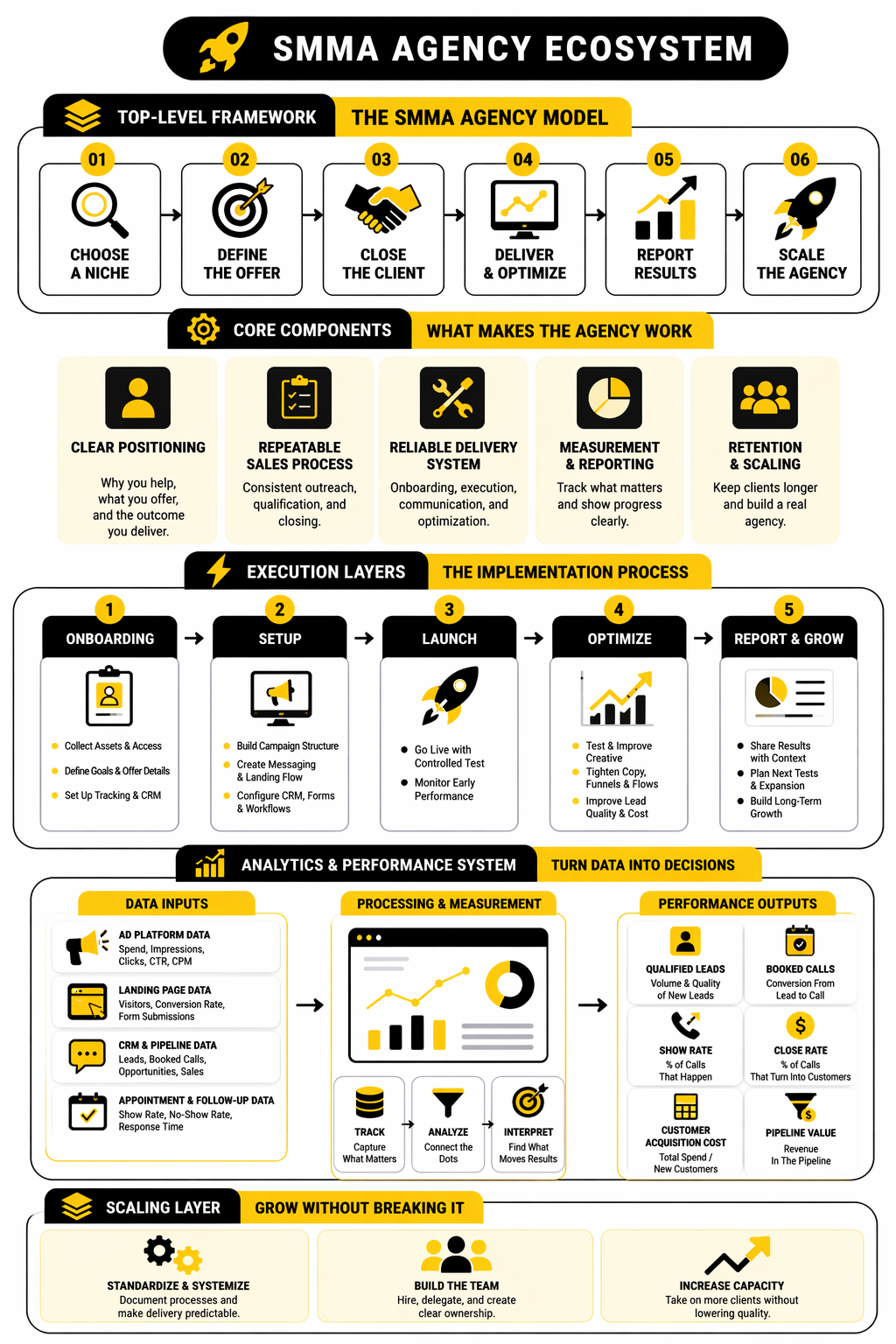
At this point, the real takeaway is simple: an SMMA agency is no longer just “someone who runs ads” or “someone who posts on Instagram.” It sits inside a much bigger ecosystem that includes acquisition, CRM, lead routing, follow-up, analytics, reporting, scheduling, content operations, and increasingly AI-assisted support. That broader environment matters because digital advertising keeps expanding, with U.S. internet ad revenue reaching about $258.6 billion in 2024, while social and messaging behavior remains deeply embedded in everyday buying journeys. (IAB) (DataReportal)
That is also why the strongest agency operators think more like system builders than channel specialists. They do not just ask how to get more reach. They ask how to create a cleaner path from attention to action, and how to make that path easier to measure, improve, and scale over time.
If you want to build a serious operating stack around that model, the useful categories are pretty clear. A platform like GoHighLevel can anchor CRM, pipelines, and follow-up. ManyChat can tighten messaging flows. Buffer can support publishing and collaboration. Cal.com can improve routing and scheduling. The point is not to collect software. The point is to make the agency’s delivery system more coherent.
FAQ - Built for Complete Guide
What does an SMMA agency actually do?
An SMMA agency helps businesses generate attention, leads, customers, or retention through social platforms and the systems around them. In practice, that can mean paid social, organic content support, landing pages, chat automation, CRM workflows, appointment booking, and reporting. The reason the model still matters is that digital ad spend keeps growing and businesses still need operators who can turn channel activity into measurable business outcomes. (IAB)
Is starting an SMMA agency still worth it?
Yes, but only if you treat it like a real service business instead of a trend. Social and messaging platforms still sit at the center of how people discover products, research brands, and communicate with businesses, which keeps demand alive for operators who can manage that path well. What no longer works is the lazy version of the model where the agency sells vague “marketing help” without a niche, a process, or a clear result. (DataReportal) (SBA)
How much should an SMMA agency charge?
Pricing depends on complexity, risk, and how much of the growth system the agency controls. A simple content workflow should not be priced the same way as a lead-gen offer with CRM setup, follow-up automation, booking logic, and reporting. The strongest pricing usually comes from packaging around outcomes and delivery scope rather than charging for random tasks.
Should an SMMA agency focus on one niche?
Usually yes, especially in the early stages. Specialization makes sales easier because the agency can speak the client’s language, understand the economics, and build faster trust around predictable problems. It also makes service delivery better, because patterns repeat and the team gets sharper at diagnosing what actually moves results in that niche.
What is the biggest mistake new agency owners make?
The biggest mistake is selling before they can deliver consistently. A founder gets excited about closing retainers, but without clear onboarding, scope control, and reporting logic, the client experience starts breaking almost immediately. That is how churn shows up early and why a messy SMMA agency can feel busy while quietly getting weaker.
Do you need paid ads to run an SMMA agency?
No, but you do need a defined value engine. Some agencies lean more on organic content, creator-style short-form execution, community management, or messaging workflows. Still, paid media remains one of the clearest paths to measurable acquisition for many businesses, so an SMMA agency that understands ad strategy, follow-up, and attribution has a stronger commercial position in a market where internet advertising continues to expand. (IAB)
Which tools are most useful for a growing SMMA agency?
The best tools are the ones that reduce handoffs and make the operating system easier to manage. For many agencies, that means a central CRM and automation layer such as GoHighLevel, a messaging layer such as ManyChat, a publishing layer such as Buffer, and a scheduling layer such as Cal.com. What matters most is not the logo set. It is whether the stack makes the client journey easier to execute and easier to measure.
How long does it take to get results for clients?
That depends on the offer, the sales cycle, the quality of the client’s fulfillment, and how much existing demand already exists. Some accounts show useful signal quickly, especially when the offer is strong and follow-up is tight, while others need more time before the data becomes commercially meaningful. A good SMMA agency sets expectations around testing windows, reporting cadence, and optimization milestones instead of promising instant wins.
What metrics matter most in an SMMA agency?
The numbers that matter most are the ones closest to business movement. That usually means qualified leads, booked calls, show rates, close rates, customer acquisition cost, and pipeline value, with platform metrics used to diagnose rather than to impress. A smart agency does not drown the client in stats. It uses a short set of metrics to identify what is working, what is weak, and what needs to be tested next.
Can one person run an SMMA agency?
Yes, at the beginning. A solo operator can close deals, onboard clients, run campaigns, and manage reporting for a while, especially with strong systems and a narrow offer. The challenge starts when the founder becomes the bottleneck for every decision, which is why documentation, automation, and standardized delivery become essential if the business is meant to grow beyond freelancer mode.
How do SMMA agencies keep clients longer?
Retention comes from confidence, clarity, and visible progress. Clients stay when they understand what is being built, what is being tested, where the bottlenecks are, and why the agency is making certain decisions. That is also why reporting matters so much: it should explain the logic behind performance, not just display charts.
Is AI changing the SMMA agency model?
Absolutely, but not in the lazy “AI replaces agencies” way people love to post about. AI is changing how agencies qualify leads, write first drafts, assist support flows, organize data, and reduce repetitive work, which means the winning agencies will probably become faster and more systems-driven rather than less necessary. The real edge will come from combining human judgment with better infrastructure, not from pretending prompts alone can replace strategy and execution.
Do clients care more about content or systems?
Most clients say they want content, but what they really care about is outcomes and predictability. Content is important because it creates the message and the hook, but systems are what turn attention into bookings, follow-up, sales context, and measurable business movement. A mature SMMA agency understands that creative gets the click, but process is what turns that click into revenue.
What makes an SMMA agency feel premium?
Premium agencies feel controlled. They onboard cleanly, communicate clearly, explain decisions well, report with context, and make the client feel like there is an actual machine behind the scenes instead of a few scattered tasks. That perception matters because trust is built less by claiming expertise and more by making the experience feel organized, consistent, and commercially intelligent.
Work With Professionals
Explore 10K+ Remote Marketing Contracts on MarkeWork.com
Most marketers spend too much time chasing clients, competing on crowded platforms, and losing a percentage of every project to middlemen. MarkeWork gives you a better way. Browse thousands of remote marketing contracts and connect directly with companies desperate to hire skilled marketers like you, without platform commissions and without unnecessary gatekeepers.
If you're serious about finding better opportunities and keeping 100% of what you earn, explore available contracts and create a profile for free at MarkeWork.com.