

A lot of people talk about starting an SMMA business like it is still 2018. Pick a niche, run a few Facebook ads, send cold DMs, and watch retainers roll in. That version of the story is outdated. The real opportunity now is not just selling attention. It is helping businesses turn attention into booked calls, qualified leads, and revenue they can actually track.
That matters because the market has become tougher and more serious at the same time. Agency competition is real, with recent industry research showing a crowded digital agency landscape and a sector that rewards sharper positioning and more repeatable delivery models much more than generic service menus (Promethean Research). At the same time, the businesses agencies serve still need help badly, especially when paid acquisition costs remain meaningful and execution keeps getting more technical (WordStream, Google Business).
The reason the SMMA business model still gets attention is simple. Small and midsize businesses keep investing in marketing, but many of them still do not have the time, systems, or internal talent to run content, paid traffic, lead handling, follow-up, and reporting at a high level. Recent SMB research also shows a gap between effort and confidence, with many owners still unsure what is working and where their marketing budget is really paying off (Constant Contact, Salesforce).
That is where a modern SMMA business can still win. Not by pretending to be a magic growth machine, but by building a clear offer around channels, systems, measurement, and client outcomes. The agencies that last usually stop selling random tactics and start owning one business problem end to end.
Why an SMMA Business Still Matters
A serious SMMA business sits at the intersection of three trends that are not going away. First, digital advertising and digital media keep pulling more budget and attention, which gives agencies room to specialize instead of trying to be full-service for everyone (Deloitte, IAB). Second, local and service-based businesses still need outside help turning marketing into leads and appointments, especially in categories where every click costs real money and weak follow-up destroys ROI (Google Business, WordStream).
Third, automation has changed what clients expect. Businesses are getting used to AI-assisted workflows, better CRM visibility, and faster response times, which means agencies that only deliver creatives or campaign setup can start to feel incomplete. SMB adoption data shows why this is important: many growing businesses increasingly see AI and tech stack decisions as part of growth, not just back-office experimentation (Salesforce).
Article Outline
- What an SMMA Business Really Is
- Why the Model Still Works
- The Revenue Engine Behind a Modern SMMA
- Core Services, Offers, and Pricing
- How to Build Operations That Scale
- How to Win Clients and Keep Them
Framework Overview
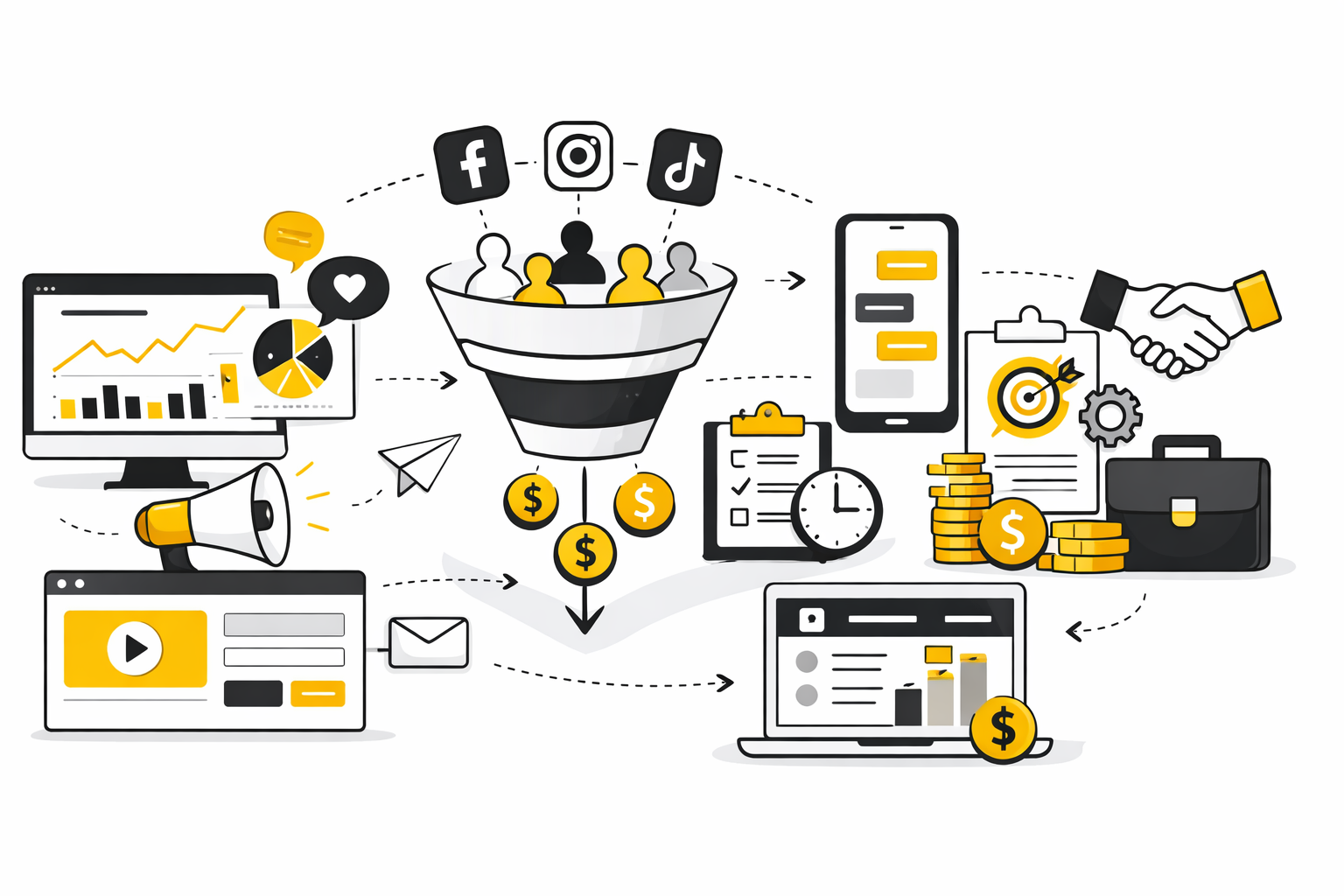
The easiest way to understand an SMMA business is to stop thinking about it as a “social media agency” in the narrow sense. In practice, the strongest agencies are client acquisition operators. They may use social platforms, search ads, landing pages, email, SMS, content, or outbound, but the commercial goal is the same: create a reliable flow of demand and make that demand measurable.
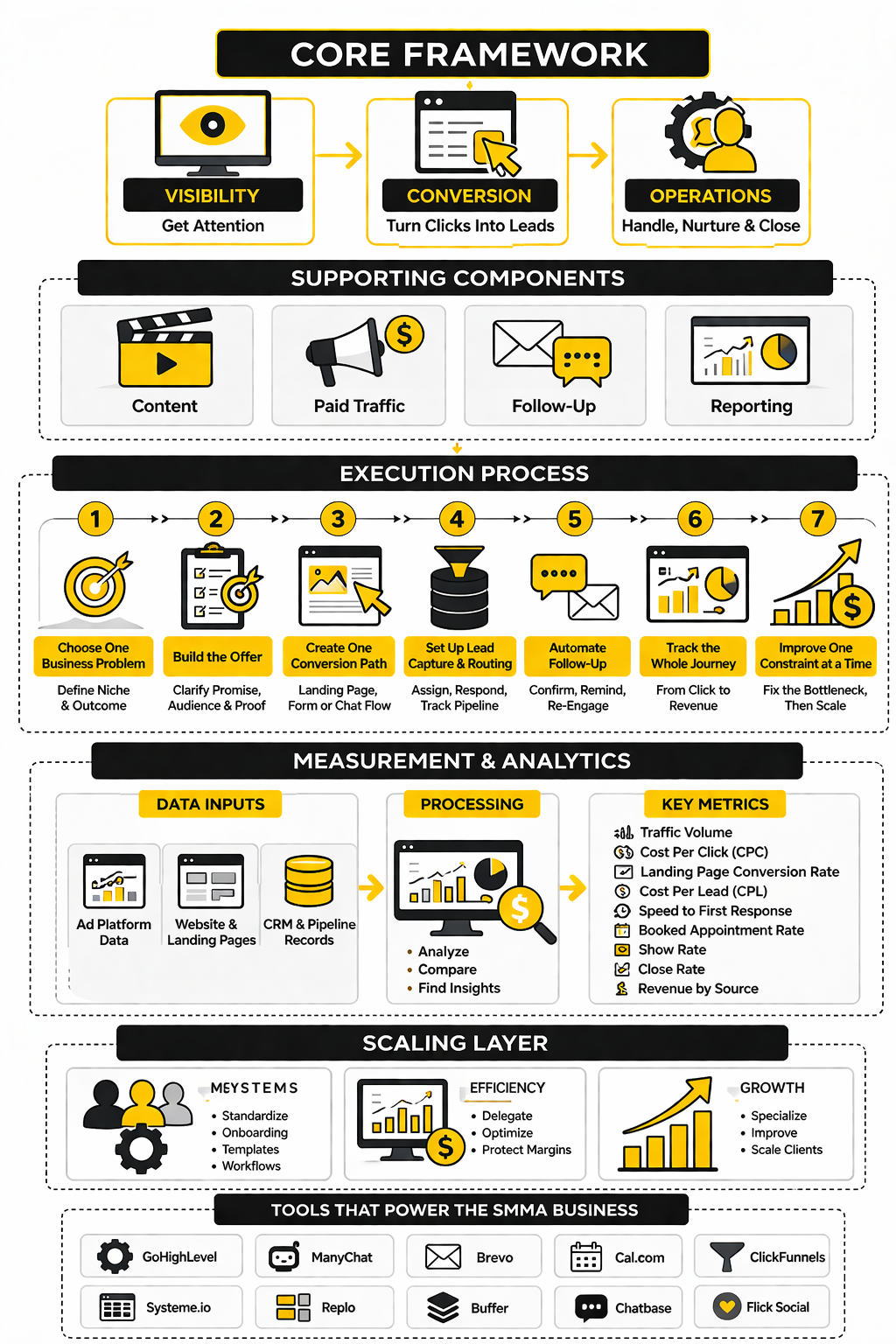
That is why the rest of this article follows a structure built around business mechanics rather than platform hype. We will start by defining what an SMMA business really is, then look at why the model still works, how revenue is created, which service packages make sense, how delivery operations should be set up, and finally how client acquisition and retention actually work when the market is crowded. That order matters because too many new agency owners jump straight into outreach before they have a sharp offer, a delivery system, or a believable reason for a client to stay.
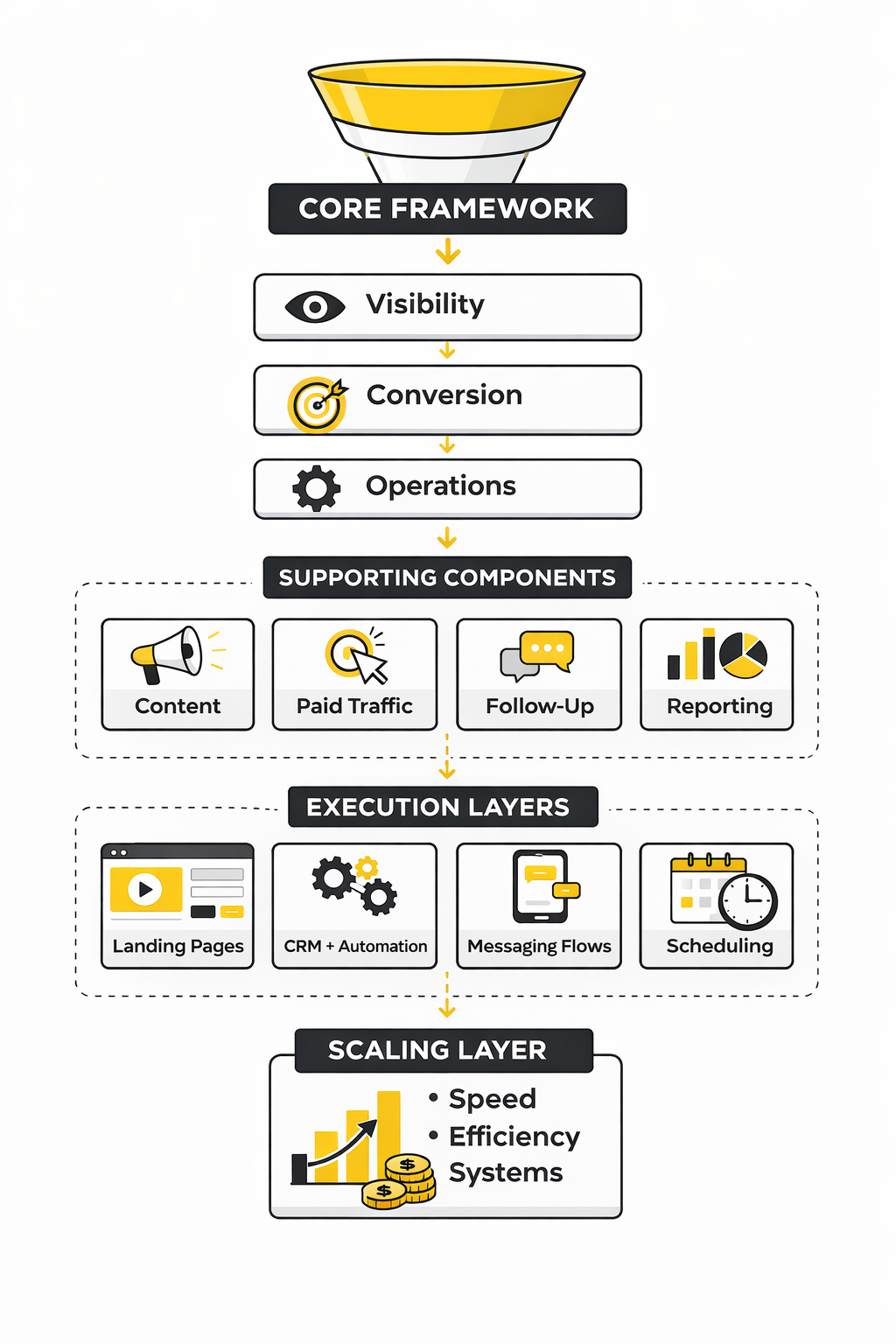
A modern delivery stack often reflects that shift. Tools like GoHighLevel, ManyChat, Buffer, and Chatbase fit when they support a clear client outcome, not when they are used as shiny objects. The real framework is offer, channel, conversion path, follow-up, reporting, and retention.
What an SMMA Business Really Is
At its core, an SMMA business is a service company that helps brands or local businesses acquire customers through digital channels. The name still says “social media,” but the work usually extends beyond posting content or managing comments. In the current market, clients care far more about pipeline, booked calls, cost per lead, cost per acquisition, and revenue contribution than they do about vanity metrics.
That is an important distinction because it separates a hobby freelancer from an actual agency model. A real SMMA business has positioning, a repeatable offer, a delivery workflow, a client communication process, and some level of performance accountability. Even when the agency is small, the business works best when it is built like a system rather than a collection of random gigs.
This is also why the best SMMAs usually narrow their scope. Some focus on paid social for info businesses. Others focus on local lead generation for med spas, dental clinics, or law firms. Others blend content, paid traffic, CRM automation, and appointment-setting for high-ticket service businesses. The narrower the problem, the easier it becomes to price well, deliver consistently, and grow without reinventing the business every month.
FAQ - Built for Complete Guide
Is an SMMA business still worth starting in 2026?
Yes, but not for the reasons most beginner content pushes. The market is still large, digital ad spend is still growing, and social remains one of the stronger growth channels inside advertising forecasts, which means demand has not disappeared at all (IAB 2025 outlook). What has changed is that a modern SMMA business now has to own more of the client journey, because businesses increasingly expect help with automation, response speed, and measurable pipeline impact, not just content or ad setup (Salesforce SMB Trends).
What does SMMA actually mean now?
The label still stands for social media marketing agency, but in practice the strongest version of an SMMA business is broader than that. It usually includes paid social, organic content, landing pages, lead capture, follow-up systems, CRM visibility, and reporting because that is what clients need to turn attention into revenue. If you only sell posting or ad account access, you are usually competing in the weakest part of the market rather than the most valuable one.
Do I need to pick a niche, or can I work with any client?
You can technically work with any client, but that usually makes the business harder to sell and harder to scale. Recent agency benchmarking shows most agencies identify as specialists, and the fastest gains in 2025 came from firms that reduced their service mix instead of expanding it endlessly (Promethean Research). In plain English, a focused SMMA business tends to win more trust, create better systems, and avoid the custom-work trap that kills margins.
What services should be inside an SMMA business offer?
The right services are the ones that support one clear commercial outcome. For many agencies, that means paid acquisition, creative testing, landing pages or funnels, CRM setup, follow-up automation, and reporting, because those services connect directly to leads, appointments, and sales. Tools like GoHighLevel, ManyChat, Brevo, and Cal.com fit well when they support that system instead of turning the offer into a pile of disconnected software.
How much should an SMMA business charge?
There is no universal price because pricing depends on niche economics, scope, and how much of the revenue system you actually control. What the agency data does show is that retainers are standard, with 91% of agencies offering them and 88% offering both projects and retainers, which tells you recurring pricing is normal when the work is ongoing and operationally meaningful (Promethean Research 2025 report). A smart setup usually combines a recurring retainer for campaign and system management with project fees for builds, migrations, or major strategic resets.
Should I charge per lead, per month, or on performance?
For most agencies, a monthly retainer is the cleanest base because it gives you room to manage creative, campaigns, follow-up systems, and reporting consistently. Performance components can work, but only when tracking is solid and the client’s sales process is reliable enough that you are not taking risk for problems you do not control. If you are early, keep the pricing simple and measurable first, then add upside models after the system is stable.
How many clients can one person realistically manage?
That depends on how narrow the niche is and how standardized the delivery model becomes. A founder manually custom-building every account will hit capacity quickly, while a focused SMMA business with repeatable onboarding, templated workflows, and a tight tech stack can handle more without service quality falling apart. This is exactly why service reduction and specialization matter so much in the current agency market: complexity, not demand, is often the real ceiling (Promethean Research).
What metrics should I show clients every month?
Show numbers that map to the real journey from attention to revenue. That usually means traffic volume, cost per click or thousand impressions where relevant, landing page conversion rate, cost per lead, speed to first response, booked appointments, show rate, close rate if available, and revenue by source when the client can support that level of tracking. The reason this matters is simple: market benchmarks already show paid traffic can be expensive, with recent Google Ads data putting the average cost per lead at $70.11, so reporting has to explain whether those leads are turning into something commercially useful (WordStream benchmarks).
What if my campaigns produce leads but the client still says the results are bad?
That usually means the problem is happening after the lead comes in. Response speed, sales quality, booking friction, no-show rate, and follow-up sequences can all destroy outcomes even when the front end is working, which is one reason lead management has become such a core part of a modern SMMA business. Recent response-time research found a median online lead response time of 13 minutes, and that number alone explains why so many businesses waste good leads before a salesperson ever has a serious conversation (Hennessey Digital study).
Do I need a funnel builder, or can I send traffic straight to a website?
You can send traffic to a normal site, but a focused conversion path usually performs better because it removes extra choices and clarifies the next action. If the offer is specific, a dedicated landing page or funnel makes measurement easier and helps you isolate whether the issue is traffic quality, message clarity, or page friction. Builders like ClickFunnels, Systeme.io, or Replo make sense when they help simplify the path rather than just adding another layer of tech.
Is organic social enough, or do I need paid ads too?
Organic can absolutely matter, especially for credibility, audience building, and warmer conversion paths over time. But most clients hire an SMMA business because they want speed, control, and predictable demand, and paid channels usually make that easier when the economics work. BrightLocal’s latest SMB marketing research also shows small businesses remain highly active in social, with only a small minority not investing in organic social at all, which reinforces the idea that the strongest model is often a blend rather than a one-channel bet (BrightLocal SMB Marketing Report 2025).
What tools are actually worth using in an SMMA business?
The best tools are the ones that reduce friction, improve visibility, and save labor without making the operation harder to run. For many agencies, that means a CRM and automation layer, a booking layer, a messaging layer, and one or two specialized tools for funnels, reporting, or content operations. That is why stacks built around GoHighLevel, ManyChat, Brevo, Buffer, and Chatbase can be powerful when the agency uses them deeply instead of collecting software for the sake of it.
Can I start an SMMA business without a team?
Yes, and many agencies begin that way. The bigger issue is not whether you start solo, but whether you build the business in a way that can later be standardized and delegated once clients start coming in. If your delivery model depends entirely on your personal judgment, manual work, and constant custom execution, scaling will feel painful even if sales are going well.
What is the biggest reason most SMMA businesses stall?
Usually it is not platform changes or lack of opportunity. It is weak positioning, messy service packaging, and no repeatable operating system behind the offer. The current agency market is crowded and maturing, which means generic agencies with vague offers and no process are under more pressure than businesses that specialize, measure well, and simplify their delivery model (Promethean Research PDF).
What should someone do first if they want to build an SMMA business the right way?
Start by choosing one market, one expensive problem, and one outcome you can explain in plain English. Then build one clean path from offer to conversion to follow-up instead of trying to launch ten services at once. That approach fits the broader shift in SMB behavior too, because many small businesses are investing more seriously in automation, AI, and scalable operating systems, which means they are looking for partners who can create business structure, not just marketing noise (Salesforce SMB Trends 2026).
Work With Professionals
Explore 10K+ Remote Marketing Contracts on MarkeWork.com
Most marketers spend too much time chasing clients, competing on crowded platforms, and losing a percentage of every project to middlemen. MarkeWork gives you a better way. Browse thousands of remote marketing contracts and connect directly with companies desperate to hire skilled marketers like you, without platform commissions and without unnecessary gatekeepers.
If you're serious about finding better opportunities and keeping 100% of what you earn, explore available contracts and create a profile for free at MarkeWork.com.