

SMMA stands for social media marketing agency, but that simple label hides a much bigger shift in how companies grow. Social is no longer a side channel that brands use for a few awareness posts and the occasional giveaway. It sits much closer to revenue now, because brands are competing inside feeds where attention is fragmented, trust is hard to earn, and buying decisions are shaped long before someone lands on a website. With 5.24 billion active social media identities in early 2025 and global social ad spend forecast to reach $286.2 billion in 2025, the demand is obvious.
That is exactly why so many people are still drawn to the SMMA model. On paper, it looks lean, fast, and scalable: sign clients, manage campaigns, deliver leads or sales, and grow recurring revenue. In reality, the agencies that survive are the ones that stop acting like content vending machines and start behaving like operators. They understand acquisition, creative, messaging, funnels, reporting, and client communication as one connected system rather than a pile of disconnected deliverables.

Article Outline
- Why SMMA Still Matters
- The SMMA Model in Plain English
- The Core Services Clients Actually Pay For
- How to Get Clients and Price Your Offers
- How to Deliver Results Without Chaos
- How to Scale an SMMA Into a Real Agency
Why SMMA Still Matters
SMMA still matters because businesses do not buy social media activity. They buy customer acquisition, stronger retention, faster feedback loops, and a clearer path to revenue. That distinction is everything. If you think an SMMA is just about posting content, you will attract low-budget clients who want vanity metrics. If you understand that social sits inside the broader customer acquisition funnel, you can build an offer that matters to businesses with real budgets and real urgency.
The market itself keeps moving in that direction. In the United States alone, the IAB and PwC measured social media advertising revenue at $88.8 billion in 2024, which gives you a pretty clear signal that brands are not treating this as an experiment anymore. At the same time, Sprout Social’s 2025 Index was built on surveys of more than 4,000 consumers and 1,200 marketers and leaders, reinforcing how central social has become to discovery, customer care, brand relevance, and executive decision-making.
There is also a practical reason the model remains attractive for founders and freelancers. An SMMA can start with a narrow service, a small team, and a focused niche. You do not need a giant office, a massive payroll, or years of brand equity to begin. What you do need is a way to connect your work to outcomes, because clients are increasingly less impressed by reach screenshots and more interested in cost per lead, booked calls, pipeline value, conversion rate, and retained customers.
That shift is making the space more demanding, but it is also making it healthier. Weak operators get exposed faster. Strong operators stand out faster too. When high-ROI brands put 42% of their social budgets into creator partnerships, and when short-form video continues to dominate marketer attention and performance, the opportunity is not in calling yourself an agency. The opportunity is in understanding what businesses are actually trying to buy right now and building your delivery around that.
The SMMA Model in Plain English
At its core, an SMMA helps a business use social platforms to create measurable business results. Sometimes that means paid ads. Sometimes it means organic content. Sometimes it means creator campaigns, retargeting, landing pages, lead nurture, and conversion tracking working together. The cleanest way to understand the model is this: an SMMA sits between attention and action, and gets paid to make that transition happen more predictably.
That is why the best SMMAs are not really selling posts. They are selling a system. A prospect sees a video, clicks an ad, books a call, joins an email list, sends a DM, or visits a landing page. From there, the agency’s job is to reduce friction and improve the path to conversion. That lines up with how modern acquisition works, and it matches the broader funnel logic used by major platforms and CRM providers, where awareness, interest, consideration, conversion, and onboarding all matter if you want sustainable growth rather than one lucky month of results.

What an SMMA Actually Sells
An SMMA usually sells one of four things, even when the packaging looks more complicated than that. The first is attention, which includes content, ad creative, platform strategy, and audience targeting. The second is conversion, which includes landing pages, offers, messaging, and call booking flows. The third is retention, which can include community management, remarketing, email sequences, and follow-up systems. The fourth is clarity, meaning reporting that helps a client understand what is working, what is not, and what should happen next.
This is where a lot of beginners get confused. They think they need a huge list of services to look legitimate. Usually the opposite is true. A sharper offer wins. A local lead generation SMMA, for example, might only handle Meta ads, landing pages, and lead follow-up. An ecommerce-focused SMMA might center on creative testing, creator sourcing, and paid social optimization. A B2B agency might care more about LinkedIn, webinars, retargeting, and booked demos.
The Basic Operating Framework
A practical SMMA runs on a simple framework. First, choose a market where social can clearly influence revenue. Second, create an offer tied to one core business outcome. Third, build a delivery system that can repeat without depending on heroics. Fourth, measure the whole path, not just the top of the funnel. That sounds obvious, but this is where most agencies either become real businesses or stay stuck as stressed-out freelancers.
That framework also determines your tech stack. You might use Buffer for scheduling and content workflow, Brevo for email capture and follow-up, and Cal.com for frictionless booking. If your offer depends on funnels or lead magnets, tools like Systeme.io or ClickFunnels can make sense. The point is not the software itself. The point is that an SMMA becomes much easier to scale when fulfillment, communication, reporting, and conversion are built into one operating rhythm instead of patched together every week.
The biggest takeaway here is simple: SMMA is not dead, easy, or magic. It is still one of the cleanest service models on the internet for people who can connect social media activity to real commercial outcomes. The rest of this article will break down exactly which services clients still pay for, how to package them, and how to build delivery that does not collapse the moment you win a few accounts.
The Core Services Clients Actually Pay For
Once you understand the SMMA model, the next question gets very practical very fast. What do clients actually hand over money for right now? Not in theory, not in agency Twitter fantasies, but in the real market. The answer is simpler than most people think: businesses pay for services that either create demand, convert demand, or protect revenue that already exists.
That matters because a lot of new agency owners still build offers around tasks instead of outcomes. They sell posting frequency, random engagement promises, or vague “brand growth” packages that sound busy but do not solve a pressing business problem. The stronger play is to package services around commercial value, because brands are already treating social as a revenue channel, a service channel, and a research channel at the same time. Sprout Social’s 2025 Index and Digital 2025 brand discovery data both point to the same reality: people discover, research, and evaluate brands through social long before a sales call or checkout page ever happens. Sprout Social+1
Paid Social Campaign Management
Paid social is still the clearest service line for many SMMA businesses because the value proposition is easy to explain. A client puts money into distribution, the agency improves targeting, creative, offer positioning, and measurement, and the business gets more leads, sales, or booked calls. That is much easier to defend than a package built around “awareness,” especially when the client already has pressure from leadership to show return.
The bigger reason this service keeps selling is that spending is still flowing into the channel. IAB and PwC reported $88.8 billion in US social media ad revenue for 2024, while EMARKETER’s 2025 paid social forecast says brands are continuing to increase social network ad spend as AI, social commerce, and influencer activity reshape performance media. In other words, businesses are not asking whether paid social matters. They are asking who can run it without wasting budget. EMARKETER+1
For an SMMA, this service usually includes:
- audience research
- creative testing
- campaign setup
- retargeting
- landing page alignment
- conversion tracking
- weekly optimization
- reporting tied to pipeline or revenue
That last point is where agencies either become sticky or disposable. Clients do not just want someone who can launch ads. They want someone who can explain why cost per lead changed, why lead quality improved or dropped, which creative angle is doing the heavy lifting, and what to test next.
Short-Form Content and Creative Production
Short-form video has moved from nice-to-have to default expectation. Brands want content that feels native to the platform, not recycled TV-style creative with subtitles slapped on at the end. That creates a major opportunity for an SMMA that understands hooks, pacing, visual proof, creator-style delivery, and how organic content can feed paid performance.
This is not just a trend headline. HubSpot’s 2025 and 2026 marketing research shows video formats leading marketer-reported ROI, with short-form video sitting at the center of that shift, while TikTok’s 2025 trend report frames platform-native creative as a strategic necessity rather than a creative bonus. If your agency can consistently produce better hooks, sharper messaging, and cleaner offers inside short-form assets, you are not selling editing. You are selling better performance. hubspot.com+2
The important nuance here is that content alone is rarely the full offer anymore. Clients do not just want reels, TikToks, or shorts piling up in a content calendar. They want creative that supports launches, product education, lead generation, remarketing, and customer trust. That is why many of the best agencies now tie content production directly into paid media testing, sales campaigns, or creator partnerships instead of leaving it in a silo.
Creator and Influencer Program Execution
A lot of people still talk about influencer marketing like it is separate from SMMA work. In practice, it is becoming one of the most valuable agency extensions, especially for ecommerce, consumer apps, info products, and brands that need social proof at scale. The agency role here is not just “find influencers.” It is sourcing the right creators, managing briefs, handling approvals, repurposing top-performing content into paid assets, and measuring contribution beyond vanity metrics.
That service is increasingly budget-worthy because creator partnerships now sit closer to performance than many brands expected a few years ago. Deloitte’s creator economy research found that high-ROI brands allocate 42% of their social budgets to creator partnerships, and Deloitte’s 2025 digital media trends work reinforces the role creators play in credibility, trust, and audience access. That makes creator management one of the strongest upsells an SMMA can offer once it understands the client’s economics. Deloitte+1
This is also where agencies can create leverage. One creator brief can become organic content, paid social ads, landing page proof, email assets, and retargeting material. When you think like that, creator execution stops being a campaign add-on and becomes a content supply chain.
Social Commerce and Funnel Support
Some clients do not need more content. They need fewer leaks between attention and purchase. That is why social commerce support and funnel optimization have become such strong service categories for agencies that want to move beyond pure channel management. A click from Instagram, TikTok, Facebook, or LinkedIn means very little if the landing page is weak, the offer is muddy, or the next step creates friction.
The market is moving hard in this direction. EMARKETER projected US social commerce sales at $87.02 billion in 2025, with another jump expected in 2026, and DataReportal’s 2025 research on brand discovery shows that consumers rely on multiple touchpoints before they buy. That means an SMMA that can improve product pages, lead forms, booking pages, email capture, and follow-up flows is far more valuable than one that stops at the click. EMARKETER+1
This is also where the right stack can make the offer more compelling. If a client needs a simpler path from traffic to lead or sale, tools like ClickFunnels, Systeme.io, or Fillout can fit naturally into the delivery. The agency is still selling strategy and execution, but these tools help close the gap between social attention and measurable action.
Community Management and Social Customer Care
This is the service many agencies ignore until a client specifically asks for it. That is a mistake. Customer care on social is no longer some side task for the intern. It affects retention, public trust, brand perception, and in many categories, actual buying behavior. A slow reply, sloppy DM flow, or abandoned comment section can quietly undo the work of a great acquisition campaign.
Consumer expectations here are not subtle anymore. Sprout Social’s 2025 Index found that personalized customer care is the top priority consumers want from brands on social, and Sprout’s customer care research says 73% of consumers expect a response within 24 hours or sooner. That is exactly why businesses will pay for community management, moderation, escalation workflows, and message handling when the service is framed correctly. Sprout Social+2
For some niches, this service is worth more than content production. Think local services, healthcare clinics, education brands, restaurants, SaaS companies, or ecommerce stores with heavy pre-sale questions. In those environments, social is not just top-of-funnel attention. It is a front desk, a support queue, and a trust signal all in one.
Reporting, Attribution, and Decision Support
This is the least glamorous service and one of the most valuable. Clients are drowning in dashboards, screenshots, platform metrics, and disconnected reports. They do not need more numbers. They need interpretation. A serious SMMA gives them a clearer view of what is happening across content, paid campaigns, lead flow, and revenue contribution.
That is more important now because leadership teams are asking harder questions about proof. Sprout Social’s 2025 Impact of Social Media Marketing report focuses on what separates teams that can prove social impact from those that cannot, while broader digital performance research from Deloitte shows stronger organizations measuring across wider KPI sets, especially financial and customer outcomes. So yes, reporting is a service. But only when it helps clients make better decisions instead of just admire charts. Sprout Social+1
A strong SMMA report usually answers a few simple questions:
- What happened?
- Why did it happen?
- What did we learn?
- What changes next?
- How does this connect to leads, sales, retention, or pipeline?
If your report cannot answer those, it is not helping the client. It is just documenting activity.
What Clients Rarely Pay For on Its Own
This part is worth saying plainly. Most clients do not want to pay premium retainers for generic posting, random hashtags, or “engagement growth” disconnected from revenue. They may ask for those things because that is the language they know, but what they are really trying to buy is business momentum.
That is why weak SMMA offers get pushed into price competition so fast. If your deliverables look interchangeable, your price will be treated as interchangeable too. But if your service clearly improves customer acquisition, conversion, retention, or visibility into performance, the conversation changes. You stop sounding like another freelancer with Canva access and start sounding like someone who understands how growth actually works.
The smart move is to build your offer around one core outcome and then include only the supporting pieces that help produce it. That could mean lead generation through Meta ads, short-form creative for ecommerce growth, LinkedIn demand generation for B2B, or creator-led paid assets for product launches. The exact package can change by niche, but the principle stays the same: the market pays more for commercial clarity than for social media busyness. LinkedIn Business Solutions+2
Choosing the Right Service Mix for Your SMMA
You do not need to offer everything in this section. In fact, you probably should not. A better approach is to pick one service that creates the headline result, then add one or two support layers that increase delivery quality and retention. That is how an SMMA stays focused enough to sell clearly without becoming fragile.
A lean combination might look like paid social plus landing page optimization. Another might be short-form creative plus creator sourcing. Another might be LinkedIn strategy plus booked-call funnel support for B2B companies. The right mix depends on the client, but the logic stays consistent: every service in the package should help move the prospect closer to revenue.
That is also where operational discipline starts to matter. Once you know which services clients truly pay for, you can stop copying bloated agency menus and start building sharper offers. In the next part, that is exactly where the conversation goes: how to get clients, package your services, and price your SMMA without trapping yourself in low-value work.
Reading the Numbers That Actually Matter
Once an SMMA has clients, offers, and a delivery process, the next layer is measurement. This is where a lot of agencies either grow up or get exposed. Reporting activity is easy. Interpreting performance well enough to make better decisions is harder, and that is the part clients actually value.
The reason measurement matters so much now is simple: social is no longer a side experiment inside the marketing mix. In the US, social media advertising revenue reached $88.8 billion in 2024, and industry benchmark studies from Emplifi and Rival IQ both show that competition for attention is intensifying while engagement is getting harder to earn. That combination changes how an SMMA should read data. Bigger spending does not automatically mean easier wins. It means the margin for bad creative, weak offers, and sloppy tracking gets smaller. IAB+2
The Wrong Way to Measure an SMMA
The wrong way is to obsess over surface-level metrics with no business context. Reach, impressions, followers, likes, and video views can all be useful, but only when they are connected to what happens next. On their own, they can create a fake sense of progress. A campaign can produce strong view counts and still fail commercially because the audience is wrong, the offer is weak, or the landing page leaks conversions.
That is why benchmark reports need to be read carefully. Rival IQ’s 2025 industry benchmark report found engagement rates declined across major platforms, while Emplifi’s 2025 benchmark report emphasizes that format choice, paid support, and platform behavior all shape outcomes. The takeaway is not that social is getting worse. The takeaway is that weak content and average execution are punished faster now, so an SMMA has to measure quality and conversion behavior, not just visibility. Rival IQ+1
The Metrics Hierarchy That Keeps You Honest
A good SMMA looks at metrics in layers. The first layer is attention, which includes impressions, reach, hook rate, thumb-stop performance, and watch time. The second layer is engagement, which includes shares, saves, comments, click-through rate, and cost per click. The third layer is conversion, which includes leads, booked calls, purchases, conversion rate, and cost per acquisition. The fourth layer is commercial impact, which includes revenue, pipeline value, retention, repeat purchase behavior, and payback period.
This layered view matters because every metric answers a different question. Attention metrics tell you whether the market noticed. Engagement metrics tell you whether the message resonated. Conversion metrics tell you whether the offer and funnel worked. Commercial metrics tell you whether the work was worth funding in the first place. If your SMMA only reports the top layer, you are not really helping the client make decisions. Emplifi+1
What Strong Performance Signals Usually Mean
When reach is healthy but clicks are weak, the problem is usually messaging, call to action, or audience fit. When clicks are strong but conversions are poor, the problem usually sits on the page, in the form flow, or in the offer itself. When engagement is low across multiple creatives, the issue is often not the algorithm people love to blame. It is usually a weak hook, generic content angle, or creative fatigue.
This is exactly why benchmark data should be used as a reference point rather than a scoreboard. Emplifi’s 2025 report looks across real brand activity to compare format and platform performance, while Rival IQ’s 2025 study analyzes millions of posts and billions of engagements to show how platform norms are shifting. For an SMMA, those reports are useful because they help answer a better question than “is this number good?” They help answer “is this number weak because the market changed, or because our execution is off?” Emplifi+1
Benchmarks, Trends, and What They Should Make You Do
Benchmarks are only valuable when they trigger a decision. That is the standard. Not trivia, not dashboard decoration, not random stat-dropping in client calls. A useful benchmark tells you where to look next.
One example is the broader engagement decline visible in recent benchmark work. If platform-wide engagement is slipping, then an SMMA should usually respond by tightening creative testing, refreshing hooks faster, and putting more pressure on content formats that still earn stronger interaction. Rival IQ’s 2025 findings highlight broad engagement drops, while also noting that Instagram carousels outperformed Reels on engagement in its dataset. That does not mean every client should suddenly abandon video. It means agencies should stop assuming one format wins by default and start testing format-market fit more seriously. Rival IQ
Another strong signal is the continued expansion of commerce on social platforms. Forecast coverage from EMARKETER shows social commerce continuing to grow in 2025, with TikTok Shop taking a meaningful share of that activity. For an SMMA, that should push measurement beyond ad metrics alone. If more buyers are comfortable discovering and purchasing in or near the social environment, then conversion tracking, product-page quality, creator proof, and checkout friction matter even more than they did a few years ago. EMARKETER
A third signal comes from customer care. Social is not just where people discover brands. It is increasingly where they expect support. Sprout Social’s customer service research says personalized customer care is the top social priority consumers want from brands in 2025, and related Sprout coverage shows rising expectations around brand responsiveness. That means an SMMA managing comments, DMs, or community flows should not treat response operations as an afterthought. Slow replies, dead comment sections, and unresolved messages now affect revenue, retention, and trust more directly. Sprout Social+1
Building a Real Analytics System
A real analytics system is not a giant stack of disconnected dashboards. It is a simple flow from traffic to outcome, with clear checkpoints along the way. You want to know where attention starts, where interest increases, where friction appears, and where money is actually made.
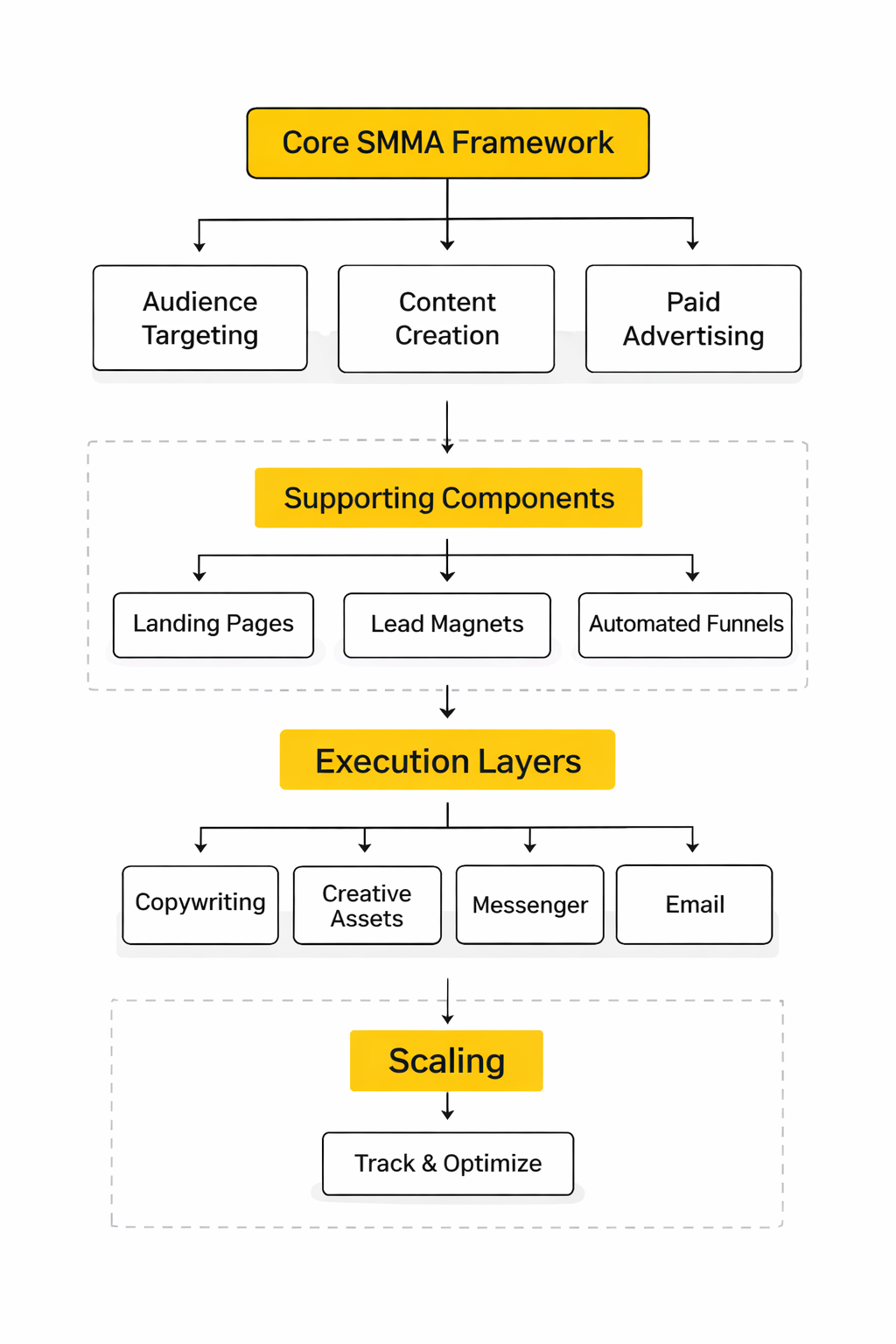
In practice, that means an SMMA should track at least four things every month. First, content and creative performance by angle, format, and hook. Second, traffic quality by source, platform, and campaign. Third, funnel behavior, which includes landing page conversion, form completion, booking rates, and drop-off points. Fourth, business results, which means leads, closed deals, revenue, retention, or repeat purchases depending on the client model. Without that chain, you are guessing. With it, you can explain why results happened and what to change next. Emplifi+1
This is where simple tooling matters. A scheduling platform like Buffer can support publishing workflow, while Brevo can help connect lead capture and nurture data. If the client’s path to conversion depends on structured landing pages or lead funnels, ClickFunnels or Systeme.io can make attribution much easier to understand. The software is not the strategy, but it does make clean measurement easier when the system is designed properly.
The Difference Between a Metric and a Decision Trigger
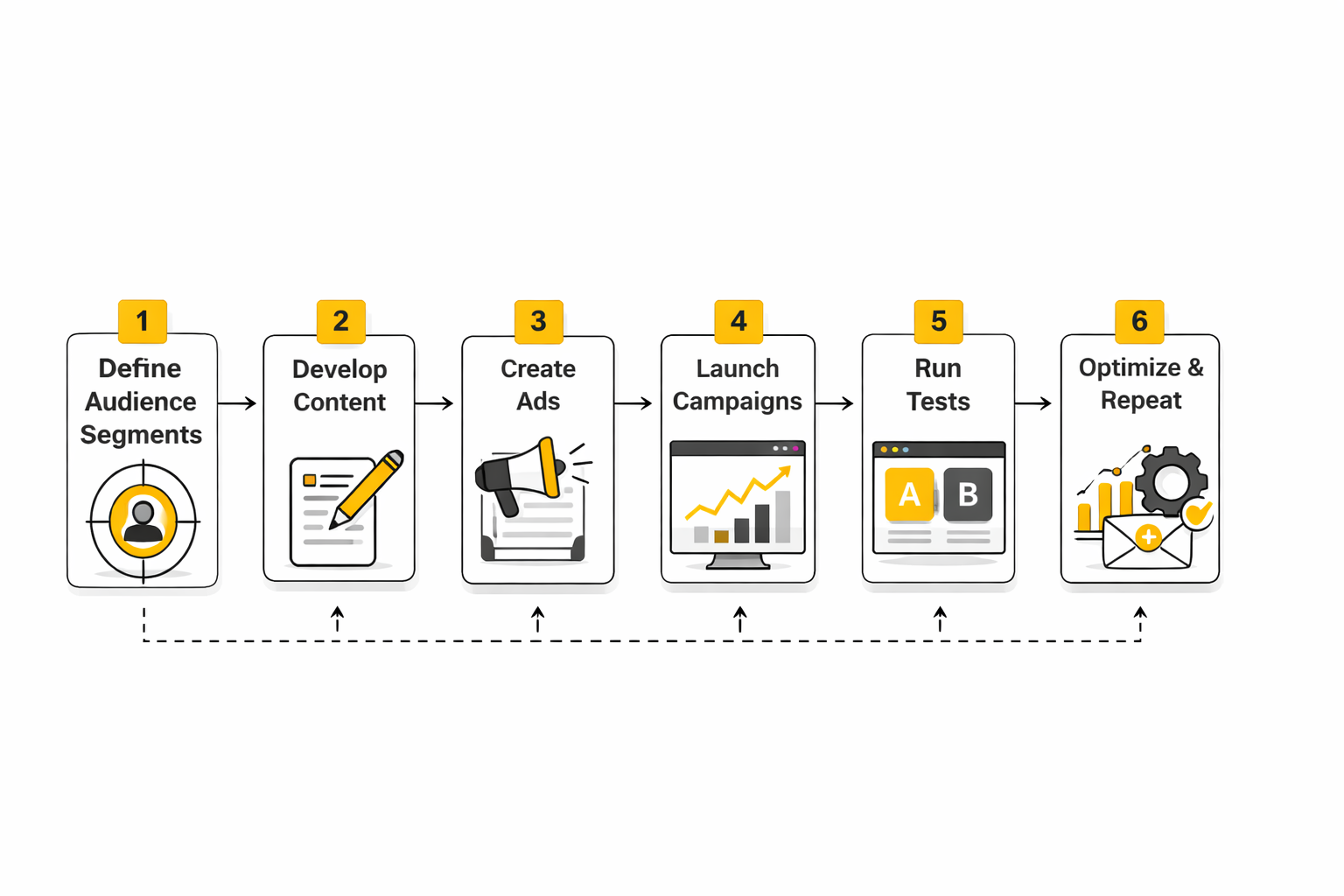
This distinction is where mature agencies separate themselves. A metric is just a number. A decision trigger is the point where that number tells you to act. For example, a falling click-through rate across several new creatives is not just reporting detail. It is a trigger to revisit the hook, audience, or visual structure. Rising cost per lead is not just a complaint. It is a trigger to inspect lead quality, auction pressure, page performance, and creative fatigue.
That mindset is what makes data useful. Benchmark reports from Emplifi are valuable because they tie performance patterns to format and channel behavior, and IAB/PwC’s 2024 revenue report is valuable because it shows the scale and continued importance of social ad investment. But neither report tells an SMMA exactly what to do for a specific client. Your job is to translate broad market signals into concrete actions inside the client account. Emplifi+1
What to Show Clients Every Month
Client reporting should never feel like punishment. It should feel like clarity. That means showing only the numbers that explain performance and support next actions.
A useful monthly SMMA report usually includes:
- the main business goal for the period
- the core numbers tied to that goal
- what improved
- what declined
- what caused those movements
- what gets tested next
That structure works because it mirrors how decision-makers actually think. They do not need 40 charts. They need confidence that the agency understands the system and has a plan. In a market where social budgets are large, competition is rising, and platform behavior keeps shifting, clarity is not a nice extra. It is part of the service. IAB+2
The next step is scaling, and this is where the numbers become even more important. Once an SMMA can read performance properly, it can standardize what works, spot weak points sooner, and grow without relying on guesswork.
How to Scale an SMMA Into a Real Agency
Scaling an SMMA sounds exciting until you hit the part where growth starts breaking the thing that made the business work in the first place. More clients mean more complexity, more communication, more QA risk, and more pressure on delivery. This is the stage where a lot of agencies confuse revenue growth with operational strength. Those are not the same thing.
A real agency is not just a freelancer with more Slack messages. It is a business with defined offers, repeatable systems, measurable client success, and enough margin to survive mistakes. That matters even more in a market where brands are still increasing investment in social and digital channels, but scrutiny around performance is getting tighter at the same time. IAB’s 2024 internet advertising revenue report shows just how large the market has become, and benchmark research from Sprout Social and Rival IQ makes it clear that competition for attention is not easing up. IAB+2
The First Scaling Tradeoff: Custom Work Versus Repeatable Delivery
In the early stage, custom work feels like a strength. You adapt constantly, say yes to almost everything, and make each client feel like the whole agency was built just for them. That can help you close deals, but it becomes dangerous when every account runs on a different process, different reporting style, different tool stack, and different expectations.
The agencies that scale usually move in the opposite direction. They standardize the parts that do not need to be reinvented every month: onboarding, creative briefing, campaign setup, reporting, review cycles, and communication cadence. That does not make the work robotic. It makes the business stable. In a market where benchmark data shows engagement norms vary sharply by industry and platform, standardization is not about using the same tactics everywhere. It is about using the same decision-making structure everywhere. Rival IQ+1
Hiring Too Early Is a Real Risk
A lot of SMMA founders think the next move after landing clients is building a team fast. Sometimes it is. Often it is not. Hiring before your delivery system is clean usually multiplies confusion instead of solving it.
If you have not defined how work gets scoped, reviewed, approved, launched, optimized, and reported, then every new contractor or employee adds another layer of interpretation. That is expensive. It also creates inconsistent client experience, and clients notice faster than agency owners think. The better path is to document the work first, then hire against the bottlenecks that are actually repeatable.
In practice, the first hires or contractors in an SMMA often land in a few predictable areas:
- media buying or campaign operations
- video editing and creative production
- client communication and account management
- funnel or automation support
- reporting and data cleanup
That sequence matters because it reflects where execution usually becomes fragile first. The goal is not to build a big team. The goal is to protect delivery quality while reclaiming founder time.
Client Mix Can Make or Break the Business
Not all revenue is equal. This is one of the most important lessons in agency growth, and people usually learn it later than they should. A portfolio full of demanding low-ticket clients can create more stress and less profit than a smaller roster of better-fit accounts.
That is why the strongest SMMA operators get ruthless about client fit. They look at margin, communication style, speed of approvals, internal client readiness, and how measurable the business outcome actually is. If a client cannot provide access, clear goals, basic responsiveness, or a realistic budget, they usually become expensive to serve no matter what the retainer says.
This is also where niche clarity pays off again. The more similar your clients are, the more reusable your systems become. Creative testing gets faster. Reporting gets cleaner. Sales conversations improve because your examples are more relevant. Over time, that operational compounding is one of the biggest advantages an SMMA can create.
The Hidden Cost of Bad Retention
A lot of agency owners obsess over acquisition and underthink retention. That is backwards. Client churn is one of the fastest ways to make an SMMA look healthy on the outside while quietly becoming unstable underneath.
Retention matters because replacing lost accounts is expensive in time, energy, and opportunity cost. It also disrupts team planning. If you are constantly filling holes, you never get the operational calm required to improve systems, train people, or deepen expertise. Social teams that can demonstrate business impact tend to have stronger internal influence and longer-term value, which is exactly why proving performance and keeping communication tight matters so much. Sprout Social+1
The practical fix is not fake friendliness or over-servicing. It is strategic clarity. Clients stay longer when they understand what is happening, see what is improving, know what gets tested next, and trust that the agency is not hiding behind vanity metrics. Retention is usually won in the boring moments: clean onboarding, clear expectations, fast communication, and calm problem-solving when results wobble.
Margin Is More Important Than Vanity Revenue
This is the part too many people skip because bigger revenue screenshots are more fun to post online. But an SMMA with weak margins is fragile even if the top-line number looks impressive. Founder dependency stays high, hiring gets harder, and one or two bad months can create real pressure.
A healthier agency thinks in terms of contribution margin per client, fulfillment cost per service line, average time to onboard, and how much founder involvement each account still requires. That is not glamorous, but it is the difference between a stressful income machine and a durable business. As digital ad investment continues to rise, the agencies that capture the most value will not automatically be the loudest ones. They will be the ones that can deliver outcomes without their internal costs spiraling. IAB+1
AI Changes the Game, But It Does Not Remove the Need for Judgment
This is one of the biggest strategic shifts happening inside agency work right now. AI tools can speed up ideation, reporting drafts, ad variations, research support, meeting notes, and parts of production. That is useful. It can absolutely improve speed and margin when used well.
But here is the catch: when everyone gets faster, judgment becomes more valuable, not less. The market does not reward agencies just for producing more content or more dashboards. It rewards agencies that know which creative angle to push, which funnel leak matters most, which client signal suggests churn risk, and which test is actually worth running next. AI can help with throughput. It does not replace commercial taste, strategic prioritization, or client leadership.
That is why the best move is usually selective integration. Use AI where it compresses repetitive work, but keep human control over messaging, decision-making, client communication, and quality control. In a crowded social market, speed without judgment just creates faster mediocrity.
Advanced Positioning: From Service Provider to Growth Partner
This is where an SMMA starts becoming genuinely hard to replace. If you stay framed as “the people who post” or “the ad buyers,” you will always face pricing pressure. If you become the team that improves acquisition efficiency, creative performance, reporting clarity, and revenue visibility, the relationship changes.
That repositioning is not about using fancier language. It comes from the actual scope of your work. If your agency can connect creative production, paid distribution, landing page flow, follow-up systems, and reporting into one coherent operating model, you are much closer to a growth partner than a vendor. Tools like Copper, Brevo, and Cal.com can support that transition by tightening CRM visibility, lead follow-up, and sales handoff, but the core shift is strategic rather than technical.
That strategic shift also protects you from one of the biggest scaling traps: commoditization. The more your work looks interchangeable, the more fragile your pricing becomes. The more your work is tied to a business system the client relies on, the more durable the relationship gets.
The Risks That Smart SMMA Owners Watch Closely
By this stage, the biggest threats are usually not the obvious ones. They are not “should I use Instagram or TikTok” level questions anymore. They are structural risks that quietly reduce performance, team stability, and decision quality.
A mature SMMA watches for:
- founder bottlenecks in sales or approvals
- overreliance on one acquisition channel
- weak documentation
- client concentration risk
- offer sprawl
- delivery inconsistency across accounts
- bad-fit clients consuming disproportionate time
None of these problems look dramatic at first. That is why they are dangerous. They build slowly, then all show up at once when the business is under pressure.
The answer is not perfection. It is operational honesty. You need to know what is fragile before growth exposes it. That is the difference between scaling on purpose and just getting bigger by accident.
What Scaling Successfully Usually Looks Like
Successful scaling usually looks less dramatic than people expect. It is not overnight transformation. It is a sequence of cleaner decisions. Narrower offers. Better-fit clients. More documented workflows. Better reporting. Sharper hiring. Stronger margins. Less founder chaos.
That is worth emphasizing because the social market is still large and still growing, but the winners are not the agencies doing the most random activity. They are the ones building systems that can survive platform changes, rising competition, and client scrutiny. If your SMMA can consistently tie attention to outcomes, and outcomes to business value, you have something real.
The final part will wrap this up with practical closing guidance and the FAQ, so the entire picture becomes clear from first principles all the way to expert execution.
The final lesson is simple. SMMA is still a real business model, but only when you treat it like a business system instead of a social media side hustle. The market is large, the budgets are real, and the demand is still there, with global social media identities at 5.24 billion in early 2025 and US social media ad revenue reaching $88.8 billion in 2024. Those numbers matter because they confirm the opportunity, but they do not guarantee your agency wins. Execution does.
What actually separates a durable SMMA from a short-lived one is not the niche you brag about or the software stack you screenshot. It is whether you can connect four things without breaking the chain: attention, conversion, retention, and reporting. When those pieces work together, your agency stops feeling like outsourced posting support and starts behaving like a revenue partner. That is the real endgame.
The strongest operators also understand that the market has matured. Social teams are now expected to prove impact, support customer relationships, and adapt to changing performance norms, which is exactly what recent benchmark and survey work from Sprout Social and Rival IQ keeps reinforcing. That should make your next move obvious. Build cleaner systems, sell clearer outcomes, and stop measuring success with vanity metrics.
FAQ - Built for Complete Guide
What does SMMA stand for?
SMMA stands for social media marketing agency. In practical terms, it usually means a business that helps companies grow through paid social, content, creator campaigns, community management, lead generation, or a combination of those services. The acronym is simple, but the work is only valuable when it ties social activity to real business outcomes.
Is SMMA still worth starting in 2026?
Yes, but only if you approach it with realistic expectations. The opportunity is still there because brands continue investing heavily in social channels and digital advertising, as shown by the latest IAB revenue data and Digital 2025 usage data. The easy-money fantasy is the part that is dead. The serious opportunity is still alive for people who can deliver results and communicate them clearly.
Do I need to pick a niche for my SMMA?
You do not need a niche on day one, but you will usually grow faster once you choose one. A niche makes your offer clearer, your outreach sharper, and your delivery more repeatable. It also helps with pricing because you can speak to a specific business problem instead of offering generic “social media help.”
What services should a beginner SMMA start with?
Start with one core service that has a clear commercial outcome. That could be paid social for lead generation, short-form video creative for ecommerce brands, or LinkedIn demand generation for B2B companies. The mistake is trying to sell everything at once. A tighter offer is easier to sell and easier to fulfill well.
Is organic social enough, or do clients really want paid ads too?
Some clients can get meaningful results from organic social, especially when brand trust, creator content, or audience education matter. But many businesses want faster and more measurable results, which is why paid social remains such a strong service category. A good SMMA does not treat organic and paid as enemies. It uses both where they make sense.
How much should an SMMA charge?
There is no universal number because pricing depends on the value created, the complexity of the service, and the business model of the client. What matters is that your price reflects an outcome, not just your time. If your work helps generate booked calls, purchases, or pipeline value, your pricing should reflect that commercial impact rather than a random hourly logic.
How long does it take to get the first SMMA client?
It depends on your niche, outreach quality, proof, and offer clarity. Some people land a client quickly because their message is sharp and they are speaking to a real pain point. Others stay stuck for months because their offer is vague and their outreach sounds like everyone else. The biggest lever is not luck. It is relevance.
What is the hardest part of running an SMMA?
For most people, the hardest part is not launching campaigns. It is building a delivery system that stays consistent under pressure. Getting a client is one challenge. Keeping quality high across multiple accounts, communicating clearly, and protecting margins at the same time is a bigger one. That is where agencies either mature or stay chaotic.
Do I need a team before I start?
No. Many SMMAs start with one person doing sales, strategy, and delivery. What matters more than team size is process quality. Once your workflow becomes predictable, you can bring in contractors or employees to remove bottlenecks without creating even more confusion.
What tools are most useful for an SMMA?
The best tools depend on your service mix, but most agencies need support for scheduling, lead capture, follow-up, booking, reporting, and CRM visibility. That is why platforms like Buffer, Brevo, and Cal.com often fit naturally into agency operations. If your offer includes funnel building or conversion support, Systeme.io or ClickFunnels can also make sense.
What metrics matter most in an SMMA?
The best metrics are the ones closest to business outcomes. Reach and engagement can be useful, but they are only part of the story. A better measurement system looks at attention, click behavior, conversion rate, lead quality, revenue contribution, retention, and what changed from one reporting period to the next. Good reporting should always drive the next decision.
Can AI replace an SMMA?
AI can absolutely speed up parts of the work. It can help with idea generation, reporting drafts, research assistance, asset variations, and admin tasks. But AI does not remove the need for strategy, prioritization, judgment, client communication, or creative direction. In fact, as more agencies use AI, the value of real judgment gets higher.
What makes clients stay with an SMMA longer?
Clients stay longer when they understand what is happening and believe the agency is in control of the process. That usually comes down to clear onboarding, smart reporting, honest communication, and measurable progress tied to real business goals. Most churn is not caused by one bad week. It is caused by confusion, weak expectations, or a lack of trust.
Is SMMA better than freelancing?
It depends on what you want to build. Freelancing is often simpler and can be very profitable with the right skill set. An SMMA becomes more attractive when you want recurring revenue, systems, team leverage, and the ability to deliver broader solutions. The tradeoff is complexity. You gain scale potential, but you also take on more operational responsibility.
What should someone focus on first if they want to build a serious SMMA?
Focus on one market, one outcome, and one reliable delivery process. That is the cleanest starting point. Once that foundation works, then you can improve outreach, refine pricing, add support tools, and scale operations. The agencies that last usually grow through tighter focus, not more random activity.
Work With Professionals
Explore 10K+ Remote Marketing Contracts on MarkeWork.com
Most marketers spend too much time chasing clients, competing on crowded platforms, and losing a percentage of every project to middlemen.
MarkeWork gives you a better way. Browse thousands of remote marketing contracts and connect directly with companies desperate to hire skilled marketers like you, without platform commissions and without unnecessary gatekeepers.
If you're serious about finding better opportunities and keeping 100% of what you earn, explore available contracts and create a profile for free at MarkeWork.com.
The final lesson is simple. SMMA is still a real business model, but only when you treat it like a business system instead of a social media side hustle. The market is large, the budgets are real, and the demand is still there, with global social media identities at 5.24 billion in early 2025 and US social media ad revenue reaching $88.8 billion in 2024. Those numbers matter because they confirm the opportunity, but they do not guarantee your agency wins. Execution does.
What actually separates a durable SMMA from a short-lived one is not the niche you brag about or the software stack you screenshot. It is whether you can connect four things without breaking the chain: attention, conversion, retention, and reporting. When those pieces work together, your agency stops feeling like outsourced posting support and starts behaving like a revenue partner. That is the real endgame.
The strongest operators also understand that the market has matured. Social teams are now expected to prove impact, support customer relationships, and adapt to changing performance norms, which is exactly what recent benchmark and survey work from Sprout Social and Rival IQ keeps reinforcing. That should make your next move obvious. Build cleaner systems, sell clearer outcomes, and stop measuring success with vanity metrics.
Work With Professionals
Explore 10K+ Remote Marketing Contracts on MarkeWork.com
Most marketers spend too much time chasing clients, competing on crowded platforms, and losing a percentage of every project to middlemen.
MarkeWork gives you a better way. Browse thousands of remote marketing contracts and connect directly with companies desperate to hire skilled marketers like you, without platform commissions and without unnecessary gatekeepers.
If you're serious about finding better opportunities and keeping 100% of what you earn, explore available contracts and create a profile for free at MarkeWork.com.