

SMMA usually stands for social media marketing agency, but the acronym gets thrown around so loosely that it often hides the real business underneath. A serious SMMA is not just someone posting Reels, chasing trends, or selling vague “growth” packages. It is a service business that helps brands turn attention on platforms like Instagram, TikTok, LinkedIn, Facebook, YouTube, and X into pipeline, sales, retention, or brand lift.
That distinction matters more now than it did a few years ago. Social is bigger, faster, and more commercial than ever, with 5.24 billion active social media user identities worldwide in early 2025, while U.S. social media ad revenue reached $88.8 billion in 2024. At the same time, the channel is influencing the entire buying journey, not just awareness, with 81% of consumers using social media for product discovery and 93% saying it is important for brands to keep up with online culture.
This article breaks SMMA down the practical way. Not as a hustle trend, not as a fantasy business model, but as a real operating system for client acquisition, delivery, reporting, and growth. The goal is to make the topic clear enough that a founder, freelancer, operator, or brand-side marketer can see exactly where an SMMA creates value and where most agencies get lost.
- What SMMA Really Means in 2026
- Why SMMA Still Matters for Business Growth
- The SMMA Service Delivery Framework
- Core Components of a High-Performing SMMA
- How Professional SMMA Implementation Works
- Where SMMA Is Headed Next
At its core, an SMMA is a business that manages or improves a company’s performance on social platforms in exchange for fees, retainers, project payments, or performance-based compensation. That work can include strategy, content planning, creative production, paid social campaigns, community management, reporting, offer positioning, lead generation, and sometimes funnel or CRM integration. In other words, the real product is not “posting on social media.” The real product is measurable business movement created through social channels.
That is why the best SMMAs are closer to growth partners than content vendors. They do not just ask what to post this week. They ask what the client is trying to sell, who the buyer is, which platform matches buyer intent, what content angle reduces friction, and how results will be tracked from impression to conversion. When an agency cannot answer those questions, it usually ends up selling activity instead of outcomes.
The term also covers a wide range of business models. Some agencies focus on local lead generation for med spas, dentists, or real estate teams. Others specialize in ecommerce creative, B2B thought leadership, paid acquisition, creator partnerships, or executive personal branding on LinkedIn. So when people ask whether SMMA still works, the honest answer is that generic SMMA is fading, but specialized SMMA is getting stronger.
Social media is no longer an optional visibility channel for most businesses. It sits in the middle of discovery, trust building, consideration, and in many cases direct conversion, which is exactly why marketers continue to prioritize it. Broader marketing surveys from HubSpot’s 2025 and 2026 reporting keep showing paid social and social commerce among the channels delivering meaningful ROI, while the U.S. Small Business Administration notes that most small business owners use social platforms to build awareness and promote products.
What changed is not just scale, but buyer behavior. People now discover brands in feeds, validate them through content, compare them through comments and creator mentions, and often make a decision before ever filling out a form or talking to sales. That is one reason the old model of “run a few ads and hope” has become too shallow. Businesses need a system that connects audience research, creative testing, message clarity, and conversion pathways.
That shift gives a strong SMMA a real role inside modern marketing. A capable agency helps a client translate raw platform attention into something operational: better creative, cleaner positioning, stronger offers, faster testing cycles, clearer reporting, and a tighter connection between social activity and revenue. That is where the category still matters, and it is also the bridge to the framework the rest of this article will unpack.
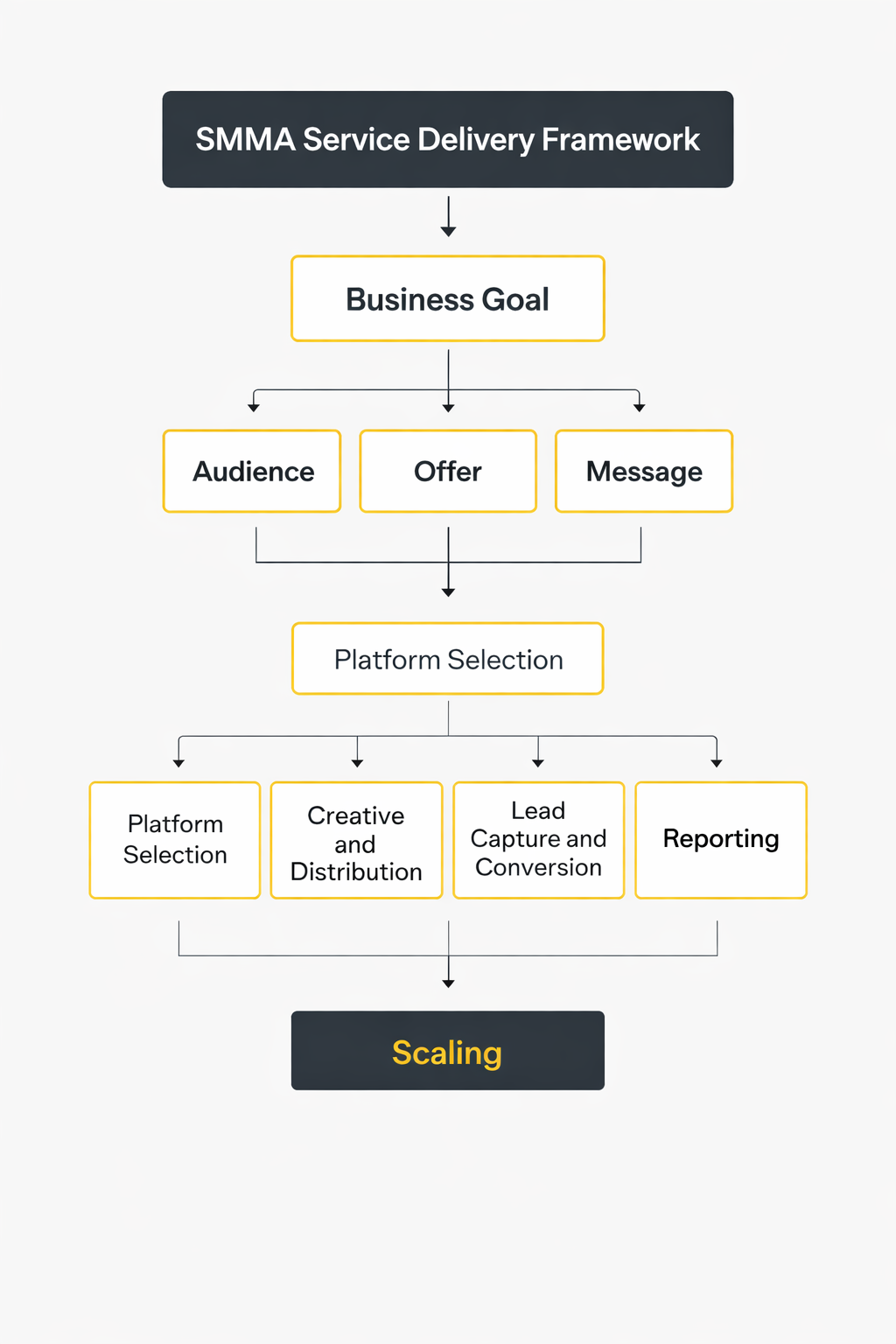
A real SMMA does not start with content calendars, Canva templates, or a promise to “go viral.” It starts with a delivery framework that connects business goals to platform execution, because social has become too commercial and too measurable to run on vibes alone. The agencies that last are the ones that can translate a client’s revenue target into audience research, creative testing, campaign operations, and reporting that leadership can actually use, which lines up with how marketers are putting more pressure on measurable outcomes and specialized roles in social now HubSpot’s 2026 marketing statistics Sprout’s 2025 impact report Nielsen’s 2025 Annual Marketing Report announcement.
The easiest way to understand the framework is this: an SMMA takes a messy client objective and turns it into a controlled system. That system usually moves in order from positioning to offer alignment, then to channel selection, content and ad production, publishing and distribution, lead capture or purchase flow, and finally reporting with iteration. When any of those pieces are weak, the agency may still look busy, but the work stops compounding.
This is where a lot of weak agencies lose the plot. They build the whole engagement around Instagram growth, TikTok views, or lead volume before they understand whether the client actually needs local appointments, demo bookings, higher average order value, repeat purchases, or stronger branded search demand. That mistake is expensive because social platforms now influence much more of the buying journey, and the channel works best when the agency is clear about where it is supposed to move the buyer next Deloitte Digital’s 2025 State of Social Research Deloitte on social commerce and the creator economy DataReportal’s 2025 social overview.
A competent SMMA gets specific fast. For one client, the goal may be qualified leads at a target cost. For another, it may be content that warms up buyers before sales calls. For ecommerce, it may be creative that lifts click-through rate, conversion rate, or new-customer revenue. The framework changes depending on that target, which is exactly why generic “full-service social media” offers usually feel fuzzy in practice.
Once the goal is clear, the next job is alignment. The agency needs to know who the buyer is, what pain point actually matters, what promise the offer makes, and what proof removes skepticism. This sounds basic, but it is the difference between posting content that gets polite engagement and building a social engine that brings in demand.
That alignment matters even more now because consumers are using social to discover, compare, validate, and contact brands in the same environment. The old funnel is flatter than it used to be, and people expect the path from seeing a piece of content to taking action to feel seamless Deloitte Digital’s 2025 State of Social Research Sprout’s 2025 Index Hootsuite Social Trends 2026. So before an SMMA worries about hooks and hashtags, it needs message clarity: who this is for, why now, why this brand, and what action the audience should take next.
A strong SMMA does not force every client into the same channel mix. Platform choice should come from buyer behavior, content economics, sales cycle length, and the kind of proof the offer needs. A local clinic, a B2B consultancy, and a DTC skincare brand can all use social media well, but they should not be running the exact same playbook.
That matters because each platform now plays a different role inside attention and conversion. Social video is pulling more consumer time, creator ecosystems are becoming more performance-oriented, and marketers are putting more emphasis on social commerce, customer care, and social search behavior than they were even a couple of years ago Deloitte’s 2025 Digital Media Trends Hootsuite Social Trends 2026 Sprout’s 2025 impact report. In plain English, the framework has to answer a practical question: where will this client win fastest with the resources they actually have?
This is the part most people oversimplify. Content is not just “organic,” and ads are not just “paid.” In a good SMMA, creative production and distribution inform each other constantly. Organic posts reveal language, objections, and story angles that can strengthen paid campaigns, while paid performance can show which hooks, formats, and offers deserve more organic emphasis.
That approach matches how modern social teams are evolving. More brands are hiring for paid social, customer support, social SEO, and creator-related capabilities because social performance is no longer driven by one isolated function Sprout’s 2025 impact report HubSpot’s 2026 marketing statistics Nielsen’s 2025 Annual Marketing Report announcement. For an SMMA, the practical lesson is simple: treat every asset as part of one testing environment, not as disconnected deliverables created to fill a retainer.
A surprising number of agencies still treat conversion as someone else’s problem. They run traffic, publish content, send people to a weak landing page, and then blame the algorithm when results stall. That is not serious implementation. If an SMMA is going to own performance, it has to care about the handoff between social attention and the next step, whether that means a form, a booking flow, a product page, a DM script, or an email nurture sequence.
This is why the best agencies tend to get pulled deeper into the stack over time. They may start with social media management, but they end up improving funnels, forms, scheduling, CRM hygiene, and follow-up because those things decide whether social attention becomes revenue. For clients that need tighter conversion paths, tools like ClickFunnels, Systeme.io, Fillout, Brevo, and Cal.com fit naturally into the operational side of an SMMA because they reduce friction between interest and action.
The framework is not finished until reporting closes the loop. Clients do not just need screenshots of reach, engagement, and follower growth. They need a read on what changed, what that change means, what created it, and what the agency is doing next. Without that, reporting becomes a ritual instead of a management tool.
That is especially important because executives increasingly expect marketing teams to justify budget with clearer performance logic. Social still needs top-of-funnel metrics, but the stronger SMMA links those signals to business outcomes like lead quality, booked calls, assisted conversions, repeat revenue, or stronger branded demand over time Nielsen’s 2025 Annual Marketing Report announcement IAB’s 2024 internet ad revenue report Sprout’s 2025 impact report. That is the shift from “look what we posted” to “here is how the system performed.”
Once the framework is clear, the next question is what actually sits inside it. This is where the conversation gets more useful, because most SMMAs do not fail from a lack of ambition. They fail because they are missing a few core components that make the whole model stable. The next section breaks those components down one by one so you can see what separates a real operator from an agency that only looks polished on the front end.
A high-performing SMMA is not built on one talent. It is built on a handful of components that reinforce each other so the agency can keep producing results even when platforms shift, CPMs rise, or a client’s creative starts to fatigue. When social teams can prove impact, they usually have stronger reporting infrastructure, better cross-functional alignment, and clearer business goals than teams that stay stuck in vanity metrics Sprout’s 2025 social impact report HubSpot’s 2026 marketing statistics.
Most weak agencies try to look bigger by offering everything. The stronger move is the opposite. A serious SMMA usually becomes easier to sell and easier to operate once it narrows its market, its offer, or its outcome, because buyers understand faster what problem it solves and the agency can build repeatable systems around that promise.
That matters even more in crowded categories where clients have too many agencies to choose from and very little patience for vague claims. In B2B especially, differentiated expertise and thought leadership still open doors because buyers reward firms that teach clearly and frame problems intelligently rather than sounding interchangeable Edelman and LinkedIn’s 2025 B2B Thought Leadership Impact Report LinkedIn’s B2B Institute. For an SMMA, that means a tighter niche is often not a limitation. It is an operating advantage.
Good creative still wins attention, but agencies that depend on one star copywriter or one editor eventually hit a ceiling. A better model is to build a repeatable creative system: angle research, hooks, scripting, editing rules, proof assets, testing cadence, and feedback loops. That is what turns content from occasional luck into a controlled production function.
This lines up with where marketing is going. Marketers continue to lean heavily into short-form video, video-based formats are still among the strongest ROI drivers, and TikTok remains one of the platforms marketers plan to use more aggressively going into 2026 HubSpot’s 2026 marketing statistics. So the real edge is not “we make content.” The edge is being able to produce enough quality creative, fast enough, with enough variation, to keep learning.
A surprising number of SMMAs still treat replies, DMs, and comment management like a side task. That is a mistake. Social has become one of the places where trust is won or lost in public, and response quality now affects brand perception, conversion, and retention more directly than many agencies admit.
The expectation from users is already clear. Most consumers want brands to respond on social within 24 hours or sooner, and poor customer service remains one of the main reasons customers stop buying from a brand Sprout on social response time Salesforce’s State of the Connected Customer. That is why a mature SMMA builds processes for routing questions, handling objections, and escalating service issues instead of pretending engagement stops at publishing.
Clients can forgive a weak week. They do not forgive confusion. If an SMMA cannot explain what changed, why it changed, and what happens next, the relationship starts to decay even when some metrics look decent on the surface. Strong agencies make reporting simple, but not shallow. They connect channel metrics to commercial movement.
That expectation is getting sharper because leadership teams increasingly want direct links between social activity and business goals, better visualization of performance, and cleaner proof of social ROI Sprout’s 2025 ROI statistics Sprout’s 2025 social impact report. In practice, that means an SMMA needs a reporting spine that can cover reach, engagement quality, lead flow, booking rates, assisted conversions, and revenue signals without hiding behind vanity charts.
Tool stacks do not make an agency good, but bad tooling absolutely slows one down. Scheduling, review workflows, inbox management, lead capture, CRM handoff, email follow-up, and calendar booking all affect whether the agency can move quickly without dropping details. Once client volume grows, messy operations start to show up in missed approvals, delayed campaigns, and leads that never get followed up.
That is why professional SMMAs usually standardize their stack earlier than beginners expect. Platforms like Buffer for publishing and engagement workflows, Fillout for cleaner forms, Brevo for follow-up, Cal.com for booking, and Copper for CRM management fit naturally into this setup because they reduce the friction between content, conversations, and conversions Buffer’s product overview LinkedIn Lead Gen Forms.
The difference between a freelancer posting content and a professional SMMA running an account usually shows up in the process. Professional implementation has sequence. It has checkpoints. It has decision rules. Instead of improvising week to week, the agency runs a structured rollout that gives the client clarity and gives the team a real chance to improve performance over time.
The first step is not posting. It is diagnosis. A competent SMMA starts by auditing the offer, current channels, historical performance, conversion path, sales process, competitor positioning, and internal constraints. Without that work, the agency is guessing, and guesses get expensive fast.
This matters because social performance depends on far more than creative quality. Buyers now move across discovery, validation, and service touchpoints in ways that reward connected journeys and punish fragmentation Salesforce’s customer expectations overview Salesforce’s State of the Connected Customer. If the agency does not understand how the business actually closes revenue, the content plan will be disconnected from the outcome it is supposed to improve.
After the audit, the agency needs to simplify the battlefield. Which audience matters most right now? What offer is being pushed first? What counts as success in the next 30 to 90 days? These decisions sound obvious, but they remove a huge amount of confusion from execution.
This is where the SMMA decides whether the campaign is really about lead generation, booked appointments, ecommerce purchases, event registrations, or thought-leadership reach that supports a longer sales cycle. Platform tools themselves reflect that performance focus now, with systems like LinkedIn Lead Gen Forms and TikTok’s native lead generation products built to shorten the gap between attention and action LinkedIn Lead Gen Forms TikTok for Business inspiration hub TikTok Toyota case study.
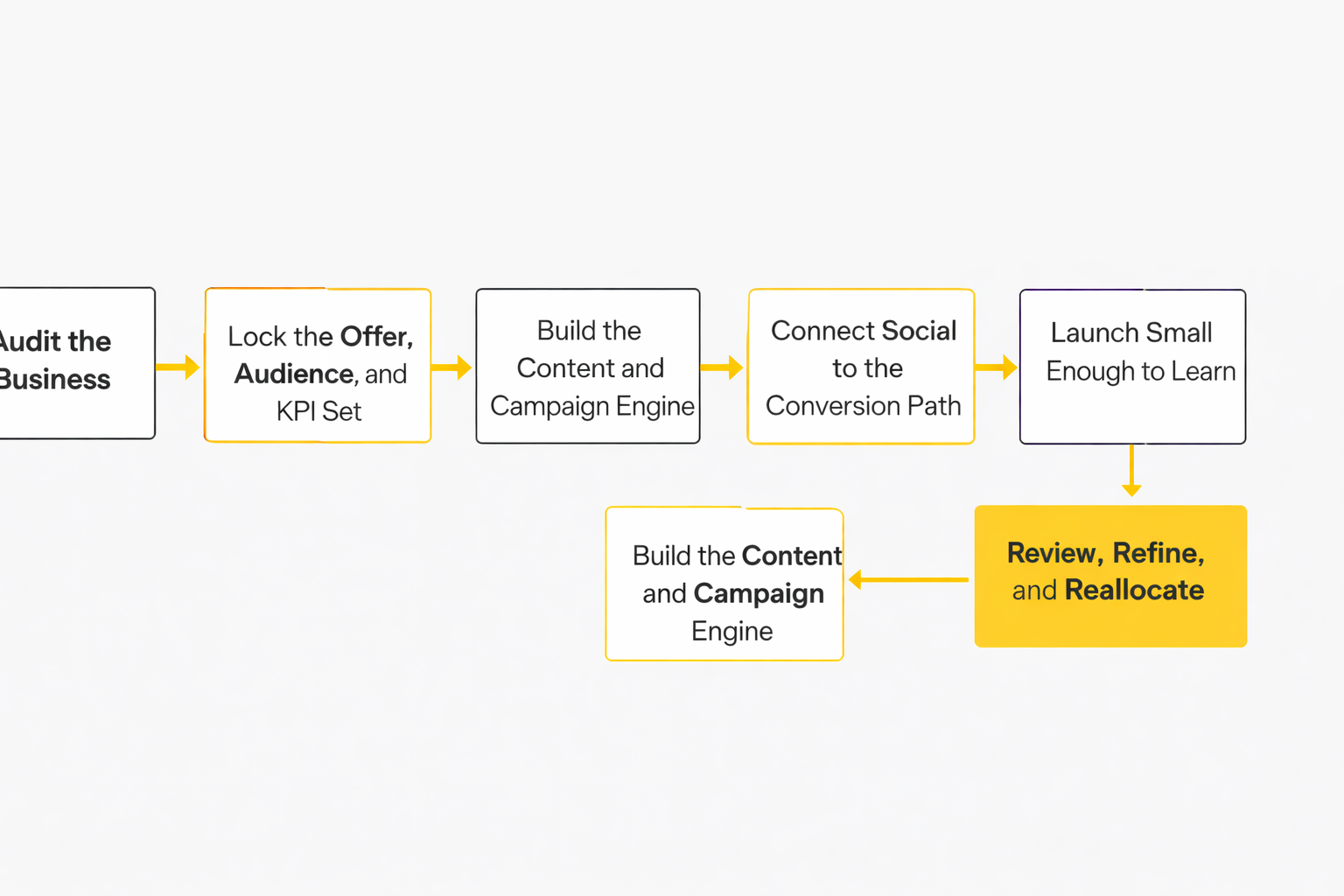
Once the target is clear, the agency can build the engine. That usually includes creative angles, script banks, content pillars, ad variations, landing-page messaging, CTAs, retargeting rules, and a publishing rhythm that fits the client’s resources. This is the stage where execution becomes tangible, because now the work is moving from strategy docs into assets, workflows, and real campaign structure.
The key is not to build one hero asset and hope it lands. The key is to build a testing environment. On platforms where short-form video and native creative dominate attention, the agency needs enough volume and enough variation to learn quickly which message, proof point, and format are actually moving results HubSpot’s 2026 marketing statistics TikTok for Business inspiration hub. A professional SMMA treats every round of creative as input for the next round, not as a finished masterpiece.
This is the part beginners skip and experienced operators obsess over. Content only matters if the next step works. That means forms have to be clean, booking flows have to be friction-light, landing pages have to match the promise in the ad or post, and follow-up has to happen quickly enough that intent does not cool off.
This is where the process often becomes more technical than clients expect. A serious SMMA may connect lead forms, CRM stages, automations, appointment scheduling, inbox routing, and email nurture so the conversion path does not break after the click. For agencies building that kind of path, tools like ClickFunnels, Systeme.io, Brevo, and Fillout make sense because they help close the gap between traffic and action.
One of the best habits in SMMA implementation is controlled rollout. Instead of going all in on one creative direction, the agency launches with enough budget, enough formats, and enough variation to produce signal without burning money on premature scale. This protects the client and gives the team clean data to work from.
That approach shows up in platform case studies again and again. Performance lifts often come from structured testing, native formats, lead-form integrations, and clearer campaign segmentation rather than from a single trick or hack TikTok Land Rover Romania case study LinkedIn Refinitiv case study LinkedIn Schneider Electric case study. In other words, strong implementation is boring in the best possible way: disciplined, deliberate, and built for iteration.
After launch, the agency has to earn the next month. That means reviewing performance against the agreed KPI set, finding which creative angles are carrying the account, spotting where drop-off happens in the conversion path, and reallocating effort toward what is actually working. This is where many agencies claim to optimize but really just keep posting.
Professional SMMAs do it differently. They review the system, not just the dashboard. They ask whether the issue is the audience, the offer, the hook, the landing page, the follow-up speed, or the platform mix itself. That review loop is what turns social media management from a deliverable business into a performance business, and it sets up the next part of this article: where SMMA is headed as platforms, automation, and buyer behavior keep changing Sprout’s 2025 social impact report HubSpot’s 2026 marketing statistics.
Data matters in an SMMA for one simple reason: it keeps the agency honest. Social media can generate a huge amount of visible activity, but visible activity is not the same thing as business progress. Once an agency starts measuring the wrong signals, it becomes very easy to celebrate views while pipeline stalls, or to brag about engagement while conversion quality quietly gets worse.
The scale of the channel is exactly why measurement has become non-negotiable. Social media usage is still expanding globally, with 5.24 billion active social media user identities reported in early 2025, and the money flowing into the channel keeps rising as well, with social media advertising revenue hitting $88.8 billion in 2024 in the U.S. alone. For an SMMA, those numbers do not just show that social is big. They show that clients are competing inside an increasingly crowded and expensive environment, which makes disciplined measurement more important, not less.
When brands invest in a channel this large, expectations rise with it. Leaders are no longer satisfied with loose updates about reach or generic claims that “brand awareness is growing.” They want clearer links between social campaigns and business goals, cleaner proof of efficiency, and better visibility into what is actually driving performance, which lines up with what marketers reported in Sprout Social’s 2025 ROI data.
That shift changes how an SMMA should present its work. The agency cannot stop at platform-native metrics if the client is thinking in revenue, qualified leads, lower acquisition costs, or improved retention. Social still creates top-of-funnel value, obviously, but the agency needs to interpret that value in a way that helps the client make better business decisions.
This is where a lot of SMMAs still get trapped. Follower growth, impressions, and likes can be useful early indicators, but they are not strong enough on their own to justify budget or prove momentum. What matters is whether those signals are tied to something commercial: better click quality, lower cost per qualified lead, stronger conversion rates, more booked calls, more assisted purchases, or faster deal movement.
The gap between activity and business value is already visible in industry research. Marketing leaders increasingly want direct connections between social campaigns and business goals, and they also want stronger visualization of that performance so decisions are easier to make Sprout Social’s 2025 ROI statistics Sprout’s 2025 impact report. That means an SMMA should treat vanity metrics as directional clues, not final proof.
A high-performing post is not always a high-performing business asset. Short-form video continues to be one of the strongest ROI-driving formats for marketers, with HubSpot’s 2026 marketing data showing video-based formats leading ROI rankings and short-form video on top. That is useful, but it does not mean every client should chase raw views or force every offer into the same style of content.
The right interpretation depends on the objective. If an SMMA is helping a founder build authority, stronger watch time and saves might matter more than direct conversions in the first phase. If the goal is lead generation, then the content has to be judged by how well it moves viewers into forms, DMs, bookings, or sales conversations. Same platform, same format, completely different meaning.
Benchmarks are useful, but only when they are tied to the job the content is supposed to do. Too many agencies compare accounts across industries, business models, and funnel stages as if the numbers are interchangeable. They are not. A B2B consultancy with long sales cycles should not be judged the same way as a local service business running appointment ads or a DTC brand optimizing for repeat purchases.
This is why the best SMMA reporting frameworks start with a small KPI hierarchy. First come the business outcomes, then the conversion metrics that feed them, then the engagement and reach signals that explain why those conversion metrics are moving. Once that hierarchy is clear, benchmarks become useful because they support decisions instead of distracting from them.
This is the part that separates operators from dashboard decorators. Platform analytics tell you what happened inside the platform, but they rarely tell the full story of what happened to the lead, the customer, or the sale after the click. A serious SMMA has to connect campaign data to forms, booking tools, CRM stages, email workflows, and sales outcomes if it wants to understand where value is being created or destroyed.
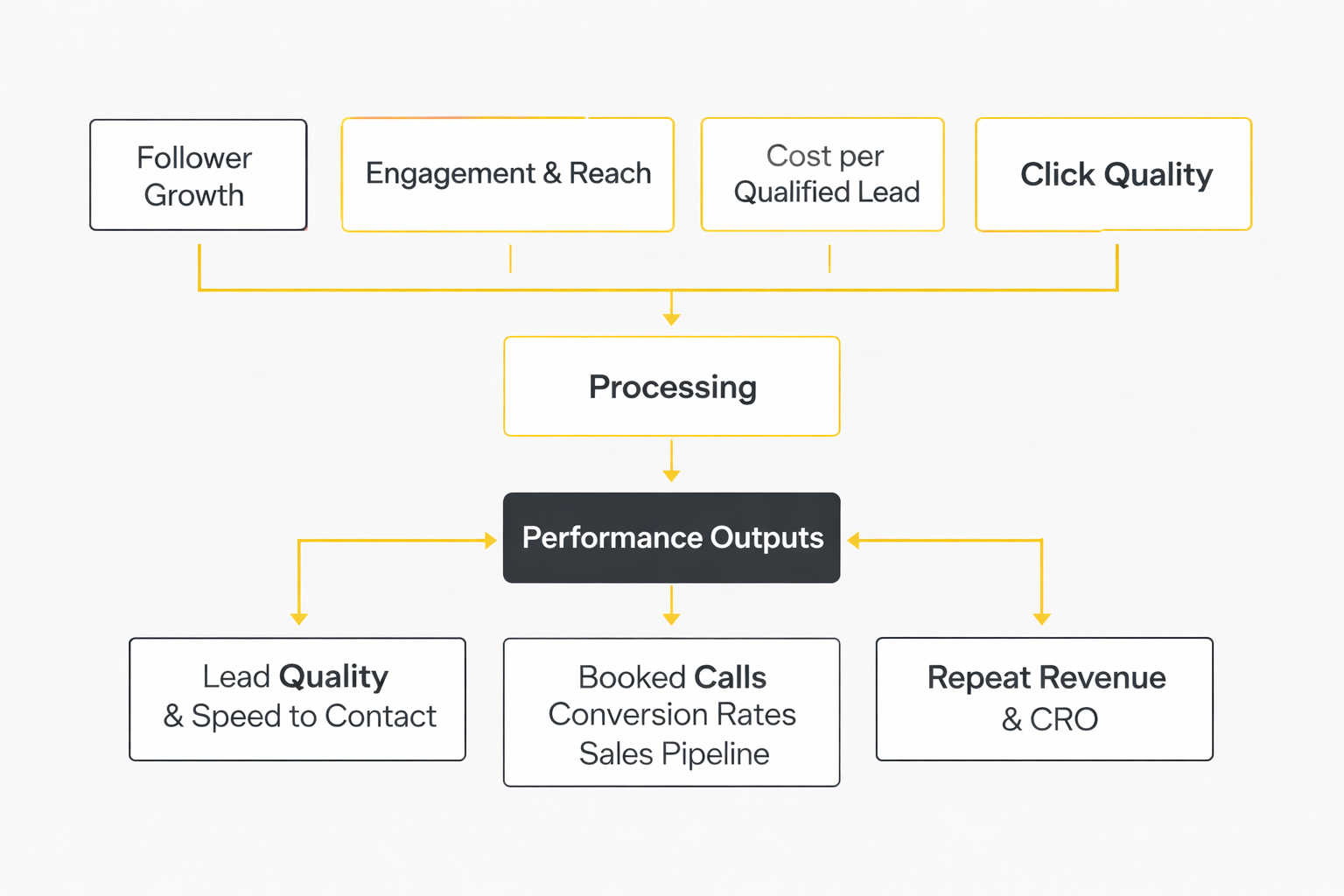
That connection is where the numbers start becoming practical. If a campaign has strong click-through rates but weak booked-call rates, the problem may be the landing page, form friction, or follow-up speed. If engagement is flat but qualified leads are rising, the agency may actually be doing better than the vanity dashboard suggests. This is exactly why a professional SMMA needs a measurement system, not just a content report.
Measurement is only useful if it changes behavior. A strong SMMA uses data to decide which hooks deserve more budget, which content pillars are attracting the wrong audience, which offer angles are creating better lead quality, and which parts of the funnel are leaking intent. The goal is not to admire the report. The goal is to improve the system.
In practice, that usually means decisions like these:
- produce more variations of a creative angle that is generating cheaper qualified demand
- cut formats that look engaging but rarely create meaningful next steps
- simplify forms when click quality is fine but completion rate is weak
- tighten follow-up when leads are arriving but booked meetings stay soft
- shift platform emphasis when audience intent is stronger somewhere else
That kind of interpretation is what turns an SMMA from a content vendor into a performance partner. The agency is no longer just reporting numbers back to the client. It is using those numbers to decide what deserves more attention, what needs repair, and what should be removed entirely.
There is another benefit here that gets overlooked. Better measurement does not just improve campaigns. It improves trust. When an agency can explain performance clearly, clients stop feeling like they are funding a black box. They can see what is working, what is uncertain, and what the next move should be.
That clarity matters because social marketing has become more cross-functional. Teams that can prove impact tend to have stronger reporting infrastructure and better alignment with broader business objectives, which means the data from social can influence decisions beyond the marketing team itself Sprout’s 2025 impact report. For an SMMA, that is a major opportunity. The more clearly you interpret the numbers, the more strategic your role becomes.
Once an agency understands how to measure performance properly, the next question is where the model is going. And that matters because SMMA is not standing still. Platform behavior is changing, client expectations are getting sharper, and automation is starting to reshape how agencies produce, distribute, and optimize work. The next part looks at what is changing now and what a smart SMMA should do about it.
The next phase of SMMA is not about doing more of the same faster. It is about becoming more specialized, more measurable, and more integrated with the rest of the client’s commercial system. Social is still growing as a business channel, but the model is getting less forgiving for agencies that sell generic retainers without a clear edge, especially as marketers keep prioritizing paid social, social commerce, and performance accountability HubSpot’s 2026 marketing statistics IAB’s 2024 internet ad revenue report.
That shift is good news for serious operators. A better market usually feels harder because it punishes sloppy work. But that same pressure creates room for agencies that can combine strategy, creative speed, tighter measurement, and cleaner implementation into one system clients can actually trust.
A lot of people still talk about AI as if it will wipe out the agency model. That is too simplistic. AI is clearly reshaping how content gets researched, produced, edited, and distributed, and agencies are already being pushed to adopt it faster Google’s agency AI adoption guidance HubSpot’s 2026 State of Marketing Deloitte’s 2026 TMT predictions. But that does not make strategy, judgment, positioning, offer clarity, or client communication disappear.
What it does do is remove the excuse for being slow. If an SMMA is still charging premium fees for tasks that can be accelerated with AI, clients will notice. At the same time, fully automated content is not automatically trusted by audiences, and marketers are already dealing with the tension between AI efficiency and audience skepticism Hootsuite Social Trends 2026. So the smart move is not “use AI everywhere.” The smart move is to use AI where it speeds up workflow, then keep human control where it sharpens message quality and protects trust.
As platforms mature, clients are getting better at spotting vague agency offers. “We help brands grow on social” is too soft now unless there is real proof and a very clear operating model behind it. Stronger SMMAs will keep moving toward tighter positioning, whether that means a niche industry, one platform, one traffic source, one funnel model, or one measurable outcome.
This lines up with how B2B and high-consideration markets increasingly reward clear expertise and distinct points of view. Buyers are drawn to firms that teach well, frame problems well, and demonstrate depth rather than breadth Edelman and LinkedIn’s 2025 B2B Thought Leadership Impact Report LinkedIn B2B Institute. For an SMMA, that means the future probably belongs less to the “full-service agency for everyone” and more to the operator who can say, very clearly, what problem they solve and for whom.
Another major shift is that social influence is spreading across more formats and more voices. Brands still need owned content, obviously, but they also need creator collaborations, founder-led media, customer proof, and more native-feeling distribution models. The line between a social media agency, a creative studio, and a creator strategy partner is getting thinner.
That is not a minor trend. Platform and industry research keeps pointing toward creator ecosystems, platform-native storytelling, and more authentic-looking content as important growth levers for modern marketing teams Deloitte on the creator economy TikTok What’s Next 2025 Trend Report Google’s Cannes 2025 marketing takeaways. In practice, that means an SMMA that only knows how to publish branded posts may start feeling outdated. The stronger agency will know how to orchestrate multiple trust signals, not just fill one brand calendar.
The future of SMMA also points toward deeper measurement. Clients are under pressure to justify spend more precisely, and that means agencies will need to connect social activity not only to leads, but also to lead quality, speed to contact, pipeline movement, purchase behavior, and retention signals wherever possible. The closer social gets to the revenue conversation, the more valuable the agency becomes.
This is one of the biggest strategic tradeoffs in the business. Going deeper into measurement and system integration takes more skill, more tooling, and often more client access. But it also makes the agency harder to replace. Tools like Copper, Brevo, Cal.com, and Fillout fit naturally into that future because they help an SMMA connect social demand to CRM structure, follow-up, and conversion tracking instead of stopping at impressions and clicks.
This is where a lot of agencies hit the wall. Growth sounds exciting until the founder becomes the bottleneck for sales, strategy, approvals, reporting, and quality control at the same time. At that point, the issue is no longer demand. The issue is operational design.
Scaling an SMMA usually creates four predictable risks:
- client experience gets worse as delivery becomes templated and slower
- reporting loses clarity because too many accounts are being managed with shallow oversight
- creative quality drops when production volume rises faster than review systems mature
- the founder becomes trapped in everything that feels “too important to delegate”
That is why smart agencies standardize earlier than they want to. They document onboarding, briefing, approvals, QA, reporting, and handoff rules before chaos becomes expensive. Scheduling and workflow tools like Buffer, campaign infrastructure like ClickFunnels or Systeme.io, and automation layers built around clean forms and follow-up are not just convenience plays. They are how a growing SMMA avoids breaking under its own client load.
Every SMMA eventually runs into the same question: do you want more clients, or better economics per client? There is no universal answer, but there is a real tradeoff. A higher-volume agency can grow fast, yet it often relies on more standardized delivery and thinner strategic involvement. A deeper agency may serve fewer clients, but it can own more of the funnel, influence more of the client’s commercial system, and justify stronger fees.
This is where many agencies have to choose what business they are really building. If the goal is speed and scale, productized delivery may make sense. If the goal is durability and defensibility, deeper implementation usually wins. Either way, the SMMA that survives long term will be the one that makes this choice deliberately instead of drifting into it by accident.
At the expert level, SMMA is less about platform tricks and more about coordinated leverage. It is understanding where audience intent lives, how creative should be tested, how offers need to be positioned, how friction should be removed after the click, and how performance should be interpreted so the client can make smart decisions. That is a very different game from simply offering “social media management.”
And honestly, this is where the whole category gets clearer. The future SMMA is not a posting service. It is a compact growth operation built around social attention. Agencies that can do that well will keep finding demand even as platforms shift, AI accelerates, and the market gets noisier.
The final part will bring everything together with practical answers to the most common questions people still have about SMMA, including what it is, how it works, what it costs, and where beginners usually get it wrong.