

A social media ad agency helps businesses turn paid social platforms into a predictable growth channel. That sounds simple, but the real work is not just launching ads. It is building the strategy, creative system, tracking, testing rhythm, and follow-up process that make campaigns improve over time.
Social advertising matters because attention has shifted hard toward social feeds, short-form video, creators, and community-led discovery. Global digital ad spend keeps moving toward online channels, with social media remaining one of the major growth areas in DataReportal’s 2025 advertising trends. At the same time, marketers are under pressure to prove ROI, create better content faster, and adapt as platforms push more automation into targeting and delivery.
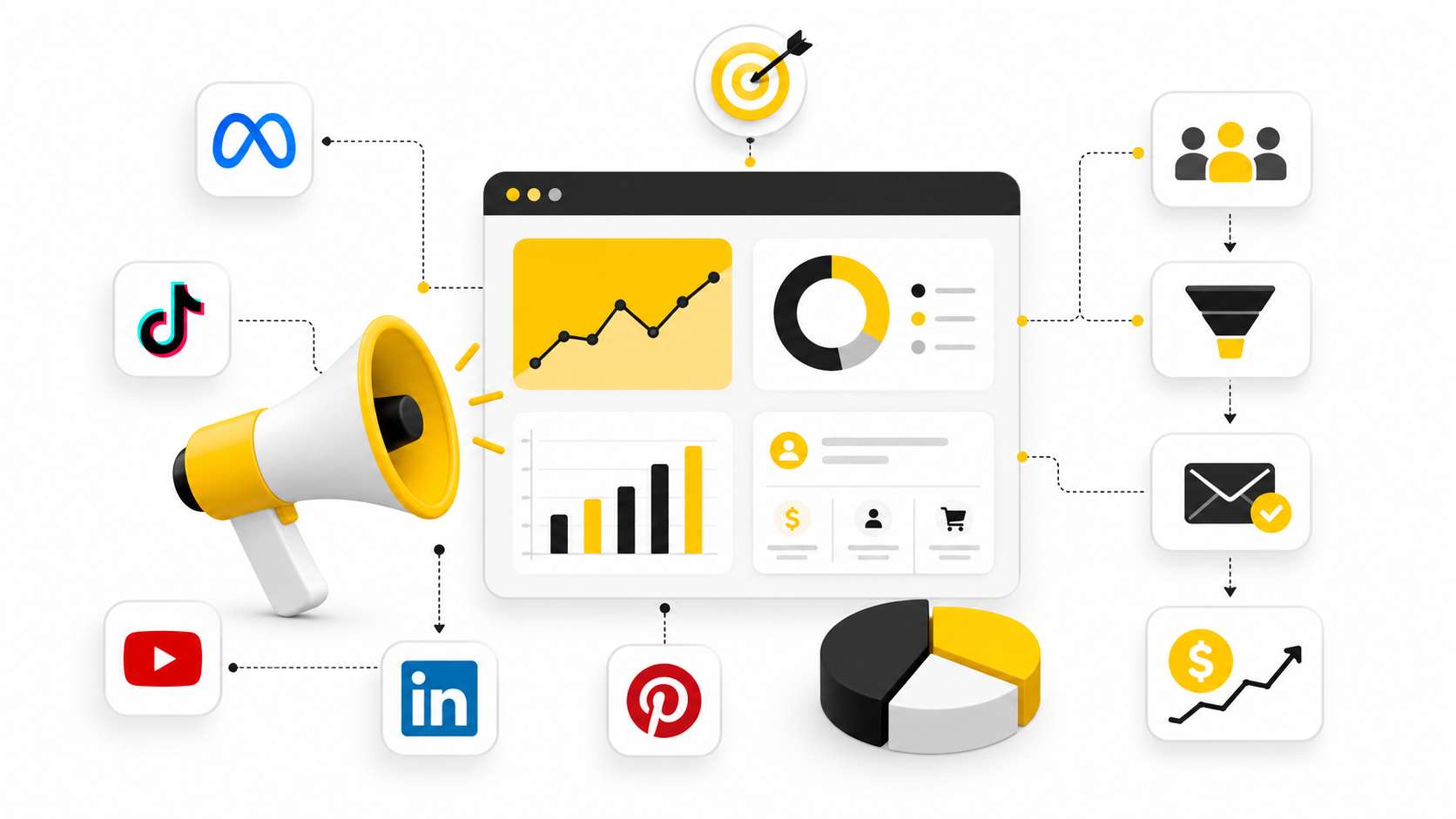
This article breaks the topic into six practical parts:
- Why A Social Media Ad Agency Matters Now
- The Social Media Advertising Framework
- Core Services A Strong Agency Should Offer
- How Professional Implementation Actually Works
- How To Choose, Evaluate, And Work With An Agency
- FAQs And Final Takeaways
Why A Social Media Ad Agency Matters Now
A good social media ad agency is not valuable because it “knows how to boost posts.” That is the shallow version of paid social, and it usually leads to wasted budget. The real value is knowing how to connect positioning, creative, targeting, funnel design, analytics, and sales follow-up into one working system.
The market has become too competitive for random campaigns. Meta, TikTok, LinkedIn, YouTube, Pinterest, and Snapchat all reward different creative formats, audience behaviors, and conversion paths. Research from Sprout Social’s 2025 benchmarks shows how much performance varies by industry, content type, and audience expectation, which is why a generic ad playbook rarely works well.
This is also why agencies now need stronger creative operations. Short-form video, creator-style content, AI-assisted production, and fast testing cycles have changed what “ad management” means. The brands that win are not just spending more; they are learning faster.
The Social Media Advertising Framework
A social media ad agency should work from a framework, not from guesswork. The basic framework is simple: understand the offer, define the audience, build the message, produce creative, launch controlled tests, measure the right numbers, then scale what proves itself. Each step depends on the one before it.
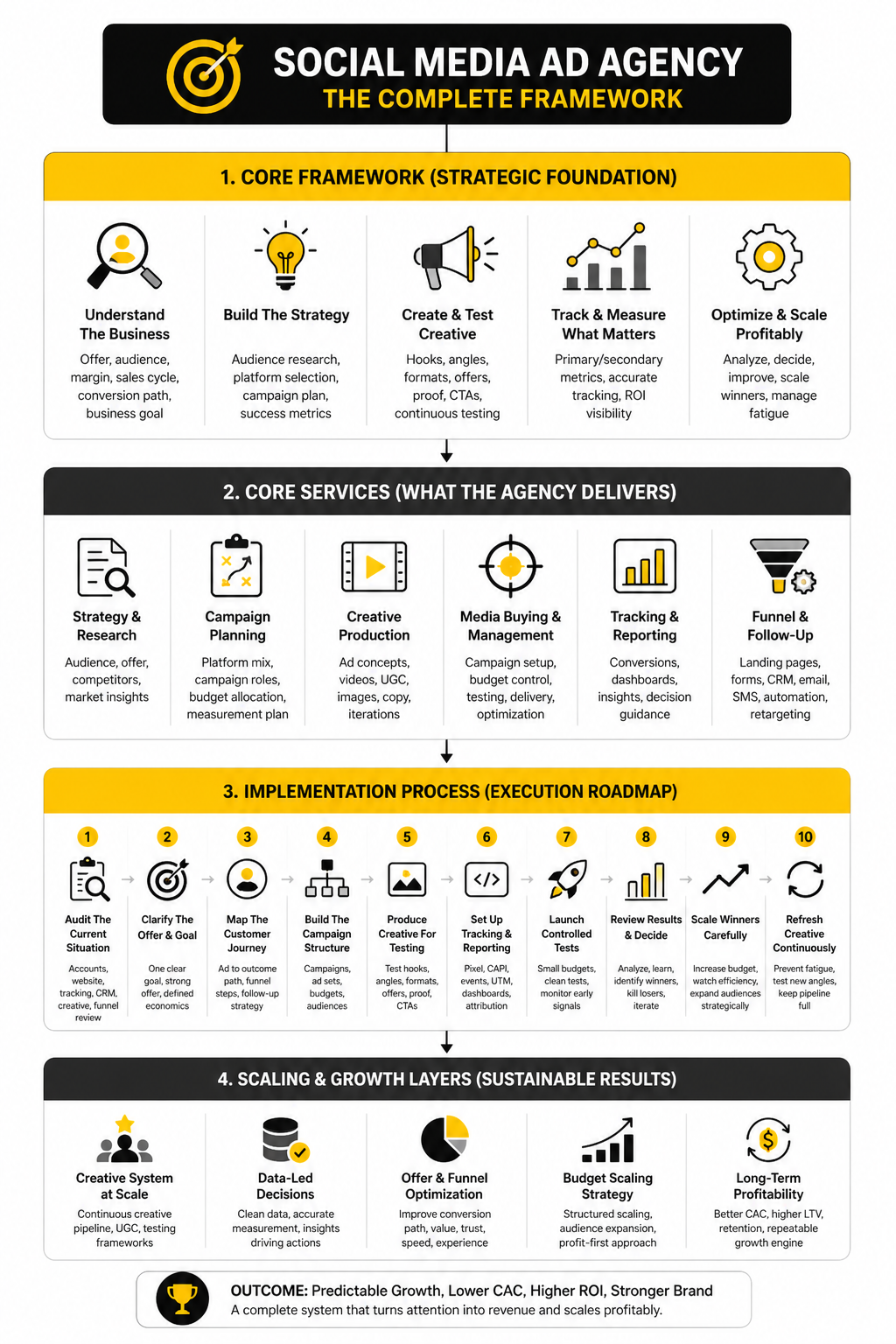
The strongest agencies usually think in systems. They do not separate ads from landing pages, email capture, CRM follow-up, sales calls, or retention. For example, tools like GoHighLevel, ManyChat, and ClickFunnels can fit naturally when a campaign needs lead capture, automated follow-up, or funnel testing.
The point is not to use more tools. The point is to remove gaps. If someone clicks an ad, lands on a weak page, receives no follow-up, and never gets retargeted, the campaign did not fail only inside the ad account. The system failed.
Core Services A Strong Agency Should Offer
A strong social media ad agency should start with strategy, not media buying. Before budget touches a campaign, the agency needs to understand the offer, audience, margin, sales cycle, conversion path, and the real business goal. Without that, even a technically clean campaign can optimize toward the wrong thing.
The first service is audience and offer research. This includes competitor analysis, customer pain points, buying triggers, objections, and platform fit. Social platforms are noisy, so the agency has to know what angle will make someone stop scrolling and care.
The second service is campaign planning. This means deciding which platforms deserve budget, what role each campaign plays, and how success will be measured. A brand selling impulse-buy products may lean heavily into Meta, TikTok, and creator-style ads, while a B2B company may need LinkedIn, YouTube, retargeting, and a stronger lead nurture process.
Creative production is the third big service, and it is now one of the most important. Social ads are won or lost in the creative before the algorithm ever has a chance to help. With creator ad spending projected to keep growing and U.S. creator spend expected to reach tens of billions, brands need agencies that can produce native-feeling content instead of polished ads that people instantly ignore.
Creative Strategy Comes Before Creative Volume
More ads do not automatically mean better results. More useful tests mean better results. That is why a serious agency builds creative around hypotheses, not random variations.
A practical creative system usually tests different hooks, formats, angles, proof points, offers, and calls to action. One ad might lead with pain. Another might lead with a clear outcome. Another might use a founder, customer-style demo, comparison, objection handling, or direct product walkthrough.
This matters because platforms have become more automated. Targeting still matters, but creative now carries more of the performance weight. The agency’s job is to feed the system with enough strong creative signals to find what the market actually responds to.
Tracking, Reporting, And Decision-Making
A social media ad agency should also own the measurement conversation early. If tracking is weak, reporting becomes theater. Everyone looks at dashboards, but nobody knows what is actually driving revenue.
The agency should define primary and secondary metrics before campaigns launch. Primary metrics might include qualified leads, booked calls, purchases, cost per acquisition, contribution margin, or revenue. Secondary metrics might include click-through rate, thumb-stop rate, landing page conversion rate, cost per lead, and email opt-in rate.
This is where many campaigns break. Business leaders increasingly want social campaigns tied to real business outcomes, while many marketers still struggle to measure ROI clearly, a gap highlighted in Sprout Social’s 2025 ROI research. A good agency does not hide behind vanity metrics. It explains what the numbers mean and what should happen next.
Funnel And Follow-Up Support
Paid social rarely works best as a single click-to-sale moment. Some buyers are ready now, but many need proof, reminders, education, or a lower-friction next step. That is why funnel design and follow-up support are part of professional implementation.
For lead generation, the agency may need landing pages, forms, calendar booking, SMS, email, CRM stages, and sales pipeline visibility. A platform like GoHighLevel can make sense when the business needs lead capture, automated follow-up, pipeline tracking, and appointment workflows in one place. For ecommerce or product-led campaigns, a landing page builder like Replo can fit when the goal is to test higher-converting product pages without waiting on a full development cycle.
The key is simple: the ad is only the beginning. If the follow-up is slow, unclear, or disconnected, the campaign will leak money. A strong agency looks for those leaks before asking for more budget.
Platform Management And Optimization
Campaign management still matters, but it should not be treated as the whole job. The agency needs to structure campaigns cleanly, control budgets, manage testing windows, review delivery, and adjust based on performance. That includes knowing when to scale, when to pause, and when to let a test run long enough to gather useful data.
Different platforms require different judgment. Meta is often strong for broad consumer reach, retargeting, and creative testing. TikTok can work well when the content feels native and the offer matches the audience. LinkedIn can be expensive, but useful for B2B targeting when lead quality matters more than cheap volume.
The agency should not recommend platforms just because they are popular. It should recommend them because the audience, offer, creative format, and economics make sense. That distinction is everything.
How Professional Implementation Actually Works
Professional implementation starts with removing uncertainty. A social media ad agency should not rush straight into campaign setup just because the ad account is available. The first job is to understand what the business is selling, who buys it, why they buy it, what stops them, and where the existing funnel is already leaking.
This is where the agency turns strategy into an operating rhythm. The work becomes tangible: audit, plan, build, launch, measure, improve. It sounds basic, but most weak campaigns fail because one of those steps gets skipped or treated casually.
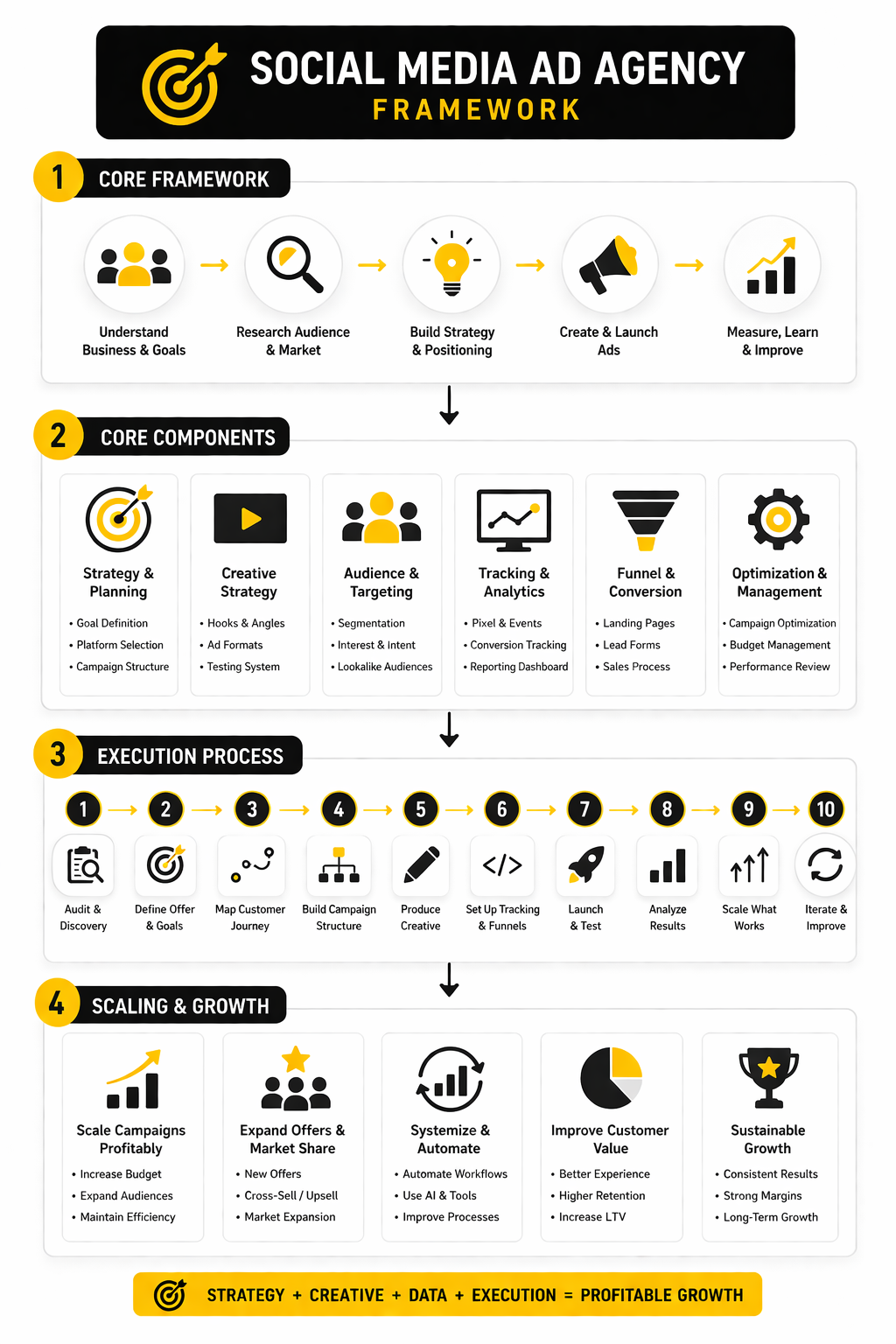
A practical implementation process usually looks like this:
- Audit the current situation
- Clarify the offer and conversion goal
- Map the customer journey
- Build the campaign structure
- Produce and organize creative assets
- Set up tracking and reporting
- Launch controlled tests
- Review results and decide what changes
- Scale winners carefully
- Refresh creative before performance drops
Step 1: Audit The Current Situation
The audit should look at the ad account, website, landing pages, analytics, CRM, creative library, organic social presence, and sales process. This is not busywork. It gives the agency the context needed to avoid repeating old mistakes.
A useful audit does not just say what is broken. It explains what matters first. For example, poor tracking is more urgent than testing five new hooks, because bad data makes every creative test harder to trust.
The agency should also review past winners and losers. Old campaigns can reveal which offers had demand, which audiences responded, and which messages fell flat. Even failed campaigns are useful when the agency can separate a bad idea from bad execution.
Step 2: Clarify The Offer And Campaign Goal
A campaign needs one clear job. It might generate booked calls, sell a product, collect leads, drive trial signups, build retargeting audiences, or validate a new offer. If the goal is vague, the optimization will be vague too.
The offer has to be specific enough for a real person to understand quickly. Social feeds move fast, and the user is not waiting for a brand to explain itself. The stronger the offer, the easier it becomes for creative, targeting, and funnel design to work together.
This is also where the agency should define the economics. Cost per lead means very little if lead quality is poor. Cost per purchase means very little if the product margin cannot support the acquisition cost.
Step 3: Map The Customer Journey
A strong agency maps what happens before and after the click. The ad creates attention, but the journey has to turn that attention into action. That may include a landing page, form, quiz, calendar, checkout, chatbot, email sequence, SMS follow-up, sales call, or retargeting sequence.
This step matters more as social platforms become more automated. Meta continues pushing advertisers toward automated campaign tools, and TikTok’s own creative guidance emphasizes planning, production, and iteration for performance ads. The agency’s advantage is no longer just button-clicking inside the ad manager; it is designing the full journey around how people actually decide.
For lead generation, automated follow-up can make the difference between a lead that goes cold and a lead that books. A setup using ManyChat can fit when conversations start inside social messaging, while GoHighLevel can fit when the business needs CRM stages, reminders, workflows, and appointment tracking in one place.
Step 4: Build The Campaign Structure
Campaign structure should match the goal, budget, and learning stage. A new account usually needs controlled testing before aggressive scaling. A mature account may need cleaner segmentation, stronger retargeting, or a better creative testing system.
The agency should avoid overcomplicating the structure. Too many campaigns, ad sets, and tiny budgets can slow learning and make results harder to read. Clean structure gives the algorithm enough data while giving the team enough visibility to make decisions.
This is where platform judgment matters. Meta may need broader targeting and stronger creative variety. TikTok may need more native-feeling video iterations. LinkedIn may need tighter audience logic and stronger qualification because clicks are usually more expensive.
Step 5: Produce Creative For Testing
Creative production should follow the strategy, not personal taste. The agency should produce variations that test meaningful differences: hook, angle, format, proof, offer, objection, and call to action. Changing a background color is not a strategy unless there is a real reason to test it.
The best creative often feels native to the platform. Creator-led formats have become a serious media channel, with U.S. creator ad spending projected to reach 37 billion dollars in 2025. That does not mean every brand needs influencers, but it does mean every brand needs ads that feel human, fast, and relevant.
A practical agency will keep the creative pipeline moving. Performance fatigue is real, especially when the same winning angle is pushed too hard. The solution is not panic; it is a repeatable system for finding the next strong message before the old one collapses.
Step 6: Launch, Measure, And Improve
Launch is not the finish line. It is the first clean feedback loop. Once campaigns are live, the agency should watch delivery, spend, early conversion quality, tracking accuracy, and creative-level signals without making emotional changes too quickly.
The review process should separate noise from signal. A campaign can have a weak first day and still become useful. It can also look good on cheap clicks while producing leads that never buy. That is why reporting needs to connect platform metrics with business outcomes.
A serious social media ad agency will bring recommendations, not just screenshots. It should explain what happened, what changed, what is being tested next, and what decision the business needs to make. That is the difference between ad management and real implementation.
Statistics And Data That Actually Matter
Data is only useful when it changes a decision. A social media ad agency should not report numbers just to make a dashboard look busy. The point of measurement is to understand what is working, what is broken, and what action should happen next.
The first thing to measure is not the ad platform itself. It is the business outcome. If the campaign is meant to generate booked calls, then booked calls, show-up rate, sales rate, and revenue matter more than cheap clicks. If the campaign is meant to sell products, then cost per purchase, average order value, gross margin, repeat purchase behavior, and payback period matter more than impressions.
This is why benchmarks need context. A cost per lead can look expensive in one industry and completely normal in another. A low cost per click can look good until the landing page fails to convert, and a high cost per click can still be profitable if the buyers are qualified and the offer has strong margins.
Build The Measurement System Before Scaling
A social media ad agency should build the measurement system before asking for more budget. That means the pixel, conversion API, UTM structure, CRM stages, attribution windows, landing page events, and reporting cadence need to be clear. If those pieces are messy, scaling only makes the confusion more expensive.
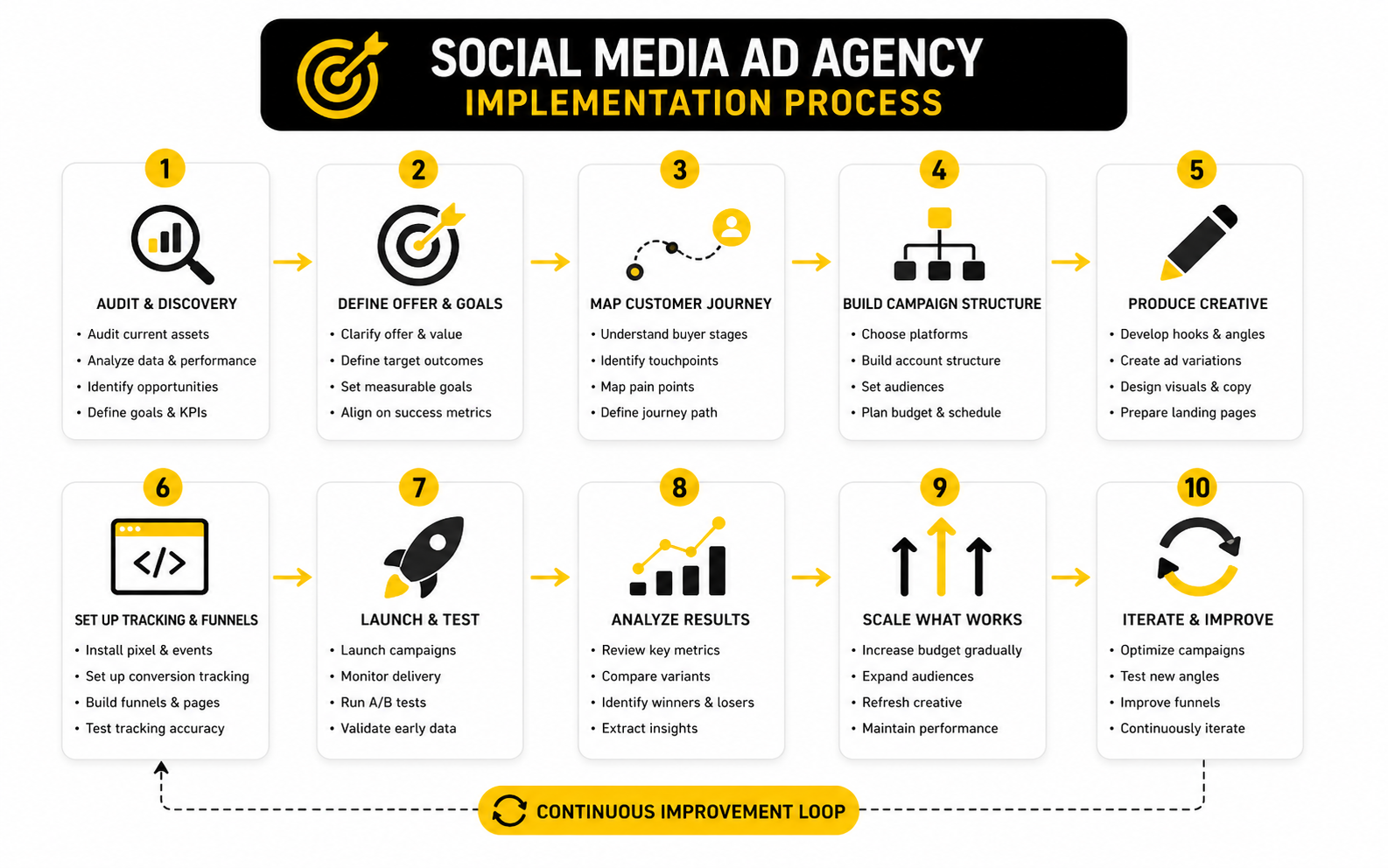
A clean analytics system connects four layers:
- Platform data shows impressions, reach, clicks, video views, conversions, and spend.
- Website data shows landing page behavior, form starts, checkouts, purchases, and drop-off points.
- CRM data shows lead quality, booked calls, sales opportunities, close rate, and revenue.
- Business data shows margin, refund rate, retention, lifetime value, and real profitability.
The mistake is treating one layer as the full truth. Platform data is fast, but it can over-credit or under-credit results depending on attribution settings. CRM data is closer to revenue, but it depends on the sales team logging activity properly. Business data is the most important, but it often arrives later than campaign data.
The Metrics That Tell You What To Fix
Every metric should point to a possible action. If click-through rate is weak, the creative or audience-message fit may be the issue. If clicks are strong but conversions are weak, the landing page, offer, price, trust signals, or page speed may be the problem.
If leads are cheap but sales are poor, the campaign may be attracting the wrong people. That is not a win. A serious agency will look past cost per lead and ask whether those leads are qualified, responsive, and likely to buy.
If conversion rate is healthy but volume is low, the issue may be budget, audience size, creative fatigue, or platform choice. If frequency climbs while results fall, the audience may be overexposed. None of these numbers should be read in isolation.
Benchmarks Are Useful, But They Are Not The Goal
Benchmarks help you understand whether performance is roughly reasonable. They should not become the target. Industry averages are built from mixed accounts, mixed offers, different budgets, and different levels of execution.
For example, Meta reported that Family of Apps ad impressions increased 12% for full-year 2025 while average price per ad increased 9%, which shows both more ad delivery and stronger advertiser demand in the auction environment in Meta’s 2025 results. That matters because rising competition can make weak creative and weak funnel economics more painful. If the auction gets more competitive, the account needs better ads, better conversion paths, or stronger customer value.
Social ROI expectations are also rising. Marketing leaders increasingly want campaigns tied directly to business goals, while many teams still struggle to measure ROI with confidence, a gap reflected in Sprout Social’s 2025 ROI research. This is exactly where a good agency earns its fee: not by showing more metrics, but by translating metrics into better decisions.
How To Read Performance Signals
Early campaign data should be treated as directional, not final. In the first few days, the agency is checking whether delivery works, tracking fires correctly, spend is pacing properly, and any creative is showing early signs of relevance. Fast reactions feel productive, but they often kill tests before the data is useful.
Once enough data comes in, the agency should compare performance across creative angles, audiences, placements, landing pages, and funnel steps. The question is not just “which ad won?” The better question is “what did the market tell us about the offer?”
A good review might show that demo-style creative gets fewer clicks but better leads, while trend-style creative gets attention but weaker buyers. That is valuable. It tells the agency where to push, where to stop, and what kind of creative to produce next.
What The Data Should Drive Next
Measurement should lead to action in three areas: creative, funnel, and budget. If the data shows weak attention, improve hooks and formats. If the data shows weak conversion, improve the page, offer, proof, or follow-up. If the data shows profitable acquisition, increase budget carefully while watching whether efficiency holds.
For service businesses, the agency should also review lead response time and sales outcomes. A campaign can look bad when the real issue is slow follow-up. Tools like GoHighLevel can help connect form submissions, pipeline stages, automated reminders, and booked appointments so the agency and client can see what happens after the ad.
For ecommerce, the agency should connect ad data with product page performance, cart behavior, and post-purchase economics. A landing page tool like Replo can be useful when the team needs to test product pages, bundles, or offer pages quickly. The goal is not prettier pages. The goal is clearer evidence about what makes buyers act.
How To Choose, Evaluate, And Work With An Agency
Choosing a social media ad agency is not just a hiring decision. It is a risk decision. You are trusting an outside team with budget, brand reputation, customer data, creative direction, and sometimes the first impression a buyer has of your business.
The wrong agency can make ads look active while the business quietly loses money. The right agency brings structure, clarity, and honest tradeoffs. It helps you understand where growth is possible, where the economics are weak, and what needs to improve before more budget makes sense.
Look For Strategic Thinking, Not Just Platform Access
Any agency can open Meta Ads Manager or launch a TikTok campaign. That is not the skill. The skill is knowing what should be launched, why it should be launched, how it should be measured, and what decision the data should create.
A strong agency will ask uncomfortable but useful questions. What is the margin? What happens after the lead comes in? How fast does the sales team respond? Which offers have already failed? What does a profitable customer look like after refunds, churn, or repeat purchases?
This is the difference between an operator and a partner. An operator waits for instructions. A partner helps diagnose the business problem behind the campaign.
Understand The Tradeoff Between Control And Automation
Paid social has moved toward automation, and fighting that shift is usually a waste of time. Platforms are better at delivery than humans are when they have strong inputs, clean data, and enough conversion volume. The agency’s role is to improve those inputs, not micromanage every lever like it is 2018.
The tradeoff is that automation can hide problems. If the creative is weak, the funnel is unclear, or the conversion event is too shallow, the algorithm will still spend the money. It will just optimize around bad signals.
That is why expert agencies focus heavily on offer quality, creative quality, tracking quality, and conversion quality. Less manual control does not mean less strategy. It means the strategy has to happen before the machine starts spending.
Watch For Risks Before You Scale
Scaling is where many accounts break. A campaign that works at a small budget can become unstable when spend increases, audiences saturate, creative fatigue rises, or lead quality drops. More budget exposes weaknesses faster.
A good agency will scale in stages. It will protect learning, monitor efficiency, refresh creative, and compare revenue quality against platform-reported performance. It will also know when not to scale, which is often more valuable than forcing growth for the sake of bigger spend.
The biggest risks usually fall into a few categories:
- Creative fatigue, where the same winning message gets overused until performance declines.
- Weak attribution, where platform results look better than actual business outcomes.
- Lead quality problems, where campaigns generate volume but not buyers.
- Funnel bottlenecks, where the page, checkout, calendar, or sales process limits growth.
- Offer weakness, where no amount of optimization can fix unclear value.
Set The Working Rhythm Early
The agency-client relationship should have a clear operating rhythm. That includes reporting cadence, communication channels, approval timelines, creative review process, budget rules, and decision ownership. Without that rhythm, good ideas move slowly and weak campaigns stay live too long.
Weekly reviews are usually enough for active campaigns, unless the account is spending heavily or launching something sensitive. The review should cover what changed, what was learned, what needs approval, and what decision comes next. Long reports are less useful than clear judgment.
This is also where tools can help, but only if they support the process. A CRM and automation setup like GoHighLevel can keep lead flow, pipeline stages, and follow-up visible. A scheduling setup like Cal.com can help reduce friction when campaigns are driving booked calls.
Know When To Hire An Agency And When Not To
A social media ad agency makes sense when the business has a real offer, a defined customer, enough margin, and the ability to handle more demand. It also makes sense when the internal team lacks the time, creative system, or technical experience to run paid social properly. In those cases, the agency can speed up learning and prevent expensive mistakes.
An agency may not be the right move if the offer is unproven, the website is not ready, the sales process is chaotic, or the business cannot respond to leads quickly. Paid social will not magically create operational discipline. It will usually reveal the lack of it.
The cleanest approach is to fix the biggest bottleneck first. Sometimes that means better landing pages. Sometimes it means better follow-up. Sometimes it means sharper positioning before a single ad is launched.
Questions To Ask Before Signing
The best questions expose how an agency thinks. Do not only ask for case studies. Ask how they diagnose problems, how they run tests, and how they decide when to scale or stop.
Useful questions include:
- What do you need to know before recommending a budget?
- How do you define a successful first 30 to 60 days?
- How do you separate creative problems from funnel problems?
- What metrics do you report beyond platform dashboards?
- How do you handle campaigns that generate leads but not revenue?
- How often do you produce new creative?
- Who owns tracking, landing pages, and CRM follow-up?
- What happens if early results are inconclusive?
- How do you prevent over-scaling too quickly?
- What work is included, and what requires a separate scope?
Good answers will be specific. Weak answers will sound polished but vague. Pay attention to that.
The Best Agency Relationship Is Built On Shared Accountability
A strong agency cannot carry a weak business alone. It can improve targeting, creative, testing, reporting, and campaign structure. But it still needs a real offer, timely approvals, sales feedback, and honest performance data from the client side.
The best relationships work because both sides own their part. The agency owns the advertising system. The business owns the product, fulfillment, sales process, and customer experience. Growth happens when those two sides are aligned.
That is the standard to look for. Not hype. Not vanity metrics. Not a promise that one platform will solve everything. A social media ad agency is worth hiring when it can help you make better growth decisions faster, and then execute those decisions with discipline.
The Final System: What Everything Should Become
By this point, the role of a social media ad agency should be clear. The goal is not to “run ads” in isolation. The goal is to build a growth system where strategy, creative, tracking, funnel design, follow-up, and optimization all work together.
That system is what makes paid social more predictable. It gives the business a way to test ideas, learn from the market, improve the offer, and scale with more discipline. Without that system, the brand is just buying attention and hoping the numbers work.
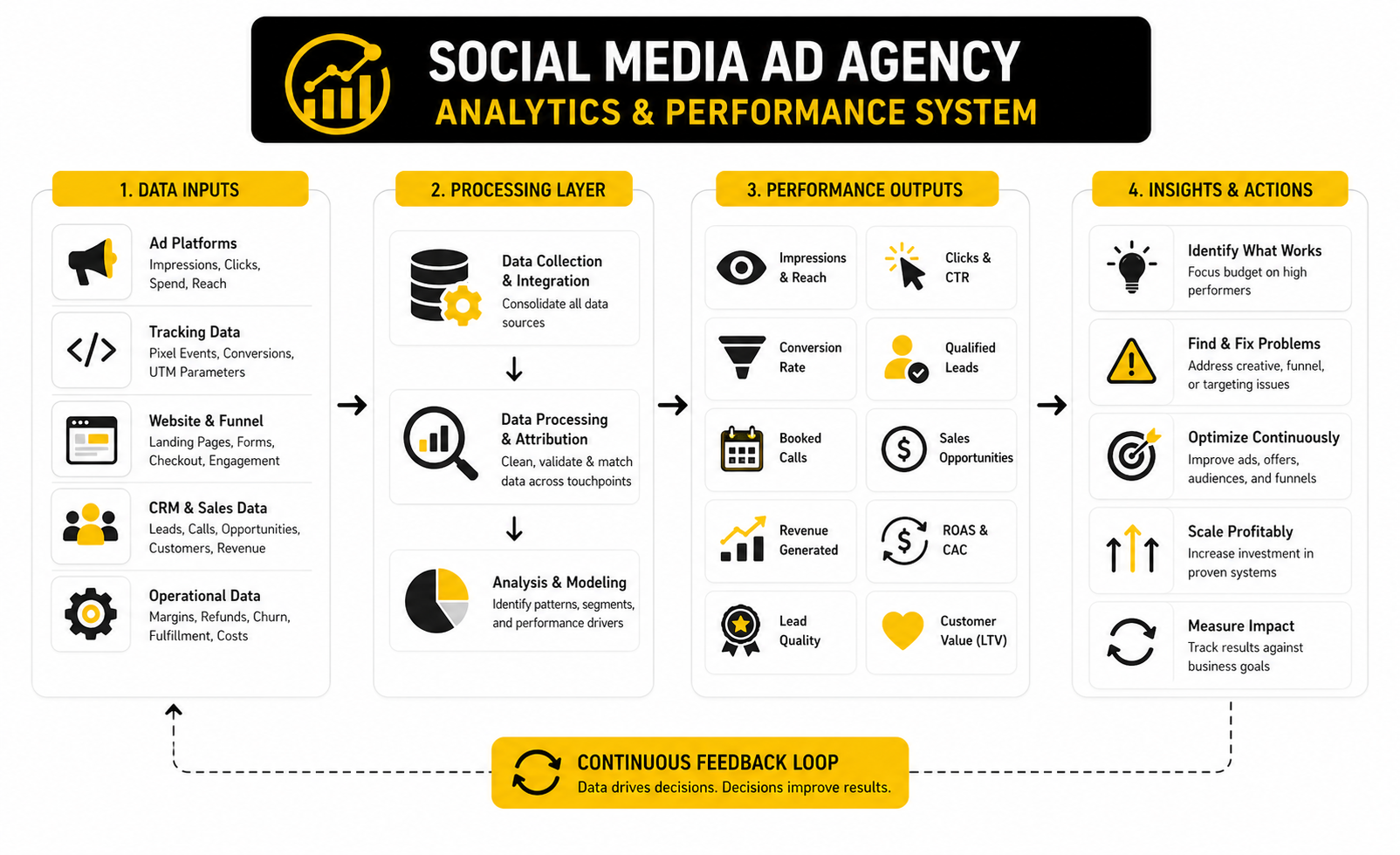
The best agencies understand that social media advertising is now part media buying, part creative lab, part analytics function, and part revenue operations. That blend matters because platform automation keeps increasing, privacy rules keep changing, and buyers keep getting harder to interrupt. The agency that wins is the one that can connect the full ecosystem and keep improving it.
FAQ - Built For Complete Guide
What does a social media ad agency do?
A social media ad agency plans, launches, manages, and optimizes paid advertising campaigns across platforms like Meta, TikTok, LinkedIn, YouTube, Pinterest, and Snapchat. The work usually includes strategy, creative testing, tracking setup, landing page feedback, reporting, and performance optimization. A strong agency also helps connect ads to real business outcomes, not just clicks and impressions.
Is hiring a social media ad agency worth it?
Hiring an agency can be worth it when your business has a proven offer, enough margin, and the ability to handle more leads or sales. The agency can bring structure, testing speed, creative direction, and platform experience that would take longer to build internally. It is not worth it if the offer is unclear, the sales process is broken, or the business expects ads to fix deeper operational problems.
How much does a social media ad agency cost?
Costs vary depending on scope, ad spend, platform mix, creative needs, and reporting depth. Some agencies charge a flat monthly retainer, some charge a percentage of ad spend, and some use a hybrid model. The important question is not only the fee, but whether the agency can improve profit, learning speed, and decision quality enough to justify that fee.
Which platforms should a social media ad agency manage?
The right platforms depend on the audience, offer, budget, and sales cycle. Meta is often useful for broad reach, retargeting, and conversion campaigns. TikTok can work well for native video and fast creative testing, while LinkedIn is often better for B2B campaigns where lead quality matters more than low click costs.
How long does it take for paid social campaigns to work?
Some campaigns show useful signals within days, but reliable performance usually takes longer. The agency needs time to test creative, validate tracking, understand lead quality, and improve the funnel. A serious first evaluation window is often 30 to 60 days, although higher-spend accounts may gather useful data faster.
What should I prepare before hiring an agency?
You should prepare your offer details, customer research, past campaign data, website or landing pages, sales process, margins, and clear growth goals. The agency should not have to guess what a good customer is worth. The more clarity you bring, the faster the agency can make useful decisions.
What makes a good social media ad agency different from a weak one?
A good agency thinks beyond the ad account. It asks about your offer, funnel, tracking, sales process, customer quality, and profitability. A weak agency talks mainly about impressions, clicks, and posting more content without showing how those activities connect to revenue.
Should an agency create the ad creative too?
In most cases, yes. Creative is now one of the biggest performance levers in paid social. Even if the client provides raw assets, the agency should guide hooks, angles, formats, testing priorities, and creative refresh cycles.
What metrics should I ask an agency to report?
Ask for metrics that connect platform performance to business outcomes. Useful reporting can include spend, cost per result, conversion rate, qualified leads, booked calls, sales opportunities, revenue, ROAS, CAC, lead quality, and creative-level performance. Vanity metrics are not useless, but they should never be the whole report.
Why do social media ads stop working after a while?
Ads often decline because of creative fatigue, audience saturation, seasonal changes, stronger competition, tracking issues, or funnel bottlenecks. A winning ad is not permanent. A good agency expects this and keeps testing new angles before performance drops too far.
Can a social media ad agency help with funnels and automation?
Yes, many agencies support landing pages, lead forms, CRM workflows, chat automation, email follow-up, and booking systems. Tools like ClickFunnels, Systeme.io, ManyChat, and GoHighLevel can fit when the campaign needs a stronger path from click to conversion.
What is the biggest mistake businesses make with paid social?
The biggest mistake is treating ads as a magic fix instead of a system. Paid social amplifies what already exists. If the offer, page, follow-up, or sales process is weak, the ad budget will usually expose the weakness faster.
Work With Professionals
Explore 10K+ Remote Marketing Contracts on MarkeWork.com
Most marketers spend too much time chasing clients, competing on crowded platforms, and losing a percentage of every project to middlemen.
MarkeWork gives you a better way. Browse thousands of remote marketing contracts and connect directly with companies desperate to hire skilled marketers like you, without platform commissions and without unnecessary gatekeepers.
If you're serious about finding better opportunities and keeping 100% of what you earn, explore available contracts and create a profile for free at MarkeWork.com.