

A social media agency is no longer just a company that writes captions and schedules posts. For a lot of brands, it sits right in the middle of awareness, demand generation, customer care, creator partnerships, paid distribution, and conversion. That shift matters because social is not a side channel anymore when the world now counts 5.24 billion active social media user identities, the typical internet user spends 2 hours and 21 minutes a day on social platforms, and global marketers are already spending close to a quarter of a trillion dollars on social media ads.
That also explains why hiring a social media agency has become a strategic decision instead of a production decision. People discover brands through a mix of channels, but social keeps moving closer to the front of that journey, with global research showing consumers use an average of 5.8 sources to discover brands and that social media ads rank among the top discovery drivers worldwide. On the commerce side, consumer behavior is pushing even harder, with Deloitte reporting that 72% of consumers are willing to buy directly within social platforms.
That pressure has changed the job description. A serious social media agency now needs to understand content systems, platform behavior, paid amplification, measurement, community management, and the difference between looking busy and actually moving revenue. HubSpot’s 2025 trend research makes the direction pretty clear: brands are treating social as a search engine, leaning harder into community-led growth, and building more around short-form video and social commerce than many companies were prepared for just a couple of years ago.
This guide is built for business owners, marketing leads, and operators who want a clearer answer to one question: what should a social media agency actually be responsible for today? Instead of recycling vague agency promises, we are going to break the topic into a practical structure you can use to evaluate strategy, execution, and fit. That matters, because the wrong agency creates activity, while the right one creates momentum.
Article Outline
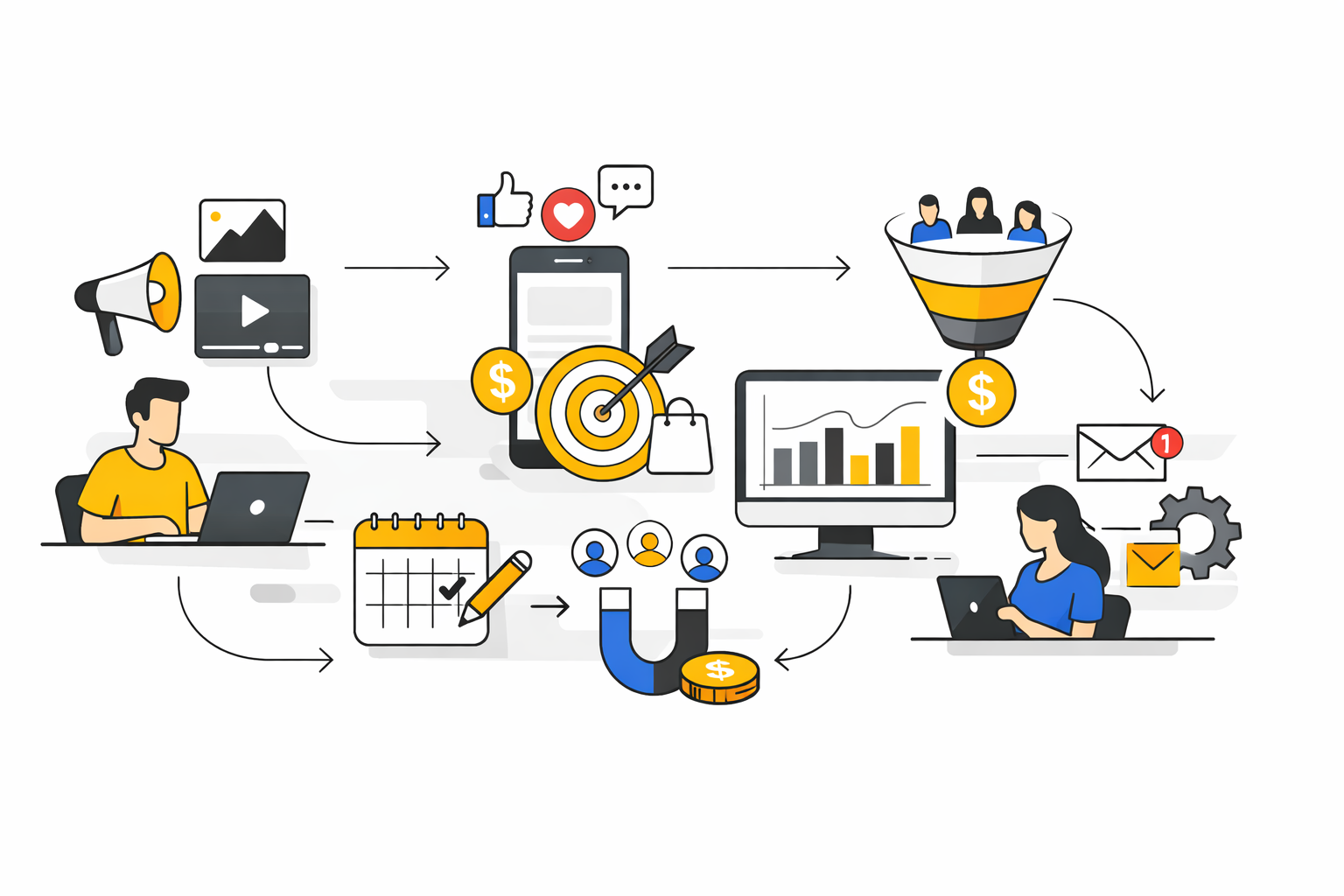
The article is organized as one continuous guide split into six parts. Each section builds on the one before it, so the goal is not just to define a social media agency, but to show how the model works in practice and where it tends to succeed or fail. By the end, you should be able to judge whether your business needs an agency, what kind of agency you need, and how to tell the difference between polished sales talk and real capability.
- Part 1: What a Social Media Agency Actually Does
- Part 2: Why a Social Media Agency Matters Now
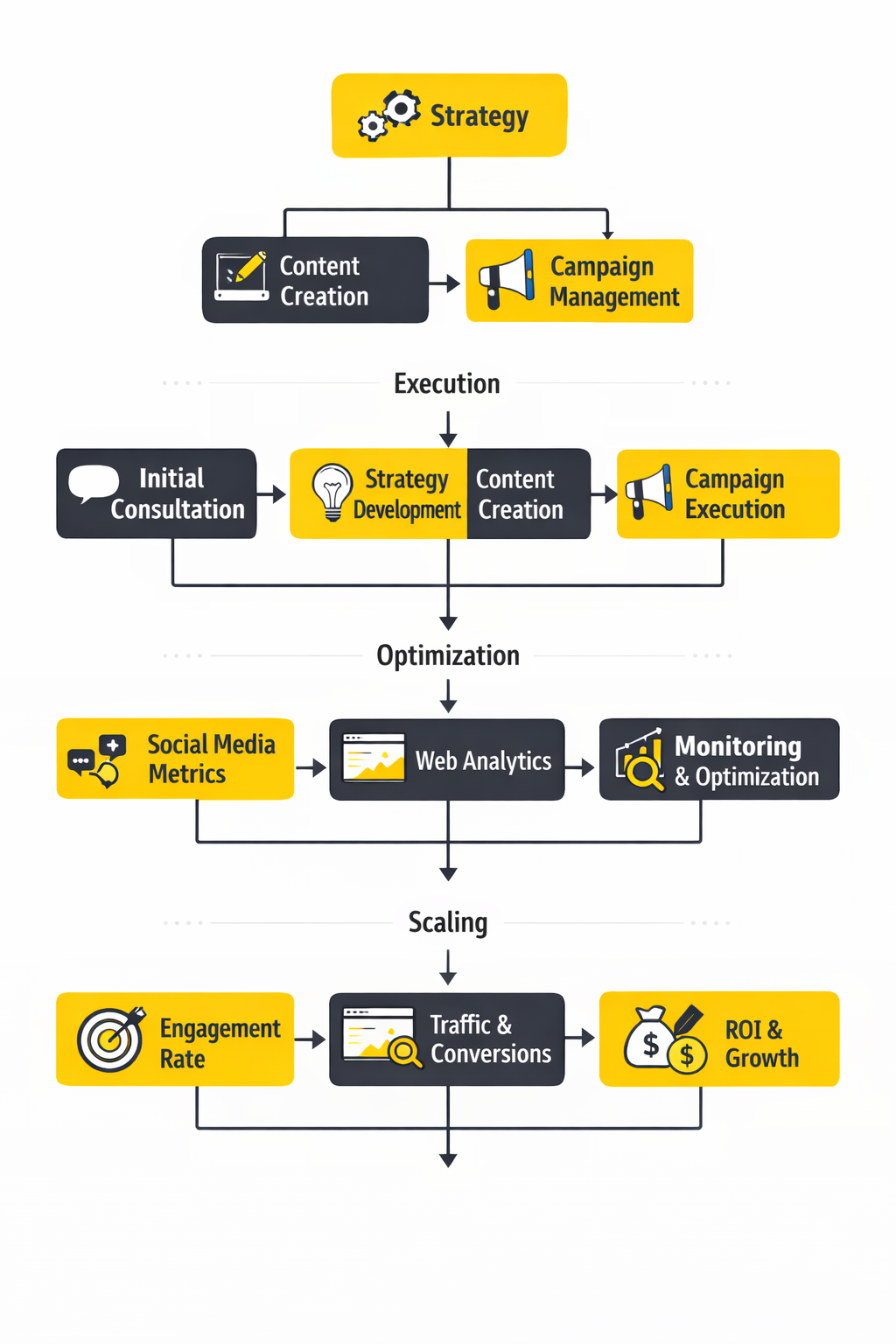
- Part 3: The Social Media Agency Framework
- Part 4: Core Components of High-Performance Agency Work
- Part 5: Professional Implementation Across Teams, Channels, and KPIs
- Part 6: How to Choose, Manage, and Scale With the Right Agency
What a Social Media Agency Actually Does
At the most basic level, a social media agency helps a business plan, produce, publish, manage, and improve its presence across social platforms. In practice, though, that basic definition is too small for the way the market works now. A modern agency may handle organic content, paid social, creator collaborations, social listening, community management, reporting, testing, and social commerce workflows at the same time.
That broader scope exists because social media has stopped behaving like a neat top-of-funnel channel. It influences discovery, consideration, trust, support, retention, and direct sales all at once, which means the agency working on it has to think more like an operating partner than a posting service. Once that clicks, the rest of the article becomes easier to follow.
Why a Social Media Agency Matters Now
A social media agency matters more today because social platforms are shaping far more than attention. They influence how people discover brands, compare options, ask questions, judge credibility, and decide whether to buy now or later. When the average internet user already relies on 5.8 different sources to discover brands, and social ads sit among the strongest of those discovery routes, weak execution on social does not stay isolated for long.
That is the first big shift a lot of companies still underestimate. Social is not just a publishing channel anymore; it is now part media engine, part search layer, part customer experience layer, and part sales environment. The platforms have changed, user behavior has changed, and the role of a serious social media agency has changed right along with them.
Social Now Sits Closer to Revenue
There was a time when brands could treat social as a soft-awareness play and call it a day. That is much harder to justify now that consumers increasingly expect to move from discovery to evaluation to purchase without leaving the platform ecosystem for long. Deloitte’s consumer research shows 55% of consumers use social for search at least sometimes, 43% discovered a new brand on social in the last 12 months, and 72% are willing to buy directly within social platforms.
That changes the standard for agency work. A good social media agency cannot think only in terms of reach, impressions, and post frequency when the channel is now helping shape pipeline and purchase behavior. It has to understand how content, offers, landing pages, creators, paid distribution, and follow-up systems connect, because that handoff is where a lot of revenue is either created or quietly lost.
Organic Reach Alone Is Not a Strategy
Many brands still hope they can win with posting consistency alone. Consistency matters, but it is not a strategy by itself, especially in a market where 5.24 billion social media user identities are competing for attention and where marketers poured close to $250 billion into social media advertising in 2024. A crowded feed punishes average thinking fast.
This is exactly where a social media agency earns its keep when it is good. It brings prioritization, channel discipline, creative testing, and distribution logic instead of telling a client to “just post more.” That sounds simple, but it is one of the biggest differences between an agency that creates motion and one that creates measurable progress.
Social Has Become a Search Behavior
This is one of the most important developments in the entire category. HubSpot’s 2025 social trends research highlights that people increasingly use social as a search engine, not just as a place to scroll, react, and leave. That means content now has to perform two jobs at once: catch attention in-feed and answer intent when someone is actively looking for solutions, products, comparisons, or proof.
A modern social media agency has to build for that reality. It should know how to create posts, videos, and creator assets that are discoverable, clear, and useful beyond the first 24 hours of engagement. The agencies still running on old “brand vibes only” logic are going to look polished in meetings and underperform in the market.
Community and Customer Experience Now Matter More Than Trend Chasing
A few years ago, a lot of social strategies were built around speed, reaction, and the hope of viral lift. That approach still has moments, but it is not enough to carry a serious business. HubSpot’s 2025 reporting points toward community-led growth, while Sprout’s recent research shows consumers increasingly expect better service and more relevance from brands on social, not more noise for the sake of noise alone.
That puts pressure on both brand teams and agencies to grow up. A strong social media agency should know when to join a conversation, when to lead one, and when to stay quiet because the fit is weak. Sprout’s 2025 index findings, published in early 2025, underline the risk here: a third of consumers see brands jumping on viral trends as embarrassing.
The Workload Is More Operational Than Most Companies Expect
This is where many internal teams hit the wall. Social today involves planning, briefs, copy, design, editing, approvals, paid boosting, creator coordination, reporting, comments, DMs, testing, and constant platform adaptation. Even before you get to strategy, the operating load is already heavy.
That is one reason businesses start looking for a social media agency in the first place. They need outside structure, specialist attention, and execution capacity without building a full in-house department from scratch. In practice, that often means the best setup is not agency versus internal team, but agency plus internal team, with each side owning what it does best.
Tools Matter, But Systems Matter More
A lot of companies shop for software when the real problem is process. Tools can absolutely help a social media agency move faster and stay more organized, whether that means scheduling through Buffer, tightening hashtag and content research workflows with Flick, or connecting social follow-up into broader customer communication through Brevo. But none of those tools fix weak positioning, unclear goals, or content that does not deserve attention.
That is why the agency model still matters. The right team does not just add software to the stack and hope for better outcomes. It builds a repeatable system around content decisions, measurement, approvals, and conversion paths so the tools support the strategy instead of distracting from it.
Businesses Need Specialization Without Fragmentation
One of the hardest things for leadership teams is that social now touches too many functions at once. Brand wants consistency, growth wants leads, sales wants better intent, support wants faster response, and leadership wants proof that the effort is worth the budget. Without a clear operating model, social becomes a tug-of-war.
A good social media agency helps unify that chaos into one practical workflow. It translates business goals into channel-specific action, then turns those actions into creative, campaigns, and reporting the rest of the company can actually use. That coordination role is not glamorous, but it is usually where the real value shows up.
Why This Decision Is Strategic, Not Cosmetic
Hiring a social media agency should not be treated like outsourcing a design task or filling a content gap. It is closer to choosing a growth partner for one of the most public, fast-moving, and high-feedback parts of your business. The brand voice is visible, the customer reactions are immediate, and the performance data compounds quickly, for better or worse.
That is why this decision deserves more rigor than most companies give it. The right agency can help a business move from scattered posting to coordinated growth, while the wrong one can trap a team in endless activity that looks modern but never really builds leverage. That brings us to the next step: the actual framework a strong social media agency should be working from, not the vague version they put on a proposal deck.
The Social Media Agency Framework
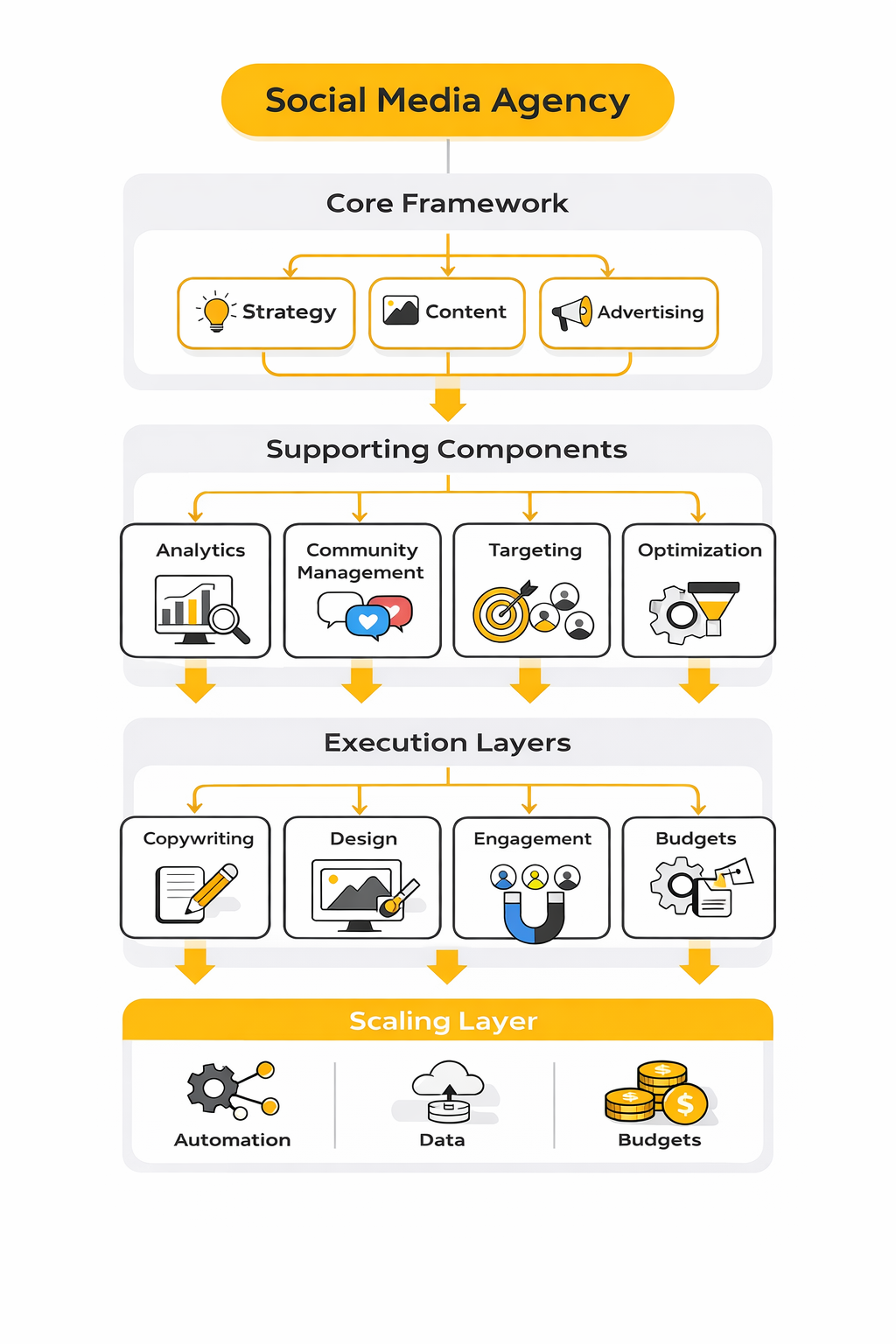
Once you understand why a social media agency matters, the next step is seeing how the work actually gets structured. This is where most confusion happens, because many agencies present services as a list instead of a system. The reality is that high-performing agencies operate on a repeatable framework that connects strategy, content, distribution, and conversion into one flow.
Without that structure, everything feels busy but disconnected. With it, every post, campaign, and experiment has a clear role inside a bigger growth engine.
The Four-Layer Model That Drives Results
A practical social media agency framework can be broken into four layers. Each layer builds on the one before it, and if one is weak, the whole system underperforms.
- Positioning and Strategy
- Content and Creative Production
- Distribution and Amplification
- Conversion and Follow-Up
Most agencies talk heavily about layer two because content is visible and easy to showcase. The real leverage, however, comes from how all four layers connect and reinforce each other.
Layer 1: Positioning and Strategy
This is where the direction gets set, and skipping it is one of the fastest ways to waste budget. A social media agency should define audience segments, core messaging angles, platform priorities, and success metrics before anything gets published. Without that, content becomes reactive and inconsistent.
This layer also forces clarity on what the business actually wants from social. Is the goal demand generation, authority building, direct sales, or retention? Each path leads to a different execution style, and trying to do everything at once usually leads to diluted results.
Layer 2: Content and Creative Production
Once strategy is clear, production becomes much more focused. Content is no longer random ideas; it is built around themes, formats, and repeatable patterns that align with audience behavior. That includes short-form video, carousels, creator-led content, and educational posts that double as search assets.
This is also where a strong agency separates itself. It does not just produce content; it builds a system that can consistently generate, test, and refine ideas over time. Given that short-form video continues to dominate engagement across platforms and remains one of the most effective formats for both discovery and retention, production quality and consistency matter more than ever.
Layer 3: Distribution and Amplification
Publishing alone is not enough anymore. With organic reach becoming more competitive, distribution has to be intentional. A social media agency should know when to boost content, how to structure paid campaigns, and how to extend reach through creators and collaborations.
This is where many brands unlock scale. Instead of hoping a post performs, they actively push winning content into larger audiences. When done correctly, this turns social from a guessing game into a controlled growth channel.
Layer 4: Conversion and Follow-Up
This is the layer most businesses overlook, and it is often where the biggest gains are hiding. Social attention only becomes valuable when it turns into action, whether that means a lead, a purchase, or a meaningful interaction.
A serious social media agency connects social activity to landing pages, funnels, and follow-up systems. For example, using tools like ClickFunnels or Systeme.io, agencies can guide users from a social post to a structured conversion path instead of leaving them to figure it out on their own.
That connection between content and conversion is what turns visibility into revenue. Without it, even strong engagement can fail to produce meaningful business outcomes.
How the Framework Turns Into Execution
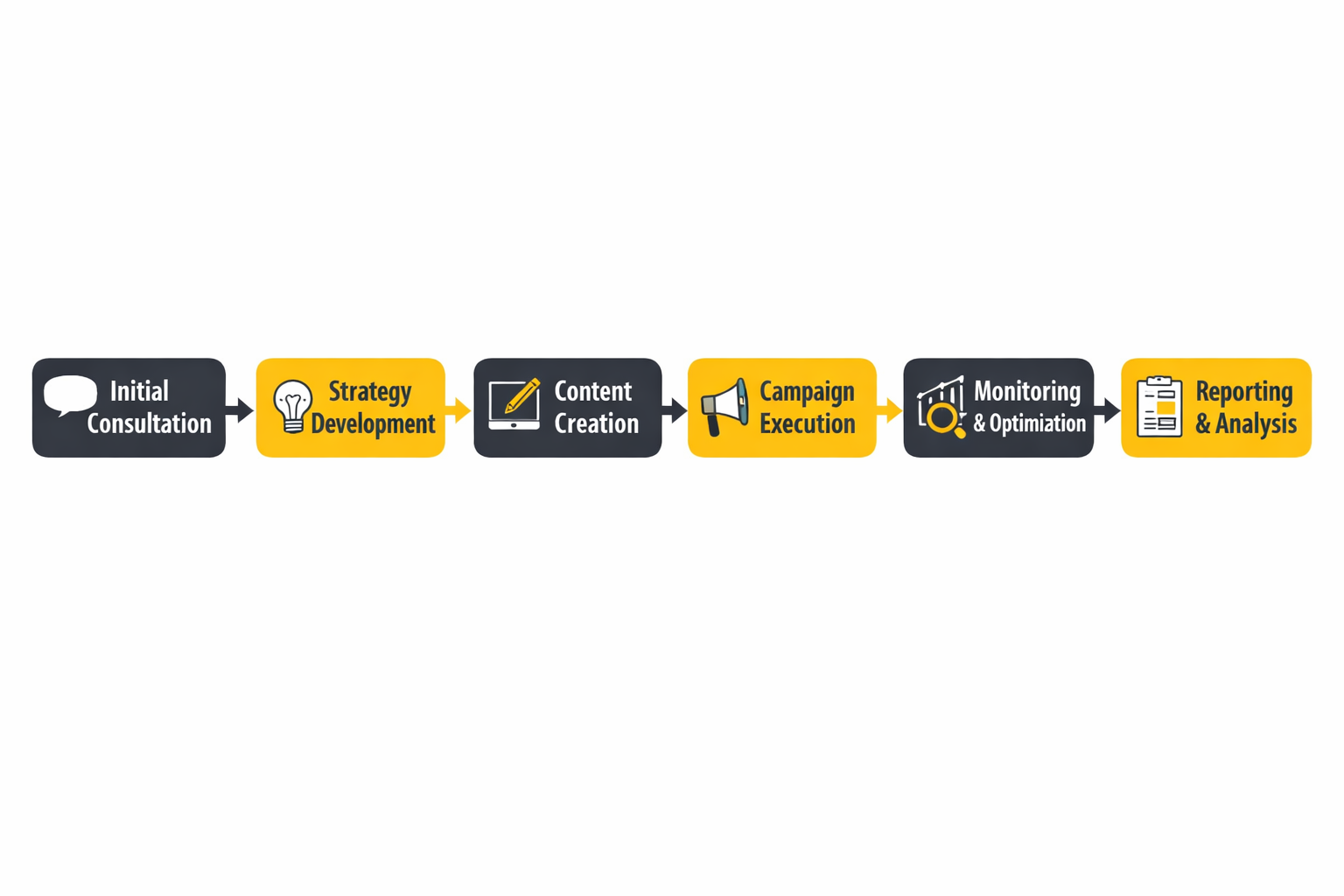
At this point, the framework makes sense conceptually. The next step is understanding how a social media agency actually runs this in day-to-day execution. This is where the process becomes tangible.
Step 1: Audit and Baseline
Every serious engagement starts with understanding the current state. That includes reviewing existing content, performance metrics, audience behavior, and competitor positioning. The goal is not just to identify what worked, but to understand why it worked and whether it can be repeated or scaled.
This step also sets a baseline, which is critical for measuring progress later. Without a clear starting point, it is almost impossible to tell whether the agency is actually improving results.
Step 2: Strategic Direction and Content Plan
Once the audit is complete, the agency defines a clear direction. That includes content pillars, messaging angles, posting cadence, and platform focus. Instead of guessing what to create next, the team works from a structured plan.
This is also where alignment happens between business goals and social execution. If the goal is lead generation, the content plan will look very different than if the goal is brand authority or community building.
Step 3: Production and Publishing Workflow
With a plan in place, the agency builds a production system. This includes idea generation, scripting, design, editing, approvals, and scheduling. Tools like Buffer often help streamline publishing, but the real value comes from having a consistent workflow.
A strong workflow reduces delays, improves quality, and makes it easier to scale output without losing direction. It also ensures that content is not created in isolation but as part of a larger system.
Step 4: Distribution and Campaign Execution
After publishing, the focus shifts to amplification. The agency identifies which content is performing and decides how to push it further. That may include paid promotion, retargeting, or collaboration with creators who can extend reach.
This step is where data starts to compound. Instead of starting from zero with every post, the agency builds on what is already working and pushes it into larger audiences.
Step 5: Measurement and Iteration
Finally, everything loops back into measurement. A social media agency tracks performance across engagement, reach, conversions, and revenue impact. The key is not just collecting data, but using it to refine the next cycle.
Over time, this creates a feedback loop where each round of content and campaigns becomes more effective than the last. That compounding effect is what turns social media from a constant effort into a scalable growth channel.
Core Components of High-Performance Agency Work
By this point, the framework is clear: strategy sets direction, production creates assets, distribution expands reach, and conversion turns attention into business results. What separates a strong social media agency from an average one is how well it measures that system. This is the part where a lot of brands get fooled, because dashboards can look impressive while performance stays weak.
The fix is simple in theory and harder in practice. You have to know which numbers signal momentum, which numbers are just noise, and what action each metric should trigger next.
Performance Data That Actually Matters
A good social media agency does not chase every available metric. It organizes analytics into layers, because not all signals carry the same weight. Some numbers tell you whether content is getting attention, some tell you whether the audience cares, and some tell you whether the channel is creating business value.
That distinction matters because reach without action is not enough, and conversions without enough qualified attention usually do not scale. The real job is understanding how the metrics work together instead of reading them in isolation.
Reach and Impressions Show Distribution Strength
Reach tells you how many unique people saw the content. Impressions tell you how many total times the content was displayed. Those numbers matter because they show whether the agency is getting enough market exposure to create opportunities in the first place.
But here is the important part: high reach is not proof of quality. It can mean strong creative, smart distribution, a paid push, or simply broad exposure without much relevance. A social media agency should use reach as a diagnostic metric, not a victory metric.
Engagement Reveals Resonance, But Context Changes Everything
Engagement still matters because it shows whether the content is earning some level of response. Likes, comments, shares, saves, replies, and clicks help reveal whether the audience finds the post useful, relevant, entertaining, or worth passing along. That said, engagement rates have become more competitive, not less.
Rival IQ’s 2025 benchmark data shows median engagement rates remain relatively low for most brands and have declined across several major platforms, with Instagram around 0.36% median engagement rate, Facebook around 0.046% median engagement rate, and broader platform trends showing year-over-year drops across Facebook, Instagram, TikTok, and X in its 2025 Social Media Industry Benchmark Report. That does not mean social is broken. It means average content is easier to ignore, so engagement should be read against platform norms, industry norms, and content format.
A sharp agency uses engagement as a directional signal. If saves, shares, comments, and watch behavior are climbing, the content is probably getting stronger. If vanity reactions rise while deeper actions stay flat, the agency should not pretend the strategy is working better than it is.
Video Completion and Watch Time Show Content Quality Better Than Views Alone
Views are useful, but they are incomplete. A view can happen very quickly and say almost nothing about actual interest, especially on short-form platforms. Watch time and completion rate tell a much more honest story because they show whether the creative held attention long enough to matter.
That is why many strong teams obsess over retention curves instead of celebrating raw view counts. A social media agency that understands video performance will look at where viewers drop, what hooks hold, and which formats earn repeat attention. This is where the creative process gets smarter over time instead of staying stuck in guesswork.
Statistics and Data That Help Benchmark Performance
Benchmarks are useful when they guide decisions, not when they become random trivia. The point is not to memorize industry averages. The point is to understand whether your current numbers are strong enough to scale, weak enough to fix, or misleading enough to ignore.
The market context is big enough to justify serious measurement. Global digital research shows there are 5.24 billion active social media user identities worldwide, while users spend an average of 2 hours and 21 minutes per day on social media. That is an enormous attention pool, but it also means the competitive pressure is brutal. A social media agency is not operating in an empty room; it is fighting for attention in one of the most crowded environments in business.
Advertising pressure keeps rising too. DataReportal’s 2025 advertising analysis shows global social media ad spend reached roughly a quarter of a trillion dollars in 2024. That matters because it changes the interpretation of organic metrics. If paid competition is intensifying, flat organic reach may not mean your agency is failing, but it may mean you need stronger creative, smarter amplification, or a more selective platform focus.
Engagement Benchmarks Need Platform-Specific Reading
One of the biggest reporting mistakes is comparing every platform as if they behave the same way. They do not. Instagram, LinkedIn, TikTok, Facebook, YouTube, and X all produce different interaction patterns, different content lifespans, and different audience expectations.
Recent benchmark roundups from Rival IQ and Hootsuite’s 2026 statistics summary make that point clearly. Average engagement rates in 2025 vary significantly by platform, with Hootsuite summarizing broad benchmark ranges between 1.4% and 2.8% across selected platforms and post types, while Rival IQ’s medians for many brand accounts come in much lower depending on the platform and industry mix. The takeaway is not that one source is wrong. The takeaway is that benchmark methodology changes the number, so agencies must compare like with like.
A competent social media agency explains the benchmark source before drawing conclusions. It should separate median from average, organic from blended performance, and industry-specific norms from broad cross-platform summaries. Otherwise, the report sounds precise while the interpretation stays sloppy.
Discovery Metrics Matter More Than Many Reports Admit
Not every valuable social action happens at the bottom of the funnel. Discovery metrics matter because social increasingly shapes the very first touchpoint. Consumers now use social not just to scroll but to find products, follow trends, and evaluate credibility before clicking anything.
That is why research from Deloitte and Sprout matters here. Deloitte reports that 43% of consumers discovered a new brand on social in the last year, while Sprout highlights that social plays a major role in how people keep up with trends and cultural moments in its 2025 Index research and 2026 statistics summary. A social media agency should treat discovery performance as a core signal, especially when branded search, direct traffic, and assisted conversions rise after stronger social campaigns.
How a Social Media Agency Should Build an Analytics System
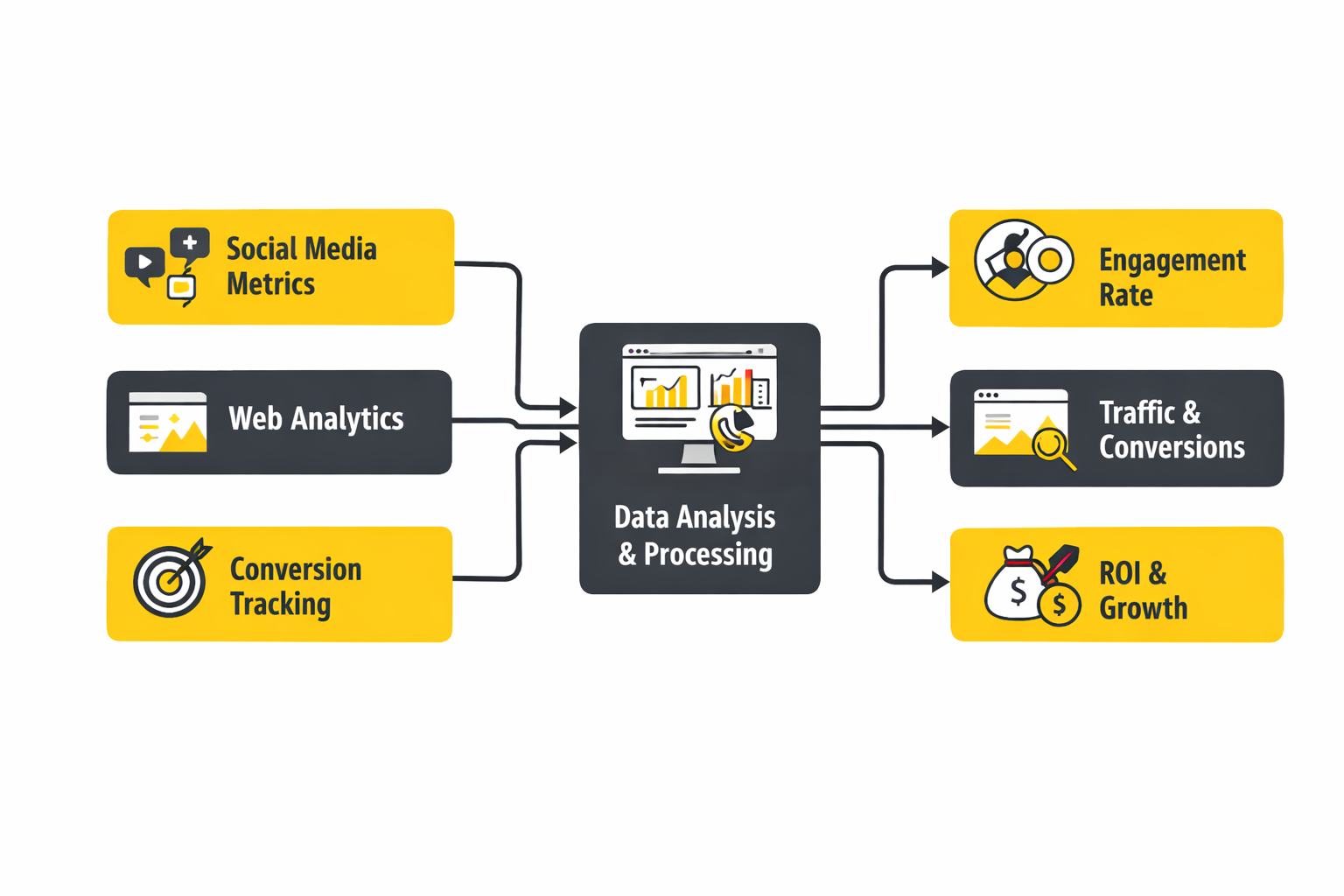
A real analytics system is not just a monthly PDF. It is a decision engine. It should tell the team what is working, what is weakening, where to test next, and which channel deserves more budget or less attention.
That system usually works best when metrics are grouped into four practical levels.
- Attention metrics such as reach, impressions, video views, and watch time
- Engagement metrics such as comments, shares, saves, replies, and click-through rate
- Pipeline metrics such as leads, booked calls, email sign-ups, and qualified traffic
- Business metrics such as revenue, customer acquisition cost, return on ad spend, and customer lifetime value
This layered view stops the team from overreacting to surface-level swings. A post can have lower engagement and still produce stronger commercial outcomes. Another post can go “viral” and create almost no qualified action. The job of a social media agency is to know the difference fast.
Click-Through Rate Tells You Whether Interest Turns Into Action
CTR matters because it sits between attention and conversion. It tells you whether the audience was motivated enough to leave the platform and take the next step. That could mean visiting a landing page, downloading something, starting a free trial, or booking a call.
When CTR is weak, the problem is often one of four things: weak hook, weak offer, weak audience match, or weak creative-to-landing-page alignment. This is exactly why social reporting should not end at “engagement looked solid.” A social media agency has to connect the post to the next action or it cannot diagnose performance properly.
Conversion Rate Shows Whether the Journey Makes Sense
This metric matters because it exposes a common lie in social reporting. Sometimes the content works and the page fails. Sometimes the ad works and the offer fails. Sometimes the agency drives traffic and the client-side sales process quietly destroys the result.
That is why conversion rate should be tracked beyond the platform wherever possible. A strong social media agency will connect posts and campaigns to landing pages, email capture, booking flows, and CRM follow-up so the team can see where friction begins. Tools like Fillout, Brevo, or Copper can help tighten that handoff when social needs to feed a broader lead or sales system.
Cost Metrics Matter Once Scale Becomes the Goal
The moment paid support enters the picture, efficiency becomes critical. Cost per click, cost per lead, cost per acquisition, and return on ad spend start carrying more weight. These numbers tell you whether the agency is scaling intelligently or just buying expensive attention.
This is where context matters again. A higher cost per lead is not always bad if lead quality improves and close rates rise. A lower cost per click is not always good if the traffic is weak. A serious social media agency should always interpret cost metrics against downstream quality, not in isolation.
What the Data Should Drive Next
Metrics are only useful when they change behavior. If analytics do not influence creative, offers, targeting, posting cadence, or budget allocation, then reporting is just theater. Too many agencies still stop at descriptive dashboards when the client really needs prescriptive action.
Here is what the numbers should lead to in practice. Weak retention should push better hooks and tighter editing. High saves and shares should trigger repurposing and paid amplification. Strong CTR with weak conversion should trigger landing page work. Strong engagement from the wrong audience should trigger targeting refinement.
That is what an experienced social media agency does well. It turns numbers into decisions, then decisions into better next-week execution.
The Signals That Usually Matter Most
Not every business needs the same model, but some signals keep showing up as the most useful across categories. Saves, shares, watch time, CTR, lead quality, assisted conversions, and repeat content winners usually tell a more honest story than raw follower growth alone. Follower growth can still matter, but only when the audience quality and downstream activity support it.
Sprout’s 2025 reporting also reinforces that brands need to focus on relevance over empty trend participation, with consumer data showing many people see off-brand trend chasing as a negative signal rather than a smart growth move in its 2025 Index coverage. That matters analytically because it changes how success should be defined. The goal is not maximum activity. The goal is credible, compounding performance.
Once that is clear, the next question becomes more practical: what capabilities must an agency actually have to deliver this level of execution consistently across channels, teams, and objectives?
Professional Implementation Across Teams, Channels, and KPIs
Once a social media agency has strategy, process, and measurement in place, the real test is operational. This is the stage where agencies either become a serious growth partner or get exposed as a content vendor with nicer slides. Professional implementation is about making social work across teams, platforms, timelines, and commercial goals without letting the whole thing collapse into bottlenecks and mixed signals.
That matters more now because the channel is doing more jobs at once. HubSpot’s 2025 social media reporting points to a landscape where brands are balancing community, customer experience, creator collaboration, and performance demands at the same time, not one after another in a clean sequence. offers.hubspot.com+1 A strong social media agency has to build for that complexity from the start.
The Best Agency Models Do Not Replace the Internal Team
One of the biggest mistakes companies make is hiring a social media agency as if they are outsourcing the entire problem. In reality, the best results usually come from a shared operating model where the internal team owns brand truth, approvals, customer insight, and commercial priorities, while the agency brings execution depth, creative systems, testing discipline, and outside perspective. When those roles are not clear, social becomes political fast.
This is why handoffs matter so much. Leadership needs to define what success means, product or sales teams need to surface real objections and buying triggers, and the agency needs enough access to turn that information into content and campaigns people actually care about. Without that alignment, even talented agency teams end up producing polished work that feels detached from the business.
Channel Strategy Should Be Selective, Not Performative
A lot of weak agency work starts with the wrong assumption that every brand needs to be everywhere. That sounds ambitious, but it usually creates mediocre execution across too many channels. A better social media agency chooses platforms based on audience behavior, content fit, and business model, then goes deeper where the odds are best.
That is a more disciplined response to the current market. Consumers already discover brands through a mix of channels, with DataReportal showing an average of 5.8 sources used for brand discovery, so the goal is not total platform coverage. The goal is to win enough attention in the right places that discovery turns into consideration and action.
Scaling Content Without Losing Quality Is Harder Than It Looks
Early growth on social often comes from founder energy, a few strong posts, or a burst of creative momentum. Scaling that is a different game. Once output increases, the system starts to strain under approvals, feedback loops, platform changes, asset requests, and the constant pressure to keep quality high while moving fast.
A capable social media agency solves that by building production standards instead of relying on random bursts of talent. It creates repeatable briefing, scripting, editing, review, and publishing workflows so the machine keeps moving even when volume rises. Tools like Buffer, Flick, and Brevo can support that system, but they only help when the operating logic is already sound.
Short Approval Loops Are a Competitive Advantage
This point gets ignored too often. Social rewards relevance, timing, and iteration, but none of those survive bloated approval chains. If a brand takes a week to approve basic creative, the agency is not really running a live channel; it is managing a delayed publishing pipeline.
That problem becomes even more obvious when brands try to participate in fast-moving conversations. Sprout’s 2025 findings show that trend participation has a narrow window and that many consumers see off-brand or late brand trend-hopping as embarrassing. investors.sproutsocial.com+1 In practice, that means a social media agency needs pre-approved messaging territory, decision rights, and escalation rules so speed does not destroy judgment and caution does not destroy relevance.
Paid and Organic Need One Shared Strategy
Too many companies separate organic and paid social as if they were unrelated disciplines. That creates duplicated work, inconsistent creative, and lost learning. A better social media agency uses organic content as a testing ground, then amplifies proven messages through paid distribution when the signals are strong enough.
This approach fits the current economics of attention. With global social ad spend reaching roughly a quarter of a trillion dollars in 2024, brands cannot afford to treat paid amplification as an afterthought. They need a combined model where content, targeting, and offer strategy inform each other instead of competing for budget and credit.
Creator and Community Layers Need Operational Discipline
A lot of agencies talk about creators and community because both sound modern and high leverage. They are right about the leverage, but only when the work is structured properly. Creator partnerships need clear briefs, usage rights, performance expectations, and audience fit, while community management needs tone guidance, escalation rules, and actual ownership.
This is where advanced agency work starts to look more like operations than promotion. HubSpot’s 2025 reporting points to continued emphasis on community and creator-led formats, but those only compound when they are treated as systems rather than one-off experiments. offers.hubspot.com+1 A social media agency that cannot operationalize these layers will usually end up chasing volume instead of building durable brand equity.
Reporting Has to Match Executive Reality
Another scaling issue shows up in reporting. Marketing teams may care about content performance and audience engagement, but leadership usually wants a tighter story: what changed, what it means, and what happens next. A social media agency that cannot translate platform data into business language will keep fighting for credibility, even when some of the work is strong.
That is why KPI design matters so much at the implementation stage. The reporting system should connect social metrics to outcomes leadership already values, whether that is qualified traffic, leads, conversion efficiency, assisted revenue, or lower customer acquisition cost. When those links are missing, social stays vulnerable to budget skepticism no matter how active the channel looks.
The Biggest Risk Is Activity Without Leverage
This is the trap many businesses fall into after hiring an agency. Content is going out, meetings are happening, dashboards are arriving, and everyone is busy. But six months later, the company still cannot clearly explain what social is contributing beyond presence.
A serious social media agency is supposed to prevent that exact outcome. It should force prioritization, cut weak work faster, and keep asking whether the current system is creating compounding advantage or just recurring effort. That sounds blunt, but it matters. Social is too expensive in time, money, and brand visibility to run on momentum alone.
Scaling Requires Better Infrastructure, Not Just More Content
When performance starts improving, many brands respond by asking for more posts, more channels, more campaigns, and more complexity. Sometimes that works, but often it breaks the system because the infrastructure underneath has not matured. More output without better operations usually means slower approvals, weaker insights, and lower average quality.
The smarter move is to strengthen the stack around the channel. That can mean better intake forms with Fillout, cleaner CRM follow-up through Copper, stronger nurture flows in Brevo, or tighter funnel logic using ClickFunnels or Systeme.io. The platform content gets most of the attention, but infrastructure is often what determines whether growth holds.
What Expert-Level Agency Work Really Looks Like
At the advanced level, a social media agency is not just making content or even running campaigns. It is managing an adaptive system. It knows when to protect brand consistency and when to test harder, when to push reach and when to tighten targeting, and when to invest in community, creators, paid amplification, or funnel optimization based on real signals rather than fashion.
That is the level most businesses think they are buying when they hire an agency. The problem is that many agencies sell the language of strategy without building the mechanics to support it. The final step, then, is practical: how to choose the right agency, manage the relationship properly, and scale without getting trapped by the wrong fit or the wrong expectations.
How to Choose, Manage, and Scale With the Right Agency
By now, the structure is clear. A social media agency is not just producing content, it is running a system that connects attention, engagement, and conversion. The last piece is practical: how to choose the right partner, manage the relationship, and scale without wasting time or budget.
This is where most businesses get it wrong. They evaluate agencies based on presentation quality, surface-level case studies, or how confident the pitch sounds. None of those guarantee execution. The real signal is how the agency thinks, how it structures decisions, and how it reacts when something does not work.
What to Look for Before You Sign Anything
The first filter is simple. A serious social media agency should be able to explain its framework clearly, without hiding behind buzzwords. If the team cannot walk you through how strategy connects to content, distribution, and conversion, you are likely buying activity instead of outcomes.
You should also look for how they talk about tradeoffs. Strong agencies do not promise everything at once. They prioritize platforms, content formats, and goals based on your business model. That clarity is more valuable than vague promises about “going viral” or “maximizing engagement.”
Another strong signal is how they approach measurement. If reporting is limited to reach, likes, and follower growth, the agency is not operating at the level most businesses need today. You want a team that connects social performance to leads, pipeline, and revenue, not just platform metrics.
Red Flags That Usually Show Up Early
Weak agencies tend to show the same patterns, even if the presentation looks polished.
- They overemphasize posting frequency instead of strategy
- They promise fast growth without explaining how distribution works
- They avoid clear KPIs tied to business outcomes
- They rely heavily on trends without explaining brand fit
- They cannot explain what happens after a user clicks
None of these issues always show up immediately in results, which is why companies often stay in the wrong partnership longer than they should. The problem compounds quietly until leadership starts questioning the entire channel.
Managing the Relationship Without Micromanaging It
Once you hire a social media agency, the goal is not to control every detail. It is to create enough structure that the team can move fast while staying aligned with the business. That balance is harder than it sounds.
The best approach is to define a few non-negotiables early:
- Clear business goals and priorities
- Defined KPIs across attention, engagement, and conversion
- Agreed timelines for reporting and iteration
- Decision ownership for content approvals and campaign changes
With those in place, the agency can operate without constant friction. Without them, even strong teams get stuck in slow feedback loops and conflicting directions.
Scaling Without Breaking the System
Growth introduces new pressure. More content, more campaigns, more data, and more expectations. The instinct is often to increase output immediately, but that is not always the right move.
Scaling works best when the underlying system is stable. That means consistent content quality, clear reporting, strong conversion paths, and reliable workflows. If those pieces are not solid, increasing volume usually reduces performance instead of improving it.
This is also where infrastructure starts to matter more. As social generates more leads and interactions, the business needs systems to capture, qualify, and follow up. Tools like Systeme.io, ClickFunnels, and Brevo can help structure that flow, but only if they are integrated into the overall strategy instead of treated as separate tools.
When to Double Down and When to Change Direction
One of the hardest decisions is knowing when to keep pushing and when to adjust. Social performance is not linear. Some strategies take time to mature, while others show early signals that they are not working.
A good social media agency should help you read those signals. If engagement depth is improving, CTR is rising, and conversion quality is getting stronger, the system is likely moving in the right direction even if results are not explosive yet. If everything stays flat or inconsistent, it is usually a sign that something deeper needs to change.
The key is to avoid emotional decisions based on short-term fluctuations. The data should guide the decision, not the pressure of the moment.
The End Goal: A Self-Reinforcing Growth System
At its best, a social media agency helps build a system that improves over time. Content gets sharper, distribution becomes more efficient, conversion paths get cleaner, and insights compound. The channel stops feeling like a constant effort and starts behaving like a structured growth engine.
That is the real outcome to aim for. Not just more posts, not just more reach, but a system that consistently turns attention into measurable business impact.
FAQ - Built for Complete Guide
What does a social media agency actually do today?
A modern social media agency handles strategy, content production, distribution, analytics, and conversion support. It is no longer just about posting, but about building a system that connects attention to business outcomes.
How much should a social media agency cost?
Pricing varies widely depending on scope, platforms, and performance expectations. Lower-cost services often focus on posting, while higher-tier agencies include strategy, paid distribution, and conversion systems. The key is not price alone, but what level of impact the agency is responsible for.
How long does it take to see results?
Early signals like engagement and reach can improve within weeks, but meaningful business results often take a few months. Social works as a compounding system, so consistency and iteration matter more than quick spikes.
Is it better to hire an agency or build an in-house team?
The strongest setup is often a combination. Internal teams provide brand knowledge and control, while a social media agency brings specialized execution and outside perspective. The decision depends on resources, goals, and growth stage.
Which platforms should a business focus on?
That depends on where your audience spends time and how your product is discovered. A good agency will prioritize platforms based on data, not trends, and focus on depth instead of spreading resources too thin.
How do you measure success in social media?
Success should be measured across multiple layers, including reach, engagement, traffic, leads, and revenue impact. A social media agency should connect platform metrics to real business outcomes, not just surface-level numbers.
Can social media directly drive sales?
Yes, especially with the rise of social commerce and integrated funnels. Research shows many consumers are open to buying directly within social platforms, which makes the connection between content and conversion more important than ever.
What is the biggest mistake businesses make with agencies?
The most common mistake is focusing on activity instead of outcomes. Posting more content does not guarantee better results if the strategy, distribution, and conversion systems are weak.
Do you need paid ads to succeed on social media?
Organic content can build momentum, but paid amplification often helps scale results faster. The best approach combines both, using organic performance to guide paid investment.
How do you know if an agency is underperforming?
Warning signs include flat engagement quality, weak conversion results, unclear reporting, and lack of strategic direction. A strong social media agency should continuously improve performance and explain what is changing and why.
What role do tools play in social media success?
Tools support execution, but they do not replace strategy. Scheduling, analytics, and CRM tools help streamline workflows, but the real value comes from how they are used within a structured system.
Can a social media agency help with lead generation?
Yes, especially when social is connected to landing pages, funnels, and follow-up systems. Without that connection, even strong content may fail to produce measurable leads.
Work With Professionals
Explore 10K+ Remote Marketing Contracts on MarkeWork.com
Most marketers spend too much time chasing clients, competing on crowded platforms, and losing a percentage of every project to middlemen.
MarkeWork gives you a better way. Browse thousands of remote marketing contracts and connect directly with companies desperate to hire skilled marketers like you, without platform commissions and without unnecessary gatekeepers.
If you're serious about finding better opportunities and keeping 100% of what you earn, explore available contracts and create a profile for free at MarkeWork.com.