

The best social media campaign examples are not just clever posts with big numbers attached. They show how a brand turned attention into action through timing, message-market fit, creative consistency, and a clear next step.
That matters because social media is no longer just a visibility channel. People use platforms to discover products, compare brands, follow creators, ask questions, and decide what feels worth trusting. Global social media use remains massive, with DataReportal’s Digital 2025 research showing that social platforms are still central to how people spend time, discover content, and interact with brands.

This article will break down real campaigns without pretending that virality is a strategy by itself. We will look at what worked, why it worked, and what a smaller business can realistically borrow without copying the surface-level gimmick.
Article Outline
- Why Social Media Campaign Examples Matter
- The Campaign Framework Behind Strong Examples
- Core Components of a Social Media Campaign
- Social Media Campaign Examples by Goal
- How to Build and Measure Your Own Campaign
- Common Mistakes, Tools, and FAQs
Why Social Media Campaign Examples Matter
Studying examples gives you pattern recognition. You start to see that strong campaigns usually have one sharp idea, one clear audience, and one behavior they want people to take. That is very different from posting every day and hoping something catches.
The pressure to prove results is also getting higher. Sprout Social’s 2025 ROI research notes that 65% of leaders want direct connections between social campaigns and business goals, while only a smaller share of marketers feel fully confident measuring ROI. That gap is exactly why examples matter: they help connect creative work to commercial logic.
The point is not to copy Duolingo, Spotify Wrapped, Barbie, or Liquid Death. The point is to understand the strategic mechanism underneath the content. Once you see the mechanism, you can adapt it to your own product, budget, audience, and risk tolerance.
The Campaign Framework Behind Strong Examples
A useful campaign framework starts with four questions: who are we trying to move, what do they already care about, what moment can we enter, and what action should happen next? Without those answers, social media campaign examples become entertainment instead of instruction. Good campaigns are not random bursts of creativity; they are focused systems.
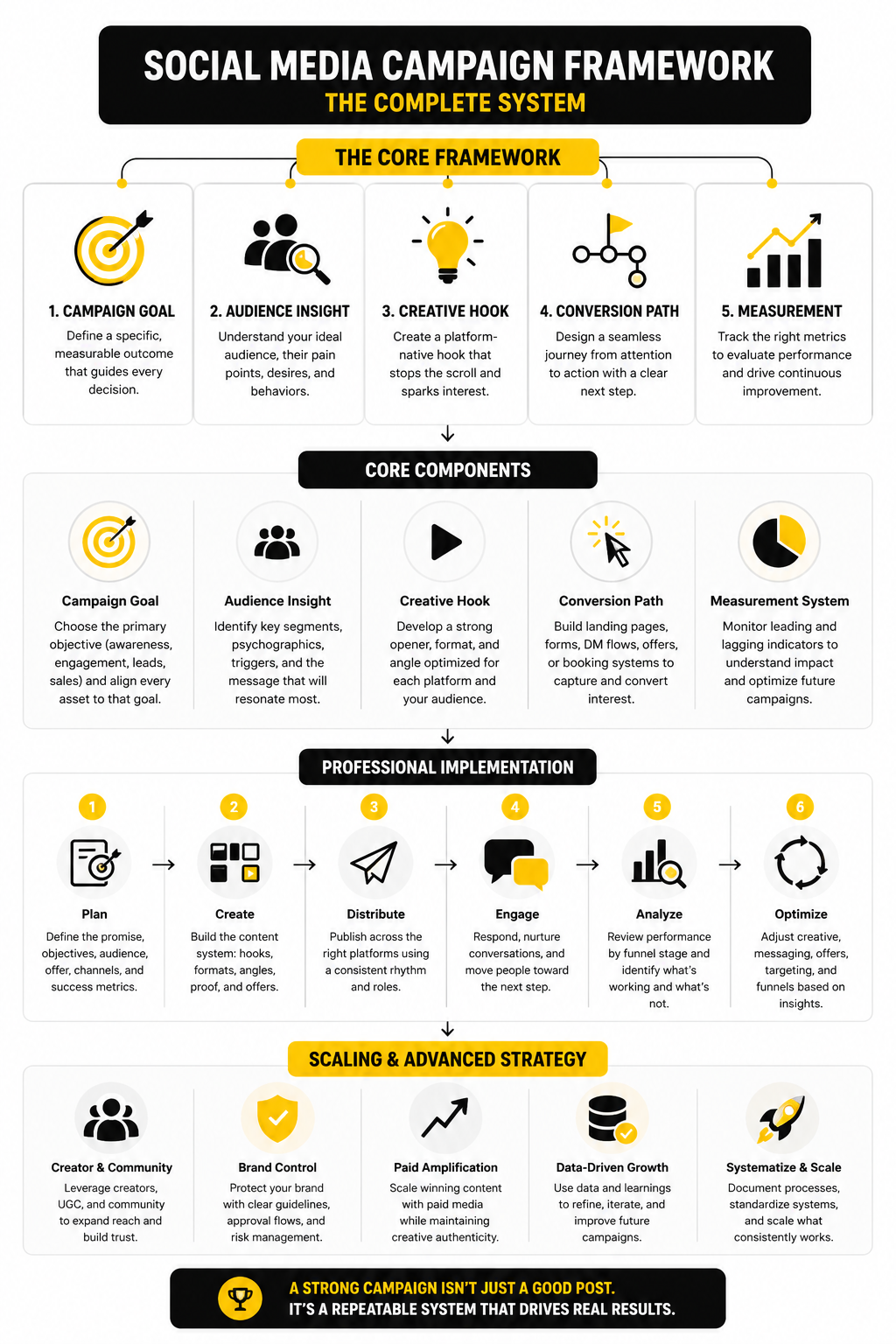
The strongest campaigns usually combine audience insight, platform-native creative, distribution, and measurement. Duolingo’s TikTok work, for example, succeeded because the content felt native to the platform rather than like recycled advertising, with TikTok’s own case study reporting more than 90 million video views and follower growth above 1,400%. That kind of result comes from matching brand personality to platform behavior.
For practical implementation, the framework should stay simple. Use a publishing tool like Buffer when scheduling and review workflows matter, and consider ManyChat when the campaign needs automated DM follow-up from Instagram, Messenger, or WhatsApp. Tools will not fix a weak idea, but they can help a strong idea convert.
Core Components of a Social Media Campaign
A strong campaign needs more than a good post. It needs a clear goal, a specific audience, a repeatable creative angle, a distribution plan, and a measurement system that tells you whether the campaign is working. When you study social media campaign examples, these are the pieces to look for first.
The goal should be painfully specific. “Grow awareness” is weak because it can mean anything. “Drive email signups from Instagram Reels,” “increase demo bookings from LinkedIn,” or “turn TikTok comments into DM conversations” gives the campaign a real job.
The audience should be narrow enough that the creative has an edge. Great social content usually feels like it was made for a specific group of people, not for a generic market segment. That is why platform-native campaigns often outperform polished but bland brand content.
The Campaign Goal
The goal decides the shape of the campaign. A brand awareness campaign might optimize for reach, shares, creator participation, and cultural relevance. A conversion campaign should care more about clicks, landing page performance, lead quality, booked calls, or sales.
This is where many campaigns quietly fail. They use awareness-style creative, then judge it like a direct-response ad. Or they build conversion content, then wonder why it does not create a big cultural moment.
Before you borrow ideas from famous social media campaign examples, ask what the original campaign was designed to do. Spotify Wrapped is built for participation and identity sharing. A product launch campaign is built to create urgency. A lead generation campaign needs a much tighter path from post to action.
The Audience Insight
Audience insight is the reason a campaign feels relevant instead of random. It is the difference between “we made a funny video” and “we made a funny video that our exact buyers instantly understand.” That small difference is huge.
Recent platform behavior supports this. HubSpot’s 2025 social media research found that marketers are leaning into funny, relatable content, community building, and micro-influencer collaborations because audiences are responding to content that feels less corporate and more native to the feed.
The insight does not have to be complicated. It can be a frustration, an aspiration, a shared joke, a recurring question, or a moment your audience already talks about. The best campaigns simply package that insight in a way people want to repeat.
The Creative Hook
The hook is the part people notice first. It might be a provocative opening line, a visual pattern, a creator format, a recurring character, a challenge, or a simple idea that is easy to share. Without a hook, even a smart campaign can disappear.
The hook also has to fit the platform. TikTok rewards fast context and emotional clarity. LinkedIn rewards useful perspective and professional identity. Instagram often rewards visual consistency, creator credibility, and content that feels saveable or shareable.
This is why copying the surface of another campaign rarely works. If a brand copies Duolingo’s humor without Duolingo’s character, timing, and community fluency, it feels forced. The lesson is not “be chaotic.” The lesson is to build a recognizable creative behavior your audience actually wants from you.
The Conversion Path
Attention is only half the job. Once people engage, the campaign needs a next step that feels natural. That could be a landing page, a comment-to-DM flow, an email signup, a quiz, a checkout page, or a booked call.
For ecommerce and creator-led offers, a focused landing page can make the campaign feel complete instead of scattered. Tools like Replo can help teams build campaign-specific pages when the social creative needs a more tailored destination than the homepage.
For service businesses, agencies, coaches, and local brands, the follow-up system matters just as much as the post. A platform like GoHighLevel can make sense when the campaign needs forms, CRM follow-up, email, SMS, appointments, and pipeline tracking in one place. The key is simple: do not let campaign interest leak because the next step is unclear.
Professional Implementation
Once the strategy is clear, implementation is where most campaigns either become real or fall apart. This is the practical layer: briefs, timelines, assets, approvals, publishing, engagement, follow-up, and reporting. The best social media campaign examples look effortless from the outside, but behind the scenes they usually run on a very deliberate process.
A campaign should never begin with “What should we post?” It should begin with the offer, the audience, the campaign promise, and the action path. Once those are locked, content becomes much easier because every asset has a job instead of existing as random filler.
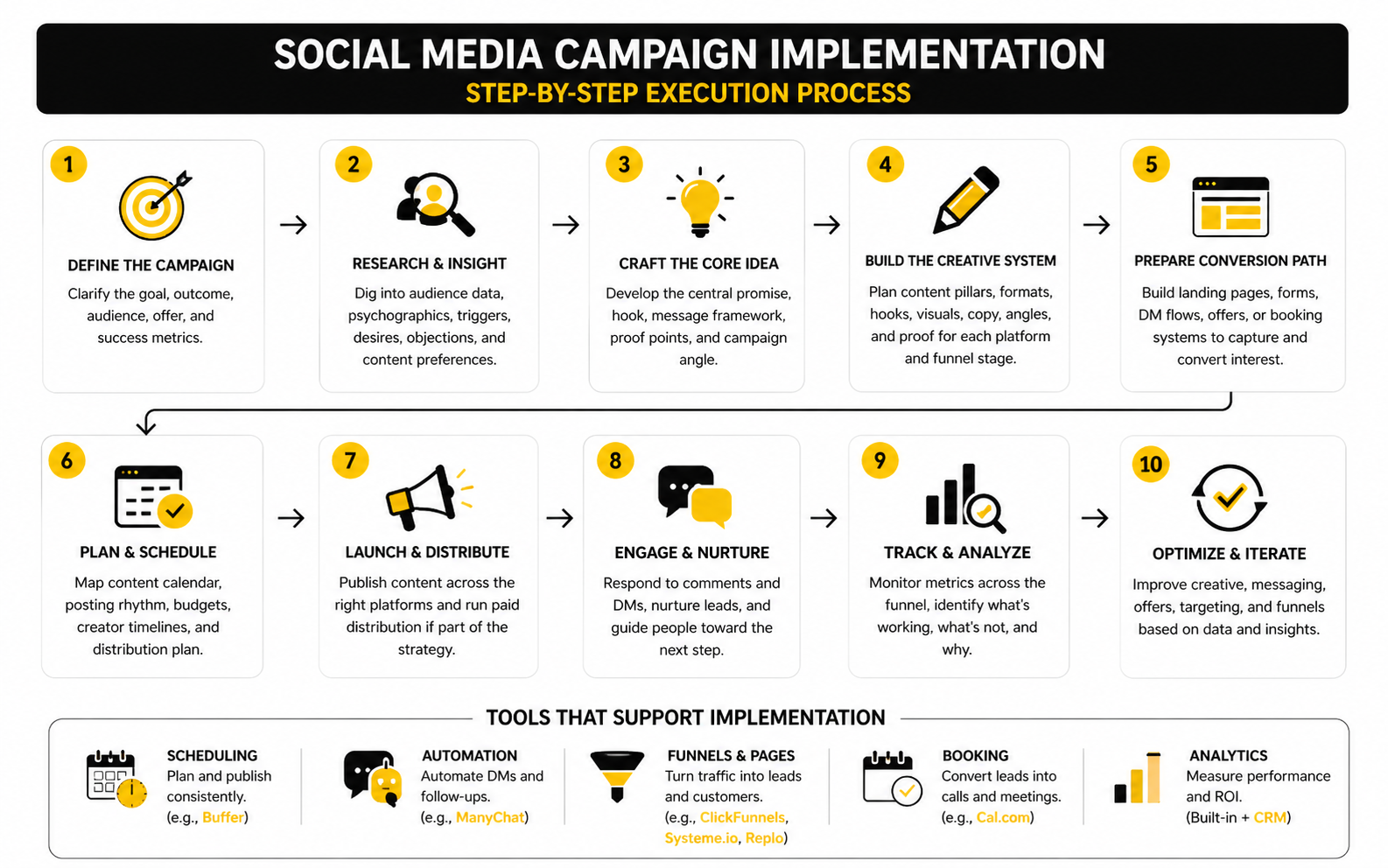
Step 1: Turn the Goal Into One Campaign Promise
A campaign promise is the simple idea people should understand after seeing your content once or twice. It is not always the slogan, but it guides the slogan, the hooks, the visuals, and the call to action. If the promise is fuzzy, the campaign will feel fuzzy.
For example, a social media campaign for a new product trial might promise “get the result without the usual setup headache.” A creator campaign for a skincare brand might promise “see the routine on real skin, in real bathrooms, with real results.” A B2B campaign might promise “solve this painful workflow before your next team meeting.”
Keep this tight. One campaign should not try to explain the whole company, the full feature set, the founder story, and the quarterly promotion at the same time. Strong campaigns reduce the message until people can repeat it.
Step 2: Build the Content System Before You Publish
A campaign needs a content system, not just a content calendar. The system defines the formats, angles, posting rhythm, creator roles, review process, and repurposing plan. This matters because consistency is much easier when the team knows what kind of content belongs in the campaign.
A practical system might include:
- 3 awareness posts that introduce the problem
- 3 proof posts that show results, reactions, or use cases
- 2 objection-handling posts that answer doubts
- 2 conversion posts with a clear offer
- 1 recap post that turns campaign learnings into a useful takeaway
This gives the campaign enough shape without making it rigid. Hootsuite’s 2025 Social Trends research highlights how social teams are pushing creative boundaries and using social listening more seriously, which reinforces the point: execution should be structured, but not stiff. Campaigns need room to respond when the audience shows you what they actually care about.
Step 3: Match Each Platform to a Role
Do not force every platform to carry the same message in the same format. Instagram might be the visual proof channel. TikTok might be the testing ground for hooks and creator-style content. LinkedIn might be where the campaign becomes a practical business argument.
This is where many brands waste effort. They publish the same asset everywhere, then assume the campaign failed when one platform underperforms. Usually, the issue is not the idea; it is the platform fit.
Give each channel a job. If short-form video creates discovery, use it for reach and emotional clarity. If email captures warmer intent, use a tool like Brevo or Moosend to continue the conversation after someone opts in.
Step 4: Set the Engagement Rules Before Launch
Engagement cannot be an afterthought. If the campaign is designed to create comments, DMs, shares, or creator responses, someone needs to know exactly how to respond. That includes tone, response speed, escalation rules, and when to move the conversation from public replies into a private channel.
This becomes especially important for campaigns with strong opinions or humor. The more attention you earn, the more interpretation you invite. A good response guide protects the brand while still letting the social team sound human.
For campaigns built around comments or DMs, automation can help, but it should not feel robotic. Use automation for routing, delivery, reminders, and simple qualification. Keep human judgment for sensitive replies, objections, partnerships, and anything that could affect trust.
Step 5: Review Early Signals and Adjust Fast
The first few days of a campaign are not just for publishing. They are for learning. Watch which hooks earn saves, which comments reveal objections, which creators drive qualified attention, and which posts lead to the next step.
Do not overreact to one weak post. Look for patterns across formats, platforms, and audience responses. If a campaign promise is working, you will usually see signs before the final results arrive.
This is why social media campaign examples are useful, but your own data matters more. Famous campaigns can show you what is possible. Your audience behavior shows you what to do next.
Statistics and Data
Measurement is where social media campaign examples become useful instead of inspirational. A campaign that gets attention but cannot be connected to business behavior is hard to defend. A campaign with smaller reach but clear movement from impression to engagement to lead to sale may be far more valuable.
The numbers matter because social media has become too expensive, too competitive, and too visible inside the business to measure casually. Sprout Social’s 2025 ROI research found that 65% of leaders want direct connections between social campaigns and business goals, while only 30% of marketers feel confident measuring social media ROI. That gap is the measurement problem most teams need to fix.
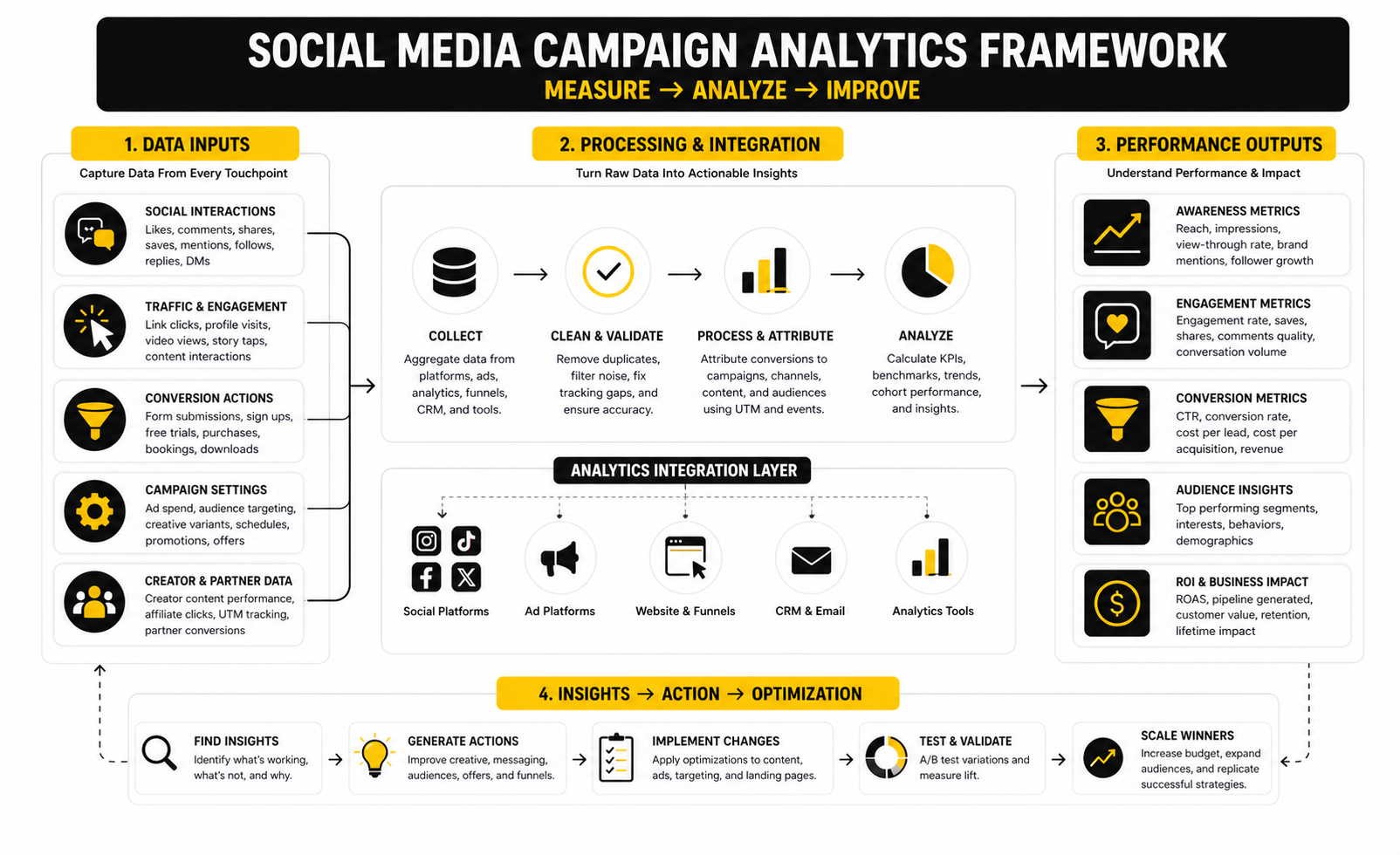
The Metrics That Actually Matter
Start with the campaign goal, then choose the metric. If the goal is awareness, reach, impressions, video views, branded search lift, follower growth, and share of voice may matter. If the goal is demand, track clicks, landing page conversion rate, lead quality, booked calls, checkout starts, and revenue.
Engagement rate is useful, but only when you interpret it in context. Rival IQ’s 2025 benchmark report shows that engagement rates vary heavily by industry and platform, which means a “good” number for a university, beauty brand, SaaS company, or restaurant will not be the same. Benchmarks help you avoid guessing, but your own past performance is usually the most honest comparison.
The mistake is treating one metric as the truth. High reach with low saves may mean the hook worked but the content lacked depth. High comments with low clicks may mean the topic sparked conversation but the offer was weak. High clicks with poor conversion may mean the social creative worked and the landing page did not.
Benchmarks Are Starting Points, Not Targets
Benchmarks are useful because they give you a reality check. Sprout Social’s 2025 Content Benchmarks research analyzed 3 billion messages across 1 million active public profiles, which makes it valuable for understanding broad publishing and engagement patterns. Still, broad averages should not become lazy targets.
Your best benchmark is layered. Compare the campaign against industry averages, direct competitors, and your own previous campaigns. If all three signals point in the same direction, you can make stronger decisions.
For example, if your campaign underperforms the industry average but beats your previous launch by 40%, that may still be meaningful progress. If it beats generic benchmarks but produces poor-fit leads, the campaign may look good in a dashboard and still fail commercially. Measurement should protect you from both false panic and false confidence.
Read Performance by Funnel Stage
A clean analytics system separates early, middle, and late signals. Early signals tell you whether the creative is earning attention. Middle signals tell you whether people care enough to interact, save, click, comment, or reply. Late signals tell you whether the campaign is producing business value.
A simple campaign measurement map looks like this:
- Attention: reach, impressions, video hook rate, view duration, profile visits.
- Interest: saves, shares, comments, replies, link clicks, content completion.
- Intent: landing page visits, form starts, quiz completions, DMs, email signups.
- Revenue: booked calls, purchases, pipeline value, customer acquisition cost, return on ad spend.
- Learning: winning hooks, objections, audience segments, creator performance, platform fit.
This is where tools should support the strategy instead of becoming the strategy. If the campaign drives people into a funnel, platforms like ClickFunnels or Systeme.io can help connect traffic to opt-ins, offers, and sales pages. If the campaign depends on booking calls, Cal.com can keep the conversion path cleaner.
What the Data Should Make You Do
Data is only useful when it changes your next move. If a short-form video has strong watch time but weak clicks, rewrite the call to action or test a stronger offer. If posts with customer language outperform polished brand copy, use more voice-of-customer research in the next batch.
If a campaign creates a lot of comments but few qualified leads, do not celebrate too early. Look at what people are actually saying. The comments may reveal confusion, price resistance, missing proof, or a better angle than the one you planned.
The smartest teams treat every campaign as both a growth play and a research asset. They measure the result, but they also mine the campaign for hooks, objections, audience language, creator fit, and channel behavior. That is how one campaign makes the next campaign sharper.
Advanced Strategy: What Changes When You Scale
Small campaigns can run on instinct. Larger campaigns cannot. Once more people, platforms, creators, budgets, approvals, and customer touchpoints get involved, the real challenge becomes control without killing creativity.
This is where many brands misunderstand the best social media campaign examples. They see the public-facing idea, but they miss the operating system behind it. A campaign that looks spontaneous may still have legal checks, creator briefs, response guidelines, tracking links, escalation rules, and reporting dashboards behind the scenes.
Creative Freedom vs. Brand Control
The more a campaign depends on creators, humor, trends, or community participation, the more uncomfortable it can feel for a brand team. That tension is normal. If everything is controlled too tightly, the campaign feels sterile; if everything is loose, the brand can drift into risk.
The better approach is to control the non-negotiables and loosen the delivery. Define the promise, claims, compliance rules, offer details, banned language, and approval process. Then give creators or social teams room to translate the idea into native content that actually fits the platform.
Creator marketing keeps growing because audiences often trust people more than polished brand messages. The IAB reported that U.S. creator economy ad spend was projected to reach $37 billion in 2025, but the same category also brings challenges around measurement, transparency, and creator-brand fit. That means the opportunity is real, but so is the need for discipline.
Trend Speed vs. Strategic Consistency
Trends can help campaigns move faster, but they can also make brands look desperate. Not every meme, sound, format, or conversation deserves your logo. The question is not “Can we join this?” but “Does joining this strengthen the campaign promise?”
A strong campaign can use trends without becoming dependent on them. The core idea should still work when the trend fades. If the only reason a post makes sense is because of a sound that will be irrelevant next week, it might be a useful tactical post, but it is not a campaign strategy.
Use trends as accelerators, not foundations. The foundation should be the audience insight, the offer, the campaign message, and the conversion path. That is what keeps the campaign coherent when the platform mood changes.
AI Assistance vs. Audience Trust
AI can speed up research, ideation, editing, repurposing, and reporting. Used well, it helps teams move faster without burning out. Used badly, it makes the brand sound generic, synthetic, or careless.
The risk is not simply “AI content.” The risk is content that removes the human proof people were looking for in the first place. Hootsuite’s 2026 trend research notes that consumers remain cautious about AI in brand content, especially when it feels overproduced or impersonal. That matters because trust is now part of campaign performance, not a soft brand metric.
Use AI behind the scenes where it improves speed and clarity. Let humans own the judgment, stories, customer language, creator relationships, and final creative direction. In social campaigns, authenticity is not decoration; it is part of the product.
Paid Media vs. Organic Learning
Paid distribution can scale a winning campaign, but it can also hide a weak one. If the organic response is poor and the paid numbers only look good because of heavy spend, the campaign may not have a creative problem solved yet. Money can amplify signal, but it can also amplify waste.
A smarter path is to use organic and low-budget testing before scaling. Test hooks, formats, objections, creator angles, and landing page messages with smaller audiences. Then put budget behind what shows actual traction.
This is especially important when using funnel tools or campaign pages. A platform like ClickFunnels can help move people from social attention into a structured offer, but the funnel should be built around proven audience intent. Do not build a complicated conversion machine for a message nobody has validated yet.
Brand Building vs. Direct Response
Some campaigns are designed to make people remember you. Others are designed to make people act now. The problem starts when a team wants both outcomes equally from the same creative without making a strategic choice.
Brand-building campaigns usually need emotional memory, distinctiveness, repetition, and cultural relevance. Direct-response campaigns need clarity, proof, urgency, and a low-friction next step. Both can support each other, but they are not the same job.
The strongest teams plan for both across the customer journey. They use broad social content to earn familiarity and sharper campaign assets to convert demand when the audience is ready. That is how social stops being random posting and becomes a real growth system.
Scaling Without Losing the Signal
Scaling a campaign should not mean multiplying assets blindly. More platforms, creators, and posts can create more reach, but they can also dilute the original insight. The signal gets weaker when everyone interprets the campaign differently.
Before scaling, document what made the campaign work. Capture the winning hooks, strongest comments, best-performing formats, clearest objections, and most persuasive proof points. Then scale those patterns instead of simply increasing volume.
This is the expert-level lesson behind great social media campaign examples. The public sees the creative. The team behind it sees the system.
Final Campaign System
At this point, the campaign should no longer feel like a collection of posts. It should feel like an ecosystem where the message, creative, channels, follow-up, analytics, and learning loop all work together. That is the difference between a social media push and a campaign that can actually improve over time.
The best social media campaign examples are useful because they show how many moving parts can support one simple idea. A customer sees the post, understands the angle, recognizes the proof, takes the next step, and enters a follow-up path that matches their level of intent. Nothing feels accidental.
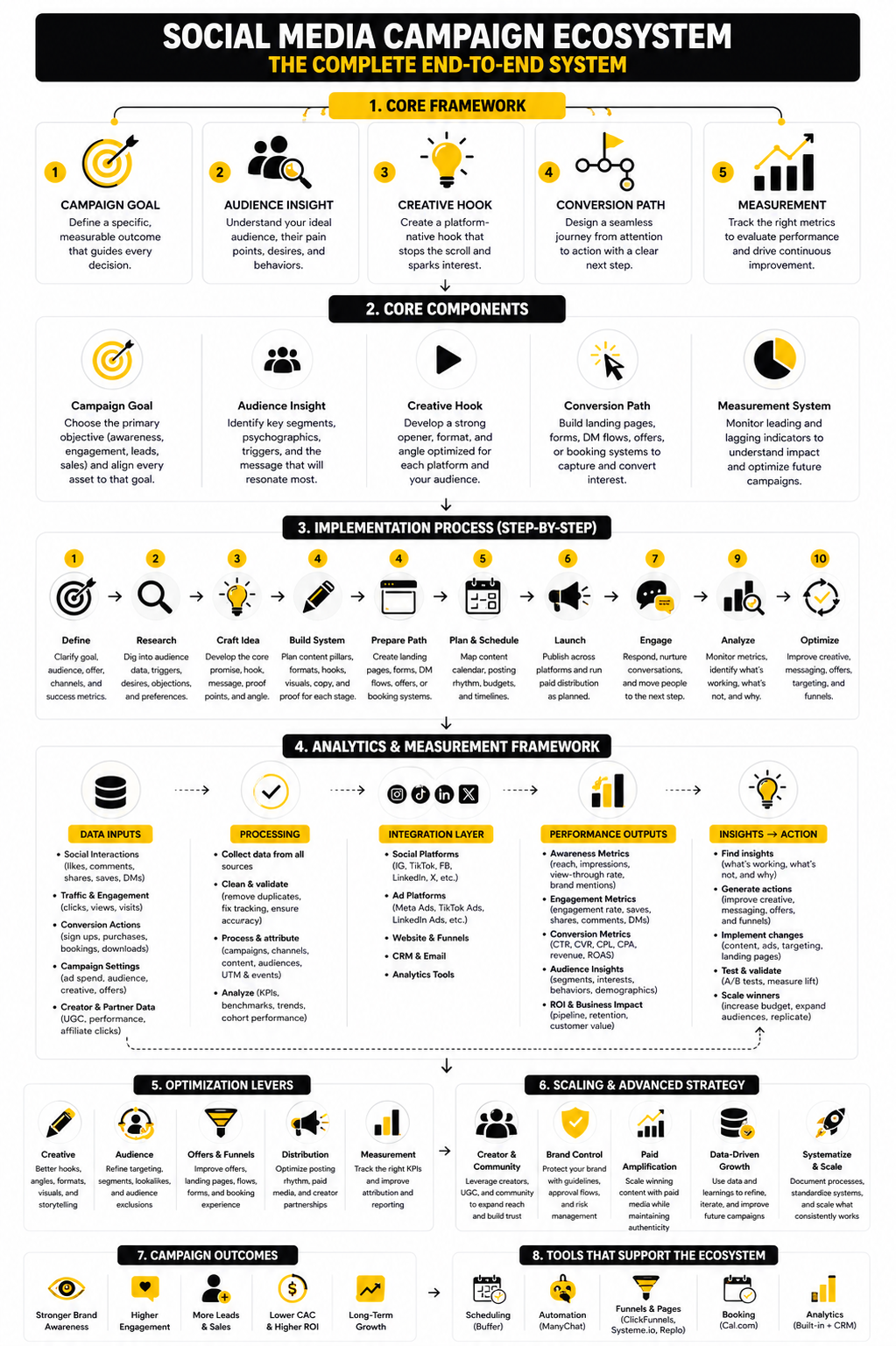
A complete campaign system also protects the team from chasing every new trend. Trends can still be useful, but they become inputs, not the strategy. The real system is built around audience insight, a clear promise, strong creative, conversion paths, and honest measurement.
FAQ: Social Media Campaign Examples
What are the best social media campaign examples to study?
The best examples are the ones where you can clearly see the strategy behind the creative. Spotify Wrapped is useful for studying participation and identity sharing. Duolingo is useful for studying platform-native brand personality. Barbie’s movie campaign is useful for studying partnerships, cultural saturation, and coordinated launch momentum.
Do not only study campaigns with massive reach. Study smaller campaigns in your niche too. They are often more useful because they show what can work without celebrity budgets or global brand awareness.
What makes a social media campaign successful?
A successful campaign moves the right audience toward the right action. That action might be sharing, saving, commenting, signing up, booking a call, buying, or remembering the brand later. The definition depends on the campaign goal.
The mistake is judging every campaign by the same metric. A brand campaign and a lead generation campaign should not be measured the same way. Success starts with choosing the right job for the campaign.
How do I choose the right platform for a campaign?
Choose the platform based on audience behavior, content format, and conversion path. TikTok and Instagram may be stronger for discovery and creator-led content. LinkedIn may be stronger for professional trust, B2B education, and founder-led perspective.
Do not choose a platform just because it is popular. Choose it because your audience spends time there and the campaign idea fits how people behave there. Platform fit is one of the biggest reasons good ideas either travel or stall.
How many posts should a campaign include?
There is no perfect number. A small campaign might need 8 to 12 strong assets across a few weeks. A larger launch might need dozens of assets across organic, paid, creator, email, and retargeting channels.
The better question is whether every post has a role. You need content that introduces the problem, builds desire, proves the promise, handles objections, and drives action. If a post does not serve one of those jobs, it may not belong in the campaign.
Should I use influencers or creators in my campaign?
Creators can help when trust, demonstration, reach, or cultural fluency matters. They are especially useful when your audience wants to see the product or idea in a real context instead of hearing it from the brand alone. The creator should fit the audience, not just the vanity metrics.
The safest approach is to test creators before scaling. Look at comment quality, audience overlap, content style, and conversion behavior. Big follower counts are not enough.
How do I measure social media campaign ROI?
Start by defining the business outcome before launch. Then track the path from social activity to that outcome using links, landing pages, forms, CRM data, purchase events, or booked calls. ROI measurement becomes much easier when the conversion path is designed before the campaign goes live.
You should also separate leading indicators from final results. Saves, shares, comments, clicks, and DMs can show momentum. Revenue, pipeline, customer acquisition cost, and retention show business impact.
What is the biggest mistake brands make with campaign examples?
The biggest mistake is copying the visible creative without copying the thinking. A brand sees a funny mascot, a trend, a creator format, or a viral challenge and tries to recreate it without the audience insight behind it. That usually feels hollow.
Use examples as strategy lessons, not templates. Ask what the campaign understood about the audience, platform, timing, and next step. Then adapt the principle to your own market.
Can small businesses run strong social media campaigns?
Yes, and small businesses often have an advantage because they can move faster. They can test hooks quickly, respond personally, use founder-led content, and build campaigns around specific offers. They do not need giant budgets to create relevance.
The key is focus. A small business should not try to be everywhere at once. One sharp campaign on one or two platforms can outperform scattered posting across five channels.
How long should a social media campaign run?
A campaign can run for a few days, a few weeks, or several months depending on the goal. A flash sale may need a short burst of urgency. A product launch may need pre-launch, launch, and post-launch phases.
Longer campaigns need more variation. You cannot repeat the same message endlessly and expect people to stay interested. Keep the core promise consistent, but rotate hooks, proof, formats, and objections.
How do I know if a campaign idea is strong enough?
A strong campaign idea is easy to explain, easy to recognize, and easy to act on. If your team needs a long paragraph to explain the campaign, the audience will probably miss it. Simple travels faster.
Test the idea with hooks before building the whole campaign. If people respond to the angle, ask questions, share the post, or click through, you have signal. If the response is flat, improve the promise before scaling production.
What tools help manage a social media campaign?
Use tools only when they support a clear process. A scheduler like Buffer can help with publishing and planning. A DM automation tool like ManyChat can help when comments or messages are part of the conversion path.
For funnels and offer pages, ClickFunnels, Systeme.io, or Replo can help connect campaign traffic to a focused next step. The tool stack should make the campaign easier to execute, not more complicated.
How often should I review campaign performance?
Review early signals daily during launch, especially if the campaign depends on paid spend, creators, or fast-moving trends. Look for hook performance, comments, saves, click behavior, and any obvious friction in the conversion path. Early review helps you fix problems before the campaign burns through too much time or budget.
Do a deeper review after the campaign ends. That review should cover results, audience insights, creative winners, weak points, conversion issues, and what should be reused. The goal is not just reporting; the goal is making the next campaign better.
Work With Professionals
Explore 10K+ Remote Marketing Contracts on MarkeWork.com
Most marketers spend too much time chasing clients, competing on crowded platforms, and losing a percentage of every project to middlemen.
MarkeWork gives you a better way. Browse thousands of remote marketing contracts and connect directly with companies desperate to hire skilled marketers like you, without platform commissions and without unnecessary gatekeepers.
If you're serious about finding better opportunities and keeping 100% of what you earn, explore available contracts and create a profile for free at MarkeWork.com.