

The attention economy is no longer a theory—it’s measurable, saturated, and brutally competitive. Over 5.17 billion people use social media globally, and the average person spends around 2 hours and 27 minutes per day scrolling, watching, and engaging . That’s not just idle time. It’s where discovery, trust, and buying decisions are happening in real time.
For brands, this creates a paradox. The opportunity is massive, but so is the noise. Posting randomly doesn’t work anymore. Even good content struggles without strategy, consistency, and distribution. That’s exactly where a social media content agency becomes essential—not as a vendor, but as a growth system.
The best agencies today don’t just “manage posts.” They build attention pipelines, convert engagement into revenue, and turn content into a compounding asset.
Article Outline
- Why a Social Media Content Agency Matters More Than Ever
- How a Social Media Content Agency Actually Works (Framework Overview)
- The Core Components of High-Performing Content Systems
- How Agencies Execute at a Professional Level
- Choosing the Right Social Media Content Agency
- Scaling Content Into Predictable Growth
Why a Social Media Content Agency Matters More Than Ever
Social media has evolved from a branding channel into a primary revenue driver. Roughly 74% of users rely on social platforms when making purchasing decisions , and more than half actively use social media to research brands before buying . This means your content is no longer optional—it directly influences sales.
But here’s the catch: consistency and quality are now baseline expectations. With billions of users and millions of daily posts, average content gets ignored. Even strong ideas fail without execution systems behind them.
A social media content agency solves three major problems:
- Content volume without burnout
- Strategy instead of guesswork
- Distribution that actually reaches people
Brands that rely on internal teams often hit a ceiling. The workload grows faster than capacity. Ideas run dry. Performance becomes inconsistent. Agencies step in with processes, specialized talent, and data-backed decisions.
The shift is clear: social media is no longer about presence—it’s about performance.
How a Social Media Content Agency Actually Works
At a high level, every effective agency operates on a structured system. Without that structure, content becomes reactive instead of strategic.
The difference between random posting and scalable growth is a repeatable framework.
Framework Overview
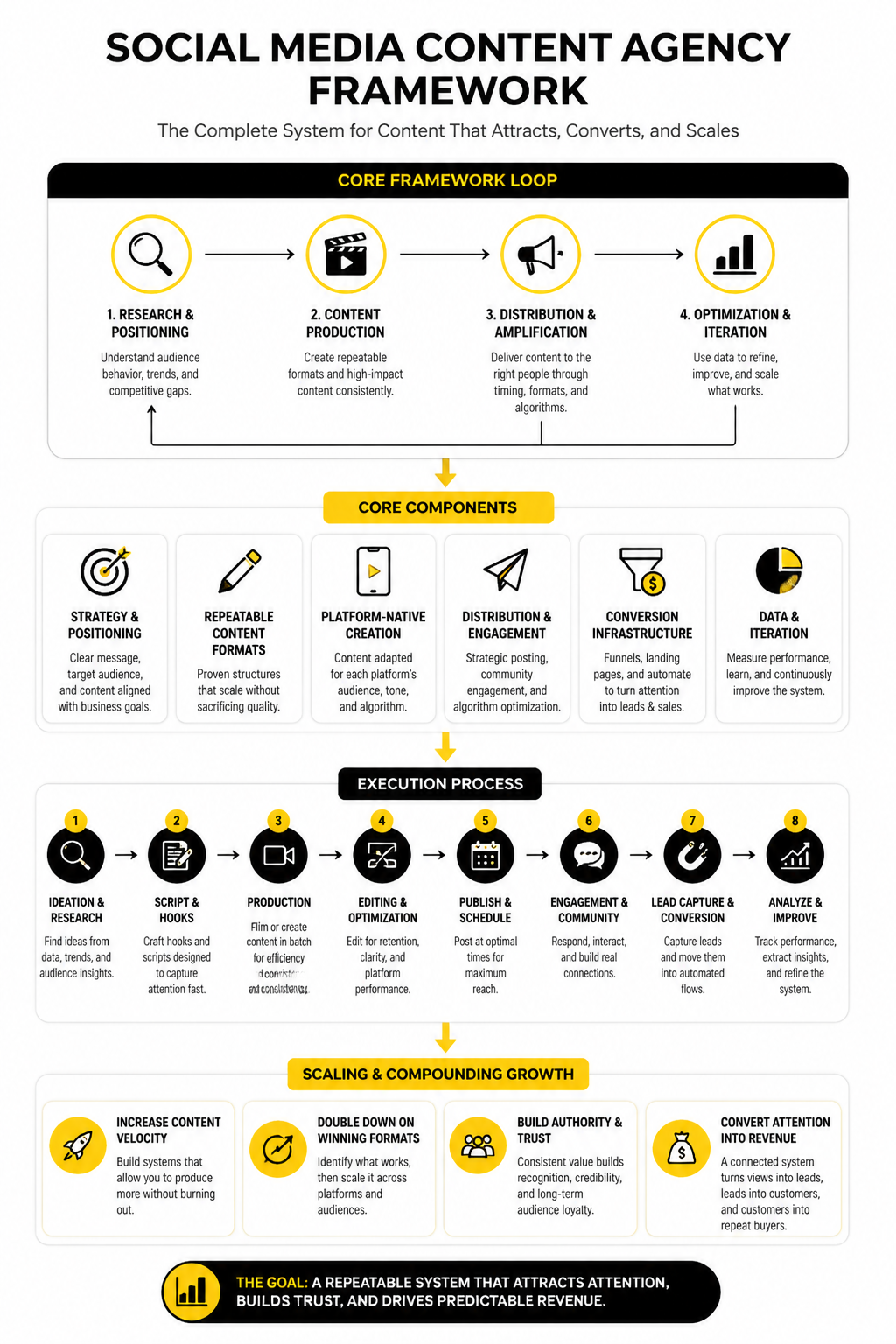
A modern social media content agency typically follows a four-stage loop:
- Research and positioning
Understanding audience behavior, platform trends, and competitive gaps.
- Content production system
Creating repeatable formats instead of one-off posts.
- Distribution and amplification
Ensuring content reaches the right people through timing, formats, and algorithms.
- Optimization and iteration
Using performance data to refine what works and eliminate what doesn’t.
This loop never stops. The compounding effect is what separates brands that plateau from those that scale.
Why Frameworks Beat Random Content
Posting without a system is like investing without a strategy. You might get lucky, but you won’t build momentum.
A structured approach allows agencies to:
- Double down on high-performing formats
- Identify patterns across platforms
- Scale output without sacrificing quality
Tools like Buffer help streamline scheduling and analytics, but tools alone aren’t enough. The real advantage comes from how the system is designed and executed.
Where Most Brands Get It Wrong
The biggest mistake is treating content as isolated posts instead of part of a larger ecosystem.
Common issues include:
- Chasing trends without strategy
- Posting inconsistently
- Ignoring performance data
- Focusing on vanity metrics instead of conversions
A social media content agency fixes this by aligning every piece of content with a specific goal—reach, engagement, or revenue.
And that alignment changes everything.
The Core Components of High-Performing Content Systems
Once the framework is clear, the real leverage comes from execution at the component level. This is where a social media content agency separates average output from content that consistently drives reach, engagement, and conversions.
Think of it like a machine. If even one component is weak—messaging, visuals, distribution, or analytics—the entire system underperforms. Strong agencies don’t guess here. They build each piece deliberately and refine it over time.
Content Strategy That Connects to Revenue
Most brands think they have a strategy when they actually have a content calendar. Those are not the same thing.
A real strategy answers three things:
- Who exactly are we speaking to?
- What problems or desires are we targeting?
- How does each piece of content move someone closer to buying?
Without this clarity, content becomes noise. With it, every post has direction. This is why top-performing agencies spend significant time on positioning before creating anything.
They map content to stages of awareness:
- Top of funnel: reach and attention
- Middle: education and trust
- Bottom: conversion and decision
When done right, content stops being random and starts acting like a sales system.
Repeatable Content Formats That Scale
One of the biggest shifts in recent years is the move from one-off creativity to repeatable formats.
Instead of constantly reinventing ideas, agencies build frameworks like:
- Hook → insight → takeaway
- Problem → agitation → solution
- Story → lesson → call to action
These structures allow teams to produce high-quality content faster without losing effectiveness. It’s how some creators and brands publish daily without burning out.
Tools like Flick Social help analyze which formats perform best across hashtags, captions, and audience behavior. But again, the tool is only as powerful as the strategy behind it.
Platform-Native Content Creation
What works on TikTok rarely works on LinkedIn. What performs on Instagram won’t necessarily convert on YouTube Shorts.
A strong social media content agency doesn’t just repurpose blindly—they adapt.
That means:
- Editing content differently for each platform
- Adjusting hooks based on audience behavior
- Matching tone and pacing to platform expectations
For example, short-form video dominates right now, with platforms like TikTok and Instagram Reels driving massive discovery. Some reports show short-form video delivers the highest ROI among content formats (hubspot.com).
Ignoring platform differences is one of the fastest ways to kill performance.
Distribution That Actually Gets Seen
Creating content is only half the job. Distribution determines whether it succeeds or disappears.
Algorithms reward:
- Consistency
- Engagement velocity
- Watch time and retention
This is why timing, posting frequency, and early engagement matter more than most brands realize.
Agencies often combine organic posting with automation and engagement tools like ManyChat, which helps capture leads directly from social conversations and turn engagement into measurable outcomes.
The goal isn’t just views—it’s controlled distribution that leads somewhere.
Conversion Layer Most Brands Ignore
Here’s where things get interesting. Most social media content stops at engagement. The best agencies go further—they connect content to conversion infrastructure.
This includes:
- Landing pages
- Funnels
- Email capture systems
- Retargeting flows
Platforms like ClickFunnels or Systeme.io are often used to turn social traffic into leads and customers.
Because attention without conversion is wasted effort.
Data and Iteration as a Growth Engine
The final component—and arguably the most important—is feedback.
Every piece of content produces data:
- Views
- Watch time
- Click-through rates
- Conversions
Agencies use this data to refine the system continuously. Weak formats get removed. Strong ones get scaled.
Over time, this creates a compounding effect. Content improves. Results stabilize. Growth becomes predictable instead of volatile.
And that’s the real goal of a social media content agency—not just to create content, but to build a system that gets smarter with every post.
How Agencies Execute at a Professional Level
Understanding the components is one thing. Executing them consistently at scale is something else entirely. This is where a social media content agency proves its value—not in theory, but in process.
Professional execution is not chaotic creativity. It’s structured, repeatable, and optimized over time. The best agencies operate like production companies combined with performance marketing teams.
The End-to-End Content Execution Process
At a high level, execution follows a clear pipeline. Each stage feeds into the next, creating momentum instead of friction.
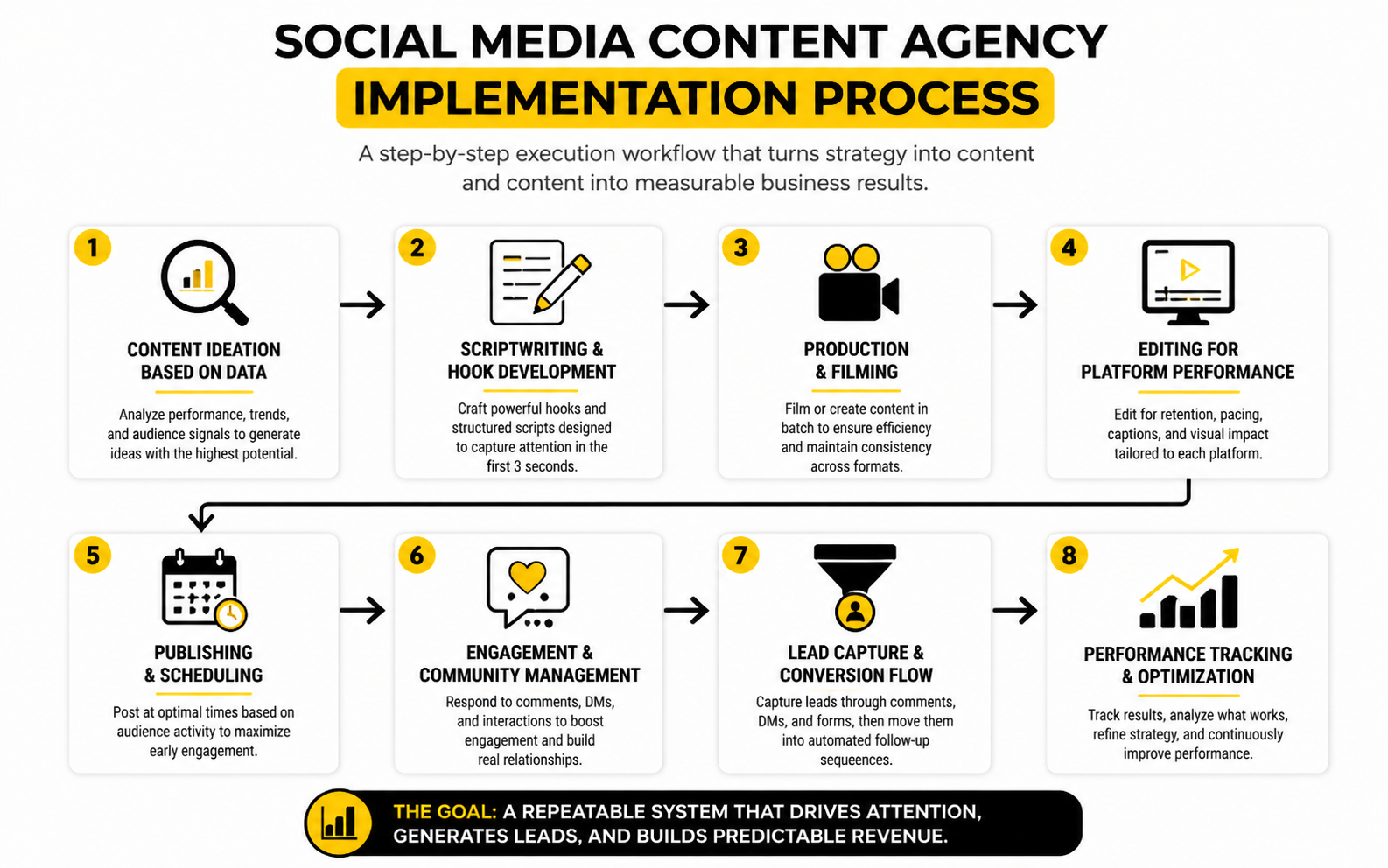
- Content Ideation Based on Data
Ideas don’t come from brainstorming alone. Agencies analyze past performance, trending formats, and audience signals. This reduces guesswork and increases the likelihood that content will resonate before it’s even created.
- Scriptwriting and Hook Development
The first 3 seconds determine whether content lives or dies. Agencies spend disproportionate time crafting hooks because retention drives reach. Strong scripts are structured, concise, and designed for attention, not just information.
- Production and Filming
This is where quality meets efficiency. Whether it’s short-form video, carousels, or static posts, agencies build production workflows that allow batching. Instead of creating one piece at a time, they produce content in volume without sacrificing consistency.
- Editing for Platform Performance
Editing is not cosmetic—it’s strategic. Fast cuts, captions, pacing, and visual cues all influence watch time. Agencies tailor edits to each platform to maximize retention and engagement.
- Publishing and Scheduling
Timing matters more than most brands realize. Posting when your audience is active increases early engagement, which directly impacts algorithmic reach. Tools like Buffer help manage this, but the strategy behind timing is what drives results.
- Engagement and Community Management
Content doesn’t end at posting. Agencies actively respond to comments, messages, and interactions to boost engagement signals. This also creates direct conversations that can convert into leads or customers.
- Lead Capture and Conversion Flow
High-performing agencies connect engagement to backend systems. For example, automated flows through ManyChat allow brands to capture leads directly from comments or DMs without manual effort.
- Performance Tracking and Optimization
Every post feeds data back into the system. Agencies analyze what worked, what didn’t, and why. Over time, this creates a feedback loop that continuously improves results.
The Role of Automation in Scaling Execution
Manual execution doesn’t scale. At some point, volume breaks the system unless automation is introduced.
Modern agencies rely on tools to handle repetitive tasks:
- Scheduling and publishing
- Lead capture and follow-ups
- Email nurturing sequences
- CRM tracking
Platforms like GoHighLevel bring these elements together into one system, allowing agencies to manage both content and conversion without fragmentation.
This matters because speed is now a competitive advantage. The faster you can test, iterate, and scale, the faster you grow.
Content Velocity as a Competitive Edge
There’s a clear pattern across high-growth brands: they produce more content, not less.
This doesn’t mean spamming low-quality posts. It means increasing output while maintaining standards. Agencies achieve this through:
- Batch production days
- Template-based editing systems
- Pre-defined content formats
Some brands publish multiple pieces of content daily across platforms. That level of output would be impossible without a structured agency process behind it.
Quality Control Without Slowing Down
Scaling content often leads to a drop in quality—unless there’s a system in place to prevent it.
Professional agencies implement:
- Review checkpoints before publishing
- Performance benchmarks for approval
- Standardized brand guidelines
This ensures that even at high volume, content remains aligned with brand voice and objectives.
The key insight here is simple but powerful: execution is not about working harder—it’s about building systems that make consistent performance inevitable.
And once that system is in place, growth stops being unpredictable. It becomes engineered.
Understanding the Data That Drives Content Performance
At this point, the difference between content that “looks good” and content that actually grows a business comes down to measurement. A social media content agency doesn’t rely on intuition—it relies on signals.
But here’s the nuance most people miss: metrics don’t matter equally. Some numbers are vanity. Others are leading indicators of revenue. The skill is knowing which is which and how to act on them.
The Metrics That Actually Matter
Not all engagement is valuable. A post with thousands of likes can still generate zero business impact.
High-performing agencies focus on metrics that reflect real performance:
- Watch time and retention
- Engagement rate (comments, shares, saves)
- Click-through rate (CTR)
- Conversion rate (leads or sales generated)
Retention, in particular, has become one of the most critical signals. Platforms prioritize content that keeps users watching. Data shows that videos with higher completion rates are significantly more likely to be pushed to larger audiences (sproutsocial.com).
This changes how content is created. It’s no longer about impressions—it’s about keeping attention.
How to Interpret Performance Signals
Raw numbers don’t tell the full story. Context is everything.
For example:
- High views + low engagement → weak message or irrelevant audience
- High engagement + low clicks → strong content but poor call to action
- High clicks + low conversions → issue in funnel or landing page
This is where agencies bring clarity. They don’t just report metrics—they translate them into decisions.
A drop in retention might lead to:
- Shorter intros
- Stronger hooks
- Faster pacing
A low conversion rate might trigger:
- Funnel optimization via tools like ClickFunnels
- Improved landing page design
- Better offer positioning
The key is connecting every metric to an action.
The Analytics System Behind High Growth
The best agencies don’t track everything—they track what drives decisions. Their analytics systems are designed to simplify complexity, not add to it.
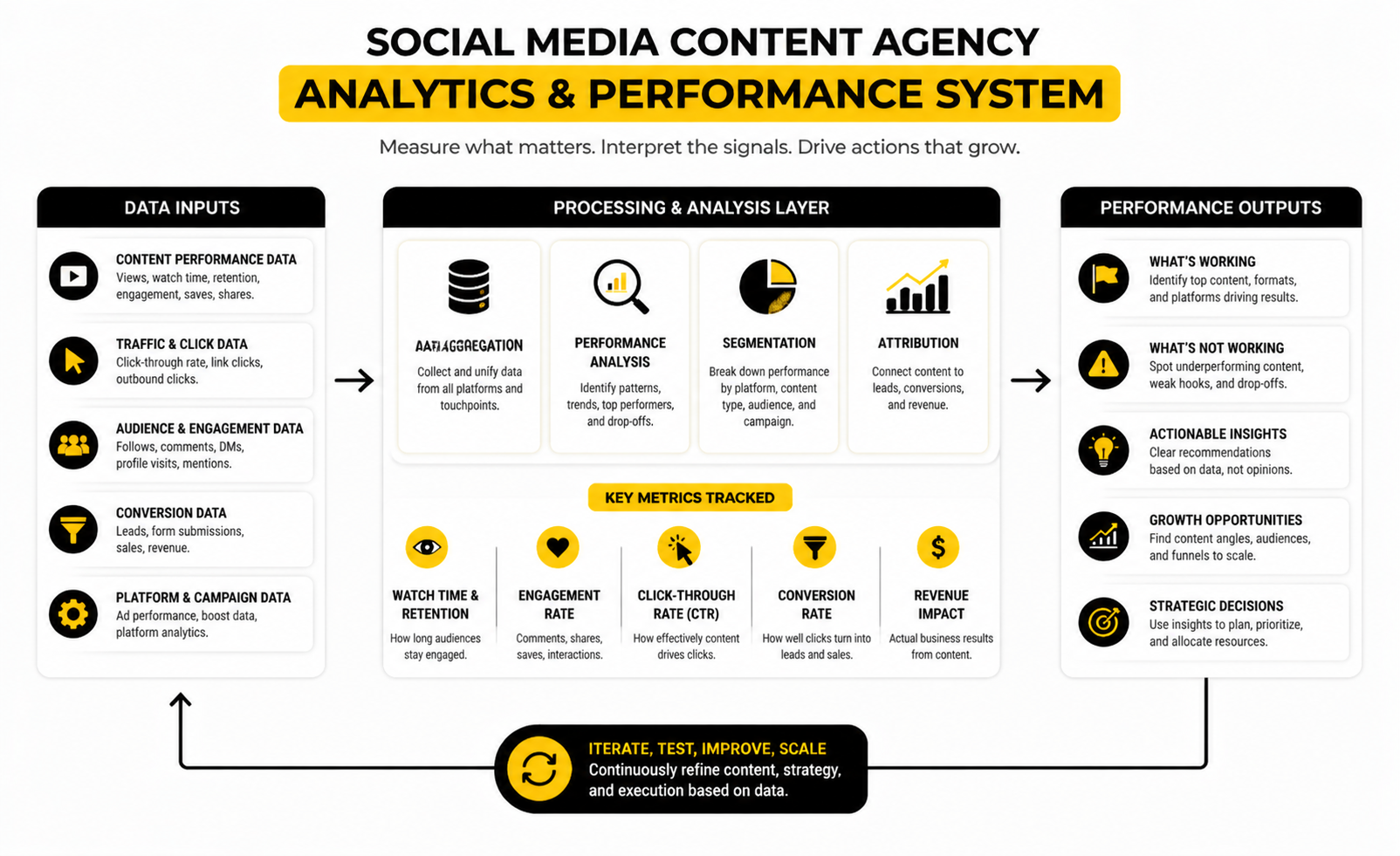
A typical system includes:
- Content-level tracking
Every post is measured individually for performance patterns.
- Format-level analysis
Identifying which content structures consistently outperform others.
- Platform comparison
Understanding where specific content types gain the most traction.
- Conversion attribution
Linking content directly to leads and sales, not just engagement.
Tools like GoHighLevel allow agencies to connect social activity with CRM data, making it possible to see exactly which content drives revenue.
Without this connection, you’re flying blind.
Benchmarks That Actually Mean Something
Benchmarks can be misleading if taken out of context. A “good” engagement rate varies wildly depending on the platform, niche, and audience size.
That said, there are directional indicators worth paying attention to:
- Engagement rates above 1–5% are generally strong across most platforms
- Short-form video retention above 30–40% signals healthy performance
- Click-through rates above 1–3% often indicate effective messaging
What matters more than hitting a benchmark is trend direction. If your numbers are improving over time, the system is working. If they stagnate, something needs to change.
Turning Data Into a Competitive Advantage
Most brands collect data but don’t use it effectively. They look at dashboards, feel overwhelmed, and move on.
A social media content agency turns data into leverage by:
- Identifying repeatable wins
- Eliminating underperforming formats quickly
- Scaling what works across platforms
Over time, this creates a compounding effect. Content becomes more precise. Audience targeting improves. Conversion rates increase.
And this is where the gap widens. Brands that ignore data stay inconsistent. Brands that use it strategically build predictable growth systems.
That’s the difference between guessing and knowing.
Choosing the Right Social Media Content Agency
At this stage, the difference between growth and stagnation often comes down to one decision: who you trust to execute the system.
Not all agencies are built the same. Some focus on aesthetics. Others focus on posting volume. Very few understand how to connect content, distribution, and conversion into one cohesive engine.
The right social media content agency doesn’t just create content—it builds infrastructure.
What Separates Top Agencies From Average Ones
The gap is rarely visible at the beginning. Most agencies can produce decent-looking content. The difference shows up in results over time.
High-level agencies consistently:
- Tie content directly to business outcomes
- Build repeatable systems instead of relying on creative bursts
- Integrate content with CRM, funnels, and automation
- Iterate based on data, not opinions
Lower-tier providers usually fall into predictable patterns:
- Posting without a clear goal
- Prioritizing visuals over performance
- Ignoring conversion tracking
- Delivering inconsistent output
This is why many brands feel like “social media isn’t working” when in reality, the system behind it is broken.
Key Questions to Ask Before Hiring
If you want to avoid expensive mistakes, you need to go deeper than surface-level promises.
Ask questions that reveal how the agency actually operates:
- How do you connect content to revenue, not just engagement?
- What does your content testing process look like?
- How do you decide which formats to scale or kill?
- What tools do you use for tracking and automation?
- Can you show performance trends, not just isolated wins?
You’re not looking for perfect answers. You’re looking for structured thinking.
The Tradeoff Between Cost and Capability
There’s a reason pricing varies so much across agencies.
Lower-cost options often rely on:
- Generic templates
- Minimal customization
- Limited strategic input
Higher-end agencies invest in:
- Dedicated strategists
- Data analysis systems
- Conversion infrastructure
- Continuous optimization
This doesn’t mean expensive always equals better. But it does mean you should understand what you’re paying for.
A cheap agency that produces content no one sees or acts on is far more expensive than a premium one that drives measurable growth.
In-House vs Agency: The Real Decision
Many brands debate whether to build internally or outsource. The reality is more nuanced.
In-house teams offer:
- Full control
- Deep brand understanding
- Faster internal communication
Agencies bring:
- Specialized expertise
- Proven systems
- Scalability without hiring overhead
The most effective setups often combine both. Internal teams handle brand direction, while the agency executes at scale.
Scaling Challenges Most Brands Don’t Anticipate
Growth introduces new problems. What works at a small scale often breaks under pressure.
Common scaling issues include:
- Content fatigue and declining performance
- Inconsistent messaging across platforms
- Operational bottlenecks in production
- Difficulty maintaining quality at higher volume
A strong social media content agency anticipates these challenges early. They build systems designed to scale, not just to perform temporarily.
The Hidden Risk of Platform Dependency
One of the biggest strategic risks is relying too heavily on a single platform.
Algorithms change. Reach fluctuates. Entire strategies can collapse overnight.
Smart agencies mitigate this by:
- Diversifying content across platforms
- Building owned audiences (email lists, CRM databases)
- Creating content ecosystems instead of single-channel strategies
Tools like Brevo help turn social traffic into owned contacts, reducing reliance on unpredictable algorithms.
Long-Term Thinking vs Short-Term Wins
Viral content is seductive. It creates spikes in attention and feels like success.
But sustainable growth comes from consistency, not occasional breakthroughs.
The best agencies balance:
- Short-term performance (high-impact posts)
- Long-term positioning (brand authority and trust)
This is where patience becomes a competitive advantage. Brands that stay consistent while refining their system outperform those chasing quick wins.
And ultimately, that’s what this entire process leads to—a system that doesn’t rely on luck, but on structure, data, and execution.
Scaling Content Into a Predictable Growth Ecosystem
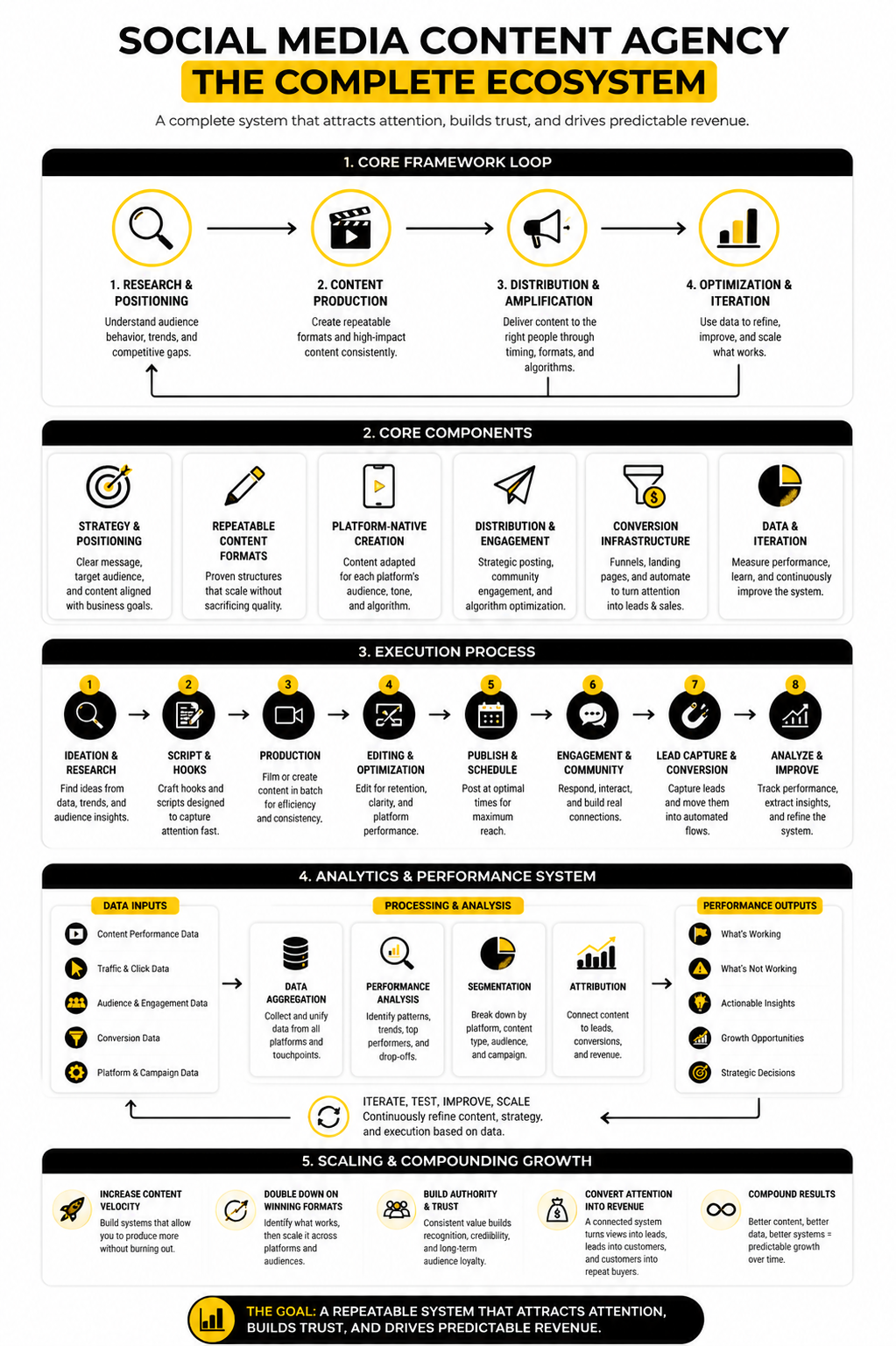
At the highest level, a social media content agency is not just producing content—it’s building an ecosystem. Every piece connects: content attracts attention, systems capture it, and infrastructure converts it into measurable business outcomes.
This is where everything compounds.
Instead of thinking in isolated posts, agencies design full loops:
- Content → engagement → lead capture → nurture → conversion
- Data → insight → iteration → improved performance → scale
The brands that win long-term are the ones that treat content as a system, not a tactic.
Building an Ecosystem That Compounds
A strong ecosystem has multiple layers working together:
- Top layer (attention): social content across platforms
- Middle layer (capture): landing pages, forms, chat automation
- Bottom layer (conversion): email sequences, offers, follow-ups
This structure ensures that every piece of content has a purpose beyond visibility.
For example, combining tools like ManyChat for engagement capture and GoHighLevel for CRM and automation allows agencies to connect social media directly to revenue systems.
That’s the difference between content that performs and content that builds a business.
The Shift From Campaigns to Systems
Traditional marketing focused on campaigns—launch, push, pause, repeat. Social media doesn’t work that way anymore.
Today, growth comes from continuous systems:
- Always-on content pipelines
- Ongoing optimization loops
- Constant testing and iteration
This shift changes how you measure success. Instead of asking “Did this campaign work?”, you ask “Is the system improving over time?”
That mindset is what creates predictable growth.
FAQ - Built for Complete Guide
What does a social media content agency actually do?
A social media content agency builds and manages the entire content system—from strategy and creation to distribution and conversion. The goal is not just engagement, but measurable business growth through content.
How is a social media content agency different from a social media manager?
A social media manager typically focuses on posting and engagement. An agency builds a full system that includes strategy, production, analytics, and conversion infrastructure.
How long does it take to see results?
Early signals like engagement and reach can improve within weeks. Meaningful business results—like consistent lead generation—usually take 2–3 months of structured execution and iteration.
What platforms should a business focus on?
It depends on the audience and content type. Most agencies prioritize platforms like Instagram, TikTok, LinkedIn, and YouTube Shorts because of their discovery potential and algorithmic reach.
How much content is enough?
Consistency matters more than volume, but high-performing brands often post daily or multiple times per day. The key is maintaining quality while increasing output through systems.
Can small businesses benefit from a social media content agency?
Yes, especially when internal resources are limited. Agencies provide expertise and scalability that small teams often cannot build on their own.
What is the biggest mistake brands make with social media?
The most common mistake is treating content as isolated posts instead of part of a larger system. Without strategy and conversion infrastructure, even strong content underperforms.
How do agencies measure success?
They track metrics like retention, engagement, click-through rates, and conversions. More importantly, they connect these metrics to business outcomes, not just visibility.
Do you need paid ads alongside organic content?
Not always, but combining organic content with paid amplification can accelerate results. Organic builds trust, while paid increases reach and speed.
What tools are essential for a social media content system?
Key tools include scheduling platforms, analytics dashboards, CRM systems, and funnel builders. Platforms like Systeme.io are often used to connect content with lead generation and sales.
Is it better to outsource or build in-house?
It depends on resources and goals. Many brands use a hybrid approach—internal teams for brand direction and agencies for execution and scaling.
How do you know if your current content strategy is failing?
Signs include inconsistent performance, low engagement relative to reach, poor conversion rates, and lack of growth over time. These usually point to a broken system, not just weak content.
Work With Professionals
Explore 10K+ Remote Marketing Contracts on MarkeWork.com
Most marketers spend too much time chasing clients, competing on crowded platforms, and losing a percentage of every project to middlemen.
MarkeWork gives you a better way. Browse thousands of remote marketing contracts and connect directly with companies desperate to hire skilled marketers like you, without platform commissions and without unnecessary gatekeepers.
If you're serious about finding better opportunities and keeping 100% of what you earn, explore available contracts and create a profile for free at MarkeWork.com.