

Most brands do not have a social media problem. They have a clarity problem. Social is now too important, too crowded, and too algorithmic to treat as a stream of isolated posts. With 5.24 billion active social media identities worldwide, the typical internet user spending 2 hours and 21 minutes a day on social platforms, and brand discovery happening across 5.8 different sources, content needs a system, not a vibe.
That shift matters because social media is no longer just top-of-funnel noise. 61% of consumers discovered a new brand or product on social media in the past 12 months, while half of adult users visit social platforms specifically to learn more about brands and the content they publish. At the same time, people spread their attention across 6.83 platforms per month, which means the winning move is not posting everywhere. It is saying the right thing, in the right format, on the right platform, with enough consistency to compound.

Why Social Media Content Strategy Matters
A real social media content strategy does three jobs at once. It gives your team a clear point of view, turns platform behavior into repeatable editorial decisions, and makes measurement possible before the budget disappears into vanity metrics. That is the difference between posting because the calendar is empty and publishing with a reason.
The platforms themselves are pushing brands in that direction. Instagram’s 2025 creator guidance puts a premium on original content that can travel beyond your followers, YouTube’s creator advice centers growth on making videos viewers genuinely want to watch, and TikTok’s 2025 trend report is built around relevance, participation, and cultural resonance rather than one-way brand broadcasting. In plain English, follower count still helps, but distribution increasingly belongs to content that fits audience intent.
This is also why strategy has to connect to business outcomes, not just reach. Deloitte’s 2025 social research found that customer reviews on social make people more likely to buy, and Wyzowl’s latest video marketing data shows consumers still prefer short video when they want to learn about a product or service. Meanwhile, Content Marketing Institute’s 2025 benchmarks show marketers continuing to shift investment toward video, thought leadership, and performance-oriented optimization, which is exactly where serious teams expect returns to keep moving.
How This Six-Part Guide Is Structured
This article is built as one continuous six-part guide, and the section names below are the exact sections the rest of the article will follow. I am not going to pretend social media content strategy is one template you can copy from a generic blog post, because it changes with audience behavior, business model, and platform mechanics. What does stay stable is the operating logic: know who you want to influence, define what you want to be known for, turn that into repeatable content pillars, and run the whole thing with a workflow your team can actually sustain.
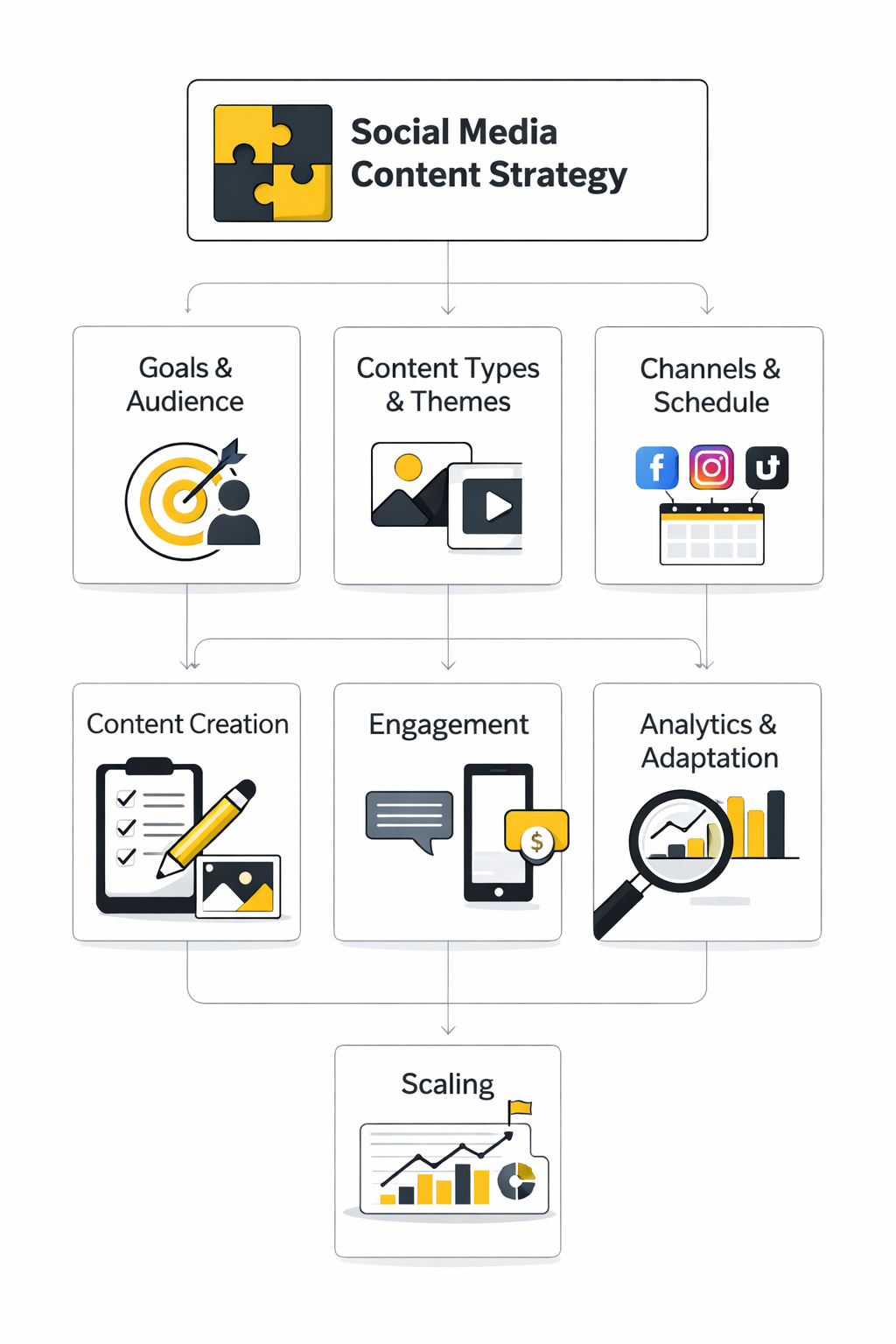
- Why Social Media Content Strategy Matters
- The Framework Behind High-Performing Social Content
- Audience, Positioning, and Content Pillars
- Formats, Channels, and Distribution Decisions
- Professional Implementation and Workflow
- Measurement, Optimization, and Frequently Asked Questions
The sequence matters. Before you touch a content calendar, you need a framework. Before you choose formats, you need positioning. Before you buy more software, you need a publishing system that can survive real life, whether you run it with Buffer for scheduling, Manychat for DM automation, or HighLevel when your social media content strategy also needs to feed leads into a real pipeline. The next part starts with the framework itself, because that is where strategy stops sounding smart and starts becoming usable.
The Framework Behind High-Performing Social Content
Now let’s make this usable. A strong social media content strategy is not built by choosing platforms first or by filling a calendar with whatever feels timely that week. The better approach is to decide what your content must accomplish, then build channels, formats, and workflows around that job. Recent research keeps landing on the same basic idea: mature teams treat social as a system built around community, content, and conversion, while weaker teams still burn time on outdated tactics that do not match what audiences actually want. Deloitte’s 2025 State of Social research and Sprout’s 2025 Index research point in the same direction here, and that matters more than any one platform trick. Deloitte+2
A practical framework for high-performing social content has four moving parts. First, you gather audience signals instead of guessing what people care about. Second, you choose a position the brand can own instead of sounding like every other account in the niche. Third, you turn that position into a small set of repeatable content pillars. Fourth, you connect those pillars to a real action, whether that is a follow, a lead, a demo request, a sale, or a deeper conversation in DMs. That framework is not copied from one official playbook; it is the clearest synthesis of what current platform guidance and recent industry research reward in practice. Deloitte+4
Audience Signals Come Before Content Ideas
Most teams brainstorm too early. They sit down to think of posts before they have done the harder work of listening, which is why the output often sounds polished but irrelevant. Hootsuite’s Social Trends 2025 report shows that teams using social listening are more confident in ROI across platforms, and YouTube’s own analytics guidance explicitly tells creators to study what their audience watches, what formats they prefer, and when recurring patterns appear. South African CX report+1
In practice, that means your strategy should begin with evidence from comments, replies, search behavior, customer calls, support tickets, sales objections, and creator-side analytics. Emplifi’s 2025 consumer-brand survey found that consumers want brands to be genuine, responsive, and actively engaged, which is another way of saying they want content that reflects real understanding, not scheduled noise. When you build from those signals, your content gets sharper because it starts answering questions people already have instead of hoping they care after the fact. Emplifi
This is also the point where a lot of strategy suddenly gets simpler. You stop asking, “What should we post on Thursday?” and start asking, “What does our audience keep trying to solve, validate, avoid, or compare?” A planning tool like Flick can help you organize those repeating audience themes into usable buckets, but the important part is not the tool. The important part is that your social media content strategy starts from recurring demand, not from random inspiration.
Positioning Has to Be Obvious in the Feed
Once you know what the audience cares about, the next job is deciding how your brand will be recognized. This is where many content plans fall apart, because they confuse consistency with sameness. Real positioning is not using the same colors on every post. It is creating a repeatable point of view, so the audience can tell what your brand stands for even when the logo is not visible. TikTok’s 2025 trend report makes this brutally clear: users find brands more relevant when they show personality and feel understood, not when they imitate culture from a safe distance. newsroom.tiktok.com
That is also why trend-chasing is such a weak substitute for strategy. Sprout’s 2025 Index release highlighted that a third of consumers think brands jumping on viral trends is embarrassing, which is a useful reminder that visibility without fit can do more harm than good. Your job is not to prove you saw the meme. Your job is to make the audience feel that your brand has a clear role in their world. investors.sproutsocial.com
Platforms are reinforcing that standard from the distribution side too. Meta’s March 2026 update on original content says Facebook is giving greater reach to original creators while reducing the reach of unoriginal content, and YouTube’s recommendation system documentation says the platform is trying to match viewers with content they want to watch while maximizing long-term satisfaction. Different platform, same message: copied formats can help you learn, but distinctive value is what compounds. Facebook+1
Audience, Positioning, and Content Pillars
Once the framework is clear, you need to turn it into a working editorial structure. This is where audience definition, brand positioning, and content pillars stop being buzzwords and start becoming operational decisions. If these three pieces are vague, your team will keep defaulting to disconnected posts, random experiments, and content that might perform once but cannot be repeated with confidence. Deloitte+1
Define the Audience by Tension, Not Just Demographics
Demographics still matter, but they are a weak starting point on their own. Age, location, and job title rarely explain why somebody stops scrolling, saves a post, shares it with a colleague, or finally clicks through. YouTube’s audience-planning guidance pushes creators to study what viewers actually watch and which formats they respond to, while Emplifi’s 2025 survey emphasizes that people judge brands through interactions, responsiveness, and value. That is why the better way to define an audience is by tension: what they are trying to achieve, what is slowing them down, what they are skeptical of, and what proof they need before moving. Google Podpora+1
A useful audience profile usually answers four questions. What outcome does this person want right now. What confusion, risk, or friction is in the way. What content format helps them trust the answer faster. What next action would feel natural rather than pushy. When your social media content strategy can answer those four questions clearly, the content gets easier to plan and much easier to measure.
Turn Positioning Into a Repeatable Point of View
Positioning on social should create recognition and trust at the same time. For B2B teams especially, LinkedIn’s 2025 B2B Marketing Benchmark argues that trust comes through connection, social proof, and peer validation more than through simple exposure, and the 2025 Edelman x LinkedIn thought leadership report says thought leadership is a strategic tool for building trust and opening doors across the buying group. That means your content should not merely inform. It should make your audience think, “These people see the category the way I want to see it.” business.linkedin.com+1
A repeatable point of view usually sounds like this in practice: what you believe, what you reject, what you can prove, and what kind of transformation you help create. That gives your team a filter for saying yes or no to ideas before production starts. It also protects you from drifting into generic “helpfDeloitte+1
Bringing the Social Media Content Strategy Ecosystem Together
The strongest version of a social media content strategy is not a posting calendar. It is a connected system with six moving parts: audience insight, positioning, content pillars, format and channel choices, a reliable production workflow, and a measurement loop that tells you what to improve next. That matters even more now because the average connected user moves across about 6.75 social platforms a month, while major platforms keep rewarding relevance, originality, retention, and viewer satisfaction rather than simple follower distribution. DataReportal – Global Digital Insights+3
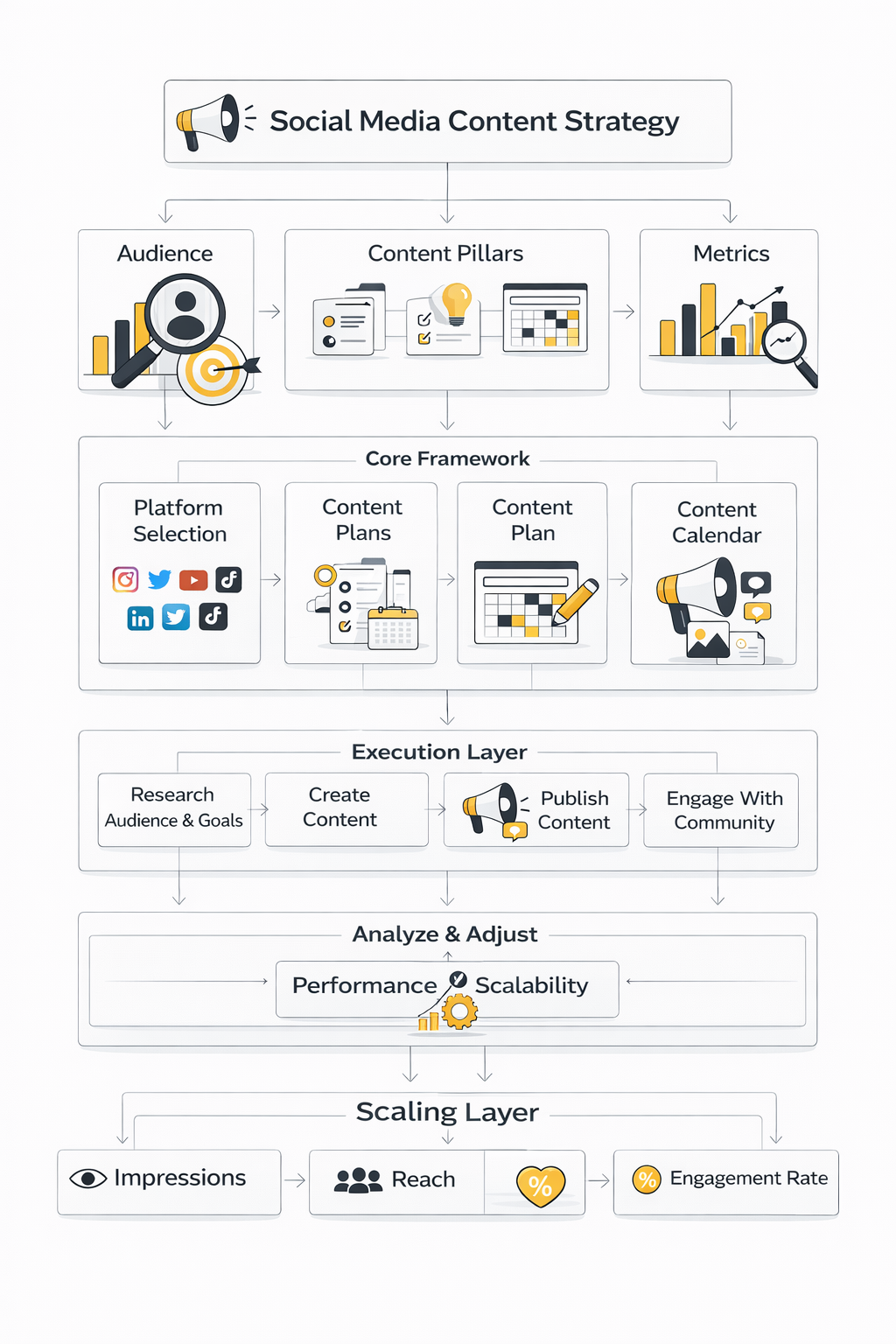
When that ecosystem is working, no single post has to do everything on its own. One asset earns reach, the comment section reveals objections, replies and DMs surface intent, the next asset answers what people are still unsure about, and the conversion layer captures action without making the audience work too hard. Tools can absolutely help clean up those handoffs, whether that means scheduling in Buffer, turning comment intent into conversations with Manychat, or routing leads into HighLevel, but the real advantage still comes from the system logic behind them. business.linkedin.com+1
Frequently Asked Questions About Social Media Content Strategy
How often should I post on social media?
Use frequency benchmarks as a starting point, not a commandment. Recent Hootsuite benchmark data found that two posts a week often delivered the highest engagement on Facebook, Instagram, LinkedIn, and X, while TikTok rewarded much heavier posting, and Sprout’s 2025 frequency guide makes the same point in a different way: the right cadence depends on your industry, audience, and resources. The real goal is to find the highest quality cadence your team can sustain without sacrificing responsiveness, originality, or follow-through. Sociální Média Dashboard+1
Do I need to be on every platform?
No, and trying to be everywhere usually weakens the work. People spread their attention across many platforms, but that is exactly why brands need clearer channel roles instead of copy-pasting the same asset everywhere; the average user now visits roughly 6.75 platforms per month, and platforms like YouTube are explicitly matching content to what each viewer is most likely to watch and enjoy. A better social media content strategy picks fewer channels, gives each one a job, and makes the packaging feel native instead of duplicated. DataReportal – Global Digital Insights+1
What matters more now: follower count or content performance?
Follower count still matters, but it is no longer the cleanest signal of momentum. Instagram’s 2025 creator guidance highlights watch time, retention, shares, likes, and comments as ranking signals, while YouTube’s recommendation documentation and its CTR and average view duration guidance make it clear that click-through without viewer satisfaction does not carry you very far. That is why smart teams treat followers as context and treat retention, saves, shares, repeat viewing, and conversion behavior as the stronger performance signals. creators.instagram.com+2
How long should I give a strategy before judging it?
Judge it in stages, not all at once. LinkedIn’s latest growth guide recommends separating leading indicators such as clicks, CTR, and engagement rate from lagging outcomes such as qualified leads and revenue won, because commercial results often take longer than attention signals to show up. In practice, the first question is whether the content is earning reach and response from the right people; only after that should you expect the downstream numbers to become a fair verdict on the strategy. business.linkedin.com+1
Should every brand go video-first?
Video deserves a central role in many strategies, but “video-first” is too blunt to be useful on its own. Instagram benchmark data from Dash Social and Rival IQ’s 2025 industry report both found carousels outperforming Reels in engagement on Instagram, even while short-form video remained powerful for reach and discovery. The better rule is format-to-job fit: use short video for fast discovery and emotional pull, and use carousels, text-led posts, screenshots, clips, or longer videos when the audience needs explanation, proof, or nuance. dashsocial.com+2
Which metrics should I watch first every week?
Start with the chain, not the dashboard. The first layer is distribution metrics like reach, impressions, and views; the second is consumption metrics like watch time, average view duration, retention, and saves; the third is intent metrics like shares, comments, profile visits, DM starts, and link clicks; the fourth is outcome metrics like leads, booked calls, pipeline, and revenue. That logic matches both LinkedIn’s current measurement guidance and YouTube Analytics, which separate reach, engagement, audience, and outcomes so teams can diagnose the actual bottleneck instead of reacting to one noisy number. business.linkedin.com+2
Can AI help without making the brand sound generic?
Yes, but only if it speeds up the backend of the work instead of replacing judgment. CreatorIQ’s 2025–2026 research says nearly all marketers are already using AI, while YouTube’s inauthentic content policy and Meta’s originality push on Facebook show the platforms are becoming less tolerant of repetitive, mass-produced content. So use AI for research compression, draft variants, transcript cleanup, reporting, or idea organization, and let human editorial standards control the final voice; tools such as Guideless AI can support that workflow, but the distinctive point of view still has to come from the brand. creatoriq.com+2
How do I repurpose content without getting punished for repetition?
Repurposing is not the problem. Lazy duplication is. Meta says Facebook is lowering reach for unoriginal or low-value reposting, and YouTube says repetitive or mass-produced content falls under its inauthentic content rules, so the right move is to translate an idea into platform-native versions rather than cloning the same asset everywhere. That usually means changing the hook, the edit, the pacing, the CTA, and sometimes the angle itself while keeping the underlying insight consistent. Google Podpora+1
Should organic and paid social work together?
Yes, but paid should usually amplify proof instead of compensating for weak thinking. Organic content shows you which messages earn attention, hold attention, and trigger intent, while paid distribution can extend that learning, retarget engaged viewers, and move proven messages closer to revenue. The strongest social media content strategy treats organic as message discovery and trust-building, then uses paid selectively where the economics and the conversion path are already clear. business.linkedin.com+1
When is it smart to add creators, founders, or employee voices into the strategy?
Add them when the market needs more trust, more specificity, or more human proof than the brand account can create by itself. CreatorIQ’s current report says boosted creator posts and branded creator content are among the highest-ROI tactics for many organizations, which helps explain why creator collaboration keeps moving deeper into the core strategy. Just keep the governance tight, because the FTC’s endorsement guidance still applies, and undisclosed or misleading endorsements create problems much faster than they create trust. creatoriq.com+1
What tells me the system is ready to scale?
Scale when the pattern is repeatable, not when one post got lucky. If a specific pillar, format, and channel role are repeatedly producing strong leading indicators and a clear path to downstream business results, and your workflow can publish, respond, and measure without chaos, then scaling makes sense. That logic matches the way LinkedIn separates on-track leading signals from long-term revenue metrics, and it also fits the operational reality in CreatorIQ’s 2025–2026 report, where growing organizations are already managing more platforms, more creators, and more coordination pressure. business.linkedin.com+1
Work With Professionals
Explore 10K+ Remote Marketing Contracts on MarkeWork.com
Most marketers spend too much time chasing clients, competing on crowded platforms, and losing a percentage of every project to middlemen.
MarkeWork gives you a better way. Browse thousands of remote marketing contracts and connect directly with companies looking to hire skilled marketers, without platform commissions and without unnecessary gatekeepers. Markework+1
If you are serious about finding better opportunities and keeping 100% of what you earn, explore available contracts and create a profile for free at MarkeWork.com.