

A social media expert is not someone who simply posts often, follows trends, or knows how to use every platform. The real job is to understand attention, trust, content, distribution, audience behavior, analytics, and business outcomes well enough to turn social media into a repeatable growth channel.
That matters because social media is no longer a side task. Global social platforms now reach billions of people, and adults use them for communication, entertainment, discovery, news, research, and brand interaction, as shown in DataReportal’s Digital 2025 social media report. Buyers also expect brands to respond, listen, and act like humans, which is why the 2025 Sprout Social Index frames social as a business function, not just a content calendar.
A good social media expert combines creative judgment with operating discipline. They know when to move fast, when to ignore a trend, when to build a campaign, when to improve the funnel, and when the content problem is actually a positioning problem. That is the difference between “doing social” and building a social media system that compounds.

Article Outline
This article is split into six connected parts so the ideas build in the right order. Part 1 sets the foundation, defines the role, and gives you the full structure. The later parts move from strategy to execution, measurement, professional workflows, and long-term career or business leverage.
- What a Social Media Expert Really Does
- Why Social Media Expertise Matters Now
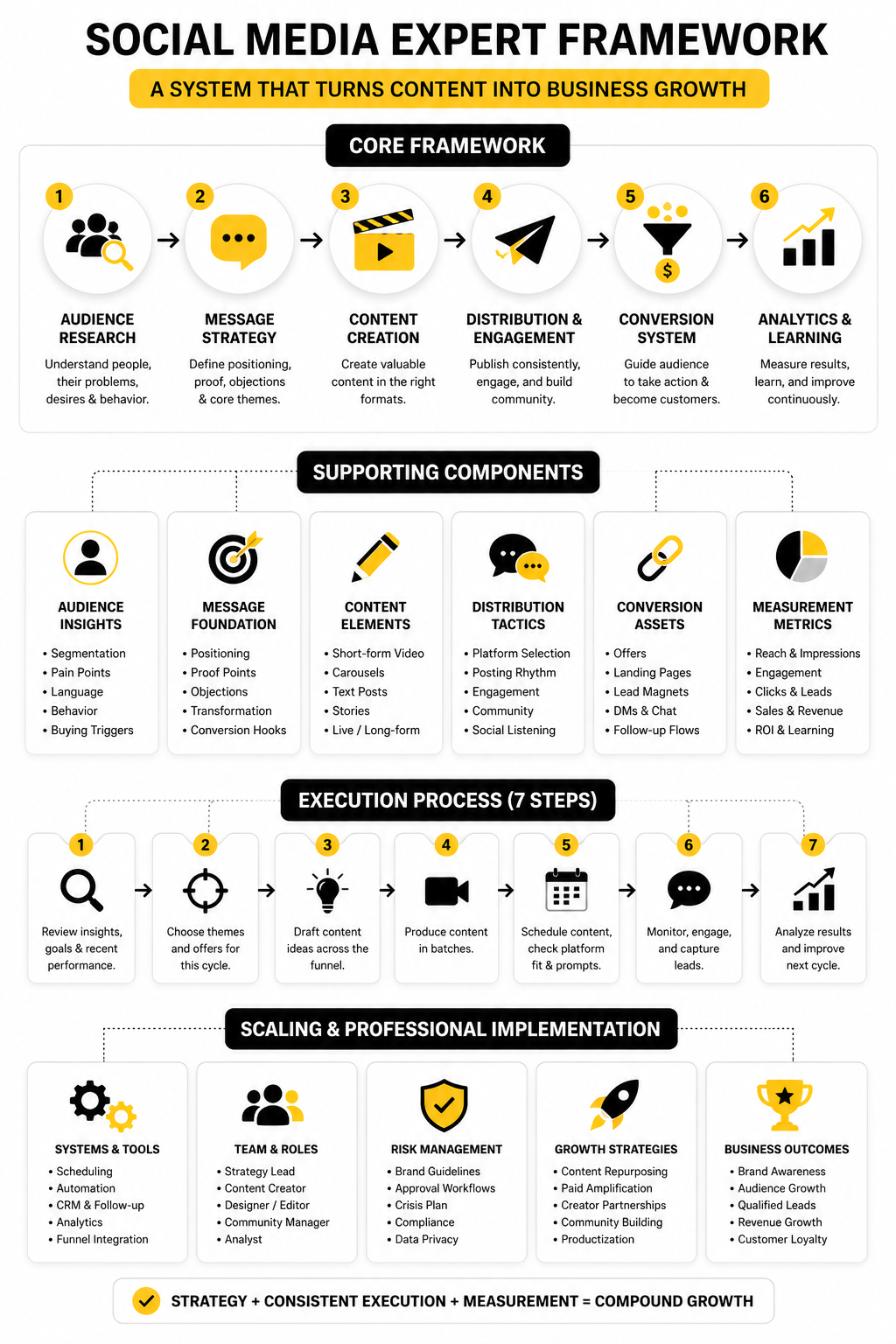
- The Social Media Expert Framework
- Core Skills Every Social Media Expert Needs
- How Professionals Implement Social Media Strategy
- Tools, Systems, Measurement, and Next Steps
What a Social Media Expert Really Does
A social media expert turns attention into business value. That sounds simple, but it involves far more than writing captions or choosing hashtags. The work sits between brand strategy, audience research, content production, distribution, community, analytics, and revenue.
The first job is clarity. A social media expert has to understand who the brand serves, what the audience already believes, what problem the offer solves, and why anyone should care now. Without that, the content becomes random activity instead of a deliberate system.
The second job is judgment. Social platforms move quickly, but not every trend deserves your time. A professional knows the difference between useful momentum and noise, which is critical when global social media use is already massive and fragmented across platforms, behaviors, and age groups, as shown in DataReportal’s Digital 2025 social media overview.
Strategy Comes Before Content
Most weak social media work starts with the wrong question. The question is not “What should we post today?” The better question is “What does this audience need to believe, understand, or feel before they take the next step?”
That shift changes everything. It forces the social media expert to connect content with positioning, offers, objections, proof, and timing. It also prevents the brand from chasing platform hacks while ignoring the actual reason people follow, trust, or buy.
Strong strategy usually defines the audience, content pillars, platform priorities, publishing rhythm, conversion paths, and measurement plan. A tool like Buffer can help organize scheduling and publishing, but the tool cannot replace thinking. The strategy has to come first, then the workflow supports it.
The Role Is Part Creative, Part Analyst
A good social media expert needs creative taste, but taste alone is not enough. They need to understand why one hook earns attention, why another one dies, why a carousel gets saved, why a video gets shared, and why a post with fewer likes may still drive better business results. That requires reading both the content and the data.
This is where amateurs often get stuck. They treat metrics as a scoreboard instead of a feedback loop. A professional looks at reach, retention, saves, comments, click-throughs, leads, and conversions to decide what to improve next.
The point is not to become robotic. The point is to make creativity sharper. When Pew’s 2025 research shows YouTube, Facebook, and Instagram still reaching huge portions of U.S. adults in different ways through its social media fact sheet, the lesson is obvious: platform behavior matters, and strategy has to match how people actually use each channel.
Why Social Media Expertise Matters Now
Social media has become one of the main places where people discover brands, compare options, judge credibility, and decide whether a company feels relevant. That means poor social media execution is no longer just a missed marketing opportunity. It can quietly damage trust before a sales conversation ever happens.
The pressure is higher because audiences are more selective. People are surrounded by content, so they filter quickly. If a brand sounds generic, inconsistent, or disconnected from the audience’s real problems, it gets ignored.
This is why the social media expert role has become more valuable. Businesses do not just need more posts. They need someone who can build a clear presence, earn attention repeatedly, and turn that attention into measurable movement.
Social Media Is Now a Trust Channel
People do not only use social platforms to be entertained. They use them to check whether a brand is active, credible, responsive, and aligned with their values. That means your social presence often acts like a public trust layer around the rest of the business.
The 2025 Sprout Social Index highlights how social has become tied to business impact, customer expectations, and brand memorability. That is a big deal because it moves social media out of the “nice to have” category. It becomes part of how the market evaluates you.
A social media expert protects that trust by making the brand consistent without making it boring. They know when to educate, when to entertain, when to sell, when to respond, and when to stay quiet. That balance is where professionalism shows up.
Discovery Has Shifted Toward Social Behavior
Search still matters, but discovery is no longer limited to search engines. People find products through creators, recommendations, short-form video, comments, communities, and algorithmic feeds. DataReportal’s 2025 analysis of brand discovery shows why social visibility now belongs inside the core marketing strategy.
This does not mean every brand needs to be everywhere. That is usually a mistake. A social media expert chooses platforms based on audience behavior, content fit, resources, and commercial intent.
For example, a local service business may need short-form educational content, reviews, automated follow-up, and a simple lead capture system. In that case, a platform like GoHighLevel may fit naturally behind the social content because it helps connect attention with CRM, messaging, and pipeline follow-up. The real win is not posting more; it is closing the gap between attention and action.
The Social Media Expert Framework
A social media expert needs a framework because random posting creates random results. The framework does not have to be complicated, but it does need to be clear enough that every post, campaign, reply, and report connects back to the same business direction. Without that structure, social media becomes a busy calendar instead of a growth system.
The simplest way to think about the framework is audience, message, content, distribution, conversion, and learning. Each part supports the next. If one part is weak, the whole system gets harder to scale.
This is also why professional social media work feels calmer than amateur social media work. The expert is not guessing every morning. They are using a process that turns research into content, content into engagement, engagement into action, and action into better decisions.
Start With Audience Research
Audience research is the first real step because content only works when it reflects what people already care about. A social media expert studies the audience’s problems, questions, objections, desires, language, buying triggers, and platform habits. This keeps the brand from sounding like it is talking at people instead of with them.
The research should include direct customer conversations, comment analysis, competitor reviews, community observation, search behavior, and platform analytics. Social listening matters because audiences often reveal better content ideas in comments, complaints, and repeated questions than they do in formal surveys. The 2025 Sprout Social Index reinforces this shift by showing how social has become a place where brands understand customers, not just broadcast to them.
The practical output should be simple. You want a short list of audience segments, core pain points, belief gaps, common phrases, and content angles. If the research does not make writing easier, it is probably too vague.
Build the Message Before the Calendar
Once the audience is clear, the next step is message strategy. This is where a social media expert defines what the brand needs to be known for and what the audience needs to believe before they take action. It is not enough to post tips; the content has to move people toward a stronger understanding of the brand’s point of view.
A useful message strategy includes positioning, proof points, objections, transformation themes, and conversion moments. For example, a brand may need to show that its product saves time, reduces risk, improves status, or helps the buyer avoid a costly mistake. The content calendar should then express those ideas in different formats, not invent a new direction every week.
This is where many brands go wrong. They create a calendar full of disconnected posts because they treat planning as filling slots. A real social media expert treats the calendar as a delivery system for the message.
Turn Strategy Into a Repeatable Execution Process
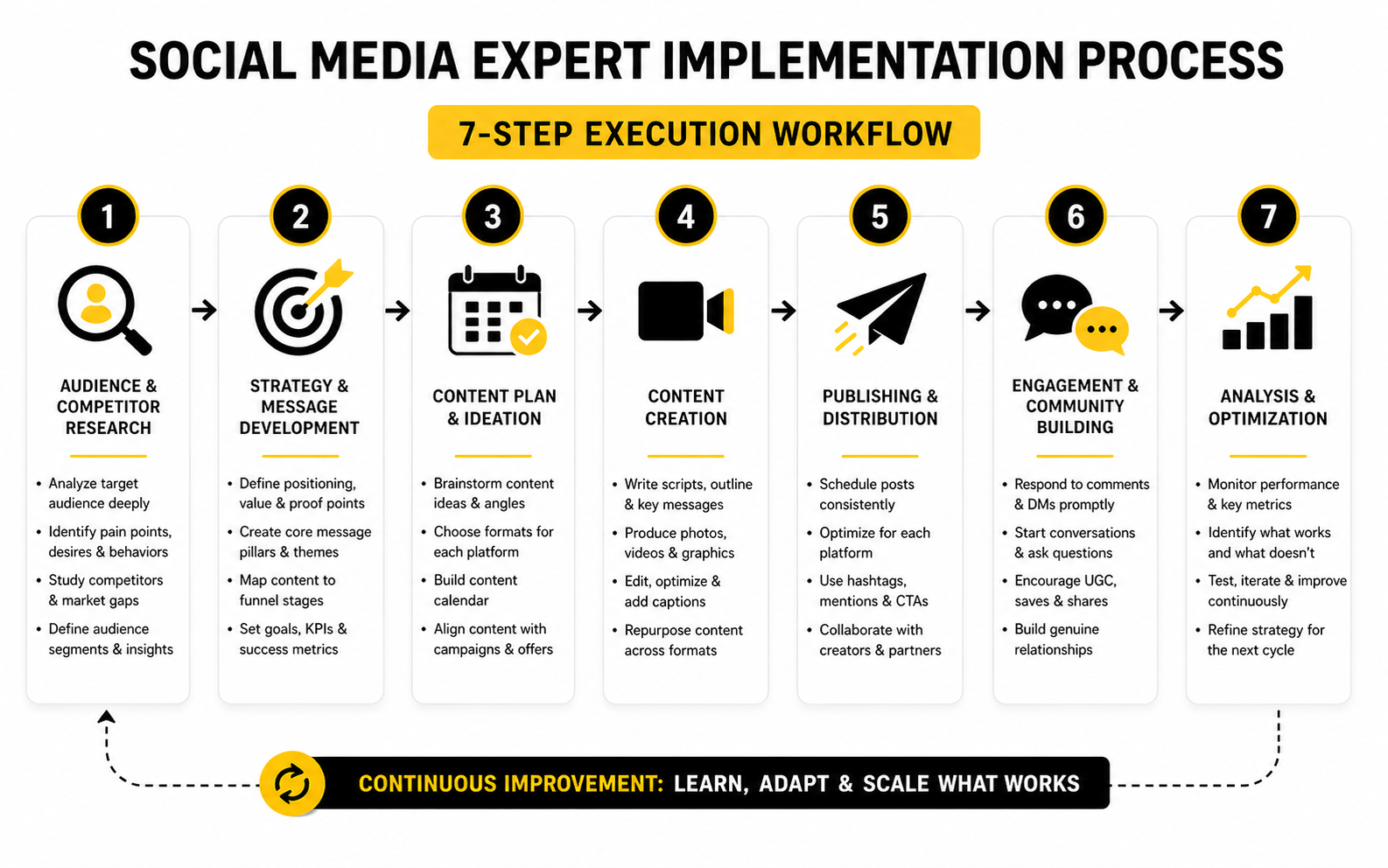
Execution becomes easier when the process is visible. A professional workflow usually moves from research to planning, production, publishing, engagement, measurement, and refinement. That sequence helps the team avoid chaos because everyone can see what happens next.
A practical process can look like this:
- Review audience insights, campaign goals, and recent performance.
- Choose the themes and offers that matter this cycle.
- Draft content ideas across awareness, trust, education, and conversion.
- Produce the assets in batches so publishing does not depend on daily inspiration.
- Schedule content, check platform fit, and prepare engagement prompts.
- Monitor comments, direct messages, saves, shares, clicks, and conversions.
- Use the results to improve the next cycle.
This is where tools can help, but only after the workflow is clear. A scheduling platform like Buffer can support publishing discipline, while a system like ManyChat can help turn social interactions into automated conversations when the campaign genuinely needs that next step.
Match Content Formats to the Job
Different content formats do different jobs. Short-form video can earn fast reach and personality. Carousels can teach, simplify, and create saves. Text posts can sharpen positioning. Lives, webinars, and long-form video can build trust when the decision is more complex.
A social media expert chooses the format based on the audience and the goal, not because a platform is currently pushing a trend. DataReportal’s Digital 2025 brand discovery analysis shows how discovery behavior varies across channels and age groups, which is exactly why one-size-fits-all content planning is weak. The same message may need to become a Reel, a LinkedIn post, a story sequence, and a landing page depending on the buyer journey.
The smart move is to build from core ideas, then adapt. One strong insight can become multiple useful assets without feeling repetitive. That is how professionals create leverage without watering down the message.
Connect Social Activity to the Next Step
Social media should not end at engagement. Likes and comments are useful signals, but they are not the full outcome. A social media expert thinks about the next step before the post goes live.
That next step might be a direct message, email signup, booked call, product page, community invite, quiz, webinar, or lead magnet. If the social content creates interest but the path forward is confusing, the campaign leaks value. This is why social strategy and funnel strategy need to work together.
For service businesses, creators, and agencies, a simple funnel builder such as ClickFunnels or an all-in-one follow-up platform like GoHighLevel can make sense when there is a clear offer behind the content. The tool is not the strategy. It is the infrastructure that helps the strategy turn attention into measurable action.
Statistics and Data
Measurement is where a social media expert proves the work is more than activity. The goal is not to collect every number a platform gives you. The goal is to understand which numbers explain attention, trust, intent, and revenue movement.
This matters because social media performance is easy to misunderstand. A post can get high reach and still attract the wrong people. Another post can get fewer likes but generate better comments, stronger saves, more qualified clicks, or direct conversations that actually move the business forward.
The best measurement systems separate surface signals from business signals. Surface signals show whether the content is being noticed. Business signals show whether the attention is becoming useful.
The Metrics That Actually Deserve Attention
A social media expert should track metrics in layers instead of treating all numbers equally. Reach, impressions, watch time, retention, engagement rate, saves, shares, profile visits, clicks, leads, booked calls, purchases, and customer conversations all tell different parts of the story. The mistake is expecting one number to explain everything.
Reach tells you whether the platform distributed the content. Retention tells you whether the creative held attention. Saves and shares often show usefulness or identity value. Clicks, replies, signups, and sales show whether the content created enough intent to make someone act.
This is why engagement rate alone can be misleading. Rival IQ’s 2025 Social Media Industry Benchmark Report shows that engagement varies heavily by platform and industry, so a “good” number depends on context. A social media expert uses benchmarks as a reference point, not as a final verdict.
Build a Simple Analytics System
The analytics system should be simple enough to use every week. If reporting becomes a giant spreadsheet nobody reads, it fails. The real job is to make performance visible, understandable, and actionable.
A practical system can track four layers:
- Audience growth: followers, subscriber growth, profile visits, audience quality, and returning viewers.
- Content performance: reach, impressions, retention, engagement rate, saves, shares, and comments.
- Traffic and lead signals: link clicks, landing page visits, direct messages, form submissions, email signups, and booked calls.
- Business outcomes: revenue, pipeline value, customer acquisition cost, repeat purchases, and retention impact.
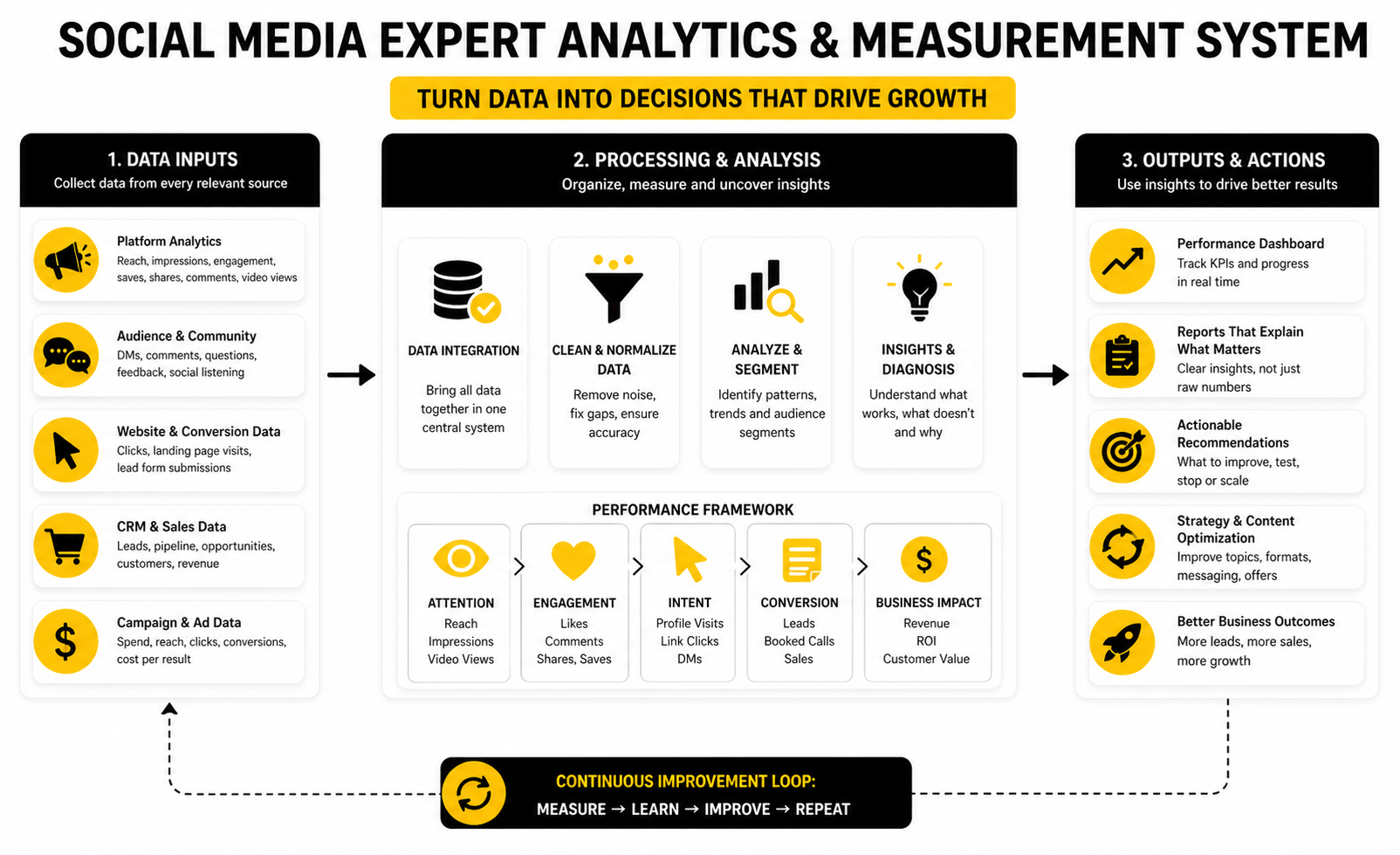
This structure keeps the team honest. If reach is growing but leads are flat, the content may be too broad or the next step may be weak. If clicks are strong but conversions are poor, the issue may be the landing page, offer, or follow-up process rather than the social post itself.
Read Benchmarks Without Worshipping Them
Benchmarks are useful because they stop you from judging performance in a vacuum. They help a social media expert understand whether a channel is underperforming, whether a content format is unusually strong, or whether the whole category has shifted. But benchmarks are dangerous when people use them as universal targets.
The better question is not “Are we above average?” The better question is “Are we improving against our own baseline while moving closer to the business goal?” Sprout’s social media benchmarks guidance makes this point clearly by separating industry benchmarks from personal benchmarks in its 2025 benchmark analysis.
A small account with the right audience can outperform a large account commercially. A B2B brand may care more about qualified conversations than viral reach. An ecommerce brand may care more about product page clicks, abandoned cart recovery, and paid retargeting audiences.
Connect Social Data to Revenue
Executives do not need a dump of platform screenshots. They need to understand what social media is doing for awareness, demand, trust, customer experience, and revenue. That is where a social media expert becomes valuable inside the business.
Sprout’s 2025 ROI research shows a real gap between leadership expectations and measurement confidence, with leaders wanting stronger connections between campaigns and business goals while many marketers still struggle to measure ROI through its social media ROI statistics. That gap is the opportunity. The expert who can translate content performance into business language becomes much harder to replace.
This is where CRM and follow-up systems matter. If a brand uses GoHighLevel, social leads can be connected to pipelines, automated follow-up, appointment booking, and revenue attribution. If a creator or small business uses ClickFunnels, social traffic can be tied to opt-ins, offers, and sales pages instead of disappearing into vague “link in bio” data.
Turn Data Into Better Decisions
Data only matters when it changes what you do next. A social media expert should use performance reviews to decide what to repeat, what to improve, what to stop, and what to test. That is the difference between reporting and learning.
A useful weekly review might ask:
- Which posts attracted the right audience?
- Which hooks held attention longest?
- Which topics created saves, shares, replies, or clicks?
- Which platform deserves more effort next cycle?
- Which content should be repurposed, expanded, or turned into an offer?
- Where did people drop off before taking action?
This turns analytics into a creative advantage. Instead of guessing, the brand builds from evidence. The social media expert still uses taste and instinct, but now those instincts are sharpened by real behavior.
Core Skills Every Social Media Expert Needs
A social media expert eventually reaches a point where basic posting skills are not enough. The work becomes more strategic, more cross-functional, and more exposed to risk. That is when the difference between a content operator and a true expert becomes obvious.
The expert has to think beyond the next campaign. They need to understand how brand trust, creator partnerships, platform dependence, AI workflows, customer experience, and revenue systems fit together. This is where social media becomes less about “being active” and more about making smart tradeoffs.
Know What Not to Chase
The hardest skill in social media is restraint. There will always be another trend, another format, another platform update, another creator tactic, and another competitor doing something loud. A social media expert knows that chasing everything usually weakens the brand.
The better move is to choose channels and formats based on fit. If the audience is not there, the brand has no clear point of view, or the team cannot sustain quality, the opportunity is probably a distraction. Deloitte’s 2025 Digital Media Trends shows how fragmented attention has become across creators, platforms, streaming, and recommendation systems, which makes focus even more important.
This does not mean being slow. It means being selective. Fast execution works best when the direction is already clear.
Balance AI Speed With Human Trust
AI can help a social media expert move faster. It can support research, draft variations, summarize comments, repurpose long-form content, and build first-pass workflows. Used well, it removes friction from the process.
But AI also creates a trust problem when brands use it carelessly. Audiences can feel when content has no lived perspective, no specific insight, and no human judgment behind it. Vogue’s 2026 reporting on AI creators and the creator economy shows the tension clearly: AI can scale content, but credibility still depends heavily on authenticity, experience, and emotional connection.
The practical rule is simple. Use AI to assist the work, not replace the thinking. The social media expert should still own the angle, the voice, the proof, the ethics, and the final judgment.
Treat Community as an Asset, Not a Comment Section
Community is not just people reacting under posts. It is the group of people who repeatedly pay attention, ask questions, share feedback, defend the brand, challenge weak ideas, and move closer to becoming customers or advocates. That makes community one of the most valuable assets a brand can build.
The challenge is that community cannot be faked. If the brand only shows up to promote, people notice. If replies feel automated, defensive, or generic, people notice that too.
A social media expert builds community by creating useful conversations, responding with context, and turning repeated audience signals into better content and offers. For brands that receive a lot of direct messages, ManyChat can help manage automated conversation flows, but the strategy still has to feel human. Automation should make response easier, not make the brand colder.
Manage Risk Before It Becomes Public
Social media creates leverage, but it also creates exposure. A rushed post, unclear claim, weak disclosure, badly handled complaint, or careless creator partnership can turn into a public problem quickly. That is why professional social media work needs guardrails.
Risk management includes approval workflows, brand voice rules, claims review, crisis escalation paths, influencer disclosure checks, platform access control, and data privacy discipline. It also includes knowing when not to publish. The social media expert has to protect the brand’s trust, not just grow the account.
This is especially important as misinformation, synthetic media, and platform moderation debates keep changing the environment. Harvard Law School’s Forum on Corporate Governance has warned that misinformation and disinformation are becoming a rising business and investor risk in its analysis of digital-age misinformation. That means social teams need sharper standards for verification, sourcing, and escalation.
Scale Without Losing the Voice
Scaling social media is not just doing more. More posts, more creators, more platforms, and more automation can create growth, but they can also dilute the brand. The real challenge is increasing output without making everything feel generic.
A strong scaling system usually needs documented positioning, reusable content pillars, creative templates, approval rules, performance dashboards, and clear ownership. It also needs a consistent way to capture ideas from sales calls, customer support, product feedback, and community conversations. That turns the whole business into a source of useful content.
Tools can support this, but the operating model matters more. Buffer can help coordinate publishing, while GoHighLevel can help connect social activity with follow-up and pipeline management. The expert-level move is making sure the systems serve the strategy instead of forcing the strategy to fit the tools.
How Professionals Implement Social Media Strategy
Professional implementation is about making the strategy durable. A campaign can perform well once because of timing or luck. A mature social media system performs repeatedly because the team knows how to plan, produce, measure, and improve.
This is where a social media expert becomes a builder. They do not just create content; they build the operating rhythm behind the content. That rhythm is what keeps quality high when the workload increases.
Create an Operating Rhythm
A good operating rhythm gives the team enough structure to move fast without becoming rigid. Weekly planning keeps content aligned with current priorities. Monthly reviews reveal patterns. Quarterly strategy checks make sure the channel still supports the business direction.
The rhythm should include clear ownership for research, writing, design, editing, publishing, engagement, reporting, and conversion tracking. When those roles are fuzzy, social media becomes reactive. When they are clear, the team can move with confidence.
This also makes collaboration easier. Sales can share objections, support can share recurring issues, product can share roadmap context, and leadership can share strategic priorities. The social media expert turns those inputs into public-facing content that makes the brand more useful and more trusted.
Protect the Brand While Testing New Ideas
Testing is essential, but it should not become chaos. A social media expert needs room to experiment with hooks, formats, offers, creators, platforms, and posting rhythms. At the same time, the brand still needs a stable identity.
The solution is controlled experimentation. Keep the core message consistent while testing the packaging. Change one meaningful variable at a time when possible, then review whether the result actually taught you something.
This is where many teams overreact. One strong post does not mean the whole brand should pivot. One weak post does not mean the strategy failed. The expert looks for patterns, not emotional spikes.
Tools, Systems, Measurement, and Next Steps
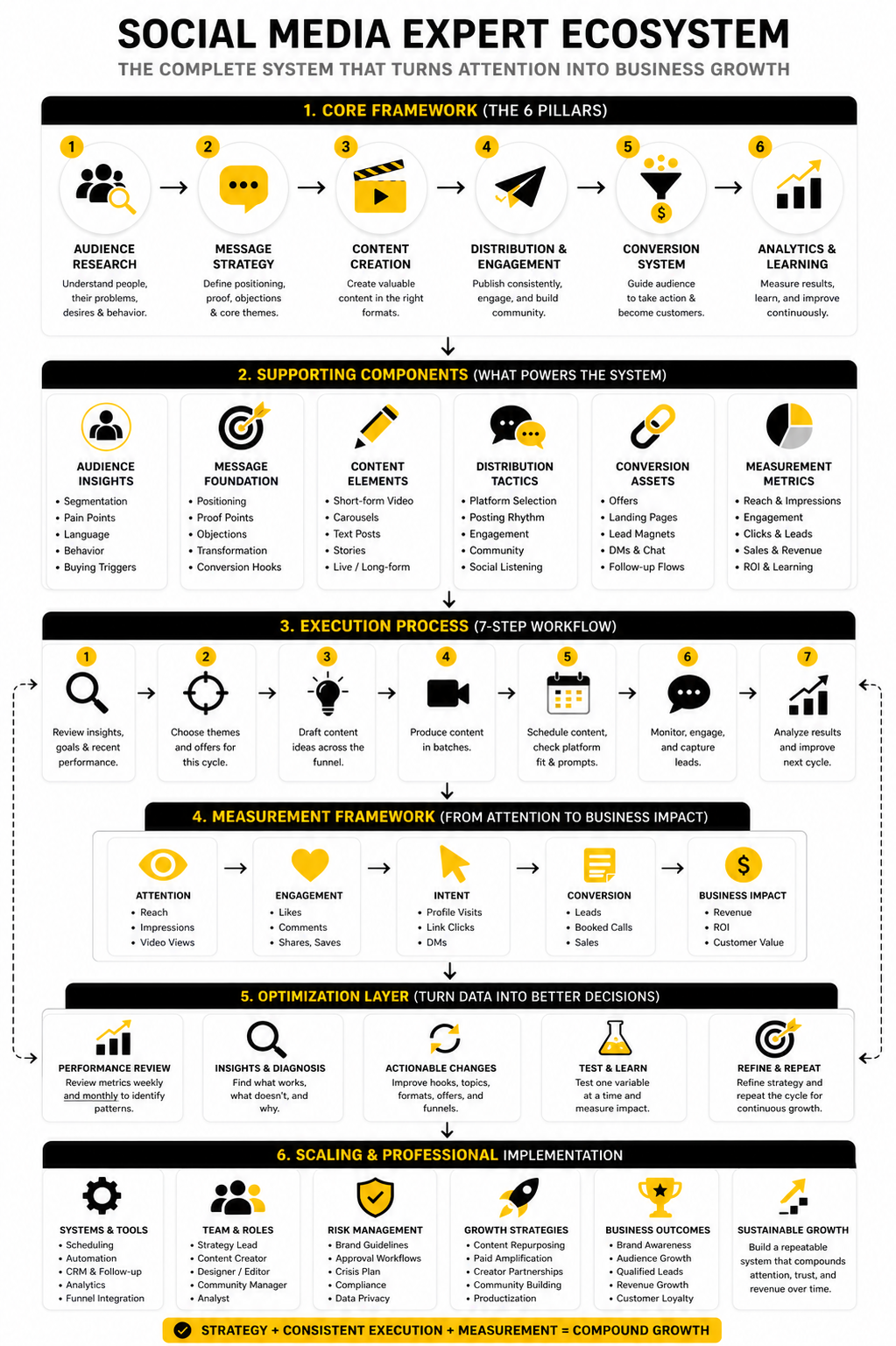
At the end of the process, a social media expert should have more than a content calendar. They should have a working ecosystem. The content attracts attention, the brand voice builds trust, the analytics show what is working, and the follow-up system turns interest into a real business outcome.
This is where everything connects. Strategy without execution stays theoretical. Execution without measurement becomes guesswork. Measurement without a next step becomes a report that nobody uses.
The mature version is simple to understand but hard to build well. Content brings the right people in, community keeps them engaged, automation supports the journey, and sales or conversion systems capture the demand.
Build the Ecosystem Around the Buyer Journey
A strong social media ecosystem follows how people actually move from stranger to customer. Some people need education first. Some need proof. Some need comparison. Some are ready to take action but need a clear next step.
A social media expert maps content to those stages so the brand does not only publish top-of-funnel content. Awareness posts help people discover the brand. Trust-building content helps them believe the brand. Conversion content helps them understand the offer and act.
This also makes tool decisions easier. ManyChat can support direct-message flows, GoHighLevel can support CRM and follow-up, and ClickFunnels can support offer pages when the campaign needs a focused conversion path.
Decide What to Improve Next
The best next step is rarely “post more.” More content only helps when the system already has direction. A social media expert looks for the weakest link and improves that first.
If reach is weak, improve hooks, topics, formats, and distribution. If trust is weak, improve proof, specificity, founder voice, customer insight, and transparency. If conversion is weak, improve the offer, landing page, follow-up, and call to action.
This is how social media stops feeling chaotic. You are not trying to fix everything at once. You are improving the part of the system that currently limits growth.
FAQ - Built for Complete Guide
What does a social media expert do?
A social media expert plans, creates, publishes, measures, and improves social media activity so it supports business goals. The role usually includes audience research, content strategy, platform selection, community management, reporting, and campaign optimization. The best experts also understand positioning, offers, funnels, and customer behavior.
What skills does a social media expert need?
A strong social media expert needs writing, creative direction, analytics, platform knowledge, audience research, communication, and strategic planning. They also need judgment because social media changes quickly and not every trend deserves attention. The real skill is knowing what to do, why it matters, and how to measure whether it worked.
Is a social media expert the same as a social media manager?
Not always. A social media manager often handles day-to-day execution, scheduling, publishing, and community tasks. A social media expert usually brings deeper strategy, measurement, campaign design, and business alignment.
How do you become a social media expert?
Start by learning one or two platforms deeply instead of trying to master everything at once. Build real projects, study audience behavior, track performance, and practice turning insights into better content. Over time, add skills in analytics, paid social, funnels, creator partnerships, and reporting.
What should a business look for when hiring a social media expert?
Look for clear thinking, relevant experience, strong examples, and the ability to explain why a strategy should work. A good candidate should ask about goals, audience, offer, brand voice, resources, and measurement before promising results. Be careful with anyone who only talks about posting frequency or follower growth.
How much does a social media expert cost?
The cost depends on experience, scope, location, platform mix, content volume, and whether the work includes strategy, creative production, ads, reporting, or community management. A freelancer may charge per project, monthly retainer, or hourly rate. A more advanced expert usually costs more because they connect social activity to business outcomes, not just content output.
Which platforms should a social media expert focus on?
The right platforms depend on the audience, offer, content strengths, and buying journey. LinkedIn may fit B2B authority, TikTok may fit fast discovery, Instagram may fit visual brands, YouTube may fit education and long-term search, and Facebook may still matter for communities or local markets. The expert choice is based on fit, not hype.
How do social media experts measure success?
They measure success across attention, engagement, intent, and business outcomes. Useful metrics include reach, retention, saves, shares, comments, profile visits, clicks, leads, booked calls, sales, and customer conversations. The best reports explain what the numbers mean and what should change next.
Can AI replace a social media expert?
AI can help with research, drafting, repurposing, summarizing, and workflow speed. It cannot fully replace strategic judgment, original perspective, audience empathy, brand trust, or final creative taste. The strongest social media experts use AI as leverage while keeping the thinking human.
How long does it take to see results from social media?
Some signals can appear quickly, especially reach, comments, saves, and direct messages. Business results usually take longer because trust, testing, offer clarity, and follow-up systems need time to compound. A realistic approach is to look for early learning first, then stronger patterns, then repeatable conversion.
What is the biggest mistake brands make with social media?
The biggest mistake is treating social media like a posting task instead of a business system. Random posts create random feedback. A better approach starts with audience insight, clear messaging, consistent execution, and measurement that leads to better decisions.
Do small businesses need a social media expert?
Small businesses do not always need a full-time specialist, but they do need expert thinking. Even a simple strategy can prevent wasted effort and help the business focus on the platforms, content, and offers that matter most. The smaller the team, the more important clarity becomes.
Work With Professionals
Explore 10K+ Remote Marketing Contracts on MarkeWork.com
Most marketers spend too much time chasing clients, competing on crowded platforms, and losing a percentage of every project to middlemen.
MarkeWork gives you a better way. Browse thousands of remote marketing contracts and connect directly with companies desperate to hire skilled marketers like you, without platform commissions and without unnecessary gatekeepers.
If you're serious about finding better opportunities and keeping 100% of what you earn, explore available contracts and create a profile for free at MarkeWork.com.