

Social media for business is no longer a side channel you update when there is spare time. It is where people discover brands, compare options, ask questions, watch proof, and decide whether a company feels relevant enough to trust. The businesses that win here usually are not the loudest. They are the ones that show up consistently, make buying easier, and understand what each platform is actually good at.
That matters even more now because the audience is massive and the behavior is commercial. DataReportal’s 2025 global report put global social media identities at 5.24 billion at the start of 2025, while Meta’s latest annual results showed its family of apps reached 3.58 billion daily active people by December 2025. Social is not just attention anymore. It is infrastructure for reach, trust, service, and revenue.
The hard part is that most businesses still treat social media like a posting calendar instead of a business system. They publish disconnected content, chase trends that do not fit their market, and then wonder why the results feel random. A better approach is to build social around business goals, customer intent, and repeatable execution.
Article Outline
- Why Social Media for Business Matters
- The Social Media for Business Framework
- Choosing the Right Platforms for Your Business
- Building a Content System That Compounds
- Turning Engagement Into Leads and Sales
- Measuring Performance and Scaling What Works
Why Social Media for Business Matters
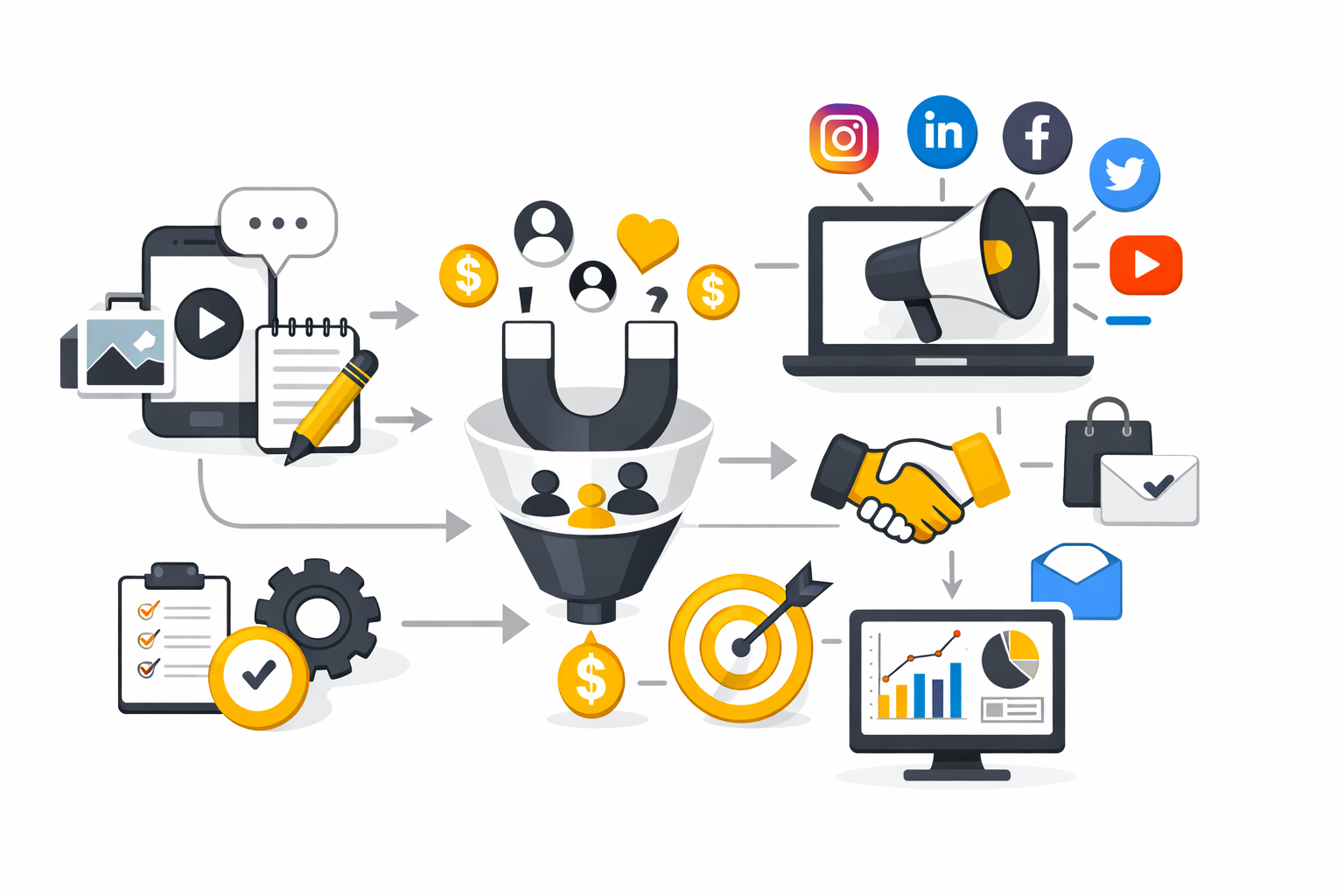
The biggest shift is simple: social platforms now sit much closer to the buying decision than they used to. People do not only use them for entertainment or keeping up with friends. They use them to research products, check credibility, read comments, watch demos, and see whether a business feels active, responsive, and worth their money.
That change shows up differently depending on the business model. For a local company, social can drive awareness, reviews, direct messages, and repeat visits. For an ecommerce brand, it can move people from discovery to product education to conversion. For B2B companies, it often works as a trust engine that supports longer sales cycles, especially on platforms like LinkedIn where LinkedIn’s 2025 B2B benchmark research shows marketers are leaning harder into thought leadership, trust, and influence.
It is also becoming a more practical business channel because the tools around it are maturing. Scheduling, reporting, collaboration, comment management, and automation are easier than they were a few years ago, which is why many smaller teams now run smarter systems with leaner headcount. A platform like Buffer makes consistency easier, while tools built for conversational automation such as ManyChat help businesses turn comments and direct messages into actual lead flow.
The opportunity is huge, but it is easy to waste. A business can spend months publishing content that looks busy without creating any business impact. That usually happens when there is no clear framework behind the activity.
The Social Media for Business Framework
A useful framework for social media for business starts with one rule: every post should support a larger system. That system needs to connect four things clearly—audience, message, channel, and conversion path. When one of those pieces is weak, social becomes noisy fast.
The first layer is strategy. You need to know exactly who the content is for, what problem your business solves, and what kind of proof your audience needs before they act. The second layer is platform fit, because the same business should not speak the same way on LinkedIn, Instagram, TikTok, YouTube, and Facebook. TikTok’s 2025 trend report makes this point well: brands perform better when they build with community behavior instead of forcing traditional ad logic into the feed.
The third layer is content operations. This is where most businesses either build momentum or stall out. You need a repeatable way to create educational content, trust-building content, authority content, and conversion content without reinventing your strategy every week.
The fourth layer is conversion. Social media for business works best when there is an obvious next step, whether that is a direct message, an email opt-in, a booked call, a product page visit, or a purchase. If the path is vague, the content may still get attention, but attention alone does not build a durable business.
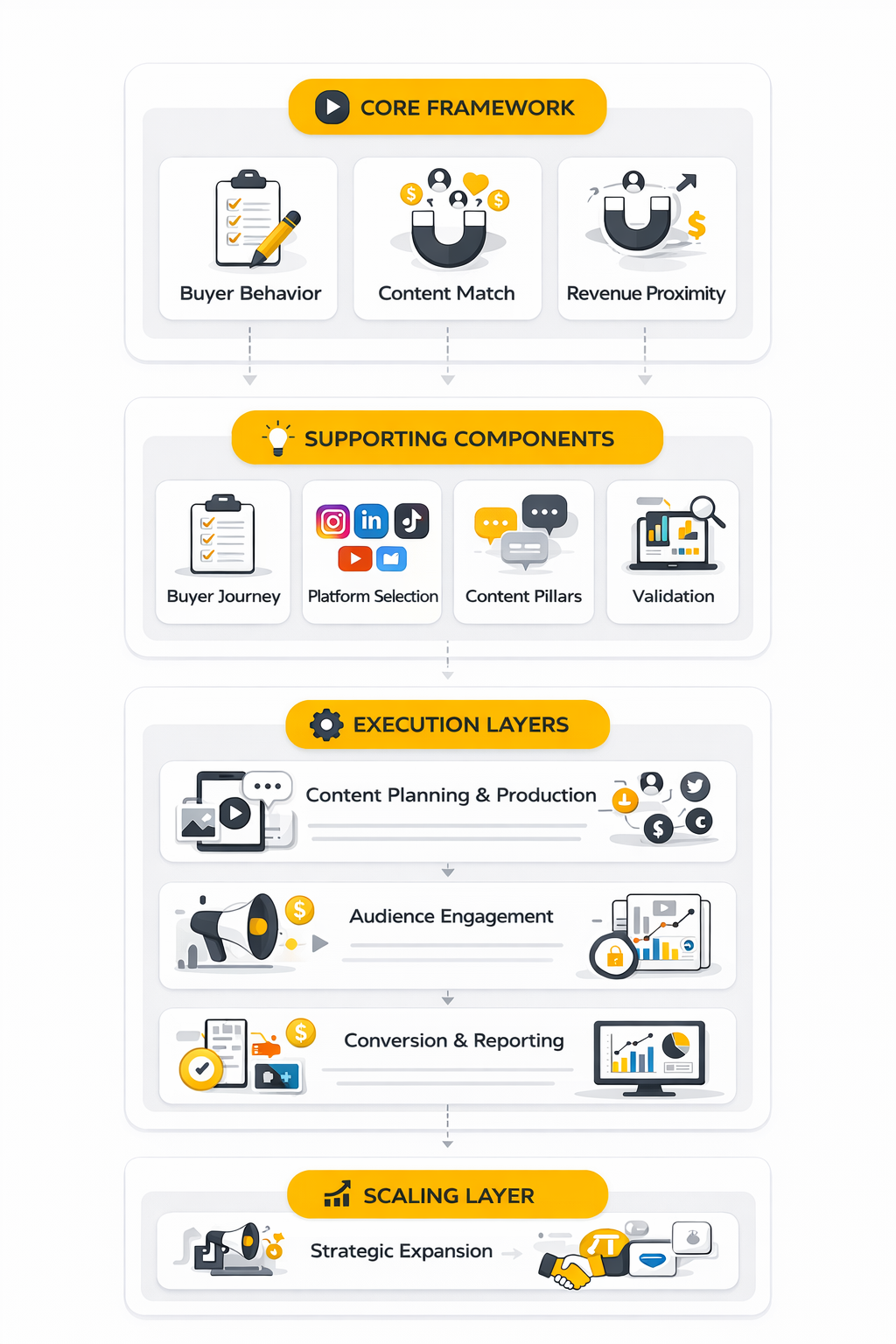
This article follows that exact structure. Next, we will look at how to choose the right platforms instead of trying to be everywhere, because platform selection is where strategy becomes realistic. After that, we will build the content system, connect it to leads and sales, and finish with the numbers that actually tell you whether your social media is helping the business grow.
Choosing the Right Platforms for Your Business
The biggest mistake in social media for business is trying to win everywhere at once. That usually creates a weak presence on five platforms instead of a strong presence on one or two that actually match how your customers discover, evaluate, and buy. A better move is to choose channels based on buyer behavior, content fit, and how close the platform sits to revenue.
That decision matters because audience size alone is not strategy. Digital 2025 shows social usage is now broad enough that almost any business can find its customers online, but reach does not tell you whether people are in discovery mode, research mode, or buying mode. The real question is where your audience pays attention in a way that matches your sales process.
Start With Buyer Behavior, Not Platform Hype
Before picking platforms, map your customer journey in plain language. Where do people first notice the problem, where do they compare options, and where do they look for proof that your business is credible enough to trust. Once that is clear, platform selection gets easier because you are no longer asking where you want to post, but where your buyer naturally moves.
This is where many teams get distracted by trends. A platform can be exploding culturally and still be the wrong fit for your offer if your buyers are not in the right mindset there. The 2025 Sprout Social Index makes that gap clear by showing consumers want brands to be relevant and useful on social, not just visible or trend-chasing for the sake of it.
A practical filter helps. If your sale depends on trust, expertise, and a longer decision cycle, lean toward platforms that reward depth and professional context. If your sale depends on visual appeal, impulse, or creator influence, lean toward platforms built for discovery and fast emotional response.
LinkedIn for B2B Trust and Pipeline
LinkedIn is usually the strongest fit when the business sells expertise, services, software, consulting, recruitment, or anything else that involves professional credibility. It works especially well when the buyer needs more than one touchpoint before taking action, because the platform gives you room for opinion, proof, education, and repeated exposure. For many B2B brands, it is less about going viral and more about becoming familiar to the right people.
That matters because B2B marketing is shifting toward trust, quality, and influence rather than raw lead volume. LinkedIn’s 2025 B2B benchmark research and its 2025 trust-focused benchmark report both lean in that direction, and LinkedIn’s own business updates in late 2025 reported deeper engagement, comments up 24%, and continued double-digit growth in video uploads. That combination tells you something useful: buyers and practitioners are not only scrolling there, they are actively engaging with professional content.
This is why LinkedIn is often the best primary channel for agencies, SaaS companies, executive coaches, recruiters, and founders selling high-ticket offers. It supports personal brand content, company-page credibility, employee advocacy, and targeted paid distribution in one place. If your business needs decision-makers rather than broad consumer attention, LinkedIn deserves serious weight.
Instagram and Facebook for Reach, Proof, and Local Demand
Instagram and Facebook still matter for far more businesses than people like to admit. Meta reported 3.58 billion family daily active people in December 2025, which means these platforms remain part of everyday digital behavior at enormous scale. That is especially valuable for businesses that need broad reach, retargeting, social proof, and direct response in the same ecosystem.
Instagram is usually the better fit when visual identity, taste, transformation, or lifestyle plays a big role in the sale. That includes ecommerce brands, creators, beauty, fitness, food, hospitality, home design, and many service businesses that benefit from strong before-and-after proof. It is also useful when you need a tight loop between content, direct messages, creator partnerships, and product interest.
Facebook stays relevant because of community behavior, local discovery, groups, events, and mature ad infrastructure. For local businesses, franchise models, community-led brands, and businesses targeting older or broader age ranges, it can still outperform trendier channels simply because the audience is established there. Social media for business gets much easier when you stop treating Facebook like a legacy platform and start seeing it as a practical demand-capture layer.
YouTube for High-Intent Education
YouTube is the strongest choice when customers need education before they buy. That includes products with complexity, higher price points, technical features, or any offer where demonstrations, reviews, and comparisons reduce buyer hesitation. When a business can explain clearly on video, YouTube often becomes one of the highest-leverage channels in the mix.
The scale is hard to ignore. DataReportal’s 2025 YouTube report pulled from Google’s tools showed YouTube ads reached 2.53 billion users in January 2025, and Google’s own 2025 shopping research highlighted how video shapes confidence during the buying journey. That makes YouTube different from faster-feed platforms because the audience often arrives with more patience and stronger intent.
This platform works especially well for software tutorials, product explainers, founder-led education, expert breakdowns, webinars repurposed into evergreen content, and branded search capture. In practice, YouTube is often less about daily posting and more about building a searchable library that keeps working long after publishing day. For businesses that want compounding content, that is a huge advantage.
TikTok for Discovery and Creator-Led Demand
TikTok is usually the right move when attention starts with curiosity, entertainment, identity, or culture. It is powerful for consumer brands, visually demonstrable products, education with personality, and businesses willing to let creators or founder voices carry the message. It can also work for B2B, but only when the brand understands how to teach or entertain without sounding like a brochure.
What makes TikTok different is not just scale. Its own What’s Next 2025 report argues that the old model of brands broadcasting polished messages is losing ground to creator collaboration, community behavior, and cultural participation. That lines up with broader brand research from 2025 showing that audiences respond better to content that feels native, specific, and genuinely useful.
The warning here is important. TikTok is not a place to dump repurposed ad creative and hope for results. Businesses that do well there usually commit to fast feedback loops, creator-style execution, and a much looser tone than they would use on a corporate blog or a polished landing page.
Pinterest and Reddit for Intent-Rich Niches
Some businesses should spend more time on quieter platforms with stronger intent instead of automatically chasing the loudest networks. Pinterest is a great example. The platform reported 619 million monthly active users in Q4 2025, and its business materials keep emphasizing planning, discovery, and shopping behavior rather than passive scrolling.
That makes Pinterest especially strong for home, beauty, weddings, food, fashion, travel, design, gifting, and any business that benefits from aspiration plus planning. People often arrive there earlier in the decision cycle, which means the content can influence choices before shoppers are flooded by competitive ads elsewhere. For brands with strong visuals and evergreen search behavior, Pinterest can quietly outperform more crowded feeds.
Reddit is a different kind of opportunity. The platform reported 121.4 million daily active uniques in Q4 2025, but the real value is not raw scale. It is the depth of intent inside topic communities where people ask blunt questions, compare tools, share frustrations, and pressure-test brand claims.
For software, finance, health-adjacent education, gaming, tech accessories, and enthusiast products, Reddit can reveal what buyers actually care about long before a polished campaign does. It is not the easiest channel to post on directly, but it is one of the best channels to learn from. Social media for business gets smarter when you treat platforms like Reddit as market research and trust signals, not just distribution.
How to Narrow Your Channel Mix
A simple rule helps here: start with one primary platform, one supporting platform, and one optional experiment. Your primary platform should be the place most likely to influence revenue. Your supporting platform should help reinforce trust, retarget attention, or deepen education. The experiment should stay small until it proves it deserves more time.
That structure keeps execution realistic. Most teams do not fail because they chose the completely wrong platform. They fail because they spread themselves too thin, publish inconsistently, and never reach the repetition required for the market to notice them.
The right channel mix also depends on business model. A local clinic might build around Instagram plus Facebook. A SaaS company might focus on LinkedIn plus YouTube. A design-led ecommerce brand might lean into Instagram plus Pinterest, while a creator-led education business could pair TikTok discovery with YouTube depth. The point is not to copy what looks popular. The point is to choose a stack that matches how your customer actually buys.
Once that is clear, the next challenge is execution. Choosing the right platform gives you focus, but focus only turns into growth when content is built as a system instead of a random stream of posts.
Building a Content System That Compounds
Once you have chosen the right platforms, the next job is building a system that makes consistency realistic. This is where social media for business either starts to create momentum or quietly falls apart behind the scenes. Most brands do not struggle because they lack ideas. They struggle because their workflow is too fragile to survive a busy week.
A real content system removes that fragility. It gives your team a repeatable way to turn customer questions, sales objections, product proof, and brand perspective into posts that actually move the business forward. Instead of asking what to post every morning, you work from a structure that keeps generating useful material.
That matters because compounding content is rarely about one perfect post. It is the result of publishing the right types of content, in the right rhythm, with enough repetition that the market starts to recognize your message. Social media for business gets a lot easier when content creation stops feeling like improvisation.
Build Around Content Pillars, Not Random Ideas
The cleanest way to create consistency is to work from a small set of content pillars. These are not vague themes that sound good in a strategy deck. They are practical categories tied to what your audience needs to believe before they trust you, contact you, or buy from you.
A strong setup usually includes education, proof, point of view, and conversion. Education helps the audience understand the problem and the available options. Proof shows that your business can actually deliver. Point of view gives your brand a voice worth remembering. Conversion content tells people what to do next without making every post feel like a sales pitch.
This structure keeps your content balanced. If you only educate, people may like you but never move. If you only sell, they tune out. If you only post polished brand content, they may not understand why they should care. The right mix builds attention, trust, and action over time.
Create Content From Real Business Inputs
A lot of businesses overcomplicate content because they look for inspiration in the wrong place. They search for trending formats before they mine the information already sitting inside the company. In practice, the best raw material usually comes from sales calls, onboarding questions, support tickets, objections, testimonials, and product demos.
That is a major shift because it turns content from a marketing-only task into a company-wide advantage. Your sales team already knows what prospects hesitate over. Your support team already knows where customers get confused. Your founder or subject-matter experts already have opinions the market would benefit from hearing more clearly.
This is also why so much weak content feels disconnected from revenue. It may sound polished, but it is not built from real buyer friction. When social media for business is fed by real conversations, the content becomes sharper, more useful, and much harder for competitors to imitate.
Match Format to Platform Behavior
Not every good idea belongs in the same format. A strong content system adapts the core message to the way people consume information on each platform. That does not mean creating everything from scratch. It means translating the same strategic point into the format that each channel naturally rewards.
On LinkedIn, a strong idea may work as a text-led post, a short document carousel, or a concise video with a clear business takeaway. On Instagram, the same idea might perform better as a reel, a swipeable carousel, or a story sequence that turns one lesson into a fast visual journey. On YouTube, it could become a deeper explainer that answers the question fully and keeps generating search-driven traffic long after publishing.
This is where many teams waste effort. They repurpose mechanically instead of intelligently. The goal is not to paste the same content everywhere. The goal is to preserve the core insight while changing the delivery so it feels native to the platform.
Turn One Strong Idea Into Multiple Assets
The easiest way to keep quality high without burning out your team is to think in source content. That means creating one substantive asset first, then breaking it into smaller platform-specific pieces. A webinar, customer interview, product walkthrough, strategy memo, or founder recording can all become the seed for several posts.
A simple process works well here. Start with one substantial idea worth saying properly. Pull out the strongest argument, one useful lesson, one proof point, one objection, and one call to action. From there, you can build short-form video, a text post, a carousel, an email, and a landing-page section without inventing five separate campaigns.
This is where the economics of content start to improve. The effort goes into clarity once, then the value spreads across formats and channels. That is one of the smartest ways to make social media for business more efficient without turning the content into recycled filler.
A Practical Content Workflow for Social Media for Business
Execution becomes much easier when the workflow is visible. The point is not to create a huge process for the sake of control. The point is to make content production simple enough that the team can actually keep going.
A practical weekly system usually follows a clear sequence. Strategy decides what matters. Production turns that into assets. Distribution puts the content in front of the audience. Review tells you what deserves to be repeated, refined, or dropped.
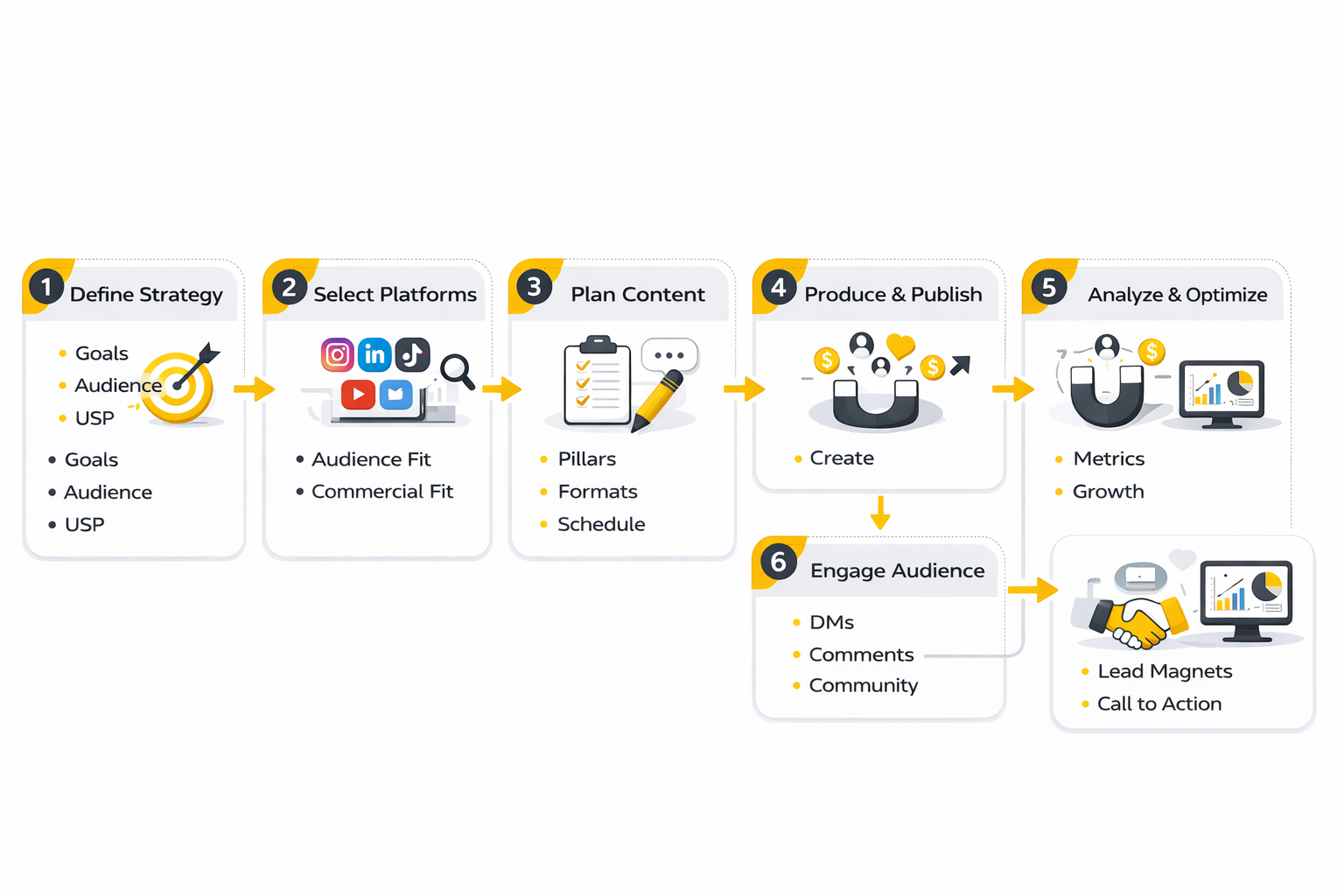
Here is the process in its most usable form:
- Gather inputs from the business each week
- Choose one to three priority messages
- Turn each message into a primary asset
- Adapt that asset into platform-specific posts
- Schedule the content and assign ownership
- Publish, engage, and capture audience feedback
- Review what performed, what converted, and what to improve next
This is the part most teams skip. They may publish consistently for a while, but without a documented workflow, the system depends on individual energy rather than operational discipline. That is why content often collapses the moment one person gets busy or priorities shift.
Use a Calendar, but Do Not Worship the Calendar
A content calendar matters because it creates visibility, pacing, and accountability. It helps prevent long gaps, last-minute scrambling, and duplicated ideas. It also makes it easier to balance educational, proof-driven, and conversion-focused content across the month.
Still, the calendar should serve the strategy, not control it. Some businesses become so attached to planning that they stop responding to what the audience is actually doing. When a strong customer objection appears repeatedly, when a timely industry shift creates urgency, or when one post clearly opens a new angle, the system should flex.
That balance is what keeps the operation both stable and alive. You want enough planning to stay consistent and enough freedom to stay relevant. A scheduling tool like Buffer can help keep the publishing side clean, but the quality still depends on the thinking behind the posts.
Build an Approval Process That Does Not Kill Speed
For many businesses, content quality is not the real bottleneck. Approval is. The message gets stuck between marketing, leadership, legal, product, or sales until the timing is gone and the post comes out flatter than it started.
The solution is not removing oversight completely. It is defining what actually needs approval, who owns each type of content, and how quickly decisions need to happen. A company that wants serious output from social media for business needs rules that protect brand standards without turning every post into a committee project.
This is especially important for founder-led brands and expert-led businesses. Their strongest content often comes from speed, specificity, and conviction. If every opinion is softened until nobody could disagree with it, the post may still be safe, but it will not be memorable.
Keep a Content Backlog So the Team Never Starts From Zero
One of the simplest improvements you can make is maintaining a backlog of usable ideas. This is a working list of questions, objections, examples, customer wins, product insights, myth-busting angles, and industry reactions that can be turned into content later. It gives the team creative inventory instead of creative panic.
That backlog should be built continuously, not once a quarter. Every sales conversation can feed it. Every webinar can feed it. Every recurring comment or direct message can feed it. Over time, this turns content planning into selection rather than invention.
This matters more than it sounds. When teams start from zero each week, quality drops and stress rises. When they work from a growing bank of proven ideas, content becomes more strategic, faster to produce, and much more resilient.
Add Light Automation Where It Actually Helps
Automation is useful when it removes repetitive work without flattening the brand voice. Good uses include scheduling, comment routing, basic follow-up flows, lead capture, and internal task handoffs after someone takes action. Bad uses include automating everything so aggressively that the experience feels generic and lifeless.
This is where a lot of businesses can tighten the gap between content and action. If someone comments on an offer, requests a resource, or responds to a story, the next step should not rely on a manual scramble every time. A tool like ManyChat can help turn interest into an organized follow-up flow, especially for brands using Instagram and Facebook as active lead channels.
The same principle applies to handoffs after social activity. If a lead comes in through content, there should be a clear destination for that information. Platforms like GoHighLevel are useful when you want social engagement, contact capture, pipeline movement, and follow-up sequences connected in one place instead of scattered across disconnected tools.
A good rule here is simple: automate the mechanics, not the relationship. Social media for business still works because people feel like they are interacting with a real company, not a machine.
Professional Implementation Means Measuring Process, Not Just Output
A mature content operation does not only track likes, reach, or follower growth. It also tracks whether the process itself is healthy. Are ideas moving through production on time. Are approvals blocking output. Are posts being repurposed effectively. Are leads or conversations being captured when audience intent shows up.
This is where implementation becomes professional rather than casual. You are not just looking at what the audience sees. You are looking at whether the system behind the scenes is strong enough to keep producing useful work month after month. That operational view is what allows a business to scale content without losing clarity.
Once the process is stable, the next step is connecting social activity more directly to pipeline and revenue. That is where social media stops being a visibility channel and starts proving commercial value.
Measuring Performance and Scaling What Works
Once your content system is running, the next question is simple: is it doing anything that matters for the business. This is where social media for business often gets messy, because teams look at whatever the platform makes easiest to see instead of the numbers that actually explain progress. Reach, likes, views, clicks, replies, leads, and revenue can all matter, but they do not matter equally in every situation.
The right measurement model depends on what the business is trying to achieve. A new brand may need proof that awareness is growing in the right audience. A mature business may care more about qualified traffic, direct inquiries, booked calls, or purchases. The mistake is treating all metrics as if they tell the same story, because they do not.
This is also why random benchmarks are dangerous. A number only becomes useful when it is tied to a goal, a time frame, and a decision. Good analytics help you act. Bad analytics just create dashboards that look busy.
What Social Media Data Actually Tells You
The first thing data should tell you is whether the market is noticing your content. That is the top of the funnel, and the signals here usually include reach, impressions, video views, follower growth, profile visits, and share rate. These numbers matter because they show whether your message is getting exposure, but they are still early signals, not proof of business impact.
The second thing data should tell you is whether the audience cares enough to interact. That is where engagement becomes useful, especially comments, saves, shares, direct messages, and outbound clicks. This layer matters more than vanity metrics because it shows whether the content is creating movement rather than just passing in front of someone’s eyes.
The third thing data should tell you is whether attention is turning into commercial action. That includes lead submissions, booked calls, product page visits, add-to-cart actions, assisted conversions, direct purchases, and customer support resolution. This is the layer executives actually care about, and it is the layer that turns social media for business from a branding discussion into a growth discussion.
A lot of teams mix these layers together and end up confused. They panic because one post had lower reach even though it drove stronger inquiry quality. Or they celebrate a spike in views that created no pipeline at all. Strong measurement separates awareness metrics, engagement metrics, and conversion metrics so each one can be judged on the right standard.
The Difference Between Vanity Metrics and Decision Metrics
Vanity metrics are not always useless, but they are easy to misuse. Follower count is the classic example. It can signal momentum, brand relevance, or improving distribution, but on its own it says very little about whether the business is attracting the right people or moving them toward a sale. The same is true for raw impressions if there is no context around quality and downstream action.
Decision metrics are different because they help you choose what to do next. Click-through rate can show whether the call to action is clear enough. Save rate can show whether educational content is useful enough to revisit. Lead-to-close rate can show whether social traffic is producing real commercial value rather than low-intent noise.
That is why so many reporting systems need to be cleaned up. HubSpot’s 2025 breakdown on vanity metrics makes the distinction plainly by contrasting metrics like followers and page views with conversion rates, retention, and other business-tied measures that are actually actionable. HubSpot’s guide to vanity metrics is worth reading for that reason alone.
The Metrics That Matter Most
Not every business needs the same dashboard, but most should track performance across four levels. The first is visibility. The second is engagement quality. The third is action. The fourth is business outcome.
A simple measurement stack usually looks like this:
- Visibility metrics such as reach, impressions, video completion trends, and profile visits
- Engagement metrics such as comments, shares, saves, direct messages, and click-through rate
- Action metrics such as lead form submissions, booked demos, email signups, add-to-cart events, and sales conversations started
- Outcome metrics such as revenue influenced, customer acquisition cost, close rate, retention, and lifetime value by source
This structure matters because it keeps the interpretation honest. If visibility is rising but action is flat, the message may be broad but weak. If engagement is strong but outcomes are poor, the audience may like the content without matching the buyer profile. If action is improving while reach is stable, the content may be getting sharper even without going wider.
The cleanest way to use social media for business is to ask one question at each level. Are more of the right people seeing us. Are they interacting in meaningful ways. Are they taking the next step. Is that next step creating measurable value for the business.
Why Benchmarks Should Guide, Not Control
Benchmarks are useful when they keep you realistic. They help you see whether a drop in engagement is your specific problem or part of a broader platform trend. They also help you spot whether your posting rhythm, content format, or response rate is materially behind what similar brands are achieving.
That said, benchmarks should never replace context. Rival IQ’s 2025 Social Media Industry Benchmark Report found engagement rates fell across major platforms, including Facebook, Instagram, TikTok, and X. That is useful because it reminds marketers not to treat year-over-year declines as automatic proof that the strategy is broken.
Sprout Social’s 2025 Content Benchmarks adds another layer by analyzing 3 billion messages across 1 million public profiles and focusing on daily and per-post inbound engagement. That matters because aggregate engagement can hide weak individual post performance, while post-level benchmarks can reveal whether content quality is actually improving.
Hootsuite’s 2025 social media benchmarks make a related point in a more operational way by tying engagement rates to posting frequency across industries and platforms. That is valuable because it helps businesses avoid a common mistake: assuming more posting automatically means more return. Sometimes it does. Sometimes it just creates more average content.
What Platform Data Is Quietly Telling You
Platform-level business data also gives useful context. Meta reported 3.58 billion daily people across its family of apps in December 2025, along with a 12% increase in full-year ad impressions and a 9% increase in average price per ad. Those numbers matter because they show two things at once: demand for attention on Meta remains enormous, and competition for that attention is still intensifying.
That should change how you read your own numbers. If impressions are getting more expensive and feeds are more crowded, content quality and conversion efficiency matter even more. Social media for business is not just about getting distribution. It is about getting economically useful distribution.
LinkedIn’s Q1 2025 business highlights reported comments up 24% and three straight quarters of double-digit growth in video uploads. That suggests the platform is getting more interactive and more competitive at the same time. For B2B marketers, that means strong engagement on LinkedIn is increasingly valuable, but generic content is also easier to ignore.
DataReportal’s 2025 global overview and global social media statistics help round out the picture by showing people now move across multiple platforms regularly and that major networks still command massive potential ad reach. That matters because weak performance on one channel does not automatically mean your audience is not on social. It may simply mean your platform mix, message, or format needs adjustment.
Building an Analytics System You Can Actually Use
The best analytics system is not the one with the most charts. It is the one your team can review consistently and use to make better decisions. If reporting takes too long or requires ten tools and three spreadsheets, it usually breaks the moment the team gets busy.
A better setup is to review metrics in layers. Look at content performance weekly so you can spot message and format patterns quickly. Review pipeline and conversion data monthly so you can separate noise from meaningful changes. Then review trend lines quarterly so you can decide whether the platform mix, budget allocation, or team workflow needs to shift.
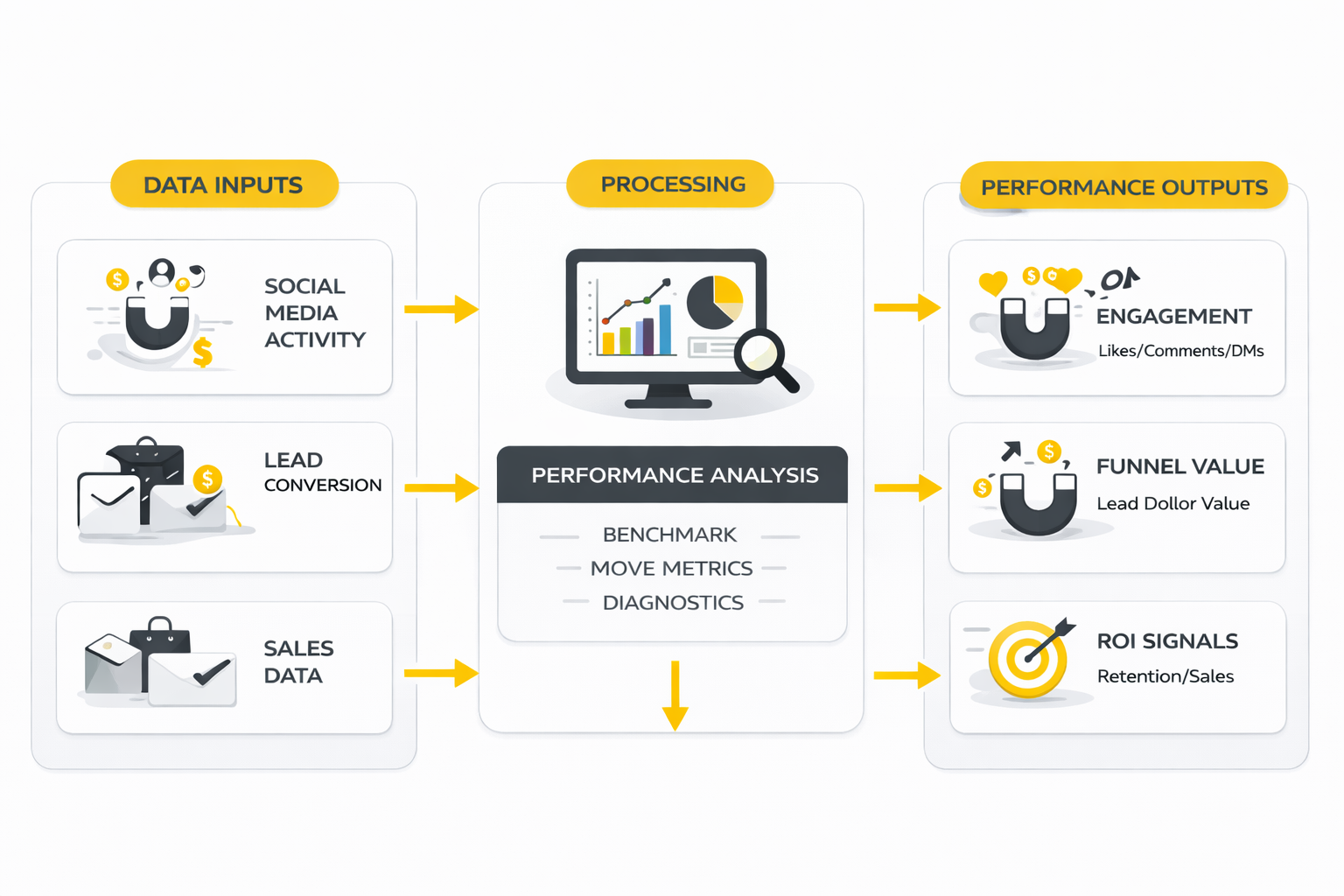
A practical analytics system for social media for business usually includes these questions:
- Which content themes are generating the strongest saves, shares, comments, or direct messages
- Which formats are producing the best click quality, not just the highest volume
- Which platforms are driving leads or purchases at the best cost and close rate
- Which posts are influencing revenue indirectly by supporting branded search, retargeting, or sales conversations
- Which customer questions keep showing up and should become future content
This is where measurement becomes useful enough to guide execution. Instead of saying reels work or LinkedIn is down or our audience likes educational content, you can say short comparison videos are driving the most qualified clicks, or founder posts are producing the highest demo-request rate, or product tutorials are creating the strongest assisted conversions. That level of specificity is what turns analytics into action.
Response Time Is Also a Performance Metric
A lot of brands still separate social content from social care, which is a mistake. If prospects or customers comment, ask questions, or send direct messages and nobody responds with speed and clarity, performance suffers even if the content itself is strong. In many businesses, responsiveness is part of the conversion path.
That is not a soft metric. Sprout Social’s 2025 customer service coverage notes that nearly three-quarters of consumers expect a response within 24 hours or sooner. Sprout’s customer service statistics makes the implication pretty obvious: response time affects trust, and trust affects revenue.
This matters especially for local businesses, service businesses, and ecommerce brands using direct messages as a buying channel. A post may do its job by generating intent, but the business still loses if the follow-up is slow. In that situation, the reporting system needs to include responsiveness, handoff quality, and conversion from conversation to next step.
How to Read Weak Numbers Without Overreacting
Bad numbers do not always mean bad strategy. Sometimes the audience is healthy and the format is wrong. Sometimes the format is strong and the call to action is weak. Sometimes the post performs poorly because distribution slipped, not because the message failed. The job is to diagnose the problem before changing everything.
This is why you should look for patterns, not single-post drama. One weak post means very little. Five weak posts around the same topic, format, or audience segment mean something. The same goes for wins. One breakout result can be luck. Repeated strong performance around the same kind of idea is a signal worth scaling.
That mindset protects you from random decision-making. Social media for business improves when teams stop chasing every spike and dip and start reading the data like a system. The goal is not perfect stability. The goal is learning fast enough to improve the next cycle.
What the Data Should Make You Do Next
Numbers only matter if they lead to action. If shares are high and clicks are low, tighten the offer or the call to action. If reach is flat but conversion rate is rising, keep refining the message before expanding distribution. If one platform consumes time without generating meaningful action, reduce the effort there and move resources toward the channels showing stronger commercial signal.
This is also where many businesses finally see the value of integrated reporting. Social performance should not live in a silo away from CRM data, sales outcomes, and customer behavior. The more clearly you can connect content to inquiries, pipeline movement, and revenue, the easier it becomes to defend budget and scale what works.
That is the real point of measurement. Not proving that social exists. Proving that it deserves a bigger role in growth when the evidence is there. The final step is turning those insights into a sharper conversion system, so the attention and trust you have built do not stall before the sale.
Advanced Strategy: What Changes When You Start Scaling
Once social media for business starts producing real attention, the game changes. The challenge is no longer getting content out the door. The challenge becomes protecting quality while volume increases, keeping the brand sharp while more people touch the workflow, and making sure growth on social does not turn into dependency on platforms you do not control.
This is the point where many businesses either mature or get exposed. Early success can hide weak systems because strong founder energy or one breakout format keeps performance alive for a while. But once the team grows, spend increases, and more revenue depends on social, the business needs better strategic tradeoffs, not just more posts.
Organic and Paid Should Support Each Other
A lot of teams still split organic and paid into separate worlds, which usually creates wasted insight. Organic tells you what language, hooks, objections, and creative angles people respond to naturally. Paid tells you which of those signals can scale with precision, budget, and stronger conversion paths.
That is why the best social media for business systems let each side feed the other. Strong organic content gives you message validation before you spend heavily. Strong paid testing helps you identify which value propositions deserve more organic emphasis because they already show commercial traction.
This matters even more now because platform monetization is getting more competitive. Meta’s full-year 2025 results showed ad impressions up 12% and average price per ad up 9%, which means reach is still massive but paid efficiency depends more heavily on creative quality and targeting discipline than it did when feeds were less crowded. Meta’s 2025 annual results make that point very clearly.
Creator-Led Distribution Is Becoming a Bigger Advantage
As brands scale, one of the smartest moves is expanding beyond the brand voice alone. Deloitte’s 2025 State of Social research and its social commerce analysis both emphasize how creators and user-generated content can increase trust and reduce friction in social shopping. That matters because consumers often believe real people before they believe polished brand claims.
This does not mean paying random influencers and hoping for magic. It means identifying creators, customers, experts, or partners whose audience and communication style actually fit the business. When that alignment is right, creator content can shorten the distance between discovery and trust in a way most branded content cannot.
For B2B and service businesses, the creator layer may look different, but the principle still holds. It might be customers, consultants, employees, founders, industry operators, or respected niche educators rather than lifestyle influencers. The real advantage is borrowed credibility combined with native communication.
Scaling Content Without Killing the Brand
Content volume usually rises before content discipline does. That is where a lot of growing companies run into trouble. They hire more creators, outsource more production, add more channels, and suddenly the brand sounds different every week.
The fix is not making everything rigid and corporate. It is creating a clear operating system for voice, proof standards, claims, visual identity, and content priorities. The more output you want from social media for business, the more important it becomes to define what the brand always sounds like, what it never sounds like, and what kind of message the audience should hear repeatedly.
This is where documented examples help more than abstract rules. Show the team what a strong post looks like, what a weak one looks like, what counts as usable proof, and what crosses the line into fluff or exaggeration. Scaling gets much easier when the standards are concrete.
AI Can Speed Up Production, but It Can Also Flatten It
AI is already reshaping how platforms distribute and monetize content, and it is also reshaping how businesses create it. Deloitte’s 2025 Digital Media Trends highlights how social platforms are becoming the center of gravity for entertainment and discovery, with recommendations and advertising increasingly shaped by advanced modeling. At the same time, Meta’s recent reporting keeps pointing to AI-driven ad improvements as a major part of performance gains.
That creates a real opportunity, but also a real risk. AI can help with ideation, transcription, repurposing, summarization, creative testing, and first drafts. What it cannot do reliably on its own is create the kind of sharp, experience-based perspective that makes a business memorable.
That is the tradeoff leaders need to understand. If you use AI to remove repetitive production work, it can improve speed without hurting quality. If you use AI to replace thinking, the content usually becomes smoother and weaker at the same time. The result is more output with less edge, which is a bad deal.
Platform Risk Is Real, So Build Owned Assets in Parallel
One of the biggest strategic mistakes in social media for business is treating rented attention like owned distribution. Platforms change algorithms, interface priorities, moderation practices, attribution models, and commerce features all the time. A business that depends entirely on platform reach without building direct relationships is more fragile than it looks.
This is why strong social strategy should always feed owned assets. That can mean email lists, SMS lists, community memberships, webinars, remarketing audiences, CRM records, or booked-call pipelines. The point is simple: social should create demand, but the business should still capture that demand somewhere it controls.
That becomes even more important as social commerce grows. Deloitte’s recent work found 72% of consumers are willing to buy directly within social platforms and 60% want more chances to discover and purchase products there. Deloitte’s social commerce analysis shows how strong the opportunity is, but it also highlights the risk of leaving too much customer relationship value inside the platform itself.
Brand Safety and Reputation Need a Real Policy
As brands grow their footprint, they also increase their exposure. More content, more comments, more partnerships, and more public responsiveness create more opportunities for reach, but also more opportunities for mistakes, impersonation, context collapse, and reputational damage. This is one reason advanced social operations need governance, not just creativity.
The risk is not theoretical. The MMA Global 2025 Brand Safety & MarTech report argues that rapid AI adoption is increasing content risk and forcing brands to update safety strategies faster. UK government analysis published in 2026 also notes how quickly a social incident can damage brand reputation and financial outcomes. The UK Safety Tech Sector 2025 analysis frames that risk in very direct terms.
A real policy does not have to be bloated. It should define escalation paths, response ownership, approval thresholds for sensitive topics, creator-partnership standards, and the kinds of claims or jokes the brand will not make. The goal is not fear. The goal is keeping a fast-moving channel from turning into an unforced error.
Social Commerce Changes the Creative Standard
When social becomes a sales channel, creative quality matters in a different way. It is no longer enough for content to be entertaining or educational in isolation. It needs to reduce hesitation, answer objections, show use cases, create urgency without sounding desperate, and make the next step feel easy.
This is why many growing brands eventually need stronger landing pages, offer pages, and post-click experiences. If social content is doing its job but the destination is weak, performance stalls and teams blame the wrong thing. A tool like Replo can make more sense at this stage because it helps brands improve the transition from social interest to ecommerce conversion rather than treating content as the whole funnel.
The same principle applies outside ecommerce. If social is driving lead intent, your form, calendar flow, and follow-up experience need to match that quality. Tools like Fillout or Cal.com can be genuinely useful when the bottleneck is not attention anymore, but friction after the click.
Team Structure Becomes a Strategic Choice
As the program grows, team design starts shaping results. One person can often handle early traction, especially in founder-led businesses. But scale usually demands clearer roles across strategy, content creation, editing, community management, reporting, paid amplification, and conversion follow-up.
The wrong structure creates hidden costs. Strategy gets diluted because too many people create without a shared direction. Response times slip because nobody owns community management. Reporting becomes shallow because analysts are disconnected from the people making the content. All of that hurts performance long before the dashboard makes it obvious.
The right structure depends on the business, but the principle is stable. Someone needs to own message quality. Someone needs to own operational consistency. Someone needs to own the commercial handoff from attention to pipeline or sale. When those responsibilities blur, social starts to feel busy again instead of effective.
The Hardest Tradeoff Is Focus Versus Expansion
At some point, every growing brand faces the same temptation: add more platforms, more formats, more campaigns, more partnerships, more experiments. Sometimes that is the right move. Often it is just a sophisticated way to lose focus.
The better question is not what else you can do. It is what deserves more concentration because it is already proving itself. Social media for business usually scales best when companies double down on the few channels, formats, and messages that clearly align with revenue, then expand carefully from that base.
That discipline matters. Growth creates pressure to do more, but mature strategy is often about deciding what not to add yet. In the final part, we will bring all of this together with the closing takeaways and the FAQ that addresses the most common questions businesses still have when they try to turn social into a serious growth engine.
The final step is pulling everything into one operating system. At this point, social media for business should not feel like a loose collection of posts, tools, and reports. It should feel like a connected ecosystem where strategy shapes content, content drives attention, attention creates action, and measurement improves the next cycle.
That is the shift that matters most. Businesses that stay stuck in random execution keep asking what to post next. Businesses that build a real system start asking better questions, like which message is driving qualified demand, which platform is compounding trust, and which workflow makes growth easier to repeat. With 5.24 billion social media user identities worldwide in early 2025, the opportunity is still massive, but scale only becomes useful when the business is structured to capture it.
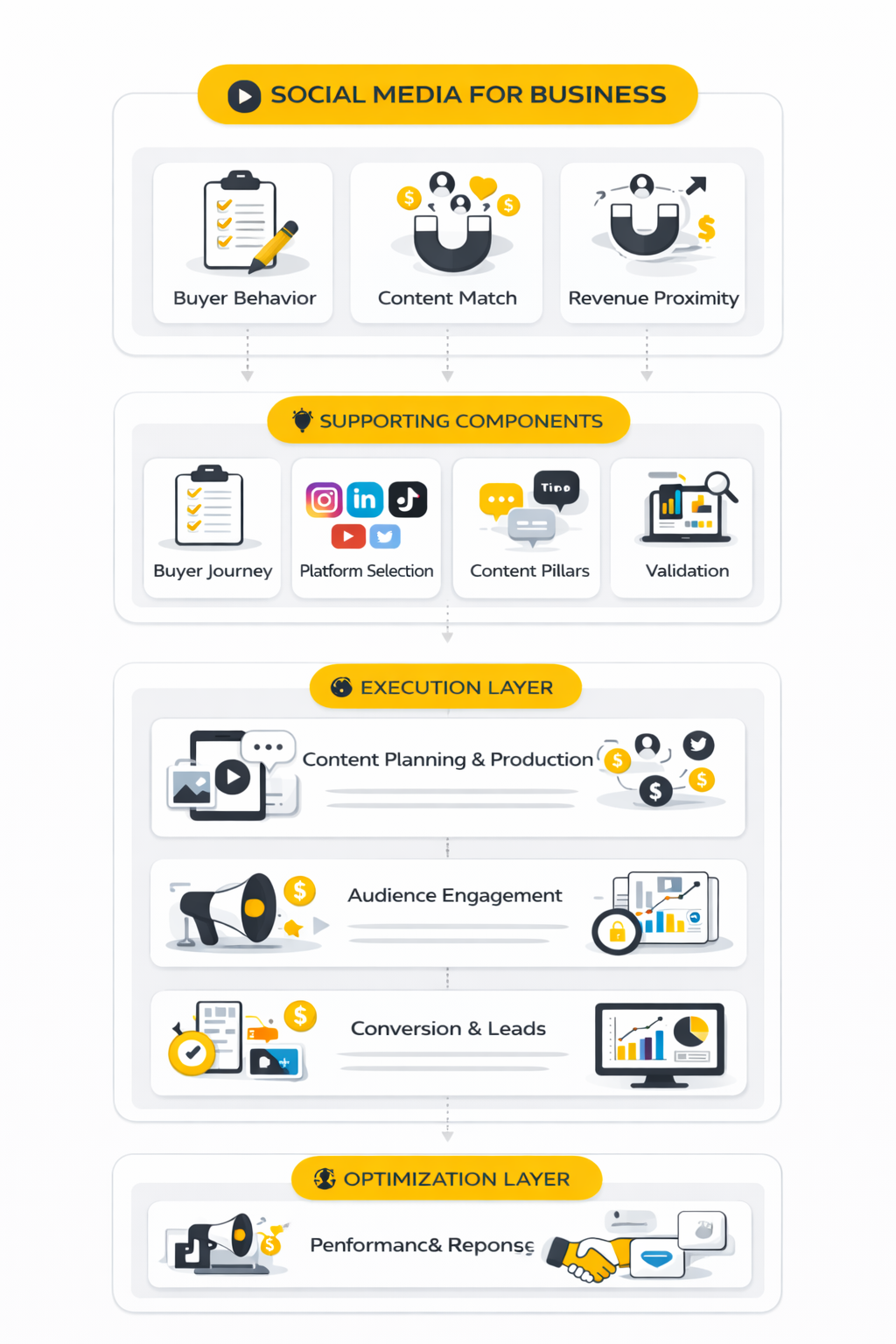
A strong ecosystem usually has a few clear layers. One layer handles content planning and publishing. Another handles community, lead capture, and response. Another handles conversion, follow-up, and sales handoff. The final layer handles reporting so the team can see what is actually improving instead of guessing. That is how social media for business moves from activity to leverage.
If you are serious about growth, the goal is not just to be present on social. The goal is to make social easier to run, easier to measure, and harder for competitors to copy. That usually means better systems, sharper positioning, and stronger follow-through after the audience shows intent.
FAQ
What is social media for business, really?
Social media for business is the use of platforms like LinkedIn, Instagram, Facebook, TikTok, YouTube, Pinterest, and Reddit to attract attention, build trust, support customer relationships, and drive measurable business outcomes. It is not just posting for visibility or trying to look active. It works best when every piece of content supports a larger commercial goal.
That goal can vary depending on the company. Some businesses want awareness. Others want leads, booked calls, direct purchases, or lower customer acquisition costs. The important part is tying the activity to a real business result.
Which platform should a business start with first?
Start with the platform that best matches buyer behavior, not the one getting the most hype. If the business depends on professional credibility and longer decision cycles, LinkedIn is often the best first move. If the business sells visually or emotionally, Instagram, TikTok, or Pinterest may be stronger.
The mistake is trying to launch everywhere at once. One strong primary platform usually beats five weak ones. Once that channel is working, you can add a supporting platform that deepens education, proof, or retargeting.
How often should a business post on social media?
The best posting frequency is the one your team can sustain without sacrificing clarity and quality. That sounds obvious, but a lot of brands break their system by committing to a volume they cannot support. Consistency matters more than inflated output.
This is why social media for business should be built around a realistic workflow instead of ambition alone. A steady weekly rhythm with useful content usually beats aggressive bursts followed by silence. Frequency only helps when the content still feels relevant and intentional.
How long does it take to see results?
That depends on the business model, platform, offer, and how good the execution is. Some businesses see traction quickly through direct messages, inbound inquiries, or better engagement. Others need more time because trust, authority, or education are a bigger part of the buying process.
The wrong expectation is instant payoff from a handful of posts. The right expectation is that content starts producing signals first, then conversations, then stronger conversion patterns if the system keeps improving. Social media for business usually rewards consistent iteration more than early perfection.
Is organic social media still worth it if paid ads exist?
Yes, because organic and paid solve different problems. Organic helps you learn what the market responds to, build trust over time, and reduce dependence on constant spend. Paid helps you scale distribution, test offers faster, and reach people with more control.
The smartest businesses use both together. Organic gives you message validation and credibility. Paid helps you push proven ideas further instead of funding guesswork from the start.
What metrics matter most?
The answer depends on the goal, but most businesses should track four categories: visibility, engagement quality, action, and business outcome. Visibility tells you whether people are seeing the content. Engagement quality tells you whether they care enough to respond, save, share, or click.
Action and outcome matter most in the long run. Those include leads, booked calls, purchases, close rates, and retention. That is why social media for business should never be judged only by follower count or impressions.
What is the biggest mistake businesses make on social media?
The biggest mistake is treating social like a content calendar instead of a business system. When that happens, teams publish disconnected posts, chase trends that do not fit their market, and measure whatever looks impressive rather than whatever drives action. The result is lots of effort and weak commercial return.
A close second is weak follow-up. If the content creates interest but nobody responds quickly or moves that intent into a clear next step, the business loses momentum. Nearly three-quarters of customers want brands to respond within 24 hours or less, which makes responsiveness part of the conversion process, not just customer support.
Should small businesses invest in tools right away?
Not all at once, but the right tools can remove friction fast. Small businesses usually need a publishing system, a basic lead-capture path, and a way to follow up consistently before they need a complex stack. The point is not buying software for the sake of it. The point is fixing clear operational bottlenecks.
For publishing and planning, a tool like Buffer can make execution simpler. For comment and direct-message automation, ManyChat can be useful when inbound interest starts getting missed.
How do you turn social media traffic into actual leads?
You need a clear next step that matches the audience’s level of intent. That could be a lead magnet, a booked call, a product page, a DM keyword flow, a simple form, or a short diagnostic. The important part is that the path feels obvious and low-friction.
This is where many businesses lose value. They create content that builds interest, then send people to a weak page or a confusing form. A stronger post-click experience with tools like Fillout, Cal.com, or GoHighLevel can make the difference between attention and pipeline.
Is social commerce a real opportunity or just a trend?
It is a real opportunity, but only for businesses that make buying feel easy and trustworthy. Deloitte’s social commerce research found 72% of consumers are willing to buy directly within social platforms, which tells you the buying behavior is already there. The opportunity is real, but it does not remove the need for strong offers, strong creative, and clear proof.
This matters because social media for business is getting closer to the sale than it used to be. For some brands, the platform itself becomes part of the checkout journey. For others, social works more as the trust-building layer that pushes buyers to a site, a form, or a sales conversation.
How can a business keep content quality high while scaling output?
By documenting standards before the workload gets too big. That means defining content pillars, tone, proof requirements, approval rules, and what good posts actually look like in practice. Without that structure, scale usually creates inconsistency.
A content backlog helps too. When your team is choosing from a bank of strong audience questions, objections, customer examples, and proof points, quality holds up much better. Starting from zero every week is one of the fastest ways to make scaling painful.
Should founders be visible on social, or should the brand account do all the work?
In many cases, founder visibility is a major advantage. People often trust a clear human voice faster than a polished brand voice, especially in B2B, services, consulting, education, and founder-led ecommerce. That does not mean every founder needs to become a creator, but it does mean hiding all expertise behind a logo can slow trust-building.
The best answer is often a mix. Let the brand account build consistency, proof, and offer clarity. Let the founder or key experts carry perspective, conviction, and narrative. Social media for business often gets stronger when the company feels human without becoming chaotic.
How do you know when to add another platform?
Add another platform when the first one is stable enough that expansion will not weaken the whole system. Stability means the workflow is documented, publishing is consistent, audience signals are clear, and the business is already capturing value from the current channel. If those pieces are still shaky, expansion usually creates noise instead of growth.
A good reason to add a platform is strategic fit. Maybe one channel is great for discovery while another is better for education or retargeting. A bad reason is fear of missing out because another platform looks exciting from the outside.
Can AI help with social media for business?
Yes, especially for speed, repurposing, workflow support, and first-draft production. It can help turn longer content into short-form posts, summarize calls, organize ideas, and speed up execution. Used well, it reduces repetitive work without replacing strategic thinking.
Used badly, it flattens the brand. If every post starts sounding polished but generic, the team may be saving time while losing distinctiveness. AI should support the system, not become the substitute for experience, judgment, and real point of view.
What should a business do first after reading this guide?
Start with one honest audit. Look at your current platforms, your content themes, your conversion path, and your reporting setup. Then identify the weakest link in the chain rather than trying to overhaul everything at once.
For some businesses, the weak link is platform choice. For others, it is inconsistent execution, weak offers, poor follow-up, or shallow analytics. Social media for business improves fastest when you solve the most expensive bottleneck first.
Work With Professionals
Explore 10K+ Remote Marketing Contracts on MarkeWork.com
Most marketers spend too much time chasing clients, competing on crowded platforms, and losing a percentage of every project to middlemen.
MarkeWork gives you a better way. Browse thousands of remote marketing contracts and connect directly with companies desperate to hire skilled marketers like you, without platform commissions and without unnecessary gatekeepers.
If you're serious about finding better opportunities and keeping 100% of what you earn, explore available contracts and create a profile for free at MarkeWork.com.