

Social media for real estate is no longer a side task you squeeze in after showings. It is part of how buyers, sellers, renters, investors, and referral partners decide whether you feel credible before they ever speak to you.
That does not mean every agent needs to dance on TikTok, post daily market rants, or chase every new platform. It means your social presence has to answer the same question your prospects are already asking: Can I trust this person with a major financial decision?
The opportunity is real, but so is the noise. The 2025 NAR REALTOR® Technology Survey found that social media is one of the most widely used technologies among REALTORS®, while Zillow’s 2025 buyer research showed that 41% of prospective buyers said they were more likely to hire an agent with a social media presence. That is not a reason to post randomly. It is a reason to build a system.
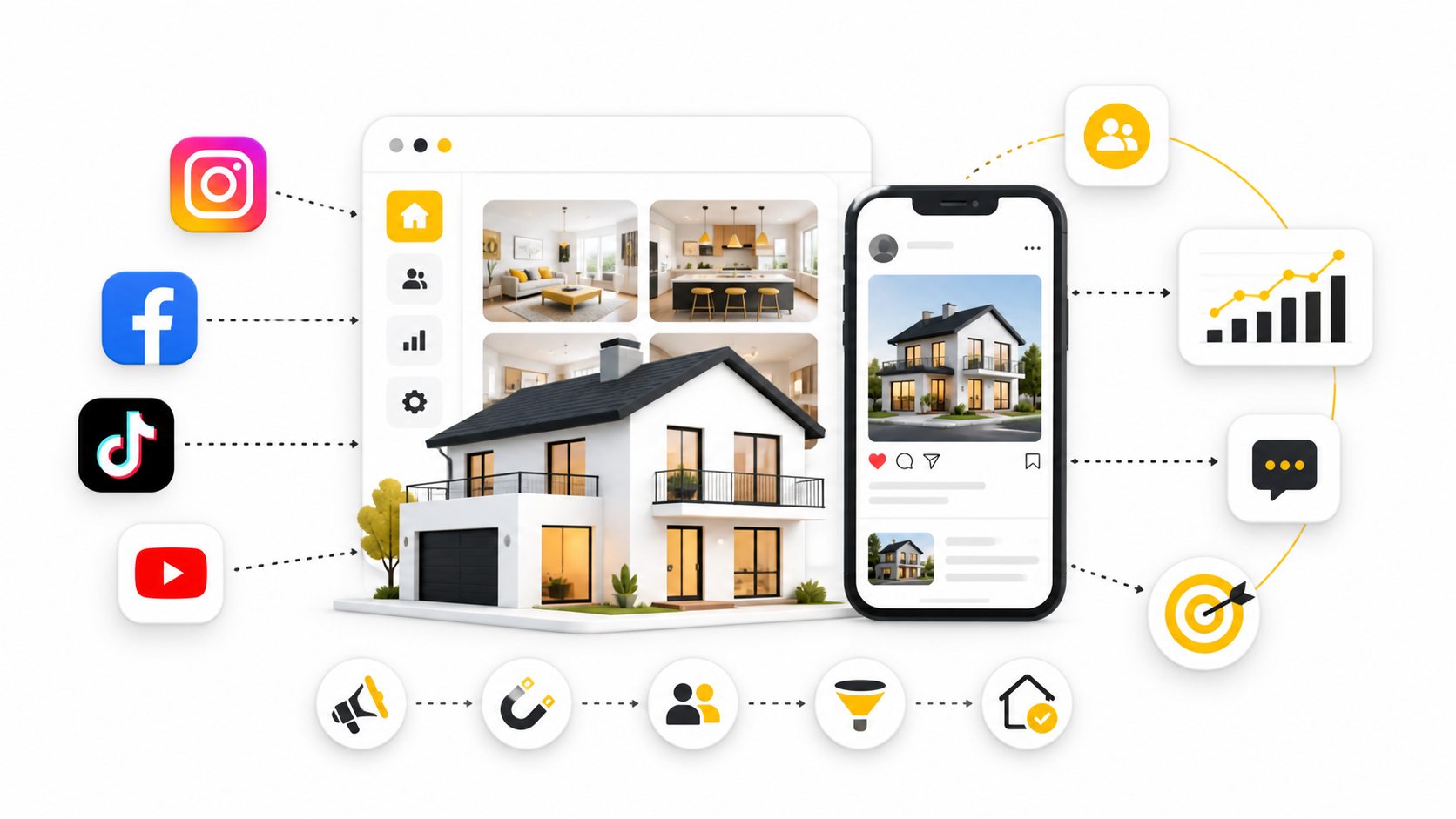
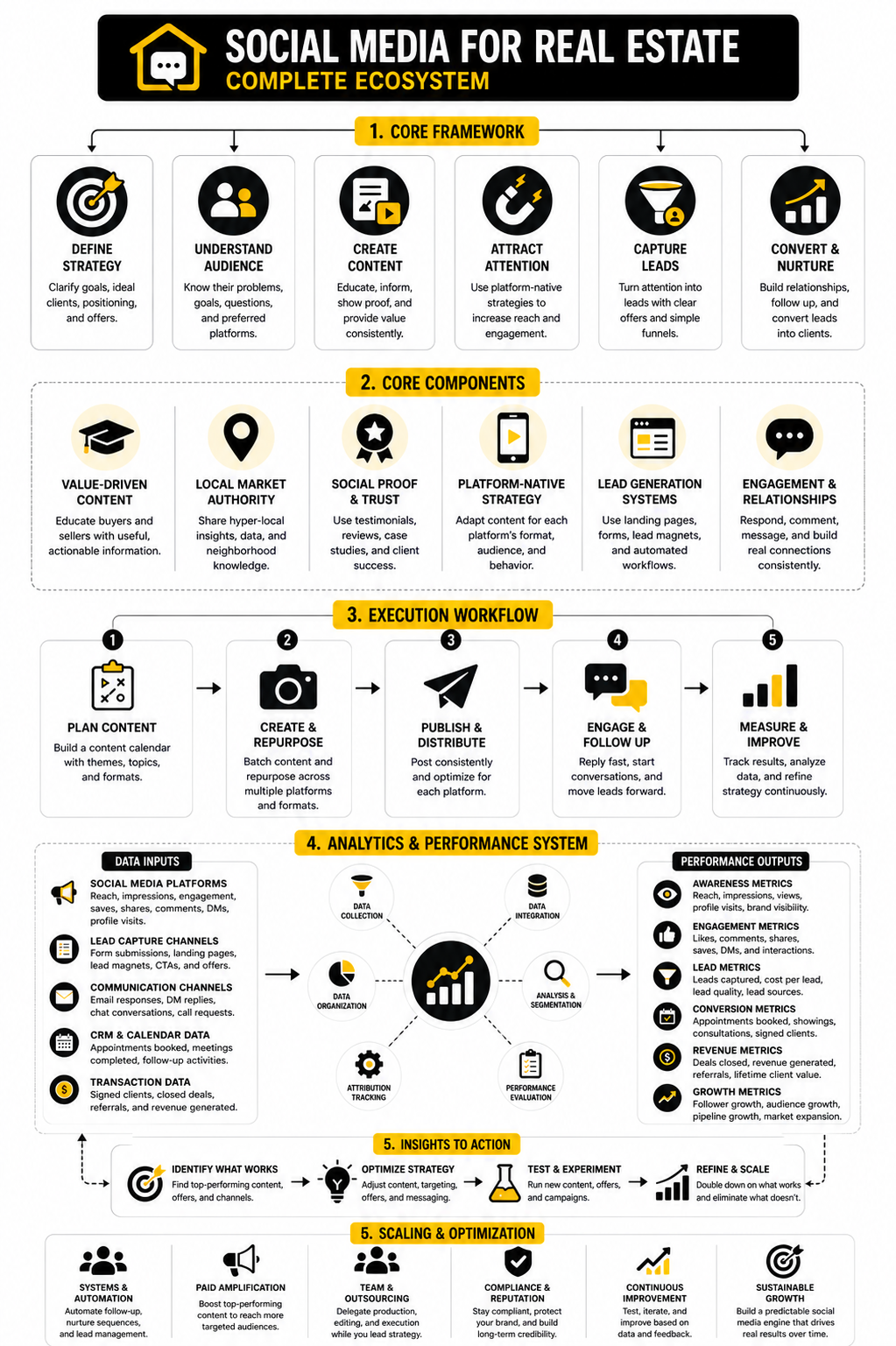
This article breaks social media for real estate into six practical parts:
- Why Social Media Matters In Real Estate Now
- The Real Estate Social Media Framework
- Core Components Of A Strong Social Presence
- Content That Builds Trust Before The First Call
- Professional Implementation Without Wasting Time
- Measurement, Optimization, And Common Questions
Why Social Media Matters In Real Estate Now
Real estate has always been a relationship business, but the way people check those relationships has changed. Before someone asks for a valuation, books a buyer consultation, or refers you to a friend, they may look at your Instagram, Facebook, LinkedIn, YouTube, or Google profile. Your social content becomes a trust filter.
That matters because attention is fragmented. Pew’s latest social media data shows that YouTube and Facebook remain the most widely used social platforms among U.S. adults, while Instagram, TikTok, LinkedIn, Reddit, and Snapchat each reach different audience segments. For real estate, that means the best platform is not always the trendiest one. It is the platform where your local buyers, sellers, landlords, tenants, or investors already pay attention.
The bigger shift is behavioral. People are using social media to evaluate competence, personality, responsiveness, market knowledge, and local familiarity. A seller does not only want to know that you can list a home. They want to see whether you understand pricing, presentation, buyer psychology, negotiation, and the local market.
The Real Estate Social Media Framework
A strong real estate social media strategy has four jobs: visibility, trust, conversion, and retention. Visibility helps new people discover you. Trust helps them believe you are credible. Conversion gives them a clear next step. Retention keeps past clients and referral sources warm long after closing.
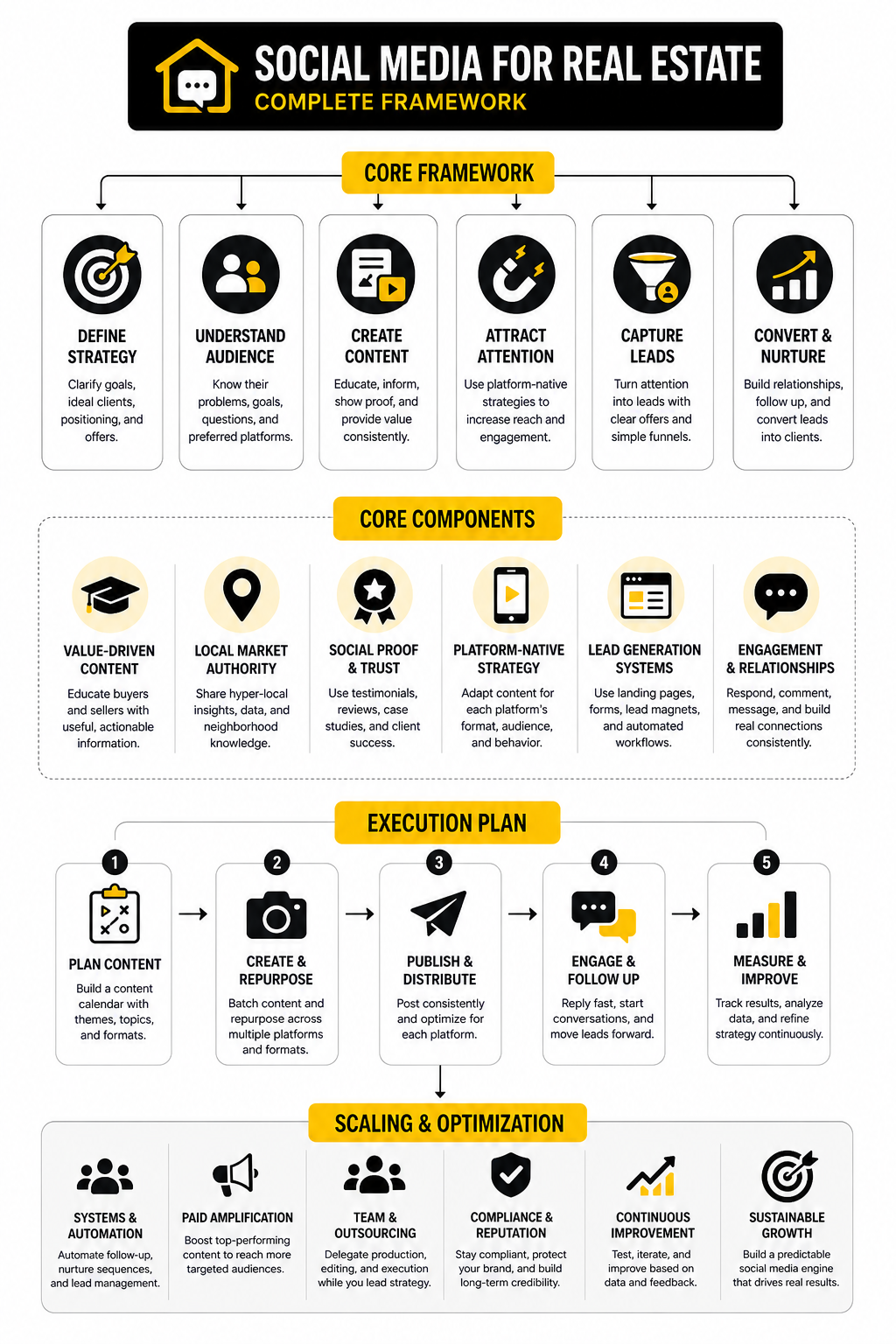
Most agents struggle because they treat social media as a content calendar instead of a business system. Posting a listing, a closing photo, and a market update is not a strategy by itself. The strategy is knowing who each post is for, what belief it should build, and what action should become easier after someone sees it.
The framework is simple: define your audience, choose your platforms, build repeatable content pillars, capture demand, and follow up properly. Tools can help, but tools do not replace positioning. A scheduler like Buffer can make consistency easier, but the real leverage comes from having clear messages worth scheduling.
Core Components Of A Strong Social Presence
Your profile is the first component. It should quickly explain who you help, where you work, what kind of real estate problems you solve, and how someone can contact you. If a motivated seller lands on your page and cannot tell your market, specialty, or next step within a few seconds, the page is underperforming.
Your content is the second component. Good real estate content does not only say “just listed” or “sold.” It teaches people how to think about timing, pricing, financing, inspections, neighborhoods, negotiation, and the trade-offs behind real decisions.
Your follow-up system is the third component. Social media creates conversations, but conversations disappear when they are not captured. That is where a CRM, forms, automation, and simple response workflows become important, especially if your content starts generating serious inquiries.
Content That Builds Trust Before The First Call
Social media for real estate works best when it reduces uncertainty. People do not wake up wanting more posts from agents. They want clarity about money, timing, neighborhoods, risks, and what happens next.
That is why educational content usually beats generic self-promotion. A buyer who understands inspection contingencies is more likely to trust the agent who explained them clearly. A seller who sees how pricing strategy changes after the first two weeks on market is more likely to respect the agent who can explain the trade-off without sounding desperate.
The best content makes your thinking visible. Do not just say the market is changing. Explain what changed, who it affects, what buyers or sellers should watch, and what you would do differently because of it.
Local Market Explainers
Local market content should be specific enough to be useful, but not so dense that it feels like a spreadsheet. Talk about inventory, days on market, pricing pressure, buyer demand, seller concessions, and neighborhood-level differences in plain English. The point is not to overwhelm people with data; the point is to help them interpret what the data means for their next decision.
This is where many agents miss the mark. They post a market report, add “call me if you have questions,” and move on. A stronger version explains why one segment is moving faster than another, why a certain price range is more competitive, or why a seller may need a different strategy than six months ago.
The 2025 NAR Profile of Home Buyers and Sellers shows how much real estate behavior depends on buyer type, financing, age, household situation, and market conditions. That is your opening. Instead of making broad claims, create content that helps each audience understand their own situation more clearly.
Buyer And Seller Education
Buyer education should focus on the decisions people are scared to get wrong. That includes pre-approval, down payments, offer terms, inspections, appraisals, closing costs, and what actually makes an offer competitive. Keep it practical. The best buyer content sounds like something you would say across a coffee table, not like a textbook.
Seller education should focus on preparation, pricing, presentation, timing, negotiation, and net proceeds. A seller does not need another vague post about “curb appeal.” They need to understand why repairs, staging, photography, pricing, and launch timing work together.
This is also where short-form video can be powerful. A 45-second explanation of “three things that make buyers hesitate during a showing” can do more for trust than a polished graphic with no point of view. Social media rewards clarity, but clients reward judgment.
Proof Without Bragging
Proof matters, but bragging gets old fast. A closing photo can be useful when it gives context, teaches a lesson, or celebrates the client without making the agent the hero. The difference is tone.
Instead of posting only “sold over asking,” explain what made the result possible. Was it preparation before launch? Better pricing discipline? Strong showing feedback? A negotiation move that protected the client’s terms?
The goal is to show competence without turning every result into a victory lap. Reviews, testimonials, and client wins can support your credibility, but they should feel earned and specific. In a market where trust is becoming harder to manufacture, real substance beats loud claims.
Platform-Native Content
Every platform has its own rhythm. Instagram is strong for visual storytelling, reels, neighborhood content, listing clips, and quick educational posts. Facebook still matters for local relationships, community visibility, groups, and past-client engagement, especially because Pew’s 2025 social media research shows Facebook remains widely used across U.S. adults.
LinkedIn works better when your real estate business touches investors, relocation, professional networks, commercial relationships, or higher-trust referral conversations. YouTube is stronger for evergreen search-driven content, longer market explainers, neighborhood guides, and buyer or seller education that can keep working after the week you publish it.
Do not copy and paste the same post everywhere without thinking. The message can stay consistent, but the format should fit the platform. A neighborhood guide may become a YouTube video, a carousel on Instagram, a shorter Facebook post, and a LinkedIn angle about relocation trends.
Lead Capture Content
Not every post needs a call to action, but your overall content system needs clear paths for people who are ready to move. A buyer guide, seller checklist, home valuation request, relocation form, showing request, webinar, or consultation link can turn passive attention into a real conversation. This matters because social media without follow-up becomes entertainment, not pipeline.
Use simple offers that match intent. A first-time buyer does not need a complex funnel; they may need a clear checklist and a way to ask questions. A seller thinking about listing in three months may need a preparation plan and a realistic pricing conversation.
For agents who want a more organized lead flow, a platform like GoHighLevel can connect landing pages, forms, CRM follow-up, SMS, email, and appointment booking in one system. That only works if the offer is genuinely useful. Automation can speed up follow-up, but it cannot rescue weak positioning.
Professional Implementation Without Wasting Time
The execution problem is not that agents lack ideas. The problem is that social media for real estate becomes chaotic when every post is created from scratch, every caption starts with a blank page, and every inquiry gets handled differently. That is how you end up busy, inconsistent, and still unsure whether the work is producing actual business.
A better process starts with batching. Instead of asking “What should I post today?” build a weekly rhythm around a few repeatable content types: one local market explanation, one buyer or seller education post, one proof-based post, one community post, and one direct response offer. This gives you enough variety without turning content into a full-time job.
The goal is not to become a content creator who happens to sell real estate. The goal is to become a real estate professional whose content makes trust easier to build.
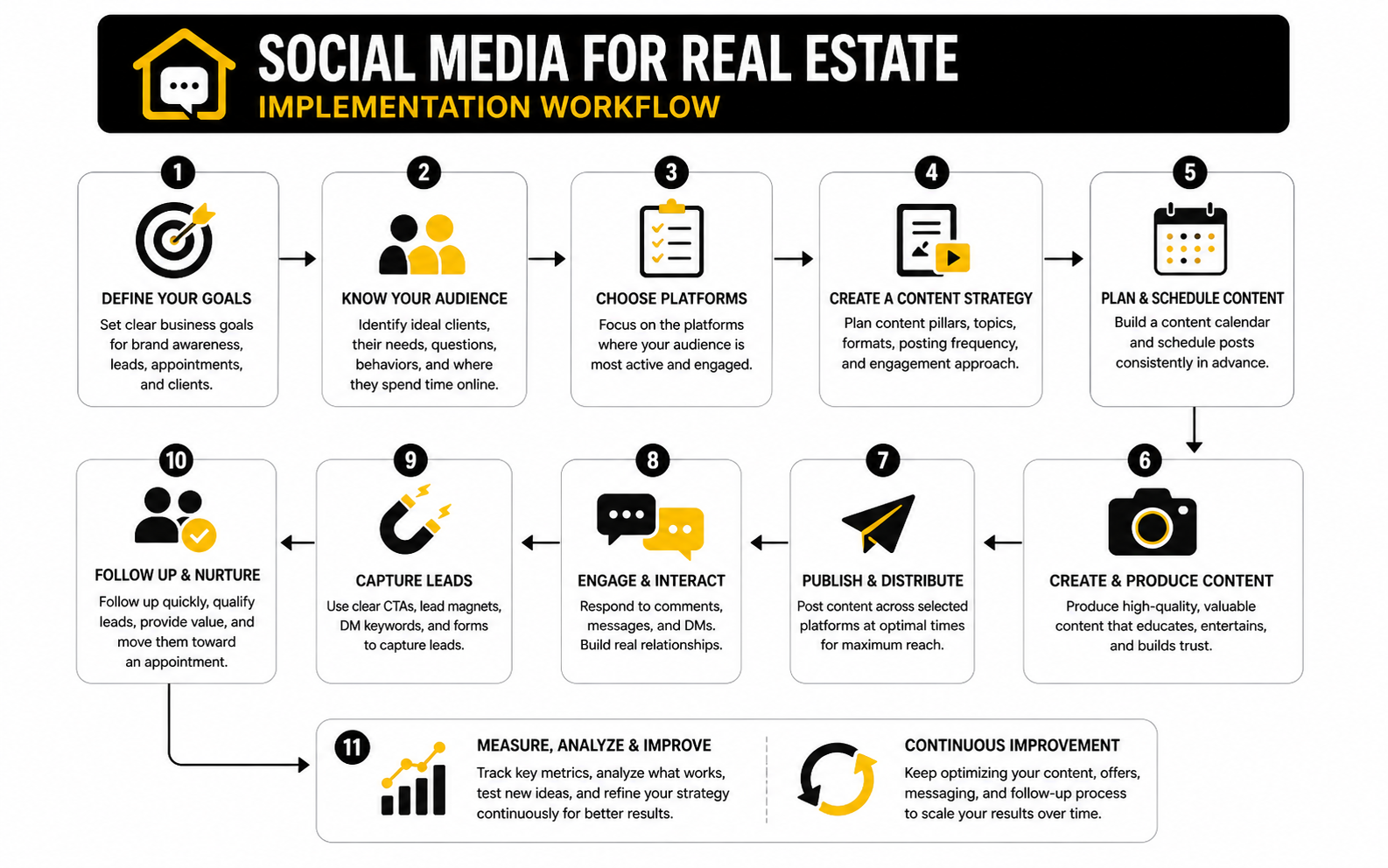
Step 1: Define The Audience And Offer
Start by deciding who the content is meant to attract. First-time buyers need different guidance than move-up sellers, downsizers, investors, luxury buyers, relocation clients, or landlords. When the audience is vague, the content becomes vague too.
Then match that audience with a useful offer. A first-time buyer may respond to a consultation, affordability checklist, or neighborhood comparison. A seller may respond to a pre-listing preparation plan, pricing review, or home valuation request.
This does not need to be complicated. The offer should simply answer the next question a motivated person already has. If someone watches three videos about selling inherited property, the next step should not be a generic “contact me.” It should be a clear invitation to discuss timing, preparation, pricing, and net proceeds.
Step 2: Build A Weekly Content System
A weekly system keeps your marketing from depending on mood. Pick your main publishing days, choose your formats, and decide what gets created in batches. Most agents can start with three to five useful posts per week before worrying about daily volume.
A practical weekly mix might look like this:
- One local market insight
- One buyer or seller education post
- One neighborhood or community post
- One client-result or process-based proof post
- One direct call-to-action post
This gives you balance. You are not only teaching, not only selling, and not only posting listings. You are creating a public body of work that shows how you think, how you serve, and why someone should trust you.
Step 3: Create Once, Repurpose Intelligently
Repurposing is where the process becomes efficient. A five-minute market video can become a short Reel, a LinkedIn post, a Facebook update, an email paragraph, and a short script for a follow-up message. The core idea stays the same, but the format changes.
This is why long-form thinking helps even when short-form content gets more attention. If you can explain one useful concept clearly, you can break it into multiple smaller assets. A neighborhood guide can become a carousel, a short video, a checklist, and a buyer consultation talking point.
A scheduling tool like Buffer can help keep that repurposed content organized across platforms. Just do not let scheduling turn into autopilot. Real estate is local, personal, and time-sensitive, so your system still needs room for timely updates and real conversations.
Step 4: Set Up Lead Capture And Follow-Up
Once content starts creating attention, you need a clean way to capture interest. That might be a form for valuation requests, a buyer consultation page, a relocation inquiry form, or a simple booking link. The important part is that interested people do not have to hunt for the next step.
Your follow-up should be fast, specific, and human. If someone asks about selling, do not send a generic drip sequence and disappear. Ask about timing, property condition, motivation, and whether they need a pricing opinion, preparation plan, or listing timeline.
For agents who want the CRM, forms, automations, and appointment flow in one place, GoHighLevel can make the process easier to manage. For simpler form-based capture, Fillout can work well when you need clean intake forms for buyers, sellers, or relocation leads.
Step 5: Stay Compliant Before You Scale
Real estate marketing is not the place to be careless. Social media posts can still be advertising, and advertising can trigger legal, brokerage, MLS, fair housing, and platform rules. This becomes especially important when you promote listings, testimonials, financing language, targeting, or neighborhood claims.
Meta requires housing-related advertisers to use its housing ad category, which comes with targeting restrictions for Facebook and Instagram campaigns through its housing ad rules. NAR also emphasizes that real estate professionals need to understand the legal and ethical responsibilities that come with using social media as a marketing tool through its social media best practices guidance.
This is not meant to scare you away from posting. It means your implementation process should include a simple compliance check before content goes live. Verify listing permissions, avoid protected-class targeting, keep claims truthful, follow brokerage rules, and never imply guarantees you cannot support.
Statistics And Data
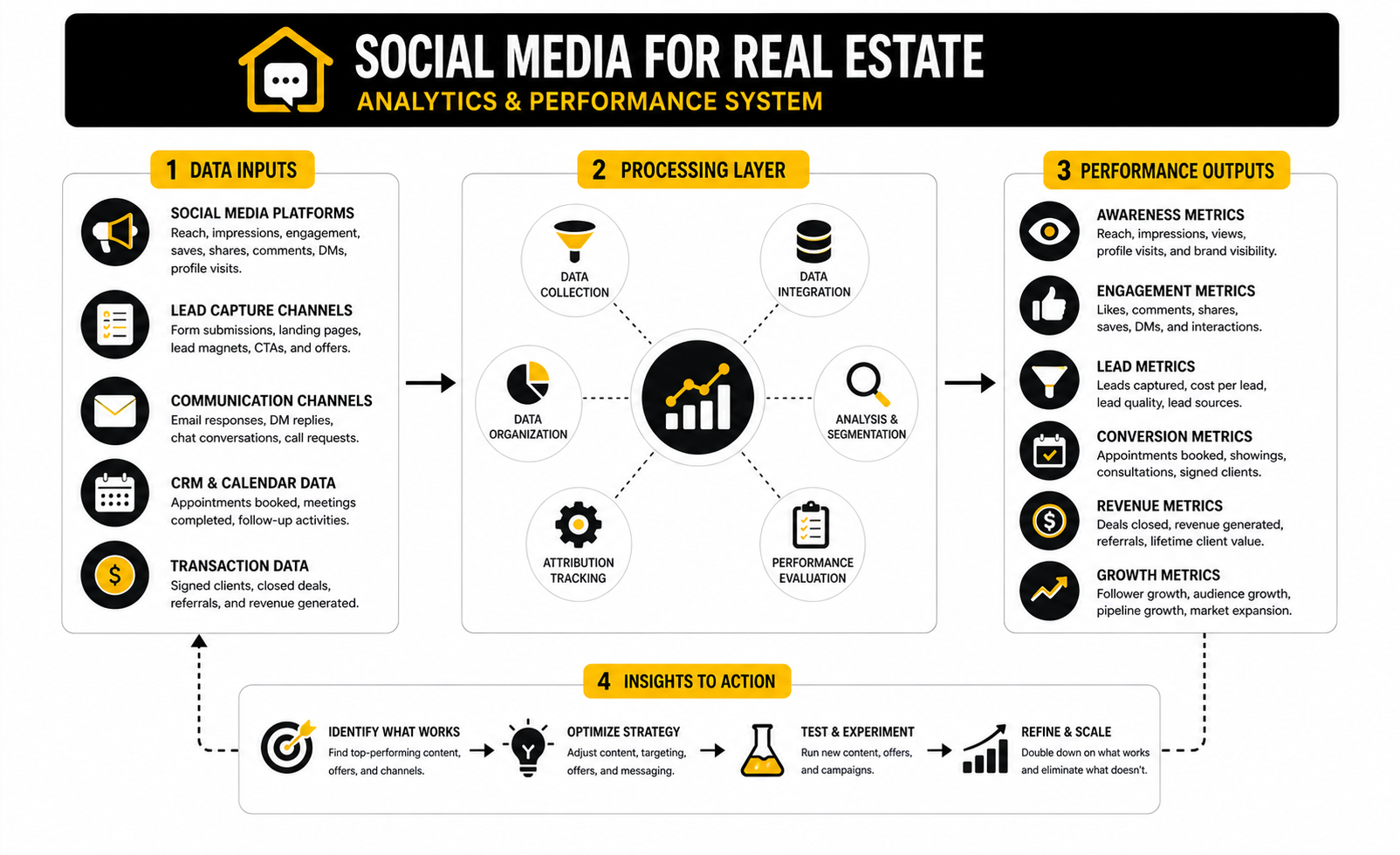
Measurement is where social media for real estate becomes serious. Without it, you are guessing. You may feel busy because you are posting, replying, filming, editing, and checking notifications, but activity is not the same as pipeline.
The numbers that matter are not only likes, views, or followers. Those can show attention, but they do not automatically show buyer intent, seller intent, appointment quality, or future referrals. A small audience that sends serious listing inquiries is more valuable than a large audience that only watches and scrolls away.
The right way to read the data is to connect each metric to a business question. Are more local people discovering you? Are the right people engaging? Are conversations turning into appointments? Are appointments turning into signed clients? That is the measurement chain that actually matters.
Reach Shows Whether The Market Can See You
Reach tells you how many people had a chance to notice your content. It matters because trust cannot compound if your posts are invisible. But reach by itself is only the top of the funnel.
A high-reach post can still be weak if it attracts the wrong audience. A funny real estate meme may get attention, but it may not bring you closer to a serious buyer consultation or seller appointment. This is why reach should always be interpreted with audience quality.
Platform choice also affects reach expectations. Pew’s 2025 social media research shows that YouTube reaches 84% of U.S. adults and Facebook reaches 71%, while Instagram, TikTok, LinkedIn, Reddit, WhatsApp, Snapchat, X, Pinterest, Threads, Bluesky, and Truth Social each have different demographic patterns. For real estate agents, that means you should not judge every platform by the same number. A platform with lower total reach may still be valuable if it reaches the exact audience you serve.
Engagement Shows Whether People Care
Engagement tells you whether people are reacting, saving, sharing, commenting, clicking, or messaging. This matters because real estate decisions usually require trust, and trust often starts with repeated low-friction interactions. A saved post about closing costs can be more meaningful than a casual like on a listing photo.
Still, engagement rates need context. Dash Social’s H1 2025 real estate benchmark report showed TikTok at a 3.1% engagement rate and Instagram at 0.3% for real estate brands in its dataset. That does not mean your exact target should be 3.1% or 0.3%. It means platform behavior, content format, audience size, and account type can change the numbers dramatically.
Use engagement to compare your own content against your own baseline. If neighborhood explainers consistently get saves and shares, make more of them. If listing posts get reach but no messages, improve the story around the listing instead of assuming the platform is broken.
Leads Show Whether Attention Is Becoming Opportunity
Lead metrics matter because they connect content to business outcomes. Track profile clicks, website visits, form submissions, DMs, booking requests, valuation inquiries, buyer consultations, relocation questions, and repeat conversations. These are stronger signals than likes because they show intent.
The 2025 NAR REALTOR® Technology Survey found that social media was the top lead-generating technology for REALTORS® at 39%, ahead of CRM at 23% and local MLS at 17%. That number matters because it confirms social is not just a branding channel for agents. It can create direct demand when the content, offer, and follow-up are aligned.
Zillow’s 2025 consumer research also found that 41% of prospective buyers said they were more likely to hire an agent with a social media presence. The practical takeaway is simple: your content should make the next step obvious. If someone is convinced but cannot quickly request help, you are leaking opportunity.
Conversion Shows Whether The System Works
Conversion is the point where social media stops being a visibility game and becomes a revenue system. You want to know how many conversations become appointments, how many appointments become clients, and how many clients become closings or referrals. This is where most agents find the real bottleneck.
Sometimes the content is fine, but the offer is weak. Sometimes the offer is fine, but the follow-up is slow. Sometimes the follow-up is fine, but the consultation process does not create enough confidence for the person to move forward.
Track the full path, not just the first click. If you use GoHighLevel, keep social leads tagged by source, offer, platform, and campaign so you can see which posts and follow-up paths produce real conversations. If you use a simpler setup, even a spreadsheet can work at first, as long as you actually update it.
Benchmarks Should Guide You, Not Control You
Benchmarks are useful, but they can also become a distraction. Real estate is local, and a luxury listing agent in Miami, a first-time buyer specialist in Cleveland, and a rural land agent in Texas should not expect identical numbers. Their audiences, content styles, price points, and sales cycles are different.
Use external benchmarks to understand the environment, then use your own data to make decisions. Your best benchmark is last month’s performance against this month’s performance. Are you reaching more relevant people? Are more people saving, sharing, messaging, booking, or referring?
The cleanest measurement habit is a monthly review. Look at your top posts, your strongest lead sources, your fastest follow-up paths, and your weakest conversion points. Then make one practical change for the next month. That is how social media for real estate improves without turning analytics into a second job.
Advanced Strategy, Tradeoffs, And Scaling
Once the basics are working, social media for real estate becomes less about posting and more about strategic decisions. This is where most agents either plateau or start building something that compounds. The difference usually comes down to focus, positioning, and how well the system handles growth.
At this level, you are no longer asking “what should I post.” You are asking “what kind of business do I want this content to create?” That shift changes everything, from platform choice to content depth to how aggressively you capture and qualify leads.
Niche Positioning Beats Generic Visibility
Trying to appeal to everyone usually leads to being remembered by no one. A general real estate feed can get decent engagement, but it often struggles to convert because the message is too broad. People trust specialists faster than generalists when the decision involves money and risk.
Niche positioning does not mean limiting your business forever. It means leading with a clear entry point. That could be first-time buyers in a specific city, relocation clients, investors, luxury homes, new construction, or downsizers. Once someone trusts you for one category, expansion becomes easier.
The tradeoff is obvious. A narrower message reduces total audience size, but it increases relevance, trust, and conversion. In practice, the second outcome usually produces more business.
Depth Over Volume
There is a point where posting more does not produce better results. If the content lacks depth, the audience stops taking it seriously. Real estate decisions are complex, and shallow content rarely builds enough confidence for someone to take action.
Depth means explaining tradeoffs, not just outcomes. It means showing what can go wrong, not only what works. It means walking through decisions step by step instead of summarizing them into vague advice.
The tradeoff is time. Deeper content takes longer to produce and requires clearer thinking. But it also has a longer lifespan. A strong market explainer or buyer guide can generate trust for months, while a quick post often disappears in a day.
Organic And Paid Should Work Together
Organic content builds trust and credibility. Paid distribution amplifies the best-performing messages to a larger, targeted audience. Treating them as separate systems leaves growth on the table.
The practical approach is simple. Let organic content show you what resonates. Then take your strongest posts and promote them to the right audience using paid campaigns. This reduces guesswork because you are not starting from zero.
The tradeoff is cost versus control. Paid campaigns can accelerate results, but they require clear targeting, compliance, and consistent follow-up. If your organic system is weak, paid traffic will expose those weaknesses faster.
Speed Of Response Becomes A Competitive Advantage
As your content starts generating more inquiries, response speed becomes critical. A buyer or seller who reaches out is often comparing multiple agents at the same time. The first agent to respond clearly and helpfully has a measurable advantage.
This is where systems matter. You can use tools like ManyChat to handle initial responses, qualify basic questions, and guide people to the right next step without losing momentum. The goal is not to replace human interaction, but to make sure no serious inquiry sits unanswered.
The tradeoff is personalization versus scale. Automation can improve speed, but it must still feel relevant and human. A generic automated reply can damage trust just as quickly as no reply at all.
Scaling Without Losing Authenticity
Scaling social media for real estate often introduces a new problem: the content starts to feel corporate, detached, or repetitive. That usually happens when production is outsourced without clear direction or when the original voice gets diluted.
The solution is to separate thinking from execution. You can delegate editing, scheduling, formatting, and distribution, but the core ideas, insights, and opinions should still come from you. That is what people are actually following.
A hybrid model works well:
- You define topics, angles, and key points
- A team helps turn those ideas into multiple formats
- You stay involved in review and final messaging
The tradeoff is control versus efficiency. Full control slows you down. Full outsourcing weakens your voice. The middle ground keeps both quality and scale intact.
Reputation Risk And Long-Term Thinking
Everything you publish becomes part of your public track record. In real estate, that matters more than in many other industries because trust is tied to financial decisions and long-term relationships.
Content that overpromises, oversimplifies, or misrepresents situations may perform well in the short term but can damage credibility later. The same applies to controversial takes that attract attention without adding real value.
A long-term approach prioritizes consistency over spikes. It focuses on building a body of work that a potential client can scroll through and think, “This person knows what they are doing.” That is what turns social media from a marketing channel into a reputation engine.
Final System For Real Estate Social Media
A strong real estate social media system is not one platform, one viral post, or one clever caption. It is the combination of positioning, useful content, clear offers, fast follow-up, compliant execution, and honest measurement. When those pieces work together, your content starts doing more than filling a feed.
The final goal is simple: make it easier for the right people to trust you before they need you. That means buyers understand your guidance, sellers understand your judgment, past clients remember your value, and referral partners see that you are active, professional, and easy to recommend.
Social media for real estate works when it feels like a natural extension of how you already serve clients. Keep it practical, keep it specific, and keep improving the system instead of chasing every trend.
FAQ - Built For Complete Guide
What is social media for real estate?
Social media for real estate is the use of platforms like Instagram, Facebook, LinkedIn, YouTube, TikTok, and others to build visibility, trust, and client conversations around real estate services. It includes educational content, local market updates, listing promotion, client proof, neighborhood content, and lead capture. The best version is not random posting; it is a structured marketing system that supports your business goals.
Why is social media important for real estate agents?
It matters because people research agents before they reach out. A strong social presence helps prospects understand your market knowledge, communication style, and professional credibility. The 2025 NAR REALTOR® Technology Survey found that social media remained the top lead-generating technology for REALTORS®, which makes it too important to treat casually.
Which social media platform is best for real estate?
There is no single best platform for every agent. Instagram is strong for visual storytelling and short-form education, Facebook is useful for local relationships and community visibility, LinkedIn works well for professional networks and referrals, and YouTube is powerful for searchable long-form content. The best choice depends on your audience, market, content style, and follow-up process.
How often should real estate agents post on social media?
Most agents should start with three to five high-quality posts per week instead of chasing daily volume. Consistency matters, but relevance matters more. A simple weekly mix of market insight, client education, community content, proof, and a clear offer is usually stronger than posting filler content every day.
What kind of content works best for real estate social media?
The strongest content usually helps people make better decisions. That includes market explainers, buyer education, seller preparation tips, neighborhood guides, pricing breakdowns, inspection advice, financing questions, and behind-the-scenes process content. Listings and closing posts can work too, but they perform better when they teach something or show your professional judgment.
Should real estate agents use video?
Yes, video is useful because it lets people hear your voice, see your personality, and understand how you explain decisions. Short-form video can be strong for quick education and local updates, while longer video works well for neighborhood guides, buyer walkthroughs, seller strategy, and market analysis. You do not need perfect production; you need clarity, usefulness, and consistency.
How do real estate agents get leads from social media?
Leads usually come from a combination of useful content, clear calls to action, and fast follow-up. A buyer may respond to a consultation offer, a seller may request a valuation, and a relocation client may fill out a form after watching local content. Tools like GoHighLevel, Fillout, and ManyChat can help capture and route inquiries, but the offer still has to be relevant.
What should real estate agents avoid posting?
Avoid misleading claims, unsupported market predictions, lazy listing spam, overhyped guarantees, and content that creates fair housing or compliance risk. Also avoid making every post about yourself. The content should help the audience understand their decisions, not just prove that you are busy.
How should agents measure social media performance?
Measure the full path from visibility to revenue. Track reach, engagement, saves, shares, profile visits, DMs, form submissions, appointments, signed clients, closings, and referrals. The most useful question is not “Did this post get likes?” It is “Did this content move the right people closer to a real conversation?”
Is paid social media advertising worth it for real estate?
Paid social can be worth it when the organic message, offer, landing page, and follow-up are already working. It is risky when agents use ads to push weak content to cold audiences without a clear next step. Housing ads also need careful compliance because Meta applies special restrictions to housing-related campaigns through its housing ad policies.
Can new agents use social media effectively?
Yes, but new agents should not pretend to have more experience than they do. They can build trust by explaining what they are learning, sharing local market research, answering common questions, documenting their process, and leaning on brokerage resources where appropriate. Honesty builds more credibility than fake authority.
Should agents outsource their social media?
Outsourcing can help with editing, design, scheduling, repurposing, and reporting. The agent should still guide the ideas, opinions, local insights, and final voice. If everything is outsourced without direction, the content often becomes generic, and generic content is easy to ignore.
Work With Professionals
Explore 10K+ Remote Marketing Contracts on MarkeWork.com
Most marketers spend too much time chasing clients, competing on crowded platforms, and losing a percentage of every project to middlemen.
MarkeWork gives you a better way. Browse thousands of remote marketing contracts and connect directly with companies desperate to hire skilled marketers like you, without platform commissions and without unnecessary gatekeepers.
If you're serious about finding better opportunities and keeping 100% of what you earn, explore available contracts and create a profile for free at MarkeWork.com.