

Social media management agencies have quietly become one of the most critical growth levers for modern brands. What used to be a “nice-to-have” marketing function is now a primary revenue channel, with platforms like Instagram, TikTok, and LinkedIn directly influencing buying decisions at scale.
Recent data from Statista shows global social media users exceeding 5 billion, while HubSpot reports that over 70% of marketers say social media delivers strong ROI when executed correctly. The gap isn’t access to platforms—it’s execution. That’s where social media management agencies come in.
Businesses don’t struggle because they lack content ideas. They struggle because they lack systems, consistency, and performance tracking. Agencies solve that by combining strategy, content, automation, and analytics into a repeatable engine.
But not all agencies operate the same way. Some post content. Others build growth machines.
This article breaks down exactly how the best social media management agencies work, what makes them effective, and how to evaluate or build one yourself.
Article Outline
- Why Social Media Management Agencies Matter More Than Ever
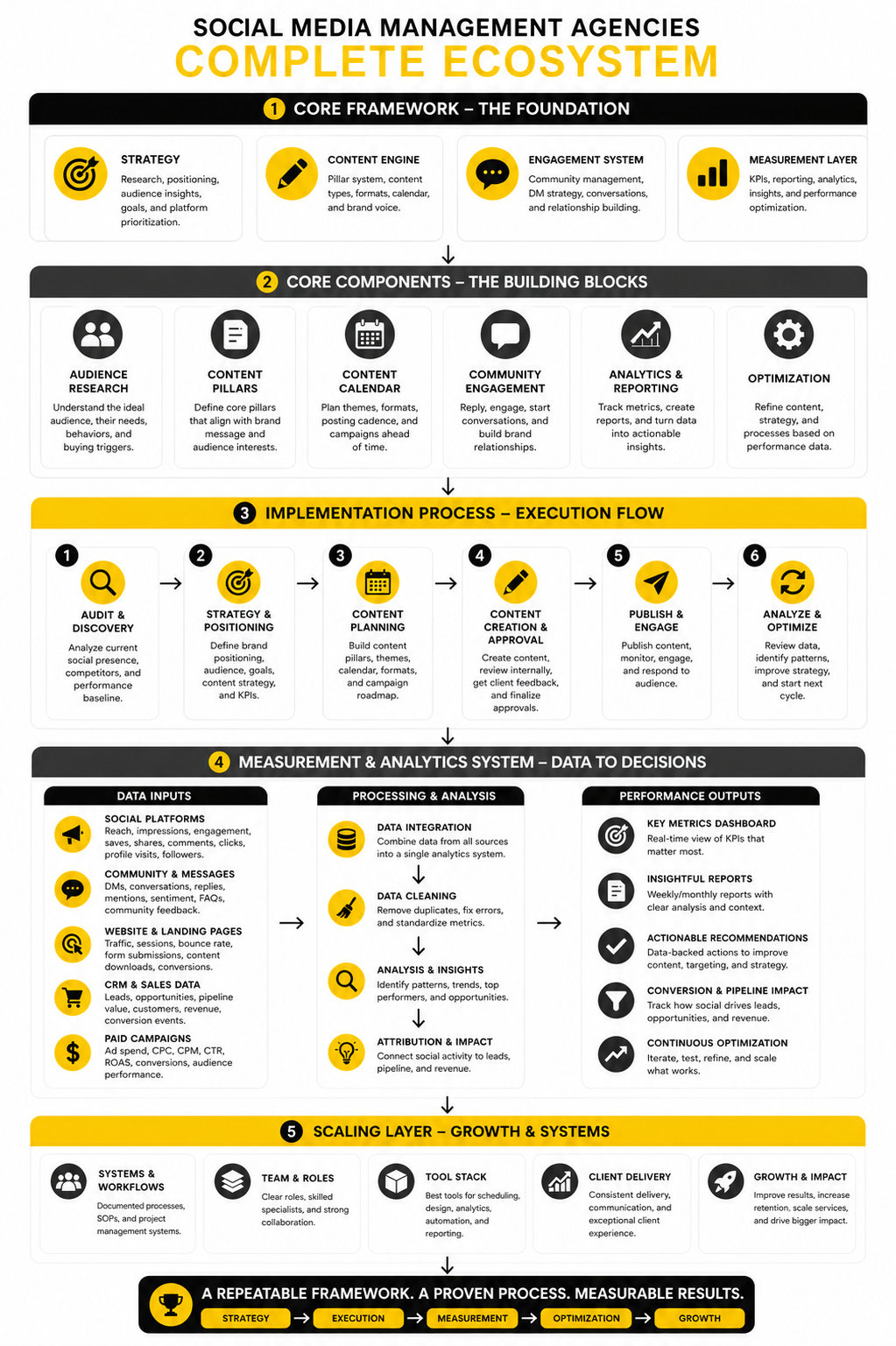
- Social Media Growth Framework Overview
- Core Components of High-Performing Agencies
- How Professional Agencies Execute at Scale
- Measuring ROI and Performance in Social Media
- Choosing or Building the Right Agency Model
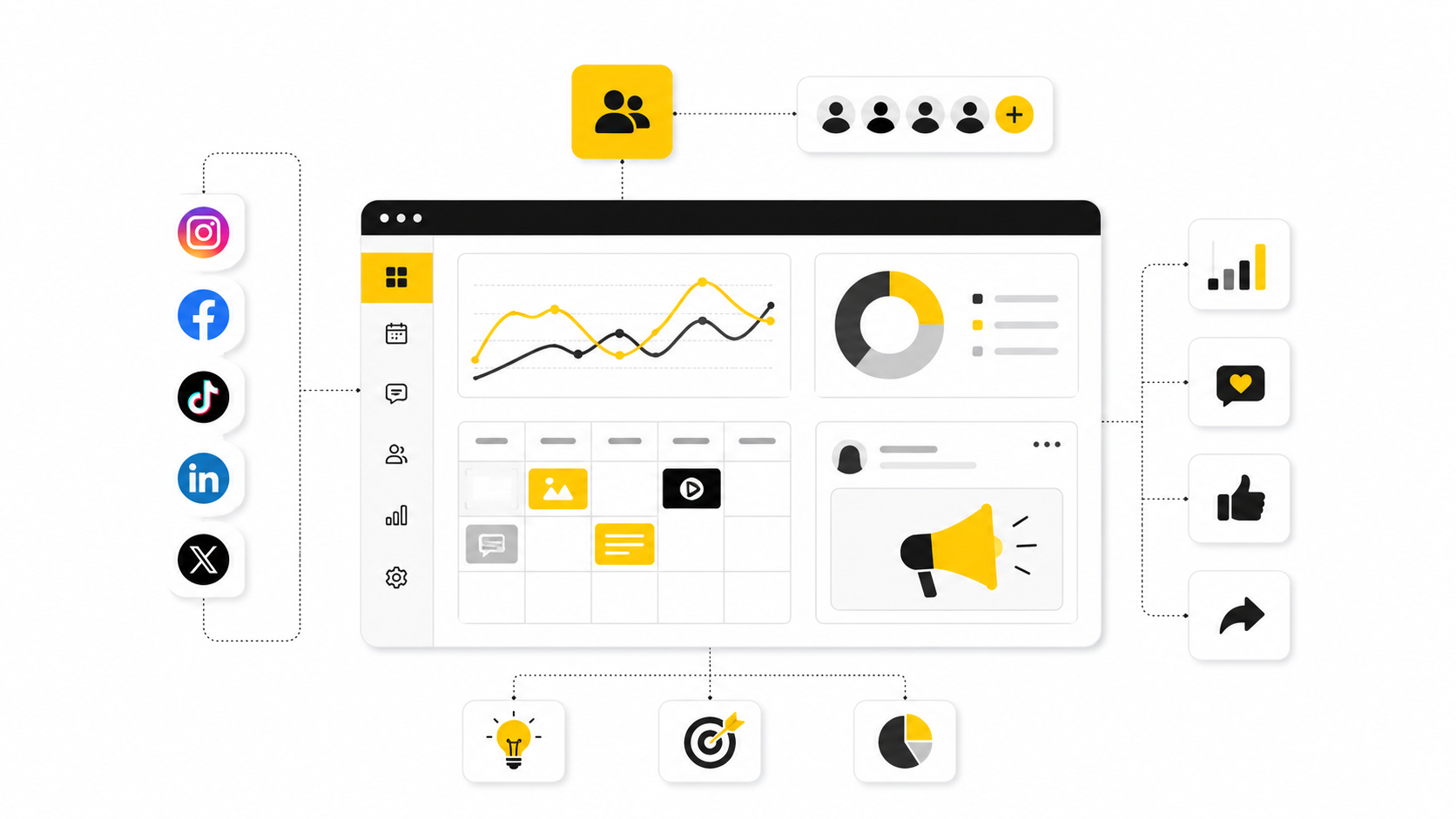
Why Social Media Management Agencies Matter More Than Ever
The biggest shift in the last few years isn’t just more users—it’s how people buy. Social platforms are no longer just awareness channels. They are discovery engines, trust builders, and conversion funnels all in one.
Consumers now expect brands to show up consistently with valuable, engaging content. A report from Sprout Social highlights that 76% of consumers are more likely to buy from brands they feel connected to on social media. That connection doesn’t happen randomly—it’s engineered through strategy and repetition.
Most businesses fail here because they underestimate the workload. Posting occasionally or outsourcing to freelancers without a system leads to inconsistent results. Social media rewards momentum, not sporadic effort.
Social media management agencies matter because they bring:
- Structured content systems
- Platform-specific expertise
- Data-driven decision making
- Scalable execution
They don’t just “manage accounts.” They build growth pipelines.
Social Media Growth Framework Overview
The best agencies don’t rely on creativity alone. They operate on frameworks that turn attention into measurable outcomes.
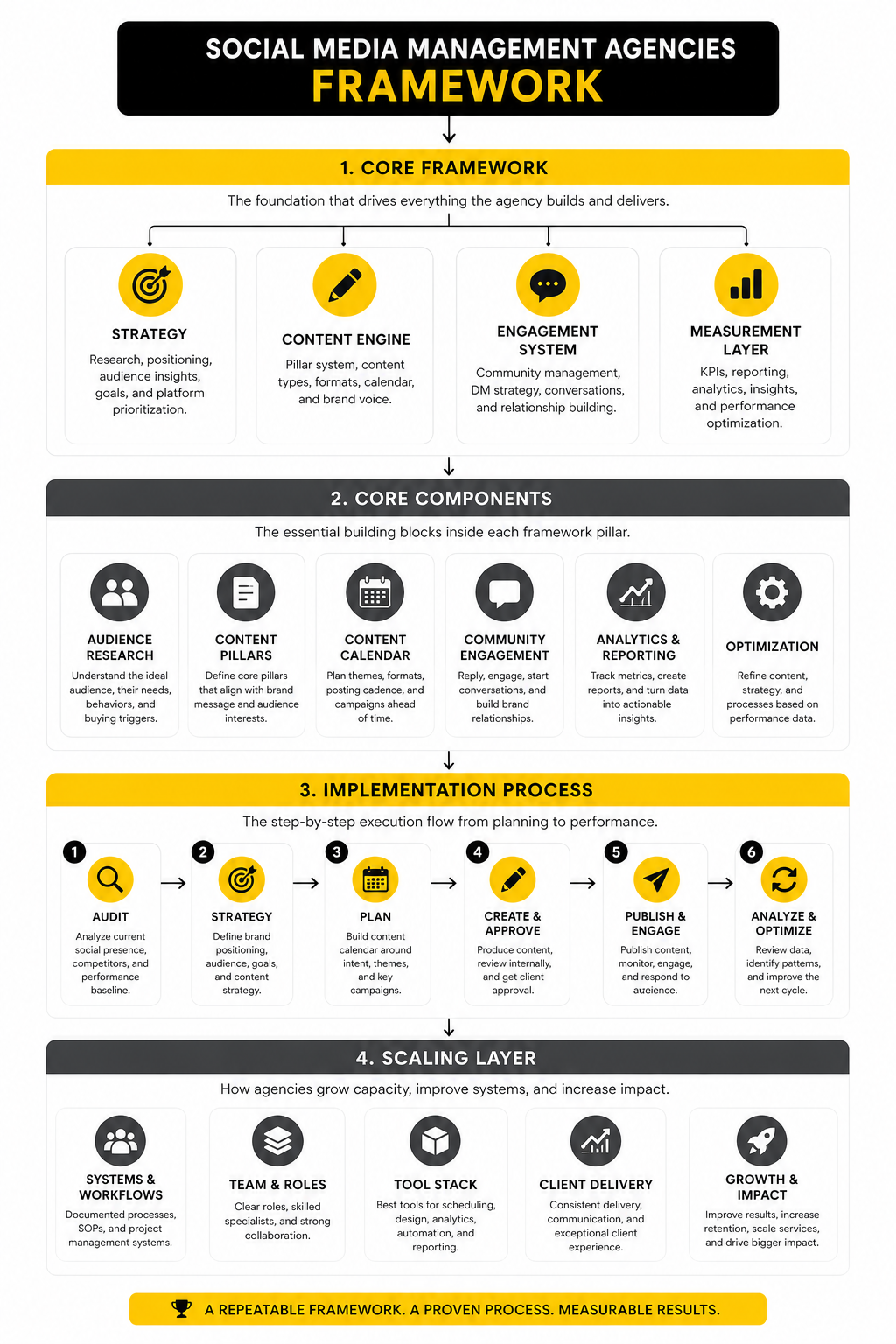
At a high level, every effective social media management agency follows a four-stage loop:
- Audience Understanding – Deep research into customer behavior, pain points, and platform habits
- Content Production – Creating high-volume, high-relevance content tailored to each platform
- Distribution & Engagement – Publishing strategically and actively interacting with audiences
- Conversion Optimization – Turning attention into leads, sales, or actions
This loop repeats continuously, improving with data over time.
The difference between average and elite agencies is how tightly these stages are connected. Weak agencies treat them as separate tasks. Strong agencies treat them as one system.
Core Components of High-Performing Agencies
To understand why some social media management agencies outperform others, you need to look at their internal structure.
Strategy Comes First
Everything starts with positioning. Agencies that skip strategy and jump straight into posting content usually fail to deliver meaningful results.
Strong agencies define:
- Target audience segments
- Content pillars
- Platform prioritization
- Brand voice and messaging
Without this foundation, content becomes noise.
Content Systems Over One-Off Posts
High-performing agencies don’t create content randomly. They build repeatable systems.
This often includes:
- Weekly or monthly content batching
- Repurposing long-form into short-form
- Trend integration without losing brand identity
- Consistent publishing schedules
Tools like Buffer help streamline scheduling, but the real advantage comes from the underlying process, not the tool itself.
Automation and Engagement Layers
Engagement is where most brands lose momentum. Responding to comments, DMs, and leads manually doesn’t scale.
This is where automation tools become critical. Platforms like ManyChat allow agencies to build automated conversations that qualify leads, answer questions, and drive conversions in real time.
The result is faster response times and higher conversion rates without increasing workload.
Analytics That Actually Drive Decisions
Posting content without tracking performance is one of the biggest mistakes businesses make.
Top agencies track:
- Engagement rates
- Watch time and retention
- Click-through rates
- Conversion metrics
They don’t just collect data—they use it to refine strategy weekly or even daily.
This constant feedback loop is what turns social media from a guessing game into a predictable growth channel.
How Professional Agencies Execute at Scale
Execution is where social media management agencies either prove their value or expose their weakness. Strategy sounds impressive on a call, but the real test is whether the agency can publish consistently, respond quickly, learn from data, and keep improving without turning everything into chaos.
That matters because social media is now too fast for casual management. The 2025 Sprout Social Index surveyed more than 4,000 consumers and 1,200 marketers, and the direction is obvious: brands are expected to be present, useful, responsive, and culturally aware. That is not a one-person side task anymore.
Professional execution usually comes down to four operating layers: planning, production, publishing, and optimization. When those layers are clean, the agency can scale without losing quality. When they are messy, clients feel it immediately.
Planning the Content Engine
Good agencies do not wake up and ask, “What should we post today?” They plan around campaigns, customer questions, buying intent, seasonal moments, product launches, and platform behavior. That planning gives the content team enough direction to move fast without guessing.
A strong planning system usually includes monthly themes, weekly content priorities, and daily publishing decisions. The monthly layer keeps the strategy focused, the weekly layer keeps execution flexible, and the daily layer lets the agency react to trends or performance signals. This balance is important because rigid calendars become stale, while purely reactive posting becomes inconsistent.
The best social media management agencies also separate content ideas by purpose. Some posts are designed to attract new audiences. Some build trust with existing followers. Some push people toward a landing page, offer, event, or sales conversation. Without that separation, every post tries to do everything, and usually does nothing well.
Building a Repeatable Production Workflow
Content production needs structure, especially when an agency manages several clients at once. A repeatable workflow prevents missed deadlines, unclear approvals, and rushed creative. It also gives clients confidence because they can see how work moves from idea to publish-ready asset.
Most professional workflows include research, scripting or copywriting, design or editing, internal review, client approval, scheduling, and post-publication analysis. That may sound simple, but the difference is discipline. Agencies that document the process can train team members faster, maintain quality standards, and avoid depending on one “creative genius” to hold everything together.
This is also where the right tools help. A scheduling platform like Buffer can make publishing cleaner for teams that need a simple way to plan, schedule, and review social content. But the tool is not the strategy. It only works when the agency already knows what it wants to say, who it is speaking to, and what action should happen next.
Managing Engagement Without Losing the Human Touch
Engagement is not just replying to comments with emojis. It is part customer support, part sales, part community building, and part brand reputation management. This is where many businesses underestimate the workload.
Strong agencies define response rules before the comments and DMs start coming in. They clarify which questions can be answered publicly, which ones need escalation, which ones should move to private messages, and which ones are signs of purchase intent. This prevents slow responses and awkward replies that damage trust.
Automation can help, but only when it supports the human experience. Tools like ManyChat are useful for agencies that need to handle lead capture, keyword-triggered replies, and simple qualification flows inside social conversations. The key is to avoid robotic automation. People can feel when a brand is trying to shortcut trust.
Turning Social Attention Into Leads
Attention is valuable, but only if the agency knows where to send it. A viral post that produces no leads, no list growth, no retargeting audience, and no useful insight is not a complete win. It is just temporary visibility.
That is why serious agencies connect social content to a broader conversion path. A post might send people to a booking page, a quiz, a free resource, a product page, a webinar, or a DM automation. For agencies managing local businesses, coaches, service providers, or consultants, a CRM and funnel system like GoHighLevel can make this easier because it connects campaigns, contacts, automations, and follow-up in one place.
The important point is not that every post needs to sell. That would get annoying fast. The point is that every content system needs a clear path from discovery to trust to action.
Keeping Reporting Simple and Useful
Reporting should not be a giant spreadsheet nobody reads. The job of reporting is to show what happened, what it means, and what will change next. That is it.
Useful agency reports usually focus on a small set of metrics: reach, engagement quality, follower growth, traffic, leads, conversions, and top-performing content patterns. The HubSpot 2026 marketing statistics hub continues to show social media as a major ROI channel for marketers, but that ROI only becomes visible when tracking connects social activity to business outcomes. Vanity metrics alone are not enough.
The best reports include decisions, not just numbers. If short-form video is driving reach but carousel posts are driving saves and clicks, the agency should explain how that changes the next content cycle. If a platform is consuming time but not producing qualified leads, the agency should say so clearly. Clients do not need more dashboards. They need better decisions.
Building the Agency Implementation System
Once the strategy, content engine, engagement layer, and reporting rhythm are clear, the next question is simple: how does an agency actually put all of this into motion without dropping the ball?
This is where professional implementation matters. Social media management agencies that scale well do not rely on scattered tasks, messy Slack threads, or random content requests from clients. They build a process that moves from diagnosis to delivery in a predictable order.
The goal is not to make the work complicated. The goal is to make the work repeatable, measurable, and easy to improve.
Step 1: Audit the Current Social Presence
Every serious implementation process starts with an audit. Before an agency creates new content, it needs to understand what is already working, what is being ignored, and where the brand is losing attention. This includes reviewing profiles, past posts, engagement quality, competitor positioning, audience comments, visual consistency, and conversion paths.
The audit should not be a generic checklist. It should answer practical questions. Which platforms deserve more focus? Which topics already create traction? Which posts attract the wrong audience? Which profile elements are blocking trust before the content even gets a chance?
This stage also gives the client a clear baseline. That matters because growth is easier to prove when everyone knows the starting point. Without a baseline, reporting becomes vague, and vague reporting creates doubt.
Step 2: Define the Brand and Audience Strategy
After the audit, the agency needs to tighten the brand’s positioning. This is not about writing a fancy brand document nobody uses. It is about giving the content team a practical operating guide.
The strategy should define the ideal audience, their problems, their buying triggers, their objections, and the language they already use. It should also clarify the brand voice, the core message, and the main categories of content the agency will produce. When this is done properly, content becomes easier to create because the team is no longer starting from zero every week.
This is especially important now because audiences are more selective. The 2025 Sprout Social Index found that consumers expect brands to show up with relevance, personality, and useful interaction, not just polished content. That puts pressure on agencies to understand the audience before they touch the content calendar.
Step 3: Build the Content Calendar Around Intent
A content calendar should not be a storage place for random post ideas. It should be a map of intent. Each post should have a reason to exist.
A strong agency calendar usually balances awareness content, authority content, community content, proof-based content, and conversion content. This prevents the feed from becoming too sales-heavy or too educational without ever asking for action. It also helps the client see how the strategy turns into daily execution.
The calendar should stay flexible. Social media moves fast, and agencies need room to react when a trend, platform update, customer question, or campaign opportunity appears. The mistake is treating the calendar like a prison. It should be a system, not a cage.
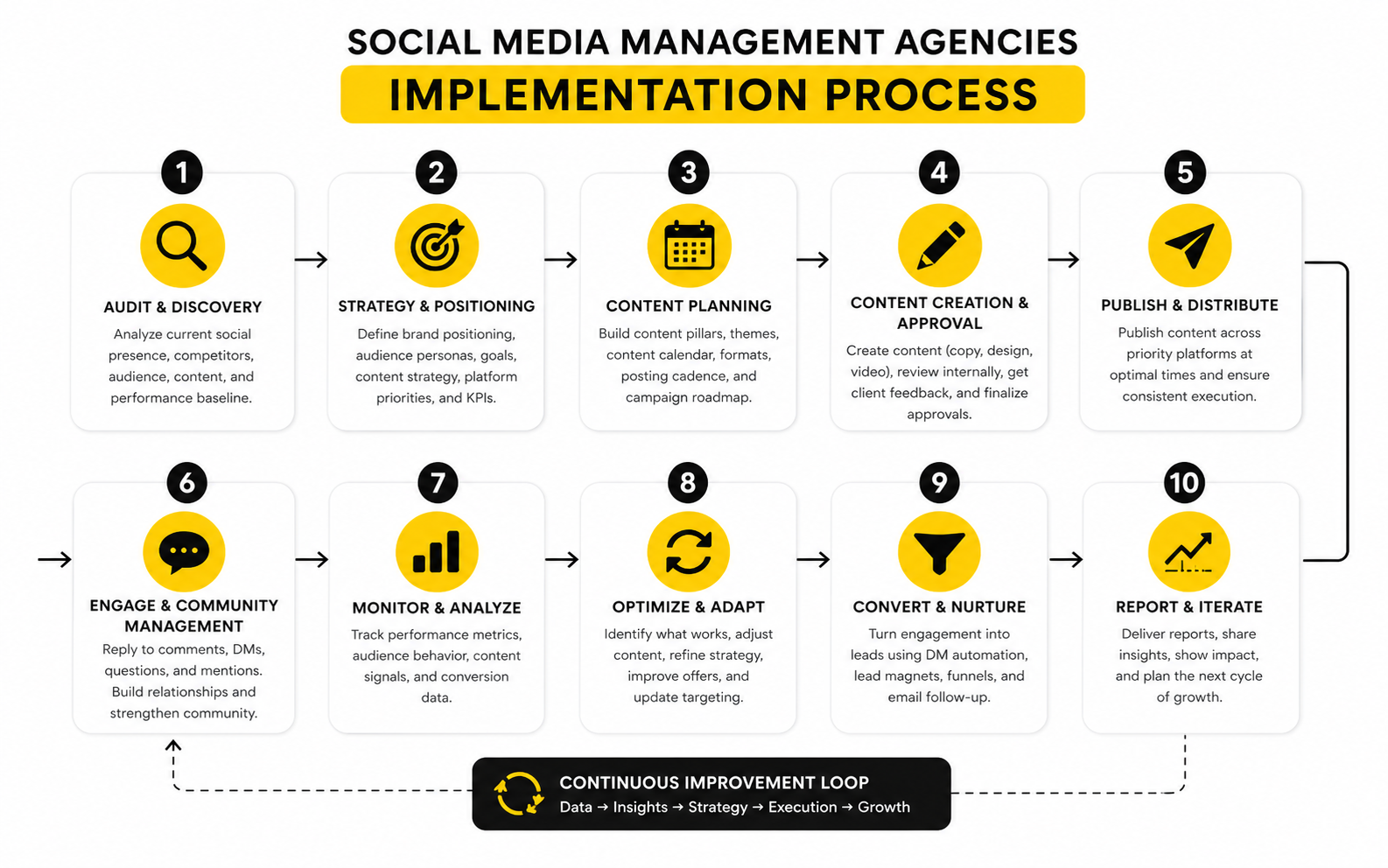
Step 4: Create, Review, and Approve Content
This is where the execution process becomes tangible. The agency turns strategy into captions, scripts, visuals, videos, carousels, stories, community prompts, and campaign assets. The work should move through a clear review path before anything goes live.
A good approval process protects both speed and quality. Internal review catches weak hooks, unclear messaging, brand inconsistencies, and platform mistakes before the client sees the work. Client review then becomes focused on business accuracy, compliance, and brand fit instead of rewriting everything from scratch.
For short-form video, the review process needs extra care. HubSpot’s social media trends research continues to point to short-form video as one of the strongest-performing formats, which means agencies need a reliable way to produce it without sacrificing clarity. The best teams do not just chase trends. They turn client expertise into simple, watchable, platform-native content.
Step 5: Publish, Monitor, and Engage
Publishing is not the finish line. It is the beginning of the live performance cycle. Once content goes out, the agency needs to monitor comments, DMs, saves, shares, replies, clicks, and sentiment.
This is where many brands discover the real value of social media management agencies. The agency is not just pressing “post.” It is watching how the audience responds and deciding what deserves a reply, what deserves escalation, what deserves follow-up content, and what deserves to be ignored.
For agencies managing high-volume conversations, automation can support the process. A tool like ManyChat can help route common questions, trigger keyword-based replies, and capture leads from DMs. But the agency still needs human judgment because social media is public, emotional, and reputation-sensitive.
Step 6: Optimize the Next Cycle
The final step is optimization. This is where the agency studies what happened and uses the findings to improve the next content cycle. It is also where good agencies separate themselves from agencies that only deliver activity.
Optimization should look at patterns, not isolated wins. One viral post can be useful, but three recurring audience behaviors are more valuable. The agency should identify which hooks earned attention, which formats kept people engaged, which topics created conversation, and which calls to action produced real movement.
The output should be practical. Create more of what worked, cut what failed, test one or two new ideas, and keep the strategy moving forward. That is how social media turns from constant pressure into a growth system.
Statistics and Data
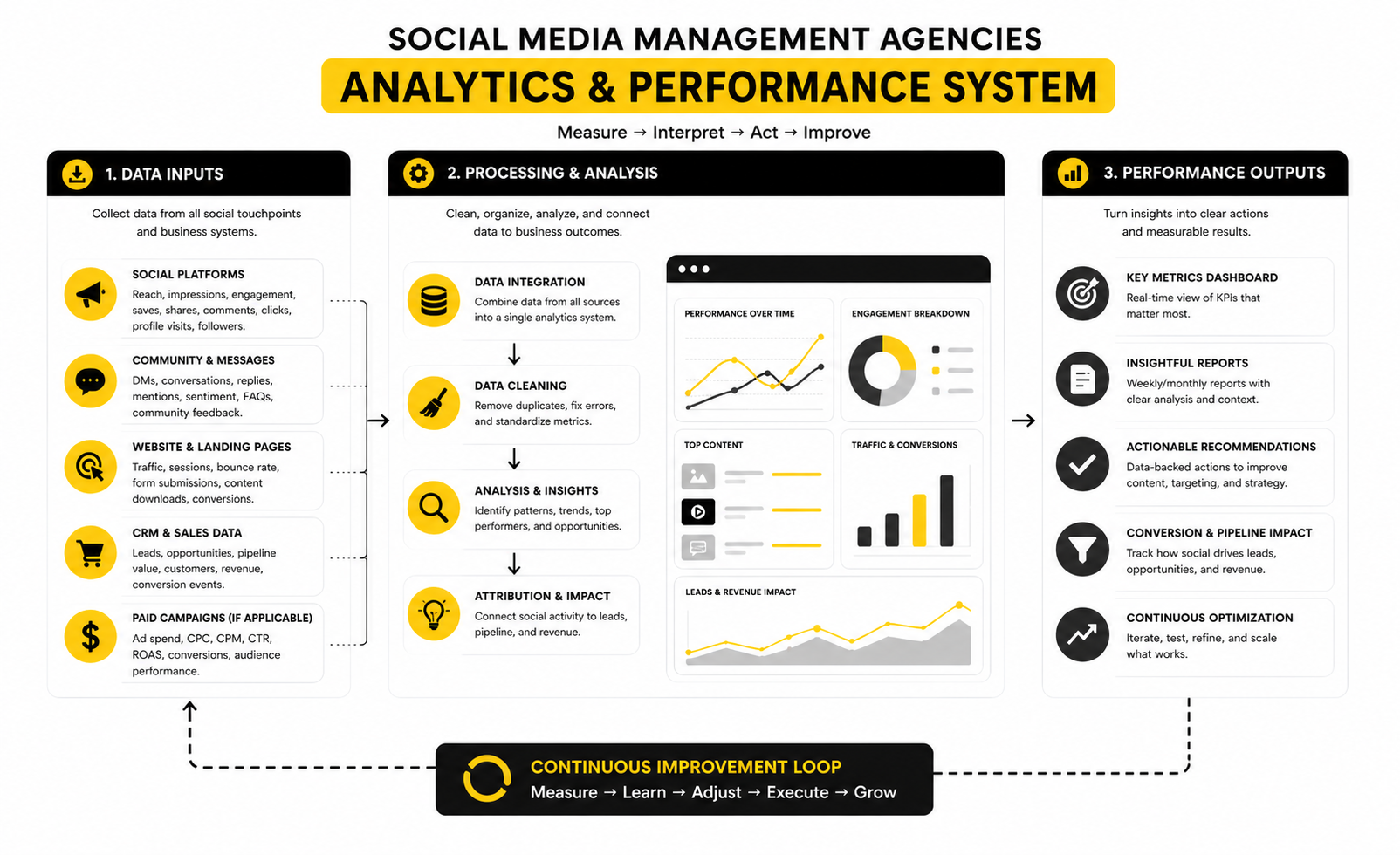
Measurement is where social media management agencies stop sounding creative and start proving business value. The problem is that most teams still look at social data the wrong way. They celebrate likes when they should be studying buying signals, retention patterns, audience quality, and conversion behavior.
The useful question is not, “Did this post perform well?” The useful question is, “What did this post teach us about the audience, the offer, and the next move?” That is the difference between reporting and actual performance management.
Modern social media data should help an agency decide what to create more of, what to cut, where to invest budget, and how to improve the customer journey. Numbers are only useful when they change behavior.
The Metrics That Actually Matter
Reach tells you how far the content traveled, but it does not tell you whether the right people cared. Engagement tells you whether people reacted, but it does not always prove intent. Clicks, saves, replies, shares, profile visits, DM starts, lead form submissions, booked calls, and assisted conversions give a much clearer picture.
For social media management agencies, the best reporting model separates metrics into three layers. The first layer is visibility: reach, impressions, follower growth, and video views. The second layer is trust: saves, shares, comments, watch time, profile visits, and repeat engagement. The third layer is action: clicks, leads, purchases, bookings, pipeline value, and customer acquisition cost.
This matters because different posts have different jobs. A short-form video may be excellent if it earns reach and watch time, even if it does not create immediate leads. A case-study post may have lower reach but higher conversion intent. Judging both posts by the same metric is lazy analysis.
Benchmarks Are Useful, But Only With Context
Benchmarks can help you understand whether performance is broadly healthy, but they should never become the entire strategy. The 2025 Rival IQ Social Media Industry Benchmark Report found engagement rates declined across major platforms, including drops of 36% on Facebook, 16% on Instagram, 34% on TikTok, and 48% on X. That does not mean social media is dying. It means average engagement is harder to earn, so creative quality and platform fit matter more.
This is why agencies should compare performance against three reference points: industry benchmarks, the client’s historical baseline, and campaign-specific goals. Industry benchmarks show the wider market. Historical baselines show whether the client is improving. Campaign goals show whether the content is doing the job it was created to do.
A post can underperform an industry benchmark and still be a win if it beats the client’s baseline and produces qualified leads. A post can outperform the benchmark and still be weak if it attracts the wrong audience. Context is everything.
What Social ROI Should Really Measure
Social ROI is not just revenue divided by content cost. That formula is useful, but it is incomplete because social often influences buying decisions before the final click happens. Someone may see a LinkedIn post, watch three videos, read comments, visit the profile, join an email list, and only convert later through search or retargeting.
The 2025 Sprout Social Index is based on surveys of more than 4,000 consumers, 900 social practitioners, and 300 marketing leaders, which makes one thing clear: social is now deeply tied to brand perception, customer experience, and business impact. That is why agencies should report both direct conversions and assisted value. Direct conversions show immediate action, while assisted value shows how social supports the larger buying journey.
This is also why CRM integration matters. If a lead comes from a DM, quiz, webinar, call booking, or funnel, the agency needs to connect that activity back to content. A platform like GoHighLevel can help agencies track contacts, campaigns, follow-ups, and pipeline movement in one place, which makes reporting far more useful than platform screenshots alone.
Reading Performance Signals Correctly
Every metric is a signal, but not every signal means what people think it means. High reach with low engagement can mean the hook worked but the content did not hold attention. High saves with low comments can mean the content is useful but not emotionally provocative. High comments with low clicks can mean the topic created discussion but did not build enough purchase intent.
Video metrics deserve special attention. Watch time, completion rate, replays, and drop-off points tell agencies whether the content kept attention after the first few seconds. The HubSpot social media trends report continues to highlight short-form video, AI-powered social strategies, community-led growth, and social search as major drivers of social success. That means agencies need to measure more than views. They need to understand whether the video created memory, trust, or action.
Engagement quality matters too. Ten comments from ideal buyers can be more valuable than 500 reactions from people who will never buy. This is especially true for B2B, local services, consulting, coaching, SaaS, and high-ticket offers where the buying cycle depends on trust.
The Agency Reporting Rhythm
A strong reporting rhythm keeps everyone focused without drowning the client in data. Weekly reviews should be tactical. Monthly reports should explain patterns. Quarterly reviews should connect social performance to business goals.
The weekly review answers simple questions: what worked, what failed, what needs to change next week? The monthly report should show content themes, audience behavior, platform performance, engagement quality, and conversion movement. The quarterly review should zoom out and ask whether the social strategy is actually supporting revenue, retention, brand authority, or market positioning.
This rhythm prevents random decision-making. It also protects the agency-client relationship because there are fewer surprises. When performance drops, the agency can explain why. When performance improves, the agency can show what caused it.
Turning Data Into Better Decisions
The final job of analytics is action. Data should change the calendar, the creative direction, the offer, the funnel, or the engagement strategy. If it does not change anything, it is just decoration.
Social media management agencies should leave every reporting cycle with clear decisions. Maybe the client needs more founder-led video. Maybe product education is outperforming trends. Maybe the audience responds better to proof than opinions. Maybe Instagram creates awareness, but LinkedIn creates better leads.
This is where the best agencies become valuable partners instead of content vendors. They do not just say, “Your engagement is up.” They say, “This is what the market is telling us, and this is what we should do next.”
Choosing or Building the Right Agency Model
By this point, the real question is no longer whether social media matters. It does. The harder question is whether a business should hire social media management agencies, build an internal team, or use a hybrid model.
There is no perfect answer for every company. The right model depends on budget, speed, internal expertise, content complexity, approval requirements, and how closely social media connects to sales. A local service business has different needs than a funded SaaS company, and an ecommerce brand has different needs than a personal brand.
The mistake is choosing based only on price. Cheap execution gets expensive when the content misses the audience, the reporting is shallow, and the team cannot explain what is actually driving growth.
Agency vs In-House vs Hybrid
Hiring an agency usually makes sense when the business needs speed, specialist knowledge, creative volume, and an outside perspective. Agencies can bring platform experience, proven workflows, and production capacity without forcing the client to hire multiple full-time roles. That is useful when the business wants to move quickly but does not yet have a complete internal marketing team.
Building in-house makes sense when social media is deeply tied to daily company culture, founder voice, product knowledge, or sensitive customer communication. Internal teams often understand the brand faster because they live inside it. The tradeoff is that hiring, training, managing, and retaining strong social talent takes time.
A hybrid model is often the strongest option. The client owns the brand knowledge, approvals, customer insight, and internal access. The agency owns strategy, production systems, platform execution, analytics, and optimization. When this works, the agency does not feel like an outsourced vendor. It feels like an extension of the team.
The Risks Most Businesses Miss
The first risk is hiring an agency that is good at content but weak at strategy. This usually looks fine for the first month because assets are being delivered. Then performance stalls because the content is not connected to positioning, offers, audience research, or conversion paths.
The second risk is over-automation. Tools can make agencies faster, but they can also make brands sound generic. The HubSpot social media trends report highlights AI-powered social strategies as a major trend, but AI should support human judgment, not replace it. The brands that win use AI for research, repurposing, drafts, analysis, and workflow speed while keeping the message specific and human.
The third risk is platform dependency. A brand that relies on one channel is exposed to algorithm shifts, account issues, rising ad costs, and audience fatigue. Social media management agencies should help clients build platform strength while also moving attention into owned assets like email lists, communities, CRM pipelines, and customer databases.
What Scaling Actually Breaks
Scaling social media sounds exciting until the workflow cracks. More clients, more platforms, more content formats, more approvals, and more reporting can quickly create operational drag. This is where agencies either professionalize or become overwhelmed.
The first thing that breaks is usually quality control. When production volume increases, weak hooks, generic captions, inconsistent visuals, and sloppy approvals start slipping through. A good agency prevents this with templates, brand guides, review checklists, and clear ownership.
The second thing that breaks is communication. Clients do not need constant meetings, but they do need clarity. They need to know what is happening, what is needed from them, what has been approved, what is live, and what the numbers mean. If the agency cannot communicate simply, the client will feel the chaos even if the content looks decent.
The third thing that breaks is reporting discipline. As volume grows, agencies are tempted to send automated reports without interpretation. That is not enough. Social media management agencies that want long-term clients need to translate performance into decisions, not just deliver charts.
Advanced Tool Stacks Need Clear Ownership
A modern agency tool stack can include scheduling, analytics, CRM, funnels, landing pages, AI writing support, design tools, social listening, chatbot automation, call booking, email marketing, and client portals. That can be powerful. It can also become a mess if nobody owns the system.
For example, Buffer can support publishing workflows, ManyChat can support DM automation, and GoHighLevel can support CRM, funnels, follow-up, and pipeline tracking. But stacking tools does not automatically create a strategy. Someone still needs to define the customer journey, the handoff points, the reporting logic, and the conversion goal.
The best agencies keep the tool stack boring on purpose. Each tool has a job. Each integration has a reason. Each automation has a human fallback. That is how you get speed without losing control.
How to Evaluate an Agency Before Hiring
A strong agency should be able to explain its process without hiding behind buzzwords. If the pitch is vague, the delivery will probably be vague too. You want clear thinking before you sign anything.
Ask how they research the audience, how they build content pillars, how they handle approvals, how they define success, how often they report, and how they connect social media to revenue. Also ask what they will not do. Good agencies have boundaries because they know where they create the most value.
The strongest evaluation questions are practical:
- What would you audit first?
- Which platforms would you prioritize and why?
- What metrics would you ignore?
- How would you turn social engagement into leads?
- What would the first 90 days look like?
- How do you handle content that performs badly?
- Who actually creates and reviews the work?
The answers will tell you quickly whether you are dealing with a real growth partner or just a posting service.
The 90-Day Decision Window
Social media needs consistency, but businesses should not wait forever to judge whether the agency relationship is working. Ninety days is usually enough to evaluate process quality, strategic clarity, communication, content direction, and early performance signals. It may not be enough time to prove full revenue impact in every business, especially with long sales cycles, but it is enough time to see whether the machine is being built properly.
In the first 30 days, look for audit quality, onboarding discipline, messaging clarity, and content planning. In days 31 to 60, look for production rhythm, publishing consistency, engagement handling, and early pattern recognition. In days 61 to 90, look for sharper decisions, better-performing content, cleaner reporting, and a clearer connection between social activity and business outcomes.
This is the practical standard. Social media management agencies do not need to create miracles in three months. But they should create visible momentum, better systems, and smarter decisions.
Final System for Sustainable Social Growth
At the end of the day, the best social media management agencies are not just content suppliers. They are operating systems for attention, trust, and conversion. They help brands understand what the market cares about, turn that insight into content, distribute it consistently, and connect the results back to business outcomes.
That is the standard. Not “we posted three times this week.” Not “engagement looks good.” Not “the client liked the graphics.” The standard is whether social media is becoming a stronger, clearer, more measurable growth channel over time.
The final system should connect five parts: strategy, content, engagement, conversion, and analytics. When those pieces work together, social media stops feeling random. It becomes a business asset.
FAQ - Built for Complete Guide
What do social media management agencies actually do?
Social media management agencies plan, create, publish, monitor, and optimize social media content for businesses. The better ones also handle strategy, analytics, community engagement, campaign planning, and conversion systems. Their real job is not just posting content but turning social attention into measurable business value.
Are social media management agencies worth it?
They are worth it when they bring strategy, execution discipline, and clear reporting. A weak agency can waste money by producing generic content without understanding the audience or business model. A strong agency gives the brand consistent visibility, better creative output, sharper decisions, and a clearer path from content to leads or sales.
How much do social media management agencies charge?
Pricing varies widely based on scope, platforms, content volume, video needs, paid ads, reporting, and strategy depth. A basic posting package costs much less than a full growth system with content production, engagement, automation, CRM tracking, and campaign management. The important question is not only the monthly fee, but what level of thinking and execution is included.
How long does it take to see results from social media management?
Early signals can appear within 30 to 60 days, especially around consistency, engagement quality, and content direction. Stronger business outcomes usually need a longer runway because trust, audience growth, and conversion systems compound over time. A 90-day window is a practical starting point for judging whether the agency process is working.
What should I ask before hiring a social media agency?
Ask how they audit accounts, choose platforms, build content pillars, manage approvals, measure success, and connect content to revenue. Also ask who creates the work and how performance decisions are made. Good social media management agencies can explain their process clearly without hiding behind vague marketing language.
What platforms should an agency manage first?
The right platforms depend on the audience, offer, and sales process. A B2B service brand may prioritize LinkedIn, while an ecommerce brand may lean into Instagram, TikTok, Pinterest, or paid social. The mistake is trying to manage every platform before mastering the few that actually match the business.
Should an agency use AI for social media management?
Yes, but carefully. AI can help with research, idea generation, repurposing, drafting, trend analysis, and reporting summaries. It should not replace human judgment, brand voice, customer insight, or final creative decisions.
What is the difference between social media management and social media marketing?
Social media management usually refers to the ongoing operation of accounts: content calendars, publishing, engagement, moderation, and reporting. Social media marketing is broader and includes campaigns, funnels, paid ads, influencer partnerships, lead generation, and revenue strategy. The strongest agencies combine both instead of treating social as a simple posting task.
How do agencies measure social media ROI?
Agencies measure ROI by connecting social activity to business outcomes such as leads, sales, bookings, email signups, pipeline value, customer retention, or assisted conversions. They also track supporting signals like reach, saves, shares, comments, clicks, profile visits, and DM starts. The key is interpreting those numbers together instead of treating one metric as the full story.
What makes a social media agency different from a freelancer?
A freelancer may be excellent at a specific task like design, copywriting, editing, or scheduling. An agency usually offers a broader system with strategy, account management, production workflows, reporting, and multiple specialists. The better choice depends on whether the business needs one skill or a complete operating process.
Can small businesses use social media management agencies?
Yes, but small businesses need to be selective. They should avoid oversized packages that create content volume without a clear business goal. A lean agency model focused on local visibility, trust-building, reviews, offers, and lead follow-up can be far more useful than a bloated content plan.
What are the biggest red flags when hiring an agency?
Big red flags include vague reporting, no clear onboarding process, generic content examples, unrealistic guarantees, poor communication, and an obsession with vanity metrics. Another warning sign is an agency that talks about platforms before understanding the business. Strategy should come before posting.
How many posts should an agency publish per week?
There is no universal number. The right cadence depends on the platform, content quality, audience behavior, and team capacity. Consistency matters, but publishing more weak content is not better than publishing fewer strong pieces with a clear purpose.
Do social media management agencies handle paid ads too?
Some do, and some do not. Organic social and paid social require different skills, even though they should work together. If paid ads are included, the agency should explain how organic insights, creative testing, retargeting, and conversion tracking will support the ad strategy.
What tools should social media management agencies use?
Tools should support the workflow, not replace strategy. Publishing tools, analytics dashboards, CRM systems, DM automation, funnel builders, email platforms, and reporting tools can all help when used with clear ownership. The best stack is usually the simplest one that supports the client’s actual customer journey.
Work With Professionals
Explore 10K+ Remote Marketing Contracts on MarkeWork.com
Most marketers spend too much time chasing clients, competing on crowded platforms, and losing a percentage of every project to middlemen.
MarkeWork gives you a better way. Browse thousands of remote marketing contracts and connect directly with companies desperate to hire skilled marketers like you, without platform commissions and without unnecessary gatekeepers.