

Most brands do not need more posts. They need sharper execution across discovery, content, community, customer care, and reporting. That is the real reason social media management companies have become more important: social is no longer one channel with one job.
The scale alone explains the shift. There were 5.24 billion active social media user identities worldwide at the start of 2025, and the typical internet user now spends 2 hours and 21 minutes per day on social platforms. At the same time, people do not discover brands in one neat funnel anymore. The average adult internet user now finds brands through 5.8 different sources, which means social has to work alongside search, creator content, referrals, paid media, email, and on-site conversion.
That is where a good partner can make a measurable difference. Recent research from Sprout Social’s 2025 Index and Deloitte Digital’s 2025 State of Social research shows the same thing from two angles: brands are pushing more budget and responsibility into social, while the best-performing teams are treating it as a business function tied to community, content, and conversion rather than a posting calendar. In other words, the best social media management companies are not content factories. They are operating partners.
Article Outline
- Why Social Media Management Companies Matter More Than Ever
- A Practical Framework for Evaluating Social Media Management Companies
- The Core Services That Separate Strategic Partners From Content Vendors
- How Strong Social Media Management Companies Build Process, Reporting, and Cross-Functional Execution
- Pricing Models, Red Flags, and What to Ask Before You Sign
- How to Choose the Right Social Media Management Company for Your Brand

Why Social Media Management Companies Matter More Than Ever
A few years ago, many businesses could get away with treating social as a lightweight support channel. That is much harder now. Consumers expect brands to show up consistently, respond quickly, understand platform behavior, and create content that feels native instead of recycled. Research from Sprout Social shows that 30% of consumers plan to use social more in 2025 and 56% plan to keep usage steady, while personalized customer service ranks as a top brand priority on social.
That changes the hiring question. You are no longer choosing whether someone can design graphics and schedule posts. You are choosing whether a team can help your company compete in an environment where audiences split attention across an average of 6.83 social platforms per month, where community expectations keep rising, and where each platform rewards different creative instincts. A weak partner adds activity. A strong one adds coordination, speed, and judgment.
The business case is getting stronger as well. Deloitte found that social-first B2C brands reported average social budget growth of 9% from 2023 to 2024, and its research ties stronger outcomes to brands that focus on community, content, and conversion together. In B2B, the platform mix is different but the strategic pressure is just as real, with Forrester’s 2024 survey showing LinkedIn as the clear leader for social media marketing initiatives among larger B2B organizations. So whether the goal is pipeline, brand demand, customer retention, or social commerce, the job has become too broad for most companies to improvise.
A Practical Framework for Evaluating Social Media Management Companies
The easiest mistake is to compare firms by visible output alone. Nice-looking feeds, polished pitch decks, and platform buzzwords can make almost any agency look capable for an hour. But once the contract starts, the real question becomes much simpler: can this company connect social activity to business priorities without creating more internal chaos?
That is why the most useful evaluation framework starts with alignment, not aesthetics. First, a company should understand what social needs to do for your business right now, whether that is brand visibility, creator coordination, customer care, demand generation, or commerce support. Second, it should show how it turns that goal into a repeatable operating model with roles, workflows, approvals, measurement, and escalation paths. Third, it should prove it can adapt the plan by platform, because a serious B2B LinkedIn program, a community-led Instagram presence, and a TikTok growth push do not run on the same logic. Guidance from Clutch’s updated firm-selection checklist reinforces the same basics: define goals, set budget, examine firms carefully, interview them well, and review the service agreement closely.
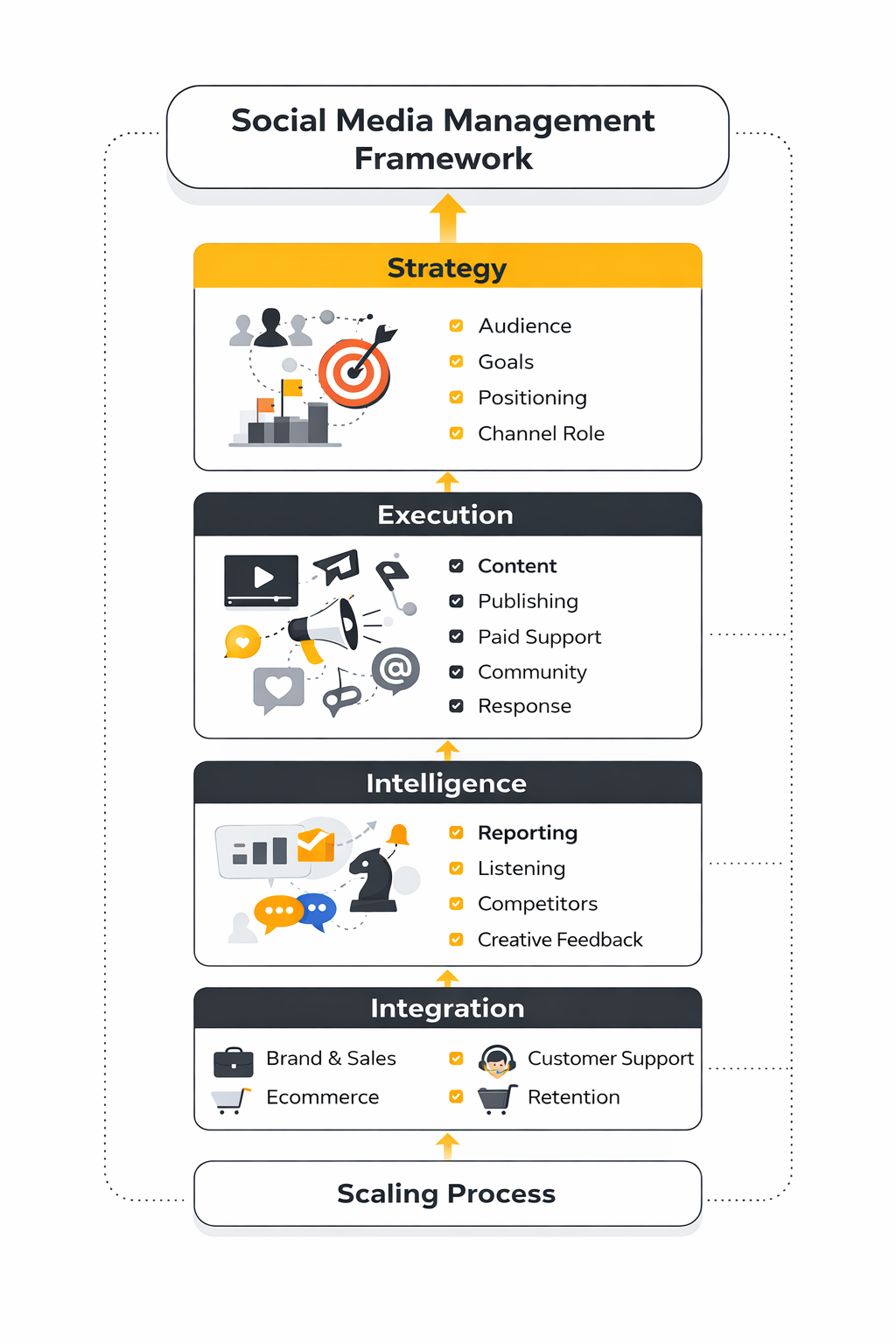
A practical way to think about this is through four layers. Strategy defines audience, goals, positioning, and channel role. Execution covers content production, publishing, paid support, community management, and response workflows. Intelligence includes reporting, social listening, competitor monitoring, and creative feedback loops. Integration connects social to the rest of the business, including brand, sales, customer support, ecommerce, and retention. When a partner is weak in any one of those layers, performance usually stalls no matter how good the content looks.
This framework matters even more because platforms are moving toward culture-led and community-shaped discovery. TikTok’s own 2025 trend report emphasizes creator collaboration, community resonance, and native storytelling rather than one-way brand broadcasting. The companies worth hiring understand that shift. They do not just ask what you want to post. They ask how your brand should participate, respond, learn, and compound results over time.
The Core Services That Separate Strategic Partners From Content Vendors
This is where a lot of buying decisions go wrong. Many social media management companies sell deliverables that are easy to count, like posts per month, number of reels, or scheduled stories, but the brands that actually grow on social usually need a tighter operating system than that. The best firms combine planning, creative, community, reporting, and business coordination, because social performance now depends on how well those pieces work together.
That matters because platform behavior is not stable anymore. Buffer’s analysis of platform-level engagement trends from January 2024 through January 2025 shows that attention is shifting unevenly, with LinkedIn climbing from 6.00% to 8.01% median engagement while Instagram fell from 2.94% to 0.61% and X dropped from 3.47% to 2.15%. A company that still sells one recycled content plan across every platform is not managing social well. It is just distributing assets.
Strategy and Channel Planning Come First
A serious partner starts by defining what each channel is supposed to do. That sounds obvious, but it is one of the biggest differences between high-performing social media management companies and teams that stay stuck in content churn. One platform may be for authority, another for discovery, another for retention, and another for customer response.
This is even more important now that social has become a search layer, not just a publishing layer. Sprout Social’s 2025 Pulse research found that 41% of Gen Z go to social platforms first when they need information, ahead of traditional search engines at 32%. That means channel planning has to account for intent, not just reach. If your agency cannot explain why LinkedIn, Instagram, TikTok, YouTube Shorts, or Reddit each play a different role in discovery and trust, it is not doing strategy yet.
In practice, good planning usually includes audience segmentation, content pillars, platform-specific formats, publishing cadence, paid amplification rules, and escalation paths for comments or crises. It also includes realistic scope. A company that promises to dominate six channels at once with a tiny monthly retainer is usually telling you what you want to hear, not what the work requires.
Content Production Should Be Native, Testable, and Fast
The second core service is content production, but not in the lazy “we make graphics” sense. Good social media management companies build content that fits the platform, respects how people actually consume media there, and leaves room for iteration. They understand that a polished asset built for brand review can still fail in-feed if it feels too stiff, too late, or too generic.
Recent platform and industry research points the same way. Deloitte’s 2025 State of Social report says the strongest social-first brands are still doubling down on community, content, and conversion, while TikTok’s 2025 trend report frames brand growth around creator collaboration, cultural relevance, and storytelling that feels native to the community instead of imposed on it. That is why strong agencies do not just ask what assets you already have. They ask what can be filmed quickly, what can be repurposed intelligently, what should be creator-led, and what should be tested before anyone overcommits budget.
Speed matters here more than most clients realize. Social teams lose momentum when every post becomes a mini brand campaign with endless rounds of approvals. The better firms design a production system that protects brand standards without strangling creative output, and they often pair that with lightweight workflow tools for intake, review, and scheduling. For teams that want cleaner publishing and analytics without building a messy stack, Buffer is one of the more practical options because it keeps planning, scheduling, and performance visibility simple.
Community Management Is Not a Side Task Anymore
A lot of agencies still treat comments, direct messages, and reactive engagement as optional add-ons. That is outdated. Community management has become one of the clearest dividing lines between firms that understand the current social environment and firms that still think their job ends after publishing.
The numbers make the case on their own. Deloitte found a 9% year-over-year increase in community management investment in 2024, and the same research notes that 51% of consumers liked or shared brand content or spent more time on branded platforms because of personalized content. Sprout Social’s customer care research adds a more direct operational angle: 30% of consumers plan to use social more in 2025, 56% expect to keep usage steady, and personalized customer service ranks as the top social priority from the consumer side. When you stack those findings together, the message is simple: response quality is now part of brand performance.
This is why good social media management companies build playbooks, not just inbox coverage. They define tone, escalation rules, response windows, handoff points with customer support, and what should happen when legal, PR, or product teams need to get involved. If a company cannot tell you who answers what, how fast, and with what level of judgment, you are not buying community management. You are buying hope.
For brands that rely heavily on Instagram, Facebook, or WhatsApp conversations, messaging automation can help absorb volume without making the experience robotic. Used carefully, ManyChat can support lead capture, FAQ routing, and basic qualification, but the key phrase there is used carefully. Automation should reduce friction, not trap people in dead-end flows.
Reporting, Listening, and Business Feedback Loops Close the Gap
The last service that usually separates a strategic partner from a content vendor is intelligence. Publishing content without structured reporting and listening is one of the fastest ways to waste budget while feeling busy. Strong agencies do not just send vanity dashboards at the end of the month. They explain what changed, why it changed, what should happen next, and what other teams inside the business should learn from it.
That includes social listening, comment analysis, competitor tracking, creative pattern recognition, and conversion handoffs. Sprout Social’s 2025 Index highlights an executive trust gap around social impact, which is exactly why reporting has to connect activity to decisions that leadership actually cares about, not just impressions and follower counts. The goal is not more charts. The goal is sharper action.
This is also where channel context matters. In B2B, for example, the strongest social media management companies do not pretend every platform deserves the same investment. Forrester’s 2024 research on B2B social preferences makes it clear that LinkedIn remains the platform of choice for larger B2B marketing organizations, so reporting should reflect that reality instead of spreading attention evenly just to make a dashboard look balanced. Good firms understand that measurement is not a reporting task at the end. It is a steering function baked into the work from week one.
How Strong Social Media Management Companies Build Process, Reporting, and Cross-Functional Execution
Once the strategy is clear and the core service mix is in place, the next question is operational: can the company actually run the work without turning your internal team into a traffic jam. This is where strong social media management companies separate themselves fast. They do not just bring ideas. They build a system that makes those ideas shippable, measurable, and easier for your team to support.
That matters because social is now tied to more departments than most brands admit at the start. Customer support wants visibility into complaints, sales wants lead context, brand wants consistency, legal wants guardrails, and leadership wants proof that the investment is doing more than generating impressions. The firms that handle this well build process on purpose instead of hoping smart people will sort it out mid-campaign.
Good Implementation Starts With a Clean Onboarding Sequence
The first month usually tells you whether a partner is serious. Weak firms rush straight into content production because it feels productive. Good firms slow down just enough to gather access, define approvals, clarify ownership, document tone, audit existing performance, and map the handoffs that will matter later.
This is not bureaucracy for its own sake. It is risk control and execution prep. Sprout Social’s 2025 Index shows that social teams still face a credibility gap with leadership, while a separate 2025 Sprout analysis highlights ongoing tension between executives and practitioners around publishing trust and decision-making, which is exactly why a clear operating model matters from the start (Sprout Social Index 2025, executive-team trust gap). When everyone knows who approves, who publishes, who responds, and what success looks like, the work gets faster instead of noisier.
A solid onboarding process usually covers brand and audience review, channel audit, content pillar alignment, account access, compliance boundaries, response guidelines, measurement setup, and reporting cadence. None of that is glamorous, but it is what keeps social from becoming another half-owned function. If a company skips this stage or treats it like a formality, the problems usually show up later as missed approvals, vague reporting, and internal frustration.
Execution Gets Real When the Workflow Is Visible
The easiest way to test whether a firm can actually deliver is to ask how the work moves from idea to live post to optimization. Not in vague terms. In steps. Strong social media management companies can explain the exact workflow, the review sequence, the turnaround expectations, and what happens when a post underperforms or a comment thread becomes sensitive.
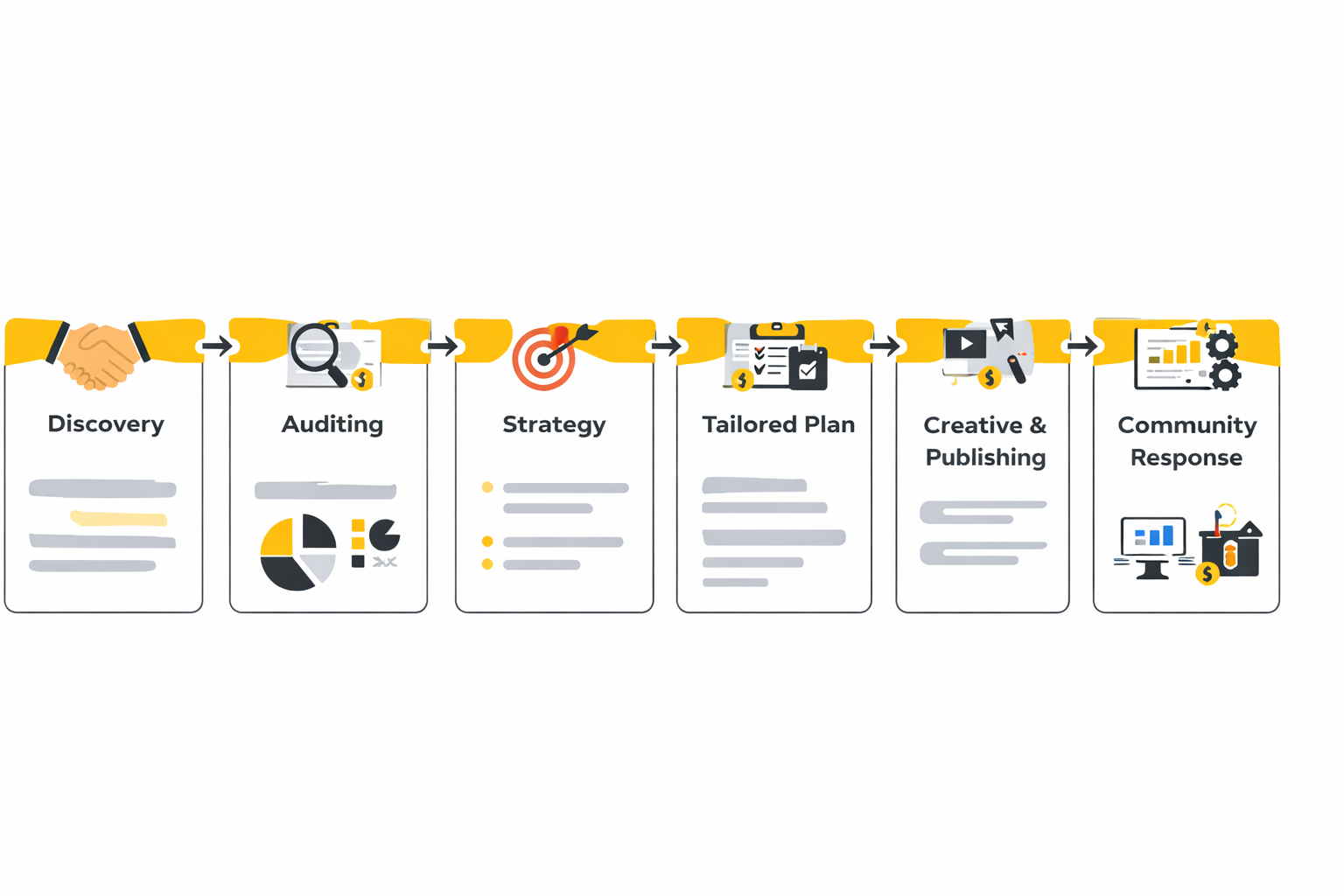
A practical implementation flow usually looks like this:
- Strategy priorities are translated into monthly themes and channel-specific goals.
- Creative concepts are turned into platform-native assets and copy variations.
- Internal or client approvals happen against a documented checklist, not personal preference.
- Publishing, community response, and paid support are coordinated against a shared calendar.
- Performance data, audience signals, and comment patterns feed the next round of decisions.
That step-by-step structure sounds simple, but most execution problems happen because one of those steps is weak or invisible. Hootsuite’s trend research keeps pushing the same operational point: the brands winning on social are becoming more agile, more creator-minded, and more dependent on faster learning loops rather than slower campaign cycles (Social Trends 2026 overview, 2025 research methods summary). The implementation lesson is obvious: if your workflow cannot absorb feedback quickly, the strategy will look worse than it really is.
Reporting Should Guide Decisions, Not Just Prove Activity
A surprising number of agencies still treat reporting like a monthly formality. They send a deck, list some top posts, show engagement changes, and move on. Strong firms do the opposite. They use reporting to tighten decisions about creative direction, channel emphasis, response quality, paid support, and where internal collaboration is slowing things down.
That shift matters because leadership pressure is increasing even as measurement remains messy. Sprout’s 2025 reporting shows that many leaders believe in the business value of social, but fewer teams feel expert at proving it consistently, which creates a gap between investment and confidence (impact and measurement findings, business value analysis). The best social media management companies know this, so they do not stop at platform metrics. They connect content output to audience behavior, response efficiency, lead quality, creator performance, and conversion movement where possible.
This is also where social listening becomes more than a nice add-on. If reporting only tells you what happened on your own posts, you miss the wider context shaping performance. Better firms look at competitor patterns, recurring customer language, sentiment shifts, question frequency, and signals coming from creators or communities around your category. That is how reporting becomes useful enough to affect product, support, and growth decisions instead of living in a marketing silo.
Cross-Functional Execution Is What Makes Social Sustainable
Social gets much harder once it begins working. More attention means more comments, more internal opinions, more customer issues, more requests from leadership, and more pressure to prove revenue impact. That is why the strongest social media management companies build relationships across teams early instead of waiting for friction to appear.
Deloitte’s 2025 State of Social research points directly at this broader role for social by tying stronger brand performance to coordinated investment in community, content, and conversion, while its related social commerce analysis found that social-first brands reported an average 10.2% revenue increase from social strategies and were 8 times more likely to exceed revenue goals by 25% or more in B2C lines of business. Those outcomes do not come from better captions alone. They come from systems that let social connect with ecommerce, customer experience, campaign planning, and decision-making across the business.
In practical terms, this means the agency or partner should know when to pull in support, when to route feedback to product, when to coordinate with paid media, and when to protect the brand from overreacting to noise. It also means the client has to do its part. Even the best process breaks when nobody on the brand side owns approvals, access, or strategic decisions.
The companies worth keeping make social easier to run over time. They reduce confusion, create repeatable rhythms, and help internal teams trust the function more because the work no longer feels random. That is what professional implementation actually looks like. Not more motion. More control, faster learning, and fewer avoidable mistakes.
What the Data Actually Tells You
The easiest way to get lost with social media management companies is to confuse available data with useful data. Social platforms give you a lot of numbers, but a long dashboard is not the same thing as a clear decision system. The point of measurement is not to admire activity. It is to figure out what to do next with better confidence and less wasted effort.
That is why benchmarks matter, but only when they are handled properly. They give you context for performance, not a substitute for strategy. A strong team uses external benchmarks to spot outliers, pressure-test assumptions, and identify where a channel is underperforming for reasons that actually deserve action.
Platform Benchmarks Are Starting Points, Not Verdicts
A good benchmark tells you whether your results are normal, unusually strong, or clearly weak for the platform and content type. It does not tell you why those results happened. Rival IQ’s 2025 benchmark report, based on more than 4 million posts and 9 billion engagements, found that engagement rates fell across major platforms year over year, including Facebook down 36%, Instagram down 16%, TikTok down 34%, and X down 48%. That is useful because it reminds you not to panic every time a raw engagement rate softens in isolation.
The smarter move is to read benchmark shifts in context. If platform-wide engagement is dropping, a flat result may actually mean you held your ground. If your engagement is weak but your saves, shares, qualified comments, or click quality are improving, the content may be getting more commercially useful even if the surface numbers look worse. This is exactly why smart social media management companies look for directional signals rather than obsessing over one vanity number.
The same report also found that carousels outperformed Reels on Instagram, which matters because it changes creative decisions. If a team is still forcing every idea into short-form video while ignoring a format that is currently driving stronger interaction, that is not strategic discipline. That is inertia.
The Best Analytics Systems Track More Than Reach and Engagement
Reach and engagement still matter. They help you understand whether content is being seen and whether it creates some level of reaction. But on their own, those numbers are too blunt to tell you whether your social program is creating business value.
Sprout Social’s 2025 ROI reporting makes that tension explicit. It notes that 65% of leaders want direct connections between social campaigns and business goals, 52% want quantifiable cost savings across social channels, and 45% want better visualizations of social data. At the same time, the same analysis points out that teams often struggle because platform-native metrics like impressions and clicks were never designed to explain business impact cleanly. That gap is the real measurement problem.
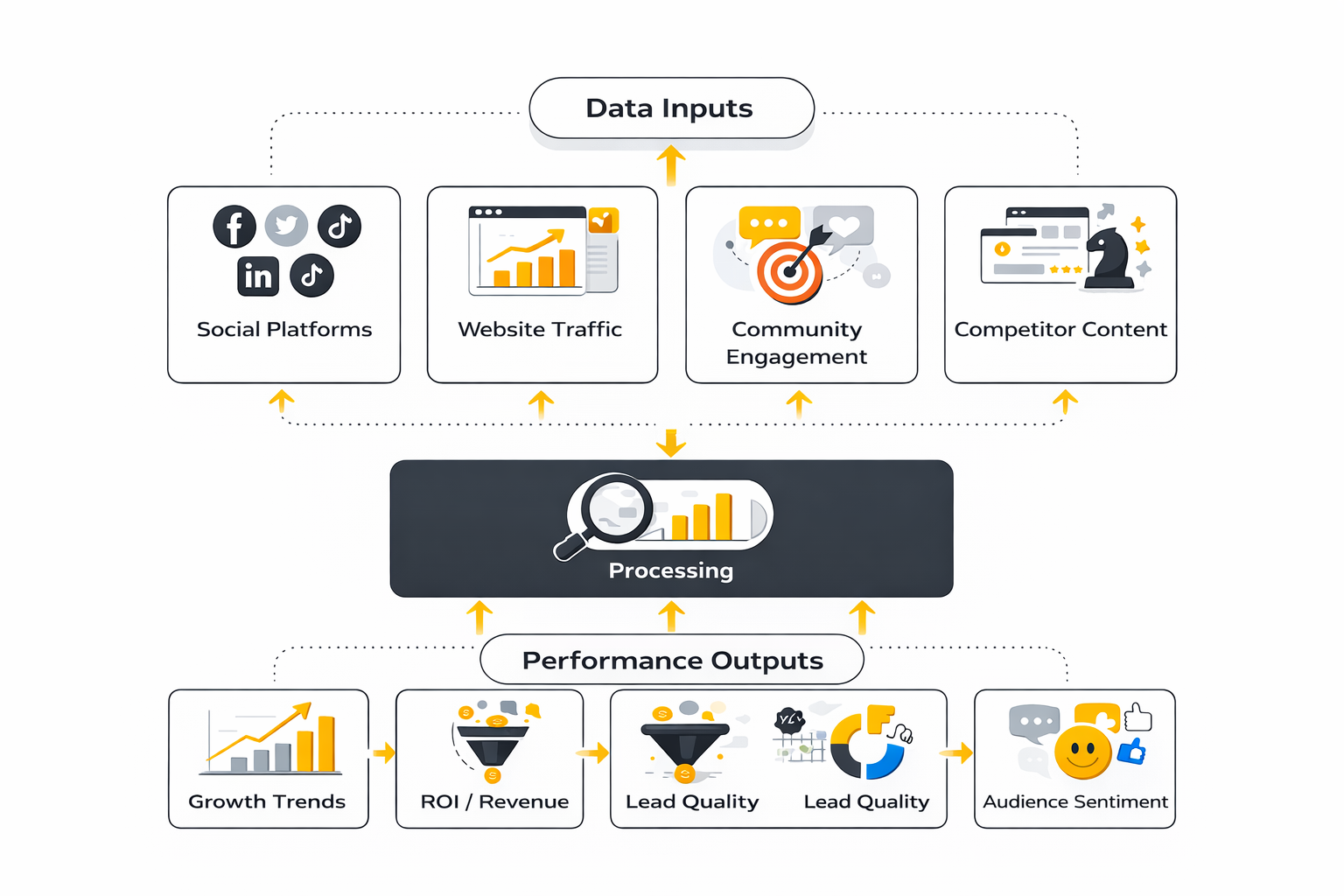
The fix is to build a layered analytics system. The first layer covers attention metrics such as reach, views, watch time, and retention. The second covers engagement quality, which is usually more useful than total engagement because it focuses on saves, shares, meaningful comments, direct messages, and repeat interactions. The third layer covers behavior metrics like profile visits, site clicks, lead form completions, booked calls, purchases, and assisted conversions. The fourth layer covers operational metrics, including response time, resolution quality, publishing consistency, creative turnaround speed, and the percentage of content that gets repurposed successfully.
When a company measures across those layers, reporting starts to become actionable. You can tell whether a weak campaign failed because nobody saw it, because people saw it but did not care, because the offer was wrong, or because the handoff after the click was weak. Without that structure, teams tend to blame the content for everything.
Engagement Quality Is More Important Than Raw Volume
A lot of brands still celebrate any spike in likes or views as if it automatically means progress. Sometimes it does. Often it does not. Social data only becomes useful when you understand what kind of response matters for the business model you actually have.
Sprout’s 2025 benchmark work is helpful here because it breaks out inbound and outbound activity in a way most teams overlook. In 2024, brands saw a 20% jump in average inbound engagements and a 17% increase in average daily inbound engagements per post. That signals rising audience interaction, but the same report also says average outbound engagement across industries stayed at just 2 per day, which reveals a huge missed opportunity. Brands want community, but many still behave like broadcasters.
That difference matters because the healthiest social programs are not just attracting reactions. They are creating loops. People comment, the brand responds, the audience sees that response, trust increases, and the account becomes more worth following. If a social media management company shows you engagement totals but cannot separate passive reactions from deeper interaction, the data is not telling you enough.
This is also why comment quality, DM volume, tagged mentions, and repeat participation deserve more attention than they usually get. A post with fewer likes but more useful questions, buyer intent, or share-worthy discussion can be far more valuable than a post that simply performs well on superficial metrics. Smart teams know the difference.
Response Metrics Now Belong in the Main Dashboard
Customer care data used to sit off to the side, as if it were separate from social performance. That no longer makes sense. Social has become a service layer, and response behavior now shapes retention, brand perception, and even conversion.
Sprout’s customer care research shows that 73% of consumers expect a response within 24 hours or sooner. That one number should immediately affect how you judge a partner. If an agency reports beautifully on content but cannot explain first-response time, escalation speed, or resolution quality, it is ignoring one of the most commercially important parts of the channel.
This is where data should drive staffing and process decisions, not just weekly commentary. If response times are slipping, you may need more coverage windows, clearer escalation rules, or better automation for common questions. For brands with heavier message volume, tools like ManyChat can help handle routing and routine flows, but the decision to use automation should come from response data, not from hype.
Conversion Signals Deserve More Respect Than They Usually Get
Not every brand should judge social only by last-click revenue. That is too simplistic. But many teams make the opposite mistake and avoid conversion measurement almost entirely because attribution is messy. That leaves leadership with activity reports while the real commercial questions stay unanswered.
The better way to handle this is to measure conversion in ranges and layers. Sprout’s 2025 ROI analysis notes that 81% of consumers are influenced by social media to make spontaneous purchases multiple times a year, while Deloitte reports that 72% of consumers are willing to buy directly within social platforms and 60% want more opportunities to discover and purchase there. Those numbers do not mean every post should push a product. They mean social is much closer to revenue than many internal reporting models still assume.
So the right action is not to force perfect attribution. It is to build better signal capture. Track landing page behavior, tagged links, assisted conversions, creator codes, lead-source fields, reply-to-booking journeys, and the percentage of qualified inquiries that begin on social. If your agency cannot connect social behavior to at least some downstream outcomes, it is leaving leadership with an incomplete picture.
For brands that want a cleaner bridge between content, follow-up, and lead management, platforms like GoHighLevel can help consolidate funnel steps and reporting in one place. The tool itself is not the point. The point is that measurement gets stronger when the handoff after social is visible.
The Right Action From the Data Is Usually Smaller Than People Expect
One of the most useful things a strong analytics partner can do is stop clients from overreacting. Not every weak post means the strategy is broken. Not every strong post means you found a repeatable growth engine. Most of the time, data should drive focused adjustments: stronger hooks, better creative packaging, clearer CTAs, tighter response windows, more deliberate repurposing, or a smarter distribution split across channels.
That is why the best social media management companies treat analytics as a weekly steering tool, not a monthly autopsy. They use the numbers to decide what to keep, what to kill, what to test, and what to escalate across the business. They do not drown clients in random statistics. They translate performance into action.
And that is the real standard to hold. Good reporting does not just explain the past. It improves the next round of execution.
Pricing Models, Red Flags, and What to Ask Before You Sign
By this point, the conversation usually shifts from strategy to commitment. You understand what strong social media management companies are supposed to do, how they operate, and how performance should be measured. Now comes the harder part: figuring out whether the commercial model and working relationship actually make sense for your business.
This is where a lot of brands get trapped. They compare retainers without comparing scope, they compare deliverables without comparing operating quality, and they sign contracts before they understand how the relationship will behave under pressure. A low monthly fee can become expensive very quickly if the team is slow, reactive, unclear, or impossible to scale with.
Cheap Pricing Is Usually Hiding a More Expensive Problem
Most social media management companies price around one of four models: flat monthly retainers, per-channel pricing, deliverable-based packages, or project-and-add-on structures. None of those models is automatically bad. The problem starts when the pricing model makes it hard to see what is actually included and what the team is optimizing for.
A deliverable-heavy package often looks attractive because it feels concrete. You get a set number of posts, videos, stories, or community hours, and the offer looks easy to compare. But that structure can quietly push the agency to protect output volume instead of business results, which is exactly how brands end up with lots of content and very little momentum.
Retainers tend to work better when the social program needs ongoing judgment, iteration, and cross-functional coordination. That is usually the more realistic setup for brands that care about consistency, community management, reporting, and faster optimization. The catch is that retainers only work when the scope is clear, the communication rhythm is strong, and both sides understand what the team is actually responsible for.
Scope Creep Works Both Ways
Clients usually think scope creep is something agencies complain about. In reality, it hurts both sides. When the scope is vague, the agency starts protecting itself, the client starts asking for more reactive support, and the relationship slowly shifts from strategic work into constant cleanup.
This is why the best social media management companies are unusually specific during the sales process. They define how many channels are covered, who owns publishing, how revisions work, whether paid support is included, how community management is staffed, what turnaround times look like, and what counts as out-of-scope work. That level of clarity is not rigidity. It is what keeps the relationship healthy once real pressure shows up.
The client side has responsibilities here too. If your team cannot approve content on time, cannot provide product context, cannot supply raw material, or keeps changing priorities every week, even a strong partner will struggle. Good agencies know how to absorb friction. Great ones help reduce it. But nobody can build momentum inside permanent confusion.
The Biggest Red Flags Show Up Before the Contract Does
You can spot weak social media management companies earlier than most buyers think. The warning signs are usually visible in the proposal, in the questions they ask, and in how they describe success. If they sell confidence without process, that is a problem. If they promise growth without clarifying scope, channel fit, or creative resources, that is also a problem.
Another red flag is when every solution sounds the same. Serious firms adapt around business model, audience behavior, internal team capacity, and platform role. Weak firms just swap the brand name on the same package. If the recommendation for a fast-moving consumer brand looks identical to the recommendation for a B2B SaaS company, you are not looking at strategy. You are looking at a template.
You should also pay attention to how they talk about risk. Good partners are willing to say that some channels are not worth the current investment, that some content ideas will take time to validate, and that some goals require internal support the client has not planned for yet. Agencies that promise only upside are usually avoiding the hard conversation that you will eventually have anyway.
Scaling Social Creates New Problems, Not Just More Output
A partner can look great at a small scale and still break once the workload grows. That is why scaling questions matter before you sign, not after. You need to know what happens when content volume increases, when customer messages spike, when another market or product line gets added, or when leadership suddenly wants weekly reporting and faster turnaround.
The strongest social media management companies scale through systems, not heroics. They have documented workflows, reusable briefing structures, clear review paths, and a tool stack that makes collaboration easier instead of messier. They know when to add automation, when to add people, and when to narrow focus so the overall program does not become chaotic.
This is where tools can either support the system or make it more fragmented. For example, Buffer can work well for straightforward scheduling, collaboration, and reporting, especially when a team wants a cleaner publishing layer without unnecessary complexity. If the challenge is more about turning social attention into lead capture, follow-up, and pipeline visibility, GoHighLevel becomes more relevant because the issue is no longer just content management. It is operational handoff.
Automation Is Useful, but It Can Also Damage the Brand Fast
As social programs grow, automation becomes tempting. Some of that temptation is healthy. Routing repetitive direct messages, qualifying leads, organizing approvals, or standardizing reporting can save real time and reduce avoidable mistakes. But automation becomes dangerous the moment it starts replacing judgment in places where people expect nuance.
This is especially true in community management and inbound conversations. Used carefully, ManyChat can help with routing, basic qualification, and repetitive question handling. Used badly, it can make the brand feel lazy, impersonal, and weirdly unavailable inside a channel that is supposed to feel immediate.
The same principle applies to AI-assisted workflows more broadly. Drafting, repurposing, summarizing, tagging, and handoff support can all be useful. But the closer a task gets to live brand voice, customer emotion, or public response, the more dangerous blind automation becomes. Strong partners know where the efficiency line is. Weak ones cross it because the shortcut looks impressive in a pitch.
Ask Questions That Expose How the Relationship Will Actually Work
By the time you are down to a shortlist, the best thing you can do is stop asking generic agency questions. Portfolio reviews and service lists only tell you so much. What you need now are questions that reveal how the company handles friction, prioritization, accountability, and tradeoffs.
A few questions tend to expose the truth fast:
- How do you decide what not to do on social right now?
- What happens when approvals slow down and content starts missing schedule?
- How do you handle a sudden spike in customer complaints or negative comments?
- What metrics would make you change the strategy after 30, 60, or 90 days?
- Which work stays senior-led, and which work gets delegated?
- What does success look like if follower growth stays flat but business results improve?
- What does offboarding look like if the relationship ends?
These questions matter because they move the conversation from selling to operating. Any social media management company can sound polished while describing best-case work. The better test is whether they can explain how they behave when the work gets messy, political, or harder than expected.
The Best Choice Usually Feels Clearer, Not More Exciting
This is the part many buyers miss. The right partner is not always the most charismatic one, the cheapest one, or the one with the flashiest creative deck. Usually, the right choice is the company that makes the work feel clearer. You understand the process, the tradeoffs, the expectations, the limits, and the next steps.
That clarity matters more than hype because social compounds slowly and operationally. The wins come from consistency, speed, useful reporting, stronger community response, better creative iteration, and fewer preventable mistakes. A good agency can absolutely accelerate that. But only if the relationship is built on a realistic scope, honest communication, and a system that can keep working after the honeymoon phase ends.
That is the real test near the end of the buying process. Not whether the company sounds smart for an hour. Whether it looks capable of helping your team make better decisions for a long time.
How to Choose the Right Social Media Management Company for Your Brand
At the end of all this, the decision is usually less mysterious than it looked at the start. The right social media management companies are not the ones promising the loudest growth story. They are the ones that can match channel strategy, execution process, reporting discipline, and business alignment to the stage your company is actually in.
That matters because social keeps getting bigger, more crowded, and more commercially relevant at the same time. There were 5.24 billion active social media user identities worldwide at the start of 2025, and leadership teams increasingly want social tied to real business outcomes, with 65% of leaders looking for a clearer connection between campaigns and results. So the right hire is not just a content vendor. It is a partner that helps you make better decisions under real operating pressure.
The practical filter is simple. Choose the company that understands what social needs to do for your business now, knows which channels deserve attention, can explain its process in plain English, and shows you how reporting will improve the next round of work. If a firm can do that while keeping creative quality high, response systems tight, and internal collaboration manageable, you are looking at a partner worth taking seriously.
FAQ
What do social media management companies actually do?
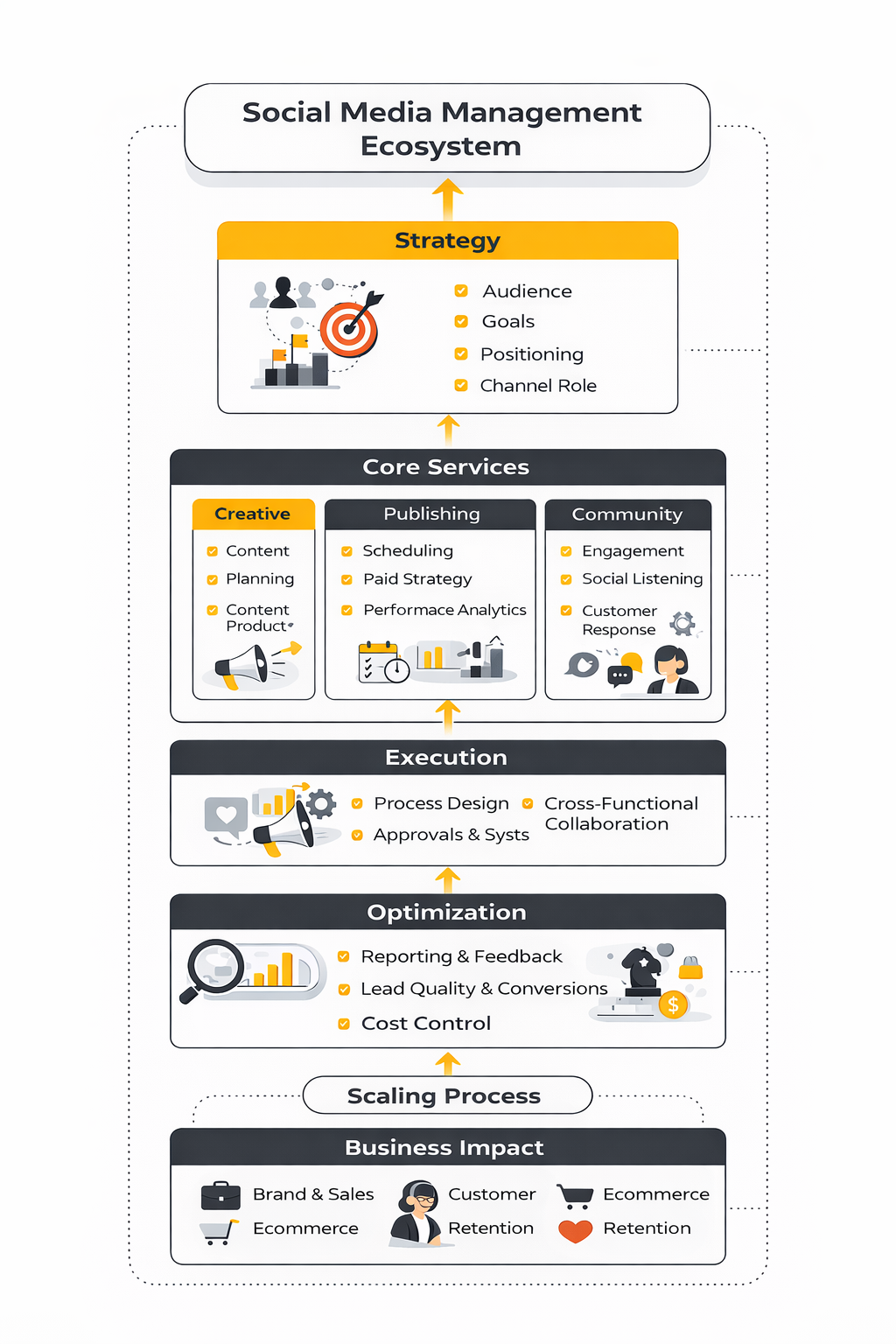
The best social media management companies do much more than schedule posts. They usually combine channel strategy, content planning, creative production, community management, reporting, and coordination with teams like customer support, paid media, sales, or ecommerce. That broader role matters because social now sits much closer to discovery, customer service, and conversion than it did a few years ago.
A weaker company often sells output. A stronger one builds a repeatable operating system around your social presence. That distinction is what determines whether you end up with more activity or better business performance.
When should a business hire a social media management company?
A business should usually hire outside help when social becomes important enough that inconsistent execution starts costing real opportunities. That might happen when your team cannot publish consistently, when customer messages are piling up, when content quality is too uneven, or when leadership wants clearer reporting than your internal setup can provide. It can also happen when social starts influencing search, sales conversations, or customer retention and the current team simply does not have the capacity to manage that properly.
This timing matters because audiences are spending serious time on social and using it for more than entertainment. Global internet users still spend well over two hours per day on social platforms on average, and platform behavior keeps shifting across multiple networks, which makes part-time handling much harder to sustain well.
How much do social media management companies typically cost?
Pricing varies widely because scope varies widely. A company managing one or two channels with limited content production will price very differently from a partner handling strategy, short-form video, creator coordination, community management, reporting, and paid support. That is why comparing retainers without comparing responsibilities is one of the fastest ways to make a bad choice.
The better question is not what the monthly fee is in isolation. It is what work the fee covers, how senior the team is, how quickly they move, and whether the system can scale without falling apart. Cheap service is often expensive once you count delays, weak content, poor response handling, and unclear accountability.
Are agencies better than hiring an in-house social media manager?
Not automatically. An in-house hire can be a better fit when the brand needs daily internal context, fast access to product or leadership, and tighter collaboration across departments. A good agency can be the better option when the business needs a wider range of skills, faster execution systems, or cross-industry pattern recognition that one internal hire may not bring.
In many cases, the strongest setup is hybrid. One internal owner keeps priorities clear and approves quickly, while an external partner handles production, optimization, community support, and reporting. That kind of model tends to work especially well once social grows beyond a single person’s realistic workload.
What should I ask before hiring one?
You should ask questions that expose how the company works when things get messy, not just when the pitch is polished. Ask how they decide channel priorities, what they expect from your internal team, how they handle approvals, what happens during negative comment spikes, and which metrics would make them change the plan after the first 30 to 90 days. Those questions reveal far more than asking for another case study deck.
You should also ask how they define success by business model. A B2B firm should not evaluate success the same way a DTC brand does, and a company that treats every client the same is usually hiding a template behind confident language. The right partner will talk about tradeoffs, not just upside.
Which metrics matter most when evaluating performance?
The answer depends on the goal, but the best measurement systems usually track four layers: attention, engagement quality, behavior, and operations. That means looking at reach, views, watch time, saves, shares, meaningful comments, direct messages, site visits, leads, purchases, response time, and content turnaround together rather than relying on one surface-level metric. This kind of layered reporting is what turns social data into decisions instead of noise.
That approach matters because benchmark data only gives context, not a full answer. Rival IQ’s 2025 report found engagement rates declined across major platforms year over year, which means many brands need to interpret performance trends carefully instead of overreacting to raw numbers in isolation.
How long does it take to see results?
Some signals appear quickly. You can often see whether the process is improving within the first month through better consistency, sharper creative packaging, faster response handling, and more useful reporting. But stronger business outcomes usually take longer because the work needs time to gather feedback, refine patterns, and build audience recognition.
That slower timeline is normal. Social is an iterative system, not a switch you flip once, and even platform-wide engagement patterns move over time. The companies worth hiring are the ones that can show you what is improving early while staying honest about what needs more runway.
Do social media management companies also handle customer service?
Some do, and increasingly they should at least help structure it. Social has become a major service touchpoint, and consumers expect brands to respond quickly when they reach out through public comments or direct messages. Research from Sprout Social shows that 73% of consumers expect a response within 24 hours or sooner, so response design is no longer a side task.
That does not mean the agency should own every support issue by itself. It means the company should know how to manage first response, escalation rules, routing, and coordination with the internal support team. If an agency ignores this part of the job entirely, it is not managing the channel in a modern way.
What is the biggest red flag when evaluating social media management companies?
The biggest red flag is false certainty. If a firm promises strong results without first clarifying your goals, channel mix, approval process, resource constraints, and reporting needs, it is probably selling confidence rather than competence. Real social execution has too many moving parts for honest experts to pretend otherwise.
Another red flag is generic planning. Strong firms can explain why one platform deserves investment and another does not, why one format fits your audience better than another, and what internal support they need from you to make the work succeed. Weak firms hide behind standardized packages and vague growth language.
Should I care more about creativity or process?
You need both, but process usually determines whether creativity compounds. Great ideas die all the time inside weak approval systems, unclear ownership, and bad reporting habits. A solid process gives good creative work enough structure to get published, measured, improved, and repeated.
That is especially important as brands lean harder into social across community, content, and conversion. Deloitte’s 2025 State of Social research centers those three pillars for social-first brands, which is a good reminder that execution strength matters just as much as creative spark.
Can social media management companies help with leads and sales, not just awareness?
Yes, but only when the system after the post is visible. Social can influence discovery, consideration, direct inquiries, and even in-platform purchasing, but the results are easier to prove when the handoff to landing pages, forms, CRMs, and follow-up workflows is clean. That means the company you hire should understand not just publishing, but also routing, attribution, and conversion support.
The opportunity is real. Deloitte’s social commerce research found that 72% of consumers are willing to buy directly within social platforms and 60% want more opportunities to discover and purchase products there. That does not mean every brand should turn every post into a sales pitch. It does mean social is too close to revenue to be measured only as awareness.
What tools tend to matter most in a strong social setup?
The right stack depends on the business, but most serious teams need a clean scheduling layer, a reporting layer, a place to manage conversations, and a way to connect social actions to downstream outcomes. For simpler publishing and reporting workflows, Buffer is still a practical option. For direct-message automation and lead routing on social, ManyChat can be useful when the automation is designed carefully.
If the business needs a stronger bridge between leads, follow-up, and pipeline visibility, GoHighLevel can make more sense. The important thing is not chasing a trendy stack. It is choosing tools that support a clear operating model instead of adding another layer of confusion.
Work With Professionals
Explore 10K+ Remote Marketing Contracts on MarkeWork.com
Most marketers spend too much time chasing clients, competing on crowded platforms, and losing a percentage of every project to middlemen. MarkeWork gives you a better way. Browse thousands of remote marketing contracts and connect directly with companies desperate to hire skilled marketers like you, without platform commissions and without unnecessary gatekeepers.
If you're serious about finding better opportunities and keeping 100% of what you earn, explore available contracts and create a profile for free at MarkeWork.com.