

Social media management pricing looks simple until you get into the work itself. One business wants three polished posts a week and light reporting, while another expects strategy, short-form video, creator coordination, inbox coverage, paid support, and same-day replies across multiple platforms. That is why the market swings so wildly, with freelance marketplace benchmarks around $14 to $35 per hour for social media managers on Upwork and broader agency or freelancer benchmarks from WebFX placing monthly management in the $500 to $5,000 range, while UK-focused benchmarks from Wise put retainers anywhere from £300 to £3,000.
The stakes are higher than they used to be because social is no longer just a posting channel. DataReportal’s 2025 social report says there were 5.24 billion active social media user identities worldwide at the start of 2025, and the typical internet user spends 2 hours and 21 minutes a day on social platforms. At the same time, HubSpot’s 2025 social trends research found 84% of marketers believe consumers will search for brands on social media this year, while Sprout Social’s 2025 Index coverage says 73% of consumers expect a response within 24 hours or sooner.
That mix changes the math. You are not pricing “some posts.” You are pricing attention, creative output, channel expertise, responsiveness, analysis, and business risk. Get the number wrong and clients either overpay for shallow execution or underbuy the work they actually need.

Article Outline
- Why Social Media Management Pricing Is Hard to Get Right
- The Pricing Framework at a Glance
- What Actually Drives the Price
- Common Pricing Models and When to Use Them
- How to Build Packages Clients Understand
- How to Quote, Negotiate, and Protect Margin
Why Social Media Management Pricing Is Hard to Get Right
The biggest reason social media management pricing feels messy is that buyers often compare offers that are not remotely equivalent. A low-cost package may cover scheduling and basic captions, while a higher-priced retainer may include strategy, content planning, editing, analytics, community management, and customer care. When nearly three-quarters of consumers expect replies within 24 hours and brands increasingly treat social as discovery as well as service, the gap between “posting support” and “real management” becomes expensive fast.
There is also a labor reality underneath every quote. Even if a company skips the agency route and hires internally, marketing talent is not cheap, with the U.S. Bureau of Labor Statistics listing a 2024 median annual wage of $161,030 for marketing managers. That does not mean every social media manager should charge like a senior in-house leader, but it does show why serious strategy, content oversight, and performance accountability cannot live forever inside bargain-basement retainers.
The practical takeaway is simple: pricing only makes sense when scope is visible. Once you separate planning, production, publishing, engagement, reporting, revisions, and platform count, the numbers stop feeling random. They start looking like workload.
The Pricing Framework at a Glance
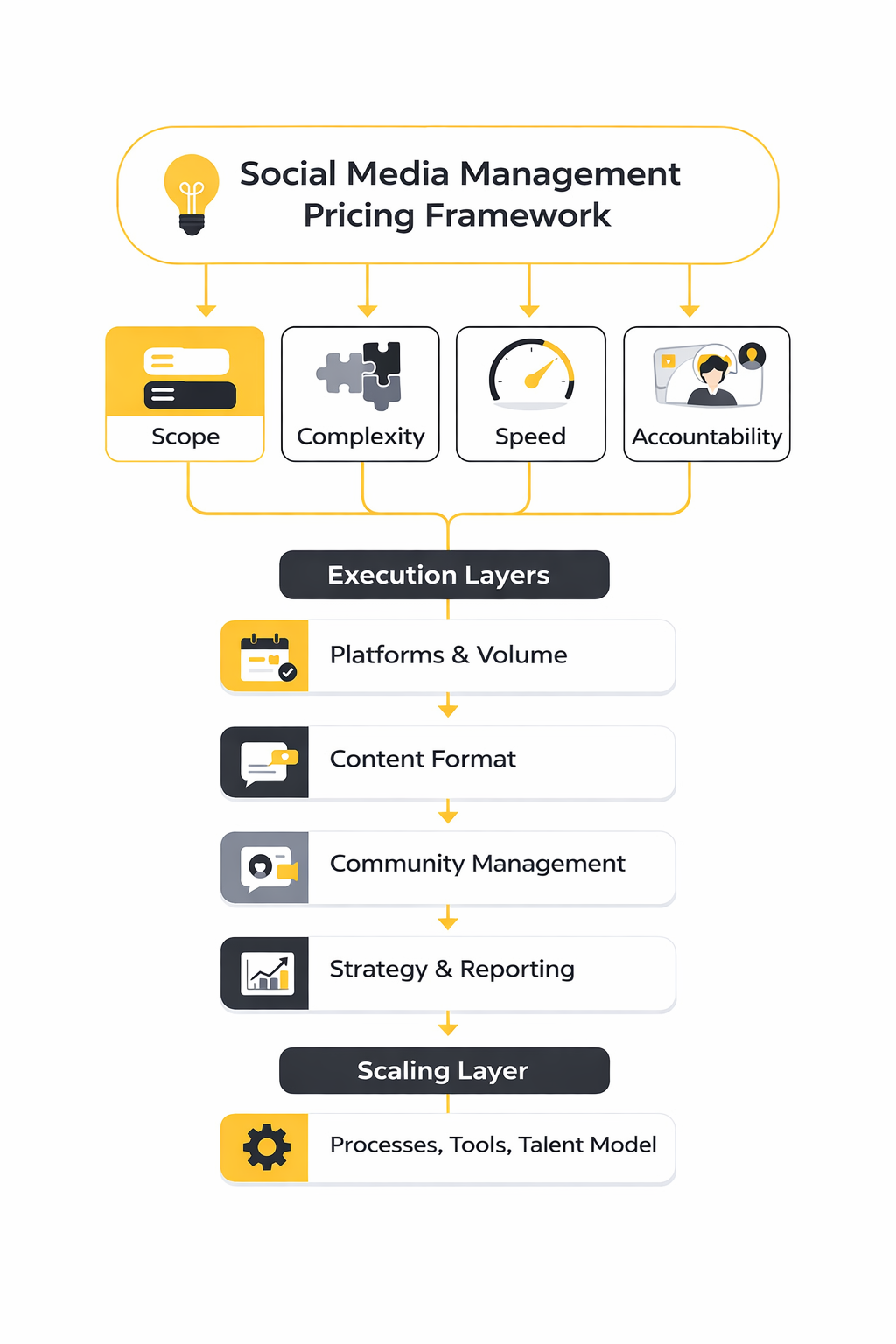
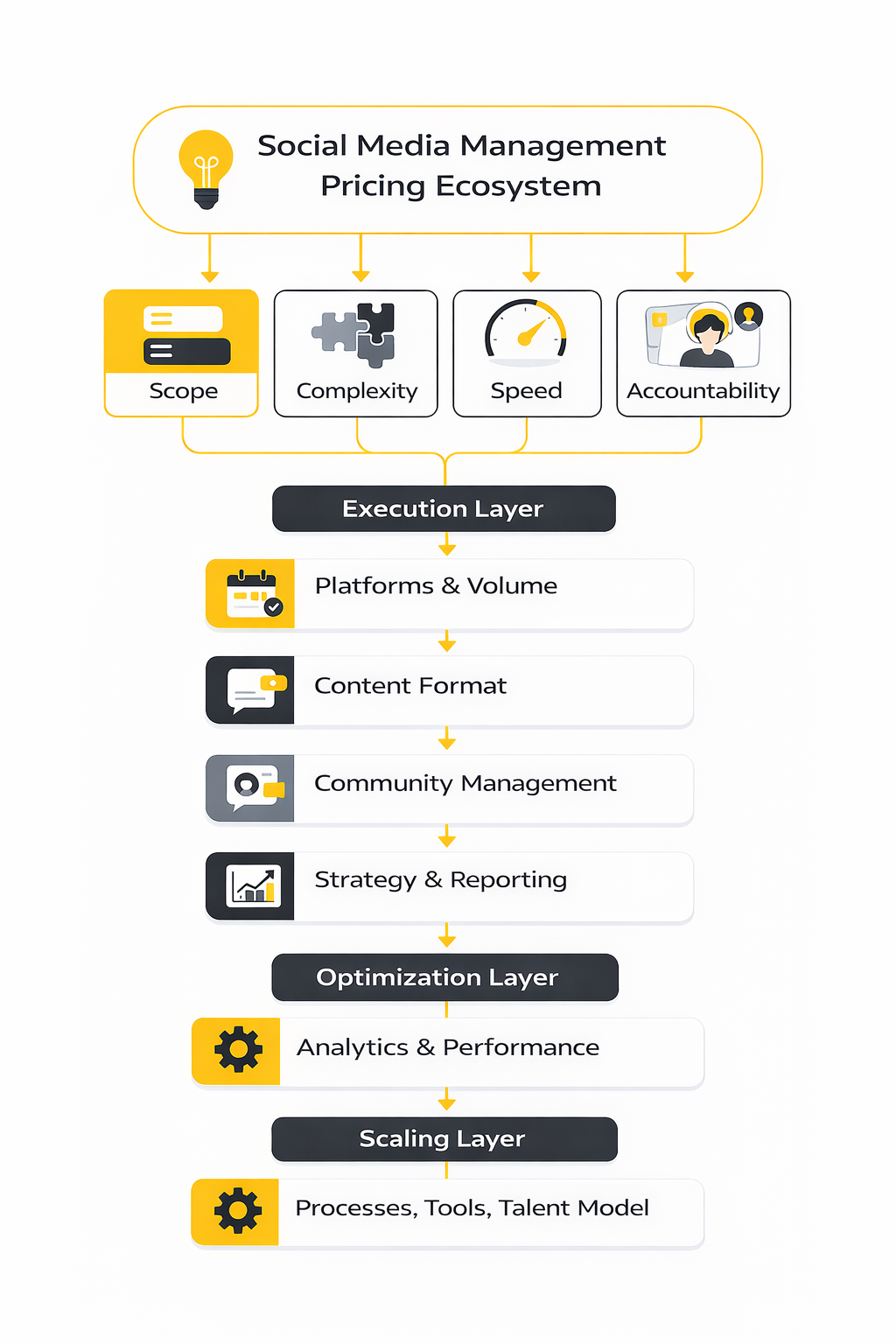
This article will use a straightforward framework: price social media management based on scope, complexity, speed, and accountability. Scope covers how much work gets done. Complexity covers how hard that work is, including platform mix, content format, approvals, and brand nuance. Speed covers how quickly the team is expected to respond, publish, revise, or handle community activity. Accountability covers how much strategic ownership sits with the provider rather than the client.
That matters because the same brand can need very different service levels at different stages. A local business that wants steady posting and basic reporting should not be priced like a multi-location brand that needs short-form video, creator collaboration, paid support, and active inbox coverage. The framework keeps you from undercharging for hidden labor and helps clients see why one proposal lands at four figures while another pushes far beyond that.
Later in the article, I will turn this into a practical model you can actually use to build retainers, project fees, and hybrid offers. For now, the important point is that good social media management pricing starts with workload design, not guesswork, and not whatever number a competitor happened to put on a pricing page.
What Actually Drives the Price
Once you move past vague package labels, social media management pricing is mostly driven by the amount of work hiding behind the deliverables. Two proposals can both say “monthly management,” but one may cover content scheduling only while the other includes channel planning, original creative, active moderation, stakeholder reviews, and performance reporting. That gap is why recent benchmark pages can show everything from roughly $20 to $150 per hour for freelancers to broader monthly retainers of $500 to $5,000, because the market is really pricing different service stacks.
The cleanest way to think about it is this: price rises when the work becomes more custom, more frequent, more reactive, or more accountable to revenue and brand outcomes. A business that needs polished execution on a simple calendar is cheaper to support than a business that expects strategy, creative iteration, customer service coverage, and channel-specific decision making. That sounds obvious, but it is exactly where most underpricing starts.
Number of Platforms and Publishing Volume
The first driver is platform count, but not just because there are more places to post. Every extra channel changes the workflow, the asset requirements, the formatting, the approvals, and the reporting. A brand publishing on Instagram, LinkedIn, TikTok, Facebook, and X is not buying five copies of the same task. It is buying five slightly different operating systems.
Volume matters for the same reason. More posts mean more planning, more caption writing, more asset handling, more scheduling checks, and usually more revisions. This is especially true now that brands are competing inside an environment where the average internet user still spends 2 hours and 21 minutes per day on social media, which raises expectations for consistency and freshness rather than occasional posting.
There is also a hidden compounding effect here. Once posting frequency rises, the calendar becomes less forgiving, approvals become more urgent, and a single missed asset can disrupt an entire week. That is why serious providers do not price higher volume by adding a token fee per post. They price the operational load around that volume.
Content Format Changes the Work More Than Most Clients Realize
A static graphic and a high-performing short-form video should never sit at the same price point. The production effort is different, the review process is different, and the creative stakes are different. HubSpot’s 2025 reporting keeps pointing to short-form video as the top-performing content format marketers are using and the format they expect to keep investing in, which means more clients now want video-heavy calendars instead of simple post scheduling for good reason.
That shift matters because video is not just “another asset.” It usually involves hooks, scripts, raw footage handling, editing, subtitles, platform formatting, and multiple rounds of revision. Even when the client supplies the footage, turning it into usable social content takes real editorial judgment.
This is one of the biggest places where social media management pricing breaks down. Clients compare a quote built around video-led growth with one built around recycled static content, then assume the higher quote is overpriced. In reality, they are comparing two different businesses.
Community Management and Response Expectations
Posting is the visible part of the work. Community management is where the job becomes time-sensitive. When a brand expects comment moderation, DM handling, escalation paths, customer support coordination, or lead qualification inside social channels, pricing has to reflect availability, not just output.
That is even more true because customer expectations are now stable and demanding. Sprout Social’s recent reporting says 73% of consumers expect a response within 24 hours or sooner, and the same pattern shows up across its 2024 and 2025 response-time coverage again. Once that expectation enters the scope, the provider is no longer charging only for planned work. They are charging for interruption, responsiveness, and risk management.
This is where many low retainers become unprofitable. A package can look manageable on paper until the client expects someone to monitor comments over evenings, reply to inbound questions quickly, and catch emerging issues before they turn into public complaints. That is not lightweight admin. That is service labor with brand consequences.
Strategy, Reporting, and Decision-Making Responsibility
Another major pricing driver is how much thinking sits inside the engagement. Some clients come with a clear brand voice, clear campaigns, clear offers, and clear approval chains. Others expect the social media manager or agency to act like a strategist, editor, analyst, and growth advisor all at once.
That responsibility should cost more because it changes the value of the service. When the provider is expected to choose channel priorities, turn business goals into content themes, interpret performance, and recommend what to test next, they are influencing outcomes rather than merely executing instructions. There is a reason broader marketing leadership commands higher compensation, with the U.S. Bureau of Labor Statistics listing a 2024 median annual wage of $161,030 for marketing managers. Strategic ownership has economic value.
Reporting adds labor too, especially when it goes beyond screenshots and vanity metrics. A serious monthly review involves pulling platform data, comparing trends, tying performance to content types, and translating that into decisions. If the client wants insight rather than a dashboard dump, the price has to cover analysis time.
Approval Complexity and Internal Friction
One of the least discussed factors in social media management pricing is approval drag. A founder-led brand with one decision-maker can move quickly and keep production efficient. A larger company with multiple reviewers, legal checks, product teams, or regional stakeholders can burn hours without adding a single extra deliverable.
That matters because revision cycles are real labor. Every extra round means context switching, version control, editing, scheduling changes, and renewed signoff. In practical terms, a modest content calendar for a slow-moving organization can be harder to deliver profitably than a bigger calendar for a fast-moving one.
This is why experienced operators price not just for deliverables, but for process. A messy approval system creates invisible work, and invisible work is where margin disappears.
Industry, Brand Risk, and Subject-Matter Difficulty
Not every niche is equally easy to manage on social. A local lifestyle brand, a medical company, a financial services firm, and a B2B SaaS business may all want “content,” but the compliance risk, research burden, and messaging precision are completely different. Industries with legal oversight, technical detail, or reputation sensitivity usually require slower workflows and tighter review standards.
Audience expectations also shift by category. HubSpot’s 2025 social trends research shows marketers increasingly view social as a discovery and search behavior, not just a distribution channel, which raises the importance of accuracy, helpfulness, and format fit in competitive categories where buyers research brands on-platform. If the content has to educate a skeptical audience or support a longer buying cycle, the provider is doing more than filling a feed.
That is why niche expertise often deserves its own premium. The service is not just content production anymore. It is interpretation, positioning, and judgment inside a category where mistakes cost more.
Tooling, Automation, and the Real Cost of Running the Work
Software does not replace labor, but it absolutely changes the cost structure. Scheduling tools, reporting tools, approval systems, DM automation, CRM handoffs, and intake forms can make a service more scalable and more reliable. They also create stack costs that either need to be absorbed into margin or passed through clearly.
For teams that want cleaner publishing workflows, approval visibility, and cross-channel scheduling, tools like Buffer can make lower-touch management more efficient. For businesses that need Instagram and Facebook automation, comment flows, or DM capture tied to lead generation, ManyChat can reduce some manual load. And when a provider needs the broader client-management layer around pipelines, messaging, and reporting, GoHighLevel fits naturally into a more productized service model.
The important point is not the software brand. It is that tooling changes what kind of pricing model is sustainable. A provider using a tight stack can often deliver recurring work with better margins, faster approvals, and cleaner reporting than someone doing everything manually. That does not always make the service cheaper, but it often makes the offer more reliable.
Geography and Talent Model Still Matter
The final driver is who is doing the work and where the business is buying from. A solo freelancer, a boutique agency, a specialist consultant, and an in-house contractor all price differently because their overhead, positioning, and risk tolerance differ. Geography still affects rates too, even in remote work, because local market norms and client expectations shape what feels standard.
That is why marketplace and benchmark numbers are useful, but only to a point. Upwork’s 2026 earnings guidance still places freelance social media managers around $14 to $35 per hour, while Sprout Social’s 2025 pricing benchmark shows a much wider span of $20 to $150 per hour. Neither figure is wrong. They are just capturing different slices of the market.
The better question is not “What is the average?” It is “What operating model, scope, and responsibility level does this price actually buy?” Once you ask that, social media management pricing gets far easier to evaluate. And that sets up the next step: choosing the pricing model that matches the work instead of forcing every client into the same retainer.
Common Pricing Models and When to Use Them
Once you understand the drivers behind social media management pricing, the next move is choosing a pricing model that matches how the work actually gets delivered. This is where a lot of people make things harder than they need to. They use hourly pricing for ongoing strategy work, or force a flat retainer onto a messy scope that changes every week, and then wonder why margin disappears.
The better approach is to match the model to the level of uncertainty. If the work is unpredictable, you need flexibility. If the work is recurring and tightly scoped, you need a structure that rewards efficiency instead of punishing it. Recent market benchmarks still show how wide this spectrum is, with Upwork placing social media manager rates at $14 to $35 per hour while Sprout Social’s 2025 benchmark puts basic monthly programs at $500 to $5,000 and more comprehensive support higher than that.
Hourly Pricing Works Best for Unclear or Variable Scope
Hourly pricing is the simplest model to start with because it protects you when the workload is not stable yet. If a client is still figuring out what they want, has inconsistent approvals, changes direction often, or needs ad hoc consulting on top of content support, hourly billing keeps you from locking yourself into a bad fixed fee. It is also the easiest way to handle one-off audits, launch support, emergency cleanup work, or short-term advisory projects.
The problem is that hourly pricing can make buyers nervous because it feels open-ended. It also punishes efficiency over time. If you build better systems, improve templates, and shorten production time, you earn less unless you raise the rate.
That is why hourly pricing is usually strongest as a discovery model, not a forever model. It helps you learn the real workload before converting the client into something more stable.
Project Pricing Fits Specific Deliverables With Clear Boundaries
Project pricing works when the client wants a clearly defined outcome rather than ongoing management. That could mean a 30-day launch calendar, a content strategy sprint, a channel audit, a competitor review, or a package of short-form edits for a product drop. The scope has a start, a finish, and a fixed list of outputs.
This model is useful because it shifts the conversation away from time and toward deliverables. Clients often find it easier to approve a project fee than an abstract hourly estimate. It also creates room for better margins if your process is efficient.
The catch is that project pricing breaks fast when the boundaries are soft. If there is no firm revision limit, no approval timeline, and no written definition of what is included, the project quietly turns into a retainer without retainer economics.
Monthly Retainers Are Usually the Best Fit for Ongoing Management
If the work repeats every month, a retainer is usually the strongest model. It gives the client predictability, gives the provider baseline revenue, and creates enough stability to plan production properly. This is why so much social media management pricing eventually lands on monthly retainers even when the relationship started with hourly or project work.
A retainer works best when the scope is consistent enough to standardize. That means clear platform count, clear posting volume, clear review process, clear reporting cadence, and clear response expectations. It is not about creating a rigid package for the sake of it. It is about making the work legible enough to price with confidence.
This also lines up with how social tools and support software are sold. Platforms like Buffer and Sprout Social are built around recurring workflows, not scattered one-off tasks, which is another reason retainers tend to map better to real operating behavior.
Hybrid Pricing Is Often the Smartest Option
In practice, the strongest offers are often hybrid. You charge a monthly retainer for recurring work, then add separate fees for anything that breaks the baseline scope. That might include extra video edits, paid campaign support, influencer coordination, after-hours moderation, on-site content capture, or strategy days.
This model works because it keeps the core relationship simple without pretending every month is identical. It also protects your margin when client demands expand. Instead of constantly renegotiating the whole package, you preserve the retainer and price the extra load separately.
For many providers, this is the sweet spot. The retainer covers the predictable system. The add-ons capture the expensive exceptions.
How to Build Packages Clients Understand
The reason many social media proposals fail is not that the pricing is too high. It is that the offer is too vague. Clients struggle to compare options when one package says “growth” and another says “premium,” but neither clearly explains the channels, formats, deliverables, response expectations, reporting depth, or revision rules.
Good packaging solves that. It turns social media management pricing from a mystery into a structured choice. That matters because buyers are already comparing wildly different services across freelancers, agencies, and in-house alternatives, and benchmark data from Hootsuite’s 2025 benchmarks shows just how different posting rhythms and platform demands can be depending on channel and industry.
A strong package should answer one question fast: what exactly does this client get every month, and what happens when they need more than that?
Start With the Core Outcome, Not the Deliverable List
Most people build packages backward. They start by listing how many posts they can produce, then try to justify the number later. The smarter move is to start with the business outcome the client is actually paying for, whether that is consistency, lead generation support, thought leadership, customer response coverage, or stronger content operations.
That changes how the package gets framed. A founder-led B2B company may care more about consistent LinkedIn authority and monthly insight than raw content volume. A local service business may care more about lead capture, quick replies, and trust signals across Instagram and Facebook.
When the package is built around the real outcome, the scope becomes easier to defend. You are no longer selling “12 posts.” You are selling a system designed to achieve something specific.
Build Around Service Tiers Clients Can Actually Compare
A useful package structure usually has three tiers, but the difference between them should be operational, not cosmetic. The lowest tier should solve a simpler problem with limited channels and lighter reporting. The middle tier should add stronger production and more active management. The top tier should include strategic ownership, faster response expectations, and deeper creative or performance support.
What matters is that each tier changes the workload in a visible way. More platforms, more video, more reporting, more meetings, and more community coverage should all raise price because they raise labor. If the only difference between tiers is a nicer label, the client will either default to the cheapest one or assume the entire offer is inflated.
This is also where productized systems help. If you are using GoHighLevel for pipelines, client communication, and reporting, or tools like ManyChat for DM automation and lead flows, your higher tiers can include clearer operational advantages instead of just more content volume.
Make the Scope Visible Before You Make It Attractive
A package should be easy to buy, but it should also be hard to misunderstand. That means spelling out the channels included, monthly content count, asset types, revisions, reporting cadence, meeting cadence, approval windows, and response-time expectations. If inbox management or comment moderation is included, say so plainly. If it is not, say that too.
This is not about legal language. It is about avoiding the kind of ambiguity that destroys delivery. A clean scope document makes the client feel safer, and it protects you from being measured against work you never agreed to provide.
That clarity also improves closing conversations. The client can see where the price comes from, which makes negotiation more rational. Instead of pushing for a random discount, they usually start making real trade-offs.
Turn the Package Into a Repeatable Intake and Delivery Process
Once the offer is defined, the implementation side needs to become boring in the best possible way. Every new client should move through the same intake logic: goals, channels, current assets, approval process, response expectations, content inputs, reporting needs, and known constraints. If that information is gathered consistently, pricing gets faster and more accurate over time.
Forms and scheduling tools help here because they reduce loose back-and-forth. A tool like Fillout can turn onboarding into a cleaner scoped intake, while Cal.com can make review calls and kickoffs easier to standardize. This is not glamorous work, but it is exactly what makes a pricing system usable instead of theoretical.
Once your intake is clean, your packages stop feeling custom every single time. They still allow flexibility, but the delivery backbone becomes repeatable. That is where confidence comes from.
A Simple Process for Turning Scope Into Price
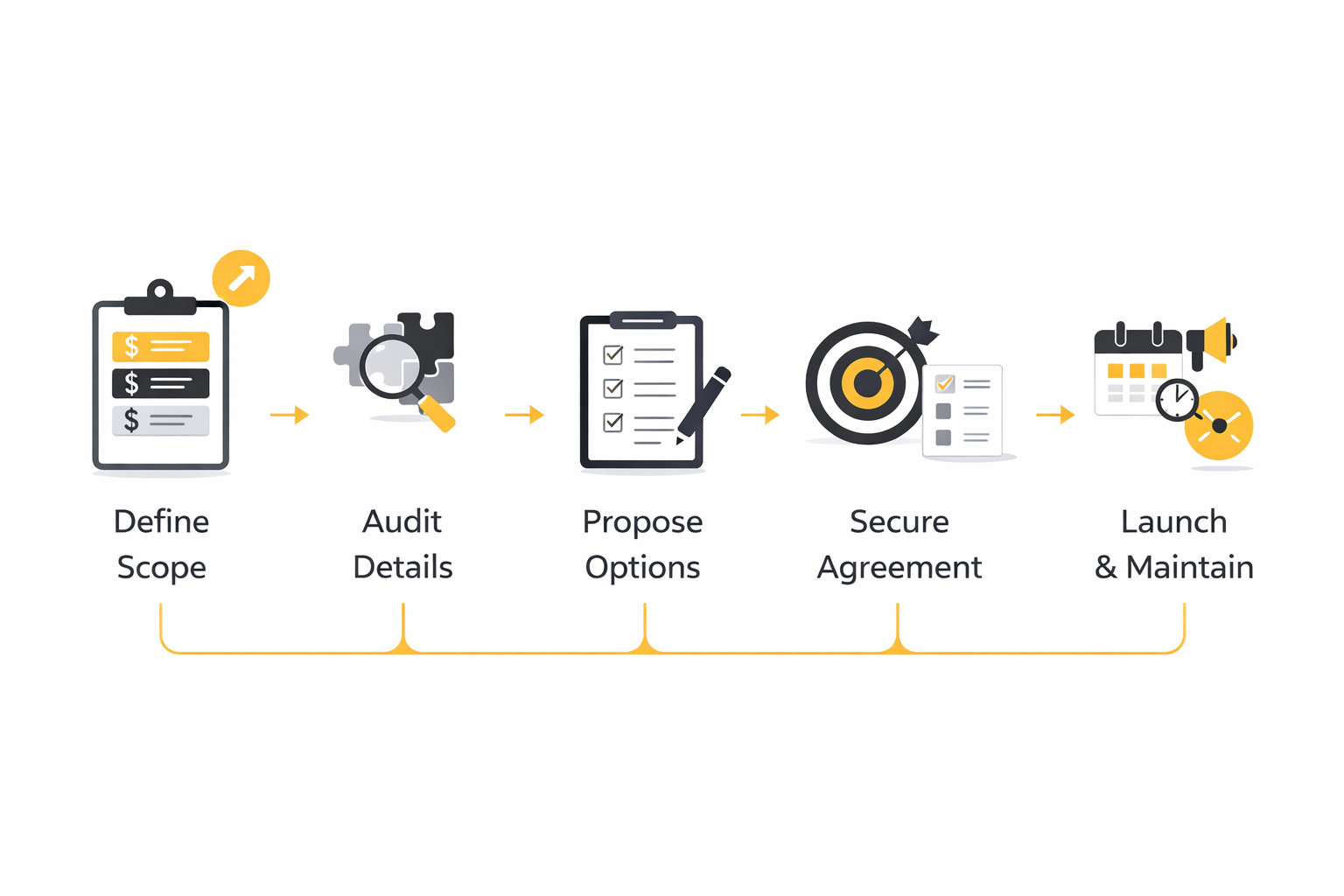
Here is the practical version. First, define the recurring baseline: platforms, posting frequency, content formats, reporting, and community expectations. Second, estimate the labor blocks behind that baseline, including planning, production, approvals, scheduling, and reporting. Third, separate anything volatile or high-touch into add-ons so the retainer stays clean.
After that, pressure-test the scope against reality. Ask how many review rounds are likely, how fast approvals move, whether the client supplies footage or raw ideas, and whether they expect reactive support when something changes mid-month. Those answers matter more than the headline deliverables.
Finally, price for the work you will actually have to absorb, not the work you hope the client will request politely. This is the point where social media management pricing becomes professional. You stop quoting vibes and start quoting operations.
The Best Package Is the One You Can Deliver Profitably Every Month
A package is only good if it works in real life. That means the team can fulfill it consistently, the client understands what is included, and the margin still holds when the month gets messy. If one difficult client can break the economics, the package is not ready yet.
This is why simplicity wins. A tighter offer with fewer hidden assumptions is usually more profitable than an impressive-looking package loaded with soft promises. Clients do not need endless options. They need a clear fit.
That is the bridge into the next part of the article. Once the packages are structured properly, the conversation shifts again from packaging to negotiation: how to quote, how to defend the number, and how to protect margin without sounding defensive.
What the Numbers Actually Mean
A lot of people talk about social media management pricing as if it should be decided before the work starts and then left alone. In reality, the best pricing gets stronger once performance data starts coming in. The numbers tell you whether the current package is aligned with the client’s goals, whether the content mix is working, and whether the service level is too light or too heavy for what the business actually needs.
That matters because the environment is not static. Social keeps getting more important as a discovery, service, and buying channel, with 5.24 billion active social media user identities worldwide in early 2025, and HubSpot’s 2025 research showing 84% of marketers believe consumers will search for brands on social media this year. If the channel keeps absorbing more customer attention, then measurement cannot stop at likes and follower counts. It has to inform staffing, workflow, package design, and price.
Benchmark Data Is Useful, But Only in the Right Context
Benchmarks help most when they prevent bad assumptions. They are useful for spotting whether a client’s performance is broadly normal, unusually weak, or unusually strong for the platform and industry. They are not useful when someone grabs a single average from a generic report and treats it like a universal target.
That distinction matters because engagement is not one number anymore. Hootsuite’s 2025 industry benchmarks show average engagement can vary sharply by platform and category, with examples like LinkedIn around 3.7% on average, Instagram around 3.4%, Instagram Reels around 2.6%, and Facebook around 1.4% across benchmarked industries. The same benchmark set also shows that industry context changes the picture again, which means a finance brand, a nonprofit, and a consumer goods company should not all judge performance against the same baseline.
The action here is simple. Use benchmark data to start the conversation, not finish it. If a client wants premium results on a hard platform in a crowded category, the service may need more creative effort, more testing, or more community management than the original price assumed.
Engagement Metrics Matter Only When They Are Tied to Format and Platform
Engagement rate still matters, but only when it is read properly. A low engagement number does not automatically mean bad work, and a high one does not automatically mean business value. What matters is whether the content format, distribution rhythm, and audience intent line up with what the platform naturally rewards.
That is why platform-specific reading is critical. Hootsuite’s 2025 benchmark analysis shows not only different engagement rates by network, but also different performance patterns tied to posting frequency and industry, with some sectors performing best at modest weekly volume and others benefiting from a much heavier cadence depending on the channel. In other words, more posting is not automatically better, and underposting is not automatically strategic.
For pricing, this changes the conversation. If a client expects stronger performance but refuses the volume, creative variation, or platform-native formats that typically support that result, then the problem is not always execution. Sometimes the package is simply too narrow for the goal.
Response Time Is a Pricing Metric, Not Just a Service Metric
One of the biggest mistakes in social reporting is treating response time like a support-team KPI that sits outside content work. It does not. Once a client expects replies, moderation, lead handling, or issue escalation on social, responsiveness becomes part of the service design and therefore part of social media management pricing.
That is especially clear now because consumer expectations are steady. Sprout Social’s 2025 reporting says nearly three-quarters of consumers expect a response on social within 24 hours, and its customer care guidance continues to frame fast response as a core trust signal rather than a nice extra for brands that want loyalty. If a client wants that level of coverage, the package should reflect monitoring time, response systems, and escalation structure.
This is where analytics should drive action. If response expectations are high but actual first-response performance is weak, the fix is not to demand miracles from the same cheap retainer. The fix is to adjust scope, staffing, automation, or price so the service matches the promise.
Reach and Impressions Tell You Whether the Distribution Engine Is Alive
Reach and impressions are often dismissed because they look like vanity metrics, but that is too simplistic. They matter because they show whether the content is getting a real chance to perform in the first place. If reach collapses, conversion conversations usually become meaningless because the audience is too small for downstream signals to be useful.
Still, reach needs interpretation. A fall in impressions can come from weaker hooks, less posting consistency, platform changes, narrower targeting, stale formats, or a brand simply publishing into the wrong channels. In a social environment where people spend 2 hours and 21 minutes per day on average across social platforms, disappearing from the feed is not a trivial issue. It usually means the content system needs adjustment, not just prettier dashboards.
For pricing, weak reach can point in two directions. Either the work needs better strategy and creative, which may justify a stronger package, or the client is paying for too much low-impact content and should shift budget into fewer, better assets. Both are pricing decisions, not just reporting notes.
The Most Useful Analytics System Is the One That Connects Activity to Outcome
A good reporting system does not stop at platform metrics. It connects content activity to commercial or operational outcomes. That means looking at leading indicators like reach, watch time, saves, shares, click-throughs, and response times, then tying them to lagging indicators like leads, booked calls, purchases, assisted conversions, or reduced support friction.
This matters more now because social is increasingly part of how people evaluate brands before they ever visit a website. HubSpot’s 2025 social trends research shows 25% of consumers bought products directly from social media in the previous three months, while marketers also expect more purchase and discovery behavior to keep moving onto social platforms. If that is true, then reporting has to move beyond “did the post do well?” and toward “did this content help the business move?”
The best action from this data is usually operational. If short-form video creates better saves, shares, or profile actions than static posts, the package may need more editing capacity. If thought-leadership content drives better qualified traffic on LinkedIn than broad engagement bait, the strategy may need fewer posts but higher quality. Analytics should shape the delivery model, not just decorate it.
Stop Reporting on Everything and Start Reporting on Decision Signals
Most monthly reports are too crowded. They throw every available platform metric into a deck, then leave the client with no idea what to do next. That is not analysis. It is just data storage wearing a blazer.
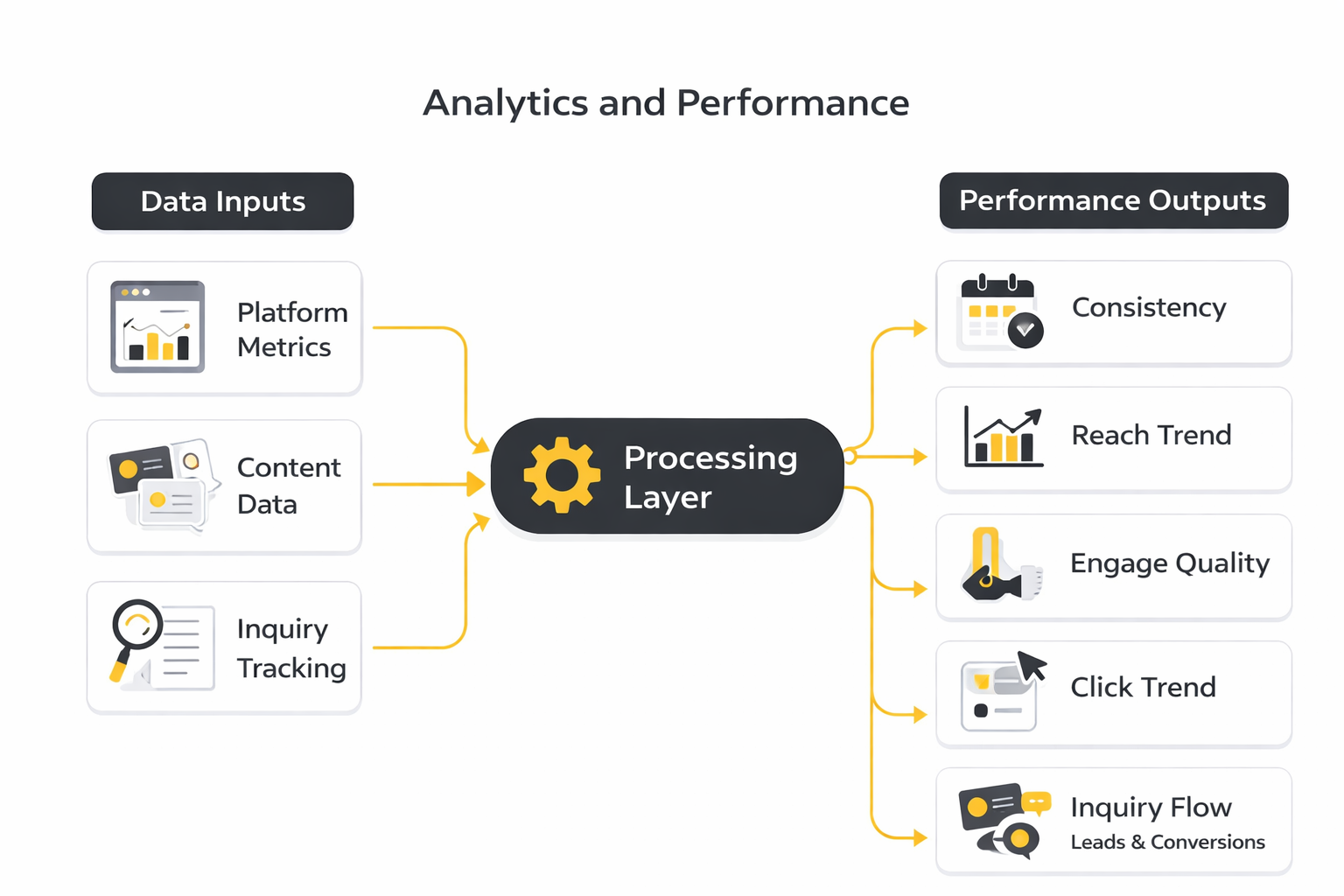
A stronger system usually tracks a smaller set of decision signals. These often include posting consistency, reach trend, engagement quality, top-performing format, response time, click behavior, lead or inquiry volume, and a simple read on what changed versus the previous period. Hootsuite’s benchmark coverage is helpful here because it reinforces that performance should be judged relative to channel norms and publishing cadence, not by one universal “good” number copied from somewhere else.
The practical payoff is huge. Once reporting focuses on decisions, social media management pricing gets easier to defend because you can show what the service is actually controlling and where more investment would change the result.
Data Should Tell You Whether to Raise the Price, Rescope the Work, or Change the Goal
This is the part many providers avoid because it forces a harder conversation. Sometimes the data shows the package is underpowered for the client’s expectations. Sometimes it shows the client is paying for the wrong type of work. Sometimes it shows the original goal was vague enough that no pricing model could have served it properly.
That is why measurement belongs inside the pricing conversation. If performance is flat but the scope is small, the right move may be a higher-tier package with more strategic input, stronger creative, or faster response coverage. If performance is strong but the service is bloated, the smarter move may be to simplify the offer and protect margin. If the content is doing fine but the business has no conversion path, the issue may sit outside social entirely.
The point is not to use analytics to justify charging more every time. The point is to use analytics to make the service honest. Good data tells you whether the current social media management pricing still matches the workload and the outcome the client is buying. That is exactly what the next section needs to solve: how to quote and negotiate from that position without giving away the margin.
How to Quote, Negotiate, and Protect Margin
By the time you get to the quote stage, most pricing mistakes have already happened. The scope is still fuzzy, the client has not made tradeoffs, and the provider is trying to sound flexible instead of being precise. That is exactly how social media management pricing turns into a low-margin retainer that feels fine on paper and miserable by month two.
The fix is not to become rigid. The fix is to become clearer earlier. A strong quote makes the client choose what they actually want, what they can wait on, and what level of responsiveness or strategic input they are truly paying for.
Quote the Operating Model, Not Just the Deliverables
A weak proposal says the client gets 12 posts, some stories, and a monthly report. A strong proposal explains how the service operates: what channels are covered, what content formats are included, how approvals work, how fast changes can be made, how reporting is delivered, and what happens when the workload expands. That shift matters because the real cost of social media management pricing lives in the system around the content, not only in the published assets.
This is especially important now because social has become a customer care and discovery channel at the same time. Sprout Social’s 2025 reporting says 73% of consumers expect a response within 24 hours or sooner, while HubSpot’s 2025 research shows social search and social shopping behaviors continue to grow. If the client expects the channel to support visibility, trust, and responsiveness, the quote has to reflect the operating burden that comes with that.
That is why a good proposal often reads more like a workflow document than a menu. The clearer the operating model, the easier it is to defend the number.
Never Negotiate Against Yourself
One of the fastest ways to wreck your margin is to lower the price before the client has even challenged it properly. A lot of providers do this because they are nervous about sounding expensive, so they start explaining discounts, custom favors, and “we can probably include that too” before the buyer has made a decision. It feels collaborative. It is usually just panic in nicer clothes.
A better move is to hold the number and change the scope if needed. If the client wants a lower monthly investment, reduce platforms, reduce content volume, remove inbox coverage, lighten reporting, or cap revisions more tightly. That way the economics stay aligned instead of silently deteriorating.
This matters because market benchmarks already show how broad the price spread is. Sprout Social’s 2025 pricing benchmark places basic monthly support at $500 to $5,000, which means a quote is only meaningful once the client sees exactly where on that spectrum their service belongs. If they want the lower end, the scope has to behave like the lower end.
Price for Revision Risk, Not Just Production Time
Revisions are one of the most common hidden costs in social work because they rarely look dangerous at the proposal stage. A client says they only need a few minor tweaks here and there. Then every post goes through three reviewers, legal wants copy edits, the founder wants last-minute rewrites, and scheduling gets pushed back every week.
That is not rare. It is normal enough that it should be built into the quote from the start. Social media management pricing should account for production time, yes, but it should also account for approval drag, context switching, and rescheduling friction.
The advanced move here is to define revision structure before delivery begins. Set approval windows. Set round limits. Set the rule for changes after approval. Margin is not usually lost because the creative was hard. It is lost because the process was loose.
Protect Margin With Add-Ons Instead of Unlimited Flexibility
The easiest way to keep a retainer healthy is to let the baseline stay clean and charge separately for the exceptions. Extra short-form edits, event coverage, creator coordination, paid support, weekend monitoring, or urgent campaign pivots should not quietly slide into the monthly fee just because the client asks nicely. Once they do, the retainer becomes a container for chaos.
This is where add-ons stop being a sales gimmick and start becoming a protection system. They create a simple rule: recurring work lives inside the package, volatile work lives outside it. That makes negotiation easier because you are not saying no to the client. You are showing them the correct pricing lane for the extra request.
Operationally, this gets easier when your workflow is centralized. A stack built around tools like GoHighLevel, Buffer, and ManyChat makes those boundaries easier to track, because the deliverables, approvals, automation, and response flows are more visible. That does not eliminate scope creep, but it makes it harder to pretend it is not happening.
Scaling Cheap Retainers Usually Breaks Before People Expect
Low-ticket social retainers often look attractive because they feel easier to sell. The problem is that they create fragile businesses. If the price is too low, every additional revision, every DM spike, every emergency request, and every messy approval chain starts eating the margin immediately. You do not feel it at one or two clients. You feel it when five or ten of them all need attention at once.
This is where scale exposes bad pricing. A cheap retainer can survive with heroic effort for a while, but it rarely survives systems growth unless the scope is extremely standardized. That is why social media management pricing should be judged not just by whether one client is profitable, but whether the delivery model is still profitable when multiplied across a portfolio.
There is a labor reality underneath this. The U.S. Bureau of Labor Statistics lists a 2024 median annual wage of $161,030 for marketing managers, which is a reminder that strategic coordination, channel judgment, and performance accountability are not low-value work. If your retainer assumes senior-level thinking at bargain rates, scale will punish that assumption fast.
Beware of Selling Strategy Without Charging for Strategy
A lot of clients ask for execution and then quietly expect strategic leadership once the relationship starts. They want the provider to decide what to post, what to test, what matters in the data, how to respond to performance dips, and how social should connect to broader growth goals. In other words, they want a strategist even if they bought a scheduler.
That mismatch is one of the biggest risks in social media management pricing. Strategy work is not just a nicer version of content production. It requires stronger judgment, more research, better reporting, and more client-facing communication. If that layer is included, the price should reflect it.
This is where advanced providers make a clear distinction between execution packages and strategy-led retainers. The work may overlap, but the accountability is different. And accountability is expensive for a reason.
AI Changes Delivery Economics, But It Does Not Eliminate the Need for Judgment
AI has absolutely changed the workflow around ideation, first drafts, repurposing, transcription, and content operations. That means some providers can move faster than they could two years ago. It also means clients are more likely to assume the whole service should cost less now. That assumption is too simplistic.
Faster production does not remove the need for editorial judgment, platform fluency, brand understanding, or quality control. In fact, when more people can generate acceptable-looking content quickly, the premium often shifts toward taste, positioning, analysis, and system design. HubSpot’s 2025 social trends coverage points to growing use of AI for content support, but it also reinforces the importance of community, customer experience, and format-specific execution across modern social teams.
The practical tradeoff is this: AI can help you improve margin, but only if you keep the pricing anchored to outcome and responsibility rather than raw minutes spent. Otherwise you train clients to buy speed and ignore judgment.
The Best Negotiation Position Is Operational Confidence
Clients can feel when a provider is quoting from a template they do not fully trust. They can also feel when the pricing is backed by a real system. That confidence does not come from sounding aggressive. It comes from knowing how the work runs, where it usually expands, what performance data means, and which requests damage delivery economics.
That is why the strongest pricing conversations usually sound calm. You explain what is included, what changes the workload, what belongs in add-ons, and what tradeoffs bring the investment down. You do not have to overtalk it because the structure is already doing the work.
At that point, social media management pricing stops feeling like a guessing game. It becomes a professional decision tied to workload, outcomes, and risk. The last piece is to wrap the whole topic cleanly, answer the common objections directly, and leave the reader with a practical way to choose or set a price without drifting back into vague averages.
If you zoom out, the right social media management pricing is rarely about finding one magical number. It is about building a service that matches the workload, supports the business goal, and stays profitable when real client behavior shows up. That is why the best pricing decisions usually come from a mix of scope clarity, benchmark awareness, reporting discipline, and the confidence to separate routine work from expensive exceptions.
The market will keep shifting because the role of social keeps expanding. WebFX’s 2026 pricing benchmark still shows a broad monthly range of $500 to $5,000 for ongoing management, while HubSpot’s 2025 research shows more marketers expect social search and direct social shopping to keep growing. That combination is the real takeaway: social is becoming more commercially important, which means the pricing conversation has to become more professional too.
FAQ - Built for Complete Guide
What is a reasonable starting point for social media management pricing?
A reasonable starting point depends on whether you are buying or selling basic posting support, strategy-led management, or a broader content and community system. Current benchmarks still vary widely, with WebFX showing $500 to $5,000 per month for monthly services and hourly support often landing anywhere from basic freelancer rates to much higher specialist pricing. The smartest starting point is not the average alone, but a scoped baseline built around channels, formats, reporting, and response expectations.
Should social media management pricing be hourly or monthly?
Hourly pricing works best when the scope is still unstable, the client changes direction often, or the engagement is more advisory than operational. Monthly pricing works better when the work repeats in a predictable rhythm and the provider can standardize planning, production, approvals, and reporting. In most mature relationships, a retainer with clearly priced add-ons is stronger than staying purely hourly forever.
How many platforms should be included in one monthly package?
There is no universal number, and trying to force one usually leads to bad pricing. Different platforms require different creative formats, different audience behavior, and different reporting logic, which is why Hootsuite’s 2025 benchmark data shows meaningful variation in performance norms by channel and industry instead of one single standard. A strong package usually includes only the platforms the client can actually support with enough content quality and operational focus.
Is content creation supposed to be included in social media management pricing?
Sometimes yes, but it should never be assumed. Basic scheduling and light caption support are one thing, while original graphics, short-form video editing, scripting, and on-platform creative adaptation are something else entirely. If content production is included, the quote should show exactly what kind of content is covered and what happens when the client wants more volume or more complex formats.
Why do two providers quote such different prices for what sounds like the same service?
Because it usually is not the same service. One offer may include planning, content adaptation, reporting, and approvals, while another may include original creative, strategic leadership, community management, and faster response handling. The words can sound similar, but the labor model underneath them can be radically different.
How much should community management affect the price?
More than most clients expect. Once the scope includes comments, direct messages, escalation handling, or service-related response expectations, the work becomes time-sensitive instead of purely scheduled. That matters because Sprout Social’s 2025 coverage says 73% of consumers expect a response within 24 hours or sooner, which means responsiveness is not a side task anymore.
What metrics should decide whether a package is working?
The best packages are judged by a mix of delivery metrics and outcome metrics. That usually means tracking consistency, reach trend, engagement quality, response time, clicks, inquiries, leads, or whatever downstream action actually matters to the business. HubSpot’s 2025 social trends research is useful here because it reinforces that social is increasingly tied to brand discovery and buying behavior, not just passive audience attention on the surface.
Should social media management pricing include paid ads?
Usually not by default. Organic social management and paid campaign management often overlap strategically, but they involve different workflows, different reporting, and different accountability structures. If paid support is included, it should be listed clearly as a separate line item or add-on rather than quietly bundled into the retainer.
How often should prices be reviewed or increased?
Prices should be reviewed whenever scope changes in a real way, not only once per year out of habit. That includes more platforms, more video, more approvals, faster turnaround, more reporting depth, or heavier community management. Even without a dramatic scope shift, it is healthy to review pricing periodically because the market, tooling, and client expectations keep evolving.
Is cheaper social media management always a bad deal?
Not always, but it is often a narrower deal than the client realizes. A lower price can make sense for simple scheduling support, limited channels, or an early-stage brand that only needs consistency. It becomes a bad deal when the client expects strategy, high-quality creative, active engagement, and business accountability from a package priced for basic admin work.
How do I know whether I need a freelancer, an agency, or an in-house hire?
The choice depends on how much specialization, control, and day-to-day integration the business really needs. A freelancer can be excellent for focused execution, a boutique agency can be strong for a repeatable multi-skill system, and in-house hires make more sense when social is central enough to require deep internal context every day. The wrong choice usually happens when businesses buy for price alone instead of buying for operating fit.
What is the biggest mistake people make with social media management pricing?
The biggest mistake is pricing the visible output and ignoring the hidden system behind it. Posts are easy to count, but approvals, revisions, reporting, inbox coverage, research, and strategic judgment are where the real workload often lives. When those pieces stay invisible, the price looks acceptable at the start and unsustainable a few weeks later.
Work With Professionals
Explore 10K+ Remote Marketing Contracts on MarkeWork.com
Most marketers spend too much time chasing clients, competing on crowded platforms, and losing a percentage of every project to middlemen. MarkeWork gives you a better way. Browse thousands of remote marketing contracts and connect directly with companies desperate to hire skilled marketers like you, without platform commissions and without unnecessary gatekeepers.
If you're serious about finding better opportunities and keeping 100% of what you earn, explore available contracts and create a profile for free at MarkeWork.com.