

Most small businesses do not lose on social media because they picked the wrong app. They lose because social gets treated like a side task, with random posting, no clear offer, no follow-up system, and no link between content and revenue. That is exactly where a good social media marketing agency for small business can make a real difference.
The right agency does more than fill a content calendar. It helps a business decide what to say, where to say it, how often to show up, and how to turn attention into leads, bookings, and sales. For a founder who is already juggling operations, hiring, customer service, and cash flow, that kind of structure matters a lot more than another batch of generic posts.
This article breaks the topic into six connected parts so you can evaluate agencies with a clear head, avoid expensive mistakes, and understand what good implementation actually looks like.
Article Outline
- Why a Social Media Marketing Agency Matters for Small Business
- The Small-Business Social Growth Framework
- What Services Actually Drive Results
- How to Evaluate Agencies Without Getting Burned
- How Agencies Implement Campaigns, Content, and Reporting
- How to Choose the Right Partner and Scale What Works
Why a Social Media Marketing Agency Matters for Small Business
A small business usually does not need a massive agency team with layers of strategy decks and enterprise reporting. It needs a partner that can understand a tight budget, a narrow offer, a real local or niche market, and the pressure to produce results without wasting three months “building awareness” with nothing to show for it. That is why the best agency fit is rarely the biggest name. It is the one that can connect day-to-day social activity to business outcomes that actually matter.
A serious social media marketing agency for small business should help simplify the channel, not make it more confusing. It should tell you which platforms deserve attention, what kind of content is realistic for your team, what paid support makes sense, and what the handoff looks like when a prospect moves from a post, reel, ad, or DM into your pipeline. If an agency cannot explain that clearly, it usually means the execution will be vague too.
This also matters because social now sits much closer to the buying decision than many owners realize. People discover brands, compare credibility, read comments, watch short videos, scan offers, and message businesses before they ever visit a website. For a small company, that means social is no longer just a branding channel. It is part storefront, part sales conversation, part trust engine.
The Small-Business Social Growth Framework
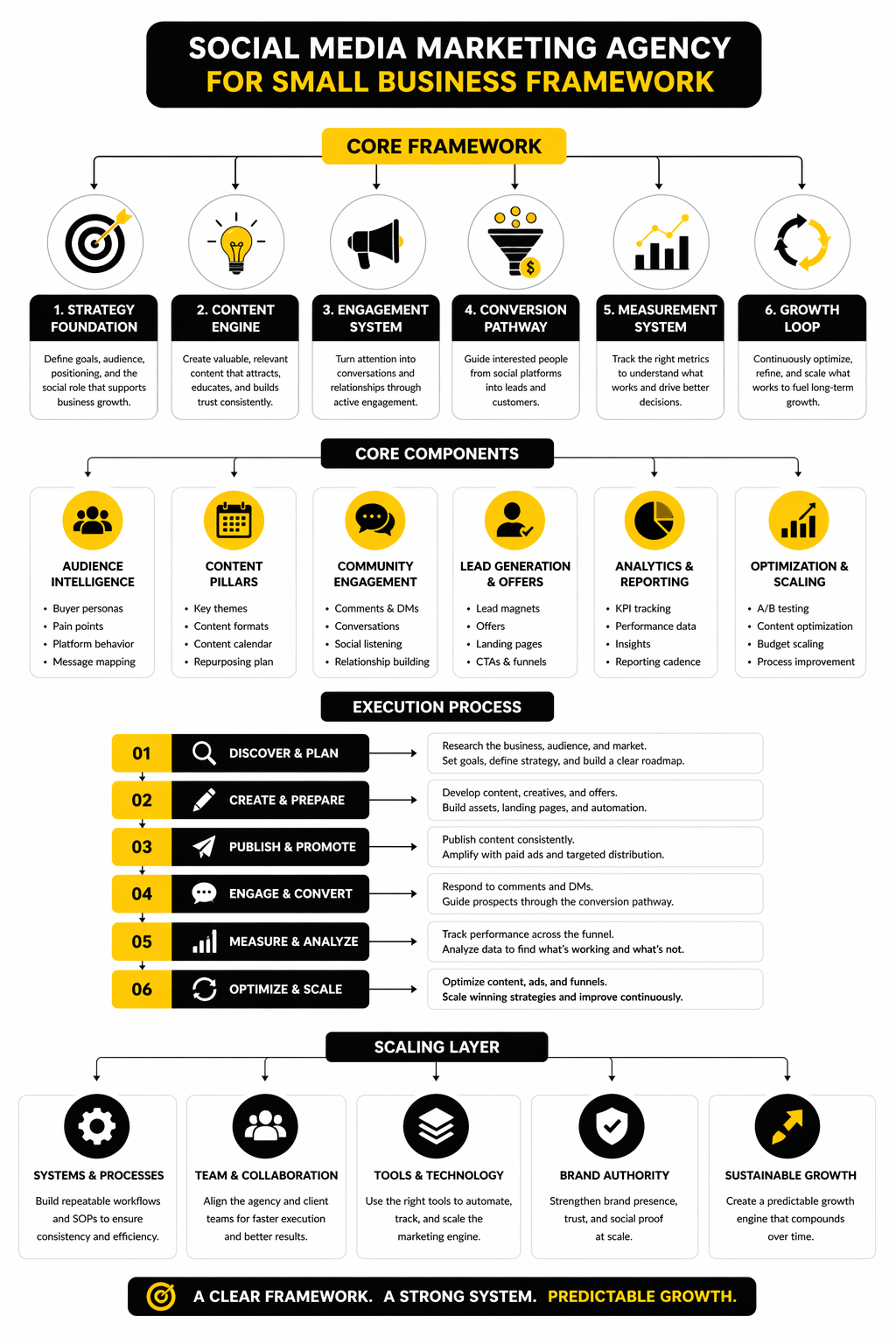
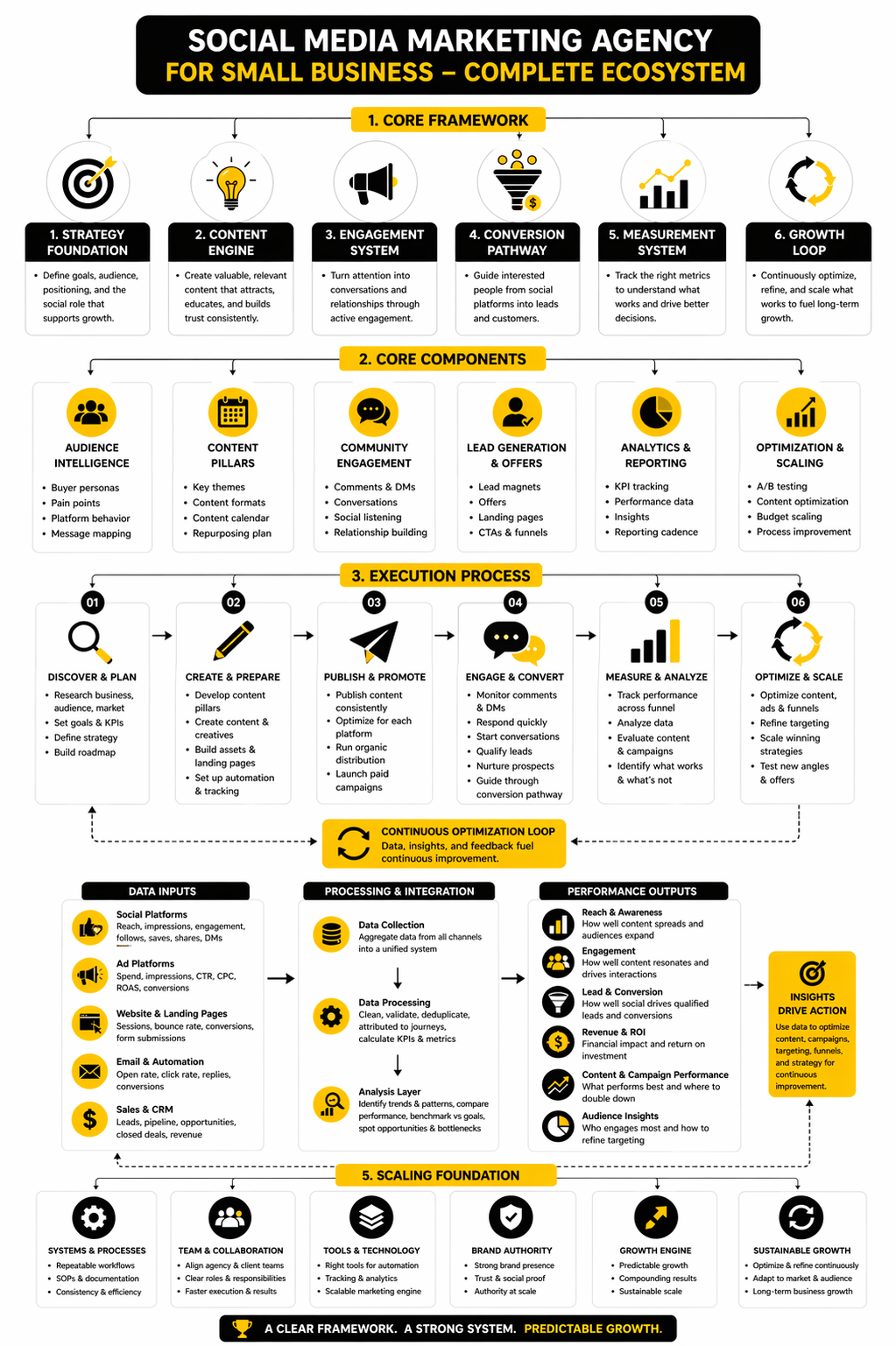
The easiest way to think about this is simple: attention, trust, conversion, and follow-up. A good agency builds content that earns attention, shapes that attention into trust with proof and consistency, creates a clear conversion path, and makes sure leads do not disappear after the first click or message. That sounds obvious, but most weak campaigns break because one of those steps is missing.
For example, plenty of businesses create content but never build the system behind it. Someone comments, sends a DM, or clicks through to a landing page, and then the experience gets slow, messy, or inconsistent. That is why strong agencies often connect social execution with tools that handle scheduling, lead capture, and follow-up, whether that means using Buffer for publishing workflows, ManyChat for DM automation, or GoHighLevel for pipeline and nurture management.
The important point is not the software itself. The important point is that a small business needs a framework that turns social activity into a repeatable process instead of a creative guessing game. When an agency understands that, content gets sharper, reporting gets cleaner, and it becomes much easier to see what is actually working.
What a Good Agency Should Be Ready to Build First
Before an agency talks about going viral, it should be able to define the basics with precision. That includes the target customer, the core offer, the buying trigger, the proof points, the best-fit platforms, the content pillars, and the conversion path. If those pieces are fuzzy, even talented content production will struggle because the message has no backbone.
This is where small businesses need practical thinking, not fluff. A restaurant, med spa, home service brand, local gym, clinic, coach, or ecommerce store may all use social media, but the buying cycle, content style, and lead flow look very different in each case. A capable agency knows that platform tactics only make sense after the business model is clear.
That foundation also shapes everything that comes next in this article. In Part 2, the focus shifts from the big picture to the services that actually move the needle, so you can separate agencies that drive growth from agencies that simply keep your feed busy.
What Services Actually Drive Results
A small business does not need every social media service an agency offers. It needs the services that move people from awareness to action, and that usually means tighter strategy, better creative, faster follow-up, and cleaner conversion paths. That sounds less glamorous than “full-service marketing,” but it is the difference between a social feed that looks active and a social program that helps the business grow.
This is where a social media marketing agency for small business earns its keep. The best agencies know that reach alone is not the win. The win is building a system where the right audience sees the right message, trusts what they see, and has an easy next step when they are ready.
Content Strategy and Creative That Match Buying Intent
Content is still the visible part of the work, but strong content starts before design and captions. An agency should know what the customer is worried about, what objections keep showing up, what proof matters most, and which format fits the platform instead of forcing the same post everywhere. Without that thinking, content becomes decoration.
Short-form video still deserves serious attention because it keeps outperforming other formats for marketers and remains the format brands are most likely to keep investing in, based on recent HubSpot reporting on video performance and 2025 platform investment trends. But that does not mean every small business should chase entertainment-first content. A local service brand often gets more value from clear educational videos, before-and-after proof, customer questions, founder clips, and offer-driven posts than from trying to look like a creator brand.
That is also why content strategy needs to match buying intent. Some posts exist to build familiarity. Others should answer objections, show proof, explain pricing logic, or create urgency around a specific next step. A good agency builds those layers on purpose instead of calling everything “brand awareness.”
Paid Social That Amplifies What Is Already Working
Organic content matters, but it usually works best when an agency can spot what is already getting traction and then put paid support behind it. That is one of the smartest moves for a small business because it reduces guesswork. Instead of launching ads from scratch, the agency can promote proven messages, proven hooks, and proven offers.
This matters even more because the platform mix is shifting. Marketers have been increasing investment most aggressively on YouTube, Instagram, TikTok, and LinkedIn in recent HubSpot trend data, which tells you where attention and commercial intent are still strong. The right agency reads that shift through the lens of your business, not through a generic industry template.
For small businesses, paid social should usually do three jobs. It should help test offers fast, retarget warm audiences who already engaged, and support conversion campaigns with landing pages that make the next step obvious. When an agency cannot explain which of those jobs the spend is supposed to do, the budget usually gets burned on vague traffic and vanity metrics.
Community Management and Fast Response Systems
A lot of agencies still treat comments and direct messages like admin work. That is a mistake. For many small businesses, replies, DMs, and basic customer care are part of the sales process, not an afterthought.
That is especially important now because people increasingly expect brands to respond inside social platforms, and recent Sprout Social reporting shows many users will switch to a competitor when a brand does not answer. For a small company, that means slow response time is not just sloppy communication. It is lost revenue hiding in plain sight.
This is why strong agencies often pair content with workflow tools that keep follow-up moving. That might mean using ManyChat to qualify inbound messages, or routing leads into GoHighLevel so nobody disappears after the first interaction. The exact stack matters less than the principle. If the agency creates attention but does not protect the handoff, the result is wasted demand.
Offer Pages, Lead Capture, and Nurture Matter More Than Most Owners Expect
Social content rarely closes the whole sale on its own. It usually earns the click, the message, the opt-in, or the booking intent. After that, the landing page and follow-up system carry a huge share of the result.
That is why agencies that understand conversion tend to outperform agencies that only think in content terms. They know a stronger page, a shorter form, a clearer booking flow, or a better email and SMS sequence can lift performance without changing the creative at all. For product-led businesses, that might mean optimized storefront pages with tools like Replo. For lead-gen businesses, it may mean a CRM and nurture stack built in GoHighLevel or an email layer through Brevo.
This is also where weak agencies get exposed. They may produce decent posts and run ads that get clicks, but if the conversion path is clunky, the campaign underperforms and nobody can explain why. A better agency looks past the content itself and fixes the steps that come after it.
Reporting Should Tie Social Activity to Business Outcomes
Small businesses do not need fifty-slide monthly reports. They need a handful of useful numbers tied to the actual sales process. That usually means reach, engagement quality, clicks, lead volume, booking rate, cost per lead, and closed revenue where tracking allows it.
Good reporting also needs context. A rise in views means very little if inquiries are weak. A drop in engagement may not matter if booked calls, purchases, or qualified leads are climbing. The real job of reporting is to help the owner decide what to keep, what to cut, and where to double down.
That becomes even more important when social is functioning across the full customer journey rather than sitting in a branding silo. Recent Sprout Social research on social’s business impact and broader DataReportal usage analysis both point to social playing a broader role in how people research, communicate, and interact with brands. A capable agency reports with that reality in mind, which means it measures influence on pipeline, not just activity on platform.
How to Evaluate Agencies Without Getting Burned
Once you know which services matter, the next step is learning how to judge whether an agency can actually deliver them. That is where many owners get tripped up, because polished proposals, busy dashboards, and slick portfolios can hide weak strategic thinking.
In the next part, the focus shifts to agency evaluation. That is where you learn how to spot empty promises, ask sharper questions, and choose a partner that can execute for a real small business instead of selling an enterprise-style fantasy.
How Agencies Implement Campaigns, Content, and Reporting
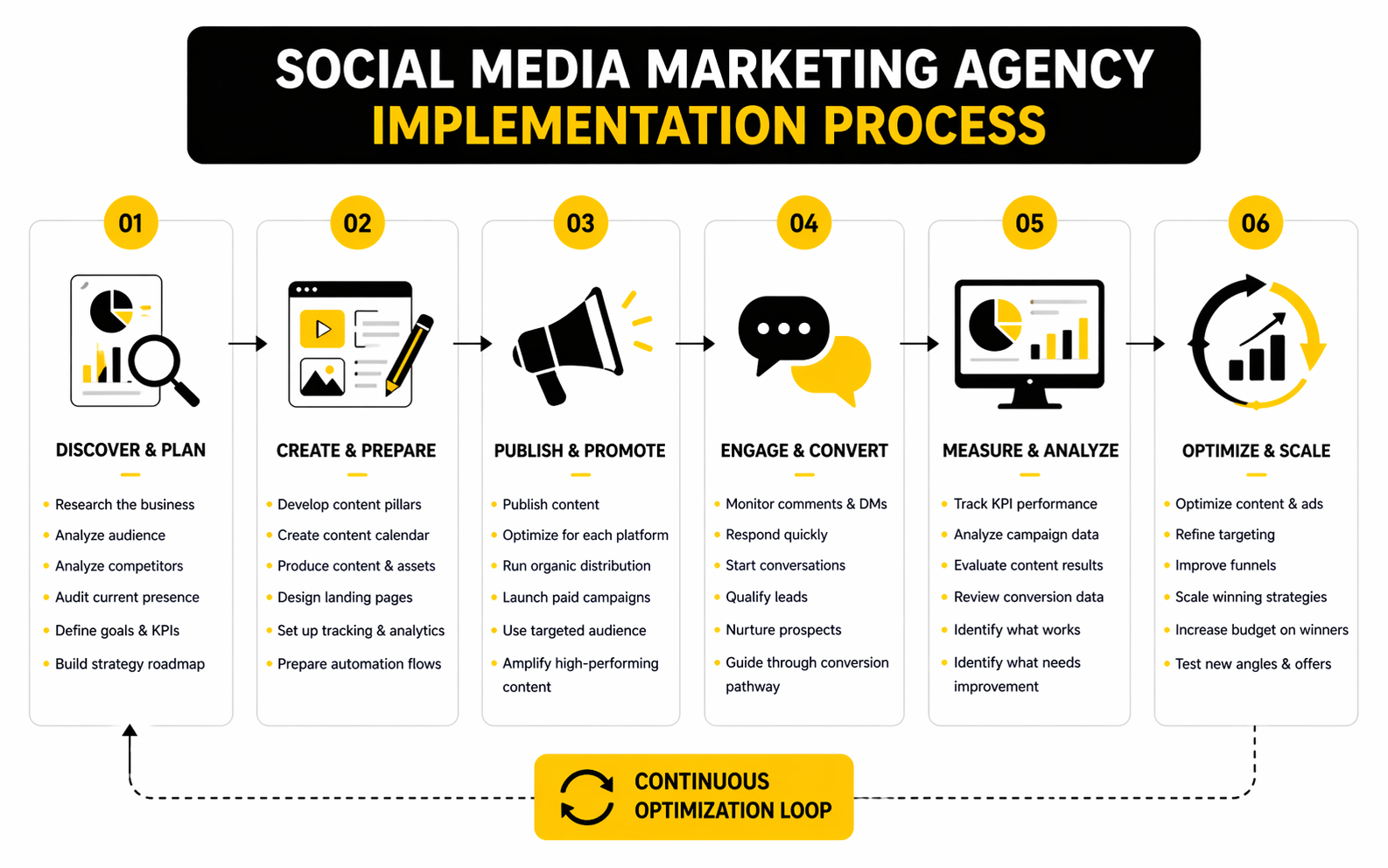
This is the point where a good pitch either becomes a working system or falls apart. A strong social media marketing agency for small business does not jump straight into posting. It builds the operating rhythm first, because execution only works when strategy, creative, publishing, follow-up, and reporting all move together.
That process should feel clear from week one. You should know who owns approvals, how content gets planned, how fast leads get handled, which numbers matter, and what happens when something underperforms. If an agency cannot make that process tangible, it usually means the work is still being improvised behind the scenes.
Step 1: Start With the Offer, Audience, and Content Angles
Professional implementation starts with message clarity, not graphics. Before anything goes live, the agency should lock in the offer, the audience, the strongest objections, the trust signals, and the content angles that will be repeated across formats. That creates consistency, which is what most small businesses are missing before they hire outside help.
This step matters because execution gets expensive when the message is fuzzy. If the offer is weak, the content calendar becomes a guessing exercise. If the audience is too broad, the creative gets watered down and the follow-up team ends up handling leads that were never a fit in the first place.
A serious agency usually turns this into a working messaging system. That means content pillars, recurring themes, clear calls to action, and a shortlist of proof assets the team can reuse without reinventing everything every week. It is not glamorous, but it is what makes later content feel sharp instead of random.
Step 2: Build a Production Rhythm the Business Can Actually Sustain
Once the message is clear, the agency should build a realistic production workflow. That includes content capture, copywriting, design, editing, approvals, publishing, and repurposing. The important word here is realistic, because small businesses break the process when they agree to a volume they cannot support with real footage, real customer proof, or timely reviews.
The best agencies create a cadence that fits the owner’s bandwidth. That might mean one focused shoot day each month, one approval block each week, and a publishing workflow managed through a tool like Buffer. What matters is that the system reduces friction instead of demanding daily chaos from a team that is already stretched thin.
This is also where good agencies separate hero content from support content. Hero content carries the brand message, proof, and offers. Support content extends that work into clips, quote posts, stories, carousels, testimonials, FAQs, and reminder posts so the channel stays active without needing a full production cycle every few days.
Step 3: Turn Content Into Distribution Instead of Hoping the Algorithm Does the Job
A lot of small businesses assume posting is the job. It is not. Posting is the delivery mechanism, but distribution is the job.
A capable agency looks at each piece of content and decides what role it plays. Some assets are meant to build familiarity. Some should be pushed with paid spend. Some should trigger direct messages. Some should be retargeted to people who already watched, clicked, or visited a page. That layer of decision-making is where professional implementation starts to outperform basic content management.
The strongest agencies also know when a piece of content deserves a second life. A strong organic post can be promoted. A customer question can become a short video series. A testimonial can be turned into a landing page section, an ad angle, a story sequence, and an email follow-up. That repurposing mindset is what gives small businesses leverage without multiplying production costs.
Step 4: Build the Lead Capture and Follow-Up System at the Same Time
This is the step many agencies still underplay, and it is one of the biggest reasons campaigns underperform. If content and ads create interest but nobody handles the handoff properly, the result is wasted demand. Leads arrive, messages sit unanswered, forms get submitted without a reply, and the business owner ends up blaming the platform when the real problem is the process after the click.
That is why implementation has to include lead routing and follow-up from the start. Some agencies use ManyChat to guide people through common questions and capture intent inside DMs. Others push leads into GoHighLevel or Brevo so the business can respond fast and keep nurturing people who are interested but not ready yet.
For product-based businesses, the same logic applies to the storefront and product pages. A strong agency should care whether the landing page matches the ad, whether the product page resolves objections, and whether the checkout flow feels clean. In ecommerce-heavy setups, tools like Replo can help tighten that path so traffic does not leak after the social click.
Step 5: Review Performance Weekly and Improve the System, Not Just the Posts
Execution is never one and done. A professional agency reviews performance in short cycles and looks for patterns across the whole funnel. That means not only asking which post got the most attention, but also which hook produced the best inquiries, which format created the strongest lead quality, which audience converted best, and where response lag hurt results.
This is where reporting should become operational, not decorative. The agency should be able to explain what happened, why it happened, and what changes are being made next. That might mean changing the first three seconds of a video, tightening an offer, simplifying a lead form, using a stronger landing page, or shifting spend toward content that already proved its value.
The best agencies get better because they treat reporting like feedback for the machine. Weak agencies use reporting to defend what they already made. That difference is huge, especially for a small business that cannot afford months of polite underperformance.
What Professional Implementation Looks Like in Practice
At a practical level, a good process usually has five moving parts working together every week:
- Strategy stays tied to one clear audience and one clear commercial goal.
- Content production follows a repeatable schedule with fast approvals.
- Organic and paid distribution work together instead of competing with each other.
- Leads and conversations move into a system that supports quick follow-up.
- Reporting drives the next round of improvements.
That is the standard a small business should expect. Not perfection, not constant reinvention, and definitely not endless “brand building” without commercial discipline. Just a clean system that turns social activity into measurable momentum.
How to Choose the Right Partner and Scale What Works
Once you understand how real execution works, choosing an agency gets easier. You stop judging based on aesthetics alone and start looking for operational maturity, strategic clarity, and the ability to connect content to sales.
That final decision matters because the wrong partner creates noise, while the right one gives the business a growth engine it can actually build on. In the next part, the focus shifts to how to choose that partner well, what warning signs to watch for, and how to scale once the early wins start showing up.
Reading the Numbers That Matter
Most small businesses do not have a data problem. They have an interpretation problem. They see reach, likes, clicks, and follower growth inside a dashboard, but they are not always sure which numbers signal real momentum and which ones are just noise.
That is where a good social media marketing agency for small business should be much more useful than a reporting tool. The agency’s job is not to dump metrics into a spreadsheet. It is to explain what the numbers mean, what is changing in the funnel, and what action should happen next. Recent Digital 2025 social media analysis and Sprout Social’s 2025 impact report both reinforce the same idea: social is now influencing discovery, evaluation, customer care, and purchase behavior at the same time, so measurement has to follow the full journey instead of one isolated platform metric.
The First Layer: Attention Metrics
Attention metrics tell you whether the market is even noticing the content. That includes reach, impressions, video views, watch time, profile visits, and click-through rate. These numbers matter because they reveal whether the message is getting distribution and whether the creative is strong enough to earn a second look.
But attention metrics only deserve respect when they are tied to context. A high view count with weak clicks can mean the hook worked but the offer did not. Strong reach with poor audience fit can mean the content attracted curiosity without commercial intent. That is why a smart agency compares attention metrics against downstream actions instead of celebrating top-of-funnel numbers in isolation.
What usually matters most at this layer is pattern recognition. If several posts around the same pain point are driving above-average watch time and profile visits, that is a signal to create more content in that angle and test it with paid support. If reach is stable but clicks are falling, the likely fix is not “post more.” It is to sharpen the call to action, the offer, or the audience match.
The Second Layer: Engagement Quality
Engagement still matters, but not in the lazy way many reports present it. Likes on their own do not tell you much. Saves, shares, comments with intent, direct messages, and repeat viewers are usually more meaningful because they show stronger relevance and stronger buying curiosity.
That matters even more now because consumers expect brands to do more than publish. Recent consumer-brand engagement research from Emplifi and consumer behavior findings from Sprout Social point in the same direction: people reward brands that feel responsive, useful, and human, and they are willing to move on when a brand feels absent or slow. So when engagement quality rises, the action is not just to admire the post. The action is to strengthen response handling, reuse the winning topic, and make the next step easier.
An agency that understands this will read comment threads and DMs as market feedback, not just inbox clutter. Repeated objections should shape future content. Repeated product questions should shape landing pages. Repeated praise around one feature or outcome should shape ads, offers, and proof assets.
The Third Layer: Conversion Signals
This is where the analytics finally become commercial. Conversion signals include booked calls, form fills, lead quality, purchases, qualified DMs, revenue from tracked campaigns, and the cost attached to those outcomes. This is the layer where social stops being a visibility channel and starts proving whether it can support growth.
A social media marketing agency for small business should be able to show the handoff between content and conversion clearly. That means knowing which post or campaign created the inquiry, where the lead went next, how fast the business responded, and how many of those opportunities turned into real sales activity. If that handoff is blurry, the business cannot tell whether the problem sits in content, targeting, follow-up, or closing.
This is also where technology matters, but only if it serves the process. A business might use ManyChat to qualify inbound interest, GoHighLevel to manage pipeline and follow-up, or Brevo to nurture colder leads. The tool stack is secondary. The non-negotiable part is being able to trace what happened after the social interaction.
The Analytics System a Good Agency Should Build
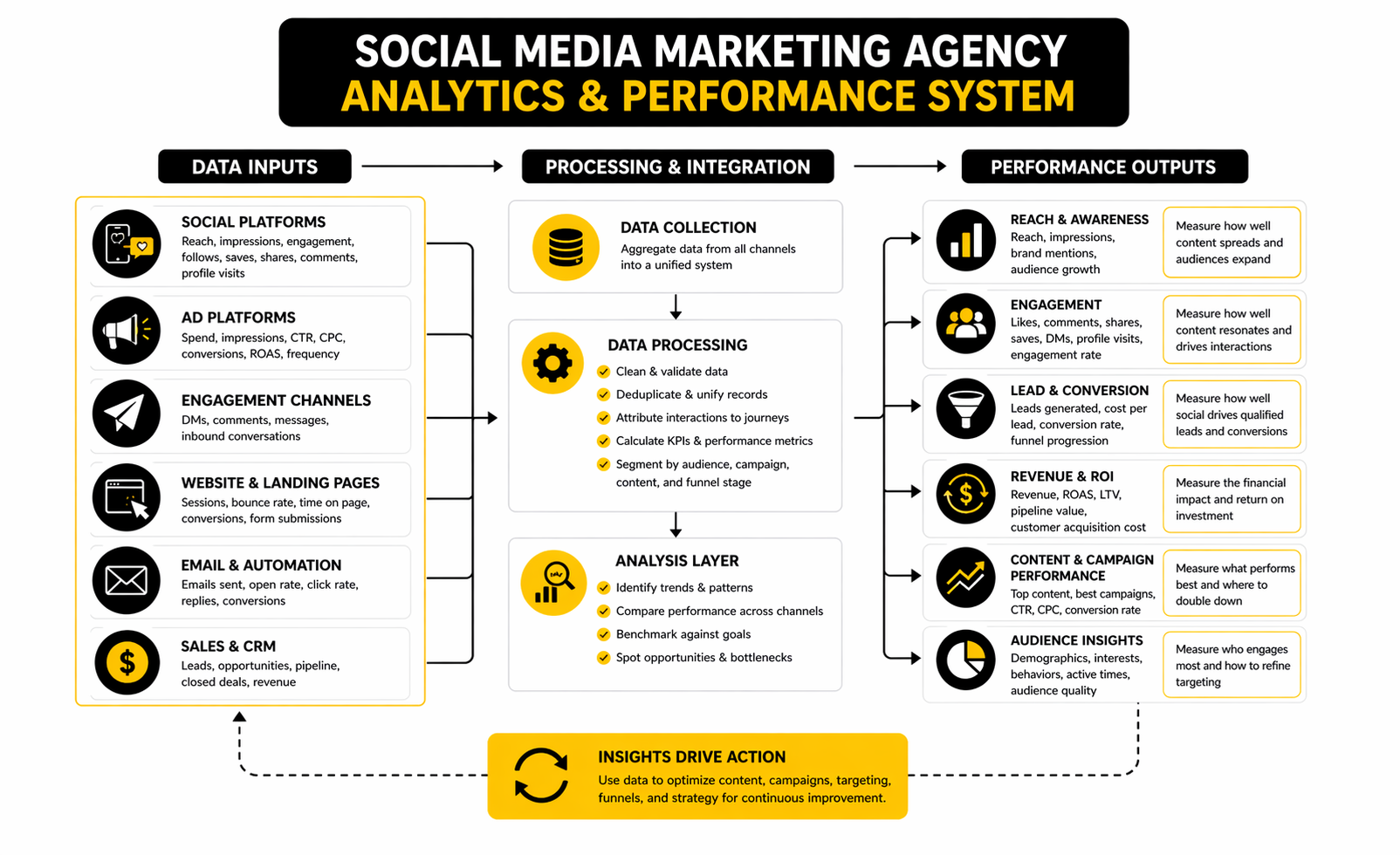
A clean analytics system usually follows a simple logic. First, measure content performance on-platform. Second, measure traffic and inquiry behavior off-platform. Third, measure sales outcomes inside the CRM or booking system. That structure sounds basic, but it is what stops reporting from breaking apart across different tools and teams.
The most useful reporting systems also separate leading indicators from lagging indicators. Leading indicators include watch time, click-through rate, saves, shares, qualified comments, and DMs. They tell you what may work soon. Lagging indicators include booked calls, sales, retained customers, and return on ad spend. They tell you what already worked in financial terms.
When an agency gets this right, decisions become much easier. Strong leading indicators with weak sales usually point to a broken offer, weak landing page, or poor follow-up. Weak leading indicators and weak sales usually point to a message problem. Strong sales from modest engagement often mean the content is attracting the right people even if it is not collecting vanity reactions, which is exactly why small businesses should not obsess over surface-level benchmarks.
Benchmarks Are Useful, but Only When They Stay in Their Lane
Industry benchmarks can help you sanity-check performance, but they should never replace business context. Platform averages can tell you whether engagement is unusually weak or whether cost per click is moving in the wrong direction. What they cannot tell you is whether the content is attracting the right customer, whether the lead quality is improving, or whether a slower campaign is still creating high-value sales.
That matters because some of the most useful signals for small businesses are niche by nature. A local clinic may care more about consultation bookings than reach. A home service business may care more about message quality and speed-to-lead than public engagement. An ecommerce brand may accept a lower click-through rate if average order value and repeat purchase behavior are strong.
This is why a smart agency uses benchmarks as guardrails, not as a script. Recent Hootsuite ROI guidance and Sprout’s reporting framework both support a broader view of performance that ties engagement and conversion back to business priorities instead of stopping at platform metrics.
What the Data Should Make You Do Next
Good data should create action, not just reassurance. If one content angle consistently produces strong watch time and strong DMs, the next move is to build a series, not just celebrate the post. If response time is slow and inquiries are falling through the cracks, the fix is operational, not creative. If a page gets clicks but not conversions, the agency should revisit the offer, proof, layout, and friction points before blaming the audience.
That action bias is what separates professional measurement from decorative analytics. The numbers are there to improve the system. They should help the business decide where to create more, where to simplify, where to spend, and where to tighten the handoff from attention to revenue.
For a small business, that is the real benchmark that matters. Not whether a post looked impressive in isolation, but whether the data helped the next month perform better than the last.
How to Choose the Right Partner and Scale What Works
Once the numbers are being read properly, choosing an agency becomes much easier. You stop being impressed by reports that are full of motion but empty on meaning, and you start looking for a partner that can connect data to clear decisions.
In the next part, the focus shifts to selection and scale. That is where the conversation moves from measurement into judgment: how to choose the right partner, what to watch for in proposals and onboarding, and how to build on early wins without losing control of the process.
Choosing the Right Partner and Scaling What Works
By this stage, the decision is no longer about whether social matters. It is about whether the partner in front of you can help a small business grow without creating operational drag, bad data, or creative chaos. That is a more serious question, because once social starts working, the pressure shifts from “can we get attention?” to “can we scale without breaking the system?”
That is where a real social media marketing agency for small business separates itself from a content vendor. A content vendor can keep the feed moving. A real partner helps the business make better tradeoffs around channel focus, budget allocation, speed, offer depth, and the capacity needed to handle the demand social creates. Social budgets have continued rising in recent industry research, including Deloitte Digital’s 2025 study, which makes disciplined partner selection even more important because more businesses are putting real money behind these channels now.
The Best Agency Is Usually the One With the Clearest Constraints
A lot of small businesses get impressed by agencies that promise full-channel dominance. That pitch sounds exciting, but it usually creates dilution. If the team is trying to do every platform, every format, every trend, and every audience segment at once, execution gets soft and reporting gets muddy.
The better agency often sounds more restrained. It may recommend fewer platforms, narrower offers, cleaner audience segments, and a more limited test plan at the start. That is not a lack of ambition. It is operational maturity. The agency understands that small businesses scale faster when they concentrate effort instead of scattering it.
This matters even more because attention is fragmented and brand discovery now happens across several touchpoints instead of one channel. DataReportal’s 2025 brand discovery analysis shows people discover brands through a mix of sources rather than a single path, which means the winning move is not to be everywhere at once. It is to be unmistakably relevant in the places that matter most for your buyer.
Scaling Creates New Problems, and Weak Agencies Usually Miss Them
Early growth hides inefficiency. A campaign starts working, inbound volume rises, content gets better response, and everyone feels like the engine is finally humming. Then the second-order problems show up.
Lead quality may start dropping because broader targeting pulls in weaker-fit prospects. Response times can slip because the inbox gets busier than the team can handle. Creative fatigue can set in because the same winning angle gets overused. Reporting can also get worse at the exact moment the business needs clarity most, because more channels, more ads, and more offers create more attribution confusion.
That is why scaling requires more than “do more of what worked.” It requires a stronger operating system. The business may need tighter qualification flows in ManyChat, cleaner automation and pipeline stages in GoHighLevel, or more disciplined publishing and approval workflows in Buffer. The agency should see those bottlenecks coming before performance starts slipping.
Strategic Tradeoffs Smart Owners Make Early
Every scaling decision has a tradeoff. More volume can reduce quality. Faster publishing can weaken brand control. Broader targeting can lower close rates. More automation can improve speed but make the customer experience feel colder if it is handled badly.
A good agency helps the owner choose those tradeoffs consciously. For example, it may be smarter to keep a smaller paid budget behind a high-converting offer than to aggressively widen spend before the follow-up team is ready. It may be better to deepen one content pillar that consistently drives qualified leads than to chase novelty every week just to look active. It may also be worth investing in stronger conversion infrastructure before increasing content volume, especially if traffic is already arriving but too little of it becomes pipeline.
That is where a lot of experienced operators get blunt, and rightly so. Scaling content without scaling the handoff is one of the fastest ways to waste money. If demand generation improves while qualification, booking, sales response, or onboarding stays weak, the business will feel busier without actually becoming healthier.
Ownership, Access, and Exit Planning Matter More Than People Think
One of the most overlooked risks in agency relationships is asset dependence. Some small businesses let an agency control the ad accounts, analytics setup, creative files, automation logic, landing pages, or customer messaging systems so completely that leaving becomes painful. That is a bad setup, even if the results are decent in the short term.
A professional partner should be comfortable with transparency. The business should know where the data lives, who owns the accounts, how leads are tracked, how workflows are built, and what the transition looks like if the relationship ends. That does not mean the agency has no proprietary process. It means the client is not being trapped by operational fog.
This is especially important when the stack expands. If the agency is using systems for landing pages, forms, CRM workflows, calendars, email, or AI assistance, the owner should understand the architecture at a basic level. Whether that includes Brevo, Cal.com, Fillout, or Chatbase, the business should not be locked out of the machine that is supposedly helping it grow.
AI Can Improve Margin, but It Should Not Flatten the Brand
This is one of the bigger strategic shifts agencies are dealing with now. AI can absolutely improve research speed, drafting speed, repurposing speed, response assistance, and internal operations. Used well, it can make a small-business engagement more efficient and more affordable.
Used badly, it makes the brand forgettable. The content starts sounding generic, the visuals lose texture, replies feel templated, and every business begins to look like it hired the same machine. That is dangerous in social because differentiation often lives in tone, specificity, proof, and point of view.
The better agency uses AI as leverage, not as a substitute for understanding the business. HubSpot’s recent marketing reporting shows AI adoption is broad and accelerating inside marketing teams, but that only raises the value of sharper positioning and more human creative judgment. When everyone can produce faster, the businesses that win are the ones that still sound real.
When to Scale the Agency Relationship, Not Just the Campaigns
There is also a practical question owners should ask once they start seeing results: should the agency relationship expand, or should the business build more in-house capability? There is no universal answer, but there is a useful way to think about it.
If the agency is still bringing strategic clarity, improving the system, and moving fast enough to support growth, expanding the relationship can make sense. That might mean deeper paid support, stronger funnel work, more creative production, or more advanced lifecycle automation. If the agency has become mostly a production layer while the business now understands the strategy better than the partner does, it may be time to keep the systems and bring more execution internal.
That choice should be based on economics and leverage, not ego. The goal is not to “graduate” from agency help just because the business has grown. The goal is to place work where it will produce the best decisions and the cleanest execution.
How to Choose the Right Partner and Scale What Works
At this point, the picture should be clearer. A strong agency is not just posting content, buying media, or filling a dashboard. It is helping the business make better decisions under real-world constraints and keeping the system healthy as demand rises.
The final part brings everything together with practical closing guidance and a FAQ built around the questions owners usually ask right before they hire, replace, or expand a social partner.
Final Takeaways for Small Businesses
By now the pattern should be obvious. Hiring a social media marketing agency for small business is not really about outsourcing posts. It is about building a system that can attract the right attention, convert that attention into conversations, and turn those conversations into revenue without creating chaos behind the scenes.
That is why the best agency decisions usually look less flashy at the start and more effective over time. The right partner gives you focus, a cleaner process, faster learning, and better commercial discipline. The wrong one gives you activity without clarity, content without conversion, and dashboards that look busy while the business stays stuck.
Recent industry research keeps pointing in the same direction. Social is influencing discovery, customer care, and purchase behavior at the same time, while marketers continue pushing more budget and more workflow into digital channels, which means small businesses need tighter systems now, not looser ones. That is also why the final decision is not “should we be on social?” It is “can we build a social engine that the business can actually support and scale?”
FAQ - Built for Complete Guide
What does a social media marketing agency for small business actually do?
A good agency should handle far more than posting content. It should help with positioning, content planning, creative production, paid amplification, community management, lead flow, reporting, and ongoing optimization. The real job is to connect social activity to business outcomes, not just make the brand look active.
For a small business, that usually means simplifying decisions. The agency should tell you where to focus, what to stop doing, what kind of content is realistic, and how leads should move from social into your sales process.
Is hiring an agency better than building in-house?
It depends on what the business already has. If you have internal talent, strong systems, and enough time to manage strategy and execution, an in-house model can work well. If you have a small team, inconsistent output, or no reliable process for content and follow-up, an agency can help you move much faster.
The key is not ideology. It is leverage. The right choice is the one that gives you the best decisions, the best execution, and the clearest visibility into results.
How much should a small business expect to spend?
There is no universal number because pricing depends on scope, channel mix, creative volume, paid spend, and whether the agency is also handling landing pages, automation, or email nurture. What matters more than the monthly fee is whether the scope matches your real commercial priorities.
A smaller, focused engagement often beats a bloated full-service package. If the budget is tight, it is usually smarter to fund clear strategy, strong creative, and reliable follow-up before paying for every possible add-on.
Which platforms should a small business focus on first?
Most businesses should not try to win everywhere at once. The right starting platforms depend on where your buyers already spend time, how they buy, and what kind of content your team can produce consistently.
For many small businesses, one primary channel and one supporting channel is enough in the beginning. That gives the agency room to build signal, test creative, and improve performance without spreading time and budget too thin.
How long does it take to see results?
That depends on the offer, the market, the existing brand awareness, and whether the business already has proof, content assets, and a functioning sales process. Some businesses see early traction within weeks. Others need a few months to refine message, creative, targeting, and follow-up before the results become meaningful.
The bigger point is that early results should still produce learning. Even before revenue fully ramps, the agency should be able to show which messages get attention, which content earns response, and where the funnel is either working or leaking.
What should I ask before hiring an agency?
Ask how they think, not just what they make. You want to know how they choose channels, how they define success, how they handle approvals, how they measure lead quality, and what they do when a campaign underperforms.
You should also ask who owns the accounts, where the data lives, how often they report, what access you get, and what the exit process looks like. Those questions reveal a lot about whether the agency is building a healthy partnership or trying to keep you dependent.
What are the biggest red flags?
Big promises with vague process is one of the clearest warning signs. Another is when the agency talks constantly about reach and engagement but has almost nothing to say about conversion, lead handling, or sales coordination.
Other red flags include weak reporting, unclear ownership of accounts, slow communication, no real onboarding structure, and generic content that could belong to any business in any industry. If the agency cannot explain how it turns attention into outcomes, you should be careful.
Should the agency also manage paid ads?
In many cases, yes, but only if it understands how organic and paid should work together. Paid social works best when it amplifies proven messages, retargets warm audiences, and supports clear offers that already make sense for the business.
What you want to avoid is a split-brain setup where one team posts content and another team runs ads without shared strategy or shared reporting. For small businesses, that fragmentation usually slows learning and wastes budget.
How important is response speed on social?
It matters more than a lot of owners realize. If someone messages the business, comments with intent, or clicks through to learn more, the experience that follows can shape whether that interest turns into revenue. Slow replies create friction, and friction kills momentum.
That is why good agencies treat response systems seriously. They do not just publish content and disappear. They help make sure leads are routed properly, questions get answered, and interested prospects do not fade out because nobody followed up.
Can automation help without making the brand feel robotic?
Yes, but it has to be used carefully. Automation is useful for routing leads, handling simple FAQs, booking calls, nurturing colder prospects, and keeping the team from missing opportunities. It becomes a problem when it replaces judgment, empathy, and brand voice.
That is why the best setups use automation to support humans, not imitate them badly. Tools like ManyChat, GoHighLevel, and Brevo can improve speed and consistency, but the brand still needs a real point of view and a real human standard.
What if my business already has content but it is not converting?
That usually means the issue is not volume. It is one of four things: the message is weak, the audience fit is off, the offer is not compelling enough, or the handoff after the click is broken.
A strong agency should be able to diagnose that quickly. Sometimes the answer is better creative. Sometimes it is sharper positioning. Sometimes it is a better landing page, stronger proof, or cleaner nurture flow. The important thing is not to assume more posting will solve a conversion problem by itself.
Do I need fancy software before I hire an agency?
No, but you do need a willingness to build a real system. Many small businesses start with a messy stack and improve it over time. What matters is that the agency can help reduce friction instead of adding more disconnected tools.
Once the process matures, software starts to matter more because it supports speed, visibility, and consistency. That might include publishing tools like Buffer, ecommerce page builders like Replo, intake tools like Fillout, or booking tools like Cal.com. But the software should follow the strategy, not replace it.
When should I replace my current agency?
Usually when the relationship becomes all motion and no clarity. If reporting is vague, strategy feels recycled, communication is weak, creative is drifting, and nobody can clearly explain where the bottleneck sits, that is a serious warning sign.
You should also look hard at whether the agency is still helping you make better decisions. If it has become a passive vendor that mainly ships deliverables while the business outgrows its thinking, it may be time to move on.
What does success really look like?
Success is not just a larger audience. It is a tighter system. The content gets clearer, the brand gets more recognizable, leads get handled faster, conversion friction drops, and the business starts learning faster from the market.
In other words, success looks like social becoming useful. Not noisy, not trendy, not performative. Useful. That is what a good agency should build.
Work With Professionals
Explore 10K+ Remote Marketing Contracts on MarkeWork.com
Most marketers spend too much time chasing clients, competing on crowded platforms, and losing a percentage of every project to middlemen.
MarkeWork gives you a better way. Browse thousands of remote marketing contracts and connect directly with companies desperate to hire skilled marketers like you, without platform commissions and without unnecessary gatekeepers.
If you're serious about finding better opportunities and keeping 100% of what you earn, explore available contracts and create a profile for free at MarkeWork.com.