

Searching for social media marketing near me usually means one thing: you do not just want posts. You want local visibility, better leads, stronger trust, and a practical system that turns attention into booked calls, store visits, messages, or sales. That matters because social media is now part discovery channel, part reputation layer, part customer service desk, and part conversion path.
The opportunity is big, but it is also noisy. Global social media user identities reached 5.66 billion in October 2025, while Pew’s 2025 research shows YouTube, Facebook, Instagram, and TikTok remain deeply embedded in daily habits for U.S. adults. For a local business, that means your customers are probably already scrolling, searching, comparing, and judging brands before they ever contact you.
Article Outline
This article is split into six connected parts so the strategy builds naturally instead of jumping from tactic to tactic. Each section focuses on a different decision a local business needs to make before hiring help, building content, or spending money on ads. The goal is simple: help you understand what good local social media marketing should actually include.
- Why Social Media Marketing Matters For Local Businesses
- A Practical Framework For Local Social Media Growth
- The Core Components Of A Strong Local Social Media Strategy
- How Professional Implementation Should Work
- How To Choose A Social Media Marketing Partner Near You
- Measurement, Tools, FAQs, And Next Steps
Why Social Media Marketing Matters For Local Businesses
Local customers rarely make decisions from one touchpoint anymore. They might see a reel, check reviews, compare your photos, read comments, look at your website, and then message you three days later. BrightLocal’s 2025 research shows local consumers are still actively using reviews and multiple platforms to evaluate nearby businesses, which means your social presence is not separate from your reputation.
This is where many businesses get it wrong. They treat social media like a digital flyer board, posting random promotions and wondering why nothing happens. A better approach treats it as a local trust engine: consistent proof, useful content, real personality, clear offers, and simple paths to take action.
The “near me” part matters too. A local restaurant, med spa, gym, contractor, realtor, clinic, or professional service does not need generic viral content as much as it needs relevant visibility in its service area. Strong local social media marketing connects the content people notice with the actions the business actually needs.
A Practical Framework For Local Social Media Growth
Good social media marketing starts with strategy, not posting frequency. The framework should answer four questions: who are we trying to reach, what do they need to believe before they act, where do they spend attention, and what should they do next? Without those answers, even polished content becomes busywork.
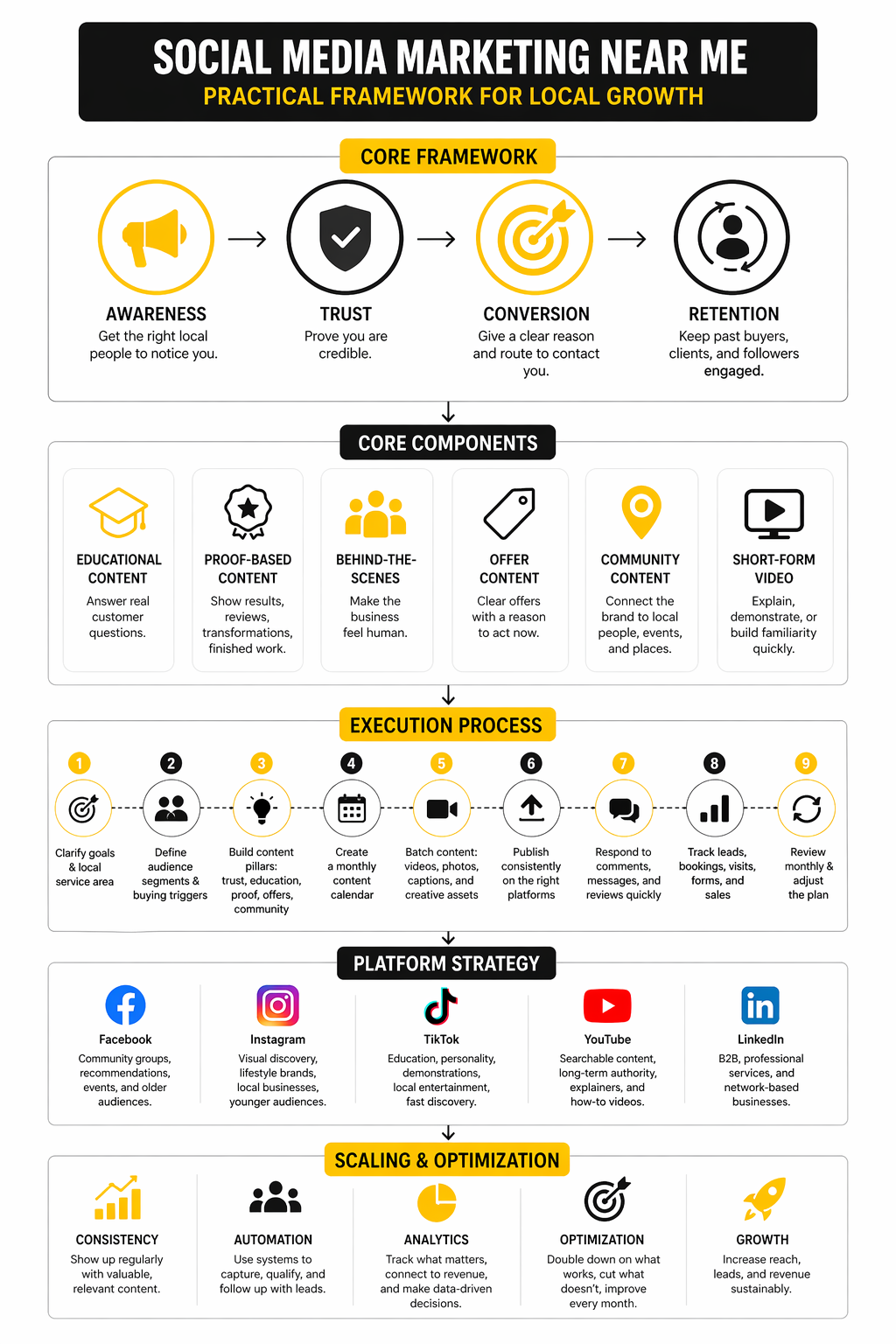
The simplest framework is awareness, trust, conversion, and retention. Awareness gets the right local people to notice you. Trust proves you are credible. Conversion gives people a clear reason and route to contact you. Retention keeps past buyers, clients, and followers engaged so the business does not depend only on new traffic.
This is also why platform choice should follow customer behavior, not personal preference. Pew’s 2025 social media research shows platform usage varies heavily by age and audience, so a local brand targeting homeowners, brides, executives, students, parents, or retirees may need very different content mixes. The winning move is not “post everywhere”; it is to show up well where your buyers already pay attention.
The Core Components Of A Strong Local Social Media Strategy
A strong local strategy starts with positioning. Before you post anything, you need to be clear about who you help, what makes you easier to trust, and why someone nearby should choose you instead of the other business they found five minutes ago. This is where social media marketing near me becomes less about geography and more about relevance.
Your content should make the buying decision easier. For a local service business, that usually means showing proof, answering objections, explaining the process, introducing the people behind the brand, and making the next step obvious. Local customers want confidence before they act, especially when the purchase involves their home, health, money, appearance, family, or business.
The best content mix usually includes several repeatable categories:
- Educational posts that answer real customer questions
- Proof-based posts that show results, reviews, transformations, or finished work
- Behind-the-scenes content that makes the business feel human
- Offer posts with a clear reason to contact you now
- Community content that connects the brand to local people, events, and places
- Short-form video that explains, demonstrates, or builds familiarity quickly
Local Visibility And Platform Fit
Not every platform deserves equal attention. YouTube and Facebook still have broad adult reach, while Instagram and TikTok can be stronger for visual discovery, younger audiences, lifestyle brands, and businesses where personality matters. Pew’s 2025 platform data shows how sharply usage can vary by age and demographic group, so platform choice should be based on your actual buyer, not whatever app feels trendy.
For many local businesses, Facebook still matters because community groups, recommendations, events, and older buyer segments remain active there. Instagram often works well for restaurants, salons, gyms, med spas, creators, real estate, wellness, retail, and visual service businesses. TikTok can help when education, personality, demonstrations, or local entertainment can make the brand memorable fast.
The practical move is to pick one primary platform and one support platform before expanding. A business with a small team is usually better off posting consistently and responding well on two channels than spreading weak content across five. Social media rewards repetition, but customers reward clarity.
Content That Builds Trust Before The Sale
Trust is built through specifics. “We offer great service” is forgettable. “Here is what happens in your first appointment, what it costs, how long it takes, and what mistakes to avoid” is useful.
Local buyers pay attention when content reduces uncertainty. That could mean showing the condition of a job site before and after work, explaining what a consultation includes, introducing staff, sharing customer questions, or breaking down how pricing works. BrightLocal’s local consumer research shows reviews remain central to local decision-making, so social content should support the same trust signals people look for when comparing nearby businesses.
This is also where automation can help without making the brand feel robotic. Tools like ManyChat can help businesses respond to common Instagram or Facebook message flows, send links, qualify leads, and capture contact details when someone comments or asks for more information. Used well, that kind of system does not replace human follow-up; it makes sure interested people are not ignored.
How Professional Implementation Should Work
Professional implementation is where strategy becomes routine. This is the point where ideas turn into a content calendar, filming days, editing workflows, approval steps, posting schedules, community management, lead routing, and reporting. It sounds basic, but this is usually where local social media marketing either becomes a growth system or turns into random posting.
A good implementation process should begin with a practical audit. That means reviewing your profiles, local competitors, reviews, website path, past content, message response speed, offers, and analytics. The goal is not to criticize what has already been done; the goal is to find the fastest gaps between attention and revenue.
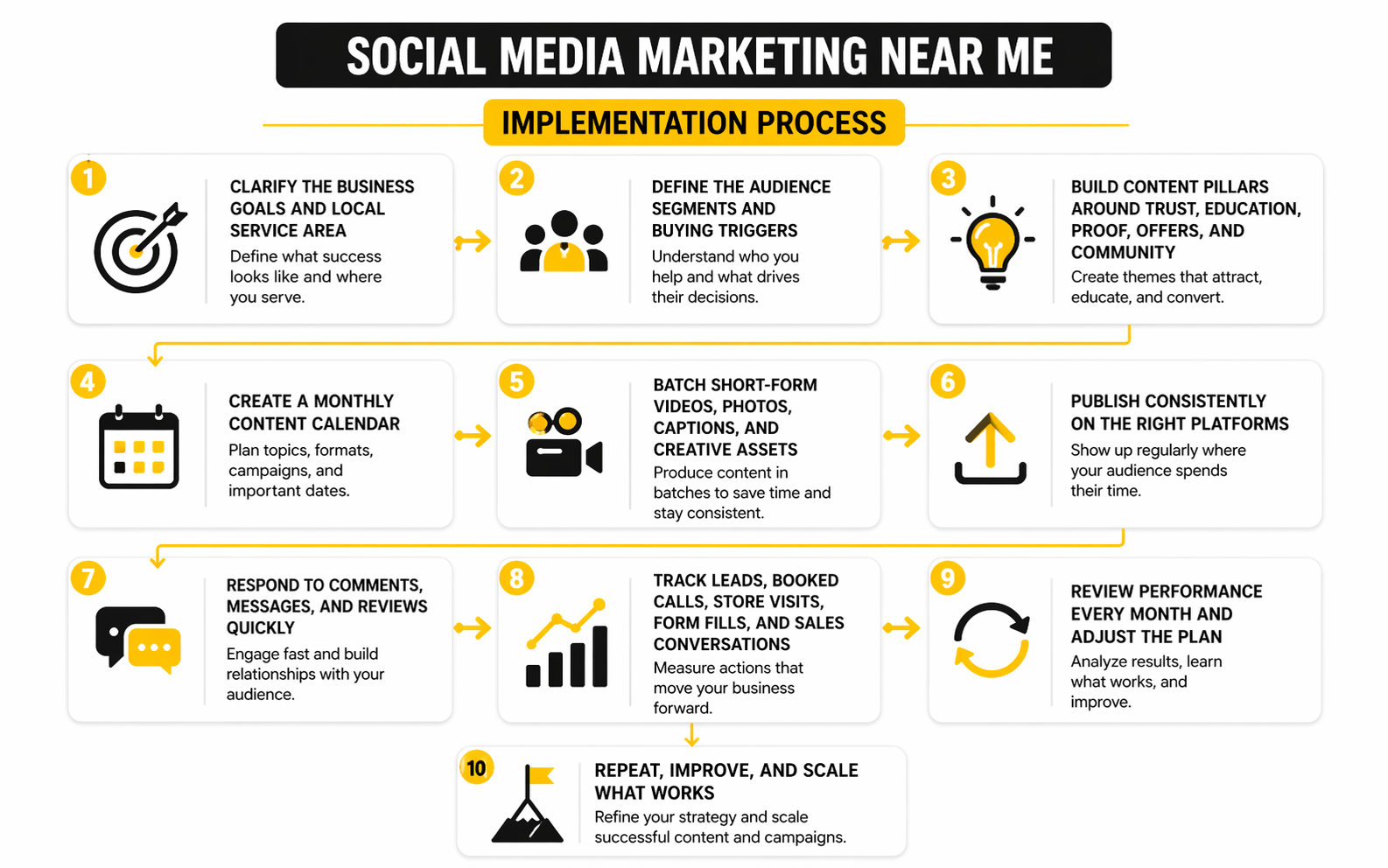
The execution process should then move in a clear order:
- Clarify the business goals and local service area
- Define the audience segments and buying triggers
- Build content pillars around trust, education, proof, offers, and community
- Create a monthly content calendar
- Batch short-form videos, photos, captions, and creative assets
- Publish consistently on the right platforms
- Respond to comments, messages, and reviews quickly
- Track leads, booked calls, store visits, form fills, and sales conversations
- Review performance every month and adjust the plan
This structure keeps the work focused. When someone searches for social media marketing near me, they are usually trying to find a partner who can remove complexity, not create more meetings and vague reports. The right process should make the business owner feel more in control, not more buried.
Content Production Without Chaos
Content production needs a system because inspiration is unreliable. A local business cannot depend on someone remembering to post between customer calls, appointments, deliveries, or job sites. The better approach is to batch content so one planning session can fuel several weeks of consistent publishing.
Start with the assets already inside the business. Customer questions, before-and-after visuals, staff expertise, product demonstrations, local events, review themes, seasonal demand, and common objections can all become useful posts. This is much stronger than chasing trends that have nothing to do with the buyer’s decision.
Scheduling tools can help keep the calendar moving. A simple platform like Buffer can make planning and publishing easier when the team needs one place to organize posts across channels. The tool is not the strategy, though. It only works when the message, offer, and follow-up process are already clear.
Turning Engagement Into Leads
Likes are nice, but local businesses need conversations. Comments, direct messages, form fills, calls, bookings, quote requests, and email signups are the actions that connect social media to revenue. That is why implementation should include a clear response path before content volume increases.
A strong lead path answers three questions. What should someone do after watching the post? What happens when they comment or message? Who follows up, and how quickly? Sprout Social’s 2025 research shows consumers continue to expect brands to use social channels for responsive, personalized care, which makes slow replies a real conversion problem.
For service businesses, this is where CRM and automation become useful. GoHighLevel can help connect forms, calendars, pipelines, follow-up messages, and client communication in one place. That matters because social media does not become profitable when people notice you; it becomes profitable when the right people are captured, followed up with, and moved toward a decision.
Statistics And Data That Actually Matter
Data only helps when it changes a decision. A local business does not need a dashboard full of vanity metrics, and it definitely does not need weekly panic because one reel underperformed. The point of measurement is to understand what is attracting the right people, what is building trust, and what is turning attention into real business outcomes.
The first number to respect is reach, because social media still has massive daily influence. Global social media user identities reached 5.66 billion in October 2025, which confirms that social is not a side channel anymore. For a local business, though, reach only matters when it includes the right geography, audience, and buyer intent.
Engagement is useful, but it needs context. Benchmark reports from Rival IQ, Emplifi, and Hootsuite all show that engagement rates vary heavily by platform, industry, account size, and content format, so copying a generic “good engagement rate” target is lazy strategy. A small local med spa, roofing company, gym, café, or law firm should compare performance against its own baseline first, then use industry benchmarks as a directional check.
The Local Social Media Measurement System
A practical analytics system should connect social activity to business movement. That means tracking attention, trust, action, and revenue instead of treating every like as equal. The cleanest setup is simple enough for the owner to understand and detailed enough for the marketer to improve.
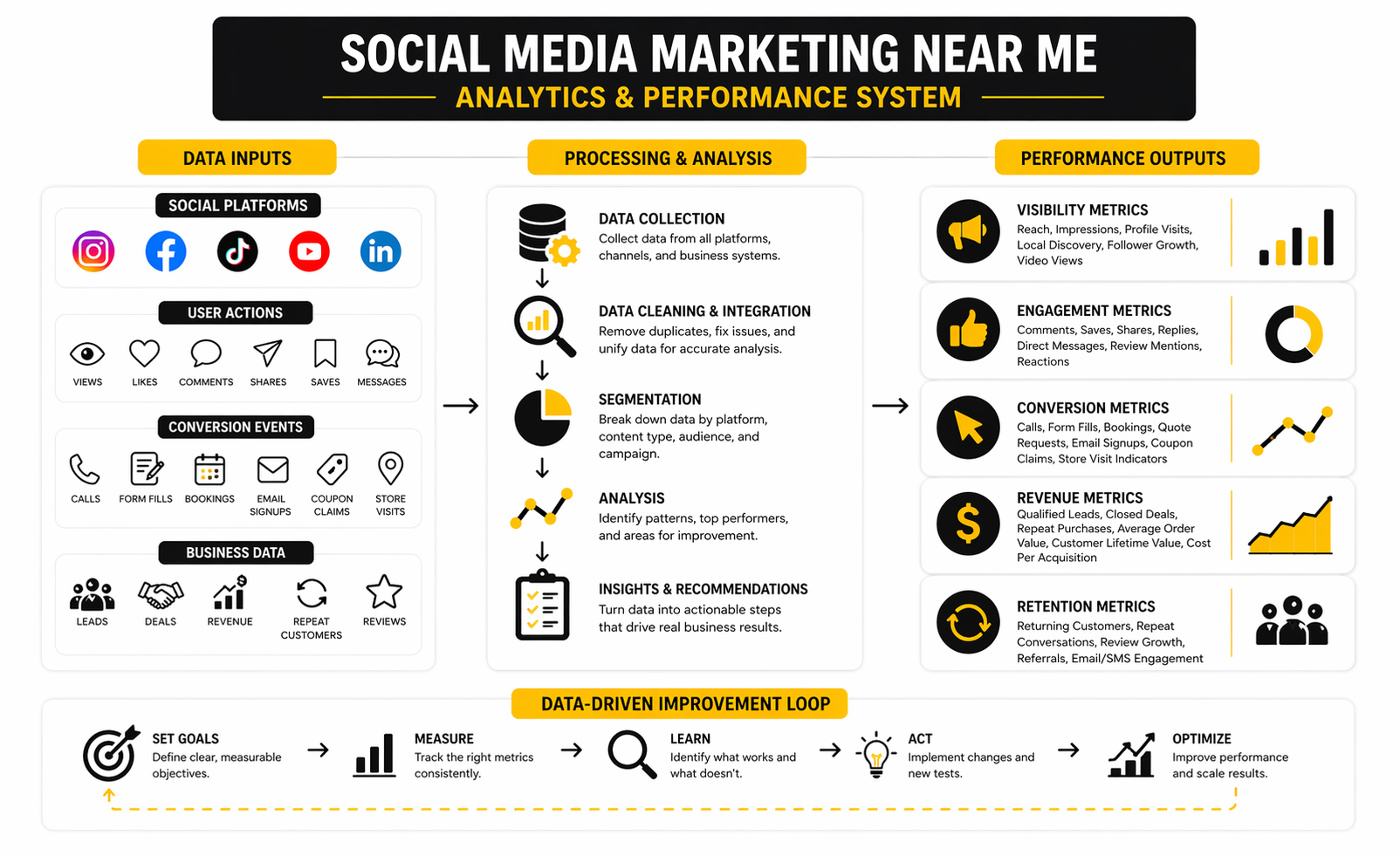
The measurement system should include:
- Visibility metrics: reach, impressions, profile visits, local discovery, follower growth, and video views
- Engagement metrics: comments, saves, shares, replies, direct messages, review mentions, and meaningful reactions
- Conversion metrics: calls, form fills, bookings, quote requests, email signups, coupon claims, and store visit indicators
- Revenue metrics: qualified leads, closed deals, repeat purchases, average order value, customer lifetime value, and cost per acquisition
- Retention signals: returning customers, repeat conversations, review growth, referrals, and email or SMS engagement
This structure prevents bad decisions. A post with fewer likes may still produce better leads if it answers a high-intent question. A video with high reach may be weak if it attracts people outside the service area. A campaign with expensive clicks may still be profitable if the customer value is high enough.
Benchmarks Should Guide You, Not Control You
Benchmarks are helpful when they create perspective. If every Instagram post is reaching only a tiny fraction of followers, the creative hook, posting rhythm, or audience fit may need work. If TikTok videos get views but no local inquiries, the content may be entertaining but not commercially useful.
The biggest mistake is treating platform averages as goals. Rival IQ’s 2025 benchmark data shows TikTok continues to generate stronger interaction than many other major platforms, but that does not automatically make TikTok the best channel for every local business. If your buyers are not there, or if your offer needs high trust and direct follow-up, a smaller audience on Facebook, Instagram, LinkedIn, or YouTube may produce better results.
Response data matters too. Sprout Social’s 2025 research shows consumers increasingly expect brands to use social channels for direct interaction and customer care, which means comments and messages are not just engagement signals. They are sales and retention opportunities. If the business is slow to reply, more content will not fix the leak.
What The Numbers Should Make You Do Next
Good reporting should create decisions, not decoration. If educational posts drive saves and DMs, make more of them. If behind-the-scenes videos get strong watch time but no inquiries, add clearer next steps. If offer posts generate clicks but weak leads, tighten the audience, landing page, or qualification process.
For businesses running ads, the numbers need another layer. Track cost per lead, lead quality, booking rate, close rate, and revenue per customer. A cheap lead is not a win if the sales team hates calling them, and an expensive lead is not a problem if it reliably turns into profitable work.
This is where connected funnels and follow-up systems can make measurement cleaner. A landing page or offer flow built with ClickFunnels can help separate campaign traffic from general website traffic, while GoHighLevel can help track the lead after the first click. The key is not buying more software. The key is building a path where every serious inquiry can be captured, followed up with, and measured.
How To Choose A Social Media Marketing Partner Near You
The right partner should understand local buying behavior, not just content trends. A nearby agency or consultant can be useful when they know the area, the competitive landscape, and the way customers actually choose businesses like yours. But proximity alone is not enough. Someone can be “near you” and still run a generic strategy that does nothing for your pipeline.
When evaluating a provider for social media marketing near me, look for strategic clarity first. They should be able to explain who they are targeting, what content themes they would test, how they would capture leads, and how success would be measured. If the conversation stays stuck on posting frequency, hashtags, and follower count, that is a warning sign.
A strong partner should ask sharp questions before pitching a package:
- What is your most profitable service or offer?
- Which locations or neighborhoods matter most?
- What objections stop people from buying?
- How fast does your team respond to inquiries?
- Which channels already produce leads?
- What happens after someone messages, calls, or books?
- How much is a good customer worth over time?
Strategic Tradeoffs Most Businesses Ignore
The hardest part of local social media is not creating content. It is choosing what not to do. Every platform, campaign, content style, and offer has an opportunity cost, especially when the business has limited time, staff, and budget.
Organic content builds trust and familiarity, but it usually takes consistency before it compounds. Paid ads can create faster traffic, but they expose weak offers, slow follow-up, and poor landing pages quickly. Influencer or creator partnerships can work well for restaurants, fitness, beauty, hospitality, events, and lifestyle brands, but they need clear expectations and local audience fit.
This is why expert guidance matters. The best strategy may not be the flashiest strategy. Sometimes the smartest move is improving response speed, tightening the offer, filming better proof content, or building a better booking flow before spending more on ads.
Risks That Can Quietly Kill Performance
The first risk is inconsistency. Posting heavily for two weeks and then disappearing for a month teaches the audience not to expect much from you. It also makes performance harder to judge because the data becomes too thin and irregular.
The second risk is outsourcing without oversight. A marketer can help with strategy, production, editing, publishing, and reporting, but the business still needs to provide expertise, access, approvals, and honest feedback from sales conversations. Nobody outside the business can magically know every customer objection, service detail, or operational constraint without input.
The third risk is chasing attention that does not match buying intent. Viral reach feels good, but local businesses do not win by becoming famous to the wrong people. The goal is not more noise. The goal is more of the right local people trusting you enough to take the next step.
Scaling Without Losing The Local Feel
Scaling local social media means building repeatable systems while keeping the brand human. That can include content templates, monthly filming days, approval workflows, saved replies, CRM automations, and campaign dashboards. The danger is making everything so polished and automated that the business starts to feel distant.
Local trust often comes from small details. Familiar streets, real staff, local customers, seasonal context, community involvement, and honest behind-the-scenes content all make the brand feel present. As you scale, protect those details because they are hard for generic competitors to copy.
For businesses managing more leads from social campaigns, a practical CRM becomes more important. GoHighLevel can help agencies and local businesses centralize follow-up, pipelines, calendars, and automations, while tools like Fillout can make lead forms and intake flows easier to build. The real advantage is not the software itself. The advantage is making sure no serious inquiry gets lost after the content works.
Measurement, Tools, FAQs, And Next Steps
At this stage, the goal is to connect everything into one operating system. Local social media works best when content, offers, follow-up, reputation, analytics, and sales conversations are not treated as separate pieces. The business needs one clear path from attention to trust to action.
That is the real difference between casual posting and professional execution. Casual posting asks, “What should we publish today?” A serious system asks, “What do local buyers need to see, believe, and do before they become customers?”
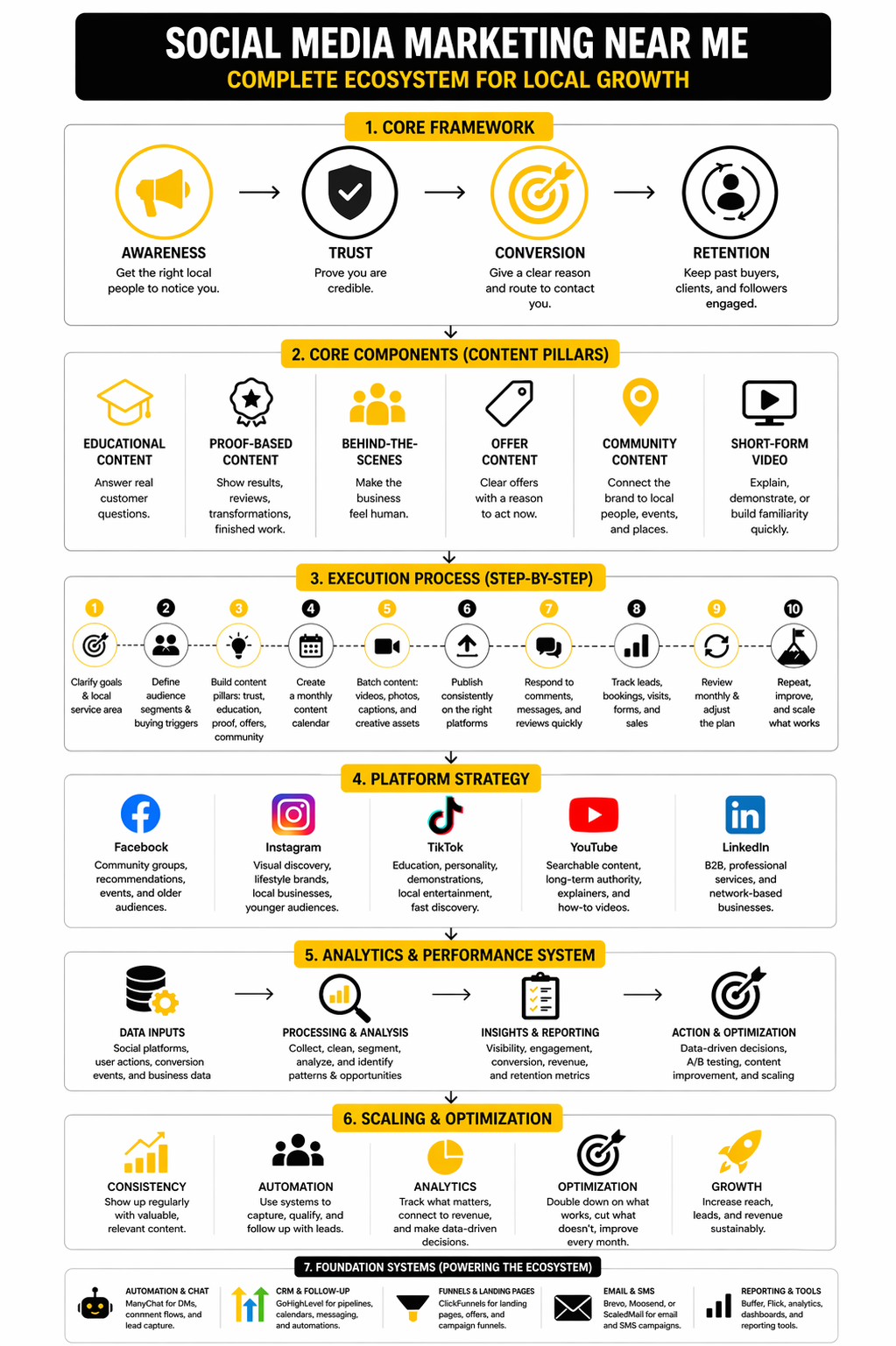
The final system should be simple enough to run every week. Create content that answers real questions, show proof often, make offers clear, respond quickly, track meaningful actions, and improve the weakest link each month. That is how social media marketing near me becomes a practical growth channel instead of another task on the owner’s plate.
FAQ - Built for Complete Guide
What does social media marketing near me usually include?
It usually includes strategy, content planning, content creation, posting, community management, paid ads, reporting, and lead follow-up support. Some providers also help with short-form video, influencer outreach, review generation, and local campaign planning. The most important thing is that the service connects social activity to business goals, not just content output.
Is a local social media agency better than a remote one?
A local agency can be useful when in-person filming, local market knowledge, or community relationships matter. A remote specialist can still do excellent work if they understand your audience, your offer, and your sales process. The best choice is the team that can build a clear strategy, communicate well, and prove progress with meaningful data.
How much should a local business spend on social media marketing?
The right budget depends on how much content you need, whether ads are included, how competitive your market is, and how much a customer is worth. A small local business might start with a lean content and management package, while a growth-focused business may need strategy, video production, paid ads, landing pages, and CRM support. The smarter question is not “What is cheap?” but “What level of execution can realistically create profitable customer acquisition?”
How long does social media marketing take to work?
Some improvements can happen quickly, especially when response speed, offers, or lead capture are fixed. Organic trust and brand familiarity usually take longer because people need repeated exposure before they act. A fair evaluation window is often 90 days for early signals, then longer for stronger patterns and scaling decisions.
Which platform is best for local businesses?
There is no universal best platform. Instagram may work well for visual businesses, Facebook may help with local community reach, TikTok may support discovery, YouTube may build long-term authority, and LinkedIn may fit B2B or professional services. The best platform is the one where your buyers already spend attention and where your business can show up consistently.
Should local businesses use paid ads with social media?
Paid ads can help when the offer, audience, landing page, and follow-up process are ready. They are not a magic fix for weak positioning or slow sales response. Start small, track lead quality carefully, and only scale when the numbers show that the campaign can create profitable customers.
What metrics should I care about most?
Care about the metrics that connect to business movement. Reach, views, and engagement help you understand attention, but calls, messages, bookings, quote requests, qualified leads, and closed sales matter more. A good report should explain what happened, why it matters, and what should change next.
Can social media help with local SEO?
Yes, but indirectly. Social media can increase branded searches, local awareness, review activity, website visits, and customer engagement signals around the business. It should support your broader local presence, including your Google Business Profile, website, reviews, content, and community visibility.
How often should a local business post?
The right posting frequency depends on the platform, content quality, team capacity, and business goals. Posting three useful pieces per week is usually better than posting daily content that says nothing. Consistency matters, but relevance matters more.
What should I ask before hiring a social media marketer?
Ask how they define success, what they need from your team, how they create content ideas, how they report performance, and how they connect social media to leads or sales. Ask for their process, not just their portfolio. Pretty posts are nice, but a clear operating system is what protects your budget.
Do I need automation for social media marketing?
You do not need automation on day one, but it becomes useful when inquiries increase. Tools like ManyChat can help manage comment and message flows, while GoHighLevel can help with follow-up, calendars, pipelines, and CRM tracking. Automation should make the customer journey smoother, not colder.
What is the biggest mistake local businesses make with social media?
The biggest mistake is posting without a business system behind it. Content alone cannot fix unclear offers, weak proof, poor follow-up, or slow response times. When the full path is built properly, social media becomes much easier to measure and much harder for competitors to copy.
Work With Professionals
Explore 10K+ Remote Marketing Contracts on MarkeWork.com
Most marketers spend too much time chasing clients, competing on crowded platforms, and losing a percentage of every project to middlemen. MarkeWork gives you a better way. Browse thousands of remote marketing contracts and connect directly with companies desperate to hire skilled marketers like you, without platform commissions and without unnecessary gatekeepers.
If you're serious about finding better opportunities and keeping 100% of what you earn, explore available contracts and create a profile for free at MarkeWork.com.