

Social media marketing packages sound simple until you start comparing them. One agency includes strategy, another only posts content, another charges separately for community management, and suddenly “monthly social media” can mean ten different things.
That matters because social is no longer just a place to publish updates. Marketing budgets remain under pressure, with Gartner reporting that 2025 marketing budgets stayed flat at 7.7% of company revenue, while brands are still expected to show up consistently, create better content, respond faster, and prove ROI.
A good package should make that easier. It should give you clear deliverables, a realistic workflow, measurable outcomes, and enough flexibility to grow without turning every small request into an upsell.
Article Outline
- Why Social Media Marketing Packages Matter
- The Framework Behind a Strong Package
- Core Components Every Package Should Include
- Common Package Types and Who They Fit
- How Professional Implementation Works
- Pricing, Red Flags, and Final Buying Checklist
Why Social Media Marketing Packages Matter
The real value of social media marketing packages is not just convenience. The value is structure. Without a defined package, businesses often end up buying random posts, vague “engagement,” or a content calendar that looks busy but does not connect to revenue, leads, retention, or brand trust.
Social media is also more demanding than it used to be. Sprout Social’s 2025 Index was built from surveys of more than 4,000 consumers and 1,200 marketers, which shows how central social has become to customer expectations, brand discovery, and public trust. That means a package has to cover more than publishing; it needs to support content quality, response speed, analytics, and strategic decision-making.
This is where many businesses get stuck. They compare packages by the number of posts per week, but that is only one piece of the offer. A cheaper package can become expensive fast if it lacks strategy, reporting, audience research, creative direction, or a clear path from attention to action.
The Framework Behind a Strong Package
A strong package starts with a simple question: what business job should social media perform? For one company, the goal may be local awareness. For another, it may be lead generation, ecommerce sales, customer education, hiring, event promotion, or retention.
Once that goal is clear, the package should be built around four layers: strategy, content, distribution, and measurement. Strategy decides what to say and why. Content turns that strategy into posts, videos, carousels, stories, ads, and campaigns that people actually want to engage with.
Distribution and measurement are what keep the package from becoming guesswork. Distribution decides which channels, formats, posting rhythms, and paid boosts make sense. Measurement shows what is working, what needs to change, and whether the package is earning its place in the marketing budget.
Core Components Every Package Should Include
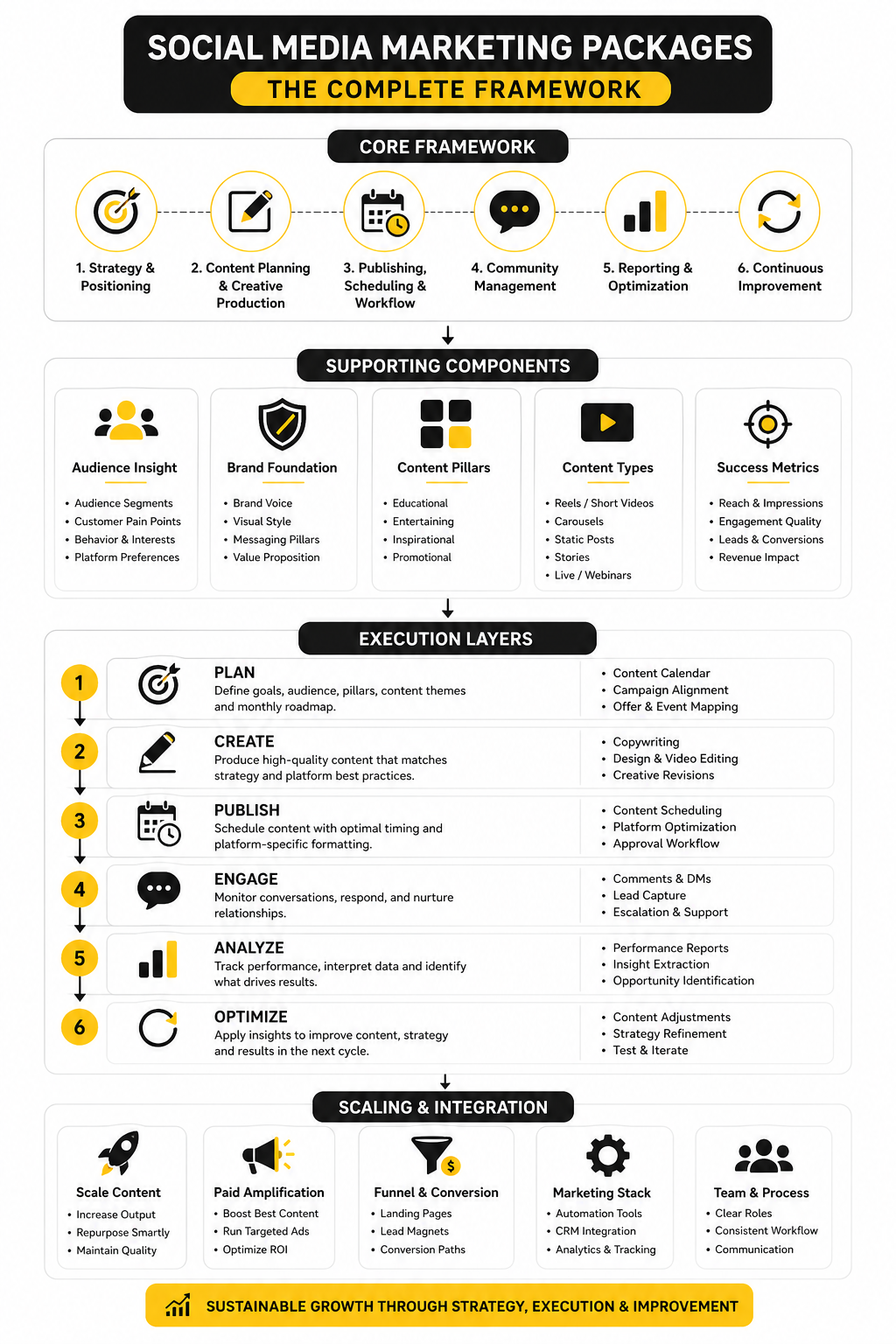
Most social media marketing packages should include some level of account audit, strategy, content planning, content creation, scheduling, community management, and reporting. The depth changes by tier, but the categories should be visible before you sign. If they are not visible, you are probably buying activity instead of a system.
Pricing varies widely because scope varies widely. WebFX lists social media marketing services as commonly ranging from $100 to $5,000 per month, while broader management estimates often rise when video, multiple platforms, ads, and strategy are included. That range is not automatically good or bad; it simply proves that deliverables matter more than the package name.
The best packages are specific enough to protect both sides. They define how many platforms are included, how many assets are created, who writes copy, who designs visuals, who approves posts, who answers comments, and what reporting cadence you receive. This removes confusion and makes performance easier to improve over time.
Strategy and Positioning
Before content gets made, the package should clarify who the brand is trying to reach, what the audience already believes, and what the company needs social media to do. This is the difference between posting because the calendar is empty and publishing because there is a clear message to move. Good social media marketing packages should include positioning work at the start, even if it is lightweight.
This does not need to become a 70-page strategy deck. In most cases, you need a practical plan that defines audience segments, content pillars, brand voice, key offers, platform priorities, and success metrics. Without that foundation, every post becomes a separate creative debate, and that slows everything down.
The best packages also connect social content to the rest of the business. If the company has email campaigns, webinars, product launches, sales calls, lead magnets, or ecommerce promotions, social should support those moments instead of floating separately. That is how social becomes part of the growth system rather than a monthly posting task.
Content Planning and Creative Production
Content planning is where the package becomes visible. This usually includes a monthly calendar, platform-specific post ideas, captions, creative briefs, hashtags where relevant, and approval timelines. A serious provider should be able to explain why each content type exists, not just how many posts you are getting.
Creative production is where pricing starts to separate quickly. Static graphics, short-form video editing, carousels, founder-led content, UGC coordination, motion graphics, and professional shoots all require different levels of time and skill. That is why two social media marketing packages can both promise “content creation” while delivering completely different levels of quality.
The key is to check what is actually included. Are they writing captions only, or are they designing assets too? Are they editing Reels and TikToks, or only scheduling content you provide? Are revisions included, and if so, how many rounds before extra fees start?
Publishing, Scheduling, and Workflow
Publishing sounds basic, but it matters more than most people think. A good workflow keeps content moving from idea to approval to scheduling without last-minute panic. It also reduces the common problem where a business pays for social media support but still has to chase, correct, and organize everything manually.
This is where tools can help, especially for teams that need simple approval flows and consistent scheduling. A platform like Buffer can make sense when the package includes planning and publishing but the business still wants visibility into what is going live. The tool is not the strategy, but it can make the strategy easier to execute.
Your package should also define responsibilities clearly. Someone needs to own final approvals, asset collection, publishing permissions, comment escalation, and reporting access. When those roles are vague, delays are almost guaranteed.
Community Management
Community management is often where weak packages expose themselves. Posting content is one thing; responding to comments, direct messages, complaints, questions, and sales inquiries is another. If the package does not mention community management, assume it is not included.
This matters because social media is not a one-way channel. People expect brands to respond, and those interactions can influence trust, conversion, and retention. A package that creates content but ignores replies may help visibility while quietly losing opportunities in the inbox.
For businesses that get frequent inquiries, automation can also support the workflow. Tools like ManyChat can help route conversations, capture leads, and answer common questions when used carefully. The important word is carefully, because automation should support the customer experience, not make the brand feel absent.
Reporting and Optimization
Reporting should not be a screenshot dump. A useful report explains what happened, why it likely happened, and what should change next. That means the package should include metrics tied to the goal, not just generic numbers like impressions and likes.
For awareness campaigns, reach, video views, profile visits, and share rate may matter. For lead generation, you want clicks, opt-ins, booked calls, cost per lead, and conversion quality. For customer retention, you may care more about response time, saved posts, repeat engagement, and useful conversations.
Optimization is the part that turns reporting into progress. The provider should use the data to adjust hooks, formats, posting times, creative angles, calls to action, and platform mix. If every month looks the same regardless of performance, you are not buying optimization; you are buying repetition.
Common Package Types and Who They Fit
Not every business needs the same level of social media support. A local service business with one core offer does not need the same package as a multi-location ecommerce brand launching campaigns every week. This is why social media marketing packages should be compared by fit, not just by price.
A basic package usually works best for businesses that need consistency, credibility, and a clean presence. A growth package makes more sense when the business needs stronger creative, more frequent publishing, community management, and campaign support. A full-service package is for companies that want social to support sales, hiring, launches, partnerships, and paid media without managing every moving part internally.
The mistake is buying a package that matches your ambition but not your capacity. If you cannot approve content, provide assets, answer strategic questions, or act on leads, even a strong package will underperform. Social media execution is collaborative, and the business still has a role to play.
The Implementation Process
Professional implementation starts with onboarding. This is where the provider gathers logins, brand assets, past performance data, offers, audience details, competitors, content preferences, approval rules, and reporting expectations. If onboarding feels rushed, the whole engagement usually feels messy later.
The next stage is the audit and strategy setup. The provider reviews what has worked, what has been ignored, where the brand feels unclear, and which platforms deserve priority. This should turn into a practical roadmap, not a vague promise to “increase engagement.”
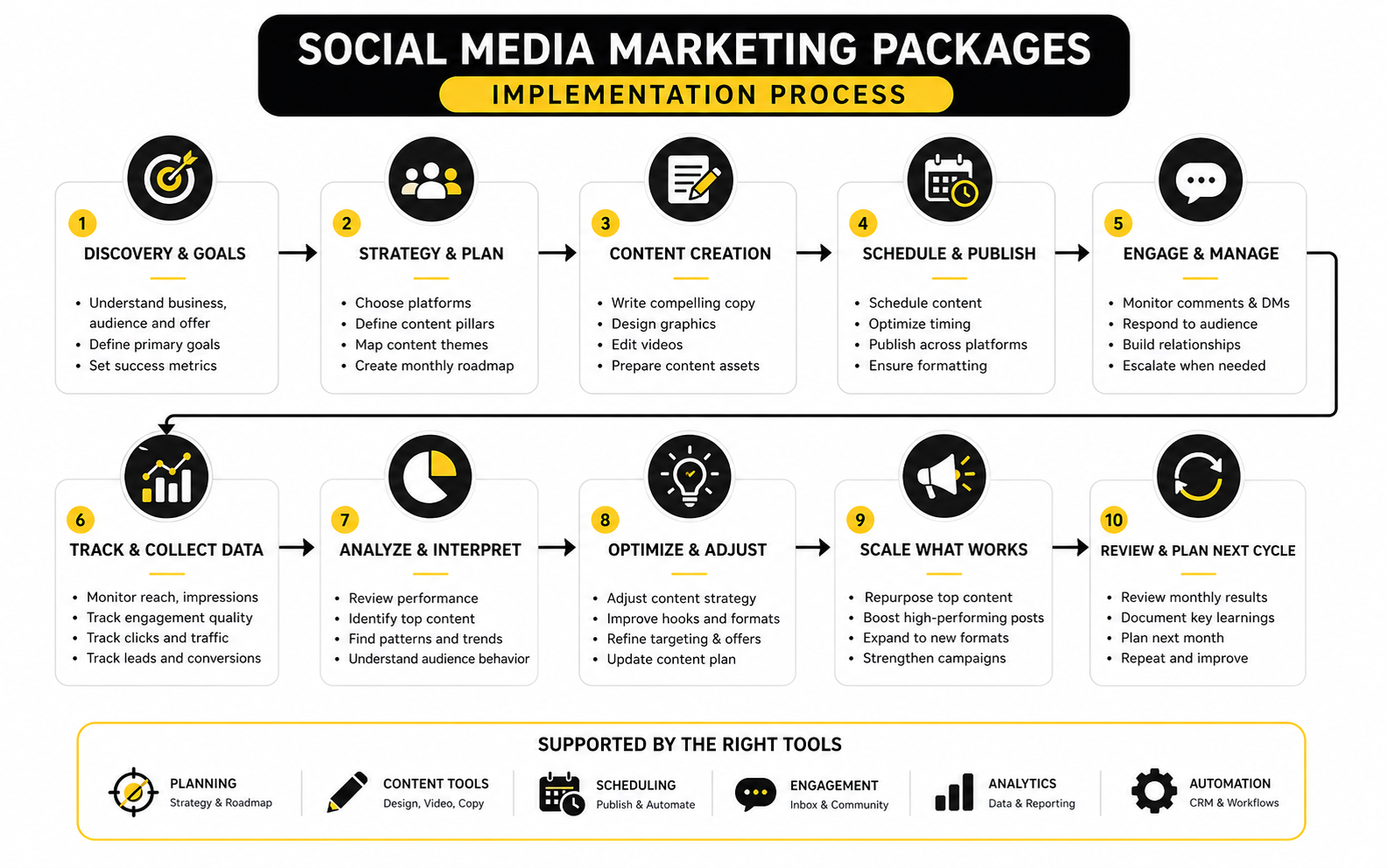
Then the execution rhythm begins. Most social media marketing packages move through a monthly cycle: plan the content, create the assets, review the drafts, schedule approved posts, manage responses, track performance, and improve the next round. Simple, but powerful when the process is actually followed.
A Practical Monthly Workflow
A good monthly workflow removes confusion before it happens. Everyone should know when ideas are due, when drafts arrive, when approvals close, and when reporting happens. That rhythm is what keeps the package from becoming reactive.
A simple process often looks like this:
- Review business priorities, promotions, events, and audience questions for the month.
- Build the content plan around themes, formats, offers, and platform priorities.
- Create captions, visuals, videos, carousels, or short-form scripts.
- Send content for review with enough time for thoughtful feedback.
- Schedule approved posts and prepare any supporting stories or engagement prompts.
- Monitor comments, messages, saves, shares, clicks, and lead signals.
- Report on performance and decide what changes next month.
This process also protects quality. When content is rushed, the first things to suffer are hooks, visuals, proof, and clear calls to action. Those are exactly the things that make social content perform.
Roles, Access, and Approval Rules
Implementation gets easier when roles are clear from day one. The business should know who approves content, who provides raw assets, who answers product questions, and who handles sensitive customer issues. The agency or freelancer should know who writes, designs, edits, schedules, reports, and escalates problems.
Access should also be handled professionally. That includes platform permissions, ad account access, brand folders, analytics tools, shared calendars, and secure password management. If a package requires direct publishing, the provider needs the right permissions without relying on messy back-and-forth every week.
Approval rules matter because social media moves fast. A package should define how many revision rounds are included, what counts as a minor edit, what happens when feedback arrives late, and which posts can be approved in batches. Clear rules do not make the relationship colder; they make it smoother.
Tools That Support Implementation
Tools should support the package, not replace the thinking behind it. A scheduling platform can organize publishing, a CRM can capture leads, an automation tool can route messages, and a reporting dashboard can make performance easier to understand. None of that matters if the strategy is weak.
For service businesses and agencies that need social leads to move into follow-up, GoHighLevel can fit naturally into the implementation stack. It can support funnels, forms, calendars, CRM follow-up, and automation when the package includes lead generation rather than just content publishing. That is useful because social engagement only becomes valuable when the next step is easy.
For ecommerce brands, the implementation stack may look different. A landing page builder, email tool, analytics setup, product feed, and paid media workflow may matter more than a CRM-heavy system. The right package should adapt to the business model instead of forcing every client into the same toolset.
Statistics and Data
Data should make social media marketing packages easier to judge, not more confusing. The point is not to collect every possible metric or chase whatever number looks biggest in a dashboard. The point is to understand whether the package is creating attention, trust, action, and learning.
That starts with context. Global social media usage is massive, with DataReportal showing 5.79 billion social media user identities worldwide at the start of April 2026, but that does not mean every business should post everywhere. A local clinic, a B2B SaaS company, a fashion brand, and a real estate agency all need different platform choices, content formats, and performance expectations.
This is why benchmark data should guide decisions, not control them. Hootsuite’s 2026 benchmark analysis shows that engagement rates vary heavily by industry, platform, and posting frequency, with some examples showing better results from fewer, more focused posts rather than constant publishing. That matters because a package that promises “more posts” is not automatically better than one that promises sharper strategy, stronger creative, and cleaner measurement.
The Metrics That Actually Matter
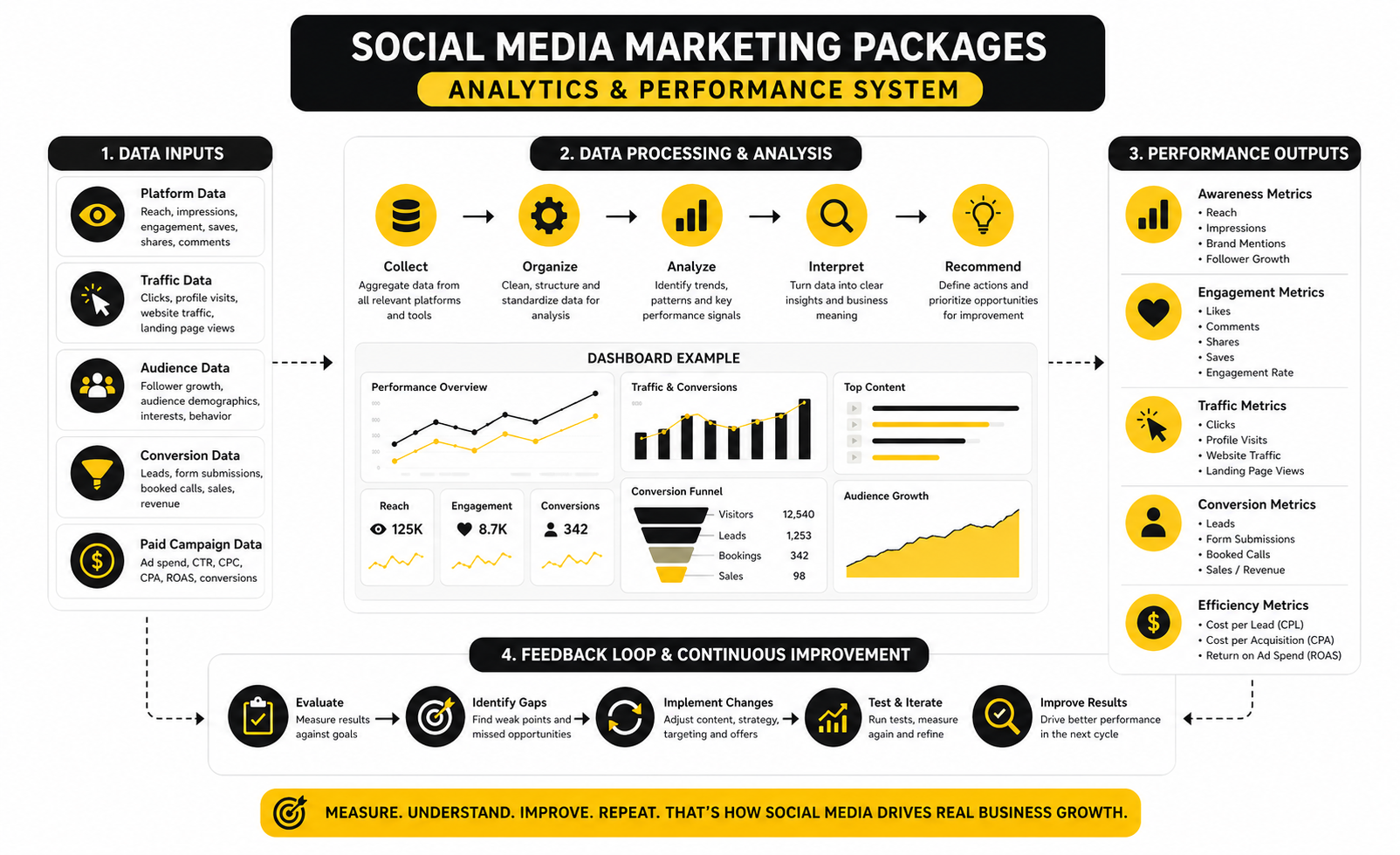
The first layer is visibility. Reach, impressions, profile views, video views, and follower growth show whether the content is getting in front of people. These numbers matter most when the package is designed for awareness, category education, local presence, or launch visibility.
The second layer is engagement quality. Likes are useful, but saves, shares, comments, replies, direct messages, and link clicks usually tell you more about intent. If people are saving a post, asking questions, forwarding it to a friend, or clicking through to learn more, the content is doing more than filling the feed.
The third layer is business action. For many companies, this means leads, booked calls, email subscribers, quote requests, purchases, trial signups, event registrations, or qualified conversations. If social media marketing packages never define which business actions matter, reporting becomes a performance theater instead of a decision-making tool.
How To Read Benchmarks Without Fooling Yourself
Benchmarks are useful only when they are relevant. Comparing your small local business to a global entertainment brand is pointless. Comparing your current performance to similar businesses, similar platforms, and your own historical baseline is much more useful.
A “good” engagement rate also depends on the goal. Hootsuite’s 2026 guidance notes that a good engagement rate is often between 1% and 5% depending on platform and industry, but that range should not become a lazy universal target. A post that gets lower engagement but drives qualified leads can be more valuable than a viral post that attracts the wrong audience.
You also need to separate content performance from offer performance. If people watch, save, and comment but do not convert, the content may be working while the offer, landing page, follow-up, or call to action is weak. If nobody engages at all, the problem is more likely the creative angle, hook, format, audience match, or posting strategy.
Building a Simple Analytics System
A good analytics system should connect the social post to the next meaningful step. That means tracking what was posted, who it was for, what message it carried, what action it asked for, and what happened after publishing. This is simple, but most weak packages skip it.
The cleanest setup is a monthly scorecard. It should show reach, engagement quality, audience growth, traffic, leads, sales indicators, top-performing content, weak content, and next-month decisions. The key word is decisions, because reporting without a decision is just decoration.
For lead-focused campaigns, the system should also connect social activity to follow-up. Tools like GoHighLevel can help when leads need to move from a comment, form, landing page, or message into a CRM and follow-up sequence. That makes measurement more practical because the business can see what happened after the first click or conversation.
What Performance Signals Should Change
Strong performance should influence the next content plan. If short videos with direct problem-solution hooks drive saves and DMs, the next package cycle should produce more of them. If educational carousels generate clicks but promotional posts get ignored, the brand may need a softer bridge between teaching and selling.
Weak performance should also create action, not panic. One slow month does not prove the package failed, especially if the business changed offers, posted fewer assets, delayed approvals, or entered a seasonal dip. But repeated weak performance with no strategic adjustment is a serious problem.
The best providers explain what they are changing and why. They might adjust platform focus, posting frequency, creative formats, campaign timing, hooks, audience targeting, landing pages, or follow-up. That is what you are really paying for: not just reports, but informed improvement.
Strategic Tradeoffs Before You Scale
Scaling social media marketing packages is not just about buying more posts, adding more platforms, or publishing more videos. Scaling means increasing complexity, and complexity has to be managed. If the foundation is weak, a bigger package simply makes the problems louder.
The first tradeoff is depth versus coverage. A brand can go deep on two channels with stronger creative, better testing, and tighter community management, or it can spread across five channels with lighter execution everywhere. For most businesses, depth wins first because platform-specific learning compounds faster than shallow activity across every network.
The second tradeoff is speed versus control. Fast-moving content can capture trends, answer market questions, and keep the brand culturally relevant. But faster workflows need stronger guardrails, because the approval process cannot become a bottleneck every time the team wants to publish something timely.
When To Add Paid Social
Paid social should usually come after the organic message has some proof. If no one clicks, comments, saves, shares, or asks questions organically, spending money may only amplify a weak angle. Ads can scale a message, but they do not magically fix unclear positioning.
That said, organic and paid should not be treated as enemies. Organic content helps you learn what the audience responds to, while paid distribution can give strong content more reach and cleaner testing. Meta’s 2025 results show its advertising engine is still huge, with ad impressions across its Family of Apps increasing 12% for the full year, which reinforces how much competition and opportunity still exist inside paid social.
If paid social is included in a package, check what the management fee covers. Strategy, creative testing, campaign setup, tracking, landing page feedback, reporting, and optimization are all different jobs. A package that only “boosts posts” is not the same as one that manages paid campaigns with a serious testing system.
When To Add Funnels and Lead Capture
A social media package becomes more valuable when attention has somewhere useful to go. If the business wants leads, bookings, signups, or purchases, then the package should connect content to landing pages, forms, calendars, email, SMS, or sales follow-up. Otherwise, the brand may create demand and then lose it through a weak next step.
This is where funnel tools can make sense. For businesses that want simple campaigns, opt-in pages, webinars, or offer pages connected to social traffic, ClickFunnels can fit naturally into the wider marketing system. The point is not to add software for the sake of it; the point is to make the path from interest to action obvious.
For leaner businesses, Systeme.io may be a simpler fit when the goal is to connect social content with basic funnels, email, and offers without creating a heavy tech stack. Either way, the package should define whether funnel strategy, page copy, automation, and conversion tracking are included or handled separately.
Risks That Cheap Packages Often Hide
Cheap social media marketing packages can be useful when the scope is honest. The risk begins when a low-cost package promises strategy, design, video, publishing, reporting, community management, ads, and growth without enough time to do any of it well. At that point, the offer is not efficient; it is unrealistic.
One hidden risk is generic content. Templates can help production move faster, but the brand still needs original thinking, specific offers, real audience insight, and a voice that sounds like the business. If every post could belong to any competitor, the package is not building brand equity.
Another risk is poor measurement. A low-cost provider may send a monthly report filled with surface-level metrics but no interpretation. That creates a dangerous illusion of progress, because everyone sees numbers but nobody knows what to change.
Scaling Without Losing Quality
Quality usually drops when the package scales faster than the system behind it. More platforms require more platform-native thinking. More videos require more hooks, editing time, source footage, and review discipline. More community management requires escalation rules, response templates, and someone who understands the brand well enough to speak for it.
The practical move is to scale in stages. First, prove the content pillars. Then prove the workflow. Then prove the conversion path. Only after that should you add more platforms, more formats, more campaigns, or paid media.
This is also where senior input matters. Junior execution can keep a calendar moving, but someone experienced needs to review strategy, creative direction, offer alignment, and performance trends. The best packages make that clear instead of hiding who is actually doing the work.
What Expert Buyers Look For
Experienced buyers do not just ask, “How many posts do we get?” They ask how the provider thinks. They want to know how ideas are chosen, how performance is reviewed, how often strategy changes, and how the package connects to revenue or pipeline.
They also ask about constraints. What happens if the brand has no video footage? What happens if approvals are late? What happens if a post performs unusually well? What happens if comments turn negative or a campaign attracts unqualified leads?
Those questions reveal whether the provider has a real operating system. Strong social media marketing packages are not just lists of deliverables. They are structured ways to turn attention into learning, trust, and action without making the business reinvent the process every month.
Pricing, Red Flags, and Final Buying Checklist
By this point, the right decision should feel clearer. You are not just buying posts, captions, or a calendar. You are choosing the operating system that will decide how your brand shows up, learns from the market, handles attention, and turns that attention into business value.
The final step is to look at the package as an ecosystem. Strategy, creative, publishing, community management, analytics, paid distribution, funnels, and follow-up all influence each other. When one part is missing, the rest of the package has to work harder to compensate.
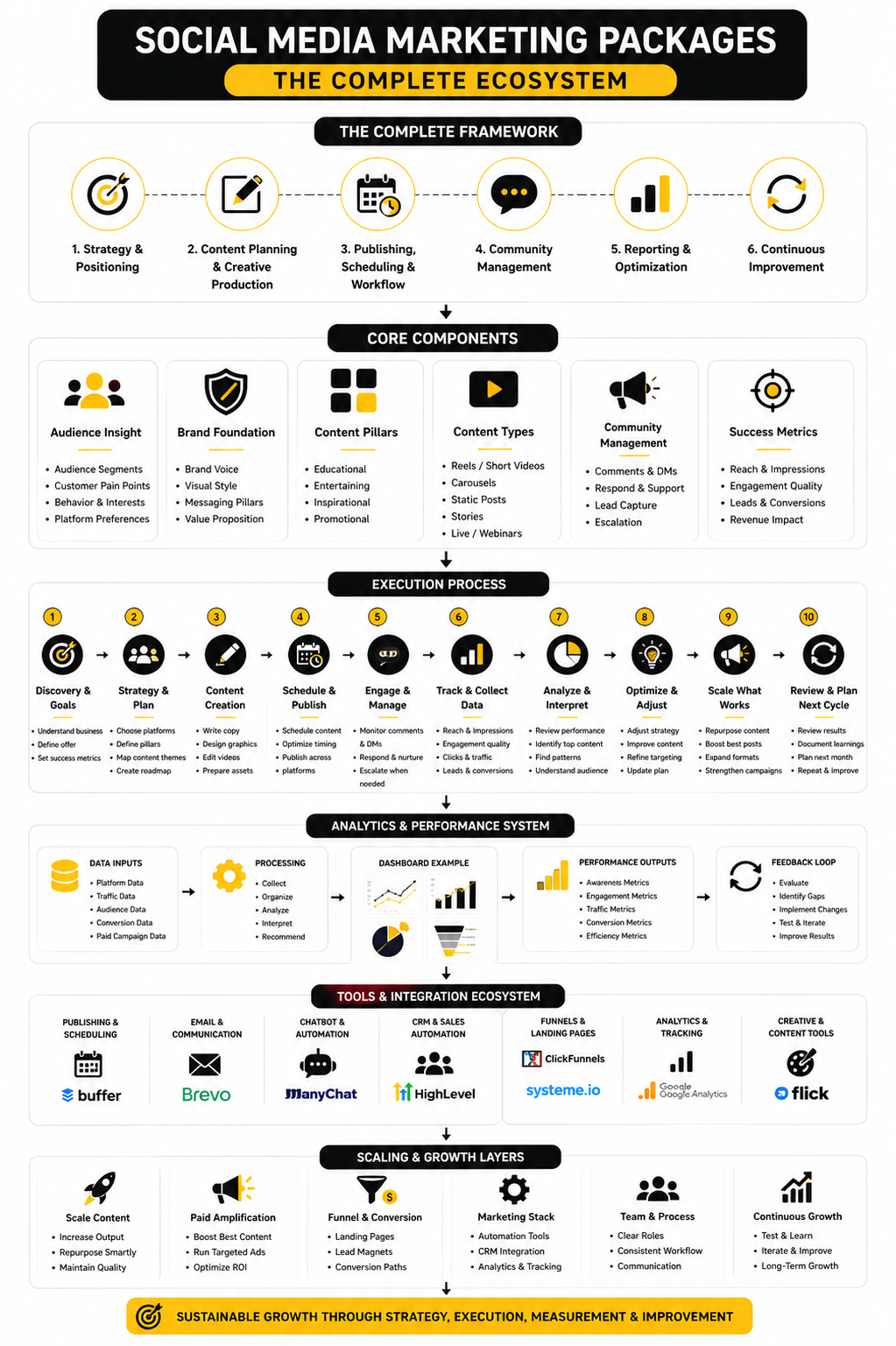
How Much Should You Expect To Pay?
Pricing depends on scope, skill, speed, and accountability. A light package for basic consistency will naturally cost less than a full-service package that includes strategy, video editing, reporting, community management, paid support, and funnel coordination. The mistake is judging price before judging what the package is responsible for.
A realistic buyer looks at the cost of the package and the cost of weak execution. If bad content damages trust, slow follow-up loses leads, or unclear reporting hides performance problems, the cheaper option can become expensive quickly. This is especially true when marketing budgets are tight and every channel has to justify its place.
The cleanest way to compare social media marketing packages is to ask what is included, what is excluded, what requires an add-on, and what outcome the package is designed to support. If the provider cannot explain those things clearly, do not expect the reporting to be clear either.
Red Flags To Watch For
A vague package is a red flag. If the provider cannot define deliverables, timelines, revision rules, platform responsibilities, reporting cadence, or success metrics, the relationship will probably become messy. Clarity is not a bonus; it is the product.
Another red flag is guaranteed viral growth. No serious professional can promise virality on demand, because platform distribution depends on audience response, creative quality, competition, timing, and algorithmic behavior. A better promise is disciplined testing, consistent improvement, and transparent reporting.
Be careful with packages that treat every business the same. A restaurant, coach, SaaS brand, ecommerce store, and local contractor should not receive identical strategies. Templates can speed up delivery, but strategy has to respect the business model.
Final Buying Checklist
Use this checklist before choosing a provider. It will save you money, time, and frustration.
- Does the package explain the business goal it is built to support?
- Are the included platforms clearly listed?
- Are content formats defined, not just content volume?
- Is strategy included, or only execution?
- Are copywriting, design, editing, scheduling, and reporting separated clearly?
- Is community management included or priced separately?
- Are paid ads included, optional, or excluded?
- Is funnel, CRM, email, or lead follow-up support included?
- Are revision rounds and approval timelines clear?
- Does the report include interpretation and next steps?
- Who is actually doing the work?
- What happens if performance is weak for two or three cycles?
- Can the package scale without breaking the workflow?
A good package should make you feel more in control, not less. You should know what is happening, why it is happening, and what the next decision will be. That is the difference between hiring activity and hiring expertise.
FAQ - Built for Complete Guide
What are social media marketing packages?
Social media marketing packages are structured service bundles that help businesses plan, create, publish, manage, and measure social media activity. They can be basic, growth-focused, or full-service depending on the level of strategy, creative production, community management, ads, and reporting included. The best packages make responsibilities clear so the business knows exactly what is being delivered each month.
What should be included in a social media marketing package?
A strong package should include strategy, content planning, content creation, scheduling, reporting, and some level of optimization. Depending on the package, it may also include community management, short-form video editing, paid social support, influencer coordination, funnel support, or CRM follow-up. The key is to confirm the details before buying because “social media management” can mean very different things from one provider to another.
How much do social media marketing packages cost?
Costs vary because the scope varies. A light package may only cover a few posts per week, while a full-service package may include strategy, video, analytics, paid campaigns, and lead handling. Instead of comparing price alone, compare the deliverables, skill level, workflow, reporting depth, and business outcome the package is designed to support.
Are cheap social media marketing packages worth it?
Cheap packages can be worth it when the scope is honest and limited. They are risky when they promise everything but do not include enough time, strategy, or senior oversight to deliver quality work. If the package only creates generic posts with no measurement or improvement process, it may save money upfront while costing growth later.
How many posts per week should a package include?
There is no universal number that works for every business. Some brands need fewer, stronger posts with better creative and sharper positioning, while others need higher frequency because they run promotions, events, campaigns, or community-driven content. The better question is whether the posting rhythm supports the business goal and whether the team can maintain quality consistently.
Should social media marketing packages include video?
Video should be included when the platform strategy and audience behavior justify it. Short-form video can be powerful, but it requires hooks, editing, source footage, scripting, and a clear workflow. A package that includes video should explain how many videos are delivered, who provides raw footage, how editing works, and how performance will be reviewed.
Do I need paid ads with my social media package?
Not always. Paid ads make sense when the organic message is clear, the offer is ready, and there is a way to track conversions or lead quality. If the organic content is weak or the landing page is not ready, paid ads may simply amplify a broken system.
What is the difference between social media management and social media marketing?
Social media management usually focuses on keeping accounts active through content planning, posting, engagement, and reporting. Social media marketing goes further by connecting content to business goals such as leads, sales, launches, retention, hiring, or brand positioning. Strong social media marketing packages should include both execution and strategic direction.
How long does it take to see results?
Some signals appear quickly, such as better content quality, stronger engagement, more profile visits, and more consistent publishing. Business outcomes like qualified leads, lower acquisition costs, stronger brand recall, or improved conversion usually need several cycles of testing and refinement. A serious package should set expectations around learning, not pretend every result happens immediately.
What metrics should I ask for in monthly reports?
Ask for metrics that match the goal. Awareness campaigns should track reach, impressions, video views, profile visits, and audience growth. Lead-focused campaigns should track clicks, forms, DMs, booked calls, conversion rate, lead quality, and follow-up performance.
Can one package cover every social platform?
It can, but that does not mean it should. Every platform has different formats, audience behavior, creative expectations, and publishing rhythms. Most businesses are better off starting with the platforms most likely to drive meaningful attention or action, then expanding once the workflow and content system are proven.
How do I know if a provider is good?
A good provider asks sharp questions before recommending a package. They want to understand your business model, offer, audience, sales process, capacity, brand voice, and current content performance. They also explain tradeoffs clearly instead of pushing the biggest package by default.
Should I hire an agency, freelancer, or in-house marketer?
It depends on your needs and internal capacity. A freelancer can be great for focused execution, an agency can provide a broader team and more structure, and an in-house marketer can build deeper brand knowledge over time. Many businesses use a hybrid setup where internal leadership owns strategy and external specialists support content, ads, or production.
What is the biggest mistake businesses make when buying social media marketing packages?
The biggest mistake is buying volume without buying thinking. More posts do not automatically mean more trust, more leads, or more sales. A better package gives you strategy, execution, measurement, and improvement in one system.
Work With Professionals
Explore 10K+ Remote Marketing Contracts on MarkeWork.com
Most marketers spend too much time chasing clients, competing on crowded platforms, and losing a percentage of every project to middlemen.
MarkeWork gives you a better way. Browse thousands of remote marketing contracts and connect directly with companies desperate to hire skilled marketers like you, without platform commissions and without unnecessary gatekeepers.
If you're serious about finding better opportunities and keeping 100% of what you earn, explore available contracts and create a profile for free at MarkeWork.com.