

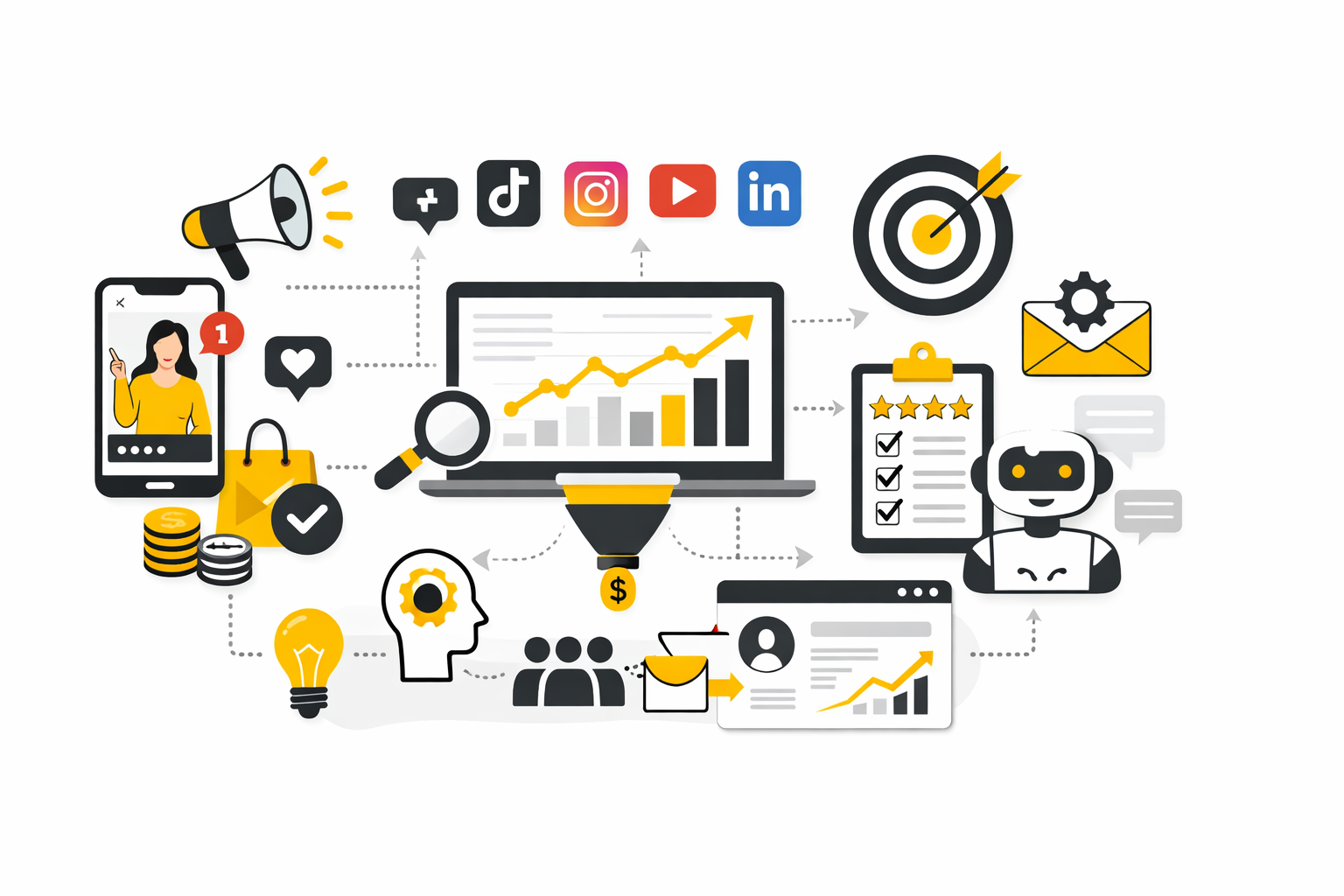
Social media marketing in 2026 is not just about posting more often or chasing the next viral format. The platforms are bigger, more competitive, more algorithmic, and far more commercial than they were even two years ago. Global social identities reached 5.24 billion in 2025, while half of adult users now visit social platforms to learn about brands, and Instagram, Facebook, and TikTok all rank as major destinations for product research. DataReportal – Global Digital Insights+1
That changes the job completely. Your content is no longer competing only with direct competitors. It is competing with creators, communities, customer opinions, algorithmic recommendations, social search behavior, livestream shopping, and increasingly polished AI-assisted content across every major platform. Meta openly states that AI systems inform ranking across its products, YouTube says TV is now the primary device for YouTube viewing in the U.S. by watch time, and TikTok keeps pushing deeper into creator-led discovery and commerce. transparency.meta.com+3
So the best social media marketing tips 2026 are not random hacks. They come from understanding how people use platforms now, what the ranking systems reward, where trust is built, and how brands turn attention into measurable business results without looking generic. That is the structure this article will follow.
- Why Social Media Marketing Looks Different in 2026
- The 2026 Social Growth Framework
- Audience Signals and Platform Fit
- Content Systems That Earn Attention
- Measurement, Testing, and Revenue
- Professional Implementation and Long-Term Advantage
The first big shift is that social is now a research channel, not just an awareness channel. DataReportal’s 2025 analysis found that 50% of adult users visit social platforms to learn more about brands, and that Instagram leads brand research usage among its active adult users, with Facebook and TikTok close behind. That means your social presence is often being evaluated by people who are already partway into a buying decision, even if they never click “follow.” DataReportal – Global Digital Insights
The second shift is that trust is moving away from polished brand messaging and toward people, proof, and visible expertise. LinkedIn’s 2025 research found that 77% of B2B marketing leaders say audiences rely on their network, not just company channels, when they vet brands, and 80% say they are increasing investment in community-driven content. On TikTok, the platform’s own 2025 trend report makes the same point from a different angle: brands are expected to build with creators and communities rather than broadcast at them. news.linkedin.com+1
The third shift is that commerce is getting compressed into the feed. EMARKETER projects that U.S. social commerce sales will pass $100 billion in 2026, and TikTok’s internal shopping data shows how quickly entertainment, search, and purchase behavior are blending together inside one platform. Even if your business does not sell directly through social checkout, buyers are learning to expect faster discovery, clearer proof, and shorter paths from content to conversion. EMARKETER+1
One more thing matters here, and it is easy to underestimate. As platforms fill up with AI-assisted content, originality and transparency become more valuable, not less. Meta has been labeling AI-generated content since May 2024, and the FTC’s guidance remains clear that endorsements, reviews, and influencer relationships need proper disclosure, especially when money, incentives, or brand relationships are involved. transparency.meta.com+2
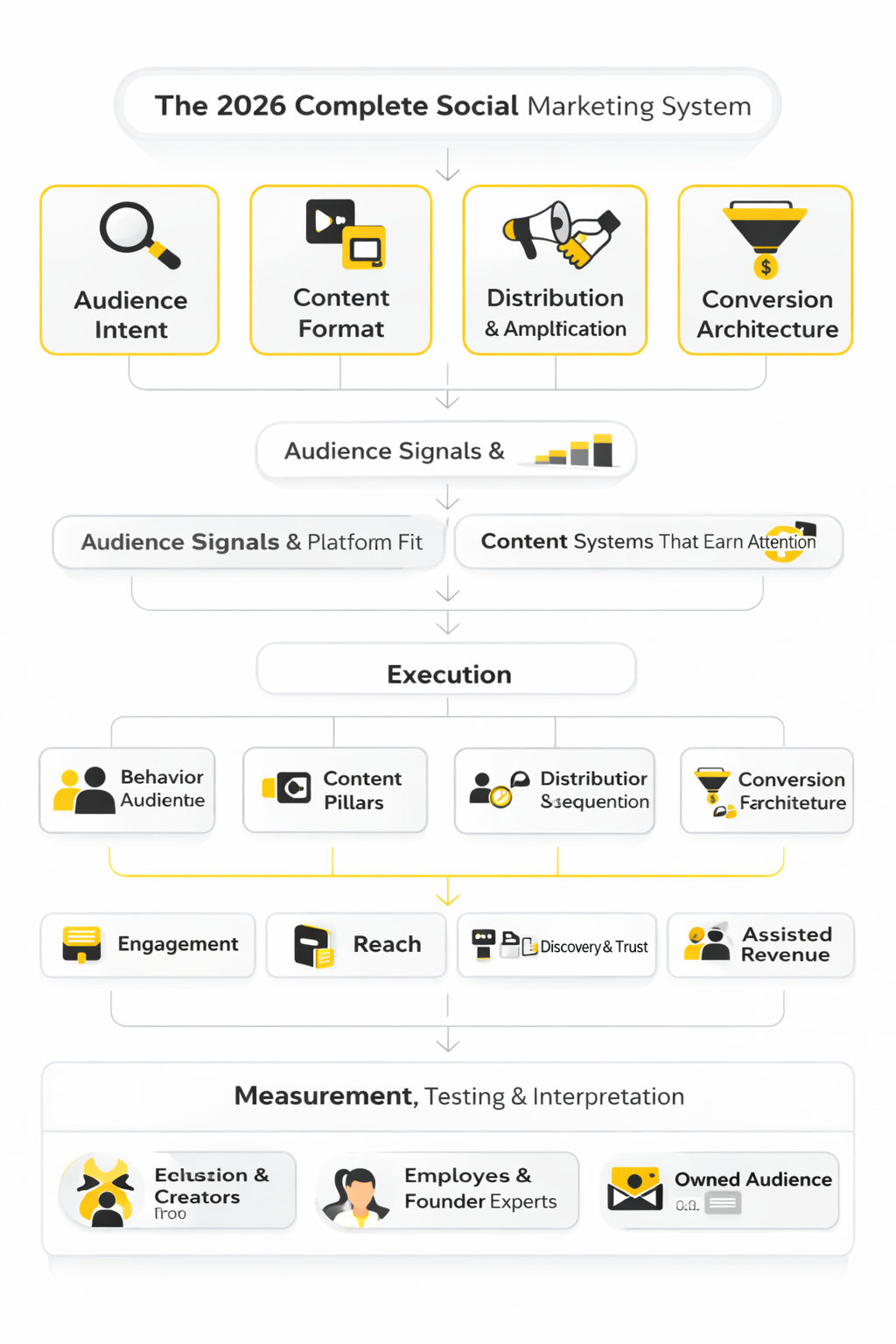
The framework for winning on social in 2026 is simple to say and harder to execute: pick the right audience signal, match it to the right platform behavior, publish content that earns attention in context, and connect that attention to a measurable business outcome. Most brands fail because they skip one of those steps. They either create content without a platform-specific reason for it to work, or they collect engagement without a system for turning that engagement into pipeline, leads, sales, or retention.
A practical framework starts with four layers. First comes audience intent, because the same person uses Instagram, TikTok, YouTube, LinkedIn, Reddit, and Facebook for different reasons. Second comes content format, because what works in a Reel, a carousel, a Shorts sequence, a founder post, or a customer proof clip is not interchangeable. Third comes distribution and amplification, which includes creators, employee advocacy, community interaction, paid support, and repurposing. Fourth comes conversion architecture, which is where landing pages, email capture, appointment flows, DMs, and offers turn visibility into business value.
That last layer is where a lot of brands quietly lose money. Social content can generate demand, but demand still needs somewhere to go. If your strategy needs a cleaner funnel or lead path, tools like ClickFunnels, Systeme.io, or Fillout fit naturally into the implementation side of this framework because they help convert social traffic into leads, bookings, and follow-up actions without adding friction.
This framework also assumes that social is no longer only mobile-scroll entertainment. YouTube says connected TV has become the primary viewing device in the U.S. by watch time, which is a reminder that social content now lives across short clips, long-form video, livestreams, search behavior, and even living-room viewing habits. In other words, social media marketing tips 2026 have to be built for a cross-format environment, not a single-post mindset. blog.youtube
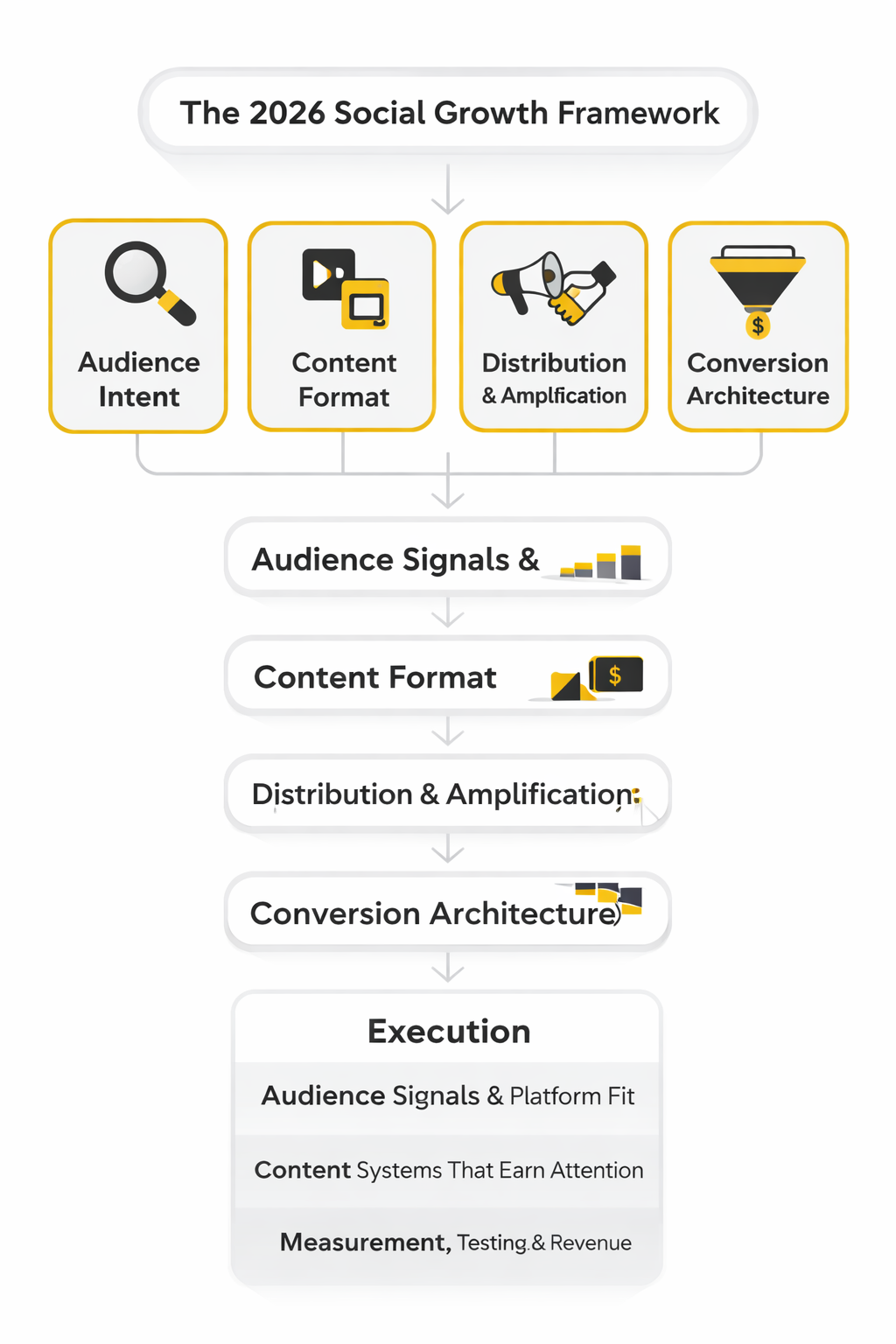
The rest of this article will unpack each layer in order. Next, we will move into audience signals and platform fit, because that is where strong strategy begins and where weak social plans usually start to fall apart.
If you want better results from social media marketing in 2026, stop asking which platform is “best” in general. That question is too broad to be useful. The real question is where your audience shows the strongest buying, learning, comparing, or community behavior, because that signal tells you what kind of content they will actually respond to.
This matters because audiences now spread their attention across multiple platforms with very different expectations. In the U.S., 95% of adults ages 18 to 29 use YouTube, 80% use Instagram, 63% use TikTok, and 48% use Reddit, while Facebook still remains extremely strong with 80% usage among adults ages 30 to 49. That is exactly why lazy platform advice falls apart so quickly. People are everywhere, but they are not doing the same thing everywhere.
The practical move is to map each platform to a dominant user intent. Some platforms are built for discovery, some for validation, some for education, some for professional trust, and some for niche problem solving. Once you see social through that lens, the best social media marketing tips 2026 stop looking like trends and start looking like positioning decisions.
Demographics still matter, but they are no longer enough on their own. Two people in the same age group can use YouTube, TikTok, LinkedIn, Instagram, and Reddit in completely different ways during the same week, which means age alone will not tell you what content to publish. What matters more is behavior: are they browsing casually, researching a product, checking social proof, trying to solve a problem, or looking for a credible expert to trust?
This is where intent becomes your advantage. DataReportal’s 2025 global overview shows that Instagram is the top platform for brand research among its active adult users at 62.3%, with Facebook at 52.5% and TikTok at 51.5%. That tells you something important: users are not just scrolling for entertainment anymore. They are checking products, comparing brands, and making shortlist decisions inside the platforms themselves.
So build your channel mix around behavior clusters, not vanity assumptions. If your buyer needs visible proof, product context, or before-and-after transformation, lean harder into visual-first platforms. If your buyer needs confidence, depth, or category education, long-form and expert-led platforms deserve more of your attention.
Instagram still earns its place when your offer benefits from visual clarity, repeat exposure, and social proof that feels current. It is especially useful for brands that need to show quality fast, because the format mix gives you short-form reach through Reels, deeper consideration through carousels, and everyday trust through Stories. That combination is hard to beat when someone is close to a decision but still wants one more layer of confidence.
The platform itself is built around ranking signals tied to user response and relevance, not just follower count. Instagram’s creator guidance explains that ranking looks at signals such as how likely someone is to spend time on a post, comment, share, or find it relevant, and those signals vary by surface like Feed, Reels, and Explore. Instagram’s own explanation of algorithms and ranking is a useful reminder that strong content on Instagram has to be designed for interaction and retention, not just aesthetics.
For marketers, the implication is simple. Do not treat Instagram as a digital brochure. Treat it as a proof engine where your visuals, customer outcomes, messaging, and creative packaging need to make sense in seconds, because that is how users decide whether to keep watching, tap through, save, or share.
TikTok remains one of the strongest platforms for unplanned discovery, especially when a brand is trying to reach people before they are actively searching for that brand name. But the style that wins there in 2026 is not random virality. TikTok’s own 2026 trend forecast says users are moving toward more honest, unfiltered stories, behind-the-scenes moments, and creator-community dynamics that feel grounded rather than overly curated. TikTok’s 2026 marketer forecast and the company’s newsroom summary both point in the same direction: less polish theater, more real context.
That lines up with what the platform has been signaling for a while. TikTok’s 2025 and 2026 trend materials both emphasize creator partnerships, community relevance, cultural participation, and shared storytelling instead of top-down brand control. TikTok’s newsroom announcement for 2026 makes the point clearly: brands that resonate are the ones that work with creators and niche communities, not the ones that only repurpose ad creative.
So if TikTok is part of your strategy, build for momentum rather than polish. Show process, show personality, show a point of view, and show why the product matters in a real situation. The platform is still fast, but the winning creative now feels closer to documentary than commercial.
YouTube matters more than a lot of brands admit, partly because they still think of it as a separate video channel instead of a core part of social strategy. That is outdated. YouTube now spans Shorts, search, subscriptions, recommendations, podcasts, creator partnerships, and connected TV viewing, which makes it one of the few platforms that can support both discovery and long-term authority.
The scale and viewing behavior make that impossible to ignore. YouTube says TV has become the primary device for YouTube viewing in the U.S. by watch time, and the company has also highlighted more than 1 billion hours of YouTube content viewed daily on TV sets globally. That changes the creative standard. Your content is not only being watched in a phone-scroll context anymore. It may also be watched like a show.
For marketers, YouTube is the platform to prioritize when your category needs explanation, trust building, product education, tutorials, comparisons, or thought leadership that should keep working over time. If social media marketing tips 2026 had to name one platform for durable content value, YouTube would be very high on the list because good videos can keep driving search and recommendation traffic long after the publish date.
LinkedIn is where authority translates most directly into commercial credibility, especially in B2B, consulting, recruiting, software, services, education, and founder-led brands. The platform now has more than 1 billion members, but the more important point is not size. It is the context. People arrive on LinkedIn expecting to learn, evaluate expertise, and understand who knows what they are talking about.
That expectation makes the platform unusually strong for trust-heavy buying decisions. LinkedIn’s 2025 research found that 77% of B2B marketing leaders say people are turning to trusted voices in their networks, while 80% say they are increasing investment in community-driven strategies. That is a huge signal. It means company pages still matter, but people often trust people more than logos.
The best play on LinkedIn is not to sound corporate. It is to be specific. Strong opinions, clear lessons, credible operating experience, original analysis, and consistent publishing tend to outperform vague “value posts” because the audience is there to evaluate thinking, not just react to feel-good content.
These platforms get overlooked when marketers build one-size-fits-all strategies, and that is a mistake. Reddit reported 121.4 million daily active uniques in Q4 2025, which tells you just how large the opportunity is when your audience is problem aware, category aware, or actively looking for unfiltered discussions. Reddit is rarely the best place for polished brand messaging, but it can be excellent for research, listening, community understanding, and very selective participation where credibility is earned.
Pinterest is different but just as useful when intent is visual and future-oriented. The company finished 2025 with 619 million monthly active users, and its own positioning remains centered on inspiration, discovery, and shopping behavior. That makes it highly relevant for categories where users save ideas before they buy, including home, beauty, style, food, events, travel, and many product-led lifestyle segments.
Snapchat also deserves a more serious look when local context, younger reach, and friend-network behavior matter. Snap says the platform reached 946 million monthly active users in Q4 2025, while Snap Map reached 435 million monthly active users. That is not niche anymore. For retail, events, location-based experiences, and youth-focused brands, those signals matter.
A lot of weak strategy comes from trying to “be everywhere” before a brand has figured out why it belongs anywhere. That usually creates mediocre content, inconsistent publishing, and scattered measurement. A tighter system works better: choose one primary platform for demand generation, one for trust building, and one optional support channel for repurposing or community depth.
This is where execution gets practical. If you are building a B2B service brand, LinkedIn plus YouTube is often a stronger combination than trying to force growth on six channels at once. If you are selling a visual consumer product, Instagram plus TikTok plus an email capture system can be a far more effective stack, especially when your content sends traffic into a clean funnel built with tools like Buffer, Brevo, or Moosend.
The point is not platform minimalism for its own sake. The point is strategic fit. Once you know where your audience discovers, validates, and converts, your content choices get sharper, your metrics become more useful, and your budget stops leaking into channels that never had the right job to begin with.
Once platform fit is clear, content gets much easier to design. You no longer have to guess what to publish just because a format is trending. You can build content around the kind of attention each platform is willing to reward, which is where the next layer of the framework starts.
Once you know where your audience spends time and why they use that platform, the next job is building a content system that can survive real-world execution. This is where a lot of strategies break. The ideas sound smart in a planning doc, but the publishing process is too fragile, too slow, or too dependent on constant inspiration to hold up for more than two weeks.
The brands that win in 2026 do not just make content. They build repeatable ways to turn expertise, proof, customer questions, creator input, and campaign assets into platform-native posts. That is the difference between occasional spikes and steady growth. A strong system keeps producing useful content even when the team is busy, the founder is tired, or the algorithm shifts again.
This matters more than ever because the platforms themselves are pushing harder against recycled, spammy, or low-effort material. Meta said in March 2026 that Facebook is giving greater reach and monetization support to creators posting original content while deprioritizing unoriginal content, and it updated its original content guidelines to make that clearer. That follows earlier 2025 moves against spammy content and copycat tactics on Facebook, which tells you exactly where platform incentives are moving: away from volume for its own sake and toward distinct, creator-owned value.
YouTube is sending the same message in a different form. Its official guidance on recommendations says there is no ideal video length and warns creators not to pad videos with filler, because the real goal is to deliver value efficiently and sustain viewer satisfaction. The audience retention tools inside YouTube Studio make that painfully visible by showing where viewers rewatch, skip, or drop off, which is why weak openings and bloated editing get punished fast.
So one of the most useful social media marketing tips 2026 is also one of the least glamorous: stop publishing interchangeable content. If a post could be copied by ten competitors and still make sense, it is probably too generic to earn strong attention. Original language, real proof, clear perspective, and platform-native packaging matter more now because the platforms have become better at detecting low-signal repetition.
A real content engine needs structure. The easiest way to do that without sounding robotic is to build around a small number of content pillars that reflect how your audience thinks, buys, and evaluates solutions. Most brands do better with four to six pillars than with twenty scattered themes.
These pillars should not be vague categories like “tips” or “inspiration.” They should map to commercial reality. A better setup looks more like this:
- problem awareness
- education and explanation
- proof and outcomes
- objections and decision support
- personality and brand perspective
- offers, next steps, and conversion
That structure works because it solves two problems at once. First, it keeps your messaging aligned with the buyer journey instead of whatever someone on the team feels like posting that day. Second, it makes repurposing easier, because one idea can be adapted into a Reel, carousel, short video, founder post, email, and landing-page hook without losing strategic clarity.
The biggest execution mistake is asking one post to do everything. A short-form video cannot always educate deeply, build trust, close the sale, and entertain at the same time. Strong content systems work because each format has a clear job.
Reels, TikToks, and Shorts are usually strongest at stopping attention, opening curiosity, and making a point quickly. Carousels are excellent when you need to organize an idea, compare options, or walk someone through a decision. Long-form YouTube content works better when the audience needs depth, explanation, or proof that compounds over time. LinkedIn posts tend to perform best when they package a sharp lesson, an operating insight, or a strong opinion people can discuss and share.
The platforms themselves keep reinforcing these use cases. Instagram introduced trial reels to let creators test content with non-followers first, which is a strong signal that format experimentation matters. TikTok’s 2026 trend forecast leans into behind-the-scenes storytelling and honest process, while YouTube’s audience retention tools and recommendation guidance keep pushing creators toward tighter editing and higher-value delivery. When you align format with job, the content feels cleaner because it is no longer trying to carry the entire strategy alone.
This is where execution becomes tangible. Instead of brainstorming seven unrelated posts, build one weekly core idea and expand it across formats. That gives you consistency without repetition, and it keeps the message sharper because every asset supports the same commercial theme.
Say your core idea is a common customer mistake, a buying myth, a new industry shift, or a result your clients keep asking about. That one idea can become a short video hook, a deeper carousel, a founder opinion post, a customer email, a lead magnet angle, and a landing-page section. Suddenly the content calendar stops feeling like a hungry machine that needs to be fed every morning.
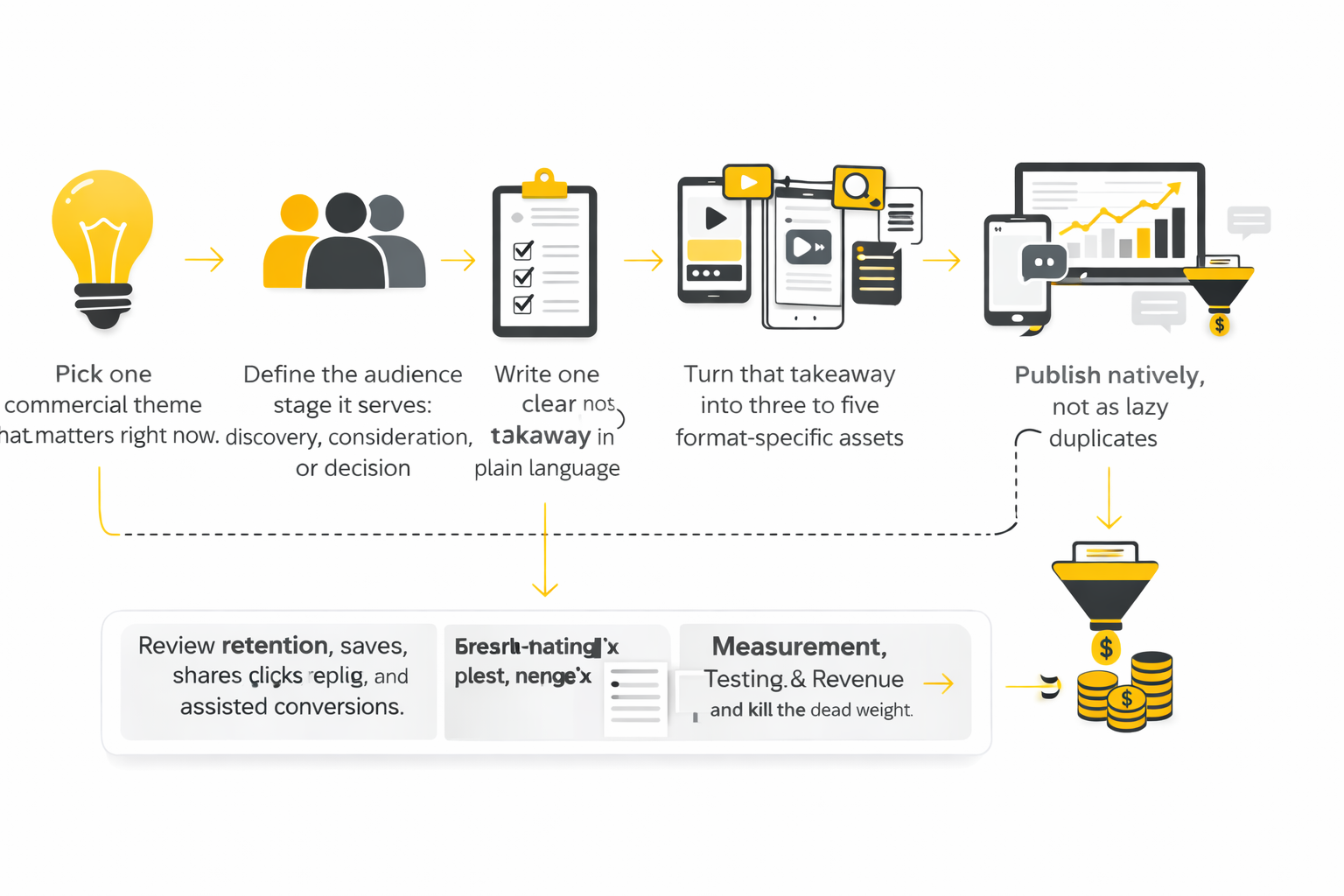
A practical weekly process looks like this:
- Pick one commercial theme that matters right now.
- Define the audience stage it serves: discovery, consideration, or decision.
- Write one clear takeaway in plain language.
- Turn that takeaway into three to five format-specific assets.
- Publish natively, not as lazy duplicates.
- Review retention, saves, shares, clicks, replies, and assisted conversions.
- Keep the winners, refine the almost-winners, and kill the dead weight.
This is the part most teams skip, and it is exactly why their content stays inconsistent. They create posts one at a time instead of building sequences. The result is more effort, weaker messaging, and less learning over time.
Your tools should speed up publishing, not turn your workflow into a software hobby. The right stack depends on your team size, but most marketers do well with a simple system for planning, writing, scheduling, capturing leads, and moving interested people into follow-up.
For scheduling and social planning, Buffer fits naturally because it keeps publishing organized without making the workflow heavier than it needs to be. If hashtag research and content optimization are part of your Instagram process, Flick is one of the more relevant add-ons because it supports the execution side rather than just reporting on it. And if social content is driving people into lead capture, surveys, or qualification forms, Fillout is the kind of tool that makes the handoff smoother.
That same logic applies to writing and follow-up. If your team struggles to turn conversations or recorded ideas into usable drafts, a tool like Wispr Flow can reduce the friction between thinking and publishing. The point is not to collect shiny apps. The point is to remove bottlenecks so the strategy actually reaches the feed.
A lot of bad advice still treats posting frequency like a growth hack. It is not. Consistency matters, but signal quality matters more, and that includes originality, relevance, retention, and the likelihood that someone will save, share, reply, or keep watching.
Even the more marketer-focused research is moving in this direction. The 2025 Sprout Social Index emphasizes that consumers want originality, authenticity, and community value rather than brands posting just to post. That lines up with what the platforms are rewarding directly. Meta is cracking down on spammy and unoriginal content, and YouTube keeps telling creators to focus on viewer satisfaction rather than stretched-out output.
So yes, publish consistently. But do not confuse more content with better content. A disciplined three-post weekly system that generates saves, shares, replies, and qualified traffic will beat a daily schedule full of forgettable posts almost every time.
Once the content system is in place, the next step is measuring what actually moves the business. This is where social media marketing in 2026 either becomes a growth channel or stays trapped as a reporting vanity project.
Metrics are where most social strategies quietly fall apart. Teams collect dozens of numbers every week but rarely translate those numbers into decisions. A dashboard full of impressions, likes, and follower counts might look impressive, but without interpretation it tells you almost nothing about whether your social media marketing is improving or simply staying busy.
The most useful social media marketing tips 2026 treat analytics as a learning system rather than a reporting ritual. The goal is not to prove that content exists. The goal is to understand what type of content creates attention, what type creates trust, and what type actually drives revenue or leads.
When you look at analytics through that lens, the numbers start to make more sense. Every metric becomes a signal about how audiences respond to your ideas, not just a vanity badge.
Social platforms have reached a scale where guessing simply does not work anymore. Global research shows that social media users passed 5.24 billion people in 2025, representing roughly 64% of the world’s population. That scale means every platform algorithm is aggressively filtering what people see, and only a small fraction of content earns meaningful reach.
At the same time, brands increasingly rely on social to influence buying decisions. Surveys of marketing leaders show that more than half of consumers discover new brands on social platforms, and many people now research products directly inside social feeds before visiting a company website. That makes measurement even more important, because social activity is now tied directly to revenue, not just awareness.
If your analytics only track likes or followers, you are missing the majority of the signal.
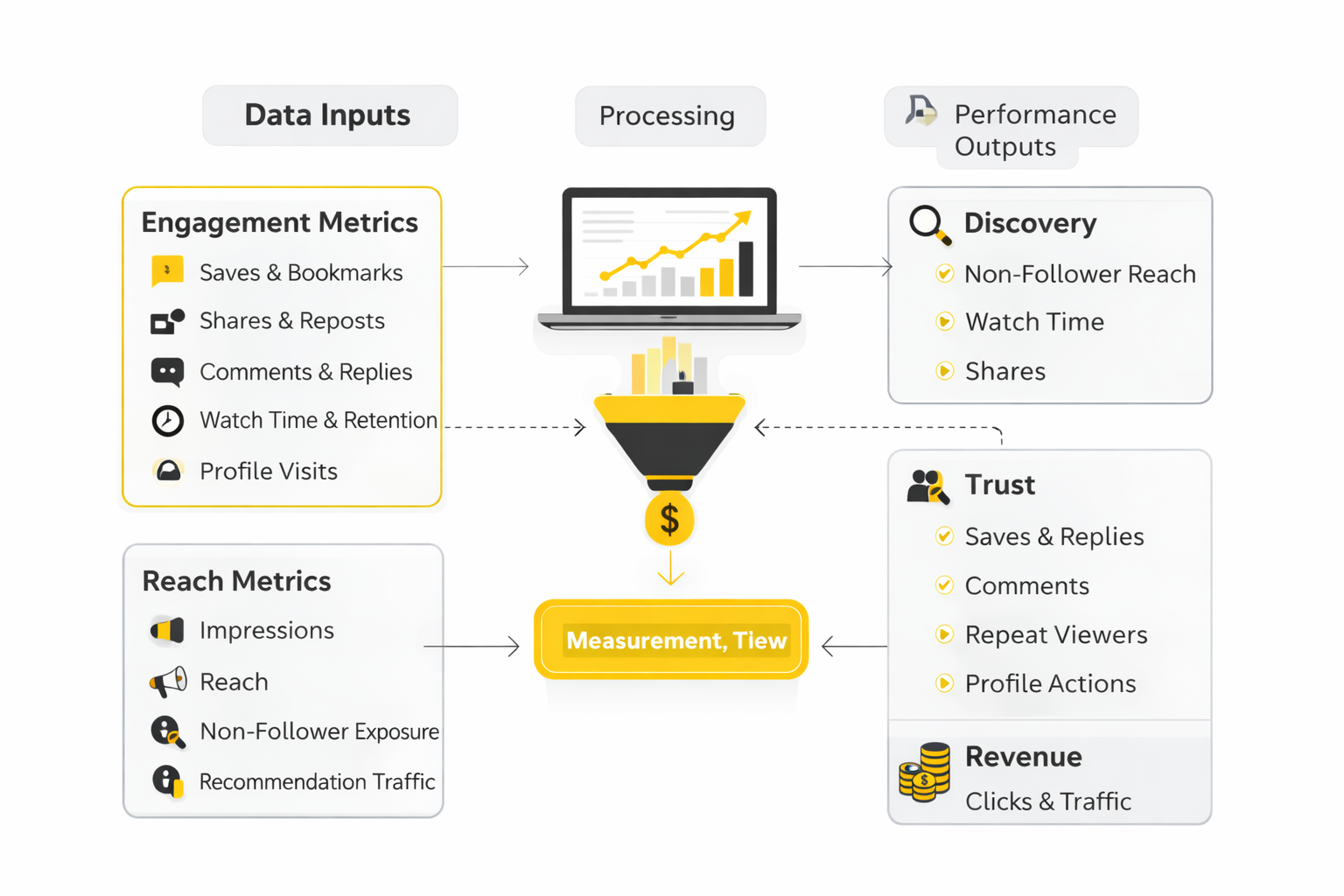
The first layer of measurement focuses on attention and interaction. These metrics help answer a simple question: does the audience care enough to respond?
The most useful engagement signals include:
- saves and bookmarks
- shares and reposts
- comments and replies
- watch time and retention
- profile visits
These behaviors matter because platforms interpret them as strong relevance signals. Instagram’s creator guidance explains that ranking considers factors like how long people spend viewing a post, whether they interact with it, and whether they share it with others. Those interactions influence how widely a post spreads within the feed or recommendation systems.
Shares and saves deserve special attention because they signal deeper value. A like can happen in a fraction of a second. Saving a post usually means someone intends to return to it, which often indicates educational value or practical relevance. When shares and saves increase, reach typically follows.
Reach metrics answer a different question: how effectively is the platform distributing your content?
This layer includes:
- impressions
- reach
- non-follower exposure
- recommendation traffic
- algorithmic discovery
These numbers help you see whether your content is escaping your existing audience and reaching new viewers. This matters because social growth depends on discovery. Platforms like TikTok, Instagram Reels, and YouTube Shorts rely heavily on recommendation systems that show content to people who do not follow the creator yet.
The difference between weak and strong distribution can be dramatic. YouTube says viewers collectively watch more than 1 billion hours of content on TV devices every day, and a significant portion of those views come from recommendations rather than direct subscriptions. When your content earns high retention and interaction, those recommendation systems are far more likely to amplify it.
Engagement and reach tell you whether the content is working. Conversion metrics tell you whether the strategy is working.
These numbers include:
- link clicks
- landing page visits
- email sign-ups
- booked calls
- product purchases
- assisted conversions
This is where social media marketing tips 2026 become practical instead of theoretical. If your content drives engagement but not conversions, something in the funnel is broken. Either the offer is unclear, the next step is confusing, or the landing experience does not match the promise of the post.
Tools designed for conversion tracking and lead capture make this layer much easier to manage. Platforms like ClickFunnels, Systeme.io, and Brevo allow marketers to build structured funnels, email sequences, and conversion tracking so social traffic does not disappear after the first click.
When these systems are connected properly, social analytics become far more useful because you can trace the journey from first impression to final action.
One challenge with analytics is that numbers mean nothing without context. A 3% engagement rate might be excellent for one platform and average for another.
Industry research helps create reference points. Studies of Instagram brand accounts often show average engagement rates hovering around one percent or lower for many industries, while creator accounts and niche communities can see much higher interaction depending on audience size and content style. TikTok engagement tends to be higher because the platform prioritizes interactive discovery, while LinkedIn engagement varies widely depending on whether posts spark discussion among professionals.
These differences explain why copying strategies between platforms rarely works. Each platform’s culture, algorithm, and format expectations shape what “good performance” actually means.
The most effective analytics systems follow a consistent learning cycle. Instead of analyzing every number constantly, they focus on a few core signals that guide improvement.
A practical measurement loop looks like this:
- Identify the goal of the content
- Measure the signal that reflects that goal
- Compare results across similar posts
- Identify patterns in high-performing content
- Adjust the next round of content accordingly
For example, if short-form videos consistently earn higher retention when they start with a strong question or surprising insight, that becomes a repeatable format. If carousel posts drive more saves when they break complex ideas into clear steps, that insight shapes future posts.
Over time, these small adjustments compound into a strategy that performs far better than guesswork.
The final step is turning analytics into decisions. Good data should influence three things:
- the topics you choose
- the formats you prioritize
- the conversion path you design
If certain topics consistently generate comments and shares, expand those ideas into deeper content. If certain formats produce higher reach, allocate more creative effort there. If posts generate traffic but not leads, redesign the landing experience.
Analytics are not about proving that social media marketing is working. They are about discovering how to make it work better next week than it did last week.
The next section moves beyond analytics into professional implementation, where systems, automation, and long-term strategy turn social media marketing into a durable growth channel rather than a series of isolated campaigns.
Once the basics are working, the real game changes. At that point, social media marketing in 2026 is no longer about finding a few winning post ideas. It becomes an operating system question: can your team produce original content consistently, protect quality as volume grows, and turn social attention into a durable business asset instead of a temporary spike?
That is the point where strategic tradeoffs start to matter more than tactics. More channels can create more reach, but they can also dilute quality. More automation can increase output, but it can also flatten your voice. More creator partnerships can expand trust, but without process and compliance they can create messy brand risk just as fast.
This is one of the hardest problems in modern social. Teams want more output because the opportunity is real, but the moment they scale carelessly, content quality drops and the audience feels it. Meta’s March 2026 update on rewarding original creators on Facebook makes the direction obvious: original content is being favored while copycat and low-value reposting are being pushed down harder. That is not a small signal. It means scaling by imitation is becoming less effective right when competition is getting tougher.
The practical answer is to scale systems, not just volume. Build repeatable briefs, repeatable review standards, and repeatable content pipelines, but keep the ideas, evidence, and voice specific to your brand. If your team cannot explain why a post deserves attention beyond “we need to publish something today,” that is usually the first warning sign that the system is expanding faster than the strategy.
AI is now part of the workflow whether people admit it or not. It helps with research summaries, transcription, draft generation, ideation, formatting, and repurposing, and there is no reason to pretend otherwise. The problem starts when teams mistake faster production for better communication.
That risk is getting more important because platforms and regulators are both moving toward stronger transparency. Meta rolled out its approach to labeling AI-generated content across its apps, and the European Union’s AI Act framework continues building around disclosure and transparency expectations for synthetic content. So the smart move is not avoiding AI completely. It is using AI where it improves speed and clarity, while keeping human judgment in charge of claims, tone, proof, brand perspective, and anything trust-sensitive.
That is the difference between efficient content and generic content. Use AI to compress workflows, organize thoughts, and remove bottlenecks. Do not use it as a substitute for expertise, because audiences are getting better at spotting empty polish.
Creator marketing is now too large and too important to run casually. CreatorIQ’s 2025-2026 state of the market shows that organizations are committing serious money to creator work, with a larger share reporting annual spend at the $5 million level and above. That tells you creator partnerships are no longer a side experiment for mature brands. They are becoming part of the core marketing mix.
But scale creates risk. The wrong creator fit can damage credibility, weak briefs can produce bland content, and sloppy disclosure can create legal exposure fast. The FTC’s endorsement and influencer guidance is still the baseline here, and it matters because a partnership that performs well but is disclosed poorly is not a win. It is a liability.
The strongest creator systems usually do three things well. They pick creators for audience fit instead of vanity reach, they brief for outcomes instead of scripts, and they build a documented review process for claims, permissions, and disclosures before anything goes live. That sounds less exciting than “brand magic,” but it is exactly how professional implementation protects both performance and reputation.
A lot of brands still overinvest in polished branded content and underinvest in credible human voices. That is a mistake, especially in trust-heavy categories. LinkedIn’s 2025 research found that professional networks are the most trusted source for many decision-makers, which reinforces something smart marketers already feel in practice: people often believe people before they believe companies.
That does not mean every founder needs to become an influencer or every employee needs to publish daily. It means brands should take credible internal expertise far more seriously as a media asset. A strong founder perspective, subject-matter expert commentary, or employee-led customer education series can outperform expensive branded campaigns when trust is the main bottleneck.
This is one of the clearest long-term advantages in social media marketing tips 2026. Competitors can copy your format, mimic your hooks, and chase the same trends. They cannot easily replicate your lived expertise, your internal operators, or the specific way your team sees the market.
Small teams can get away with improvisation for a while. Larger teams cannot. Once multiple people are publishing, editing, approving, measuring, and repurposing content, governance stops being bureaucracy and starts becoming protection.
That includes brand standards, claims review, legal checks where necessary, disclosure rules, creator agreements, platform security, account permissions, response protocols, and escalation paths for mistakes. This is not glamorous work, but it matters because social is now public operations, not just marketing. One careless post, bad partnership, or account-security failure can create weeks of cleanup.
Professional teams treat governance as part of performance. Clear rules speed up execution because people know what good looks like, what needs approval, and what crosses a line. That reduces hesitation without lowering standards.
This matters even more in a world where platform rules and recommendation systems change constantly. You can build real reach on rented platforms, but you do not control those platforms. Algorithms shift, features get deprioritized, audience behavior changes, and distribution can become more expensive overnight.
That is why strong social strategies keep pushing toward owned audience capture. Email lists, booking flows, communities, customer databases, and direct-response funnels give you something durable after the scroll ends. Tools like Moosend, Brevo, and ClickFunnels fit naturally here because they help convert borrowed attention into an audience you can reach again without depending entirely on the feed.
This is the tradeoff many brands learn too late. Viral reach feels exciting, but list growth, lead capture, and repeatable follow-up create the real compounding value. If your social system does not regularly move people into owned channels, you are building visibility without enough insulation.
It is tempting to think the winning brands in 2026 will be the ones doing everything at once. In reality, the advantage usually goes to the teams that make clearer choices. They know which platforms matter most, which voices carry trust, which formats support the funnel, and which metrics deserve action.
That kind of focus becomes more valuable as the ecosystem gets noisier. Reports like Hootsuite’s Social Trends 2026 and Ogilvy’s 2026 Social Trends report point in a similar direction: substance, distinctiveness, and emotional relevance are becoming more important in an overloaded environment. In plain English, audiences are tired of empty volume.
So the expert-level play is not endless complexity. It is disciplined clarity. Build original content systems, use AI carefully, structure creator work professionally, elevate trusted human voices, and move attention into owned assets. That is how social stops being a content treadmill and starts becoming a strategic advantage.
The final part will close this out with the key takeaways and the FAQ that usually matters most once you are ready to apply these ideas in the real world.
The common thread running through all of this is simple: strong social strategy in 2026 is not built on hacks. It is built on platform fit, original content systems, disciplined measurement, and a serious plan for turning attention into trust and trust into action. That is what separates brands that stay busy from brands that actually grow.
It also explains why social media marketing tips 2026 need to be treated like an operating model, not a checklist. The platforms keep changing, audience behavior keeps shifting, and commercial pressure keeps rising. Global social usage remains massive at 5.24 billion identities worldwide, while social commerce in the U.S. is projected to push past $100 billion in 2026. That combination means the opportunity is still huge, but only for teams that execute with more focus than noise.
Start with fewer platforms, not more. Most beginners lose momentum because they spread themselves too thin before they understand where their audience actually discovers, researches, and trusts brands. A smarter approach is to pick one primary channel, one supporting channel, and one clear conversion goal, then build from there.
You should also focus on learning signal quality early. Saves, shares, watch time, replies, and clicks tell you far more than raw follower growth. That matters because half of adult social users now visit platforms to learn more about brands, which means your content is often being judged by people who may never follow you but may still buy from you later through channels like Instagram, Facebook, and TikTok brand research behavior.
There is no universal winner, and that is the point. The best platform depends on whether your audience is trying to discover, compare, learn, validate, or buy. What works for a founder-led B2B service will not automatically work for a visual consumer brand, a local business, or a creator-driven product.
That said, the broad platform picture is clear. YouTube remains one of the most used social platforms globally, Instagram is especially strong for brand research, TikTok remains powerful for discovery, and LinkedIn continues to matter when professional trust drives the sale. The right move is to match platform behavior to business intent instead of chasing the most hyped channel.
Post often enough to learn, but not so often that quality collapses. Publishing cadence still matters, but it matters less than originality, relevance, and the ability to create posts that trigger saves, shares, replies, and strong retention. Many brands would get better results from three strong posts a week than seven forgettable ones.
That is also where current platform incentives matter. Meta has been reinforcing original content on Facebook and warning against low-value repetition, while creator guidance across major platforms keeps pointing toward relevance and audience response over sheer quantity. So consistency is important, but consistency without value is just organized noise.
Yes, but only if you treat it like a strategic asset instead of free exposure. Organic social still builds discovery, trust, search visibility, community proof, and creator-friendly momentum, but it works best when it connects to a real business system. If organic content has nowhere to send people, it becomes harder to capture the value it creates.
This is exactly why strong marketers connect social to owned channels. A useful post can lead into a newsletter, demo request, lead form, or booking flow instead of dying in the feed. Tools like Systeme.io, ClickFunnels, and Brevo make that handoff easier when your content is already generating attention.
Follower count still matters, but it is no longer the cleanest measure of influence or commercial potential. Recommendation systems across Instagram, TikTok, YouTube, and other platforms increasingly distribute content beyond followers, which means a smaller account with stronger relevance can outperform a larger account with weaker audience response. This is one of the biggest reasons vanity metrics keep misleading teams.
A better question is whether your audience is responding in ways that indicate trust or intent. If your posts generate replies, saves, repeat views, profile visits, and qualified clicks, you are building real momentum. Follower growth can still be useful, but it should be treated as a secondary signal rather than the main goal.
Use AI to reduce friction, not to outsource judgment. It is useful for organizing ideas, generating first-draft structure, repurposing content, cleaning transcripts, and accelerating workflow. It becomes a problem when it starts flattening your voice, weakening your claims, or replacing real expertise with generic language.
That distinction is getting more important because transparency expectations are rising. Meta has already outlined its approach to labeling AI-generated content across its apps, and brands are operating in a market where audiences are increasingly sensitive to synthetic-looking content. The practical takeaway is simple: let AI make the process faster, but keep human review in charge of meaning, proof, tone, and trust.
The best metrics depend on the job of the content. For discovery, look at non-follower reach, watch time, and shares. For trust, look at saves, replies, comments, repeat viewers, and profile actions. For revenue, track clicks, leads, booked calls, purchases, and assisted conversions.
That layered view matters because not every strong post should be judged by the same standard. A short-form video might win on reach but do little direct conversion work, while a carousel or founder post might drive fewer impressions but more qualified leads. The smartest social media marketing tips 2026 do not obsess over one universal metric. They match the measurement to the role of the asset.
Yes, when they are treated professionally. Creator partnerships still work because people trust people more than polished brand messaging, especially when the creator has real fit with the audience and can explain the product in a natural context. Done well, creator work can accelerate discovery, social proof, and conversion at the same time.
But the old lazy version is getting riskier. You need audience fit, clean briefs, proper permissions, and proper disclosures. The FTC’s endorsements, influencers, and reviews guidance still matters because performance does not excuse sloppy disclosure, and brands that ignore that are taking an avoidable risk.
It is important enough that most brands should at least evaluate it, even if they do not plan to sell directly inside every platform. U.S. social commerce sales are projected to surpass $100 billion in 2026, which is a clear sign that discovery and purchase behavior are continuing to move closer together. The feed is no longer just where people get inspired. It is increasingly where they compare and buy.
That does not mean every company needs native checkout. It does mean your content, offer, and next step need to reduce friction. If someone becomes interested on social, the path from curiosity to action should feel fast, clear, and credible.
Ask one hard question: could a competitor swap in their logo and publish the same post tomorrow? If the answer is yes, the content is probably too generic. Strong original content usually includes a specific point of view, real proof, distinct language, or category insight that reflects actual experience rather than recycled advice.
This matters more now because platform incentives are shifting harder toward original material and away from copycat behavior. The safest way to stand out is not by being louder. It is by being more specific, more grounded, and more useful than the sea of interchangeable content around you.
They confuse activity with progress. A full content calendar, lots of posting, and decent engagement can create the illusion that everything is working, even when there is no clear connection to trust, pipeline, or revenue. That is why so many teams stay busy for months without being able to explain what is actually improving.
The fix is not magical. Tie every channel to a role, tie every content format to a job, and tie every job to a measurable business outcome. Once you do that, weak spots become easier to spot and strong patterns become much easier to scale.
Long-form still matters a lot, especially when trust, education, or category explanation are part of the sale. Short-form is brilliant for discovery and momentum, but it often needs deeper content behind it if the buyer has more complex questions. In many categories, short-form opens the loop and long-form closes the credibility gap.
That is one reason YouTube remains so valuable. The platform says TV is now the primary device for YouTube viewing in the U.S. by watch time, which is a reminder that audiences are not only consuming quick clips on phones. They are also willing to spend serious time with content that teaches, explains, or earns trust.
You need both, but they should not be treated equally. Rented platforms are where discovery happens at scale, but owned channels are where durability lives. If your entire strategy depends on algorithms, you are building on ground you do not control.
That is why the smartest operators keep moving people from feed-based attention into email lists, lead forms, communities, and direct contact systems. If you want that transition to be cleaner, tools like Moosend, Fillout, and Buffer can support different parts of that workflow. The platform can create the first touch, but the owned audience is what gives your strategy staying power.
Most marketers spend too much time chasing clients, competing on crowded platforms, and losing a percentage of every project to middlemen. MarkeWork gives you a better way. Browse thousands of remote marketing contracts and connect directly with companies desperate to hire skilled marketers like you, without platform commissions and without unnecessary gatekeepers.
If you're serious about finding better opportunities and keeping 100% of what you earn, explore available contracts and create a profile for free at MarkeWork.com.
The common thread running through all of this is simple: strong social strategy in 2026 is not built on hacks. It is built on platform fit, original content systems, disciplined measurement, and a serious plan for turning attention into trust and trust into action. That is what separates brands that stay busy from brands that actually grow.
It also explains why social media marketing tips 2026 need to be treated like an operating model, not a checklist. The platforms keep changing, audience behavior keeps shifting, and commercial pressure keeps rising. Global social usage remains massive at 5.24 billion identities worldwide, while social commerce in the U.S. is projected to push past $100 billion in 2026. That combination means the opportunity is still huge, but only for teams that execute with more focus than noise.
Most marketers spend too much time chasing clients, competing on crowded platforms, and losing a percentage of every project to middlemen. MarkeWork gives you a better way. Browse thousands of remote marketing contracts and connect directly with companies desperate to hire skilled marketers like you, without platform commissions and without unnecessary gatekeepers.
If you're serious about finding better opportunities and keeping 100% of what you earn, explore available contracts and create a profile for free at MarkeWork.com.