

Social media packages work best when they turn a messy service into a clear business decision. Instead of selling “posting” or “content,” a strong package shows what the client gets, how the work supports growth, and what level of support fits their stage.
That matters because social is no longer a side channel. More than two-thirds of the world now uses social media, and brands are competing in feeds where attention, trust, content quality, and speed all matter. The strongest packages make that complexity easier to buy, easier to deliver, and easier to measure.
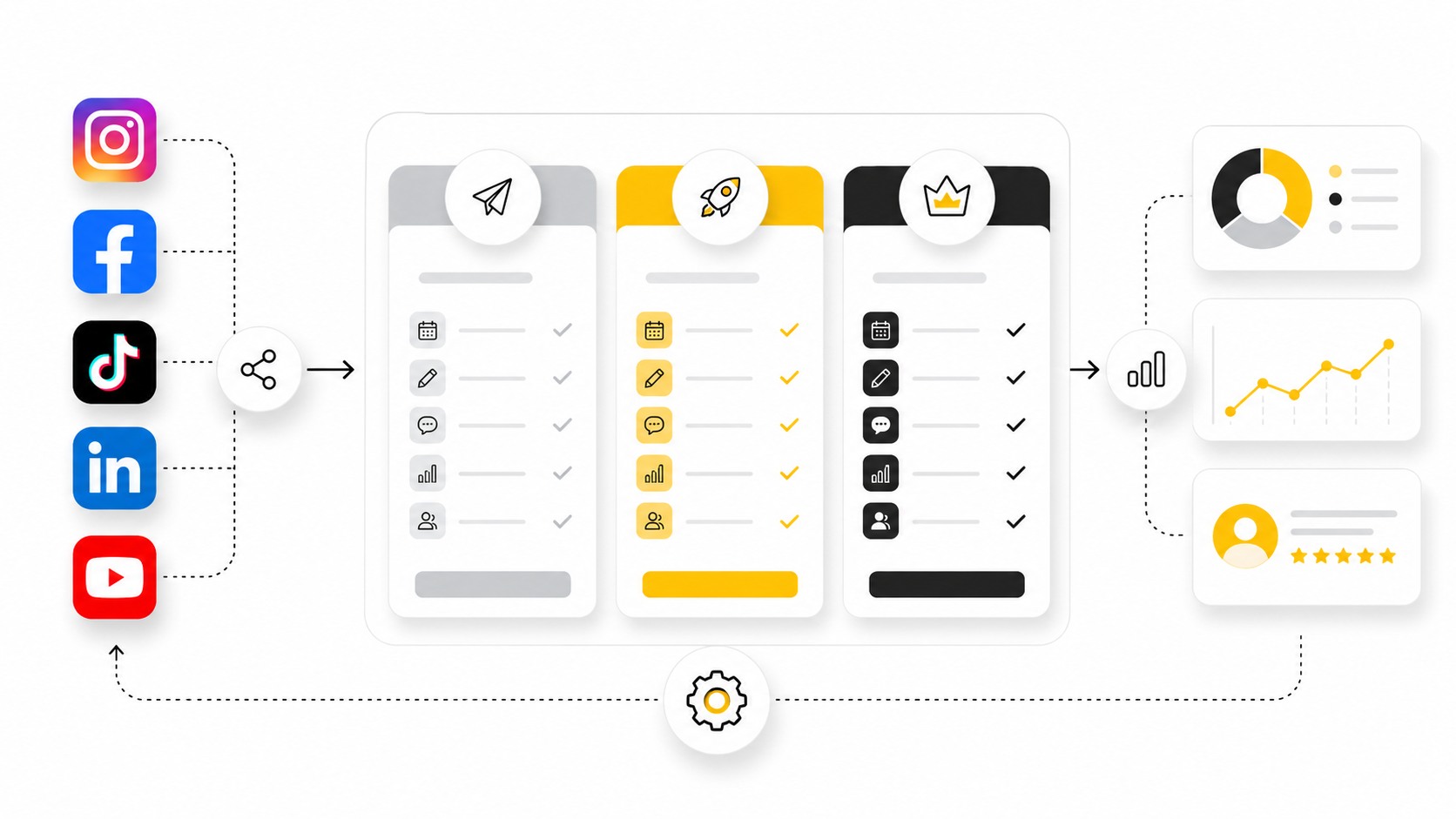
This article will continue in six parts:
- Part 1: What Social Media Packages Are and Why They Matter
- Part 2: The Core Components Every Package Should Include
- Part 3: How to Structure Packages by Client Type and Business Goal
- Part 4: Pricing Social Media Packages Without Underselling the Work
- Part 5: Tools, Workflows, and Professional Implementation
- Part 6: Package Examples, Buying Checklist, and FAQ
What Social Media Packages Are
Social media packages are bundled service offers that combine strategy, content creation, publishing, engagement, reporting, and sometimes paid promotion or automation. A basic package might cover a few posts per week and light reporting, while a more advanced package may include short-form video, community management, campaign planning, creator coordination, and conversion tracking.
The point is not to make services look neat on a pricing page. The point is to help clients understand the level of work required to get a specific outcome. When a business sees exactly what is included, what is excluded, and how success will be measured, the buying decision becomes much easier.
Good packages also protect the service provider. They prevent vague scope, endless revisions, and unclear expectations. That alone can be the difference between a profitable monthly retainer and a stressful client relationship.
Why Social Media Packages Matter
Businesses are under pressure to get more from every marketing dollar. Gartner’s 2025 CMO Spend Survey found that marketing budgets stayed flat at 7.7% of company revenue, which means teams are being asked to prove performance without simply spending more. Clear social media packages help make that possible because they connect deliverables to business priorities instead of treating social as random activity.
Clients also need help choosing the right level of investment. A startup testing its first offer does not need the same package as an ecommerce brand running weekly campaigns. A local service business may need reputation, trust, and lead capture more than daily trend content.
That is why the best social media packages are not just bundles of posts. They are decision frameworks. They help a client choose between visibility, consistency, engagement, lead generation, sales support, or a full growth system.
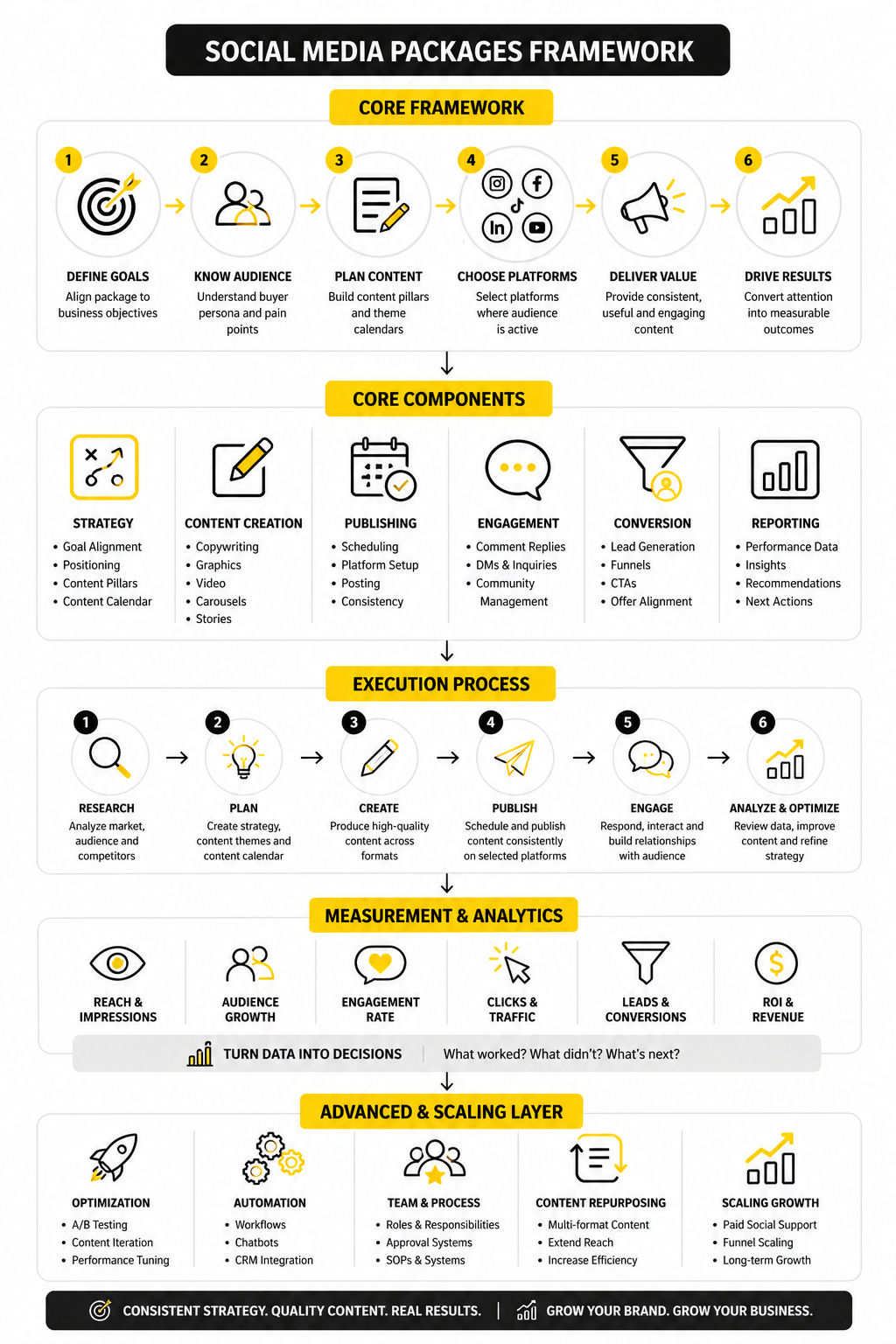
The Framework This Article Will Use
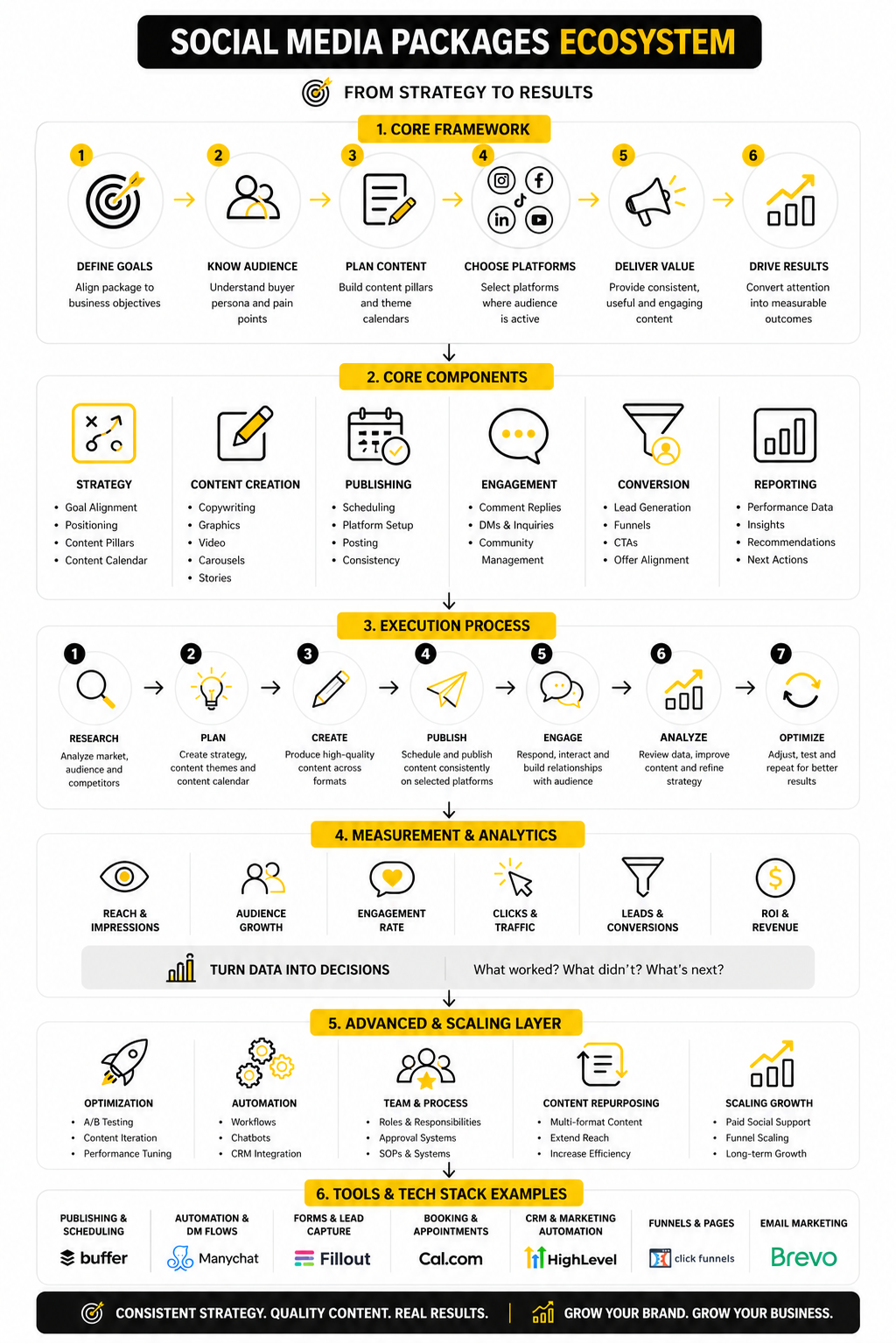
The rest of this guide will use a simple framework: strategy, content, distribution, engagement, conversion, and reporting. Each part matters because social media performance rarely comes from one isolated activity. Posting more content without a strategy usually creates noise, while strategy without execution never reaches the market.
A lean package may include only the essentials: planning, content scheduling, and monthly reporting. A growth package may add short-form video, social inbox management, landing pages, email follow-up, and automation through platforms like GoHighLevel, ManyChat, or Buffer. A premium package may bring everything together with campaigns, paid traffic support, creator partnerships, and deeper analytics.
This framework keeps the article practical. Instead of giving you a generic list of services, it will show how each component changes the value, workload, pricing, and client outcome of a package.
The Core Components Every Package Should Include
A strong social media package is not built around post count alone. Post count is easy to sell, but it does not explain the thinking, production, publishing, engagement, and reporting needed to make social media useful. The better structure is to define what the client gets at each stage of the work.
Every package should make five things clear: what will be planned, what will be created, where it will be published, how interaction will be handled, and how performance will be reviewed. When those pieces are missing, clients start judging the package by volume instead of value. That is how agencies and freelancers end up trapped in low-margin work.
The goal is simple: make the package easy to understand before the sale and easy to deliver after the sale. If a client can see the logic behind the service, they are less likely to ask for random extras. If the provider has a defined delivery system, the work becomes repeatable instead of chaotic.
Strategy and Positioning
Strategy is the part most weak social media packages skip, usually because it is harder to show than a finished post. But without strategy, content becomes guesswork. A proper package should include at least a basic review of the client’s audience, offers, competitors, platforms, content themes, and business goal.
This does not mean every client needs a 40-page strategy document. For smaller retainers, a simple content direction document may be enough. For higher-value packages, strategy should include campaign planning, brand voice, funnel mapping, and a clear explanation of how social content supports leads, sales, retention, or community growth.
This is where the package starts to become more than content production. A client is not only paying for someone to “make posts.” They are paying for someone to decide what should be said, why it matters, and how it connects to a commercial outcome.
Content Creation
Content creation is usually the most visible part of social media packages, so it needs to be defined carefully. A package should explain whether it includes static graphics, carousels, short-form videos, captions, hooks, scripts, thumbnails, stories, or platform-specific edits. These details matter because a simple caption is not the same workload as a scripted video sequence.
The package should also define the level of creative input expected from the client. Some clients provide raw footage, brand photos, testimonials, and product details. Others expect the provider to create everything from scratch, which requires more planning, more production, and often a higher fee.
Strong packages also separate content quantity from content depth. Ten lightweight posts are not the same as ten posts built from research, offers, customer objections, product education, and conversion goals. This distinction helps clients understand why better content usually costs more.
Publishing and Scheduling
Publishing sounds simple until the client expects every platform to be handled differently. A good package should state which platforms are included, how often content is scheduled, and whether each post is adapted for the channel. Instagram, LinkedIn, TikTok, Facebook, YouTube Shorts, and Pinterest do not reward the exact same creative approach.
Scheduling also creates operational value. When content is planned in advance, the client is not approving posts at the last minute, and the provider is not constantly reacting. Tools like Buffer can make this easier when the package includes multi-platform publishing and approval workflows.
The package should also clarify whether publishing includes optimization. That may cover hashtags, titles, descriptions, tagging, links, posting times, and basic formatting. These small details are easy to overlook, but they often affect whether content looks professional once it goes live.
Engagement and Community Management
Engagement is where many social media packages become unclear. Some clients think social media management includes replying to every comment and direct message. Some providers only include publishing and reporting unless community management is priced separately.
This should be stated directly. A package can include light engagement, such as responding to basic comments for a set amount of time each week. A higher-tier package may include inbox monitoring, escalation rules, saved replies, lead qualification, and handoff to the sales team.
For businesses that receive leads through Instagram, Facebook, or Messenger, automation can also become part of the package. A tool like ManyChat fits naturally when the client wants comment-to-DM flows, lead capture, or simple conversation automation. That should be sold as a business system, not as a random add-on.
Reporting and Performance Review
Reporting is not just a monthly PDF with numbers. It should explain what happened, what changed, what was learned, and what should happen next. That is what makes reporting useful instead of decorative.
At minimum, social media packages should define the reporting frequency and the metrics included. Reach, engagement, follower growth, profile visits, clicks, leads, saves, shares, video retention, and conversion events all tell different parts of the story. The right metrics depend on the goal of the package.
A visibility package may focus on reach and audience growth. A lead generation package should care more about clicks, conversations, booked calls, form submissions, or pipeline activity. When reporting is tied to the package goal, the client can judge performance more fairly.
Conversion Support
Not every social media package needs full funnel buildout, but every serious package should consider what happens after someone clicks. If social content creates interest but the landing page is weak, the campaign can still fail. That is not a content problem; it is a conversion path problem.
This is why advanced packages often include landing pages, lead magnets, forms, appointment booking, email follow-up, or CRM integration. Platforms like GoHighLevel fit well when a client needs social leads to move into pipelines, automations, reminders, and sales follow-up. For ecommerce or landing-page-heavy campaigns, tools like Replo can support the page-building side of the offer.
This is where social media packages become more valuable. The service stops being “we post for you” and becomes “we help turn attention into action.” That shift matters because clients do not ultimately want content; they want movement in the business.
Revisions, Approvals, and Boundaries
Every package needs boundaries. Without them, a simple retainer can turn into unlimited edits, emergency requests, and unclear responsibility. That is bad for both sides.
The package should explain how many revisions are included, how approvals work, when content must be reviewed, and what happens if feedback is late. It should also define what counts as out of scope, such as extra platforms, new campaign concepts, additional video edits, or weekend monitoring.
This does not make the service rigid. It makes it professional. Clear boundaries create better work because everyone knows how the process runs before the pressure starts.
How to Structure Packages by Client Type and Business Goal
Once the core components are clear, the next step is deciding how to package them. This is where many offers get messy. They mix random deliverables, vague promises, and copied competitor pricing instead of building around what the client actually needs.
The cleanest way to structure social media packages is to start with the client’s business model. A local service business, ecommerce brand, creator-led company, SaaS startup, and personal brand may all need social media, but they do not need the same package. Their content, conversion path, sales cycle, and reporting priorities are different.
That is why package structure should follow the client’s goal before it follows platform trends. A business that needs trust should buy a credibility package. A business that needs leads should buy a conversion package. A business that already has demand but lacks consistency should buy an execution package.
Start With the Client’s Stage
Client stage matters because social media problems change as a business grows. A new business usually needs positioning, credibility, and a simple publishing rhythm. An established business may need better creative, stronger campaigns, and clearer reporting.
For early-stage clients, the package should stay focused. They usually do not need five platforms, complex automations, and daily content. They need a clear message, a manageable posting schedule, and enough consistency to look alive and trustworthy.
For growth-stage clients, the package can include deeper planning and more moving parts. This is where short-form video, lead capture, audience segmentation, and campaign calendars become more useful. At this stage, social content should not just fill the feed; it should support active business goals.
Match the Package to the Main Outcome
Every package should have a primary outcome. This does not mean guaranteeing results you cannot control. It means making the package’s purpose obvious.
A visibility package is built to increase reach and awareness. It usually includes content themes, regular posting, platform optimization, and light reporting. It works best for brands that need to show up more often and become more recognizable.
A lead generation package is different. It needs stronger calls to action, landing pages, forms, direct message workflows, booking links, and follow-up. A tool like Fillout can fit when the package needs simple lead forms, while Cal.com makes sense when the next step is booking calls.
A sales support package goes even further. It connects content to offers, email follow-up, CRM activity, and pipeline tracking. This is where GoHighLevel can become useful because the client needs more than content scheduling; they need a system that catches and follows up with demand.
Build the Delivery Process Before You Sell It
A package is only strong if it can be delivered repeatedly. Before selling the offer, map the delivery process from onboarding to reporting. This prevents the classic problem where the sales page looks clean, but fulfillment turns into improvisation.
The process should show what happens first, what the client must provide, when content is reviewed, how approvals work, and how results are measured. This is not just internal admin. It directly affects the client experience.
A simple delivery flow can look like this:
- Audit the client’s current social presence, offers, competitors, and audience.
- Define the package goal and choose the platforms that actually matter.
- Build content pillars, campaign themes, and posting rhythm.
- Collect brand assets, product information, proof, testimonials, and raw materials.
- Create the first content batch and submit it for approval.
- Schedule approved content and manage agreed engagement tasks.
- Review performance and adjust the next content cycle.
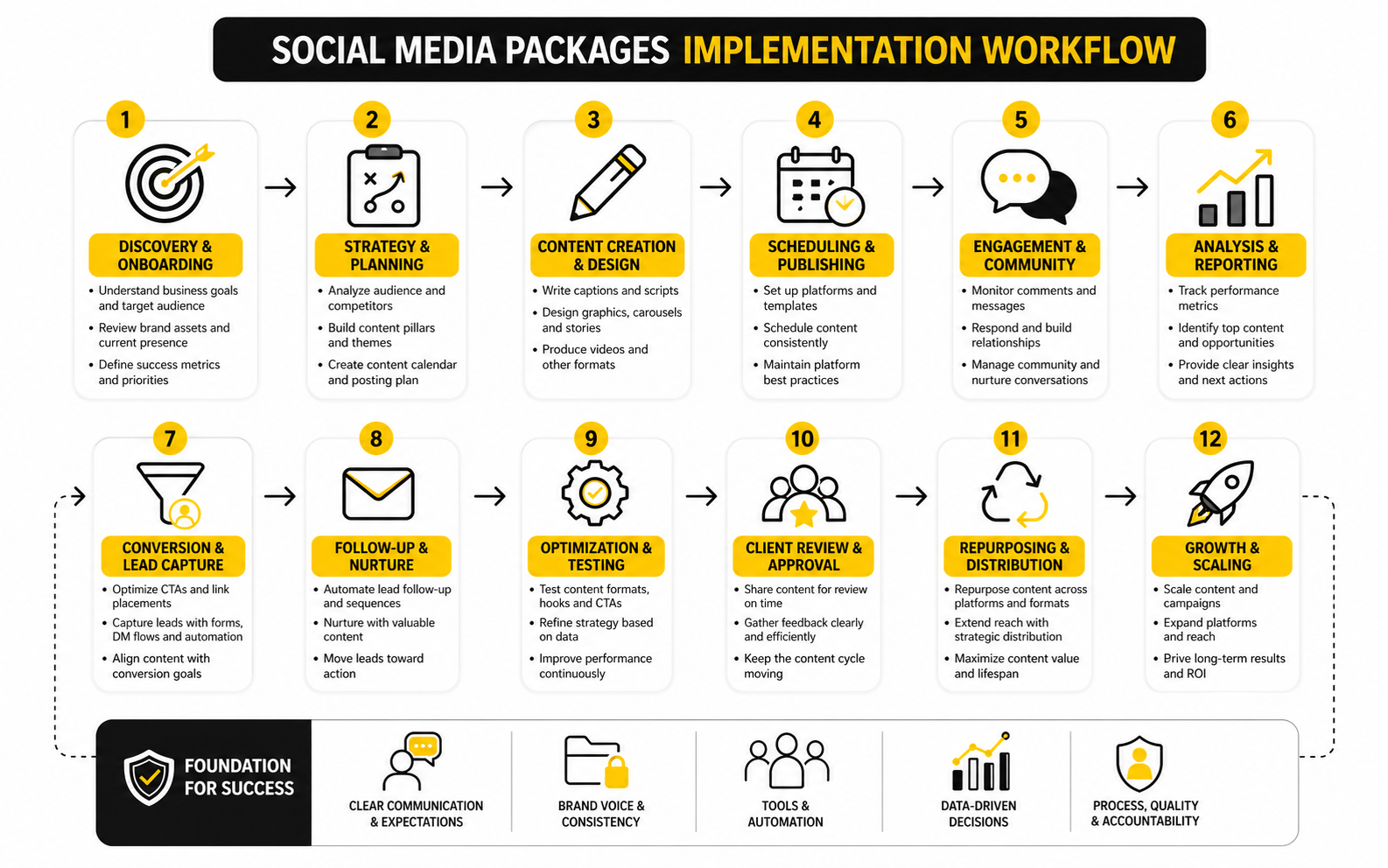
This is where social media packages become tangible. The client can see the work moving through a system instead of feeling like they bought a mystery box. The provider can also spot where scope expands before it becomes a problem.
Structure Packages by Complexity, Not Just Volume
The easiest mistake is creating three packages that only differ by the number of posts. For example, five posts, ten posts, and twenty posts per month. That looks simple, but it ignores the real workload.
Complexity comes from strategy depth, creative format, approval needs, platform adaptation, engagement expectations, and conversion support. A package with eight short-form videos may be more demanding than a package with twenty simple static posts. A package with lead follow-up may require more operational setup than a visibility package with higher content volume.
A better structure is to increase both responsibility and business value as the package tier rises. The entry tier handles consistency. The middle tier adds campaigns and stronger creative. The top tier connects social media to leads, sales, and reporting that leadership can actually use.
Choose Platforms Based on Buyer Behavior
Not every client needs to be everywhere. Platform choice should come from where the audience spends time, how they make decisions, and what kind of content the business can realistically produce. Forcing every client into the same platform mix is lazy strategy.
A B2B consultant may get more value from LinkedIn, email capture, and webinar promotion than from daily Instagram Reels. A visual ecommerce brand may need TikTok, Instagram, creator content, and landing pages. A local business may need Facebook, Instagram, Google Business Profile support, and direct response campaigns.
The package should explain why each platform is included. That small explanation builds trust because it shows the client the offer was designed around their market. It also makes it easier to say no when a client asks to add another channel without increasing the budget.
Define What the Client Must Provide
Social media packages fail when the provider is expected to invent everything without access to the business. Good content needs raw material. That includes product details, customer questions, sales calls, photos, videos, testimonials, founder opinions, and proof.
The package should list what the client is responsible for. This might include sending monthly updates, approving content on time, providing brand assets, recording short clips, or sharing campaign priorities before each planning cycle. Without that input, even a skilled social team will struggle to create content that sounds specific.
This also protects quality. Generic content usually comes from generic inputs. When the client understands their role in the process, the package becomes a collaboration instead of a vendor guessing game.
Add Upsells Only When They Strengthen the Package
Upsells should not feel like random extras. They should solve a clear next problem. If the client has traffic but weak conversion, add landing pages. If they get comments but no follow-up, add direct message automation. If they have leads but no nurture system, add email.
For example, ManyChat fits naturally when comments and direct messages are part of the lead path. Brevo can fit when the client needs email follow-up after someone opts in. ClickFunnels can fit when the package includes a more direct funnel from social traffic to a specific offer.
The rule is simple: do not add tools to look advanced. Add them when they make the package easier to deliver, easier to measure, or more valuable to the client. That keeps the offer clean and keeps the client focused on the outcome.
Statistics and Data That Actually Matter
Measurement should make social media packages easier to manage, not harder to understand. The goal is not to dump every number from every platform into a monthly report. The goal is to show whether the package is doing the job it was designed to do.
This matters because social media data can be misleading when it is read in isolation. A post with high reach may create no leads. A post with fewer views may generate strong comments, direct messages, saves, clicks, or booked calls. The numbers only become useful when they are tied to the package goal.
The right analytics setup should answer three practical questions. Is the content reaching the right people? Are those people showing meaningful interest? Is that interest turning into a next step for the business?
Match Metrics to the Package Goal
A visibility package should not be judged the same way as a lead generation package. Visibility work needs metrics like reach, impressions, audience growth, video views, profile visits, and branded search lift when available. These numbers show whether the brand is becoming more visible in the market.
An engagement package needs a different lens. Comments, shares, saves, replies, direct messages, and repeat interactions matter more than raw impressions. These signals show whether the audience is paying attention or just scrolling past.
A conversion-focused package should go deeper. It should track clicks, form submissions, booked calls, email signups, purchases, cost per lead, and follow-up speed. If the package includes funnels, CRM, or automation, then the real question is not “did the post perform?” It is “did the system turn attention into pipeline?”
Build a Simple Analytics System
The best measurement system is usually simple. It should connect platform activity, website or landing page behavior, lead capture, and sales follow-up. If those pieces are disconnected, the report will show activity but not business impact.
A practical analytics system for social media packages can work like this:
- Define the primary goal of the package before content starts.
- Choose three to five core metrics that match that goal.
- Track platform performance weekly without overreacting to single-post spikes.
- Review content themes monthly to see what is creating meaningful signals.
- Connect clicks, forms, bookings, and sales conversations back to campaigns where possible.
- Use the data to adjust the next content cycle.
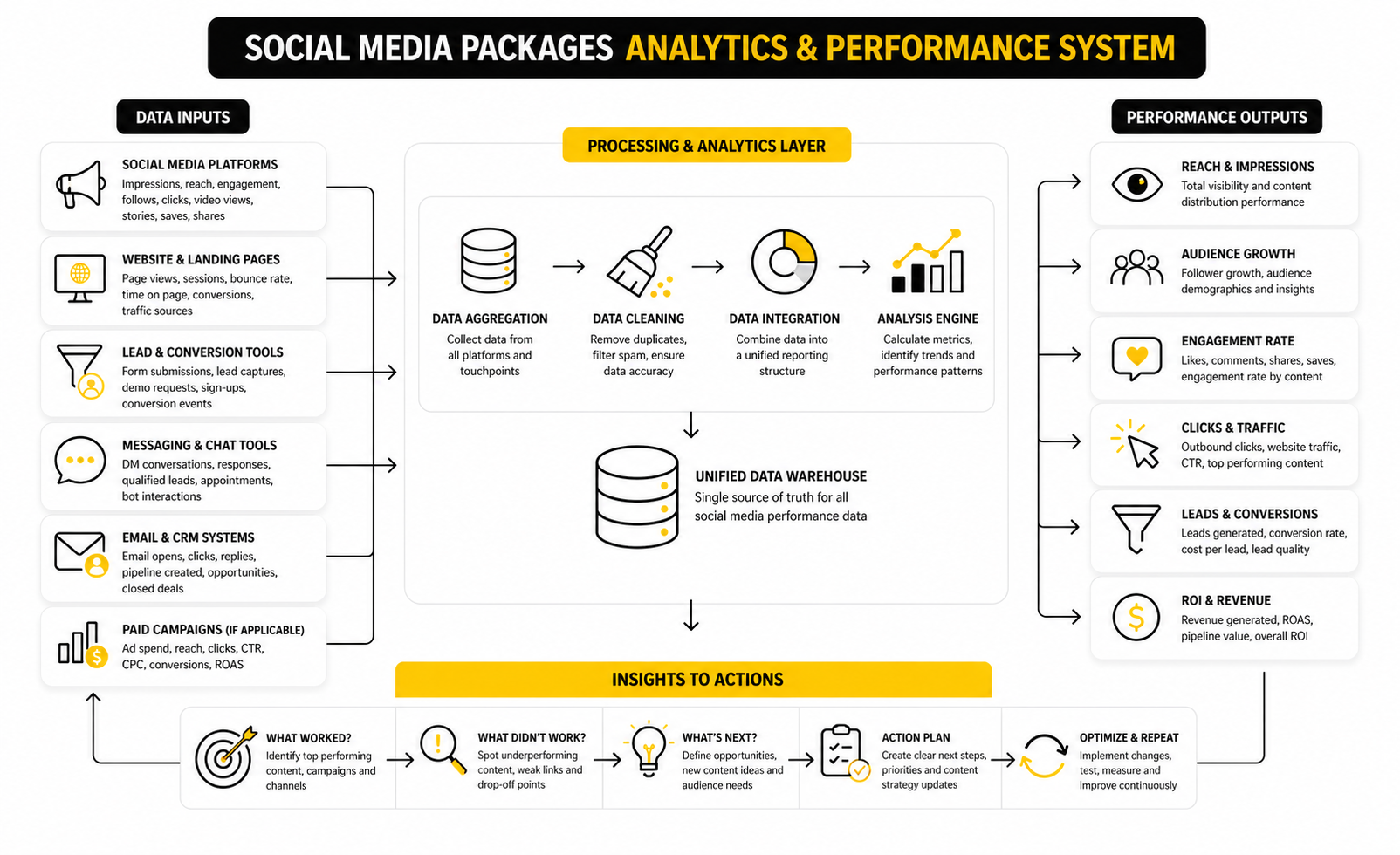
This kind of system keeps reporting grounded. It does not pretend every result can be perfectly attributed, because organic social rarely works that cleanly. But it does create enough structure to see what is improving, what is stalling, and where the package needs to change.
Benchmarks Are Useful, but They Are Not the Strategy
Benchmarks help set expectations, but they should never replace judgment. Rival IQ’s 2025 benchmark research showed that TikTok still generated higher engagement rates than Instagram, Facebook, and X for many brand categories, even as engagement pressure increased across platforms. That is useful context, but it does not mean every client should immediately buy a TikTok-heavy package.
Industry benchmarks are averages. Your client’s niche, offer, creative quality, audience size, posting consistency, and sales process will all change the result. A B2B firm with a long sales cycle should not panic because its engagement rate looks lower than an entertainment brand.
Use benchmarks as a reality check, not a scoreboard. If performance is far below category norms, investigate the content, positioning, cadence, and creative format. If performance is above benchmark but leads are weak, the problem may be the offer, call to action, landing page, or follow-up process.
Read Engagement Signals in Context
Engagement is often treated like one metric, but different engagement types mean different things. A like is light interest. A comment shows more effort. A share suggests the content made someone look good, feel understood, or want to pass the idea on.
Saves are especially useful for educational, comparison, checklist, and how-to content. They suggest the content has future value. Direct messages and replies are even stronger because they can reveal buying questions, objections, and demand that public metrics miss.
That is why social media packages should not report engagement as one flat number. A post that gets fewer likes but creates qualified conversations may be more valuable than a viral post that attracts the wrong audience. The package should make that distinction clear.
Track Content Quality, Not Just Output
A package can hit its posting quota and still fail. This is why measurement should include content quality signals. Look at hook strength, watch time, saves, shares, comment quality, click intent, and whether the content supports the client’s positioning.
For short-form video, retention and completion rate often reveal more than total views. A high-view video with weak retention may have a strong hook but poor substance. A lower-view video with strong saves, comments, or clicks may be more useful for the business.
For carousels and static posts, saves, shares, profile visits, and link actions can show whether the audience found the content valuable. The point is not to worship one metric. The point is to understand what the audience is doing after the content reaches them.
Measure the Conversion Path
When social media packages include lead generation, the reporting must go beyond the platform. A click is not a lead. A lead is not a sale. A booked call is not revenue until the sales process does its job.
This is where a connected tool stack matters. GoHighLevel can help connect forms, calendars, automations, pipelines, and follow-up activity in one place. ClickFunnels can fit when the social package drives traffic into a focused offer funnel. Brevo can support email follow-up when leads need nurturing before they buy.
The important part is not the tool itself. The important part is visibility. If a client cannot see what happened after the click, they will judge the package only by social metrics, and that is usually too narrow.
Turn Reporting Into Decisions
A monthly report should not end with charts. It should end with decisions. Keep doing what is working, fix what is weak, stop what is wasting time, and test what has a clear reason behind it.
For example, if educational posts get saves but no clicks, the next move may be stronger calls to action. If video reach is high but comments are poor, the creative may be too broad. If direct messages are increasing but leads are not booking, the issue may be response speed, qualification, or calendar flow.
This is where professional social media packages stand out. They do not just deliver content and send screenshots. They use the data to improve the next month of work. That is the difference between activity reporting and real marketing management.
Professional Implementation and Scaling
At this stage, social media packages are no longer just service menus. They are operating systems. The more clients, platforms, campaigns, approvals, assets, and reports involved, the more the package needs structure behind it.
This is where advanced providers separate themselves. They do not rely on memory, scattered messages, or last-minute creative energy. They build delivery systems that protect quality while making the work easier to repeat.
That matters because scale exposes every weak spot. If one client approval process is messy, five clients will make it painful. If reporting is manual and inconsistent, growth will turn into admin overload. If the package depends entirely on one person’s taste, the business becomes hard to delegate.
The Tradeoff Between Custom Work and Repeatable Systems
Custom work feels valuable because every client wants to feel understood. But fully custom delivery is hard to scale. Every new client becomes a new process, a new calendar, a new reporting structure, and a new set of exceptions.
Repeatable systems solve that, but they can become too rigid if they ignore context. The best approach is structured flexibility. Keep the process consistent, but adapt the strategy, creative angles, platforms, and metrics to the client’s business.
This is a practical balance. The onboarding checklist can be the same. The content calendar format can be the same. The reporting rhythm can be the same. But the ideas, offers, hooks, proof points, and conversion path should feel specific to the client.
Scope Creep Is the Silent Margin Killer
Scope creep usually starts small. One extra Reel. A quick story graphic. A last-minute campaign post. A few extra replies in the inbox. None of it feels dramatic in the moment, but it quietly destroys profitability.
That is why social media packages need clear escalation rules. If a request adds production time, platform coverage, strategy work, approval rounds, paid campaign support, or conversion setup, it should either replace something inside the package or become paid extra work. This is not being difficult. This is protecting the quality of the work.
The client also benefits from this clarity. When the scope is loose, everything feels urgent and nothing feels prioritized. When the scope is defined, the provider can focus on the work that actually supports the client’s goal.
AI Can Speed Up Delivery, but It Cannot Replace Taste
AI can help with research, outlines, captions, repurposing, content variations, summaries, and reporting notes. Used properly, it makes social media packages faster to deliver. Used lazily, it makes every brand sound the same.
The risk is not using AI. The risk is publishing content with no judgment. Social content still needs taste, timing, audience understanding, brand voice, proof, and a clear reason to exist.
Recent social trend research has pointed in the same direction: brands are using AI more, but audiences still respond to authenticity, human perspective, and content that does not feel overproduced. That is the real lesson. Use AI to support the workflow, not to remove the thinking.
Approval Systems Matter More Than People Think
Approvals are one of the biggest hidden bottlenecks in social media delivery. If the client takes too long to review content, the calendar slips. If feedback is vague, the creative team guesses. If too many stakeholders are involved, the package slows down.
A professional approval system should define who approves content, where feedback is given, how many revision rounds are included, and when late feedback moves content into the next cycle. This keeps the relationship calm because everyone knows the rules before there is pressure.
The approval process should also protect momentum. Social media moves fast, but that does not mean every post should be rushed. A good system gives the client enough control without turning every asset into a committee project.
Build for Content Repurposing From the Start
Repurposing is one of the smartest ways to increase package value without multiplying workload. One strong idea can become a short video, a carousel, a LinkedIn post, an email, a story sequence, and a sales talking point. But that only works if the package is designed for it upfront.
The content planning process should identify pillar ideas that can travel across formats. A founder insight may become a video script. A customer objection may become a carousel. A product comparison may become a landing page section. A strong comment may become the next content prompt.
This is where tools like Wispr Flow can help teams move faster when turning spoken ideas into drafts. The tool is not the strategy. It simply reduces friction when a client or creator has good ideas but does not want to stare at a blank document.
Protect Brand Voice as the Team Grows
The more people involved in delivery, the easier it is for the brand voice to drift. One writer sounds too polished. Another sounds too casual. A designer changes the visual language. A strategist approves content that technically fits the brief but does not feel like the brand.
This is why advanced packages should include brand voice documentation, especially for clients on larger retainers. It does not need to be complicated. It should capture the client’s tone, phrases to use, phrases to avoid, content beliefs, proof points, common objections, and examples of strong posts.
Brand voice is not decoration. It is consistency. And consistency is what helps a client become recognizable instead of blending into the feed.
Decide When to Add Paid Social
Paid social can strengthen a package, but it should not be used to hide weak organic strategy. If the offer is unclear, the landing page is weak, or the creative is generic, paid traffic will usually make the problem more expensive. It may create more data, but not necessarily better results.
Paid support makes sense when the client has a proven offer, a clear conversion path, and enough content testing to identify promising angles. In that case, organic content can reveal what people care about before paid spend scales the message. This is a healthier sequence than guessing with ad budget from day one.
When paid social is included, the package should define who handles creative testing, budget management, landing pages, tracking, and performance review. Otherwise, paid ads become another vague responsibility inside an already complex service.
Know When the Package Needs a Funnel
Some clients do not need a funnel. They need consistency, trust, and better content. But if the package is meant to generate leads or sales, the path after the click matters a lot.
A simple funnel can include a landing page, form, calendar, email sequence, and follow-up reminders. Tools like ClickFunnels, Systeme.io, or GoHighLevel can support that structure depending on the client’s needs. The important thing is that the funnel fits the offer instead of adding unnecessary complexity.
A package should only include funnel work when it improves the outcome and the provider can deliver it properly. A broken funnel creates more problems than no funnel. A simple, clear conversion path usually beats an overbuilt system nobody maintains.
Standardize Reporting Without Making It Generic
As packages scale, reporting must become easier to produce. But easier should not mean generic. A report that looks the same for every client may save time, but it can also miss the details that actually matter.
The best reporting format has a consistent structure with client-specific interpretation. Keep the same sections: goal, core metrics, top content, weak spots, lessons, and next actions. Then write the analysis based on the client’s package and business model.
That final interpretation is where the value is. Charts show what happened. A professional explains what it means and what should change next. That is the level clients remember.
Package Examples, Buying Checklist, and Final System
By this point, the structure should be clear. Social media packages work when they connect strategy, content, publishing, engagement, conversion, and reporting into one manageable system. The client should know what they are buying, and the provider should know exactly how the work gets delivered.
The final step is choosing the right package without getting distracted by shiny extras. A bigger package is not automatically better. The best package is the one that fits the business goal, the client’s current stage, and the resources available to support the work.
A simple package can be powerful when the business needs consistency. A conversion package can be worth more when the client already has demand and needs better follow-up. A premium package only makes sense when the strategy, creative, systems, and reporting can all be executed properly.
A Practical Buying Checklist
Before choosing between social media packages, look at the offer behind the content. If the business does not have a clear product, service, audience, or call to action, more content will not fix the deeper issue. The package should either solve that strategic gap or avoid pretending it can create results without the right foundation.
The next thing to check is delivery capacity. A package that includes videos, carousels, daily publishing, inbox management, reports, and funnels sounds impressive, but someone has to produce and manage all of it. If the team cannot support the workload, the package will break under pressure.
Use this checklist before buying or selling a package:
- Does the package have one clear primary goal?
- Are the included platforms listed clearly?
- Are content formats defined, not just post counts?
- Is strategy included at the right depth?
- Are revisions and approval timelines explained?
- Is engagement management included or priced separately?
- Does the package include reporting that leads to decisions?
- Is there a clear conversion path after someone clicks?
- Are tools and automations included only when they support the goal?
- Is the client’s role in providing input and assets clearly defined?
What a Starter Package Should Look Like
A starter package should focus on consistency and credibility. It is best for businesses that need to look active, professional, and clear before they invest in more advanced growth systems. This package should not promise aggressive lead generation if the service is mostly content planning and publishing.
A strong starter package may include content direction, a simple monthly calendar, a small number of platform-specific posts, basic scheduling, and a short performance review. The goal is to build rhythm and reduce the client’s day-to-day content burden. It should be clean, focused, and easy to deliver.
This package works best when expectations are honest. It can improve visibility and professionalism, but it is not a full sales machine. That distinction matters.
What a Growth Package Should Look Like
A growth package should add stronger creative, better campaigns, and more intentional engagement. It is a good fit for businesses that already understand their offer and want social media to support demand generation. This is where the package starts moving beyond presence and into momentum.
A growth package may include short-form video, carousels, campaign planning, comment monitoring, direct message prompts, lead forms, and better monthly analysis. Tools like Buffer, ManyChat, and Fillout can fit here when they make publishing, conversation capture, or lead collection easier.
This package should still avoid unnecessary complexity. Growth comes from sharper execution, not from stacking tools. If the package adds moving parts, each one should have a job.
What a Premium Package Should Look Like
A premium package should connect social media to a broader revenue system. This is the right fit when the client needs strategy, content, conversion assets, automations, reporting, and ongoing optimization working together. It should feel like a managed growth function, not a bigger posting plan.
This type of package may include campaign strategy, creative direction, high-volume content production, community management, landing pages, CRM workflows, email nurture, sales handoff, and deeper reporting. GoHighLevel, ClickFunnels, Systeme.io, and Brevo can support different parts of that system when they match the client’s workflow.
A premium package also needs stronger boundaries. More value does not mean unlimited access, unlimited revisions, or unlimited strategy calls. The best premium offers are generous but clearly scoped.
FAQ - Built for Complete Guide
What are social media packages?
Social media packages are bundled service offers that define what a client gets for social media strategy, content creation, publishing, engagement, reporting, and sometimes conversion support. They make the service easier to understand because the client can compare levels of support instead of trying to price every task separately. A good package also protects the provider by making scope, expectations, and deliverables clear from the start.
What should be included in a social media package?
A solid package should include strategy, content formats, publishing frequency, included platforms, approval rules, reporting, and boundaries around engagement or inbox management. More advanced packages may also include lead forms, landing pages, automations, email follow-up, and CRM workflows. The right combination depends on whether the client wants visibility, consistency, leads, sales support, or a complete growth system.
How many posts should a social media package include?
There is no universal number because post count is only one part of the workload. A package with eight strong videos may require more effort than a package with twenty simple graphics. The better question is how much content is needed to support the client’s goal without sacrificing quality.
Should social media packages include strategy?
Yes, even basic packages should include some level of strategy. Without strategy, the provider is just creating content in the dark. The depth can change by tier, but every package should explain the audience, content themes, platform focus, and business goal.
Should engagement management be included?
Engagement management should only be included when it is clearly scoped. Replying to comments, handling direct messages, qualifying leads, and escalating customer issues can become time-heavy fast. If engagement is part of the package, define the response window, platforms, weekly time limit, and what gets handed back to the client.
What is the difference between a content package and a growth package?
A content package usually focuses on planning, creating, and publishing posts. A growth package connects content to a broader business outcome, such as leads, booked calls, email signups, or campaign performance. That often means stronger calls to action, better reporting, landing pages, direct message flows, and follow-up systems.
Are cheaper social media packages worth it?
Cheaper packages can be worth it when the goal is simple consistency and the scope is realistic. They become risky when they promise strategy, content, engagement, reporting, and lead generation at a price that cannot support the workload. Low-cost packages should be narrow, clear, and honest about what they can actually achieve.
How should social media packages be priced?
Pricing should reflect workload, complexity, business value, turnaround time, platform count, content format, and responsibility level. Static posts, short-form videos, community management, funnels, and analytics all require different effort. The mistake is pricing only by post count, because that ignores the strategy and operational work behind the content.
How do you know if a package is working?
A package is working when its metrics match its goal. A visibility package should improve reach, consistency, profile activity, and audience recognition. A lead generation package should create measurable next steps like clicks, forms, direct messages, bookings, or sales conversations.
What tools are useful for social media packages?
Useful tools depend on the job. Scheduling tools help with publishing, automation tools help with direct message flows, form tools help capture leads, and CRM or funnel tools help manage follow-up. The tool stack should support the package instead of making it more complicated.
Should every package include video?
No, but many packages should consider it. Short-form video can be powerful, but it also requires stronger creative planning, production input, editing time, and approval discipline. If the client cannot provide raw material or support the process, video may need to be priced separately or introduced gradually.
Can one package cover every platform?
Technically yes, but it is usually not smart. Every platform adds planning, formatting, publishing, and reporting complexity. A stronger package focuses on the platforms most likely to reach the client’s buyers and support the business goal.
How often should reports be sent?
Monthly reporting works well for most social media packages because it gives enough time to spot patterns. Weekly checks can be useful internally, especially for campaigns, but clients usually need interpretation more than constant screenshots. The report should explain what happened, what it means, and what changes next.
When should a client upgrade to a higher package?
A client should upgrade when the current package is limiting the next stage of growth. That might mean they need more content depth, faster production, stronger engagement handling, better conversion assets, or more detailed reporting. Upgrading should solve a real constraint, not just add more activity.
Work With Professionals
Explore 10K+ Remote Marketing Contracts on MarkeWork.com
Most marketers spend too much time chasing clients, competing on crowded platforms, and losing a percentage of every project to middlemen.
MarkeWork gives you a better way. Browse thousands of remote marketing contracts and connect directly with companies desperate to hire skilled marketers like you, without platform commissions and without unnecessary gatekeepers.
If you're serious about finding better opportunities and keeping 100% of what you earn, explore available contracts and create a profile for free at MarkeWork.com.