

A strong social media plan is no longer a nice-to-have for brands that want predictable growth. Social platforms now sit at the intersection of attention, discovery, customer service, creator partnerships, and commerce, which means random posting is usually just a slow way to waste budget. The scale alone explains why this matters: the world had 5.24 billion active social media user identities in early 2025, and marketers are putting even more pressure on social to prove business value rather than vanity metrics.
That shift changes what a useful social media plan should do. It should not just organize content ideas or choose platforms. It should connect audience insight, channel priorities, publishing systems, creator strategy, customer response workflows, and measurement into one operating model that your team can actually run every week.
Article Outline
- Part 1: Why a Social Media Plan Matters
- Part 2: Start With Business Goals and Audience Insight
- Part 3: Choose Channels and Content Pillars
- Part 4: Build the Publishing and Engagement Workflow
- Part 5: Measure Performance and Improve the Plan
- Part 6: Put the Plan Into Practice Without Losing Consistency
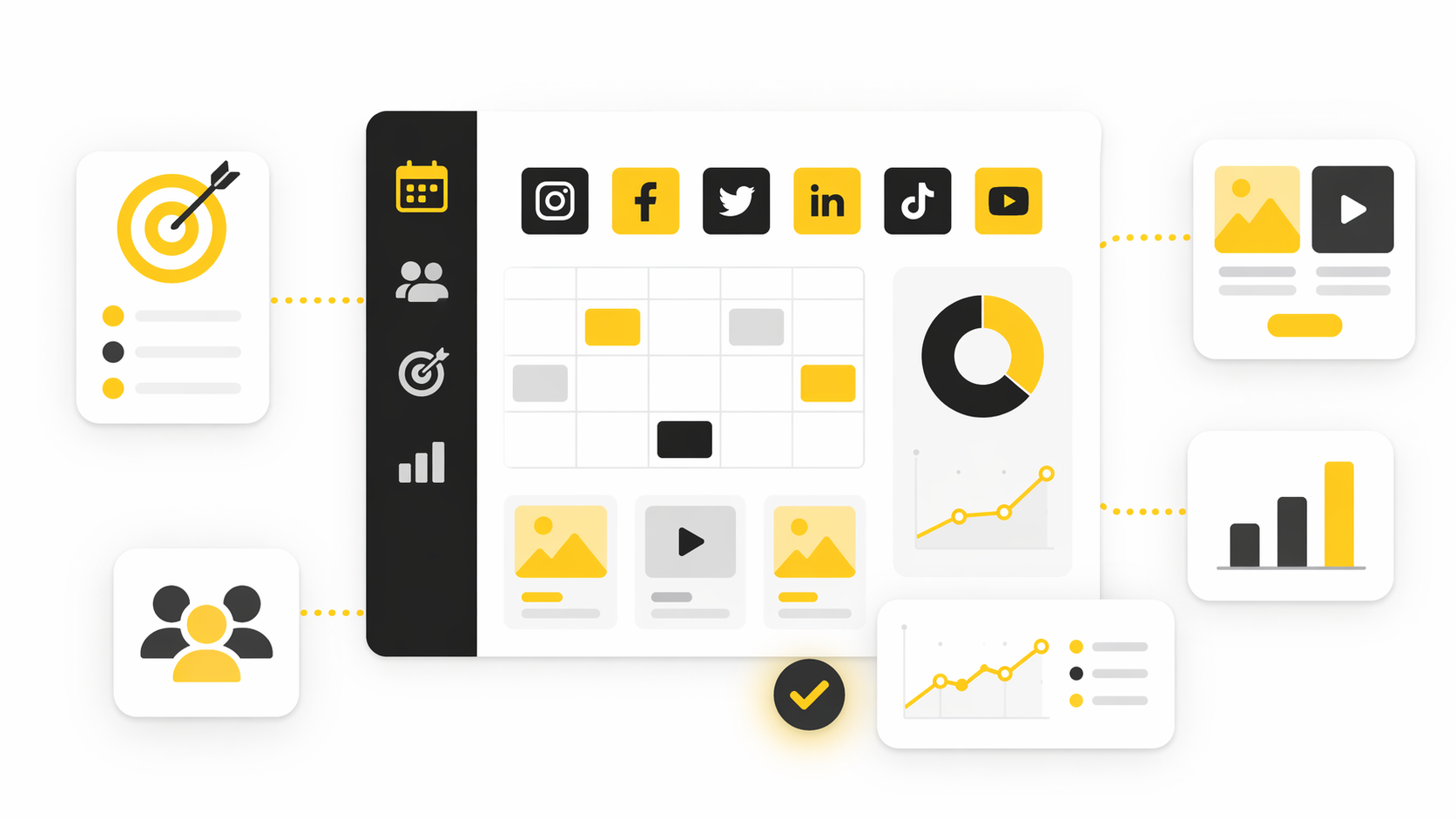
Why a Social Media Plan Matters
A social media plan matters because social has become much bigger than a content distribution channel. Recent research shows younger audiences increasingly rely on social media and social video environments for entertainment, discovery, and purchase influence, while marketers are under pressure to tie that activity back to revenue, retention, and brand health. Deloitte’s 2025 digital media research and social research both point in the same direction: social is taking a larger role in consumer decision-making, and brands are increasing investment because the channel now influences community, content performance, and conversion all at once.
That is exactly why a loose posting schedule is not enough anymore. HubSpot found that 29% of consumers in 2025 said they discovered a product through an influencer on social media, while Deloitte reported that 63% of Gen Z consumers said ads or product reviews on social media were most influential to their purchasing decisions. When discovery, trust, and conversion are all happening inside the same ecosystem, your social media plan needs to decide what role each platform plays and how success will be measured before the content machine starts running.
There is also an operational reason to plan properly. Sprout Social’s recent reporting shows many teams still struggle to prove ROI even as leadership expects social to contribute beyond engagement metrics, and its customer care data shows consumers continue to expect brands to respond directly on social. A real plan closes that gap by turning social from a reactive stream of posts into a system with priorities, ownership, workflows, and reporting.
How This Article Is Structured
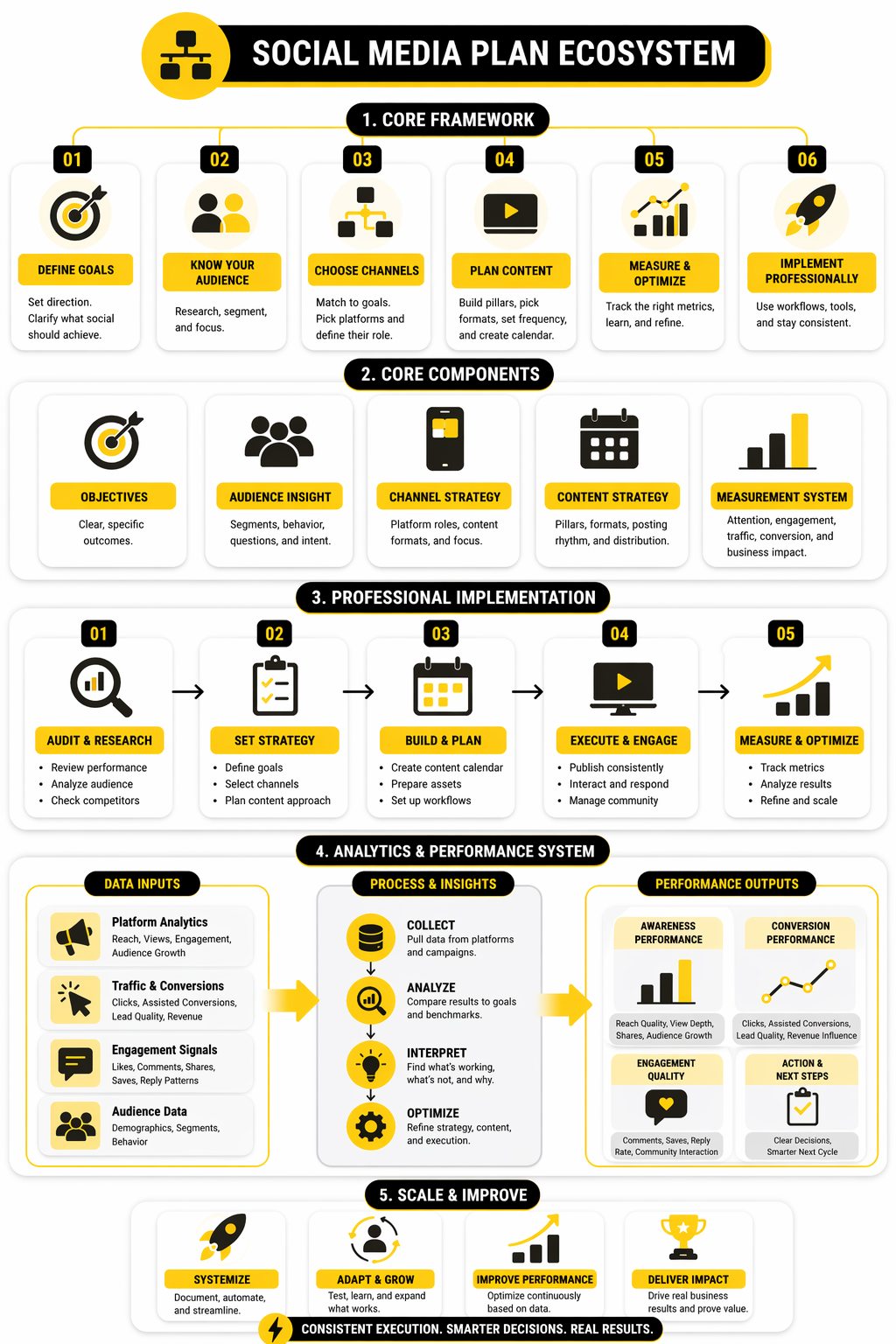
This article is built as a practical six-part framework because that is the easiest way to make a social media plan usable in the real world. First, you need context and structure. Then you need goals and audience insight, followed by channel choices, content pillars, publishing systems, engagement rules, and a measurement process that helps you improve rather than just report numbers after the fact.
The sequence matters. Teams usually fail with social because they jump straight to formats and tactics before they decide what the business needs social to do. That is why the rest of this article moves in a clear order from strategy to execution, so each decision supports the next one instead of creating more noise for the team.
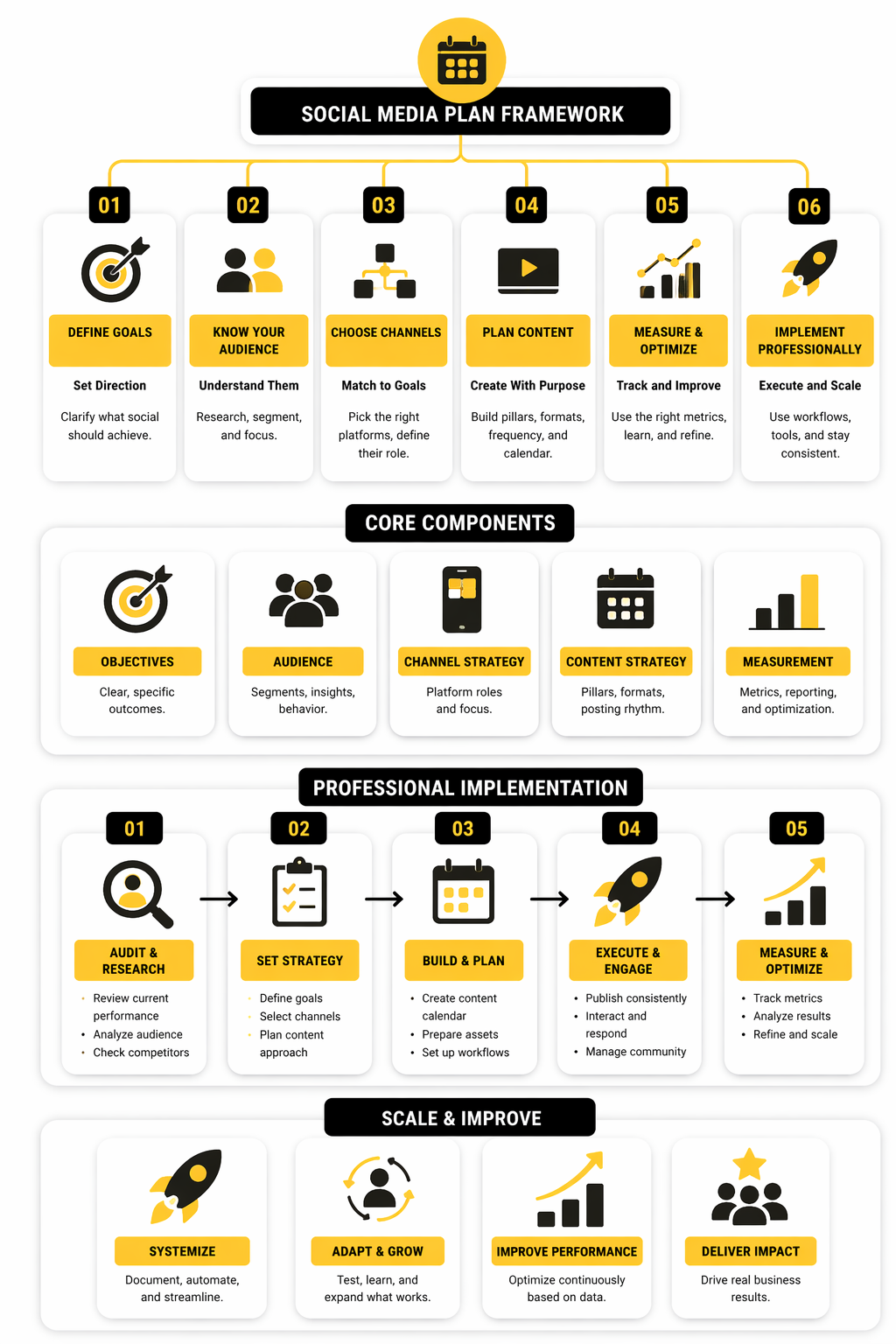
Framework Overview
The framework behind this social media plan is simple, but it is not simplistic. It starts with business goals, moves into audience behavior, translates that into channel roles and content pillars, then locks everything into a repeatable workflow for publishing, engagement, and measurement. That structure reflects what recent research keeps reinforcing: the strongest social programs are the ones that connect community, content, and conversion instead of treating them as separate activities.
In the next part, the focus will shift to the foundation that most brands rush past. Before choosing post formats or building a calendar, you need to define what success looks like, which audience segments matter most, what behaviors signal intent, and where social should support the wider business. Get that part right, and the rest of the social media plan becomes much easier to scale without losing clarity.
Start With Business Goals and Audience Insight
The next step in a social media plan is where most teams either get serious or get lost. This is the point where you decide whether social is supposed to build demand, generate leads, support sales, improve retention, strengthen community, or reduce support friction. If that job is not clear, everything that follows will look busy without being particularly useful.
Social teams are feeling more pressure to prove business impact, and leadership expectations are getting more specific. Recent Sprout Social research found that many marketing leaders want a direct connection between social campaigns and business goals, not just a report full of impressions and engagement metrics. That matters because it changes how you set the plan up from day one.
Define What Social Needs To Do For The Business
A good social media plan starts by giving social a job description. For one business, that job might be top-of-funnel discovery and creator-led reach. For another, it might be lead generation, customer education, or handling questions quickly enough to protect conversion rates and brand trust.
This sounds obvious, but it is where a lot of weak strategies collapse. If your team says social is supposed to do everything, then it usually ends up doing nothing particularly well. Stronger teams choose primary goals first, then assign secondary goals that support them rather than compete with them.
The shift toward goal clarity is not theoretical. Deloitte’s 2025 social research shows brands are increasingly organizing their efforts around community, content, and conversion, while Sprout’s latest ROI reporting shows leadership wants clearer proof of business value from social programs. In other words, the market is pushing teams toward sharper priorities whether they are ready or not.
Turn Goals Into Measurable Outcomes
Once the goal is clear, the next move is to decide what evidence would prove social is doing its job. If the goal is awareness, you are looking at reach quality, video views, share of voice, branded search lift, and audience growth in the right segment. If the goal is demand generation, you care more about qualified traffic, assisted conversions, lead quality, pipeline influence, and the handoff between social and the rest of your funnel.
This is where discipline matters. A social media plan should not treat every metric as equally important because they are not. The right metric depends on the outcome you are trying to produce, and that is exactly why reporting gets messy when teams jump into content production before agreeing on what success means.
That approach also matches how platforms and research bodies frame campaign planning now. Meta’s own business guidance continues to emphasize choosing the right objective before launching a campaign, and TikTok’s 2025 trend reporting highlights the value of strategies built around deeper relevance and audience connection rather than one-way broadcasting. Those are different ecosystems, but the planning principle is the same: objective first, tactics second.
Use Audience Behavior Instead Of Assumptions
After goals, audience insight is the real foundation of a social media plan. Not the vague kind where somebody says the target audience is “busy professionals” or “women aged 25 to 44.” The useful kind comes from observed behavior: what people watch, where they discover products, which platforms they trust for reviews, how often they use specific apps, what questions they ask before buying, and what makes them engage instead of scroll past.
That matters more than ever because platform usage is not evenly distributed. HubSpot’s consumer research shows social media remains a top product discovery channel across multiple age groups, while Pew’s recent platform usage data shows daily behavior differs sharply by age and platform. A plan built on generic demographic labels will miss those differences and push content into the wrong channels or the wrong format.
Audience research also needs to go beyond platform choice. The goal is to understand intent. Someone may use Instagram for passive discovery, TikTok for active inspiration, YouTube for research, and LinkedIn for professional credibility, all within the same week. If your social media plan ignores that behavior and treats every channel as interchangeable, the content will feel misaligned even when the creative looks good.
Build Audience Segments Around Intent
The smartest way to segment an audience for social is usually by intent, awareness level, and decision stage. One segment may not know your brand exists yet and needs entertaining or useful content that earns attention. Another may already know the problem and be comparing options, which means proof, education, testimonials, and direct answers will matter more than broad lifestyle content.
This is also where platform role becomes clearer. On B2B-heavy channels like LinkedIn, trust and professional credibility tend to matter more, while creator and community dynamics may carry more weight on consumer-heavy platforms. LinkedIn’s 2025 benchmark work and TikTok’s trend reporting both reinforce the same broader truth: people respond better when content matches the context they are already in.
That is why a serious social media plan should define audience segments in plain language. You want to know who they are, what problem they are trying to solve, what level of awareness they have, what objections they carry, and what kind of proof helps them move forward. Once you have that, content planning becomes much more obvious because you are no longer posting for a fictional average user.
Pull Insight From The Right Data Sources
You do not need perfect data to build a strong plan, but you do need better inputs than guesswork. The most useful sources are usually your own customer interviews, sales call notes, search query data, CRM tags, website behavior, social comments, direct messages, support tickets, and platform analytics. Those sources tell you what people actually care about, not what your team assumes they care about.
External research still helps because it adds context. Industry reports can tell you where discovery is shifting, how consumers use platforms, and what expectations are rising around response times, creators, and content formats. Internal data tells you how those broader patterns show up for your specific audience. The real edge comes from combining both instead of relying on one alone.
If you need a cleaner operating layer for this part of the process, a scheduling and analytics tool like Buffer can help keep channel reporting and publishing in one place, while a content workflow tool like Flick can make it easier to organize themes, captions, and planning without turning the whole system into a mess.
Write A Clear Strategic Starting Point
By the end of this stage, your social media plan should be able to answer a few simple questions without hesitation. What is social expected to achieve for the business over the next quarter or year. Which audience segments matter most right now. Which behaviors signal interest or buying intent. And what proof will tell you the plan is working.
If those answers are still fuzzy, the solution is not to start posting faster. It is to tighten the strategy before the calendar fills up with content that does not move anything important. That is the real purpose of this section: to make sure every channel, format, and campaign in the rest of the article has a solid reason to exist.
The next part builds on that foundation by choosing the right channels and turning audience insight into content pillars that are specific enough to guide execution, but flexible enough to keep the brand relevant over time.
Choose Channels and Content Pillars
A social media plan gets sharper once you stop asking where you can post and start asking where you should win. Every platform has different audience behavior, different content expectations, and different strengths across discovery, trust, conversation, and conversion. That is why strong teams assign each channel a role instead of cloning the same content everywhere.
This is more important now because platform behavior is fragmenting, not converging. Digital 2025 shows that platform usage patterns, motivations, and social discovery habits vary widely by audience and market, while YouTube remains one of the most used social platforms globally and social video continues to shape how people research and discover content. Digital 2025 global platform data and the 2025 state of social media both reinforce the same point: channel choice should follow user behavior, not internal preference.
Give Each Channel A Clear Job
The cleanest way to choose channels is to define what each one is supposed to do in the plan. One platform may be best for broad reach and top-of-funnel discovery. Another may be better for deeper education, creator partnerships, or proof-heavy content that helps buyers move from interest to action.
That distinction matters because different platforms reward different kinds of effort. TikTok’s 2025 trend reporting leans heavily into creative participation, relevance, and community-led momentum, while LinkedIn’s 2025 benchmark research keeps emphasizing trust, influence, and business credibility in B2B environments. Those are not small differences. They should shape the entire structure of your social media plan. TikTok's 2025 trend report and LinkedIn's 2025 B2B benchmark hub make that contrast pretty clear.
A useful channel map usually looks something like this:
- Reach channels for awareness and discovery
- Trust channels for proof, education, and expertise
- Conversation channels for community and feedback loops
- Conversion-support channels for product detail, retargeting, and buying momentum
This does not mean every business needs four separate social priorities. It means every platform in the social media plan should have a reason to exist. If you cannot explain that reason in one sentence, the channel probably does not deserve the energy you are giving it.
Focus On The Few Formats That Match The Platform
Once channel roles are clear, the next job is to choose the formats that naturally fit each platform. This is where a lot of content teams overcomplicate things by trying to be everywhere with every format at once. In reality, most brands do better when they commit to a few repeatable formats they can execute well.
That approach lines up with where platform strategy has been moving. HubSpot’s 2025 social media marketing reporting highlights continued growth in micro-influencers, community-focused content, and social as a customer experience channel, while YouTube’s culture work keeps showing that creator-led, audience-aware formats outperform content that feels detached from how people actually watch. HubSpot's 2025 social media marketing report and YouTube's culture and trends coverage both point toward the same practical takeaway: make content that fits the native rhythm of the platform.
For most teams, that means narrowing content into a manageable set of recurring formats such as:
- short-form video for reach and relevance
- carousels or document-style posts for education
- testimonials, case-led proof, or customer stories for trust
- founder or team-led commentary for brand perspective
- replies, comment threads, and direct engagement for community building
A social media plan becomes easier to run once you stop treating every post like a one-off creative challenge. Repeatable formats lower production friction, make testing easier, and help the audience recognize what your brand is good at.
Build Content Pillars That Support Real Buyer Movement
Content pillars are where strategy becomes editorial discipline. A good pillar is not just a topic you like talking about. It is a repeatable lane of content that helps the audience move from curiosity to confidence.
That is why weak pillars usually sound broad and lazy. Things like “tips,” “culture,” or “industry news” are not useless, but on their own they do not give the team enough direction. Better pillars connect the audience’s questions with the business’s strengths and the platform’s role in the journey.
In practical terms, most strong social media plan frameworks end up with pillars like these:
- Problem awareness content that names pains, mistakes, or missed opportunities
- Education content that explains how to improve, choose, or evaluate
- Proof content that shows results, testimonials, product evidence, or behind-the-scenes credibility
- Brand perspective content that gives the audience a reason to trust your point of view
- Engagement content that creates discussion, response, and audience participation
This is also the point where distribution gets smarter. You do not need a fresh idea every day. You need pillars strong enough to create multiple angles, multiple formats, and multiple calls to action without sounding repetitive. That is how a social media plan stays consistent without becoming stale.
Build The Publishing And Engagement Workflow
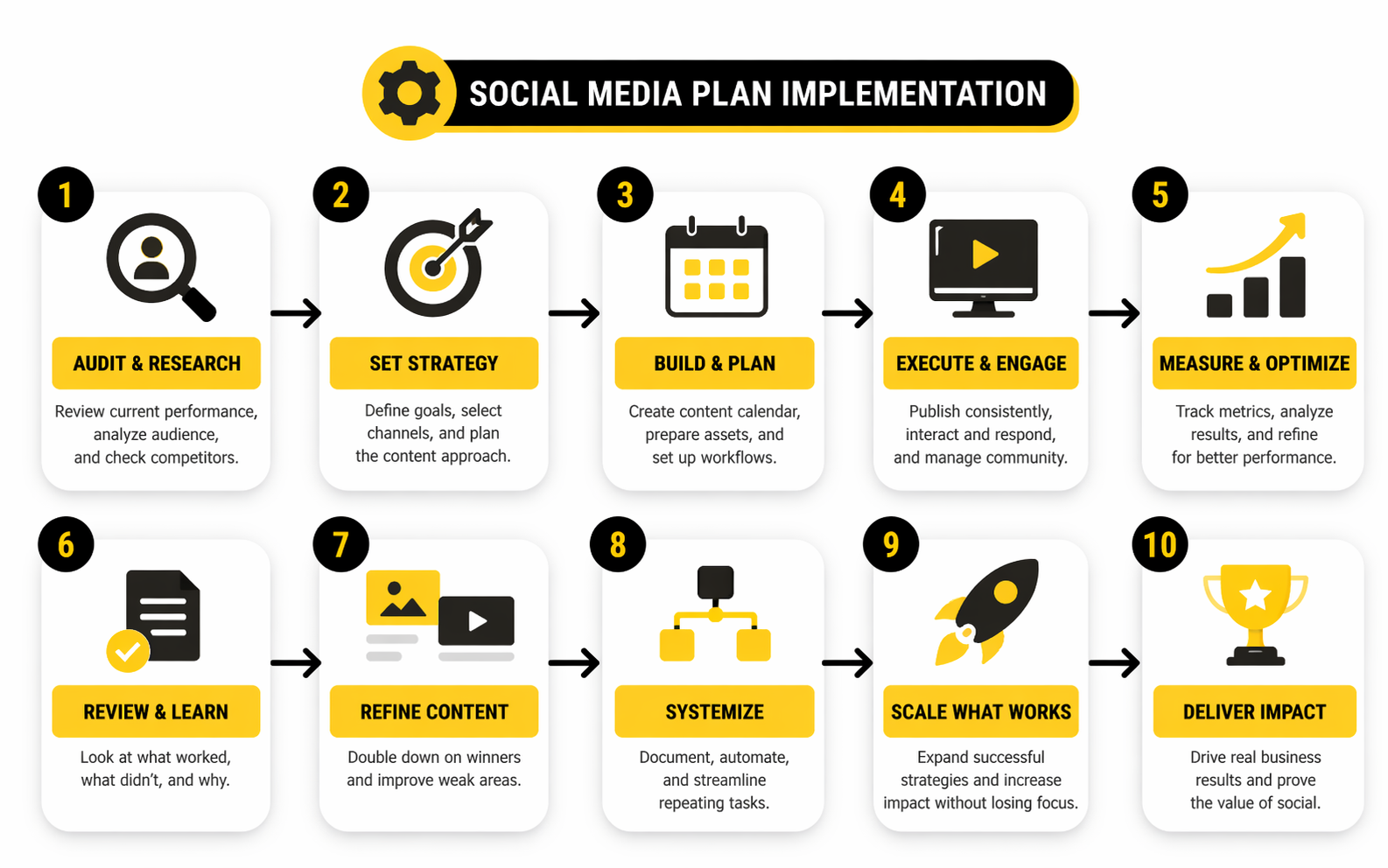
Once channels and pillars are locked, the plan needs a working process. This is the moment where strategy stops being a slide deck and turns into a weekly operating rhythm. If the workflow is vague, even a smart social media plan will break the first time the team gets busy.
The strongest teams usually separate the workflow into a few clear stages: planning, production, publishing, engagement, and review. That sounds simple, but it matters because each stage needs an owner, a timeline, and a decision rule. Without that structure, content approval drags, replies get missed, and reporting becomes an afterthought instead of a feedback loop.
Turn The Plan Into A Weekly Production System
A practical social media plan should tell the team what gets done each week, not just what the brand believes in. That usually starts with a recurring planning session where the team reviews performance, upcoming campaigns, audience questions, launches, and timely opportunities. From there, the team maps content to channel roles and assigns each piece to a pillar, a format, an owner, and a publishing date.
That kind of system matters because content calendars are under more pressure than they used to be. Hootsuite’s latest trends reporting points to faster content cycles, more nuanced algorithm behavior, and more pressure to adapt quickly to what audiences respond to in real time. A fixed monthly calendar without room for iteration is starting to feel outdated. Hootsuite's latest social trends report captures that shift well.
A simple weekly operating model often works better than a massive quarterly planning doc:
- review last week’s winners and weak spots
- pull audience questions, objections, and topical hooks
- assign posts by channel and pillar
- batch production where possible
- schedule core content
- leave room for fast-response content and community moments
This is where tools can genuinely help instead of just adding another subscription. A platform like Buffer can simplify scheduling and basic reporting across channels, while Flick is useful when you want a tighter workflow for planning, caption development, and organizing recurring ideas. The point is not the tool itself. The point is making the process easy enough that consistency survives real life.
Treat Engagement As Part Of Execution, Not Cleanup
A lot of brands still treat engagement like what happens after the important work is done. That is a mistake. In a serious social media plan, replies, direct messages, comment patterns, and audience feedback are part of the strategy because they tell you what people care about, what they doubt, and what they are ready to act on.
That shift is showing up in the data too. HubSpot’s 2025 social reporting points to social becoming more of a customer experience channel, not just a promotion channel, and Sprout’s broader research continues to show consumers expect brands to show up responsively in social spaces. When teams ignore that, they miss one of the fastest feedback loops they have. HubSpot's 2025 report and Sprout's social media insights hub both reflect this change in expectations.
For some businesses, direct-message automation can make this part of the workflow much more manageable, especially when social is tied to lead capture or qualification. ManyChat can be useful when you need structured DM flows without turning every interaction into a manual task. Used well, that kind of support makes the social media plan more responsive without making it feel robotic.
Create A Process For Fast Testing Without Chaos
The final piece of implementation is controlled experimentation. A strong social media plan should not lock the team into one style forever. It should create a stable system for testing hooks, formats, post structure, creative approaches, offers, and calls to action without turning the whole operation into random guessing.
This is where many teams need a reset. They either test nothing and become predictable, or they test everything at once and learn nothing useful. The better move is to change one meaningful variable at a time and review the results against the goal of the channel, not just the raw engagement number.
That makes the next part essential. Once the plan is running, you need a way to measure whether the channels, pillars, and workflows are actually producing business value. That is where the article goes next: not into vanity metrics, but into the numbers and review habits that make a social media plan stronger over time.
Statistics and Data
A social media plan only gets better when the team knows how to read the numbers without fooling itself. That is the real job of measurement. It is not to decorate a monthly report with charts, but to show whether social is creating attention, trust, traffic, pipeline, revenue, or support efficiency in the way the business actually needs.
That distinction matters because the wrong metrics can make a weak strategy look healthy for a while. A post can collect likes and still attract the wrong audience. A campaign can generate reach and still fail to move qualified traffic, assisted conversions, or buying intent. The point of analytics in a social media plan is to separate surface activity from signals that deserve action.
Measure By Goal, Not By Habit
The cleanest way to measure social is to go back to the job you assigned it earlier in the plan. If the goal is awareness, you should care about qualified reach, view depth, share rate, follower growth in the right segment, and branded search lift. If the goal is demand generation, you should care more about clicks, conversion rate, lead quality, assisted revenue, and what happens after the visit.
This sounds simple, but it fixes one of the biggest reporting problems in social media. Teams often report the same dashboard every month regardless of what the channel was supposed to achieve. That habit creates noise, not insight, because awareness metrics and conversion metrics answer completely different questions.
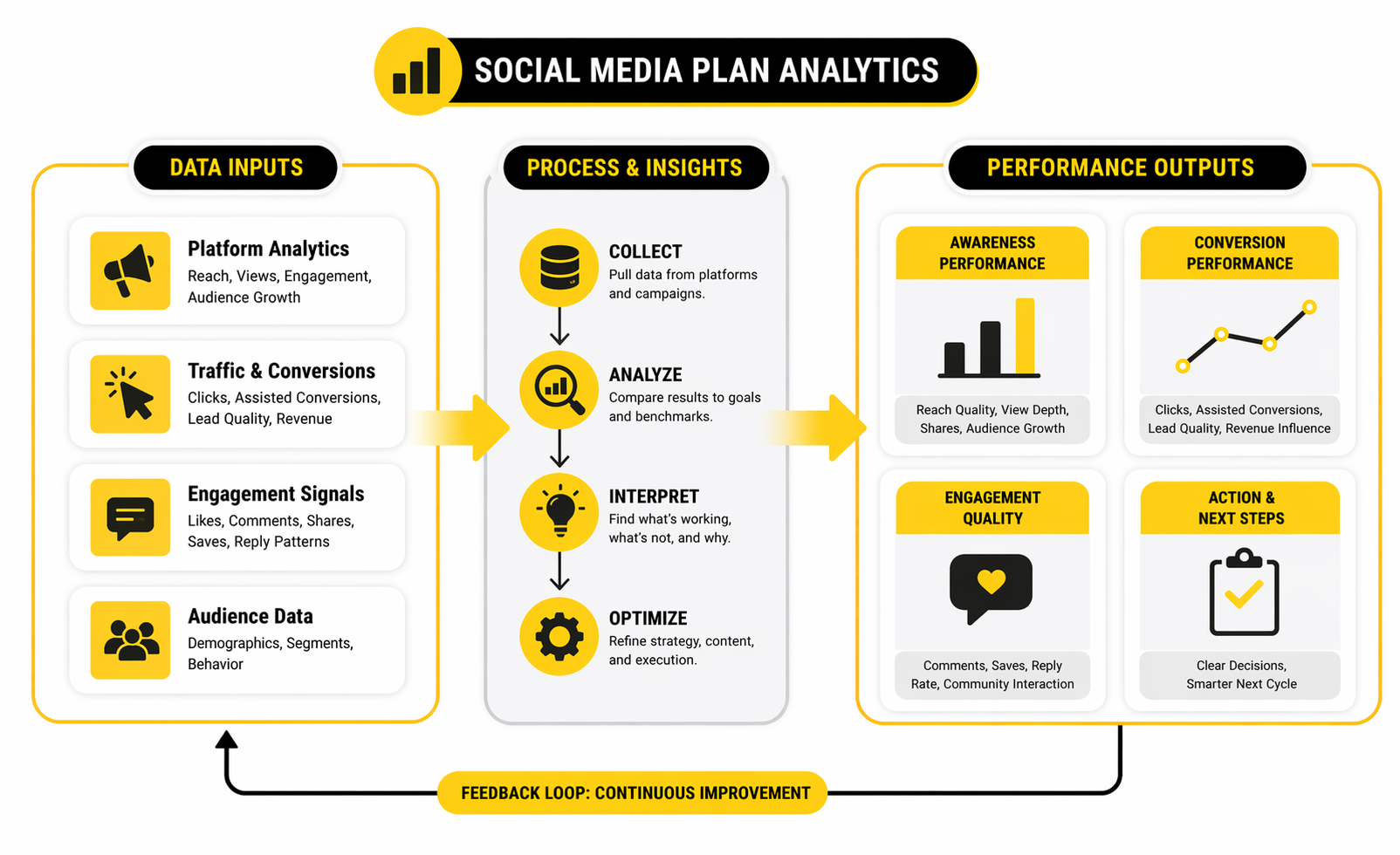
A useful social media plan usually maps metrics into four layers:
- Attention signals like reach, impressions, watch time, and thumb-stop rate
- Engagement signals like comments, shares, saves, reply rate, and sentiment patterns
- Traffic and conversion signals like click-through rate, landing-page conversion rate, assisted conversions, and lead quality
- Business signals like pipeline influence, revenue contribution, customer retention support, and cost savings from service deflection
When reporting follows that structure, the numbers start to explain what to do next instead of just what happened.
What Current Benchmarks Actually Tell You
Benchmarks are useful, but only when used carefully. Rival IQ’s 2025 benchmark report found engagement rates fell across major platforms, with Facebook down 36%, Instagram down 16%, TikTok down 34%, and X down 48% year over year. That does not mean social stopped working. It means competition, content saturation, and platform dynamics got tougher, so old performance baselines are less reliable than they used to be.
That same report also found that carousels led Instagram engagement, which is a good reminder that format assumptions age fast. A lot of teams still act as if short-form video automatically wins every time. In reality, the better question is which format fits the audience, the message, and the channel role inside your social media plan.
This is why benchmark data should guide interpretation, not replace thinking. If industry engagement is dropping and your reach is flat, you may still be doing fine if qualified clicks, saves, replies, or assisted conversions are rising. The number only matters when you understand the context around it.
Read Performance Signals In Clusters
Single metrics can be misleading, so strong teams read them in clusters. High reach with weak watch time usually means the hook worked but the content did not hold attention. High engagement with weak clicks may mean the post was interesting but not commercially aligned. Strong click-through with weak conversion may point to a landing-page problem rather than a social problem.
That kind of interpretation is where a social media plan becomes practical. Numbers should tell you where the friction is. They should help you decide whether to change the creative, the offer, the audience targeting, the publishing cadence, or the page people land on after the click.
HubSpot’s recent social and channel research also supports this more nuanced view of performance. Marketers are shifting investment toward the channels they believe create stronger returns, with YouTube, Instagram, and TikTok often getting more attention than weaker performers, but the point is not to chase whoever is currently fashionable. The point is to align channel investment with the kind of return each platform is most likely to produce.
Build A Simple Analytics System The Team Will Actually Use
A social media plan does not need a huge reporting stack to become useful. It needs a simple system that gets reviewed consistently. For most teams, that means one weekly performance check for tactical adjustments and one deeper monthly review for strategic decisions.
The weekly review should stay focused on immediate signals. What posts earned attention. Which hooks pulled people in. Which format underperformed. Which comments or DMs revealed confusion, objections, or demand. This is where the team improves execution while the data is still fresh.
The monthly review should answer bigger questions. Are the channel roles still correct. Are the content pillars producing the right mix of attention and conversion. Is engagement translating into qualified traffic or pipeline movement. Is the team spending too much effort on channels that look active but do not contribute enough to the business.
If you want that process to stay organized without becoming heavy, a tool like Buffer can help centralize scheduling and reporting, while a workflow tool like Flick can make it easier to keep content tracking, testing notes, and planning in one place. The right tool is the one your team will actually keep using, because consistency beats complexity here.
Know Which Numbers Deserve Action
The best measurement systems tell you what to change. If watch time drops, the first few seconds probably need work. If saves are rising, the content likely has strong practical value and may deserve repurposing or paid support. If comments are active but sentiment is weak, messaging may be attracting attention while undermining trust.
This is where many brands waste time. They collect numbers but do not connect them to decisions. A social media plan should do the opposite. It should make every major metric useful by tying it to a response, whether that means scaling a format, refining a content pillar, shifting budget, changing the CTA, or fixing the landing experience after the click.
Sprout’s recent reporting shows leaders increasingly want clear alignment between social activity and business goals, and they also want better visualization of social data so decisions happen faster. That is not just a reporting preference. It is a sign that social teams are being pushed to become more commercially accountable.
Use Benchmarks To Challenge Assumptions, Not To Chase Vanity
Benchmarking works best when it exposes false confidence. If your engagement rate looks strong but your competitors are converting more efficiently, then engagement alone is not enough. If your posting frequency is high but your output is not outperforming the industry, then volume may be hiding a quality problem.
Rival IQ’s live benchmark hubs and annual industry reporting are useful for this because they show how performance changes by vertical, not just by platform. That is a much healthier comparison point than copying generic social media averages from random blog posts. A serious social media plan should compare itself against relevant peers and then ask what that gap actually means operationally.
The bigger lesson is simple. Data should sharpen the plan, not inflate the ego. When measurement is set up properly, it shows which channels deserve more investment, which formats need rework, which pillars are creating real business movement, and which activities should be cut even if they look busy on the surface.
The next part takes that logic one step further. Once the data is clear, the social media plan needs a process for improving over time so the team can scale what works, fix what does not, and keep consistency without getting trapped in stale habits.
Improve The Plan Without Breaking What Already Works
Once a social media plan is running consistently, the next challenge is not getting started. It is learning how to improve the system without accidentally destroying the parts that already work. This is where stronger teams separate themselves from busy teams, because scaling social is usually less about adding more content and more about making smarter decisions about what to repeat, what to cut, and what to protect.
That matters because the pressure on social keeps expanding. The channel now touches content, creators, paid amplification, customer care, and increasingly AI-assisted production, which means the plan can become bloated fast if nobody is making hard choices. A mature social media plan needs explicit tradeoffs, not just more activity.
Scale Through Systems, Not Through Volume
A lot of brands try to scale by posting more often on more platforms with more formats. That sounds ambitious, but it usually creates weaker creative, slower approvals, and flatter results. A better move is to scale through systems: stronger content pillars, better repurposing, tighter workflows, and a clearer distinction between core content and experimental content.
This is where a social media plan should become more selective, not less. If one pillar consistently drives qualified engagement and another keeps underperforming, the answer is not to keep feeding both equally out of habit. It is to concentrate resources where the audience is clearly telling you there is demand, then keep a smaller testing lane open for new ideas.
The same logic applies to distribution. Repurposing is valuable, but blind reposting is lazy. The best teams adapt one strong idea into the native language of each platform so the message stays consistent while the delivery changes enough to feel natural.
Know The Tradeoff Between Reach And Trust
One of the hardest decisions in a social media plan is choosing when to chase reach and when to protect trust. Broad, trend-driven content can pull in new attention, but not all attention is useful. Educational content, proof-heavy content, and deeper commentary usually build more credibility, but they may grow more slowly.
That tradeoff is not a flaw in the plan. It is a normal part of strategy. The point is to know which job a piece of content is doing before it goes live, so the team does not judge every post by the same standard and then panic when a trust-building asset does not behave like an entertainment asset.
This is also why creator partnerships need sharper thinking than they used to. HubSpot’s 2025 reporting highlights the continued rise of micro-influencers, which makes sense because smaller creators often bring stronger audience fit and higher trust than pure scale plays. In a mature social media plan, creator selection should be based on audience credibility, content alignment, and business fit, not just follower count. HubSpot’s 2025 social media marketing report
Use AI Carefully Or It Will Flatten The Brand
AI can absolutely make a social media plan more efficient. It can help with ideation, repurposing, transcript cleanup, caption drafts, content clustering, social listening prep, and workflow support. The problem starts when teams let efficiency outrun judgment and end up publishing content that is technically fast but strategically empty.
That risk is getting bigger, not smaller. Current industry reporting keeps pointing to more AI-assisted creative production, while responsible AI guidance is pushing organizations toward stronger oversight and ongoing monitoring rather than casual experimentation. In plain English, AI can help the team move faster, but it also raises the cost of weak review processes because mediocre content can now be produced at scale.
The practical answer is simple. Use AI to support thinking, not replace it. A serious social media plan should define which tasks can be accelerated safely, which ones require brand-level judgment, and who signs off before AI-assisted content goes public.
Protect The Plan From Creator And Compliance Risk
As social programs mature, risk management stops being optional. The more a brand relies on creators, partnerships, user-generated content, and community-led distribution, the more exposed it becomes to disclosure mistakes, suitability problems, and reputation damage when something goes sideways. That does not mean creator programs are too risky to pursue. It means the social media plan needs rules, not vibes.
The compliance side is especially important. The FTC’s endorsement guidance makes clear that material connections need to be disclosed clearly and conspicuously, and that principle applies directly to social media endorsements, reviews, and influencer collaborations. If your plan includes creators, affiliates, employees, or customer advocacy, disclosure and review processes should be built into the workflow before campaigns launch. FTC guidance on endorsements, influencers, and reviews
Brand safety belongs here too. Recent 2025 reporting points to a more unstable moderation environment on some platforms and a more complex suitability landscape shaped by AI-generated content, fast-moving public reactions, and shifting community standards. That means mature teams need escalation rules, creator vetting, topic sensitivity guidelines, and a clear idea of what kinds of adjacency the brand will not accept.
Build For Community And Service, Not Just Campaigns
A social media plan that only comes alive during launches is not really a plan. It is a campaign calendar. The stronger long-term model is to treat social as an always-on relationship layer that supports awareness, customer experience, and retention between the bigger promotional moments.
This becomes more important as social care expectations rise. Recent consumer-focused reporting from Emplifi and Sprout points to continued demand for faster, more personal support on social channels, which means the quality of your replies, direct messages, and escalation process can affect loyalty just as much as the quality of your posts. A mature social media plan should reflect that by giving engagement and service real operational weight.
For teams that want a cleaner way to route leads and conversations once social starts generating real volume, a CRM-centered workflow can help. Something like GoHighLevel can make sense when the social plan is tightly connected to lead follow-up, nurture, and multi-step conversion processes, especially for service businesses and agencies.
Decide What You Will Not Do
This is the advanced move most teams avoid. A mature social media plan needs a stop-doing list. Not every trend deserves a response, not every platform deserves a presence, and not every audience request deserves equal production effort. Without that discipline, the plan gets wider every quarter and weaker every month.
This is where leadership judgment matters most. The team should know which channels are strategic, which metrics trigger action, which formats deserve repetition, which risks require escalation, and which requests get declined even when they sound exciting. Strategy gets clearer the moment you start saying no to things that do not serve the actual role of social in the business.
That is also what makes the final part possible. Once the plan has goals, channel roles, workflows, measurement, and operating guardrails, the only thing left is execution discipline. The last section pulls everything together into a practical way to keep the social media plan consistent over time without letting it become rigid, bloated, or forgettable.
Put the Plan Into Practice Without Losing Consistency
A social media plan is only useful if it survives real conditions. That means limited time, shifting priorities, platform changes, approval delays, and the constant temptation to chase whatever looks hot this week. The final test is simple: can the plan keep producing relevant content, useful engagement, and measurable business movement without needing to be reinvented every month. Digital 2025 shows social environments are still expanding, with 5.24 billion active social user identities in early 2025 while HubSpot’s 2025 social media marketing report shows marketers are balancing creative pressure, AI adoption, and performance demands at the same time. (datareportal.com blog.hubspot.com)
That is why the best version of a social media plan is not the most complicated one. It is the one that keeps strategy, production, engagement, and measurement connected closely enough that the team can adjust without losing direction. When those pieces stay aligned, social stops feeling like a stream of isolated posts and starts working like an actual operating system for attention, trust, and conversion. Sprout’s 2025 ROI reporting shows leaders want clearer links between social campaigns and business goals, cost savings, and better data visualization. (sproutsocial.com)
The long-term win is not perfection. It is having a repeatable system that can absorb feedback, protect brand quality, and improve with every cycle. If you build the plan around real goals, real audience behavior, strong channel roles, disciplined workflows, and useful measurement, you do not need to panic every time the algorithm shifts. You just refine the machine and keep moving. FTC guidance on endorsements and influencer disclosures is a good reminder that consistency also includes operational discipline, not just creative output. (ftc.gov)
FAQ - Built for Complete Guide
What is a social media plan, really?
A social media plan is a working document that defines what social is supposed to achieve for the business, who it needs to reach, which channels matter, what content will be published, how engagement will be handled, and how success will be measured. It is not just a posting calendar. The calendar is one output of the plan, not the plan itself. HubSpot’s 2025 social media marketing report and Sprout’s 2025 ROI reporting both support the idea that teams are under pressure to connect social activity to broader business outcomes. (blog.hubspot.com sproutsocial.com)
How is a social media plan different from a content calendar?
A content calendar tells you what is being published and when. A social media plan goes much deeper and explains why those posts exist, which audience they are meant to influence, what role each platform plays, and what metrics should guide future decisions. Without that larger framework, a calendar can keep a team busy while still producing weak results. HubSpot’s 2025 report is useful here because it reflects how marketers are combining strategy, AI, and channel decisions rather than treating publishing as an isolated task. (blog.hubspot.com)
How many platforms should a business include in a social media plan?
Usually fewer than people think. A strong social media plan focuses on the channels that match audience behavior and business goals instead of spreading effort across every major network. Global usage is huge, but Digital 2025 also makes clear that platform behavior differs significantly, so trying to treat every platform the same is usually a mistake. (datareportal.com datareportal.com)
How often should you update a social media plan?
The core strategy should be reviewed at least quarterly, while tactical elements should be reviewed much more often. Weekly checks help teams react to content performance, comment patterns, and engagement quality, while monthly reviews are better for bigger decisions around channels, formats, and investment. That cadence fits the current reality of faster content cycles and rising pressure to prove impact. Sprout’s 2025 ROI report and HubSpot’s 2025 report both point toward more accountable, continuously optimized social operations. (sproutsocial.com blog.hubspot.com)
What metrics matter most in a social media plan?
That depends on the job social is supposed to do. Awareness-focused plans should watch reach quality, view depth, shares, and audience growth in relevant segments. Conversion-focused plans should care more about clicks, assisted conversions, lead quality, and revenue influence. The important thing is matching the metric to the business objective instead of reporting the same dashboard every month out of habit. Sprout’s 2025 ROI statistics page is especially relevant because it shows how strongly leaders want direct connections between social campaigns and business goals. (sproutsocial.com)
Should a social media plan include influencer or creator partnerships?
Yes, if creators genuinely help the brand earn reach, credibility, or conversion with the right audience. The key is not using follower count as the main filter. A stronger plan looks at audience fit, trust, disclosure compliance, and how creator content supports a specific stage of the customer journey. FTC guidance matters here because disclosure is not optional when material connections exist. (ftc.gov blog.hubspot.com)
Can AI help improve a social media plan?
Yes, but it should support the system rather than replace thinking. AI can help with brainstorming, repurposing, transcript cleanup, draft captions, and organizing workflow inputs, but strategy, brand voice, and judgment still need human control. HubSpot’s 2025 report highlights how common AI-assisted work has become in social teams, which makes oversight even more important if you want content to stay useful and distinctive. (blog.hubspot.com)
How do you know when a social media plan is working?
You know it is working when the numbers and the qualitative signals move in the same direction. That means the right audience is engaging, the content is producing better questions and stronger reactions, traffic quality is improving, and downstream business signals are getting clearer. A plan that generates activity without business movement is not really working, even if the dashboard looks busy. Sprout’s 2025 reporting on social ROI expectations is a good lens here because it centers business connection rather than vanity metrics. (sproutsocial.com)
What is the biggest mistake teams make with a social media plan?
The most common mistake is treating social like a publishing obligation instead of a strategic system. Teams jump into formats, trends, and platform activity before deciding what social should actually do for the business and how it should influence the customer journey. That creates lots of motion but not much momentum. HubSpot’s 2025 social media marketing report reflects this wider pressure to connect social to clearer goals, stronger operations, and better performance signals. (blog.hubspot.com)
Does a social media plan need customer service rules too?
Yes, absolutely. Social is not just a publishing channel anymore. It is also a customer experience channel, which means response expectations, escalation paths, and ownership rules should be built into the plan from the start. If the team ignores that side of the work, it misses one of the fastest and most commercially important feedback loops available on social. Sprout’s 2025 scorecard guidance and broader ROI reporting both emphasize that leaders increasingly care about response quality and customer-facing performance, not just campaign metrics. (sproutsocial.com sproutsocial.com)
How long does it take to build a strong social media plan?
The first draft can come together relatively quickly if the business already knows its goals, audience, and offers. The stronger version takes longer because it improves through testing, measurement, and operational refinement. In practice, the plan becomes stronger over time as the team learns which content pillars, channels, and workflows create real movement. That ongoing refinement matters more now because social environments keep changing and the total scale of social usage keeps growing. (datareportal.com blog.hubspot.com)
Do small businesses need a formal social media plan too?
Yes, maybe even more than large brands do. Smaller teams usually have less time, less budget, and less room for wasted motion, so a clear plan protects focus. It helps them choose the right channels, publish more consistently, respond faster, and avoid chasing every new idea that shows up in the feed. A lean plan is still a real plan if it defines the essentials clearly. Sprout’s 2025 ROI reporting is useful here because it shows how much pressure exists to tie social activity back to measurable value. (sproutsocial.com)
Work With Professionals
Explore 10K+ Remote Marketing Contracts on MarkeWork.com
Most marketers spend too much time chasing clients, competing on crowded platforms, and losing a percentage of every project to middlemen.
MarkeWork gives you a better way. Browse thousands of remote marketing contracts and connect directly with companies desperate to hire skilled marketers like you, without platform commissions and without unnecessary gatekeepers.
If you're serious about finding better opportunities and keeping 100% of what you earn, explore available contracts and create a profile for free at MarkeWork.com.