

Social media services are no longer just posting, captions, and “keeping the feed alive.” They now sit across brand positioning, content strategy, community management, paid distribution, creator partnerships, reporting, and customer response. That matters because social is where attention, trust, discovery, and buying intent increasingly overlap.
The opportunity is big, but the bar is higher. Global social media adoption remains massive, with DataReportal’s Digital 2025 reporting billions of active social users worldwide, while brands face tighter budgets, faster content cycles, and more pressure to prove revenue impact. Good social media services turn that chaos into a repeatable system.

This article breaks the topic into six connected parts:
- Why Social Media Services Matter Now
- The Social Media Services Framework
- Core Components Of A Strong Social Media Program
- Professional Implementation And Workflow
- Tools, Automation, And Performance Measurement
- Choosing The Right Social Media Services Partner
Why Social Media Services Matter Now
Social media has become one of the most visible parts of a company’s customer experience. People use it to discover products, compare brands, ask questions, complain publicly, follow creators, and decide who feels trustworthy. That means weak social execution does not just look unprofessional; it can quietly cost attention, sales, and loyalty.
The pressure is not only on big brands. Smaller businesses now compete in the same feeds as national companies, creators, media brands, and AI-generated content. Professional social media services help level that playing field by turning scattered activity into a clear operating system.
Budget pressure makes this even more important. Gartner’s 2025 CMO Spend Survey found that marketing budgets have flatlined at 7.7% of company revenue, so teams cannot afford random posting with no strategic direction. Every channel, campaign, and piece of content needs a job.
The Social Media Services Framework
A strong social media services framework starts with strategy, not content volume. Before deciding what to post, the business needs to know who it is trying to reach, what those people care about, which platforms matter, and what action the content should eventually support. Without that foundation, even beautiful content becomes expensive noise.
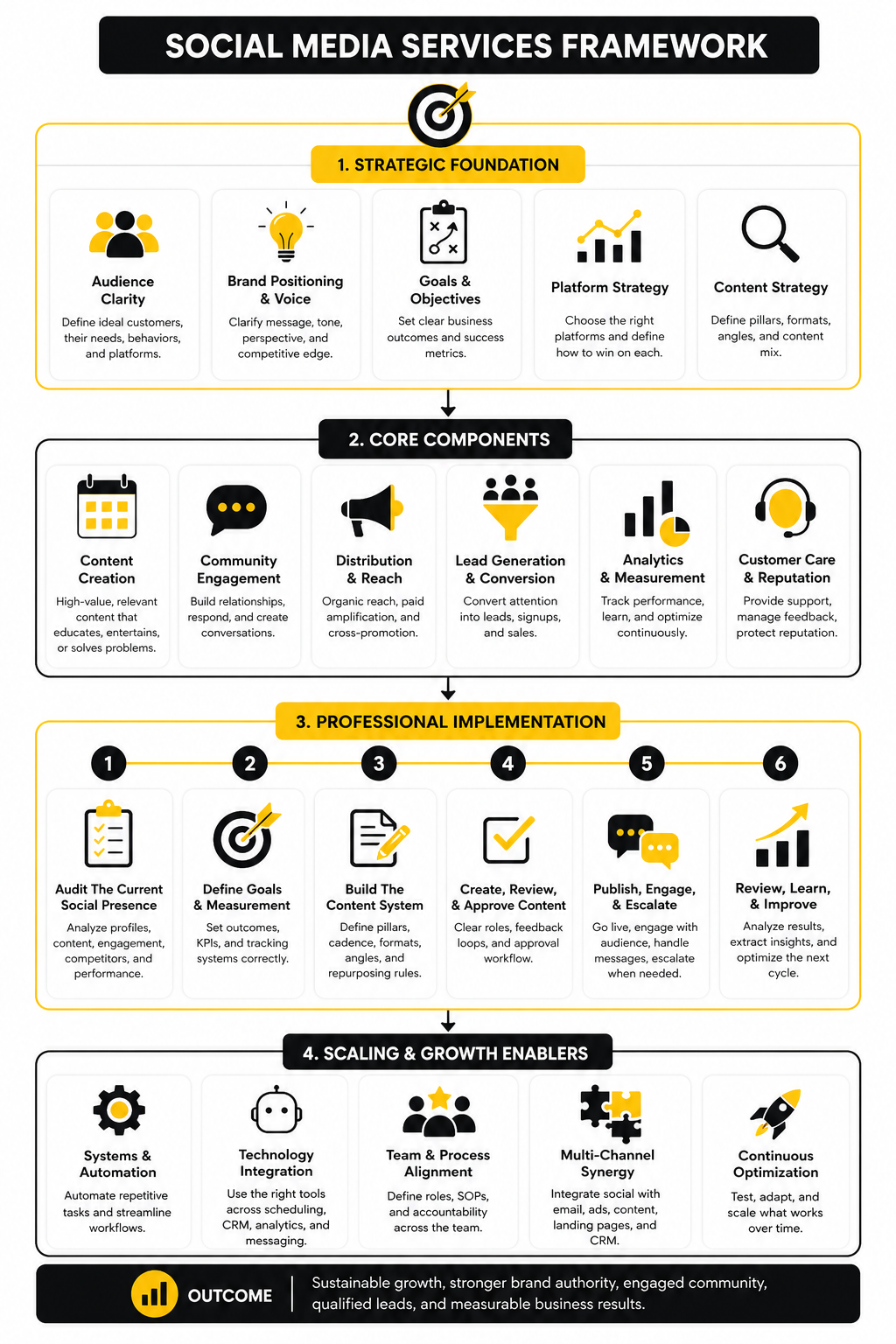
The framework is simple: strategy defines the direction, content creates the signal, distribution gets it seen, engagement builds trust, and reporting improves the next cycle. Each part depends on the others. When one part is missing, the whole system gets weaker.
This is why professional implementation matters. A brand may need scheduling support from a platform like Buffer, automated conversation flows through ManyChat, or a broader client acquisition system inside GoHighLevel. The tool is not the strategy, but the right tool can make the strategy easier to execute consistently.
Core Components Of A Strong Social Media Program
A strong program starts with positioning. Before a team creates posts, short videos, carousels, threads, ads, or influencer briefs, it needs to understand what the brand should be known for. This is where many social media services either create leverage or create clutter, because unclear positioning turns every content calendar into a guessing game.
The next layer is audience insight. A business should know what its buyers are trying to solve, what objections slow them down, what language they already use, and which platforms influence their decisions. This matters because social media is not one channel with one behavior; LinkedIn, TikTok, Instagram, Facebook, YouTube, Reddit, and X all reward different formats, rhythms, and expectations.
Then comes execution. Good execution means publishing consistently, adapting creative to each platform, responding to comments and messages, and measuring what actually moves the business forward. The goal is not to look busy; the goal is to create a system where attention becomes trust, and trust becomes action.
Strategy And Positioning
Strategy decides what the brand will say, who it will say it to, and why anyone should care. Without that, social becomes reactive: someone sees a trend, copies a competitor, posts something generic, and hopes the algorithm helps. That is not a strategy. That is gambling with content.
A practical strategy should define the brand’s audience, offer, voice, proof points, content pillars, platform priorities, and conversion path. It should also explain what the brand will not do, because focus is part of the advantage. The best social media services make these decisions early so the team can move faster later.
This is especially important because marketers are under pressure to connect social activity to business outcomes. Sprout Social’s 2025 ROI research notes that 65% of marketing leaders want direct connections between social campaigns and business goals, while only 30% of marketers say they can measure social media ROI. That gap is exactly where better strategy earns its keep.
Content Planning And Creative Direction
Content planning is not just filling a calendar. It is deciding which ideas deserve to be repeated, expanded, repurposed, tested, and retired. A useful plan gives the team enough structure to stay consistent without making every post feel stiff or predictable.
Creative direction turns that plan into assets people actually want to watch, read, save, share, or respond to. That includes hooks, formats, visual style, editing pace, caption structure, calls to action, and platform-specific adjustments. A LinkedIn thought-leadership post should not feel like a recycled Instagram caption, and a TikTok video should not feel like a corporate webinar cut into pieces.
This is where professional judgment matters. HubSpot’s 2025 social media research highlights that marketers are dealing with several challenges at once, including measuring ROI, creating engaging content, and keeping up with trends. A serious content system gives the brand room to move quickly without losing the plot.
Community Management And Customer Response
Community management is where social media services become very real. It is one thing to publish a smart post. It is another thing to handle comments, questions, complaints, praise, objections, and direct messages in a way that protects the brand and moves people forward.
People increasingly expect brands to be reachable inside social platforms. HubSpot’s social media research found that around a quarter of Gen Z, Millennial, and Gen X users contacted brands through direct messages for customer service in recent years, and that behavior is now part of the channel. Ignoring it is not neutral; it can make the brand feel unavailable.
A clear response system should define tone, escalation rules, response times, approved answers, and handoff points to sales or support. Tools can help here, especially when a business needs automated replies, lead capture, or comment-to-message flows through platforms like ManyChat. But automation should support the relationship, not make the brand sound like a vending machine.
Paid Social And Distribution
Organic content builds presence, but distribution decides how far strong creative can travel. Paid social gives brands more control over reach, audience testing, retargeting, lead generation, and campaign pacing. It also creates faster feedback loops because the team can see which messages, offers, and creative angles earn attention from specific audiences.
The mistake is treating paid social like a rescue plan for weak content. Ads can amplify a message, but they cannot fix unclear positioning, weak offers, or lazy creative. The best social media services connect organic learning with paid testing so the whole system improves over time.
This also means the landing experience matters. If a social campaign sends people to a slow, confusing, or generic page, performance will suffer even when the ad is good. For brands building campaign-specific pages, tools like Replo, ClickFunnels, or Systeme.io can fit naturally when the goal is to turn social traffic into leads, bookings, or sales.
Reporting And Decision Making
Reporting should not be a monthly screenshot dump. A useful report explains what happened, why it likely happened, what the team learned, and what should change next. That is how social moves from activity tracking to decision making.
Vanity metrics still have a place, but they cannot be the whole story. Reach, impressions, likes, saves, shares, comments, click-throughs, conversion rates, cost per lead, customer response time, and revenue influence all tell different parts of the truth. The job is to connect the right metrics to the right business goal.
This is why reporting has to be designed before the campaign starts. If the business wants leads, the tracking setup must support that. If the goal is retention or customer care, response quality and resolution speed matter more than follower growth. Professional social media services make measurement part of the operating system, not an afterthought.
Professional Implementation And Workflow
Once the strategy is clear, the work has to become operational. This is where social media services either become valuable or fall apart, because ideas alone do not publish posts, brief creators, manage approvals, answer comments, or build reports. A good implementation process turns the strategy into a weekly rhythm the team can actually maintain.
The process should be simple enough to follow and strong enough to scale. Most teams do not need a complicated machine with endless approval layers. They need a clean workflow that shows what is being planned, who owns each task, when content is due, what has been approved, and what results should be reviewed.
The point is not to remove creativity. The point is to protect it. When the operating system is clear, creators spend less time chasing missing details and more time making work that earns attention.
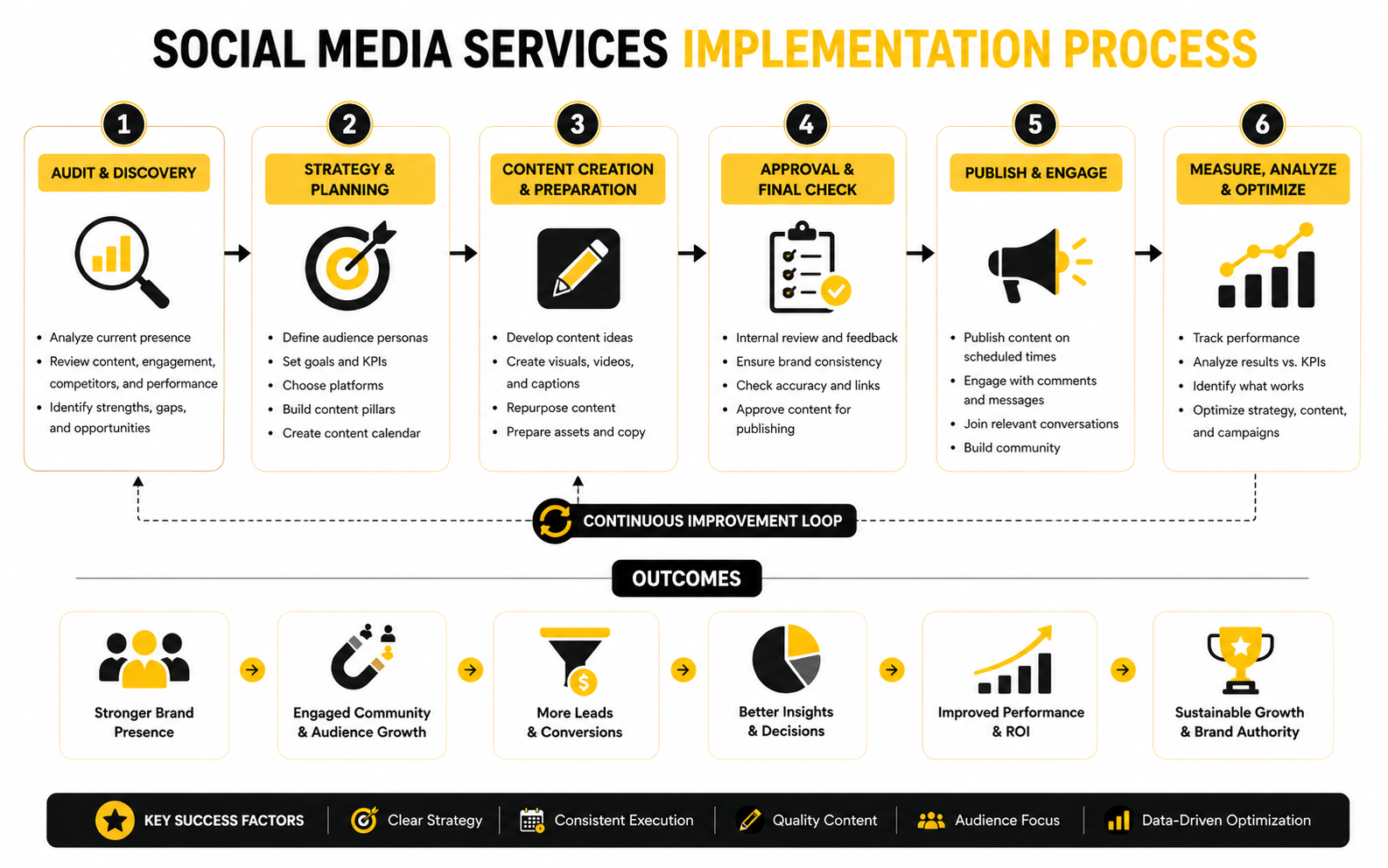
Step 1: Audit The Current Social Presence
The first step is understanding what already exists. That means reviewing profiles, bios, links, pinned posts, content formats, engagement patterns, posting frequency, audience comments, brand consistency, and competitor activity. This gives the team a realistic starting point instead of building a plan from assumptions.
A useful audit should separate opinions from evidence. Which posts attracted meaningful comments? Which topics created saves, shares, clicks, leads, or sales conversations? Which platforms are active but not productive?
This audit also shows whether the brand has a positioning problem, a creative problem, a distribution problem, or a measurement problem. Those are very different issues. Treating them the same is how teams waste months polishing content that was never strategically sound in the first place.
Step 2: Define Goals And Measurement
After the audit, the team needs to choose the outcome. Social media services can support awareness, authority, lead generation, customer service, recruitment, community growth, product education, event promotion, and retention. But the same content plan cannot optimize for everything equally.
Clear goals make measurement easier. If the goal is awareness, reach and profile growth may matter. If the goal is pipeline, clicks, form fills, booked calls, qualified conversations, and CRM movement matter more.
This is also where tracking needs to be set up properly. UTM links, platform pixels, CRM fields, lead source rules, and campaign naming conventions are boring, but they are important. Without them, the team ends up arguing about performance instead of improving it.
Step 3: Build The Content System
The content system connects strategy with production. It should define content pillars, platform formats, posting cadence, creative angles, approval roles, and repurposing rules. This gives the team enough structure to move fast without making every post feel copied and pasted.
A practical system usually includes a monthly theme, weekly priorities, and daily execution. The monthly theme keeps the brand aligned, the weekly priorities keep the calendar focused, and the daily execution keeps momentum alive. That balance matters because social platforms reward consistency, but audiences reward relevance.
Benchmarks can help, but they should not become handcuffs. Buffer’s 2026 benchmark analysis found that Instagram Reels remained a top format for reach, with median engagement and posting frequency varying heavily by platform. Use that kind of data as a reference point, then let your own audience behavior decide the final rhythm.
Step 4: Create, Review, And Approve Content
Content production needs clear ownership. Someone owns the idea, someone owns the copy, someone owns the creative, someone checks brand and compliance, and someone presses publish. In a small business, that may be one or two people. In a larger team, it may involve marketing, sales, product, legal, customer success, and leadership.
The approval process should catch real issues without killing speed. That means using clear status labels such as draft, internal review, client review, approved, scheduled, published, and reported. It also means giving feedback that is specific, not vague comments like “make it pop.”
This is one reason scheduling and collaboration tools can be useful. A platform like Buffer can help teams plan and queue posts, while a broader system like GoHighLevel can support follow-up when social activity turns into leads or sales conversations. The workflow should make execution easier, not add another dashboard nobody checks.
Step 5: Publish, Engage, And Escalate
Publishing is not the finish line. Once content goes live, the team needs to watch the response, answer relevant comments, handle direct messages, capture useful feedback, and escalate anything sensitive. This is where the brand becomes human or feels completely absent.
Engagement rules should be written before the team needs them. What gets a public reply? What moves to direct messages? What should be handed to support, sales, legal, or leadership? These rules help the brand respond quickly without improvising under pressure.
This part matters because customer expectations have changed. The 2025 Sprout Social Index is based on surveys of more than 4,000 consumers and 1,200 marketers and focuses heavily on the rising expectation that brands show up with more responsive customer care on social. A social media services team that ignores engagement is only doing half the job.
Step 6: Review, Learn, And Improve
The final step is review. Not a bloated report nobody reads, but a sharp review of what worked, what failed, what surprised the team, and what should change next. This is where social media turns into a learning engine.
A good review looks at patterns, not isolated wins. One high-performing post can be luck. Three or four strong posts around the same audience pain point is a signal worth testing again.
The best teams build this into their weekly or monthly process. They review creative, audience response, platform changes, campaign performance, and customer questions. Then they adjust the next cycle with more discipline than emotion, which is exactly how social media services become more profitable over time.
Statistics And Data
Data should make social media services sharper, not heavier. The point is not to collect every number available from every platform. The point is to understand which signals explain performance, which signals predict business impact, and which signals are just noise dressed up as insight.
This matters because social is crowded, fragmented, and easy to misread. A post can have strong reach and weak commercial value. Another post can look modest publicly but create qualified conversations, demo requests, booked calls, or repeat customers behind the scenes.
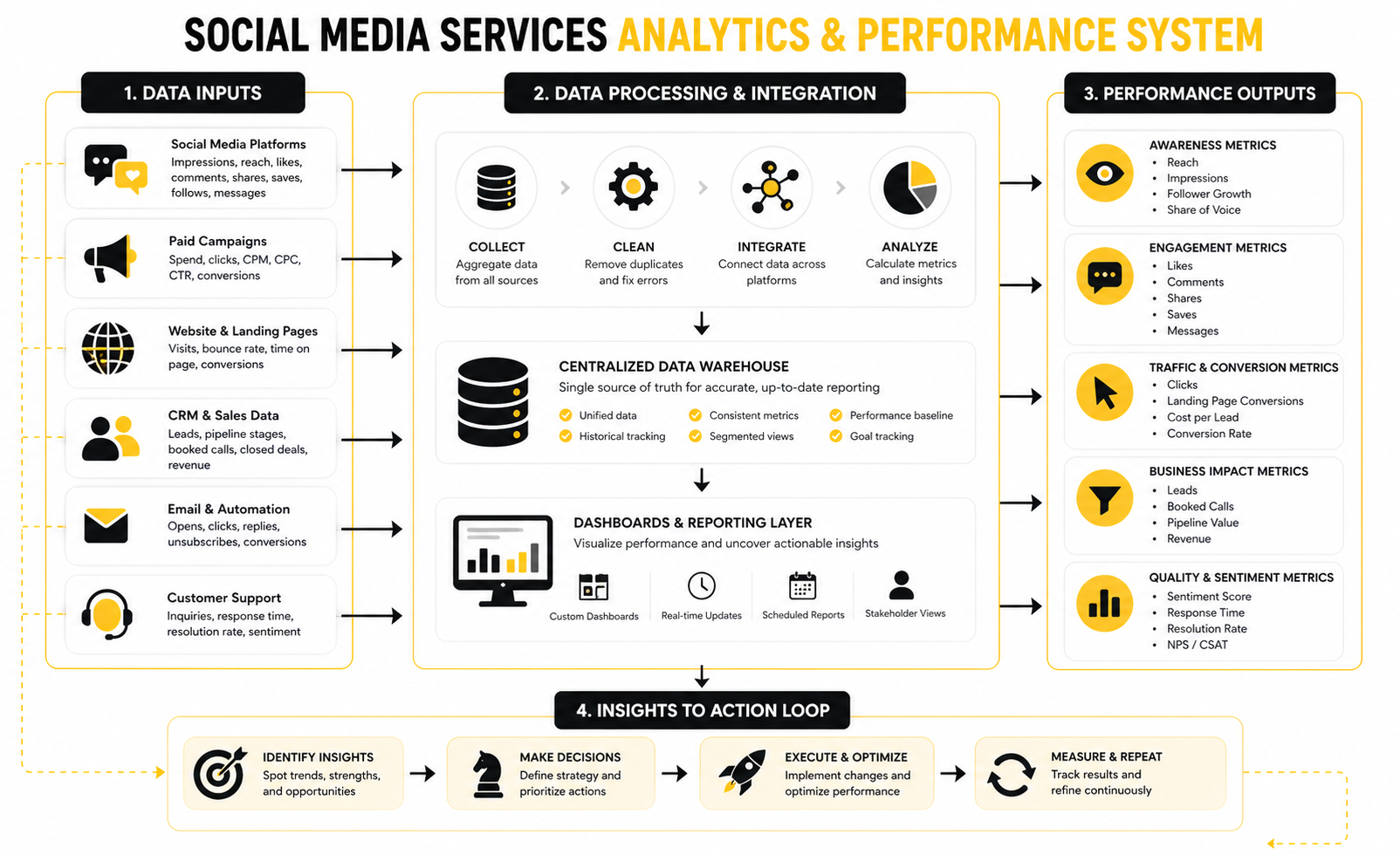
The best teams read social data in layers. They look at visibility first, engagement second, conversion third, and retention or customer care last. That sequence helps separate what gets attention from what actually grows the business.
Visibility Metrics Show Whether The Market Is Seeing You
Visibility metrics include reach, impressions, video views, profile visits, follower growth, and share of voice. These numbers tell you whether the brand is getting in front of enough relevant people. They do not prove trust, intent, or revenue by themselves.
This is where teams often overreact. If reach drops, they assume the content is bad. If reach spikes, they assume the strategy is working. Neither conclusion is safe without context.
A reach spike can come from controversy, low-intent entertainment, paid distribution, or a one-off algorithm push. A reach decline can happen during a platform shift, a seasonal dip, or a deliberate move toward narrower but more qualified content. Good social media services interpret reach as a diagnostic signal, not a scoreboard.
Engagement Metrics Show Whether People Care
Engagement metrics include likes, comments, saves, shares, replies, mentions, and direct messages. These signals show whether people found the content relevant enough to react, keep, discuss, or pass along. They are stronger than raw visibility because they show some level of human response.
But engagement still needs judgment. A sarcastic comment is not the same as a buying question. A save on an educational post may be more valuable than a like on a trendy post. A share from the right niche audience can matter more than thousands of passive views.
Benchmarks help create perspective, but they should never replace brand-specific learning. Buffer’s social media insights hub tracks platform benchmarks, best-time-to-post data, and performance trends from aggregated social data, which can help teams understand whether their numbers are unusually low, normal, or genuinely strong. The real move is to compare benchmarks against your own goals and audience behavior.
Conversion Metrics Show Whether Social Is Creating Business Momentum
Conversion metrics connect social activity to real actions. These include link clicks, landing page visits, lead form submissions, booked calls, trial signups, purchases, email subscriptions, and CRM stage movement. This is where social media services become easier to defend inside a business.
The hard part is attribution. People do not always see one post, click once, and buy immediately. They may watch videos for weeks, check reviews, ask a friend, visit the website directly, join an email list, and return later through search or retargeting.
That is why conversion tracking should combine platform data with website analytics, CRM data, and sales feedback. Campaign pages built in tools like ClickFunnels or Systeme.io can make the path clearer when the goal is lead capture or sales. A CRM and automation setup inside GoHighLevel can also help connect social leads to follow-up, appointments, and revenue.
Customer Care Metrics Show Whether The Brand Is Responsive
Social is not only a marketing channel. It is also a customer care channel, and that changes what should be measured. Response time, resolution time, sentiment, escalation volume, unanswered messages, and repeated customer issues all matter.
Sprout Social’s 2025 ROI research highlights the measurement gap clearly: 65% of marketing leaders want direct connections between social campaigns and business goals, while only 30% of marketers say they can measure social media ROI. That gap becomes even bigger when teams ignore support and customer experience data.
The action here is simple: define what a good response system looks like before volume grows. Decide which comments need replies, which messages become sales opportunities, and which issues need escalation. If the brand uses automated messaging through ManyChat, the automation should improve speed without making customers feel ignored.
Benchmarks Are Useful, But They Are Not The Strategy
Benchmarks help teams avoid operating in a bubble. If a brand has no reference point, it can mistake weak performance for normal performance or chase unrealistic goals that do not match the platform, industry, or audience. External data is useful because it adds perspective.
But benchmarks are averages, and averages can be dangerous. A local service business, a B2B software company, a beauty brand, and a creator-led education brand should not measure success the same way. They have different buying cycles, audience expectations, margins, and conversion paths.
DataReportal’s Digital 2025 reporting shows that social platforms remain deeply embedded in everyday behavior, including discovery, entertainment, news, and brand interaction across markets. That scale explains why social matters, but it does not tell an individual business what to post tomorrow. Your own data has to make that decision.
The Reporting System Should Drive Action
A strong report should answer four questions. What happened? Why did it happen? What does it mean? What are we doing next? If a report does not lead to a decision, it is probably too bloated or too vague.
The cleanest reporting structure is usually a scorecard plus commentary. The scorecard tracks the core numbers, while the commentary explains the pattern behind them. This keeps everyone focused on learning, not just counting.
For most social media services, the monthly review should include:
- Top-performing content and why it worked
- Weak content and what should be changed
- Audience questions, objections, and repeated comments
- Platform-level trends worth adapting to
- Conversion movement from social traffic or leads
- Recommendations for the next content cycle
The real value is not the dashboard. The real value is the decision that comes after the dashboard. That is where measurement turns into better strategy, better creative, and better business outcomes.
Tools, Automation, And Performance Measurement
At this stage, the question is not whether a brand should use tools. It should. The real question is which parts of the social media services workflow deserve automation, which parts need human judgment, and which parts should stay deliberately manual because trust is involved.
Automation is useful when it removes repetitive work. Scheduling posts, collecting leads, routing messages, tagging contacts, building reports, and standardizing follow-up can all become faster with the right setup. But automation becomes a liability when it makes the brand sound generic, hides customer problems, or pushes people into funnels before they are ready.
This is the tradeoff: speed helps, but only when the system is still thoughtful. A brand that automates everything can become efficient at being forgettable. A brand that automates the right things gives its team more time for strategy, creative thinking, and real conversations.
Choosing Tools Without Building A Mess
A social media stack should be built around the workflow, not around whatever tool looks exciting this month. Start with the jobs that need to happen every week: planning, publishing, engagement, reporting, lead capture, follow-up, and conversion tracking. Then choose the simplest toolset that supports those jobs without creating duplicate dashboards.
For many teams, a scheduling tool like Buffer can cover planning and publishing. For businesses that rely on social comments, direct messages, and automated conversations, ManyChat can help turn engagement into structured follow-up. For agencies or service businesses that need CRM, pipelines, appointment booking, automation, and client management in one place, GoHighLevel can make sense.
The mistake is stacking tools before the process is clear. More software does not automatically mean better execution. It often means more places for tasks, data, and accountability to disappear.
Using AI Without Losing The Brand
AI can speed up research, ideation, repurposing, caption drafting, reporting summaries, customer response suggestions, and creative testing. That is genuinely useful. Hootsuite’s 2025 social trends research highlights that teams are moving beyond basic AI tasks and using AI to support strategy, analysis, and content experimentation.
But AI should not become the brand voice. The more content starts to sound like everyone else, the more valuable real perspective becomes. Social media services need to use AI as an assistant, not as a replacement for taste, positioning, lived expertise, and customer understanding.
The practical rule is simple. Use AI to create first drafts, organize information, generate variations, and reduce admin work. Keep final judgment, messaging, sensitive replies, and strategic decisions in human hands.
Scaling Content Without Diluting Quality
Scaling social content is not just publishing more. It means increasing output while keeping the brand recognizable, useful, and strategically focused. That requires systems, but it also requires restraint.
A strong scaling model usually starts with a few core ideas. One customer insight can become a short video, a LinkedIn post, an email, a carousel, a founder post, a sales enablement snippet, and a retargeting ad. This is smarter than forcing the team to invent brand-new ideas every day.
The risk is repetition without freshness. Repurposing should adapt the idea to the platform and audience, not copy and paste the same thought everywhere. The best social media services build content libraries, but they also keep listening so the content does not become stale.
Managing Brand Risk And Reputation
Social media moves fast, and mistakes travel faster than most approval processes. A careless joke, delayed response, inaccurate claim, poorly disclosed partnership, or insensitive trend can create damage that takes far longer to repair than it took to post. This is why risk management belongs inside the social workflow, not outside it.
The 2025 Sprout Social Index reports that consumers increasingly expect brands to be responsive and responsible on social, including around customer care and misinformation. That matters because audiences are not only judging what brands publish. They are judging what brands allow, ignore, amplify, and correct.
A good risk system should include brand voice guidelines, escalation rules, compliance review when needed, crisis response templates, and clear ownership. This does not mean every post needs legal review. It means the team knows where the line is before pressure hits.
Balancing Organic, Paid, Creator, And Owned Channels
Social media services get stronger when they do not rely on one channel type. Organic content builds presence and trust. Paid social creates controlled reach and faster testing. Creator partnerships add borrowed credibility and cultural fluency. Owned channels like email, SMS, communities, and websites protect the business from being fully dependent on platform algorithms.
This balance matters because platform performance changes. Reach can drop, ad costs can rise, formats can shift, and audience behavior can move quickly. A brand that only wins on one platform is more exposed than it thinks.
The smarter approach is to let social create demand and then capture that demand through owned systems. A landing page built with Replo, ClickFunnels, or Systeme.io can help convert campaign traffic, while email tools like Brevo or Moosend can keep the relationship alive after the first click.
Knowing When To Insource Or Outsource
Not every business should outsource everything. Strategy, customer insight, leadership perspective, and product knowledge often need strong internal involvement. External partners can help with structure, production, execution, paid media, analytics, and creative volume, but they need access to the real business to do great work.
The best model is usually a hybrid. The internal team owns the brand truth, offer, customer intelligence, and final accountability. The external social media services partner brings process, speed, platform expertise, creative execution, and an outside perspective.
This works only when expectations are clear. Define who approves content, who answers customers, who owns reporting, who manages paid spend, who handles creative assets, and who makes strategic decisions. Ambiguity is expensive, especially when the content calendar is moving every week.
The Advanced Standard: Build A Learning System
The strongest social programs are not just publishing systems. They are learning systems. Every post, comment, campaign, message, and report should teach the business something about the audience.
This is where social becomes more than marketing. It can reveal objections sales teams hear later, product questions that need clearer education, customer frustrations support teams should fix, and language that belongs on landing pages, ads, and emails. That is the hidden value most brands miss.
A mature social media services model captures those insights and sends them back into the business. The content gets better, the offer gets clearer, the customer experience improves, and the brand becomes sharper. That is the compounding effect worth building toward.
Choosing The Right Social Media Services Partner
Choosing a partner is not just about who can make nice posts. The right partner should understand strategy, content, distribution, community, reporting, and the business model behind the work. Social media services should help the company make better decisions, not simply add more activity to the calendar.
A good partner will ask uncomfortable but useful questions. Who is the audience? What is the offer? What does the sales process look like? Which metrics matter to leadership? Where does social fit inside the wider customer journey?
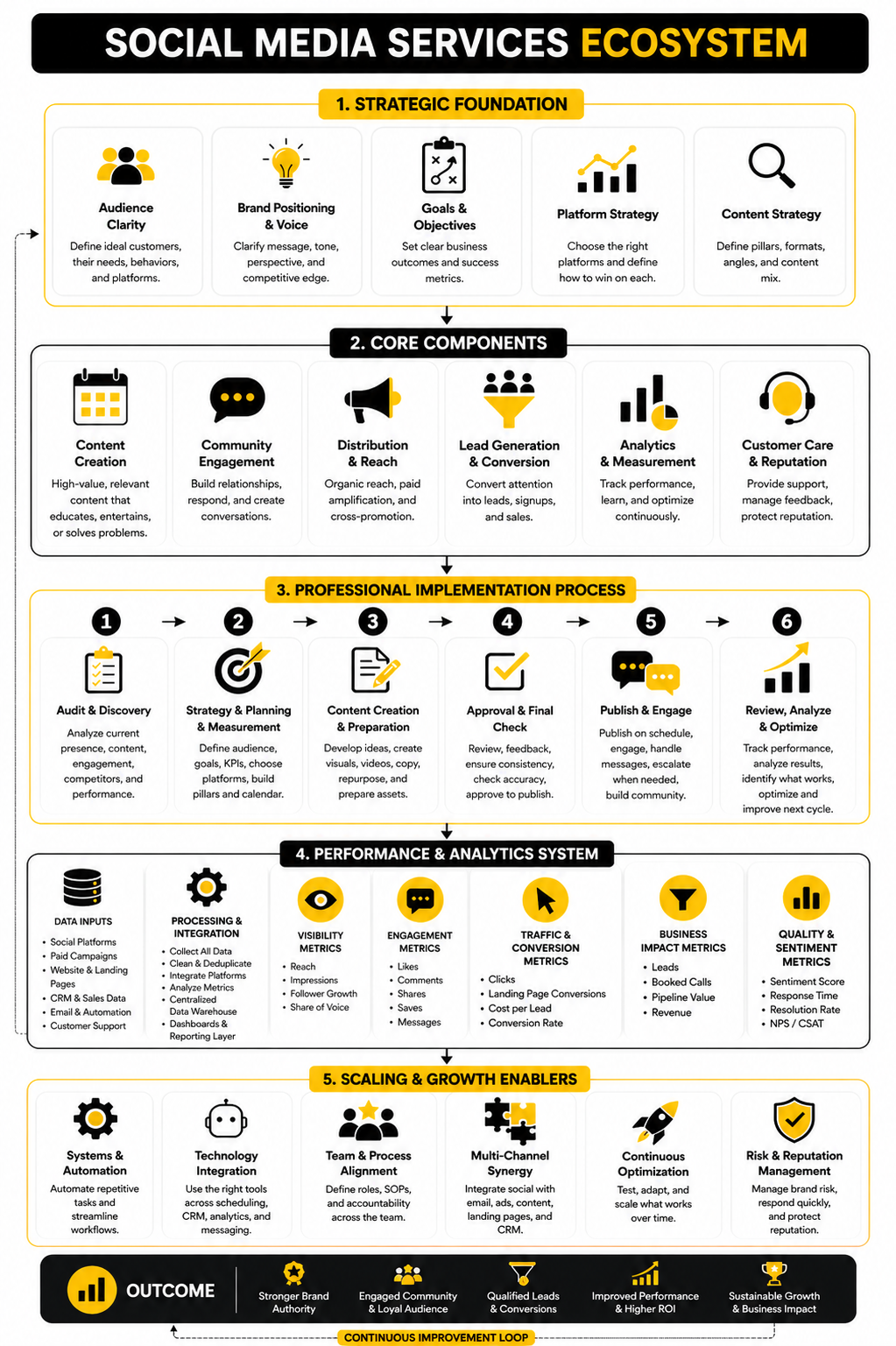
This is also where the full system comes together. Strategy, content, automation, paid media, reporting, customer care, and owned-channel follow-up should not operate as disconnected pieces. They should work as one ecosystem that turns attention into trust, trust into action, and action into measurable business growth.
What A Strong Partner Should Bring
A strong partner brings process first. They should be able to explain how strategy becomes a content calendar, how content becomes campaigns, how engagement becomes insight, and how reporting becomes decisions. If they cannot explain the workflow clearly, execution will probably become messy later.
They should also bring platform judgment. Social media changes constantly, and the best partner knows when to follow a trend, when to adapt it, and when to ignore it. That judgment matters because chasing every platform shift can drain the team and confuse the audience.
Finally, they should understand commercial outcomes. The 2025 Sprout Social Index is based on surveys of more than 4,000 consumers and 1,200 marketers and reinforces how much pressure teams face to prove social’s business impact. A partner who only reports likes and impressions is not enough anymore.
Red Flags To Watch For
Be careful with any provider that promises guaranteed virality. Nobody controls the algorithm, and anyone pretending they do is selling comfort, not strategy. Strong social media services can improve the odds with better positioning, creative testing, distribution, and measurement, but they cannot honestly guarantee explosive reach on demand.
Another red flag is content without discovery. If a partner does not ask about the customer, offer, funnel, sales cycle, brand voice, or past performance, they are probably building from templates. Templates can save time, but they cannot replace real strategic work.
Also watch for reporting that looks impressive but avoids hard questions. A beautiful dashboard is useless if it does not explain what should change next. The report should make the next decision easier, not just make the last month look busy.
How To Brief A Social Media Services Team
A good brief saves weeks of confusion. Give the team your offer, audience, positioning, brand guidelines, previous content, analytics access, customer objections, sales materials, and examples of content you like or dislike. The more context they have, the faster they can produce work that feels accurate.
The brief should also define the business goal. Are you trying to build authority, generate leads, support paid campaigns, attract talent, improve customer care, or launch a product? Each goal changes the content mix, cadence, metrics, and workflow.
Do not hide the messy parts. If sales follow-up is slow, landing pages are weak, customer support is overloaded, or the offer is unclear, the social team needs to know. Social can amplify a strong business system, but it can also expose a weak one.
FAQ - Built For Complete Guide
What Are Social Media Services?
Social media services are professional services that help a business plan, create, publish, manage, measure, and improve its presence on social platforms. They can include strategy, content creation, community management, paid social, influencer coordination, analytics, automation, and reporting. The strongest version connects social activity to real business goals instead of treating social as a place to post random updates.
Why Do Businesses Need Social Media Services?
Businesses need social media services because social is now part of discovery, trust-building, customer care, and sales influence. People use platforms to compare brands, ask questions, read comments, watch product education, and decide who feels credible. Without a clear system, social becomes inconsistent and hard to measure.
What Should Be Included In A Social Media Services Package?
A useful package should include strategy, content planning, creative production, publishing, engagement management, reporting, and optimization. Depending on the business, it may also include paid ads, creator partnerships, landing pages, CRM setup, or automated messaging. The package should match the business goal, not a generic list of deliverables.
How Much Do Social Media Services Cost?
Costs vary based on strategy depth, number of platforms, content volume, creative complexity, paid media management, reporting needs, and whether community management is included. A small business may need a lean execution package, while a growing brand may need a full strategy, production, and performance system. The important question is not only price; it is whether the service can create measurable value.
How Long Does It Take For Social Media Services To Work?
Social media usually needs time because trust, audience learning, and creative testing build over multiple cycles. Some paid campaigns can generate faster feedback, but organic growth and authority often require consistent execution over months. A serious team should be able to show early learning quickly, even if the bigger compounding results take longer.
Which Platforms Should A Business Focus On?
The best platforms depend on the audience, offer, content strengths, and buying process. B2B brands may lean into LinkedIn, YouTube, X, and niche communities, while consumer brands may prioritize Instagram, TikTok, Facebook, Pinterest, or creator-led channels. The smart move is to focus where the audience already pays attention and where the business can create consistently good content.
Are Social Media Services Better Than Hiring In-House?
Neither option is automatically better. In-house teams usually have deeper brand and customer context, while external providers can bring speed, process, creative production, platform experience, and broader market perspective. Many businesses get the best result from a hybrid model where internal experts provide insight and external specialists help execute.
Can Social Media Services Help Generate Leads?
Yes, but only when the system is built for it. Lead generation requires clear offers, strong calls to action, campaign tracking, landing pages, follow-up, and often a CRM or automation workflow. Tools like GoHighLevel, ClickFunnels, and Systeme.io can support that path when they are connected to a clear strategy.
What Metrics Matter Most For Social Media?
The right metrics depend on the goal. Awareness needs reach, impressions, follower quality, and share of voice. Engagement needs comments, saves, shares, replies, and direct messages. Conversion needs clicks, leads, booked calls, purchases, and CRM movement.
Should Social Media Services Include Paid Ads?
Paid ads are not required for every brand, but they often help when the business needs faster testing, controlled reach, retargeting, or lead generation. Organic content can build trust and insight, while paid social can amplify proven messages. The best setup uses both carefully instead of treating ads as a fix for weak content.
How Does Automation Fit Into Social Media Services?
Automation should remove repetitive work, not replace judgment. Scheduling, lead routing, message triggers, form collection, and follow-up reminders can all be automated. Customer-sensitive replies, brand positioning, crisis decisions, and creative direction still need human oversight.
What Makes Social Media Services Successful?
Success comes from alignment. The strategy, content, distribution, engagement, tracking, and follow-up all need to support the same business goal. When those pieces work together, social stops being a content treadmill and becomes a real growth system.
Work With Professionals
Explore 10K+ Remote Marketing Contracts on MarkeWork.com
Most marketers spend too much time chasing clients, competing on crowded platforms, and losing a percentage of every project to middlemen.
MarkeWork gives you a better way. Browse thousands of remote marketing contracts and connect directly with companies desperate to hire skilled marketers like you, without platform commissions and without unnecessary gatekeepers.
If you're serious about finding better opportunities and keeping 100% of what you earn, explore available contracts and create a profile for free at MarkeWork.com.