

A strong social media strategy is no longer a nice extra for marketing teams. It now sits much closer to demand generation, brand building, customer research, community management, and even revenue than many companies assumed a few years ago. With 5.24 billion active social media user identities worldwide in early 2025, the question is not whether your audience uses social platforms. The real question is whether your brand shows up there with a clear plan or just adds more noise.
That distinction matters because social media has become fragmented, fast-moving, and deeply contextual. Platform habits differ, content expectations differ, and even the reasons people use each network differ, which is exactly why a copy-paste posting routine underperforms. Research from Pew shows that how people consume information across platforms varies significantly, while newer market data from the 2025 Sprout Social Index shows consumers are still spending substantial time on social and expect brands to be more relevant, responsive, and memorable.
This article breaks social media strategy into a practical system you can actually use. Instead of treating social as a calendar full of posts, we will treat it as an operating model that connects audience insight, channel choice, content design, measurement, and execution. That gives you a much better shot at building momentum instead of chasing isolated wins.
Article Outline
- Why Social Media Strategy Matters Now
- The Strategic Framework at a Glance
- Audience, Positioning, and Channel Fit
- Content Systems That Compound
- Measurement, Testing, and Optimization
- Professional Implementation Across Teams and Tools
Why Social Media Strategy Matters Now
Most brands do not fail on social media because they lack ideas. They fail because they confuse activity with strategy, publish without a clear point of view, and measure success with disconnected metrics. A social media strategy fixes that by defining who you want to reach, what role each platform should play, what outcomes matter, and how the work will be executed consistently over time.
That matters even more now because social platforms influence far more than awareness. Social increasingly shapes discovery, trust, validation, and purchase behavior, especially as social commerce keeps expanding and platform-native shopping experiences become more normal for consumers, a shift reflected in eMarketer’s 2025 social commerce forecast and broader market analysis from DHL’s 2025 social commerce report. In plain English, your social presence now affects how people find you, how they judge you, and whether they move closer to buying.
There is another reason this has become more strategic: content volume is exploding, but attention is not. The brands that keep winning are usually not the brands posting the most. They are the ones with sharper positioning, better editorial judgment, stronger creative packaging, and a repeatable system for learning what works.

A useful way to think about it is this: social media strategy is the bridge between business goals and daily publishing decisions. Without that bridge, content teams default to reacting, recycling competitor ideas, or posting what feels timely in the moment. With it, every post has a job, every channel has a purpose, and every campaign produces signals you can actually learn from.
The Strategic Framework at a Glance
The framework in this article is built around six connected decisions, not random best practices. First, you clarify the business goal. Then you define the audience and the specific problem your brand can own in their mind. After that, you choose the right channels, create content pillars that fit those channels, build measurement around business-relevant outcomes, and finally install the workflows needed to run the whole system professionally.
This structure matters because social media strategy breaks when teams jump straight to content production. They start with formats before they define positioning, or they obsess over reach before they know what action they want that reach to create. A better approach is sequential: objective first, audience second, channel third, content fourth, measurement fifth, operations sixth.
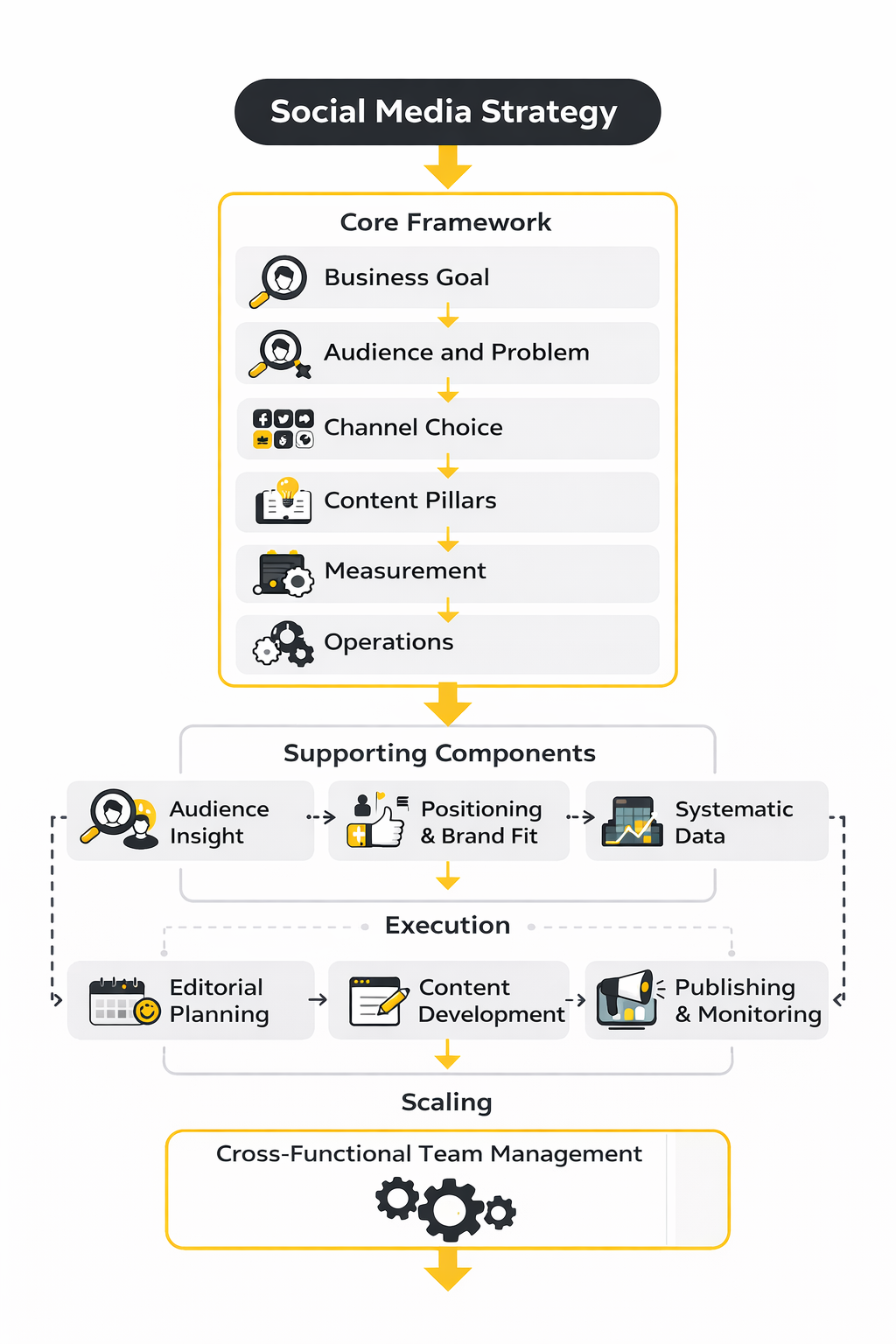
You can also think of the framework as moving from strategy to execution without losing the thread. The strategic layer answers what matters and why. The operational layer answers who does what, how often, with which tools, and how performance gets reviewed. That is what turns social from a stream of posts into a system that compounds.
In the next part, we will start where strong strategies actually begin: audience, positioning, and channel fit. That is the point where a brand stops trying to be everywhere for everyone and starts becoming relevant to the people it most needs to reach.
Audience, Positioning, and Channel Fit
A social media strategy gets sharper the moment you stop thinking in terms of “our audience” as one blob. Real audiences are made up of different intent states, attention habits, trust triggers, and content expectations. That is why the same person may watch product explainers on YouTube, follow creators on Instagram, check industry takes on LinkedIn, and use TikTok or Reddit to validate opinions before buying.
That behavior is not random. Global research shows people now use an average of 6.83 social platforms per month, which means your social media strategy has to account for overlap, not just reach. The practical takeaway is simple: your audience is not choosing one platform instead of all others, so your job is to understand what role each platform plays in their decision-making.
Start With Audience Jobs, Not Demographics
Demographics still matter, but they are not enough to guide content decisions on their own. Age, gender, income, and geography can help with media planning, yet they rarely explain why somebody stops scrolling, saves a post, clicks a profile, or shares a brand with a colleague. A better social media strategy starts with audience jobs: what people are trying to learn, solve, compare, express, or belong to when they open a platform.
This is where many brands drift into generic messaging. They define the audience as “small business owners” or “busy parents” and then publish content that could belong to anyone. The stronger move is to map the recurring questions, tensions, and ambitions that show up before action, because those are the moments content can actually become useful.
A simple test helps here. If your audience description cannot explain why someone would care about one post over another, it is probably too vague to support a real strategy. You need insight that leads directly to choices about format, tone, proof, and distribution.
Platform Behavior Tells You What to Create
Once you know the jobs your audience is trying to get done, the next step is understanding where those jobs show up. Platform choice is not mainly about which network is biggest. It is about where your message fits the native behavior already happening there.
The broad usage numbers make this clear. In the United States, YouTube and Facebook still reach the widest adult audiences, while Instagram, TikTok, WhatsApp, and Reddit continue gaining ground. The same Pew data also shows pronounced age differences, with younger adults far more concentrated on Instagram, TikTok, Snapchat, and Reddit, while YouTube and Facebook remain much broader across age groups.
That matters because channel fit changes the kind of content that works. YouTube often rewards depth, clarity, and searchability. TikTok tends to reward immediacy, packaging, and pattern interruption. LinkedIn works better when the content carries a strong professional point of view rather than watered-down corporate language. Instagram still depends heavily on visual identity and short-form narrative framing, while Reddit punishes obvious brand theater faster than almost anywhere else.
Positioning Comes Before Posting
Here is the mistake that burns time: brands start making content before they decide what they want to be known for. Then six months later, the feed looks busy but forgettable. A social media strategy only starts compounding when the audience can quickly understand what your brand consistently helps them do, think, avoid, or achieve.
Positioning on social is not your full company manifesto. It is the repeated angle that gives your content a recognizable edge. That edge can come from depth, candor, speed, contrarian clarity, strong proof, practical education, or a distinct creative style, but it has to be chosen deliberately.
This is also why trend participation is often overrated. The better path is not to jump into every cultural moment, but to decide which conversations fit your brand’s authority and which ones do not. That direction is becoming more important as Sprout Social’s 2025 Index highlights a familiar pattern: consumers want brands that understand context and relevance, not brands that mindlessly recreate every meme in sight.
Choose Fewer Promises and Make Them Credible
Good positioning is not built by saying everything. It is built by making fewer promises and backing them up consistently. If your brand wants to own practical expertise, then your posts need to teach clearly and often. If your brand wants to own premium judgment, your content has to filter noise rather than contribute to it.
That sounds obvious, but it changes the content mix immediately. You stop publishing vague inspiration and start publishing material that proves something. You stop asking what will fill the calendar and start asking what will strengthen memory structures around your brand.
Credibility is especially important now because social discovery is tied closely to trust. People do not just consume content on social platforms. They use it to validate opinions, compare experiences, and pressure-test claims. So your social media strategy should help the audience move from interest to belief, not just from impression to impression.
Channel Fit Is About Role, Not Presence
Most companies do not need to win everywhere. They need to assign each channel a role and execute that role well. When every platform is treated the same, the result is usually watered-down creative, weak analytics, and a team that feels permanently behind.
A cleaner model is to define channels in tiers. One or two platforms serve as primary growth channels. Another one or two support trust, retention, or community. Everything else becomes secondary, experimental, or dormant until there is a reason to invest. This approach is much more realistic in a world where overall social adoption is still rising, with 5.24 billion active social media user identities tracked in early 2025, but attention remains limited and fragmented.
That structure also protects quality. You can put real energy behind the platforms where your brand has the strongest chance of earning attention instead of spraying effort across every network with no real advantage. In practice, that usually beats being mediocre in six places.
A Simple Way to Map Channel Fit
You do not need a complicated framework to evaluate channels. You need honest answers to a few strategic questions and the discipline to follow them. The goal is not to find the perfect platform in theory, but to find the right platform mix for your message, your team, and your business model.
Use this filter:
- Where does the audience already spend time for the problem or interest you serve?
- What content format can your team produce repeatedly at a high standard?
- Which platform best matches your sales cycle, price point, and level of consideration?
- Where can your brand contribute something distinct instead of just copying what is already there?
- Which channel gives you enough signal to learn fast and improve?
A B2B company with strong operator insights may find LinkedIn and YouTube more valuable than chasing every short-form trend. A visually led ecommerce brand may find Instagram, TikTok, and creator partnerships far more natural. A local service business may benefit more from consistent proof, reviews, and response systems than from trying to look culturally fluent on every platform.
What This Means for the Rest of the Strategy
Once audience, positioning, and channel fit are clear, content gets easier to design because it finally has constraints. Those constraints are useful. They tell you what to say more often, what to ignore, which formats deserve investment, and how each platform should support the customer journey.
This is the point where a social media strategy stops being theoretical. You now know who you are trying to reach, what mental territory you want to own, and where that message has the best chance of landing. From here, the next challenge is building content systems that do not depend on constant reinvention.
Content Systems That Compound
The best brands on social are rarely creating from scratch every day. They are running systems. That is a crucial distinction, because content quality matters, but consistency, reuse, and strategic repetition matter too.
In the next part, we will break down how to build content pillars, format families, and publishing workflows that help your social media strategy compound instead of resetting every week.
Content Systems That Compound
Once the audience is clear and each channel has a defined role, the next challenge is production. This is where many brands quietly fall apart. They may have a smart social media strategy on paper, but the weekly reality still looks like rushed brainstorming, last-minute approvals, and random posts built to fill empty calendar slots.
That is why content systems matter more than isolated ideas. A system gives you repeatability without making the work robotic. It helps you publish with consistency, test deliberately, reuse strong material, and keep quality high even when the team is busy.
Build Around Content Pillars, Not Endless Topics
The easiest way to make social harder than it needs to be is to invent a new theme every day. A better approach is to define a small set of content pillars that sit directly on top of your positioning. These pillars are not generic buckets like “tips,” “company news,” and “culture.” They should reflect the few themes you want the market to associate with your brand over time.
This creates two advantages at once. First, it reduces decision fatigue because your team already knows the lanes you play in. Second, it improves memorability because the audience starts seeing a repeated pattern instead of disconnected posts.
For most brands, three to five pillars are enough. More than that usually signals weak prioritization rather than strategic depth. If everything is a pillar, nothing really is.
Turn Pillars Into Format Families
A pillar becomes useful only when it is translated into repeatable formats. That means your social media strategy should not stop at deciding what themes matter. It should also define how those themes will show up in a way that matches platform behavior and production reality.
This is where format families help. One pillar might become a short talking-head video, a carousel breakdown, a founder opinion post, a customer proof clip, and a comment-driven follow-up. Another might become a recurring series that answers the same type of question each week from a slightly different angle.
That structure matters because modern social rewards packaging as much as subject matter. Recent market data from HubSpot’s marketing statistics roundup shows marketers still rank short-form video as the strongest ROI-producing format, but that does not mean every brand should only make short clips. It means strong strategies translate core ideas into the formats most likely to earn attention on each platform.
Repetition Is a Feature, Not a Problem
A lot of teams worry that repeating themes will make them look boring. In practice, the opposite is usually true. Brands are often far less repetitive than they think, because the audience only sees a fraction of what gets published and rarely remembers a message after one exposure.
This is one of the most useful mindset shifts in social media strategy. You are not trying to sound endlessly novel. You are trying to become recognizable, relevant, and credible through repeated proof in slightly different packaging.
That is why strong social content often feels familiar without feeling stale. The idea stays stable, while the angle, hook, example, format, or delivery changes. Over time, that pattern compounds into brand memory.
Make the Workflow Visible
Even the best content plan breaks when execution lives in someone’s head. Once you get past a solo creator or tiny team, the process needs to be visible enough that work can move without constant confusion. Editorial planning, production, approvals, publishing, community management, and reporting all need defined owners.
This is the point where strategy becomes operational. You are no longer deciding just what to post. You are deciding how ideas become published assets, how quickly the team can respond to new opportunities, and where quality control actually happens.
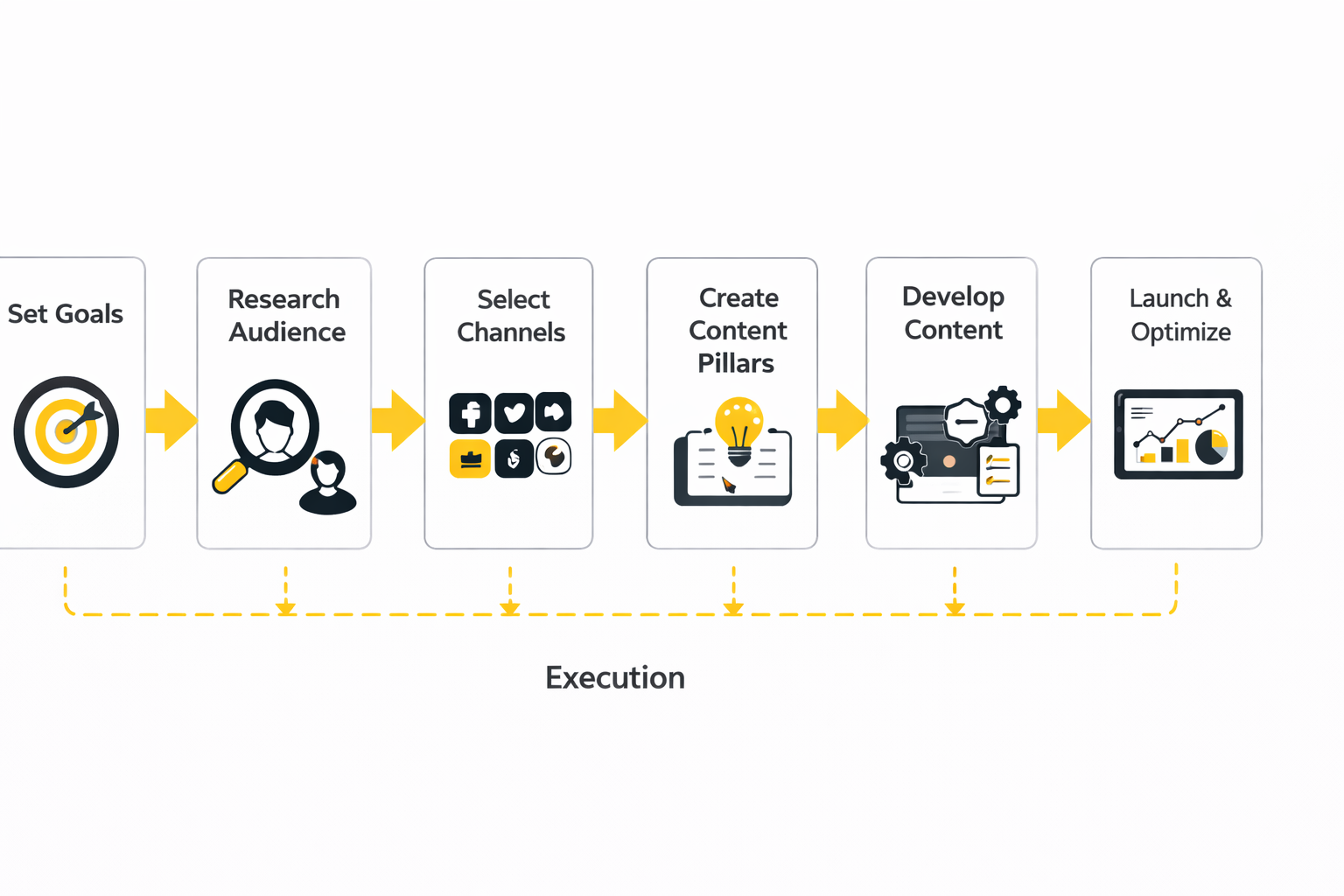
A practical execution flow usually looks like this:
- Pull ideas from pillars, audience questions, sales calls, comments, and performance data.
- Score those ideas by relevance, timeliness, platform fit, and production effort.
- Turn selected ideas into briefs with a clear angle, target platform, desired action, and proof points.
- Produce platform-native assets instead of resizing one master file and hoping it works everywhere.
- Review for clarity, quality, and brand fit before publishing.
- Monitor comments, saves, shares, watch time, clicks, and downstream behavior after release.
- Feed performance lessons back into the next cycle.
The reason this matters is simple: content systems improve when feedback loops are built in. A social media strategy should not treat publishing as the end of the process. Publishing is the moment the learning starts.
Originality Now Matters More Than Lazy Repurposing
Repurposing is still useful, but the platforms are getting stricter about what counts as valuable reuse. Meta said in March 2026 that it is increasing reach and monetization support for original creators on Facebook while deprioritizing unoriginal content, and it updated its guidance to give creators more clarity on what gets recommended in Feed and Reels (Meta announcement). That is a meaningful signal for brands too.
The takeaway is not that you should stop adapting content across channels. The takeaway is that adaptation has to add something. Simply reposting clipped, watermarked, contextless assets is a weak execution model and increasingly a risky one if you care about sustained distribution.
A better system treats repurposing as transformation. One strong insight can become multiple assets, but each version should be rebuilt for the context where it appears. That keeps efficiency high without turning the brand into a content recycler.
Plan for Native Strengths Instead of Forcing Uniformity
A common mistake in social media strategy is over-standardizing content so every platform gets the same message in the same shape. That usually makes the work less effective, not more efficient. Channels have different rhythms, discovery mechanics, and user expectations, so the same core idea should often be expressed differently.
For example, a concept that works as a concise contrarian text post on LinkedIn might deserve a deeper explainer on YouTube or a faster, more visual hook on Instagram Reels. Facebook and Instagram guidance on Reels continues to emphasize strong openings, entertainment value, and high-quality native creation (Meta for Business best practices). That does not mean every post has to be flashy. It means the packaging needs to match how people actually consume the format.
This is where teams either gain leverage or lose it. If you force one execution across all platforms, you save time upfront and lose performance later. If you adapt intelligently, you create more work at the asset level but much better odds of earning attention.
Use Tools to Reduce Friction, Not Replace Judgment
Tools can absolutely strengthen execution, but only when they support the system instead of pretending to be the strategy. Scheduling platforms help keep workflows clean, which is one reason many teams centralize publishing and approvals with tools like Buffer. Audience engagement flows can also become easier to manage when brands want to move conversations from comments or DMs into structured follow-up, which is where platforms like ManyChat naturally fit.
But this only works when the team already knows what good content looks like. No scheduler can rescue weak positioning. No automation tool can fix bland creative judgment. Tools reduce friction in the machine, but the machine still needs a clear operating logic.
That is the real point. Your social media strategy should create a production environment where useful ideas are easier to ship, good assets are easier to reuse, and performance feedback is easier to act on. When that happens, execution stops feeling chaotic and starts feeling compounding.
Measurement, Testing, and Optimization
With the content system in place, the next step is deciding what success actually means and how to improve it over time. In the next part, we will break down how to measure a social media strategy without getting trapped by vanity metrics, and how to run testing in a way that sharpens both creative and business results.
Measurement, Testing, and Optimization
A social media strategy becomes much more useful when measurement stops being a reporting ritual and starts being a decision system. The goal is not to collect as many metrics as possible. The goal is to understand which signals reflect attention, which ones reflect intent, and which ones actually connect to business outcomes.
That distinction matters because social dashboards can create false confidence very quickly. Reach can rise while relevance falls. Engagement can look healthy while qualified traffic stays flat. Follower growth can feel exciting while the audience becomes less aligned with the people you actually want to reach.
What the Numbers Actually Tell You
The most helpful social metrics are the ones that explain behavior, not just volume. Impressions tell you whether distribution happened. Watch time, completion rate, saves, shares, replies, profile visits, clicks, and conversion actions tell you what people did with that distribution.
This is why benchmark data should be handled carefully. The latest Rival IQ benchmark report found that engagement rates fell across major platforms in 2024, including drops of 16% on Instagram, 34% on TikTok, and 36% on Facebook. That does not mean social is broken. It means the environment is getting more competitive, average performance is harder to maintain, and weak content is being exposed faster.
The right action is not panic. It is sharper interpretation. When baseline engagement softens across platforms, your team should focus less on vanity comparisons and more on relative outperformance inside your category, your own trailing averages, and the specific formats that still create response.
Benchmarks Are Context, Not Strategy
Benchmarks can be useful, but only when they are treated as a reference point rather than a target to worship. An average engagement rate from a cross-industry report can tell you whether your account is dramatically underperforming. It cannot tell you whether your content is moving the right people toward trust, leads, or revenue.
That becomes obvious when you look at how uneven platform performance really is. Rival IQ’s 2025 data shows major differences by industry and post type, while Emplifi’s 2025 benchmark report shows Reels still outperform many other formats on reach engagement, even after some year-over-year softening. The point is not that every brand should publish more Reels. The point is that performance lives inside context, not in one universal rule.
So use benchmarks to frame questions, not settle them. If your results are below category norms, investigate creative quality, targeting, posting consistency, and offer strength. If your results are above norms but business impact is still weak, the problem may sit further down the funnel.
Attention Metrics Need a Hierarchy
One of the easiest ways to improve a social media strategy is to sort metrics by what stage of value they represent. Top-level distribution metrics matter, but they should not dominate your reporting. They are often the least predictive of commercial value unless they are paired with stronger downstream signals.
A useful hierarchy looks like this:
- Attention signals such as impressions, reach, video starts, and thumbnail click-through behavior.
- Engagement signals such as comments, shares, saves, reply depth, and average watch time.
- Intent signals such as profile visits, link clicks, DM starts, lead form opens, and product page views.
- Business signals such as qualified leads, booked calls, assisted conversions, revenue, retention, or customer support resolution.
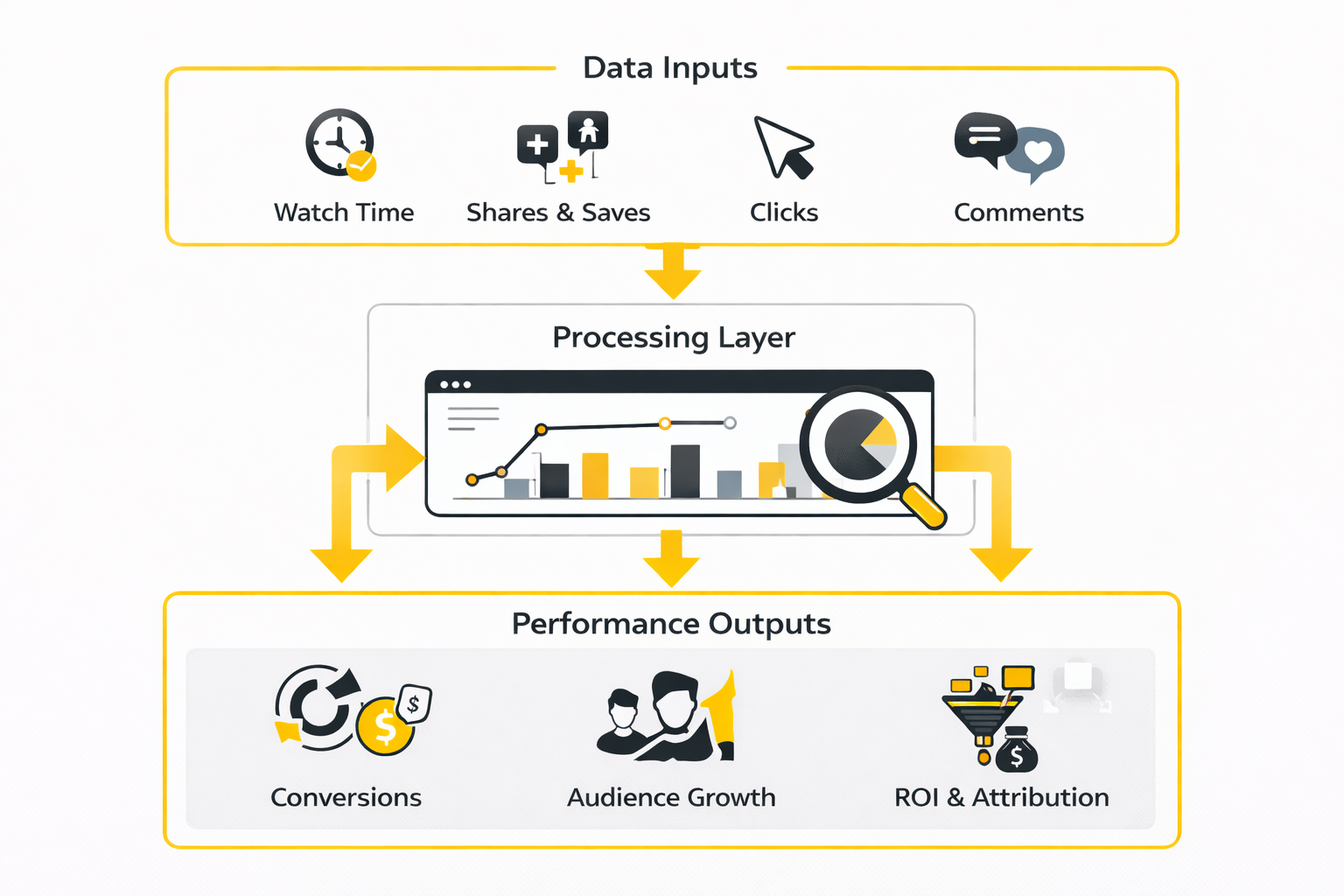
This structure matters because each layer should drive a different response. Weak attention usually points to packaging, hooks, thumbnails, or distribution problems. Strong attention but weak engagement often signals that the topic looked promising but the delivery did not hold up. Strong engagement with weak intent may mean the content is interesting but not commercially aligned. Strong intent with weak conversion can indicate that the landing page, offer, or follow-up system is the real bottleneck.
Saves, Shares, and Watch Time Often Matter More Than Likes
Likes are easy to see, which is exactly why they are overrated. They are a light signal. They can indicate approval, but they do not always indicate impact, memory, or future action.
In many cases, stronger signals come from what requires more effort or creates more consequence. Saves suggest the content has future value. Shares suggest the content is good enough to pass along and put your name next to. Watch time and completion rate suggest the packaging held attention long enough for the message to land.
This is especially important for video-heavy strategies. Platform and industry reporting continue to show short-form video as one of the most effective content formats for marketers, with HubSpot’s latest statistics roundup showing short-form video remains the most-used content format among marketers. But usage alone is not the useful lesson. The real lesson is that video performance should be judged by hold rate, completion patterns, and action after viewing, not just raw view counts.
Customer Care Metrics Belong in the Strategy Too
A lot of brands still report social performance as if publishing were the whole game. It is not. Response quality, response speed, and issue handling increasingly shape how people judge a brand online.
That is why customer care metrics deserve a place in the measurement framework. The 2025 Sprout Social Index makes that pretty clear: consumers expect brands to be more responsive and more useful on social, not just more visible. If your content is strong but your replies are slow, generic, or absent, the strategy is leaving value on the table.
The action here is straightforward. Track response time, resolution rate, repeat complaint themes, and the share of inbound messages that reveal product confusion or purchase friction. Those are not side metrics. They are often a direct feed into better content, clearer offers, and stronger retention.
Testing Should Improve Decisions, Not Just Generate Activity
Testing is where many teams say the right thing and do the wrong thing. They claim to be experimenting, but what they are really doing is publishing a random mix of ideas with no clean way to interpret the result. That is not testing. That is noise with better branding.
A stronger social media strategy treats testing as controlled learning. You do not change everything at once. You isolate one variable that matters, such as the hook, post length, opening visual, CTA placement, on-screen text density, or topic framing, and then compare results against a meaningful baseline.
This is where teams gain clarity fast. You learn which claims earn curiosity, which formats create retention, which proof points reduce skepticism, and which calls to action actually move people. Over time, those lessons become assets, because they make future creative decisions smarter.
The Best Analytics Systems Connect Social to the Funnel
The final step is the one that separates content teams from mature marketing teams. Social data should not live in a silo. It should connect to CRM data, ecommerce performance, attribution reporting, customer support patterns, and sales feedback whenever possible.
That connection changes the quality of decisions. A post with modest engagement but high-quality lead generation may deserve more investment than a viral post that produces nothing downstream. A comment thread full of objections may be more strategically useful than a high-reach awareness piece with no follow-through. A recurring question in DMs may deserve an entire content series because it signals buyer friction at scale.
This is where the measurement side of social media strategy becomes genuinely powerful. You stop asking, “Did this post perform?” and start asking, “What did this teach us about audience behavior, message-market fit, and the next action we should take?” That is a much better question, and it leads to much better content.
Professional Implementation Across Teams and Tools
Once measurement is tied to decisions, the next challenge is scale. In the next part, we will look at what professional implementation actually requires across people, workflows, governance, and tools so your social media strategy keeps working when the team, channel mix, and publishing volume grow.
Professional Implementation Across Teams and Tools
A social media strategy gets more fragile as it grows unless the operating model grows with it. What worked when one person handled content, publishing, replies, and reporting usually breaks once multiple stakeholders, more channels, paid support, legal review, and customer-facing risk enter the picture. At that stage, professional implementation is not about adding bureaucracy for the sake of it. It is about making quality, speed, and consistency possible at the same time.
The biggest shift here is mental. Social can no longer be treated like a side task attached loosely to marketing. It needs ownership, decision rights, escalation paths, approval logic, and clear service levels, otherwise the team spends more time negotiating work than shipping it.
Scale Creates New Failure Modes
A small team usually struggles with capacity. A larger team often struggles with coordination. That sounds like progress, but it introduces a different class of problem where more resources do not automatically create better output.
This is where many brands start drifting into inconsistency. One team speaks in a sharp, human voice while another publishes corporate filler. One business unit is quick in comments while another disappears for days. One campaign is measured well while another is reported in isolation. The audience does not see departments. They see one brand, so fragmentation is expensive.
A mature social media strategy has to solve for this. It needs enough structure to keep the brand coherent without making the work so slow that the team misses the moment. That balance is harder than it looks, and it is one of the main reasons social execution feels easier in theory than in practice.
Governance Should Protect Speed, Not Kill It
Governance gets a bad reputation because it is often introduced too late and in the wrong form. A brand gets burned by a security issue, a compliance problem, or a public backlash, then responds by building an approval maze that punishes every future post. That usually solves one risk while creating another: the team becomes too slow to be relevant.
Better governance is designed upstream. It defines what requires review, what does not, who can publish in which scenarios, what language is off-limits, how crises escalate, and how access is managed. When this is done well, the team moves faster because fewer decisions have to be re-litigated from scratch.
This matters more now because social risk is broader than obvious PR disasters. It includes account security, creator misalignment, accidental claims, AI-generated misinformation, inconsistent moderation, and simple operational sloppiness. A serious social media strategy treats all of those as implementation issues, not just reputation issues.
Centralized Strategy and Decentralized Execution Can Work
There is no perfect org chart for social, but one model tends to scale better than the extremes. Pure centralization often creates bottlenecks because one small team becomes the gatekeeper for everything. Pure decentralization usually creates chaos because every department starts sounding different and chasing different goals.
A more durable model is centralized strategy with decentralized execution. The center owns positioning, guardrails, measurement definitions, platform priorities, and editorial standards. Specialists or business units then execute within that framework for the audiences they know best.
That structure gives you two things at once. You keep strategic coherence at the brand level, and you preserve enough proximity to customers, product teams, and market context to keep the content relevant. Without that balance, scale usually makes the brand either slow or scattered.
Approval Systems Need Tiers
Not all content carries the same risk, so it should not carry the same approval burden. A reactive comment, a recurring educational post, a product claim, a regulated-industry statement, and an executive thought-leadership piece should not all move through the exact same process. When they do, the team either gets clogged or starts bypassing the system.
Tiered approvals solve that. Low-risk recurring content can follow a lightweight path once the format is approved. Medium-risk campaign content may need brand and channel review. High-risk material involving legal exposure, sensitive issues, or executive visibility can trigger a stricter route.
This is one of the most practical upgrades a company can make. It respects the fact that social is both a publishing engine and a live communication environment. A social media strategy that ignores that dual role usually becomes either reckless or unusable.
Tool Stacks Should Follow the Workflow
Teams often buy tools too early or for the wrong reasons. They add software because the category sounds useful, not because the operating model actually requires it. Then six months later they have overlapping dashboards, messy handoffs, and people working around the stack instead of through it.
A better approach starts with the workflow. First define how ideas move from planning to production, how assets are stored, how publishing is scheduled, how comments are handled, how reporting is reviewed, and where customer or lead data needs to flow next. Then choose tools that reduce friction at those exact points.
This is also where restraint helps. More tools do not automatically mean more sophistication. In many cases, the stronger setup is the one with fewer systems, clearer ownership, and tighter integration between content, CRM, reporting, and customer communication.
The Hard Tradeoff Between Brand Consistency and Platform Native Behavior
As teams scale, one tension becomes unavoidable. Brand leaders want consistency. Channel operators want content that feels native. Both sides are right, which is why this tradeoff has to be managed deliberately rather than argued about endlessly.
If you over-prioritize consistency, the content becomes flat and over-controlled. Every post sounds like it passed through the same committee, and platform fit suffers. If you over-prioritize native behavior, the brand starts shape-shifting to match every channel and loses its core identity.
A strong social media strategy resolves this by separating the stable elements from the flexible ones. The point of view, claims, tone boundaries, visual rules, and strategic priorities stay stable. The hooks, pacing, post length, editing style, and platform-specific packaging stay flexible. That is usually the sweet spot.
Executive Visibility Changes the Stakes
The moment executives become visible on social, the strategy changes. Reach can increase, trust can deepen, and the brand can feel far more human. But the downside is obvious too: a personal account with real visibility can create brand consequences very quickly.
That means executive social should never run on improvisation alone. It needs narrative alignment, message discipline, scenario planning, and a clear understanding of where the line sits between personal voice and company implication. Otherwise the brand ends up reacting to its own leadership instead of benefiting from it.
This is also why ghostwriting, review support, and feedback loops matter. The goal is not to sterilize the executive voice. The goal is to help it stay sharp, credible, and strategically useful without creating avoidable mess.
Creator Partnerships Raise the Complexity
As social programs mature, creator partnerships often move closer to the center of the strategy. That can be powerful because creators bring trust, distribution, and creative fluency that many brands cannot replicate internally. But it also expands risk in ways that in-house publishing does not.
The challenge is not just picking creators with audience overlap. It is choosing partners whose incentives, tone, reliability, disclosure habits, and broader reputation fit the brand you are trying to build. A creator can be a growth engine in one quarter and a liability in the next if the selection process is lazy.
That is why expert teams treat creator collaboration as a strategic capability, not a bolt-on tactic. They define fit criteria, approval rules, briefing standards, success metrics, and contingency plans before the first post goes live. Without that discipline, scale creates exposure faster than it creates leverage.
AI Can Speed Production, but It Can Also Flatten the Brand
AI is now part of social execution whether teams admit it or not. It can help with ideation, repurposing, workflow support, transcription, summaries, first drafts, and even response assistance. Used well, it reduces friction and frees the team to spend more time on judgment, packaging, and strategy.
Used badly, it creates the exact sameness audiences are getting tired of. Generic hooks, generic opinions, generic visuals, and generic comment replies all make a brand easier to ignore. That is the hidden cost of using AI as a replacement for thinking instead of a support system for thinking.
A mature social media strategy treats AI like leverage, not authorship. The machine can accelerate process, but the team still needs to own the angle, the proof, the taste, the risk decisions, and the final standard. That line matters a lot.
Scaling Requires Fewer Priorities, Not More
When social starts proving value, the natural temptation is to add more of everything. More channels, more formats, more campaigns, more stakeholders, more meetings, more dashboards. That usually feels ambitious, but it often weakens the system.
The smarter move is usually the opposite. Protect the few channels that matter most. Double down on the formats that already show strong signal. Tighten the approval logic. Simplify the reporting layer. Keep the operating model understandable enough that new people can enter it without breaking it.
That discipline is what lets a social media strategy survive growth. Without it, the system gets louder, heavier, and more political until performance starts slipping for reasons nobody can diagnose cleanly.
The Real Expert Move Is Operational Clarity
At an advanced level, social success is not just about creativity. It is about operational clarity. Everyone involved should know what the brand is trying to achieve, which audiences matter most, what each platform is supposed to do, how work gets approved, what gets measured, and how insights feed back into the next cycle.
That may sound less exciting than talking about trends or viral hooks, but this is where durable performance comes from. Great social teams do not just create strong posts. They build environments where strong posts are more likely to happen repeatedly.
That is what makes the difference between a social media strategy that looks smart in a deck and one that keeps working in real life. In the final part, we will bring the whole system together, answer the most common questions, and close with a practical view of what strong execution actually looks like over time.
Bringing the Entire Social Media Strategy Together
At this point, the system is complete. You have audience clarity, positioning, channel roles, content systems, measurement logic, and operational structure. What matters now is how these pieces connect in practice, because a social media strategy only works when it behaves like a loop, not a checklist.
The strongest teams operate in cycles. They publish, observe behavior, extract insight, adjust positioning or formats, and repeat. Over time, this creates a compounding effect where content improves not just because of creativity, but because the system keeps learning.
This is also where many brands underestimate the long game. Social media rarely rewards short bursts of effort followed by inconsistency. It rewards sustained clarity. The brands that win are not always the loudest. They are the ones that stay relevant, useful, and recognizable long enough for trust to build.
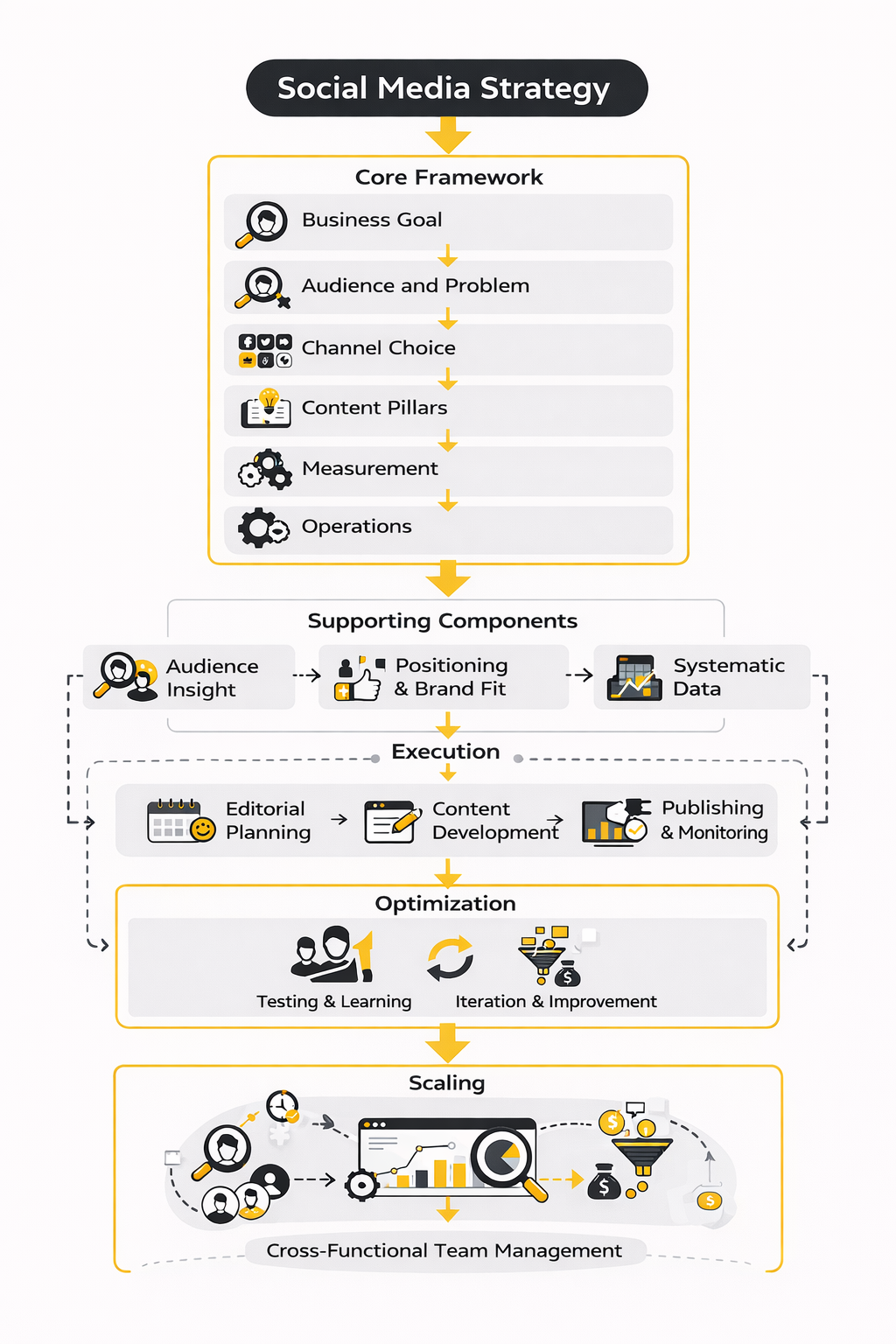
Think of the full system as an ecosystem. Audience insight feeds content. Content generates signals. Signals inform decisions. Decisions refine positioning. Positioning sharpens future content. When this loop is tight, the strategy becomes self-improving.
FAQ - Built for Complete Guide
What is a social media strategy in simple terms?
A social media strategy is a structured plan that defines who you want to reach, what you want to be known for, where you will show up, what content you will create, and how you will measure success. It connects business goals to daily publishing decisions so content is not random.
How long does it take to see results from a social media strategy?
Most strategies start showing early signals within a few weeks, but meaningful results usually take months. Consistency, repetition, and learning cycles matter more than short bursts. The platforms reward sustained patterns, not isolated wins.
Which platform is best for a social media strategy?
There is no universal best platform. It depends on where your audience spends time and what type of content you can produce well. A strong strategy focuses on channel fit instead of chasing every platform at once.
How often should you post on social media?
Frequency depends on the platform and your production capacity. It is better to post consistently at a sustainable pace than to spike activity and disappear. Quality and repeatability matter more than volume alone.
What metrics matter most in a social media strategy?
The most useful metrics are tied to behavior. Watch time, saves, shares, comments, clicks, and conversions matter more than impressions alone. The right mix depends on your business goal and sales cycle.
Is it better to focus on organic or paid social?
Both have a role. Organic content builds trust, authority, and long-term audience relationships. Paid distribution can accelerate reach and target specific segments. A strong social media strategy uses paid to amplify what already works organically.
How do you come up with content ideas consistently?
The best ideas come from audience questions, customer conversations, performance data, and industry trends. Systems like content pillars and format families make ideation repeatable instead of stressful.
Can small businesses compete with large brands on social media?
Yes, and often more effectively. Smaller teams can move faster, sound more human, and respond more directly. That agility can outperform larger brands that struggle with slow approvals and generic messaging.
What role does automation play in social media?
Automation should reduce friction, not replace thinking. Tools can help with scheduling, responses, and workflows, but the strategy, positioning, and creative decisions still require human judgment.
How do you scale a social media strategy without losing quality?
Scaling requires clearer systems, not just more output. Defined workflows, content standards, and measurement frameworks allow teams to grow without becoming inconsistent or slow.
When should you change your social media strategy?
You should adjust when performance signals shift, audience behavior changes, or business priorities evolve. The strategy should stay stable enough to build momentum but flexible enough to adapt to new data.
Work With Professionals
Explore 10K+ Remote Marketing Contracts on MarkeWork.com
Most marketers spend too much time chasing clients, competing on crowded platforms, and losing a percentage of every project to middlemen.
MarkeWork gives you a better way. Browse thousands of remote marketing contracts and connect directly with companies desperate to hire skilled marketers like you, without platform commissions and without unnecessary gatekeepers.
If you're serious about finding better opportunities and keeping 100% of what you earn, explore available contracts and create a profile for free at MarkeWork.com.
Is this conversation helpful so far?