

A strong social media strategy is no longer just a publishing calendar with a few content pillars taped on top. Brands are competing in feeds shaped by algorithms, creators, private sharing, short-form video, social search, customer service expectations, and nonstop creative fatigue. That changes the job completely. You are not simply trying to post more. You are trying to earn attention, build memory, create demand, and turn engagement into measurable business outcomes.
That is why a modern social media strategy has to connect brand positioning, audience insight, platform choice, content systems, distribution, community management, and measurement. When those pieces are disconnected, even good content underperforms. When they work together, social stops feeling random and starts becoming a repeatable growth channel.
This guide breaks the process into six parts so the whole system is easier to build, audit, and improve. It is written for teams that want clarity, not fluff, and for operators who need a plan they can actually run. Tools can help once the strategy is clear, and platforms like Buffer or Flick can support publishing and optimization, but neither one can fix a weak strategic foundation.
Article Outline
- Why Social Media Strategy Matters Now
- The Social Media Strategy Framework
- Audience, Positioning, and Channel Selection
- Content Systems, Publishing, and Community Management
- Measurement, Optimization, and Team Workflow
- Professional Implementation and Long-Term Scale
Why Social Media Strategy Matters Now
The biggest mistake in social media is treating every platform like the same room with different dimensions. It does not work like that anymore. People open different apps with different expectations, different levels of intent, and very different tolerance for branded content, so a strategy has to start with behavior rather than with templates.
A good social media strategy also protects teams from wasting energy. Without one, brands chase trends they do not understand, copy creators they cannot realistically imitate, and spread effort across too many channels. That usually leads to inconsistent messaging, weak creative, confused reporting, and the feeling that social is busy but not productive.
The real value of strategy is focus. It tells you who you are trying to reach, what you want to be known for, which platforms deserve effort, what formats support your goals, and how success will be measured. Once those decisions are made, execution gets faster, content gets sharper, and the team can stop guessing.

The Social Media Strategy Framework
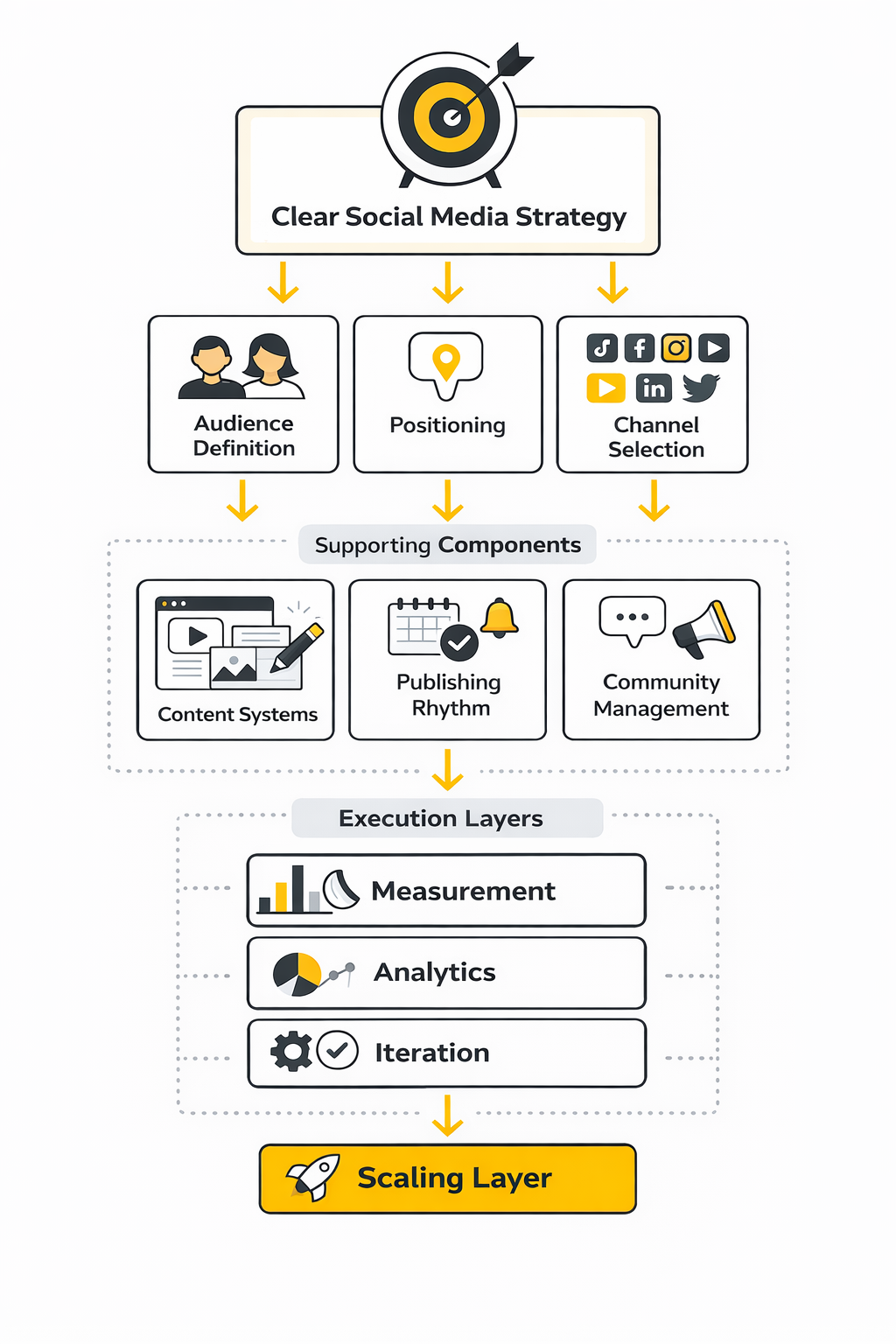
At its core, a social media strategy is a decision-making system. It helps a brand choose where to show up, what to say, how to say it, when to publish it, how to respond, and how to know whether the work is paying off. That sounds simple on paper, but the difference between average and excellent execution comes from how tightly those decisions connect.
The framework in this article is built around a practical flow. First, define the business objective and the role social should play. Next, match that role to the right audience segments, the right channels, and the right content approach. Then build the operating layer: publishing cadence, creative workflow, community management, reporting, and optimization.
This matters because social media strategy is not just a content exercise. It is part brand strategy, part media strategy, part customer experience, and part operational discipline. Teams that understand that tend to create stronger content with less wasted effort and much better consistency over time.
What the Rest of This Guide Will Build
The next parts of this article move from direction into execution. We will start with audience insight, brand positioning, and channel selection, because those decisions shape everything that follows. After that, we will cover the core components that make content sustainable, then the measurement systems and workflow choices that separate serious teams from chaotic ones.
The final sections will focus on professional implementation. That includes how to turn a strategy into a real operating model, how to align social with broader marketing goals, and how to scale without losing quality. By the end, you should have a structure that is practical enough to use and strong enough to defend inside a real business.
Audience, Positioning, and Channel Selection
A social media strategy gets sharper the moment you stop talking about audiences as broad categories and start thinking about behavior. Age, job title, and location still matter, but they are not enough on their own. What matters more is why someone opens a platform, what kind of content they trust there, and what action they are realistically willing to take after seeing your brand.
That shift is important because social platforms do not all solve the same problem. Global usage is still growing, with Digital 2025 tracking more than 5.2 billion active social media user identities worldwide, but that scale can be misleading if you treat every user as equally reachable or equally relevant. A practical social media strategy is not about chasing the biggest audience. It is about finding the right pockets of attention and building a plan around how those people actually behave.
Start With Audience Reality, Not Internal Assumptions
Most teams begin with what they want to say. The better move is to begin with what the audience is already trying to solve, compare, learn, or avoid. When you understand that, your content stops sounding like a campaign calendar and starts feeling useful in the context where people discover it.
A strong audience definition usually comes from combining customer conversations, sales objections, support tickets, search behavior, on-site analytics, and platform-level usage patterns. That matters because social behavior varies sharply by age and platform. Pew’s recent work on U.S. adults and its newer reporting on teens make the same point from different angles: the platforms people use most, and the intensity with which they use them, are not evenly distributed.
In practice, that means your social media strategy should define audience segments by intent. One group may want quick education. Another may want proof that your offer is credible. Another may be ready for product comparison, while a fourth just wants entertaining, low-friction exposure until timing changes. That is a much more useful model than saying your audience is “founders aged 25 to 44” and hoping that covers it.
Build a Positioning Angle People Can Recognize Fast
Once you know who you are trying to reach, the next job is deciding what your brand should consistently mean inside the feed. This is where many social media strategy documents fall apart. They describe tone of voice, list a few adjectives, and never make the harder decision about what perspective the brand will own.
Good positioning on social is not just branding language. It is a repeated angle that helps people identify your content quickly even before they see the logo. That angle can be expertise, strong point of view, practical clarity, founder-led transparency, premium taste, operational depth, or category simplification, but it has to be specific enough to shape real content choices.
This is also why copying another brand rarely works for long. The platform may reward familiar content formats, but audiences still respond to distinctiveness. Research collected in the 2025 Sprout Social Index points to a crowded environment where memorability matters, and that puts pressure on brands to sound like themselves instead of like a thinner version of whoever is trending this week.
Define the Job Social Needs to Do
Before you pick channels, decide the role social is supposed to play in the business. That sounds obvious, yet plenty of teams still expect one account to drive awareness, demand generation, community, recruiting, customer support, and conversion at the same time. It can contribute to all of those, but not with equal force and not with the same content.
A better social media strategy gives each channel a primary job and maybe one secondary job. For one brand, Instagram may be the visual trust builder. For another, LinkedIn may be where expertise turns into pipeline. For another, TikTok may be the best top-of-funnel discovery engine, while email or the website does the heavier lifting later. The point is not to reduce social to one metric. The point is to stop asking every post to do everything.
This decision also makes creative tradeoffs easier. If a channel’s main role is discovery, the content should bias toward reach, relevance, and clear hooks. If the role is trust, the content should lean harder into proof, consistency, and repeated exposure. If the role is conversion support, stronger calls to action, product context, and friction reduction make much more sense.
Choose Channels by Behavior, Not Prestige
Channel selection is where discipline really shows up. Too many brands pick platforms because competitors are there, executives expect them to be there, or someone on the team personally likes the app. None of those is a strategy. A good social media strategy chooses channels based on audience fit, format fit, production fit, and business fit.
That usually means asking a few blunt questions. Does your audience spend meaningful time there. Does the platform reward the kind of creative your team can produce consistently. Can your offer be communicated well in that environment. And can you maintain the account at a standard that helps the brand instead of quietly damaging it.
Recent platform research reinforces how different these environments are. Pew’s adult social media data shows major differences in platform penetration across age groups, while Pew’s teen reporting shows how dominant some platforms remain for younger audiences. On the B2B side, LinkedIn’s marketing benchmark work continues to underline the importance of data-driven, customer-centric planning rather than default channel expansion.
What Each Major Platform Is Usually Best For
Instagram is often strongest when brand, aesthetics, lifestyle, creator collaboration, and short-form visual storytelling matter. It can support both discovery and consideration, but it rewards consistency and format fluency. If your offer needs visual proof, transformation, taste, or repeated brand exposure, Instagram can play a strong role in your social media strategy.
TikTok is usually strongest when the brand can earn attention through relevance, personality, creator collaboration, or culturally fluent education. The platform’s own What’s Next 2025 report leans hard into authenticity, community participation, and creator-led relevance, which is another way of saying polished brand broadcasting is rarely enough there. If your team cannot create content that feels native, the channel can become expensive in time and weak in results.
LinkedIn is the obvious home for many B2B brands, but the opportunity is broader than lead generation posts and company news. It works especially well for expert positioning, category education, founder voice, hiring visibility, and trust-building around complex decisions. When used well, it becomes a compounding reputation channel rather than just a place to recycle webinar links.
YouTube deserves more strategic attention than many brands give it. It supports both discovery and depth, which is a rare combination, and it gives strong ideas a longer shelf life than most feed-based platforms. If your team can explain, teach, review, compare, or document in a way that people genuinely search for, YouTube can become one of the most durable parts of a social media strategy.
Match Content Format to Audience Intent
This is where strategy starts affecting creative output directly. Different audience states need different content formats, and if you ignore that, even solid ideas can miss. Someone discovering your brand for the first time does not need the same asset as someone comparing vendors, and neither of them needs the same thing as a loyal customer deciding whether to recommend you.
A practical way to think about it is to map formats to moments. Short-form video is strong for interruption and discovery. Carousels and visual explainers are strong for saving and sharing. Founder commentary can help with authority. Customer proof can reduce skepticism. Product demos help when the audience is already closer to action. A strong social media strategy uses all of these, but not randomly.
This also affects tool choices. Scheduling and workflow tools like Buffer help when you need consistency across multiple channels, while planning and hashtag optimization tools like Flick can support faster execution for teams managing content at volume. The key is that tools should reinforce the strategy you already chose. They should not be the thing making the strategic decisions for you.
Narrowing Down to a Channel Mix That You Can Actually Run
The strongest channel mix is rarely the largest one. In most cases, two well-run channels beat five neglected ones. That is especially true when content quality, response speed, and community consistency matter more than raw posting frequency.
A useful rule is to identify one primary channel, one secondary channel, and one optional experimental channel. The primary channel gets the best thinking, the clearest positioning, and the most consistent resources. The secondary channel adapts the message for a different content environment or audience segment. The experimental channel is where you test without putting the entire brand rhythm at risk.
This approach creates focus, and focus is what gives a social media strategy teeth. It forces tradeoffs, but those tradeoffs are healthy. They keep the team from pretending that every platform deserves equal investment, and they make it easier to produce work that actually fits the channel instead of filling space just to stay visible.
The Strategic Output You Should Have Before Moving On
By this stage, your social media strategy should have a few decisions locked in. You should know which audience segments matter most, what brand angle you want to reinforce, what role social plays in the business, and which channels deserve real investment. If those answers still feel vague, the content plan will stay vague too.
You do not need a massive document to get this right. You need a clear set of choices that can guide content, approvals, reporting, and resource allocation. Once those choices are in place, the next step is building the engine that turns strategy into repeatable output: content systems, publishing rhythm, and community management that can hold up under real operating pressure.
Content Systems, Publishing, and Community Management
Once the audience, positioning, and channel mix are clear, a social media strategy needs an operating system. This is the part most teams underestimate. They spend weeks defining content pillars and then run the whole thing through a messy process that depends on last-minute ideas, scattered approvals, and whoever happens to be free that day.
That is why implementation matters so much. Strategy only becomes valuable when it turns into a repeatable workflow that can produce good content consistently, respond to real audience signals, and improve over time. Without that operating layer, even smart strategy decks collapse the moment the business gets busy.
Turn Strategy Into a Content System
A content system is not the same as a content calendar. The calendar shows what is going live. The system explains how ideas are found, filtered, produced, approved, published, repurposed, and reviewed without burning out the team.
This is where a practical social media strategy becomes much more powerful. Instead of asking what to post every morning, the team works from a fixed set of inputs: audience pain points, recurring questions, proof assets, opinion angles, product moments, and campaign priorities. That removes a huge amount of friction because you are not inventing the brand from scratch every week.
A strong content system usually includes a small number of repeatable categories. You might build around education, authority, proof, product, and community. The exact labels can change, but the principle stays the same: every piece of content should have a clear job, a clear audience fit, and a reason to exist beyond filling a slot.
Build Around Core Content Pillars Without Becoming Predictable
Content pillars matter because they create consistency, but they should not trap the brand inside repetitive formatting. The goal is to repeat strategic themes, not to repeat the same post template with different nouns swapped in. Audiences notice that quickly, and once they do, attention drops.
A better approach is to keep the themes stable while letting the execution vary. One week a pillar might appear as a short video. The next week it might show up as a carousel, a founder post, a customer story, a stitched reaction, or a simple opinion-led text post. The consistency comes from the angle, not from the packaging.
This is also where positioning comes back into play. If your brand wants to be known for operational clarity, your pillars should naturally produce content that simplifies, compares, explains, and de-risks decisions. If your brand wants to win on taste or identity, the same strategy would need a very different creative expression.
Plan in Themes, Produce in Batches, Publish With Flexibility
Most teams need more structure than they think and more flexibility than they usually allow. Planning in monthly or quarterly themes gives the social media strategy a clear direction, especially when launches, seasonal moments, partnerships, or campaigns matter. But overfilling the calendar weeks in advance can make content slower, flatter, and less responsive to what is happening now.
The smarter rhythm is to plan strategically and produce operationally. Lock in themes, priorities, and key assets ahead of time. Then batch production where it makes sense, especially for formats that benefit from efficiency, while leaving room for fast reactions, timely posts, and creative experiments.
That balance matters because the feed rewards relevance as much as consistency. Sprout’s newer reporting has made the point clearly that social teams need both structure and room to adapt, while the broader 2025 Sprout Social Index keeps emphasizing originality and memorable brand presence over mechanical volume. A social media strategy works better when cadence supports quality instead of quietly replacing it.
Create a Workflow That Survives Real Life
This is where many teams hit the wall. The strategy may be solid, but the production process depends on endless review loops, unclear ownership, or a single overloaded social manager trying to do strategy, copy, design, editing, analytics, and community all at once. That is not a workflow. That is a bottleneck disguised as hustle.
The implementation process gets much easier when each stage has a clear owner. Idea sourcing, brief creation, asset production, approval, publishing, engagement, and reporting should each have a default path. Not every team needs a large headcount, but every team needs clarity on who makes decisions and how work moves.
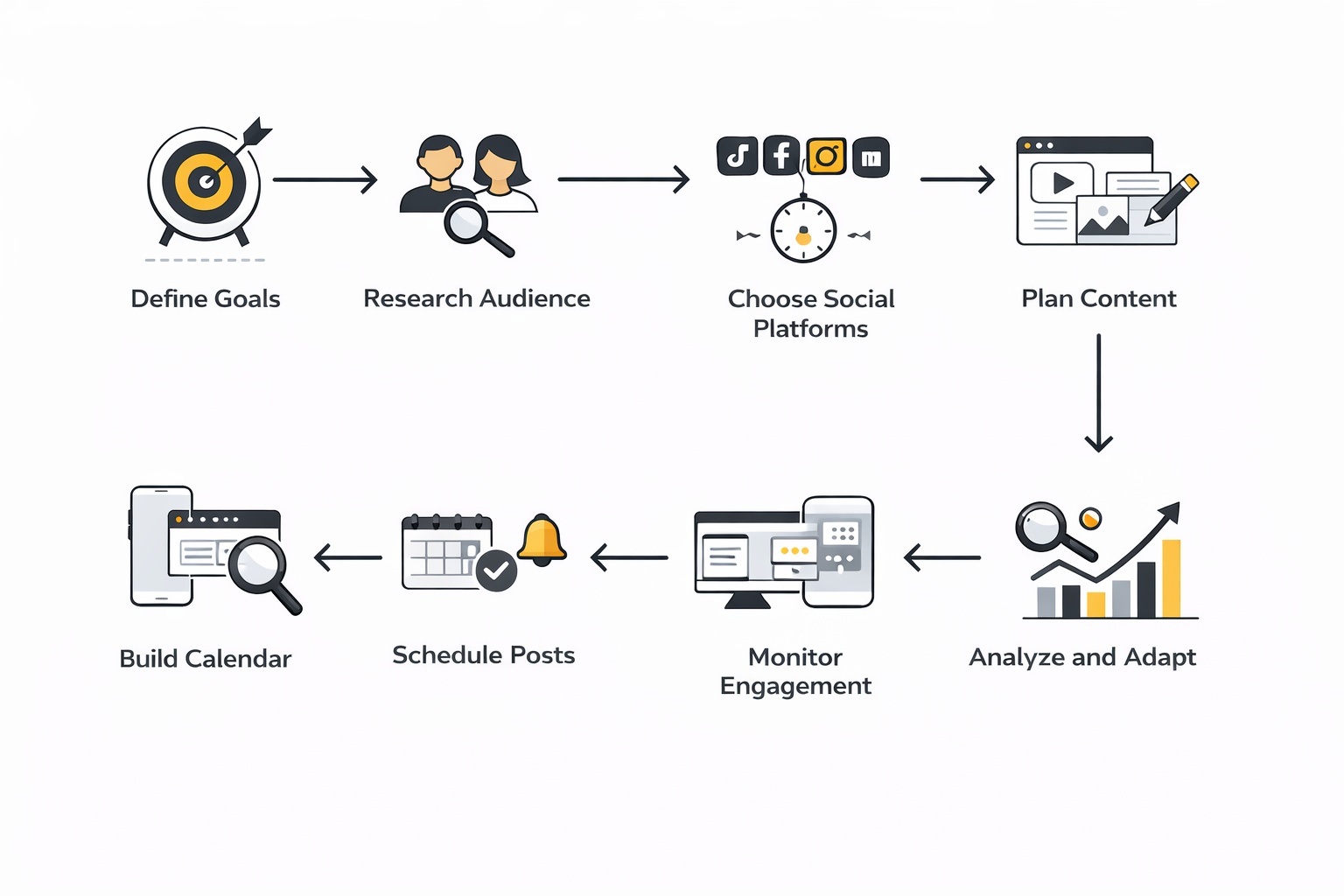
At a practical level, the process should feel simple enough to repeat every week. A basic operating model often works best:
- Review business priorities, audience signals, and performance trends
- Choose weekly content angles tied to the larger strategic themes
- Create or assign briefs for each post or asset
- Produce in batches where possible, especially for video and design-heavy formats
- Approve with tight deadlines and minimal unnecessary revisions
- Publish with room for timely additions
- Monitor comments, mentions, and direct messages
- Review performance and feed insights back into the next cycle
That kind of workflow turns a social media strategy into an actual production engine. It also makes it much easier to diagnose problems. When performance is weak, you can see whether the issue is the offer, the angle, the hook, the format, the channel, or the publishing rhythm instead of blaming “the algorithm” for everything.
Match Your Publishing Rhythm to Your Capacity
There is no universal posting frequency that guarantees success. What matters is whether the team can maintain quality, responsiveness, and strategic consistency at the pace it sets. A social media strategy should be ambitious enough to build momentum, but realistic enough that the brand does not look rushed, inconsistent, or half-managed.
That is why capacity planning matters. If your team can produce two strong short-form videos, one thoughtful carousel, and a few fast community posts each week at a high standard, that is better than forcing daily output that weakens every asset. Consistency still matters, but consistent mediocrity is not a win.
The platforms themselves increasingly reinforce this logic. Instagram’s creator guidance and Meta’s Reels best-practice materials keep pushing quality, clarity, and audience value over empty posting behavior, while Instagram’s best-practices rollout for creators reflects how seriously the platform now treats sustainable, informed creation. That should shape your social media strategy more than generic advice about posting more often.
Build a Community Management Standard, Not Just a Response Habit
A lot of brands still treat community management as an afterthought. They post the content, maybe reply if something takes off, and then wonder why engagement does not turn into loyalty. That misses a huge part of how social actually works. People do not just evaluate what you publish. They evaluate how you show up when someone talks back.
Good community management does three jobs at once. It protects the brand, deepens trust, and turns passive reach into relationship. In many cases, it also creates the best source material for future content because comments, objections, questions, and DMs reveal exactly what the audience cares about right now.
This matters more than ever because response expectations are not casual anymore. Sprout’s customer care reporting has pointed to a strong expectation for brands to answer within a day, with recent summaries citing that roughly three-quarters of customers want a response within 24 hours or less. Once that expectation exists, silence starts to feel like a signal too.
Treat Comments, DMs, and Mentions as Strategic Inputs
One of the easiest wins in social media strategy is using audience interaction as raw material. Comments can become future posts. Objections can become education assets. Repeated questions can shape landing pages, email sequences, and sales enablement. Praise can turn into proof, and criticism can expose where positioning is weak or where expectations are unclear.
This is where a lot of teams leave value on the table. They engage politely, but they do not capture patterns. The better move is to create a simple system for tagging or documenting recurring themes so the content engine keeps learning from real-world feedback.
This also creates better alignment across marketing and sales. If the social team is hearing the same confusion repeatedly, that is not just a community issue. It may be a product messaging issue, a website clarity issue, or a funnel issue. A mature social media strategy does not isolate those signals. It passes them through the rest of the business.
Use Tools to Reduce Friction, Not to Automate Judgment
Software helps most when it supports the workflow rather than trying to replace the thinking. Scheduling, approval, reporting, inbox management, and asset organization all become easier when the stack is sensible. But the tool should serve the process, not define it.
For publishing and cross-channel scheduling, Buffer is a straightforward option for keeping cadence organized without overcomplicating the stack. For planning, analysis, and optimization around social content workflows, Flick can also fit well when a team wants tighter execution support. The important thing is to choose tools that remove operational drag while leaving strategic decisions in human hands.
That same rule applies to automation. Smart automation can help route messages, collect leads, and reduce repetitive work, especially in direct-message flows or simple qualification paths. If that is part of the plan, tools like ManyChat can be useful, but only when the automation feels helpful rather than robotic.
What Good Implementation Looks Like in Practice
When implementation is working, the team is no longer scrambling to invent content under pressure. There is a clear weekly rhythm, a manageable production load, a reliable publishing cadence, and a real habit of learning from audience response. Content gets better because the process gets cleaner.
That is the point where social media strategy starts compounding. You are not just posting and hoping. You are running a system that can generate insights, improve creative quality, and strengthen brand recognition over time. The next step is making sure that system is measured correctly, optimized intelligently, and connected to business outcomes instead of vanity metrics alone.
Reading Social Media Data the Right Way
A social media strategy gets stronger when measurement tells you what to change, not just what happened. That sounds obvious, but a lot of reporting still turns into a scoreboard of reach, impressions, likes, and follower growth with no real interpretation behind it. The problem is not the numbers themselves. The problem is treating them as proof of success without asking what they actually signal about attention, relevance, intent, and business impact.
The goal of analytics is not to collect more metrics. It is to make better decisions about creative direction, channel investment, publishing rhythm, community response, and conversion support. That is the only reason measurement belongs inside a serious social media strategy in the first place.
What the Data Is Actually Telling You
The first useful distinction is between visibility metrics and value metrics. Visibility metrics tell you whether the platform gave your content a chance. Value metrics tell you whether people cared enough to watch, save, click, comment, share, return, or convert. You need both, but they should never be treated as interchangeable.
That matters because social media use is still massive, with Digital 2025 showing 5.24 billion active social media user identities worldwide, yet that scale does not guarantee meaningful attention for any specific brand. More users in the ecosystem does not automatically mean better performance for your content. It simply means the competition for attention remains intense, which makes interpretation more important than raw volume.
A post that reaches a large audience but produces weak watch time, low saves, no comments, and no clicks may still be useful for awareness, but it is not evidence that the strategy is working broadly. On the other hand, a post with lower reach but strong saves, shares, qualified clicks, or meaningful conversation may be doing a much better job for the business. This is exactly why a social media strategy needs metric priorities tied to channel role rather than one generic dashboard for everything.
The Metrics That Usually Matter Most
Reach matters because it tells you whether distribution is happening at all. If reach collapses across a set of posts, the issue may be content quality, weak hooks, poor audience fit, inconsistent posting, or a shift in platform behavior. Reach alone is not a win, but it is still an early signal you should pay attention to.
Engagement matters when you define it properly. Not all engagement is equal. A quick like is a lighter signal than a save, a share, a thoughtful comment, or a direct message. Recent benchmark reporting still shows wide performance gaps by platform, with Socialinsider’s 2026 benchmarks putting average engagement at 3.70% on TikTok, 0.48% on Instagram, and 0.15% on Facebook, which is useful not because those numbers are universal targets, but because they remind you not to compare platforms as if they behave the same way.
Clicks matter when the job of the content is to move people somewhere. But clicks should be read alongside on-site behavior, not in isolation. If click-through is strong and downstream conversion is weak, the issue is probably not the post. It may be the landing page, offer clarity, audience match, or conversion path.
Follower growth matters less than many teams pretend, but it still has value when it reflects increasing relevance within the right audience. If follower growth rises while engagement quality falls, you may simply be attracting low-intent attention. If growth is modest but content is driving better qualified traffic or stronger community interaction, the strategy may actually be improving.
Why Benchmarks Help and Where They Mislead
Benchmarks are useful because they give context. A number without context invites overreaction. If a team sees a 1% engagement rate and assumes that is weak, they may make bad decisions simply because they do not understand the norms of the platform, the format, the audience size, or the industry. That is where benchmark studies can save a lot of confusion.
But benchmarks become dangerous when they replace judgment. Industry averages are not targets handed down from reality. They are directional reference points. Hootsuite’s 2025 benchmark work and Socialinsider’s benchmark reporting both exist to help teams understand relative performance, not to tell every brand to chase the same output pattern or optimize toward the same ceiling.
This is especially important when comparing formats. On Instagram, for example, newer benchmark reporting suggests carousels continue to hold up well on engagement while Reels remain important for distribution and baseline platform relevance, but neither insight should be turned into a lazy rule like “always post Reels” or “carousels always win.” The correct takeaway is that your social media strategy should test formats based on role and audience response, not one-size-fits-all advice.
Build a Measurement Stack Around Strategic Questions
The best analytics systems begin with questions, not dashboards. What content earns attention fastest. What format drives the strongest save or share behavior. Which topics create qualified traffic. Which channels produce the most efficient downstream outcomes. Which recurring posts strengthen brand memory even if they are not the biggest traffic drivers. Those are strategic questions. Metrics exist to answer them.
That means a useful measurement stack usually has layers. The first layer tracks platform performance such as reach, retention, engagement, response time, and follower movement. The second layer tracks journey behavior such as clicks, landing page engagement, lead quality, or assisted conversion. The third layer tracks business impact such as pipeline contribution, purchase intent, customer support efficiency, or retention signals where relevant. Sprout’s ROI guidance keeps pushing teams in this direction because leadership increasingly wants social performance tied to business outcomes, not just content output.
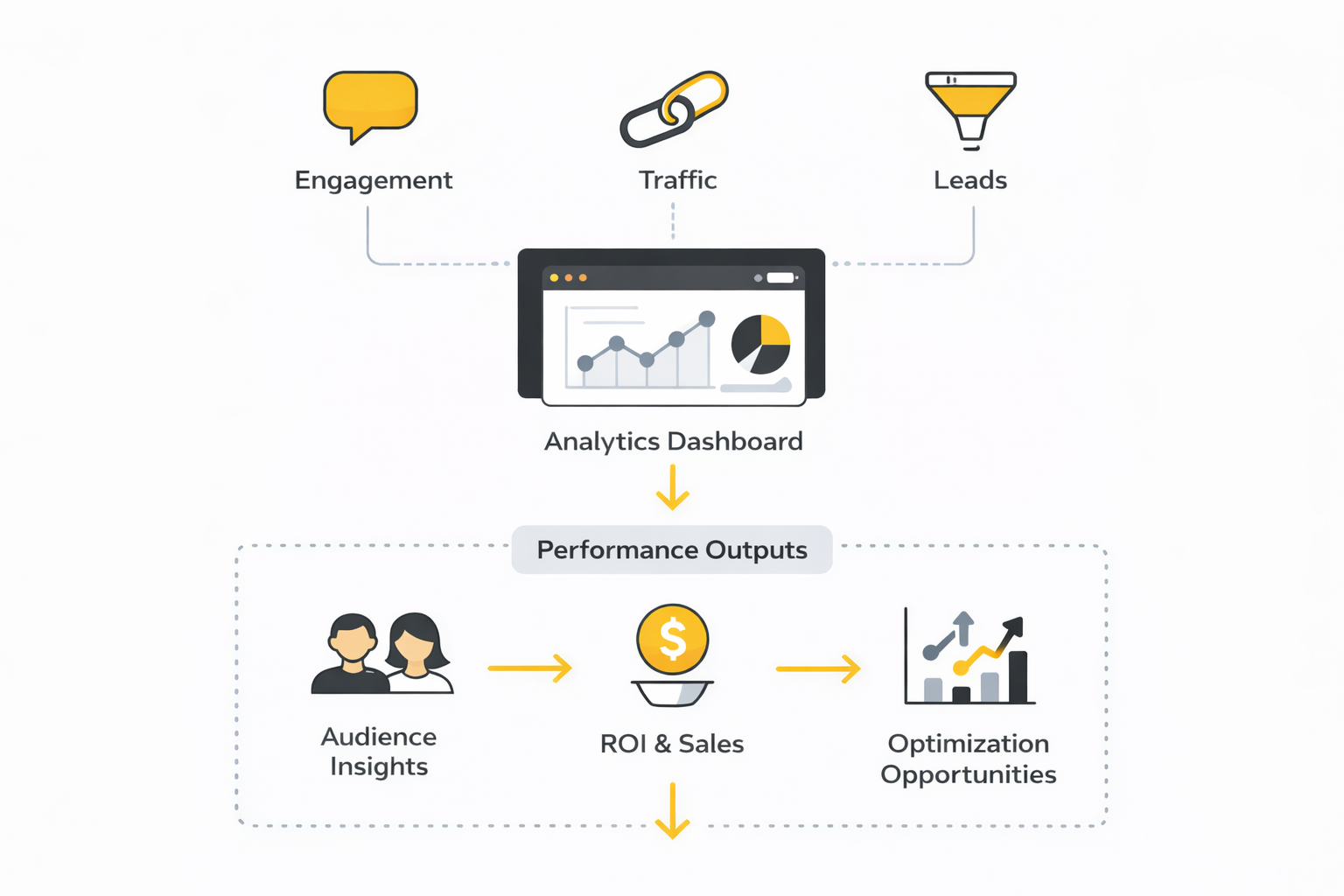
When this system is set up correctly, reporting becomes much more actionable. If top-of-funnel visibility is strong but downstream action is weak, you know the problem is not simply “social is underperforming.” If comments and direct messages rise while clicks stay flat, that may signal stronger trust but weaker calls to action. If shares rise sharply on one content pillar, that is a clue about message-market fit and distribution potential.
Match Metrics to the Role of the Channel
This is where many teams clean up their reporting immediately. A discovery-focused channel should not be judged the same way as a conversion-support channel. If TikTok is mainly there to earn attention and introduce the brand, then watch time, completion rate, shares, profile visits, and branded search lift may matter more than direct last-click conversion. If LinkedIn is being used for B2B trust and demand support, then qualified clicks, conversation quality, and influenced pipeline may matter more than raw reach.
This approach also protects your social media strategy from false negatives. A channel can be strategically valuable while looking mediocre on the wrong dashboard. The mistake is not in the platform. The mistake is using the wrong lens to evaluate it.
Look for Signals, Not Single-Post Drama
One post is rarely the truth. It is a data point. Social performance is noisy by nature, which means smart teams look for patterns across content types, hooks, themes, posting windows, formats, and time periods before changing the strategy. Overreacting to one underperforming post can push a team into randomness very quickly.
A stronger social media strategy uses trend lines and repeated signals. If expert-led posts consistently drive high saves, that matters. If product-heavy content repeatedly gets weak retention at the top of the video, that matters. If comments improve when the brand voice becomes more direct and less polished, that matters too. Analytics gets useful when it starts shaping repeated decisions rather than emotional reactions.
The Numbers That Usually Trigger Action
When reach is falling across multiple posts, the first thing to inspect is the creative opening. Weak first seconds, weak first lines, poor thumbnails, vague framing, or recycled concepts are often the problem before posting time or hashtags. That kind of drop should trigger a creative review, not just a scheduling tweak.
When engagement is soft but reach is decent, the content may be visible but not resonant. That usually means the angle is too generic, the message is too safe, or the audience does not see a reason to respond. In that case, your social media strategy probably needs sharper points of view, stronger audience tension, or better format matching.
When clicks are weak despite strong engagement, the content may be satisfying curiosity without creating motion. That is often a messaging issue. The audience got enough value to interact but not enough reason to continue. The fix is usually clearer sequencing, stronger calls to action, better offer framing, or tighter landing-page alignment.
When response times are slow and conversation volume is rising, the problem shifts from content performance to operational strain. That matters because customer expectations around social care are now much higher, with recent Sprout reporting emphasizing that most customers expect brands to reply within 24 hours or less. If you cannot support that expectation, the strategy needs operational adjustment, not just more publishing.
Reporting That a Team Can Actually Use
The most effective reports are not the prettiest. They are the ones that help a team decide what to do next. A strong monthly review for a social media strategy usually includes a small set of essentials:
- what grew
- what declined
- what content patterns outperformed
- what audience signals appeared repeatedly
- what changed by channel
- what should be tested next
That is enough to guide action without drowning the team in noise. This is also where tools earn their keep. A platform like Buffer can help centralize publishing and reporting for cleaner weekly reviews, while Flick can support performance analysis and iteration when the team is moving fast across multiple post types. The key is still interpretation. A dashboard is only useful if someone can read it with strategic intent.
What Good Measurement Changes
Good analytics makes a social media strategy calmer. It reduces guesswork, lowers the urge to chase random trends, and gives the team a better way to argue for resources, priorities, and creative changes. That alone is a huge advantage.
More importantly, it creates a feedback loop. The team learns what earns attention, what builds trust, what creates action, and what drains time without moving the business forward. Once that loop is working, social stops being a stream of isolated posts and starts operating like a system that improves itself.
Professional Implementation and Long-Term Scale
A social media strategy becomes genuinely valuable when it survives growth. It is one thing to run a solid account when the team is small, the founder is involved in every post, and the content load is still manageable. It is something else entirely to keep quality high when more channels appear, more stakeholders want input, more campaigns compete for attention, and more performance pressure lands on the same system.
That is where advanced strategy starts to matter. At this stage, the question is no longer just what to post or how to measure it. The real question is how to scale output, protect quality, manage risk, and keep the brand distinctive while the operation gets more complex.
Scaling Without Diluting the Brand
The first scaling risk is sameness. As teams grow, they often become more efficient but less distinct. More templates get introduced, more approvals flatten the voice, and more content gets pushed through the machine until the brand starts sounding polished but forgettable.
A strong social media strategy avoids that trap by protecting a few things aggressively. The brand angle stays clear. The tone stays recognizable. The content still reflects actual audience tension instead of drifting into generic advice and safe corporate filler. Scale should increase consistency, not erase personality.
This is why documentation matters, but only if it is practical. A useful brand playbook for social should show examples of strong hooks, point-of-view boundaries, response standards, escalation rules, visual patterns, and channel-specific voice notes. If the guidance is too abstract, nobody uses it when the pace picks up.
Build Governance Before You Need It
Governance sounds boring until something breaks. Then suddenly it is the most important part of the system. Account access, approval rights, legal review, crisis routing, disclosure standards, and security ownership all feel optional right up until a post goes out incorrectly, a creator partnership is handled badly, or an employee turnover issue locks the team out of a major account.
That is exactly why governance belongs inside a mature social media strategy. Recent guidance from Sprout highlights the same cluster of risks many teams run into as they scale: legal exposure, audience backlash, security threats, misinformation pressure, and weak account controls.
Good governance does not mean slowing everything down. It means deciding in advance who can publish, who can approve, who responds in a high-risk situation, how credentials are managed, and when legal or leadership review is actually necessary. That kind of structure makes the team faster when stakes are high because nobody is improvising under pressure.
Creator Partnerships Need Strategy, Not Just Budget
As brands scale social, creator partnerships usually become more important. That makes sense because creators can add trust, native platform fluency, and reach that brand-owned content may not generate on its own. But creator work only strengthens a social media strategy when it is treated like a real operating discipline rather than a one-off promotion tactic.
That means choosing creators based on audience fit, credibility, content quality, and brand alignment rather than pure follower size. It also means planning for sourcing, onboarding, contracts, coordination, performance reporting, and compliance. LinkedIn’s partner ecosystem description points to exactly this kind of full-process model, where creator work is handled as a structured capability instead of an ad hoc add-on.
The strategic tradeoff here is simple. The easier path is to buy bursts of attention. The harder but better path is to build creator relationships that deepen brand meaning over time. The second path is slower, but it usually creates stronger recall and more credible audience transfer.
Compliance Is Part of Trust
A lot of teams still treat disclosure like a legal footnote. That is a mistake. Clear disclosure is part of audience trust, and once creator partnerships, affiliate relationships, or incentivized endorsements enter the picture, weak disclosure stops being a small issue very quickly.
The FTC’s guidance is blunt on this point. Material connections need to be disclosed clearly, and tagging a brand is not enough by itself. That matters for any social media strategy that uses creators, ambassadors, customer advocates, or team members in promotional content.
This is one of those areas where discipline helps the brand, not just the legal team. Clear standards reduce confusion, protect credibility, and make it easier to scale partnerships without turning every campaign into a custom compliance debate. Once the rules are built into briefs and review steps, the whole process gets cleaner.
AI Can Speed the System Up, but It Cannot Be the Strategy
AI now touches almost every part of social execution, from ideation and research support to editing, repurposing, customer messaging, and reporting summaries. Used well, it can reduce friction and help teams move faster. Used badly, it fills feeds with polished emptiness and creates a brand voice that feels vaguely correct and completely forgettable.
That is the central tradeoff. A social media strategy should use AI to accelerate preparation, variation, and workflow, but not to replace judgment, perspective, or audience understanding. The moment a team starts publishing content just because a tool can produce it quickly, quality usually falls even if output rises.
This is also where process design matters. AI is much more useful when it is pointed at specific jobs inside a well-defined system. It can help generate variations from a strong brief, summarize comment themes, organize a content backlog, or support message testing. It is far less useful when it is asked to invent the entire strategic direction from scratch.
Cross-Functional Alignment Separates Serious Teams From Busy Ones
As social grows, isolation becomes expensive. A standalone social team may publish constantly and still miss what sales is hearing, what support is solving, what product is changing, and what leadership needs the market to understand. That disconnect weakens the entire operation because some of the best content inputs sit outside marketing.
A stronger social media strategy creates regular exchange with adjacent teams. Sales objections become content. Customer support questions become education. Product launches become narrative opportunities. Hiring priorities shape employer brand content. Executive insight can become thought leadership when it is translated well instead of posted raw.
This is one reason agile, data-driven, customer-centric marketing structures keep showing up in modern benchmark research. The more social is tied into the rest of the business, the more useful its signal becomes and the easier it is to defend investment in the channel.
Know What Should Be Standardized and What Should Stay Human
Not everything should scale the same way. That is a crucial distinction. Publishing workflows, approval paths, asset naming, reporting structures, inbox routing, and basic response protocols should absolutely become more standardized as the operation grows. That is how teams reduce chaos.
But other parts should stay intentionally human. Creative judgment, point of view, cultural sensitivity, escalation in delicate conversations, and the final call on whether a trend fits the brand should not be flattened into rigid process. A social media strategy gets brittle when it standardizes the wrong things.
This is where leadership judgment matters most. The goal is to systemize the repeatable work so the team has more room for good thinking. If process starts suffocating insight, the brand may become operationally efficient and strategically weak at the same time. That is a bad trade.
Prepare for Platform Volatility Instead of Acting Surprised by It
One of the biggest mistakes in social is building the entire engine around one platform behavior and then panicking when it changes. Algorithms shift. Features get prioritized and then deprioritized. Discovery mechanics change. Audience behavior moves. New competitors arrive. All of that is normal.
A resilient social media strategy expects volatility and plans for it. That means owning reusable creative ideas, building audience relationships beyond one feed, capturing first-party signals where possible, and avoiding total dependence on a single format or a single distribution source. It also means reviewing channel mix regularly instead of treating past platform wins as permanent.
This is where supporting systems can help. Tools such as Buffer can make cross-channel publishing and review easier when the mix evolves, while direct-message and conversation automation tools such as ManyChat can support lead capture and response handling when engagement volume grows. The strategy still comes first. The tools just make it easier to operate the system you have chosen.
What Experienced Teams Understand
The more advanced your social media strategy becomes, the less it feels like a content calendar and the more it feels like a business function. It touches brand, demand, customer experience, risk management, insight gathering, and operational design all at once. That is why experienced teams stop looking for hacks and start building durable systems.
The final piece is bringing all of this together into a clear closing model. A strong strategy needs a way to stay understandable even after all the complexity shows up. That is what the last part is for: simplifying the whole framework, answering the most important questions, and showing what a good social media strategy really looks like when everything is working together.
Bringing the Full System Together
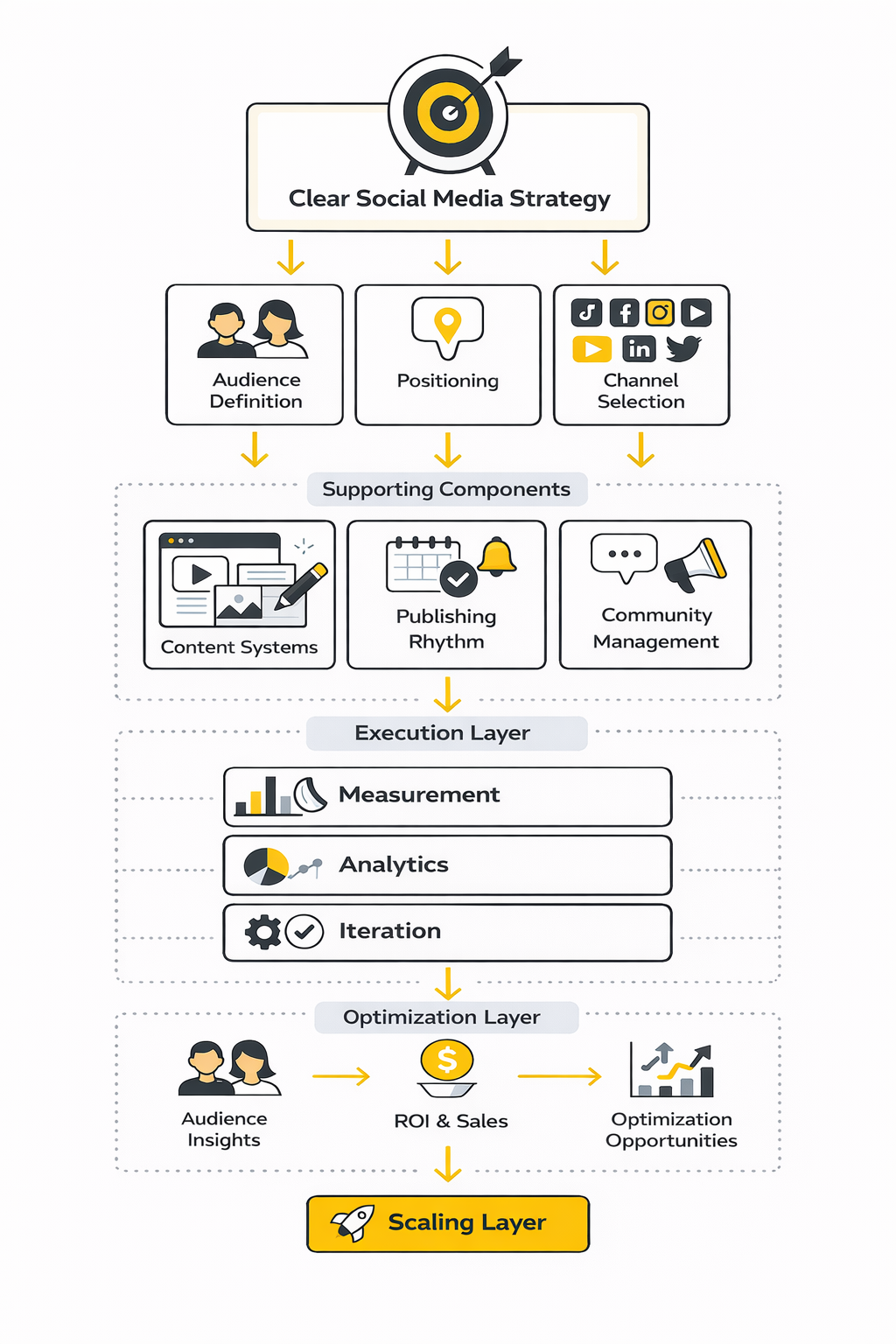
By this point, a social media strategy should feel less like a stack of disconnected tactics and more like an operating model. You know who the audience is, what the brand should mean in the feed, which channels deserve real investment, how content gets produced, how performance is read, and how the operation scales without losing control. That is the difference between “doing social” and building a system that can compound.
This matters even more now because the environment keeps getting denser. Global social usage has continued to rise, with Digital 2025 reporting 5.24 billion active social media user identities worldwide, while newer DataReportal updates show that figure moved even higher later in 2025 as usage kept expanding. More people are reachable, but more brands are competing for the same attention at the same time. (Digital 2025, DataReportal global social media statistics)
A strong social media strategy responds to that reality by staying focused. It does not try to win every platform, every trend, every format, and every audience segment at once. It chooses a role, builds a repeatable process, measures what actually matters, and adapts without becoming chaotic.
FAQ - Built for Complete Guide
What is a social media strategy, really?
A social media strategy is a clear plan for how a brand will use social platforms to support business goals. It covers audience definition, positioning, channel selection, content systems, publishing rhythm, community management, measurement, and long-term scaling. In other words, it is not just a content calendar. It is the logic behind the calendar.
That distinction matters because social is now large enough and influential enough to affect discovery, trust, service, and conversion all at once. Digital 2025 makes that scale obvious, while the 2025 Sprout Social Index shows how much pressure brands now face to be memorable, responsive, and strategically useful.
Why does a business need a social media strategy instead of just posting consistently?
Consistency helps, but consistency without direction usually creates volume rather than results. A business needs a social media strategy so the team knows who it is trying to reach, what the brand should be known for, which platforms matter, and how success will actually be judged. Without those decisions, even frequent posting can turn into noise.
This is especially important because platform behavior and audience behavior vary sharply. Pew’s platform research on U.S. adults and its newer 2025 social media fact sheet both show that usage patterns differ meaningfully by platform and demographic group, which is exactly why random posting is not enough.
How many platforms should most brands focus on?
Most brands should focus on fewer platforms than they think. In practice, one primary platform and one secondary platform are often enough to build real momentum, with a third channel used only for testing if the team has the capacity to do it well. This keeps the social media strategy focused and prevents quality from collapsing under the weight of too many commitments.
That tradeoff matters because each platform behaves differently and requires different creative instincts. Pew’s adult usage data and its 2025 update both reinforce the point that platform reach is uneven, so channel decisions should be driven by audience fit and execution capacity rather than prestige.
Which metrics matter most in a social media strategy?
The most important metrics depend on the role of the channel, but the short version is this: reach tells you whether distribution is happening, engagement quality tells you whether people care, clicks tell you whether the content creates movement, and downstream business metrics tell you whether social is helping the company in a meaningful way. A good social media strategy treats these as connected layers, not isolated numbers.
This is also why benchmark data needs context. Socialinsider’s social media benchmarks show very different engagement norms across platforms, and Sprout’s ROI research shows that leadership increasingly wants social tied to business outcomes rather than vanity metrics alone.
How often should a brand post on social media?
There is no universal posting frequency that works for everyone. The best cadence is the one your team can maintain at a high standard without damaging quality, responsiveness, or strategic clarity. A social media strategy should be built around sustainable output, not around generic pressure to post more.
That is a smarter approach because platform guidance has increasingly emphasized quality and audience value over empty frequency. Instagram’s best-practices guidance for creators reflects that shift clearly, and broader industry reporting like the 2025 Sprout Social Index reinforces how important memorability and originality have become.
What is the difference between organic social and paid social in a social media strategy?
Organic social builds brand presence, audience familiarity, community, and recurring attention through content and conversation. Paid social adds distribution control, audience targeting, and faster testing when the brand wants to amplify content or drive a specific commercial outcome. A strong social media strategy usually uses both, but they play different roles.
The key is not to make them compete with each other. Organic often helps with creative learning, trust, and relevance. Paid helps with scale and sharper targeting. The strongest teams let organic insight improve paid creative, and let paid performance sharpen organic messaging.
How long does it take for a social media strategy to work?
A social media strategy can produce early signals quickly, but durable results usually take time. Within a few weeks, you can often see whether the positioning is clearer, whether content themes are landing better, and whether the right audience is starting to respond. But stronger brand memory, consistent pipeline contribution, and compounding audience trust usually take months, not days.
That longer horizon matters because social performance is noisy by nature. A few posts can spike. A real system compounds. The 2025 Sprout Social Index points to a crowded environment where lasting memorability matters, which is another way of saying patience and consistency still matter when the strategy is sound.
Should every business be on TikTok, Instagram, LinkedIn, and YouTube?
No. A business should be on the platforms where its audience attention, content fit, and team capability overlap. That is a much better rule than trying to be everywhere. A social media strategy gets stronger when channel choices are made deliberately instead of being copied from competitors.
This matters because audience distribution is not uniform. Pew’s research on adults and its newer 2025 findings show that platform use varies across age, race, gender, and education, which means the right channel mix depends heavily on who the brand is actually trying to reach.
How important is community management in a modern social media strategy?
It is far more important than many teams treat it. Community management is where social stops being a broadcast channel and starts becoming a relationship channel. Replies, direct messages, mentions, and comment threads all shape how the audience interprets the brand.
This also has direct operational consequences because customer expectations are no longer casual. Recent Sprout reporting highlights that about 73% of consumers expect a response from brands within 24 hours or sooner, and related Sprout customer-care reporting continues to show similar expectations. A social media strategy that ignores response standards is incomplete. (customer service statistics, customer service metrics)
Can AI help with social media strategy?
AI can absolutely help, but mostly by speeding up parts of the workflow rather than replacing the thinking behind it. It can support ideation, research organization, content variation, reporting summaries, and response triage. What it cannot do well on its own is build a distinctive point of view, understand brand nuance deeply, or make good strategic tradeoffs without human judgment.
That is why experienced teams use AI as an accelerator, not as the strategist. The social media strategy still has to come from real audience understanding, real positioning choices, and real editorial standards. Otherwise the output becomes faster and flatter at the same time.
How do you know whether a social media strategy is failing?
Usually the warning signs appear before the dashboard makes them obvious. Content starts feeling repetitive, reach becomes inconsistent, comments become shallow, the wrong audience begins to engage, approvals get slower, or the team cannot explain what a channel is actually supposed to do. Those are all strategic problems before they are reporting problems.
Once the data does show it clearly, the pattern is often the same: weak repeatable performance, unclear content winners, poor downstream behavior, and rising operational friction. That is when the brand needs to revisit positioning, channel role, content system design, or internal workflow instead of blaming the algorithm by default.
What should a team review every month?
A monthly review should focus on direction, not just output. The team should look at which themes gained traction, which formats created the strongest signals, which audience questions kept coming up, which channels supported the business best, and what should be tested next. A social media strategy stays sharp when monthly reviews drive decisions rather than just documenting history.
This kind of review becomes even more useful when it combines platform analytics with business context. Sprout’s analytics and ROI guidance and its ROI reporting both point toward this broader view, where content performance is connected to business goals instead of treated as a separate universe.
Do disclosures and compliance rules really matter for social media?
Yes, and not just for legal reasons. They matter because trust is part of performance. Once a brand works with creators, affiliates, ambassadors, or any incentivized endorsement, disclosure needs to be clear and hard to miss. A social media strategy that wants long-term credibility cannot treat transparency as optional.
The FTC is explicit about this in its guidance on endorsements, influencers, and reviews. Material connections need to be disclosed clearly, and vague signals are not enough. That becomes especially important as creator partnerships and affiliate-led content become more common parts of the social mix. (FTC guidance on endorsements, influencers, and reviews)
What tools help support a social media strategy without overcomplicating it?
The best tools are the ones that reduce friction in a system that already makes sense. For scheduling and cross-channel workflow, Buffer is useful when a team wants a cleaner publishing process. For content planning and optimization, Flick can support teams that need tighter execution support. For direct-message automation or lead flows, ManyChat can fit naturally when responsiveness and qualification matter.
The important point is that tools should support the social media strategy, not define it. If the process is weak, more software will not fix it. It usually just adds more dashboards to ignore.
Work With Professionals
Explore 10K+ Remote Marketing Contracts on MarkeWork.com
Most marketers spend too much time chasing clients, competing on crowded platforms, and losing a percentage of every project to middlemen. MarkeWork gives you a better way. Browse thousands of remote marketing contracts and connect directly with companies desperate to hire skilled marketers like you, without platform commissions and without unnecessary gatekeepers.
If you're serious about finding better opportunities and keeping 100% of what you earn, explore available contracts and create a profile for free at MarkeWork.com.
Líbí se ti tato osobnost?