

Social network advertising is paid promotion across platforms like Facebook, Instagram, TikTok, LinkedIn, Pinterest, YouTube, Snapchat, Reddit, and X. It includes feed ads, Stories, Reels, Shorts, creator partnerships, lead forms, retargeting, shopping ads, and message-based campaigns.
The reason it matters is simple: attention has moved into social feeds, but profitable attention is harder to buy than it used to be. The IAB reported that U.S. digital advertising reached $259 billion in 2024, with social media revenue jumping to $88.7 billion. That growth is exciting, but it also means more competition, more expensive mistakes, and less room for lazy campaigns.
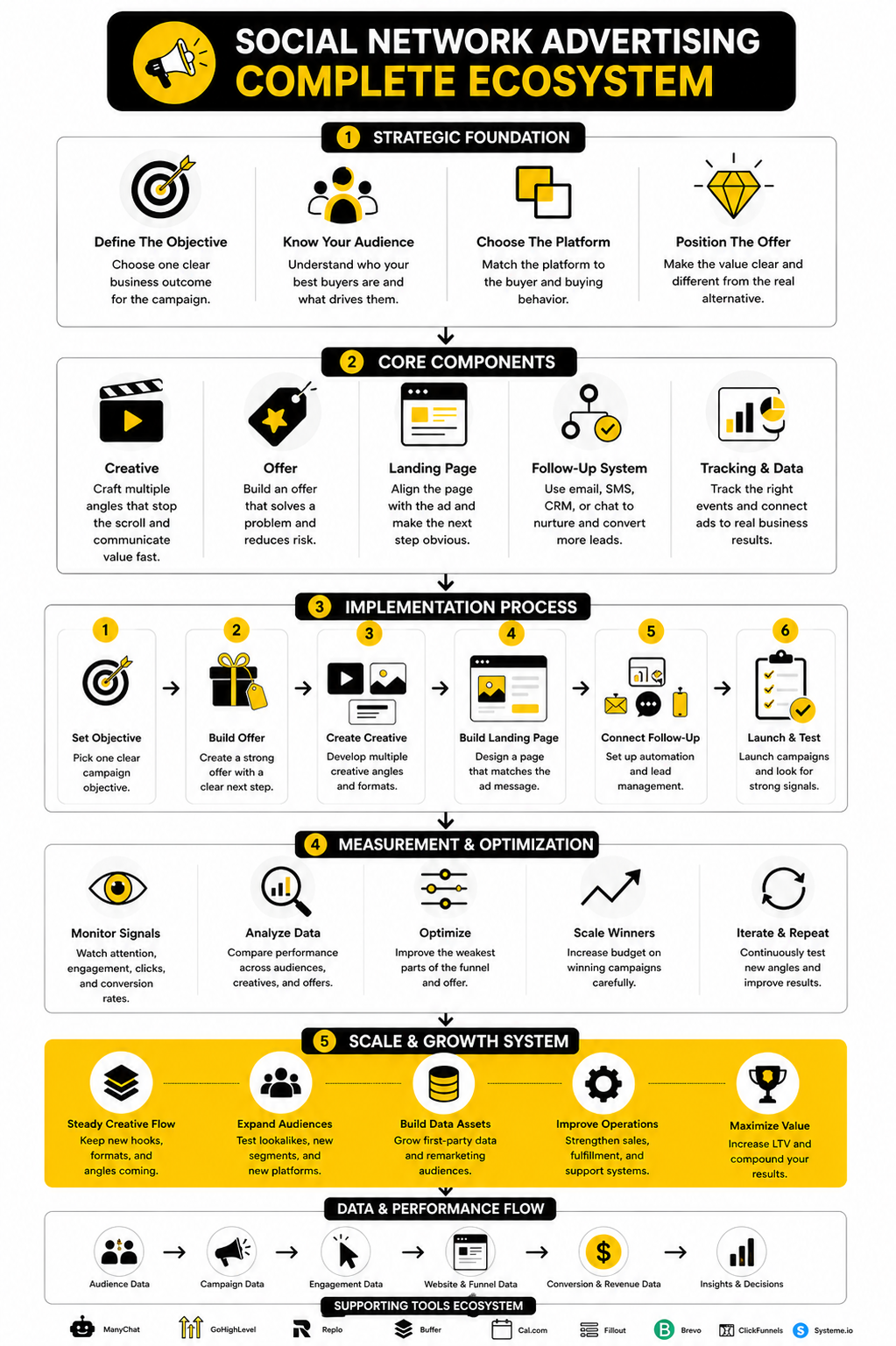
Social network advertising works best when it is treated as a system, not a random boost button. The winning brands connect audience research, creative testing, offer design, landing pages, tracking, and follow-up into one clear machine. Tools can help, but the strategy has to come first.
Article Outline
- Why Social Network Advertising Matters Now
- The Social Network Advertising Framework
- Audience Strategy And Market Positioning
- Creative, Offers, And Campaign Structure
- Tracking, Optimization, And Scaling
- Tools, Workflows, Mistakes, And FAQ
Why Social Network Advertising Matters Now
Social platforms are no longer just awareness channels. They influence discovery, comparison, trust, purchase decisions, repeat sales, and customer service. That is why social network advertising now sits closer to revenue than traditional brand marketing ever did.
The big shift is that users do not move through a clean funnel anymore. Someone might see a short video on TikTok, check comments on Instagram, search the brand on Google, read Reddit opinions, and finally convert through a retargeting ad on Facebook. A strong campaign has to respect that messy journey instead of pretending one click tells the whole story.
This is also why measurement has become harder. The 2025 Sprout Social Index found a clear gap between leaders who want direct business proof from social and marketers who struggle to measure ROI confidently. That does not mean social ads do not work. It means weak tracking, weak offers, and weak attribution models make good decisions harder.
The Social Network Advertising Framework
A useful framework keeps the campaign grounded. You are not just picking a platform and uploading a few creatives. You are building a repeatable system that turns audience insight into creative tests, turns winning creative into traffic, and turns traffic into measurable revenue.
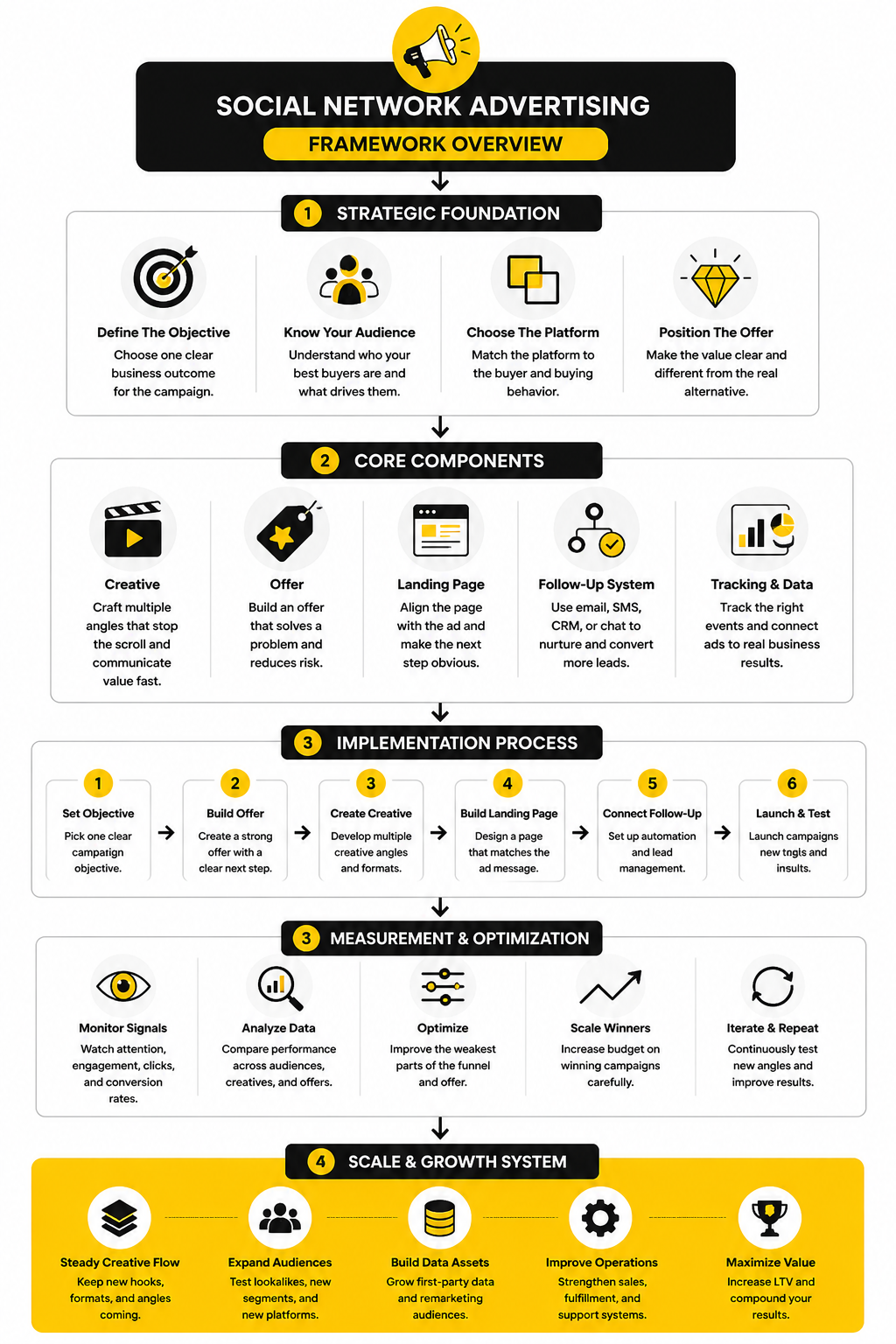
The framework starts with the audience. You need to know who you are targeting, what they already believe, what problem they want solved, and what would make them hesitate. Without that, even a large budget becomes guesswork.
The second layer is the offer. A social ad does not sell in isolation. It sells a promise, a next step, and a reason to act now. That could be a demo, a lead magnet, a product bundle, a quiz, a free trial, a consultation, or a message automation flow using a tool like ManyChat.
The third layer is the conversion path. A click should land somewhere designed for the exact campaign, not a generic homepage that forces the visitor to figure everything out alone. For ecommerce teams, a dedicated landing page builder like Replo can make this part easier because campaign pages can match the ad angle more closely.
The fourth layer is follow-up. Most people will not buy on the first visit, especially from a cold social ad. Retargeting, email, SMS, CRM workflows, and message-based follow-up turn the first click into a longer conversation instead of a wasted visit.
Core Components Of A Strong Campaign
Every strong social network advertising campaign has four core components: audience, creative, offer, and measurement. If one of them is weak, the whole campaign becomes unstable. You can sometimes compensate for one weakness temporarily, but you cannot scale profitably on broken fundamentals.
Audience defines who sees the ad. Creative defines why they stop. The offer defines why they care. Measurement defines whether you know what to do next.
This is where many campaigns fail. The advertiser blames the platform, but the real issue is usually a mismatch between the person, the message, and the next step. A great ad shown to the wrong audience still fails, and a great audience sent to a weak offer still fails.
Professional Implementation
Professional implementation starts with discipline. Instead of launching ten disconnected ideas, build campaigns around one clear business objective. That objective might be qualified leads, booked calls, trial starts, purchases, pipeline, or repeat orders.
From there, each platform should have a job. LinkedIn may be better for high-ticket B2B targeting. Meta may be stronger for retargeting and broad consumer reach. TikTok may be useful for fast creative discovery. The point is not to be everywhere. The point is to know why each channel exists in the system.
A serious setup also needs clean handoff after the lead or sale. For agencies, local businesses, and service brands, platforms like GoHighLevel can connect forms, calendars, CRM pipelines, email, SMS, and follow-up automation. That matters because social ads do not end when someone clicks. They end when the business captures the opportunity and turns it into revenue.
Audience Strategy And Market Positioning
Audience strategy is where social network advertising starts to become serious. The goal is not to target “everyone who might buy.” The goal is to understand the highest-probability buyers well enough that your ads feel specific, useful, and timely.
Start with the buying situation, not the demographic label. A 34-year-old founder, a 34-year-old marketing manager, and a 34-year-old parent may look similar inside an ad platform, but they respond to completely different problems, promises, and proof. Good targeting begins with context: what changed in their life, team, budget, or business that makes your offer relevant now?
This matters because social platforms are crowded and expensive. U.S. social media advertising revenue reached $117.7 billion in 2025, which means advertisers are not competing for cheap attention anymore. They are competing for qualified attention.
Build Around Buyer Intent
Intent is stronger than interest. Someone interested in fitness content is not automatically ready to buy a coaching program. Someone searching comments, saving comparison posts, watching transformation videos, and clicking pricing pages is showing much stronger commercial behavior.
In social network advertising, intent often appears through behavior before it appears through a search query. Saves, comments, shares, video completion, profile visits, message replies, and repeat site visits can all signal that a person is moving closer to action. That is why broad cold campaigns should not be judged the same way as warm retargeting campaigns.
The practical move is to separate audiences by temperature. Cold audiences need education, contrast, and curiosity. Warm audiences need proof, clarity, and lower friction. Hot audiences need direct offers, urgency, and a clean path to conversion.
Match The Platform To The Buyer
Each social platform has its own buying psychology. Meta is strong for broad reach, retargeting, ecommerce, local services, and visual direct response. LinkedIn is useful when job role, company size, industry, or seniority genuinely affects purchase intent.
TikTok and YouTube Shorts are better when the product needs demonstration, personality, repetition, or creator-style explanation. Pinterest can work well when planning, visual discovery, and future purchase intent matter. Reddit can be powerful for research-heavy categories, but the creative and tone need to respect the community or the campaign will feel painfully out of place.
Do not choose a platform because it is trending. Choose it because the buyer’s attention, decision process, and trust signals are there. That one distinction saves a lot of wasted budget.
Position Against The Real Alternative
Your competitor is not always another brand. Sometimes the real alternative is doing nothing, staying with a spreadsheet, asking a freelancer, using a cheaper tool, or delaying the decision until next quarter. Your positioning has to speak to that reality.
A strong ad makes the trade-off obvious. It shows what the buyer is losing by staying where they are, what changes when they act, and why your offer is the believable next step. This is especially important when the product is not an impulse purchase.
For lead generation, the positioning should also continue after the click. A campaign that promises speed, simplicity, or expert help should not send people into a slow form and a vague confirmation page. If the next step is booking a call, tools like Cal.com can keep the handoff clean and reduce unnecessary friction.
Creative, Offers, And Campaign Structure
This is where social network advertising becomes real. Strategy is useful, but the campaign only starts producing data when the creative, offer, landing page, and follow-up path are built together. If those pieces are disconnected, optimization becomes guesswork.
The mistake is treating the ad as the whole campaign. The ad is only the entry point. The campaign includes what the person sees before they click, what they experience after they click, and what happens if they do not convert right away.
A strong implementation process keeps each step connected. You are not just launching ads. You are building a controlled testing environment where every result teaches you something useful.
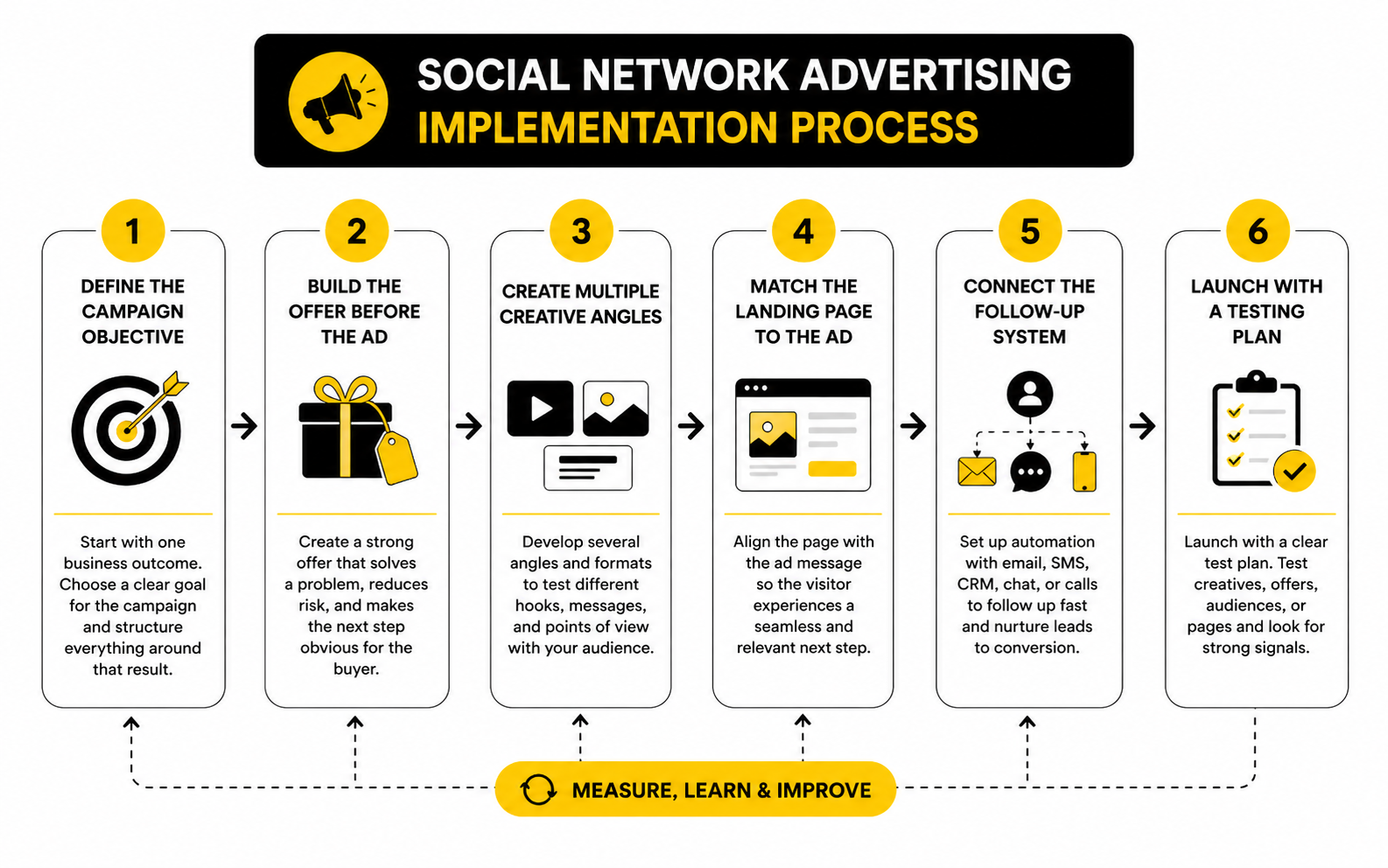
Step 1: Define The Campaign Objective
Start with one business outcome. Not five. One.
For social network advertising, the objective could be purchases, qualified leads, booked calls, webinar registrations, trial starts, demo requests, or message conversations. The cleaner the goal, the easier it is to structure the campaign and judge performance.
This also prevents the classic reporting problem where the campaign gets likes, comments, and cheap clicks but no meaningful business result. Engagement can help, but it is not the same as revenue. If the goal is sales, build the campaign around sales behavior from the beginning.
Step 2: Build The Offer Before The Ad
The offer is the reason someone takes action. It is not just the product. It is the product, the promise, the risk reduction, the timing, and the next step packaged together.
For ecommerce, the offer might be a bundle, limited drop, quiz, discount, free shipping threshold, or product education angle. For service businesses, it might be a consultation, audit, workshop, calculator, checklist, or direct booking path. For software, it might be a free trial, demo, use-case page, comparison page, or onboarding incentive.
This is where many campaigns are too weak. A nice ad cannot save an unclear offer. If the user has to work too hard to understand why they should care, they will scroll.
Step 3: Create Multiple Creative Angles
One ad is not a test. It is a guess.
A proper creative set should test different angles, not just different colors or captions. You might test problem-aware messaging, proof-driven messaging, founder-led videos, product demonstrations, customer objections, before-and-after positioning, comparison angles, and short educational clips.
For teams that publish across multiple social channels, planning and scheduling can get messy fast. A tool like Buffer can help keep organic and paid creative organized, especially when the same campaign theme needs to be adapted across platforms without becoming repetitive.
Step 4: Match The Landing Page To The Ad
The landing page should feel like the next sentence after the ad. If the ad talks about one pain point and the page opens with a generic brand headline, you lose momentum. That disconnect quietly kills conversions.
For product campaigns, campaign-specific pages usually beat sending everyone to a homepage because the message can stay focused. The page can repeat the promise, handle the objection, show the product clearly, and make the next action obvious. If you are building dedicated ecommerce pages, Replo is useful because the landing page can be shaped around the exact ad angle instead of forcing every visitor through the same store layout.
For lead generation, the page should reduce friction without removing qualification. A short form can improve volume, but a smarter form can improve quality. Tools like Fillout can help when the campaign needs conditional questions, routing, or a cleaner lead capture experience.
Step 5: Connect The Follow-Up System
Most paid social leads are not ready to buy the second they click. That does not make them bad leads. It means the campaign needs follow-up.
Follow-up can happen through email, SMS, retargeting, CRM tasks, sales calls, chatbot flows, or booking reminders. The key is speed and relevance. A lead who asked for pricing should not receive the same sequence as someone who downloaded a beginner guide.
For message-first campaigns, ManyChat can turn comments, DMs, and simple opt-ins into automated conversations. For service businesses that need forms, calendars, pipelines, and follow-up in one place, GoHighLevel can keep the operational side from falling apart after the ad starts working.
Step 6: Launch With A Testing Plan
Do not launch and hope. Launch with a simple test plan.
Decide what you are testing before the campaign goes live. That might be three creative angles, two offers, two audiences, or two landing pages. Keep the structure clean enough that the results actually mean something.
A good first test is not about finding the perfect campaign immediately. It is about finding a signal. Once you know which angle earns attention, which offer gets action, and which page converts, you can improve the system instead of randomly changing everything at once.
Tracking, Optimization, And Scaling
Measurement is where social network advertising either becomes a growth system or turns into expensive noise. The numbers are not there to decorate a report. They are there to tell you what to fix, what to protect, and what to scale.
The problem is that most dashboards show too much and explain too little. A campaign can have a low cost per click and still attract the wrong people. Another campaign can have a higher cost per lead and still produce better customers. You need to read the data in context, not as isolated scoreboard numbers.
That context starts with the campaign objective. If the goal is booked calls, the most important question is not “Which ad got the cheapest click?” It is “Which campaign produced the most qualified conversations at a cost the business can afford?”
Statistics And Data
Social network advertising keeps growing because the audience and the money are both there. Global social media user identities reached 5.66 billion in the Digital 2026 report, which means social platforms are no longer a side channel for most brands. They are one of the main places buyers discover products, compare options, and form opinions.
The spend side tells the same story. U.S. digital advertising reached $294.6 billion in 2025, and social continues to be one of the biggest growth engines inside that market. That does not mean every advertiser should spend more. It means the channel is mature enough that weak campaigns get punished quickly.
The most useful statistic is not always the biggest one. The 2025 Sprout Social Index found that leaders want clearer connections between social campaigns and business outcomes, while many marketers still struggle to prove ROI. That gap explains why measurement quality matters so much. If you cannot connect ad activity to real business movement, you cannot scale with confidence.
The Metrics That Actually Matter
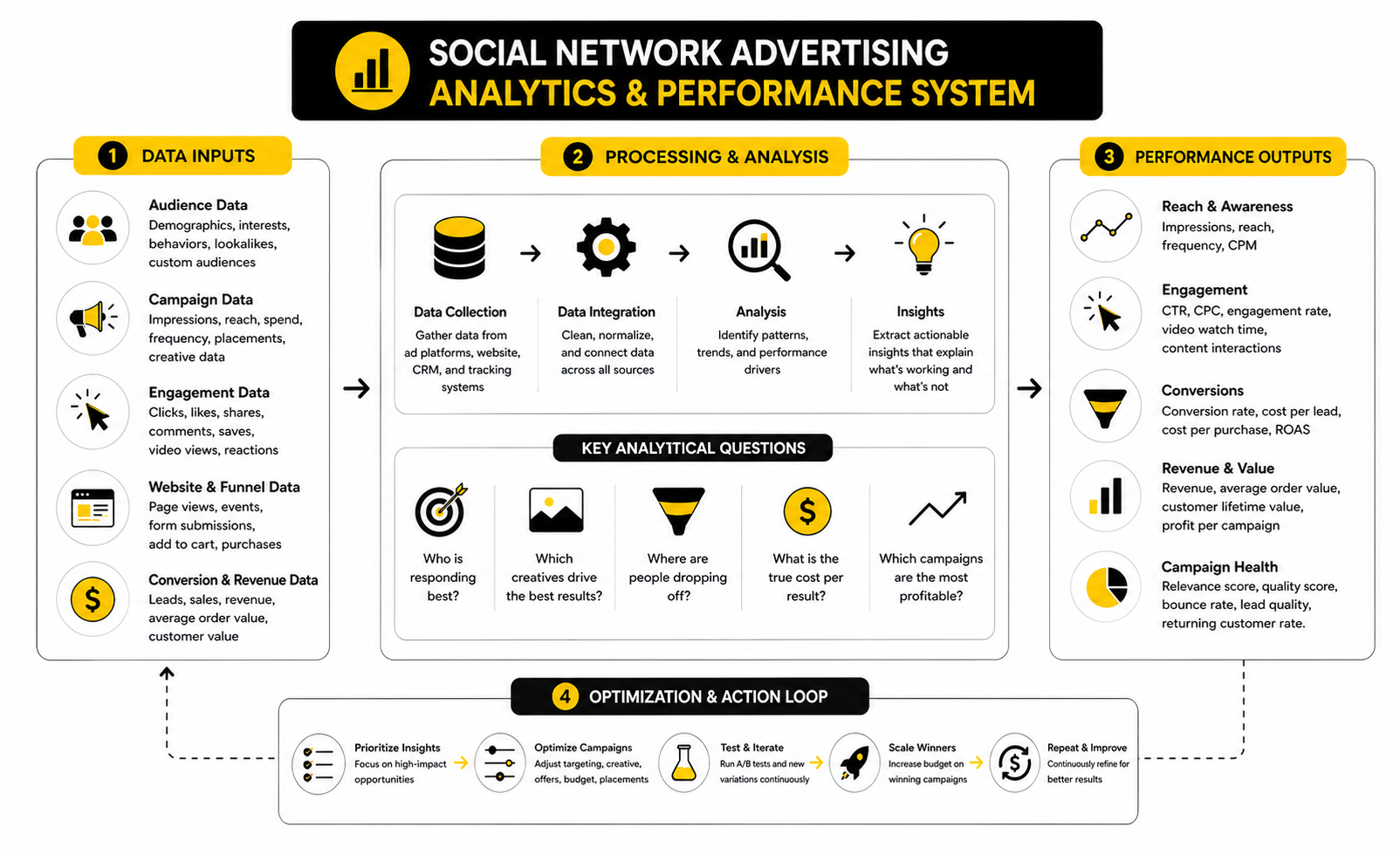
Start with the full path from impression to revenue. At the top, watch thumb-stop rate, video hold, click-through rate, cost per click, and engagement quality. These numbers show whether the creative is earning attention from the right people.
In the middle, watch landing page conversion rate, form completion rate, booked-call rate, cart additions, checkout starts, and cost per qualified lead. This is where you learn whether the offer and page are doing their job. If clicks are strong but conversions are weak, the problem is usually message match, page clarity, price resistance, or poor lead capture.
At the bottom, watch close rate, purchase conversion rate, average order value, customer acquisition cost, payback period, retention, and lifetime value. These are the numbers that decide whether the campaign is worth scaling. A campaign with average front-end metrics can still be excellent if it brings in customers who buy again, stay longer, or upgrade faster.
How To Read Benchmarks Without Getting Misled
Benchmarks are useful for orientation, not decision-making. A typical click-through rate or cost per lead can help you spot obvious issues, but it cannot tell you whether your campaign is profitable. Your market, offer, price point, funnel, sales process, and customer value change the meaning of every number.
For example, a low-cost lead campaign can look great inside the ad account and still fail if the sales team cannot reach the leads. A higher-cost campaign can look worse at first but win because the leads have stronger intent and a better close rate. This is why social network advertising should never be judged only inside the platform dashboard.
Use benchmarks as a warning system. If your click-through rate is far below normal, check the hook and creative relevance. If your landing page conversion rate is weak, check the message match and friction. If your cost per acquisition is too high, check the whole chain instead of blaming one metric too early.
Attribution Needs A Reality Check
Attribution is helpful, but it is not perfect. Privacy changes, cross-device behavior, delayed purchases, dark social sharing, and platform-reported conversions all make measurement messy. Treat attribution as a decision tool, not absolute truth.
The practical answer is to compare multiple signals. Use platform data, analytics data, CRM data, payment data, and qualitative feedback from sales or support. When several sources point in the same direction, you can act with more confidence.
This is also why naming conventions and tracking discipline matter. Use clean UTM parameters, separate campaigns by objective, and keep landing pages tied to specific ad angles. If everything is mixed together, the data becomes harder to trust exactly when you need it most.
Optimization Should Follow The Constraint
Do not optimize randomly. Find the constraint first.
If impressions are high but clicks are weak, improve the creative. If clicks are strong but leads are weak, improve the landing page or offer. If leads are strong but sales are weak, improve qualification, follow-up, or the sales process. If sales are strong but profit is weak, work on average order value, retention, pricing, or acquisition cost.
This is where a CRM and automation layer can make the data more useful. For service businesses, GoHighLevel can help connect form submissions, calls, appointments, pipeline stages, and follow-up activity so the campaign is judged beyond the first conversion. For email-heavy funnels, Brevo can support segmented follow-up when leads need more education before they buy.
Scaling Without Breaking The Campaign
Scaling is not just increasing the budget. That is the easy part. The hard part is increasing spend without destroying efficiency.
Scale only after you know what is working. That usually means a proven audience signal, a clear creative winner, a converting page, and a follow-up path that can handle more volume. If one part of the system is fragile, more budget just exposes the weakness faster.
The safest approach is controlled expansion. Increase budgets gradually, duplicate winning angles into new creative variations, test broader audiences, and improve the conversion path before forcing more traffic through it. Social network advertising rewards momentum, but it punishes impatience.
Tools, Workflows, Mistakes, And FAQ
Before the final FAQ, it is worth looking at the decisions that separate professional social network advertising from basic campaign management. Most accounts do not fail because one button was wrong. They fail because the operating system behind the ads is weak.
The deeper you go, the more the tradeoffs matter. Automation can improve speed, but it can also hide bad strategy. AI can help produce more variations, but it can also flood the account with shallow creative. Scaling can unlock growth, but it can also expose every weakness in the funnel.
Automation Should Support Judgment
Automation is useful when it removes repetitive work. It is dangerous when it replaces thinking. Social platforms can optimize delivery, adjust bids, and find conversion patterns faster than a human team, but they still need a clear goal, strong creative, enough signal, and clean tracking.
This is why campaign structure matters. If you feed the algorithm messy objectives, mixed audiences, weak conversion events, and inconsistent landing pages, the system has very little to learn from. Better automation starts with better inputs.
Use automation for routing leads, triggering follow-up, sending reminders, updating CRM stages, and keeping response speed high. Tools like GoHighLevel can help here because the ad result does not stay trapped inside the ad platform. It moves into a workflow where the business can actually act on it.
AI Creative Needs Human Taste
AI can speed up research, scripting, editing, repurposing, and variation testing. That is useful. But social network advertising still rewards taste, clarity, timing, and emotional relevance.
The risk is producing more assets without producing better ideas. A campaign with fifty generic variations is not more strategic than a campaign with five sharp angles. Volume only helps when the underlying insight is strong.
There is also a trust issue. Public backlash around AI-generated campaigns has shown that audiences can react badly when creative feels cheap, uncanny, or detached from the brand. The lesson is not “never use AI.” The lesson is to keep human judgment in control, especially when the brand depends on authenticity, craft, or emotional connection.
Creative Fatigue Is A Scaling Problem
Creative fatigue happens when the same audience sees the same message too many times and stops responding. It usually shows up as rising frequency, falling click-through rate, higher cost per result, weaker comments, and lower conversion quality. This is not always a platform problem. Often, it means the campaign has run out of fresh reasons for people to care.
The fix is not changing the button color. Build a creative pipeline around new hooks, new objections, new proof points, new formats, and new stages of awareness. A fresh founder video, product demo, customer objection angle, comparison post, or short educational clip can reopen performance without changing the entire offer.
For teams managing multiple platforms, a planning workflow matters. Buffer can help organize publishing and campaign themes, while tools like Flick Social can support content planning when organic insights are feeding paid creative ideas. The goal is not to post more for the sake of it. The goal is to build a repeatable source of tested angles.
Brand Safety And Compliance Are Not Optional
As ad systems become more automated, platform enforcement is getting more aggressive. Google’s 2025 ad safety reporting showed the scale of the problem, with billions of ads blocked or removed as AI-generated spam and scam activity increased. Social platforms face the same pressure because advertisers, users, and regulators all expect safer ad environments.
That means advertisers need to be more careful with claims, targeting, testimonials, health promises, financial language, before-and-after messaging, and exaggerated results. A campaign can be profitable and still be risky if the claims are too loose. Short-term performance is not worth account restrictions, rejected ads, payment issues, or brand damage.
The practical move is to build a review checklist before launch. Check the claim, the proof, the landing page, the privacy language, the targeting, and the follow-up sequence. If a statement would make you nervous in front of a customer, regulator, or platform reviewer, rewrite it.
Scaling Requires Operational Capacity
Scaling social network advertising is not only a media buying decision. More leads require faster response times. More orders require fulfillment capacity. More booked calls require sales availability. More customers require support.
This is where many campaigns break after they start working. The ad account improves, but the business cannot handle the volume cleanly. Leads wait too long, sales calls get missed, onboarding becomes sloppy, and the campaign gets blamed for what is really an operations problem.
Before scaling, check the backend. Make sure forms work, calendars have availability, emails send correctly, SMS follow-up is compliant, sales stages are clear, and reporting connects the ad source to the outcome. If the system cannot handle more demand, more spend just creates more mess.
The Advanced Play Is Message Consistency
The best campaigns feel consistent across the whole journey. The ad, landing page, form, follow-up email, sales call, checkout, and onboarding all reinforce the same promise. That consistency builds trust because the buyer does not feel like they are being passed between disconnected experiences.
This is especially important for higher-ticket offers. A prospect may need several touches before making a decision, and every touch either strengthens or weakens confidence. If the ad sounds premium but the follow-up feels rushed, trust drops. If the landing page promises simplicity but the signup process is confusing, trust drops.
For funnel-heavy businesses, ClickFunnels or Systeme.io can help keep the offer, page, checkout, and follow-up path connected. The tool is not the strategy, but a clean funnel makes the strategy easier to execute.
FAQ - Built For Complete Guide
What is social network advertising?
Social network advertising is paid promotion on social platforms where people discover, discuss, compare, and buy. It includes campaigns on platforms like Facebook, Instagram, TikTok, LinkedIn, YouTube, Pinterest, Snapchat, Reddit, and X. The goal is not just visibility; the goal is to turn social attention into measurable business outcomes.
Is social network advertising the same as social media marketing?
No, but they overlap. Social media marketing includes organic posting, community building, creator partnerships, customer engagement, and brand content. Social network advertising specifically means paid campaigns that use platform ad systems, targeting, bidding, creative testing, and conversion tracking.
Which platform is best for social network advertising?
The best platform depends on the buyer, the offer, and the buying journey. Meta is often strong for broad consumer reach and retargeting, LinkedIn can work well for B2B targeting, and TikTok or YouTube Shorts can be strong when the product needs demonstration or personality. Do not choose the platform first; choose the buyer and strategy first.
How much should a business spend on social network advertising?
A practical starting budget should be large enough to test multiple creatives, collect meaningful conversion data, and avoid making decisions from tiny sample sizes. For a small business, that might mean starting with a controlled daily budget and one clear objective instead of spreading money across five platforms. The better question is not “How little can we spend?” but “How much can we test without risking cash flow?”
What makes a social ad profitable?
A profitable social ad connects the right audience, sharp creative, a clear offer, a relevant landing page, and a strong follow-up system. The ad itself only creates the opportunity. Profit comes from the full system converting attention into leads, sales, repeat purchases, or pipeline.
What metrics should I watch first?
Start with the metric closest to the campaign goal. If you want purchases, watch cost per purchase, conversion rate, average order value, and customer acquisition cost. If you want leads, watch cost per qualified lead, booked-call rate, show-up rate, close rate, and revenue per lead.
Why do social ads stop working after a while?
Creative fatigue is usually the main reason. The audience has seen the message too many times, the hook no longer feels fresh, or competitors have copied the angle. Refresh the campaign with new hooks, proof points, formats, objections, and offers instead of making random edits.
Should I use AI for social network advertising?
Yes, but use it carefully. AI can help with research, scripting, creative variations, reporting, and workflow speed. It should not replace human taste, customer insight, brand judgment, or claim review.
Do I need a landing page for social ads?
In most cases, yes. A dedicated landing page lets the message continue naturally from the ad and keeps the visitor focused on one action. Sending paid traffic to a generic homepage often creates friction because the visitor has to search for the next step.
How long should I run a test before optimizing?
Run the test long enough to collect a useful signal, not just a few clicks. The exact timing depends on budget, audience size, conversion volume, and campaign objective. Avoid changing everything too quickly, because constant edits can make the data harder to interpret.
What is the biggest mistake in social network advertising?
The biggest mistake is treating the ad platform as the strategy. Platforms can optimize delivery, but they cannot fix a weak offer, unclear positioning, poor follow-up, or broken funnel. The business needs a complete system before scale makes sense.
How does social network advertising fit with organic content?
Organic content helps you learn what people care about, which objections appear often, and which messages earn attention naturally. Paid campaigns can then turn the strongest themes into controlled tests. The best teams use organic content as a research engine, not just a posting calendar.
When should I scale a campaign?
Scale when the campaign has proven creative, reliable conversion tracking, a profitable acquisition cost, and enough operational capacity to handle more demand. Do not scale just because one ad had a good day. Scale when the system can absorb more volume without breaking.
Work With Professionals
Explore 10K+ Remote Marketing Contracts on MarkeWork.com
Most marketers spend too much time chasing clients, competing on crowded platforms, and losing a percentage of every project to middlemen.
MarkeWork gives you a better way. Browse thousands of remote marketing contracts and connect directly with companies desperate to hire skilled marketers like you, without platform commissions and without unnecessary gatekeepers.
If you're serious about finding better opportunities and keeping 100% of what you earn, explore available contracts and create a profile for free at MarkeWork.com.