

Sports marketing works because fans do not experience sport like ordinary entertainment. They follow teams, athletes, leagues, rivalries, rituals, and moments with emotional intensity, which gives brands a rare chance to earn attention that people actually care about.
That attention is becoming more valuable and more complex. Sponsorship is no longer just logo placement, because the global sports sponsorship market was valued at $84.08 billion in 2024, while modern rights holders, sponsors, and agencies are now competing across live events, streaming, social platforms, creators, retail, data, and community channels.
The practical challenge is simple: sports marketing only works when the brand has a clear role in the fan experience. A campaign should not interrupt the match, the athlete, or the culture around the sport. It should make the experience more useful, more entertaining, more personal, or easier to act on.
This article breaks sports marketing into a complete operating system. We will move from strategy and audience insight into campaign architecture, execution, measurement, and professional implementation.
Article Outline
- Why Sports Marketing Matters Now
- The Sports Marketing Framework
- Core Components of a Sports Marketing Strategy
- Building Campaigns Around Fans, Athletes, Teams, and Events
- Measuring Performance, ROI, and Brand Impact
- Professional Implementation, Tools, Mistakes, and FAQ
Why Sports Marketing Matters Now
Sports marketing matters because sport still creates live, shared attention in a fragmented media world. Deloitte describes the sports industry as moving into a broader phase of expansion, with AI, capital investment, media change, and new operating models reshaping how organizations grow across the global sports ecosystem. That makes sport more than a sponsorship category; it is becoming a growth channel, a content engine, and a customer relationship platform.
The big shift is that fans are no longer reachable through one dominant broadcast moment. Nielsen’s 2025 Global Sports Report highlights football’s global scale, with 51% of people globally identifying as football fans, but those fans now engage across highlights, live streams, social clips, fantasy games, creator commentary, merchandise, and in-person experiences. A strong sports marketing strategy has to connect those moments instead of treating them as separate tactics.
That is why the best campaigns start with fan behavior, not the asset list. A shirt logo, stadium board, athlete post, hospitality package, or digital giveaway can all be useful, but only if each one supports a clear commercial job. The brands that win are the ones that understand the sport, respect the audience, and build campaigns that can be measured beyond surface-level exposure.
The Sports Marketing Framework
A useful sports marketing framework starts with one question: what should the fan do next? Not what asset did the brand buy, not how big the logo looks, and not how many impressions can be estimated after the campaign ends. The real work is connecting fan attention to a clear next action, whether that is watching, subscribing, joining, buying, sharing, visiting, booking, or returning.
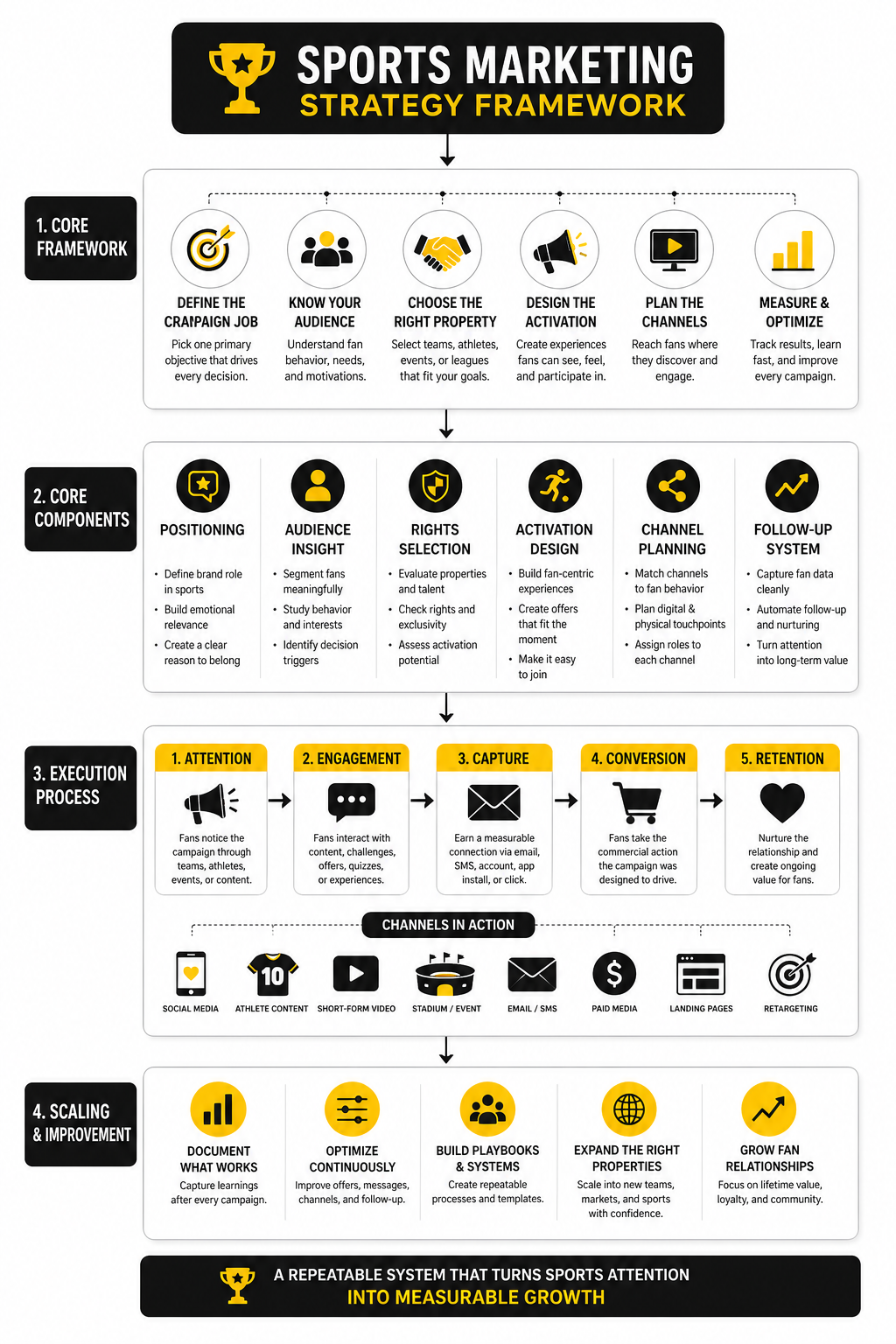
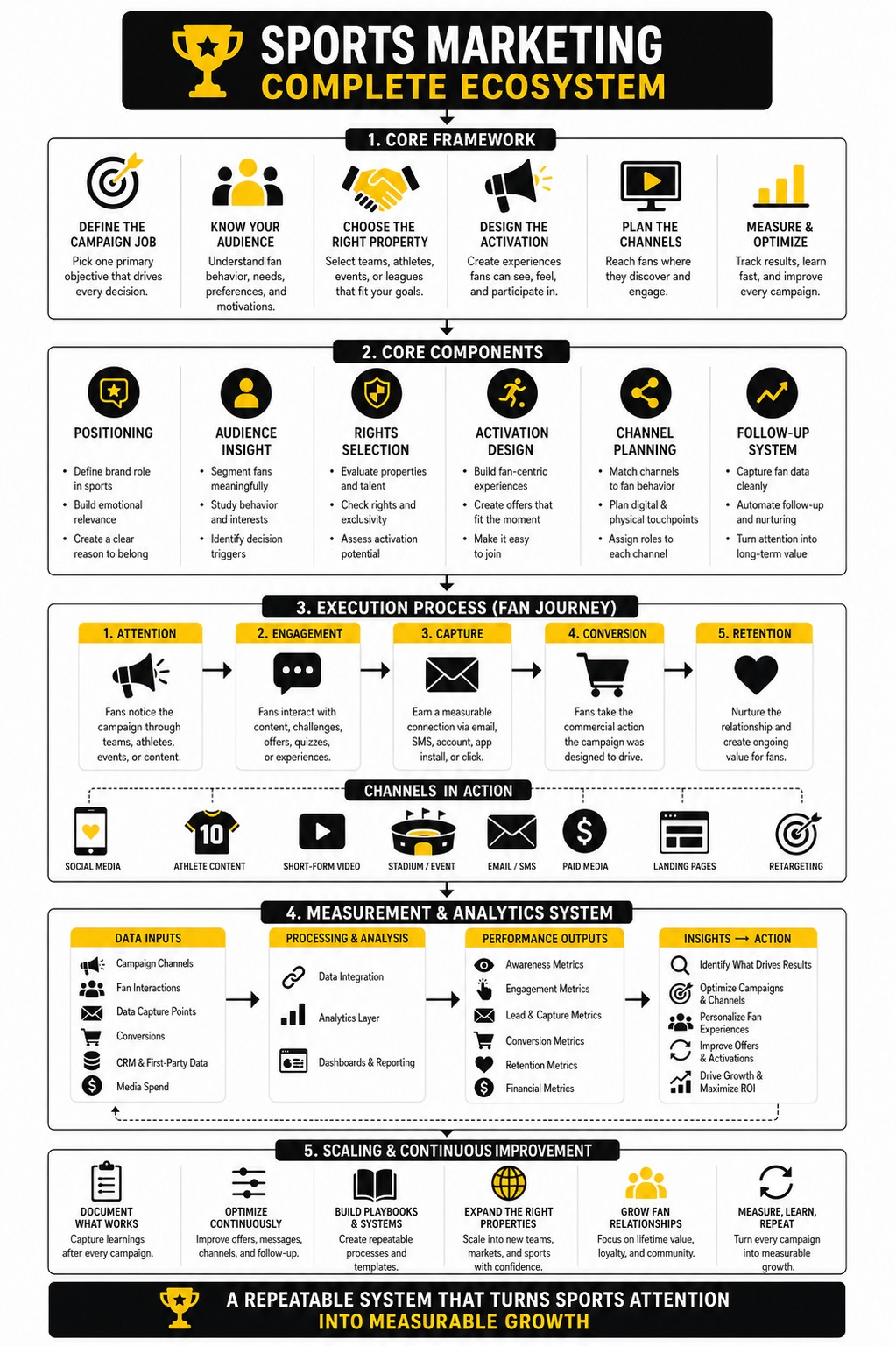
The framework has four layers: audience, property, activation, and measurement. Audience defines who the campaign is for and what they already care about. Property defines the team, athlete, league, event, venue, or creator ecosystem that gives the campaign credibility. Activation turns the partnership into visible fan experiences. Measurement proves whether the campaign created brand lift, demand, revenue, retention, or usable first-party data.
This matters because sponsorship spending is growing, but attention is not getting easier to win. The global sports sponsorship market was valued at $84.08 billion in 2024 and is projected to keep expanding, which means more brands are competing for the same emotional territory. A loose campaign can still look busy, but a structured campaign is the only version that can be improved, defended, and scaled.
Start With the Fan Segment
Sports audiences are not one audience. A lifelong season-ticket holder, a fantasy player, a parent watching youth tournaments, a sneaker collector, and a casual fan scrolling highlights all respond to different triggers. Treating them the same is how brands waste good rights.
The segment should be defined by behavior, not just demographics. Useful questions include what the fan watches, where they engage, what they buy, which athletes they trust, how often they attend, and what moment in the season changes their urgency. This is where sports marketing becomes practical, because the message can be built around a real fan context instead of a generic brand slogan.
A simple segmentation model can separate fans into casual followers, active viewers, community participants, buyers, and advocates. Each group needs a different offer and a different channel mix. Casual followers may need short-form content, buyers may need limited drops or event-linked offers, and advocates may need referral mechanics, VIP access, or community recognition.
Match the Brand Role to the Property
The brand should have a believable reason to be in the sport. That reason can be functional, emotional, cultural, or commercial, but it has to make sense quickly. Fans can feel when a sponsor is only renting attention.
A sports drink, travel platform, apparel brand, financial service, local restaurant, software company, or healthcare provider can all belong in sport if the role is clear. The problem starts when the campaign asks fans to make the connection themselves. Strong sports marketing makes the link obvious by tying the brand to performance, convenience, access, identity, recovery, celebration, or community.
The property choice also needs discipline. A famous team is not automatically the right team, and a high-profile athlete is not automatically the right messenger. Fit beats fame when the goal is trust, conversion, and repeatable growth.
Turn Rights Into Fan Experiences
Rights are the raw material. Activation is the product. This is the part many campaigns underbuild, even though it is where most of the value is created.
A brand may buy signage, content rights, hospitality, athlete appearances, ticket access, digital inventory, naming rights, retail integration, or community programs. None of those assets guarantee results on their own. They need to become experiences fans notice and remember.
That could mean a pre-game content series, a matchday offer, an athlete-led product demo, a fan challenge, a limited-edition drop, a stadium utility, a youth development program, or a post-game retention flow. The key is that each activation should have a job. Awareness assets should make the brand easier to recall, engagement assets should create participation, and conversion assets should move the fan into a measurable relationship.
Build the Measurement Before the Campaign Goes Live
Measurement cannot be added at the end and still be credible. The campaign needs a tracking plan before the first post, event, email, landing page, QR code, broadcast placement, or creator integration goes live. Otherwise, the team ends up celebrating vanity metrics because they are the only numbers available.
Good measurement combines brand and performance signals. Reach, frequency, share of voice, sentiment, and brand lift help explain whether the campaign changed perception. Clicks, signups, redemptions, purchases, booked calls, app installs, retention, and customer lifetime value show whether attention turned into business value.
The cleanest campaigns use dedicated landing pages, unique offers, tagged links, CRM source tracking, and post-event follow-up. For brands that need a practical system to capture leads, automate responses, and track campaign pipelines, a platform like GoHighLevel can fit naturally when the sports marketing campaign includes local sponsorships, clinics, ticket promotions, fan communities, or sales follow-up. The tool is not the strategy, but the strategy gets much easier to execute when the data does not disappear after the final whistle.
Core Components of a Sports Marketing Strategy
A sports marketing strategy needs more than a property, a budget, and a launch date. It needs a working system that turns attention into action without making the fan feel like they are being pushed through a generic funnel. The strongest campaigns usually have six core components: positioning, audience insight, rights selection, activation design, channel planning, and follow-up.
Positioning defines why the brand belongs in the conversation. Audience insight defines who the campaign is built for and what fan behavior matters most. Rights selection decides which team, athlete, event, creator, league, or venue gives the campaign credibility. Activation design turns the partnership into something fans can experience. Channel planning decides where the campaign shows up. Follow-up captures the value after the first interaction.
This is where sports marketing starts to feel less like a media buy and more like an operating model. The campaign should have a clear emotional hook, a commercial path, and a data plan before anything goes live. If one of those pieces is missing, the campaign may still look good in a recap deck, but it will be harder to prove, repeat, or improve.
Define the Campaign Job
Every campaign needs one primary job. It may be awareness, lead generation, product trial, ticket sales, app installs, retail traffic, community growth, membership retention, sponsor value, or brand repositioning. Pick one as the main objective, then let secondary goals support it.
This prevents the most common execution problem: trying to make one campaign do everything. A brand-building campaign should not be judged only by short-term sales, and a conversion campaign should not hide behind vague exposure metrics. The job determines the offer, the content, the channel mix, the measurement plan, and the internal team that needs to own results.
A practical way to define the job is to write one sentence before production starts: this campaign will help this fan segment take this action because this sports moment makes the action feel relevant now. That sentence keeps the work honest. If the sentence sounds weak, the campaign probably needs sharper strategy before it needs more creative.
Build the Fan Journey
Fans rarely move from first exposure to purchase in one clean step. They may see an athlete post, watch a highlight, scan a code at the venue, visit a landing page, ignore the first message, engage with a follow-up, and convert later. The campaign needs to respect that journey instead of pretending every touchpoint has the same job.
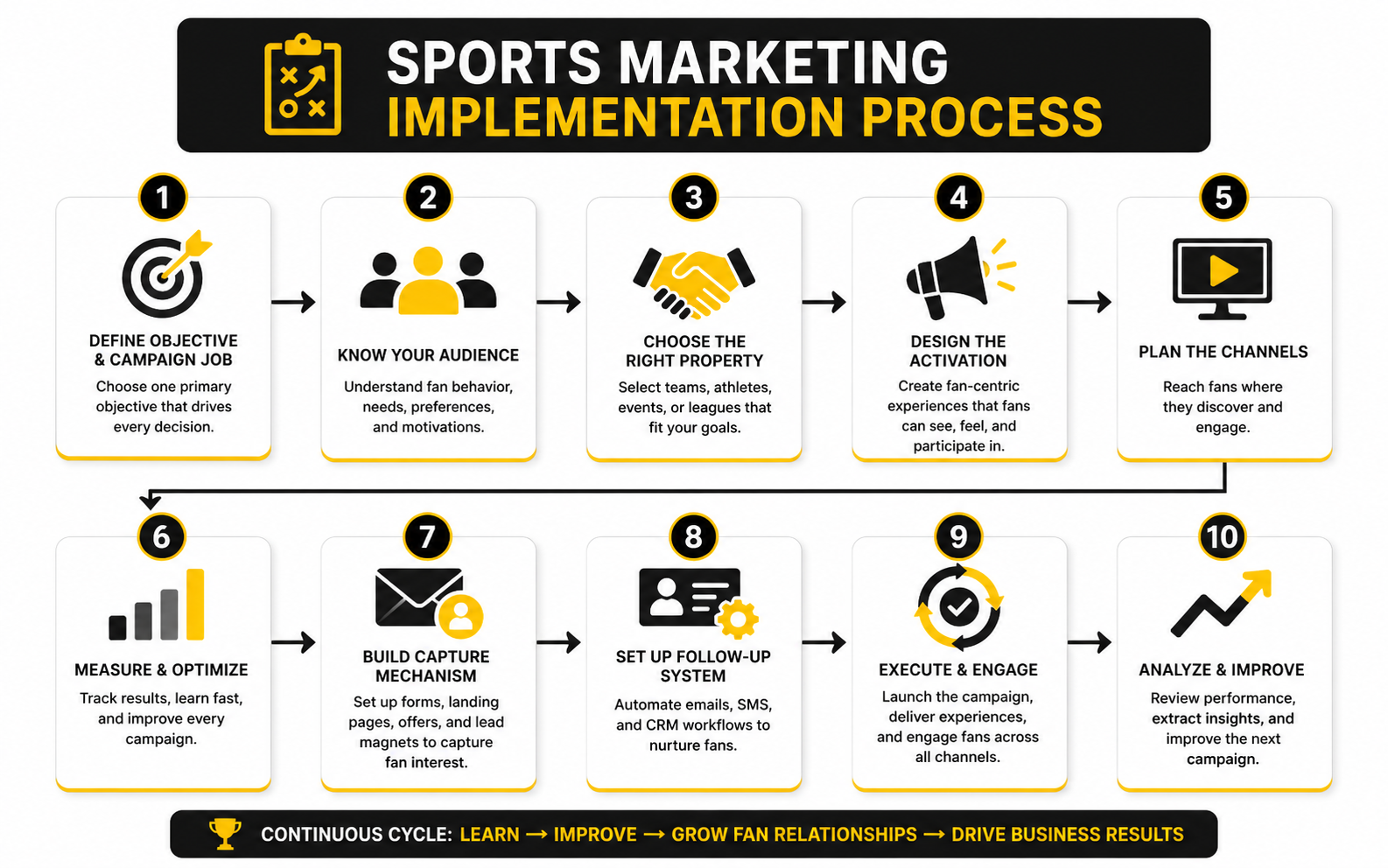
A simple fan journey can be mapped in five stages:
- Attention: The fan notices the campaign because it connects to a team, athlete, match, event, or cultural moment they care about.
- Engagement: The fan interacts with content, a challenge, a quiz, a giveaway, an offer, a community moment, or an in-venue experience.
- Capture: The campaign earns a measurable connection through an email, SMS opt-in, account creation, app install, booking, purchase, or tracked click.
- Conversion: The fan takes the commercial action the campaign was designed to support.
- Retention: The brand continues the relationship after the campaign moment ends.
That last stage is where a lot of sponsorship value gets lost. Sports create powerful spikes of attention, but the business value comes from what happens after the spike. If the fan relationship is not captured and nurtured, the brand is renting attention instead of building an owned asset.
Choose Channels Around Behavior
Channel planning should follow fan behavior, not internal preference. Deloitte’s research on immersive sports fandom found that nearly all Gen Z fans use social media for sports-related content, and around 80% follow a professional athlete online, which can influence what they watch, attend, follow, and buy through athlete-driven engagement. That does not mean every campaign should chase the same platforms, but it does mean younger fans often discover sport through people, clips, and context before they commit to full events.
For live events, the channel mix usually needs physical and digital layers. Stadium signage may create visibility, but mobile prompts, QR codes, SMS flows, retargeting, app integrations, and post-event email can make the campaign measurable. For digital-first campaigns, short-form video, athlete content, creator commentary, paid social, search, landing pages, and automated follow-up may do more work than traditional media.
A clean execution plan assigns one role to each channel. Social should not just “drive engagement”; it should introduce the hook, invite participation, or retarget warm fans. Email should not just “send updates”; it should move captured fans toward a next action. Landing pages should not just “provide information”; they should convert attention into something trackable.
Make the Offer Feel Native to the Moment
The offer has to match the sports context. A generic discount dropped into a high-emotion matchday moment often feels lazy. A better offer connects to the reason the fan is paying attention right now.
That could mean early access after a win, a limited drop tied to a rivalry week, a youth clinic registration during a community event, a travel package around an away game, or a post-match reward for fans who attended. The offer does not always need to be expensive. It needs to feel timely, relevant, and easy to understand.
This is also where landing page quality matters. If a fan clicks from an athlete post or scans a stadium QR code, the page should load fast, match the campaign promise, and make the next action obvious. For ecommerce and campaign-specific pages, a tool like Replo can be useful when the team needs to launch polished pages quickly without turning every promotion into a full development project.
Create the Follow-Up System Before Launch
The follow-up system should be ready before the first fan enters the campaign. That includes email or SMS messages, CRM tagging, sales notifications, audience exclusions, retargeting pools, customer support handoffs, and reporting views. Waiting until after the campaign launches is how good leads go cold.
For community-driven campaigns, messaging automation can be especially useful when fans enter through social comments, direct messages, giveaways, or content interactions. A platform like ManyChat fits naturally when the campaign needs to move fans from social engagement into a controlled follow-up path. That can be the difference between a fun activation and a measurable acquisition channel.
The important part is not the tool itself. It is the discipline of designing the post-click, post-scan, post-comment, and post-event experience before the campaign starts. Sports marketing creates the spark, but follow-up turns that spark into pipeline, revenue, loyalty, and learning.
Measuring Performance, ROI, and Brand Impact
Sports marketing measurement should explain what happened, why it happened, and what the team should do next. A report full of impressions may look impressive, but it does not automatically prove that the campaign changed awareness, trust, consideration, sales, or loyalty. The point of analytics is not to decorate the campaign recap; it is to decide what deserves more budget, what needs fixing, and what should be cut.
The cleanest approach is to separate metrics into three layers: exposure, engagement, and business impact. Exposure shows whether the campaign reached enough of the right people. Engagement shows whether fans cared enough to interact. Business impact shows whether that attention created measurable value.
This is especially important because the sports audience is large, emotional, and fragmented. Nielsen’s 2025 Global Sports Report shows football alone reaches 51% global fandom, which is massive, but scale only becomes useful when the campaign knows which fans it is trying to influence. Big reach is not the win. Relevant reach that moves behavior is the win.
Statistics and Data
The numbers around sports sponsorship are strong, but they need context. The global sports sponsorship market was valued at $84.08 billion in 2024, which explains why brands, teams, agencies, and platforms are taking measurement more seriously. When that much money is moving through the category, “brand exposure” is not enough on its own.
Fan receptivity also matters. Nielsen’s 2025 sports data shows women’s sports interest reached 50% of the global general population in 2024, up from 45% in 2022. That does not mean every brand should jump into women’s sports without a plan. It means the audience is broadening, the commercial opportunity is real, and brands need to evaluate where their message can earn trust instead of simply chasing the newest growth story.
The bigger lesson is that statistics should guide decisions, not replace strategy. Market size can justify category investment, fan growth can reveal timing, and audience behavior can shape channel planning. But the campaign still has to answer the practical question: which number tells us what to do next?
Build a Measurement Stack
A sports marketing measurement stack should connect campaign inputs to commercial outcomes. Start with the asset map, then define the tracking method for each asset before launch. If a stadium sign, athlete post, landing page, email, QR code, creator video, paid ad, or in-person activation cannot be connected to a metric, the team should decide whether it is truly needed.
The stack usually needs four layers:
- Visibility metrics: reach, impressions, broadcast exposure, social views, share of voice, media value, and audience quality.
- Engagement metrics: clicks, saves, comments, shares, scans, dwell time, contest entries, replies, direct messages, and content completion.
- Conversion metrics: purchases, leads, app installs, bookings, trials, redemptions, subscriptions, and ticket sales.
- Relationship metrics: repeat purchase, retention, loyalty participation, CRM growth, customer lifetime value, referral activity, and brand lift.
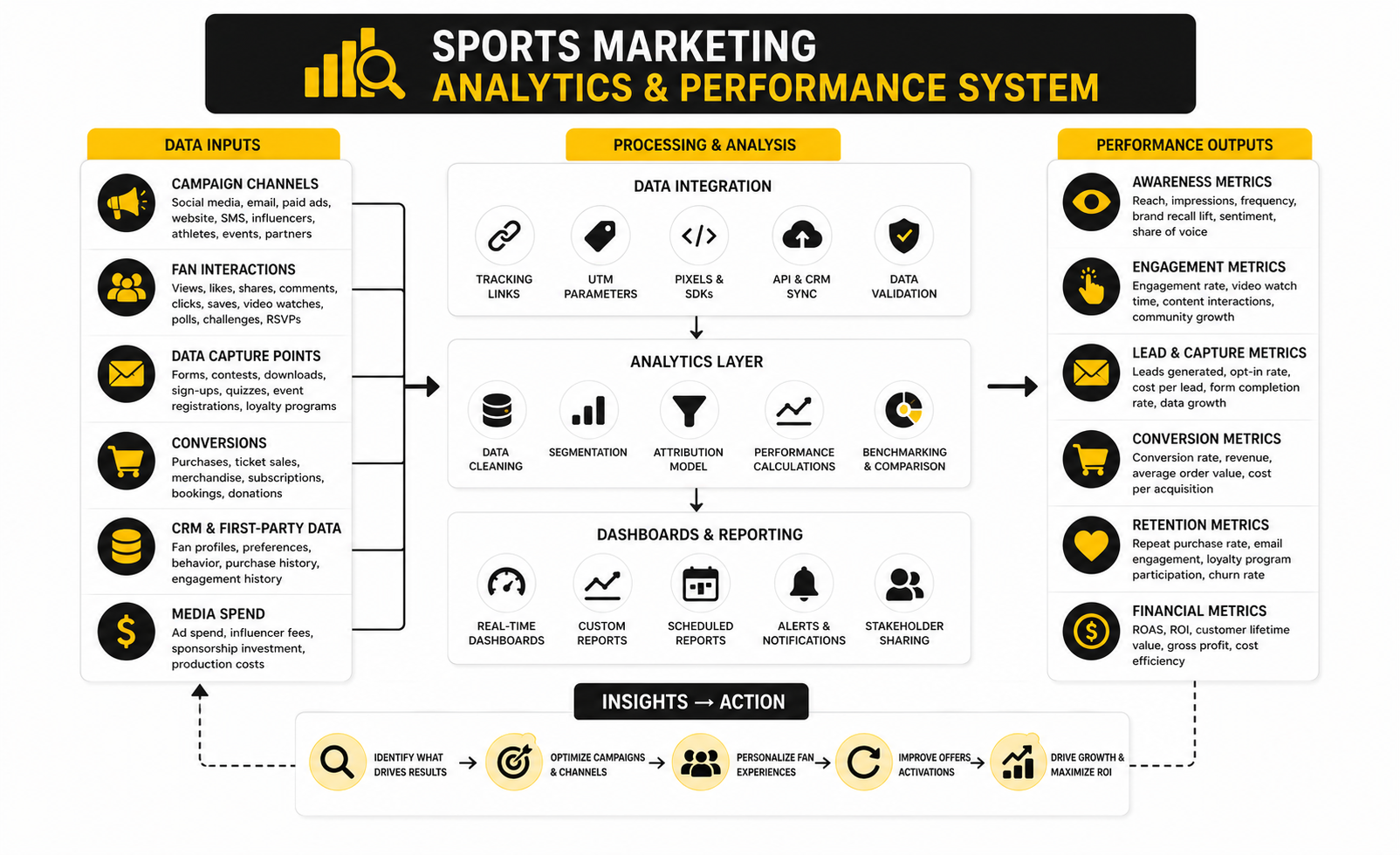
The mistake is treating these layers as interchangeable. Exposure can explain whether the campaign had enough oxygen. Engagement can show whether the idea resonated. Conversion can prove whether the offer worked. Relationship metrics show whether the campaign created value after the sporting moment ended.
Read Benchmarks Carefully
Benchmarks are useful, but only when they are compared against the right context. A social engagement rate from an athlete post should not be judged the same way as a paid conversion landing page, a stadium activation, or a broadcast sponsorship. Different assets have different jobs.
A better benchmark asks what the asset was supposed to do. If the goal was awareness, look at quality reach, frequency, brand recall, and sentiment. If the goal was acquisition, look at cost per lead, opt-in rate, conversion rate, and downstream revenue. If the goal was loyalty, look at repeat engagement, retention, community activity, and incremental purchase behavior.
This is where a lot of sports marketing reporting becomes misleading. A campaign can have huge impressions and weak conversion because the offer was poor. Another campaign can have modest reach and excellent ROI because it reached a high-intent fan segment. The right benchmark protects the team from rewarding the wrong thing.
Connect Attribution Without Overclaiming
Attribution in sports is messy because fan behavior is rarely linear. A person may see a jersey sponsor for months, watch player content, attend an event, scan a QR code, search the brand later, and buy through a different channel. Giving all credit to the final click is too narrow, but claiming every sale came from sponsorship is not credible either.
The practical answer is to use multiple signals. Use tagged links, promo codes, QR codes, CRM source fields, survey data, geo-lift testing, media exposure analysis, brand tracking, and matched-market comparisons where possible. None of these methods is perfect alone, but together they create a more honest view of performance.
For campaigns that depend on landing pages and direct response, a focused funnel builder like ClickFunnels can help separate traffic sources, offers, and conversion paths more clearly. That matters because the post-click experience is often where sports attention either turns into revenue or quietly disappears.
Turn the Data Into Decisions
The final measurement question is not “how did we do?” It is “what should change next time?” If athlete content drove attention but not leads, the next campaign may need a stronger offer or clearer call to action. If QR scans were high but conversion was weak, the landing page or mobile experience probably needs work. If engagement was low across every channel, the fan insight or creative hook may be wrong.
A good recap should end with decisions, not just results. Increase budget for the segments that converted. Replace assets that looked visible but did not move behavior. Improve follow-up for fans who engaged but did not buy. Negotiate better rights if the current package does not support measurable activation.
This is how sports marketing becomes a growth system instead of a seasonal expense. The data should make the next campaign sharper, faster, and easier to defend. That is the standard.
Advanced Strategy, Tradeoffs, and Scaling Risks
Once the basic system is in place, sports marketing becomes a game of tradeoffs. Bigger properties bring reach, but they also bring higher costs, more clutter, tighter approval rules, and less flexibility. Smaller properties may offer less visibility, but they can give a brand deeper access, stronger community trust, and more room to build something original.
This is why the smartest move is not always the biggest sponsorship. A regional club, niche sport, university program, creator-led sports community, youth tournament, or women’s sports property can outperform a premium asset when the audience fit is stronger. The goal is not to look impressive in a rights announcement. The goal is to create fan behavior the business can actually use.
The tradeoff becomes sharper as the sports market expands. Deloitte’s 2026 outlook describes the industry as entering an era where AI, capital, media convergence, and venue evolution are reshaping growth across teams, leagues, events, investors, and partners throughout the sports ecosystem. That creates opportunity, but it also raises the standard. Brands now need better strategy, better execution, and better proof.
Choose Depth or Breadth Deliberately
Breadth works when the objective is broad awareness, national relevance, or fast association with a major cultural moment. That may justify a large league partnership, a top-tier team deal, broadcast integration, or event sponsorship. The risk is that broad campaigns can become expensive visibility plays with weak fan participation.
Depth works when the goal is trust, conversion, local growth, retention, or community building. A brand may get more value from owning a specific fan moment than from appearing everywhere in a shallow way. This is especially true when the campaign includes clinics, meetups, memberships, limited offers, hospitality, referral programs, or recurring content.
The decision should come down to the campaign job. If the brand needs mass salience, breadth makes sense. If the brand needs measurable fan relationships, depth is usually the better starting point. Trying to do both with an underfunded campaign is where strategy gets blurry.
Manage Athlete and Creator Risk
Athletes and creators can make sports marketing feel human, fast, and culturally relevant. They can also introduce risk because their value is tied to performance, public behavior, personal beliefs, injuries, team changes, platform algorithms, and audience trust. A great athlete partnership can build credibility quickly, but it should never be treated like a guaranteed media slot.
The first risk is mismatch. The athlete may be famous, but fame does not automatically transfer to brand relevance. The second risk is control. Fans follow athletes because they feel more authentic than traditional advertising, so over-scripted content can perform badly, while under-managed content can create brand safety problems.
The solution is not to avoid athlete partnerships. It is to build them with clear selection criteria, approval rules, usage rights, contingency plans, and performance expectations. Sports marketing teams should evaluate audience overlap, values fit, content quality, availability, exclusivity conflicts, and the athlete’s ability to participate beyond one post.
Treat Women’s Sports as Strategy, Not a Trend
Women’s sports should not be treated as a short-term media angle. Nielsen reported that interest in women’s sports reached 50% of the global general population in 2024, while Deloitte projected global elite women’s sports revenue to exceed $2.35 billion in 2025. Those numbers show momentum, but smart brands still need to do the work.
The opportunity is not simply cheaper inventory or positive sentiment. The opportunity is to build early credibility in properties where fan communities are growing, commercial models are professionalizing, and sponsor roles can still be meaningfully shaped. That requires consistency, not opportunism.
A weak approach shows up only around major tournaments or viral moments. A strong approach invests in the ecosystem, supports storytelling, activates year-round, and measures both brand and commercial outcomes. Fans can tell the difference.
Plan for Rights Complexity Before Signing
Rights packages can look simple on a sales deck and become complicated in execution. The brand may have access to marks, footage, players, tickets, hospitality, data, retail space, content days, media inventory, or venue activations, but every right usually comes with usage limits. The campaign team needs to understand those limits before the creative plan is approved.
The biggest issues often involve approval timelines, territory restrictions, category exclusivity, athlete availability, music rights, footage usage, paid media permissions, data ownership, and post-campaign asset use. These details sound boring until they block a launch. Then they become very expensive.
Before signing, the team should pressure-test the package against the actual campaign plan. Can the brand use the content in paid ads? Can it retarget fans who engage? Can it collect first-party data? Can it use player images after the season? Can it activate in retail, online, and at events? If the answer is unclear, the deal is not ready.
Scale With Playbooks, Not Guesswork
Scaling sports marketing requires repeatable playbooks. The team should not reinvent the strategy every time a new season, athlete, event, or region comes up. It should build a system that can adapt while keeping the core operating model consistent.
A useful playbook includes:
- Campaign objective and primary fan segment
- Property selection criteria
- Creative territories and messaging rules
- Rights checklist and approval workflow
- Channel roles and content formats
- Landing page and conversion structure
- CRM tagging and follow-up sequences
- Measurement dashboard and reporting rhythm
- Post-campaign decision rules
This is where tools can support the operating model without replacing the strategy. If the campaign relies on social scheduling, performance review, and consistent publishing across multiple properties, Buffer can help keep the content workflow organized. If the campaign needs forms for registrations, surveys, contests, or fan feedback, Fillout can make data capture cleaner and faster.
The advanced move is simple but rare: document what works while the campaign is still fresh. Which offer converted? Which asset caused delays? Which fan segment responded? Which approval step slowed the team down? The playbook gets stronger when every campaign leaves behind learning that the next campaign can actually use.
Professional Implementation, Tools, Mistakes, and FAQ
Professional sports marketing works best when the whole ecosystem is connected. Strategy, rights, creative, media, fan experience, data, sales, and retention cannot operate in separate rooms and still produce a clean outcome. The campaign needs one operating rhythm from planning to execution to reporting.
That rhythm should be simple enough for teams to follow under pressure. Sports move fast, and campaigns often collide with fixtures, injuries, playoffs, breaking news, weather, player availability, broadcast windows, approvals, and shifting fan sentiment. A strong system keeps the team focused when the environment changes.
The final version of the system looks like this: pick the right fan segment, choose the right property, design a valuable activation, capture the relationship, measure the outcome, and turn the learning into the next campaign. That is how sports marketing becomes a repeatable growth engine instead of a one-off sponsorship expense.
Common Mistakes to Avoid
The first mistake is buying rights before defining the campaign job. A brand may secure a team, athlete, event, or venue package and then try to invent the strategy afterward. That usually leads to scattered assets, weak messaging, and reporting that feels disconnected from business goals.
The second mistake is treating awareness as a complete strategy. Awareness matters, but it should create a path toward engagement, trust, data capture, conversion, or loyalty. If fans notice the brand but have no meaningful next step, the campaign leaves too much value on the table.
The third mistake is underestimating operational detail. Rights approvals, landing pages, tracking links, CRM fields, creative deadlines, athlete content windows, ticket logistics, and post-event follow-up all matter. The glamorous part is the partnership announcement, but the money is usually made in the execution details.
Tools That Support the System
Tools should make the strategy easier to execute, not replace strategic thinking. A CRM and automation platform can help track fan journeys, follow up with leads, and connect campaign activity to revenue. For teams that need a central place to manage pipeline, communication, and campaign follow-up, GoHighLevel can be useful when the campaign includes local sponsorships, clinics, consultations, events, or sales outreach.
Content operations also need structure. Sports campaigns often involve fast publishing across matchdays, athlete content, recaps, sponsor posts, community updates, and promotional windows. A scheduling workflow through Buffer can help teams stay consistent without losing control of timing and approvals.
Fan capture needs to be frictionless. Registration forms, surveys, giveaways, event RSVPs, and feedback loops should be easy to launch and easy to measure. A form tool like Fillout can support that layer, while campaign landing pages from Replo can help turn sports attention into clearer conversion paths.
FAQ - Built for Complete Guide
What is sports marketing?
Sports marketing is the use of teams, athletes, leagues, events, venues, creators, fan communities, and sports culture to promote a brand, product, service, or cause. It can include sponsorships, athlete partnerships, content campaigns, event activations, ticket promotions, merchandise, community programs, and digital campaigns. The best version connects fan attention to a clear brand role and a measurable business outcome.
Why is sports marketing effective?
Sports marketing is effective because fans often have strong emotional connections to the teams, athletes, and moments they follow. That emotional context helps brands earn attention in a way that feels more meaningful than ordinary advertising. The key is to add value to the fan experience instead of interrupting it.
What is the difference between sports marketing and sports sponsorship?
Sports sponsorship is usually the rights agreement, while sports marketing is the broader strategy and execution around it. A sponsorship may include assets like signage, content rights, tickets, hospitality, athlete access, or naming rights. Sports marketing turns those assets into campaigns that fans can see, feel, join, share, and act on.
How do brands measure sports marketing ROI?
Brands measure sports marketing ROI by connecting campaign activity to business results. That can include leads, purchases, redemptions, app installs, ticket sales, bookings, subscriptions, CRM growth, retention, brand lift, and customer lifetime value. The measurement plan should be built before launch so every important asset has a clear tracking method.
What metrics matter most in sports marketing?
The most useful metrics depend on the campaign objective. Awareness campaigns should track quality reach, frequency, recall, sentiment, and audience fit. Performance campaigns should track clicks, opt-ins, conversion rate, revenue, cost per acquisition, and retention. Community campaigns should track participation, repeat engagement, referrals, and owned audience growth.
How do you choose the right sports property?
Choose the sports property based on audience fit, credibility, rights flexibility, activation potential, cost, geography, category exclusivity, and measurement access. A famous team or athlete is not always the best choice. The right property is the one that gives the brand a believable role in the fan experience.
Should small brands use sports marketing?
Yes, but small brands should usually start with focused, measurable opportunities instead of expensive visibility plays. Local clubs, youth sports, niche events, regional athletes, creator communities, and community programs can be more practical than major league sponsorships. The goal should be depth, trust, and clear fan action.
How important are athletes in sports marketing?
Athletes can be extremely valuable because they bring personality, trust, and direct fan relationships. They are especially useful when the campaign needs storytelling, product demonstration, community credibility, or social reach. The partnership still needs careful planning around fit, rights, approvals, content quality, availability, and brand safety.
What role does social media play in sports marketing?
Social media helps sports marketing travel beyond the stadium, broadcast, or event. It gives fans access to highlights, athlete personalities, behind-the-scenes content, reactions, challenges, and community conversations. It works best when each post has a clear role, such as introducing the campaign, driving participation, collecting leads, or extending the story after the event.
What makes a sports marketing campaign fail?
A campaign usually fails when it has unclear objectives, weak audience fit, poor activation, no follow-up system, or shallow measurement. Another common problem is buying rights that look impressive but do not support the actual campaign plan. If the fan does not understand why the brand belongs or what to do next, the campaign will struggle.
How long should a sports marketing campaign run?
The right length depends on the objective and the sports calendar. Some campaigns are built around one match, tournament, launch, or event, while others run across a full season or multi-year partnership. Longer campaigns usually perform better when the brand needs trust, community, and repeat behavior rather than short-term attention.
What is the future of sports marketing?
The future of sports marketing will be more data-driven, more creator-led, more personalized, and more connected across live, digital, and commerce experiences. Nielsen’s 2025 Global Sports Report highlights how globalization, diverse fandoms, and shifting media behavior are changing sponsorship strategy across the sports landscape. Brands that can combine cultural credibility with measurable fan relationships will have the strongest advantage.
Work With Professionals
Explore 10K+ Remote Marketing Contracts on MarkeWork.com
Most marketers spend too much time chasing clients, competing on crowded platforms, and losing a percentage of every project to middlemen.
MarkeWork gives you a better way. Browse thousands of remote marketing contracts and connect directly with companies desperate to hire skilled marketers like you, without platform commissions and without unnecessary gatekeepers.
If you're serious about finding better opportunities and keeping 100% of what you earn, explore available contracts and create a profile for free at MarkeWork.com.