

The target affiliate program looks simple on the surface: join Target Partners, publish tracked product links, and earn on qualifying sales. But that simple pitch hides the real question serious publishers and creators should ask before they invest time in it. Is this a program that fits your audience, your content model, and the way people actually shop in 2026?
That question matters more now because the market around affiliate commerce keeps getting bigger and more competitive at the same time. The U.S. Census Bureau says ecommerce reached $1.2337 trillion in 2025, while eMarketer expects U.S. affiliate marketing spend to keep growing at a double-digit pace through 2026. In other words, more money is flowing through digital commerce, but affiliates still need to be selective about where they place their effort.
Target stays relevant in that conversation because shoppers already trust the brand, and the business is still moving meaningful volume online. In its latest full-year results, Target reported a 1.9% increase in comparable digital sales in Q4 fiscal 2025, even while total sales pressure remained real. That combination makes the target affiliate program interesting: strong consumer familiarity, broad product coverage, and enough online demand to create real opportunity, but not enough margin for sloppy promotion.
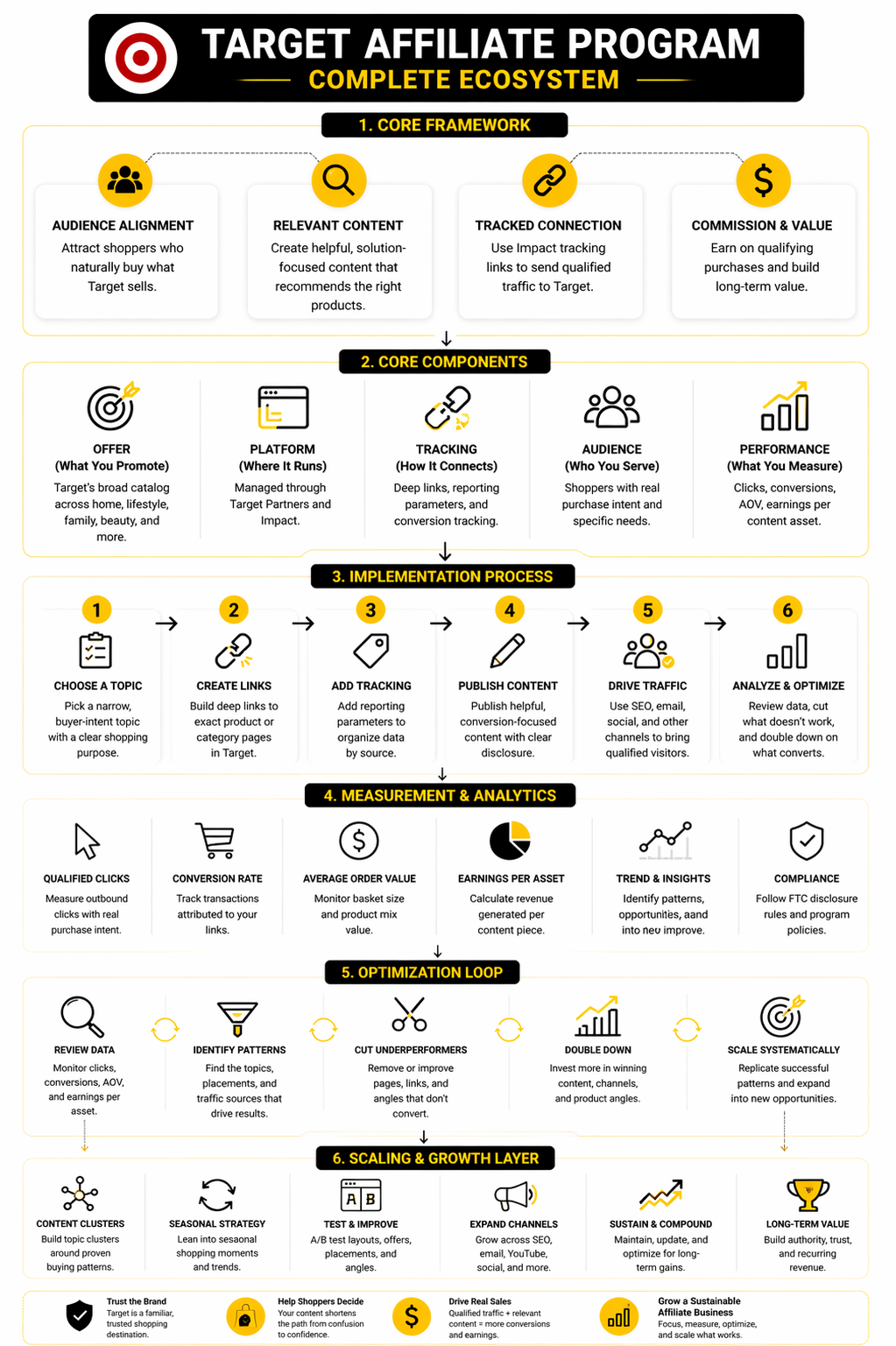
This article is structured in six parts:
- Why the Target Affiliate Program Matters
- How Target Partners Actually Works
- Where the Program Wins and Where It Gets Hard
- Content Angles That Convert Without Feeling Pushy
- Professional Implementation: Tracking, Compliance, and Optimization
- Final Verdict and FAQ
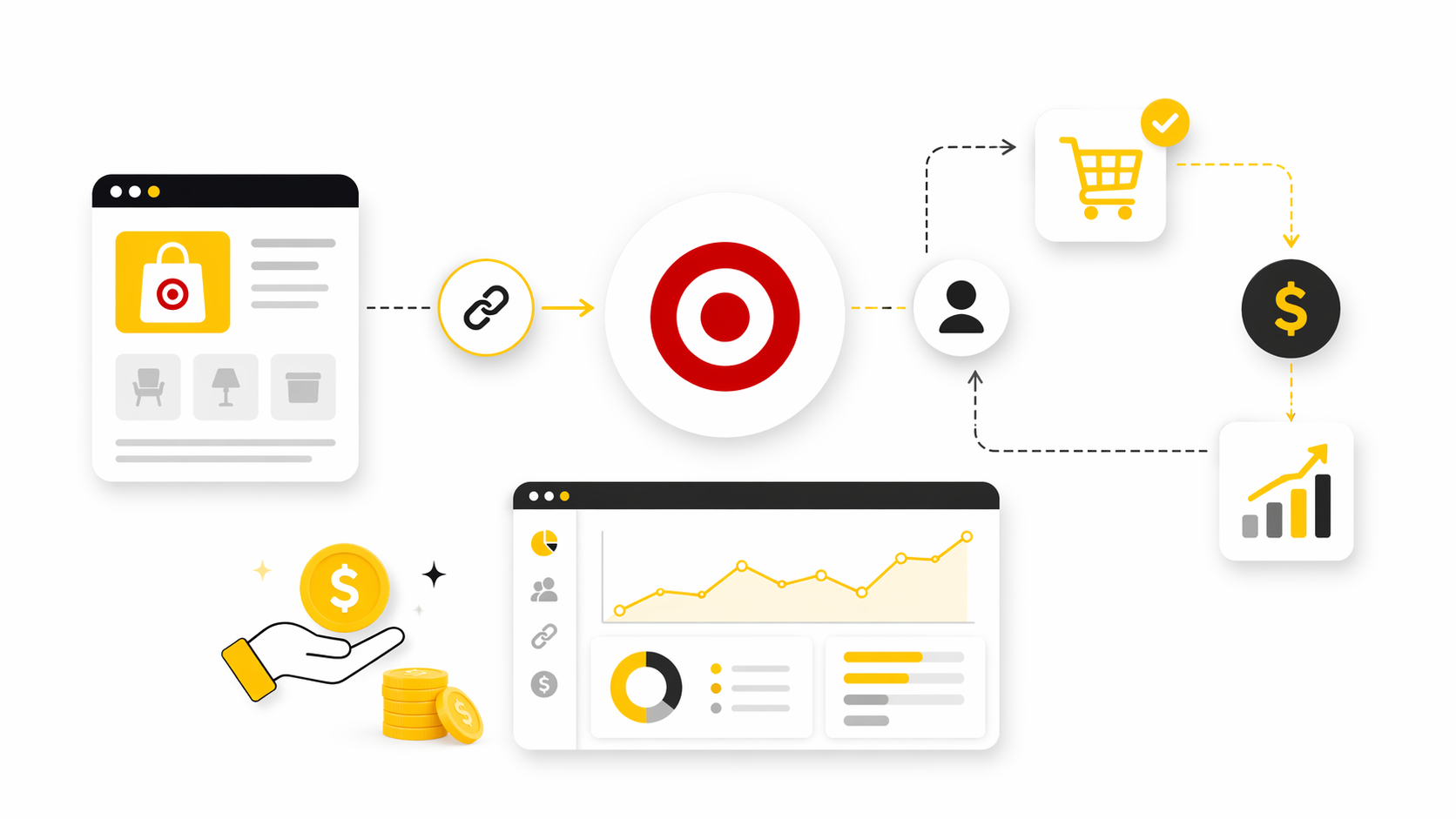
Why the Target Affiliate Program Matters
The first reason the target affiliate program matters is reach. Target is not a niche merchant with a narrow catalog. It is a mainstream retailer with a huge product range, which means one content site can potentially cover everything from baby gear and home organization to seasonal decor, beauty, and back-to-school lists through a single retailer relationship on the official Target Partners platform.
The second reason is buying behavior. U.S. online retail keeps expanding, with the Commerce Department reporting ecommerce made up 16.4% of total retail sales in 2025, and Digital Commerce 360 showing how online spending continues to set new records even as growth normalizes. That matters because the best affiliate programs are not just about commission tables. They are about whether shoppers already feel comfortable completing the purchase once your content sends them there.
The third reason is that retail affiliate programs now sit inside a much more complex discovery environment. Adobe’s 2025 holiday data and its AI shopping analysis show that AI-assisted product discovery is rising fast, which changes how people move from inspiration to checkout. For a creator or publisher, that makes a familiar retailer like Target more useful, because trust reduces friction when readers land on a product page from a recommendation.
Still, none of that means the target affiliate program is automatically a fit. Broad catalogs are helpful, but they can also make content lazy. If your traffic is weak, your audience is outside the U.S., or your content does not influence real purchase decisions, a recognizable brand alone will not save the economics.
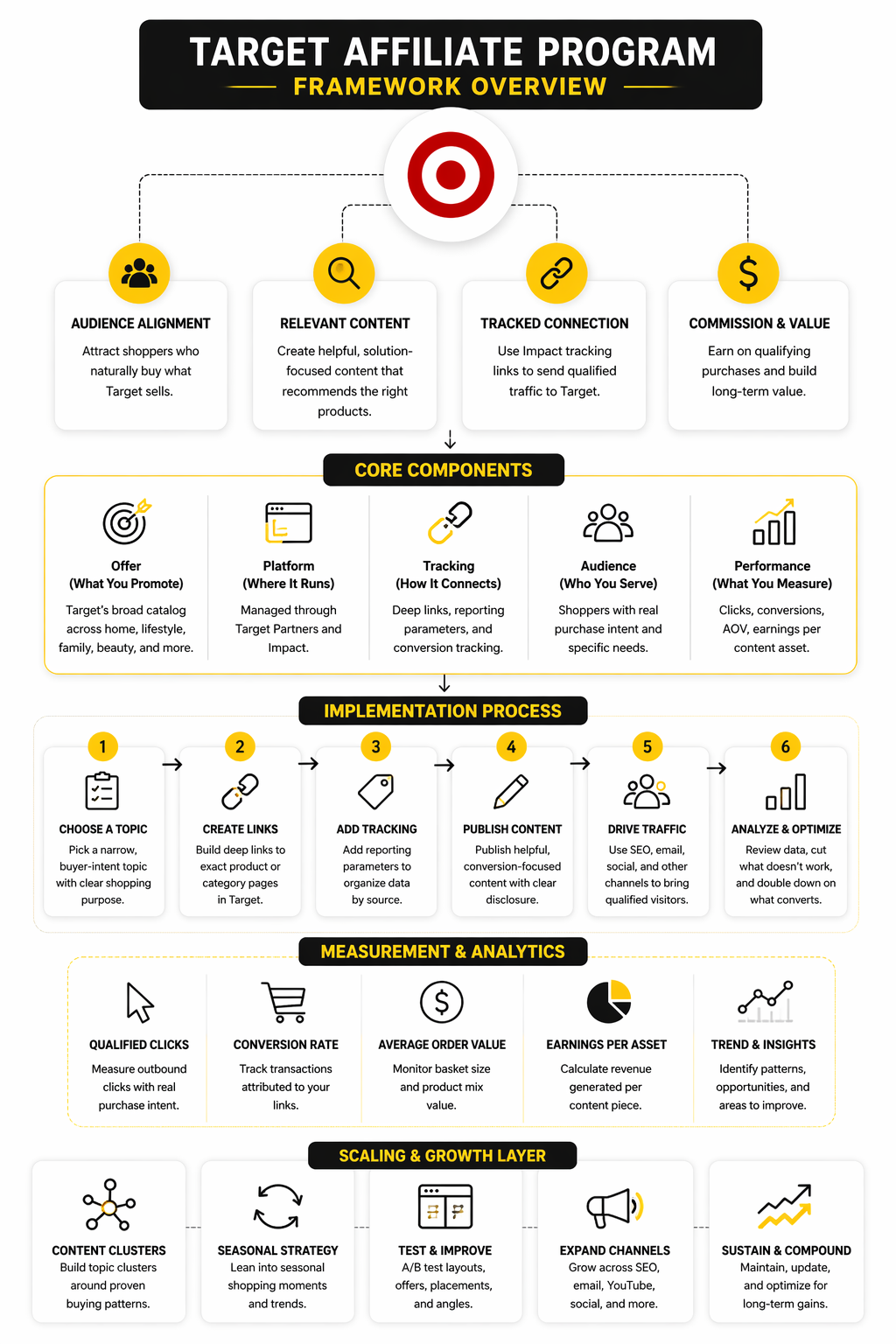
A Simple Framework for Evaluating Target Partners
A practical way to judge the target affiliate program is to use four filters: audience fit, catalog fit, conversion intent, and operational discipline. Audience fit comes first because Target is strongest when your readers already shop for practical consumer goods rather than high-ticket specialist products. If your content lives in lifestyle, home, parenting, seasonal shopping, gift guides, or everyday product discovery, the odds get better immediately.
Catalog fit is the next filter. The official Target Partners FAQ makes clear that the program works through tracked referrals to Target.com, and the real advantage is breadth rather than a single flagship product. That sounds great, but it also means your content needs structure. General traffic is not enough. You need pages, videos, newsletters, or social formats that help people narrow choices and move toward a basket.
Conversion intent is where many affiliates misread the opportunity. The target affiliate program tends to work better when the reader is already in shopping mode than when they are casually browsing. That is why product roundups, seasonal lists, registry content, dorm essentials, apartment setup guides, and “best under budget” comparisons usually make more sense than vague brand mentions. The more the content solves a buying problem, the more a mass-market retailer becomes useful.
The last filter is operational discipline, and this is where professional implementation begins. Impact’s explanation of how affiliate marketing works is basic but still important: tracking, attribution, and payout only happen when the publisher builds clean promotional systems around real consumer intent. So before you worry about scaling the target affiliate program, you need a sharper question: do you have a repeatable way to publish content that matches what people are already ready to buy?
How Target Partners Actually Works
At the operating level, the target affiliate program runs through Target Partners, with application, link generation, and reporting handled through Impact. Target’s own FAQ explains that approved publishers place tracked links, banners, and product references that send traffic to Target.com, and commissions are tied to qualifying referred purchases rather than to raw clicks alone through the program FAQ. That is the right mental model to keep from the start: this is a tracked commerce relationship, not a sponsorship deal and not a flat media buy.
That distinction matters because people often overestimate how passive retail affiliate income is. Target’s terms make clear that not every product is eligible for referral fees, and payout details depend on the agreement structure and exclusions inside the partner arrangement in the official terms and conditions. So the smart move is not to build your entire content strategy around a headline commission number that may vary by category, placement, or program updates.
The practical workflow is pretty straightforward. You apply, get reviewed, and if approved, you build affiliate links inside the Impact environment connected to the target affiliate program, then send readers to product or category pages that match the intent of your content. From there, reporting, attribution, and payouts live inside the platform, which is useful because it gives publishers a cleaner way to test pages, placements, and campaigns without trying to patch together manual tracking.
Where the Program Wins and Where It Gets Hard
The biggest strength of the target affiliate program is trust at the point of purchase. Target is already a familiar destination for millions of shoppers, and the business still has real digital momentum: Digital Commerce 360 reported that ecommerce made up 23.7% of Target’s Q4 fiscal 2025 sales, while Target’s own full-year earnings release showed continued digital growth even during a tougher retail year. When a reader already knows the store, already trusts the checkout experience, and already recognizes the categories, your content has less persuasion work to do.
Another advantage is breadth. The target affiliate program is naturally suited to content formats where shoppers want practical options from one retailer instead of a maze of specialist stores. Gift guides, dorm checklists, baby registry ideas, apartment setup lists, seasonal decorating picks, and household organization roundups all make more sense when the user can add multiple items in one shopping session instead of bouncing across ten merchants.
Now for the hard part. Retail affiliate behavior in 2025 was not simple, and that should shape how you think about this program. Impact’s 2025 affiliate benchmark found that clicks rose 2% year over year while transactions fell 5% and conversion rates dropped 6%, which signals a buyer journey with more comparison shopping and more hesitation before checkout. That is not bad news for the target affiliate program, but it does mean lazy content gets punished faster than it used to.
This is where many affiliates hit the wall. They assume a trusted retailer will carry weak content, but broad catalogs usually demand sharper editorial decisions, not weaker ones. If your page is vague, your product selection is random, or your traffic is mostly top-of-funnel curiosity traffic, readers will click around, compare prices, and disappear.
There is also a structural challenge inside Target’s own business model. The company’s digital engine is increasingly tied to loyalty, same-day delivery, and omnichannel convenience, with Target executives noting that same-day services generated more than $14 billion in fiscal 2025 sales. That is great for the retailer, but it reminds affiliates of something important: the brand wins when the whole ecosystem works together, while the publisher only wins when their content captures the moment before the shopper would have bought anyway.
That is why the target affiliate program works best for affiliates who are genuinely useful. You need strong product curation, clean buying logic, and content built around actual shopping decisions. If you can do that, the program has real upside; if you cannot, the brand’s scale becomes a distraction instead of an advantage.
Content Angles That Convert Without Feeling Pushy
The target affiliate program performs best when the content feels like shopping help, not a sales ambush. That sounds obvious, but it is where a lot of affiliates go wrong. Google’s guidance on people-first content makes the standard clear: publish because the page genuinely helps someone solve a problem, not because you want to force a click.
That matters even more now because shoppers are getting faster at skipping weak recommendations. Adobe’s recent retail reporting shows AI-assisted shopping and discovery are becoming more common, which means people increasingly expect direct answers, tighter curation, and less fluff before they decide where to buy. When the target affiliate program sits inside content that reduces decision fatigue, it becomes useful; when it sits inside padded filler, it becomes invisible.
The highest-fit content angles are usually practical and specific. Think apartment essentials, back-to-school supply systems, baby registry add-ons, holiday gift buckets, pantry organization upgrades, and “best picks under a real budget” style pages. Those formats match how the Target catalog is actually shopped, and they respect the fact that the target affiliate program works better when readers arrive with purchase intent instead of vague curiosity.
Build Around One Shopping Mission at a Time
A good Target page should answer one clear buying question. Not ten. If someone lands on a post about dorm storage, they should not have to wade through kitchen gadgets, patio furniture, and random beauty picks just because they all live on the same retailer site.
This is the practical edge many affiliates miss. Target’s strength is assortment, but your strength has to be editorial focus. The target affiliate program becomes more clickable when the page has a single shopping mission, a narrow audience, and a reason each recommendation made the cut.
That also keeps your content credible. Readers can feel the difference between “I picked these because they solve the problem” and “I dumped a product feed into a page and hoped something converts.” In affiliate content, that difference is everything.
Use Curation, Not Catalog Dumps
You do not need more products on the page. You need fewer, better-explained choices. Target already has the giant catalog, so your job is not to recreate the store. Your job is to shorten the path between confusion and confidence.
That is where the target affiliate program can become genuinely strong. Instead of linking every possible option, highlight the few that win for a specific reason: better size for small apartments, easier cleaning, lower price for starter setups, or stronger reviews for repeat-use categories. Target’s own partner setup emphasizes tracked links that drive users to your recommendations, which only works well when the recommendations feel intentional.
The same logic applies to format. Comparison tables can work. Checklists can work. Gift bundles can work. But only if the reader comes away feeling that someone already did the hard sorting for them.
Professional Implementation: Tracking, Compliance, and Optimization
Once the content angle is right, the target affiliate program turns into an operations game. This is the part that separates a few lucky clicks from a system you can repeat. Target’s official setup points partners toward easy tracking links through Impact, and Impact’s documentation shows that publishers can create tracked links, deep link to specific pages when permitted, and add reporting parameters to organize performance data more clearly.
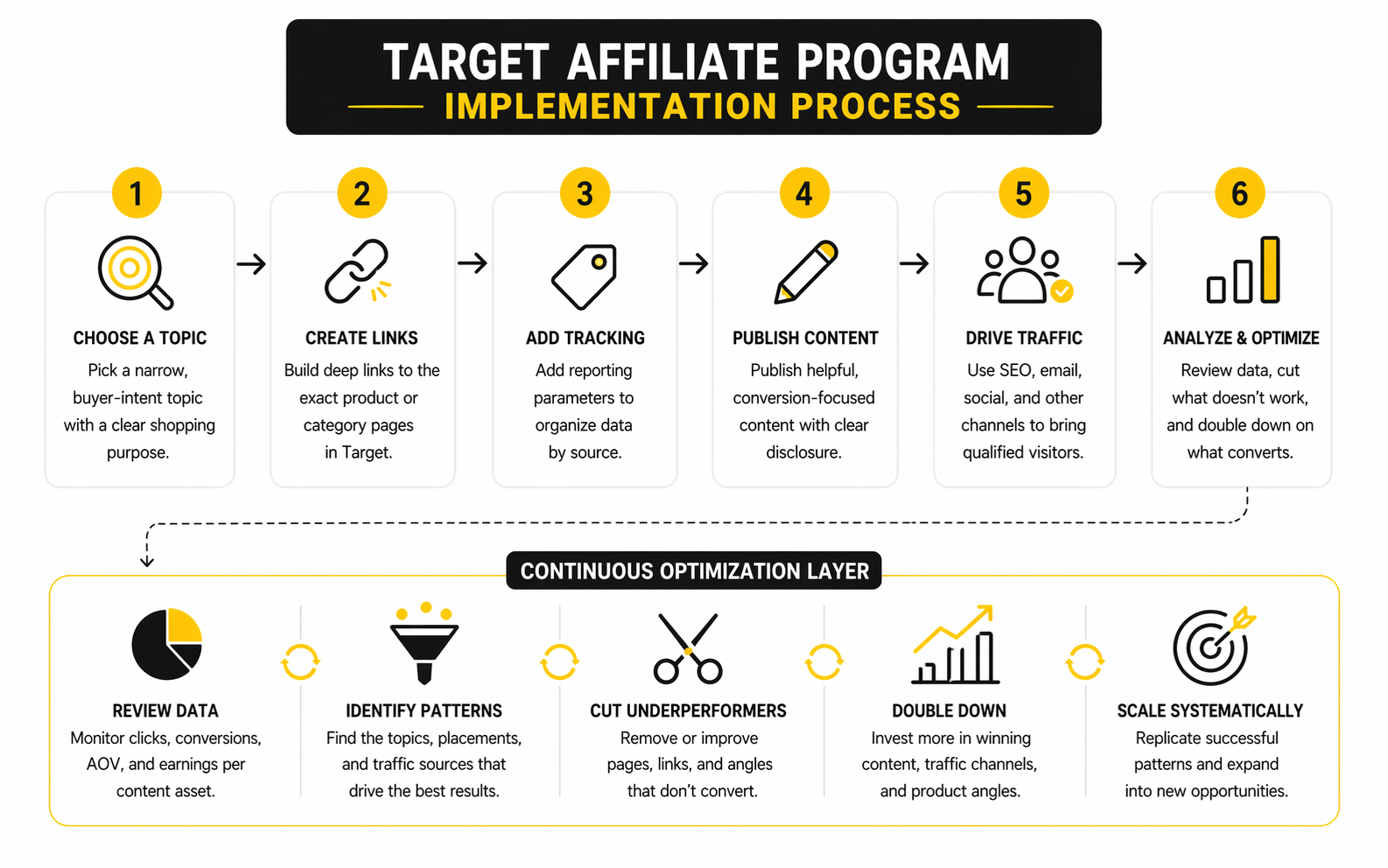
A Clean Execution Process
- Start with one narrow category page or one buyer-intent article. Pick a topic where people are already close to buying, like entryway organization, toddler travel essentials, or practical holiday gifts. The target affiliate program is much easier to evaluate when the first page has a tight purpose instead of broad lifestyle traffic.
- Build deep links to the exact pages that match the promise of the content. Impact’s partner documentation explains that deep links can send visitors to specific destinations rather than forcing them through a generic landing page, which matters because irrelevant clicks are usually wasted clicks. If the article says “small-space shoe storage,” the link should land on that kind of solution, not on a broad category homepage.
- Add reporting structure before traffic arrives. Impact also allows extra reporting information to be attached to tracking links, which helps you separate placements, campaigns, and page types during analysis. This sounds boring, but it is how you learn whether the target affiliate program is working from blog posts, newsletters, social content, or comparison pages.
- Disclose the relationship clearly and early. The FTC’s endorsement guidance is blunt on this point: material connections should be disclosed in a way people can actually notice and understand. If you are using the target affiliate program, clean disclosure is not optional, and hiding it in a footer is not smart.
Measure What Actually Moves Revenue
A lot of affiliates obsess over click volume because it is emotionally satisfying. It feels like progress. But Impact’s 2025 benchmark showed that clicks and completed transactions do not always move together, which is exactly why the target affiliate program should be judged on downstream performance, not vanity metrics.
The numbers that matter more are simple: which pages create qualified outbound clicks, which placements send traffic that buys, and which product angles attract readers who are already close to checkout. Once you know that, you can improve the structure of the content instead of endlessly changing button text and hoping for magic.
That is the professional way to run this. Publish a focused page, link tightly to the offer, disclose properly, label your traffic sources, and review the data with enough discipline to cut what is not working. The target affiliate program is not complicated, but it absolutely rewards people who treat it like a system instead of a side experiment.
What the Numbers Are Really Telling You
By this point, the target affiliate program should not be judged by gut feel. It should be judged by signal quality. A broad retail program can generate plenty of clicks that look encouraging in a dashboard, but if those clicks come from weak intent, vague pages, or bad product matching, they do not tell you much about future revenue.
The wider market is already showing why this matters. Impact’s 2025 affiliate benchmark found that clicks were up 2% year over year, while conversion rates dropped 6% and transactions fell 5%. That is not just an interesting industry stat. It is a warning that people are clicking more to compare, research, and hesitate before buying, which means the target affiliate program needs stronger pre-click curation than many affiliates expect.
That same pattern fits the broader spending picture. EMARKETER’s 2025 forecast projected $12.42 billion in U.S. affiliate marketing spend for 2025 and said affiliate activity would influence 13% of U.S. ecommerce sales. Bigger spend does not mean easier commissions. It means affiliate is becoming more important to brands, while competition for buyer attention gets tighter.
The Metrics That Actually Matter
For the target affiliate program, there are five numbers worth caring about first: qualified outbound click rate, landing-page match quality, conversion rate, average order value, and earnings per content asset. Everything else is secondary until these are healthy. If your page gets traffic but very few people click, the problem is probably positioning, weak curation, or low commercial intent.
If people click but fail to buy, that usually points to a mismatch between the promise of the content and the destination on Target’s site. This is why deep linking and cleaner page intent matter so much. A post that promises “best small-space desk organizers” but sends readers to a broad storage category page is usually creating friction, not revenue.
Average order value is worth watching because it helps you understand whether your content is driving narrow one-item decisions or broader basket-building behavior. With a retailer like Target, that distinction matters. One strong content page can become much more valuable when the shopper adds related products during the same purchase journey instead of buying a single low-priced item and leaving.
Read Target’s Retail Context the Right Way
The target affiliate program also has to be understood in the context of Target’s own business performance. In its latest annual results, Target reported Q4 fiscal 2025 comparable digital sales growth of 1.9%, even while total comparable sales declined. That tells you something important: digital demand is still there, but the environment is not forgiving.
There is another useful clue in the company’s channel mix. Digital Commerce 360’s reporting on Target’s latest results highlighted that ecommerce represented 23.7% of Q4 fiscal 2025 sales, and Target leadership said two-thirds of digital sales came from same-day fulfillment services. For affiliates, that means convenience is a major part of the value proposition. Your content is not just selling products. It is often helping the shopper choose a retailer workflow that already feels fast and low-risk.
That should change how you interpret underperformance. If the target affiliate program is not converting for you, the answer is not automatically “Target is weak.” It may mean your content is too early in the funnel, your recommendations are not urgent enough, or your product selection does not fit the kinds of practical purchases people already make through the brand.
Build an Analytics View That Drives Action
A clean analytics view for the target affiliate program should connect content topic, placement, click behavior, and downstream revenue. If your tracking setup only shows total clicks and total commissions, you are flying blind. You need to know which article type, which list position, and which traffic source are producing visitors who actually buy.
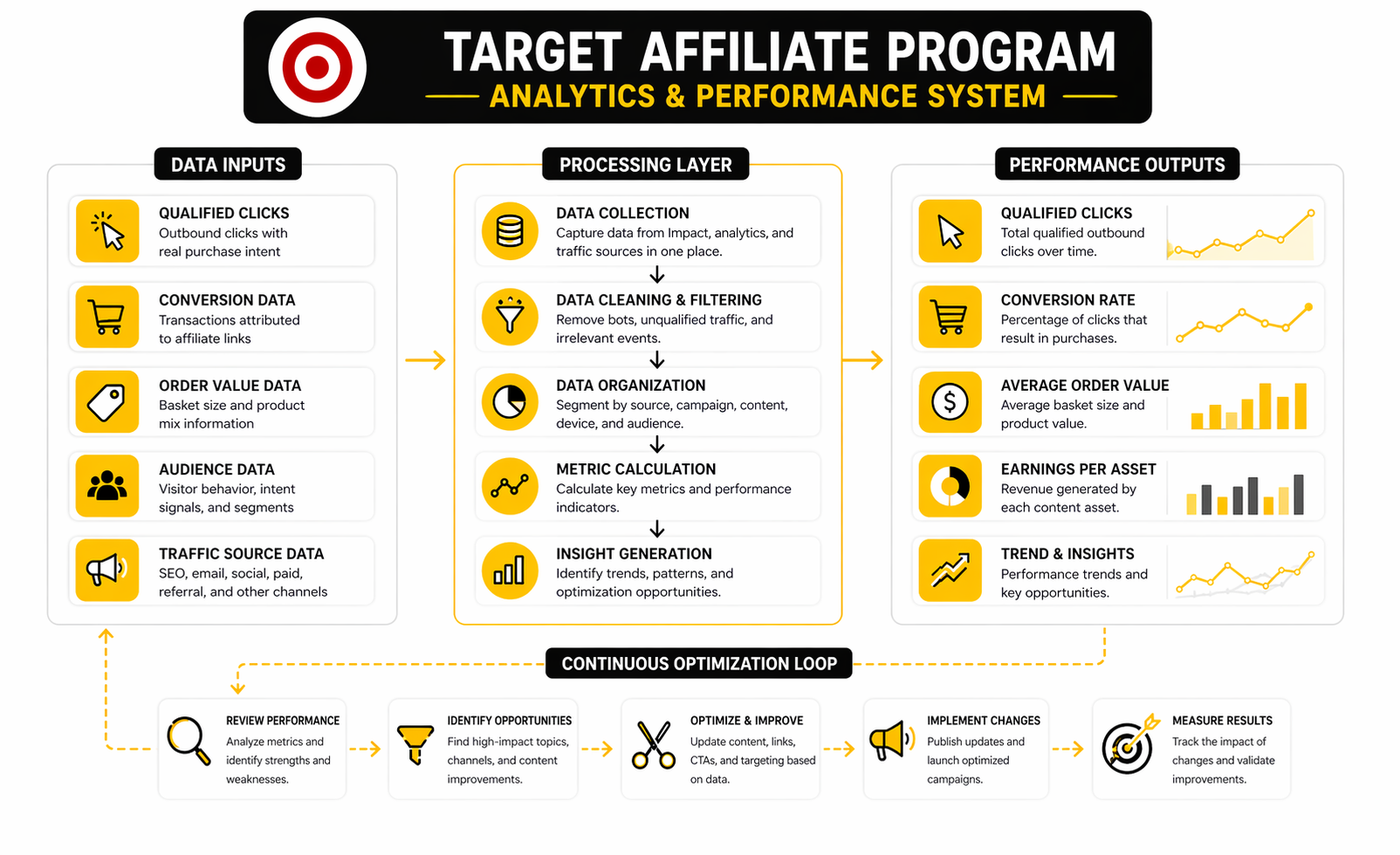
A simple working view usually answers four questions:
- Which page topics create the highest qualified click rate
- Which links produce the best post-click conversion behavior
- Which product clusters lead to stronger basket value
- Which traffic sources create revenue instead of curiosity clicks
This is where Impact’s tracking structure becomes useful, because its link tools and reporting parameters let publishers label links with sub-IDs and campaign context. That one habit can save you months of confusion. Instead of asking whether the target affiliate program works in general, you can ask whether your dorm checklist from organic search works better than your gift guide from email, or whether top-of-article product placements outperform mid-article links.
That is the difference between affiliate content that improves and affiliate content that stays random. The numbers are only useful when they force a decision.
What Good and Bad Signals Usually Mean
A high click rate with low earnings usually means the content is attractive but not commercially aligned. Readers are curious enough to leave your page, but not convinced enough to buy. In the target affiliate program, that often happens when the article is broad, the products are generic, or the page does not narrow choices clearly enough.
A lower click rate with stronger earnings can actually be healthier. It may mean fewer people are leaving the page, but the ones who do are much closer to purchase. This is often what you want with Target-style affiliate content, because the catalog is broad and the real win comes from sending the right shopper to the right product context, not from maximizing raw click volume.
A weak average order value can mean your content is too isolated around one cheap item. That does not make the content useless, but it may mean you should restructure the page around a set, a room, a season, or a use case instead of a single product mention. On the other hand, rising order value combined with stable click volume is one of the cleanest signs that your curation is getting sharper.
The Action That Should Follow the Data
The target affiliate program gets easier to improve once you stop reacting emotionally to every dashboard fluctuation. If clicks rise but transactions lag, tighten the intent of the page and improve link relevance. If conversion looks healthy but volume is weak, publish more pages using the same buying pattern instead of reinventing the format.
If a page gets traffic and still does nothing, do not just update the button color or move a link higher. Rework the commercial angle. Narrow the audience, sharpen the product logic, and make the recommendation path simpler. That is usually where the lift comes from.
And keep compliance inside the measurement system, not outside it. FTC guidance on endorsements and affiliate relationships makes clear that disclosure has to be clear enough for people to notice and understand. That matters for trust, and trust matters for conversion. In the real world, clean disclosure is not a drag on performance. It is part of professional implementation.
Advanced Considerations Before You Scale
Once the target affiliate program starts producing some revenue, the temptation is to scale by doing more of everything. More listicles, more product mentions, more categories, more pages. That is usually the wrong move. The better move is to protect what is already working and scale only the patterns that have a clear commercial logic behind them.
This matters because broad retail programs are easy to overextend. Target has enough assortment to make almost any content idea feel plausible, but plausible is not the same as profitable. Google’s recent guidance on creating people-first, non-commodity content and its documentation on scaled content abuse both point in the same direction: if you mass-produce pages without adding real value, the system eventually catches up with you.
That is the first expert-level tradeoff in the target affiliate program. Scale can increase output, but it can also dilute buying intent. If your winning pages are narrow, practical, and clearly curated, turning them into a giant factory of thin retail pages is not growth. It is erosion.
The Real Risk Is Strategic Drift
The biggest risk is not rejection from the program or a random month of weak commissions. The bigger risk is strategic drift. You start with one content angle that genuinely helps readers, then slowly expand into categories that feel adjacent but have weaker fit, lower urgency, or more price comparison friction.
That is where the target affiliate program can quietly stop being efficient. A focused page on first-apartment essentials may work because readers are solving an immediate problem and Target is a natural store for that mission. A vague page on “cool home products” may pull traffic, but it usually creates weaker intent, lower trust, and softer conversion behavior.
Target’s own business direction reinforces this point. The company has said same-day services were its fastest-growing shopping mode in 2024 and that it is investing further in convenience and omnichannel ease in its March 2025 strategic update. That means the target affiliate program gets stronger when your content matches practical, time-sensitive, real-world shopping behavior. Drift away from that, and you are fighting the natural strengths of the retailer.
Margin Reality Changes the Way You Should Publish
Retail affiliate economics are not the same as software affiliate economics. You do not usually get huge commissions for a single sale, which means the target affiliate program has to be approached like a precision game. The content has to convert well, the traffic has to be relevant, and the page has to create enough basket-building or enough repeatable purchase behavior to justify the effort.
That changes publishing strategy. A page that takes ten hours to research, write, format, and maintain needs a realistic path to repeated commercial value. If it only monetizes around one cheap item with weak search intent, it may never clear the workload threshold no matter how nice the writing is.
This is where experienced affiliates start thinking in clusters instead of isolated posts. One article on kitchen organization might be decent. A cluster around apartment setup, pantry systems, cleaning tools, and renter-friendly storage can become much more durable because it builds topical relevance, internal traffic flow, and repeated retail intent over time.
Maintenance Is Part of the Business Model
The target affiliate program is not a publish-once system. Products go out of stock, pricing moves, category pages change, and seasonal demand shifts quickly. A page that converts well in August can be half-dead by November if the recommendations are no longer available or the shopping context has changed.
That is not a minor operational issue. It is part of the business model. Target’s annual report makes clear that its stores and digital infrastructure are tightly integrated and that most digitally originated sales are fulfilled through stores and same-day options in ways that depend on inventory flow and local execution in the 2024 Annual Report. For an affiliate, that means page freshness is not just good SEO hygiene. It is revenue protection.
The advanced play here is simple: maintain fewer pages better. Audit dead links, weak recommendations, outdated seasonal references, and pages with declining click-to-sale behavior. The target affiliate program usually rewards tight operational upkeep more than raw publishing volume.
Search, Email, and Social Should Not Be Measured the Same Way
A common scaling mistake is treating all traffic sources as interchangeable. They are not. Search traffic often arrives with stronger problem-solving intent, email traffic usually performs best when it is tied to a specific buying moment, and social traffic can create demand but also send a lot of soft clicks with no purchase urgency.
That difference matters because the target affiliate program sits closer to retail conversion than brand storytelling. You need to know which channel creates buyers, not just visitors. Google has even added better query analysis tools in Search Console, including newer filtering features for understanding how demand reaches a site through branded and non-branded queries in recent Search documentation updates. For affiliate operators, that means your measurement should get more granular as you scale, not less.
The practical takeaway is to design content for the channel instead of cross-posting the same idea everywhere. Search pages should solve a clear shopping problem. Email should sharpen urgency or seasonality. Social should hook attention without pretending every view is a buyer signal.
Compliance Gets More Important as You Grow
Small affiliate sites sometimes treat disclosure like an afterthought because they assume regulators only care about giant influencers. That is a mistake. The FTC’s current materials on endorsements, influencers, and reviews and its updated advertisement endorsements guidance make the standard plain: if there is a material connection, people need to understand it.
As the target affiliate program scales, disclosure needs to become more systematic, not more casual. That means visible affiliate language on commercial pages, consistent disclosure in newsletters and social placements, and a review process so fast content production does not quietly create sloppy risk. Good operators do this because it is legally smart and because it protects trust, which is the real asset under all affiliate revenue.
What Experts Usually Do Differently
Experienced affiliates using a broad retail partner like Target tend to make a few disciplined choices. They pick categories where the retailer has a natural shopper advantage. They build content around real purchase moments instead of abstract inspiration. And they review performance by page type, audience intent, and traffic source rather than by looking at blended totals and guessing.
They also know when not to force the target affiliate program into a slot it does not deserve. If a niche calls for specialist expertise, custom products, or unusually high-ticket decisions, a general retailer may not be the strongest fit. The expert move is not loyalty to one merchant. It is alignment between audience behavior and offer structure.
That is the broader strategic lesson. The target affiliate program works best when you use it where Target is already naturally strong: practical consumer purchases, convenience-driven shopping, and categories where trust and breadth matter more than technical specialization. The moment you respect that boundary, the program becomes easier to scale without losing discipline.
Final Verdict
So, is the target affiliate program worth it?
Yes, but only if you use it for the kind of commerce Target already wins at. The program makes the most sense for creators, publishers, and niche site operators who help people make practical buying decisions in categories like home, lifestyle, family, seasonal shopping, organization, and everyday essentials. Target’s own partner materials make the core offer clear: broad catalog, trusted brand, tracked links, and commissions on qualifying referred sales through Target Partners. That can work very well when your audience is already close to purchase and wants a familiar retailer.
It is a weaker fit if you expect high-ticket economics, want zero-maintenance passive income, or plan to mass-produce shallow retail pages and hope the brand name does the rest. The target affiliate program rewards good merchandising judgment more than generic content production. If your content narrows choices, matches real shopping intent, and sends readers to relevant pages, the program can become a reliable piece of a broader affiliate strategy. If not, it turns into noise fast.
That is really the honest close. The target affiliate program is not magic, and it is not broken. It is a practical retail affiliate program with clear strengths, real limitations, and a strong upside for operators who stay disciplined.
FAQ
What is the target affiliate program?
The target affiliate program is Target’s partner program for publishers, creators, and site owners who want to earn commissions by sending shoppers to Target.com through tracked links. The program is managed through Target Partners and uses Impact for link generation, reporting, and partner operations in the official FAQ. In plain English, you recommend products, Target tracks the referral, and you may earn on qualifying purchases.
Is the target affiliate program free to join?
Yes, applying is free. Target reviews applications before approval, which means it is not an open-access system where everyone is automatically accepted. That review step matters because the target affiliate program is meant for real publishers and creators with legitimate promotional channels, not random link placement.
Do you need a website to join?
A website is still the most common setup, but affiliate programs now work across multiple publisher types, including content creators and other owned channels. The safest approach is to check the current acceptance standards and channel expectations inside Target Partners before applying. What matters most is whether you have a real audience and a credible way to drive relevant shopping traffic.
How do commissions work in the target affiliate program?
Commissions are earned on qualifying referred purchases, not on clicks by themselves. Target’s terms also make clear that exclusions and program-specific conditions apply, which is why it is smarter to think about the target affiliate program as a conversion system rather than a commission headline in the terms and conditions. The exact economics depend on what you promote, how you promote it, and whether the purchase qualifies under current program rules.
Is the target affiliate program good for beginners?
It can be, but only if the beginner understands buying intent. The target affiliate program is easier to work with than a niche merchant if your audience already shops mainstream consumer categories, because the brand is familiar and the catalog is broad. What makes it hard for beginners is not the tech. It is the discipline required to publish content that helps people choose rather than just browse.
What kinds of content work best?
The best content is usually practical, specific, and close to a real shopping moment. Pages like dorm essentials, first-apartment checklists, baby registry additions, holiday gift ideas, and small-space organization roundups tend to fit the target affiliate program better than broad inspiration posts. That is because Target is strongest when convenience, assortment, and trust matter more than deep technical specialization.
Can you promote Target products on social media?
Yes, but you still need to handle affiliate disclosure properly and make sure the promotional method fits the program rules. The FTC’s endorsement guidance makes it clear that material connections have to be disclosed in a way people can understand in its disclosure resources. So if you use the target affiliate program on social, the content strategy and the compliance standard both matter.
What should you track first?
Start with qualified outbound clicks, conversion behavior after the click, average order value, and earnings per page or campaign. Those are the numbers that tell you whether the target affiliate program is actually matching your audience. Industry data from Impact’s 2025 benchmark shows that higher click volume alone does not guarantee more transactions, so interpretation matters more than dashboard excitement.
Why do some Target affiliate pages get clicks but not sales?
Usually because the click was curious, not commercial. That can happen when the content is too broad, the product curation is weak, or the landing page does not match the promise of the article. In the target affiliate program, this is one of the most common failure points: the page looks active, but the traffic is not genuinely ready to buy.
Is the target affiliate program better than Amazon for some niches?
In some cases, yes. If your audience likes shopping from Target already, or if your content works best when people can buy several practical items from one retailer, Target can be a better fit. The target affiliate program is especially attractive when brand trust, lifestyle alignment, and mainstream retail convenience matter more than maximum catalog depth.
How often should you update content?
More often than most affiliates want to admit. Retail affiliate pages age faster because products move, seasonal demand changes, and inventory availability shifts. If you want the target affiliate program to keep producing, updating recommendations, checking links, and refreshing buying logic should be part of your ongoing workflow, not a one-time cleanup.
Is the target affiliate program worth scaling?
Yes, but only after you know which content patterns actually convert. The right way to scale the target affiliate program is to expand proven buying-intent formats, not to flood your site with random product pages. Scale works when you protect relevance, keep maintenance tight, and let the data tell you which categories deserve more attention.
Work With Professionals
Explore 10K+ Remote Marketing Contracts on MarkeWork.com
Most marketers spend too much time chasing clients, competing on crowded platforms, and losing a percentage of every project to middlemen.
MarkeWork gives you a better way. Browse thousands of remote marketing contracts and connect directly with companies desperate to hire skilled marketers like you, without platform commissions and without unnecessary gatekeepers.
If you're serious about finding better opportunities and keeping 100% of what you earn, explore available contracts and create a profile for free at MarkeWork.com.