

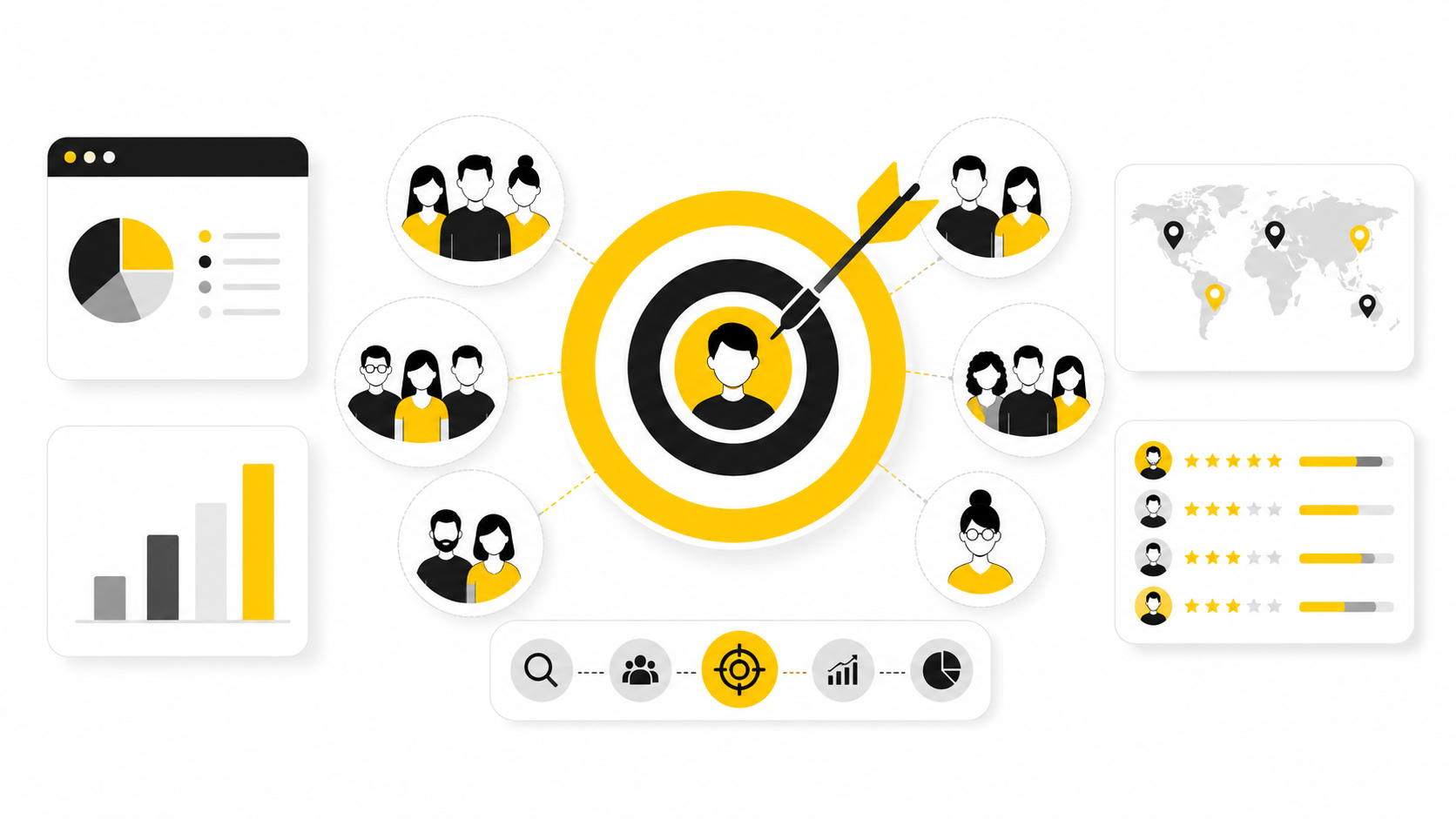
A target market is the specific group of people or businesses your product is best suited to serve. Not everyone who could buy is worth targeting, and that distinction matters.
When you define your target market clearly, your messaging gets sharper, your offers become easier to package, and your marketing budget stops leaking into audiences that were never likely to convert. The goal is not to shrink your ambition. The goal is to focus your growth.
Article Outline
- Why Your Target Market Matters
- The Target Market Framework
- Core Components of a Strong Target Market
- How to Research and Validate Your Market
- Professional Implementation Across Marketing and Sales
- Common Mistakes, Examples, and FAQs
Why Your Target Market Matters
A strong target market gives your business a practical filter for decision-making. It helps you decide what to build, what to say, where to advertise, and which opportunities to ignore. Without that filter, marketing becomes guesswork dressed up as activity.
The mistake many businesses make is thinking a broader audience means more potential revenue. In reality, broad targeting often creates weak positioning because the message has to appeal to too many different people at once. When your message tries to speak to everyone, it usually lands with no one.
Your target market also affects product strategy, pricing, content, sales conversations, and retention. A premium service aimed at experienced operators needs a different promise than a low-cost tool aimed at beginners. The clearer the market, the easier it becomes to make every part of the business feel aligned.
The Target Market Framework
A useful target market framework starts with the people who have a painful problem, a clear motivation to solve it, and enough ability to buy. Those three conditions matter more than surface-level demographics. Age, location, and job title can help, but they are not enough on their own.
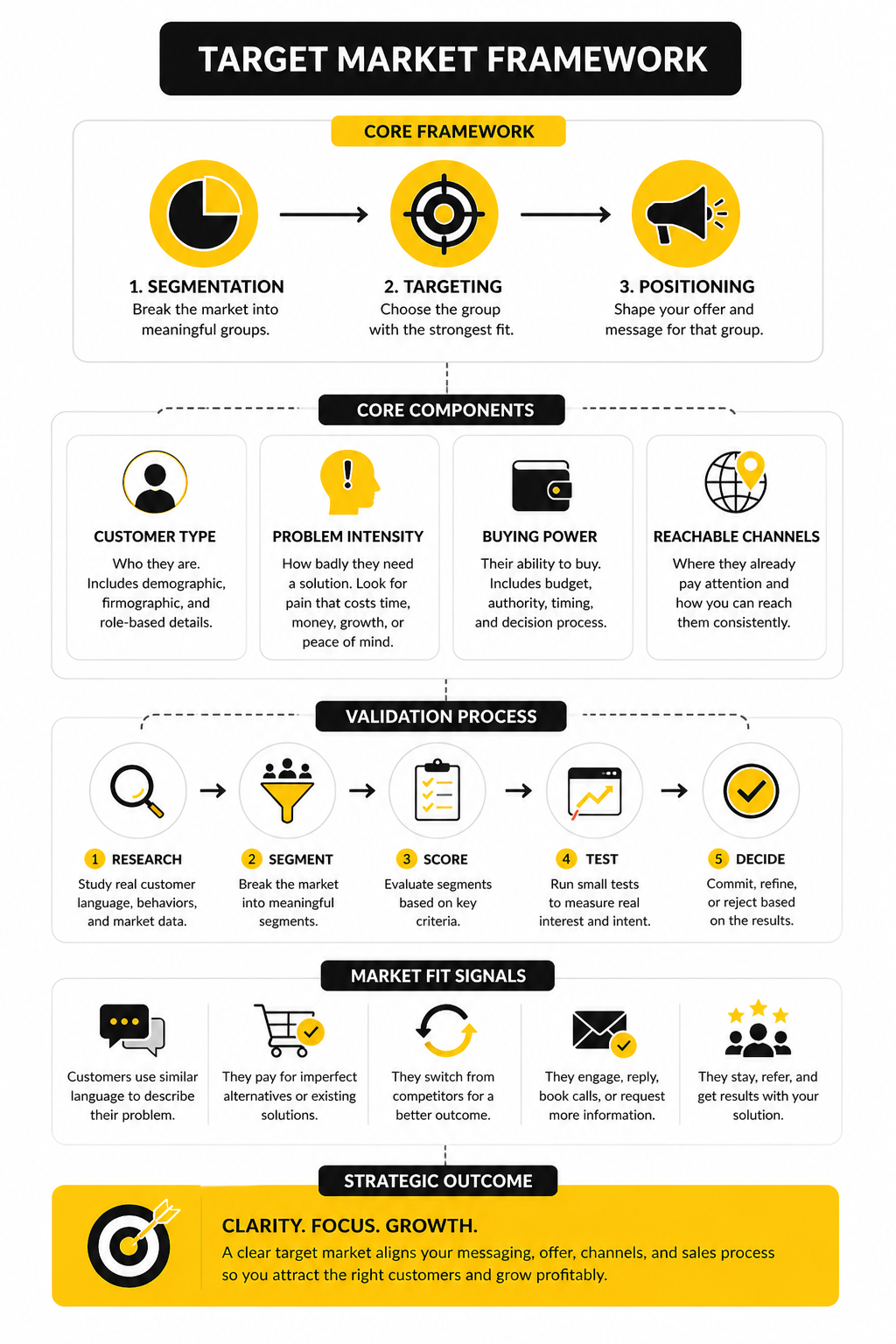
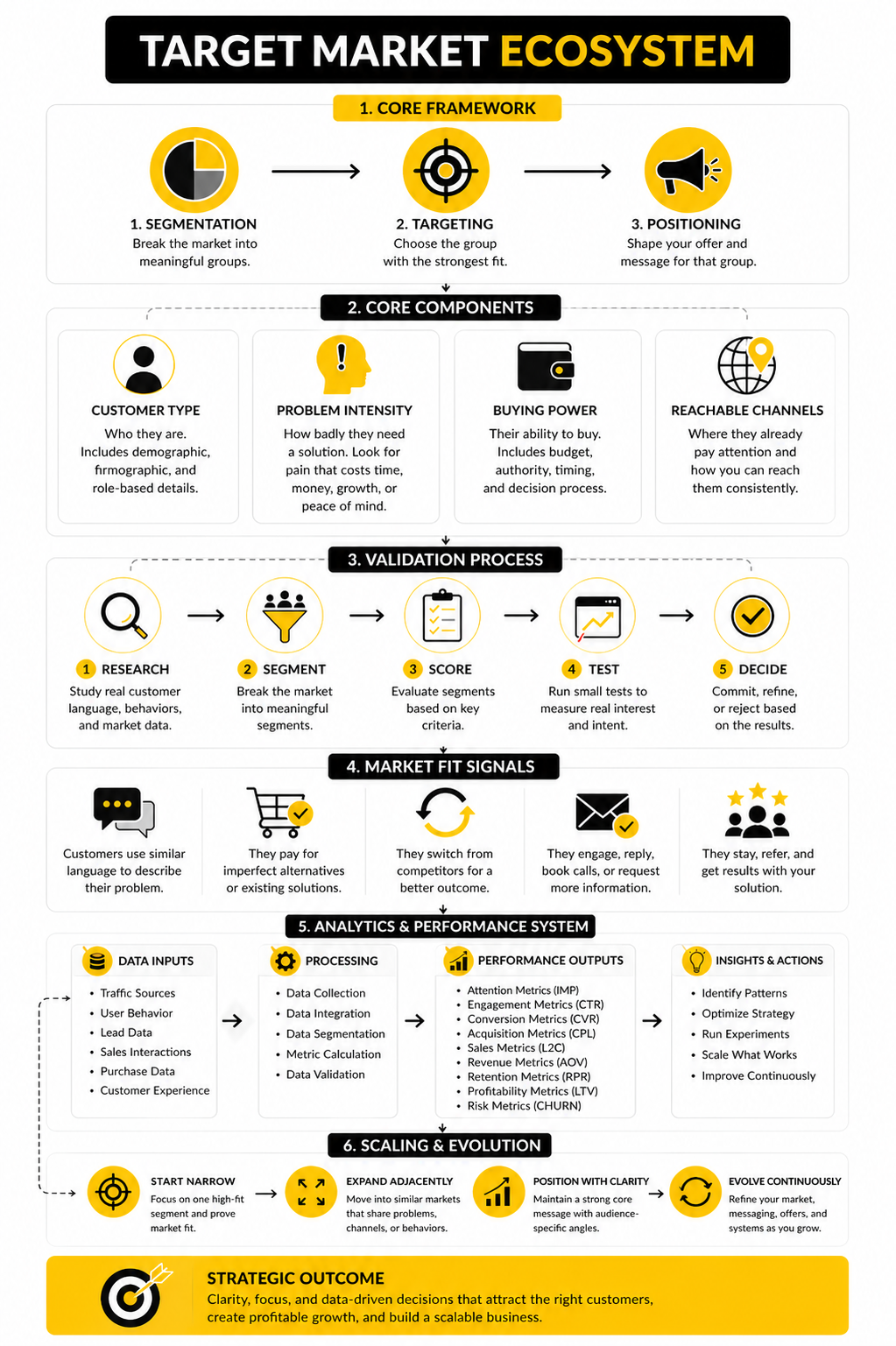
The best frameworks combine segmentation, targeting, and positioning. First, you break the market into meaningful groups. Then you choose the group with the strongest fit. Finally, you shape your offer and message so that group immediately understands why it is for them.
This article will build that framework step by step. We will move from strategy into research, then into implementation, so the idea of a target market becomes something you can actually use. By the end, you should be able to describe who you serve, why they care, and how to reach them without sounding generic.
Core Components of a Strong Target Market
A strong target market is not just a description of who someone is. It explains what they need, why they need it now, what they have tried before, and what would make them choose you instead of another option. That is the difference between a useful market definition and a vague buyer profile.
The most practical way to define your target market is to combine four layers: customer type, problem intensity, buying power, and reachable channels. Customer type tells you who they are. Problem intensity tells you how badly they need a solution. Buying power tells you whether they can act. Reachable channels tell you whether you can actually get in front of them.
Customer Type
Start with the broad category of customer you serve. For B2C, this might include lifestyle, life stage, interests, values, or buying behavior. For B2B, it usually includes company size, industry, role, budget ownership, team structure, and operational maturity.
This layer matters because two people can have the same problem but need completely different messages. A founder buying a marketing tool wants speed, simplicity, and direct revenue impact. A marketing director inside a larger company may care more about reporting, compliance, workflow control, and team adoption.
Problem Intensity
Problem intensity is where your target market starts becoming commercially useful. A person who mildly wants a better outcome is not the same as someone who urgently needs one. The urgent buyer pays attention faster, compares options more seriously, and has a stronger reason to move.
Look for signs that the problem is already costing them time, money, growth, reputation, or peace of mind. If the pain is only theoretical, your marketing has to work much harder. If the pain is already visible, your message can be direct because the buyer is already aware of the gap.
Buying Power
A target market also needs the ability to buy. This sounds obvious, but it is one of the easiest parts to ignore. Interest does not equal demand if the audience cannot justify the price, approve the purchase, or commit the time needed to use the solution.
For consumer offers, buying power usually means disposable income, willingness to spend, and perceived value. For business offers, it means budget, authority, timing, and internal priority. A good target market sits where need and ability overlap.
Reachable Channels
Even the perfect audience is hard to serve if you cannot reach them consistently. That is why channel fit belongs inside the target market definition, not after it. You need to know where the market already pays attention before you build campaigns around it.
Some audiences are easier to reach through search, content, and comparison pages. Others respond better to communities, outbound sales, creator partnerships, events, or paid social. Tools like ManyChat can make sense when your audience is active in messaging channels, while platforms like GoHighLevel can help when the business needs CRM, follow-up, funnels, and automation in one place.
Market Fit Signals
The best target market definitions include evidence, not just assumptions. You want to see repeated patterns in customer conversations, sales calls, reviews, search behavior, support tickets, and conversion data. When the same pain points keep appearing in different places, you are probably looking at a real market signal.
Strong signals include customers describing the problem in their own words, paying for imperfect alternatives, switching from competitors, or asking for the same outcomes before you mention them. Weak signals include compliments, vague interest, and people saying they would buy “someday.” Build around behavior, not politeness.
How to Research and Validate Your Market
Once the core components are clear, the next step is validation. This is where you stop treating your target market as an idea and start testing whether the market behaves the way you think it does. Good research does not need to be complicated, but it does need to be honest.
Start with the assumption that your first version is probably incomplete. You may be right about the problem but wrong about the buyer. You may be right about the buyer but wrong about the channel. The point of research is to find those gaps before you spend months building campaigns around them.
Start With Real Customer Language
The fastest way to improve a target market definition is to listen to how real people describe the problem. Sales calls, support tickets, reviews, community posts, survey responses, and search queries all reveal language that is more useful than internal brainstorming. Your customers rarely explain the problem the way your team does, and that difference matters.
Look for repeated phrases, emotional triggers, objections, desired outcomes, and buying criteria. If people keep using the same words to describe a pain point, those words should influence your messaging. This is not about copying customers blindly; it is about grounding your strategy in the language the market already understands.
Segment Before You Choose
Segmentation comes before targeting because you need options before you can make a smart choice. Break the broader market into groups with meaningful differences in need, urgency, budget, behavior, or decision process. The classic segmentation categories are still useful, but the strongest segments usually combine firmographic or demographic details with behavioral insight.
For example, “small business owners” is too broad to guide execution. “Local service businesses that rely on repeat appointments and need automated follow-up” is much more useful because it suggests a clearer offer, channel, and sales message. That kind of specificity makes a target market actionable instead of decorative.
Score Each Segment
After you define possible segments, score them before choosing one. This keeps you from chasing the audience that sounds exciting but is expensive, hard to reach, or unlikely to buy. A simple scoring model is often enough.
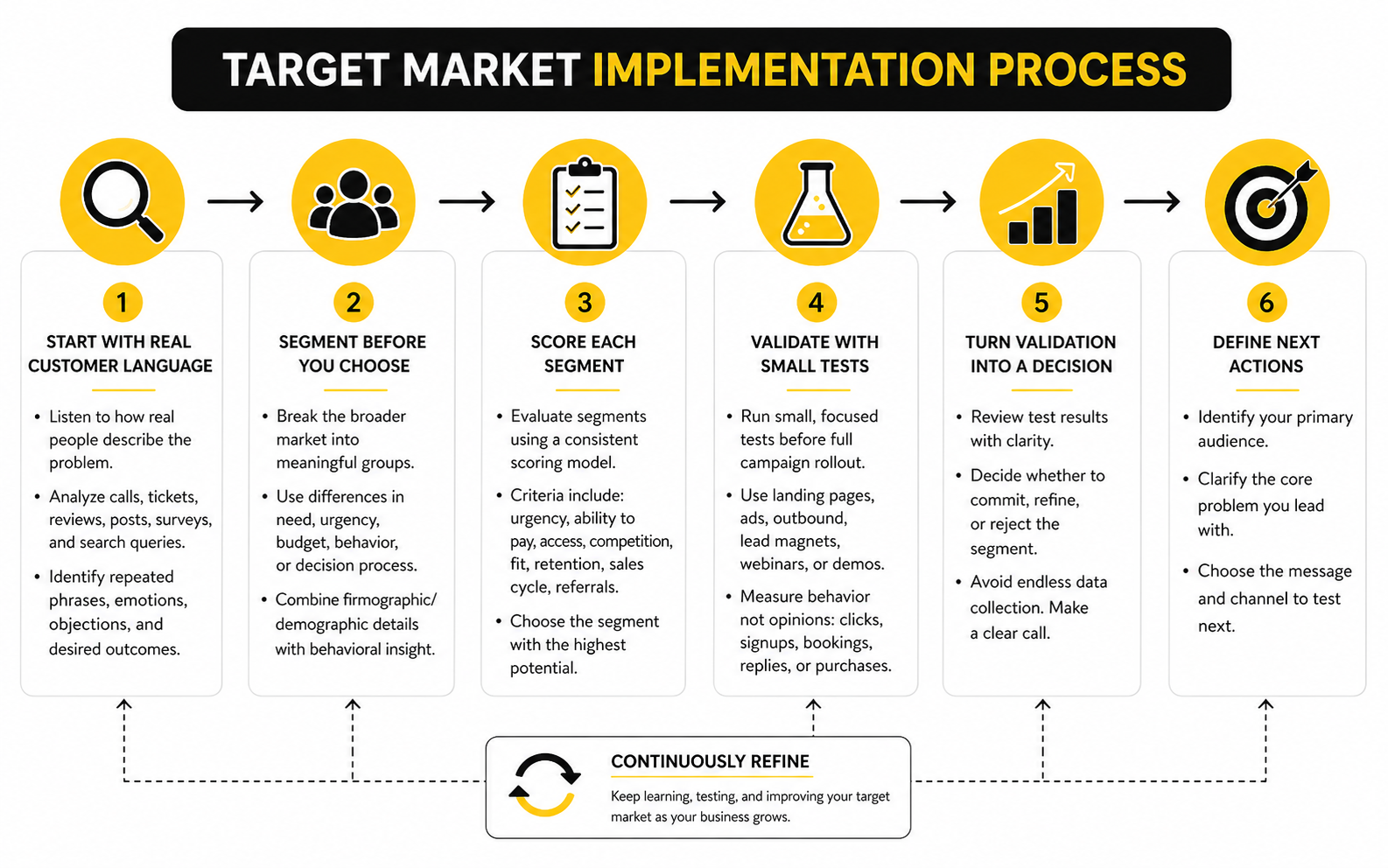
Use criteria like:
- Problem urgency
- Ability to pay
- Ease of access
- Competitive intensity
- Strategic fit
- Repeat purchase or retention potential
- Sales cycle length
- Referral potential
The best target market is not always the biggest segment. It is the segment where your offer has the clearest advantage and the path to revenue is realistic. Big markets look impressive in a strategy document, but reachable markets pay the bills.
Validate With Small Tests
Validation should happen before a full campaign rollout. Run small tests that measure behavior, not opinions. A landing page, paid search campaign, outbound sequence, lead magnet, webinar, product demo, or waitlist can show whether the market is actually responding.
If you are testing funnels or lead capture, tools like ClickFunnels, systeme.io, or Fillout can help you move faster without building a full custom setup. The point is not to over-engineer the test. The point is to create a clean signal: did the right people care enough to click, subscribe, book, reply, or buy?
Turn Validation Into a Clear Decision
Research only helps if it leads to a decision. After testing, decide whether to commit, refine, or reject the segment. Do not keep collecting data forever because you are afraid to choose.
A practical decision should answer three questions. Who are we prioritizing right now? What problem are we leading with? What message and channel are we testing next? Once those answers are clear, your target market stops being a description and becomes an operating choice.
Statistics, Benchmarks, and What the Data Actually Means
Data should make your target market clearer, not noisier. The goal is not to collect every possible metric. The goal is to understand whether the right people are finding you, trusting you, engaging with your offer, and moving closer to a buying decision.
This matters because modern buyers have more control than ever. In B2B, 67% of buyers now prefer a rep-free buying experience, which means your positioning, content, landing pages, and follow-up need to do more of the work before a conversation happens. If your target market is unclear, those assets become generic, and generic does not survive self-directed buying.
The Metrics That Prove Market Fit
The cleanest target market signals usually show up across four layers: attention, engagement, conversion, and retention. Attention tells you whether the market notices the message. Engagement tells you whether the message feels relevant. Conversion tells you whether the offer creates action. Retention tells you whether the promise matched the reality.
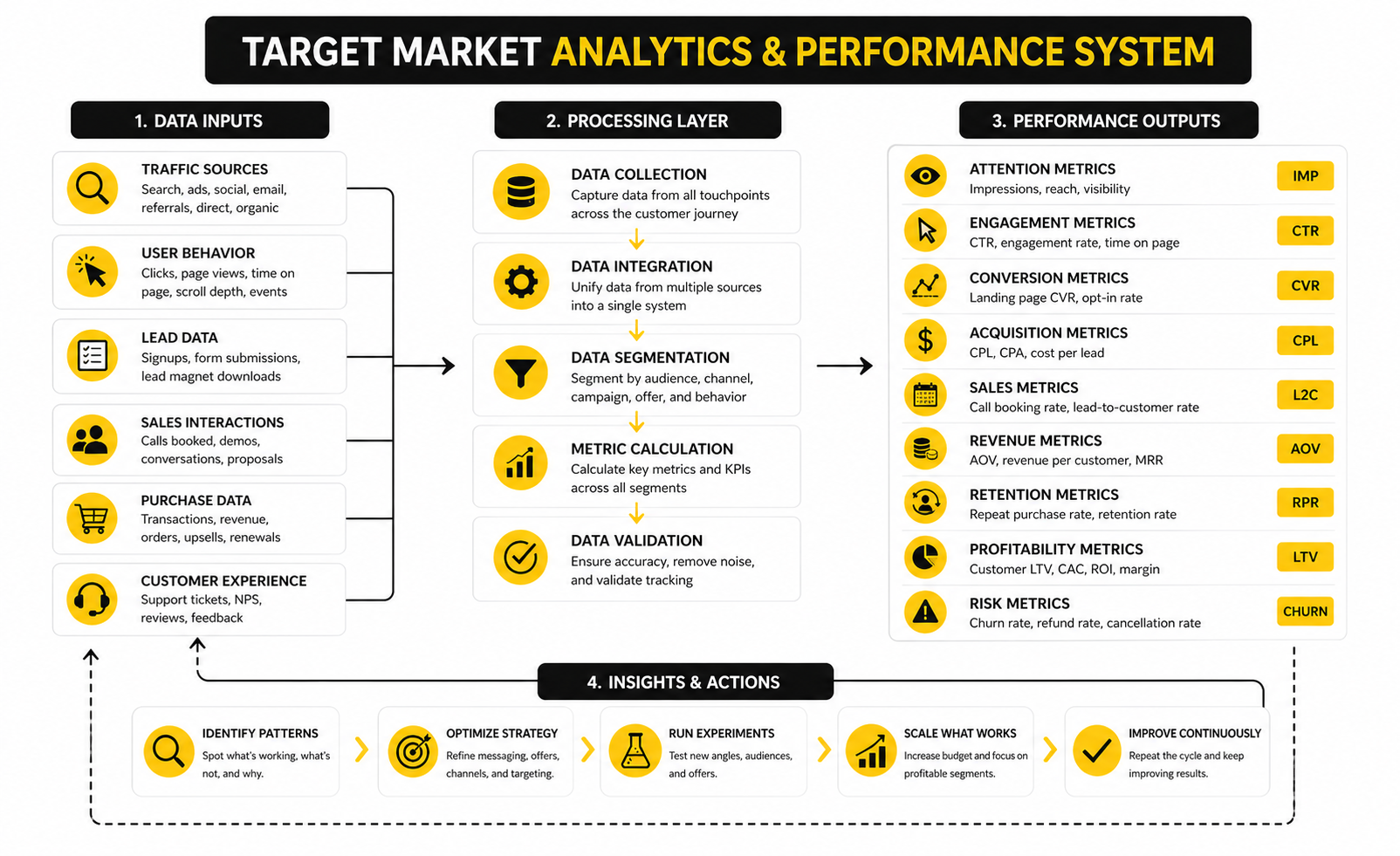
Track these numbers together, not separately:
- Search impressions from high-intent keywords
- Click-through rate by segment or campaign
- Landing page conversion rate
- Cost per qualified lead
- Sales call booking rate
- Lead-to-customer conversion rate
- Customer acquisition cost
- Average order value or contract value
- Repeat purchase rate
- Churn, refund, or cancellation rate
- Customer lifetime value
A high click-through rate with weak conversion usually means the angle is interesting but the offer is not convincing. A low click-through rate with strong conversion can mean the market is right, but the hook is too narrow or the channel is not giving you enough volume. High churn after strong acquisition is the biggest warning sign because it means you may be attracting people who like the promise but are not the right fit for the product.
Benchmarks Are Context, Not Targets
Benchmarks are useful when they help you ask better questions. They become dangerous when you treat them like universal standards. A 3% conversion rate can be excellent for one offer and weak for another, depending on price, buying intent, channel, market maturity, and sales cycle.
Paid search benchmarks show why context matters. WordStream’s 2025 analysis of more than 16,000 campaigns found major differences by industry, which is exactly why a target market should be measured against its own channel and category reality rather than a generic average. A niche legal, healthcare, SaaS, ecommerce, or local service campaign will not behave the same way, even when the ad platform is identical.
The right move is to use benchmarks as a diagnostic baseline. If your numbers are far below the category range, inspect your targeting, offer clarity, landing page, and follow-up speed. If your numbers are above average but revenue is still weak, the issue may be deal size, qualification, retention, or margin.
Segment-Level Data Beats Blended Averages
Blended averages hide the truth. One segment may be profitable, another may be expensive, and a third may convert well but cancel quickly. If you only look at the combined average, you will miss which target market actually deserves more budget.
Break reporting down by segment, channel, offer, and buyer stage. For example, separate first-time visitors from returning visitors. Separate small business leads from enterprise leads. Separate cold paid traffic from warm email or referral traffic. This makes your data useful because you can see where the market is responding instead of guessing from one big number.
A simple CRM and automation setup can make this much easier. GoHighLevel is useful when you want lead source, pipeline stage, follow-up, and conversion data in one place. For email-heavy validation, Brevo or Moosend can help you compare how different audience segments respond to messages over time.
What the Numbers Should Make You Do
Good analytics should lead to action. If one segment has a lower lead cost but poor sales quality, tighten qualification instead of scaling spend. If another segment has a higher acquisition cost but better lifetime value, it may be the better target market even though it looks more expensive upfront.
The same logic applies to content and funnels. If comparison pages convert better than educational posts, your market may already be solution-aware and ready to evaluate options. If educational content drives strong email engagement but weak purchases, the audience may need more trust, proof, or a lower-friction first offer before they buy.
The practical rule is simple: measure the full path from attention to revenue. Do not optimize only for clicks. Do not celebrate cheap leads too early. The best target market is the one that creates profitable customers, not just busy dashboards.
Advanced Target Market Strategy
At a basic level, choosing a target market is about focus. At a more advanced level, it is about tradeoffs. Every market you choose affects your product roadmap, pricing model, acquisition channels, sales motion, brand voice, and support burden.
This is where many businesses get uncomfortable. They want the benefits of focus without the cost of saying no. But strong positioning requires exclusion, because a business that refuses to exclude weak-fit buyers eventually becomes harder to understand, harder to sell, and harder to scale.
The Risk of Expanding Too Early
Expansion feels like growth, but it can quietly weaken the business if the first target market is not fully working yet. New segments often need different messaging, different onboarding, different sales assets, different integrations, or different proof. If you add those demands too early, the team spreads itself thin and the customer experience gets messy.
The better move is to earn the right to expand. First, prove that one segment can be reached, converted, served, and retained profitably. Then use what you learned to move into the next adjacent segment with intent, not panic.
Adjacent Markets Beat Random Markets
The smartest expansion usually happens through adjacency. That means moving into a market that shares similar problems, buying triggers, channels, or product requirements with your current best customers. You are not starting from zero; you are extending from a position of strength.
For example, a business serving appointment-based local services might expand from med spas into dental clinics or fitness studios because the operational pain is similar. The offer may need adjustments, but the core problem, follow-up logic, and retention opportunity remain familiar. That is very different from jumping into a completely unrelated market just because it looks bigger.
Positioning Gets Harder as You Scale
A narrow target market makes your message sharper. A broader market gives you more revenue paths, but it also creates more positioning pressure. The bigger the audience, the harder it becomes to keep the message specific without creating separate campaigns, pages, offers, or sales motions.
That is why scaling often requires a messaging architecture, not one universal tagline. You need a core brand promise that stays consistent, then segment-specific angles that speak to different use cases. Tools like Chatbase can help turn customer questions into clearer support and sales guidance, while Replo can help ecommerce teams build more targeted landing pages for different audiences.
Do Not Confuse Personalization With Strategy
Personalization can improve relevance, but it cannot fix a weak target market. If the segment is wrong, personalized emails and dynamic pages only make the wrong message more efficient. Strategy comes first, automation comes second.
This matters even more as AI makes it easier to produce more campaigns, more content, and more variations. McKinsey has described AI-driven personalization as a way to serve smaller microcommunities with more relevant messages, but the value still depends on knowing which communities are worth serving. More output is not the win. Better fit is the win.
When to Narrow, Hold, or Expand
Your target market should evolve, but not randomly. Narrow when conversion is weak, the audience is too mixed, or sales conversations keep pulling in different directions. Hold when the segment is profitable but there is still room to improve messaging, proof, onboarding, or retention.
Expand when the current segment is predictable and the next segment shares enough similarities to make the move efficient. That is the cleanest path. You keep the discipline of focus while giving the business room to grow.
Common Mistakes, Examples, and FAQs
Even with a strong framework, target market strategy can still break down in execution. Usually, it is not because the business lacks effort. It is because the team keeps making decisions that blur the market, dilute the message, or chase the wrong performance signals.
The final system should connect research, positioning, content, sales, analytics, and retention into one loop. Your target market is not a one-time document. It is a working decision that should keep getting sharper as the business learns.
Mistake 1: Defining the Market Too Broadly
A broad market feels safer because it gives you more possible buyers. In practice, it usually creates weaker messaging. When the audience is too wide, every claim becomes softer, every offer becomes less specific, and every campaign becomes harder to optimize.
A better approach is to start with a narrow, high-fit segment and expand only when the numbers support it. That does not limit the business forever. It gives the business a sharper starting point.
Mistake 2: Targeting Interest Instead of Intent
People can be interested in a topic without being ready to buy. That is why content engagement alone is not enough to define a target market. You need buying signals, not just attention.
Intent shows up when people compare options, request pricing, book calls, search for solutions, join demos, or pay for imperfect alternatives. Those behaviors are more valuable than likes, comments, or vague survey answers. Interest is useful, but intent is what turns a market into revenue.
Mistake 3: Ignoring Retention
A segment that buys quickly but cancels quickly is not a great target market. It may look good in the acquisition dashboard, but it creates hidden costs in support, refunds, churn, and reputation. This is especially dangerous for subscription businesses and service providers.
Retention tells you whether the promise matched the customer’s real needs. If a segment stays, upgrades, refers, and gets results, pay attention. That is often the market you should build around.
FAQ - Built for Complete Guide
What is a target market?
A target market is the specific group of customers a business chooses to serve with its product, messaging, and marketing. It is not everyone who could possibly buy. It is the audience most likely to need the offer, understand the value, and take action.
Why is a target market important?
A target market keeps your strategy focused. It helps you write clearer messaging, choose better channels, build stronger offers, and avoid wasting money on people who are unlikely to convert. Without it, marketing becomes scattered.
What is the difference between a target market and a target audience?
A target market is the broader customer group your business serves. A target audience is usually a more specific group reached by a campaign, content piece, or offer. For example, your target market might be local service businesses, while your target audience for one campaign might be med spa owners looking for automated appointment follow-up.
How do I identify my target market?
Start by studying who has the problem, who feels it urgently, who can afford to solve it, and who you can reach consistently. Then validate that segment with customer conversations, search data, campaign tests, sales feedback, and retention data. Do not rely on guesses alone.
Can a business have more than one target market?
Yes, but each market needs its own logic. Different markets may require different messages, offers, sales processes, landing pages, and proof. Most businesses should start with one primary market before expanding into secondary markets.
How narrow should my target market be?
Narrow enough that your message feels specific and your campaigns are measurable. If your target market is so broad that you cannot name their problem clearly, it is probably too wide. If it is so narrow that you cannot reach enough buyers, it may need to expand.
What are the main types of market segmentation?
Common segmentation types include demographic, geographic, psychographic, behavioral, firmographic, and needs-based segmentation. For practical marketing, the strongest segments usually combine who the customer is with what they are trying to solve. Behavior and urgency matter more than surface-level labels.
How often should I review my target market?
Review it whenever your conversion rates, acquisition costs, retention, product usage, or customer feedback change meaningfully. For fast-moving businesses, a quarterly review is practical. For early-stage offers, review it more often because the learning cycle is faster.
What data should I use to validate a target market?
Use a mix of qualitative and quantitative data. Customer interviews, reviews, support tickets, and sales calls explain why people care. Search demand, conversion rates, lead quality, customer acquisition cost, lifetime value, and churn show whether the market is commercially viable.
What is the biggest target market mistake?
The biggest mistake is choosing a market because it sounds large instead of because it shows strong fit. A big market with weak urgency, low trust, and expensive acquisition is not automatically attractive. A smaller market with clear pain and strong buying intent can be far more valuable.
How does positioning relate to a target market?
Positioning is how you make your offer obvious and valuable to the target market. Once you know who you serve, positioning clarifies why they should care, why now, and why your solution is different. Weak positioning usually starts with an unclear market.
What tools can help with target market execution?
Use tools that support the part of the system you are improving. Funnels and landing pages help test offers, CRM tools help track sales quality, email platforms help compare segment engagement, and analytics tools help connect campaigns to revenue. The tool matters less than the discipline of measuring the right audience.
Work With Professionals
Explore 10K+ Remote Marketing Contracts on MarkeWork.com
Most marketers spend too much time chasing clients, competing on crowded platforms, and losing a percentage of every project to middlemen.
MarkeWork gives you a better way. Browse thousands of remote marketing contracts and connect directly with companies desperate to hire skilled marketers like you, without platform commissions and without unnecessary gatekeepers.
If you're serious about finding better opportunities and keeping 100% of what you earn, explore available contracts and create a profile for free at MarkeWork.com.