

Part 1: Opening Overview and Article Outline
Targeted email marketing is more than blasting a generic message to every contact on your list — it’s about delivering the right message to the right person at the right time. Rather than relying on broad, impersonal blasts, modern marketing leaders use data to segment audiences and tailor communications, which boosts engagement, conversion, and customer loyalty. Targeted campaigns that align messaging with recipient interests and behavior tend to outperform generic email blasts by a significant margin across key metrics such as open and click‑through rates.
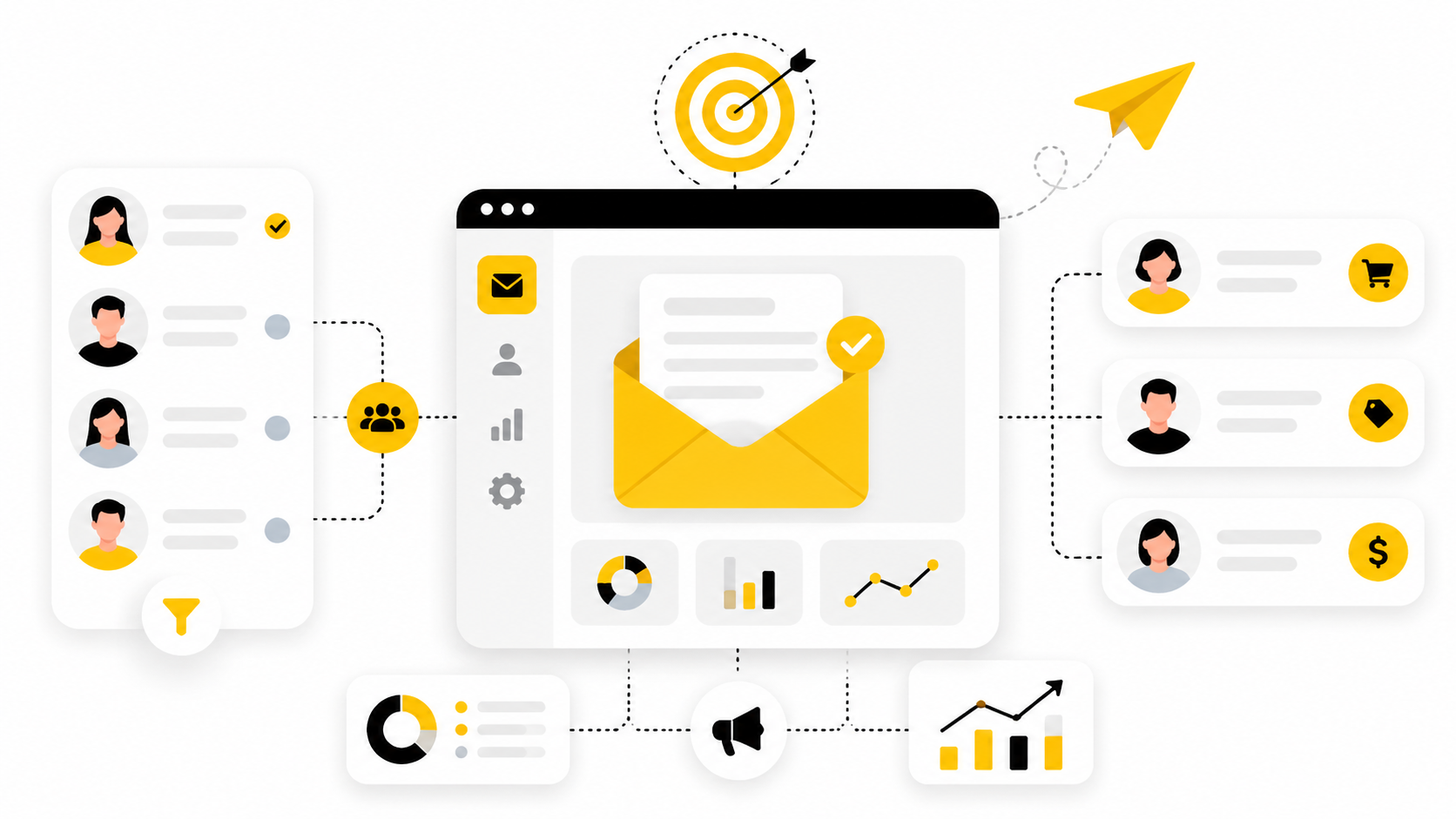
In this article, we’ll walk through how targeted email marketing works and why it’s become a cornerstone of effective digital outreach. You’ll learn the essential strategies for structuring campaigns that deliver value for both your business and your audience.
Here’s how the full article is structured:
- Why Targeted Email Marketing Matters
- Framework Overview for Success
- Core Components of Targeted Campaigns
- Professional Implementation Strategies
- Measuring and Optimizing Performance
- Advanced Tactics and Future Trends
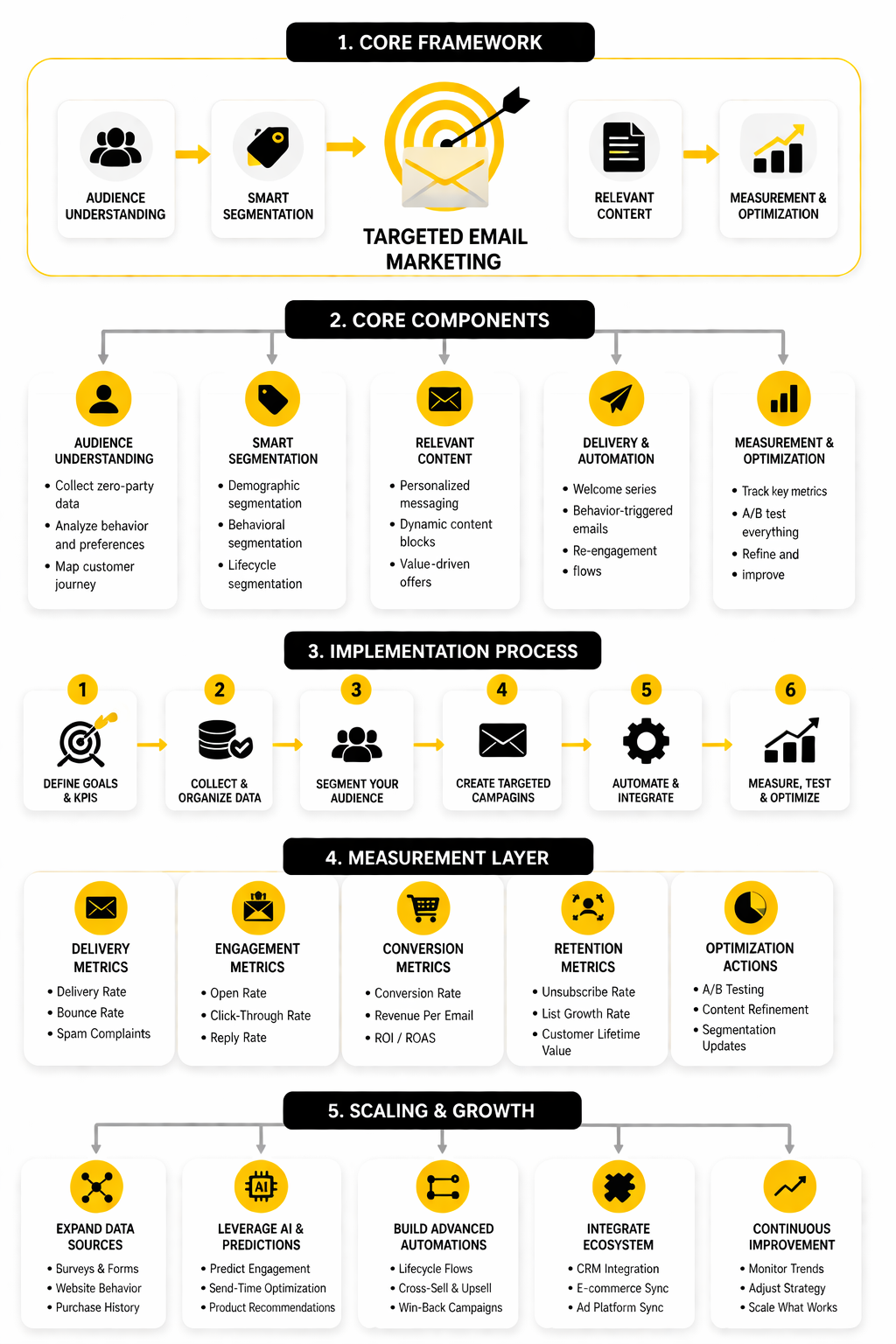
Each section builds on the last so you can go from understanding why targeted email matters to how to implement it with measurable outcomes.
We’ll begin with the reasons behind its importance and the foundational concepts you need before designing your first targeted sequence.
Why Targeted Email Marketing Matters
Targeted email marketing moves you away from spray‑and‑pray messaging and toward relevance, personalization, and results that matter for your bottom line. Emails that speak directly to a recipient’s interests and behaviors earn stronger engagement than generic blasts, especially in inboxes crowded with automated messages and competing offers. Segmentation and tailored messaging help your email stand out and get read.
One of the clearest indicators of why targeted email marketing matters is how it affects key engagement metrics. Campaigns that use targeted segmentation tend to get much higher open and click‑through rates than non‑segmented campaigns because the content aligns with what recipients are actually interested in seeing. Breaking subscribers into groups based on behaviour, purchase history, or demographic signals lets you craft subject lines and content that feel personal rather than generic.
Beyond engagement, targeted email marketing also drives better business outcomes. When you tailor messages to specific customer segments, those emails are far more likely to lead to conversions and revenue. Segmented and targeted campaigns consistently generate a disproportionate share of total email revenue, showing that sending the right offer to the right person makes the difference between an ignored message and a sale.
Framework Overview for Effective Targeted Email Campaigns
A solid framework for targeted email marketing starts with understanding who you’re sending to and why those people should care about your message. At a high level, the framework looks like this:
- Audience Segmentation – Divide your full list into smaller groups based on shared attributes, such as purchase behaviour, engagement level, or demographics. Grouping subscribers lets you tailor offers and messaging to each segment’s specific interests.
- Personalized Content – Once segments are defined, craft content that speaks directly to each group’s needs and expectations. This includes subject lines that resonate and body copy that feels relevant.
- Engagement Signals & Analytics – Use open, click, and conversion metrics to refine your segments over time. High‑performing segments can be expanded with similar audiences, while underperforming ones can be re‑evaluated or re‑engaged with different messaging.
This framework is iterative: as data comes in, you refine segments, update messaging, and adjust how you trigger campaigns so that each send becomes more effective than the last.
Targeted email marketing is not static — it evolves as you learn more about what your audience responds to, where they are in their journey, and how their preferences shift over time. The goal isn’t just to send more emails but to send smarter emails that align with real customer behaviour.
Core Components of Professional Implementation
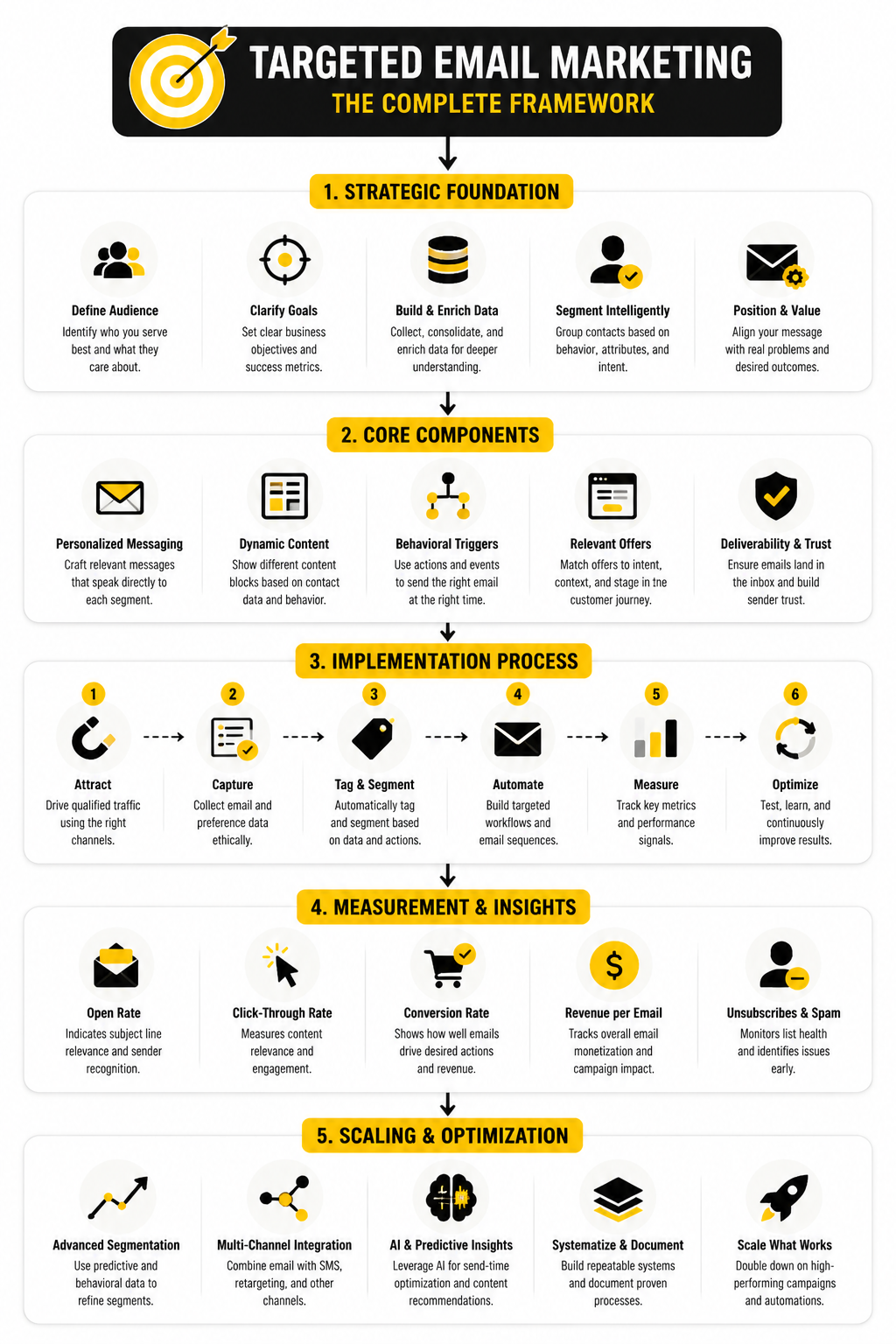
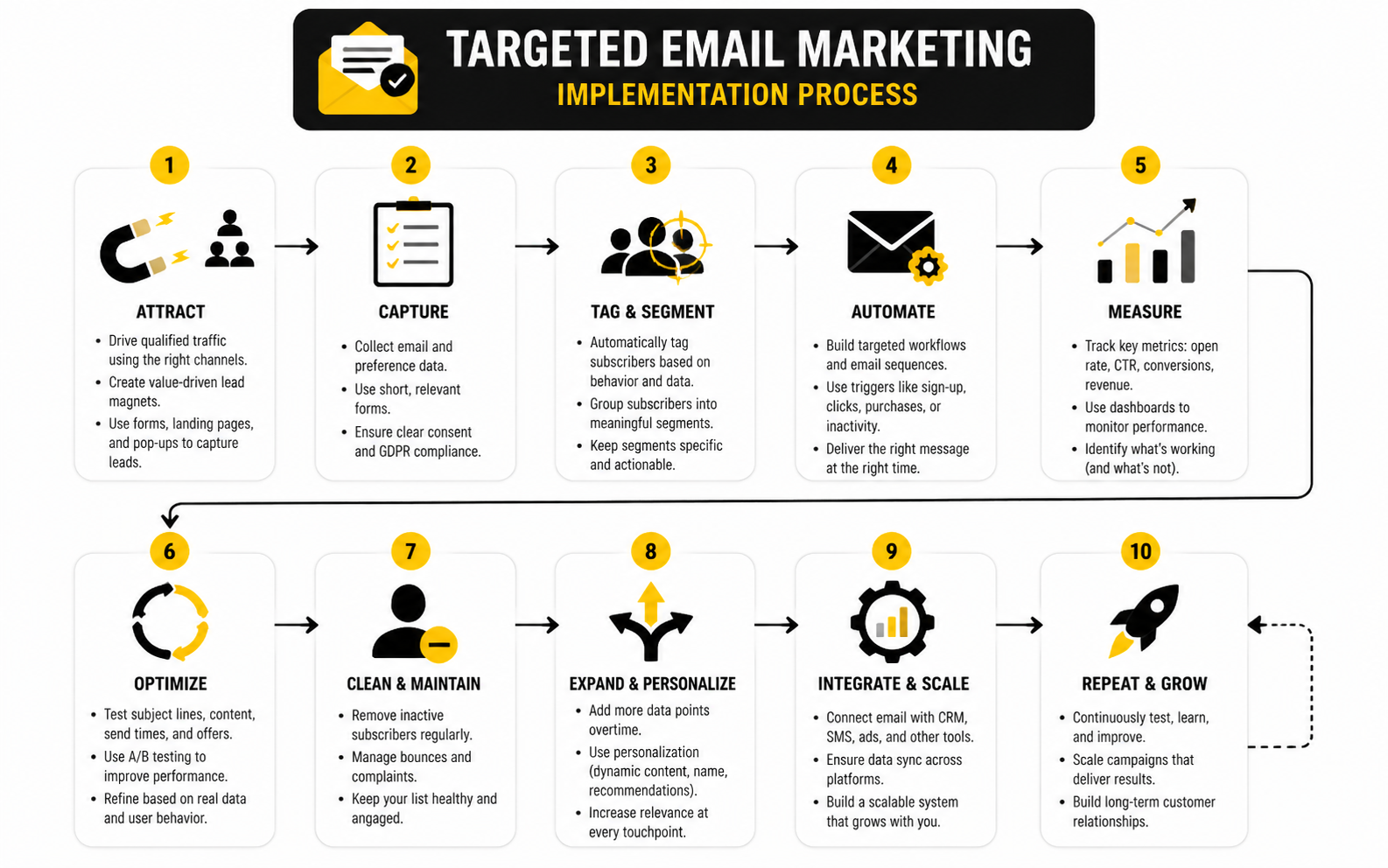
Getting targeted email marketing right means moving beyond concept into practice. This section breaks down the process in a way that aligns your strategy with real, measurable execution — from tools and data foundations all the way through automated workflows that give your campaigns life.
Start With Your Data Foundation
Before writing a single email, you need clean, actionable data. This means collecting information that tells you who your subscribers are, how they behave, and what they want. The most effective targeted email marketing starts with identity‑resolved customer data so you know you’re sending messages to the right profiles. Without that foundation, even the most creative messaging falls flat.
Good data management includes:
- Collating first‑party data from signups, website activity, and purchase history
- Integrating your CRM with your email platform so every interaction enriches subscriber profiles
- Ensuring governance and consent policies are clear so you respect privacy while building relevance
A solid data foundation ensures every subsequent step — segmentation, personalization, triggers, and measurement — works off reliable insights.
Segment Your Audience Strategically
Segmenting your list is one of the most impactful steps in targeted email marketing. Instead of treating your list as a single group, segmentation lets you tailor campaigns to specific audiences. Segments can reflect:
- Demographic criteria like age, location, job role, or company size
- Behavioral signals such as purchase history, browsing patterns, or email engagement
- Lifecycle stage, from new lead to loyal customer to re‑engagement target
Using these divisions, you craft messaging that feels directly relevant to each group’s needs — a key reason why segmented campaigns outperform generic sends on metrics like open and click‑through rates.
Define Clear Goals Before You Build
Targeted campaigns should have defined, measurable goals before launch. Are you trying to:
- Increase repeat purchases?
- Boost webinar registrations?
- Re‑engage dormant subscribers?
A clear objective shapes how segments are built and how success is measured. Without this clarity, you risk executing campaigns that look good on the surface but don’t move business outcomes.
Craft and Personalize Your Messaging
Once segments and goals are set, it’s time to create content that resonates. Personalization goes beyond dropping a name into an email. True personalization means adapting both the message and offer to reflect what each segment cares about. This can include:
- Tailored subject lines that reflect segment interests
- Dynamic content blocks that display different products or CTAs based on segment data
- Messaging that speaks to where the subscriber is in their journey
Highly relevant content signals to your audience that you understand their context and needs — which in turn drives engagement and conversions.
Build Automated Workflows
Great targeted email marketing isn’t just about sending emails manually — it’s about automating the right sequences so your campaign runs on its own while adapting to subscriber behaviour. Common automated workflows include:
- Welcome series for new subscribers
- Behavioral triggers such as cart abandonment or repeat browsing
- Lifecycle touchpoints like post‑purchase follow‑ups or lapsed buyer reactivation
Automation ensures every subscriber gets the right message at the right time, without you having to press send each time. And by linking triggers to segment rules, your email platform can adjust sends dynamically as subscribers act or change behaviour.
Test, Measure, and Optimize Continuously
No implementation is complete without a cycle of measurement and refinement. Successful teams rigorously test elements like subject lines, send times, and CTAs, then use performance data to refine segments and messaging. Key performance indicators for targeted email marketing include:
- Open and click‑through rates
- Conversion rates tied to campaign goals
- Revenue per email or per segment
When you pair structured testing with real analytics, you turn targeted campaigns into ever‑improving systems that adapt to what your audience responds to — not just what you think they will.
This practical implementation process turns targeted email marketing from a theoretical advantage into a reliable, measurable driver of growth. Each step builds on the last so your campaigns evolve from broad broadcasts into personalized experiences that deliver results.
Measuring Performance: Key Metrics and What the Data Really Means
When you implement targeted email marketing, measurement isn’t optional — it’s central to the entire approach. Knowing which metrics matter, how to interpret them, and what to do next can turn a decent campaign into one that consistently moves the needle for your business.
What Metrics Tell You Beyond the Surface
At first glance, performance numbers like open rate and click‑through rate (CTR) might seem like simple percentages on a dashboard. But in the context of targeted email marketing, each metric reveals a different part of the story:
- Open rate tells you whether people are interested enough in your subject line or sender name to look. However, recent changes in privacy protections mean open rates can inflate automatically, so they’re best used as directional indicators rather than absolute truths.
- Click‑through rate (CTR) reflects real engagement — it measures the percentage of recipients who clicked on a link in your email, which shows genuine interest in your content or offer. This makes CTR one of the most trusted performance signals today.
- Click‑to‑open rate (CTOR) goes a step further by isolating how compelling your content was after an open. A high CTOR means your email resonated well with those who actually opened it.
- Bounce, unsubscribe, and spam complaint rates help you maintain list health and sender reputation. Rates above industry averages — like an unsubscribe rate above ~0.3% or spam complaints over ~0.1% — are warning signs that your targeting or frequency might be off.
These metrics together form a performance story, not a single scorecard. For example, a high open rate with low CTR suggests your subject lines are strong but your content or call‑to‑action isn’t compelling enough — and that’s an actionable lesson, not just a number.
Benchmarks Worth Comparing
Benchmarks give context to your results so you can judge whether your targeted campaigns are underperforming, on track, or leading your industry:
- Across many industries in 2026, the median open rate sits roughly between 36% and 40%, while the average CTR typically falls in the 2.5% to 3.5% range. These figures shift based on audience quality, industry, and campaign type.
- Healthy click‑to‑open rates (CTOR) often land between 8% and 11%, with top performers exceeding this. A strong CTOR usually signals that your offer and content truly resonate with segmented groups.
- Unsubscribe rates in a healthy campaign are generally 0.15%–0.3%, and bounces should stay below 1% for good deliverability. Persistent spikes here require cleaning lists and checking segmentation rules.
Benchmarks are starting points, not targets. Your own list composition, send cadence, and audience expectations can shift ideal rates up or down. Still, these figures help you spot outliers quickly and focus optimization where it matters most.
Turning Data Into Action
Numbers by themselves don’t improve performance — your interpretation of them does. Here’s how typical email metrics should drive decisions in a targeted email marketing workflow:
- Review open rates first to ensure your audience is at least curious about your messages. If they’re low, refine your subject lines and sender reputation.
- Analyze CTR and CTOR next. If clicks are low relative to opens, audit your content, offer clarity, and calls to action. Strong segmentation often boosts these more than broad personalization.
- Watch list‑health signals like bounces and unsubscribes. A spike in bounce rates usually means it’s time to clean or re‑engage stale contacts.
- Compare segments within your list, not just the overall campaign. A low average can mask high performance in specific segments that behave differently.
Interpreting your data this way — in light of contextual benchmarks and performance trends — turns analytics from a scoreboard into a growth engine.
Why These Metrics Matter for Targeted Campaigns
Metrics don’t just report past performance — they guide your future moves. With targeted email marketing, you use these numbers to:
- Predict what content will engage each segment next
- Decide which segments need new offers or re‑engagement flows
- Identify where automation rules succeed or fail
- Allocate time and resources where ROI is strongest
In short, the numbers help you learn faster and act smarter with every campaign you send. Successful email programs evolve by listening to data — not guessing at it.
Advanced Considerations for Targeted Email Marketing Success
As you mature your targeted email marketing program, the challenges and opportunities become more nuanced. Beyond basic segmentation and automation, there are strategic trade‑offs, risks, and scaling issues that experienced marketers must navigate if they want to sustain high performance over time.
Balancing Personalization Depth and Scalability
Deep personalization — tailoring emails based on granular behavioral and contextual signals — delivers more relevance than surface‑level approaches like simply inserting a name. Highly personalized emails consistently drive significantly higher engagement and transaction rates than generic sends. (wifitalents.com)
However, there’s a strategic trade‑off: extreme personalization can be resource‑intensive and harder to scale. When teams concentrate too much on individual variations rather than robust segmentation frameworks, the complexity grows exponentially and can slow down execution without equally dramatic performance improvements. The most effective scaling strategies often blend intelligent segmentation with personalization within those segments rather than bespoke messaging for every individual subscriber. This keeps relevance high without overwhelming operational capacity.
Managing Deliverability and Reputation at Scale
As your send volume increases, so does your responsibility to maintain sender reputation and inbox deliverability. High‑volume email streams attract stricter filtering by inbox providers, and poor list hygiene or inconsistent sending patterns can lead to messages landing in spam rather than the inbox — effectively neutering all of your targeted email marketing efforts. Ensuring strong deliverability involves:
- Authenticating your domain with SPF, DKIM, and DMARC records.
- Removing hard bounces and suppressing unengaged contacts regularly.
- Monitoring complaint rates and responding to spikes with segmentation or frequency adjustments.
Poor deliverability not only hurts your current campaigns but can damage your domain’s reputation long‑term, making recovery slow and expensive. Robust reputation management becomes even more critical as your list and frequency grow.
Privacy, Consent, and Regulatory Risk
Collecting and using subscriber data for targeted email marketing walks a fine line with privacy and consent regimes such as GDPR and similar laws. As data sources proliferate and AI‑enabled insights become standard, marketers must make sure that the data used for segmentation and personalization is lawfully collected, consented to, and transparently used. Failure to respect consent can lead not only to unsubscribes but to regulatory penalties and lasting brand damage.
Ethical use of subscriber data is not just about compliance — it’s about trust. When subscribers feel their data is exploited or shared without a clear, agreed purpose, it undermines long‑term engagement and can lead to higher unsubscribe or complaint rates. Clear opt‑in practices, preference centers, and transparent privacy policies are vital parts of scaling targeted email marketing responsibly.
Integrating Cross‑Channel Signals and Journeys
A sophisticated targeted email marketing program doesn’t operate in isolation. As customer journeys become more complex and multi‑touch, incorporating cross‑channel signals (website behavior, social engagement, app usage) into your segmentation and automation logic enhances relevance and timing. Using data from other touchpoints helps you:
- Identify when a subscriber is ready for a sales‑triggered sequence.
- Suppress email sends when a user is highly engaged via another channel to avoid fatigue.
- Re‑engage dormant contacts with coordinated retargeting across channels.
Integrating these signals into your email automation platform turns targeted email marketing into a true lifecycle orchestration engine rather than a standalone broadcast tool.
Measuring What Matters and Avoiding Vanity Metrics
As we’ve discussed, surface metrics like open rates can be misleading on their own — especially with shifts in privacy practices and inbox technology. True performance measurement requires focusing on metrics that correlate with business impact, such as conversion rates, revenue per send, and segment‑specific engagement trends.
Advanced programs often:
- Tie email outcomes directly to revenue and pipeline influence.
- Segment analytics by customer value and journey stage.
- Use predictive scoring to forecast long‑term subscriber value and churn risk.
Teams that elevate their measurement approach gain actionable insights rather than just dashboards. These insights feed back into smarter segmentation, better offer timing, and more effective automation — creating a virtuous cycle of improvement.
Sustainable Growth Through Strategic Automation
Finally, scaling targeted email marketing means trusting automation — but not blindly. Automation must be built with guardrails, human oversight, and testing frameworks so that it augments strategic thinking rather than replaces it. This includes frequent review of automation logic, periodic segmentation audits, and continuous experimentation with offers and triggers.
When automation is thoughtfully combined with strategic oversight, targeted email marketing becomes a sustainable engine of growth that evolves with your audience and adapts to shifting behaviors — not just a set of repetitive sequences. Focus on building systems that learn over time, not just execute predefined steps.
Advanced Ecosystem Visualization
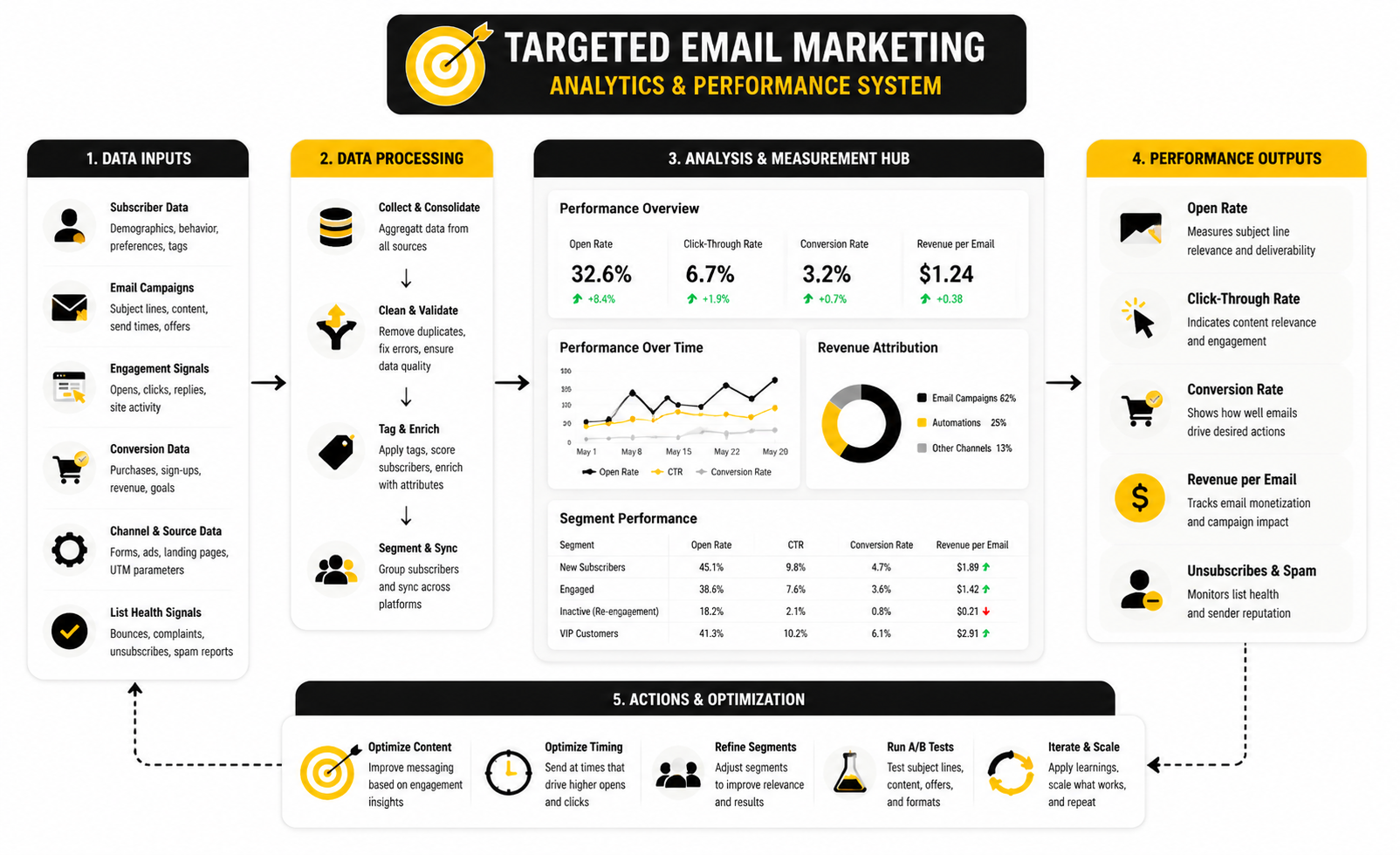
FAQ – Built for Complete Guide
1. What is targeted email marketing?
Targeted email marketing is the practice of segmenting your email list and sending tailored messages to specific groups of subscribers based on their behaviour, preferences, or demographics. The goal is to increase relevance, engagement, and conversions compared with generic broadcast emails.
2. How does segmentation improve email performance?
Segmentation groups subscribers into meaningful categories — such as purchase history, engagement level, or interests — so that each message speaks directly to what those groups care about. This typically leads to higher click‑through rates and better conversion outcomes.
3. What types of data are most useful for targeting?
First‑party data like past purchases, website behaviour, and email engagement are the strongest signals for targeted campaigns. These data points reflect real actions taken by subscribers, allowing you to tailor timing and offers more accurately.
4. Can small businesses benefit from targeted email marketing?
Yes. Small businesses often see immediate lift because they can quickly segment smaller lists and deliver highly relevant content without massive infrastructure. Even simple segments — like new subscribers or recent purchasers — can produce measurable results.
5. How often should I send targeted emails?
There’s no one‑size‑fits‑all cadence, but the frequency should balance staying top of mind without causing fatigue. Monitoring unsubscribe and complaint rates helps you adjust cadence so you stay relevant without overwhelming subscribers.
6. What’s the difference between personalization and targeted email marketing?
Personalization refers to customizing elements of an email (like names or dynamic content) for individual recipients. Targeted email marketing is broader and includes segmentation logic, automation, and strategy that shapes when and to whom emails are sent.
7. Do I need automation tools for targeted campaigns?
Automation tools are highly recommended because they let you trigger emails based on specific subscriber behaviour (like cart abandonment or download completions). This ensures timely delivery and consistent execution without manual sends.
8. How do I measure if a targeted email campaign is successful?
Success is measured by engagement (click‑through rates), conversions tied to campaign goals, revenue generated per send, and how well the campaign contributes to your broader marketing objectives. Comparing these metrics to benchmarks helps interpret performance.
9. Can targeted email marketing help reduce churn?
Yes. By identifying at‑risk subscribers through engagement patterns and sending re‑engagement or special offers, targeted email marketing can help slow churn and retain more customers over time.
10. Is targeted email marketing compliant with privacy laws?
It can be when you collect and use data transparently with consent. Respecting opt‑ins, providing clear unsubscribe options, and adhering to regulations like GDPR are essential parts of ethical and compliant targeted email efforts.
Work With Professionals
Explore 10K+ Remote Marketing Contracts on MarkeWork.com
Most marketers spend too much time chasing clients, competing on crowded platforms, and losing a percentage of every project to middlemen. MarkeWork gives you a better way. Browse thousands of remote marketing contracts and connect directly with companies desperate to hire skilled marketers like you, without platform commissions and without unnecessary gatekeepers.
If you're serious about finding better opportunities and keeping 100% of what you earn, invite readers to explore available contracts and create a profile for free at MarkeWork.com.