

The cookieless future is not a theory anymore. It is already reshaping how platforms, brands, and marketers operate at a fundamental level. Browsers are blocking third-party cookies, regulators are tightening privacy laws, and consumers are far more aware of how their data is used than they were even two years ago.
What most people get wrong is thinking this is just a tracking problem. It is not. It is a system problem. The entire growth stack built on third-party data is being replaced, not patched. If you treat this as a minor adjustment, your acquisition costs will climb, your attribution will break, and your scaling ceiling will drop.
But if you understand how the cookieless future really works, you gain an advantage. You move from renting attention to owning relationships. And that shift changes everything about performance, margins, and long-term growth.
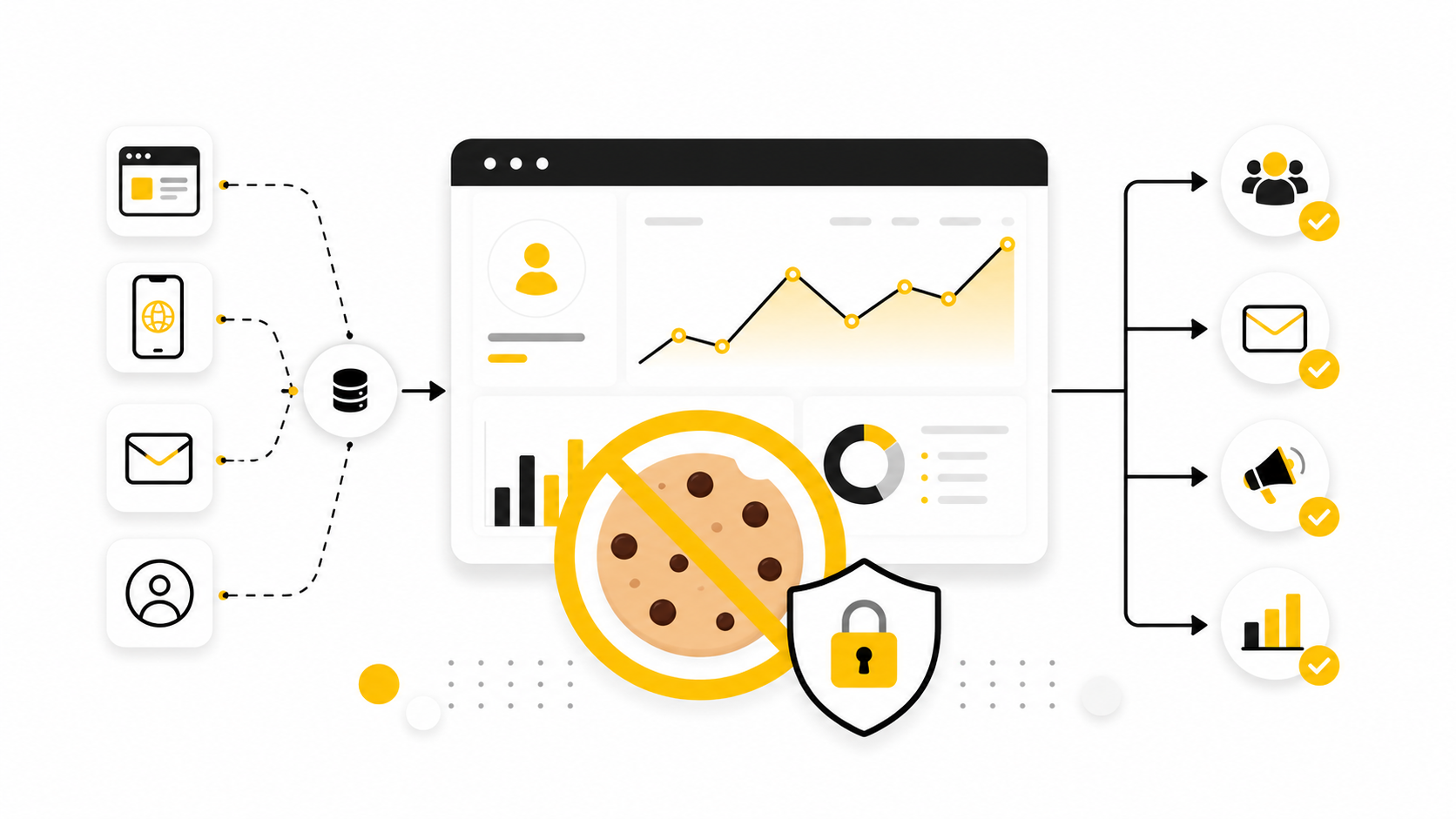
What the Cookieless Future Really Means
At its core, the cookieless future is about one simple transition: from third-party data dependency to first-party data ownership. Instead of relying on platforms to tell you who your customer is, you build systems that collect, enrich, and activate your own data.
Browsers like Safari and Firefox already block most third-party cookies by default, and Chrome—holding over 60% global market share—has been actively moving in the same direction. This is not a slow trend. It is a forced migration.
What changes is not just tracking. It is:
- how you acquire users
- how you personalize experiences
- how you measure performance
- how you scale profitably
That is why businesses that adapt early are outperforming. They are not guessing who their customers are anymore. They are building direct data pipelines.
Why This Shift Matters More Than Most Realize
The biggest misconception is that losing cookies means losing accuracy. In reality, the opposite often happens. Third-party data was always incomplete, probabilistic, and increasingly restricted.
Studies from Google’s Privacy Sandbox initiative show that many legacy tracking methods were already degrading due to browser restrictions and consent requirements. That means your attribution was already breaking before you noticed.
The real risk is not losing cookies. The real risk is continuing to depend on them.
Here is what happens if you do nothing:
- paid ads become less efficient
- retargeting pools shrink dramatically
- attribution becomes unreliable
- customer acquisition cost increases
On the flip side, brands that invest in first-party data strategies are seeing stronger retention and higher lifetime value because they control the relationship directly.
The New Marketing Stack Replacing Cookies
The cookieless future does not remove capabilities. It redistributes them. Instead of being handled by ad platforms, the responsibility moves into your own stack.
The modern system typically includes:
- first-party data collection (forms, quizzes, onboarding flows)
- CRM and customer data platforms
- server-side tracking and event APIs
- owned communication channels (email, SMS, chat)
- AI-driven segmentation and automation
This is where platforms like GoHighLevel or Brevo become critical. They are not just tools. They are infrastructure for owning and activating customer data without relying on third-party cookies.
What used to happen invisibly through pixels now has to be designed intentionally.
The Cookieless Framework That Actually Works
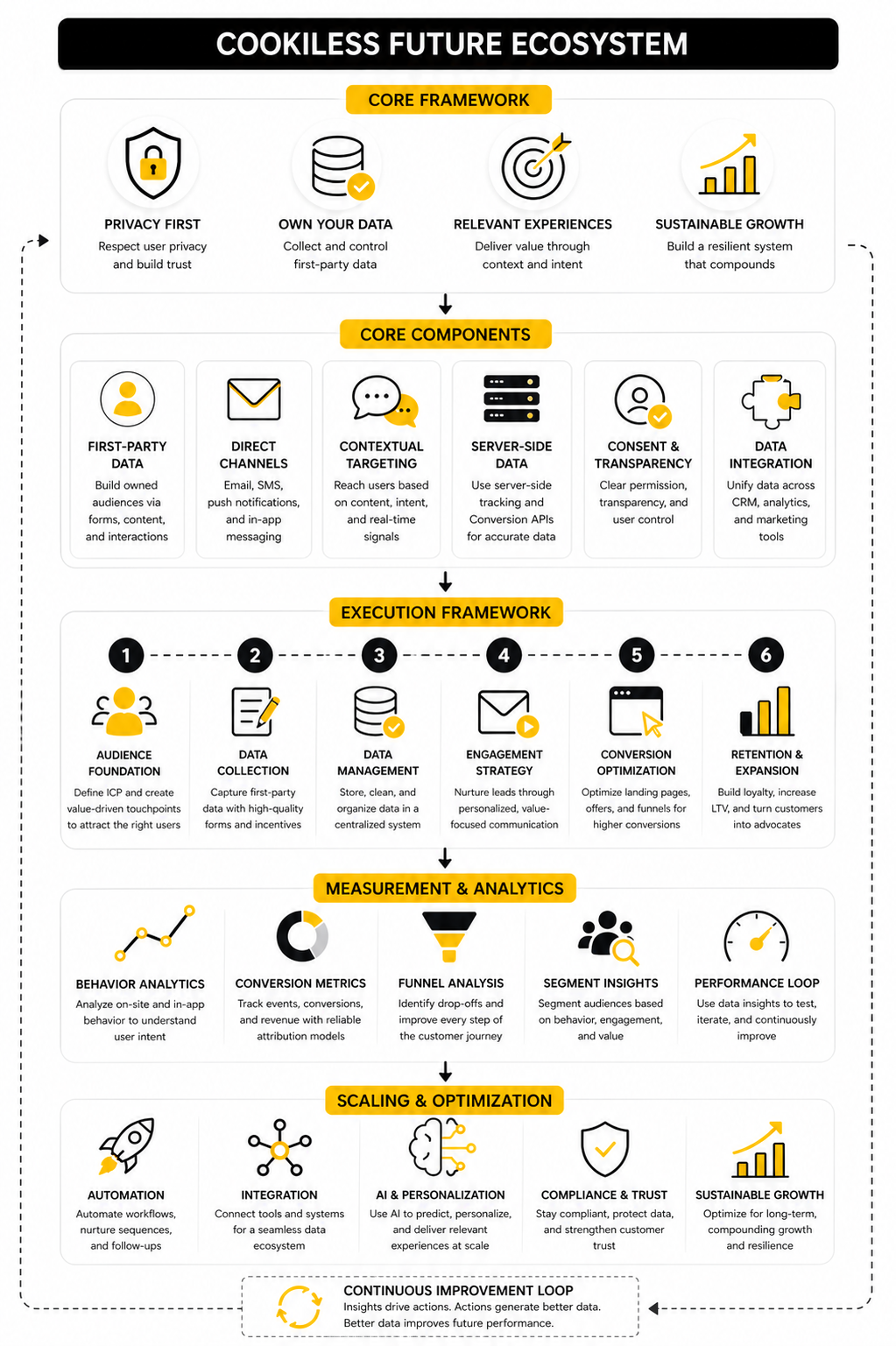
If you strip away the noise, the cookieless future follows a simple but powerful framework. Every successful implementation aligns around four stages:
- Capture – collect first-party data through meaningful interactions
- Store – centralize data in a CRM or unified system
- Enrich – add behavioral and contextual signals over time
- Activate – use that data for personalization, automation, and targeting
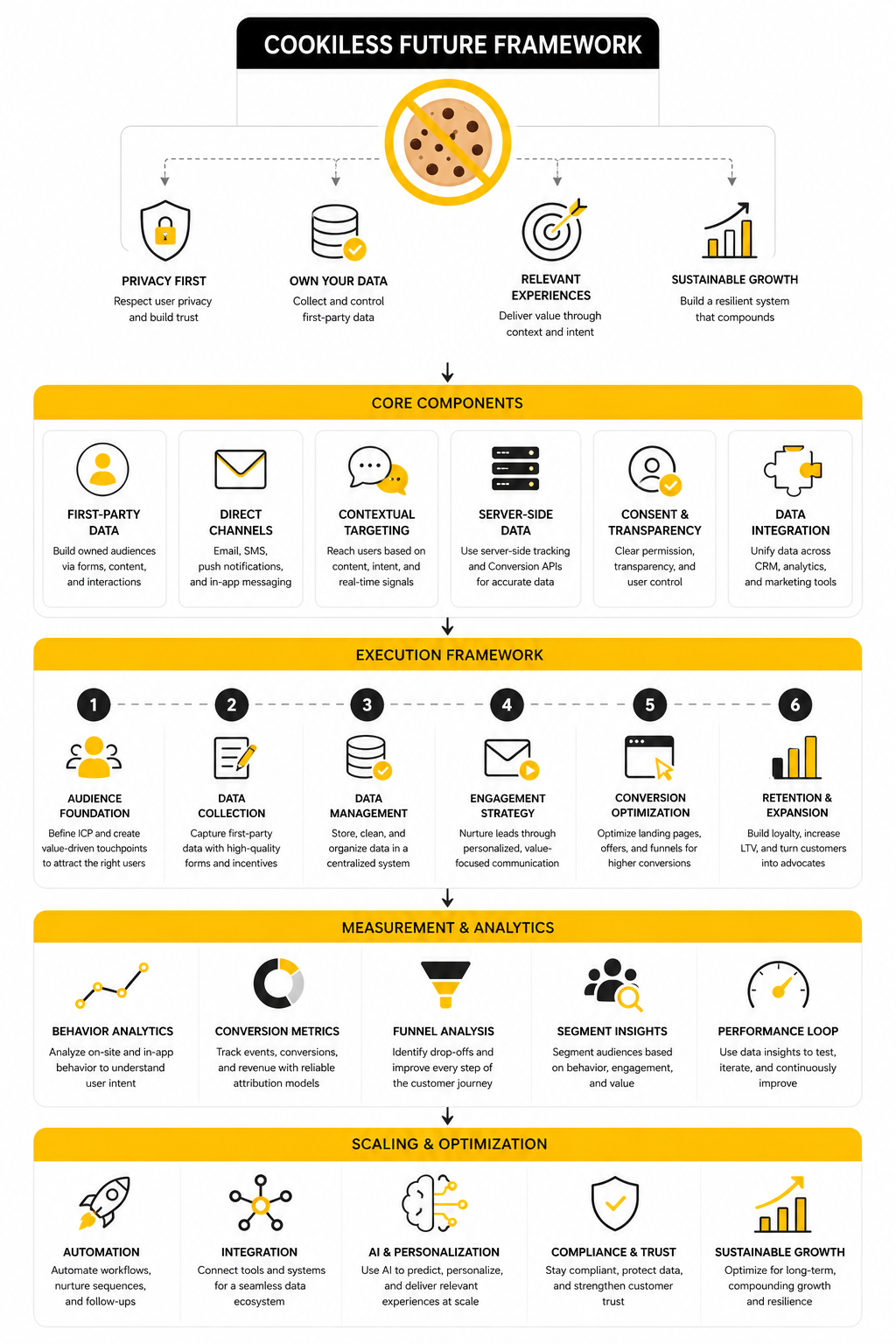
This framework replaces the old model of anonymous tracking with something far more durable. Instead of guessing who someone is based on cookies, you build a profile based on real interactions.
And that changes how you think about growth. Instead of optimizing for clicks, you optimize for data depth and relationship quality.
Core Components of a Cookieless System
To make this framework work in practice, you need specific components that connect seamlessly. Without them, you end up with fragmented data and weak insights.
First-Party Data Collection
This is your entry point. It includes:
- email capture forms
- lead magnets
- quizzes and surveys
- onboarding flows
The key is value exchange. People will share data when they get something meaningful in return. Generic forms do not work anymore.
Tools like Fillout allow you to create dynamic forms that adapt based on user responses, which increases both conversion rate and data quality.
Centralized CRM and Data Layer
Once data is captured, it must live in one place. Fragmented tools create blind spots. A centralized CRM ensures every interaction builds on the last.
Platforms like GoHighLevel combine CRM, automation, and communication channels into a single system. This is essential because the cookieless future rewards integration, not tool stacking.
Owned Communication Channels
Email, SMS, and chat are no longer optional. They are your primary distribution channels.
Using tools like ManyChat, you can build automated conversations that feel personal while scaling to thousands of users. This replaces the reliance on retargeting ads that are becoming less effective.
Conversion Infrastructure
Finally, you need high-converting pages that capture and route data correctly. This is where funnel builders like ClickFunnels or Replo play a key role.
They allow you to control the user journey from first touch to conversion, ensuring every interaction feeds your data system.
Professional Implementation Starts With the Right Mindset
Most businesses approach the cookieless future tactically. They try to replace pixels, patch attribution, or test new tools. That approach fails because it misses the bigger picture.
This is not about fixing tracking. It is about rebuilding your growth engine around owned data.
When you shift your mindset, your priorities change:
- you optimize for data capture, not just traffic
- you design journeys, not just campaigns
- you build systems, not just funnels
And once that shift happens, the cookieless future stops being a threat. It becomes a competitive advantage.
How to Build a First-Party Data Engine
The next logical step is building the system that replaces third-party tracking. In the cookieless future, your first-party data engine becomes the center of your marketing operation because it turns anonymous attention into known relationships.
This is not just a database. It is the process that captures intent, stores it cleanly, enriches it through behavior, and activates it through communication. When that engine works, your marketing becomes less dependent on shrinking retargeting pools and more dependent on assets you actually own.
Start With High-Intent Data Capture
Most businesses collect data too passively. A generic newsletter form buried in a footer will not carry your strategy in a cookieless future. You need entry points that give people a clear reason to share information.
Strong data capture points include:
- quizzes that personalize recommendations
- calculators that solve a specific problem
- lead magnets tied to immediate value
- webinar registrations
- onboarding forms
- product finders
- consultation request flows
The key is value exchange. People are more willing to share data when the benefit is obvious and immediate. Tools like Fillout are useful here because they let you build dynamic forms that feel more like guided interactions than static lead capture boxes.
Collect Less Data Upfront, Then Enrich Over Time
A common mistake is asking for too much too early. Long forms create friction, and friction kills conversion. The better approach is progressive profiling.
Start with the smallest useful piece of information, usually an email address or phone number. Then collect additional signals as the relationship develops through clicks, form responses, purchases, support conversations, and content engagement.
This gives you cleaner data because it comes from real behavior, not rushed form fields. It also respects the user experience, which matters more as privacy expectations rise. In a cookieless future, trust is not a soft metric—it directly affects how much useful data people are willing to share.
Centralize Data Before You Try to Personalize
Personalization fails when data is scattered. If one tool holds email engagement, another holds purchases, another holds form responses, and another holds support history, you do not have a customer profile. You have fragments.
Your CRM or customer data layer should become the source of truth.
At minimum, it should store:
- contact information
- lead source
- funnel activity
- purchase history
- engagement behavior
- lifecycle stage
- consent status
Platforms like GoHighLevel help because they combine CRM, automation, funnels, and communication in one environment. That reduces the risk of disconnected data and makes it easier to act on what users actually do.
Segment by Behavior, Not Just Identity
Old targeting often relied on broad assumptions. The new model should rely on behavior.
A user who visits a pricing page twice is different from someone who downloads a beginner checklist. A subscriber who clicks three product emails is different from someone who only opens newsletters. A returning customer is different from a cold lead, even if both came from the same ad campaign.
Useful segments include:
- new leads
- high-intent prospects
- inactive subscribers
- repeat buyers
- abandoned checkout users
- content-engaged audiences
- consultation-ready prospects
This is where the cookieless future can actually improve marketing quality. Instead of targeting people based on third-party guesses, you respond to signals they created inside your own ecosystem.
Activate Data Through Owned Channels
Data has no value if it just sits in your CRM. The advantage comes from activation.
Owned channels give you direct access to your audience without relying entirely on ad platforms. Email remains especially important because recent email marketing research continues to show strong returns, with some businesses reporting more than $10 for every $1 spent when they track ROI properly. That number matters because it shows the gap between teams that simply send campaigns and teams that measure, segment, and
Professional Implementation in a Cookieless Environment
Once you understand the framework, the real challenge is execution. This is where most businesses fail. They know they need first-party data, but they never translate that into a working system that actually drives revenue.
The cookieless future rewards operational clarity. You need a clear process that connects acquisition, data capture, automation, and conversion into one continuous loop. If even one part is disconnected, the entire system underperforms.
Let’s break this down into how it actually works in practice.
Step-by-Step Execution Flow
At a high level, your implementation should follow a structured path. Not complicated, but precise.
- Traffic enters controlled environments
Instead of sending traffic to generic pages, you direct it into funnels or landing pages designed to capture data immediately.
- Data is captured early, not late
You don’t wait until checkout or sign-up. You capture email, preferences, or intent signals as early as possible using lead magnets, quizzes, or gated content.
- Profiles are created instantly
Every interaction is tied to a contact record in your CRM. No anonymous users floating around.
- Behavior is tracked server-side
Events like page views, clicks, and purchases are tracked through APIs instead of cookies.
- Automation activates immediately
Based on behavior, users are segmented and pushed into personalized journeys via email, SMS, or chat.
- Conversion loops are optimized continuously
You analyze which sequences convert and refine based on real data, not assumptions.
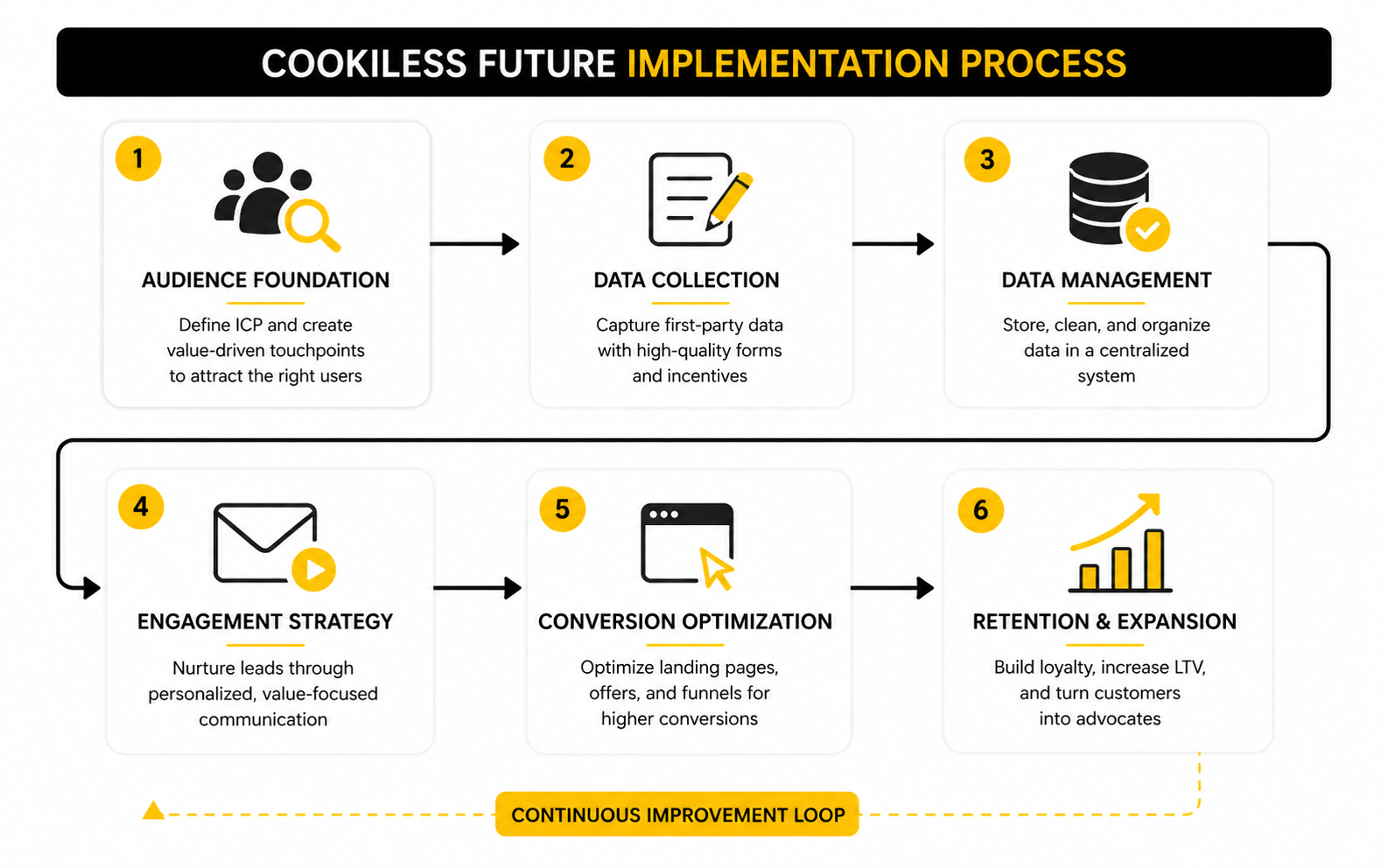
This is where the cookieless future becomes tangible. You are no longer relying on pixels firing in the background. You are building a system where every step is intentional and measurable.
Building the Data Capture Layer Correctly
Most companies get this wrong. They add a simple email form and think they are “cookieless ready.” That does not work.
Your data capture layer must be designed to increase both volume and quality of data. That means:
- asking better questions, not more questions
- using progressive profiling instead of long forms
- offering clear value exchanges
- adapting flows based on user behavior
For example, instead of a generic “subscribe to newsletter,” you create:
- product recommendation quizzes
- personalized onboarding flows
- interactive calculators
- gated insights tailored to the user
Tools like Fillout make this process dynamic, allowing you to build forms that evolve based on answers. This significantly improves both conversion rates and data depth.
Connecting Everything Into One System
Fragmentation kills performance in a cookieless setup. If your data lives in multiple tools that do not communicate, you lose context. And without context, personalization breaks.
That is why integration matters more than ever.
A platform like GoHighLevel allows you to:
- store all contacts in one place
- track interactions across channels
- automate responses based on behavior
- manage pipelines and conversions
Instead of juggling separate tools for CRM, email, SMS, and funnels, you operate from a single system. That is how you maintain data integrity and speed.
Activating Data Through Owned Channels
Capturing data is only step one. The real leverage comes from activation.
In the cookieless future, your growth depends on channels you control:
- SMS
- chat
- direct notifications
This is where automation becomes critical. You are not manually sending campaigns. You are building sequences that respond to user behavior in real time.
For example:
- user downloads a guide → receives onboarding sequence
- user clicks a pricing page → triggered follow-up with offer
- user abandons cart → personalized reminder sequence
Tools like ManyChat allow you to build conversational flows that feel natural while still being fully automated. This replaces the old retargeting-heavy strategies that are losing effectiveness.
Designing Conversion Paths That Feed Data
In the old model, funnels were built purely for conversion. In the cookieless future, they must also be built for data enrichment.
Every step in your funnel should answer a question about the user:
- what problem are they trying to solve
- what level of intent do they have
- what objections are holding them back
- what segment do they belong to
This means your funnel is not just a sales tool. It is a data engine.
Platforms like ClickFunnels or Systeme.io make it easier to build these structured journeys without needing complex development.
The difference is in how you design them. You are not just asking “will this convert?” You are asking “what data does this step give me?”
The Real Shift: From Campaigns to Systems
This is the part most people underestimate.
In the cookieless future, you do not run isolated campaigns anymore. You build systems that continuously learn and improve.
That means:
- your funnels feed your CRM
- your CRM feeds your automation
- your automation feeds your analytics
- your analytics improve your funnels
It becomes a loop.
And once that loop is working, scaling becomes easier. Not because you spend more on ads, but because your system becomes more efficient over time.
That is the real implementation advantage. Not just surviving the cookieless future, but using it to build a more resilient and profitable growth engine.
Measuring What Actually Matters in a Cookieless Future
Once your system is implemented, the next challenge is measurement. This is where most teams feel the biggest loss when moving into a cookieless future. They go from overconfident dashboards to uncertainty almost overnight.
But here is the reality. Most of the old metrics were misleading anyway. Cookie-based attribution often double-counted conversions, inflated retargeting impact, and ignored real customer journeys.
The cookieless future forces you to measure differently. And when done correctly, it actually gives you a clearer picture of performance.
The Shift From Attribution to Signals
The biggest mindset shift is this: you are no longer chasing perfect attribution. You are reading performance signals across your system.
Instead of asking “which ad caused this sale,” you ask:
- which channels drive qualified traffic
- which funnels convert that traffic into data
- which sequences turn data into revenue
This removes the illusion of precision and replaces it with actionable clarity.
For example, browser restrictions have already reduced the accuracy of traditional tracking methods significantly, with some estimates showing attribution gaps of over 30% in certain environments as privacy features increased across Safari and Firefox ecosystems.
That means your old dashboards were already incomplete. The cookieless future simply makes that visible.
The New Analytics Stack
To measure effectively, you need a different structure. Not more tools, but better alignment between them.
Your analytics system should include:
- server-side tracking to capture reliable event data
- CRM-based reporting for lifecycle insights
- channel-level performance tracking instead of user-level tracking
- cohort analysis to understand long-term behavior
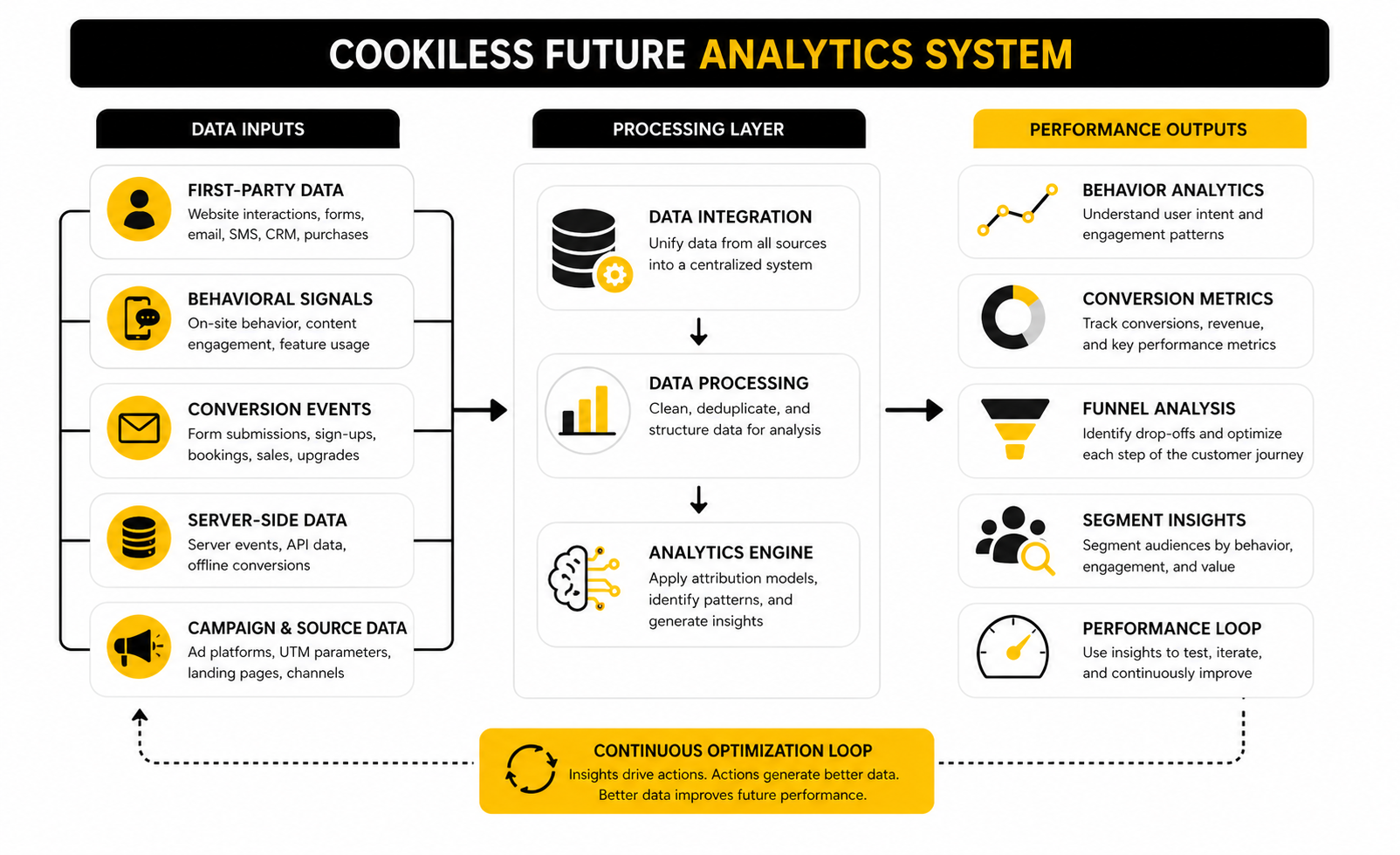
This is the core difference. Instead of fragmented data from multiple pixels, you centralize insights into a unified system where behavior, conversions, and revenue are connected.
Platforms like GoHighLevel already integrate reporting directly into CRM workflows, which allows you to track pipeline value instead of just clicks or impressions.
Metrics That Actually Matter Now
You do not need more data. You need better metrics.
Here are the signals that matter most in a cookieless future:
Cost Per Qualified Lead
Not all leads are equal. The focus shifts from raw volume to quality.
If your cost per lead drops but conversion rate drops with it, you are losing efficiency. A qualified lead metric forces you to measure what actually drives revenue.
Lead-to-Customer Conversion Rate
This becomes one of your most important indicators. It tells you how well your system turns captured data into paying customers.
If this number is low, the issue is not traffic. It is your funnel, messaging, or follow-up system.
Customer Acquisition Cost (Blended)
Instead of tracking CAC per channel with questionable accuracy, you measure total spend versus total customers acquired.
This gives you a realistic view of profitability, especially when attribution becomes less precise.
Customer Lifetime Value
This is where the cookieless future becomes powerful. When you own the relationship, you can increase retention and upsells.
Brands focusing on first-party data strategies often see stronger lifetime value because they can personalize communication more effectively.
Engagement Depth
Clicks are weak signals. Depth of interaction is stronger.
This includes:
- number of interactions per user
- time between touchpoints
- response rates to sequences
Tools like Brevo allow you to track these engagement metrics across email and automation flows, giving you insight into relationship strength, not just activity.
How to Interpret the Data Without Guessing
Data in a cookieless environment is less about exact answers and more about directional truth.
Here is how to read it properly:
- If traffic increases but conversions stay flat → your funnel is weak
- If leads increase but revenue does not → your qualification is poor
- If engagement drops → your messaging is off or irrelevant
- If CAC rises while LTV stays flat → your system is inefficient
This approach eliminates the need for perfect attribution. You focus on system performance instead of individual touchpoints.
Benchmarks That Actually Mean Something
Benchmarks still matter, but only when they are interpreted correctly.
For example:
- email open rates vary widely, but engagement trends over time matter more than a fixed percentage
- conversion rates differ by industry, but improvements within your own funnel are more important than external comparisons
- CAC benchmarks are useful, but only relative to your LTV
The cookieless future shifts benchmarking from external comparison to internal optimization.
Turning Insights Into Action
Data without action is useless. Every metric should lead to a decision.
Here is how that looks in practice:
- low conversion rate → redesign landing pages or offers
- weak engagement → rewrite sequences or improve segmentation
- high CAC → adjust targeting or improve data capture earlier
- low LTV → build better retention and upsell flows
This creates a feedback loop where your system continuously improves.
And that is the real advantage. In the cookieless future, the companies that win are not the ones with the most data. They are the ones that act on the right data consistently.
Advanced Strategy in a Cookieless Future
Once your foundation and measurement systems are in place, the real advantage comes from how you scale and defend your position. This is where most companies either compound growth or quietly fall behind.
The cookieless future is not just a technical shift. It is a strategic filter. It rewards businesses that own relationships and exposes those that relied on rented audiences.
The Tradeoff Between Precision and Scale
One of the hardest adjustments is accepting less precision at scale.
In the cookie era, you could hyper-target users with detailed behavioral data. That level of granularity is disappearing. What replaces it is broader targeting combined with stronger internal systems.
This creates a clear tradeoff:
- less external targeting precision
- more internal conversion optimization
The companies that win lean into this. They invest more in:
- creative quality
- offer clarity
- funnel performance
Instead of trying to perfectly target the right user, they build systems that convert a wider range of users effectively.
First-Party Data Becomes a Competitive Moat
Owning your data is no longer optional. It is one of the few sustainable advantages left.
Large platforms have already moved in this direction. Walled gardens like Google and Meta are strengthening their own ecosystems because they control massive amounts of first-party data.
For smaller businesses, the opportunity is different but just as powerful. You build your own data layer through:
- email lists
- SMS subscribers
- CRM pipelines
- community platforms
Tools like ManyChat allow you to capture conversational data through messaging, which is often more responsive than traditional email funnels.
The key insight is simple. Every data point you collect directly reduces your dependence on external platforms.
The Risk of Over-Reliance on Platforms
One of the biggest hidden risks in the cookieless future is platform dependency.
If your entire acquisition strategy depends on:
- one ad platform
- one traffic source
- one algorithm
you are exposed.
Algorithm changes, policy updates, or pricing shifts can wipe out performance overnight. This has already happened repeatedly across Meta, Google, and TikTok ecosystems.
The solution is not abandoning platforms. It is diversifying intelligently while pulling users into your owned system as quickly as possible.
That is why funnel builders like ClickFunnels still play a critical role. They act as the bridge between rented attention and owned relationships.
Scaling Without Losing Signal Quality
As you scale, maintaining signal quality becomes harder.
More traffic means:
- more noise in your data
- more variation in user intent
- more complexity in attribution
To handle this, you need structured segmentation.
Instead of treating all leads equally, you segment based on:
- acquisition source
- behavior patterns
- engagement level
Then you tailor follow-up accordingly.
Platforms like GoHighLevel are built for this kind of segmentation, allowing you to automate workflows based on real behavioral triggers instead of static lists.
The Creative Layer Becomes Critical
In a cookieless future, creative is no longer just branding. It becomes targeting.
When you cannot rely on detailed tracking, your messaging has to do more work. It needs to:
- attract the right audience
- filter out the wrong audience
- pre-qualify intent
This is why creative testing becomes a core growth lever.
You are not just testing for clicks. You are testing for:
- downstream conversion rates
- lead quality
- revenue impact
This shifts your mindset from campaign optimization to system optimization.
Compliance and Trust as Growth Drivers
Privacy regulations are not slowing down. GDPR, CCPA, and similar frameworks continue to evolve.
What most businesses miss is this: compliance is not just a legal requirement. It is a trust signal.
Users are more likely to share data when:
- they understand how it is used
- they trust the brand
- they see clear value in exchange
This creates an opportunity. Transparent data practices can actually increase conversion rates.
Instead of hiding consent mechanisms, you integrate them naturally into your funnel experience.
Building a Resilient Marketing System
At an advanced level, your goal is resilience.
A resilient system can:
- absorb traffic fluctuations
- adapt to platform changes
- maintain consistent revenue
To achieve this, you need alignment across:
- acquisition channels
- data capture systems
- conversion funnels
- retention mechanisms
This is where most businesses struggle. They optimize individual pieces but fail to connect the entire system.
The cookieless future rewards those who think in systems, not tactics.
The Real Strategic Advantage
Here is the bottom line.
The cookieless future does not remove your ability to grow. It removes shortcuts.
You can no longer rely on:
- hidden tracking
- aggressive retargeting
- black-box attribution
Instead, you build:
- stronger offers
- clearer messaging
- better relationships
- owned data ecosystems
And that is the advantage. Because once you build it, it is much harder for competitors to replicate.
The Cookieless Ecosystem in Practice
At this point, everything connects.
The cookieless future is not about replacing one tool or tactic. It is about building a closed-loop system where traffic, data, conversion, and retention all reinforce each other.
Instead of fragmented campaigns, you operate a unified ecosystem:
- acquisition feeds into owned channels
- owned channels deepen relationships
- relationships generate better data
- better data improves acquisition
This is the compounding loop that replaces cookie-based targeting.
Tools like Brevo or Moosend help turn that ecosystem into something scalable by managing communication and lifecycle marketing across channels.
When done correctly, you no longer depend on cookies to understand your audience. You understand them directly.
FAQ - Built for Complete Guide
What is a cookieless future in simple terms?
A cookieless future means online tracking through third-party cookies is being phased out. Businesses can no longer rely on external data to follow users across the web. Instead, they must build direct relationships and collect data through their own channels.
Why are third-party cookies disappearing?
Privacy concerns and regulatory pressure are driving this shift. Browsers like Safari and Firefox already block third-party cookies, and Chrome is actively moving in the same direction to align with global privacy expectations.
Does this mean digital marketing will stop working?
Not at all. It just changes how it works. The focus moves from tracking users everywhere to building stronger systems that capture intent, trust, and engagement directly.
What replaces third-party cookies?
Several approaches replace them:
- first-party data collection
- contextual targeting
- server-side tracking
- privacy-preserving technologies like aggregated measurement
Each one reduces reliance on external identifiers.
How important is first-party data now?
It is one of the most valuable assets you can build. First-party data gives you direct insight into your audience without relying on platforms. It improves targeting, personalization, and long-term stability.
Can small businesses compete in a cookieless world?
Yes, and often more effectively. Large companies depend heavily on scale and external data. Smaller businesses can move faster and build deeper relationships, which becomes a major advantage.
What tools help with cookieless marketing?
You need tools that support owned data and automation. For example:
- GoHighLevel for CRM and automation
- ClickFunnels for funnel building
- ManyChat for conversational data
These tools help you build a system instead of relying on fragmented campaigns.
Is retargeting completely dead?
No, but it is evolving. Retargeting now relies more on first-party audiences, email lists, and platform-native data rather than third-party tracking across multiple sites.
How do you measure performance without cookies?
You rely on a combination of:
- first-party analytics
- modeled attribution
- platform insights
- conversion APIs
This gives you directional accuracy instead of perfect tracking, which is enough to optimize effectively.
What is the biggest mistake companies make right now?
Waiting too long to adapt. Many businesses are still trying to extend old systems instead of building new ones. This delays growth and creates long-term dependency risks.
How long does it take to adapt to the cookieless future?
It depends on your current setup. Businesses starting from scratch can build a clean system in a few months. Those with complex legacy systems may take longer because they need to restructure data flows and processes.
Is privacy-first marketing harder?
It is different, not harder. It requires clearer thinking, better systems, and stronger offers. Once those are in place, performance becomes more stable and less dependent on external factors.
Work With Professionals
Explore 10K+ Remote Marketing Contracts on MarkeWork.com
Most marketers spend too much time chasing clients, competing on crowded platforms, and losing a percentage of every project to middlemen.
MarkeWork gives you a better way. Browse thousands of remote marketing contracts and connect directly with companies desperate to hire skilled marketers like you, without platform commissions and without unnecessary gatekeepers.
If you're serious about finding better opportunities and keeping 100% of what you earn, explore available contracts and create a profile for free at MarkeWork.com.