


Once you stop lumping everything together, affiliate marketing companies become much easier to evaluate. The market is really a mix of networks, partnership platforms, specialist agencies, and service providers that solve different pieces of the same growth problem. That distinction matters because a brand looking for partner discovery and payout infrastructure is not shopping for the same thing as a company that needs strategic management, recruitment help, and commission design.
Traditional affiliate networks are still the most familiar model. They usually offer access to a large pool of publishers, built-in tracking, standardized payments, and a marketplace environment that makes it easier for advertisers to launch quickly. CJ and Awin both sit firmly in that world, though both have evolved well beyond the old image of coupon-heavy affiliate programs.
Partnership platforms take a wider view. Instead of focusing only on classic affiliate relationships, they often cover affiliates, creators, referrals, B2B partners, mobile partnerships, and other performance-based relationships in the same operating layer. impact.com is one of the clearest examples of that category shift, and its positioning shows how much the term affiliate marketing companies now overlaps with the broader partnership economy.
Agencies are different again. They do not always own the core technology, but they can be the right choice for brands that need recruiting, program operations, creative coordination, compliance review, and hands-on optimization without building a large internal team. That matters because even the best platform does not fix a weak partner strategy on its own. In practice, many high-performing programs use both a platform and an agency, especially during the first year of growth.
Then there are specialist software layers that support execution around the core program. A brand may use ManyChat for conversational lead capture, Dub for cleaner branded link workflows, GoHighLevel for CRM and funnel operations, or Replo for ecommerce landing page performance. These are not affiliate marketing companies in the strict classic sense, but they often become part of the real-world stack that helps an affiliate program convert better after the click.
How Professionals Implement and Scale Affiliate Programs
This is where the conversation gets real. A lot of businesses spend too much time comparing affiliate marketing companies and almost no time thinking through how the program will actually run once the contract is signed. The result is predictable: messy partner recruitment, bad tracking, generic commissions, weak compliance, and a channel that looks active without becoming meaningfully profitable.
Professional implementation starts with operational design, not outreach. Before a brand invites a single publisher or creator, it needs to define what counts as success, which conversion events matter, how attribution will work, and what kinds of partners are worth recruiting first. impact.com’s 2025 benchmark data is useful here because it shows why raw click volume is not enough. Clicks rose while transactions and conversion rates moved the other way, which is exactly what happens when teams chase activity without tightening program design.
Step 1: Set the Economic Rules Before Recruitment Starts
The first step is deciding what the program is supposed to produce. That means getting specific about whether the main goal is new customer acquisition, higher average order value, lead generation, subscription growth, or broader market reach through creators and publishers. Without that clarity, affiliate marketing companies end up managing to vanity metrics because no one has agreed on the commercial objective.
This is also the moment to define partner economics. A professional setup decides in advance which partner types deserve different commission rates, how reversals will be handled, whether there are bonuses for new customers, and what kinds of actions should never be rewarded. Awin’s work on commission flexibility points in exactly that direction. The best programs do not pay everyone the same. They pay based on role, value, and business impact.
Step 2: Build Clean Tracking and Attribution
The second step is technical, and it is absolutely worth taking seriously. Tracking needs to be in place before recruitment ramps up, because fixing attribution after partners are already sending traffic is much harder and much more political. If the platform cannot show reliable conversion paths, cross-device behavior, and commission logic, the program will start leaking trust almost immediately.
This is where many affiliate marketing companies separate themselves. Some are still strongest in standard last-click network reporting, while others push more advanced attribution and tracking models that recognize creator influence and upper-funnel content value. impact.com’s attribution guidance for creator partnerships is a good example of how the market is moving beyond simplistic credit rules. That shift matters because a lot of creator and content influence never shows up cleanly in a pure last-click view.
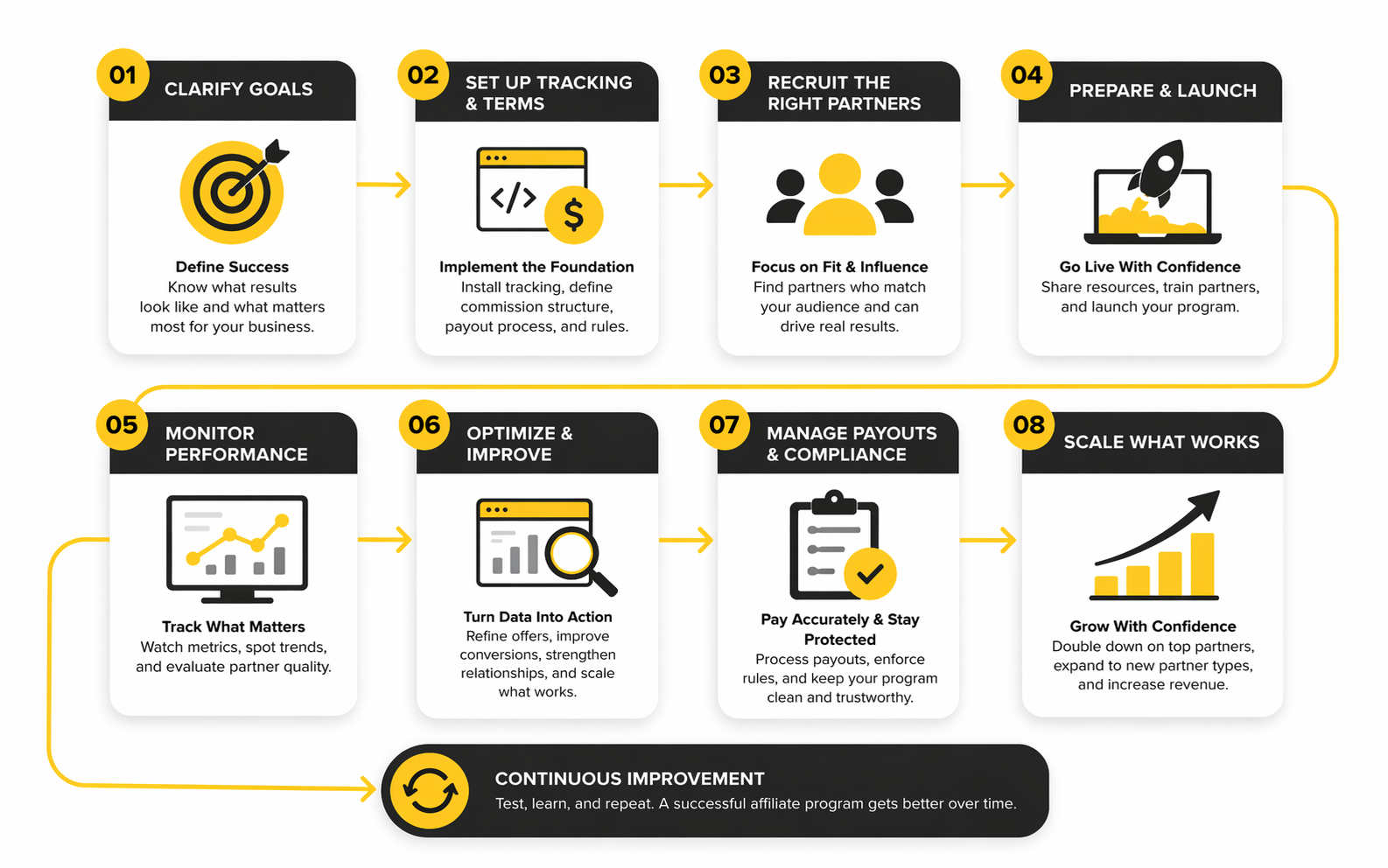
Step 3: Recruit Partners in a Deliberate Sequence
The third step is recruitment, but not the spray-and-pray version. A serious team starts with a priority partner map: review publishers, niche content sites, creators, referral partners, loyalty partners, or B2B relationships depending on the offer and customer journey. The point is not to flood the program with applications. The point is to bring in the partner types most likely to create incremental value first.
That sequencing changes everything. If you invite discount-heavy partners too early, you can distort the channel before content and creator relationships have a chance to build real influence. If you recruit creators before the landing pages, offers, and tracking are ready, you burn goodwill fast. This is why businesses that want more control often combine a core affiliate platform with supporting tools such as Fillout for application flows, Copper for relationship tracking, or Cal.com for smoother partner onboarding calls.
Step 4: Give Partners a Real Conversion Environment
A surprising number of affiliate programs fail because the partner experience ends at the tracking link. That is weak execution. If the landing pages are slow, the offer is generic, the messaging is inconsistent, or the signup flow creates friction, even excellent partners will underperform. Affiliate marketing companies can support growth, but they cannot rescue a bad conversion path.
This is where the adjacent stack becomes practical rather than theoretical. Ecommerce brands may tighten landing page relevance with Replo, service businesses may centralize lead handling with GoHighLevel, and education or funnel-driven offers may prefer ClickFunnels or Systeme.io. These tools do not replace affiliate marketing companies, but they can dramatically improve what happens after a partner has done the hard work of generating intent.
Step 5: Put Compliance and Communication on a Schedule
A professional program does not “handle compliance later.” It builds disclosure expectations, promotional rules, trademark boundaries, and review standards into onboarding and ongoing partner communication. That matters more now because the FTC’s endorsement and review rules are not abstract policy noise. They directly affect how affiliate-backed recommendations and testimonials need to be disclosed and managed. The FTC’s endorsements guidance and the current reviews rule Q&A make that clear.
Communication cadence matters too. Partners perform better when they get timely updates on promotions, creative angles, product launches, and commission opportunities instead of being treated like interchangeable traffic sources. Teams often use tools such as Brevo, Moosend, or Buffer around this layer because partner enablement is part of performance, not separate from it.
Step 6: Optimize by Partner Role, Not Just by Revenue
The final step is where scaling either becomes disciplined or turns into chaos. Once the program is live, the real job is to compare partner types, watch customer quality, adjust commissions, remove low-trust behavior, and keep improving conversion paths. Flat optimization is lazy. Strong programs optimize differently for content partners, creators, referrals, and loyalty sites because those partners influence the buying journey in different ways.
This is also where reporting maturity matters. IAB’s view of affiliate inside the wider commerce and digital revenue landscape helps explain why smarter measurement now matters so much. As commerce-driven media grows, brands need to know not just who closed the sale, but who shaped it, who added value, and who simply intercepted intent that would have happened anyway.
By this stage, the pattern is clear. The best affiliate marketing companies do not win because they have the loudest marketplace pitch. They win because they fit into an implementation process that is commercially sound, technically credible, and operationally disciplined. The next section will get even more specific by looking at how to choose the right company for your business model and how to avoid the mistakes that make affiliate programs look easy at launch and expensive six months later.
What the Data Really Says About Affiliate Marketing Companies
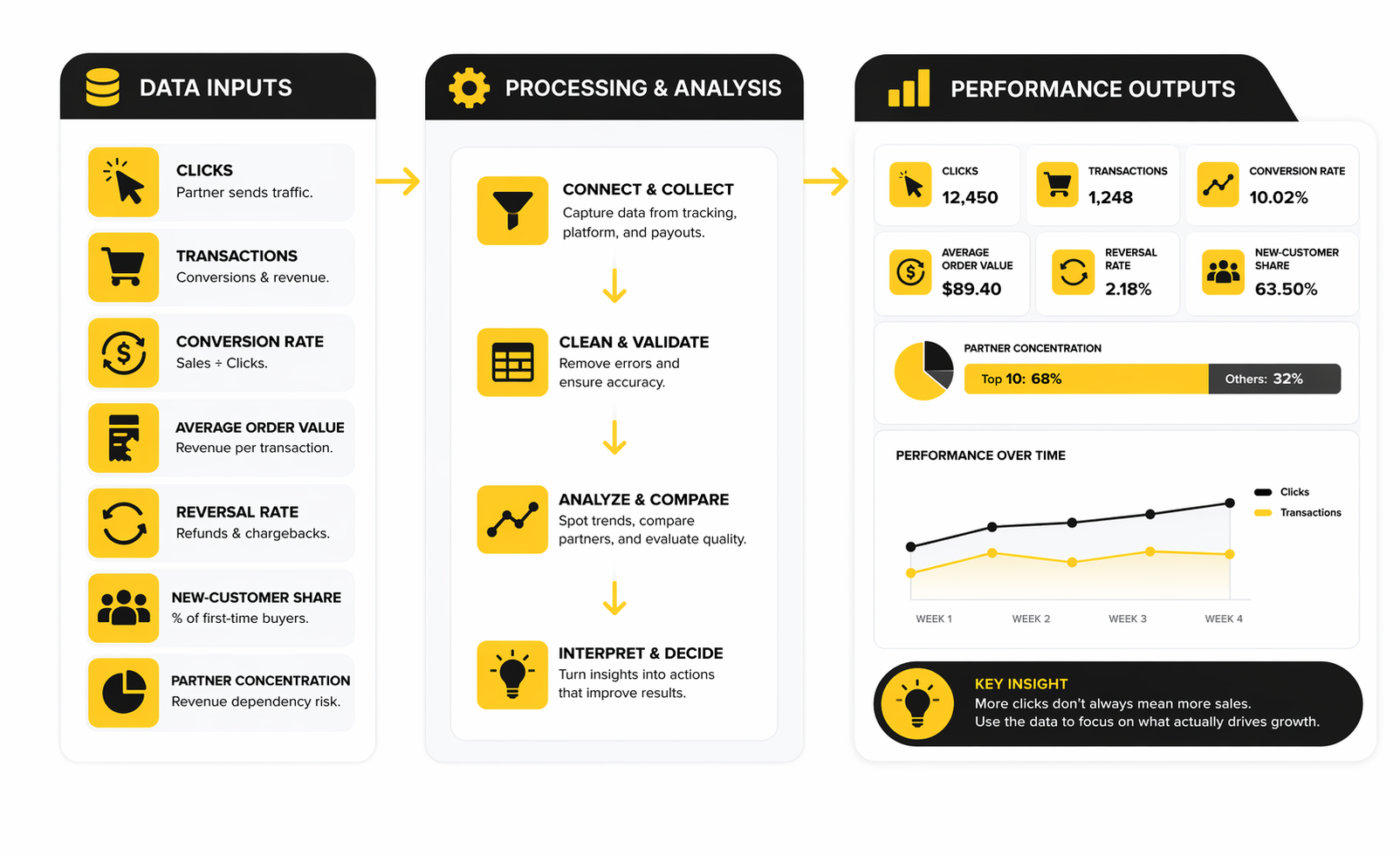
The most useful numbers in affiliate are not the flashy ones. Clicks, orders, conversion rate, average order value, partner mix, reversal rate, and new-customer share only become valuable when you read them together. On their own, they can easily push a team toward the wrong conclusion, which is one reason so many businesses think their affiliate marketing companies are underperforming when the real issue is bad interpretation.
The broad market context is still strong. Digital advertising revenue in the US reached a record $259 billion in 2024, up 15% year over year, and retail media revenue rose to $53.7 billion. That matters because affiliate marketing companies increasingly operate inside the same commerce-driven budget environment. Brands are not just comparing affiliate with old-school display anymore. They are comparing it with other measurable, commerce-connected channels that promise tighter accountability.
That shift raises the bar. Affiliate marketing companies now need to show not only that they can generate sales, but that they can explain where those sales came from, which partner types influenced them, and whether the spend created incremental value. If the reporting stops at “we drove revenue,” the analysis is incomplete.
Reading the Right Performance Signals
A good benchmark is only useful when it changes a decision. One of the clearest examples comes from impact.com’s 2025 affiliate benchmark, which found clicks up 2% year over year while transactions fell 5% and conversion rates dropped 6%. That is exactly the kind of data that can mislead a team if they only celebrate traffic growth. More clicks do not automatically mean a healthier program.
What does that pattern usually mean in practice? It often points to longer buying journeys, heavier comparison behavior, weaker landing page alignment, or a partner mix that creates curiosity without producing enough buying intent. In other words, when affiliate marketing companies show growing top-of-funnel activity but shrinking conversion efficiency, the right response is not “buy more traffic.” The right response is to audit partner quality, landing page relevance, attribution rules, and commission design.
Another useful signal is order value. During key retail periods, platform data has shown that revenue can remain resilient even when conversion rates soften because shoppers spend more when they do convert. Partnerize’s Cyber 5 performance summary for 2025 reported a 3% year-over-year revenue increase with 18% more clicks and 5% higher average order value, even while conversion rate declined 17%. That tells you something important: an affiliate program can look weaker on one metric and stronger on economics overall. The action is not to panic about conversion rate in isolation. It is to ask whether the customer value and partner mix justify the traffic you are paying for.
Why Click Growth Can Be a Trap
Clicks are seductive because they arrive fast. They make dashboards feel alive, and they are easy to present internally. But affiliate marketing companies that lean too heavily on click growth can hide major quality problems, especially when more of the activity is coming from lower-intent partner types or from shoppers doing broader price comparison before buying.
This is where interpretation matters. If clicks rise while orders and conversion efficiency fall, that usually signals friction somewhere in the path. Maybe the offer is less competitive, maybe the audience is researching more heavily, maybe the content is reaching colder users, or maybe the program is over-indexed on partners who intercept interest rather than create it. impact.com’s consumer spending analysis for 2025 makes this clear by showing that shopper journeys have become more extended and less linear.
The practical move is simple. Treat click growth as an early signal, not a success metric. If the growth is healthy, it should eventually show up in better transaction quality, stronger new-customer share, or higher lifetime value. If it does not, the clicks are probably telling you the wrong story.
Why Conversion Rate Needs Context
Conversion rate is important, but it is also one of the easiest metrics to misread. A falling conversion rate can mean deteriorating traffic quality, but it can also reflect a program expanding into higher-funnel content and creator partnerships that influence buyers earlier in the journey. That is why affiliate marketing companies that recruit more content and review partners often need more nuanced reporting than a basic last-click dashboard.
This becomes especially important when brands diversify away from loyalty and coupon-heavy models. Newer partnership mixes often create more discovery and consideration before the purchase decision is final. impact.com’s recent discussion of content and review partners points to a meaningful shift toward these partner types, which makes sense if brands want more influence higher up the funnel. But it also means conversion rate may soften before a simplistic dashboard catches the full value.
The right action here is not to excuse bad performance. It is to segment performance by partner role. Compare creators against creators, content publishers against content publishers, and loyalty partners against loyalty partners. That is how you tell whether the affiliate marketing companies in your stack are helping you broaden demand or simply making the reporting harder to read.
Benchmarks That Actually Drive Better Decisions
The most practical benchmark is not an industry average. It is your own trendline by partner type, device, offer, and customer segment. External benchmarks help you understand the market, but internal benchmarks tell you what to fix. If a content partner category keeps driving strong assisted value but weak last-click conversion, that is not a failure. It may be a sign that your attribution model is behind the way customers actually shop.
The second benchmark that matters is average order value. If affiliate marketing companies are sending fewer conversions but materially higher-value customers, that can still be a strong outcome. Partnerize’s retail sales index updates in 2025 repeatedly pointed to periods where click growth and order value offset weaker conversion behavior. That pattern matters because it changes how commissions and partner recruitment should be managed. Higher-value partner cohorts may deserve stronger incentives even if their close rate looks less impressive at first glance.
The third benchmark is partner concentration. If too much revenue comes from a small number of bottom-funnel partners, your program may be profitable but fragile. Strong affiliate marketing companies should help reduce that risk by broadening partner mix and making it easier to recruit creators, editorial publishers, and niche referral sources. The 2025 State of Affiliate Marketing research is useful here because it frames diversification as one of the core growth levers for modern programs, not just a nice extra.
Signals That a Program Is Healthy
A healthy affiliate program usually shows a few traits at the same time. Revenue is not concentrated in one narrow partner type. New partners begin contributing without immediately cannibalizing existing ones. Average order value and customer quality remain stable or improve. Reversal rates do not spike. Communication and payout reliability stay consistent enough that good partners keep promoting the brand.
That is why the best affiliate marketing companies are not judged only by raw output. They are judged by whether the system becomes more resilient over time. If your network or platform helps you recruit widely but cannot show partner contribution clearly, you may be building a noisy program rather than a scalable one.
A healthy program also tends to have a visible optimization rhythm. Teams are adjusting commissions, testing new partner categories, refining landing pages, and improving conversion paths instead of just watching dashboards passively. That is where supporting tools can become genuinely useful. Dub can help clean up link governance, GoHighLevel can centralize lead follow-up, and ManyChat can strengthen conversational conversion paths when affiliate traffic lands cold. The key is that each tool should improve a measurable bottleneck, not just add more software to the stack.
What Actions the Numbers Should Trigger
If clicks are up and orders are down, review partner mix, landing page fit, and attribution before touching commissions. If conversion rate is down but order value is rising, segment by partner type before assuming the channel is weaker. If a handful of partners dominate the program, invest in diversification before that concentration turns into dependency. If reversal rates creep up, audit traffic quality and offer clarity before recruiting more aggressively.
This is the mindset shift that separates mature operators from everyone else. They do not collect affiliate data for decoration. They use it to make commercial decisions. That is exactly what businesses should expect from serious affiliate marketing companies: not random dashboards, but reporting that helps them choose better partners, reward the right behavior, and spot channel risk early.
The final sections will build on that by getting more specific about selection criteria, common buying mistakes, and how to choose the right affiliate marketing company for the business you are actually running rather than the one a sales deck pretends you have.
FAQ
What are affiliate marketing companies, exactly?
Affiliate marketing companies are the businesses that help brands manage performance-based partnerships with publishers, creators, referral partners, and other traffic sources. Some operate as networks with built-in marketplaces, some are broader partnership platforms, and some are agencies or specialist service providers that run execution on top of the tech. The important thing is not the label. It is whether they can recruit the right partners, track outcomes cleanly, manage payouts, and protect the brand while the program scales.
Are affiliate marketing companies the same as affiliate networks?
Not always, and that distinction matters. Networks are one major category inside the broader world of affiliate marketing companies, but many modern vendors now position themselves as partnership platforms because they manage creators, referrals, mobile partnerships, and B2B relationships alongside traditional affiliate activity. That shift is visible in how companies like impact.com and Awin describe the market today.
How do affiliate marketing companies make money?
Most affiliate marketing companies make money through platform fees, network fees, managed-service retainers, transaction-based pricing, or some combination of those models. That means the cheapest-looking option on paper is not always the least expensive in practice, especially if weak tracking or poor partner quality ends up costing more later. The right question is not just what the invoice says. It is whether the economics hold up once commissions, management time, and conversion quality are factored in.
What is the difference between a platform and an agency?
A platform gives you the infrastructure to run the program, while an agency usually helps with strategy, recruitment, optimization, and day-to-day management. Some businesses only need the software because they already have internal marketing and partner teams. Others need agency support because a great dashboard is useless if no one is actively recruiting partners, reviewing compliance, and optimizing offers week after week.
Are affiliate marketing companies still mostly about coupon sites?
That is one of the oldest bad assumptions in the category. Coupon and loyalty partners still matter, but recent market data shows brands putting more attention on content, review, and creator relationships as the channel evolves beyond a last-click-only mindset. impact.com’s 2025 benchmark work and its recent analysis of content and review partnerships both reflect that change clearly.
How long does it usually take to see results?
It depends on the business model, the offer, the partner mix, and how ready the conversion path is before recruitment starts. A program that launches with clear economics, working tracking, good landing pages, and strong partner outreach can create early movement quickly, but sustainable results usually come from months of refinement rather than a few lucky first wins. That is why the best affiliate marketing companies feel operational, not magical. They create systems that improve over time instead of promising instant scale.
What metrics matter most when evaluating performance?
The most useful metrics are the ones that explain each other. Clicks, transactions, conversion rate, average order value, reversal rate, new-customer share, and partner concentration all matter, but they matter more as a connected system than as isolated numbers. impact.com’s 2025 affiliate benchmark is a good example because it showed clicks rising while transactions and conversion rates weakened, which is exactly the kind of pattern that forces better decision-making instead of lazy reporting.
Why can an affiliate program show more clicks but fewer sales?
Because attention and intent are not the same thing. Shoppers are often researching more broadly, clicking across more partners, and delaying purchase decisions until confidence and value line up, which can increase activity without improving close rates. impact.com’s consumer spending analysis and IAB’s broader commerce media reporting both point to a market where measurement needs to account for more complex buying behavior.
Do smaller businesses actually need affiliate marketing companies?
Not every small business needs a complex platform from day one, but many do need some kind of structure once partnerships start generating real revenue. Even a lean program needs tracking discipline, partner rules, payout clarity, and compliance standards if it is going to stay profitable. The question is not whether a small business deserves infrastructure. It is how much infrastructure it needs right now without overbuilding too early.
How important is compliance in affiliate marketing today?
It is central, not optional. Affiliate relationships involve endorsements, recommendations, testimonials, and promotional claims, which means disclosure quality and review integrity matter a lot more than they did when many programs were treated as simple referral engines. The FTC’s endorsements guidance and the agency’s Consumer Reviews and Testimonials Rule Q&A make it clear that deceptive review and endorsement practices can create real enforcement risk.
What is a realistic sign that an affiliate program is healthy?
A healthy program does not rely on one narrow partner type, one traffic trick, or one superstar affiliate to hold everything together. It shows improving partner diversity, stable or improving customer quality, controlled reversal rates, and enough reporting clarity that the team can tell who is creating value instead of just catching the last click. That is why strong affiliate marketing companies are judged on resilience as much as revenue. A profitable but fragile program can break faster than most teams expect.
Should businesses prioritize incrementality or last-click attribution?
Incrementality is the more useful long-term lens, even if last-click reporting remains part of the operational reality. If a company only rewards whoever touches the buyer last, it can overpay low-value interceptors and underinvest in the partners who actually educate or persuade the customer earlier in the journey. That is one reason the market is moving toward richer partner segmentation and broader partnership frameworks rather than treating every affiliate touchpoint as if it plays the same role.
Can creators and influencers belong inside affiliate programs?
Yes, and increasingly they do. Many affiliate marketing companies now support creator partnerships as part of the same broader performance ecosystem, especially when brands want to connect awareness with measurable outcomes instead of running creators as a totally separate channel. impact.com’s creator strategy content shows how quickly this overlap is becoming standard rather than experimental.
What tools can strengthen an affiliate program after the click?
The answer depends on the bottleneck. A business that needs better partner communications might use Brevo or Moosend, a team that needs stronger post-click funnel control might use GoHighLevel or ClickFunnels, and an ecommerce brand that needs sharper landing pages might prefer Replo. Those tools are not substitutes for the core affiliate company, but they can improve the economics of the traffic and partnerships you are already paying for.
What is the biggest mistake companies make when choosing an affiliate partner?
They buy for the sales demo instead of the operating reality. A company can look polished, feature-rich, and “enterprise-ready” while still being the wrong fit for your team size, partner model, economics, or compliance requirements. The smartest buyers keep coming back to the same questions: can we actually run this well, can we measure it credibly, and will this help us recruit the kinds of partners that fit how our business grows?
Work With Professionals
Explore 10K+ Remote Marketing Contracts on MarkeWork.com
Most marketers spend too much time chasing clients, competing on crowded platforms, and losing a percentage of every project to middlemen. MarkeWork gives you a better way. Browse thousands of remote marketing contracts and connect directly with companies desperate to hire skilled marketers like you, without platform commissions and without unnecessary gatekeepers.
If you're serious about finding better opportunities and keeping 100% of what you earn, explore available contracts and create a profile for free at MarkeWork.com.