

TikTok affiliate marketing stopped being a side hustle tactic the moment commerce moved inside the feed. What used to be a loose mix of creator links, discount codes, and hope is now tied to product discovery, in-app checkout, creator marketplaces, and increasingly detailed seller analytics. That shift matters because the platform is no longer just good at attention; it is built to shorten the distance between seeing a product and buying it.
The timing matters too. TikTok’s global ad audience reached at least 1.59 billion users in January 2025, and 51.5% of active adult users say they use TikTok to research brands and products. In the US, affiliate marketing itself is getting bigger rather than smaller, with advertisers expected to spend $12.42 billion on affiliate programs in 2025, while social commerce keeps climbing and TikTok Shop is projected to account for nearly one-fifth of US social commerce sales in 2025.
That is why TikTok affiliate marketing deserves a more serious framework than most guides give it. The winners are not simply posting product clips and waiting for commissions. They are matching product fit, creator fit, content format, conversion path, and compliance so the channel can scale without turning into chaos.
Article Outline
- Why TikTok Affiliate Marketing Matters Now
- How the TikTok Affiliate Model Actually Works
- The Core Components of a Profitable TikTok Affiliate System
- Choosing Products, Creators, and Offers That Can Sustain Margin
- Professional Implementation: Content, Tracking, and Operational Systems
- Scaling, Compliance, and the Mistakes That Kill Momentum
Why TikTok Affiliate Marketing Matters Now
TikTok sits at the intersection of entertainment, search behavior, and impulse buying, which is exactly why affiliate offers can move faster there than on slower intent channels. People do not always arrive on TikTok wanting to shop, but the platform is unusually good at turning curiosity into demand through demos, reactions, comparisons, routines, and before-and-after proof. When a product is easy to understand visually and easy to buy immediately, the affiliate model becomes much more powerful.
The infrastructure around that behavior is also maturing. TikTok has expanded commerce tooling through TikTok Shop’s ecommerce products, the general release of TikTok Shop Affiliate APIs, and a more formal seller workflow for open and targeted affiliate collaborations. That combination changes TikTok affiliate marketing from “creator posts a link” into a system brands can actively manage.
The commercial upside is getting harder to ignore. TikTok said its 2024 Black Friday and Cyber Monday period was its biggest holiday shopping moment to date, with creators, LIVE shopping, and deals driving discovery across major retail categories in its holiday recap. Independent coverage has also shown how quickly the channel is moving, with reporting on TikTok Shop’s rise in beauty and broader retail reinforcing that this is no longer an experimental sales surface but a meaningful commerce engine for brands willing to adapt.
How the TikTok Affiliate Model Actually Works
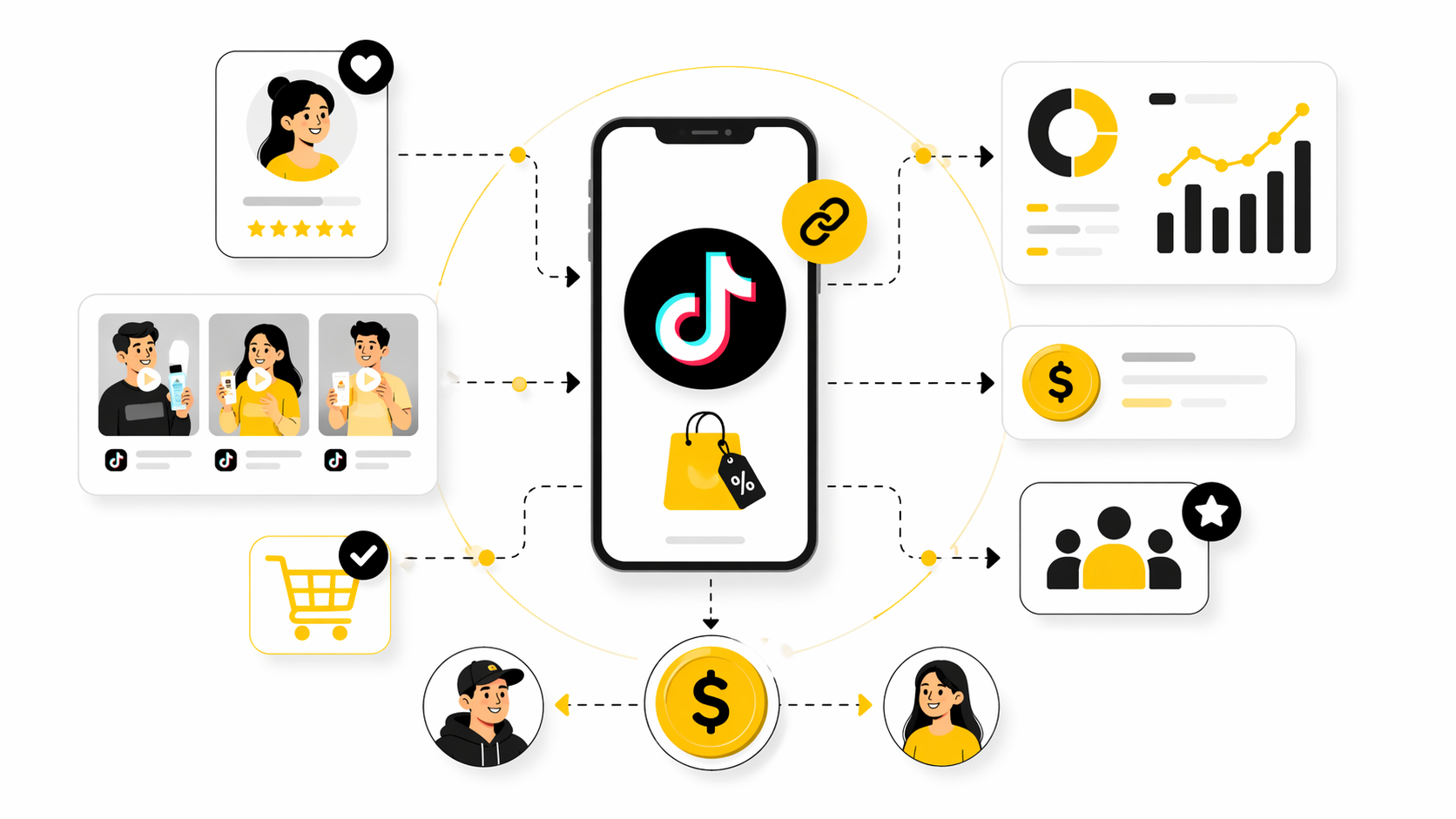
At its simplest, TikTok affiliate marketing means a creator or publisher promotes a product and earns a commission when that promotion produces a sale. On TikTok, that can happen through in-app product tagging, creator showcases, LIVE sessions, or externally shared affiliate links, depending on the market setup and the tools being used. The important point is that TikTok compresses discovery, persuasion, and transaction into a much tighter loop than traditional affiliate channels.
For sellers inside TikTok Shop, the platform has made that loop increasingly measurable. TikTok’s own seller education materials show that merchants can review affiliate performance through metrics such as GMV, orders, commissions, video views, engagement, and collaboration type in the Affiliate Partnerships overview and Affiliate Center analytics guide. In practice, that means the channel can be optimized like a real acquisition system instead of treated like vague influencer awareness.
There is also a major structural difference between TikTok affiliate marketing and old-school blog affiliate marketing. On a search-based affiliate site, the user usually arrives with intent and compares options. On TikTok, the creator and the content create the intent first, which means product-market-content fit matters more than raw link placement. If the creative does not earn attention in-feed, the rest of the funnel never gets a chance.
The Six-Part Framework This Article Will Use
The rest of this article follows a practical structure designed for operators, creators, and brands who want to understand where the leverage really is. It starts with why the channel matters and how it works, then moves into the mechanics of choosing offers, building systems, and scaling without destroying trust or margin. That order matters because most failures in TikTok affiliate marketing happen when people jump straight to tactics before understanding the model.
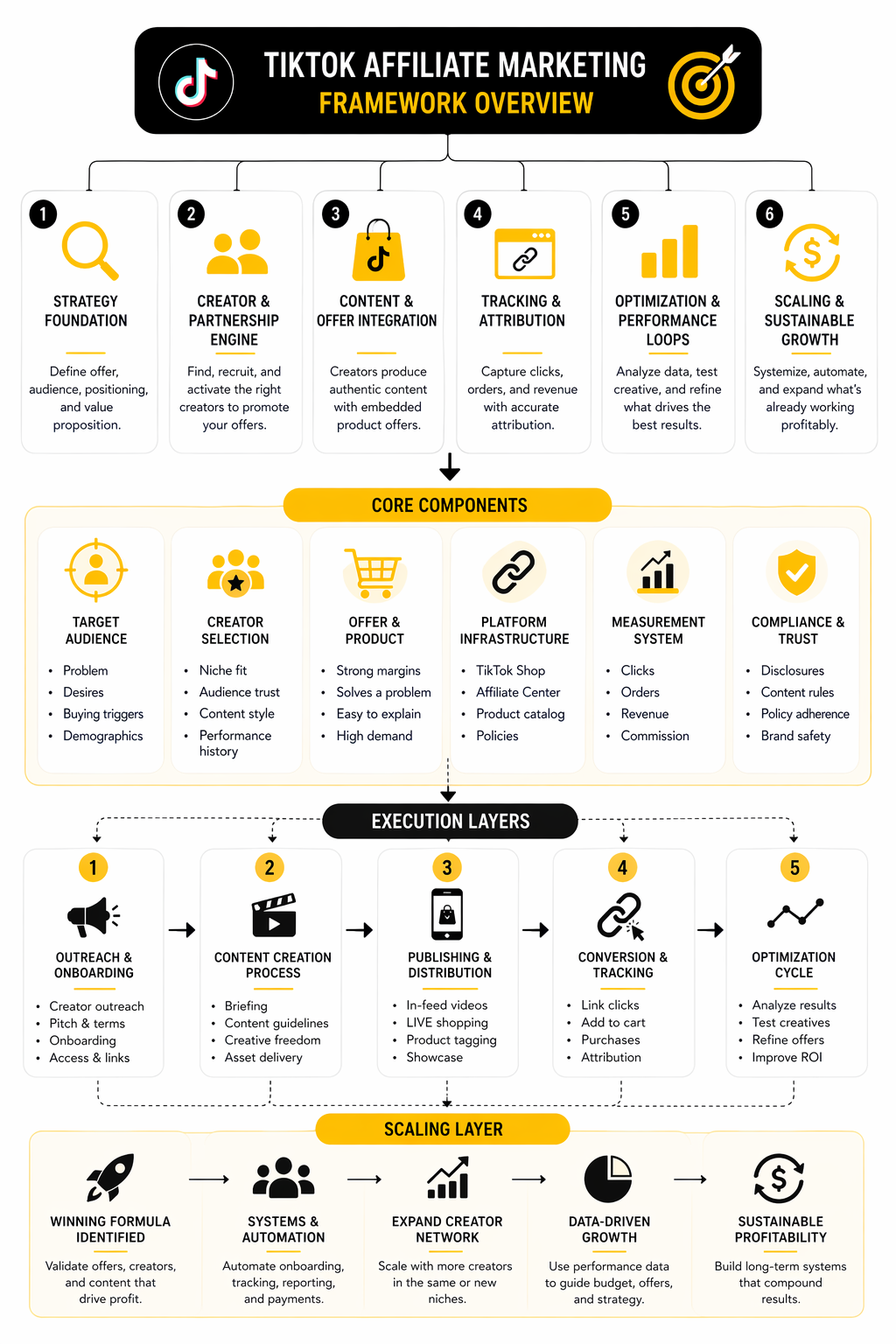
The framework is built around six connected ideas. First comes market reality. Then comes mechanism. After that, the article moves into the parts you can actually control: offer selection, creator selection, content production, measurement, and operational discipline. By the end, the goal is not just to explain TikTok affiliate marketing, but to show what separates a few lucky conversions from a repeatable revenue channel.
What Comes Next
The next part will break down the core components of a profitable TikTok affiliate system so you can see exactly where value is created and where it leaks. That includes the relationship between product economics, creator incentives, content formats, attribution, and follow-up systems. If you get those pieces right, TikTok affiliate marketing becomes much easier to scale with intention instead of guesswork.
The Core Components of a Profitable TikTok Affiliate System
A profitable TikTok affiliate marketing setup is not one tactic. It is a system made of moving parts that have to reinforce each other instead of fighting each other. When people say TikTok affiliate marketing “works” or “doesn’t work,” they are usually describing whether those parts were aligned, not whether the channel itself had potential.
That distinction matters because TikTok has already built the commerce layer, the creator layer, and the ad layer into the same environment. Sellers can run in-app storefronts, recruit affiliates, measure collaboration performance, and now plug into a broader affiliate tooling ecosystem through TikTok Shop’s developer expansion and Shop-focused ad products. That makes execution more powerful, but it also exposes weak offers and weak operations much faster.
Product Economics Come First
The first component is brutally simple: the numbers have to work before the content ever goes live. If your product cannot support commission, discounting, returns, creator sampling, and paid amplification where needed, then TikTok affiliate marketing turns into a vanity channel that looks busy but quietly destroys margin. A lot of operators miss this because TikTok makes demand look easy, but easy top-line revenue and healthy contribution margin are not the same thing.
TikTok’s own seller education makes clear that merchants can set commission structures and manage affiliate collaborations at the product level, which means the economics are not an afterthought baked in somewhere else. They are part of the operating model from the beginning. The practical implication is that the best TikTok affiliate programs usually start with products that already have room for creators to win, the seller to win, and the customer to still feel they got real value.
This is where smart brands get more selective. They do not ask, “Can this product go viral?” first. They ask whether the offer can survive a real-world mix of commissions, platform fees, promotional incentives, and creative testing. If the answer is no, scale only makes the problem more expensive.
Creator and Audience Fit Is the Real Multiplier
The second component is creator fit, and this is where most lazy TikTok affiliate marketing advice falls apart. A creator is not valuable just because they have reach. They become valuable when their audience already trusts the way they explain, demonstrate, compare, or react to products in a category that matches the offer.
TikTok’s own developer launch notes highlighted exactly this point when creators described how hard it can be to sift through irrelevant offers and how important it is to find products that match their audience demographics and niche. That is not a side comment. It is one of the clearest signals about how the channel actually behaves in practice. Creators do not want endless outreach; they want relevant products that make sense for the people already watching them.
This is why smaller creators often outperform bigger ones in TikTok affiliate marketing. A niche creator with the right audience, the right format, and believable product context can move more profitable sales than a larger creator forcing a bad fit. Trust transfers through relevance, not just visibility, and TikTok’s commerce research keeps leaning in that direction by emphasizing discovery, authenticity, and creator-led shopping behavior.
Content Has to Sell Without Feeling Like an Ad
The third component is content architecture. On TikTok, the affiliate link or product tag matters, but the creative decision happening before that matters more. If the hook is weak, if the proof is vague, or if the product is shown without enough context, the conversion path collapses long before the viewer reaches checkout.
TikTok’s commerce materials repeatedly frame the platform as an entertainment-led shopping environment rather than a static storefront. Its ecommerce product pages describe a frictionless in-app purchase path, and its GMV Max positioning explicitly says affiliate, organic, and paid content can all be turned into incremental sales. That only works when the content itself already carries persuasive weight.
In practical terms, the strongest TikTok affiliate marketing content usually does one of four jobs well. It demonstrates a transformation, removes skepticism, shortens the learning curve, or helps the viewer imagine the product inside a real routine. That is why “just posting product clips” usually underperforms while strong creator-native formats keep winning.
Tracking, Attribution, and Feedback Loops Separate Operators From Amateurs
The fourth component is measurement. Without clean feedback loops, brands tend to reward the loudest creators, the prettiest videos, or the most recent sales spike instead of the partnerships that actually produce durable profit. TikTok’s affiliate infrastructure gives sellers a more direct view into orders, GMV, commissions, video performance, and collaboration types, which means there is no excuse for running the channel on vibes alone.
This is also where the broader stack starts to matter. If you want to track links outside the platform cleanly, a tool like Dub helps when you need tighter attribution and cleaner routing across creator assets. If you want to capture demand that starts in comments or direct messages, a follow-up layer like ManyChat can turn attention into a more structured conversion path instead of leaving warm intent sitting in the inbox.
The deeper point is that TikTok affiliate marketing becomes more predictable when every sale teaches you something. You want to know which creators convert by category, which hooks pull first-time buyers, which videos create repeatable lift, and where the drop-off happens. Once that loop is working, optimization stops being guesswork and starts looking like operating discipline.
Retention Matters More Than Most Affiliate Setups Admit
The fifth component is what happens after the first sale. Too many affiliate programs treat conversion as the finish line, which is one reason they stay fragile. In reality, the first TikTok-driven order is often just the acquisition event, and the real economics improve when the customer enters an owned retention system after purchase.
That is especially important on a platform where discovery can happen fast and unpredictably. A brand that captures customer data, segments buyers, and follows up intelligently can afford to be more aggressive with commissions because it is not depending on a single transaction to carry the whole channel. This is where tools for CRM, funnels, and follow-up can start to make sense, whether that means building stronger lifecycle flows in GoHighLevel or creating simpler post-click journeys in Systeme.io.
This is the part many people skip because it feels less exciting than creators and videos. But it is the difference between a flashy affiliate program and a commercially serious one. If TikTok affiliate marketing keeps feeding customers into a weak backend, the ceiling arrives much sooner than people expect.
Why These Components Have to Work Together
Each component makes the others stronger or weaker. A good creator cannot rescue a bad margin structure forever. A strong product cannot overcome poor audience fit. Great content without tracking creates confusion, and strong acquisition without retention creates unstable economics.
That is why the best TikTok affiliate marketing systems are built like operating models, not campaigns. Product economics decide whether the offer deserves scale. Creator fit determines whether trust can transfer. Content creates the initial conversion event. Tracking tells you what is real. Retention turns a promising channel into a durable one.
The next part moves into a harder question: how to choose products, creators, and offers that can actually sustain margin instead of just generating noise. That is where a lot of brands either build a channel with staying power or walk straight into unprofitable growth.
Professional Implementation: Content, Tracking, and Operational Systems
Once product economics and creator fit are clear, TikTok affiliate marketing becomes an execution problem. This is the stage where a promising offer either turns into a disciplined revenue channel or gets buried under weak creative, messy communication, and bad tracking. The good news is that TikTok has built more of this workflow directly into Seller Center, affiliate collaboration tools, analytics, and Shop ad products, so the path is clearer than it was even a year ago.
The mistake is thinking implementation starts with posting videos. It starts earlier, with system design. You need a repeatable way to recruit creators, approve products, package creative direction, monitor performance, and decide what gets scaled, paused, or rebuilt.
Start With an Operator-Friendly Workflow
A lot of TikTok affiliate marketing programs fail because the team builds around one person’s hustle instead of a workflow anyone can run. That is manageable when you are testing with a handful of creators, but it breaks the moment outreach, product seeding, approvals, commission updates, and content reviews start happening at the same time. A real implementation process needs clear stages and clear ownership.
TikTok’s seller documentation already reflects that reality. Sellers can manage open collaboration, targeted collaboration, creator communication, affiliate analysis, and shop analytics from the same operating environment, which is a strong hint that the channel works best when you treat it like a system rather than a creative free-for-all.
That usually means building one source of truth for product priorities, one review standard for creator content, and one rhythm for reporting. If those basics are loose, every future optimization becomes slower and more political than it needs to be.
The Practical Rollout Process
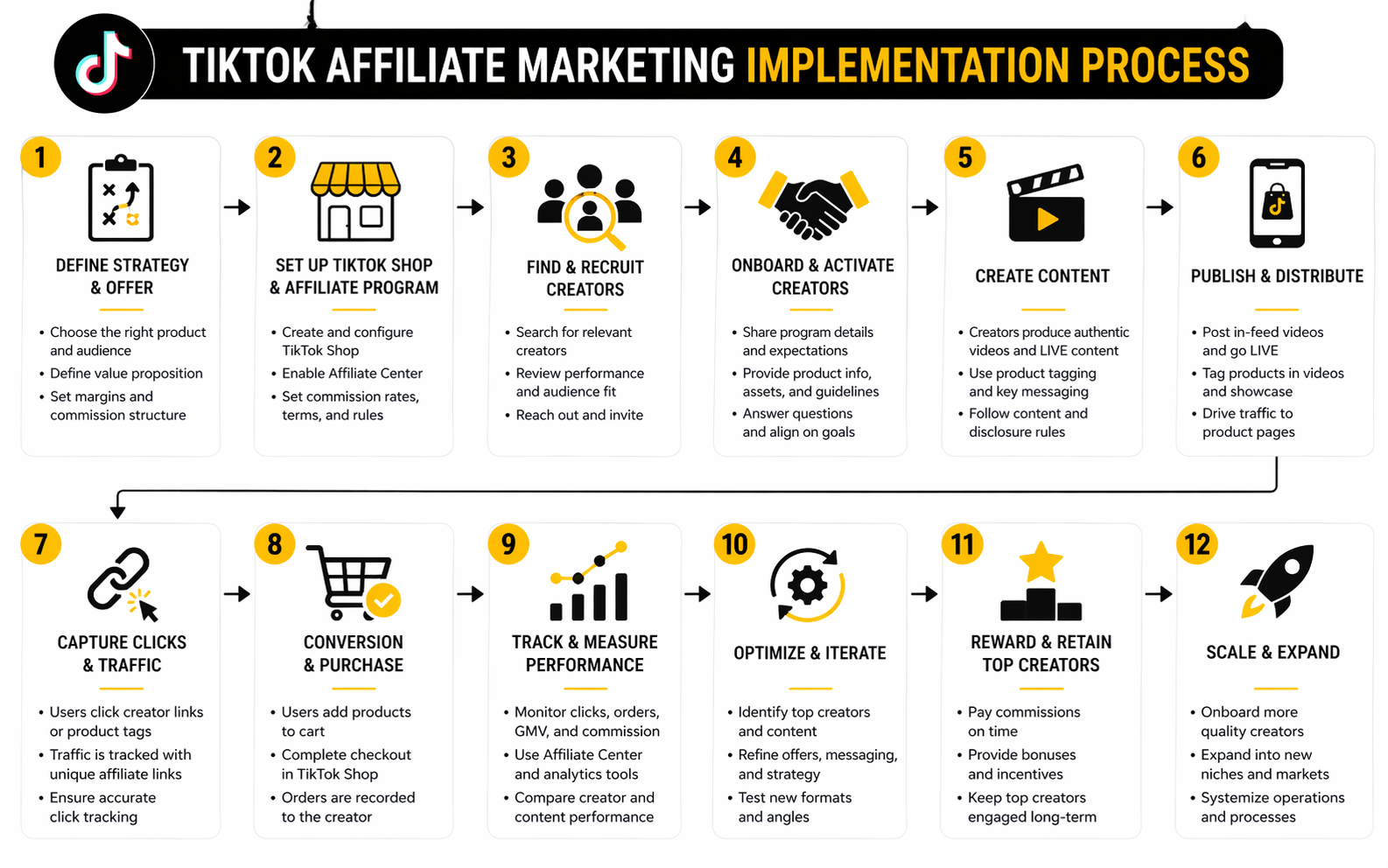
The simplest way to implement TikTok affiliate marketing well is to break the launch into controlled phases. That keeps the team focused on signal instead of noise and makes it easier to tell whether a problem came from the product, the creator, the content, or the offer structure. It also gives you a sequence you can repeat as new products or creators enter the program.
- Define the products you actually want affiliates to push.
- Choose whether those products belong in open collaboration, targeted collaboration, or both.
- Set commission logic that reflects margin, demand, and inventory reality.
- Recruit or invite creators whose audience and format match the product.
- Give creators a clear brief without scripting the content into something lifeless.
- Review early content for accuracy, policy fit, and proof strength.
- Track which creators, products, and hooks produce real sales, not just engagement.
- Move winning content into broader amplification where it makes economic sense.
TikTok’s own affiliate workflow supports that kind of staged rollout. Sellers can publish open or targeted plans, manage creator relationships, analyze collaboration performance, and increasingly connect affiliate content with Shop ad automation through GMV Max. That is useful because implementation gets much easier when your organic, affiliate, and paid loops are not living in separate worlds.
Build Creator Briefs That Create Better Content, Not More Friction
Most creator briefs are either too vague or too controlling. When they are too vague, creators miss the real buying trigger and produce content that looks pleasant but sells very little. When they are too controlling, the content stops feeling native to TikTok, which is a fast way to kill watch time and trust.
A better brief gives creators usable direction while preserving their delivery style. That usually means clarifying the product angle, the target customer, the proof points that matter, the claims they must avoid, and the action you want the viewer to take. TikTok’s Shop policies and promotional content rules make this especially important because creators cannot safely improvise around misleading claims, unsupported comparisons, or inconsistent product representation.
This is where implementation gets more professional very quickly. Instead of telling creators to “make it authentic,” you define the creative territory. Show the use case, demonstrate the result honestly, surface the objection early, and make the purchase path obvious. That is still creator-native, but it is no longer random.
Use Policy as a Performance Tool, Not Just a Legal Checkbox
Compliance is usually treated as the boring part of TikTok affiliate marketing, but that is a mistake. Policy discipline is one of the reasons strong programs keep scaling while sloppy ones burn trust, get content limited, or end up wasting time on revisions that should never have been necessary. What looks like a legal detail is often an execution detail.
TikTok requires disclosure when content promotes a brand, product, or service, and its seller-side content policies restrict misleading, inconsistent, or unsafe promotional behavior. In practice, that means good operators bake disclosure, claim review, and product accuracy into the workflow before content goes live rather than treating them as cleanup work after the fact.
The upside is bigger than compliance alone. Content that is clearer, more accurate, and more transparent usually converts better over time because it attracts the right buyer. That reduces refund pain, cuts audience skepticism, and protects the credibility of both the seller and the creator.
Create a Tracking Layer Outside the Platform Too
TikTok’s native analytics are far better than most people realize, but serious operators usually need one more layer. Native reporting can tell you a lot about creators, products, content, and sales behavior inside the Shop environment. What it does not always do on its own is unify every off-platform touchpoint, every follow-up path, and every supporting content asset the brand is using around the campaign.
That is why external tracking and routing tools become valuable once the program starts expanding. A link infrastructure tool like Dub helps keep attribution cleaner across creator assets, support pages, and campaign experiments. If your process relies on comment triggers, keyword replies, or DM-driven follow-up, ManyChat can help turn messy inbound attention into something you can actually measure and improve.
The point is not to bolt on software for the sake of it. The point is to close visibility gaps. TikTok affiliate marketing gets much easier to scale when you know not just who posted, but what path the buyer actually followed and where intent was either strengthened or lost.
Turn Winning Affiliate Content Into a Broader Growth Engine
One of the most important implementation shifts on TikTok is that affiliate content no longer has to stay trapped in its original post format. TikTok’s GMV Max setup and related Shop ad infrastructure increasingly treat organic, affiliate, and paid commerce signals as part of one performance environment. That matters because strong creator content can now do more than earn direct affiliate sales. It can become reusable sales media.
This is where many brands leave money on the table. They identify a creator video that clearly resonates, then fail to operationalize it. A better implementation process reviews authorized affiliate content regularly, identifies which assets are proving product-market-message fit, and then moves those assets into broader campaign testing where the economics still hold.
That does not mean throwing budget behind every decent video. It means promoting the assets that already showed they can persuade the right customer. Done properly, TikTok affiliate marketing stops being an isolated partner channel and starts feeding the rest of your growth engine.
The Tech Stack Should Support the Workflow, Not Lead It
There is always a temptation to overbuild the stack too early. In most cases, you do not need a huge software layer to start. You need the minimum systems that let you route traffic, capture interest, organize leads or customers, and keep the execution process visible to the team.
For brands that need stronger post-click experiences, Replo can help tighten the landing-page side when the journey extends beyond the app. For teams that want a more connected CRM and follow-up engine, GoHighLevel is one of the clearer options for keeping affiliate-driven demand from disappearing after first contact. The key is that tools should reinforce the operating model you already chose, not distract you from building one.
That principle is worth emphasizing because software cannot rescue a weak implementation process. If outreach is sloppy, briefs are unclear, approvals are slow, and reporting is inconsistent, adding more tools usually just hides the problem under a prettier dashboard.
What Good Execution Looks Like in Practice
Good implementation in TikTok affiliate marketing has a specific feel to it. Products are clearly prioritized. Creators know what angle they are selling. Content is reviewed fast enough to keep momentum. Performance is visible at the creator, product, and asset level. Winning content gets reused intelligently. Weak content gets cut without drama.
That sounds simple, but it is exactly where most programs lose the plot. They spend too much time chasing more creators and not enough time building a process that helps the right creators produce better work. The result is activity without learning, and eventually fatigue without scale.
The next part moves into scaling and control. Once the execution layer is working, the question becomes how to grow TikTok affiliate marketing without letting compliance risk, channel volatility, weak creator quality, or sloppy economics undo the progress you just built.
The Numbers That Actually Matter
By the time a TikTok affiliate marketing program is live, the biggest risk is not lack of data. It is drowning in the wrong data. TikTok gives sellers a growing list of metrics across affiliate partnerships, creator content, Shop analytics, and ad automation, but numbers only become useful when they change a decision.
That is why this part is not a stat dump. The goal is to separate market context from operating metrics, then show what each number should push you to do. A big platform number can tell you the channel deserves attention, but it cannot tell you whether your creators, your products, or your workflow are actually working.
Start With the Market-Level Numbers
The broadest numbers matter because they explain why TikTok affiliate marketing deserves budget, attention, and process in the first place. TikTok’s ad reach climbed to 1.59 billion users in early 2025, which tells you the platform is already operating at global scale. More importantly for commerce, 51.5% of active adult users say they use TikTok to research brands and products, which means shopping intent is not limited to people who opened the app planning to buy.
That should change how you interpret the channel. TikTok affiliate marketing is not just a bottom-funnel conversion tactic. It is also a discovery engine, which means some of the most valuable creator content will look like research support, objection removal, or product education before it looks like a direct hard sell.
US commerce forecasts reinforce the same point from another angle. TikTok Shop represented nearly 20% of US social commerce in 2025, and more than half of US social buyers are expected to shop on TikTok in 2026. The action these numbers should drive is simple: stop treating TikTok affiliate marketing like a fringe experiment and start judging it like a serious acquisition channel.
Separate Vanity Signals From Buying Signals
One reason teams misread performance is that TikTok is very good at making engagement look like success. Views, likes, comments, and shares absolutely matter because they tell you whether the content earned attention inside the feed. But for TikTok affiliate marketing, those are leading indicators, not final proof.
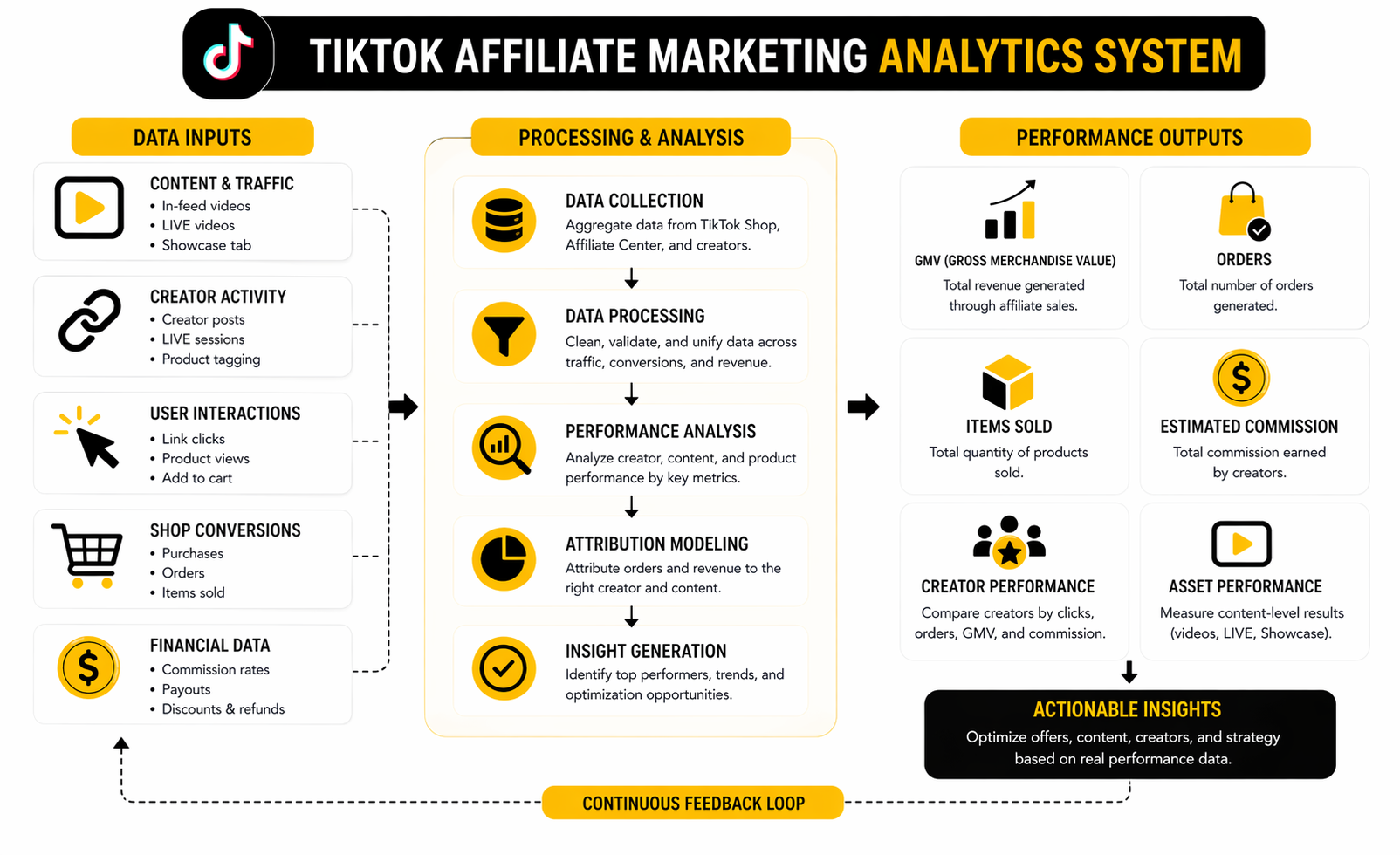
TikTok’s own affiliate and creator analytics put much heavier commercial emphasis on metrics like GMV, items sold, estimated commission, orders, and creator-level contribution because those are the numbers tied to actual revenue behavior. Seller analytics pages also allow deeper breakdowns by video, LIVE, creator, and product, which is exactly how measurement should work when different content formats behave differently. (seller-my.tiktok.com)
The practical rule is this: treat engagement as a diagnosis tool, not a scoreboard. High views with weak orders usually mean the hook worked but the offer, the audience fit, or the buying trigger did not. Strong orders from moderate views usually mean the content reached the right people even if it never looked “viral.”
Build an Analytics Stack Around Four Layers
The cleanest way to read TikTok affiliate marketing data is to group metrics into four layers. That helps you avoid mixing awareness signals with conversion signals and makes it easier to find where performance is actually breaking.
- Reach and attention: views, watch behavior, click behavior, engagement
- Commerce output: GMV, orders, items sold, conversion events, commissions
- Efficiency: ROI, margin after commission, cost to acquire a customer when paid amplification is involved
- Durability: repeat purchases, refund patterns, creator consistency, content reuse potential
This structure matters because a creator can look strong on layer one and weak on layer two. A product can look healthy on gross sales and weak on efficiency. A campaign can look profitable short term and still have fragile economics if repeat purchase never materializes. Measurement gets smarter the moment you stop asking whether performance is “good” in general and start asking which layer is healthy and which one is not.
GMV Is Important, but It Can Mislead You
GMV is one of the most visible metrics in TikTok Shop, and for good reason. It gives a fast view of how much sales value creator content, product content, or campaigns are generating. TikTok’s affiliate dashboards, creator shop analytics, and Shop ad systems all lean heavily on GMV because it is a practical first indicator of commerce momentum. (seller-us.tiktok.com)
The problem is that GMV can flatter bad operators. A campaign can produce healthy top-line volume while hiding weak margins, aggressive discounting, expensive commission rates, or poor retention. That is why GMV should open the conversation, not end it.
The right move is to pair GMV with contribution thinking. If GMV is climbing but estimated commissions are taking too much of the sale, or if discounts are doing all the work, your TikTok affiliate marketing program may be scaling activity rather than profit. The corrective action is usually to revisit product mix, creator mix, or offer design before scaling further.
Estimated Commission Tells You More Than Most Teams Realize
Estimated commission is not just a payout number. It is a clue about how much incentive you needed to create the result you got. TikTok includes estimated commission in affiliate analytics because seller performance cannot be judged honestly without it. (seller-my.tiktok.com)
This is where interpretation matters. A creator driving modest GMV with a much healthier commission profile may be more valuable than a creator pushing larger volume through an expensive commission rate that crushes margin. Likewise, a product that only moves when commission is unusually high may not belong at the center of your TikTok affiliate marketing program.
The action this metric should drive is better incentive design. Do not blindly reward whoever generated the biggest raw number. Reward the creators and products that create sustainable economic outcomes.
Orders and Items Sold Tell You Whether Demand Is Broad or Narrow
Orders and items sold sound obvious, but they help answer two different questions. Orders show how often people are converting. Items sold can reveal whether buyers are stacking multiple units, whether bundles are working, or whether certain creators are especially good at pushing higher cart depth.
That distinction becomes useful quickly. If a creator is generating strong orders but low items per order, the content may be convincing first-time buyers without expanding basket size. If items sold climb faster than orders, you may have found a bundle angle, a replenishable product, or a more purchase-ready audience than expected.
This is one reason TikTok affiliate marketing should be analyzed by creator and by product together, not in separate silos. The same creator can perform very differently depending on which product they are asked to sell, and the same product can behave very differently depending on whether the content is educational, demonstrative, or LIVE-led.
View Metrics Still Matter, but Only in Context
View count, watch behavior, and engagement metrics remain important because TikTok is still a feed-driven platform before it becomes a checkout environment. If content cannot hold attention, very little else will matter. TikTok’s creator campaign reporting and measurement tools continue to highlight reach, views, engagement rate, and related performance signals for that reason. (ads.tiktok.com)
But view metrics need context. A high-view video with weak GMV might still be useful if it is expanding product awareness or feeding later conversion through retargeting, creator trust building, or repeated exposure. A lower-view video with strong commerce output may be your better template for direct-response creator briefs.
So the decision is not “views versus sales.” It is whether the content is doing the job you assigned to it. In TikTok affiliate marketing, some assets are built to open the door, and others are built to close the sale. The mistake is expecting every video to do both equally well.
Use Total Channel ROI, Not Just Post-Level Wins
As TikTok pushes harder into GMV Max and related Shop automation, it is also pushing a more useful idea of performance: total channel ROI. Its current GMV Max documentation is explicit that the system is designed to optimize for total channel ROI and incremental GMV by using available creative assets across organic and paid delivery. (ads.tiktok.com)
That matters because a strong TikTok affiliate marketing program often creates value in more than one place at once. A creator video might generate direct affiliate sales, inspire later organic conversions, and become a paid asset if the economics justify broader distribution. If you only look at the original post in isolation, you can undervalue the content that is actually doing the most commercial work.
The action here is to stop evaluating creator output as if it lives in a vacuum. Measure the asset, the creator, and the broader channel effect together whenever your systems allow it. That is how you spot content worth amplifying rather than just content worth admiring.
Benchmarks Should Be Relative, Not Blindly Imported
One of the fastest ways to break TikTok affiliate marketing analysis is to import generic benchmarks from another category, another market, or another content type. Beauty, supplements, home goods, apparel, digital products, and software-adjacent offers all behave differently. Video-led product demos do not behave like LIVE sessions, and open-affiliate creator performance does not always look like tightly managed targeted partnerships.
That is why the best benchmark is usually your own rolling baseline. Compare creators against other creators selling similar products. Compare products within similar price bands and margin structures. Compare videos by creative format, not just by raw output. The point of benchmarks is not to create a false sense of certainty. It is to help you notice when something is meaningfully stronger or weaker than it should be.
A useful benchmarking habit is to keep asking four questions. Which creators produce efficient sales? Which products convert without extreme incentives? Which hooks repeatedly generate buying behavior? Which content stays useful long enough to deserve reuse? Those questions lead to better action than memorizing a single universal threshold ever will.
Measurement Should Change What You Do Next
If your data does not change the next move, it is reporting theater. The best TikTok affiliate marketing teams use analytics to decide who gets invited again, which products stay in rotation, where commission needs adjustment, which videos deserve paid support, and which creator briefs need to be rewritten. Numbers are useful because they force better operational choices, not because they make dashboards look sophisticated.
This is where supporting tools can help as the program matures. If you need tighter attribution across creator links, routing, or post-click paths, Dub is useful. If your measurement starts revealing that a lot of demand is getting trapped in comments or messages rather than moving cleanly to conversion, ManyChat can help close that loop. If your problem is what happens after the click, a stronger CRM and follow-up setup in GoHighLevel can make the data more commercially meaningful because it connects first purchase to longer-term value.
That is the real point of analytics in TikTok affiliate marketing. The numbers should not just tell you what happened. They should make your next creator decision, your next product decision, and your next scaling decision harder to get wrong.
What the Data Should Push You to Do
Once you read the data properly, the action plan usually becomes obvious. Keep creators who produce profitable demand, not just visible content. Keep products that convert without destroying margin. Rework briefs when attention is high but buying intent is weak. Reallocate energy toward assets that perform across organic, affiliate, and paid layers. Cut complexity where the numbers keep pointing to friction.
That interpretation layer is what separates operator-grade measurement from random reporting. TikTok affiliate marketing moves fast, but the core discipline is still the same: read the right signals, make the next decision, and keep tightening the system. The next part looks at how to scale that system without letting risk, volatility, or bad habits undo the gains.
Scaling, Compliance, and the Mistakes That Kill Momentum
Once a TikTok affiliate marketing program starts working, the next problems are rarely creative. They are operational. Scale brings more creators, more products, more approvals, more policy exposure, more inconsistent content quality, and much more pressure on margin. If the system underneath the channel is weak, growth does not expose success. It exposes fragility.
This is where a lot of teams get blindsided. Early wins make the channel look easy, so they expand too fast, lower standards, and assume more creator activity will automatically mean more profitable sales. In reality, TikTok affiliate marketing gets harder as it grows because each new layer of complexity creates another place where quality can slip and economics can deteriorate.
Scale Creator Quality Before You Scale Creator Count
The fastest way to damage a good affiliate program is to confuse more creators with better coverage. In the early phase, a handful of well-matched creators can give you strong creative variation, believable product context, and clean feedback loops. At scale, that same program can drown in low-quality outreach, generic content, and creators who technically post but never really sell.
TikTok’s own developer and seller materials already point toward better matching rather than endless volume. The platform has kept expanding tools that help sellers find relevant affiliates, structure collaboration types, and analyze creator performance because creator quality is one of the main economic levers in the system. (developers.tiktok.com) (seller-us.tiktok.com)
The practical move is simple: build tiers. Keep a small core of proven creators, an active testing layer, and a discard layer for creators who generate noise without commercial value. That sounds strict, but it is how TikTok affiliate marketing stays efficient instead of turning into a bloated coordination exercise.
Do Not Let Incentives Hide Weak Product-Market Fit
A rising channel can make bad products look better than they are for a while. Discounts, free samples, elevated commissions, and short-term platform momentum can create sales that feel exciting in the dashboard. But once you need to hold performance without constantly sweetening the deal, weak product-market fit becomes obvious.
TikTok’s refundable sample system is a good example of where this tradeoff becomes real. The seller-side rules now emphasize sales-based outcomes rather than just content creation, which is a healthier structure because it forces both sellers and creators to care about actual conversion instead of just posting activity. (seller-us.tiktok.com) (seller-us.tiktok.com)
That should influence how you scale. If a product only moves when the commission is unusually aggressive, the sample terms are unusually generous, or the discounting is doing all the persuasive work, you do not have a stable TikTok affiliate marketing winner. You have a subsidized spike.
Automation Is Powerful, but It Can Make Lazy Teams Worse
TikTok has been moving its Shop ad products toward heavier automation, with GMV Max now positioned as the core campaign type for TikTok Shop advertising and explicitly optimized for total channel ROI and incremental GMV. That is a meaningful advantage for strong operators because it helps unify affiliate, organic, and paid signals in one system. (ads.tiktok.com) (ads.tiktok.com)
The danger is that automation can create false confidence. A weak team can look more sophisticated simply because the platform is doing more of the campaign assembly, asset selection, and delivery optimization. But automation does not fix bad product selection, weak creator fit, inconsistent briefs, or poor margin discipline.
That is the tradeoff advanced operators need to understand. Automation should reduce execution friction, not replace judgment. In TikTok affiliate marketing, the platform can help scale what is already working, but it is still your job to decide what deserves scale in the first place.
Policy Risk Becomes More Serious as the Program Expands
Compliance always matters, but at scale it becomes a serious growth constraint. More creators means more room for unsupported claims, misleading comparisons, poor disclosures, risky editing tactics, and content that drifts away from what the product actually is. A small program can catch these issues manually. A larger one needs policy discipline built into the workflow.
TikTok’s current seller policies are unusually clear on several of these points. Creators are prohibited from promoting false, misleading, or inconsistent information, from making unsupported disparaging comparisons, and from using editing tactics designed to conceal policy violations. TikTok has also tightened enforcement around certain content categories and made it explicit that e-commerce permissions can be impacted by these violations. (seller-us.tiktok.com) (seller-us.tiktok.com) (seller-us.tiktok.com)
That should change how you manage growth. The right question is not just whether a creator can produce content. It is whether they can produce repeatable content inside the rules. In TikTok affiliate marketing, unsafe scale is not real scale. It is deferred damage.
Returns, Refunds, and After-Sales Friction Can Quietly Break the Model
One of the less glamorous scaling issues is what happens after the sale. When teams focus only on front-end demand, they underestimate how much returns, refunds, replacements, and customer disappointment can undermine the economics they think they are building. This matters even more when creator-driven content raises expectations quickly.
TikTok’s seller guidance on returns and replacements makes it clear that after-sales handling is a real operational layer, not a footnote. Policies differ by product type, and sellers are expected to manage those flows properly. (seller-us.tiktok.com) If your TikTok affiliate marketing program sells aggressively but your after-sales experience creates friction, your revenue quality is weaker than it looks.
This is why advanced operators watch refund behavior almost as carefully as gross sales behavior. A creator who drives fast orders and fast regret is not necessarily an asset. In many cases, they are a signal that the messaging, the product expectations, or the audience fit is off.
Channel Concentration Is a Real Strategic Risk
TikTok Shop is still growing fast. US sales hit about $15.82 billion in 2025, up 108% year over year, and another forecast says the platform should surpass more than $20 billion in 2026. That growth is a huge opportunity, but it creates a temptation to overconcentrate.
The danger is obvious: when one channel becomes extremely efficient, brands start designing the whole business around its current rules. That can work for a while, but it leaves you exposed to policy changes, category restrictions, ad product shifts, creator availability changes, and platform-level volatility. TikTok affiliate marketing is powerful, but it should not become your only demand engine.
The advanced move is to use TikTok as a discovery and conversion accelerant while still building owned assets around it. That means better customer capture, stronger retention, clearer post-purchase workflows, and less dependence on any single feed algorithm or platform policy environment.
Build an Owned Layer Before You Need It
This is where mature operators pull away from everyone else. They do not just build a TikTok affiliate marketing program. They build a surrounding infrastructure that captures and compounds the demand the program creates. That usually means CRM, routing, email or SMS follow-up, customer segmentation, creator coordination, and a clean way to manage offers and post-click journeys.
For some teams, that can mean using GoHighLevel to centralize lead and customer flows once the channel starts generating meaningful volume. If the problem is cleaner routing and attribution across creator traffic, Dub becomes useful. If comment-triggered or message-driven demand is getting lost, ManyChat can help move that interest into a more controlled funnel. The point is not to stack tools for the sake of it. The point is to reduce dependence on one in-app moment.
This matters more than people think. The brands that survive long-term are usually the ones that use TikTok affiliate marketing to acquire attention but do not let TikTok own the whole customer relationship.
Advanced Operators Scale Through Constraints, Not Around Them
By this stage, the real skill is no longer “getting sales from TikTok.” It is scaling while respecting the real constraints of the system: margin, creator quality, policy boundaries, after-sales performance, and channel concentration. Teams that ignore those constraints often look faster for a quarter. Teams that design around them usually win for much longer.
That is the tradeoff serious brands have to accept. Sustainable TikTok affiliate marketing is less chaotic than people imagine and more disciplined than most beginner guides admit. It is built by tightening selection, protecting economics, systemizing compliance, and turning short-term creator momentum into a broader operating advantage.
The final part will close the article with the key takeaways and answer the most practical questions brands, operators, and creators still have about TikTok affiliate marketing in 2026.
Bringing the Whole System Together
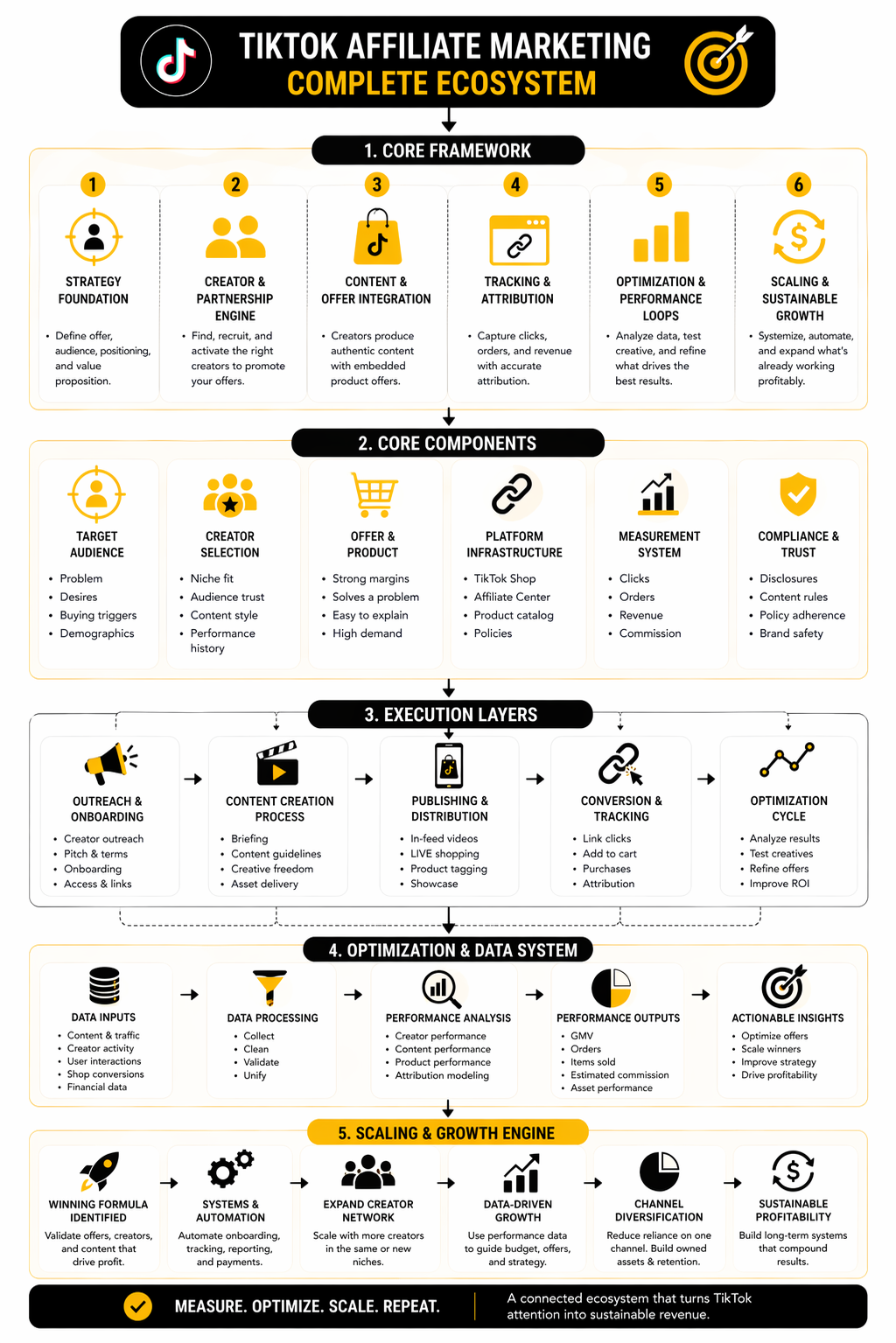
By this point, the pattern should be clear. TikTok affiliate marketing works best when you stop treating it like a creator lottery and start treating it like a commercial system. The brands and operators who win tend to align product economics, creator selection, content structure, measurement discipline, compliance control, and retention infrastructure instead of trying to compensate for one weak area with more effort somewhere else.
That matters even more now because the channel is still expanding. TikTok Shop’s US business is expected to reach about $23.41 billion in ecommerce sales in 2026, while 51% of US social buyers are forecast to shop on TikTok this year. Those numbers do not mean every seller should rush in blindly. They mean the channel is now big enough that good operators can build a real edge, and bad operators can waste a lot of time very efficiently.
The strongest takeaway is probably the simplest one: TikTok affiliate marketing is not one thing. It is a connected ecosystem. Seller Center, creator partnerships, Shop-enabled videos, LIVE selling, analytics, automation, and post-purchase follow-up all influence each other. Once you see the channel that way, better decisions come much faster.
FAQ
What is TikTok affiliate marketing in practical terms?
TikTok affiliate marketing is a model where creators promote products and earn a commission when their content drives sales. On TikTok Shop, that usually happens through product-tagged videos, LIVE sessions, creator showcases, and structured affiliate collaborations inside Seller Center, rather than through the old blog-style “drop a link and hope” approach. TikTok’s own seller documentation explains the affiliate model as a commission-based relationship between sellers and creators inside the platform’s commerce environment, which is exactly why it behaves differently from traditional affiliate programs. TikTok Shop’s affiliate explanation
Is TikTok affiliate marketing still worth starting in 2026?
Yes, but only if you approach it like an operator instead of a hobbyist. The market is large enough to matter, with TikTok Shop projected to exceed $23 billion in US ecommerce sales in 2026 and more than half of US social buyers expected to shop on TikTok, which means the demand side is very real. What is no longer realistic is assuming weak offers, weak content, or weak systems will survive just because the channel itself is growing.
Do you need TikTok Shop to do TikTok affiliate marketing?
No, but TikTok Shop makes the model much tighter and easier to manage when it is available in your market. TikTok’s commerce documentation shows that Shop supports in-feed videos, LIVE videos, and the Showcase tab, which reduces the distance between discovery and checkout in a way external-link setups usually cannot match. TikTok Shop and Showcase details If you are selling physical products and your region supports Shop, it is usually the cleaner way to run TikTok affiliate marketing.
What kinds of products tend to work best?
Products that perform well on TikTok usually have three traits: they are easy to understand visually, easy to demonstrate quickly, and easy to justify emotionally or practically. That does not mean only cheap impulse buys work, but it does mean the content has to create fast clarity around why the product matters. In TikTok affiliate marketing, confusing products, weak margins, or benefits that are hard to show usually struggle no matter how many creators touch them.
Is a big creator always better than a niche creator?
Usually not. A large creator can absolutely help, but niche relevance often converts better than broad visibility because trust transfers through fit, not just reach. TikTok’s own affiliate tooling and creator-matching direction keep reinforcing this logic by helping sellers find relevant creators rather than simply chasing maximum scale, which tells you a lot about how the platform itself sees performance. TikTok’s affiliate collaboration setup
What metrics should matter most?
The most useful metrics are the ones that change a decision. GMV, orders, items sold, estimated commission, creator-level performance, and asset-level contribution all matter more than raw vanity signals when you are judging whether a TikTok affiliate marketing program is commercially healthy. TikTok’s reporting tools increasingly support this view, including affiliate analytics and the Ads x Affiliate reporting that compares organic and ad-driven outcomes around affiliate creative. Affiliate creative reporting overview
Are views and engagement still important?
Yes, but they are diagnostic signals, not final proof of success. Strong views tell you the content earned attention, which is necessary because TikTok is still a feed-driven environment first, but attention without sales usually points to a mismatch in offer, audience, or buying trigger. The smart move in TikTok affiliate marketing is to treat engagement as the first checkpoint and commerce metrics as the decision layer.
How do brands avoid wasting money on the wrong creators?
They build a selection and review process instead of treating creator outreach like a volume game. That means testing small, comparing creators within similar product categories, and keeping a clear record of who drives profitable demand rather than who simply posts the most content. TikTok’s current seller workflows around open and targeted collaboration make this easier, but the judgment still has to come from the operator. Seller setup for open and targeted collaboration
What is the biggest mistake beginners make?
They start with tactics before they lock the economics. A lot of people jump straight into creator outreach, commission offers, and content requests without checking whether the product can absorb commissions, returns, discounts, and follow-up costs while still producing healthy contribution margin. In TikTok affiliate marketing, scale does not fix bad economics. It just makes the mistake visible faster.
How important is compliance and disclosure?
It is more important than most beginners think, because poor compliance is not just a legal issue. It is a performance issue, a trust issue, and eventually a scaling issue. TikTok requires disclosure for branded or promotional content and maintains specific rules around misleading claims, inconsistent product representation, and other risky promotional behavior, so strong operators build those controls into the workflow early rather than cleaning up problems later. TikTok’s disclosure guidance
Should brands use outside tools or keep everything native?
Start as native as possible, then add tools where visibility or follow-up breaks down. If your TikTok affiliate marketing program is getting traction and you need cleaner routing, Dub can help with attribution across creator assets, while ManyChat becomes useful when comments and DMs are generating buyer intent that needs structure. The right stack is the one that removes friction from a working system, not the one that tries to substitute for one.
Can TikTok affiliate marketing work for service businesses or software?
It can, but the path is usually less direct than it is for physical commerce. TikTok Shop is naturally built for productized buying behavior, so service and software offers usually need stronger post-click systems, better lead capture, and a tighter conversion environment outside the app. That is where a stronger funnel or CRM layer can help, whether that means a cleaner page flow in Replo or a more connected follow-up system in GoHighLevel.
How long does it usually take to know whether the channel is working?
Long enough to collect useful patterns, but not so long that you ignore obvious signals. In most cases, you can identify early clues pretty quickly by looking at creator fit, hook strength, click behavior, and first-order conversion patterns, but it takes more time to judge whether the economics are actually sustainable. The mistake is either quitting before the system has enough data or scaling before the system has earned that trust.
What is the smartest way to think about TikTok affiliate marketing going forward?
Treat it as a hybrid of creator commerce, performance marketing, and customer acquisition infrastructure. The platform scale is there, with TikTok reaching 1.59 billion users in its global ad audience and 51.5% of active adult users saying they use it to research brands and products, but those market facts only matter if your internal system is strong enough to convert attention into durable value. In other words, TikTok affiliate marketing is no longer just about posting products. It is about building a machine that can handle what happens after the post works.
Explore 10K+ Remote Marketing Contracts on MarkeWork.com
Most marketers spend too much time chasing clients, competing on crowded platforms, and losing a percentage of every project to middlemen. MarkeWork gives you a better way. Browse thousands of remote marketing contracts and connect directly with companies desperate to hire skilled marketers like you, without platform commissions and without unnecessary gatekeepers.
If you're serious about finding better opportunities and keeping 100% of what you earn, explore available contracts and create a profile for free at MarkeWork.com.