

TikTok marketing is not just about posting short videos and hoping one lands. The platform now sits at the intersection of attention, search, creator influence, and increasingly commerce, which changes how brands need to think about content from day one. TikTok ads reached 1.59 billion users in January 2025, and the platform’s Android users spent almost 35 hours in the app in November 2024, so the opportunity is big, but the competition for attention is very real.
The bigger shift is behavioral. TikTok is no longer only where trends start. It is also where people evaluate products, compare opinions, learn skills, and decide what feels worth buying or trusting. Ofcom’s 2025 media literacy research shows younger users are using TikTok as a search engine for practical decisions, while Adobe’s recent consumer research found 49% of surveyed consumers used TikTok as a search engine, which tells you this channel now influences discovery much deeper in the funnel.
That matters because most weak TikTok marketing strategies still treat the platform like a distribution channel. The stronger ones treat it like a live market signal. TikTok’s own What’s Next 2025 report frames the platform around evolving audience behavior, creator collaboration, and cultural relevance, which is exactly why serious brands are moving away from polished campaign thinking and toward faster, more adaptive content systems.
- Why TikTok Marketing Matters in 2025
- The TikTok Marketing Framework
- Audience and Search Intent
- Creative and Creator Strategy
- Distribution, Ads, and Conversion Paths
- Measurement, Optimization, and Long-Term Growth
TikTok matters because it compresses the old marketing funnel. One video can create awareness, trigger comments that reveal objections, surface in search results, send traffic to a product page, and influence a purchase without feeling like a traditional ad. That is a different operating environment from platforms where reach, trust, and conversion usually happen in separate places.
The platform also rewards relevance more than legacy brand size. TikTok’s own trend and creator materials keep coming back to the same point: brands gain traction when they understand niche communities, partner with a wider mix of creators, and respond to what people are already talking about instead of forcing a message into the feed. In the What’s Next 2025 report, TikTok highlights creator diversity, real engagement, and stronger trust as core signals shaping brand performance.
There is also a practical reason this channel deserves serious attention. Discovery habits are shifting toward short-form video, and that affects everything from SEO strategy to product positioning to creative testing. When people search TikTok for where to eat, what to buy, how to style something, or whether a product is worth it, your brand is competing in a format where the best answer often beats the biggest budget.
Another reason TikTok marketing matters is that the platform keeps expanding its business infrastructure. TikTok for Business continues to position the channel around growth, sales, conversions, and customer acquisition, while tools like Creative Center and TikTok One make it easier to study creative patterns and build creator-led campaigns. That lowers the barrier to entry, but it also raises the standard because brands can no longer claim they are guessing in the dark.
None of this means every business should chase dances, trends, or entertainment for its own sake. It means TikTok marketing works best when a company understands what people actually want to watch, what they are trying to solve, and what type of proof makes them move. The brands that win here are usually the ones that stop asking how to “go viral” and start asking how to become consistently useful, interesting, or convincing inside the feed.
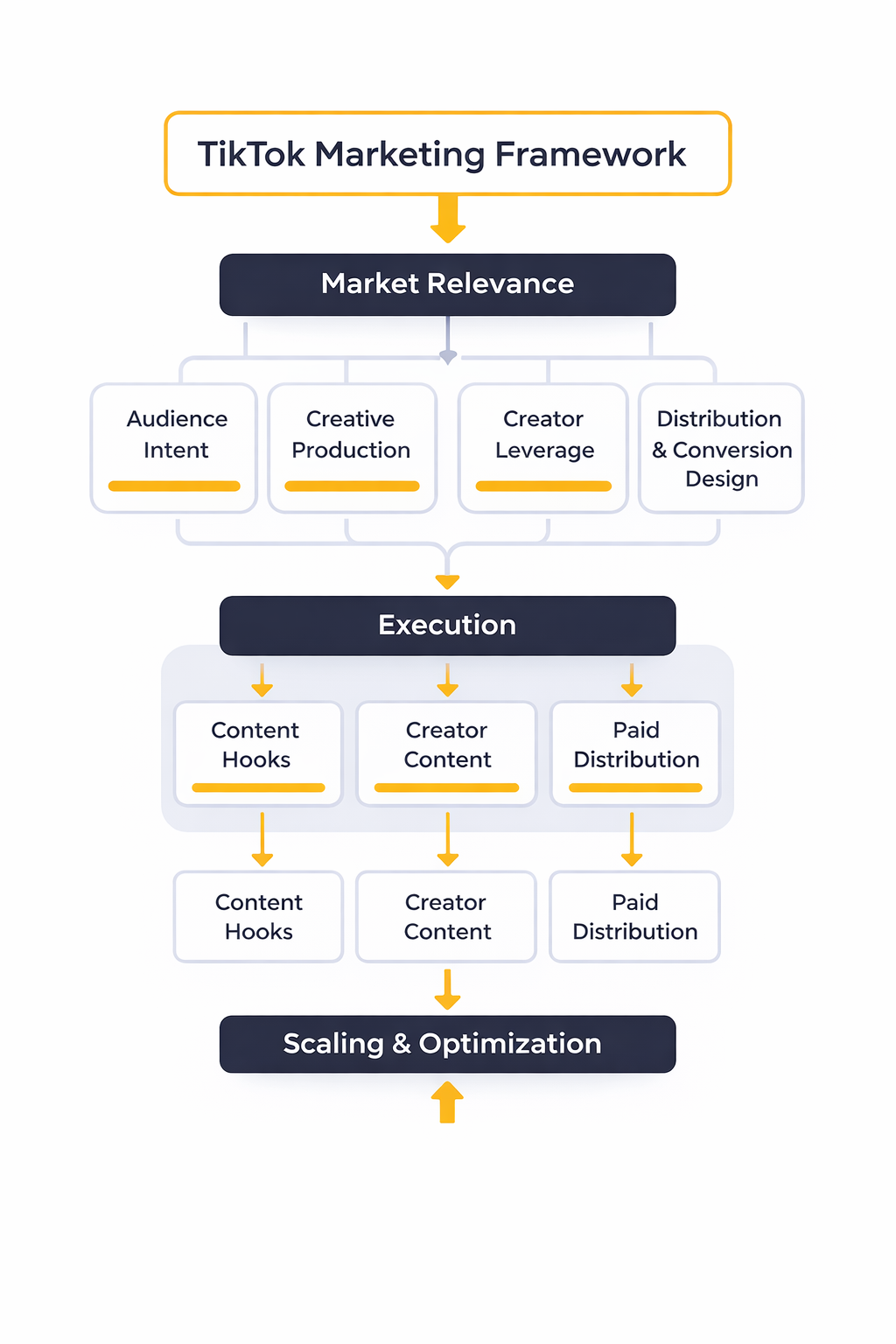
A practical TikTok marketing framework has six moving parts: market relevance, audience intent, creative production, creator leverage, distribution, and conversion design. Most brands focus too early on posting volume or ad spend, but the real leverage comes from arranging these pieces in the right order. First you identify what the market is paying attention to, then you shape content around audience questions and creator-native storytelling, and only after that do you scale reach with paid distribution and conversion assets.
This structure matters because TikTok is unusually sensitive to message-market fit. If the hook is wrong, the watch time collapses. If the story is too polished, it feels like an ad and people scroll. If the content gets attention but the offer path is weak, you create visibility without business value. Good TikTok marketing is not one tactic. It is a system where each element supports the next.
The framework we will use throughout this article is simple. Start with what people already care about, turn that into native creative angles, validate those angles through organic feedback and creator collaboration, amplify winners with paid support, and connect that attention to a clear next step. That next step could be a product page, a lead form, an email capture flow, a shop listing, or a booking page depending on the business model.
This is also where a lot of marketers get too complicated too fast. You do not need a giant studio setup to begin. You need a repeatable way to find signals, produce credible creative, and learn faster than the market changes. TikTok’s Creative Center is useful for trend visibility, and if your operation needs a simple publishing layer once the strategy is working, a tool like Buffer can help coordinate distribution across channels without turning your workflow into a mess.
The next sections will build this framework piece by piece. We will start with audience and search intent, because that is where strong TikTok marketing begins. If you miss that layer, everything downstream gets harder, more expensive, and less reliable.
The next layer of TikTok marketing is understanding why people open the app and what they are actually trying to find once they get there. That sounds obvious, but most brands still build content around what they want to say instead of what users are trying to solve, compare, copy, or avoid. That gap is expensive because TikTok is now part entertainment platform, part discovery engine, and part product research environment, with Adobe reporting that 49% of surveyed U.S. consumers used TikTok as a search engine in 2026, up from 41% in 2024, while a 2025 Journal of Economics and Management study found that habit, social influence, and perceived usefulness all shape purchase intention on TikTok’s recommendation-driven environment in measurable ways.
This changes how you should think about audience research. On TikTok, demographics help, but intent is what makes creative work. A 22-year-old and a 42-year-old can search the same phrase for totally different reasons, and the winning video is usually the one that reads the emotional context correctly, not the one with the most polished editing.
That is why solid TikTok marketing starts with questions, not formats. What is the viewer trying to figure out right now. Are they looking for proof, inspiration, reassurance, a shortcut, a comparison, or a reason to finally buy. If you can answer that clearly, your hooks get sharper, your retention improves, and your conversion path starts making sense.
TikTok intent usually shows up in patterns rather than formal keyword tools. You see it in repeated comment questions, recurring creator angles, autocomplete phrases, and the style of top-performing videos around a topic. TikTok’s Creative Center exists for exactly this reason, because it lets marketers study trending videos, creators, hashtags, and ad patterns by market and category instead of guessing from the outside.
A practical way to read intent is to split demand into four buckets. First, there is discovery intent, where users want ideas and inspiration. Second, there is evaluation intent, where they want reviews, comparisons, demos, or honest reactions. Third, there is action intent, where they want pricing, where to buy, what to click, or how to start. Fourth, there is identity intent, where they want content that helps them feel seen inside a niche, subculture, or lifestyle.
Those buckets matter because they lead to different content structures. Discovery content needs curiosity and breadth. Evaluation content needs proof and specificity. Action content needs clarity and low friction. Identity content needs language, references, and tone that feel native to the community you want to reach.
Once you understand intent, TikTok marketing gets much more practical. You stop asking what to post and start building content around real audience jobs. A software brand might create videos around setup mistakes, tool comparisons, and workflow shortcuts, while a product brand might focus on use-case demos, side-by-side tests, customer objections, and expectation-versus-reality content.
This is also where many brands finally realize TikTok is not one content stream. It is a bundle of mini search results that keep refreshing based on behavior. Research published in 2025 on TikTok as a search engine found users do search for information there, but they value the platform differently from traditional search because the experience is shaped by video affordances, social cues, and perceived authenticity rather than just efficiency alone. That means your content has to answer the query and feel credible in-feed.
The smart move is to create content clusters instead of random one-off posts. Build around recurring themes your market keeps searching, discussing, or hesitating over. That gives you a repeatable engine for TikTok marketing, and it makes paid amplification easier later because you already know which messages the market responds to.
There is a difference between optimizing for TikTok search and turning your content into awkward SEO sludge. You do not need robotic scripts with the same phrase repeated ten times. You need a clear topic, a strong spoken or on-screen hook, supporting language in captions, and a video structure that quickly proves relevance.
The easiest mistake here is over-optimizing the text layer while ignoring the content itself. If the first few seconds do not match the promise of the topic, people leave. If the video keeps the promise and answers the question quickly, the platform gets a stronger quality signal from watch behavior, engagement, and saves.
For that reason, strong TikTok marketing teams study language that real users use, then translate it into natural creative. They do not chase keywords in isolation. They chase useful relevance, because useful relevance is what earns attention, comments, shares, and eventually conversion.
Once audience intent is clear, creative becomes much easier to manage. You are no longer trying to invent viral ideas from scratch. You are packaging useful, persuasive, or entertaining answers in a format that feels native to TikTok instead of imported from another channel.
This is where brands often need a mindset reset. TikTok does not reward “brand content” in the old sense nearly as much as it rewards watchable content that happens to come from a brand. TikTok’s 2025 trend research emphasizes authenticity, community fluency, and creator collaboration as core drivers of stronger brand connection on-platform, which is another way of saying the creative has to earn its place in the feed.
The implication is simple but important. Your job is not to make content that looks expensive. Your job is to make content that feels relevant fast. That is the core creative standard in effective TikTok marketing.
Good TikTok creative usually starts with a sharp opening, but the hook is only part of it. The stronger videos also create a reason to stay by promising a payoff, showing a tension, or making a claim specific enough that the viewer wants to see whether it holds up. Then they deliver that payoff quickly, without wasting time on brand intros that kill momentum.
There is also a structural difference between average and strong content. Average content explains too much before it demonstrates anything. Strong content shows first, then explains just enough to keep the viewer oriented. That matters because TikTok is a visual proof environment, and people trust what they can watch unfold more than what a brand says in abstract language.
This is why content formats like before-and-after, side-by-side comparison, live reaction, walkthrough, myth-busting, and “three things nobody tells you” keep showing up. They are not magic templates. They simply align with how users process risk, curiosity, and proof inside short-form video.
Creators are not just distribution partners. In a good TikTok marketing system, they are also translators. They understand pacing, tone, visual grammar, and what makes a message feel believable to a specific audience segment. That matters even more now that creator marketing is pulling larger budget share, with IAB projecting U.S. creator ad spend at $37 billion in 2025, up 26% year over year.
The most useful creator partnerships are usually not the loudest ones. They are the ones with the cleanest fit between audience, message, and category. A mid-tier creator who knows how to explain a niche product clearly will often outperform a bigger name who can generate reach but not trust.
TikTok has been building more infrastructure around this through TikTok One and its creator collaboration tools, which combine sourcing, campaign collaboration, and creative insight in one environment. That does not remove the need for judgment, but it does make it easier to build a creator pipeline with more consistency and less randomness.
The first thing to screen for is not follower count. It is credibility inside the specific context you care about. Can this person make your category feel understandable, desirable, or urgent without sounding forced. Can they communicate your offer in a way their audience would accept as normal rather than obviously scripted.
The second thing to screen for is format fit. Some creators are brilliant at storytelling. Others are better at demos, voiceovers, humor, tutorials, or commentary. TikTok marketing gets stronger when you match the creator to the message format instead of giving everyone the same brief and hoping for the best.
The third thing is commercial fit. Not every creator who can generate attention can move people to action. If your goal is leads or direct sales, prioritize creators who know how to handle objection-heavy content, show product use clearly, and move naturally toward a next step without making the video feel like a hard sell.
This is where professional implementation starts to separate from casual posting. A serious TikTok marketing setup does not rely on one concept, one creator, or one lucky spike. It builds a testing loop where hooks, offers, formats, creators, and call-to-action styles are all treated as variables you can improve over time.
A simple production system works better than a complicated one nobody maintains. Create a content bank from audience questions and search themes. Turn those into multiple creative angles. Test them through brand content, creator content, or both. Then keep the winners in circulation long enough to learn what really drives response.
Operationally, this gets easier when you use lightweight tools that support the workflow instead of burying it. For example, Buffer can help manage publishing cadence across channels, and Flick can be useful when your team needs a cleaner content planning process around short-form distribution. The tool is not the strategy, but once your system works, good workflow support saves a lot of friction.
The bigger point is this: great TikTok marketing does not come from creative chaos. It comes from structured experimentation that still looks human on the surface. That balance is what lets brands scale without becoming boring, and it is exactly what we need before moving into distribution, paid media, and conversion paths.
Once your creative starts working, TikTok marketing shifts from content experimentation to distribution discipline. This is the stage where a lot of brands either waste money or finally become efficient. The difference usually comes down to whether they treat paid media, organic reach, and conversion assets as one connected system instead of three separate jobs.
TikTok itself has been building more of the stack to support that system. Search Ads Campaign gives advertisers keyword-based placements inside TikTok search results, Smart+ Campaigns automate more of campaign setup and optimization, and TikTok Shop keeps pushing discovery commerce deeper into the platform. That means distribution is no longer just about boosting a few posts. It is about deciding where demand lives and matching your route to how people want to act.
There is no single best distribution model for TikTok marketing because not every business is asking the platform to do the same job. Some brands need broad reach and repeated exposure before conversion happens. Others need to capture people when intent is already high. Others need direct response from creators, live shopping, or lead forms because friction is the real problem.
A practical way to think about it is this. Organic content is where you test angles and build pattern recognition. Paid in-feed campaigns are where you amplify what has already shown signs of life. Search Ads are where you capture active demand around category, product, and problem-based queries. TikTok Shop or external landing pages are where that attention turns into revenue or leads.
That sequencing matters because strong TikTok marketing usually performs best when each layer does a clear job. Organic helps you learn. Paid helps you scale. Conversion assets help you monetize. When a team skips the learning layer and jumps straight to spend, it often pays to discover what it could have learned much more cheaply in the feed.
Search behavior on TikTok changes the paid media conversation. If users are already typing product, need, or comparison phrases into the app, you do not need to interrupt them as aggressively. You need to show up with the right creative at the right moment. That is exactly why Search Ads Campaign matters inside a modern TikTok marketing setup.
The interesting part is not just the format. It is the fit between message and intent. In TikTok’s own case study, Steve Madden used branded and non-branded search campaigns, aligned creator-style content to user queries, and within a month saw a $4.08 iROAS and 54% lower CPA versus its non-search campaigns. In another official case study, Resume.co used keyword targeting tied to job-seeker pain points and reported 50% lower CPC, 300% higher CTR, and 25% more conversions than its other TikTok campaigns.
The lesson is simple. Search Ads work best when you stop treating them like generic media inventory. Group keywords by user need, match the creative angle to that need, and send traffic to the most relevant next step. That could be a product page, a lead form, a comparison page, or a sign-up flow, but the message has to stay consistent from search term to click to landing experience.
This is the part too many teams underestimate. A good TikTok video creates interest fast, but interest is fragile. If the next step is confusing, slow, generic, or obviously disconnected from the video, the conversion rate drops and the campaign gets blamed for a landing page problem.
TikTok gives you multiple ways to reduce that friction. If lead capture matters more than website traffic, Instant Form campaigns are designed to keep the action native, and TikTok highlights benefits like lower form friction, instant lead capture, and CRM sync. If you need website conversion tracking and optimization, Web Data Connection supports measurement through Pixel or Events API, which is foundational if you want the algorithm optimizing toward something more meaningful than clicks.
For businesses that need a stronger post-click flow, this is where a clean offer stack matters. If you are pushing traffic to a dedicated funnel, ClickFunnels or Systeme.io can make sense when you need fast landing-page deployment without a long build cycle. If the real value comes after the first opt-in, tools like Brevo or Moosend are more relevant because TikTok attention is often the start of the relationship, not the finish line.
At this point, the strategy stops being theoretical. You know the audience, you know the creative angles, and you know the likely path from impression to action. Now the job is execution, and this is where disciplined TikTok marketing usually beats talented-but-chaotic TikTok marketing.
The smartest teams do not launch everything at once. They move in controlled stages so they can see what is actually driving results. That means content validation first, then paid amplification, then tighter conversion design, then heavier optimization. It is less exciting than chasing “viral” moments, but it is how you build something that survives past a few lucky posts.
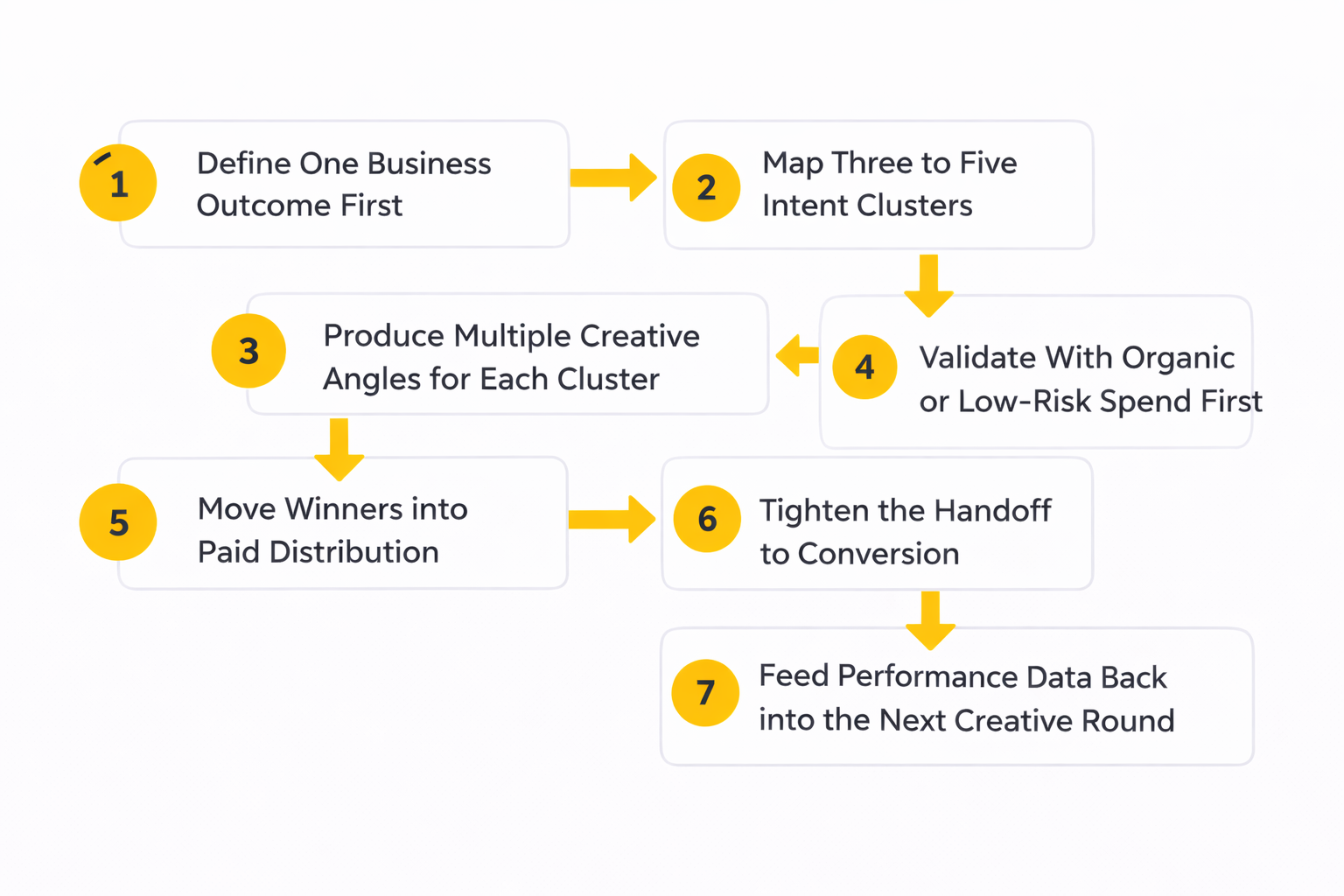
Use this process if you want TikTok marketing to become operational instead of improvisational. It is simple on purpose, because simple systems are easier to run consistently.
- Define one business outcome first. Pick the real priority for the next cycle, whether that is qualified leads, first purchases, repeat orders, booked calls, or lower CPA. If you mix five goals into one launch, the platform, the creative team, and the landing experience all pull in different directions.
- Map three to five intent clusters. Build these around the questions, objections, search phrases, and creator angles that keep surfacing in your market. This gives your TikTok marketing program a structure you can test repeatedly instead of creating disconnected content every week.
- Produce multiple creative angles for each cluster. Do not make one version and call it testing. Build different hooks, different proof styles, and different CTA framings so you can learn whether the audience responds to authority, demonstration, relatability, urgency, or comparison.
- Validate with organic or low-risk spend first. Let the market show you which messages deserve more budget. Watch time, saves, comments, click behavior, and even the specific objections people leave under videos tell you where to push harder and where to rewrite.
- Move winners into paid distribution. This is where formats like Smart+ Campaigns or Smart Performance Campaign become useful, especially when you want faster optimization across audience targeting, bidding, and creative delivery. Automation is not a substitute for strategy, but it can reduce operational drag once your inputs are strong.
- Tighten the handoff to conversion. Check that the CTA, landing page, form, or product page matches the promise of the video exactly. A surprising amount of TikTok marketing underperforms because the ad is specific and the destination is vague.
- Feed performance data back into the next creative round. This is where the loop compounds. Once you know which angle gets the cheapest qualified clicks, which creator handles objections best, and which format leads to higher purchase intent, your next testing cycle starts smarter.
A surprising number of teams spend weeks on creative and almost no time on tracking. That is backwards. If your measurement foundation is weak, TikTok marketing turns into a debate club where everyone argues from vibes and nobody can prove what is really happening.
TikTok has made this easier, but you still need to do the work. Events API is designed to create a more reliable connection between TikTok and advertiser data across web, app, offline, and CRM sources, and standard events give you a more consistent way to pass actions like add to cart or purchase back into the system. That matters because optimization gets much better when the platform can learn from real downstream behavior instead of top-of-funnel proxies.
You also want measurement beyond the platform dashboard. Use your site analytics, CRM, and revenue reporting to see whether low-cost traffic is actually turning into qualified demand. TikTok marketing looks amazing on paper until you discover that the easiest clicks are not always the most valuable customers.
Not every conversion path should look the same. A low-ticket ecommerce product can often move from video to product page to purchase if the offer is clear and the creative demonstrates the use case well. A higher-consideration service usually needs an intermediate step like a lead form, email capture, quiz, or booking page because the buyer needs more reassurance before committing.
This is why professional implementation always depends on business model fit. For ecommerce brands, TikTok Shop is becoming harder to ignore, with TikTok reporting that U.S. TikTok Shop sales were up 120% year over year in 2025, while brands and creators hosted more than 8 million hours of LIVE shopping sessions in the U.S. in 2024. For lead generation, native forms and CRM sync often matter more than getting a user to browse a full website first.
The key is to remove unnecessary steps. Every extra click is another chance to lose momentum. The more direct the path from attention to action, the stronger your TikTok marketing economics usually become.
A lot of marketers secretly want TikTok to produce one breakout hit that fixes everything. That is understandable, but it is the wrong target. The real goal is a repeatable engine where audience insight, native creative, paid distribution, and conversion design keep reinforcing each other.
That is what makes TikTok marketing sustainable. You stop depending on luck and start relying on a process. Once that happens, optimization becomes much more interesting, because you are no longer asking whether TikTok can work. You are asking how to make it work better, more predictably, and at a healthier margin over time.
By the time you get to measurement, TikTok marketing stops being a creative game and becomes a decision-making system. This is where weak operators drown in vanity metrics and strong operators start seeing what the platform is really doing for the business. The goal is not to collect more numbers. It is to identify which signals predict profitable growth and which ones just make the dashboard look busy.
That distinction matters because TikTok can generate massive attention without generating much business value. The platform’s ad tools showed a potential reach of 1.59 billion users in January 2025, and Adobe’s 2026 consumer survey found that 49% of respondents used TikTok as a search engine. Those numbers explain why TikTok marketing deserves budget, but they do not tell you whether your specific content, offer, and funnel are actually working.
So the right question is not “Are the views high?” The right question is “What are the views leading to, and what are they telling us about fit, intent, and conversion quality?” That is the mindset shift that makes analytics useful.
The first layer of TikTok marketing measurement is creative response. Before you obsess over CPA or ROAS, you need to know whether the content is earning attention in the feed. TikTok Studio gives creators and brands access to account analytics, post performance, viewer analytics, follower insights, and engagement details, including metrics around views, engagement, and audience activity times through its analytics features.
At this stage, the most useful signals are usually watch behavior, completion behavior, saves, shares, comments, and profile actions. Those metrics tell you whether the creative actually resonated or just got served. A video with decent reach and strong saves often signals practical utility. A video with lots of comments can reveal either strong relevance or strong confusion. A video with profile visits but weak clicks may mean the hook is working while the offer is still vague.
This is why early TikTok marketing analysis should focus on patterns, not isolated posts. One video can spike for weird reasons. A repeated pattern across several videos is much more valuable. When the same angle keeps producing longer watch time, stronger comments, or better search visibility, you are seeing a message-market signal, not an accident.
One of the most underused parts of TikTok marketing analytics is search behavior. TikTok now gives creators access to Creator Search Insights, which surfaces popular search topics, content gaps, follower search behavior, and search analytics for posts. That is a serious clue about where the platform is headed and how brands should think about demand.
This matters because search-driven traffic often behaves differently from passive feed traffic. A viewer who found your content while actively looking for an answer is usually warmer than someone who simply scrolled past it. That means search-aligned content can outperform broader content even when the top-line view count looks smaller.
In practice, this should change your content decisions. If a post drives moderate reach but strong search visibility, useful comments, and qualified actions, that is often more valuable than a trend-based video with much higher views and almost no downstream movement. In TikTok marketing, intent-heavy traffic often beats inflated attention.
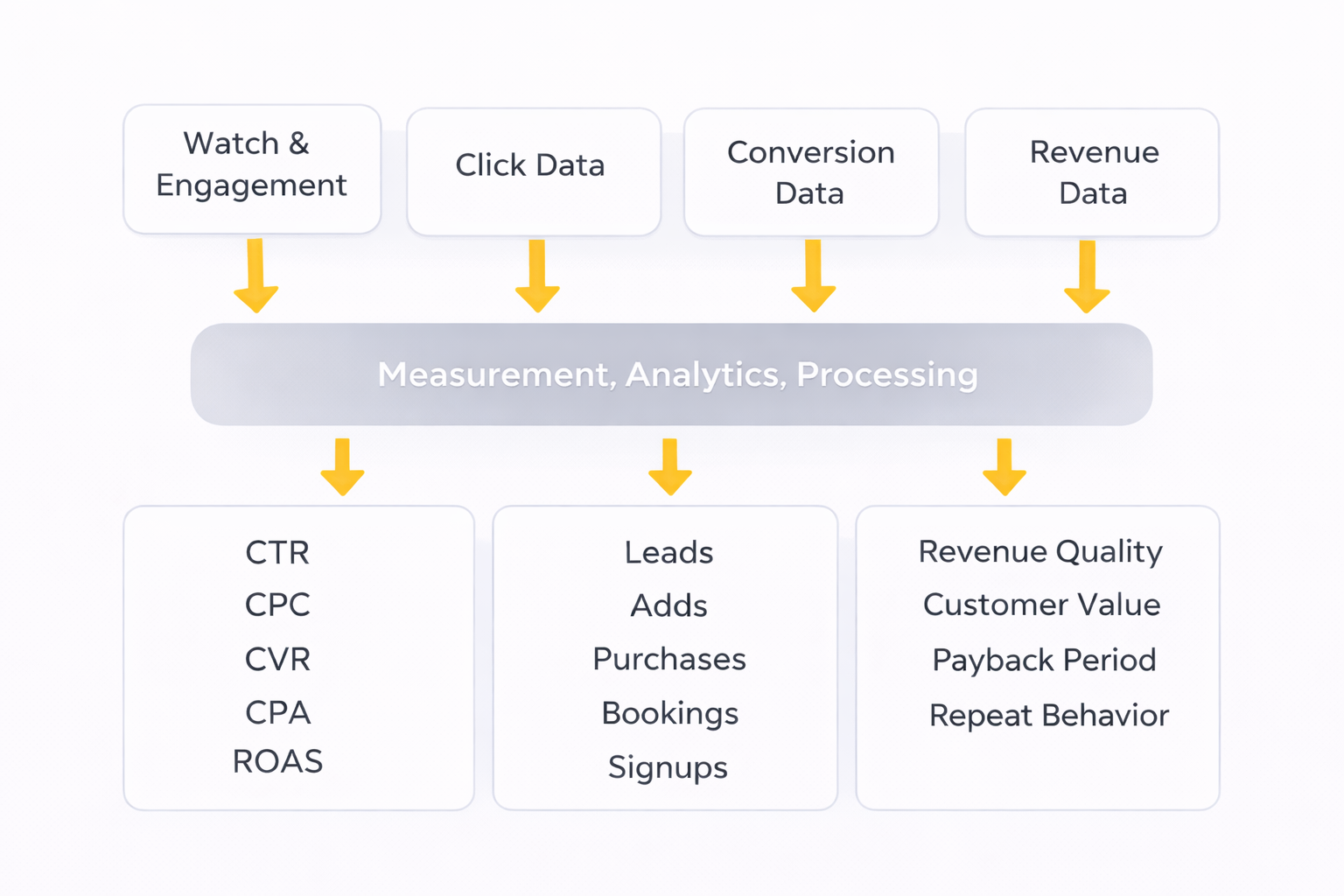
A professional TikTok marketing setup needs measurement at four levels: content, click, conversion, and business outcome. If one layer is missing, interpretation gets messy fast. You end up blaming the wrong part of the system.
At the content level, you are looking at feed response. At the click level, you are tracking CTR, CPC, landing-page sessions, and whether the right people are actually moving. At the conversion level, you are measuring actions like leads, add-to-cart events, purchases, bookings, or qualified applications. At the business-outcome level, you care about revenue quality, customer value, payback period, and repeat behavior.
TikTok’s own measurement tools support a lot of this infrastructure. Standard events let advertisers track actions like add to cart, purchase, or submit form. Events API adds server-to-server data sharing across websites, apps, offline channels, and CRM systems, which makes the signal more durable than relying on browser-side tracking alone. That setup is not glamorous, but it is what allows TikTok marketing to optimize toward actual business results instead of surface-level engagement.
Once you are spending real money, the usual dashboard metrics matter more, but only in context. Impressions tell you whether delivery is happening. CTR tells you whether the creative and offer are convincing enough to earn action. CPC tells you how expensive that curiosity is. CVR and CPA tell you whether the post-click path is doing its job. ROAS tells you whether revenue is coming back fast enough to justify the spend.
The trap is reading any one of these metrics in isolation. A high CTR can mean the hook is strong, but it can also mean the targeting is broad and curiosity-heavy. A low CPC can look efficient while sending you weak traffic. A decent ROAS can hide the fact that only your remarketing pool is profitable. Strong TikTok marketing analysis looks at the chain, not a single link.
TikTok documents these metrics across Ads Manager reporting and campaign reporting tools, including CTR, CVR, CPA, CPM, and ROAS definitions. That sounds basic, but many teams still skip the interpretation layer. Metrics are not the insight. The insight is what a combination of metrics says about creative fit, audience quality, and funnel friction.
This is where people usually want a universal answer. They want to know what a “good” CTR or CPA is for TikTok marketing. The honest answer is that category, price point, market maturity, creative quality, and conversion path change the number so much that generic benchmarks are often misleading.
A much better approach is to use relative benchmarks inside your own system. Compare creator-led videos against brand-led videos. Compare search traffic against in-feed traffic. Compare objection-handling hooks against lifestyle hooks. Compare native lead forms against external landing pages. Once you do that, your benchmarks become operational instead of theoretical.
Official case studies are useful here not because they give you a magic target, but because they show what efficiency gains can look like when the setup is right. In TikTok’s Search Ads examples, Steve Madden reported a 54% lower CPA than non-search campaigns, while Resume.co reported 300% higher CTR and 25% more conversions than its other TikTok activity. Those are not benchmarks you should copy blindly. They are proof that distribution model and intent alignment can swing performance dramatically.
Good measurement should lead to a clear move, not just a reporting meeting. If watch time is weak, the hook or opening structure likely needs work. If engagement is solid but clicks are weak, the CTA or offer framing may be too soft. If clicks are strong but conversions are weak, the landing page, form, or product page is probably breaking momentum. If conversion rate is fine but CPA is still too high, targeting, bid strategy, or creative efficiency may be the constraint.
This is why action thresholds matter. Decide in advance what performance pattern triggers a rewrite, a relaunch, or a scale decision. That keeps TikTok marketing from turning into subjective debate. You are no longer asking what people “feel” about the campaign. You are asking what the signal is telling you to do next.
A clean action model also speeds up iteration. When teams know how to interpret performance, they stop overreacting to one bad day or one random spike. They learn to look for durable signals, and that is how measurement becomes a competitive advantage instead of a reporting burden.
One of the biggest measurement mistakes in TikTok marketing is judging the platform only through last-click attribution. That is especially dangerous on a channel that often creates demand before it captures it. People may see a video, remember the brand, search later, convert through another touchpoint, and make TikTok look weaker than it really was.
TikTok has been pushing more advanced measurement for exactly this reason. Its media mix modeling support says MMM endpoints can help advertisers capture TikTok’s contribution to business metrics, with returns that may appear 23 times higher than last-click models suggest. That is a platform claim, not a universal law, but the broader point is correct: narrow attribution models often undervalue channels that shape discovery and consideration early.
So yes, use click-based reporting. But do not stop there. When budgets get serious, bring in CRM quality checks, cohort analysis, and broader revenue measurement. TikTok marketing becomes much more understandable once you measure it the way people actually buy instead of the way dashboards prefer to simplify the story.
By this stage, TikTok marketing is no longer about whether you can get reach. It is about whether you can keep performance stable while the platform, audience behavior, and your own creative library keep changing. That is the harder game, and it is the one serious operators need to understand before they scale budget too aggressively.
The main strategic tradeoff is simple. TikTok rewards speed, experimentation, and cultural fluency, but businesses still need control, compliance, and repeatable economics. If you lean too far toward control, the content gets stiff and the feed rejects it. If you lean too far toward spontaneity, you may get attention that cannot be scaled safely or profitably.
That is why mature TikTok marketing systems are built around tension management. You are balancing native content with brand standards, platform dependence with owned audience capture, creator freedom with legal disclosure, and short-term spikes with long-term customer value. Get that balance right and TikTok becomes a serious growth channel. Get it wrong and it becomes a noisy source of inconsistent wins.
One of the fastest ways a strong TikTok marketing program stalls is creative fatigue. The first few winning videos create confidence, media spend increases, and then performance quietly starts slipping because the audience has seen the pattern too many times. TikTok’s own creative best practices for performance ads emphasize continuous testing, fast iteration, direct storytelling, and fresh creative variations because static ad libraries lose effectiveness quickly on the platform.
This matters more on TikTok than many teams expect because the feed is built around novelty. Users are training the system every second with swipes, rewatches, saves, and exits. That means the cost of repeating the same message shape too often can show up as weaker CTR, higher CPA, or slower delivery before the team even realizes the creative is stale.
The practical fix is not endless reinvention. It is structured variation. Keep the core offer, proof, and audience intent stable, but rotate hooks, scenarios, creators, visual openings, CTA styles, and objection frames. In good TikTok marketing, freshness should live in the packaging more often than in the strategy itself.
When you are posting organically, brand safety can feel like a distant concern. Once you start scaling paid distribution, it becomes operational. The bigger your presence gets, the more exposure you have to adjacency issues, comment risks, creator inconsistency, and category-specific sensitivity.
TikTok has expanded its own suitability controls for this reason. Its Inventory Filter lets advertisers choose among inventory tiers based on sensitivity and risk, while the 2025 Brand Safety & Suitability Playbook frames suitability as an active control layer rather than a passive trust assumption. That is useful, but it does not remove the need for internal rules about claims, creator selection, moderation standards, and escalation paths.
The smart move is to treat brand safety as design, not cleanup. Decide early what topics, tones, creator behaviors, and comment environments are acceptable for your brand. That keeps TikTok marketing from becoming a series of reactive decisions made after something already went wrong.
A lot of brands still run creator programs as if good vibes are enough. They are not. If creators are part of your TikTok marketing engine, you need briefing standards, content rights clarity, performance evaluation, disclosure expectations, and a process for reusing winning assets without confusion later.
This matters because creator marketing is now too large to treat casually. IAB projected U.S. creator ad spend at $37 billion in 2025, up 26% year over year, which tells you brands are pushing real budget into this channel and expecting business outcomes, not just “buzz.” Once that kind of money is involved, informal workflows stop being charming and start becoming expensive.
Compliance is part of that governance. The FTC’s endorsements, influencers, and reviews guidance makes it clear that material relationships need clear disclosure, and that applies to social content, not just traditional ad formats. In other words, strong TikTok marketing does not just look authentic. It is also transparent enough to stay on the right side of the rules.
This is the part many brands would rather not think about. TikTok can become such a strong acquisition channel that teams start building the whole go-to-market machine around it. That works until reach shifts, costs rise, policy changes hit, or a category loses momentum on the platform.
The answer is not to avoid TikTok marketing. That would be a mistake. The answer is to make TikTok a discovery and demand engine that feeds assets you control. Email lists, SMS, customer data, community channels, CRM pipelines, and direct traffic matter more once the platform proves it can create demand consistently.
That is why the post-click experience is strategic, not just technical. If TikTok is generating qualified attention, you want a system that captures and develops that attention off-platform. For list growth and follow-up, Brevo or Moosend can be relevant depending on how your nurture flow works. If your offer needs a more controlled conversion environment, ClickFunnels or Systeme.io can make more sense than sending valuable traffic into a generic website path.
As TikTok matures, the old distinction between entertainment, search, and commerce keeps getting weaker. That changes scaling strategy. A brand that only thinks in terms of feed impressions misses how users now move between discovery, search, creator proof, and purchase with much less friction than before.
TikTok’s own platform updates make this obvious. It has continued expanding Search Ads Campaign, creator collaboration infrastructure through TikTok One, and commerce through TikTok Shop. In the U.S., TikTok said Shop sales were up 120% year over year in 2025, which is not just a commerce stat. It is a signal that discovery and transaction are getting closer together on-platform.
That creates a real strategic choice. Do you want TikTok marketing to be mainly a top-of-funnel engine that drives people into your own ecosystem, or do you want to use more of TikTok’s native commercial path and trade some control for less friction? There is no universal answer. The right choice depends on your margin structure, customer lifetime value, data needs, and how much post-purchase relationship building matters in your business.
Scaling TikTok marketing across markets looks easier from the outside than it really is. The format is global, but humor, search language, creator credibility, purchase behavior, and compliance expectations are not. What works in one country can fail quietly in another because the cultural logic underneath the creative changed.
Even within regulated regions, the operating context is shifting. TikTok’s February 2026 DSA transparency report for Europe said the platform now has 178 million monthly users in the EU, which shows the scale of the opportunity, but also the scale of the governance environment brands are entering. Larger audiences usually come with more scrutiny, more moderation expectations, and more pressure on transparency.
So if international expansion is on the table, keep the strategy centralized but localize the execution. Use common measurement logic, common creative testing discipline, and common governance rules, but let language, creator choice, content examples, and commercial flow adapt to the market. That is how TikTok marketing scales without flattening into generic global content nobody really trusts.
At the expert level, the real edge is not access to better tactics. It is speed of learning. The strongest teams use TikTok marketing to understand objections earlier, identify product language faster, spot rising demand sooner, and see content patterns before competitors notice them.
That learning advantage compounds beyond TikTok itself. The hooks that work in short-form video can improve landing pages. The comment objections can sharpen sales scripts. Search behavior can influence email copy, product page structure, even new offer development. In other words, TikTok marketing becomes more valuable when you stop treating it as an isolated social channel and start using it as a live market research loop.
That is the deeper reason this channel matters. Yes, it can drive attention and revenue. But at a higher level, it can also help a business understand what the market cares about right now. And when you can learn that faster than competitors, you are not just buying media better. You are making better strategic decisions everywhere else too.
At this point, the shape of effective TikTok marketing should be clear. You start with audience intent, build native creative around real questions and real proof, validate what works, amplify winners with paid distribution, and measure performance in a way that connects feed behavior to business outcomes. The reason this system works is not because TikTok is magical. It works because the platform compresses discovery, evaluation, influence, and action into one environment, and your strategy either respects that reality or wastes it.
The ecosystem is also getting tighter. Search, creator content, paid media, TikTok Shop, analytics, and CRM-connected measurement are no longer separate conversations. TikTok has kept expanding that stack through products like Creator Search Insights, TikTok One, Search Ads Campaign, Events API, and TikTok Shop. That means the winning approach is no longer “post more and hope.” It is to build a connected operating system for attention and conversion.
What matters most now is discipline. TikTok marketing rewards brands that learn quickly, publish consistently, interpret data honestly, and keep their funnel aligned from first impression to final action. That sounds simple, but it is the difference between a channel that occasionally creates noise and one that reliably creates revenue.
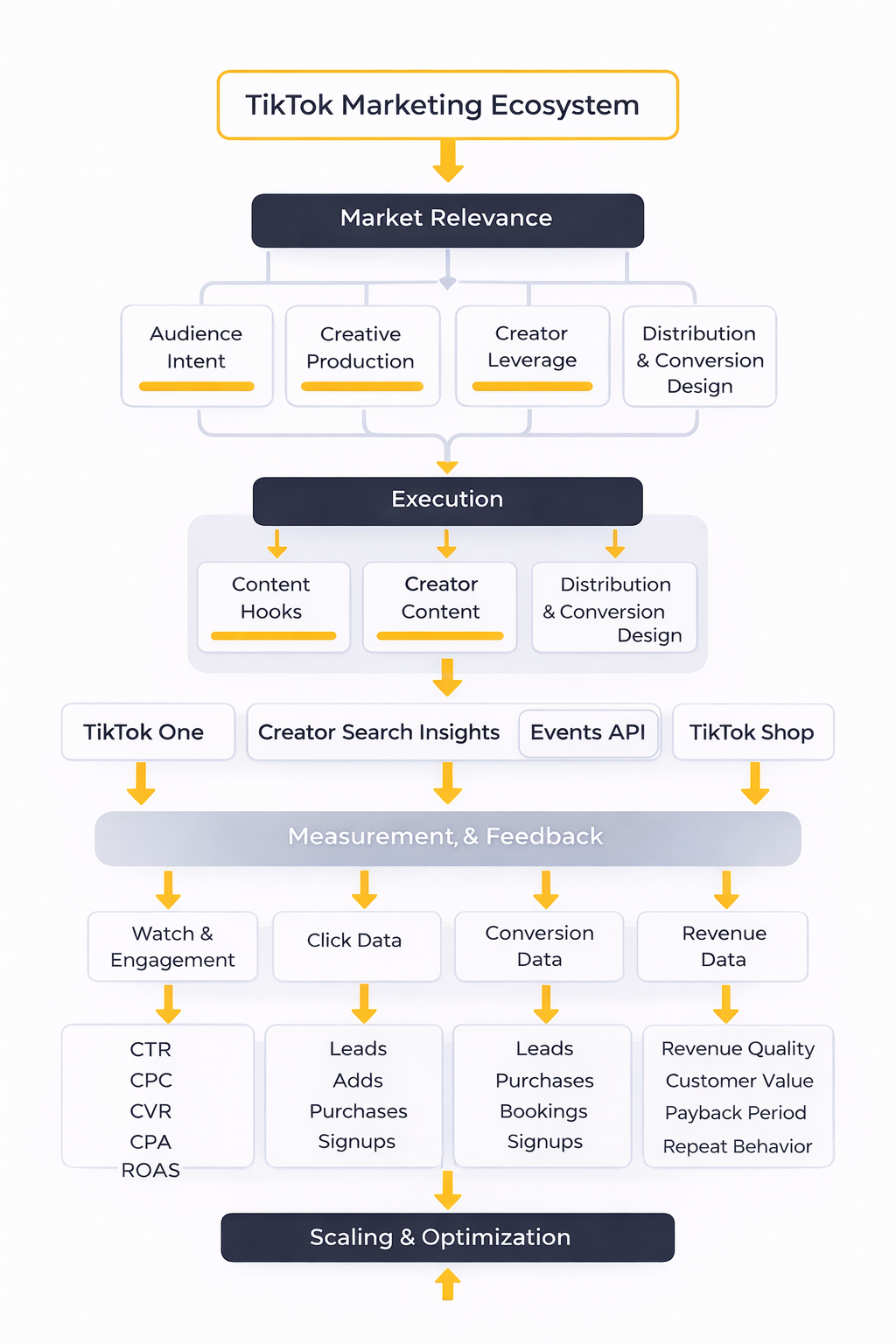
A healthy TikTok marketing engine usually has five traits. First, it knows exactly which audience questions and search themes it is trying to own. Second, it has a repeatable content production loop instead of random creative bursts. Third, it treats creators as strategic partners, not decorative distribution. Fourth, it connects media spend to clear conversion paths. Fifth, it uses measurement to decide what to change next.
When those pieces line up, the platform becomes easier to manage. You stop debating whether TikTok “works” and start optimizing which hooks, creators, offers, landing flows, and search angles work best. That is a much better problem to have.
And this is the final point that matters. TikTok marketing is not just a traffic source. It is a live feedback loop that can sharpen your positioning, copy, offer design, and customer understanding faster than many traditional channels. If you build the system properly, the value goes well beyond the videos themselves.
TikTok marketing is the process of using TikTok content, creators, ads, search visibility, and sometimes commerce features to attract attention and move people toward a business goal. That goal might be awareness, leads, sales, app installs, bookings, or repeat purchases depending on the company. In practice, the strongest TikTok marketing programs combine organic testing with paid amplification and a conversion path that matches what the viewer is ready to do next.
It matters more because TikTok is no longer just a place where trends spread. It is also a place where people search for product advice, reviews, tutorials, and recommendations, with Adobe reporting that 49% of surveyed U.S. consumers used TikTok as a search engine in 2026. At the same time, TikTok ads reached 1.59 billion users in January 2025, so the scale and the intent are both there.
No, and that is one of the biggest misconceptions. Ecommerce brands can benefit quickly because product demos, reviews, and creator commerce fit the platform naturally, especially as TikTok Shop keeps growing in the U.S.. But service businesses, software companies, coaches, education brands, local businesses, and B2B firms can all make TikTok marketing work when they build content around problems, objections, and proof instead of entertainment for its own sake.
There is no magic publishing number that guarantees results. What matters more is whether you can sustain a consistent testing rhythm with enough creative variety to actually learn something. For most businesses, TikTok marketing gets better when they commit to a repeatable content cadence they can maintain for weeks, not when they post heavily for five days and disappear for the next three weeks.
You do not need creators to start, but creator partnerships can accelerate performance once you understand what message you want to push. Creators are often better at native pacing, trust-building, and making a product or service feel believable inside the feed. That is one reason creator ad spend keeps rising, with IAB projecting U.S. creator ad spend at $37 billion in 2025.
The best content usually matches a real audience intent and delivers proof fast. Tutorials, demos, comparisons, objection-handling videos, transformations, reviews, myth-busting clips, and creator explanations often work because they help viewers solve a problem or reduce uncertainty. TikTok marketing tends to break when brands lead with self-important messaging instead of useful, relevant, watchable content.
Usually, organic or low-risk testing should come first because it helps you identify which angles deserve more investment. Once you see repeated signs of traction, paid campaigns can scale what is already resonating instead of forcing the market to accept unproven creative. TikTok marketing becomes much cheaper to optimize when your ads are based on real audience response rather than internal guesses.
Yes, but it is not the same as traditional search engine optimization. TikTok search visibility is influenced by topic clarity, creative relevance, audience behavior, and how well the content answers what the user seems to want. TikTok has leaned further into this direction with tools like Creator Search Insights, which signals that search-based discovery is now a real part of the platform’s growth model.
You know it is working when the metrics line up across the funnel. Strong watch behavior and engagement show that the content is landing, but clicks, leads, purchases, bookings, and revenue quality tell you whether that attention is producing business value. TikTok marketing should be judged by connected performance, not by views alone.
At the content level, watch time, completion rate, saves, shares, comments, and profile actions are usually the first meaningful clues. At the paid level, CTR, CPC, conversion rate, CPA, and ROAS become more important, especially when tied back to real tracked events through tools like standard events and Events API. The best metric mix depends on your business model, but the pattern is always the same: creative response first, conversion quality second, business outcome last.
Sometimes a good video can create movement fast, but sustainable performance usually takes longer because you need enough testing volume to see patterns. Most businesses need time to refine hooks, find the right creator fit, improve the conversion path, and build measurement they can trust. TikTok marketing gets more reliable when you treat the first phase as a learning cycle, not as a final verdict on the channel.
Yes, and in some cases they can compete more effectively than on legacy channels. TikTok still gives relevance, clarity, and native creative a real chance to outperform corporate polish, which helps smaller brands that understand their niche deeply. The key advantage in TikTok marketing is not always bigger budget. It is often sharper positioning and faster iteration.
The first mistake is treating TikTok like a place to repost generic social content. The second is optimizing for reach without building a conversion path. The third is confusing views with business progress. TikTok marketing usually fails when brands skip intent research, overproduce the creative, underbuild the funnel, and then blame the platform for what was really a systems problem.
Not always. For some ecommerce brands, TikTok Shop can reduce friction and keep the conversion path closer to the moment of discovery, which is why the platform keeps investing in it and highlighting strong commerce growth through its newsroom updates. But for other businesses, especially lead generation or high-consideration offers, a stronger move may be directing traffic into a funnel or CRM-driven nurture flow instead.
The answer depends on what part of the system needs support. For publishing workflow, Buffer can help keep content operations cleaner. For funnel building and landing pages, ClickFunnels or Systeme.io may fit. For email and follow-up, Brevo or Moosend can make sense. The point is not to stack tools for the sake of it. The point is to remove friction from a strategy that already makes sense.
Most marketers spend too much time chasing clients, competing on crowded platforms, and losing a percentage of every project to middlemen. MarkeWork gives you a better way. Browse thousands of remote marketing contracts and connect directly with companies desperate to hire skilled marketers like you, without platform commissions and without unnecessary gatekeepers.
If you're serious about finding better opportunities and keeping 100% of what you earn, explore available contracts and create a profile for free at MarkeWork.com.