

TikTok marketing tips are everywhere, but most of them fall apart the moment you try to use them in a real business. You get vague advice about trends, generic reminders to “be authentic,” and recycled posting hacks that never explain how attention turns into sales. That is exactly why this article takes a different route.
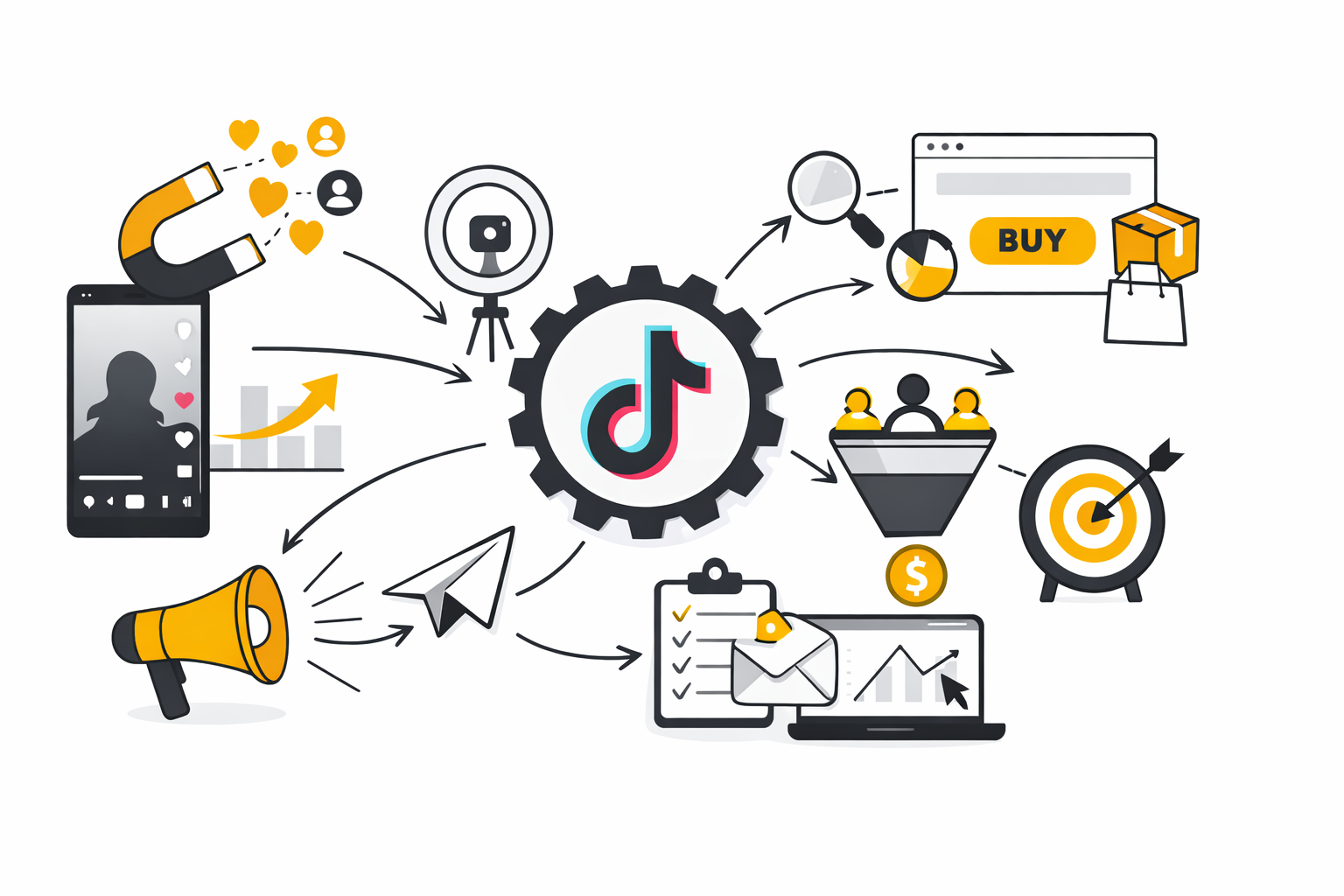
The smart way to approach TikTok now is to treat it as a discovery engine, a search surface, a creative testing lab, and for some brands even a direct commerce channel. TikTok’s own business resources keep pushing that same direction, from its 2025 trend report to its marketing education hub and Creative Center. In other words, this is no longer a side platform you post on when you have leftover content.
That shift matters even more because audience behavior on TikTok is not the same as audience behavior on older social platforms. Pew Research found that about half of U.S. adult TikTok users have never posted a video, which tells you something important right away: most people are there to watch, search, learn, compare, and decide. If your marketing only chases virality and ignores that quieter buyer behavior, you miss the real opportunity.
This article is built as a practical six-part system, not a random list of tricks. We will start with why TikTok matters now, then move into the framework, the content engine, conversion paths, paid growth, and the mistakes that keep brands stuck.
- Why TikTok Marketing Matters Now
- The TikTok Marketing Framework
- Build a Content Engine That Fits TikTok
- Turn Views Into Traffic, Leads, and Sales
- Scale With Ads, Creators, and Measurement
- Common Mistakes, Smarter Execution, and Your Next Moves
Why TikTok Marketing Matters Now
TikTok still gets talked about like a pure awareness play, but that is outdated. The platform’s business ecosystem now includes a much stronger creative workflow, keyword-based Search Ads Campaigns, AI creative tools through TikTok Symphony, and a more mature measurement story through partnerships like Nielsen ONE. That combination makes TikTok relevant much deeper in the funnel than many marketers still assume.
The audience scale is also too large to dismiss casually. DataReportal reported that TikTok’s ad reach represented 19.4% of the world’s population in January 2025, while TikTok’s own business messaging continues to frame the platform as a place where shopping trends, culture, and discovery happen together through TikTok for Business. You do not need every customer to live on TikTok for it to matter; you need enough of your buyers to use it during discovery, consideration, or cultural validation.
The bigger reason TikTok matters, though, is how it changes the way brands are judged. In the 2025 TikTok trend report, 40% of TikTok users said brands that show personality feel more relevant. That lines up with broader platform thinking from Kantar’s Media Reactions study, which argues that receptivity shapes advertising impact in a major way. On TikTok, relevance is not created by polish first. It is created by presence, usefulness, timing, and a brand voice that feels like an actual participant instead of an interruption.
There is also a commerce angle that more businesses should take seriously. TikTok and Ipsos describe the platform as part of a new, more seamless path from discovery to purchase in Commerce Redefined, and TikTok’s newsroom said U.S. TikTok Shop sales were up 120% year over year in 2025. Not every business should rush into TikTok Shop, but every business should understand that attention on TikTok can move closer to transaction than it could a few years ago.
The TikTok Marketing Framework
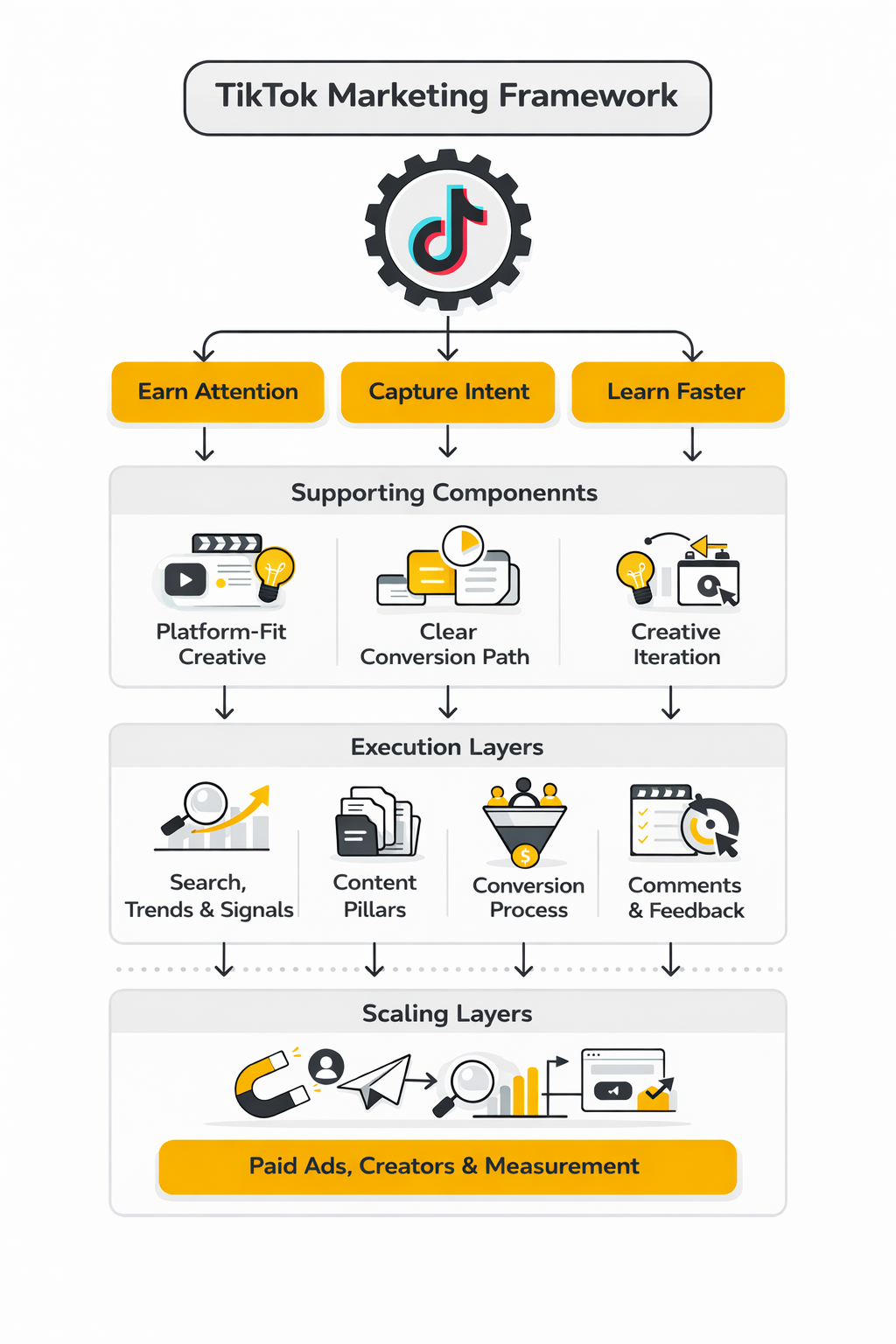
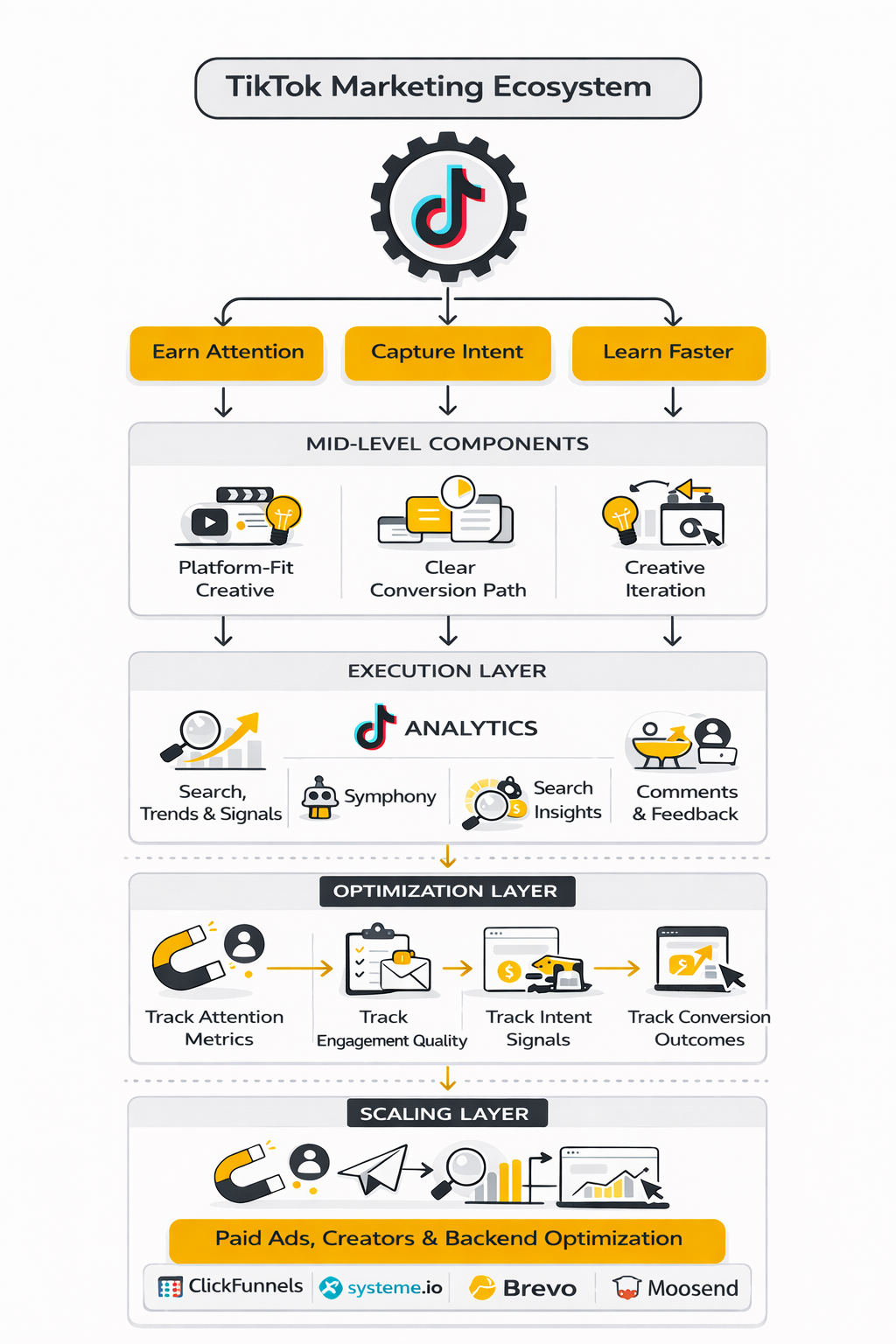
The framework for strong TikTok execution is simpler than most people make it. You need content that earns attention, a clear path that captures intent, and a feedback loop that helps you learn faster than competitors. Everything else is detail.
The first layer is attention. TikTok’s Creative Center and creative best-practice resources point in the same direction: platform-fit creative wins because it looks and feels native to the environment people are already enjoying. That means your opening hook, visual pacing, framing, captions, and storytelling structure matter more than squeezing your logo into the first second and hoping brand recognition does the heavy lifting.
The second layer is intent capture. Some viewers want to follow, some want to click, some want to search your brand name later, and some are ready for a landing page right now. That is where your backend matters. If your profile, offer, email capture, and sales page are messy, TikTok exposure turns into wasted motion, which is why tools like Buffer for workflow management or funnel platforms like ClickFunnels and systeme.io can make sense when they support a real conversion path instead of becoming another distraction.
The third layer is creative iteration. TikTok’s Return on Influence guidance emphasizes creative and creator variety, which is a useful reminder that one winning angle is never enough for long. Good TikTok marketing is not about finding a magical format and repeating it forever. It is about building a repeatable system for testing hooks, proof points, creators, offers, and audience signals until the channel becomes predictable enough to scale.
How The Rest Of This Article Builds On The Framework
The next parts of this article follow that framework in order. First, we will break down how to build a content engine that actually fits TikTok instead of copying Instagram Reels habits and calling it strategy. Then we will move into conversion mechanics, because views without action are nice for the ego and useless for the business.
After that, we will get into paid campaigns, creator partnerships, and measurement so you can scale what is already working rather than pouring budget into guesswork. By the end, you will have a practical system for using TikTok as a serious marketing channel, not just a place to chase trends and hope something pops.
Build a Content Engine That Fits TikTok
Most TikTok marketing tips fail because they start with content formats instead of content logic. People copy a trend, stitch together a few fast cuts, add captions, and assume they are doing TikTok marketing. In reality, a content engine works only when it is built around the way people discover, consume, and respond on the platform, which is exactly why TikTok keeps emphasizing creative relevance, trend awareness, and early-message clarity in its Creative Center, creative best practices, and creative guidance resources. TikTok For Business+2
The practical takeaway is simple. You do not need more random content. You need a repeatable system that turns audience signals into useful videos, useful videos into engagement, and engagement into business outcomes. TikTok’s own position has moved in that direction too, with tools like Keyword Insights, Trend Discovery, and Top Products all designed to help marketers connect ideas to visible demand rather than guess in the dark. TikTok For Business+2
Start With Search, Trends, And Audience Signals
A strong TikTok content engine begins before you press record. The first job is to understand what your market is already watching, asking, comparing, and reacting to. That matters more now because TikTok is not just an entertainment feed anymore. Adobe’s 2026 consumer survey found that 49% of U.S. consumers use TikTok as a search engine, up from 41% in its 2024 study, while Pew’s research shows many users are primarily watchers rather than active creators, which reinforces the idea that a big share of demand is hidden inside viewing and searching behavior. Adobe+2
This changes how you should research content ideas. Instead of asking, “What should we post this week?” ask, “What is our audience trying to solve, evaluate, or understand right now?” TikTok’s Keyword Insights and Trend Discovery exist for that exact reason, because they let you inspect the language, themes, and creative patterns already gaining traction. TikTok For Business+2
That also means search-friendly content deserves a permanent place in your plan. Not every video should chase a trend. Some of your best-performing assets will be straightforward answers to buyer questions, quick demos, comparisons, objections, myths, and beginner mistakes. TikTok marketing tips that ignore this usually create bursts of attention with no staying power, while search-aligned videos can keep pulling in qualified viewers long after the trend noise has moved on. Adobe+2
Build Around Content Pillars, Not One-Off Posts
Once you understand what people care about, the next step is to organize your output into content pillars. This is where a lot of brands get sloppy. They post one product video, one trend response, one behind-the-scenes clip, then disappear for a week and call the platform unpredictable. It is not unpredictable. It is just very hard to learn from scattered creative. TikTok’s own educational material keeps pointing marketers back to structured creative systems rather than isolated experiments. TikTok For Business+2
For most businesses, four pillars are enough to start. You need one pillar for education, one for proof, one for brand personality, and one for conversion-oriented content. Education helps you answer the questions people are already searching. Proof gives buyers reasons to trust you through demonstrations, outcomes, comparisons, or process transparency. Personality helps you feel native to the platform instead of sounding like an ad department. Conversion content makes the next step clear when intent is already there. TikTok’s 2025 trend report leans heavily into this blend of personality plus relevance, noting that 39% of TikTok users find brands that showcase personality more relevant. newsroom.tiktok.com+1
This structure also helps you avoid the most common creative trap on TikTok: overreacting to short-term performance. A single weak post does not mean a pillar is broken. It may just mean the hook was poor, the angle was wrong, or the timing was off. When you publish within a clear pillar system, you can test creative variables without losing strategic direction, which is exactly how a real content engine becomes more intelligent over time. TikTok For Business+2
Make The First Seconds Do Real Work
If there is one thing that keeps showing up in official TikTok guidance, it is the importance of the opening seconds. The platform’s help documentation says to prioritize the hook in the first six seconds, and its broader creative guidance repeats that the value proposition should land early so viewers know why they should keep watching. That is not a small production tweak. It is the difference between being skipped and being considered. TikTok For Business+2
A good hook is not just fast editing or loud text on screen. It creates a reason to stay. That reason can be curiosity, tension, surprise, usefulness, contrast, or a sharply stated problem. TikTok’s own creative best practices for top-performing ads frame the structure as hook, body, and close, and highlight that 90% of ad recall impact is captured within the first six seconds. Even if you are posting organic content, that principle still holds because the feed rewards instant clarity. TikTok For Business+1
This is why lazy openings kill otherwise good content. Long intros, generic branding, and slow setup waste the viewer’s decision window. Strong TikTok marketing tips always come back to this point because it is not optional anymore. You need to show the value fast, then earn the rest of the watch time with substance. TikTok For Business+2
Native Does Not Mean Low Effort
A lot of marketers still confuse “native” with “casual” and “casual” with “careless.” That is a mistake. TikTok does reward content that feels natural to the platform, but its business resources are very clear that effective creative still needs structure, messaging, and a deliberate narrative flow. The point is not to look unprepared. The point is to remove the friction that makes branded content feel stiff or out of place. TikTok For Business+2
So yes, looser framing, direct-to-camera delivery, and lighter production can work extremely well. But they work because they improve relatability and speed, not because standards suddenly disappear. TikTok’s SMB creative playbook and related guidance repeatedly emphasize narrative flow, unique selling points, and clear calls to action. In other words, the craft still matters. It is just being expressed in a platform-native way. TikTok For Business+1
This matters for teams that default to repurposing polished ad assets from other channels. Those assets can still be useful, but they usually need to be adapted. A TikTok-first version often works better when it feels less like a final commercial and more like an informed, confident recommendation made inside the feed itself. That shift in feel is one of the most practical TikTok marketing tips to internalize because it affects every creative decision after that. TikTok For Business+2
Use Comments As Content Research
The comment section is not just where engagement happens. It is one of the fastest feedback loops you have. TikTok’s 2024 shopping trend report highlighted that 68% of TikTok users say brands should use the comment section to better understand their customers, which is a very direct signal about how the platform wants brands to behave. Listening is not extra credit here. It is part of the job. TikTok For Business
That gives you a practical workflow. Pull recurring questions out of comments and turn them into videos. Pull objections into myth-busting clips. Pull confusion into tutorials. Pull praise into proof-driven content angles. The more your content reflects visible audience language, the more it tends to feel relevant instead of manufactured. TikTok For Business+2
This is also where smaller brands can compete harder than bigger ones. Large teams often move slowly. A smaller operator can notice a question in the morning, publish a response by afternoon, and learn from the reaction before the week is over. On a platform shaped by iteration, that speed is a real advantage. TikTok For Business+2
Build A Publishing System You Can Actually Sustain
The best content strategy in the world is useless if your team cannot maintain it. Sustainability matters on TikTok because creative iteration requires repetition. You need enough output to spot patterns, but not so much chaos that nobody knows what was tested, what worked, or what should be improved next. TikTok’s education resources are full of tools meant to reduce that chaos by making research, inspiration, and creative review more systematic. TikTok For Business+2
This is where operations start to matter almost as much as ideas. A simple workflow is usually enough: collect demand signals, map them to content pillars, script or outline the strongest angles, batch record, edit for native pacing, publish consistently, then review performance by hook, topic, and outcome. Social scheduling tools like Buffer can help keep that process moving, but the real win comes from discipline, not software. TikTok For Business+1
If you want this to stay manageable, keep your weekly system tight:
- review search terms, trends, and comments
- choose a small number of repeatable video angles
- record multiple videos in one session
- test different hooks for similar messages
- track which topics produce watch time, profile visits, clicks, and saves
That kind of rhythm is not flashy, but it is what separates serious TikTok execution from random posting. And once that engine is working, the next challenge becomes obvious: turning audience attention into measurable business results. TikTok For Business+2
Turn Views Into Traffic, Leads, And Sales
A lot of TikTok marketing tips stop at content creation. The assumption is that if you keep posting, growth will eventually show up somewhere in your business. Sometimes that happens, but it is unreliable and painfully slow. The brands that consistently win on TikTok treat attention as the start of the funnel, not the finish line.
TikTok’s own commerce research reflects that shift. Its collaboration with Ipsos on the Commerce Redefined report shows that TikTok users are significantly more likely to discover new brands on the platform compared with users of many other social channels, and the discovery moment often leads directly to deeper product research or purchase consideration. Commerce Redefined makes an important point here: discovery and transaction are moving closer together.
That means the question is no longer “How do we get views?” The real question is “Where do those viewers go next?” If your TikTok content performs but your business results stay flat, the gap usually lives between the video and the next step.
The Conversion Path Most Brands Miss
Think about TikTok as a discovery machine feeding a conversion system. When the two are connected, the platform becomes much more predictable.
Most businesses accidentally break the chain. They post useful content, viewers become curious, and then the viewer hits friction. Maybe the profile bio is vague. Maybe the link goes to a generic homepage. Maybe the offer is unclear. Instead of moving forward, the viewer scrolls away.
A simple structure fixes this.
- Content creates interest
- Profile reinforces authority
- Landing page captures intent
- Email or offer moves the relationship forward
When this sequence works, TikTok attention becomes measurable traffic and leads. That is why experienced creators often connect their profiles to a focused funnel instead of a messy website navigation tree. Platforms like ClickFunnels or systeme.io exist specifically to simplify that step so the viewer lands on a page designed for one clear action rather than ten competing choices.
TikTok itself reinforces the idea that clear next steps matter. The platform’s advertising and creative education materials repeatedly emphasize strong calls to action and simple user journeys because they directly improve campaign performance. When the path is obvious, viewers move.
What High-Converting TikTok Content Actually Looks Like
The content that drives business outcomes rarely looks like traditional advertising. It usually feels closer to a recommendation or a helpful explanation. TikTok’s marketing documentation consistently highlights creator-style storytelling because it keeps viewers watching long enough to absorb the message.
The structure is surprisingly consistent across high-performing videos.
- a sharp hook that identifies a problem or curiosity gap
- a clear explanation or demonstration
- a proof element such as results, data, or comparison
- a natural transition to the next step
That last part is where many creators hesitate. They worry that mentioning an offer will ruin the authenticity of the video. In practice, the opposite is often true. When a video actually solves a problem, viewers often want the next step.
Marketing experiments discussed in TikTok’s creative best practice resources show that clear calls to action significantly improve campaign outcomes when they appear naturally within the content flow. The platform rewards useful information first, but it does not punish clarity about what viewers should do next.
A Practical Execution Workflow
Turning TikTok attention into real growth becomes much easier when the process is visible and repeatable. Instead of guessing with every new post, treat content and conversion as one connected system.
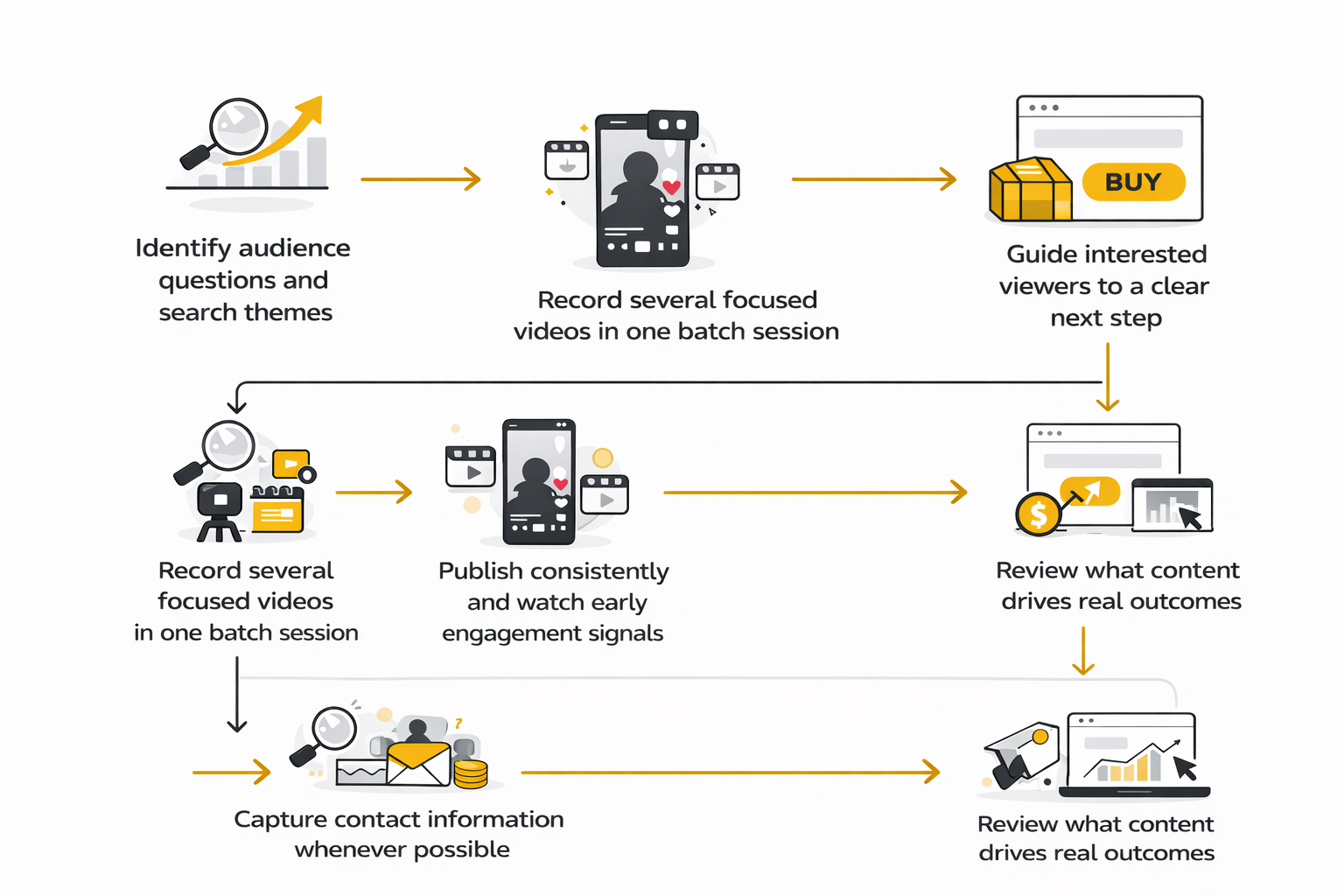
A practical weekly execution process looks like this.
- Identify audience questions and search themes Use TikTok search suggestions, comments, and trend data to identify what your audience is trying to learn or solve.
- Record several focused videos in one batch session Each video should address one specific question or insight. Avoid trying to cover too many ideas in one clip.
- Publish consistently and watch early engagement signals Pay attention to watch time, saves, comments, and profile visits rather than obsessing over raw view counts.
- Guide interested viewers to a clear next step Your profile and link should point toward a focused destination such as a guide, free resource, consultation, or product.
- Capture contact information whenever possible Email capture still matters because it moves the relationship off the platform. Services like Brevo or Moosend make it simple to turn that traffic into a list you control.
- Review what content drives real outcomes Over time, track which topics produce not just views but clicks, signups, or sales.
This process is not complicated, but it requires discipline. The goal is not to chase viral moments. The goal is to build a reliable discovery-to-conversion system.
Why Measurement Matters More Than Virality
The obsession with virality has probably damaged more TikTok strategies than any algorithm change. Viral clips are exciting, but they are unpredictable and rarely repeatable on demand.
A more professional approach focuses on signals that indicate business impact. Profile visits, link clicks, saves, comments asking for more information, and repeat viewers often tell you more about long-term potential than a sudden spike in views.
That is exactly why TikTok’s measurement partnerships and reporting tools continue expanding. The platform works with organizations like Nielsen to help advertisers understand cross-channel outcomes, which reflects a broader shift toward performance accountability rather than vanity metrics.
Once you start tracking outcomes instead of applause, a pattern usually appears. Certain topics consistently move viewers toward action. Others entertain people but never produce business results.
That difference becomes incredibly valuable because it shows you where to invest your creative energy next.
And that leads directly into the next phase of TikTok marketing: scaling what works with creators, ads, and smarter distribution.
What The Numbers Actually Mean On TikTok
A lot of TikTok marketing tips throw statistics at you as if more numbers automatically create better decisions. They do not. Raw data only becomes useful when you know what each signal is really telling you about audience behavior, creative quality, and commercial intent.
That matters even more on TikTok because the platform blends entertainment, search, discovery, and shopping in one feed. A video can generate strong reach and still be weak for business. Another can produce modest views but high-quality clicks, leads, or sales. If you do not separate those outcomes, you end up rewarding the wrong content and scaling the wrong ideas.
The smarter approach is to read TikTok analytics in layers. First, check whether the content earned attention. Then check whether it held attention. Then check whether it moved people toward action. That sequence is much more useful than staring at views in isolation and hoping the answer appears.
Start With Reach, But Do Not Stop There
Reach still matters because without distribution there is nothing to optimize. TikTok’s global footprint remains massive, with DataReportal’s 2025 TikTok overview showing ad reach at 1.59 billion adults each month, while Pew Research’s 2024 platform usage study confirms that a large share of users are primarily viewers rather than heavy creators. That combination tells you the platform is still a serious discovery engine, but it also reminds you that passive viewing is common, so reach alone does not prove persuasive impact.
This is where many teams get fooled. A high-reach video can simply mean the opening hook worked well enough to win initial distribution. It does not automatically mean the message landed, the audience was qualified, or the business offer resonated. In practical terms, reach is best treated as the top of the measurement stack, not the final verdict.
That is also why comparisons need context. If one video reaches 200,000 people and another reaches 40,000, the first one is not automatically better. If the smaller video drives more profile visits, more clicks, and better downstream conversion, it is doing more valuable work. TikTok marketing tips become much more effective the moment you stop treating exposure as the same thing as performance.
Watch Time Tells You Whether The Idea Had Real Pull
Once a video gets distributed, retention becomes the next reality check. TikTok’s own creative best practices for performance ads and top-performing ad guidance repeatedly emphasize early hooks, fast value delivery, and tight structure because the platform clearly sees attention quality as a major performance driver.
That is why watch time matters more than most beginners realize. It tells you whether the promise in the hook matched the substance in the body. If people leave quickly, the issue is often not the topic itself. It is usually the opening, pacing, clarity, or relevance of the message. A weak retention curve is a creative diagnosis tool, not just a disappointing stat.
Completion rate needs the same kind of careful reading. A short video with a high completion rate can be useful, but it does not always beat a longer video that holds qualified viewers and drives stronger action. The real question is whether attention stayed long enough for the viewer to absorb the point and care about the next step. That is the kind of interpretation that leads to better creative decisions instead of shallow benchmarking.
Engagement Signals Need To Be Read In Context
Likes are nice, but they are weak evidence on their own. Comments, saves, shares, profile visits, and repeat viewing usually tell you more about how meaningful the content actually was. TikTok’s own shopping research points in that direction too, with its 2024 shopping trend report showing that 68% of TikTok users think brands should use comments to understand customers better. That is not just a community management note. It is a measurement clue.
A save often signals future intent. The viewer found the content useful enough to keep. A share can signal social value, emotional impact, or practical relevance. A comment often reveals where understanding is high, where confusion remains, and where purchase questions are starting to appear. Those are much richer signals than a passive tap on the like button.
This is why engagement quality matters more than engagement volume. Ten comments asking pricing, setup, fit, comparisons, or implementation questions can be more valuable than a thousand likes from people who enjoyed the video and instantly forgot it. Strong TikTok marketing tips always become more commercial when they teach you how to read behavior, not just totals.
Search And Discovery Metrics Are Becoming More Important
TikTok is increasingly behaving like a search surface, not just a recommendation feed. Adobe found that 49% of U.S. consumers used TikTok as a search engine in 2026, up from 41% in its 2024 survey. That shift changes what success looks like because content can now perform through searchable relevance as well as pure feed velocity.
If your videos keep attracting views through search behavior, that usually means your topics, phrasing, captions, and audience alignment are working. It also means your content may have a longer performance tail than trend-based posts. That is a big deal for businesses because evergreen discovery content can keep producing qualified traffic after the initial publishing spike is over.
So when you review analytics, look for signs that content is meeting active intent rather than only casual scrolling behavior. Videos built around questions, comparisons, mistakes, tutorials, and buyer concerns often do better here. They may not always look like breakout entertainment, but they can be much stronger business assets over time.
Build A Simple Analytics System Around Business Outcomes
If your reporting is too complicated, nobody will use it properly. The best analytics system is usually the one your team can review every week without friction.
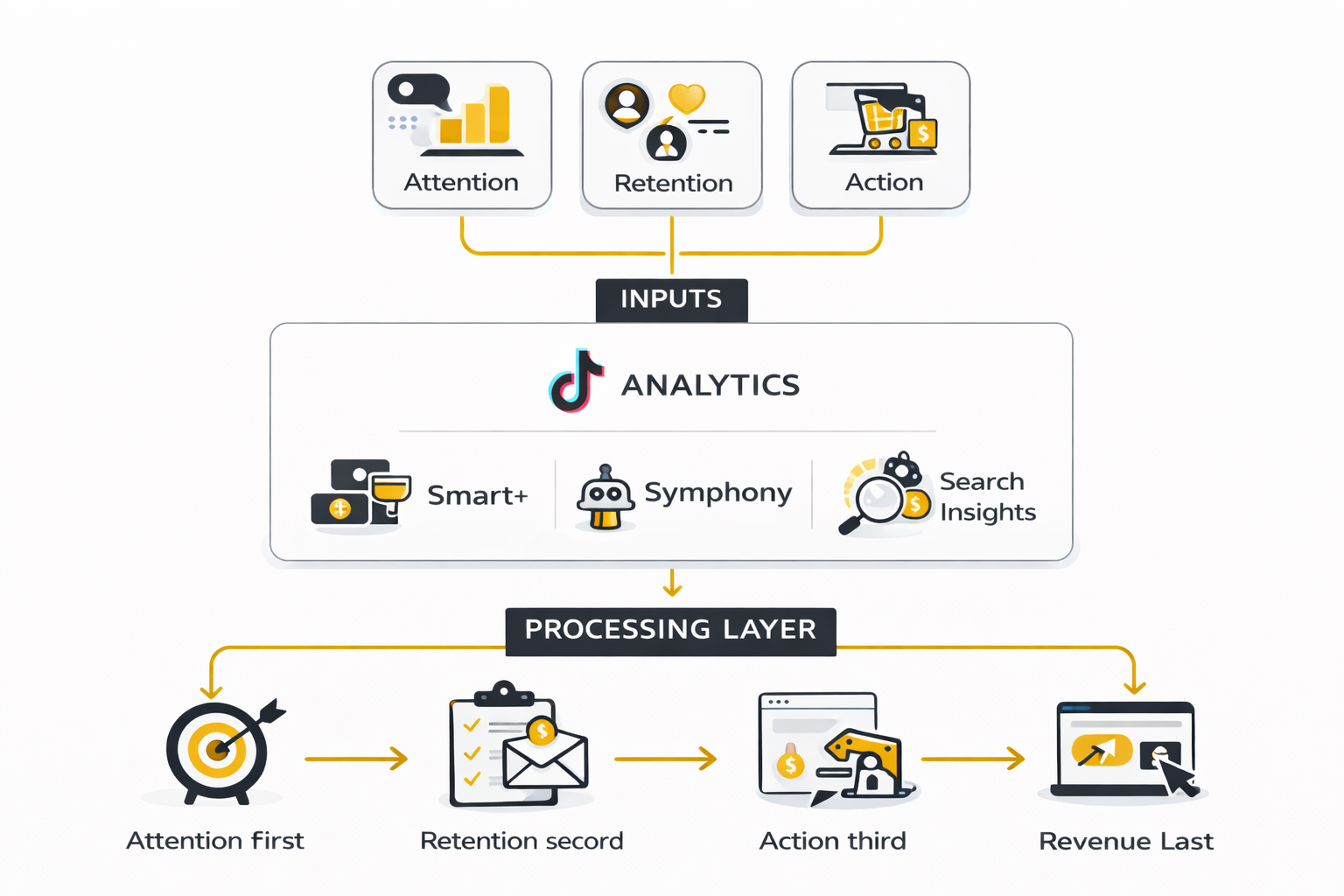
A practical measurement stack for TikTok looks like this:
- Attention metrics Track views, reach, average watch time, and completion patterns. These tell you whether the creative earned and held interest.
- Engagement quality metrics Review saves, shares, meaningful comments, profile visits, and follows. These show whether the content created enough relevance for people to respond.
- Intent metrics Monitor link clicks, landing page visits, product page sessions, and sign-up starts. This is where audience curiosity becomes measurable commercial movement.
- Conversion metrics Track leads, purchases, booked calls, or other core outcomes. This is the layer that tells you which videos are actually helping the business grow.
- Creative learning metrics Compare topics, hooks, formats, creators, offers, and calls to action. This is where analytics becomes strategy rather than just reporting.
That last layer is the one many teams ignore, and it is usually the most valuable. You are not measuring TikTok just to describe what happened. You are measuring it to decide what to do next. Once the data starts shaping creative choices, the channel gets much less chaotic.
Benchmarks Help, But Internal Trends Matter More
External benchmarks can be useful for orientation, but they are not a substitute for your own pattern recognition. Different industries, price points, audience sizes, and content styles produce very different performance profiles. A benchmark can tell you whether you are roughly competitive. It cannot tell you whether your next move should be a better hook, a sharper offer, a different creator, or a clearer landing page.
That is why internal trendlines matter more. Compare your own best educational posts against each other. Compare creator-led videos against founder-led videos. Compare direct offer clips against problem-first clips. Compare search-driven content against trend-driven content. Those comparisons are far more actionable because they are tied to your audience and your offer.
TikTok itself is leaning further into this performance mindset. At TikTok World 2025, the company introduced Market Scope as an analytics platform designed to help advertisers understand audiences across the funnel, which is a strong signal that the platform’s own direction is moving beyond vanity metrics toward more complete decision-making.
Use Data To Decide The Next Action
The point of analytics is not to admire dashboards. It is to trigger action. If retention is weak, rework the hook and pacing. If retention is strong but clicks are low, tighten the call to action or fix the offer. If clicks are high but conversions are poor, the problem probably lives on the landing page, not in the TikTok video itself.
That is where funnel tools and follow-up systems become relevant. If TikTok is generating interest but your backend is messy, you are leaking value. A cleaner landing page in ClickFunnels, a simpler opt-in flow in systeme.io, or a more reliable follow-up sequence in Brevo or Moosend can do more for growth than publishing ten extra videos with the same broken path.
This is the real value of measurement. It helps you locate the bottleneck. And once you know where the bottleneck is, you stop guessing and start improving the system with intent.
The next step is to take those insights and apply them at scale through creator partnerships, paid campaigns, and more deliberate distribution.
Scale With Ads, Creators, And Smarter Distribution
Once your organic content starts producing consistent signals, the next question is not whether to scale. It is how to scale without wrecking what made the content work in the first place. This is where a lot of TikTok marketing tips become dangerous, because they push teams straight into more spend, more automation, and more output without protecting creative quality or audience fit.
TikTok’s own product direction shows where scaling is heading. At TikTok World 2025, the company introduced tools like Affiliate Creatives for Ads and expanded its push toward full-funnel planning, while its 2026 announcements around Smart+, Market Scope, and Symphony make one thing very clear: TikTok wants brands to connect creative, media, creators, and measurement into one system instead of managing them as separate islands. newsroom.tiktok.com+3
That direction can be useful, but it also creates new tradeoffs. The more you automate, the easier it becomes to lose the human edge that made the creative work. The more you scale spend, the faster weak messaging gets exposed. The more creators you add, the harder brand consistency becomes. Growth gets easier only when the system underneath it is strong enough to handle the pressure. TikTok For Business+2
Know When Organic Proof Is Strong Enough To Amplify
Not every post deserves paid distribution. Some videos get views because the topic is broad, the hook is provocative, or the format is unusually entertaining, but none of that guarantees commercial intent. Before you put money behind a piece of creative, check whether it already shows the signals that matter for the business: strong retention, meaningful comments, profile visits, clicks, or some other action that proves the message did more than attract passive attention. TikTok’s own performance guidance keeps returning to the same logic by tying stronger outcomes to better data connections, clearer objectives, and creative that already fits the platform. TikTok For Business+2
This is one of the most useful filters you can build. Organic content is often your cheapest testing lab. Let it reveal which hooks, offers, and proof angles actually resonate before you scale them with budget. That way paid media becomes an amplifier of evidence instead of a substitute for strategy. TikTok For Business+2
The practical mistake is boosting content too early because it “looks good.” Good-looking creative is not the same as effective creative. Strong TikTok marketing tips have to account for that difference, because the cost of scaling weak content is not just wasted spend. It also muddies your data and makes future creative decisions less reliable. TikTok For Business+2
Creator-Led Scaling Works Best When Control Stays Tight
As brands grow on TikTok, creator partnerships become hard to ignore. That makes sense. Creator-native delivery often feels more credible inside the feed, and TikTok continues building infrastructure around creator-driven commerce and ad reuse. The 2025 TikTok World announcement around Affiliate Creatives for Ads is a good example, because it is designed to help merchants automatically turn authorized affiliate content into ad assets inside GMV Max campaigns. newsroom.tiktok.com
But creator scale introduces a real management problem. The moment multiple people are speaking for the brand, consistency can drift. Tone changes. Claims get sloppy. Messaging fragments. Compliance risk rises. What looked authentic at small scale can quickly become noisy when too many creators are given broad freedom without a clear brief. TikTok’s expanding creator and automation tooling makes creator-led scaling easier, but it does not remove the need for strong inputs. newsroom.tiktok.com+2
The smart move is to define non-negotiables before you expand creator volume. Give creators room to interpret, but lock down the offer, the proof points, the language they must avoid, and the action you want viewers to take. The brands that scale best on TikTok usually do not control every word. They control the strategic center and let native delivery happen around it. TikTok For Business+2
Automation Is Powerful, But It Can Make Lazy Teams Worse
TikTok is pushing hard into automation, and for good reason. Smart Performance Campaign, Smart+ App Campaigns, and the newer Smart+ performance updates are all built around reducing manual work while improving delivery and creative selection. Used well, that can save time and help strong advertisers scale faster. TikTok For Business+2
Used badly, it creates a false sense of competence. Automation is very good at optimizing within the boundaries you give it. It is not good at fixing a weak offer, inventing differentiated positioning, or making boring creative suddenly persuasive. If the fundamentals are soft, automation often just spends money faster and gives you cleaner-looking dashboards while the underlying problem remains untouched. TikTok For Business+2
That is why advanced TikTok execution still requires judgment. Let automation handle repetitive tasks, asset selection, and parts of media optimization. Do not outsource the core thinking. The team still has to decide what story the brand should tell, what proof matters, what objections need to be answered, and which audiences are worth pursuing in the first place. TikTok For Business+2
AI Creative Tools Help With Volume, Not With Taste
TikTok’s Symphony, the original Symphony launch, and the 2025 newsroom update covering new Image to Video, Text to Video, and Showcase Products tools all point toward the same future: faster creative production, more remixing, and easier TikTok-first adaptation at scale. That is useful, especially for lean teams that need more testing volume without building a huge in-house studio. TikTok For Business+2
Still, scale is not the same as quality. AI can help you multiply assets, localize versions, generate rough cuts, or create testing variants. What it cannot do on its own is develop taste, strategic restraint, or a real feel for what your market will trust. Those things still come from research, customer understanding, and editorial judgment. TikTok For Business+2
This is the real tradeoff. More production speed gives you more shots on goal, but it also makes it easier to flood your own system with mediocre creative. Advanced teams use AI to accelerate workflow, not to excuse weak ideas. If you remember that, these tools can be extremely practical. If you forget it, you end up publishing more and learning less. TikTok For Business+2
The Biggest Scaling Risk Is A Broken Back End
A surprising number of TikTok strategies fail after the content works. The videos perform, the clicks come in, and then the user hits a weak landing page, a cluttered offer, a bad signup flow, or no follow-up system at all. TikTok’s own help resources around lead generation emphasize low-friction forms, email list building, CRM sync, and simpler paths to capture intent, which is a useful reminder that media performance can collapse after the click if the backend is messy. TikTok For Business+1
This is why scaling is not just a content problem. It is an infrastructure problem too. If your funnel is confusing, your analytics are disconnected, or your follow-up is slow, better TikTok creative will only expose those weaknesses faster. Sometimes the highest-leverage move is not posting more videos. It is fixing the page, the form, the handoff, or the email sequence. TikTok For Business+2
For teams that need a cleaner conversion path, a more focused setup in ClickFunnels or systeme.io, paired with follow-up in Brevo or Moosend, can be more valuable than another month of scattered experimentation. That is not glamorous advice, but it is often the difference between attention that disappears and attention that compounds.
Platform Risk Is Real, So Build Transferable Assets
TikTok is powerful, but it is still rented land. Product features change, ad tools evolve, policies shift, and competitive conditions move fast. Even TikTok’s own 2025 and 2026 materials show a platform changing quickly through AI, commerce, creator reuse, and analytics expansion. That creates opportunity, but it also means you should never build a strategy that depends on one single mechanic staying stable forever. newsroom.tiktok.com+3
The safest way to handle that risk is to turn TikTok reach into assets you control. Capture email. Build remarketing audiences. Turn high-performing videos into reusable ad inputs. Extract customer language from comments and use it in landing pages, product messaging, and other channels. In other words, do not just publish on TikTok. Learn from TikTok and move that learning into the rest of your marketing system. TikTok For Business+2
That mindset changes the whole game. Instead of treating TikTok as a fragile traffic source, you start using it as a high-speed research and acquisition channel that strengthens your broader business. That is a much more durable way to think about growth.
Common Mistakes That Quietly Kill Results
The biggest mistake is trying to scale before the message is proven. The second biggest is assuming that more production automatically creates more performance. The third is measuring channel success by views while ignoring whether the content generated any movement that the business actually cares about. Those errors sound obvious when written out, yet they still sink a huge amount of work. TikTok For Business+2
Another common mistake is forcing TikTok to behave like older social channels. Brands reuse polished creative, over-script the delivery, and then wonder why the response feels cold. TikTok’s 2026 trend framing explicitly points toward unfiltered stories, behind-the-scenes moments, and real process over curated perfection, which is a strong signal that platform-fit execution still matters even as the tooling gets more advanced. TikTok For Business+1
And then there is the patience problem. Teams want certainty too fast. They test for a week, get mixed results, and start rebuilding everything from scratch. Serious TikTok growth usually comes from compounding insight, not constant reinvention. The brands that improve fastest tend to keep the core system steady while iterating the creative, the offer, and the conversion path with discipline. TikTok For Business+2
The final part of this article will bring everything together with practical next steps and clear answers to the questions that usually come up once you are ready to execute seriously.
Pulling The Whole TikTok System Together
By this point, the pattern should be clear. The best TikTok marketing tips are not random posting tricks. They are part of a system that starts with audience signals, turns those signals into native creative, connects that creative to a clean conversion path, and then uses measurement to decide what deserves more investment. TikTok’s own product direction keeps reinforcing that full-funnel model through tools like Creative Center, Keyword Insights, Search Ads Campaign, Smart+, and Symphony. TikTok For Business+4
That matters because TikTok is no longer just a place to test playful brand videos. It is a serious discovery and buying environment. TikTok’s newsroom said U.S. TikTok Shop sales were up 120% year over year in 2025, while DataReportal’s 2025 TikTok stats still show enormous platform reach, and Adobe’s 2026 consumer research says 49% of U.S. consumers use TikTok as a search engine. Those numbers do not mean every brand should treat TikTok the same way. They do mean the platform now touches discovery, evaluation, and conversion in a way marketers cannot afford to treat casually. newsroom.tiktok.com+1
The practical takeaway is simple. Stop thinking in terms of isolated posts and start thinking in terms of an ecosystem. Content, profile positioning, offer structure, landing pages, email follow-up, creator collaboration, and paid amplification all need to support each other. When they do, TikTok stops feeling chaotic and starts feeling like a channel you can actually manage with intent. newsroom.tiktok.com+2
FAQ - Built for Complete Guide
How often should I post on TikTok for marketing?
Consistency matters more than arbitrary volume. TikTok’s own guidance focuses heavily on creative quality, testing, and relevance rather than promising that a fixed posting quota will unlock growth. For most businesses, the right answer is to publish often enough that you can learn from patterns, but not so often that quality collapses and the team starts posting filler just to hit a number. TikTok For Business+1
Do I need to be on camera for TikTok marketing to work?
No, but hiding behind lifeless brand graphics usually makes the job harder. TikTok rewards content that feels human, clear, and native to the platform, and that can come from a founder, an employee, a customer, a creator partner, screen recordings, product demonstrations, or voiceover-led formats. The real requirement is not your face. It is a delivery style that feels direct, useful, and worth watching. TikTok For Business+1
Are TikTok marketing tips still relevant if my audience is not Gen Z?
Yes, and this is where a lot of outdated advice still misleads people. TikTok’s scale has expanded far beyond early stereotypes, with DataReportal’s 2025 analysis showing massive global ad reach and Pew Research’s platform study showing broad adult usage patterns. Your audience may not all live on TikTok, but if enough of them use it for discovery, research, entertainment, or product validation, it can absolutely matter to your business. DataReportal – Global Digital Insights+1
Should I focus on organic content or paid ads first?
Start with organic unless you already have strong creative proof from another channel that translates cleanly to TikTok. Organic content is usually the cheaper testing environment for hooks, angles, offers, and audience language. Once you know what earns retention, engagement, and qualified action, paid distribution becomes much easier to scale intelligently instead of turning into expensive guesswork. TikTok For Business+1
What matters more on TikTok: views or conversions?
Conversions matter more for the business, but views still matter as an early signal of distribution and creative fit. The mistake is treating high reach as automatic success when it may simply reflect a good opening hook rather than true buyer intent. The better approach is to read performance in sequence: attention first, retention second, action third, and revenue last. That is how you avoid scaling content that looks exciting but produces little commercial value. TikTok For Business+1
Can TikTok work for B2B marketing?
Yes, if you stop trying to make B2B look like a corporate brochure. Many B2B offers can perform well on TikTok when the content is built around pain points, process clarity, mistakes, comparisons, workflows, case-backed lessons, or sharp opinion-led commentary. TikTok users respond to useful specificity, and that creates real space for B2B brands that know how to translate expertise into accessible, native content. TikTok For Business+1
How important is TikTok SEO now?
It is much more important than many marketers still realize. Adobe’s 2026 survey found that 49% of U.S. consumers use TikTok as a search engine, and TikTok now offers Search Ads Campaigns plus Keyword Insights, which signals how seriously the platform is treating search behavior. That means captions, spoken keywords, on-screen language, and topic framing can all influence how discoverable your content becomes over time. TikTok For Business+1
Do hashtags still matter on TikTok?
They matter, but not in the simplistic way many checklist-style TikTok marketing tips suggest. Hashtags can help with categorization, trend alignment, and discovery context, especially when they reflect actual topic relevance. They do not rescue weak content, and they should not replace sharper work on hooks, structure, search phrasing, and audience fit. TikTok’s Trend Discovery tools are most useful when they help you understand context, not when they tempt you into stuffing tags under mediocre videos. TikTok For Business+1
What is the biggest mistake brands make on TikTok?
The biggest mistake is trying to look like a polished advertiser before earning the right to be heard like a useful participant. TikTok’s trend and creative resources keep pointing back to personality, relevance, and platform-native storytelling, not stiff repurposed assets from older channels. When brands ignore that and post safe, generic content, they often mistake poor fit for poor platform potential. newsroom.tiktok.com+1
Should I use creators even if I already have an internal team?
Usually yes, but only if the creator role is clear. TikTok’s 2025 announcements around Affiliate Creatives for Ads show how central creator-led assets have become inside the platform’s commerce and performance ecosystem. Internal teams can provide strategy, guardrails, product truth, and measurement discipline, while creators can provide native delivery, speed, and audience trust. The strongest systems often combine both instead of forcing one side to do everything. newsroom.tiktok.com
Is TikTok Shop necessary for every brand?
No, and this is where nuance matters. TikTok Shop is clearly growing fast, with TikTok reporting 120% year-over-year U.S. sales growth in 2025, but that does not automatically make it the right move for every business model. If your offer needs education, lead nurturing, consultations, or a more complex sales path, a direct funnel through a focused landing page may still be smarter than trying to force everything into native commerce. newsroom.tiktok.com
How do I know when a TikTok video deserves paid budget?
A video deserves paid support when it has already shown signs of commercial relevance, not just entertainment value. Look for strong retention, meaningful comments, profile visits, clicks, product interest, or downstream conversion behavior before you spend aggressively. TikTok’s Smart+ ecosystem can help automate delivery and optimization, but it still works best when you feed it creative that already proved it can move the right audience. TikTok For Business+2
Can AI help with TikTok content creation without making it worse?
Yes, but only when you use AI as a production assistant instead of a strategy replacement. TikTok’s Symphony updates and newer Smart+ AI features make it easier to create variations, generate assets, and keep testing volume high. What AI still cannot do for you is develop taste, customer empathy, proof selection, or a strong point of view. If those are weak, faster production just gives you more weak content. TikTok For Business+1
What should my TikTok profile link lead to?
It should lead to the simplest next step that matches the intent created by your content. For some brands that is a product page, for others it is a lead magnet, consultation page, newsletter, demo request, or a more focused mini-funnel. If your current site sends TikTok visitors into a messy navigation maze, a tighter page built in ClickFunnels or systeme.io, followed by email nurture in Brevo or Moosend, will usually convert better because it reduces friction and clarifies the ask.
Is TikTok worth the effort if I already have Instagram or YouTube working?
Often yes, because TikTok does not just duplicate what those platforms do. Its discovery patterns, search behavior, creator culture, and commerce tooling create different opportunities, especially when you want faster creative feedback and more direct visibility into what language, topics, and hooks the market is reacting to right now. Even when TikTok is not your biggest revenue channel, it can still become one of your best research and message-testing environments. TikTok For Business+2
Work With Professionals
Explore 10K+ Remote Marketing Contracts on MarkeWork.com
Most marketers spend too much time chasing clients, competing on crowded platforms, and losing a percentage of every project to middlemen.
MarkeWork gives you a better way. Browse thousands of remote marketing contracts and connect directly with companies desperate to hire skilled marketers like you, without platform commissions and without unnecessary gatekeepers.
If you're serious about finding better opportunities and keeping 100% of what you earn, explore available contracts and create a profile for free at MarkeWork.com.