

The best affiliate programs are not always the ones with the highest commission rate. A 50% payout sounds exciting, but it means very little if the product has weak demand, poor retention, confusing tracking, or an audience mismatch. The real game is finding offers your audience already needs, then building trust before you ever ask for the click.
Affiliate marketing keeps growing because it gives brands something they badly want: performance-based distribution. Recent industry research shows affiliate and partnership marketing now contributes meaningful revenue for many brands, with Impact reporting that most surveyed brands generate 11–30% of revenue from affiliate marketing. That is why top affiliate programs are no longer limited to Amazon links and coupon sites. SaaS, creator tools, marketing platforms, AI software, ecommerce infrastructure, and business services are all fighting for serious referral partners.
This guide is built for people who want to choose programs like an operator, not a lottery ticket buyer. We will look at what makes a program worth promoting, how to compare commission models, where beginner-friendly offers fit, and how to build a portfolio that can survive algorithm changes, commission cuts, and product pivots.
Article Outline
- Part 1: How to Think About Top Affiliate Programs
- Part 2: What Makes an Affiliate Program Worth Promoting
- Part 3: The Best Affiliate Program Categories by Business Model
- Part 4: How to Match Programs to Your Audience
- Part 5: Professional Implementation and Promotion Systems
- Part 6: Common Mistakes, Compliance, and FAQ
How to Think About Top Affiliate Programs
A top affiliate program sits at the intersection of audience fit, product value, conversion potential, tracking reliability, and payout quality. You are not just choosing a link. You are choosing what kind of buyer journey you want to attach your reputation to.
That is why broad lists can be misleading. Amazon Associates is easy to join and familiar to buyers, but many categories pay modest percentages. A specialized SaaS program like GoHighLevel, ManyChat, or ClickFunnels can produce higher recurring revenue, but only if your audience actually wants marketing automation, funnels, or client acquisition systems.
The right question is not “Which program pays the most?” The better question is “Which program solves a painful problem for the people who already trust me?” Once you frame it that way, the list of serious options gets much smaller and much more profitable.
Why Top Affiliate Programs Matter
Affiliate income compounds when three things work together: useful content, buyer intent, and a product that keeps delivering value after the sale. If one of those pieces is weak, the whole system becomes fragile. You might get clicks without sales, sales without retention, or commissions that vanish when the merchant changes terms.
This matters even more now because affiliate marketing is no longer a side channel for many companies. Brands are investing in partner programs because paid ads are expensive, attention is fragmented, and trusted recommendations convert better than cold traffic. The FTC’s endorsement guidance also makes one thing clear: trust and disclosure are not optional details.
For affiliates, that creates both opportunity and responsibility. You can earn from recommendations, but you have to protect your credibility. The fastest way to lose long-term revenue is to promote tools you would never seriously use, understand, or recommend to a client.
Framework Overview
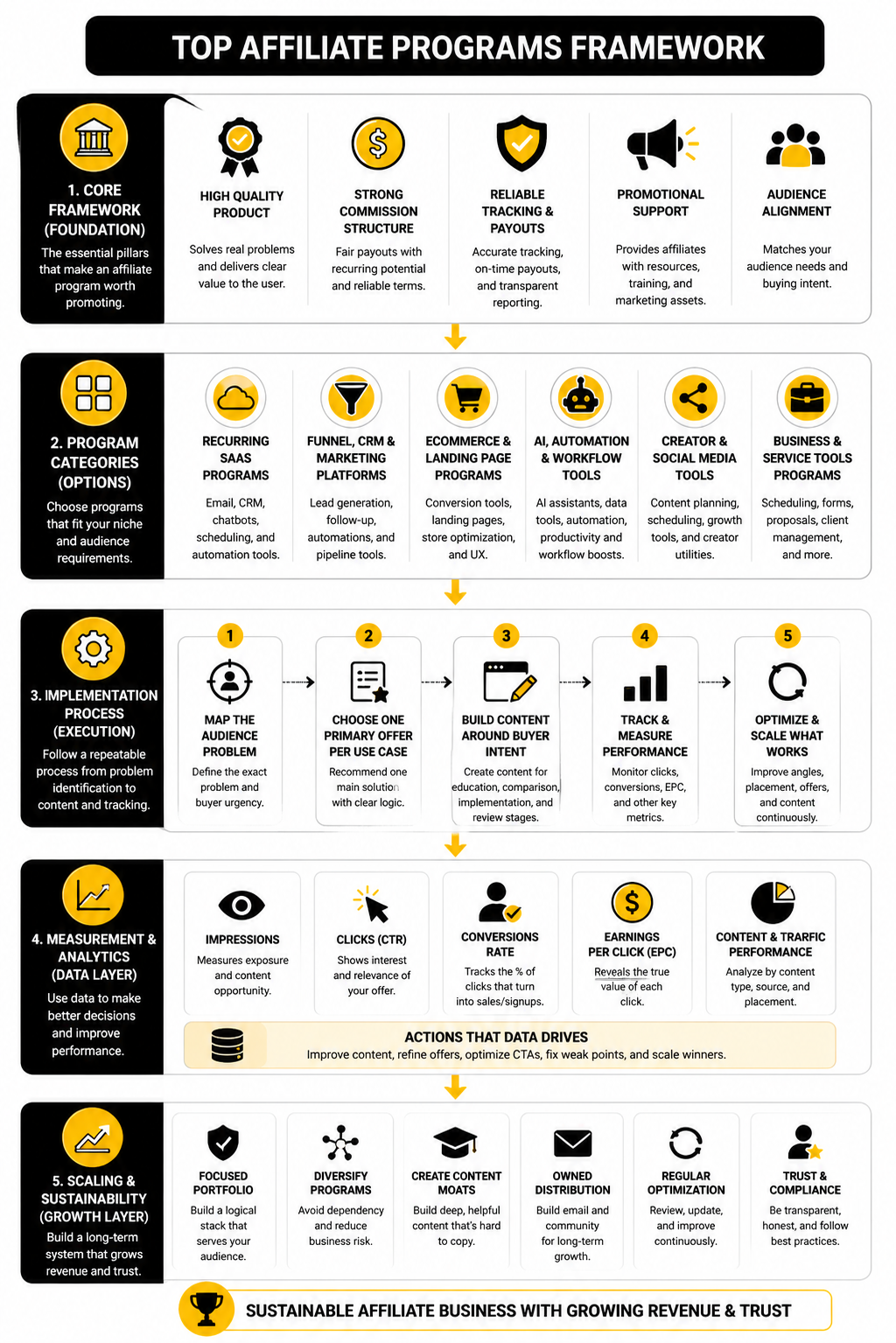
Use a simple four-part framework before joining or promoting any program: audience fit, offer economics, conversion environment, and operational trust. Audience fit tells you whether the product belongs in your content. Offer economics tells you whether the commission is worth the effort.
Conversion environment is about what happens after the click. Does the landing page explain the product clearly? Is there a free trial, demo, lead magnet, webinar, or low-friction entry point? For example, a tool like Systeme.io may appeal to beginners because it combines funnels, email, and course selling in one platform, while Replo fits a more specific ecommerce audience that cares about high-converting landing pages.
Operational trust is the part many beginners ignore. You need clear terms, reliable tracking, realistic payout rules, and a product team that does not treat affiliates as disposable traffic sources. A smaller commission from a stable program can beat a huge commission from a messy one.
What Makes an Affiliate Program Worth Promoting
A program is worth promoting when it gives your audience a real win and gives you a fair path to revenue. Both sides matter. If the product is useful but the commission structure is weak, you may be doing unpaid sales work for someone else’s business.
Start with the buyer problem. A tool like ManyChat makes sense when your audience wants automated conversations across social and messaging channels. A platform like ClickFunnels fits better when people need funnels, landing pages, and sales flows. A CRM and agency platform like GoHighLevel fits when your readers are consultants, agencies, local service providers, or operators who need a full client acquisition system.
The best top affiliate programs also make the next step obvious. A visitor should understand what the product does, who it is for, and why they should act now. If the landing page is confusing, your content has to work twice as hard, and that usually means lower earnings.
Commission Quality Beats Commission Hype
High commissions look good on a spreadsheet, but quality matters more than headline percentage. A 30% recurring commission on a product people keep using can be stronger than a one-time 80% payout on something with weak retention. Recurring software, business tools, and subscription platforms often work well because the customer keeps paying when the product becomes part of their workflow.
Look at the commission model carefully. Some programs pay a flat bounty, some pay a percentage of the first sale, and others pay recurring revenue for a set period or for the life of the customer. None of those models is automatically better. The best choice depends on product price, refund rate, customer lifetime, and how much education your audience needs before buying.
This is where many beginners get distracted. They chase the biggest number instead of the strongest business case. You want an offer where the payout, buyer intent, and product stickiness all support each other.
Product-Market Fit Comes First
An affiliate offer converts best when it feels like the natural next step after your content. If someone reads a guide about building ecommerce landing pages, Replo can fit naturally because the reader already cares about storefront conversion. If someone is learning email marketing, tools like Brevo or Moosend can fit without forcing the recommendation.
Bad fit creates friction. You can write a perfect review, but if the audience does not feel the pain the product solves, the link will not perform. That is why niche relevance usually beats general popularity.
Before joining a program, ask one practical question: would this product make sense in at least five pieces of content you can honestly create? If the answer is no, it may not deserve space in your affiliate stack. One isolated mention rarely builds meaningful affiliate income.
Tracking, Cookie Windows, and Attribution Matter
Affiliate tracking is not a boring backend detail. It decides whether you get paid. Cookie duration, attribution rules, coupon leakage, last-click policies, and payout validation can all change the real value of a program.
A short cookie window may be fine for impulse purchases, but it is usually weaker for B2B tools or higher-ticket software where people compare options before buying. Longer consideration cycles need more forgiving attribution. If a program expects you to educate the buyer but gives you almost no tracking window, that is a bad trade.
Also check whether the program gives you a clean dashboard. You need to see clicks, trials, conversions, commissions, and payout status without guessing. If the reporting is vague, you cannot improve your content with confidence.
The Sales Page Should Help You, Not Fight You
Your content creates interest, but the merchant’s page closes the sale. That means the offer page needs clear positioning, strong proof, simple pricing, and a next step that matches buyer intent. If the page feels messy or overcomplicated, even warm traffic can fall apart.
For example, a beginner comparing funnel builders may respond better to a simple signup path like Systeme.io, while a more advanced marketer may want the broader funnel ecosystem behind ClickFunnels. Neither recommendation is universally right. The right one depends on the buyer’s stage, budget, and technical confidence.
Before promoting any offer seriously, click through the journey yourself. Read the page, test the signup flow, check the pricing logic, and look for points of confusion. If you would hesitate as a buyer, your audience probably will too.
Support and Retention Protect Your Reputation
The sale is not the end of the affiliate relationship. If the product disappoints customers, your audience remembers who recommended it. That is why support quality, onboarding, education, and product reliability belong in your evaluation.
Tools with good onboarding reduce refunds and increase customer success. That helps the user, the merchant, and you. It also gives you more angles for useful content, because you can create tutorials, comparisons, setup guides, and implementation checklists that genuinely help people get results.
This is especially important for business software. A platform like GoHighLevel can be powerful, but the best audience is usually someone ready to implement systems, not someone looking for a magic button. Matching the product to the right maturity level protects trust and improves conversions at the same time.
The Best Affiliate Program Categories by Business Model
Once you know what makes an offer worth promoting, the next step is choosing the right category. This is where many affiliates make the wrong move. They pick programs because the brand is popular, not because the business model matches their traffic, audience, and content style.
The strongest top affiliate programs usually fall into a few practical categories: recurring SaaS, funnel and marketing platforms, ecommerce tools, creator tools, AI and automation software, and service-based business tools. Each category behaves differently. Some need comparison content, some need tutorials, and some need proof-heavy implementation guides before buyers feel ready.
Your job is not to promote everything. Your job is to build a focused recommendation stack that makes sense together. When your offers support the same audience journey, your content starts working like a system instead of a random collection of links.
Recurring SaaS Programs
Recurring SaaS affiliate programs are attractive because they can keep paying after the first conversion. This works especially well when the product becomes part of the customer’s daily workflow. Email platforms, CRMs, chatbots, scheduling tools, analytics software, and automation platforms all fit this pattern.
The catch is simple: recurring commissions only matter when customers stay. That means you should care about onboarding, product depth, customer support, and whether the tool solves a painful ongoing problem. A weak subscription product will not create durable income just because the commission page says “recurring.”
This category is a strong fit for educational content. Tutorials, setup guides, migration guides, and “how to choose” comparisons can all work because software buyers usually want clarity before they commit. A practical recommendation like Brevo, Moosend, or Cal.com should be tied to a specific use case, not dropped into an article as a generic tool mention.
Funnel, CRM, and Marketing Platform Programs
Funnel and CRM platforms can produce strong affiliate revenue because they sit close to money. They help people capture leads, follow up, sell offers, manage pipelines, and automate customer journeys. When a product helps someone make or save revenue, the buying intent is usually stronger.
This is where platforms like ClickFunnels, Systeme.io, and GoHighLevel can fit naturally. They are not interchangeable, though. A solo creator building a simple lead magnet does not have the same needs as an agency building client automations and white-label systems.
The content angle matters a lot here. “Best platform” articles can work, but implementation content is usually more persuasive. Show the reader how the tool fits into a lead funnel, booking flow, client onboarding process, or follow-up sequence, and the recommendation feels useful instead of forced.
Ecommerce and Landing Page Programs
Ecommerce affiliate programs work best when your audience already understands the value of conversion rate improvements. Store owners do not just want pretty pages. They want pages that load quickly, explain the offer clearly, reduce friction, and move shoppers toward the next step.
That is why a tool like Replo fits better in content about Shopify landing pages, product page testing, campaign pages, and ecommerce growth than in a generic business tools list. The narrower the use case, the easier it is for the reader to see why the tool matters. Specificity sells.
This category also rewards visual and process-based content. Break down page structure, offer hierarchy, hero sections, trust elements, product education, and checkout paths. When the reader can see the implementation path, the affiliate link becomes a natural next step.
AI, Automation, and Workflow Tools
AI and automation tools are growing quickly, but this category needs discipline. It is easy to promote every shiny product and end up with a messy stack that confuses your audience. The better approach is to recommend tools that remove a real bottleneck in a defined workflow.
For example, Chatbase can make sense in content about customer support bots, lead qualification, or website assistants. Firecrawl fits a more technical audience that needs web data extraction for AI apps, research, or automation workflows. Wispr Flow belongs in productivity content where speed, writing, and voice-first workflows are the problem.
AI offers can convert well when you avoid hype. Show what the tool actually replaces, what it does not replace, and where it fits in the user’s workday. That honesty makes your recommendation more believable and usually improves buyer quality.
Creator and Social Media Tool Programs
Creator tools are a good fit when your audience is trying to publish consistently, grow distribution, or improve content operations. These programs often work well with how-to content because creators are constantly looking for simpler ways to plan, produce, schedule, and improve content. The best angle is not “use this tool because it exists.” The angle is “use this tool to remove this specific content bottleneck.”
A scheduling platform like Buffer fits content about planning and publishing across channels. A tool like Flick Social can fit content around hashtag research, social media workflows, and Instagram growth operations. BetterPic can fit when the audience needs professional-looking headshots without a traditional shoot.
This category can drive a lot of clicks, but clicks are not the goal. Your content should help readers decide whether the tool belongs in their workflow now. If they are not publishing consistently yet, a scheduling tool may be premature. If they already have content volume but poor organization, it might be exactly the right recommendation.
Building an Affiliate Implementation Process
At this stage, choosing programs becomes an execution problem. You need a repeatable process for selecting offers, testing demand, creating content, tracking results, and improving what already works. Without that process, even the best top affiliate programs become guesswork.
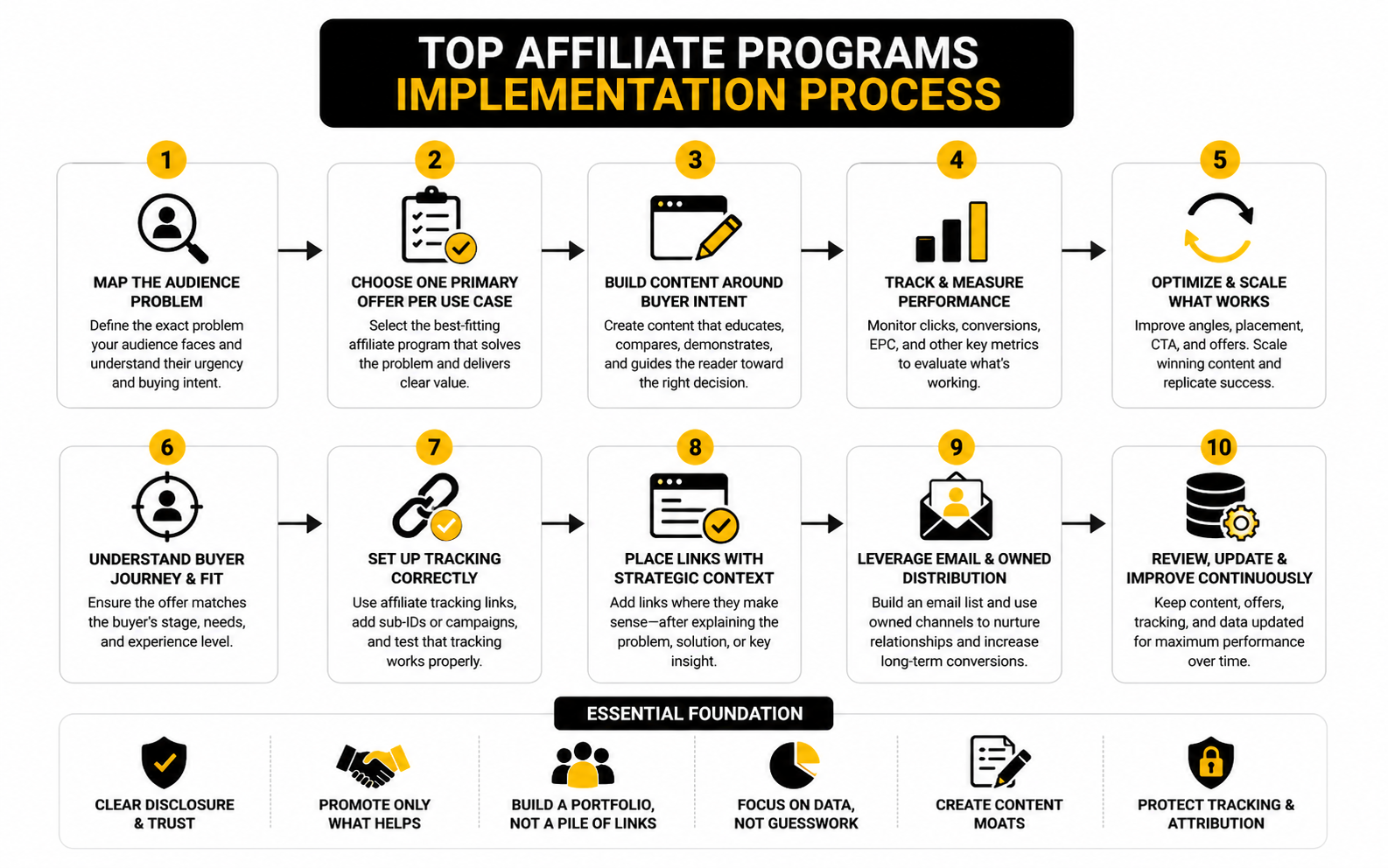
Think of the process as a simple operating system. You start with the audience problem, choose the offer that solves it, create content around the buying journey, then measure whether people click and convert. When the numbers are weak, you improve the angle before blaming the program.
This is where affiliates become professionals. They stop asking, “What should I promote?” and start asking, “Where does this product fit in the customer journey, and what proof does the reader need before they act?” That one shift changes everything.
Step 1: Map the Audience Problem
Start by writing down the exact problem your reader is trying to solve. Not the broad niche. The specific pain. “Email marketing” is broad, but “I need a simple email tool for a new service business” is clear.
Once the problem is clear, match it to buyer urgency. Some problems are annoying but not urgent. Others block revenue, waste time, or create daily frustration. The closer the problem is to money, time, or operational pain, the easier it is to create content that converts.
This step also protects you from irrelevant offers. A product may be excellent, but if it does not match the reader’s current problem, it does not belong in that piece of content. Relevance is the first filter.
Step 2: Choose One Primary Offer Per Use Case
Do not overload every article with ten affiliate links. Too many choices create friction, especially when the reader is already comparing tools. A stronger approach is to pick one primary recommendation and mention alternatives only when they genuinely help the decision.
For example, a guide for beginners building a simple funnel might lead with Systeme.io. A guide for agencies managing leads, appointments, automations, and client accounts might lead with GoHighLevel. A page about ecommerce campaign landing pages might lead with Replo.
This does not mean you ignore other programs. It means every article needs a clear recommendation logic. Readers can feel when a page is helping them decide, and they can also feel when it is just collecting commissions.
Step 3: Build Content Around Buyer Intent
Affiliate content works best when it meets the reader at the right stage. Some people need education, some need comparison, and some are almost ready to buy. Each stage needs a different content format.
Educational content explains the problem and introduces the category. Comparison content helps readers evaluate options. Implementation content shows how the product works in a real workflow. Review content helps remove final doubts before the click.
The mistake is using the same CTA everywhere. A beginner may need a simple explanation and a low-friction signup. A serious buyer may want a detailed walkthrough, pricing context, and a stronger reason to choose one platform over another. Match the content to the decision stage, and your affiliate links will feel more natural.
Statistics and Data
Data should make your affiliate decisions sharper, not noisier. Random statistics do not help if they do not change what you publish, promote, or improve. The point is to understand which top affiliate programs deserve more attention, which content assets need work, and which offers should be removed from your stack.
Affiliate marketing is already a serious revenue channel for brands, not a small side experiment. The 2025 State of Affiliate Marketing report found that 74% of brands generate 11–30% of total revenue from affiliate marketing. That matters because it shows brands are not just tolerating affiliate traffic; many are building real revenue systems around it.
But that does not mean every affiliate offer is good. A growing channel attracts excellent programs and weak programs at the same time. Your measurement system is what separates the offers worth scaling from the ones that only look good on a commission page.
The Numbers That Actually Matter
Start with four numbers: impressions, clicks, conversions, and earnings per click. Impressions tell you how much opportunity your content has. Clicks show whether your recommendation is compelling enough to create action.
Conversions show whether the offer and landing page are doing their job after the click. Earnings per click connects everything together because it tells you how much each click is worth on average. A program with fewer clicks but higher earnings per click may be more valuable than a popular tool that attracts curiosity clicks but does not convert.
Do not obsess over one metric in isolation. A low click-through rate may mean the CTA is weak, but it may also mean the offer is placed too early in the article. A high click-through rate with poor conversions may mean your content is attracting the wrong buyer or sending people to a poor-fit program.
How to Read Click-Through Rate
Click-through rate tells you whether the reader sees the offer as relevant in that moment. If a tool is mentioned after a strong problem explanation, a useful comparison, or a clear implementation step, clicks usually make more sense. If the link appears randomly, the reader has no reason to care.
For example, a link to Fillout fits naturally in content about lead capture forms, quizzes, intake flows, or customer onboarding. A link to Chatbase fits better when the article is about website assistants, support automation, or AI lead qualification. The same link can perform very differently depending on the surrounding context.
When click-through rate is weak, fix the context before changing the offer. Rewrite the paragraph before the link. Make the reader’s problem more specific. Explain why this tool is the logical next step, then check whether clicks improve.
How to Read Conversion Rate
Conversion rate tells you what happens after the click. If people click but do not sign up, the problem is usually one of three things: the offer is wrong, the landing page is weak, or your content created the wrong expectation. This is why honest positioning matters.
A tool like GoHighLevel may convert well for agencies, consultants, and service businesses that need pipeline, automation, and client management in one place. The same tool may struggle with a beginner who only wants a simple landing page. That is not a product problem; it is a fit problem.
You should also compare conversion rate by content type. Reviews, tutorials, alternatives pages, and “best tools” articles often produce different buyer intent. A tutorial may drive fewer clicks but better-qualified users because the reader already understands the workflow.
Earnings Per Click Is the Reality Check
Earnings per click is one of the cleanest ways to compare programs because it blends commission size and conversion performance. A high commission does not matter if nobody buys. A lower commission can still be excellent if the product converts consistently and keeps customers around.
Use earnings per click to decide where to invest more content time. If Brevo performs well in beginner email marketing content, create more assets around email setup, list growth, and automation basics. If Replo performs well in ecommerce landing page content, expand into campaign page examples, Shopify conversion workflows, and product launch pages.
This metric also helps you avoid emotional decisions. You may personally like a product, but if it produces weak earnings per click across several relevant pages, it may not deserve prime placement. Keep the product in your toolkit if it is useful, but do not give it your best commercial real estate unless the numbers justify it.
Building a Simple Affiliate Analytics System
Your analytics setup does not need to be complicated. It needs to be consistent. Track each offer by content asset, link position, content type, traffic source, clicks, conversions, commission, and payout status.
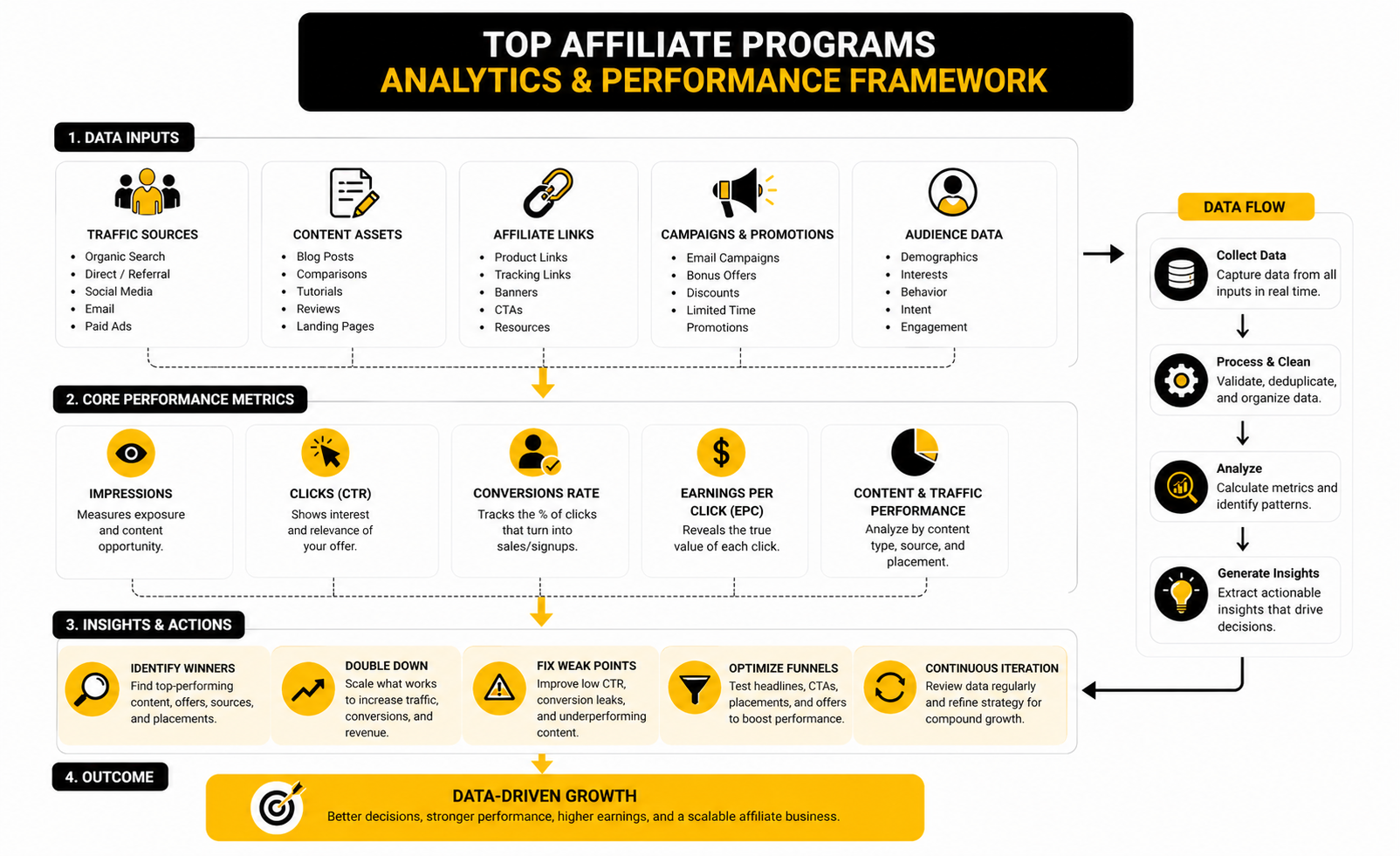
Use tracking IDs or sub-IDs wherever the affiliate platform allows it. Label links by page and placement, such as review-top-cta, tutorial-mid-link, comparison-table, or email-footer. This makes it much easier to see whether performance comes from the offer itself or from the way you presented it.
You can also use a link management tool like Dub.co when you need cleaner campaign organization, short links, and performance visibility across multiple placements. The goal is not to make links look clever. The goal is to know which content and offers are actually producing revenue.
Benchmarks Are Useful Only When They Are Local
Industry benchmarks can give context, but your own baseline matters more. The Awin and Forrester affiliate survey shows that marketers continue to value the channel, but that does not tell you what your audience will do on your site. Your traffic source, niche, trust level, and content format can completely change the numbers.
A YouTube tutorial, an SEO comparison page, a newsletter recommendation, and a paid community resource may all promote the same product with different results. That does not mean one channel is “better.” It means each channel has a different level of intent and trust.
Build benchmarks from your own data after you have enough clicks to make a fair judgment. Do not kill an offer after five clicks. But do not keep defending it after hundreds of relevant clicks with no meaningful outcome.
What Performance Signals Should Trigger Action
Good affiliate measurement should lead to clear decisions. If impressions are high and clicks are low, improve the placement, CTA, and surrounding copy. If clicks are high and conversions are low, revisit the offer fit and landing page expectation.
If conversions happen but payouts are weak, compare commission structure, refund rules, and customer value. A program may convert, but still not be worth scaling if the economics are thin. This is especially important when choosing between one-time commissions and recurring tools.
If one page performs unusually well, do not just celebrate it. Study why it works. Look at the keyword intent, the promise, the section before the link, the CTA wording, and the product fit. Then build more content around the same decision pattern.
Professional Implementation and Promotion Systems
At a certain point, affiliate marketing stops being about finding more programs and starts being about building a better system. This is where most people plateau. They keep adding links, but they do not improve the way those links are positioned, tested, updated, and protected.
The real advantage comes from treating top affiliate programs like business assets. You need a clear content map, clean tracking, strong disclosures, offer backups, and a review rhythm. That may sound less exciting than chasing the newest commission, but it is what separates durable affiliate income from random spikes.
This also protects your audience. When your process is structured, you are less likely to recommend weak tools just because the payout is tempting. You make better decisions because every offer has to earn its place.
Build a Portfolio, Not a Pile of Links
A pile of links is messy. A portfolio has logic. Each program should serve a specific audience segment, content type, or business problem.
For example, GoHighLevel can sit in an agency and service-business stack, while Systeme.io may fit a simpler creator or beginner funnel stack. Buffer belongs in a publishing workflow, while Fillout belongs in lead capture, onboarding, and form-based automation content. The offers can coexist, but they should not compete for the same job.
A strong portfolio also gives you resilience. If one merchant changes commission rules, sunsets a plan, or stops converting, your entire revenue base does not collapse. You have alternatives because your strategy is built around audience problems, not one brand.
Avoid Single-Program Dependency
Single-program dependency is dangerous because you do not control the merchant. They can change commission rates, cookie windows, payout thresholds, product positioning, or approval rules. Even great programs can become weaker for your business if their terms shift.
That does not mean you should promote ten tools in every category. It means you should know your primary option, your secondary option, and the reason each one exists. Your content can still lead with one clear recommendation, but your business should not depend on one company’s affiliate dashboard.
This matters especially with software tools. A product like ClickFunnels may be a strong fit for funnel-focused buyers, but a beginner may prefer a lighter path. A serious operator should map those differences before the article is published, not after conversions disappoint.
Use Comparison Content Carefully
Comparison content can convert well because the reader is already evaluating options. But it is also where trust gets damaged fastest. If every comparison magically crowns the highest-paying product, readers notice.
The better approach is to define the buyer first. Compare tools by use case, budget, complexity, implementation speed, support needs, and long-term fit. A platform can be the best choice for one person and the wrong choice for another.
This is where strong affiliate content feels more like consulting than selling. You are helping the reader avoid a bad decision. That is much more persuasive than pretending one tool wins every category.
Protect Attribution and Link Hygiene
As your traffic grows, link hygiene becomes more important. Broken links, expired offers, incorrect tracking, missing parameters, and outdated CTAs all create silent revenue leaks. You may think a page is underperforming when the real issue is technical.
Review your highest-value links regularly. Check that they resolve correctly, preserve tracking, and land on the right page. If you use redirects or a link tool like Dub.co, keep naming conventions consistent so you can audit performance quickly.
Also watch for attribution issues. Coupon extensions, last-click overwrite, and copied discount codes can shift credit away from the content that created the sale. You may not be able to control every merchant’s attribution model, but you can choose programs that take tracking quality seriously.
Create Offer-Specific Content Moats
The easiest affiliate content to copy is a generic listicle. The hardest content to copy is based on implementation depth, decision logic, and real workflow understanding. That is where your moat comes from.
Instead of only publishing “best tools” articles, build supporting assets around each important program. Create setup guides, mistake guides, use-case breakdowns, comparison pages, and workflow templates. A recommendation for ManyChat becomes stronger when it appears inside practical content about automated conversations, lead qualification, and social messaging flows.
The same applies to technical or specialized tools. Firecrawl makes more sense when the content explains a data extraction or AI workflow. Chatbase becomes more compelling when the reader understands how a website assistant fits into support, onboarding, or lead capture.
Balance SEO, Email, and Owned Distribution
SEO is powerful, but relying only on search traffic is risky. Rankings move, search layouts change, and competitors can copy your topics. The smartest affiliates use SEO to capture intent, then use email and owned channels to build trust over time.
Email is especially useful because many affiliate purchases do not happen on the first visit. A reader may discover your article today, compare options tomorrow, and buy next week. If you have no follow-up system, you lose a lot of that relationship.
This is where tools like Brevo, Moosend, or ScaledMail can fit into your own operating system. The point is not just to promote email tools. The point is to use owned distribution so your affiliate business is less dependent on one traffic source.
Know When Not to Promote
Saying no is part of professional affiliate marketing. Some offers are too narrow, too unproven, too misaligned, or too risky for your audience. A high payout does not fix a bad recommendation.
Do not promote a tool just because it has a generous commission. Do not promote a tool you cannot explain clearly. Do not promote a tool when the buyer would be better served by a simpler, cheaper, or more established option.
This restraint builds long-term trust. When readers sense that you are willing to recommend fewer things, each recommendation carries more weight. That is how top affiliate programs become part of a real business instead of a short-term monetization trick.
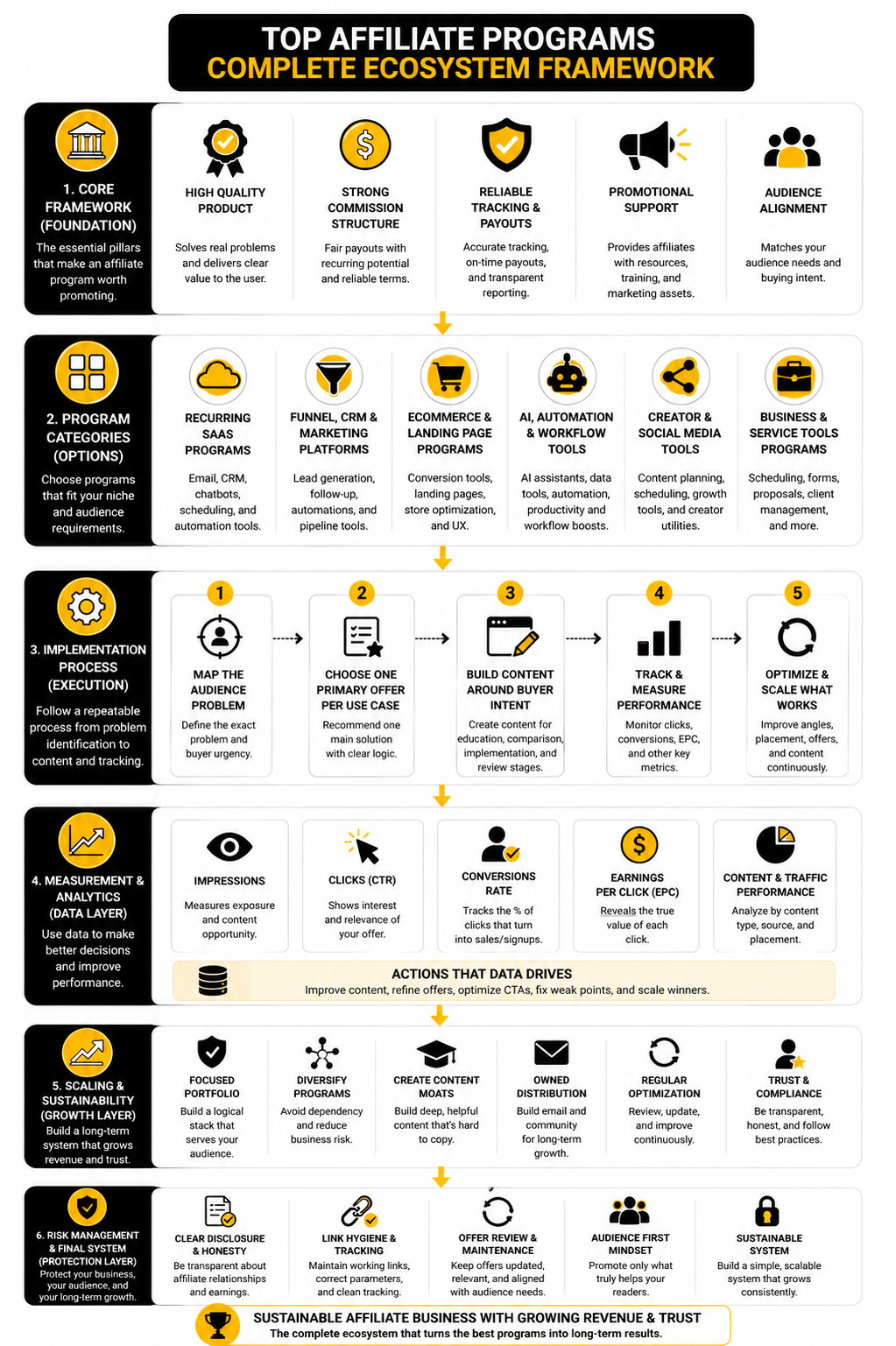
Common Mistakes, Compliance, and Final Checks
The final layer is protection. Once your affiliate system is live, you need to protect the reader, protect your tracking, and protect your reputation. This is where boring details become very expensive if you ignore them.
The most common mistake is treating affiliate marketing like a shortcut. It is not. The best top affiliate programs can create serious revenue, but only when the recommendation is clear, disclosed, useful, and connected to a real buyer problem.
A clean final check should cover three things. First, the product still fits the audience. Second, the link still tracks correctly. Third, the content still reflects the current offer, pricing path, and use case. If any of those break, update the page before you send more traffic.
Disclosure Is Part of Trust
Affiliate disclosure should be clear, early, and easy to understand. The FTC endorsement guidance makes the core principle simple: readers should understand when you may earn from a recommendation. Do not hide that behind vague language.
A practical disclosure can be short. Something like “I may earn a commission if you buy through links on this page, at no extra cost to you” is usually much clearer than legal-sounding clutter. The point is not to scare people away. The point is to be honest before they click.
Disclosure also improves your content discipline. When you know the reader sees the relationship, you naturally become more careful about what you recommend. That is a good thing.
Keep the Final System Simple
A strong affiliate ecosystem is not complicated for the reader. They should move from problem to recommendation to next step without feeling pushed. The complexity belongs behind the scenes, in your tracking, testing, content planning, and offer review process.
Your public content should feel simple. Your private system should be structured. That combination is what makes affiliate marketing scalable without making the article feel like a sales page.
When in doubt, remove friction. Use fewer offers, clearer positioning, better explanations, and stronger fit. The best affiliate system is not the one with the most links. It is the one where every recommendation earns its place.
FAQ - Built for Complete Guide
What are the best top affiliate programs for beginners?
The best programs for beginners are usually simple to explain, easy to join, and connected to products people already understand. Email tools, website tools, creator tools, and funnel builders can work well because they solve common problems. The real priority is choosing a program that matches your audience instead of chasing the highest payout.
Are high-ticket affiliate programs better than recurring programs?
Not always. High-ticket programs can pay more upfront, but recurring programs can become more valuable if customers stay subscribed. The better model depends on conversion rate, retention, refund risk, and how much education the buyer needs before purchasing.
How many affiliate programs should I promote?
Start with a small stack. One primary offer per major use case is usually enough in the beginning. Once you have data, you can add secondary recommendations where they genuinely help the reader compare options.
What makes an affiliate program trustworthy?
A trustworthy program has clear terms, reliable tracking, transparent payouts, useful reporting, and a product that delivers what it promises. Good onboarding and support matter too. If customers struggle after buying, your reputation takes the hit.
Should I promote tools I have not used?
You can mention tools you have researched, but you should be careful with strong recommendations. The more confident your endorsement sounds, the more important real product understanding becomes. For serious affiliate content, hands-on experience makes your advice much more credible.
How long does affiliate marketing take to work?
It depends on traffic, content quality, buyer intent, and offer fit. Some content can produce clicks quickly, but meaningful revenue usually comes from consistent publishing, testing, and improvement. Treat it like building a system, not launching one page.
What is the biggest affiliate marketing mistake?
The biggest mistake is promoting products before understanding the audience problem. That leads to weak clicks, weak conversions, and weak trust. Start with the reader’s situation, then choose the offer that naturally solves it.
Do affiliate links hurt credibility?
Affiliate links only hurt credibility when the recommendation feels biased, hidden, or irrelevant. Clear disclosure and honest positioning protect trust. Readers can accept that you earn a commission when they also feel you are helping them make a better decision.
How do I know when to remove an affiliate offer?
Remove or demote an offer when it no longer fits your audience, stops converting after enough relevant traffic, changes terms in a way that hurts your business, or creates poor customer outcomes. Do not keep a weak offer just because it used to perform. Your recommendation stack should stay current.
Should every article include affiliate links?
No. Some articles are better for trust-building, education, or audience growth. Forcing affiliate links into every piece can make your site feel thin and transactional. Use affiliate links where they genuinely help the reader take the next logical step.
What metrics should I check first?
Start with clicks, conversions, commission, and earnings per click. Then look at link placement, traffic source, and content type. Those numbers tell you whether the issue is visibility, offer fit, or post-click conversion.
Can affiliate marketing work without a huge audience?
Yes, if the audience has strong intent. A small number of qualified readers can outperform a large audience with weak buying interest. This is why focused tutorials, comparisons, and implementation guides can work so well.
Work With Professionals
Explore 10K+ Remote Marketing Contracts on MarkeWork.com
Most marketers spend too much time chasing clients, competing on crowded platforms, and losing a percentage of every project to middlemen.
MarkeWork gives you a better way. Browse thousands of remote marketing contracts and connect directly with companies desperate to hire skilled marketers like you, without platform commissions and without unnecessary gatekeepers.
If you're serious about finding better opportunities and keeping 100% of what you earn, explore available contracts and create a profile for free at MarkeWork.com.