

The market for top digital marketing companies is crowded, noisy, and surprisingly hard to compare. Some agencies are brilliant at paid acquisition but weak on lifecycle marketing. Others are strong on brand, content, or enterprise strategy, but not built for fast testing, landing pages, or conversion work.
That matters because digital marketing is no longer a “nice to have” department. U.S. internet advertising revenue reached $294.6 billion in 2025, while global ad spending passed the $1 trillion threshold. At the same time, marketing leaders are under pressure to prove results, with many CMOs reporting flat budgets and a sharper focus on productivity.
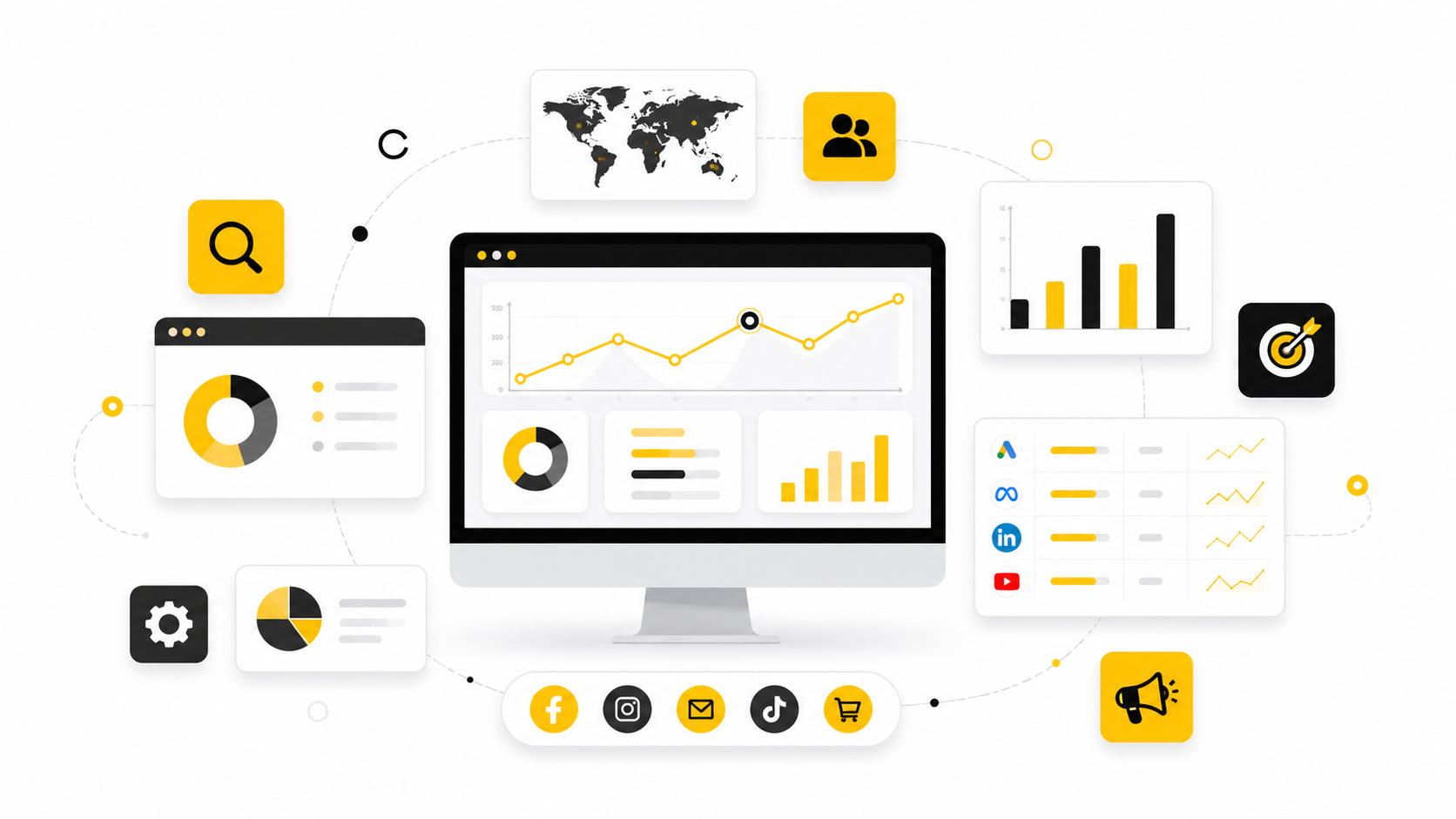
This guide is built to help you look past generic “best agency” lists and understand what actually separates strong digital marketing companies from expensive vendors. The best partner is not always the biggest name. It is the company that understands your market, can execute across the right channels, and can show how marketing activity turns into pipeline, revenue, retention, or brand demand.
Article Outline
- Why Top Digital Marketing Companies Matter
- A Practical Framework for Comparing Agencies
- The Core Services That Separate Strong Agencies From Average Ones
- How Professional Implementation Works in Real Campaigns
- What to Look for Before Hiring a Digital Marketing Company
- Final Shortlist, FAQs, and Next Steps
Why Top Digital Marketing Companies Matter
Choosing from the top digital marketing companies is not just a procurement decision. It affects how quickly your business learns, how efficiently your budget is spent, and how clearly your team can connect marketing work to commercial outcomes. A weak agency can keep you busy with reports, meetings, and activity while the actual growth levers stay untouched.
The strongest companies bring structure to messy growth problems. They help you clarify positioning, prioritize channels, improve conversion paths, and build a measurement system that tells you what is working. That is especially important now because buyers move across search, social, email, communities, creators, comparison pages, and AI-assisted discovery before they ever speak to sales.
For many teams, the right agency also fills gaps they cannot hire for internally. You may not need a full-time SEO strategist, paid media buyer, CRO specialist, lifecycle marketer, designer, analytics lead, and copywriter all at once. A good digital marketing company gives you access to that bench without forcing you to build the whole department before you know which channels will scale.
A Practical Framework for Comparing Agencies
A useful comparison starts with fit, not fame. The agency that works for a venture-backed SaaS company may be wrong for a local service business, ecommerce brand, healthcare provider, or B2B manufacturer. Before judging portfolios, you need to know whether the company understands your sales cycle, customer economics, compliance constraints, and growth stage.
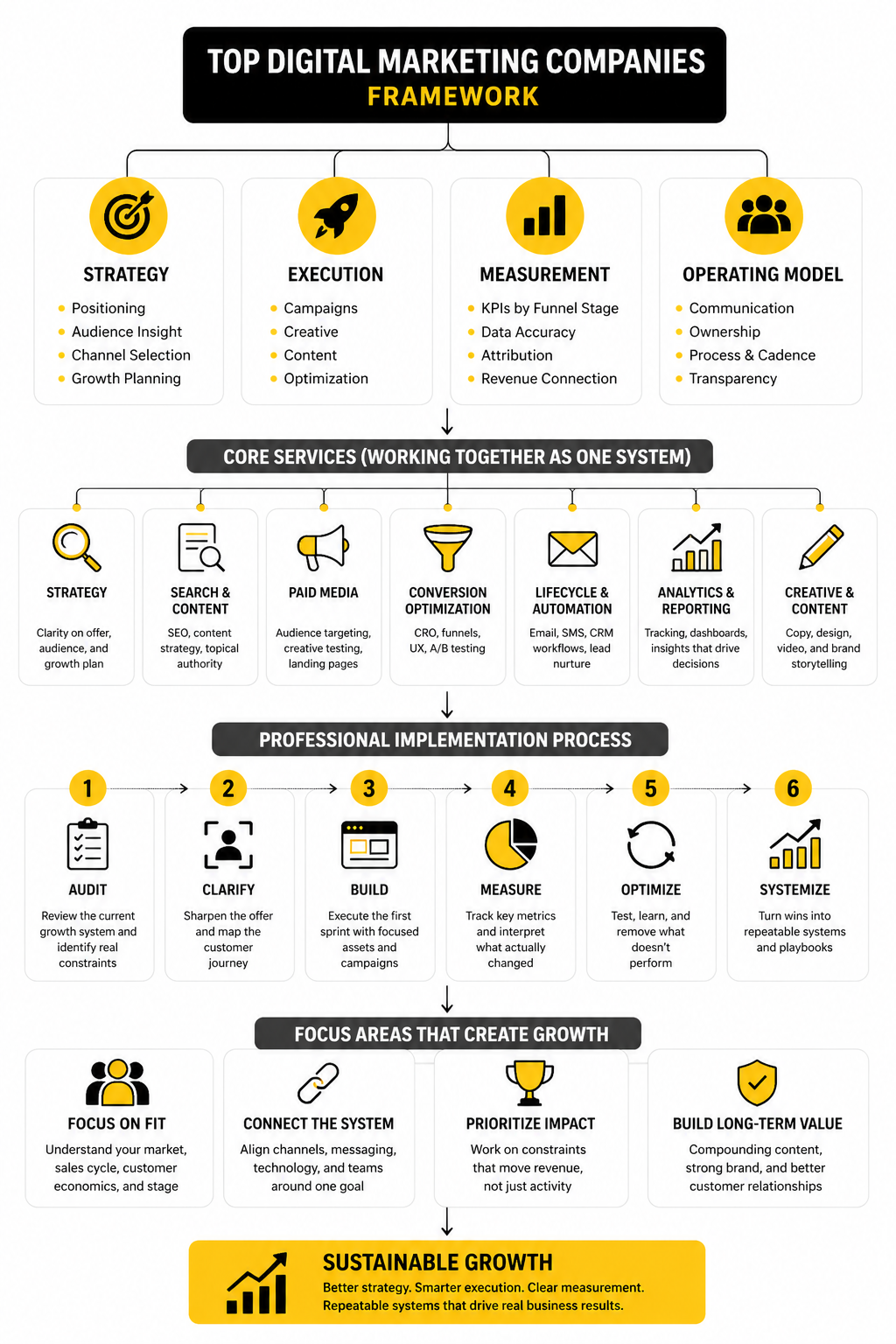
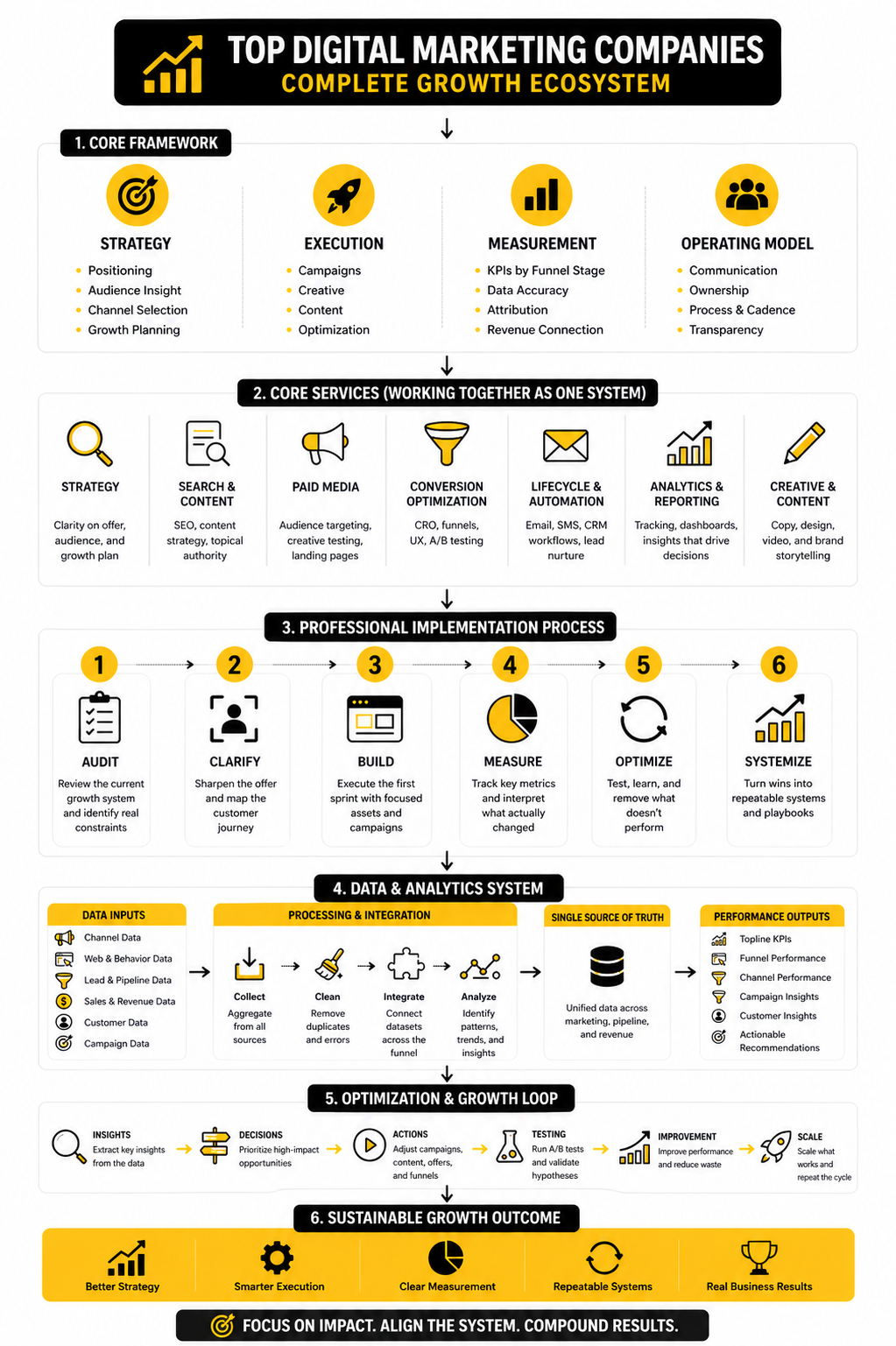
The framework for this article looks at four layers: strategy, execution, measurement, and operating model. Strategy covers positioning, audience insight, channel selection, and growth planning. Execution covers the quality of campaigns, creative, content, landing pages, automation, and optimization.
Measurement is where many agencies either prove their value or hide behind vanity metrics. Strong digital marketing companies can explain which KPIs matter at each stage of the funnel and how those KPIs connect to revenue. The operating model matters too, because the best strategy still fails when communication is slow, ownership is vague, or the agency only shows up when the monthly report is due.
The Core Services That Separate Strong Agencies From Average Ones
The easiest way to compare digital marketing companies is to look at their service menu. The smarter way is to look at how those services connect. SEO, paid media, email, automation, landing pages, analytics, and creative should not operate like separate departments fighting for budget. They should work together as one growth system.
That is where average agencies usually fall apart. They may run ads, publish content, or manage social channels, but they do not always connect those actions to the full customer journey. Strong agencies think in terms of demand creation, demand capture, conversion, retention, and expansion.
This matters because marketers are being pushed to get more from the same resources. Marketing budgets held at 7.7% of company revenue in 2025, so every channel has to earn its place. The best digital marketing companies know how to prioritize the work that compounds instead of chasing every shiny tactic.
Strategy Before Channel Execution
A good agency should not start by asking which ads you want to run. It should start by asking who you are trying to reach, what they already believe, what blocks them from buying, and which offers make the decision easier. Without that layer, execution becomes random.
Strategy also protects you from copying competitors blindly. A company with strong organic demand may need conversion rate optimization more than awareness. A new category player may need education, authority, and proof before performance campaigns can scale.
Top digital marketing companies translate that strategy into a channel plan. They define what each channel is supposed to do, what success looks like, and how fast decisions will be made. That sounds basic, but it is the difference between managed activity and managed growth.
Search, Content, and Demand Capture
Search is still one of the most important places buyers reveal intent. A serious agency should understand technical SEO, content strategy, topical authority, on-page optimization, and the commercial role of comparison pages, service pages, and buying guides. Ranking for informational terms is useful, but ranking for terms that influence revenue is where the real value appears.
Good content teams also understand that modern search is changing. Buyers use Google, YouTube, Reddit, TikTok, LinkedIn, marketplaces, review sites, and AI tools to form opinions before they click a result. That means content has to be useful, credible, and specific enough to survive outside a neat keyword spreadsheet.
The strongest agencies build content around buyer questions, objections, and decision moments. They do not just publish blog posts to fill a calendar. They create assets that sales teams can use, prospects can trust, and search engines can understand.
Paid Media and Conversion Discipline
Paid media can create fast learning, but only when the agency is disciplined. Anyone can spend budget. Not everyone can isolate the offer, audience, creative angle, landing page, and follow-up sequence well enough to know what actually moved the result.
This is why paid acquisition should be paired with landing page and funnel work. A tool like ClickFunnels can make sense when a team needs to launch offer pages, lead magnets, webinar funnels, or sales flows quickly. For ecommerce teams that need more flexible landing pages inside Shopify, Replo can be useful when speed and page-level testing matter.
The point is not the tool itself. The point is whether the agency can improve the whole path from click to customer. If the ads look good but the landing page, offer, tracking, and follow-up are weak, you are not running a growth system. You are just buying traffic.
Lifecycle Marketing and Automation
Many businesses lose money because they treat marketing as a front-end acquisition machine only. Strong agencies look at what happens after the first click, first form fill, first purchase, or first sales call. That is where email, SMS, CRM workflows, retargeting, lead scoring, and customer education become serious revenue drivers.
For service businesses and agencies that need CRM, follow-up, booking, pipelines, and automation in one place, GoHighLevel can fit naturally into the stack. For email campaigns and customer communication, platforms like Brevo or Moosend can support practical lifecycle work without overcomplicating the setup.
The best digital marketing companies do not automate bad messaging. They first understand the customer journey, then build sequences that help people take the next logical step. That is the difference between useful automation and inbox noise.
How Professional Implementation Works in Real Campaigns
Professional implementation is where the gap between a decent agency and one of the top digital marketing companies becomes obvious. Strategy is useful, but only if it turns into a working operating rhythm. The agency should know what gets built first, what gets tested next, and which decisions need data instead of opinions.
This process usually starts with diagnosis. A strong team reviews your positioning, analytics, tracking, funnel performance, existing content, paid accounts, CRM setup, landing pages, and sales follow-up. They are not looking for random problems. They are looking for the few constraints that are stopping growth from becoming repeatable.
Once the diagnosis is clear, implementation should become practical and visible. You should know what is being built, who owns it, what the deadline is, what success means, and when the next decision will be made. If an agency cannot explain its process in plain language, that is usually a warning sign.
Step 1: Audit the Current Growth System
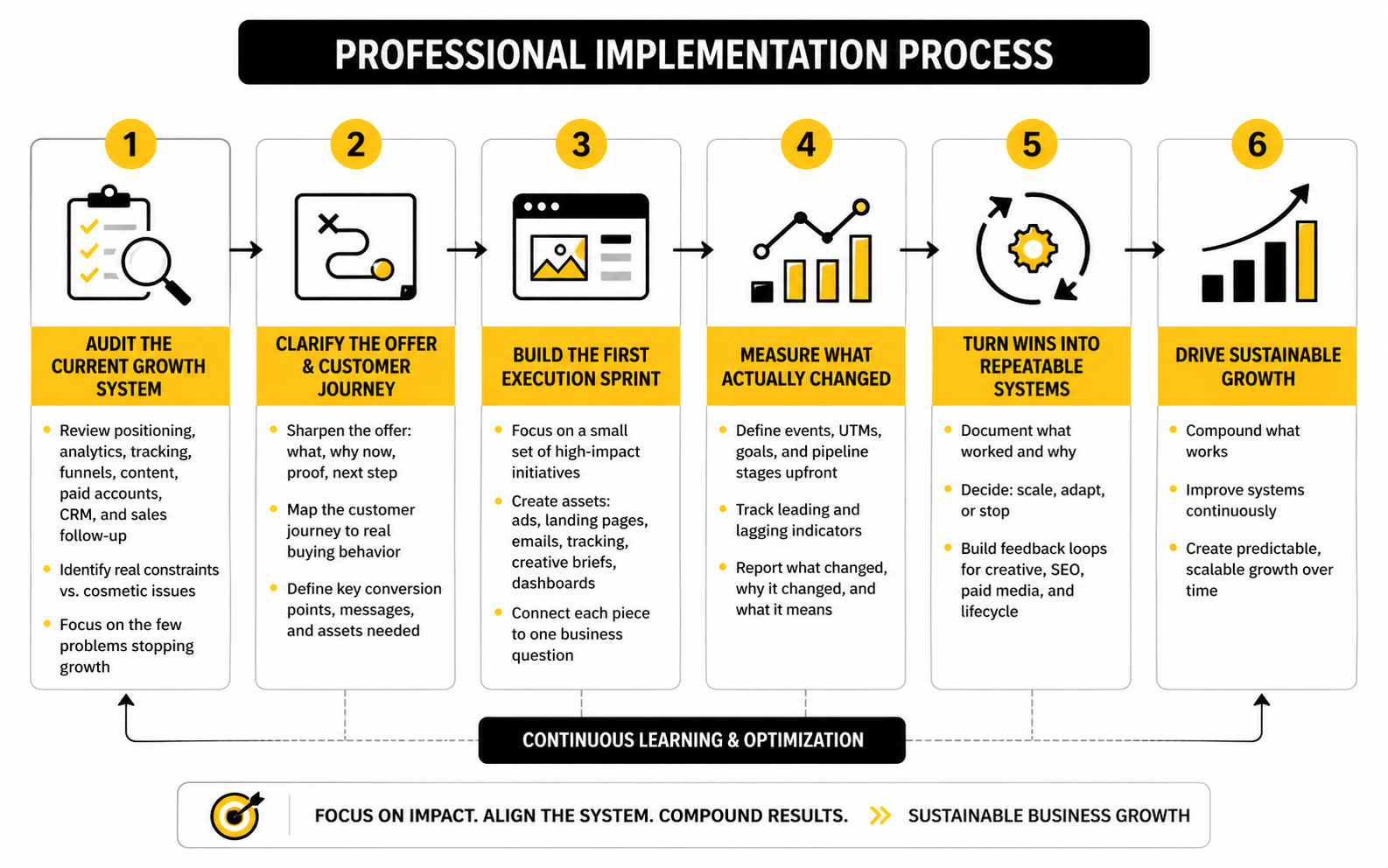
A proper audit is not a generic checklist. It should show where leads, customers, or revenue are leaking from the system. That includes traffic quality, conversion rates, offer clarity, page speed, tracking accuracy, sales handoff, email follow-up, and channel economics.
The best agencies do not treat every issue as equally important. They separate cosmetic problems from commercial problems. A homepage headline might matter, but a broken form, poor attribution setup, weak offer, or slow lead response can cost far more.
This is also where tools and workflows matter. For example, forms built with Fillout can help teams capture cleaner lead data when qualification matters. A CRM like Copper can help relationship-driven teams keep sales activity connected to marketing context.
Step 2: Clarify the Offer and Customer Journey
Before scaling channels, the agency needs to sharpen the offer. That means defining what the customer gets, why it matters now, what proof supports it, and what the next step should be. Weak offers make every channel more expensive.
The customer journey also needs to be mapped with real buying behavior in mind. Some buyers need a direct demo request. Others need education, comparison content, pricing context, a calculator, a webinar, or a lower-friction lead magnet before they are ready.
This is where strong digital marketing companies become very practical. They do not just say “improve the funnel.” They identify the exact conversion points, messages, and assets needed to move people from interest to action.
Step 3: Build the First Execution Sprint
A first sprint should be focused enough to finish and meaningful enough to teach you something. That could mean rebuilding a landing page, launching a paid search test, creating a comparison page, fixing lifecycle emails, or improving the demo request flow. The goal is not to do everything at once.
Strong agencies usually define a short list of assets for the sprint. Those assets may include ad concepts, landing page copy, tracking updates, email sequences, creative briefs, sales enablement notes, and reporting dashboards. Each piece should connect to one business question.
This is where execution speed becomes an advantage. A team using Buffer may coordinate social publishing more cleanly, while a chatbot platform like ManyChat can support faster follow-up for social-first campaigns. The tool is only useful when it supports a clear process.
Step 4: Measure What Actually Changed
Measurement should not wait until the end of a long campaign. It should be built into the work from the start. That means defining events, UTMs, source tracking, conversion goals, pipeline stages, and reporting views before traffic is pushed into the system.
The reason is simple: marketing teams are under more pressure to prove commercial impact, and fragmented reporting makes that harder. The 2025 ROI conversation is moving toward connected measurement that links media, customer behavior, and business outcomes rather than isolated channel reports, as shown in Nielsen’s 2025 ROI Report.
Good agencies keep the reporting focused. They should show what changed, why it likely changed, what the business impact was, and what they recommend next. A dashboard full of numbers is not strategy. Clear interpretation is.
Step 5: Turn Wins Into Repeatable Systems
A campaign win is useful, but a repeatable system is better. Once a test works, the agency should document what happened and decide whether to scale, adapt, or stop. This is how marketing becomes a compounding asset instead of a series of disconnected pushes.
Repeatability depends on process. Creative testing needs a feedback loop. SEO needs publishing and updating discipline. Paid media needs budget rules. Lifecycle marketing needs segmentation, triggers, and message testing.
This is also where the top digital marketing companies earn long-term trust. They do not just celebrate a good month. They turn the lesson into a playbook the business can use again.
Statistics and Data That Actually Matter
The data behind digital marketing is useful only when it changes what you do next. Random benchmarks can make a report look smart, but they do not tell you whether your agency is making good decisions. The real question is whether the numbers explain where growth is coming from, where money is leaking, and which move has the highest upside.
This is why the top digital marketing companies do not obsess over one metric in isolation. A low cost per lead can still be bad if those leads never become pipeline. A high click-through rate can still be meaningless if the landing page attracts the wrong buyer. A campaign can even look inefficient in the short term while building branded demand that lowers acquisition costs later.
The broader market makes measurement more important, not less. Digital ad revenue reached $294.6 billion in 2025, and marketing budgets stayed flat at 7.7% of company revenue. That combination creates pressure. More money is flowing into digital channels, but many teams still have to prove impact without getting much extra budget.
The Metrics That Reveal Agency Quality
A strong agency should be able to explain performance at three levels: channel metrics, funnel metrics, and business metrics. Channel metrics show whether the work is reaching the right people. Funnel metrics show whether those people are taking the next step. Business metrics show whether the work is creating commercial value.
For paid media, that means looking beyond impressions, clicks, and cost per click. You want to see qualified lead rate, conversion rate by landing page, cost per opportunity, payback period, creative fatigue, and performance by audience segment. For SEO, you want to see rankings and traffic, but also assisted conversions, content updates, commercial page performance, and the difference between informational traffic and buying-intent traffic.
For lifecycle marketing, the useful numbers are tied to movement. Open rates and click rates can help diagnose message quality, but they are not the finish line. Better signals include activation rate, booked-call rate, repeat purchase rate, expansion revenue, churn reduction, and time between key steps in the customer journey.
The Analytics System Behind Better Decisions
Good analytics is not just a dashboard. It is a decision system. It tells the agency what to scale, what to fix, what to pause, and what to test next.
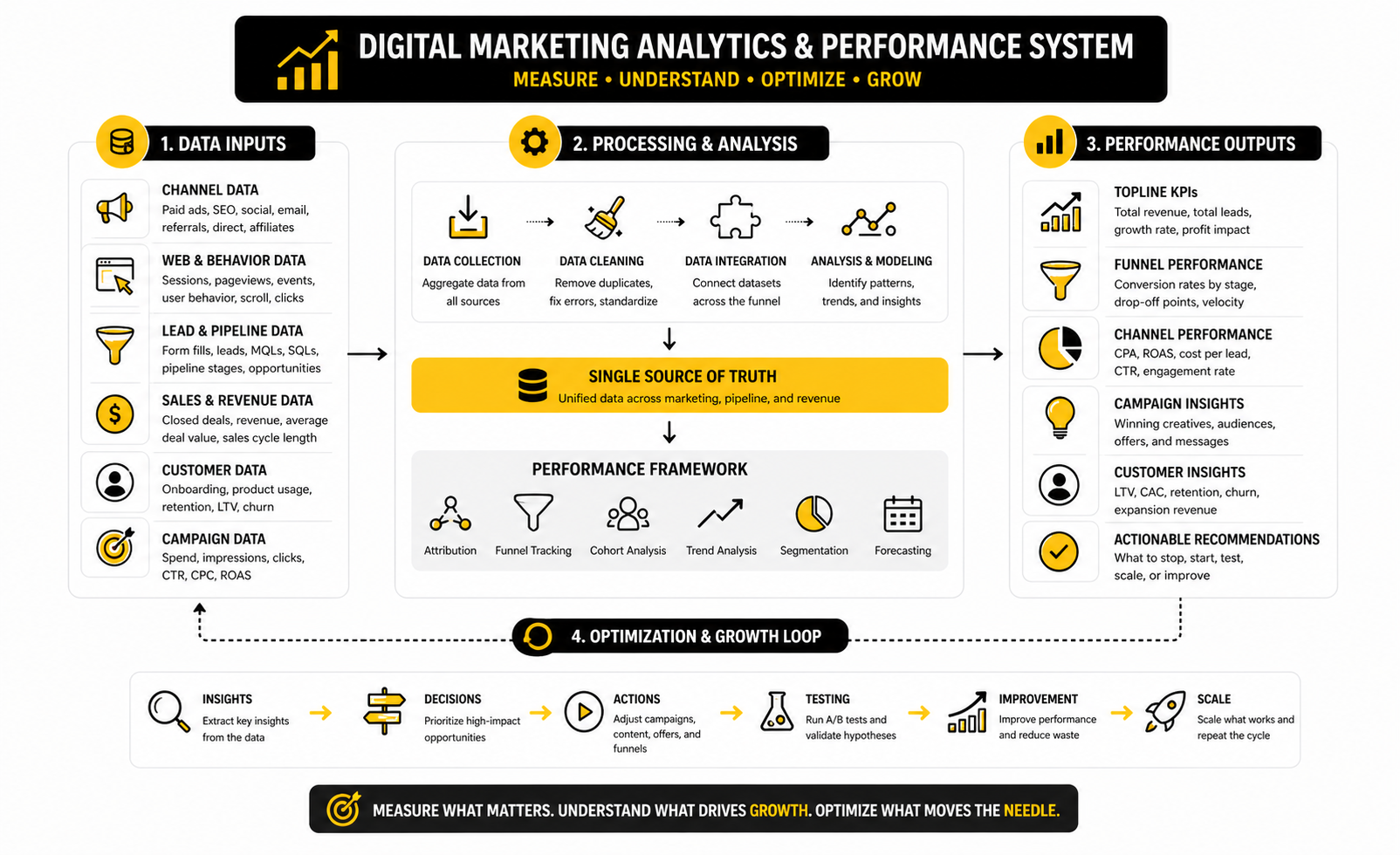
A clean measurement setup usually connects four layers. First, traffic sources need consistent tracking so campaigns can be compared properly. Second, conversion events need to reflect real business steps, not just soft engagement. Third, CRM or sales data needs to show whether leads became opportunities, customers, or revenue. Fourth, reporting needs to turn all of that into decisions a team can act on.
This is where many businesses discover that their marketing problem is partly a data problem. If ad platforms, website analytics, forms, CRM records, booking tools, and email data all live in separate places, the agency is forced to guess. Tools like GoHighLevel, Cal.com, and Fillout can help when they are used to make attribution, booking, and qualification cleaner.
How to Interpret Benchmarks Without Getting Misled
Benchmarks are useful for spotting obvious problems, but they are dangerous when treated like universal rules. A conversion rate that looks weak in one industry may be completely normal in another. A cost per lead that looks expensive may be profitable if close rates, contract value, and retention are strong.
The better move is to compare against your own baseline first. If your demo page converts at 2% today, the first goal might be 3%, then 4%, then a deeper test of offer, proof, and traffic quality. That is more useful than arguing about a generic benchmark pulled from a report that does not match your market.
You should also separate leading indicators from lagging indicators. Leading indicators help you act quickly, such as landing page conversion rate, booked-call rate, email reply rate, and qualified traffic growth. Lagging indicators confirm business impact later, such as revenue, retention, profit, and lifetime value.
What the Data Should Make You Do
Data should create action, not just explanation. If paid traffic is strong but lead quality is weak, the next move may be tighter targeting, better qualification, or a more specific landing page. If organic traffic is growing but pipeline is flat, the issue may be content intent, internal linking, conversion paths, or weak commercial pages.
If leads are coming in but sales conversations are slow, the problem may sit in routing, reminders, booking friction, or CRM follow-up. That is why performance marketing cannot stop at the form submission. The customer journey keeps going, and every delay or unclear step reduces the value of the traffic you paid for.
The best digital marketing companies make this uncomfortable in a good way. They do not hide behind positive-looking metrics when revenue is not moving. They use the numbers to expose the real constraint, then they fix the part of the system that matters most.
What to Look for Before Hiring a Digital Marketing Company
By this point, the choice should feel less like “which agency has the best website?” and more like “which team can actually improve our growth system?” That shift matters. The top digital marketing companies are not just vendors with polished case studies. They are partners that make better decisions under pressure.
A good agency should be able to explain its tradeoffs clearly. If it recommends paid search, it should explain why search intent is strong enough to justify the spend. If it recommends content, it should explain how that content will support discovery, trust, conversion, or sales enablement. If it recommends automation, it should explain where the current customer journey is too slow, too manual, or too inconsistent.
The strongest agencies also know when not to do something. That is underrated. Saying “no” to a channel, campaign, or trend can be more valuable than launching another activity that spreads the team thinner.
The Strategic Tradeoffs You Need to Understand
Every marketing decision has a cost. SEO can compound over time, but it usually needs patience, strong execution, and a clear content architecture. Paid media can create faster feedback, but it becomes expensive when the offer, landing page, or sales process is weak.
Brand work can increase trust and improve future conversion, but it is harder to measure in the short term. Conversion optimization can create quick wins, but it cannot fix a market that does not understand the offer. Lifecycle marketing can increase revenue from existing demand, but it needs clean data and a real understanding of customer behavior.
This is why the best agency conversation is not “what services do you offer?” It is “what should we prioritize first, what should we delay, and what would make this plan fail?” A serious agency will welcome that discussion because it forces the work to become sharper.
Red Flags That Should Make You Pause
Be careful with agencies that promise guaranteed rankings, instant scale, or effortless revenue growth. Digital marketing has too many moving parts for that kind of certainty. A confident agency can forecast, model, and explain assumptions, but it should not pretend it controls the entire market.
Another red flag is vague reporting. If every update is built around impressions, clicks, likes, or traffic without showing how those numbers connect to pipeline or revenue, you are probably looking at activity reporting instead of performance reporting. That can feel comforting for a while, but it does not help you make better decisions.
You should also watch for tool-first thinking. Tools like Systeme.io, ClickFunnels, GoHighLevel, and Brevo can all be useful in the right context. But no platform replaces positioning, offer clarity, creative quality, measurement discipline, and consistent execution.
How AI Changes the Agency Relationship
AI is changing digital marketing fast, but not in the lazy “robots will do everything” way. The real shift is that execution is becoming cheaper and faster, while judgment is becoming more important. If everyone can generate ad variations, content drafts, landing page ideas, and audience hypotheses faster, the advantage moves to the team that knows what to test and why.
That means top digital marketing companies need to be good at both technology and strategy. They should know how to use AI for research, creative iteration, workflow speed, reporting, and personalization. But they also need human judgment around brand voice, customer psychology, offer quality, compliance, and commercial prioritization.
AI also creates risk. Low-quality AI content can damage trust. Automated campaigns can scale bad assumptions. Overreliance on platform recommendations can make every brand sound and behave the same. A serious agency uses AI to improve the process, not to avoid thinking.
Scaling Without Breaking the System
Scaling is not just spending more money. It usually means adding complexity. More campaigns create more data. More channels create more attribution questions. More leads create more pressure on sales, support, onboarding, and retention.
A strong digital marketing company will look for bottlenecks before increasing spend. If the sales team cannot respond quickly, more leads may create waste. If onboarding is weak, acquisition growth may increase churn. If tracking is messy, scaling may hide the truth instead of revealing it.
The practical move is to scale in controlled layers. First, prove the offer. Then improve conversion. Then tighten follow-up. Then expand channels. Then increase budget. That sequence is not glamorous, but it is how serious growth gets built.
Final Shortlist, FAQs, and Next Steps
The best way to choose between top digital marketing companies is to stop looking for a universal winner. There is no single agency that is perfect for every business, every budget, and every growth stage. The right choice depends on your market, your internal team, your offer, your sales process, and the channels that matter most for your buyers.
Your final shortlist should include companies that can show clear thinking before they show tactics. They should understand where demand comes from, how buyers evaluate options, and which parts of the system need to improve first. A polished pitch is not enough. You want evidence of judgment, execution discipline, and honest reporting.
Before signing anything, ask each agency to explain what they would do in the first 30, 60, and 90 days. Their answer will tell you a lot. The strongest teams will talk about diagnosis, priorities, tracking, testing, communication, and decision-making cadence instead of throwing every service into a bloated proposal.
FAQ - Built for Complete Guide
What are the top digital marketing companies best at?
Top digital marketing companies are usually best at combining strategy, execution, and measurement into one working system. They do not just run ads, publish content, or manage social media in isolation. They connect those activities to customer acquisition, revenue, retention, and long-term brand demand.
How do I choose the right digital marketing company?
Start by defining the business outcome you want, then look for an agency with relevant experience in that type of growth problem. Ask how they diagnose issues, prioritize channels, measure success, and communicate progress. The right company should make the decision clearer, not bury you in jargon.
Are large digital marketing agencies always better?
No. Large agencies may offer deeper resources, broader teams, and enterprise processes, but that does not automatically make them better for your business. Smaller specialist agencies can be faster, more focused, and more practical when you need a specific outcome.
What services should a digital marketing company offer?
A strong digital marketing company may offer SEO, paid media, content strategy, conversion optimization, email marketing, marketing automation, analytics, creative, and social media. The exact service mix matters less than how well those services work together. A narrow expert with strong execution can beat a full-service agency with weak coordination.
How much should I spend on a digital marketing agency?
Your budget should depend on your revenue goals, sales cycle, margins, and internal capabilities. Marketing budgets remained around 7.7% of company revenue in 2025, but that is only a benchmark. The better question is what level of investment gives the agency enough room to test, learn, and improve results.
How long does it take to see results?
Paid media and conversion improvements can produce learning quickly, sometimes within weeks. SEO, brand building, lifecycle marketing, and content-led demand usually take longer because they depend on trust, authority, and compounding assets. A good agency should separate early learning from long-term growth instead of promising instant results everywhere.
What should be included in an agency report?
A useful report should show what changed, why it changed, what it means, and what happens next. It should connect channel metrics to funnel and business outcomes wherever possible. If a report only shows impressions, clicks, likes, and traffic, it is probably not enough.
What are the biggest red flags when hiring an agency?
The biggest red flags are guaranteed rankings, vague reporting, unclear ownership, tool-first recommendations, and promises that sound too easy. You should also be careful with agencies that avoid talking about tradeoffs. Serious marketers know that every strategy has constraints.
Should I hire a specialist agency or a full-service agency?
Hire a specialist when you have a clear bottleneck, such as paid acquisition, SEO, lifecycle email, analytics, or landing page conversion. Hire a full-service agency when you need coordinated support across multiple channels and do not have the internal team to manage everything. The wrong choice is hiring a broad agency when you need depth, or a specialist when the real problem is system-wide.
How do digital marketing companies use AI?
Strong agencies use AI to speed up research, creative testing, reporting, workflow management, personalization, and analysis. They do not use it as a shortcut for weak strategy. AI can make execution faster, but judgment still decides what is worth doing.
What tools should a digital marketing company use?
The tool stack depends on the job. For funnels, ClickFunnels or Systeme.io can fit lean campaigns. For CRM and automation, GoHighLevel can support service businesses and agencies, while tools like Brevo, Buffer, and ManyChat can support email, social, and messaging workflows.
How do I know if an agency is actually performing well?
Look at whether the agency is improving the constraints that matter most. That could mean better qualified leads, stronger conversion rates, lower acquisition costs, more pipeline, higher retention, or faster sales follow-up. Performance is not just activity. Performance is movement in the numbers that matter.
Work With Professionals
Explore 10K+ Remote Marketing Contracts on MarkeWork.com
Most marketers spend too much time chasing clients, competing on crowded platforms, and losing a percentage of every project to middlemen.
MarkeWork gives you a better way. Browse thousands of remote marketing contracts and connect directly with companies desperate to hire skilled marketers like you, without platform commissions and without unnecessary gatekeepers.
If you're serious about finding better opportunities and keeping 100% of what you earn, explore available contracts and create a profile for free at MarkeWork.com.