

Choosing between top marketing agencies is not about picking the biggest name, the flashiest portfolio, or the agency with the most confident sales deck. It is about finding the partner that can solve your specific growth problem, work inside your operating reality, and prove that its work connects to business outcomes. A global agency can be perfect for a multinational brand, but a focused specialist can be far better for a SaaS company, ecommerce brand, creator business, or local service company that needs speed.
The agency market is under pressure. Marketing budgets have stayed tight, with Gartner’s 2025 CMO Spend Survey showing average budgets flat at 7.7% of company revenue, while AI, automation, and changing search behavior are forcing agencies to prove value faster. That means the best agency is not just the one that can make good creative. It is the one that can combine strategy, execution, analytics, and accountability.
Top marketing agencies now compete on focus. Some are built for brand strategy, some for paid media, some for SEO, some for lifecycle marketing, some for full-service growth, and some for technical performance systems. The smartest move is not to ask, “Who is the best agency?” It is to ask, “Which agency model fits the problem we actually need to solve?”

This complete guide will cover:
- What Top Marketing Agencies Actually Do
- Why Choosing The Right Marketing Agency Matters
- The Top Marketing Agency Selection Framework
- Core Components Of A Strong Agency Partner
- How Top Marketing Agencies Actually Work
- How To Evaluate Top Marketing Agencies
- Statistics And Data
- Advanced Agency Strategy
- Common Agency Selection Mistakes
- FAQ - Built For Complete Guide
- Work With Professionals
What Top Marketing Agencies Actually Do
Top marketing agencies help businesses plan, execute, measure, and improve marketing across channels. That can include brand strategy, paid media, SEO, content, social media, email marketing, conversion rate optimization, analytics, automation, creative production, influencer marketing, and sales enablement. The exact mix depends on the agency’s specialty and the client’s growth stage.
A full-service agency may manage strategy, creative, media, reporting, and production under one roof. A specialist agency may focus deeply on one function, such as search, paid acquisition, lifecycle marketing, demand generation, or ecommerce conversion. Neither model is automatically better. The right choice depends on whether your biggest constraint is strategy, execution, channel expertise, or performance improvement.
The strongest agencies do not just “do marketing tasks.” They diagnose the business problem behind the task. If traffic is weak, they ask whether the issue is search visibility, positioning, content quality, offer strength, or conversion. If paid ads are expensive, they look beyond the campaign dashboard and inspect targeting, creative, landing pages, funnel economics, and customer quality.
Why Choosing The Right Marketing Agency Matters
A good agency can compress years of trial and error. It brings outside perspective, proven process, specialist talent, and channel experience you may not have internally. That can help you move faster, avoid expensive mistakes, and build a cleaner path from strategy to execution.
A poor agency does the opposite. It creates extra meetings, vague reports, weak assets, unclear ownership, and campaigns that look busy but do not move revenue. The cost is not only the monthly retainer. The real cost is lost time, lost focus, and missed market opportunity.
This matters more now because marketing teams are expected to do more with less. A 2025 agency benchmark found that 73% of agency leaders say generative AI has changed how people discover content, which means clients need partners who understand how search, paid media, content, AI, and customer behavior are shifting together. Activity is not enough. You need judgment.
The Top Marketing Agency Selection Framework
Choosing between top marketing agencies should start with your business problem, not the agency’s pitch deck. Before comparing case studies or testimonials, define what you need the agency to improve. Are you trying to build brand awareness, generate qualified leads, improve conversion, scale paid acquisition, launch a new product, enter a new market, or fix a broken funnel?
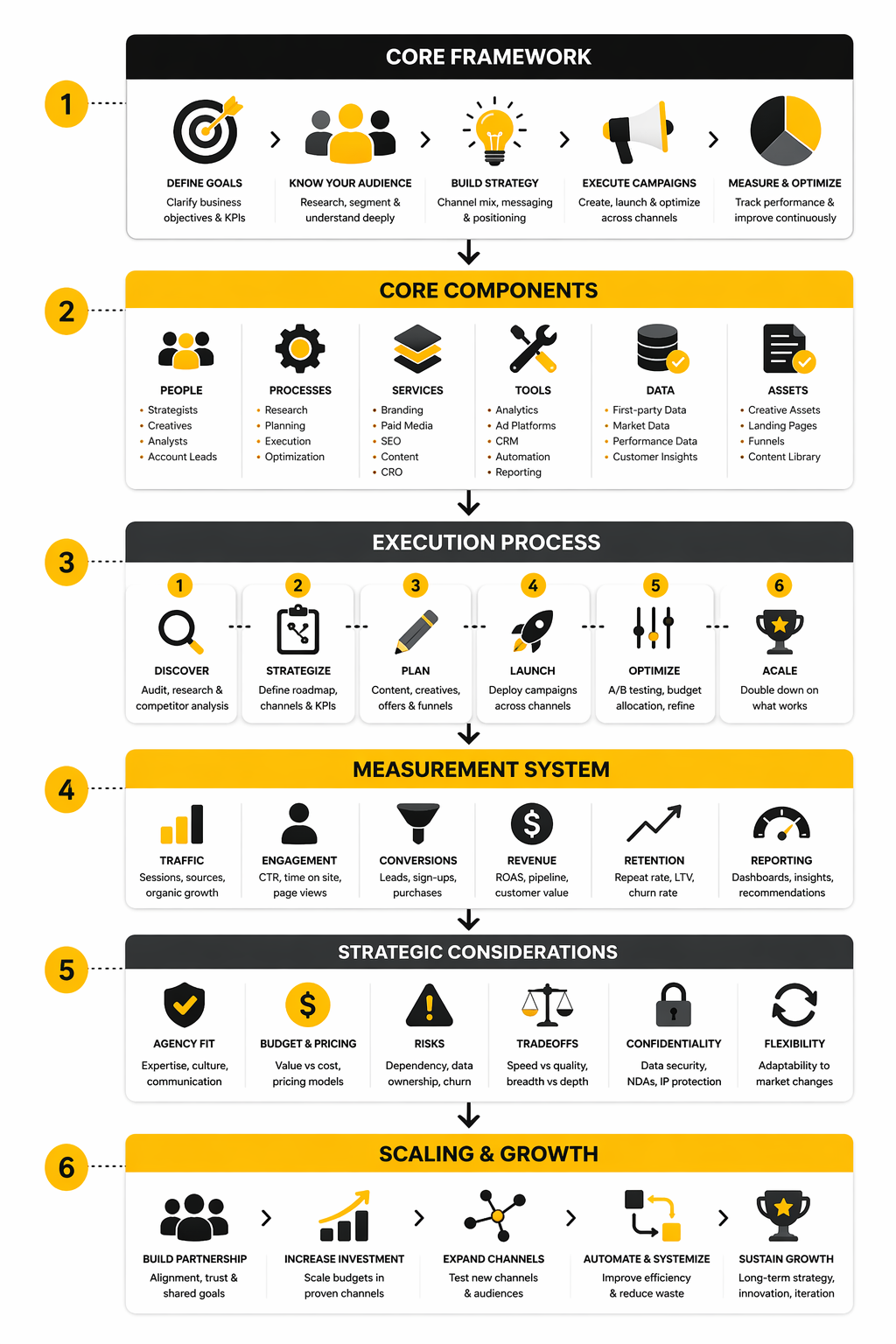
The framework has four layers: fit, capability, proof, and operating model. Fit means the agency understands your market, audience, stage, and goals. Capability means it has the skills, systems, and team to solve the problem. Proof means it can show credible evidence, not just polished claims. Operating model means the way it communicates, reports, collaborates, and makes decisions fits how your team works.
This is where many companies get it wrong. They choose an agency because it is popular, cheap, local, award-winning, or persuasive in the sales process. Those details may matter, but they are secondary. The better question is whether the agency can repeatedly make the right decisions for your specific business.
Core Components Of A Strong Agency Partner
A strong agency partner starts with clear positioning. It should be obvious what the agency is best at, which clients it serves, and which outcomes it is built to improve. If an agency claims to be perfect for everyone, be careful.
Next comes strategic diagnosis. The agency should ask sharp questions about your customers, offer, funnel, data, sales process, margins, budget, and previous marketing performance. If discovery feels shallow, the work usually becomes shallow too.
The third component is execution quality. Good agencies ship work that is clear, consistent, on-brand, and tied to a specific goal. They do not hide behind strategy forever, but they also do not rush into tactics without understanding the business.
The final component is measurement. A top agency should define success early and report on metrics that matter. For some projects, that may be pipeline, revenue, CAC, LTV, retention, or conversion rate. For others, it may be brand lift, share of search, qualified traffic, content performance, or sales enablement quality.
Professional Implementation
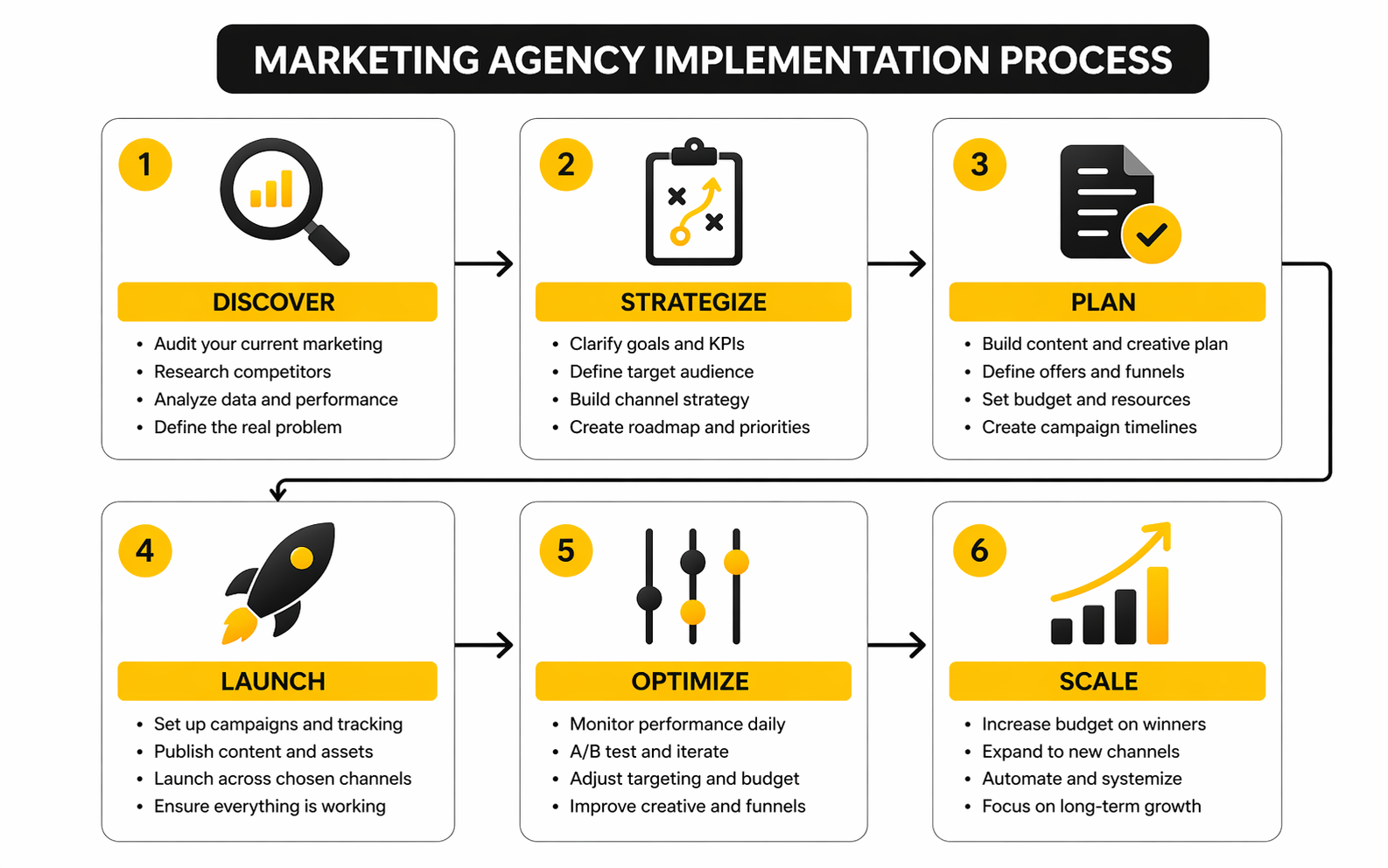
Professional agency selection is a process, not a vibe check. Start with the business goal, define the work needed, shortlist agencies by category, review proof, interview the working team, compare operating models, and agree on success metrics before the contract starts. That structure protects you from choosing the agency with the best sales pitch instead of the best fit.
The best client-agency relationships also have clear ownership. Your internal team should know who approves work, who provides data, who joins strategy calls, who gives feedback, and who makes final decisions. Agencies cannot perform well when the client side is disorganized.
A good implementation process creates momentum early. The agency should have a clear onboarding plan, access checklist, timeline, reporting cadence, and first-90-day priorities. If the first month is chaotic, that is usually a sign the operating system is weak.
How Top Marketing Agencies Actually Work
Top marketing agencies work by turning business goals into coordinated marketing decisions. They are not just there to make ads, write posts, manage campaigns, or redesign pages. The real value comes from connecting strategy, execution, and measurement so the work has a clear commercial purpose.
That means a good agency should understand the full path from audience insight to customer acquisition. It should know how the brand is positioned, which channels matter, what the customer journey looks like, where conversion breaks, and how success will be measured. Without that context, marketing becomes disconnected tasks.
The strongest agencies also know when not to do something. They do not recommend SEO when the client needs immediate lead flow. They do not push paid ads when the landing page cannot convert. They do not build a complex automation system when the offer is still unclear.
The Main Types Of Marketing Agencies
Not all top marketing agencies are built for the same job. Some are broad strategic partners, while others are specialists with deep expertise in one area. Choosing the wrong type of agency usually creates frustration because the client expects one model while the agency is designed for another.
Full-Service Marketing Agencies
Full-service agencies handle multiple parts of the marketing system under one roof. That can include strategy, branding, creative, paid media, SEO, content, email, analytics, and campaign management. This model can be useful when a company needs one coordinated partner instead of several disconnected vendors.
The benefit is alignment. One team can connect the strategy, creative, media, and reporting instead of forcing the client to manage everything internally. The risk is depth. Some full-service agencies are strong across many areas, while others are generalists that look impressive but lack specialist execution.
A full-service agency makes the most sense when the main problem is coordination. If your brand, channels, messaging, and reporting are scattered, this model can create order quickly.
Performance Marketing Agencies
Performance marketing agencies focus on measurable acquisition and conversion. They usually work across paid search, paid social, landing pages, conversion rate optimization, tracking, and reporting. Their job is to turn budget into measurable pipeline, sales, or revenue.
This type of agency is useful when you already have a clear offer and need scalable demand. The agency should understand CAC, ROAS, payback period, funnel conversion, creative testing, and attribution. If it only reports clicks and impressions, it is not acting like a true performance partner.
The risk is short-term thinking. A performance agency can optimize campaigns aggressively but still miss brand, retention, or customer quality issues. The best ones know that efficient acquisition depends on the offer, funnel, and customer economics.
SEO And Content Agencies
SEO and content agencies help businesses earn organic visibility through technical SEO, content strategy, topical authority, link earning, and conversion-focused content. This model is strong when buyers search before they buy. It is also useful for companies that want compounding traffic instead of relying only on paid acquisition.
The best SEO agencies do more than publish blog posts. They map search intent, fix technical barriers, build useful content systems, improve internal linking, and connect organic traffic to lead generation or sales. They should be able to explain how content supports the buyer journey, not just rankings.
The tradeoff is time. SEO can create durable value, but it rarely fixes an urgent pipeline problem overnight. If you need leads this month, SEO may need to work alongside paid, outbound, partnerships, or sales-led activity.
Brand And Creative Agencies
Brand and creative agencies focus on positioning, identity, messaging, campaigns, design, and storytelling. They are useful when a company has a differentiation problem, a trust problem, or a market perception problem. This is especially important when a business looks similar to everyone else in the category.
A strong brand agency helps clarify what the company stands for, who it serves, why it is different, and how that should show up visually and verbally. The output may include messaging, visual identity, campaign concepts, brand guidelines, or creative systems. Done well, this work makes every other channel easier.
The risk is beautiful work without business traction. Creative should not float above the commercial reality. It should help customers understand, remember, trust, and choose the brand.
Social Media And Community Agencies
Social media agencies help brands build visibility, engagement, content systems, and community presence across platforms. They may handle organic social, paid social, creator partnerships, influencer campaigns, short-form video, or community management. This can be valuable when audience attention is concentrated on social channels.
The best agencies in this category understand platform behavior. They know that LinkedIn, TikTok, Instagram, YouTube, Reddit, and X do not reward the same content style. They also know that social performance should support larger goals, not just likes.
The challenge is measurement. Social can influence awareness, demand, trust, and conversion, but the path is often less direct than search or paid acquisition. A good agency should still define what success looks like and how social supports the wider marketing system.
Choosing The Right Agency Category
The right agency category depends on your bottleneck. If nobody understands what you sell, start with positioning or brand strategy. If people understand the offer but do not find you, look at SEO, content, paid media, or outbound support. If people find you but do not convert, focus on conversion, messaging, landing pages, sales enablement, or lifecycle marketing.
Do not choose an agency category based only on what sounds impressive. Choose it based on the weakest part of your growth system. That is where the agency can create the most leverage.
A simple way to think about it is this:
- Unclear message: brand, positioning, or strategy agency.
- Not enough demand: SEO, paid media, content, social, or outbound agency.
- Weak conversion: CRO, funnel, landing page, or performance agency.
- Poor retention: lifecycle, email, CRM, or customer marketing agency.
- Messy execution: full-service or integrated growth agency.
What Separates Top Marketing Agencies From Average Ones
Top marketing agencies are not just better at presentations. They are better at diagnosis, prioritization, execution, and accountability. They know how to identify the real problem before prescribing the solution.
Average agencies often sell services. Top agencies sell outcomes and then explain the work required to reach them. That distinction matters because marketing activity is easy to produce, but business impact is harder.
Look for agencies that can explain tradeoffs clearly. A serious agency will tell you what it would do, what it would not do, what it needs from your team, and what results are realistic. If every answer sounds effortless, be careful. Real marketing has constraints, and top agencies are honest about them.
How To Evaluate Top Marketing Agencies
Evaluating top marketing agencies should feel structured, not emotional. A strong sales call can make almost any agency sound capable, but the real test is whether the agency can diagnose your problem, explain its process, and show how it will turn work into measurable progress. You are not hiring confidence; you are hiring judgment, execution, and accountability.
Start by defining the outcome you need before you review agencies. If you need more qualified pipeline, the evaluation should focus on demand generation, conversion, attribution, and sales alignment. If you need stronger positioning, the evaluation should focus on research quality, messaging strategy, customer insight, and brand clarity.
The clearer your goal is, the easier it becomes to compare agencies fairly. Otherwise, every pitch starts to sound good because you are not measuring them against a specific job.
Step 1: Define The Business Problem
Before shortlisting agencies, write down the business problem in plain language. Do not start with “we need social media” or “we need SEO.” Start with what is actually broken or missing.
For example, you may need more qualified leads, lower acquisition cost, better conversion, clearer positioning, stronger retention, or a more reliable content engine. Those are business problems. Channels are possible solutions.
This step matters because top marketing agencies should be chosen for the outcome they are best equipped to create. If you confuse the symptom with the problem, you may hire the wrong type of agency and still wonder why performance does not improve.
Step 2: Match The Agency Type To The Bottleneck
Once the problem is clear, match it to the right agency category. A brand agency is not automatically the best choice for paid acquisition. A performance agency is not always the right partner for a positioning problem. A social media agency may create visibility but still fail to solve conversion.
This is where the selection process becomes practical. If your funnel is getting traffic but not leads, you may need conversion strategy, landing pages, offer refinement, or CRO. If your brand looks credible but nobody finds you, SEO, content, paid media, partnerships, or outbound may be the better path.
Do not ask agencies to be something they are not built to be. The best results usually come when the agency’s strength matches the client’s constraint.
Step 3: Review Proof Carefully
Case studies matter, but you need to read them with skepticism. A good case study should explain the starting point, the problem, the strategy, the work performed, and the result. If it only shows big numbers without context, it is not enough.
Look for proof that matches your situation. An agency that scaled ecommerce ads for a fashion brand may not be the right choice for enterprise SaaS demand generation. An agency that built a beautiful consumer brand may not understand complex B2B sales cycles.
Ask what the agency directly controlled. Sometimes results come from product demand, pricing changes, seasonality, sales team improvements, or existing brand strength. Top marketing agencies can separate their contribution from the surrounding context.
Step 4: Interview The Actual Working Team
The people in the sales process are not always the people doing the work. This is important. You may love the founder, strategist, or sales lead, then later discover that your account is handled by junior staff with limited oversight.
Before signing, ask to meet the people who will actually manage strategy, execution, reporting, and communication. You want to know who owns the account, who makes recommendations, who reviews quality, and who is responsible when performance is off track.
This is not about being difficult. It is about reducing risk. The agency-client relationship depends heavily on the working team, not just the agency brand.
Step 5: Evaluate The Operating Model
A good agency should have a clear operating model. You should understand how onboarding works, how priorities are set, how meetings are run, how feedback is handled, how reporting is delivered, and how decisions get made. If the process is vague before the contract, it usually does not become magically clear after kickoff.
Ask about communication rhythm, project management tools, approval timelines, reporting cadence, and escalation paths. Also ask what they need from your team. Strong agencies are honest about client responsibilities because they know performance depends on both sides.
This is where many relationships succeed or fail. Even talented agencies struggle when access is delayed, feedback is scattered, decisions are slow, or nobody owns internal approvals.
Step 6: Align On Metrics Before Work Starts
Do not wait until month three to decide what success means. Define the scoreboard before the work begins. The right metrics depend on the project, but they should connect to the business problem you are trying to solve.
For a paid media agency, that may include CAC, ROAS, conversion rate, qualified leads, pipeline, and payback period. For an SEO agency, it may include qualified organic traffic, rankings for commercial topics, assisted conversions, leads, and content-driven pipeline. For a brand agency, it may include message clarity, conversion lift, sales enablement quality, brand recall, or improved campaign performance after repositioning.
The point is not to reduce everything to one number. The point is to avoid vague success. A strong agency should be comfortable defining what progress looks like and explaining what it can and cannot control.
Step 7: Start With A Focused First Phase
The first phase should create clarity, momentum, and evidence. It should not try to solve every marketing problem at once. A focused first phase might include an audit, strategy sprint, campaign pilot, landing page rebuild, tracking cleanup, or channel test.
This protects both sides. The client gets to see how the agency thinks and executes before expanding scope. The agency gets enough focus to produce meaningful work instead of being pulled into scattered requests.
A strong first phase should end with decisions. You should know what was learned, what improved, what still needs work, and whether the agency deserves a larger role. That is how professional implementation becomes a controlled process instead of a long gamble.
Building A Productive Agency Relationship
Hiring the agency is only the beginning. The relationship works when both sides have clear expectations, fast communication, and shared ownership of the outcome. Even top marketing agencies cannot create strong results if the client disappears, delays decisions, or withholds important business context.
Your team should give the agency access to the right data, customer insights, sales feedback, product information, and internal constraints. The agency should bring structure, expertise, momentum, and honest recommendations. When that exchange works, the relationship becomes much more than task delivery.
The best agency partnerships feel like an extension of the business without becoming dependent on guesswork. The agency understands the goal, knows the constraints, and has enough trust to challenge weak assumptions. That is when the work gets sharper.
Statistics And Data
The numbers around top marketing agencies only matter if they help you make a better decision. A benchmark should not be used to shame an agency, justify a random budget cut, or chase whatever metric looks easiest to improve. It should help you understand whether the relationship is producing the right kind of progress.
Marketing budgets are not expanding endlessly. Gartner’s 2025 CMO Spend Survey found average marketing budgets sitting at 7.7% of company revenue, which means agency spend has to work harder. When budgets are tight, the best agency relationships are not judged by activity. They are judged by impact.
That does not mean every agency should be measured only by short-term revenue. A brand agency, SEO agency, paid media agency, and lifecycle agency will all have different scoreboards. The key is matching the metric to the job you hired the agency to do.
The Agency Metrics That Actually Matter
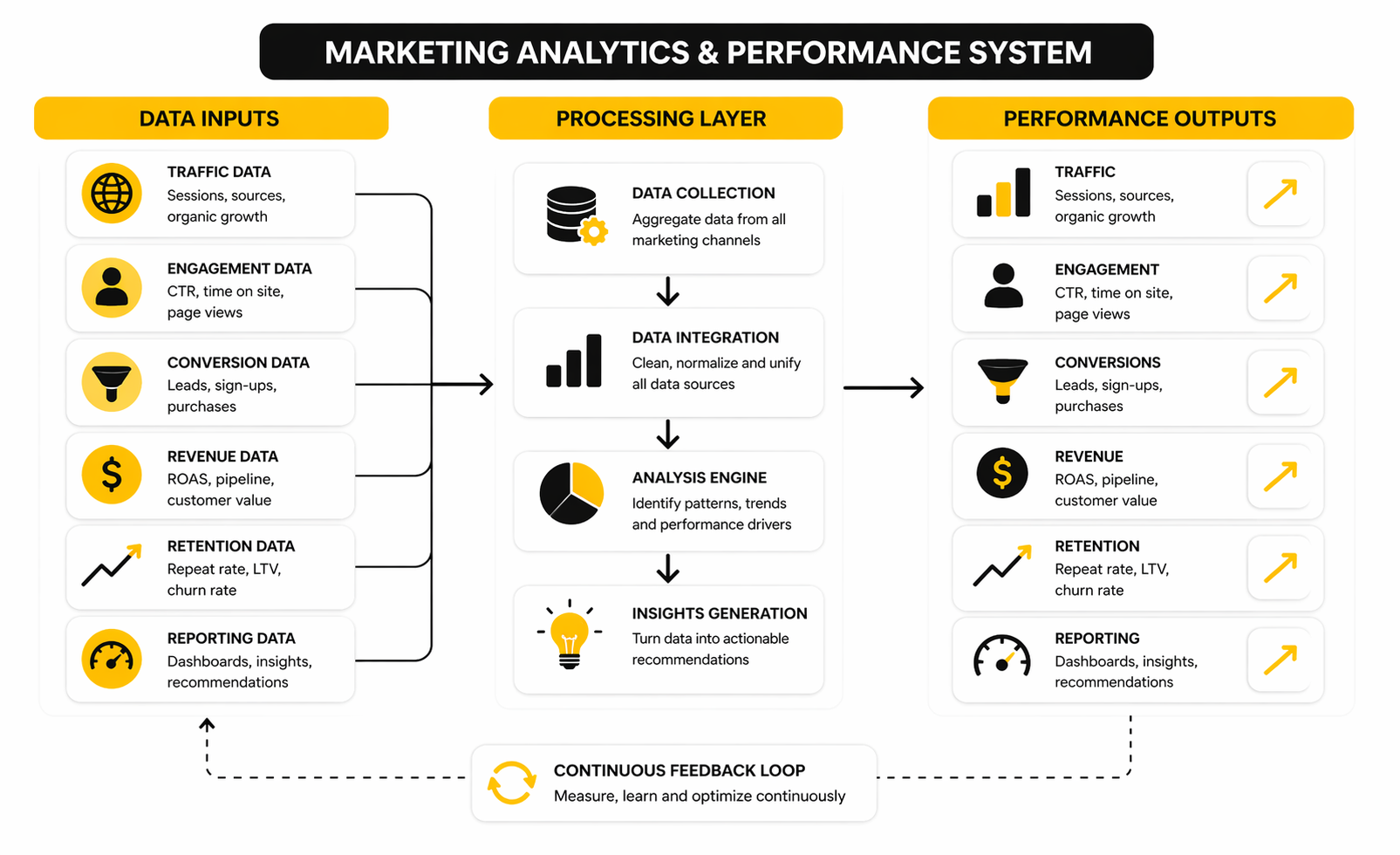
A strong agency measurement system should connect work to outcomes. It should show what the agency shipped, what changed in the market, and what business result followed. If the report only lists completed tasks, impressions, clicks, or meetings held, it is incomplete.
The right metrics usually fall into five groups:
- Strategic progress, including clearer positioning, stronger messaging, better audience definition, and improved campaign direction.
- Execution quality, including assets shipped, campaign velocity, creative testing, landing page quality, content depth, and operational consistency.
- Channel performance, including traffic, qualified leads, CAC, ROAS, rankings, engagement, conversion rate, and pipeline contribution.
- Commercial impact, including revenue, opportunity value, customer acquisition cost, payback period, retention, and lifetime value.
- Relationship health, including communication speed, decision quality, reporting clarity, accountability, and trust.
This gives you a more complete view. An agency can be strong creatively but weak operationally. It can drive traffic but fail to create qualified demand. It can hit short-term acquisition targets while damaging retention or brand trust. Measurement should make those tradeoffs visible.
Benchmarks Should Create Better Questions
Benchmarks are useful when they help you ask sharper questions. If paid media costs are rising, the question is not only whether the agency is doing a good job with bids. It is whether the audience, creative, offer, landing page, conversion path, and retention economics still support the channel.
AgencyAnalytics’ 2025 benchmark report found that 68% of agency leaders expected paid advertising to deliver the strongest results in 2025, which makes sense in a market where organic reach and AI-shaped discovery are changing. But that does not mean every company should pour money into paid ads. It means paid acquisition is attractive when the funnel, offer, and economics are ready.
The same is true for AI. A 2025 agency benchmark found that 73% of agency leaders say generative AI has changed how people discover content. That should not push you into random AI projects. It should push you to ask whether your agency understands how search, content quality, answer engines, paid media, and customer journeys are shifting together.
Measuring Brand Agencies
Brand work is often harder to measure than paid media, but it is not impossible. You just need the right scoreboard. The goal is not always immediate revenue; sometimes the goal is clearer differentiation, stronger trust, better sales conversations, or a message that makes every future campaign perform better.
Useful brand metrics can include direct traffic, branded search demand, share of search, recall, qualitative customer feedback, sales team confidence, homepage conversion, and campaign performance after repositioning. None of these metrics is perfect alone. Together, they show whether the brand is becoming easier to understand and easier to choose.
The action from brand data should be practical. If customers still cannot explain what you do, the messaging needs work. If sales keeps rewriting the pitch, the positioning is not usable. If traffic increases but conversion does not, awareness may be rising without enough clarity.
Measuring Performance Agencies
Performance agencies are easier to measure because the work usually connects directly to traffic, leads, conversions, pipeline, or sales. But simple metrics can still mislead you. A campaign can improve cost per lead while reducing lead quality, or raise ROAS while depending too heavily on discounts.
Look beyond the platform dashboard. Paid media should be measured against CAC, qualified lead rate, customer quality, payback period, conversion rate, and revenue. If you sell through a sales team, track whether leads become opportunities and whether opportunities close.
The best performance agency conversations are not about whether one ad had a good week. They are about what the data says about audience, offer, creative, channel mix, and funnel economics. That is where performance marketing becomes strategic instead of mechanical.
Measuring SEO And Content Agencies
SEO and content agencies need a longer measurement window because organic growth compounds over time. Still, that does not mean you should accept vague reporting. Rankings and traffic matter, but they are not enough.
Track qualified organic traffic, commercial keyword growth, content-assisted conversions, organic leads, pipeline influenced by content, technical health, internal linking progress, and content refresh performance. For B2B companies, also look at whether content helps sales explain the problem and handle objections.
The action should depend on intent. If traffic grows but leads do not, the content may be attracting the wrong audience or missing conversion paths. If rankings improve for informational topics but not commercial topics, the strategy may be too top-heavy. If high-intent pages rank but do not convert, the problem may be offer clarity, proof, or page structure.
Measuring Social And Community Agencies
Social and community work should not be judged only by likes. Engagement matters, but it needs context. A post can get attention without attracting the right audience, and a smaller post can create more valuable conversations than a viral one.
Useful metrics include audience quality, saves, shares, comments with intent, profile visits, referral traffic, community participation, creator performance, content consistency, and assisted conversions. For LinkedIn or B2B social, track whether the content creates sales conversations, partner interest, event signups, or qualified inbound messages.
The action from social data should shape the content system. If educational posts get saves but no conversations, you may need stronger calls to action or clearer offer connection. If opinion posts create discussion but not demand, the point of view may need to connect more directly to the buyer’s pain.
Measuring The Agency Relationship Itself
The agency relationship is part of performance. A brilliant strategy delivered late, explained poorly, or disconnected from your team will not create the same result as a slightly simpler strategy executed cleanly. Relationship health deserves measurement because it affects speed.
Track response times, meeting quality, reporting clarity, missed deadlines, decision speed, quality of recommendations, and whether the agency proactively surfaces risks. These are not soft details. They determine whether the work moves or stalls.
If the relationship is slowing down, name the problem early. Sometimes the fix is clearer ownership, better access, shorter approval cycles, or a tighter reporting format. Sometimes the issue is deeper and the agency is not the right fit. Either way, do not wait six months to say what was obvious in month two.
What The Data Should Change
Good agency analytics should create decisions. If the agency is producing activity but not progress, narrow the scope and refocus the work. If one channel is performing but another is draining resources, rebalance the budget. If reporting is unclear, rebuild the dashboard around the original business goal.
The cleanest review process asks:
- What did we ask the agency to improve?
- What work was completed?
- What changed in the data?
- What changed in customer behavior?
- What commercial impact can we see?
- What should we stop, start, or scale next?
This keeps the relationship honest. You are not evaluating the agency based on mood, effort, or presentation quality alone. You are evaluating whether the work is moving the business in the direction you hired them to move it.
Advanced Agency Strategy
Advanced agency strategy starts with one uncomfortable truth: even top marketing agencies cannot fix every business problem. If the product is weak, the offer is confusing, the pricing is wrong, or the sales process is broken, marketing can expose those issues faster but not magically erase them. A serious agency relationship should make the business sharper, not create a place to outsource responsibility.
The best companies use agencies as leverage, not as replacements for thinking. They bring the agency into a clear strategic context, share the right data, make decisions quickly, and hold the relationship accountable to the right metrics. That is very different from handing over a vague brief and hoping the agency “figures it out.”
This is where tradeoffs matter. You need to decide what should stay internal, what should be outsourced, what should be automated, and what should be handled by specialists. The strongest agency setup is usually not the biggest one. It is the clearest one.
Decide What To Keep In-House
Not every marketing function should be outsourced. Strategy, customer knowledge, product context, and final decision-making usually need strong internal ownership. Agencies can support those areas, but they should not become the only people who understand your market.
Keep the work in-house when it depends heavily on daily business context. That may include customer interviews, product positioning decisions, sales feedback, executive messaging, and offer development. These areas require proximity to the customer and fast internal judgment.
Outsource work when the agency brings specialist skill, execution speed, creative depth, channel expertise, or technical capability your team does not have. That is where agencies create leverage instead of dependency.
Avoid Agency Fragmentation
Hiring several specialist agencies can work, but only if someone owns the overall strategy. Without that, paid media goes one direction, SEO goes another, social tells a different story, and the brand becomes inconsistent. The customer does not care that five vendors were involved. They experience one company.
Fragmentation usually shows up in reporting first. Each agency proves its own channel is doing something, but nobody can explain the full customer journey. That creates meetings, dashboards, and arguments instead of better decisions.
If you use multiple agencies, create one shared growth model. Define the main business goal, customer segments, core message, channel roles, reporting cadence, and decision rights. Then make every partner operate inside that system.
Watch For Scope Creep
Scope creep happens when the agency relationship slowly expands without a clear strategic reason. A small paid media engagement becomes landing pages, then email, then reporting, then creative, then social, then strategy. Sometimes that expansion makes sense. Sometimes it creates a bloated relationship that nobody designed intentionally.
The problem is not extra work. The problem is unclear ownership. When scope grows without fresh goals, metrics, timelines, and responsibilities, performance becomes harder to judge.
Review scope regularly. Ask whether each workstream still supports the original business problem or a clearly defined new one. If it does not, pause it, simplify it, or move it somewhere else.
Use AI Without Losing Judgment
AI is changing agency work quickly. It can speed up research, content production, creative variations, reporting, customer analysis, campaign testing, and workflow automation. That can make agencies more efficient, but it also makes weak work easier to disguise.
The risk is volume without taste. More drafts, more assets, and more reports do not automatically mean better marketing. If an agency uses AI to produce faster but not think better, the client gets more noise.
Ask agencies how they use AI in the actual workflow. Good answers should mention quality control, human review, data privacy, brand standards, strategic oversight, and measurable output. Weak answers usually sound like “we use AI to do more content faster.”
Build A Clean Tech Stack Around The Agency
A strong agency relationship needs clean access to data. If analytics, CRM, email, landing pages, ad accounts, and reporting are scattered or poorly configured, the agency will spend too much time cleaning up the mess. Sometimes that cleanup is necessary, but it should be recognized as a real project.
Your tech stack does not need to be complicated. It needs to be usable. A CRM like Copper, a workflow platform like GoHighLevel, a landing page builder like Replo, or an email platform like Brevo can support the system when ownership is clear.
The key is not the tool itself. The key is whether the tool helps the agency and internal team see the same truth. If everyone is arguing from different dashboards, the relationship will slow down.
Plan For The First 90 Days
The first 90 days should be designed to create trust, evidence, and momentum. This does not always mean huge results immediately, especially for SEO, brand, or complex demand generation. It does mean the agency should be able to show progress, clarity, and disciplined execution.
A good first 90 days usually includes onboarding, access setup, audit work, strategy alignment, quick wins, campaign or asset production, tracking cleanup, and a first performance review. The agency should explain what it learned and what it recommends next.
If the first 90 days feel vague, slow, or chaotic, do not ignore it. That early operating pattern often predicts the rest of the relationship. Fix the process quickly or reconsider the fit.
Know When To Change Agencies
Changing agencies is not always a failure. Sometimes your business outgrows the current partner, the channel mix changes, or the problem you need solved becomes more specialized. A great agency for one stage may be the wrong agency for the next.
The warning signs are usually visible. Reporting becomes defensive. Strategy becomes repetitive. Deadlines slip without ownership. Recommendations feel generic. The agency stops challenging weak assumptions. Results are unclear and nobody can explain why.
Before switching, have a direct conversation. Clarify the problem, reset expectations, tighten scope, and agree on what must improve. If the same issues continue, move on professionally. Your marketing system cannot depend on a relationship that has lost trust.
Build A Partner Bench
The best companies do not wait until something breaks to look for help. They build a bench of trusted specialists, freelancers, consultants, and agencies they can call when a specific problem appears. This makes the business more flexible.
Your bench might include a paid media specialist, SEO strategist, lifecycle marketer, analytics expert, brand consultant, designer, developer, or fractional CMO. Not everyone needs to be on retainer. Some experts are better used for audits, sprints, launches, or second opinions.
This is a smarter way to think about top marketing agencies. The goal is not to find one perfect partner forever. The goal is to build the right combination of talent for the stage you are in and the stage you are trying to reach.
Common Agency Selection Mistakes
Most bad agency relationships are predictable. The client chooses based on reputation instead of fit, accepts vague promises, skips proper discovery, or signs a contract before defining what success means. Then three months later, everyone is frustrated because the work is busy but the outcome is unclear.
One major mistake is hiring a top marketing agency before fixing internal ownership. If nobody on your team can approve work, provide data, share sales feedback, or make decisions quickly, even a strong agency will slow down. Agencies need access, context, and direction to perform well.
Another mistake is confusing reports with results. A beautiful dashboard does not mean the agency is creating value. The real question is whether the work is improving customer behavior, pipeline quality, conversion, revenue, retention, or strategic clarity.
Turning Agency Selection Into A Complete Growth System
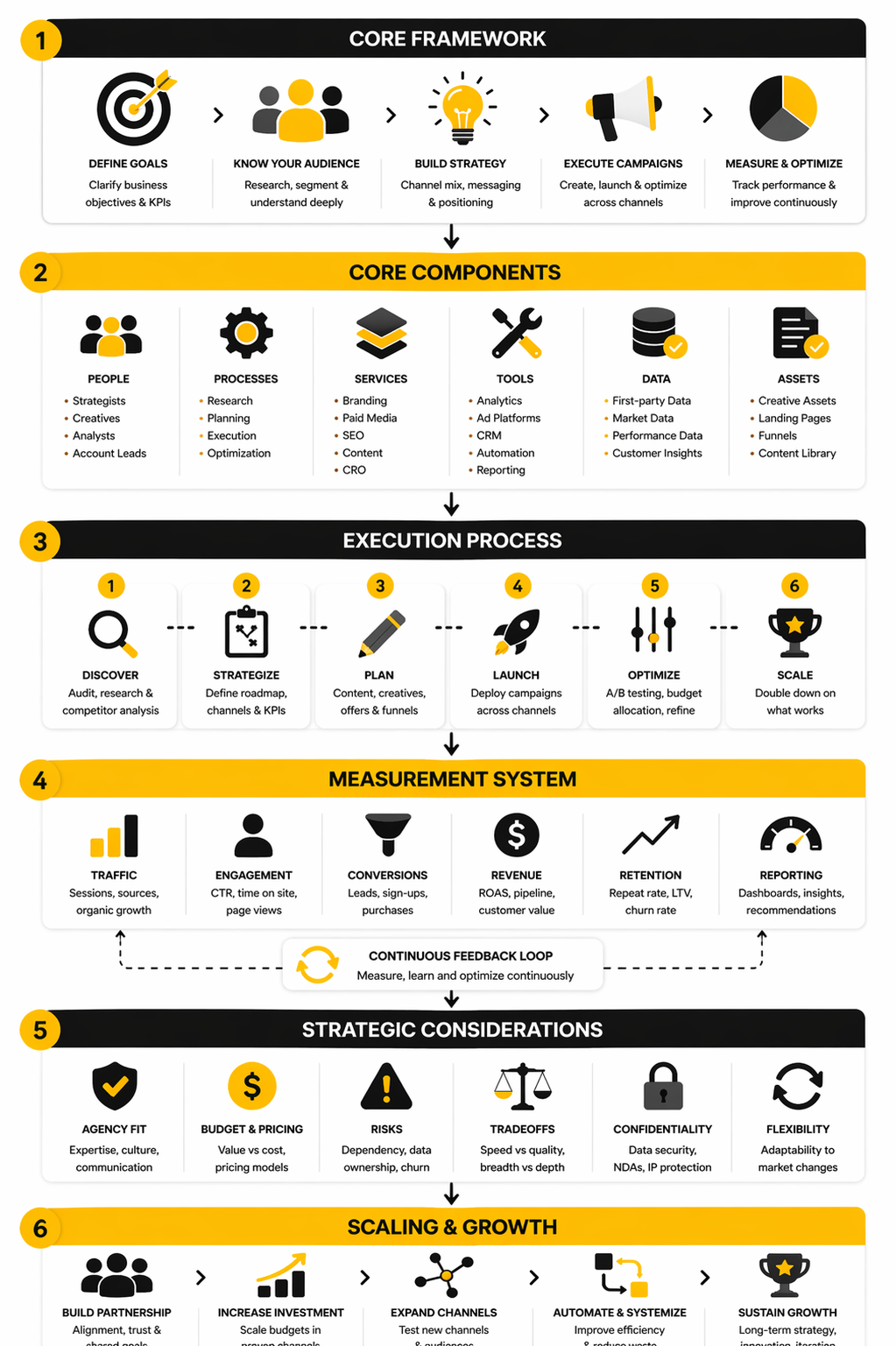
The best companies do not treat agency selection as a one-time purchase. They treat it as part of the growth system. The agency has a role, the internal team has a role, the data has a role, and the customer journey connects everything.
That system should make it clear which problems are handled internally, which problems require an agency, which tools support execution, and which metrics prove progress. When those pieces are aligned, agencies stop feeling like outside vendors and start operating like focused growth partners.
This is the final filter: a top agency should make your marketing system clearer, faster, and more accountable. If the relationship adds complexity without better decisions, it is not the right fit.
FAQ - Built For Complete Guide
What Are Top Marketing Agencies?
Top marketing agencies are firms that help businesses plan, execute, measure, and improve marketing across specific channels or complete growth systems. They may specialize in brand strategy, paid media, SEO, content, social media, lifecycle marketing, analytics, or full-service marketing. The best ones connect their work to clear business outcomes.
How Do I Choose The Right Marketing Agency?
Start with the business problem, not the agency category. Decide whether you need more demand, clearer positioning, better conversion, stronger retention, or cleaner execution. Then choose an agency whose specialty, proof, process, and operating model match that specific need.
Are Full-Service Marketing Agencies Better Than Specialists?
Not always. Full-service agencies can be better when you need coordination across several channels. Specialist agencies are often better when one channel or problem needs deep expertise. The right choice depends on your bottleneck.
What Should I Ask A Marketing Agency Before Hiring?
Ask who will actually work on the account, what process they use, what results they have produced in similar situations, what they need from your team, and how success will be measured. Also ask what they would not recommend doing. Strong agencies can explain tradeoffs clearly.
How Much Do Top Marketing Agencies Cost?
Costs vary widely based on scope, agency reputation, location, team seniority, and service type. A small specialist project may cost much less than a full-service retainer with strategy, creative, media, and analytics. The better question is whether the expected value justifies the investment.
What Makes A Marketing Agency “Top Tier”?
A top-tier agency has strong diagnosis, focused expertise, consistent execution, credible proof, clear communication, and honest measurement. It should be able to explain why a strategy fits your business instead of only showing polished creative or big-name clients.
How Long Should You Work With A Marketing Agency Before Judging Results?
It depends on the work. Paid media and conversion projects can show signals faster, while SEO, content, brand, and lifecycle strategy may need a longer window. A first 90-day phase should still create clarity, momentum, and evidence that the agency is moving in the right direction.
What Metrics Should Agencies Report On?
Agencies should report on metrics tied to the job they were hired to do. That might include qualified leads, CAC, ROAS, pipeline, revenue, conversion rate, organic traffic, rankings, retention, engagement, content-assisted conversions, or brand clarity. Task completion alone is not enough.
Should Startups Hire Marketing Agencies?
Startups can benefit from agencies when they need specialist execution, faster testing, or outside expertise. But they should avoid outsourcing core customer understanding and positioning too early. The founder or internal team still needs to own the market insight.
When Should You Fire A Marketing Agency?
Consider ending the relationship when the agency misses deadlines repeatedly, avoids accountability, gives generic recommendations, cannot explain performance, or no longer fits the problem your business needs solved. Before switching, have a direct reset conversation. If the same issues continue, move on.
Can AI Replace Marketing Agencies?
AI can help with research, reporting, creative variations, content workflows, and analysis, but it does not replace judgment. Marketing still needs positioning, customer insight, taste, strategy, prioritization, and accountability. Strong agencies use AI to improve execution, not to avoid thinking.
Should I Hire One Agency Or Multiple Agencies?
One agency is usually easier to manage when you need coordination. Multiple specialist agencies can work when you have strong internal leadership and a clear shared strategy. Without that, the work can fragment quickly.
How Do I Compare Agency Case Studies?
Look for the starting point, the problem, the strategy, the work performed, and the result. Make sure the case study matches your business model, stage, and channel needs. Big numbers without context are not enough.
What Tools Help Manage Agency Work?
Useful tools include CRMs, analytics platforms, project management systems, landing page builders, automation tools, and reporting dashboards. Platforms like GoHighLevel, Copper, Replo, and Brevo can support different parts of the relationship when ownership is clear.
What Is The Biggest Red Flag In A Marketing Agency?
The biggest red flag is vague confidence. If an agency promises results without understanding your customers, data, offer, sales process, constraints, and goals, be careful. Serious agencies ask sharp questions before making big claims.
Work With Professionals
Explore 10K+ Remote Marketing Contracts on MarkeWork.com
Most marketers spend too much time chasing clients, competing on crowded platforms, and losing a percentage of every project to middlemen.
MarkeWork gives you a better way. Browse thousands of remote marketing contracts and connect directly with companies desperate to hire skilled marketers like you, without platform commissions and without unnecessary gatekeepers.
If you're serious about finding better opportunities and keeping 100% of what you earn, explore available contracts and create a profile for free at MarkeWork.com.