

Twitter advertising still matters for one simple reason: intent on this platform shows up in public. People react to launches, product drops, earnings calls, sports events, policy shifts, creator drama, and breaking news in real time. That makes the platform unusually useful when your offer benefits from momentum, relevance, and timing instead of passive scrolling.
The mistake most brands make is treating Twitter advertising like a smaller version of Meta ads. It is not. The best campaigns here work because they match the pace of the feed, the language of the audience, and the context around the conversation. When you get that right, the platform can punch above its size, especially for software, media, finance, ecommerce, apps, and offers that can hook attention fast.
This article breaks the topic into six connected parts so you can build from strategy to execution without guessing. We will start with where Twitter advertising fits today, then move into campaign structure, targeting, creative, measurement, and the operating habits that separate mediocre accounts from profitable ones.
- Why Twitter Advertising Still Matters
- The Twitter Advertising Framework
- Campaign Objectives, Formats, and Targeting
- Creative That Fits the Feed
- Measurement, Optimization, and Budget Control
- Professional Implementation and Long-Term Scaling

Why Twitter Advertising Still Matters
Twitter advertising works best when your market already has active conversation around a problem, category, or event. That is why it can feel weak for generic mass-market products and surprisingly strong for brands selling urgency, relevance, expertise, or cultural proximity. You are not just renting attention here. You are stepping into an existing stream of intent.
That changes how you should think about value. On some channels, the job is to interrupt. On Twitter, the job is often to join. The strongest advertisers win because their campaigns feel connected to what people are already watching, debating, buying, or anticipating.
This also explains why the platform remains attractive even after years of upheaval, rebranding, and advertiser skepticism. The audience may not behave like it did in the old Twitter era, but the core advantage is still intact: when people want to react now, they do it here in public, with signals advertisers can actually use. For the right business, that is not a small edge. It is the whole game.
A second reason it still matters is that Twitter advertising can support both demand capture and demand creation at the same time. You can target users based on interests, conversations, keywords, follower look-alikes, engagement behavior, and website activity, then connect that traffic to lower-funnel campaigns once the first click happens. That makes the platform especially useful for brands that know how to turn attention into retargeting depth.
For lean teams, this can become part of a bigger operating system instead of a standalone ad channel. For example, brands that coordinate content, lead capture, and follow-up well usually get more out of Twitter advertising than brands that only look at click-through rate. That is where tools like Buffer for publishing rhythm or ManyChat for conversational follow-up can make the traffic more valuable after the first touch.
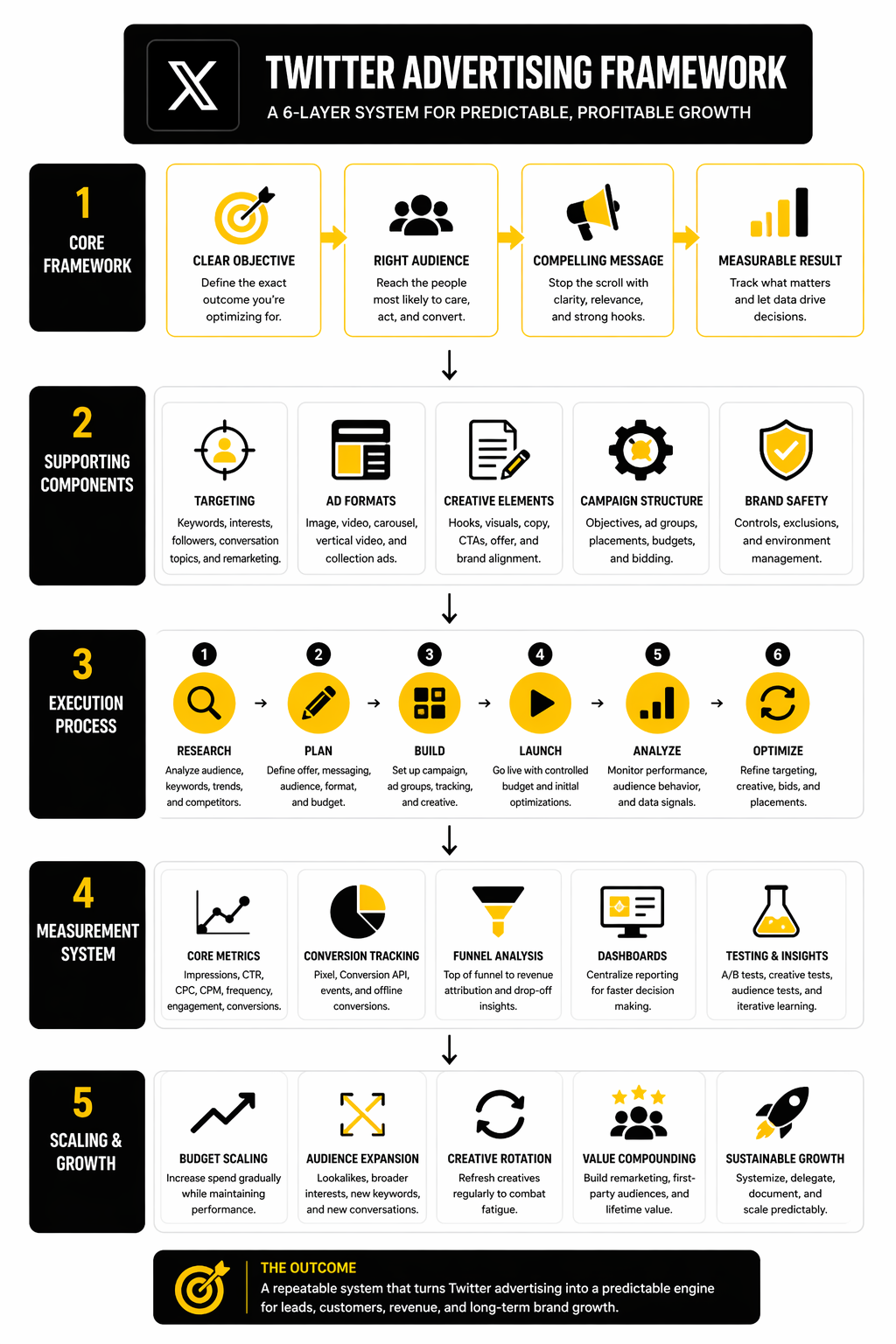
The Twitter Advertising Framework
The cleanest way to think about Twitter advertising is as a four-part system: context, audience, offer, and measurement. Most underperforming campaigns do not fail because the platform is broken. They fail because one of those pieces is missing, and the account owner keeps tweaking bids or creative without fixing the real issue.
Context comes first because timing matters more here than many advertisers expect. A campaign tied to an active category conversation, major event, seasonal angle, or emerging narrative usually has a much easier time earning engagement. When the market is already paying attention, your ad does not need to force the moment. It just needs to belong in it.
Audience comes next, but not in the lazy “broad versus narrow” way people usually discuss targeting. On Twitter, audience quality improves when you combine platform-native intent with business-stage logic. Someone engaging with industry voices, reacting to a topic cluster, or resembling the followers of a relevant account can be far more useful than a broad demographic match that looks good only on paper.
Offer is where many campaigns quietly collapse. A clever tweet is not enough, and a polished asset is not enough either. The user has to understand what they get, why it matters now, and what action to take next without effort or confusion.
Measurement is the last piece, but it should be designed before launch. If you do not know which conversion event matters, how attribution will be handled, and where post-click quality will be evaluated, you are not really running Twitter advertising. You are paying for activity and hoping it turns into results.
In the next part, we will move from the strategic view into campaign construction. That is where Twitter advertising becomes much more practical: choosing the right objective, matching it to the right format, and building targeting logic that does not waste budget before the algorithm has a chance to learn.
Campaign Objectives, Formats, and Targeting
The next step in Twitter advertising is translating strategy into campaign structure. This is where a lot of accounts get messy fast, because they mix the wrong goal with the wrong creative and then blame the platform when performance drifts. X still runs on objective-based campaigns, and the platform says delivery is optimized around the objective you choose and billing is tied to the action aligned with that goal.
Right now, the core objective stack includes Reach, Video Views, Website Traffic, Pre-roll Views, Engagement, App Installs, App Re-engagements, and Website Conversions. That matters more than most advertisers realize, because objective choice does not just change reporting. It changes how the system looks for users, what action it values, and what kind of result you should expect from the auction.
Pick the Objective That Matches the Real Business Outcome
If the goal is visibility around a launch, event, or message, Reach is the cleanest starting point. It keeps the job simple and gives the system permission to maximize exposure instead of chasing downstream actions that may not have enough data yet. That is often the right move when your audience is already paying attention and you need presence more than precision.
If the goal is traffic to a page you control, Website Traffic is the more honest choice. This sounds obvious, but many advertisers still run engagement-heavy campaigns and hope clicks will follow. When the platform explicitly offers a traffic objective and a separate conversions objective, you should assume the algorithm is treating those outcomes differently.
Website Conversions is the stronger option once your event tracking is working and the site experience is ready. X’s own documentation makes the point clearly: conversion tracking is not just for reporting, it also helps optimize and target campaigns. That means a conversion campaign without reliable event signals is not just incomplete measurement. It is a weaker machine.
For app businesses, the split between App Installs and App Re-engagements matters because acquisition and activation are different problems. X also notes that app-install advertisers should have measurement infrastructure in place before launch, including a mobile attribution partner, SKAdNetwork support, and enrollment in its advanced mobile measurement program. That is a useful reminder that Twitter advertising can move fast on the front end, but the backend setup still determines whether the data is worth trusting.
Use the Right Ad Format for the Job
X currently groups its advertising formats into Promoted Ads, Vertical Video Ads, Amplify, Takeovers, Live, Dynamic Product Ads, Collection Ads, and related features. Within Promoted Ads, the practical building blocks are still image, video, carousel, and text ads. Those formats are not interchangeable. Each one changes how much context you can deliver before the click and how naturally the ad fits the feed.
Image ads are still useful when the offer is simple and the visual can do most of the selling. Video ads work better when the product needs motion, demonstration, or pace to make sense quickly. Carousel ads are especially useful when you need to show multiple products, multiple benefits, or a sequence that reduces friction before the user leaves the platform. X says carousel units can include up to six swipeable images or videos, which makes them more flexible than a single static placement for layered offers.
Vertical video deserves special attention because X is clearly pushing it. The company says vertical video now accounts for about 20% of daily total time spent on the platform, and it describes Vertical Video Ads as its most engaging format. X also says users are seven times more likely to follow, repost, like, and click the URLs of these ads compared with the same ads on the Home Timeline, which is exactly why advertisers should not treat vertical creative as an optional extra anymore.
Amplify is a different beast and should be treated that way. It lets advertisers pair video ads with premium publisher content, with pre-roll available across multiple categories and sponsorships reserved for more customized executions. That makes it more relevant for brands that care about adjacency, premium context, or large cultural moments than for small self-serve advertisers trying to validate a landing page.
For ecommerce, Dynamic Product Ads and Collection Ads are where Twitter advertising becomes more performance-oriented. X positions Dynamic Product Ads around showing the most relevant product at the right time, with one mode for retargeting known shoppers and another for prospecting against a product catalog. That setup is far more aligned with catalog-driven retail than trying to force a generic traffic campaign to do the same job.
Build Targeting Around Intent, Not Just Demographics
X gives advertisers a wide targeting menu, including location, language, device, age, and gender, plus audience types such as conversation targeting, event targeting, post engager targeting, keyword targeting, interest targeting, follower look-alikes, follower targeting, and Custom Audiences. That breadth is useful, but it can also tempt people into stacking too many filters at once. On this platform, intent signals usually matter more than making the audience look tidy in a dashboard.
Keyword targeting is one of the strongest platform-native options because X says it can reach people based on search queries, recent posts, and posts they recently engaged with. That is unusually valuable when your category has clear language around need, urgency, or comparison behavior. It is also one of the fastest ways to align Twitter advertising with real conversation instead of broad assumptions about who might care.
Conversation targeting goes even wider by clustering users around topic behavior. X says this reaches people based on everyday conversations across more than 25 categories and over 10,000 topics, which makes it useful when the market is bigger than a handful of keywords but still organized around recognizable subject areas. For category awareness or mid-funnel demand creation, that is often cleaner than overengineering interest stacks.
Follower look-alikes remain practical when you know which accounts already attract the audience you want. X describes this as targeting people who behave similarly to another account’s followers, which is a good reminder that competitor and creator ecosystems can become targeting inputs. In the right niche, that can save you weeks of blind testing.
Post Engager targeting is where the account starts to act like a system instead of a one-off campaign. X says this allows remarketing to people who have already seen or engaged with prior campaigns or your organic presence. That means paid and organic should not be separated in your thinking. On this platform especially, the best Twitter advertising accounts use organic posts to generate signal and paid campaigns to compound it.
Do Not Overconstrain the Audience
One of X’s own optimization guides makes a point many advertisers learn too late: audiences that are too broad reduce relevance, but audiences that are too small limit who can actually see the ad. The same guide also warns that campaigns with very similar audiences can compete against each other for delivery. In practice, that means campaign architecture matters almost as much as targeting logic.
This is also where audience expansion can help, provided your seed audience is sensible. X says Audience Expansion can extend targeting to people similar to your core audience and supports levels such as Defined, Expanded, and Broad. It also notes that the feature is available for several objectives, while Website Traffic and App Installs campaigns are directed toward automated targeting instead.
The bigger lesson is that Twitter advertising usually performs better when you define the audience with one or two strong signals, not ten weak ones. A keyword cluster plus a strong offer can outperform a heavily narrowed audience that looks sophisticated but starves the system. If you want scale without losing relevance, widen from proven intent rather than layering extra restrictions out of fear.
Measurement Setup Should Happen Before You Scale
If you are sending traffic off-platform, tracking is not optional. X’s current setup gives advertisers two core web conversion paths: the X Pixel and the Conversion API. The company says both solutions serve the same goal, and it explicitly calls it critical to implement at least one of them to unlock the full capabilities of web campaigns.
For most advertisers, X recommends starting with the pixel because it is simpler to implement. For brands with technical constraints or stricter server-side preferences, the Conversion API can be the better fit. Either way, the point is the same: you need reliable event data if you want conversion campaigns, remarketing audiences, and better optimization to work the way they are supposed to.
This is especially important now because signal quality is not uniform across every environment. X’s own app advertising guide notes that Custom Audiences and some auto-exclusion capabilities have been affected by App Tracking Transparency, while age, gender, location, language, device, keyword, event, interest, conversation topic, movie and TV, and follower targeting are expected to see minimal to no impact. That should shape how you prioritize targeting inputs when precision really matters.
A practical stack often looks like this: use the platform’s native intent targeting to find the right people, use the pixel or Conversion API to capture site behavior, then use that behavior to inform retargeting and optimization. If you want tighter lead handling after the click, it can also make sense to route Twitter advertising traffic into a stronger follow-up layer using tools like GoHighLevel or Brevo, because weak post-click systems can erase good media buying.
The next part is where this gets more creative and more demanding. We will move into the ads themselves: how to write for the feed, how to structure hooks and calls to action, and why creative that looks polished but feels out of place usually loses on X.
Creative That Fits the Feed
Creative is where Twitter advertising stops being theoretical. You can choose the right objective, build a sensible audience, and install tracking properly, then still lose because the ad feels like it belongs on another platform. X’s own best-practice guidance is pretty clear on this point: short copy, strong visuals, visible branding, and video that gets to the point quickly tend to perform best, with the platform specifically recommending copy in the 50 to 100 character range for reach campaigns and videos of 15 seconds or less. X creative best practices and reach campaign guidance
That does not mean every ad has to be tiny or stripped down. It means the first impression has to resolve fast. People on X decide in a split second whether your post adds signal to the feed or whether it is just another interruption, and your creative has to win that judgment before the user scrolls on.
The platform’s own organic playbook lines up with the paid guidance in a useful way. It recommends avoiding images with heavy text, using captions or another sound-off strategy for videos with dialogue, and considering Website Buttons when driving to a link. Those are simple rules, but they matter because they reflect how people actually consume posts on X: quickly, often silently, and usually while deciding whether the click is worth the friction. organic best practices
Write Ads That Sound Native, Not Imported
The fastest way to weaken Twitter advertising is to sound like a brand that copied its ad from Meta, LinkedIn, or a display campaign. X rewards clarity, but it also rewards tone that feels like it belongs inside a live conversation. That usually means one sharp idea, one clear promise, and one next step instead of a bloated message trying to explain the entire business.
Strong copy on X usually does one of three things well. It names a problem people already recognize, frames a point of view sharply enough to earn attention, or makes the offer concrete enough to justify a click. When advertisers fail here, it is often because they write as if the audience arrived pre-sold instead of mid-scroll.
This is also where discipline matters more than cleverness. If the creative asks the user to decode what is being offered, performance usually drops. If the ad makes the value legible immediately, Twitter advertising becomes much easier to scale because the platform is no longer wasting impressions on confused clicks.
Match the Format to the Message
Format choice is part of creative, not a technical afterthought. X’s current specs support a broad set of aspect ratios across image, video, website card, and carousel ads, including 1:1, 1.91:1, 16:9, 4:5, 2:3, and 9:16 in several placements. That gives advertisers flexibility, but flexibility is only useful when it serves the message instead of adding production noise. X Ads creative specs
Image ads are still strong when the message is simple and the visual can stop the scroll on its own. Video is better when demonstration, movement, or pacing adds real persuasion. Carousel ads are most useful when the offer needs sequence, because X supports two to six cards and card-level reporting, which makes them especially effective for feature breakdowns, product lines, and multi-step narratives. carousel ads on X
The important thing is not to use a richer format just because you can. Some offers win with one bold image and direct copy. Others need a short video and a website card because the click only makes sense after a quick explanation.
Make the Click Feel Worth It Before It Happens
One overlooked issue in Twitter advertising is that a click and a real visit are not the same thing. X explicitly notes that link-click reporting can differ from third-party analytics because some users click, then bounce before the landing page fully loads. The company points to load time and user intent as two main reasons and recommends testing different creative formats, copy, and calls to action while refreshing creative every two to three weeks. website traffic campaign setup and website traffic optimization
That matters because weak pre-click framing creates expensive disappointment. If the ad makes the destination obvious, the traffic tends to be cleaner. If the user thinks they are tapping media and suddenly hits a slow sales page, you can lose the visit before the page has a chance to do its job.
This is why strong Twitter advertising often feels slightly more literal than “creative” marketers want. The ad should preview the landing-page experience honestly enough that the click feels like a continuation, not a bait-and-switch. That is not boring. That is efficient.
A Practical Execution Process for Launching Creative
Good creative teams do not improvise their way into performance. They build a repeatable process that turns audience insight into multiple testable assets, then they let the data trim the weak ideas quickly. The simplest version of that process on X is still the most reliable one.
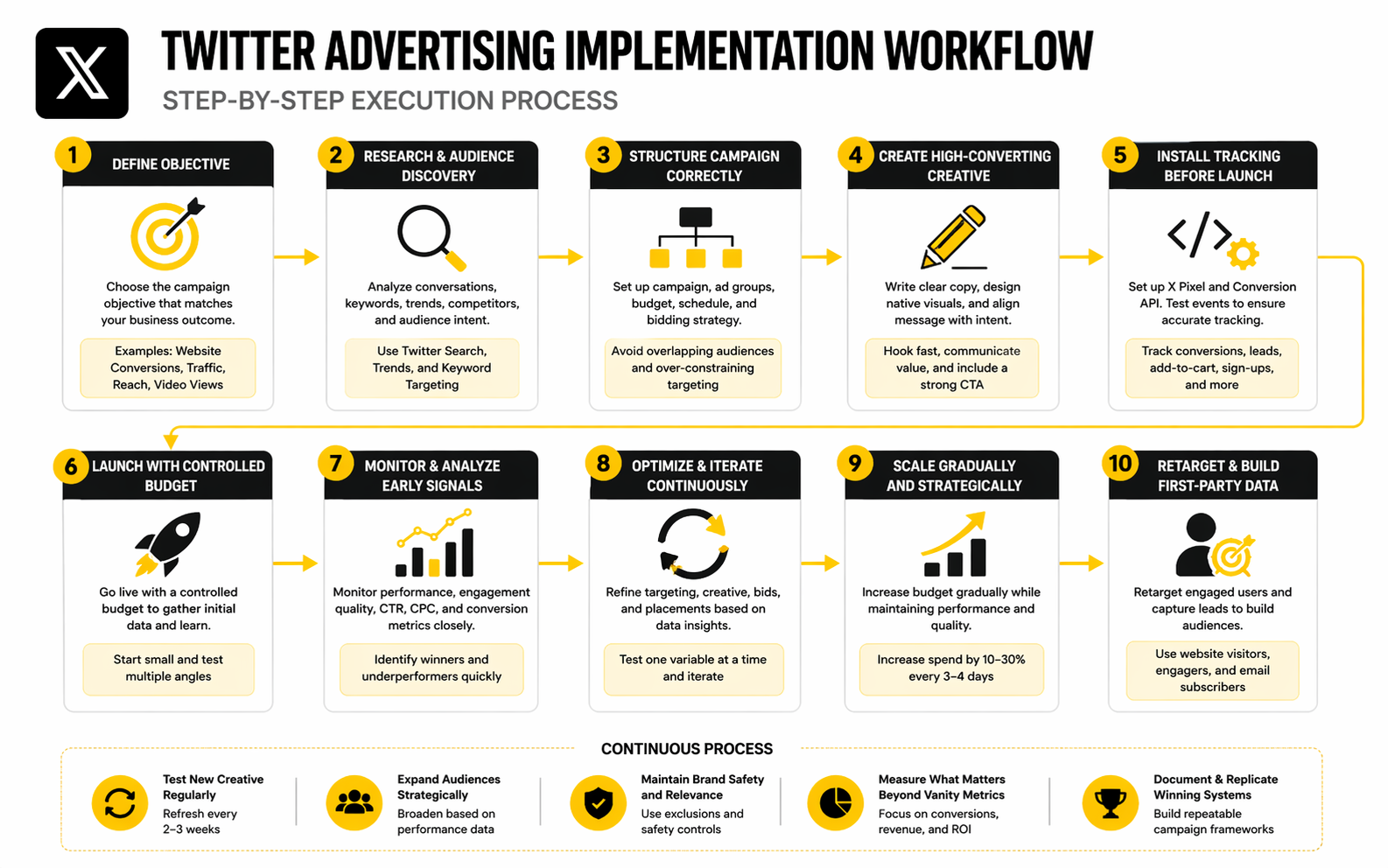
Start with one campaign goal, one audience angle, and three creative hypotheses. That might mean one pain-led version, one proof-led version, and one offer-led version, all aimed at the same audience cluster. The point is not to flood the account with endless variants. It is to give the platform enough structured diversity to reveal what message the market actually responds to.
From there, build assets that stay inside platform reality. X recommends short copy, short video, and visible branding, while its specs define the practical guardrails for media, website cards, and carousel units. That combination should shape production from day one so your team is not creating beautiful assets that immediately need to be rebuilt for the feed. reach campaign guidance and X Ads creative specs
A clean launch process usually looks like this:
- Define the exact conversion path you want, not just the headline KPI.
- Build one audience around the strongest intent signal you have.
- Create three to five ad variants around distinct messaging angles.
- Match each variant to the format that best delivers the idea.
- Send traffic to a landing page that continues the promise without friction.
- Review click quality, conversion quality, and engagement together before making changes.
That last point matters more than people think. If one ad gets the cheapest clicks but the weakest downstream behavior, it may be the worst creative in the batch. If another gets fewer clicks but stronger conversion depth, that is often the asset worth expanding first.
Build Landing Pages for Continuity, Not Just Conversion
Most Twitter advertising failures get blamed on the ad when the real break happens after the click. The user leaves a fast-moving feed and lands on a page that is slower, denser, and less emotionally coherent than the promise that got the click. That transition has to feel smooth, or the media spend starts leaking immediately.
This is why message match is not a cliché. It is operational. The headline, first visual, and call to action on the landing page should feel like the next sentence of the ad, not a new argument entirely.
For ecommerce brands, this usually means sending people to tightly matched product or collection pages instead of generic homepages. For lead generation, it means stripping the page down to one commitment and one next step. If you are iterating quickly, a landing-page tool like Replo can help ecommerce teams test layouts faster, while businesses with heavier nurture flows often do better when forms and follow-up are connected inside GoHighLevel or Fillout.
Refresh Without Resetting the Whole Account
Creative fatigue is real on X, but the fix is not to tear everything down every few days. The platform itself recommends refreshing creative every two to three weeks for website traffic campaigns, which is a far more practical rhythm than constant reactive editing. website traffic campaign setup
The smarter move is to preserve the winning structure and update the parts most likely to wear out first. Usually that means the hook, the opening frame, the first line of copy, or the visual treatment, while the audience, objective, and landing page stay stable long enough to produce usable learning. This keeps Twitter advertising from turning into chaos disguised as testing.
It also protects you from a common operator mistake: confusing novelty with improvement. A fresh asset is not automatically a better asset. The real goal is to extend performance by preserving what already works and only changing what evidence says is stale.
Treat Creative Testing as a System
Once a campaign starts generating enough data, creative testing should become more deliberate. X’s own materials recommend using multiple ad formats when possible, and older Nielsen research cited in the platform’s carousel materials found that using three or more ad formats increased campaign awareness by 20% and purchase intent by 7% versus using one format alone. The study is older, so it should not be treated like a universal law, but the operational lesson still holds: different formats reveal different kinds of buying intent. reach campaign guidance and carousel ads on X
That means testing should answer clear questions. Does the market respond better to direct benefit language or sharper opinion-led hooks. Does a website card improve qualified traffic compared with a plain image. Does a carousel help because the offer needs sequencing, or does it slow the user down too much.
The teams that get good at Twitter advertising stop treating those questions emotionally. They create a structure, test it consistently, and let performance narrow the field. That is when the channel starts becoming dependable instead of dramatic.
The next part is where the numbers come back into focus. We will move into measurement, optimization, and budget control, because good creative only becomes profitable when the account knows how to read signal, cut waste, and scale what is actually converting.
What the Data Really Tells You
By this point, Twitter advertising stops being about setup and starts being about interpretation. The platform gives you plenty of numbers, but not all numbers deserve the same weight. X’s campaign dashboard centers everything around impressions, results, engagement rate, and cost per result, and that is useful because it forces a simple question: is the campaign producing the specific action the objective was designed to generate.
That last part matters. If you picked Website Traffic, the “result” is link clicks, not purchases. If you picked Website Conversions, the platform is trying to optimize toward tracked downstream actions through the X Pixel or Conversion API. Too many advertisers look at a nice top-line number in the dashboard and assume the campaign is healthy, when in reality the metric is only proving that the system is doing the exact job it was told to do.
This is why measurement in Twitter advertising has to be hierarchical. The first layer is delivery, the second is response, and the third is business impact. If you collapse those layers into one blurry verdict, you end up scaling noise.
Start With Delivery Metrics, But Do Not Stop There
Impressions tell you whether the market is even seeing the ad. Results tell you whether the audience is taking the action tied to the campaign objective. Cost per result tells you how expensive that action is becoming, and result rate tells you how efficiently the creative and targeting are turning exposure into movement. X defines these core dashboard metrics directly, which is helpful because it keeps analysis anchored to what the platform is actually optimizing for.
These numbers matter most in the first stage of a campaign. Early on, they tell you whether the combination of audience, bid environment, and creative is viable enough to continue. If impressions are weak, you may have a delivery problem. If impressions are fine but results are weak, you probably have a response problem.
What they do not tell you on their own is whether the campaign is profitable. A low cost per click can still be expensive traffic if the landing page leaks intent. A high engagement rate can still be low-quality attention if the ad attracts curiosity instead of commercial action.
The Analytics System That Actually Helps You Decide
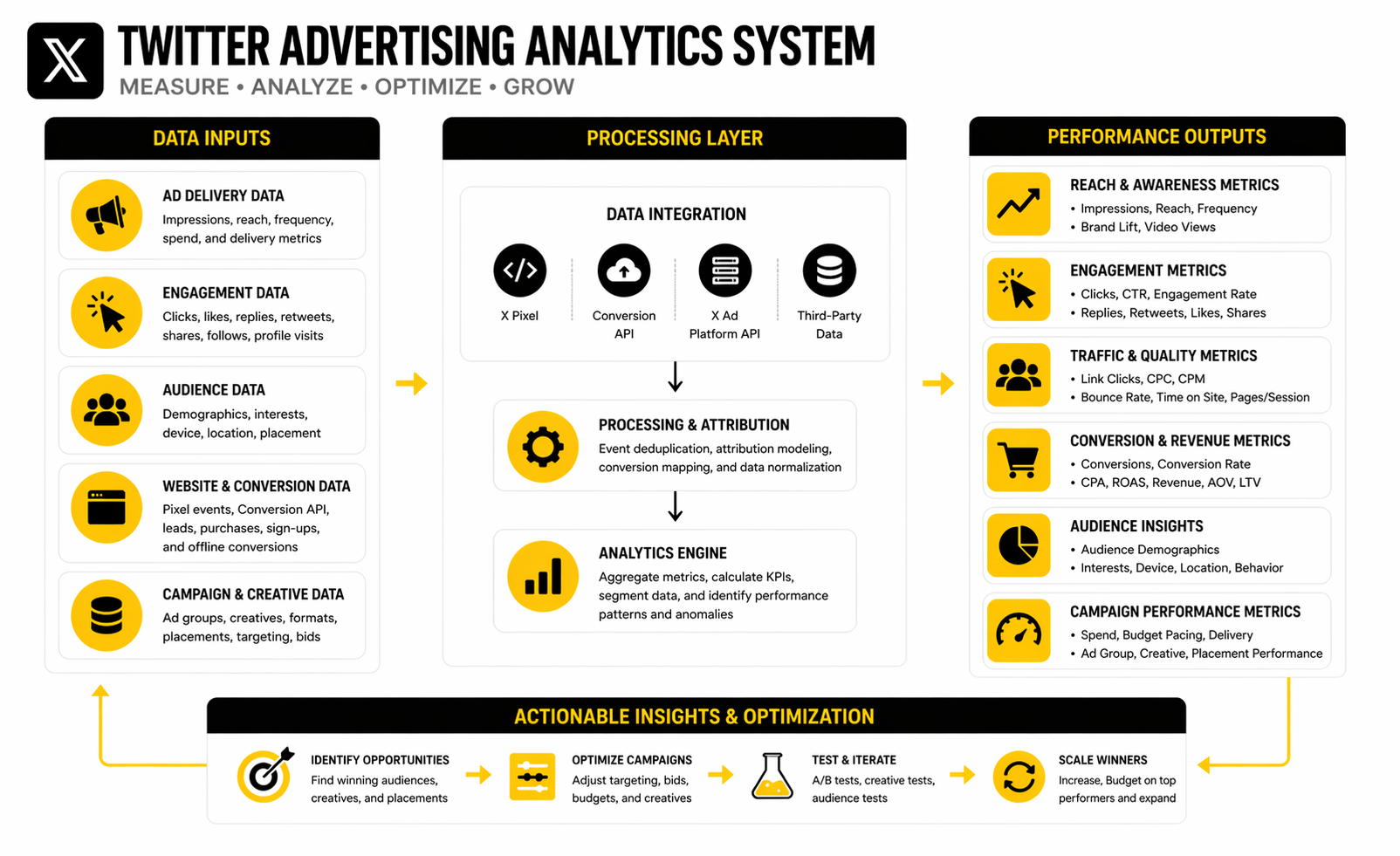
A practical measurement system for Twitter advertising needs four layers, not one dashboard glance. The cleanest structure is this: delivery, click quality, conversion quality, and revenue impact. That sequence matters because each layer filters the meaning of the one before it.
Delivery is your platform layer. Here you watch impressions, results, result rate, and cost per result inside the Ads Manager dashboard. Click quality is your traffic layer, where you compare X’s reported clicks with on-site sessions, bounce behavior, and page engagement. X itself notes that link-click metrics and third-party analytics can diverge because users may click and then leave before the page loads, which is exactly why landing-page speed and message match are not side issues. X explains those discrepancies in its website traffic guidance.
Conversion quality is where tracking infrastructure becomes non-negotiable. X says conversion tracking lets advertisers measure the actions people take after viewing or engaging with ads, and it explicitly says those events can also be used to optimize and target campaigns better. Revenue impact is the final layer, where you decide whether the campaign deserves more budget, a creative refresh, a funnel fix, or a full stop.
When teams skip that layered view, they make sloppy decisions. They pause campaigns that are actually feeding strong retargeting pools, or they scale cheap clicks that never become real customers. The dashboard is useful, but only when it sits inside a bigger measurement model.
Statistics and Data
The most useful stats in Twitter advertising are the ones that change how you operate, not the ones that just make the article look researched. One important context number is that X ads reached 586 million users globally in January 2025, which gives the platform real reach at a global level. But that same source also notes that ad reach is not the same thing as active user count, and that distinction matters because advertisers often mistake planning-tool reach for guaranteed attention.
Another useful signal is trend direction. DataReportal’s 2025 analysis says X’s reported ad reach fell by 33 million users year over year, a decline of 5.3% between January 2024 and January 2025. That does not mean Twitter advertising is automatically weaker. It means audience quality, category fit, and campaign timing matter even more, because the platform is not a pure scale play for most brands anymore.
On the business side, EMARKETER’s 2025 forecast projects X’s worldwide ad revenue to rise 16.5% year over year in 2025 after a steep earlier collapse. That is a meaningful number because it suggests advertiser demand is recovering, but the same forecast also says the business remains far below its pre-acquisition peak. In practical terms, the market is signaling cautious return, not blind confidence.
Those three stats together tell a more honest story than generic benchmark tables. The platform still has reach. That reach has softened. Advertiser spending is improving, but not because everyone suddenly decided X is easy. So the right conclusion is not “dump budget in” or “ignore the channel.” The right conclusion is that Twitter advertising rewards operators who measure tightly and move with evidence.
Which Metrics Should Trigger Action
A good analytics workflow does not just collect numbers. It assigns decisions to them. If impressions fall unexpectedly, look first at targeting overlap, bid competitiveness, or audience size before you touch the creative. X’s own optimization materials warn that audiences that are too small can limit delivery, and audiences that are too similar can compete against each other.
If clicks are strong but qualified visits are weak, the problem is often pre-click framing or page speed. X explicitly recommends testing different creatives, calls to action, and formats, and it also recommends refreshing creative regularly rather than letting fatigue drag the campaign down. Its website traffic guidance is blunt on this: creative and landing-page experience directly affect the quality of traffic you get.
If conversion volume is inconsistent, look at tracking before you look at the auction. X says web campaigns need at least one conversion tracking solution in place to unlock the full capabilities of performance optimization. For app campaigns, the platform also makes clear that attribution windows need to match your mobile measurement partner settings, or your numbers will drift and your decision-making will get corrupted.
That is the big lesson: the meaning of a metric depends on where it breaks in the system. Low CTR can be a creative problem. Low conversion rate can be a landing-page problem. Rising CPA can be a scaling problem, a signal-loss problem, or a targeting exhaustion problem. One number rarely tells the whole story by itself.
Benchmarks Are Directional, Not a Substitute for Judgment
This is where many advertisers get lazy. They look for one “good” CTR, one “normal” CPC, or one universal conversion rate and try to manage the account from there. That almost always leads to bad decisions because Twitter advertising behaves differently across event-driven markets, product categories, geographies, and campaign objectives.
A more intelligent way to use benchmarks is to treat them as orientation, not commandments. The platform itself gives you objective-specific result definitions, which already tells you that comparing a reach campaign to a conversion campaign on the same metric is usually nonsense. The useful comparison is not your campaign versus a random internet average. It is your campaign this week versus the same campaign last week, or your new creative versus the last proven control.
That internal benchmark matters more because it captures your actual economics. A campaign with an above-average CPC can still be excellent if its post-click conversion quality is strong. A campaign with a beautiful cost per result can still be weak if the result being optimized is too shallow to matter commercially.
Attribution Changes the Story More Than Most People Realize
Attribution settings are one of the least glamorous parts of Twitter advertising, and one of the most important. X supports both post-engagement and post-view attribution for app measurement, with selectable windows such as 1, 7, 14, and 30 days. That matters because the same campaign can look very different depending on how long you allow credit to travel after an impression or interaction.
The principle carries over to web campaigns too. X says its Pixel and Click ID parameter can improve attribution reliability and reduce measurement discrepancies. So when a campaign looks weaker or stronger than expected, one of the first questions should be whether the tracking design actually matches the way the business buys.
This is especially important for products with longer consideration cycles. A click today may not produce a lead or purchase today, and if your attribution window is too narrow, Twitter advertising can look worse than it really is. On the other hand, if your window is too generous, the platform may get credit for actions it only influenced lightly.
Budget Decisions Should Follow Signal Stability
Once a campaign starts working, the temptation is to push budget harder and faster. That is usually where stable performance starts wobbling. X’s own sales best-practice guide recommends increasing daily budgets by no more than 10% to 30% and only every three to four days, which is a useful operating rule because it respects how optimization systems adapt.
That guidance matters because unstable scaling creates false negatives. Advertisers often think a creative burned out or an audience stopped working, when the real issue is that they changed spend too aggressively and disrupted learning. A calmer budget rhythm gives the account time to show whether the underlying performance signal is real.
For teams that want tighter reporting discipline, this is where tooling outside the ad account can help. A CRM and automation layer like GoHighLevel, an email system like Brevo, or a cleaner attribution workflow built around forms and lead capture with Fillout can make Twitter advertising easier to judge on actual pipeline instead of surface metrics.
The next part is where all of this turns into operating discipline. We will move into professional implementation and long-term scaling, because the real advantage is not just knowing what the data means. It is building a process that acts on that meaning consistently.
Professional Implementation and Long-Term Scaling
Once Twitter advertising starts producing real signal, the game changes. At that point, the challenge is not finding one good ad. It is building a system that can survive fatigue, budget changes, platform volatility, and internal impatience without falling apart every two weeks.
That is where advanced teams separate themselves from casual advertisers. They stop treating X like a one-off media buy and start treating it like an operating channel with its own rules, risks, and rhythms. The campaigns still matter, but process matters more.
Scale With Restraint, Not Ego
A lot of campaigns do not fail because they stop working. They fail because someone tries to force them to grow faster than the account can absorb. X’s own sales guidance recommends increasing daily budgets gradually, usually by about 10% to 30% every three to four days, which is a useful reminder that stable performance is often fragile right after a jump in spend. X sales campaign best practices
That advice matters because Twitter advertising is highly sensitive to context. If you scale too aggressively, you often move beyond the most responsive slice of the audience and start paying for weaker inventory, colder users, or lower-intent clicks. The account then looks like it “broke,” when really it just outran its strongest pocket of demand.
So the professional move is boring, and that is exactly why it works. Raise spend in controlled steps, watch whether cost per meaningful outcome holds, and only continue if the downstream metrics stay healthy. Fast scaling feels exciting. Controlled scaling makes money.
Protect the Account From Audience Saturation
As budgets rise, audience quality usually falls before most advertisers notice it. The first sign is often not a dramatic collapse. It is a quiet decline in engagement rate, click quality, or conversion efficiency while delivery remains fine. That is what makes saturation dangerous. It looks survivable until the wasted spend compounds.
X’s optimization documentation already warns that very similar audiences can compete against each other, and that overconstrained audiences can limit delivery. Its optimization guide points straight at a common advanced mistake: building too many campaigns that all fish in the same pool. That creates internal competition, fragments learning, and makes performance harder to read.
A stronger approach is to widen in layers. Start with the highest-intent audience. Then expand through adjacent keywords, broader conversation clusters, follower look-alikes, or less aggressive exclusions only after the initial pocket is clearly working. Twitter advertising usually scales better by stepping outward deliberately than by cloning the same campaign logic across slightly different ad sets and pretending that counts as expansion.
Build Around First-Party Data Wherever You Can
The more unstable the platform environment becomes, the more first-party data matters. X supports Custom Audiences, website tracking through the X Pixel and Conversion API, and post-engager retargeting, which gives advertisers multiple ways to turn rented attention into reusable signal. That is not just a nice optimization layer. It is risk management.
This becomes even more important when signal loss affects parts of the stack unevenly. X’s mobile advertising guidance notes that some audience functions and automatic exclusions have been affected by App Tracking Transparency, while other targeting dimensions such as device, language, keyword, event, interest, conversation, and follower-based options are expected to see minimal to no impact. X mobile app advertising guide That should push serious advertisers toward data they can actually own and reuse.
In practice, that means your best Twitter advertising work often happens after the click. Capture the lead. Tag the source cleanly. Route the contact into follow-up. Build segmentation you can use later. If you are serious about that handoff, systems like GoHighLevel, Brevo, or ManyChat can make the channel much more durable because the value no longer depends on one session alone.
Brand Safety Is a Strategic Decision, Not a Box to Tick
This is one of the biggest tradeoffs on X, and it should be treated honestly. The platform has expanded brand-safety controls, including Adjacency Controls, sensitivity settings, and brand-suitability solutions tied to third-party partners. X has also promoted vertical-video safety solutions and premium publisher environments through Amplify and related products. X’s advertiser control update and its pre-roll guidance make that direction clear.
But X’s own brand-safety page also says it cannot guarantee 100% effectiveness for adjacency controls. That line matters. It means the right question is not “Is the platform perfectly safe?” The right question is whether your category, reputation risk, and appetite for public adjacency make the available controls sufficient.
For some brands, especially performance-led businesses, the answer will be yes. For others, especially those with heavy public scrutiny or tighter suitability requirements, the answer may be no, or only in limited formats like premium video adjacency. Professional implementation means making that decision up front instead of acting surprised later.
Use Organic and Paid Together or Accept Lower Efficiency
A lot of advertisers still separate organic posting from paid media as if they are unrelated functions. On X, that is usually a mistake. The platform is unusually good at surfacing what language, angles, and narratives are already resonating in public, which means your organic account can become a live research lab for your paid campaigns.
This is not just about vanity engagement. Organic posts can reveal which phrasing gets reaction, which topics draw the right audience, which objections keep appearing, and which hooks deserve paid amplification. X also supports remarketing against people who have engaged with your posts, which means the line between content and media is thinner here than on many other channels. X targeting options
That is why mature Twitter advertising teams often work from a shared content calendar and testing loop. They post organically, extract the strongest angles, promote the winners, and use paid performance to inform the next round of content. Tools like Buffer can help keep that cadence consistent, but the real edge is strategic: paid and organic should be feeding each other constantly.
Expect Platform Volatility and Plan for It
This is the uncomfortable part, but it is real. X’s ad business is improving, with EMARKETER projecting 16.5% global ad revenue growth in 2025 and Reuters reporting the same forecast while noting the platform remains far below its pre-acquisition size. That means advertiser demand is returning to some extent, but the platform still carries more uncertainty than many media buyers would prefer.
That uncertainty is not only about brand perception. It is also about policy changes, product evolution, organizational shifts, and how quickly the platform can reposition inventory, formats, or sales incentives. For performance advertisers, that does not automatically make Twitter advertising a bad bet. It just means you should avoid building a fragile business model that depends on X staying stable in exactly one form.
The smart move is to treat X as leverage, not as your entire foundation. Use it where it is strongest, capture the value into owned systems, and keep your acquisition model portable. That posture lets you benefit from the platform without becoming hostage to it.
Know When Not to Scale
This may be the most advanced skill of all. Sometimes a campaign works, but not in a way that deserves more budget. It might depend too heavily on one moment, one trend, one audience pocket, or one creative concept that cannot be refreshed cleanly. In those cases, the disciplined move is to bank the insight without forcing expansion.
This is where operator maturity shows up. Not every win is scalable. Not every low CPA is durable. Not every spike in performance reflects a repeatable system.
Twitter advertising rewards people who can tell the difference. The channel can absolutely produce outsized returns when the market, message, and moment line up. But long-term success comes from knowing when to push, when to protect margin, and when to stop pretending a short-term anomaly is a growth engine.
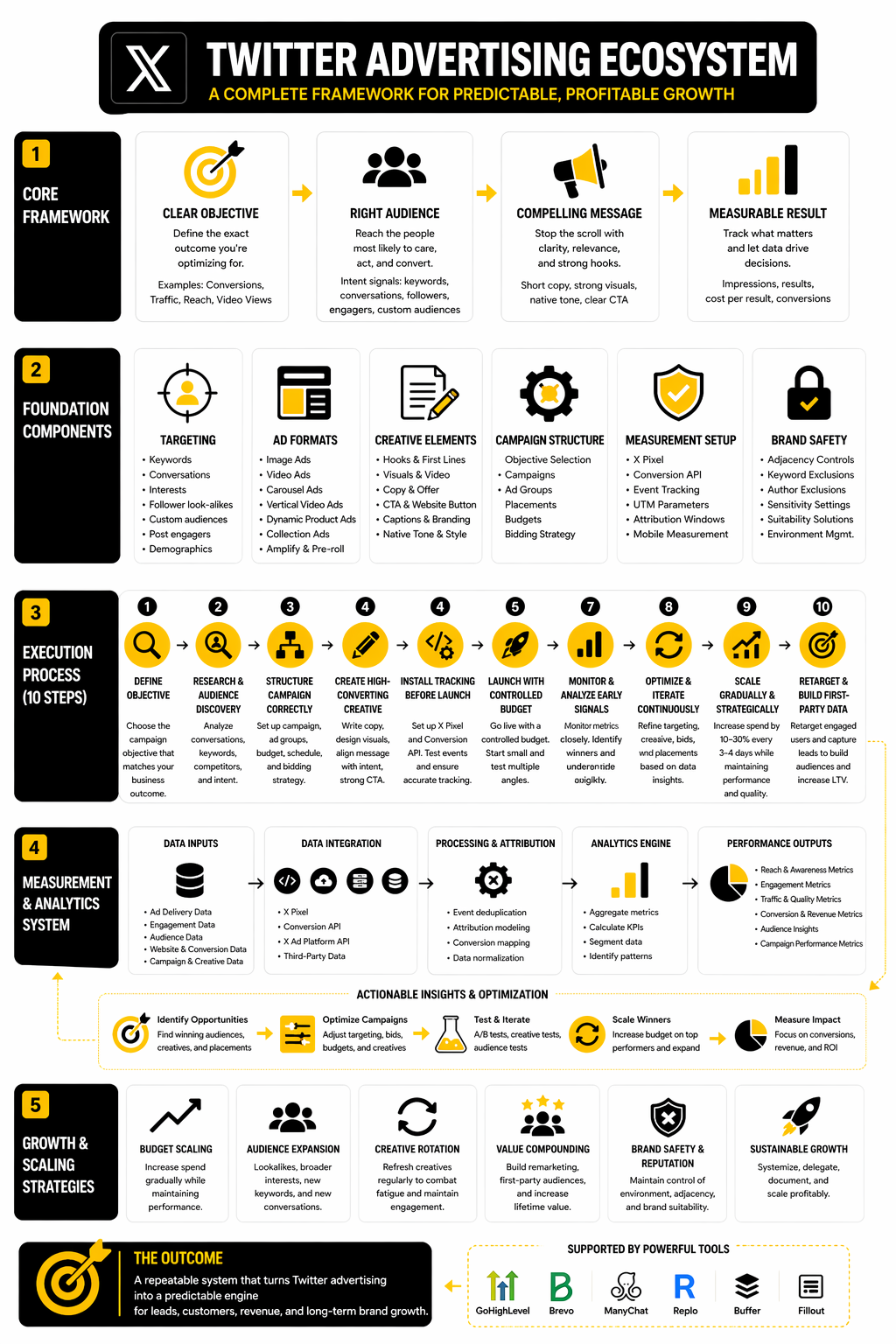
The final part will bring everything together with the most common questions, closing guidance, and a practical summary of what to prioritize first if you want Twitter advertising to become a real acquisition channel instead of another experiment that fades out.
FAQ - Built for Complete Guide
1. Is Twitter advertising still worth it in 2026?
Yes, but only for the right kind of business. X still offers substantial ad reach, with DataReportal reporting 586 million reachable users globally in January 2025, while EMARKETER projected worldwide X ad revenue would grow 16.5% in 2025, which suggests advertisers are finding reasons to come back. The opportunity is real, but it is strongest for products tied to conversation, urgency, authority, launches, events, and categories where public intent shows up fast.
That also means Twitter advertising is usually a worse fit for slow, generic offers with weak differentiation. If your product needs long education and the audience is not already discussing the problem, the platform becomes harder and more expensive. The channel can work extremely well, but it rewards fit more than optimism.
2. What objective should I choose first?
Start with the business outcome you actually care about, then choose the objective that matches it. X’s campaign system separates Reach, Video Views, Website Traffic, Engagement, App Installs, App Re-engagements, Pre-roll Views, and Website Conversions, and those are not cosmetic choices. They affect how delivery is optimized and how success is counted.
If you want clicks, use Website Traffic. If you want purchases or leads and you have tracking installed, use Website Conversions. If you just want awareness around a moment or announcement, Reach can be the cleanest option. Most wasted spend starts when advertisers ask the platform for one thing and secretly hope it will deliver another.
3. Do I need the X Pixel or Conversion API before launching?
You do if you care about serious performance measurement. X says its Pixel and Conversion API are the core tools for website conversion tracking, and it also says those events can be used to help optimize and target your ads better. That means tracking is not just about reporting after the fact. It directly improves what the system can learn.
If you are running conversion campaigns without proper event tracking, you are basically asking the platform to optimize in the dark. That can still generate activity, but it is a weak way to buy media. Install tracking first, test events, and only then judge the channel seriously.
4. Which ad format usually works best?
There is no universal winner, but there is a clear rule: the best format is the one that makes the offer easiest to understand inside the feed. X’s current format mix includes image, video, carousel, vertical video, Dynamic Product Ads, Collection Ads, Amplify, and more. The right choice depends on whether the message needs speed, proof, sequence, or demonstration.
Image ads are often enough for simple offers with a sharp hook. Video is better when motion helps explain the product or raise urgency. Carousel works when the user needs to see multiple products, benefits, or steps before the click. Most advertisers underperform because they choose the flashiest format, not the clearest one.
5. How short should ad copy be on X?
Shorter is usually stronger, but only if it still says something useful. X’s creative best practices recommend concise copy and fast visual communication, and its Reach guidance points toward copy in the 50 to 100 character range for that objective. That is a strong signal that the platform values quick comprehension.
The real takeaway is not a fixed character count. It is that Twitter advertising works best when the value lands immediately. If users have to decode the ad, you usually lose the moment before the click ever has a chance.
6. Why do my clicks in X not match my website analytics?
Because a click is not always a visit that fully loads. X explains in its website traffic campaign setup guidance that discrepancies can happen when users click but leave before the page loads or when measurement methods differ across tools. That is normal, not necessarily a sign that reporting is broken.
What matters is what action that gap should drive. If the gap is wide, look at landing-page speed, message match, and the transition from ad to page. Weak handoff is one of the easiest ways to waste otherwise good Twitter advertising traffic.
7. Should I use keyword targeting or audience targeting first?
Keyword targeting is often the best starting point when your market uses clear language around need, comparison, or urgency. X says keyword targeting can reach people based on searches, recent posts, and recent engagement with posts containing those terms. That makes it one of the most direct ways to align campaigns with actual live intent.
Audience targeting becomes more useful when you already know the ecosystem well. Conversation targeting, follower look-alikes, post engager retargeting, and Custom Audiences all become more powerful once you understand what kind of buyer the account is already attracting. In practice, many strong advertisers begin with intent-rich keywords and then expand from there.
8. How often should I refresh creative?
Often enough to avoid fatigue, but not so often that you reset learning every few days. X specifically recommends in its website traffic guidance that advertisers refresh creative every two to three weeks. That is a useful baseline because it keeps campaigns from going stale without turning testing into chaos.
The smarter move is to preserve the parts already working and refresh the hook, opening frame, first line, or angle first. Most of the time, you do not need a brand-new campaign. You need a cleaner variation of the winning idea.
9. Is brand safety on X good enough for serious advertisers?
It depends on your risk tolerance and category. X has expanded brand-safety tools, including Adjacency Controls, author exclusions, keyword exclusions, and other suitability controls, and it has also highlighted additional advertiser controls in product updates. Those tools matter, and they are much better than pretending the issue does not exist.
At the same time, X does not promise perfect protection. That means the right question is not whether the platform is universally safe. The right question is whether the available controls are sufficient for your brand, your public exposure, and the kind of adjacency risk you can tolerate.
10. How should I scale a campaign that starts working?
Slowly enough that you can still tell why it is working. X’s own sales campaign best-practice guide recommends gradual budget increases, generally around 10% to 30% every three to four days. That is not exciting advice, but it is good advice because it protects signal stability.
The advanced mistake is assuming a good campaign automatically deserves aggressive scale. Sometimes performance is tied to one audience pocket, one strong angle, or one timely moment. Good operators scale in steps, watch downstream quality, and stop forcing growth when the economics start slipping.
11. Can Twitter advertising work for ecommerce?
Yes, especially when the catalog, creative, and landing-page handoff are tight. X supports Dynamic Product Ads and Collection Ads, which are far more suitable for commerce than trying to force a plain traffic campaign to do everything. The platform can be especially effective for product drops, culturally relevant items, tech accessories, fashion moments, and categories where people react publicly.
The big caveat is post-click experience. Ecommerce brands usually do better when their product pages are fast, focused, and visually aligned with the ad. If your store needs faster landing-page iteration, a tool like Replo can make testing easier, but the real win still comes from matching the ad promise to the product page without friction.
12. What is the biggest mistake people make with Twitter advertising?
They measure shallow success and call it strategy. A campaign can generate impressions, cheap clicks, or engagement and still fail to produce meaningful business impact. X’s own dashboard definitions make it clear that results are objective-specific, which means the number only proves the system delivered the action it was asked to pursue.
That is why the best advertisers judge the channel in layers: delivery, click quality, conversion quality, and revenue. Anything less creates false confidence. Twitter advertising gets much easier once you stop asking whether the campaign looks busy and start asking whether it is driving outcomes that matter.
Final Thoughts
Twitter advertising is not a beginner-friendly channel in the way some larger ad platforms are. It is more contextual, more sensitive to timing, and more dependent on how well your message fits the feed. But that is also why it can outperform expectations when the offer, audience, and moment line up.
The practical lesson is simple. Do not treat X like a generic traffic source. Treat it like a live intent engine, build around native behavior, measure beyond surface metrics, and move budget with discipline instead of emotion.
If you want the channel to become a durable acquisition source, build the whole system. That means tracking, creative testing, landing-page continuity, retargeting, lead follow-up, and owned data capture. The advertisers who do that are the ones who keep getting paid after the novelty fades.
For teams that want stronger infrastructure around the traffic they generate, the stack after the click often matters as much as the ad account itself. That can mean using GoHighLevel for funnel and CRM workflows, Brevo for email follow-up, ManyChat for conversational automation, or Buffer to keep organic and paid content aligned. The specific tools matter less than the operating principle: capture the value you earn and make it reusable.
Work With Professionals
Explore 10K+ Remote Marketing Contracts on MarkeWork.com
Most marketers spend too much time chasing clients, competing on crowded platforms, and losing a percentage of every project to middlemen.
MarkeWork gives you a better way. Browse thousands of remote marketing contracts and connect directly with companies desperate to hire skilled marketers like you, without platform commissions and without unnecessary gatekeepers.
If you're serious about finding better opportunities and keeping 100% of what you earn, explore available contracts and create a profile for free at MarkeWork.com.