

Digital marketing isn’t a niche skill anymore — it’s central to how brands grow, connect with customers, and compete online. From search engines to social apps and email campaigns, digital channels power engagement and measurable business outcomes in ways traditional advertising simply can’t match. Digital marketers plan, execute, and optimize campaigns that drive traffic, sales, and long‑term customer relationships across channels like SEO, social media, email, paid ads, and analytics.
Udemy’s digital marketing offerings are among the most popular ways learners build these skills, combining foundational knowledge with practical tools you can apply immediately whether you’re starting your career, scaling your business, or offering freelance services.
Below you’ll find the full structure for this article so you know what to expect in the next parts.
- What Udemy Digital Marketing Is and Why It Matters
- Key Components of Udemy Digital Marketing Courses
- How Udemy’s Framework Helps You Learn
- Practical Ways to Implement What You Learn
- Evaluating and Choosing a Udemy Digital Marketing Course
- Future Trends and Next Steps to Grow Your Skills
What Udemy Digital Marketing Is and Why It Matters
Digital marketing encompasses all strategies that use the internet and digital technologies to connect with potential customers and grow awareness, engagement, and revenue. It includes core areas like search engine optimization (SEO), social media marketing, email campaigns, content strategy, paid ads, analytics, and more — all driven by data and technology to optimize performance.
Udemy’s digital marketing courses bring this broad field into a structured learning environment. These courses — ranging from beginner introductions to comprehensive programs with dozens of modules — teach you both the concepts and practical skills needed to execute campaigns, analyze results, and adapt strategies. Many courses include hands‑on exercises so you can apply what you learn immediately.
Learning digital marketing matters because businesses continue shifting budgets toward online channels. Brands that invest in SEO, social media, email automation, and data analytics are better positioned to reach the right audiences and grow over time. Mastering these skills can open doors to new jobs, freelance work, and entrepreneurial opportunities.
Article Outline
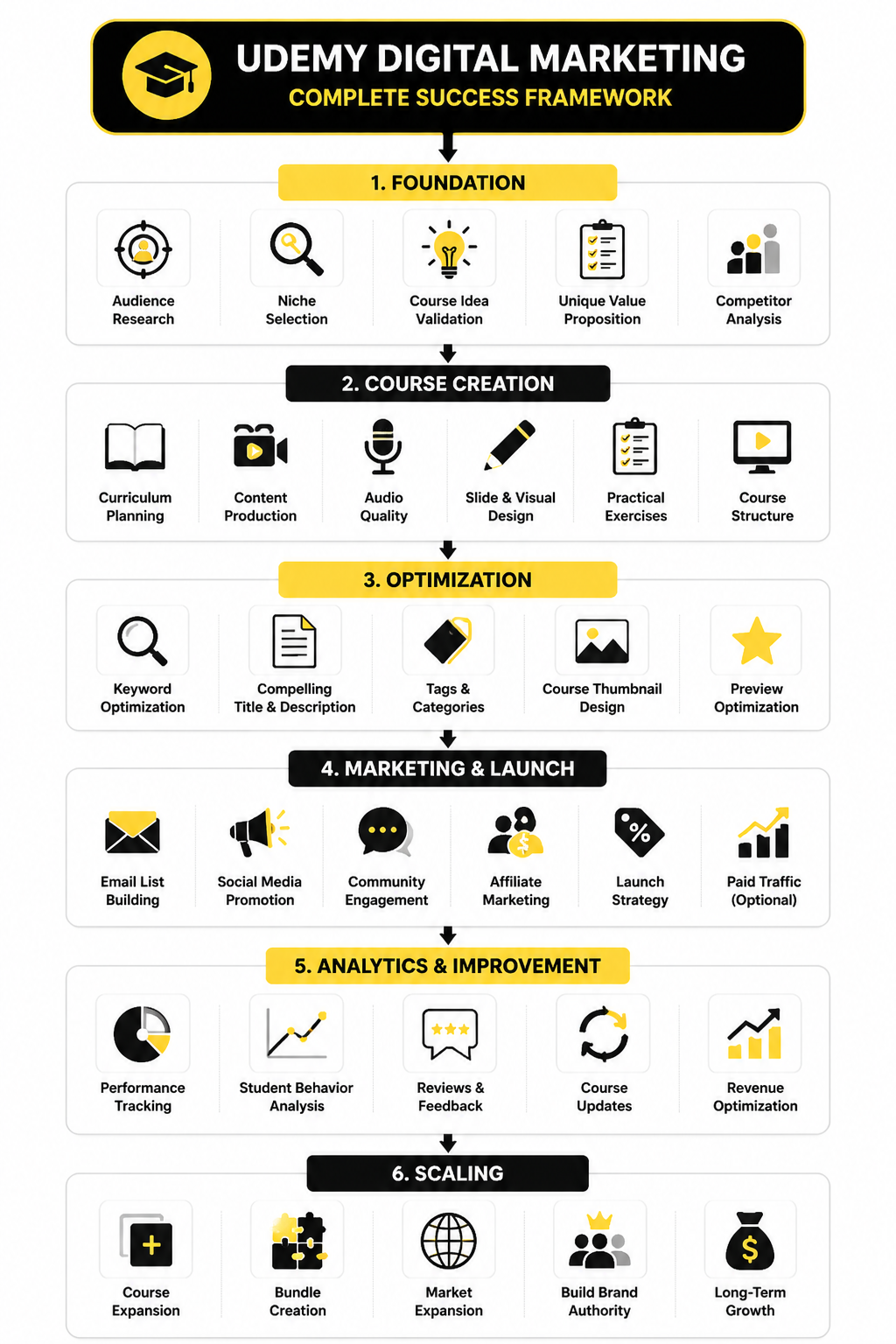
- What Udemy Digital Marketing Is and Why It Matters
- Key Components of Udemy Digital Marketing Courses
- How Udemy’s Framework Helps You Learn
- Practical Ways to Implement What You Learn
- Evaluating and Choosing a Udemy Digital Marketing Course
- Future Trends and Next Steps to Grow Your Skills
Key Components of Udemy Digital Marketing Courses
When you explore Udemy digital marketing courses, there’s a clear pattern in what the most successful programs teach. These aren’t random topics thrown together — they reflect the core skills modern marketers need to drive traffic, convert customers, and grow real businesses online.
Comprehensive Channel Coverage
Top Udemy digital marketing courses walk you through all major digital channels rather than focusing on one isolated tactic. This includes:
- Search Engine Optimization (SEO) — how to improve organic visibility, perform keyword research, and optimize websites so they rank higher in search results.
- Social Media Marketing — strategies for platforms like Facebook, Instagram, YouTube, LinkedIn, and more, including both organic engagement and paid campaign techniques.
- Paid Advertising (PPC) — setting up and optimizing paid ads on Google, Facebook, Instagram, and Bing to generate targeted traffic and measurable ROI.
- Email Marketing — building subscriber lists, crafting campaigns, and nurturing leads through automation and segmentation.
- Content Marketing & Copywriting — creating valuable content that educates, engages, and converts audiences across blogs, video, and ads.
This broad spectrum lets learners build a 360° digital skill set that’s applicable across industries — whether you want to work for a brand, consult as a freelancer, or grow your own business online.
Hands‑On Technical Skills
Udemy programs pair theory with practical tasks that simulate real work scenarios. You typically learn how to:
- Build and launch websites (often using WordPress without coding).
- Use analytics tools like Google Analytics 4 and Search Console to monitor performance and guide decisions.
- Run paid campaigns by setting budgets, targeting audiences, and interpreting results.
- Optimize content for search engines and social platforms.
This emphasis on tools and tactics is what separates theoretical knowledge from market‑ready digital marketing skills.
Strategic and Analytical Focus
Beyond channel tactics, good Udemy courses also teach learners how to think like marketers:
- How to create a marketing strategy that aligns with business goals.
- How to use data and analytics to refine campaigns over time.
- How to understand audience behavior and design campaigns that resonate.
This strategic layer helps you move beyond checking off technical tasks — you learn to plan, evaluate, and improve real‑world marketing outcomes.
How Udemy’s Framework Helps You Learn
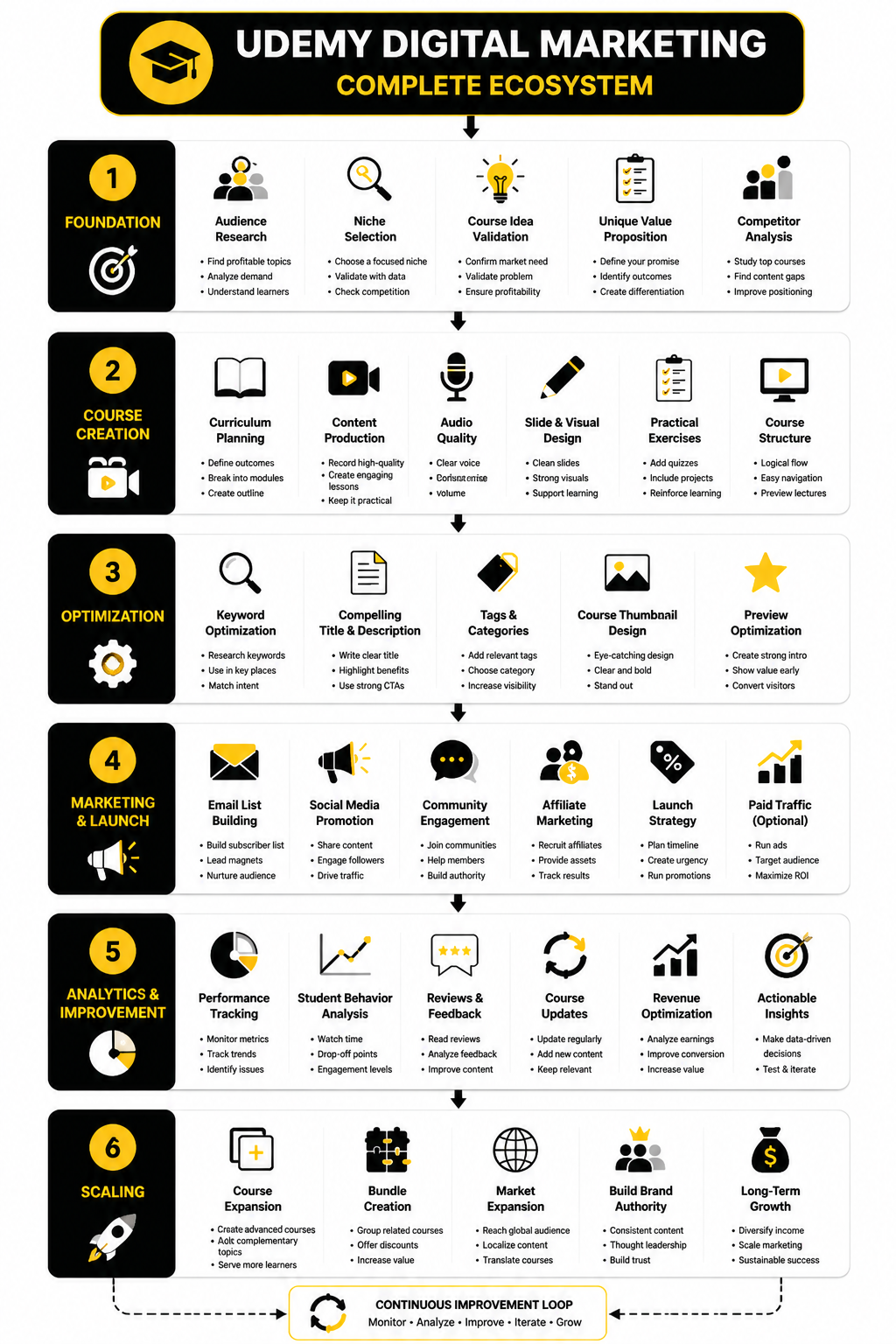
Udemy digital marketing courses are structured to guide learners from basic concepts through advanced application in a logical sequence. Most follow an educational framework that makes complex topics digestible:
- Foundational Concepts First
You start by understanding what digital marketing is, why it matters to businesses today, and how different channels interact to create impact. This sets a strong base so nothing feels abstract as you progress.
- Tool and Platform Training
After the concepts, courses introduce popular tools like WordPress (for websites), Google Analytics (for data tracking), and ad platforms like Google Ads and Meta Ads. Learning these tools early reduces friction later when applying strategies.
- Practical Application and Projects
Rather than just watching lectures, you’ll usually complete assignments, quizzes, and real‑world tasks that mirror client or business work. This “learn‑by‑doing” approach reinforces skills so you can actually execute marketing campaigns after finishing the course.
- Advanced Growth Skills Last
With fundamentals and tools in place, the framework moves you into advanced topics like conversion optimization, retargeting, analytics interpretation, and automation — the skills that differentiate good marketers from great ones.
This layered progression helps learners build confidence and context before tackling more complex marketing challenges.
What You’ll Actually Learn by the End
Most full‑featured Udemy digital marketing courses leave you able to:
- Design and execute marketing campaigns across search, social, email, and paid channels.
- Measure and optimize performance using data from analytics tools.
- Create compelling content that attracts and engages audiences.
- Run paid ads that deliver ROI by targeting the right users and trimming wasted spend.
These capabilities are what most hiring managers, clients, and business owners look for in digital marketing talent today — making Udemy a practical stepping stone for career or business growth.
Practical Ways to Implement What You Learn
Taking courses on Udemy digital marketing is only the start — the real value comes when you turn that knowledge into action. Implementation is where your skills translate into measurable outcomes, whether you’re growing an audience, driving leads, or optimizing campaigns for a business or client. This section breaks down the execution process so you can follow a logical sequence from planning to performance.
Start With a Clear Goal and Audience
Before you launch any tactic, you need a clear goal and a deep understanding of who you’re trying to reach:
- Define measurable objectives such as increasing website traffic by a specific amount, generating a target number of leads, or improving conversion rates within a timeframe.
- Build audience profiles that outline your ideal customer’s interests, behavior, challenges, and where they spend time online. This informs which channels you prioritize.
- Use analytics and market research tools to validate assumptions and refine your audience segments before you spend time or budget on execution.
Having clarity upfront prevents wasted effort and lets you structure campaigns that align with both your business targets and user needs.
Execute Core Digital Marketing Tactics Step by Step
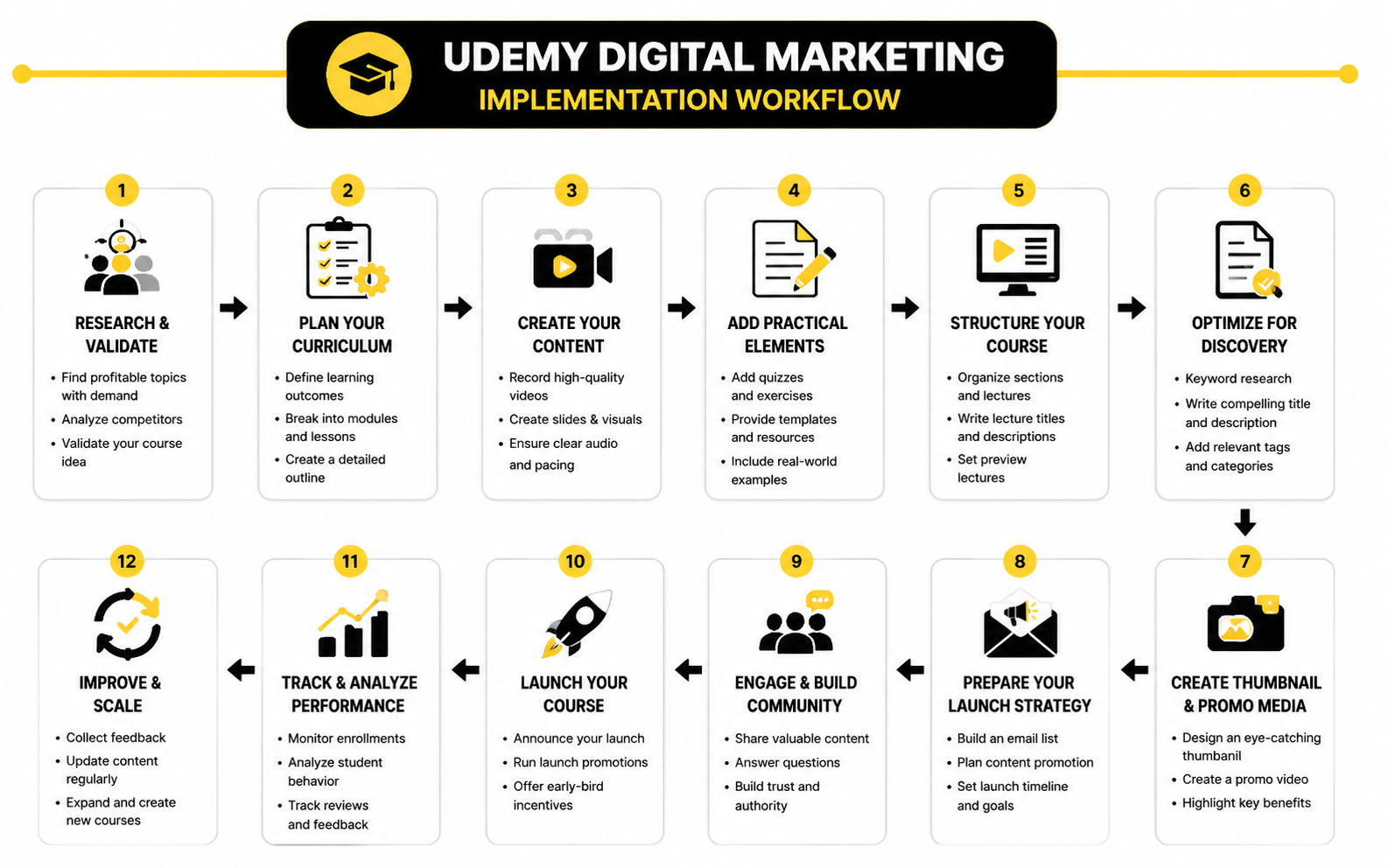
Once you have goals and audience insights, implementation becomes a series of tangible steps. Below is a practical roadmap you can follow as you launch your first campaigns.
- Set Up Tracking and Baselines
- Install web analytics tools (e.g., Google Analytics 4) to capture baseline performance and monitor changes over time.
- Configure goals or events that reflect your objectives (e.g., form submissions, product views).
- Test data collection to ensure accuracy before major campaigns go live.
- Launch Foundational Channels
- SEO: Optimize your website with keyword research, on-page improvements, and technical fixes that enhance visibility and user experience.
- Content Marketing: Publish targeted blogs, videos, or guides that address core audience needs while incorporating search intent.
- Social Media: Plan your content calendar based on audience behavior data and platform dynamics, then schedule posts that align with peak engagement times.
- Activate Paid Advertising (Optional Based on Budget)
- Create campaigns on platforms where your audience is most active (e.g., Google Ads, Meta Ads).
- Define budgets, targeting parameters, and creative assets aligned with your goals.
- Use A/B testing to compare variations of ads, audiences, or landing pages.
- Email List Building and Nurturing
- Integrate opt‑in forms on your website and landing pages to capture leads.
- Segment your email lists by user interest or behavior so your messages are relevant.
- Automate sequences that welcome, educate, and convert subscribers over time.
- Measure, Analyze, and Iterate
- Review performance data regularly against your initial goals.
- Identify what’s working and what isn’t — double down on high‑performing tactics and rework or pause those that underperform.
- Use insights to inform content topics, ad spend allocation, and audience targeting refinements.
Use Tools Consistently to Scale
Implementation isn’t a one‑time event — it’s a cycle of planning, executing, reviewing, and optimizing. Tools like analytics dashboards, content calendars, and automation platforms keep your efforts organized and measurable. Over time, this repeatable process reduces guesswork and positions you to make data‑driven decisions that improve ROI and efficiency.
By approaching implementation with structure and discipline — the same way the best Udemy courses teach — you transform theoretical knowledge into real marketing momentum that drives growth.
Measurement, Analytics, and What the Numbers Really Mean
Numbers by themselves don’t tell you if you’re winning or losing — what matters is how you interpret data to make smarter decisions in your Udemy digital marketing practice or real campaigns. Measurement and analytics help you answer the most important question in marketing: Is my effort moving the needle for business outcomes like leads, sales, and retention? When you track the right metrics and compare them to reliable benchmarks, you gain insight into what’s working, what’s not, and where you should adjust your strategy next.
What Success Looks Like Through Metrics
To link your campaigns to meaningful results, focus on these core metrics that connect user behavior to business goals:
- Conversion Rate: This measures the percentage of visitors who complete a desired action — such as signing up, purchasing, or opting in. It directly reflects how effective your funnel is at turning attention into action.
- Return on Ad Spend (ROAS) & ROI: These show whether the money you spend is producing more in return. A positive ROI or strong ROAS tells you your marketing is profitable.
- Click‑Through Rate (CTR): CTR reveals how compelling your ads, emails, or CTAs are — a higher CTR means your audience finds your message relevant.
- Customer Acquisition Cost (CAC): CAC tells you how much you need to spend to acquire each new customer — a lower CAC relative to customer value means your campaigns are efficient.
- Engagement Metrics: These include time on site, scroll depth, and event interactions. They signal whether your content truly resonates or just looks good on paper.
These are not vanity numbers — they tie actions to outcomes. For example, if your CTR is high but conversions are low, it signals a disconnect between your message and your landing page experience. If ROAS is dipping, that may point to rising cost per click (CPC) or poor audience targeting. Understanding these relationships lets you diagnose issues and focus improvements where they’ll have the most impact.
Benchmarks: Context You Can Act On
Raw numbers only become meaningful when compared to benchmarks — industry‑derived standards that show what “good” looks like in context. For example:
- A paid search CTR around 3% or higher is often considered healthy, while email open rates above 25% indicate good list quality.
- Benchmarks vary significantly by channel and audience, so comparing metrics like CTR or conversion rates within the same channel and industry prevents misleading conclusions.
Benchmarks help you decide when to intervene and where to prioritize effort. If your campaign falls short of a known standard — say a conversion rate that lags behind competitors or peers — that’s a signal to rework your landing page, ad creative, or audience targeting before increasing spend.
How to Interpret Data and Drive Action
Data isn’t just for reports — it should change decisions in real time:
- Discover patterns, not just points: A rising traffic trend with falling conversion rates suggests you’re attracting the wrong visitors or your value proposition needs sharpening.
- Compare apples to apples: Don’t look at impressions in isolation — match them with engagement, CTR, conversions, and cost metrics to see the full picture.
- Test and iterate: Use A/B testing to assess changes — for example, test landing page headlines, CTA buttons, or ad creatives and measure performance lift.
- Set realistic thresholds: Instead of chasing absolute goals, track improvement over time. A 10–20% uplift in conversion rate quarter after quarter often matters more than hitting a distant static target.
Metrics like CAC, ROAS, and conversion rate tell you exactly where your strategy is breaking down or gaining traction. Good marketing analytics doesn’t just report on outcomes — it informs your next move.
Seeing the Big Picture With Analytics Tools
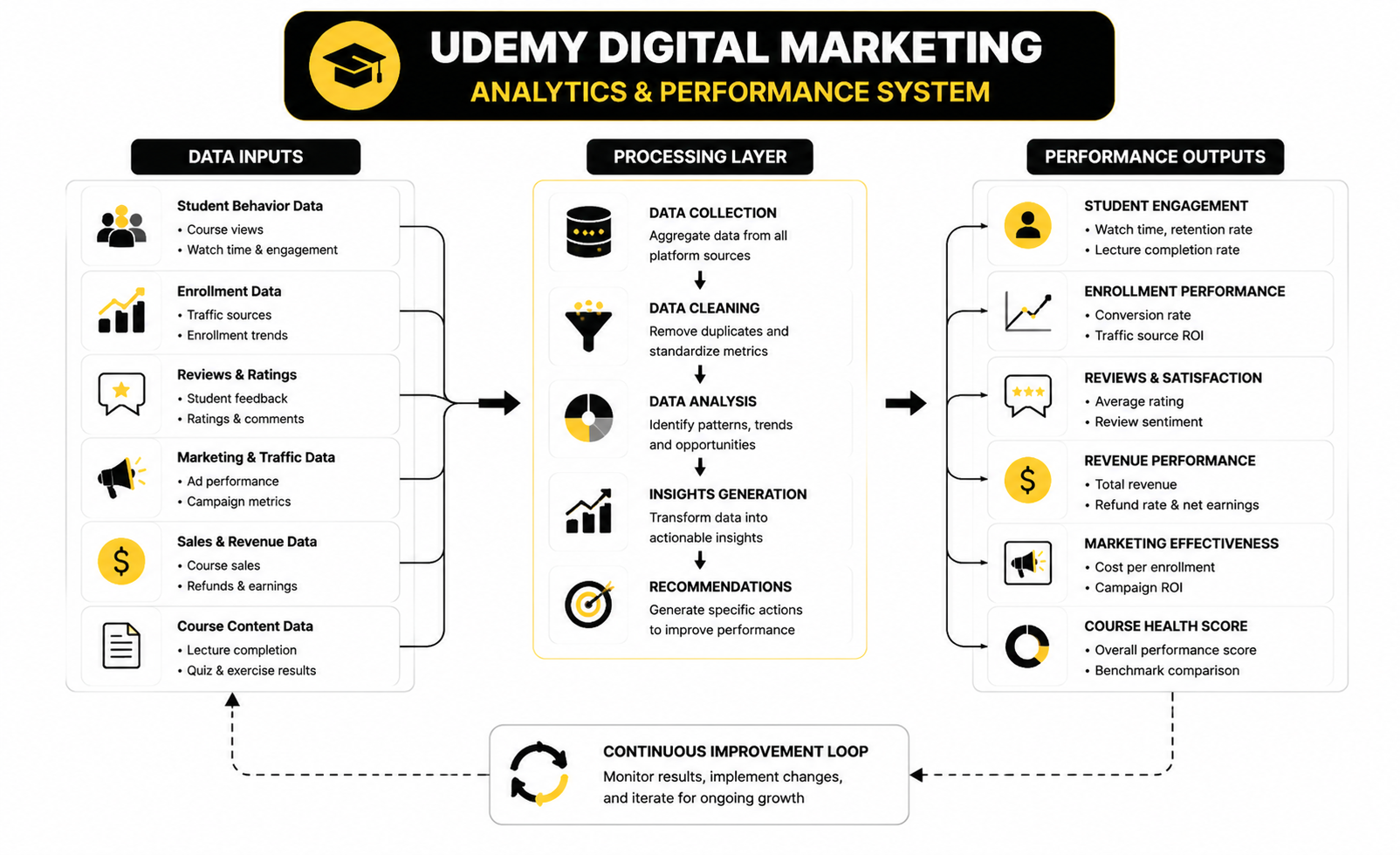
Google Analytics 4 (GA4) and platform dashboards aren’t just reporting tools — they’re diagnostic systems that let you probe performance deeply:
- GA4’s event‑based model lets you define what matters (e.g., form fills, video plays) and track how users interact from first click to conversion.
- Cross‑channel dashboards help you see how organic traffic, paid ads, social engagements, and email campaigns feed into one another.
With the right tracking setup, you can answer questions like Which source drives the most valuable traffic? or Are my campaigns profitable when accounting for all touchpoints? This level of insight is what separates directionless activity from measured growth — and it’s a core focus in advanced Udemy digital marketing courses that teach analytics and conversion tracking as foundational skills.
By grounding your implementations in solid metrics and benchmarks, you gain not just visibility into performance, but a playbook for strategic optimization. That’s how data moves you from guesswork to confident decision‑making.
Advanced Considerations for Digital Marketing Success
By the time you’re implementing and measuring campaigns learned through Udemy digital marketing courses, you’ve already covered the basics and begun tracking performance. But real expertise comes when you start asking why the numbers behave as they do — and how strategic decisions shift outcomes over time. Advanced thinking in digital marketing helps you make smarter tradeoffs, mitigate risks, and scale your efforts in sustainable ways.
Balancing Short‑Term Results With Long‑Term Growth
One strategic challenge many marketers face is prioritizing between fast wins and long‑term foundation building. For example:
- Paid advertising can generate quick traffic and leads, but costs can rise sharply as competition increases.
- Organic channels like SEO and content marketing often take longer to show results but compound over time, delivering more sustainable traffic and lower acquisition costs.
Savvy marketers build portfolios of tactics that mix both approaches — allocating some budget to fast feedback loops while investing in evergreen assets like blogs and SEO that pay dividends years later. This balanced strategy reduces reliance on a single channel and improves resilience against shifting platform rules or rising CPC (cost per click).
Dealing With Attribution and Data Limitations
One common risk in advanced digital marketing is assuming your analytics tell the whole story. Modern attribution challenges — including privacy changes, cross‑device behavior, and AI‑driven search — can obscure how channels interact and what truly drives conversions. For instance, some analytics platforms now under‑report up to 30–45% of touchpoints due to privacy protections and cookie deprecation, meaning last‑click models may understate a channel’s value.
To combat this:
- Use multi‑touch attribution where possible to see how different interactions contribute to conversions.
- Complement platform data with incrementality tests that isolate the lift provided by specific campaigns.
- Cross‑reference with revenue systems or CRM data to validate whether tracked leads translate into real business value.
This helps you avoid over‑investing in channels that appear effective due to reporting quirks and under‑investing in hidden drivers of growth.
Scaling Campaigns Without Sacrificing Efficiency
Scaling isn’t just about spending more; it’s about maintaining efficiency as you grow. Key considerations include:
- Audience saturation: When a target segment has seen your ads repeatedly, engagement can drop and costs can rise. Rotating creatives, expanding targeting criteria thoughtfully, and exploring lookalike audiences can help sustain momentum.
- Creative fatigue: High‑performing ads eventually lose effectiveness. Plan regular refresh cycles for visuals and messaging to keep engagement high.
- Automation and machine learning: Platforms increasingly offer smart bidding and automated optimization. Testing these features can reduce manual overhead, but you still need robust goals and oversight to ensure automation aligns with your KPIs.
True scaling requires systems — tracking frameworks, creative production pipelines, and testing protocols — that produce consistent insights and improvements.
Understanding Risk in Paid Channels
Paid channels such as search and social ads are powerful, but they come with strategic tradeoffs:
- Cost fluctuations: Competitive markets drive up CPC and CPA (cost per acquisition). Operating in crowded verticals without clear differentiation can quickly diminish ROI.
- Platform dependency: Heavy reliance on one platform (e.g., Meta or Google) exposes you to algorithm changes and policy shifts that can alter performance overnight.
- Attribution ambiguity: When platforms attribute conversions differently, it’s easy to misread channel value and overspend on perceived winners.
Mitigating these risks involves diversifying channels, continually validating attribution models, and anchoring decisions in long‑term performance data rather than short bursts of success.
Mastering Advanced Metrics and Strategic KPIs
At the expert level, marketers go beyond surface metrics like CTR (click‑through rate) or open rates. They focus on strategic KPI hierarchies that connect performance to business impact. For example:
- Lifetime Value (LTV) relative to Customer Acquisition Cost (CAC): A healthy ratio (often targeted at 3:1 or better) shows your marketing not only acquires customers but does so profitably over time.
- Return on Ad Spend (ROAS): Robust evaluation of revenue generated per ad dollar spent helps prioritize spend across campaigns and channels.
- Funnel velocity and retention metrics: How quickly users move from awareness to purchase and whether they return for repeat transactions are high‑leverage signals for optimization.
Tracking these metrics requires thoughtful dashboarding and regular strategic reviews rather than snapshot reporting.
Continuous Learning and Adaptation
The landscape of digital marketing evolves fast — new platforms emerge, user behavior shifts, and analytics frameworks change. What works this quarter may not work next year. That’s why advanced practitioners invest in continuous learning and experimentation. Whether you update tactics from recent Udemy digital marketing courses, explore advanced certifications, or participate in professional communities, staying current is a core part of scaling your impact.
By thinking strategically about risks, tradeoffs, and long‑term growth, you transform digital marketing from a set of tasks into a predictable engine of business performance that adapts and improves over time.
Frequently Asked Questions About Udemy Digital Marketing
FAQ – Built for Complete Guide
1. Do Udemy digital marketing courses give you real practical skills?
Yes. Many Udemy digital marketing courses include hands‑on projects and practical tasks so you can apply concepts like SEO, analytics, social media and paid ads in real scenarios. However, actual skill growth depends on doing the exercises, not just watching videos.
2. Can I preview a digital marketing course before I buy it?
Yes. Udemy lets you preview course lectures, so you can assess the teaching style and topic depth before purchasing. This helps you decide if a course matches your learning needs.
3. Will course completion give me a certification employers respect?
Completing a Udemy course gives you a certificate of completion, which shows your commitment to learning. It’s not an accredited degree, but it can strengthen resumes or portfolios when paired with demonstrable skills.
4. How long do I have access to a digital marketing course after purchase?
You get lifetime access to the course content you purchase, including future updates. There’s no deadline to start or finish lessons.
5. Are the courses updated with current marketing practices?
It varies by instructor — some update courses frequently while others may lag behind trends. Always check the “last updated” date before enrolling so you get content relevant to 2026 best practices.
6. Can I ask questions if I’m stuck on a lesson?
Yes. Paid Udemy courses include a Q&A feature where you can ask instructors or community members questions related to the curriculum.
7. Do Udemy courses prepare you for industry certifications like Google Analytics or Meta Blueprint?
Many Udemy digital marketing courses cover tools and concepts that help with external certifications, but you’ll usually need to take the official exams and training resources for those certifications separately.
8. Is Udemy good for beginners with no marketing background?
Yes. Several high‑enrollment digital marketing courses on Udemy are designed for beginners and take you from basic concepts through implementation and analytics.
9. Can Udemy help you get a job or freelance clients?
The courses build foundational skills that help you start applying for jobs or freelancing gigs, but building a portfolio and real‑world experience is essential for getting hired.
10. Are there digital marketing courses that focus on specific channels?
Yes. Some Udemy courses focus deeply on individual areas like SEO, Google Ads, Facebook marketing, email marketing, and analytics — letting you specialize as well as learn broad strategies.
11. What if I find the course doesn’t match my expectations?
Udemy offers a 30‑day money‑back guarantee on most courses, so you can request a refund if content quality or fit isn’t what you expected.
Work With Professionals
Explore 10K+ Remote Marketing Contracts on MarkeWork.com
Most marketers spend too much time chasing clients, competing on crowded platforms, and losing a percentage of every project to middlemen.
MarkeWork gives you a better way. Browse thousands of remote marketing contracts and connect directly with companies desperate to hire skilled marketers like you, without platform commissions and without unnecessary gatekeepers.
If you're serious about finding better opportunities and keeping 100% of what you earn, invite readers to explore available contracts and create a profile for free at MarkeWork.com.