
If you type udemy digital marketing into search, you get exactly what makes the platform attractive and confusing at the same time. There is real depth there: Udemy says its marketplace now reaches nearly 84 million learners, includes more than 290,000 courses in 78 languages, and keeps expanding the subscription side of the business, with paid consumer subscribers doubling year over year to 343,000 by the end of 2025. That scale is a big advantage because digital marketing changes too fast for slow, static training libraries.
At the same time, scale creates noise. You can find recent, broad digital marketing programs on Udemy that cover SEO, paid ads, social media, analytics, and AI, including courses updated in 2026 and long-running bestsellers that still attract millions of students. But buying the first popular course you see is not the same thing as building a serious marketing skill set.
That matters because the market is still moving. Global digital behavior keeps expanding, with DataReportal reporting 5.24 billion social media user identities in early 2025, while IAB and PwC reported that U.S. internet ad revenue hit a record $259 billion in 2024, up 15% year over year. At the same time, employers are reshuffling skill expectations fast: the World Economic Forum says 39% of workers’ core skills are expected to change by 2030, and LinkedIn says around 70% of the skills used in most jobs will change between 2015 and 2030. So the real question is not whether Udemy has digital marketing courses. It is whether you know how to use the platform without wasting time.
Article Outline
- Why Udemy Digital Marketing Still Matters
- A Simple Framework for Choosing the Right Course
- What a Strong Udemy Digital Marketing Course Should Actually Cover
- How to Turn Lessons Into Job-Ready Skills
- How Professionals Use Udemy Alongside Official Platforms and Real Work
- Common Mistakes, Final Recommendations, and FAQ
Why Udemy Digital Marketing Still Matters
The strongest case for Udemy is speed and range. Digital marketing now touches search, social, analytics, email, creative testing, automation, ecommerce, and AI-assisted workflows, so a platform with a huge course marketplace can help learners move faster than a traditional curriculum. Udemy’s own filings show why people keep coming back: the marketplace is large, global, and constantly refreshed, with instructors publishing more than 6,300 new courses per month on average in 2025 and top courses being updated frequently.
There is also a practical career reason to care. The U.S. Bureau of Labor Statistics projects 6% growth for advertising, promotions, and marketing managers from 2024 to 2034, with 36,400 openings per year on average. That does not mean one Udemy course gets you hired, but it does mean demand for marketing capability is real, and affordable self-paced training can help people close gaps faster.
Still, this is where a lot of beginners get the platform wrong. Udemy gives you access to learning, not automatic proof of professional competence. Udemy confirms that only paid approved courses offer certificates of completion, and its own business support docs make clear that for certification prep, learners still need to sit the exam through the official exam provider. So the value is usually in the skill you can demonstrate afterward, not the badge by itself.
There is one more reason this matters: completion is the silent killer in online learning. A 2024 randomized evaluation of online job training found only 10% course completion, and newer research keeps pointing to the same broad issue across large-scale online learning environments. In plain English, the best Udemy digital marketing course is not just the one with the biggest promise. It is the one you can actually finish, apply, and turn into visible work.
A Simple Framework for Choosing the Right Course
Most people shop for Udemy courses the wrong way. They look at the headline, the discount price, maybe the star rating, and then hope the course somehow turns into a career path. A better approach is to treat udemy digital marketing as a marketplace search problem, not a single-course decision.
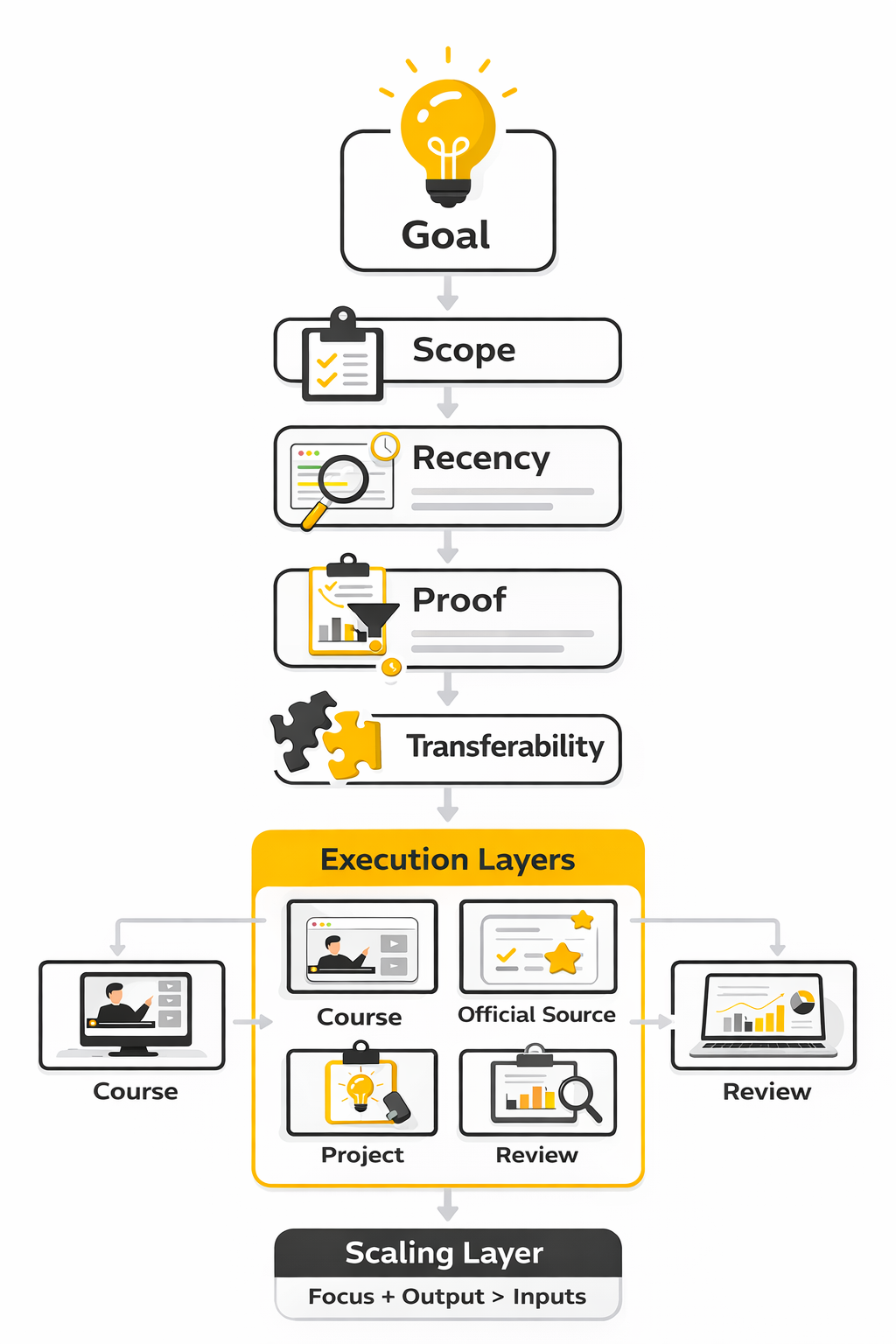
The simplest framework is this: goal, scope, recency, proof, and transferability. Your goal comes first because “digital marketing” is too broad to be useful on its own. If you want to become a generalist, a broad course can work; if you want a sharper skill, such as Google Ads, email automation, SEO, or social ad creative, narrower training is usually better.
Scope is next, and this is where many courses win attention without delivering depth. A course that promises SEO, Meta ads, Google Ads, email, analytics, ecommerce, content, and AI can be a good orientation tool, especially when its landing page clearly shows the breadth of topics, as recent Udemy offerings do for full digital marketing bundles and 27-in-1 style programs. But broad does not always mean current or useful. Sometimes the better move is to use a broad course to understand the map, then go deep on one channel at a time.
Recency matters more than many learners realize because marketing platforms change constantly. Google’s current Analytics training lives in Analytics Academy on Skillshop, and Meta continues to offer Blueprint training and certification paths. That means any Udemy course covering GA4, Meta ads, attribution, or reporting should be checked against those official ecosystems, not taken as the final word.
Proof is where you separate a useful learning experience from entertainment. A course should help you build something concrete: a campaign plan, keyword list, tracking setup, reporting dashboard, creative testing workflow, or channel audit. If you cannot point to a real output after finishing, the course may still be interesting, but it is not doing enough heavy lifting for your career.
Transferability is the final filter, and it is the one people skip. Ask whether the course teaches platform-specific button clicks only, or whether it teaches ideas you can carry into real work: audience research, funnel logic, creative testing, offer positioning, measurement, and iteration. Those principles survive tool changes. That is why this framework works: it keeps you from buying a course just because it looks comprehensive, and pushes you toward training that stays useful after the interface changes.