

Video marketing stopped being a nice extra a while ago. It now sits right in the middle of how people discover brands, compare options, and decide whether they trust what they are seeing. That shift is not just about social media trends. It is tied to a bigger change in how attention works online, where people move between search, feeds, creators, reviews, and product pages in one messy journey instead of a neat funnel (Deloitte’s 2025 Digital Media Trends, Think with Google’s analysis of 10,000 shoppers).
That is why smart video marketing is not really about “making more content.” It is about building the right system for the stage of growth you are in, the audience you want to influence, and the action you want a viewer to take next. The businesses winning with video are usually the ones that treat it as a commercial asset, not just a creative asset (Wyzowl’s 2026 data, IAB’s 2025 digital video ad spend report).
Article Outline
- Why Video Marketing Matters
- The Video Marketing Framework
- The Core Components of a High-Performing Video Strategy
- Producing Better Videos Without Wasting Budget
- Distribution, Promotion, and Conversion Paths
- Measuring Results and Scaling What Works
Why Video Marketing Matters
Video marketing matters because it matches the way people already consume information. Marketers are not just experimenting with it anymore. Recent survey data shows 91% of businesses use video as a marketing tool, while 93% of video marketers say video is an important part of their overall strategy, which tells you this is now standard operating procedure, not a fringe tactic (Wyzowl’s 2026 video marketing statistics).
The commercial momentum behind that shift is real. HubSpot’s latest marketing data shows the top ROI-driving content formats are all video-based, with short-form video leading at 49%, followed by long-form video at 29% and live video at 25%. In other words, the market is not simply rewarding video as a format. It is rewarding businesses that know how to use different video lengths and formats for different jobs (HubSpot marketing statistics).
The audience side matters just as much. Google’s published research with BCG found that after analyzing the behavior of 10,000 U.S. shoppers, video was influential across the purchase journey, not just at the awareness stage. That changes how you should think about content. A product explainer, customer proof clip, founder story, and retargeting ad do not compete with each other. They support different decisions at different moments (Think with Google’s video purchase journey research).
There is also a sheer attention reality here. YouTube says more than 20 million videos are uploaded daily, and YouTube Shorts now averages over 200 billion daily views. Add that to Deloitte’s finding that consumers are competing across an average of six hours of daily media and entertainment time, and the point becomes obvious: video marketing is not just crowded. It is brutally competitive, which means random content gets ignored while clear strategy gets rewarded (YouTube for Press, Deloitte’s 2025 Digital Media Trends).

The money moving into the category confirms the same thing. IAB reports that U.S. digital video ad spend grew 18% year over year in 2024 to $64 billion and was projected to hit $72 billion in 2025, growing faster than total media. When a channel grows that quickly, it usually means two things at once: more opportunity and less room for sloppy execution (IAB’s 2025 digital video ad spend report).
So the real question is no longer whether a business should invest in video marketing. The better question is what kind of video system it needs. A local service brand, an ecommerce operator, a SaaS company, and a creator-led business all need different mixes of content, distribution, proof, and calls to action. That is where a framework becomes useful.
The Video Marketing Framework
A practical video marketing framework starts with one rule: every video needs a job. If the job is unclear, the content usually ends up vague, overproduced, and weak in conversion. Strong video strategy works by linking message, format, channel, and next step so the viewer knows what to feel, what to understand, and what to do after watching.
The simplest way to structure that is around four layers: attention, education, proof, and conversion. Attention content earns the first stop. Education content explains the problem, the product, or the mechanism. Proof content reduces risk with testimonials, demonstrations, comparisons, and outcomes. Conversion content creates a clean next move, whether that is a click, a lead form, a booked call, a checkout, or a reply.
That matters because video marketing often fails in the handoff, not in the creative. A brand may produce strong top-of-funnel clips, then send viewers to a weak page, a slow booking path, or a generic follow-up sequence. The framework only works when the post-view experience is as intentional as the video itself.
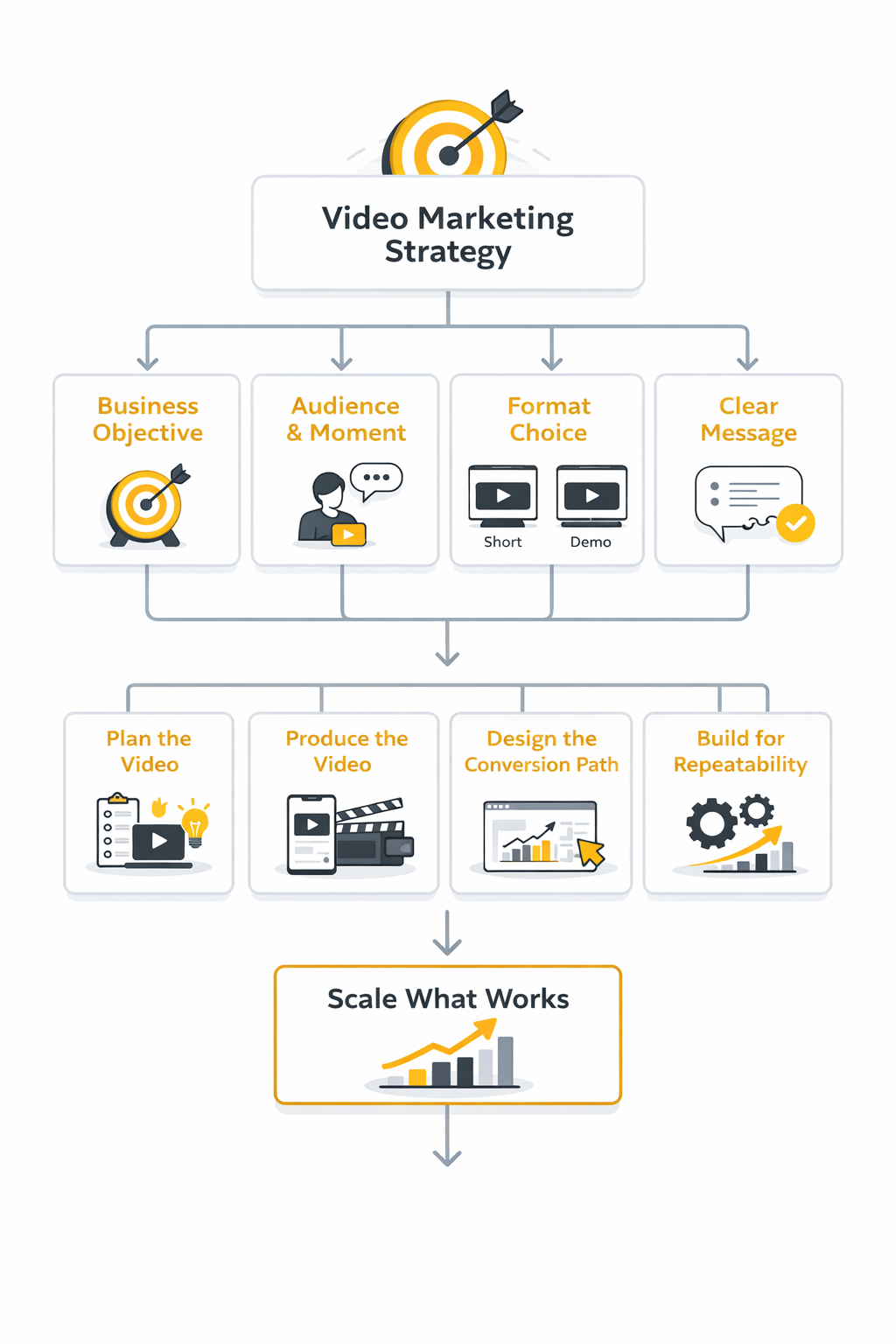
This is the structure the rest of this article will build on. First, we will break down the core components that make a video strategy hold together. Then we will move into professional implementation, including how to produce efficiently, distribute with intent, and measure what actually contributes to pipeline, sales, and growth. The goal is not to help you publish more videos. The goal is to help you make video marketing commercially useful.
The Core Components of a High-Performing Video Strategy
A strong video marketing strategy is built from a few components that work together. Miss one, and the whole thing gets weaker. You can have great editing, strong on-camera delivery, and polished visuals, but if the offer is fuzzy or the next step is unclear, the video will still underperform.
This is where a lot of teams go wrong. They treat video like a content format instead of a decision-making tool. The better approach is simpler and more commercial: decide what business outcome you want, identify the viewer you need to move, choose the format that fits that moment, and build the path that gets them from attention to action.
Start With the Business Objective
Every effective video marketing plan starts with a concrete business objective, not a creative idea. That sounds obvious, but it is one of the most common breakdowns in practice. Teams often begin with “we should post more video” when they should begin with “we need cheaper customer acquisition,” “we need more qualified demos,” or “we need to improve product understanding before the sales call.”
That distinction matters because different goals require different video structures. The latest HubSpot data shows marketers still lean heavily into short-form video for reach and ROI, while longer formats remain useful when more explanation is needed (HubSpot marketing statistics, HubSpot’s 2026 State of Marketing overview, HubSpot’s 2026 trends summary). So if your goal is awareness, you usually need speed, hooks, and pattern interruption. If your goal is conversion, you usually need clarity, proof, and a smoother transition into the offer.
The practical takeaway is straightforward. Before you brief a creator, editor, or agency, define the one metric that matters most for that video. Views can be useful, but only if they connect to something real like assisted conversions, booked calls, qualified leads, product page engagement, or completed checkouts.
Know the Audience and the Decision Moment
Good video marketing is never just about demographics. It is about the moment your audience is in when they see the video. Someone casually scrolling is not the same as someone comparing vendors, watching product reviews, or trying to justify a budget internally.
That is one reason Google’s recent shopping research matters so much. Its work with BCG found that video influences decisions across the whole journey, not only at the awareness stage, which means the same audience may need very different messages depending on where they are in the process (Google’s research on video and purchase decisions, Google’s research on how YouTube shapes the shopping journey, Google’s work on the new consumer decision-making process).
This is where smart planning beats volume. You do not need one generic brand video trying to do everything. You need content mapped to real moments: first discovery, problem recognition, category comparison, objection handling, and final trust-building. Once you do that, your videos start feeling relevant instead of noisy.
Match the Format to the Job
Format choice is one of the most underrated parts of video marketing. A founder monologue, a product demo, a customer clip, a tutorial, a before-and-after, and a creator-style review all create different types of trust. The mistake is assuming that one successful format should be used everywhere.
The data backs a more flexible approach. HubSpot’s latest research shows short-form video continues to dominate usage and ROI, while long-form and live formats still matter in the right context (HubSpot marketing statistics, HubSpot’s video marketing statistics roundup, HubSpot’s 2026 trends summary). Wyzowl’s current reporting points in the same direction, with most marketers saying video gives them a good return and remains central to strategy (Wyzowl’s 2026 statistics, Wyzowl’s 2026 strategy guide).
So the question is not whether short or long is better. The better question is what the viewer needs in that moment. Short-form earns the stop. Longer-form often closes the understanding gap. Testimonials and demonstrations reduce perceived risk. Educational video builds authority when the buying decision is more complex.
Build a Clear Message Architecture
A lot of video marketing fails because the message is trying to do too much at once. The viewer ends up with a blur of claims, features, adjectives, and vague promises. Strong videos usually feel simple because the message architecture is disciplined.
At a minimum, a high-performing marketing video needs four things. It needs a sharp problem or tension, a clear point of view, believable proof, and one logical next step. That structure matters even more now because viewers are making decisions across fragmented touchpoints, where trust gets built in pieces rather than all at once (Deloitte’s 2025 Digital Media Trends, Google’s video buying strategy analysis, YouTube’s 2026 priorities update).
This is also where brand voice actually starts to matter. In crowded feeds, polished sameness is a disadvantage. HubSpot’s 2026 report leans hard into brand point of view for exactly this reason: when content gets easier to produce, distinctiveness becomes more valuable, not less (HubSpot’s 2026 State of Marketing overview). In practical terms, your videos should sound like your company understands the problem better than the average competitor, not like another copy-and-paste content machine.
Design the Conversion Path Before You Publish
One of the biggest mistakes in video marketing is treating conversion as an afterthought. A team produces the video, posts it, and only then asks what should happen next. That sequence kills momentum because the viewer’s attention is highest right after they watch, not three steps later.
A better system designs the handoff in advance. If the video is meant to generate leads, the landing page needs to continue the same promise. If the goal is direct response, the CTA needs to match the emotional state the video created. If the goal is nurturing, the follow-up needs to keep the conversation moving instead of dropping the viewer into a dead end email sequence or a generic homepage.
This is where tooling can quietly make a difference. For example, a team using Buffer to manage consistent distribution, ManyChat to capture and route conversational intent, or Brevo to continue the follow-up journey is usually in a stronger position than a team that treats posting as the finish line. The tools are not the strategy, but they do make it easier to turn video attention into measurable business movement.
Build for Repeatability, Not One-Off Wins
The final component is repeatability. A lot of brands get one decent result from video marketing and then fail to scale it because the process lives in someone’s head. There is no repeatable briefing system, no content library, no testing rhythm, and no clear feedback loop between performance and creative decisions.
That is a serious problem in a market where video volume is exploding. YouTube continues to emphasize its scale, creator economy influence, and commercial role, while marketers are putting more budget into digital video every year (YouTube for Press, YouTube’s Europe impact report, IAB’s 2025 digital video ad spend report). In plain English, competition is not easing up. The brands that keep winning are usually the ones that can learn fast, reuse what works, and improve execution without reinventing the entire process every month.
That means your video marketing system should produce assets, not just posts. Hooks can be reused. Testimonials can be clipped into ads, landing pages, and nurture sequences. Product demos can become onboarding assets. Founder-led clips can be turned into retargeting content. Once you think this way, video stops being a content treadmill and starts becoming infrastructure.
Producing Better Videos Without Wasting Budget
Once the strategy is solid, production gets easier. Not easy, but easier. You stop arguing about random creative preferences and start making decisions based on purpose, audience, and expected outcome.
That is the right place to move next, because most wasted video budget does not come from bad cameras or weak editing software. It comes from weak planning, vague briefs, and expensive content that was never designed to perform in the first place.
Producing Better Videos Without Wasting Budget
The fastest way to waste money on video marketing is to confuse production quality with strategic quality. Expensive cameras, larger crews, and heavier editing do not rescue a weak brief. What usually drives results is a tighter process: clear goals, faster approvals, smarter repurposing, and production choices that match the channel and the decision you are trying to influence.
That shift matters because more brands are now bringing production in-house. Wistia’s latest State of Video reporting shows 71% of companies created videos in-house in 2024, up from 63% in 2023, while use of AI in video production more than doubled year over year. The signal is pretty clear: the market is moving toward leaner workflows, faster publishing, and systems that make repeatable output possible without treating every project like a mini film set.
Plan the Video Before Anyone Hits Record
Most video marketing problems start upstream. If the brief does not define the audience, the promise, the format, the CTA, and the distribution plan, production gets messy fast. Teams end up rewriting on set, improvising the hook, and arguing about edits that should have been decided before the first frame was shot.
A useful brief is not long, but it is specific. It should answer five things: who this is for, what problem it speaks to, what format fits the job, what the viewer should do next, and where the video will live first. Once those decisions are made, production becomes execution instead of guesswork.
This is also where channel reality needs to show up. YouTube says there are now over 20 million videos uploaded daily, and Shorts averages more than 200 billion daily views, which means your video marketing plan cannot assume attention will be generous. The hook, framing, and pacing need to be intentional from the start because the market is too crowded to fix a weak opening later.
Use a Simple Production Workflow That Can Scale
The best implementation process is usually boring in the right way. It reduces unnecessary decisions, shortens feedback loops, and turns production into a repeatable operating rhythm. That matters more than chasing novelty, especially when you are trying to publish consistently without burning out the team.
A practical workflow for video marketing usually follows this order:
- Define the business goal and success metric.
- Choose the audience segment and decision stage.
- Write the hook, core message, proof points, and CTA.
- Record the main asset in the format that best fits the channel.
- Edit platform-specific versions with different lengths, openings, and subtitles.
- Publish with a matching landing page, follow-up path, or offer.
- Review retention, clicks, qualified responses, and conversion data.
- Rework the winning pieces into the next content batch.
That kind of workflow sounds basic, but it creates leverage. It also makes it much easier to repurpose footage across formats, which is one of the few reliable ways to improve output without increasing budget linearly. HubSpot’s reporting shows 48% of social media marketers share similar or repurposed content across platforms with minor adaptations, and Wistia documented one webinar replay that turned into clips generating 800,000+ views and 1,500+ hours of watch time, about 8.5 times more than the live event itself.
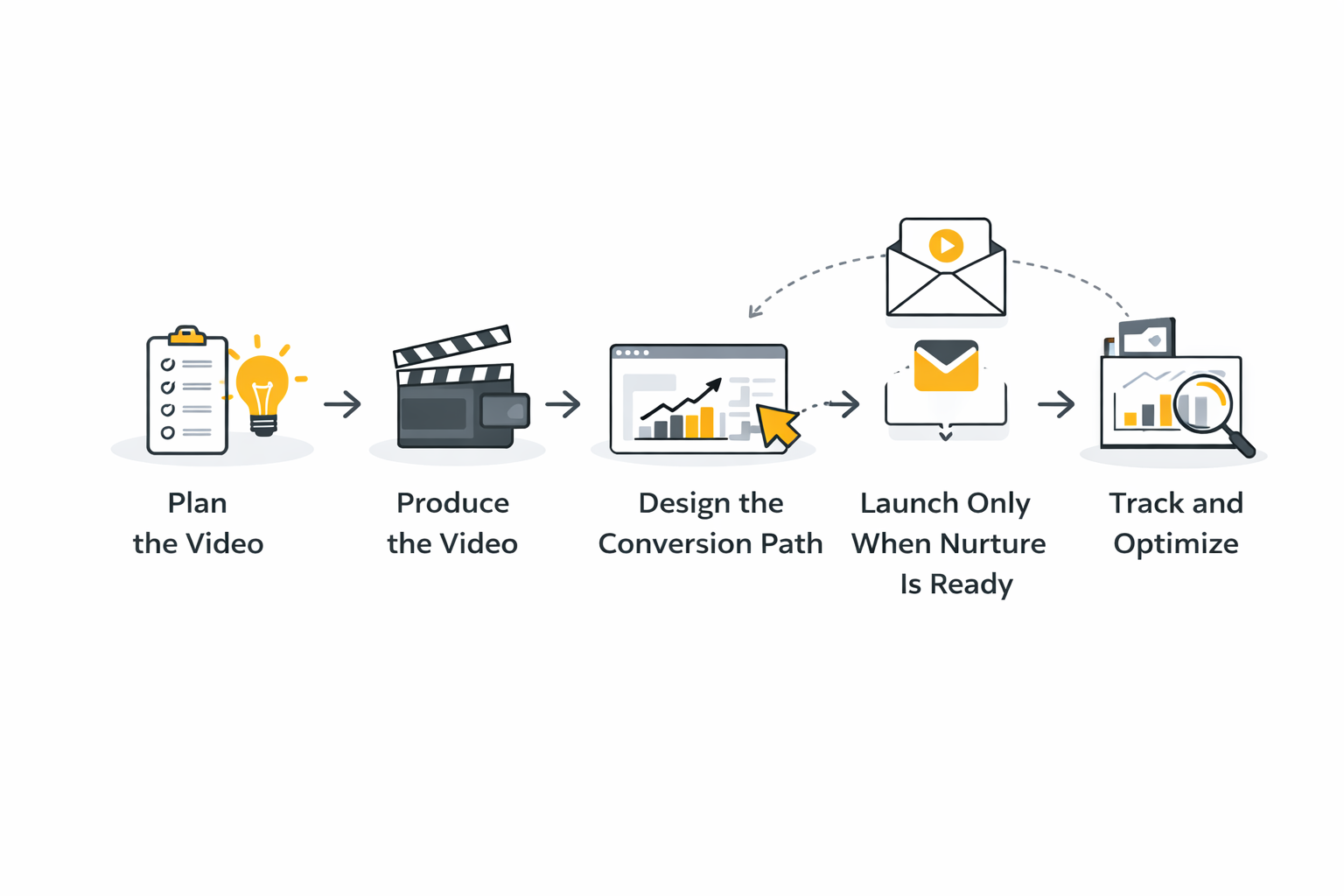
Once the workflow is visible, the execution gets easier to manage. People know what is being made, why it exists, how success will be judged, and how the raw footage can be reused later. That is the point where video marketing starts acting like a growth system instead of a scattered content habit.
Prioritize Clarity Over Overproduction
There is a trap a lot of brands fall into here. They assume a professional result always requires higher production value, when what viewers usually reward is relevance, clarity, and momentum. A clean message with strong pacing will outperform a beautiful but vague video far more often than most teams want to admit.
The current viewing data supports that. Wistia’s 2025 analysis found that videos under one minute had the highest average engagement rates, and how-to videos consistently held attention well even when they ran longer. That does not mean every marketing video should be short. It means you have to earn every extra second with useful information, clear tension, or proof the viewer actually cares about.
This is especially important for product or service education. HubSpot’s current data shows video remains one of the strongest ROI-driving content formats, but ROI does not come from polish alone. It comes from matching the depth of the message to the depth of the buying question, which is why a sharp explainer, a customer proof clip, or a direct screen demo can outperform a more cinematic asset when the viewer is close to a decision.
Build Once, Then Slice for Different Platforms
A smart video marketing team does not produce one asset and hope it fits everywhere. It creates a primary asset, then adapts that asset into multiple versions built for platform behavior. That usually means different openings, different lengths, tighter captions, different framing, and in some cases a different CTA.
This matters because audience behavior is fragmented. HubSpot’s platform data shows marketers continue to spread effort across Instagram, Facebook, TikTok, LinkedIn, and YouTube, while Sprout Social’s recent reporting shows short-form video is the format social users are most likely to interact with on major platforms. One master cut rarely respects those differences well enough to perform across all of them.
The practical move is to shoot with repurposing in mind. Record extra hooks. Capture alternate intros. Pull vertical-safe framing when possible. Gather customer soundbites, quick demos, and proof moments during the same session so one production day can feed paid ads, organic posts, landing pages, nurture email, and retargeting creative for weeks instead of days.
Tighten the Post-Click Experience
Video marketing is not finished when the video goes live. It is only finished when the viewer lands somewhere that matches the promise they just heard. This is where a lot of strong creative loses momentum, because the ad says one thing, the landing page says another, and the form or follow-up flow introduces friction right when interest is highest.
That is why implementation has to include the handoff. If the video is designed to sell, the page needs message match and proof. If the video is meant to capture leads, the form should feel like the natural next step, not an abrupt demand. If the goal is nurture, the follow-up sequence should continue the same narrative instead of starting from zero.
In practice, that often means pairing your content engine with the right infrastructure. A store using Replo for higher-converting landing experiences, a service business using GoHighLevel for lead capture and follow-up, or a team using Fillout to reduce form friction is usually better positioned to turn video views into actual outcomes. The creative still matters, but the system after the click often determines whether the effort produces revenue or just engagement.
Use AI Carefully, Not Lazily
AI can absolutely make video marketing faster. It can help with ideation, outlines, subtitles, transcription, rough cuts, clipping, tagging, and repurposing. HubSpot’s latest numbers show 75% of marketers use AI for media production and 80% use AI for content creation, while Wistia’s latest reporting shows AI usage inside video production jumped sharply over the last year.
But speed is not the same as quality. If AI makes your message more generic, strips out the founder’s voice, or turns every script into the same flattened structure, you lose the very thing that helps video stand out. The right use of AI is operational, not soul-killing. It should remove friction from the workflow so human judgment can spend more time on positioning, proof, and story clarity.
That is the mindset to keep. Use AI to compress production time, not to outsource thinking. In a crowded market, sameness is expensive.
Keep Feedback Loops Short
The most expensive production model is the one that learns too slowly. If you wait until the end of a quarter to review performance, you miss the chance to improve hooks, shorten intros, test different proof points, or fix weak CTAs while the campaign is still live. Video marketing gets better when the feedback loop between performance and creative is tight.
That means reviewing more than views. Watch retention trends, click-through rate, landing page behavior, lead quality, booked calls, sales velocity, and assisted conversions. HubSpot’s most recent reporting shows marketers increasingly care about downstream metrics like lead quality, conversion rate, ROI, and customer acquisition cost, which is exactly how video should be evaluated once it moves beyond pure awareness.
This is also where documentation pays off. Keep a running record of what hooks worked, which proof formats improved retention, which edits lifted clicks, and which distribution environments produced qualified action. Over time, that internal library becomes one of the most valuable assets in your entire video marketing system.
Distribution, Promotion, and Conversion Paths
Once production is running well, the next challenge is getting the right video in front of the right person at the right time. That is where distribution stops being a publishing task and starts becoming a real growth lever.
What the Numbers Actually Tell You
Before you scale distribution, you need to know what success looks like. That sounds basic, but a lot of video marketing teams still judge performance with surface-level numbers that feel good and explain very little. Views matter, but on their own they can hide weak retention, poor audience fit, weak post-click behavior, or low commercial intent.
The market has already moved past vanity-first thinking. IAB’s latest reporting says digital video ad spend reached $64 billion in 2024 and was projected to hit $72 billion in 2025, while industry leaders increasingly focused on performance-driven KPIs instead of broad reach alone (IAB’s 2025 digital video ad spend report, IAB’s 2025 leadership summit recap). That matters because the bigger the channel gets, the less tolerance there is for fuzzy measurement.
The practical shift is this: stop asking whether a video “did well” in a general sense. Ask where it performed, how people behaved after pressing play, and whether that behavior moved the business closer to revenue.
Start With the Right Metric for the Right Job
Different videos should be measured differently. An awareness clip, a product demo, a retargeting ad, a webinar replay, and a testimonial are not trying to accomplish the same thing, so they should not be judged by the same scoreboard. When teams apply one universal metric to everything, they usually end up making bad creative decisions.
HubSpot’s current marketing data makes that pretty obvious. Marketers now rank lead quality and MQLs, lead-to-customer conversion rate, ROI, customer acquisition cost, and lead generation volume as the top metrics that matter most, while 44% analyze campaign performance weekly (HubSpot’s 2026 marketing statistics). That tells you something important: serious teams are evaluating video marketing in the context of business outcomes, not just content engagement.
So here is the clean way to think about it. Use attention metrics to judge whether the video earns the stop. Use engagement metrics to judge whether the message holds interest. Use conversion metrics to judge whether the content and the next step are aligned. And use revenue metrics to judge whether the whole system is commercially worth repeating.
The Core Metrics That Actually Matter
There are a lot of numbers available in video marketing dashboards, but only a few consistently help you make better decisions. The first is play rate, which tells you how many page visitors or viewers actually chose to start the video. Wistia defines play rate as the number of people who played the media divided by the unique visitors to the page, which makes it one of the clearest signals for whether placement, thumbnail, page context, and initial promise are working (Wistia’s play rate definition).
The second is engagement or retention, which shows how much of the video people watched. This is one of the most useful signals in video marketing because it tells you where interest drops, where the pacing weakens, and whether the hook actually earned the next few seconds. It is also where a lot of false confidence gets exposed. A video can get plenty of plays and still fail to hold enough attention to influence a decision.
The third is conversion behavior. That may mean clicks, form fills, booked calls, product trials, replies, purchases, or assisted conversions depending on the campaign. This is the metric layer that turns video from media into business infrastructure. Once you can connect the watch behavior to the next action, you stop guessing and start learning.
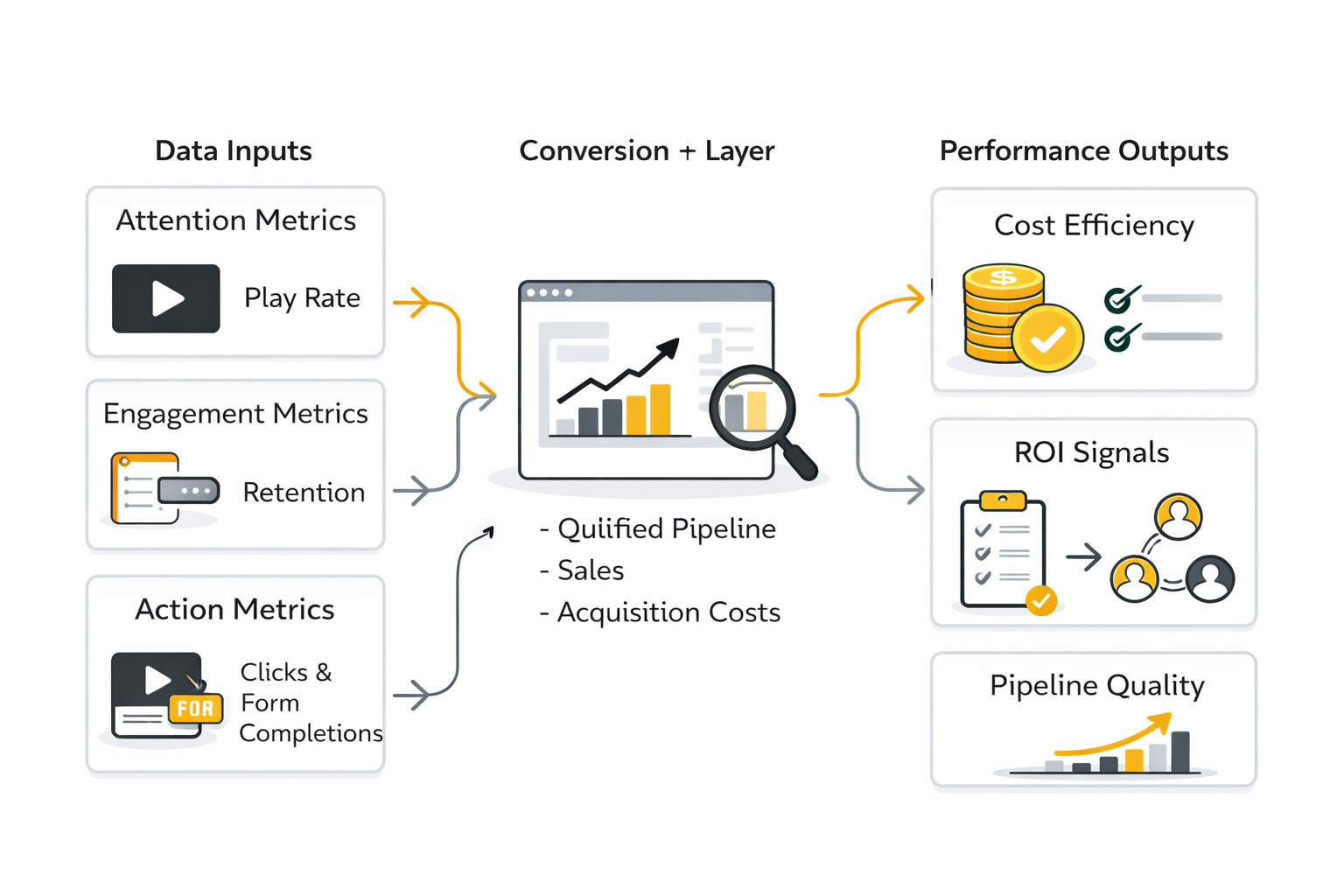
That is the point where an analytics system becomes tangible. You are not looking at a random dashboard anymore. You are reading a chain of events: impression, play, watch depth, click, lead, sale. Once that chain is visible, your next move becomes much clearer.
Benchmarks Are Useful, but Context Matters More
Benchmarks help, but only when they are used with common sense. If you treat every benchmark as a pass-fail threshold, you will misread good videos and protect bad ones. A short awareness clip, a high-intent landing page video, and a thirty-minute webinar will naturally behave very differently.
Wistia’s 2025 reporting is helpful here because it shows how much placement changes expectations. Videos on galleries, blog posts, and landing pages see engagement rates above 40% on average, while customer testimonial videos on case study pages keep viewers engaged almost halfway through on average. That is a strong reminder that intent-rich environments change how viewers behave, so you should interpret performance in context, not in isolation (Wistia’s 2025 video marketing statistics).
The action this should drive is simple. Compare similar assets against similar environments. Benchmark short social clips against other short social clips. Benchmark product-page videos against other product-page videos. Benchmark webinar replays against other deep-education assets. Mixing those categories together usually leads to bad calls and confused reporting.
What Retention Drops Usually Mean
Retention is one of the clearest diagnostic tools in video marketing because it tells you where the promise breaks. If viewers leave in the opening seconds, the problem is usually the hook, framing, or audience mismatch. If they stay for a bit and then bail, the issue is often pacing, clarity, or lack of proof. If they watch deep into the video but do not act, the problem is often the CTA, the offer, or the post-click path.
This is why retention data should change creative decisions, not just fill monthly reports. Wistia’s recent reporting showed overall video engagement dropped in 2024, with short-form videos seeing a particularly sharp decline, which is a strong sign that audiences are getting less patient and more selective (Wistia’s top insights from the 2025 State of Video Report, Wistia’s 2025 report). In plain terms, the market is telling you to earn attention faster.
That should drive specific action. Tighten intros. Front-load the point. Move proof earlier. Cut throat-clearing. And if the right people are staying but not converting, stop blaming the creative alone and audit the page, the form, the CTA, and the follow-up experience.
Statistics and Data That Should Shape Decisions
The most useful statistics in video marketing are the ones that help you decide where to put effort. HubSpot reports that the top three ROI-driving content formats are all video-based: short-form video at 49%, long-form video at 29%, and live-streaming video at 25% (HubSpot’s 2026 marketing statistics). That does not mean every business should pour everything into one format. It means video is now broad enough that multiple formats can perform when they are matched to the right job.
Wistia’s data adds a second layer to that story. High-intent page environments can produce strong engagement, and some of the most overlooked page types, like product, thank-you, and case-study pages, can carry meaningful watch behavior when the content matches the visitor’s intent (Wistia’s 2025 video marketing statistics). The interpretation here is practical: do not just publish more. Place video where buying intent is already high.
IAB’s data adds the third layer. As video budgets scale, buyers are shifting toward store visits and sales as the most important KPIs, which means measurement expectations are getting more commercial, not less (IAB’s 2025 leadership summit recap). The action this should drive is obvious. If your reporting still stops at views and completion rate, your measurement model is behind the market.
Build an Analytics Stack That Connects Watch Behavior to Revenue
A useful analytics stack does not need to be huge, but it does need to connect the steps that matter. You need to know where traffic came from, which video was watched, how long it held attention, what link or CTA was clicked, and what happened in the CRM or checkout after that. Without that chain, your reporting stays partial.
This is where simple infrastructure can save a lot of confusion. A team using Dub for cleaner attribution, GoHighLevel for lead capture and pipeline visibility, or Copper to keep contact-level follow-up visible is in a much better position than a team trying to stitch the story together manually after the fact. The exact tools matter less than the principle. Your video marketing stack should tell one connected story from first view to final outcome.
Once that system is working, your reporting gets much sharper. You can see which hooks attract the right traffic, which assets create qualified leads, which pages convert viewers best, and which videos look impressive but do very little for the business. That is the real point of analytics.
What Good Performance Should Make You Do Next
Data is only useful if it changes decisions. If a video gets strong play rates but weak retention, fix the opening and tighten the message. If it gets strong retention but weak conversions, improve the CTA and the landing environment. If it converts well on one channel and fails on another, stop assuming the problem is the creative and check the audience fit and placement context.
This is also where discipline matters. One good week does not prove a format will scale forever, and one weak result does not mean the concept is dead. HubSpot’s current numbers show marketers are already reviewing campaigns often and prioritizing commercial metrics over vanity metrics, which is exactly the right direction (HubSpot’s 2026 marketing statistics). The point is not to react emotionally to every data fluctuation. The point is to build a steady loop of hypothesis, launch, measurement, and refinement.
That is how video marketing becomes more predictable. You stop creating content in the dark. You start building with feedback. And once that happens, scaling stops feeling like a gamble.
Measuring Results and Scaling What Works
Once the analytics system is in place, the final challenge is not collecting more data. It is deciding what to keep, what to cut, and what to scale without bloating the process or losing what made the video work in the first place.
Measuring Results and Scaling What Works
Once your measurement layer is working, the next challenge is not getting more data. It is deciding what deserves more budget, more distribution, and more operational support. This is where video marketing becomes less about publishing and more about portfolio management, because the real job is to separate assets that create business movement from assets that only create activity. IAB’s 2025 digital video ad spend report makes that shift obvious by showing how quickly budgets are moving toward performance-driven video, while HubSpot’s latest marketing statistics show teams are increasingly judged on lead quality, conversion, ROI, and acquisition efficiency rather than reach alone.
That changes how scaling should work. You do not scale a video because it got compliments internally, hit a nice view count, or looked polished in a weekly meeting. You scale it because it consistently attracts the right audience, holds their attention long enough to matter, and produces a next step that is commercially useful.
Scale the Format, Not Just the Winning Video
A common mistake in video marketing is trying to scale one specific asset instead of scaling the underlying pattern that made it work. A winning video usually succeeds because of a stronger hook structure, a better angle, a clearer problem frame, a more believable proof sequence, or a better offer match. If you only duplicate the exact asset, performance usually fades fast.
The smarter move is to reverse-engineer the win. Look at the opening line, the promise, the format, the pacing, the on-screen proof, the CTA, and the audience context. Then build a family of related assets around that pattern. This approach is more durable, especially in a market where YouTube says more than 20 million videos are uploaded every day and where Wistia’s 2025 report found that engagement rates fell in 2024, with short-form video taking the biggest hit. The lesson is simple: what works once is useful, but what works repeatedly is what deserves scale.
Watch for Creative Fatigue Before Results Collapse
Creative fatigue is one of the most expensive blind spots in video marketing because it usually shows up gradually. The first sign is often not a total failure. It is a softer click-through rate, weaker hold rates in the opening seconds, rising acquisition costs, or lower conversion quality from an audience that has seen the same angle too many times.
That matters more now because platforms are saturated and viewers are harder to impress. Wistia’s 2025 State of Video coverage points to falling engagement and more selective viewing behavior, while YouTube’s current platform data shows just how much volume audiences are filtering every day. The practical response is to rotate hooks, proof formats, visual structures, and offers before performance fully breaks. If you wait until a campaign is obviously dead, you usually spend too much money learning the same lesson twice.
A good rule here is to treat your best-performing message like a theme, not a script. Keep the core tension, but change the story, framing, or evidence. That lets the market hear the same strong point without feeling like it is being shown the same video over and over again.
Do Not Scale Distribution Faster Than the Funnel Can Handle
This is where a lot of good video marketing systems break. A brand improves creative, finds an angle that converts, increases spend or posting frequency, and then runs straight into funnel problems. Landing pages do not match the promise. Forms create friction. Sales teams are not ready for the lead volume. Follow-up lags. Attribution gets messy. The video looks like the hero while the rest of the system quietly limits growth.
That is why scale has to be operational as well as creative. When IAB reports that digital video ad spend is growing far faster than total media, that is not only a signal about opportunity. It is also a warning that competition will expose weak backend systems faster. More attention only helps if the business can convert and retain what that attention brings.
This is where infrastructure matters in a very unglamorous but very real way. A team using GoHighLevel to keep lead flow, follow-up, and pipeline movement visible, Brevo to keep nurture moving, or ManyChat to route high-intent conversations quickly will usually scale more cleanly than a team trying to patch the system after the volume arrives. The video earns the opportunity. The backend determines whether you actually keep it.
Balance Brand Consistency With Platform Native Behavior
One of the harder tradeoffs in video marketing is figuring out how native to go on each platform without diluting the brand. If content is too polished and formal, it can feel out of place in social feeds. If it is too trend-driven and disposable, it can weaken brand perception or attract attention that never turns into trust.
There is no single perfect balance, but the principle is straightforward. Keep the brand consistent in point of view, promise, and tone. Let the execution adapt to the platform. HubSpot’s 2026 State of Marketing emphasizes that audiences reward brands that feel authentic, helpful, and human, which matters even more as AI makes average content easier to produce. The winning move is not to sound corporate everywhere or casual everywhere. It is to sound recognizably like yourself while respecting the way people actually consume video in each environment.
This is especially important when teams expand from one channel to several. A format that works on YouTube may need a different opening and tighter visual rhythm on Instagram or LinkedIn. The strategic point should stay intact, but the packaging has to match the room you are walking into.
Use AI to Increase Throughput Without Flattening the Brand
AI is now part of the operating reality of video marketing, but it introduces a real strategic tradeoff. It can make ideation, clipping, transcription, subtitle generation, repurposing, and workflow speed dramatically better. It can also make content feel generic at scale if teams let tools replace judgment.
That is not a theoretical risk. Wistia’s 2025 State of Video report highlighted sharp growth in AI use for video creation, and HubSpot’s current marketing statistics show broad AI adoption across content and media workflows. At the same time, HubSpot’s 2026 State of Marketing makes the opposite point just as strongly: audiences reward content that feels human-led, useful, and distinct. Put those together and the takeaway is clear. AI should compress production friction, not erase the voice that makes the brand memorable.
The expert-level move is to use AI where sameness does not hurt you and protect human thinking where it absolutely does. Let tools speed up edits, tags, rough cuts, and content variations. Keep human control over positioning, proof selection, angle choice, and the emotional truth of the message.
Treat Distribution as a Multiplier, Not a Rescue Plan
A lot of teams still treat distribution like a separate task that starts after production. That mindset causes problems because weak assets get overpromoted and strong assets get underexposed. Distribution works best when it is designed into the system early, not bolted on at the end.
This is one of the more useful findings from Wistia’s reporting on repurposing. A single webinar replay produced far more downstream value once it was broken into clips and redistributed in multiple formats, generating several times the watch time of the original live event. The lesson is not that every brand needs webinars. It is that distribution often creates more upside from existing footage than producing a constant stream of net-new material.
This is where a scheduling and repurposing layer can become a real leverage point. Tools like Buffer or Flick can support consistency, but the real advantage comes from the operating habit behind them. When your team assumes every strong video can become multiple assets for multiple contexts, scale becomes much more efficient.
Protect Measurement Quality as You Grow
One of the hidden risks in scaling video marketing is that reporting quality often gets worse as volume increases. More assets, more channels, more landing pages, more creators, and more campaigns can make attribution messy very quickly. Then teams start making expensive decisions with partial data.
That is why measurement discipline matters even more at scale than it does at the beginning. Keep naming conventions clean. Track asset families, not just isolated posts. Separate organic, paid, creator-led, and lifecycle video in reporting. And make sure the same definitions for qualified lead, conversion, and influenced revenue apply across the whole system.
If that sounds operational, good. It should. Mature video marketing does not break because smart people suddenly forget how to make content. It breaks because the business loses the ability to tell what is actually working.
The Real Risk Is Scaling Noise Instead of Advantage
At this stage, the biggest strategic risk is not underproducing. It is scaling noise. More content, more edits, more platforms, and more output can create the illusion of momentum while hiding the fact that the message is getting weaker, the audience fit is drifting, and the creative is becoming interchangeable.
That is why expert teams keep returning to the same few questions. Is this video for the right person? Does it make a clear promise? Does it hold attention for the right reason? Does it lead somewhere sensible? And does the business learn something useful from the result?
When you keep those questions in play, scale becomes an advantage instead of a mess. Your video marketing engine gets faster without getting sloppier. Your output grows without losing its point of view. And your team starts compounding learning instead of just compounding workload.
That sets up the final step: turning everything in this article into a practical set of decisions, priorities, and answers to the questions marketers usually ask when they are trying to make video work in the real world.
FAQ
What is video marketing in practical terms?
Video marketing is the use of video to attract attention, explain value, build trust, and move people toward a business outcome. That outcome might be a sale, a demo request, an email signup, a booked call, or even stronger brand recall. In practice, good video marketing is less about making “content” and more about matching the right message and format to the right stage of the buyer journey, which is exactly why marketers continue to rank video among the highest-ROI content formats. (HubSpot’s 2026 marketing statistics, Google’s research on video and purchase decisions)
Why does video marketing work so well right now?
It works because it fits how people actually consume information online. Buyers move between search, social feeds, reviews, creator content, product pages, and email, and video can support all of those moments in a way that text alone often cannot. That is why recent marketing research continues to show high adoption and sustained investment in video, while platform-level behavior shows enormous daily viewing volume and intense competition for attention. (HubSpot’s 2026 marketing statistics, YouTube for Press, IAB’s 2025 digital video ad spend report)
Is short-form video always better than long-form video?
No, and that is one of the most common misunderstandings in video marketing. Short-form is excellent for earning the stop, creating reach, and testing angles quickly, but long-form becomes more valuable when the audience needs education, proof, or deeper conviction before acting. The current data points in that direction too, with short-form leading many ROI conversations while longer video and live formats still holding real value when the buying decision is more complex. (HubSpot’s 2026 marketing statistics, Wistia’s 2025 video marketing statistics)
How often should a business publish video content?
There is no serious universal number, because the right frequency depends on your team, audience, sales cycle, and distribution model. What matters more is whether you can maintain message quality, audience fit, and a usable measurement loop while publishing consistently enough to learn. The current market context makes that discipline even more important, since more brands are publishing more video while budgets remain under pressure, which means output without learning becomes expensive fast. (Wistia’s 2026 State of Video preview, HubSpot’s 2026 State of Marketing)
What is the biggest mistake people make with video marketing?
The biggest mistake is making a video before deciding what job it needs to do. When the goal is vague, everything else gets weaker: the hook, the message, the CTA, the landing page, and the reporting. The shift across the industry toward outcome-based KPIs is basically a reaction to that problem, because buyers and operators increasingly want video tied to real business results instead of general engagement. (IAB’s 2025 Video Leadership Summit recap, HubSpot’s 2026 marketing statistics)
Do small businesses need expensive production to compete?
Usually not. Small businesses need clear positioning, relevant messaging, believable proof, and a repeatable production process much more than they need cinematic polish. That fits the broader market direction as well, since in-house production has grown and teams are using leaner workflows to create more video without turning every asset into a major production event. (Wistia’s 2025 State of Video statistics, HubSpot’s 2026 State of Marketing)
Which metrics matter most in video marketing?
That depends on the job of the video, but the core categories stay consistent. You want attention metrics like play rate or thumb-stopping ability, engagement metrics like retention and watch depth, action metrics like clicks and form completions, and business metrics like qualified pipeline, sales, or customer acquisition cost. That broader commercial view matches where the market is going, with outcome-based measurement becoming more important across the video ecosystem. (Wistia’s analytics guidance, IAB’s 2025 Measurement Leadership Summit recap, HubSpot’s 2026 marketing statistics)
How long should a marketing video be?
A better question is how long the video can stay useful before the viewer stops caring. Some videos should be fifteen seconds, some should be ninety seconds, and some should be twenty minutes if the audience is high-intent and wants deeper information. The retention data from recent video research reinforces that point, showing strong engagement in intent-rich contexts and reminding marketers that format and placement matter at least as much as raw runtime. (Wistia’s 2025 video marketing statistics, Google’s research on the shopping journey)
Where should businesses distribute their videos?
They should distribute them where their audience already makes decisions, not where a generic checklist says they should post. For some brands, that means YouTube, LinkedIn, and the website. For others, it means Instagram, TikTok, email, landing pages, sales follow-up, or webinar replays embedded on blog content. Recent Wistia reporting is especially helpful here because it shows that intent-rich placements such as landing pages, blog posts, case-study pages, and related owned channels can produce strong engagement and long-term value. (Wistia’s 2025 video marketing statistics, Wistia’s webinar repurposing analysis)
Can AI replace a real video marketing strategy?
No. AI can speed up research, transcription, clipping, repurposing, subtitling, and parts of production workflow, but it does not replace positioning, judgment, or audience understanding. In fact, the more AI-generated content floods the market, the more valuable a clear brand point of view becomes, which is one of the strongest themes in current marketing research. (HubSpot’s 2026 State of Marketing, Wistia’s 2026 State of Video preview)
How long does it take to see results from video marketing?
That depends on the type of result you mean. Reach and engagement signals can appear quickly, but qualified leads, brand lift, improved close rates, and assisted conversion effects usually take longer because video often works across several touchpoints instead of in one neat straight line. Google’s research on video and decision-making supports that broader view, showing that video influences multiple stages of the buying journey rather than acting only as top-of-funnel awareness. (Google’s research on video and purchase decisions, HubSpot’s 2026 marketing statistics)
How do you know when to scale a video?
You scale it when the pattern is repeatable, not just when one post spikes. That means the asset consistently attracts the right audience, holds attention in a meaningful way, and leads to a business outcome that justifies more spend or broader distribution. This distinction matters more now because budgets are scrutinized harder, engagement is getting tougher, and teams need stronger evidence before expanding investment. (HubSpot’s 2026 trends summary, Wistia’s 2025 video marketing statistics, IAB’s 2025 digital video ad spend report)
Is video marketing mainly for B2C brands?
Not at all. B2B teams use video for thought leadership, product education, customer proof, sales enablement, webinars, case studies, onboarding, and pipeline acceleration. Wistia’s latest preview for the 2026 State of Video even highlights LinkedIn as a primary B2B video channel for many teams, which shows how embedded video has become in professional buying environments, not just consumer ones. (Wistia’s 2026 State of Video preview, HubSpot’s 2026 marketing statistics)
What should a business do first if it wants to improve video marketing fast?
Start by auditing the current system instead of rushing to make more videos. Look at the top-performing assets, identify where retention drops, check whether the CTA matches the offer, and see whether the landing page or follow-up path is breaking the momentum. That kind of cleanup usually creates better gains than launching a totally new content calendar, especially when the market is already signaling that performance, efficiency, and clear measurement matter more than sheer volume. (IAB’s 2025 Video Leadership Summit recap, Wistia’s analytics guidance, HubSpot’s 2026 State of Marketing)
Work With Professionals
Explore 10K+ Remote Marketing Contracts on MarkeWork.com
Most marketers spend too much time chasing clients, competing on crowded platforms, and losing a percentage of every project to middlemen.
MarkeWork gives you a better way. Browse thousands of remote marketing contracts and connect directly with companies desperate to hire skilled marketers like you, without platform commissions and without unnecessary gatekeepers.
If you're serious about finding better opportunities and keeping 100% of what you earn, explore available contracts and create a profile for free at MarkeWork.com.