

Web marketing is still one of the few growth channels that can keep working after the campaign ends. A strong website, clear messaging, useful content, search visibility, email capture, and conversion-focused pages can keep bringing in leads and sales long after the initial work is done. That is exactly why smart companies still treat web marketing as infrastructure, not just promotion.
The problem is that most businesses approach it in fragments. They run paid traffic without fixing the landing page, publish content without a distribution plan, or collect leads without a follow-up system that actually moves people toward a decision. When that happens, web marketing feels expensive, inconsistent, and far more complicated than it needs to be.
What works now is a connected system. Your website has to communicate value fast, your traffic sources have to match search and audience behavior, and your conversion path has to feel frictionless on every device. When those pieces reinforce each other, web marketing stops being a random set of tactics and starts becoming a durable engine for growth.
Why Web Marketing Still Matters
Web marketing matters because your site is still where intent becomes action. Social platforms can create attention and email can nurture demand, but the website is usually where people compare options, evaluate trust, and decide whether to buy, book, subscribe, or reach out. If that experience is weak, the rest of your marketing has to work much harder just to keep results flat.
That pressure is even higher now because search, social, and user expectations have shifted at the same time. People want faster pages, clearer answers, more useful content, and less friction between discovery and decision. They also move across channels constantly, which means your web marketing cannot rely on one traffic source or one campaign format to carry the whole business.
The businesses that win tend to be the ones that simplify the journey. They understand who they are trying to reach, create pages that actually help, and connect acquisition with conversion instead of treating them as separate jobs. That sounds obvious, but in practice it is the difference between a website that looks busy and one that produces revenue.
The Web Marketing Framework at a Glance
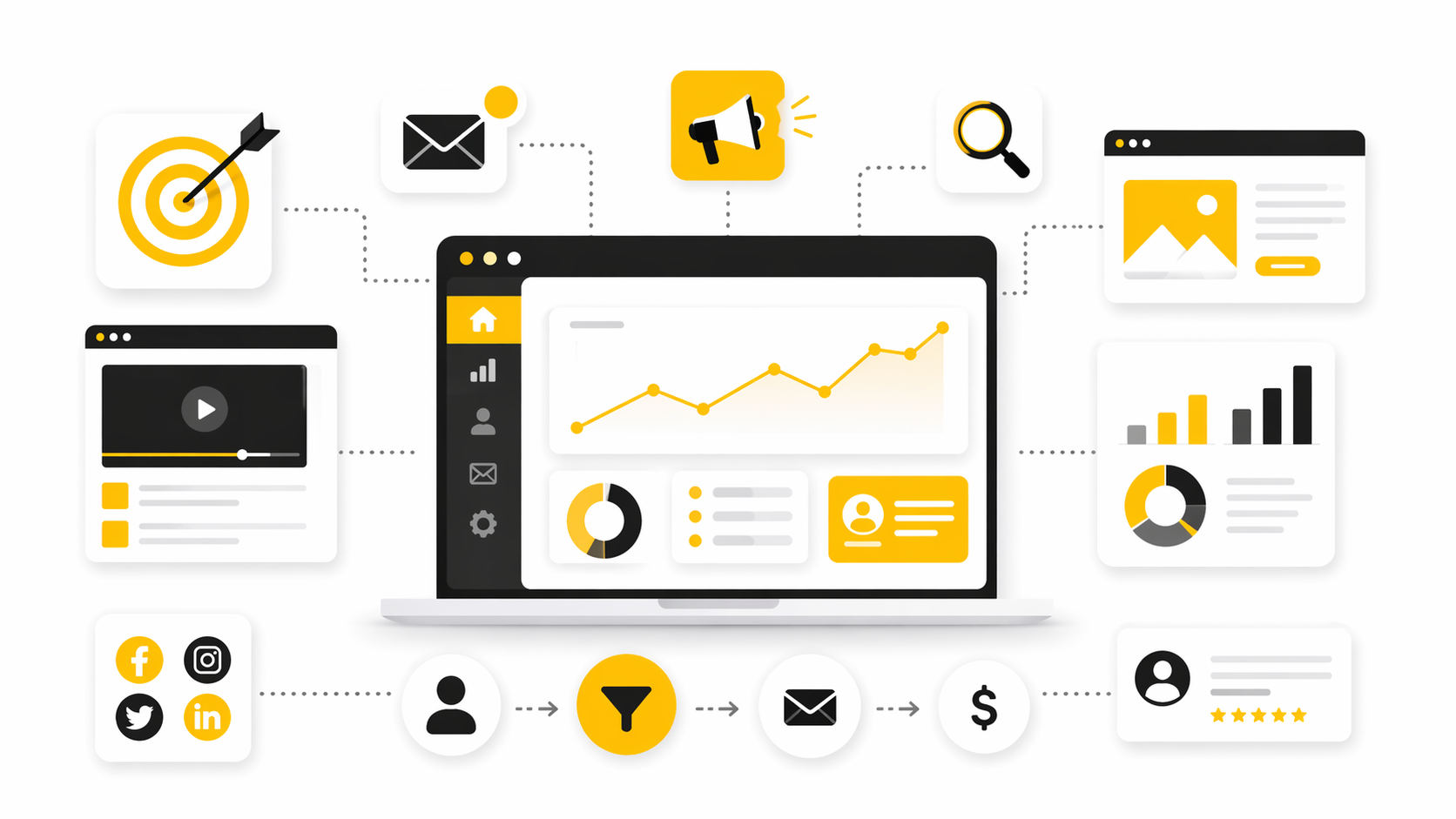
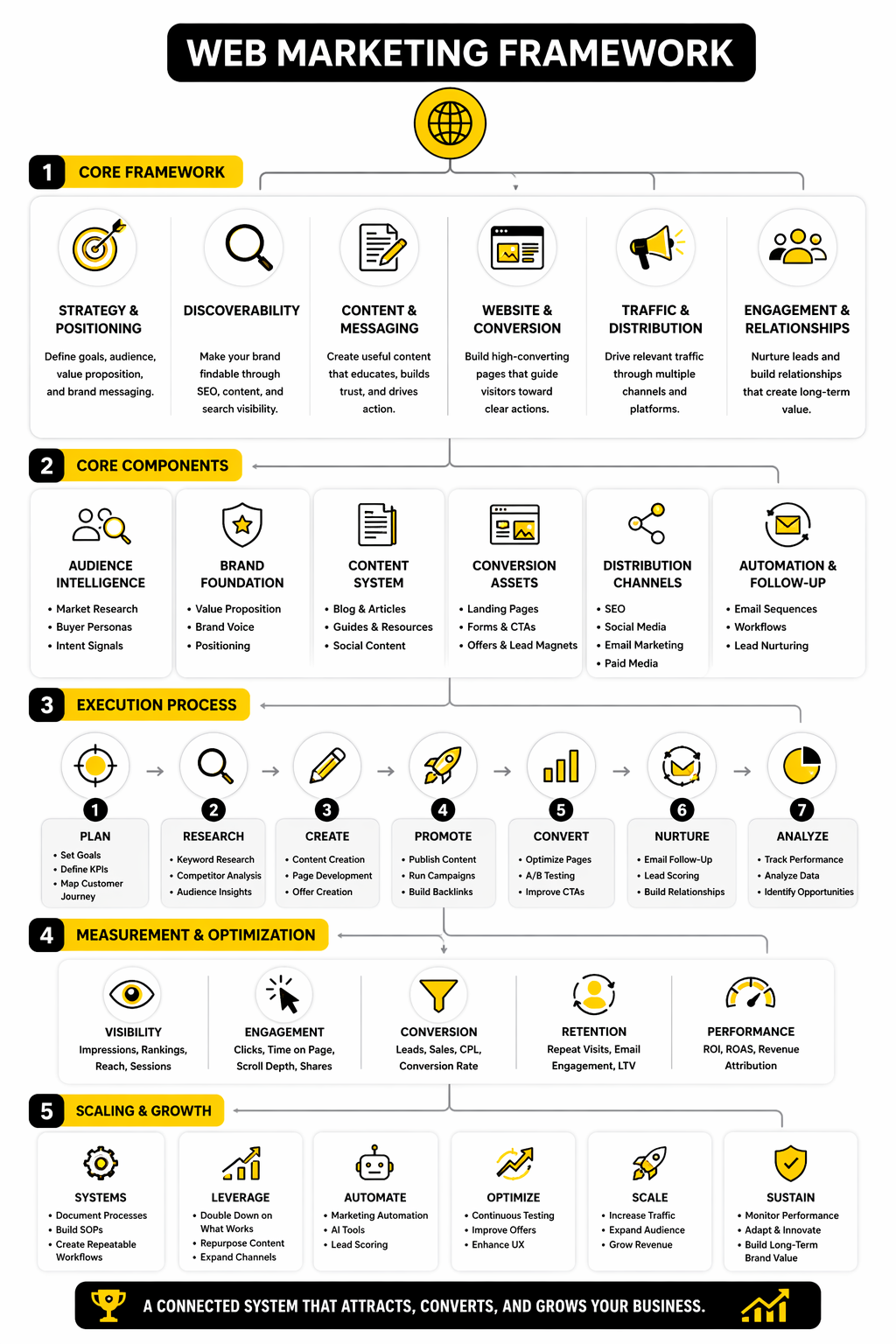
The easiest way to understand web marketing is to see it as a chain. First you earn attention, then you turn that attention into interest, then you convert that interest into action, and finally you keep the relationship alive long enough for repeat revenue, referrals, or both. If one link is weak, performance drops everywhere else.
That is why the strongest web marketing strategies are built around alignment. The audience has to match the offer, the offer has to match the page, the page has to match the traffic source, and the follow-up has to match the buyer’s stage of awareness. When those elements line up, results usually improve without needing constant reinvention.
This article will use a practical framework instead of a channel-by-channel checklist. That makes it easier to see how messaging, content, search, social, email, landing pages, analytics, and automation fit together in the real world. It also makes it much easier to spot what is missing when results stall.
Article Outline
This article is structured as one connected guide split across six parts. Each section builds on the one before it, so the logic stays consistent from strategy to execution. By the end, you should be able to look at your current web marketing setup and quickly identify what to fix, what to scale, and what to stop doing.
The order matters. We will start with the strategic foundation, move into the channels and assets that create demand, then finish with conversion, retention, and implementation. That sequence reflects how strong web marketing actually works in practice.
- Why Web Marketing Still Matters
- The Web Marketing Framework at a Glance
- Audience, Offer, and Messaging
- Content, Search, and Distribution
- Conversion, Retention, and Measurement
- How to Implement Web Marketing Like a Pro
Audience, Offer, and Messaging
The next layer of web marketing is where most results are won or lost. Before you worry about content volume, ad spend, or automation, you need to be painfully clear on who you are trying to reach, what you are asking them to care about, and why your version is worth choosing. If that foundation is fuzzy, the rest of your marketing usually turns into expensive noise.
This is also where a lot of teams get distracted by tactics. They debate channels, formats, and publishing schedules while the actual offer is still weak or the message still sounds like every competitor in the category. That is why strong web marketing starts with audience insight, then sharpens the offer, and only then turns that into messaging that can survive contact with the real market.
Search behavior reinforces this. Google’s own search guidance keeps pushing site owners toward content that is genuinely useful, clearly structured, and built for people first rather than search engines first, which makes audience clarity and message relevance even more important in practice than they were a few years ago. You can see that directly in Google’s SEO Starter Guide and the broader Search documentation.
Know the Buyer Before You Build the Funnel
Good web marketing begins with a specific buyer, not a vague market. You are not trying to attract “small businesses” or “people who want better marketing.” You are trying to reach a person in a concrete situation, with a specific frustration, an obvious goal, a limited budget, and a real reason to act now or wait.
That matters because intent is uneven. Someone comparing tools, someone looking for a quick fix, and someone ready to book a demo may all use related keywords, but they do not need the same page, the same call to action, or even the same proof. Treating them as one audience usually lowers conversions because the message lands softly on everyone instead of hitting hard for the right segment.
Recent marketing surveys keep pointing in the same direction. Teams are putting more weight on audience understanding, personalization, and lifecycle relevance because generic campaigns have become easier to ignore and harder to scale, a shift reflected in HubSpot’s 2025 State of Marketing findings and Salesforce’s State of Marketing report. In plain English, web marketing works better when the page feels like it was built for the visitor already on it.
Build an Offer That Solves a Real Problem
Once the audience is clear, the offer has to do actual work. This is where many websites underperform because they describe the business instead of presenting a compelling reason to act. A visitor does not care that you are passionate, innovative, or full-service unless those claims connect to a concrete outcome they want.
A strong offer is specific about the result, the path, and the trade-off. It shows what changes for the buyer, how fast they can expect movement, what risk is reduced, and why this option is easier or smarter than the alternatives. In web marketing, clarity usually beats cleverness because people rarely spend enough time on a page to decode vague positioning.
That is especially important in an environment where user patience is thin and acquisition costs are rising. Contentsquare’s 2025 digital benchmarks and the company’s summary of that report in its 2025 benchmarks release both point to weaker conversion performance and higher pressure on digital teams, which means weak offers become even more expensive. When traffic is harder to win, every page has to make a stronger case.
Turn the Offer Into Messaging People Immediately Understand
Once the offer is right, messaging has one job: make the value obvious fast. Not poetic. Not inflated. Obvious. The visitor should understand who this is for, what it helps them do, and what to do next without needing to scroll through three screens of brand theater.
This is why the best web marketing copy usually sounds simpler than the team expected. It uses the buyer’s language, names the problem directly, and explains the outcome in terms that reduce mental effort. The point is not to sound basic. The point is to remove friction between interest and action.
You can see this logic reflected in how search and content performance are evolving. HubSpot’s 2025 web trends report and its broader marketing statistics roundup both show how tightly traffic quality, engagement, and conversion now depend on relevance rather than just reach. In other words, better messaging does not just help conversion after the click. It also improves the chances that the right people click in the first place.
Proof, Trust, and Specificity Do More Than Hype
Once your core message is clear, the next step is making it believable. This is where proof enters the picture. Testimonials, customer logos, product evidence, use cases, transparent pricing logic, process detail, and outcome-focused examples all help reduce the natural skepticism people bring to any marketing claim.
Specificity matters more than volume here. One precise proof point is usually more persuasive than a wall of generic praise. If your page says you help ecommerce brands improve conversion rates, visitors want to know how, in what context, and for whom, not just that clients “love working with you.”
That principle matters across both organic and paid acquisition. When search engines and users are both assessing quality, vague claims create drag. Google’s documentation keeps emphasizing content that helps people complete tasks and understand topics clearly, and digital experience research keeps showing that friction and confusion make conversion weaker, which is exactly why trust-building elements should be baked into the page rather than added as decoration later through web marketing patches.
Match the Message to the Stage of Awareness
Not every visitor needs the same conversation. Someone who already knows the category may want comparison points, implementation detail, and pricing logic. Someone earlier in the journey may need a clearer explanation of the problem, the cost of ignoring it, and the options available before they are ready to evaluate your solution.
This is where strong web marketing gets more strategic. Instead of forcing one page to do everything, you create a path. Educational content attracts early attention, category and solution pages frame the decision, landing pages focus action, and follow-up email or retargeting closes the gap when people are interested but not ready yet.
That staged approach lines up with how modern buyers behave across channels. Salesforce’s marketing report highlights how customer journeys now stretch across more touchpoints, while Google’s search guidance still rewards pages that serve a clear purpose well. The takeaway is simple: message-market fit is not enough on its own. You also need message-stage fit.
What This Means Before You Move Into Channels
By this point, the shape of the system should be clearer. You need to know exactly who you want, craft an offer that solves a problem they already care about, and express that value with language that feels immediate, credible, and easy to act on. That is the part too many businesses skip, and then they wonder why their traffic does not convert.
Get this layer right and the rest of your web marketing becomes easier to scale. Your content becomes sharper, your landing pages become simpler, your ads become more efficient, and your email follow-up starts sounding like a continuation of the same conversation instead of a disconnected sales sequence. That is where we go next: the channels and assets that turn this foundation into compounding visibility.
Content, Search, and Distribution
Once the audience, offer, and messaging are clear, web marketing moves into production. This is the stage where strategy becomes visible in the market through pages, articles, lead magnets, landing pages, social posts, email follow-up, and recurring promotion. Most businesses do some of this already, but very few do it as one connected system.
That distinction matters. Publishing content is not the same as building momentum. In effective web marketing, every asset has a job, every channel supports another channel, and every piece of content helps move the visitor one step closer to trust, inquiry, or purchase.
Start With Search Intent, Not Content Volume
A lot of teams still make the same mistake here. They build a content calendar around whatever sounds interesting internally, then wonder why traffic stays weak or why the traffic they get does not convert. The smarter move is to begin with search intent and commercial relevance, then choose formats that match what the visitor actually wants at that moment.
That usually means separating your content into clear buckets. Some pages should capture bottom-of-funnel demand, like service pages, product pages, comparison pages, or landing pages tied to obvious buying intent. Other pieces should attract and educate earlier-stage visitors, especially the ones who are problem-aware but not yet solution-committed.
This is exactly where modern web marketing gets stronger when it becomes more disciplined. People-first search guidance keeps rewarding content that is useful and task-focused, while engagement research keeps showing that audiences respond better to relevance than sheer output. So the goal is not to publish more. It is to publish the right assets in the right order.
Build a Content Engine Around a Few Core Assets
Instead of chasing endless ideas, build around a small number of core assets that can carry real weight. In most cases, that means one strong commercial page, one supporting educational piece, one lead capture point, and one distribution plan that keeps sending qualified traffic back to both. That structure is much easier to maintain, and it compounds better over time.
For example, one high-intent landing page can support paid traffic, organic traffic, internal linking, retargeting, and email nurture at the same time. A well-built long-form article can attract search traffic, feed your social clips, support your newsletter, and give your sales team something useful to send after a call. This is how web marketing starts behaving like a system rather than a content treadmill.
That is also why page quality matters so much. Replo’s review of landing page offers tested across 150+ pages points to a simple truth: the offer format, the clarity of the page, and the match between promise and page structure do real conversion work. Content is not only about traffic. It also shapes the outcome after the click.
Distribute Every Asset on Purpose
One of the biggest leaks in web marketing is weak distribution. Teams spend serious time creating a page or article, publish it once, post a link on one channel, and move on. That is not a distribution strategy. That is a quiet launch followed by silence.
Strong distribution treats every asset as something worth repackaging. A guide can become a LinkedIn post, a short email, a quote graphic, a sales follow-up resource, a retargeting angle, a chatbot entry point, and a talking point for founder-led content. The goal is not to repeat the same message everywhere. The goal is to adapt the same underlying insight to the context of each channel.
This matters more now because audience behavior is fragmenting. Buffer’s analysis of 52 million posts across 10 platforms makes it painfully clear that engagement patterns vary sharply by platform, which is exactly why copy-paste distribution usually underperforms. Good web marketing respects channel behavior while keeping the core message consistent.
Use Email and Owned Follow-Up to Keep Traffic Valuable
Traffic is useful. Owned attention is better. If someone visits your site, learns something useful, and leaves without a next step, you are forced to buy or earn that attention again later. That is why effective web marketing always includes some kind of permission-based follow-up.
Email is still one of the most practical ways to do that because it lets you continue the conversation after the first visit. Brevo’s 2025 email marketing benchmarks show just how much performance changes by industry and region, which is another reminder that follow-up works best when it is segmented and relevant rather than blasted to everyone the same way. In practical terms, that means your lead magnet, opt-in form, or consultation flow should connect directly to a useful nurture sequence.
For many businesses, this is where the system starts to feel real. A visitor reads a page, joins a list, gets a short sequence that answers objections, and returns later with more trust than they had on the first click. That is not flashy, but it is exactly how good web marketing compounds.
Make the Execution Process Visible
A marketing system becomes easier to manage when the workflow is obvious. Instead of asking what to post next every Monday, define how ideas move from research to page creation to distribution to follow-up. Once you do that, the process stops depending on guesswork or last-minute energy.
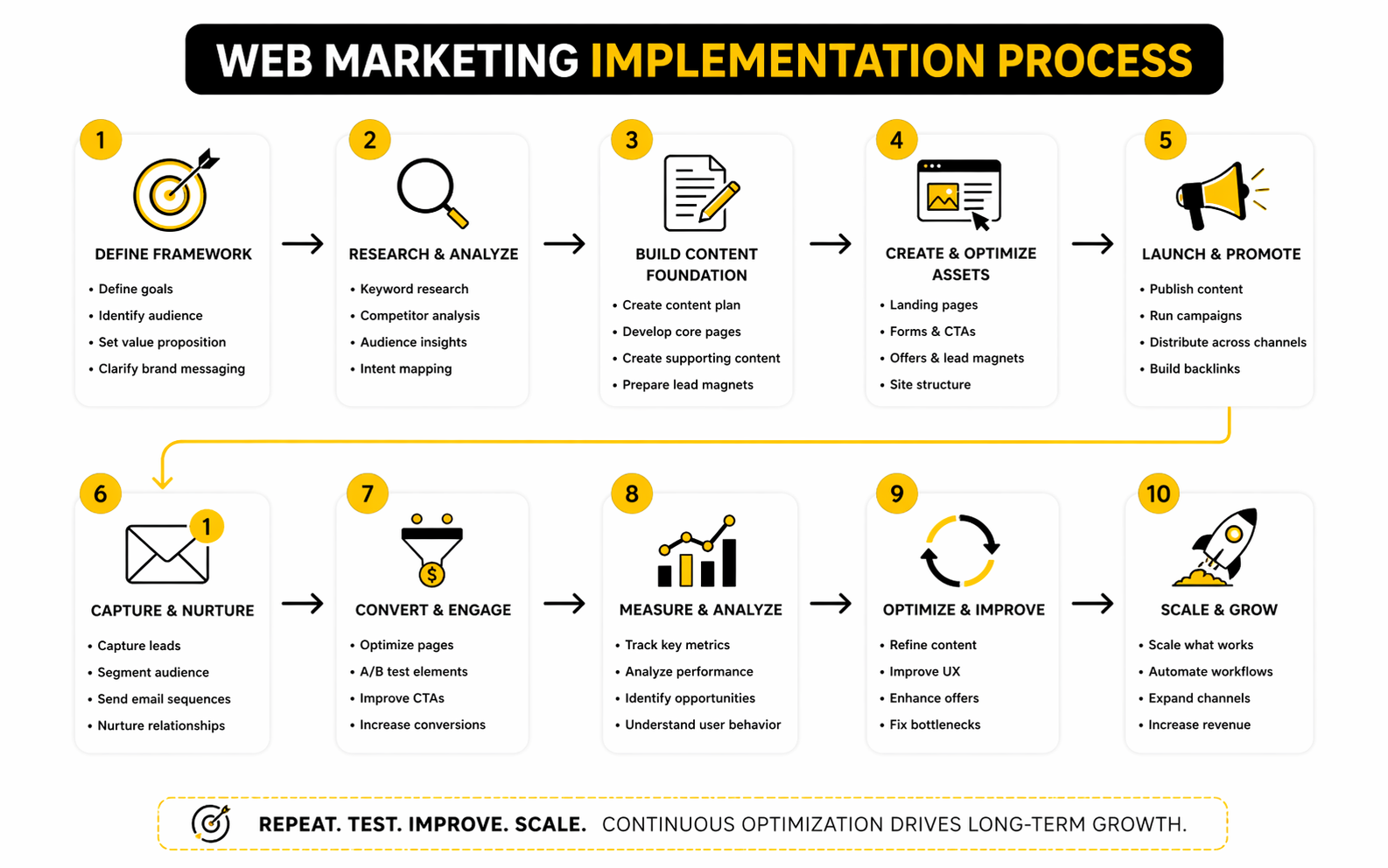
A practical execution process usually looks like this:
- Pick one commercial priority for the month.
- Build or improve the page most closely tied to that priority.
- Publish one strong supporting asset that answers a real question around the offer.
- Repurpose that asset into channel-specific distribution pieces.
- Add a clear lead capture path tied to the same topic.
- Connect the capture point to a simple follow-up sequence.
- Review what drove visits, leads, replies, and sales conversations.
- Keep what worked, tighten what confused people, and repeat.
This is where tools can help, but only if the underlying process is already clear. A scheduling platform like Buffer can make distribution more consistent. A chat automation tool like ManyChat can capture intent from social conversations. A page builder like Replo can speed up landing page execution. But none of them can rescue unclear strategy or weak messaging.
The Goal Is Momentum, Not Random Activity
This is the point most people miss. Good web marketing is not about being everywhere. It is about building a small number of high-quality assets, distributing them repeatedly, and connecting them to a follow-up path that turns attention into measurable business outcomes.
When you do that well, the channels stop competing with each other. Search supports email. Social supports content. Landing pages support conversion. Follow-up supports delayed decisions. That is when web marketing starts feeling less chaotic and much more commercial.
The next step is just as important, because attention and distribution alone do not guarantee growth. You still need a system that turns visits into action, tracks what matters, and improves performance over time. That means moving from visibility into conversion, retention, and measurement.
Conversion, Retention, and Measurement
By the time your web marketing machine is attracting traffic and distributing content consistently, the next question becomes brutally simple: is it actually producing business results. Not vanity. Not pretty dashboards. Not “good engagement.” Real movement toward leads, sales, booked calls, subscriptions, and repeat revenue.
This is where a lot of otherwise solid marketing starts to drift. Teams get excited by impressions, pageviews, and follower growth, but they never connect those signals to the actual path people take from first visit to conversion. When that happens, web marketing looks busy on the surface while the commercial impact stays vague underneath.
The fix is not more reporting. The fix is tighter interpretation. You need to know which numbers are early signals, which numbers are lagging outcomes, and which ones are basically noise unless paired with context. That is what turns analytics from decoration into decision-making.
The Numbers That Actually Matter
Not all metrics deserve equal attention. Traffic matters, but only if the right people are arriving. Engagement matters, but only if it supports the next step. Conversion rate matters, but only when it is tied to offer quality, traffic source, page type, and buying intent rather than treated like a universal scoreboard.
That is why good web marketing reporting usually starts with four layers. First, measure visibility, which includes impressions, reach, rankings, and sessions. Second, measure engagement, such as time on page, scroll depth, click behavior, replies, and returning visits. Third, measure conversion, which covers form fills, purchases, booked calls, demo requests, and assisted conversions. Fourth, measure retention, which includes repeat visits, repeat purchases, email engagement, renewal signals, and customer lifetime value where relevant.
The point is not to obsess over every number. It is to read them in order. If visibility is weak, your distribution or discoverability is the issue. If visibility is strong but engagement is poor, your message or page experience is off. If engagement is healthy but conversion is weak, the problem is usually the offer, the CTA, the page structure, or the friction around the action itself.
Why Benchmarks Help and Why They Also Mislead
Benchmarks are useful when they create perspective, not when they become a shortcut for thinking. Industry reports can tell you whether your performance is wildly out of line, but they cannot tell you whether your page should convert at 1.5% or 6% without understanding intent, source mix, pricing, brand awareness, and category maturity.
That said, benchmarks are still extremely helpful when used correctly. Brevo’s 2025 email benchmark data shows overall email performance around a 31.22% open rate and 3.64% click-through rate, with EMEA performing even better on both measures. That does not mean your list is broken if your numbers differ. It means inbox performance should be judged against audience quality, segmentation, and send intent rather than guesswork.
The same principle applies on social. Buffer’s 2026 engagement study across 52 million posts makes one thing obvious: platform behavior is not uniform, so a weak post on one channel does not automatically mean the idea itself was weak. Sometimes the format was wrong. Sometimes the timing was wrong. Sometimes the audience simply needed the same idea framed differently.
How to Read Performance Signals Without Fooling Yourself
A pageview is not interest. A click is not intent. A high open rate is not persuasion. This is where sloppy interpretation quietly ruins web marketing, because it encourages people to scale what looked impressive instead of what actually moved the pipeline forward.
For example, a post can generate great reach and still send low-quality traffic that bounces fast and never converts. An email can produce strong opens but weak clicks because the subject line created curiosity while the offer inside did not hold up. A landing page can show average conversion while still being a win if it attracts much higher-value leads than the previous version.
This is why you should read metrics in combinations, not isolation. Strong web marketing analysis usually asks questions like these:
- Did the traffic source bring qualified visitors or just volume
- Did people consume the page or leave after the headline
- Did the CTA match the level of intent on that page
- Did leads from that channel move forward or stall
- Did repeat touchpoints improve conversion later
Once you start thinking this way, analytics gets much more useful. You stop reacting emotionally to single numbers and start looking for patterns in the full journey.
Build a Simple Analytics System First
Most businesses do not need a giant measurement stack to improve web marketing. They need a clean, reliable system that tracks what matters across the funnel. That usually means analytics for traffic and behavior, event tracking for important actions, CRM visibility for lead quality, and basic reporting that ties channel activity to commercial outcomes.
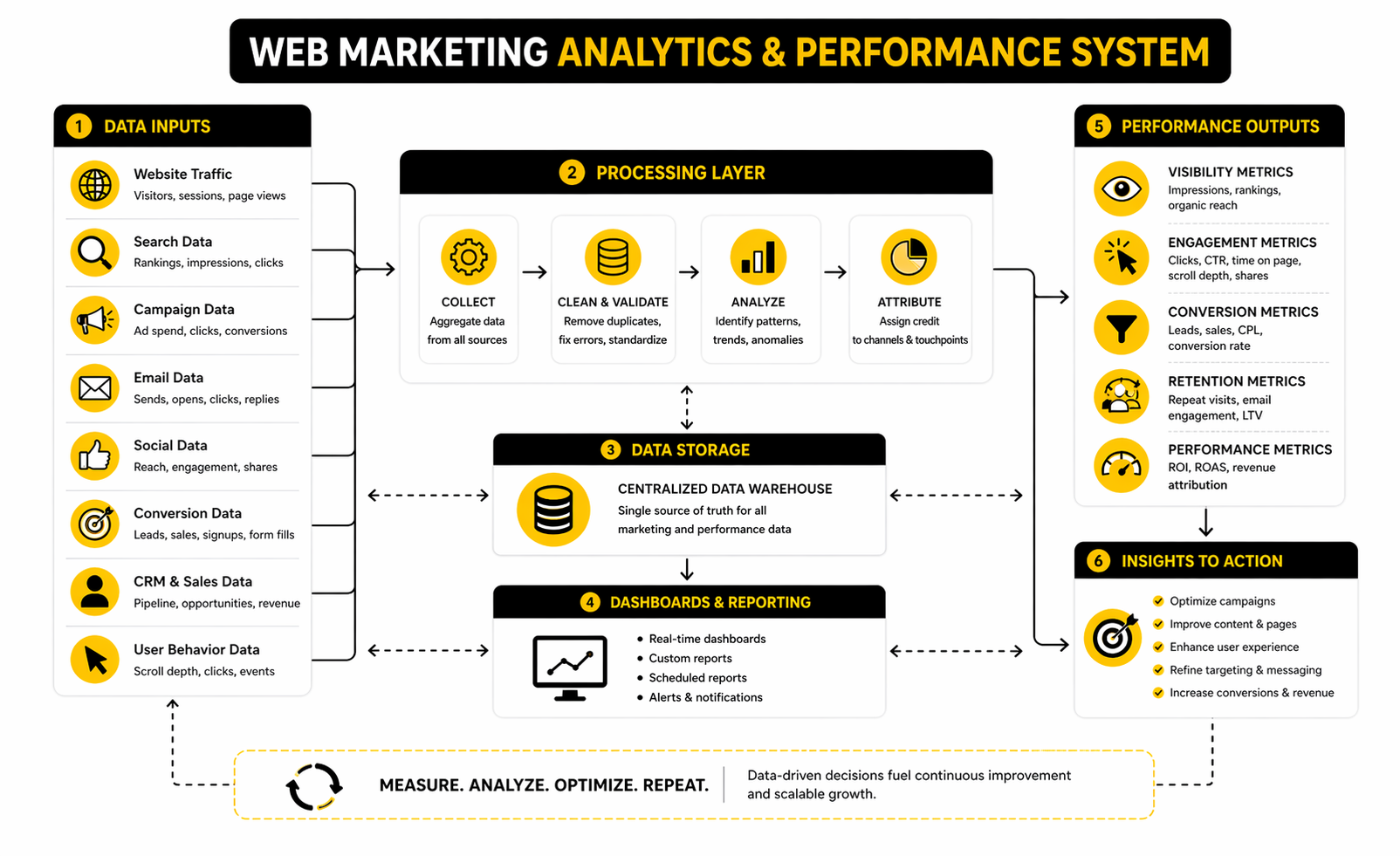
A practical measurement system usually includes these checkpoints:
- Track source-level traffic so you can see where visits actually come from.
- Track page-level behavior so you can spot where interest rises or dies.
- Track key actions like form submissions, purchases, booked calls, quiz completions, or chat starts.
- Track lead quality or downstream revenue so you do not overvalue cheap conversions.
- Review assisted conversions so channels that influence later action still get proper credit.
- Compare new visitors and returning visitors because they often behave very differently.
- Look at performance by device, page type, and campaign intent before making major changes.
That is enough to make smart decisions in most cases. The moment you can clearly see which traffic sources produce engagement, which pages create action, and which follow-up paths create revenue, your web marketing stops feeling like a black box.
Statistics and Data
The real value of statistics is not that they make the article sound smarter. The value is that they help you calibrate expectations and avoid bad conclusions. Data should tell you whether you are looking at a discoverability problem, a messaging problem, a conversion problem, or a retention problem.
Take email as one example. Brevo’s industry and regional benchmark data shows how widely results vary by industry, with ecommerce click-through rates looking very different from nonprofit or telecom performance. The action this should drive is simple: segment harder, tailor the message more carefully, and judge performance against the right peer group instead of some imaginary global average.
The same goes for social distribution. Buffer’s 2026 platform data is useful because it reminds you that channel mechanics shape results. The practical move is not to panic when one post underperforms. It is to test the same idea in another format, on another channel, or at another stage of the buyer journey before you throw the idea away.
This is the broader lesson for web marketing as a whole. Statistics are only valuable when they lead to a better decision. If the data does not change what you do next, it is just trivia with charts.
What Good Data Should Push You to Do
Good data should make action easier, not harder. If your traffic is rising but conversions are flat, tighten the page, sharpen the CTA, or fix the offer. If engagement is strong but pipeline quality is weak, refine the targeting and the promise. If leads are decent but close rates are poor, the problem may sit downstream in sales follow-up rather than in web marketing itself.
This is why measurement needs to stay close to operations. The best teams do not just review numbers once a month and move on. They use those numbers to rewrite pages, simplify forms, re-sequence email flows, kill weak channels, and double down on what is creating real business momentum.
And that is the real point of analytics in web marketing. It is not there to impress anyone in a slide deck. It is there to tell you where the engine is leaking and where the next gain is hiding. The final part of the system is putting all of this into a professional operating model that is sustainable, scalable, and much harder to break when the market shifts.
How to Implement Web Marketing Like a Pro
Once the fundamentals are in place, the difference between average and professional web marketing is not usually creativity. It is operating discipline. Pros do not just launch pages, publish content, and hope the numbers trend up. They build a system that can survive platform shifts, team changes, traffic volatility, and the constant temptation to chase whatever tactic looks exciting this week.
That matters more now because the market is noisier and faster than it used to be. HubSpot’s 2026 State of Marketing and its write-up on 2026 marketing trends both point to the same reality: marketers are scaling with AI, while audiences are also getting better at spotting generic output and demanding faster, more relevant experiences. In practical terms, professional web marketing now means using automation without letting your brand become forgettable.
Build Around Owned Assets First
The strongest web marketing systems are built on assets you control. Your website, your email list, your CRM, your landing pages, your customer data, and your internal content library matter more than any single social algorithm or paid platform. Channels can drive reach, but owned assets are what let you keep the relationship and improve the economics over time.
This is one reason first-party data has become such a big theme. Salesforce’s 2026 marketing statistics note that 84% of marketers use first-party data, while only 31% say they are fully satisfied with their ability to unify data. That gap should drive a very practical decision: collect cleaner data, connect your systems better, and stop treating customer insight as something that lives in disconnected tools.
For implementation, this means every major web marketing campaign should answer a few basic questions. Where will the traffic land. What signal will you capture. Where will that signal be stored. What follow-up happens next. If you cannot answer those clearly, the campaign is probably weaker than it looks.
Protect Yourself From Channel Dependence
A lot of businesses scale web marketing on one channel because it works fast, then get blindsided when performance drops. That channel might be SEO, Meta ads, short-form video, referrals, or a founder-led organic audience. The issue is not that any of those channels are bad. The issue is that dependence turns success into fragility.
Professional implementation reduces that fragility on purpose. Search should feed owned audiences. Social should feed site traffic and retargeting pools. Email should recover lost attention. Conversion-focused pages should support both paid and organic traffic. Good web marketing stacks channels so that when one weakens, the whole system does not collapse with it.
This is especially relevant in search. Google’s people-first content guidance and broader Search documentation keep reinforcing that sustainable visibility comes from useful, reliable content built for users, not from shortcuts designed to game rankings. That is exactly why search should be treated as a growth asset, not a single point of failure.
Use AI to Increase Speed, Not to Lower Standards
This one matters a lot. AI can absolutely improve web marketing execution. It can help with ideation, outlines, first drafts, segmentation ideas, workflow support, repurposing, and faster testing. Used well, it can remove a huge amount of production friction.
Used badly, it creates a sea of thin, repetitive content that weakens trust and makes your brand easier to ignore. HubSpot’s 2026 marketing trends summary highlights both the scale of AI adoption and the growing concern around content saturation. That should push smart teams toward a simple rule: let AI accelerate production, but keep human judgment in charge of strategy, point of view, proof, and final editorial quality.
In practice, that means your web marketing process needs quality control. Every AI-assisted page or article should still be checked for specificity, usefulness, accuracy, differentiation, and alignment with buyer intent. Fast is great. Fast and generic is a liability.
Solve for Workflow Before You Add More Tools
A messy stack can quietly kill execution. Businesses often add one tool for forms, another for scheduling, another for CRM, another for automation, another for chat, and three more for email or content, then wonder why their reporting is broken and nothing feels connected. Usually the real issue is not missing software. It is missing workflow design.
Professional web marketing teams define the process first, then choose the minimum tools needed to support it. A form tool like Fillout can help if your lead capture flow needs to be cleaner. A scheduler like Cal.com can reduce friction after a high-intent conversion. A CRM and automation platform like GoHighLevel can make sense if your follow-up, attribution, and nurture are fragmented. But none of those help much if the handoff between traffic, conversion, and follow-up is still fuzzy.
The professional question is never “what tool should we add next.” It is “where is the process breaking, and what is the leanest fix.” That mindset keeps web marketing scalable instead of bloated.
Expect Tradeoffs and Choose Them Deliberately
Every serious web marketing strategy involves tradeoffs. You can push harder on short-term conversion, but that may weaken brand trust if the experience becomes too aggressive. You can invest heavily in organic growth, but that usually takes longer and demands more editorial discipline. You can personalize more, but only if your data quality is good enough to avoid making the experience feel random or invasive.
This is where maturity shows. Professional marketers do not pretend those tensions disappear. They make them explicit. They decide where speed matters, where trust matters, where margin matters, and where automation should stop.
This is also why benchmarks need context. Contentsquare’s 2025 digital experience benchmarks showed a 6.1% drop in conversions tied to frustrating digital experiences, while its 2026 benchmark report pointed to a more nuanced environment with clearer user intent and lower friction in some areas. The lesson is not that one number tells the whole story. The lesson is that user experience, traffic quality, and conversion design interact constantly, so your tradeoffs should be made with live evidence, not fixed beliefs.
Scale What Is Repeatable, Not What Is Merely Exciting
A campaign can pop once and still be impossible to scale. A founder post can go viral and still fail to produce qualified pipeline. A landing page can convert well under one traffic source and collapse under another. That is why professional web marketing focuses less on isolated wins and more on repeatable patterns.
The questions worth asking are simple. Can this page format be reused across offers. Can this content workflow run every month without burning out the team. Can this follow-up system handle more leads without destroying response quality. Can this traffic source remain profitable when spend increases or when the easy audience is exhausted.
If the answer is no, be careful. What feels like growth may just be a temporary spike. Real scale in web marketing comes from repeatability, operational clarity, and enough measurement discipline to know which wins are structural and which are accidental.
The Real Risk Is Fragmentation
The biggest threat to web marketing is rarely a single bad tactic. It is fragmentation. Fragmented messaging. Fragmented tools. Fragmented reporting. Fragmented ownership. Fragmented follow-up. Once those pieces drift apart, the system becomes harder to trust and harder to improve.
Professional implementation fixes that by making the journey feel connected from the outside and measurable from the inside. The promise in the content matches the promise on the page. The page matches the follow-up. The follow-up matches the sales conversation or onboarding path. The analytics reflect the actual customer journey instead of a pile of disconnected numbers.
That is what separates serious web marketing from random online promotion. At this level, the goal is not just more traffic or more content. The goal is a reliable system that earns attention, converts it, learns from it, and gets stronger over time. The final piece is answering the most common questions people still have once they start trying to put all of this into practice.
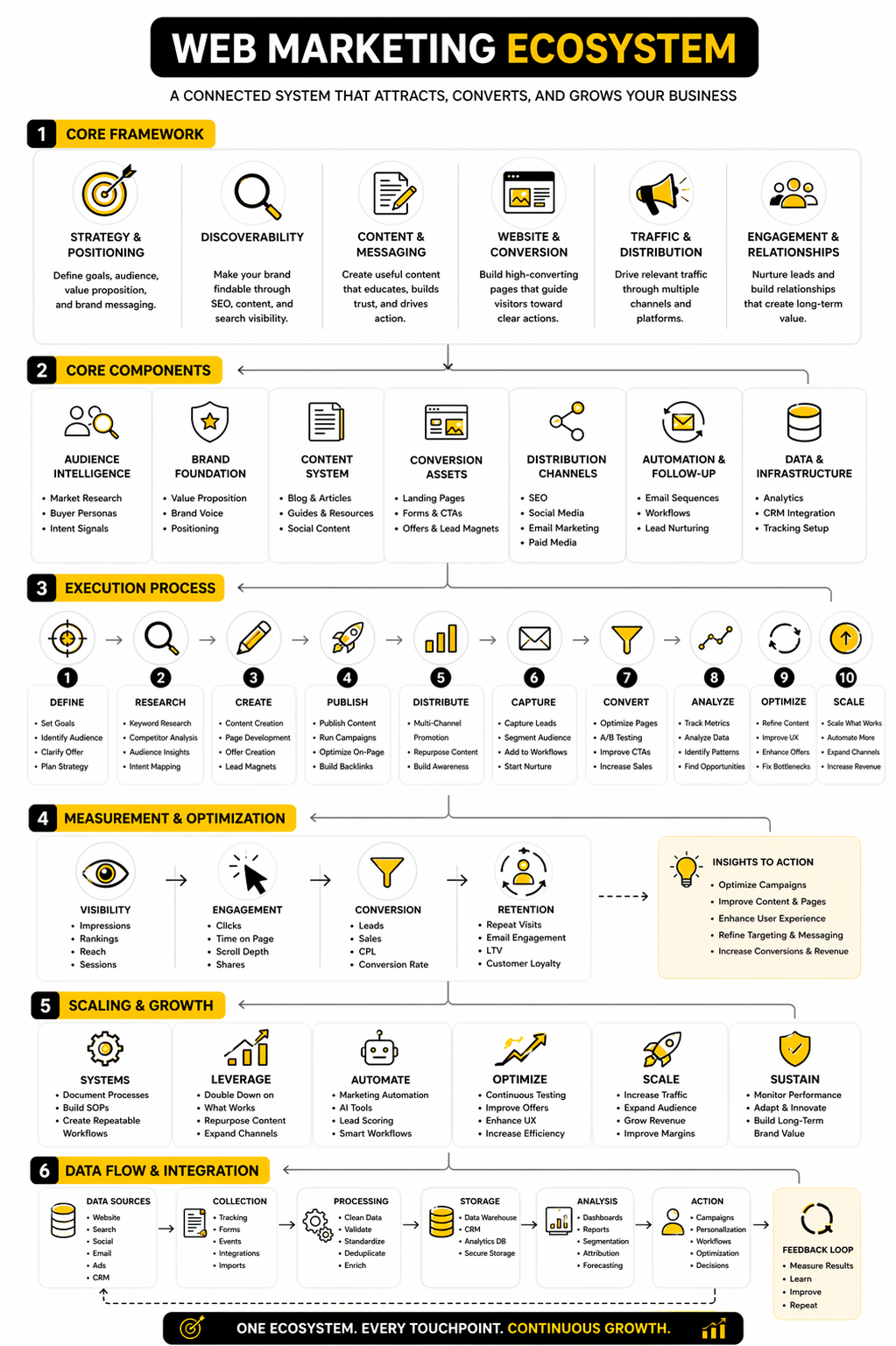
The final shape of web marketing is not a channel list. It is an ecosystem. Your site, content, search visibility, landing pages, email system, CRM, analytics, and follow-up all need to support each other well enough that growth does not depend on one lucky campaign. That is the point where web marketing becomes durable instead of reactive.
When that system works, the benefits stack. Better messaging improves click quality. Better pages improve conversion. Better follow-up improves lead value. Better data improves decisions. The whole machine gets sharper because every part is learning from the same journey instead of operating in isolation.
FAQ - Built for Complete Guide
What is web marketing in simple terms
Web marketing is the process of using your website and connected digital channels to attract attention, turn that attention into action, and build revenue over time. It includes search, content, landing pages, email, social distribution, automation, and measurement, but the website remains the central conversion environment in most cases. The reason it still matters is simple: platforms can create reach, but your web presence is where trust and intent usually turn into an actual decision.
Is web marketing the same as digital marketing
Not exactly. Digital marketing is the bigger category, while web marketing focuses more specifically on the web-based assets and systems that drive discovery, conversion, and retention. In practice the two overlap constantly, but web marketing usually puts more emphasis on websites, landing pages, search visibility, forms, email capture, and the on-site journey itself.
What is the most important part of web marketing
The most important part is alignment. Your audience, offer, message, page experience, and follow-up need to fit together tightly enough that the visitor feels the path is obvious. If one of those breaks, the rest of your web marketing has to work much harder to compensate, which is why professionals focus on system fit before they chase more traffic.
How long does web marketing take to work
Some parts can work quickly, especially paid traffic, sharp landing pages, or email improvements. Other parts, especially search-led content and authority building, usually take longer because they compound rather than spike. The right expectation is not instant scale but steady improvement, where each useful asset makes the next campaign easier to run and easier to optimize.
Should a small business focus on SEO, content, or paid traffic first
Most small businesses should start with the fastest path to qualified feedback, not the most glamorous channel. That often means tightening the offer, improving the core page, adding a strong capture path, and then using a mix of targeted distribution and useful content to test what resonates. Search content becomes much more valuable once you know which problems, objections, and offers actually move people to act.
How much content do you really need
Usually less than you think, but it needs to be much better aligned than most teams expect. A few strong commercial pages, a handful of genuinely useful supporting assets, and a consistent distribution system can outperform a bloated content library full of weak articles. Google’s guidance keeps reinforcing that helpful, reliable, people-first content is the standard that matters, not volume for its own sake.
What metrics should you watch first
Start with the metrics that reflect the customer journey rather than vanity. Source quality, page engagement, conversion actions, lead quality, and return visits tell you far more than raw pageviews on their own. That layered view matters because strong visibility without action usually points to a messaging or conversion problem, while strong action from a small audience often tells you where to scale next.
What role does email still play in web marketing
Email still matters because it lets you keep the relationship after the first visit instead of paying to win the same attention again later. Brevo’s 2025 email benchmark data shows overall engagement is still meaningful, especially when segmentation and relevance are strong. That is why even a simple lead magnet and nurture sequence can make your web marketing dramatically more valuable.
Are chatbots and automation actually useful or mostly hype
They are useful when they remove friction and weak when they replace thinking. If a chatbot helps qualify visitors, answer common objections, or route people faster, it can improve the web marketing system in a very practical way. If you want to test that kind of workflow, tools like Chatbase or ManyChat can fit naturally, but only if the offer and follow-up logic are already clear.
What tools are worth using when you want one cleaner system
The answer depends on where your current process is breaking. If distribution is inconsistent, something like Buffer can help you publish more reliably. If your forms and handoff flow are messy, Fillout can tighten capture, and if your CRM, nurture, and follow-up are fragmented, GoHighLevel is one of the more obvious systems to evaluate.
Does AI make web marketing easier or more dangerous
Both, which is why this needs a mature answer. AI makes ideation, workflow support, outlining, repurposing, and testing faster, but it also makes bland content easier to mass-produce, which raises the value of human judgment and strong brand point of view. HubSpot’s 2026 State of Marketing leans heavily into that tension, and it is a useful reminder that speed without distinctiveness is not much of an advantage anymore.
How do you know when your web marketing is ready to scale
You are ready to scale when performance is repeatable, not just exciting. That means you understand which messages pull qualified traffic, which pages convert, which follow-up steps improve outcomes, and which channels remain healthy beyond one-off wins. If those answers are still fuzzy, scaling usually amplifies waste faster than it creates growth.
What is the biggest mistake businesses make with web marketing
The biggest mistake is fragmentation. Teams publish content that does not match the landing page, run traffic to pages with weak offers, collect leads without a clear nurture path, and then measure everything in separate tools that never tell one coherent story. The fix is not more hustle. The fix is making the system feel connected from first click to final action.
If you were starting from scratch, what would the first 30 days look like
The first month should be focused and practical. Tighten the offer, rewrite the core page, set up one conversion path, connect basic analytics, publish one useful supporting asset, and distribute it consistently across the channels most likely to produce qualified attention. That gives your web marketing a real operating base instead of a pile of disconnected tasks.
Work With Professionals
Explore 10K+ Remote Marketing Contracts on MarkeWork.com
Most marketers spend too much time chasing clients, competing on crowded platforms, and losing a percentage of every project to middlemen. MarkeWork gives you a better way. Browse thousands of remote marketing contracts and connect directly with companies desperate to hire skilled marketers like you, without platform commissions and without unnecessary gatekeepers.
If you're serious about finding better opportunities and keeping 100% of what you earn, explore available contracts and create a profile for free at MarkeWork.com.