

Website marketing used to mean publishing a few pages, adding some keywords, and hoping Google would do the rest. That model is gone. Today, your site has to do several jobs at once: earn attention, load fast, explain value clearly, guide the next step, and support the kind of experience both users and search systems reward, which is why people-first content, mobile usability, and page experience matter so much.
That is also why website marketing is not just a traffic game anymore. It sits at the intersection of messaging, UX, SEO, analytics, conversion design, and lifecycle follow-up. When those pieces work together, the website stops being an online brochure and starts acting like a revenue asset.
What This Article Will Cover
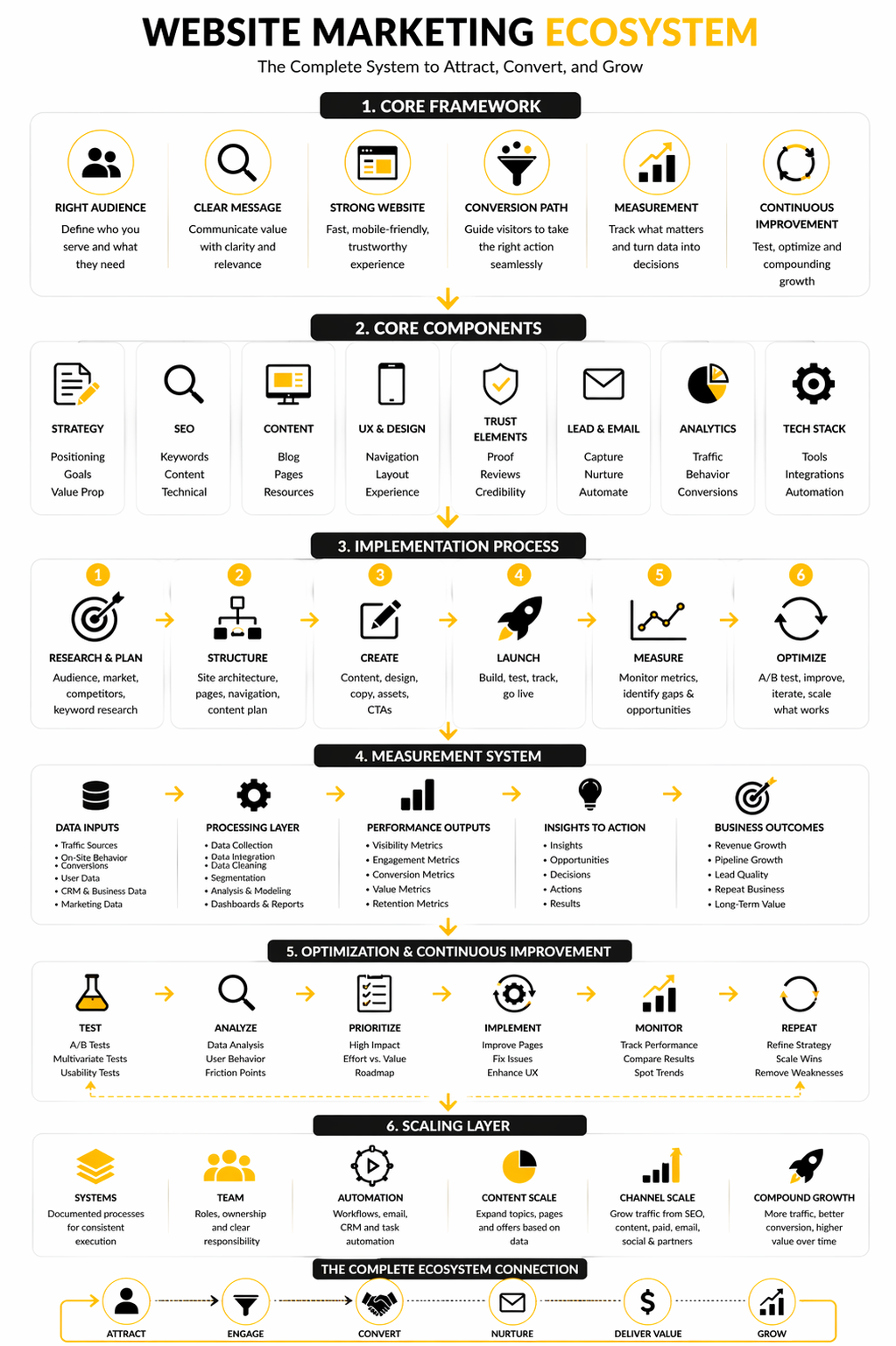
This article is structured in six parts so each layer builds on the one before it. We will use the same section names throughout the full piece.
- What Website Marketing Really Means Today
- Why Website Marketing Matters More Than Ever
- The Website Marketing Framework
- Core Components That Drive Results
- How Professionals Implement Website Marketing
- How to Measure, Improve, and Scale
What Website Marketing Really Means Today
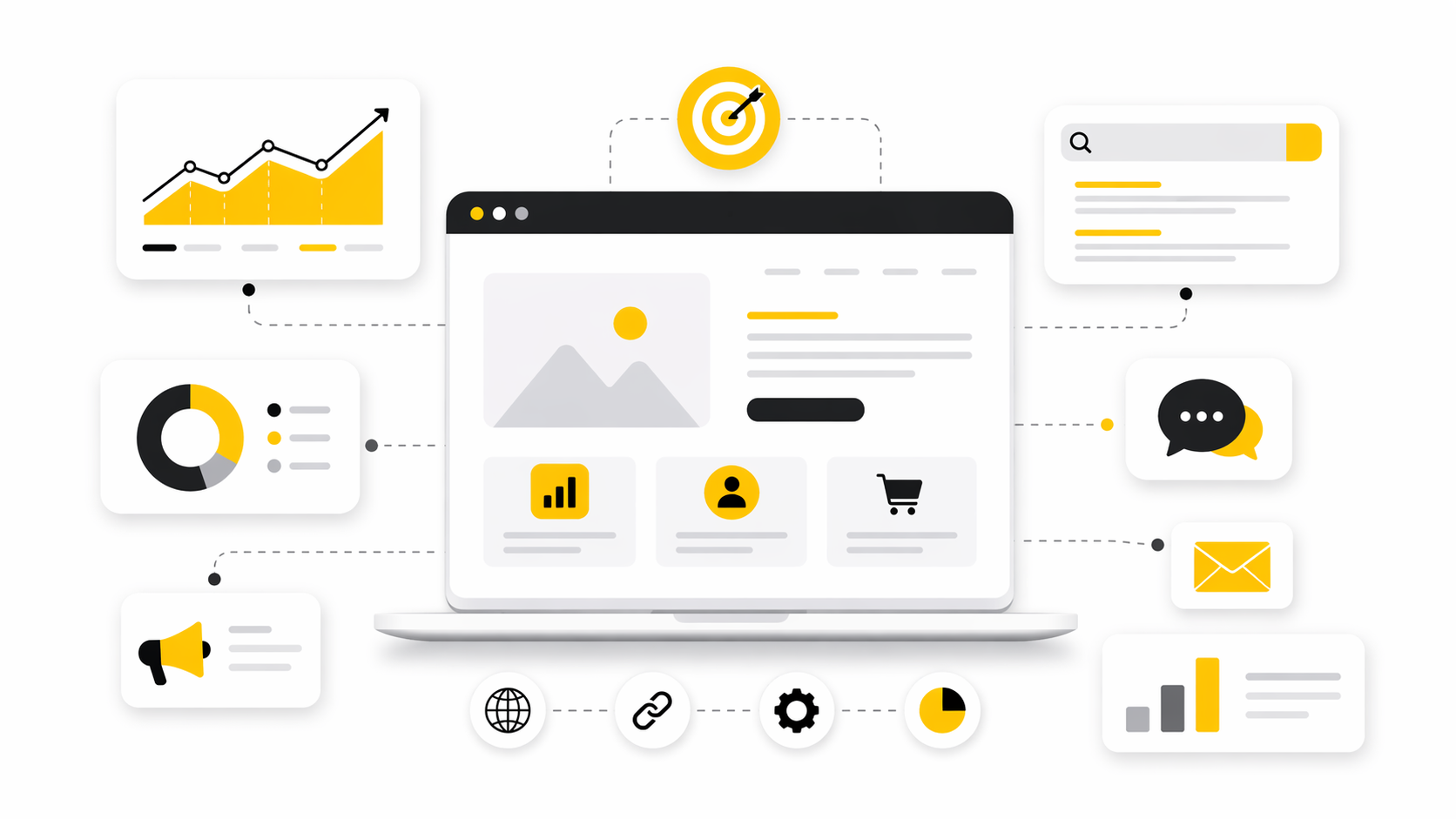
Website marketing is the system of attracting the right visitors, helping them understand your offer, and moving them toward a business goal on your site. That goal could be a purchase, a demo request, an email signup, a booked call, or even a deeper product education path. The point is not traffic alone. The point is qualified attention that turns into measurable action.
A useful way to think about website marketing is that every page is either earning trust, creating confusion, or pushing people away. Google’s own guidance keeps coming back to that same idea through helpful content principles, Search Essentials, and how ranking systems evaluate relevance and quality. If your site is slow, vague, hard to navigate, or written for algorithms instead of humans, your marketing problem is not isolated to SEO or design. It is systemic.
That shift matters because user expectations are much higher than most brands think. Research from Nielsen Norman Group on homepage design shows just how much pressure sits on the first page view, while Stanford’s web credibility work makes the business risk even clearer: design, clarity, and trust signals shape whether people believe what they are seeing. In practice, website marketing succeeds when the site feels credible fast, communicates value fast, and makes the next step obvious.
Why Website Marketing Matters More Than Ever
The channel mix has become more expensive, more fragmented, and less forgiving. Paid traffic is never enough on its own, social reach is unstable, and AI-generated noise is making bland content easier to ignore. In that environment, the website is one of the few assets a company actually controls, which is why strong website marketing now matters across acquisition, conversion, retention, and brand trust.
Mobile behavior alone makes the case. Google states that mobile-first indexing is how it primarily evaluates pages for indexing and ranking, and its own guidance on mobile sites notes that mobile searches make up more than half of searches on Google.com and visitors are far more likely to leave when a site is not mobile-friendly. If your website marketing strategy still treats mobile UX as a secondary clean-up task, you are building friction directly into the main path users take.
Performance is just as commercial as visibility. Google’s documentation explains that Core Web Vitals measure real-world loading, interactivity, and visual stability, while Adobe has reported that more than half of shoppers will abandon a site after a single poor experience. For commerce brands, Baymard’s latest benchmark adds more urgency, with average cart abandonment still hovering around 70%. Not every abandoned visit is recoverable, obviously, but a weak website compounds waste across every other marketing channel.
Clarity matters too, and this is where many teams quietly lose. Google recommends using words people actually use to search for your content, and long-standing plain-language guidance from GOV.UK and Content Design London shows that clearer writing improves comprehension for broad audiences, not just beginners. Good website marketing is not about sounding impressive. It is about reducing hesitation.
The Website Marketing Framework
The cleanest framework is simple: attract, orient, persuade, convert, and continue the relationship. Those five moves cover most of what separates a site that “gets traffic” from one that actually helps the business grow. They also make it easier to diagnose where performance is breaking down.
Attract means earning visits through search, referrals, social, email, partnerships, and paid campaigns. Orient means helping the visitor understand where they are, what you do, who it is for, and what to do next. Persuade covers proof, differentiation, structure, and trust. Convert is the action itself, whether that is a sale, form fill, trial, or booking. Continue the relationship means the site is connected to follow-up systems instead of dropping leads into a black hole.
This matters because most underperforming sites are not failing everywhere. They are failing in one or two stages while the company keeps trying to solve the problem with more traffic. A stronger website marketing approach starts by treating the website as a journey with distinct handoffs, not a pile of pages.
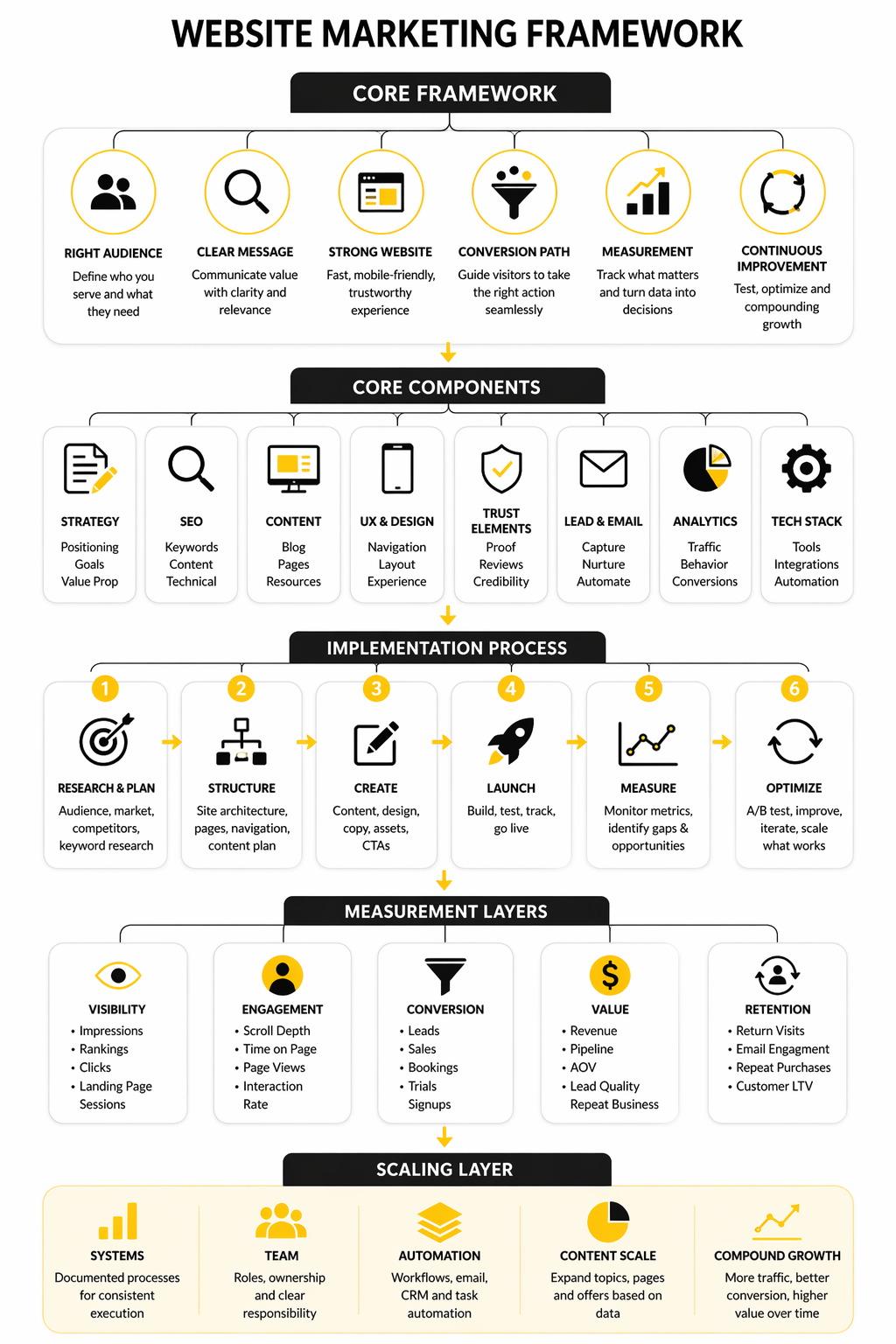
In the next parts of the article, we will break that framework into the components that matter most in practice: traffic quality, messaging, UX, content structure, conversion paths, trust signals, measurement, and professional implementation. That is where website marketing stops being a vague phrase and becomes an operating system you can actually improve.
Core Components That Drive Results
The fastest way to improve website marketing is to stop treating the website as one giant problem. High-performing sites usually win because a few core components work together at the same time: the right traffic arrives, the page makes sense immediately, trust builds fast, and the next step feels easy. When even one of those breaks, the whole system gets weaker, no matter how much effort you put into SEO, ads, or content.
That is why strong website marketing is less about clever hacks and more about reducing friction across the full path. Google keeps reinforcing people-first content and strong page experience, while UX research continues to show that clarity, usefulness, and credibility shape whether visitors stay, engage, or leave. The practical takeaway is simple: if the page is hard to trust or hard to use, marketing performance drops before the visitor ever reaches your form or checkout.
Traffic Quality Comes Before Conversion Rate
A lot of teams judge website marketing by asking whether a page converts, but that skips the more important question: who actually landed there, and why. A page built for high-intent visitors will behave very differently from a page fed by broad social traffic, generic display ads, or loosely targeted search queries. If intent is mismatched, even a good page can look broken in the data.
This is one reason search remains so valuable in website marketing. Search traffic often carries clearer intent because the visitor is already trying to solve something, compare options, or make a decision. But that advantage only shows up when the page matches the job the visitor is trying to get done, which is exactly why Google’s guidance keeps pushing creators to build content around real needs rather than filler built to rank.
In practice, traffic quality should shape page design, message hierarchy, and calls to action. Someone landing on a category page from a branded query can handle a very different page experience from someone arriving cold on a blog article. Good website marketing respects that difference instead of sending every visitor through the same generic path.
Messaging Has to Be Clear Fast
Visitors do not arrive in a patient, analytical state. They scan, judge, and decide whether a page seems useful almost immediately, which is why the first screen matters so much in website marketing. If your headline is vague, the structure is cluttered, or the offer takes too long to understand, you create hesitation before persuasion even begins.
Clear messaging does not mean oversimplifying the business. It means making the core value obvious, showing who the offer is for, and explaining the next step in plain language. That approach lines up with both user-centered writing standards and search guidance, because pages that answer real questions clearly are easier for people to understand and easier for search systems to classify.
This is also where a lot of website marketing underperforms quietly. Brands often know their product too well, so they write from the inside out instead of from the reader’s point of view. When that happens, pages sound polished but not persuasive, and traffic that should have converted slips away because the visitor never got a clean answer to a simple question: why should I care?
UX and Information Architecture Do More Than Make a Site Look Better
Design is not just aesthetic packaging around the “real” marketing. In website marketing, UX decides whether people can find what they need, compare options without stress, and complete an action without unnecessary resistance. That is why Google highlights page experience and Core Web Vitals, and why usability research keeps finding that confusion and frustration destroy business value long before a brand notices the revenue leak.
The structure of the site matters as much as the visual design. Navigation labels, page grouping, internal linking, and content hierarchy all influence whether a visitor feels oriented or lost. Website marketing works better when the site behaves like a guided path instead of a maze, especially for visitors who are still learning what you sell and whether you are credible enough to trust.
Mobile experience raises the stakes even more. Google evaluates pages primarily through mobile-first indexing, and mobile visitors are much less forgiving when a site feels slow, unstable, or awkward to use. If a page looks fine on desktop but creates friction on a phone, the site is not “mostly working.” It is underperforming where a huge share of demand actually lives.
Trust Signals Are Not Decorative
Trust is one of the most underestimated parts of website marketing because teams often treat it like a branding detail instead of a conversion variable. In reality, people look for signals that a site is legitimate, current, and accountable: clear contact details, transparent claims, visible proof, expert signals, and a professional presentation. Stanford’s long-running credibility research remains useful here because the core pattern has not changed: users make fast trust judgments based on design, transparency, and the sense that real people stand behind the site.
That idea becomes even more important when the page asks for money, personal data, or a time commitment. Testimonials, client logos, product detail, pricing clarity, return information, author expertise, and recent updates all reduce perceived risk. None of these elements work well when pasted in as decoration, but together they make the site feel safer to act on.
Accessibility belongs in this trust layer too, not as a side compliance project but as part of professional website marketing. The 2026 WebAIM Million report found an average of 56.1 detected accessibility errors per home page across one million home pages, which tells you how common avoidable friction still is. If your site excludes users, hides key information behind weak contrast, or breaks basic interaction patterns, that is not just an accessibility problem. It is a trust and performance problem.
Conversion Paths Need Less Friction and Better Follow-Through
A website does not convert because a button is orange or because the CTA says the right verb. It converts when the path feels proportionate to the value being offered. If the ask is too aggressive, the form is too long, or the checkout adds unnecessary effort, website marketing loses momentum right at the point where it should be turning attention into action.
This is one reason focused pages still outperform crowded ones. Baymard’s current checkout research shows how often extra form complexity and weak checkout UX create abandonment, while broader landing page guidance keeps coming back to the same principle: one page should support one primary goal. The more competing actions you introduce, the more likely visitors are to hesitate instead of move.
Follow-through matters just as much as the conversion event itself. If a lead submits a form and hears nothing, or a buyer has a messy first post-purchase experience, your website marketing did not really finish the job. This is where systems matter, and why businesses often connect their site to tools that handle CRM, automation, pipelines, and follow-up more cleanly, such as GoHighLevel for lead routing and nurture workflows or Replo when the bottleneck is landing page execution for ecommerce teams.
What Separates Average Sites From Professional Website Marketing
Average sites usually have pieces of the puzzle. They may have decent branding, some search traffic, a few good pages, and a working form. But website marketing becomes professional when those elements are managed as one connected system, with shared goals, clear measurement, and a deliberate user journey from first visit to next step.
That professional layer is what we will get into next. It is the difference between publishing pages and running a real operating model for growth. Once the core components are in place, the next challenge is implementation: how teams actually build, maintain, and improve website marketing without creating chaos across content, design, SEO, analytics, and conversion work.
How Professionals Implement Website Marketing
Understanding the components is one thing. Getting them to work together in the real world is where most teams struggle. Website marketing breaks down not because people lack ideas, but because execution becomes fragmented across tools, teams, and priorities.
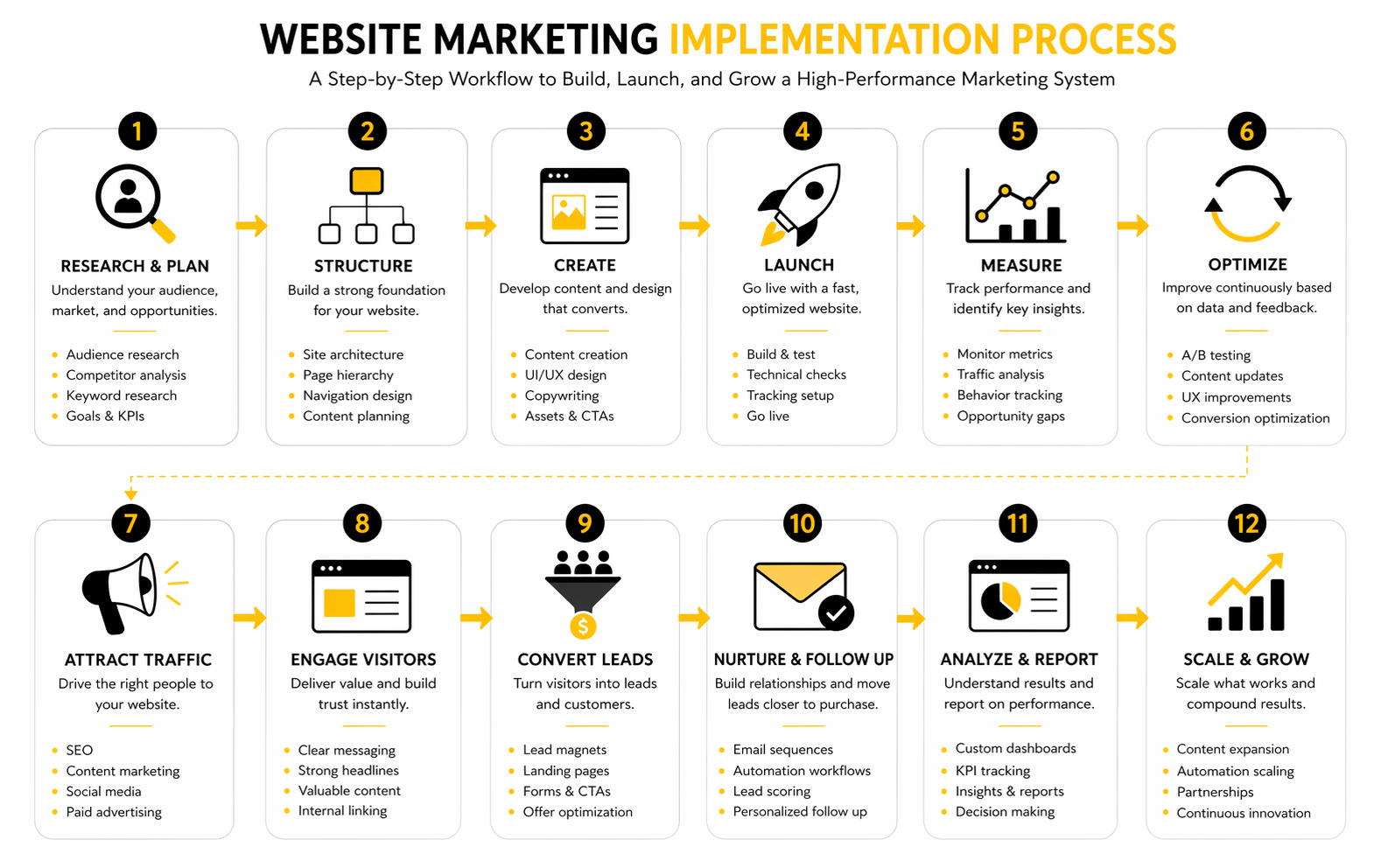
Professionals solve this by treating the website like a system with clear inputs, processes, and outputs. That means defining who the site is for, aligning content and pages with real user intent, and building a repeatable workflow for improving performance over time. It is less about launching a “perfect site” and more about continuously refining a working one.
Step 1: Start With Intent Mapping, Not Design
Most website projects still begin with design discussions, but that is backward. The first step in effective website marketing is understanding what different visitors actually want when they arrive. Search intent, referral context, and campaign targeting all shape what someone expects to see.
A practical approach is to map your traffic into a few intent categories:
- Exploring: learning what the product or category is
- Comparing: evaluating options, features, or pricing
- Deciding: ready to take action or convert
Once that is clear, pages become easier to structure. An educational blog post should not push aggressively for a sale, and a high-intent landing page should not bury the call to action under long explanations. This alignment between intent and page purpose is where website marketing starts to feel coherent instead of scattered.
Step 2: Build Pages Around a Single Primary Goal
One of the biggest execution mistakes is trying to make every page do everything. When a page has multiple competing goals, users hesitate, and performance drops. Strong website marketing simplifies the decision.
Each key page should answer three questions clearly:
- What is this page about?
- Who is it for?
- What should I do next?
This is where focused landing pages become powerful. Tools like ClickFunnels or Systeme.io are built around that idea, helping teams create conversion paths without unnecessary complexity. The goal is not to replace your entire site, but to ensure your highest-value actions have clean, dedicated paths.
Step 3: Connect Content, Pages, and Conversion Paths
Website marketing fails quietly when content lives in isolation. A blog post that attracts traffic but does not lead anywhere useful is wasted potential. A product page that lacks supporting content struggles to build trust.
Professionals connect these layers intentionally:
- Informational content links to relevant offers
- Product pages link to supporting proof and education
- Landing pages remove distractions and guide action
This creates a flow instead of dead ends. It also aligns with how search systems evaluate internal linking and topical structure, reinforcing relevance across the site. When done well, every page contributes to the larger journey instead of acting as a standalone asset.
Step 4: Implement Tracking That Reflects Reality
You cannot improve what you cannot see, but most analytics setups only scratch the surface. Page views and bounce rates rarely explain why something is underperforming. Website marketing needs deeper visibility into user behavior and outcomes.
At minimum, tracking should include:
- Key conversion events (forms, purchases, bookings)
- Drop-off points in funnels
- Traffic source quality
- Page-level engagement signals
From there, the system can expand into CRM tracking, attribution, and lifecycle analysis. Platforms like GoHighLevel make this easier by combining funnels, pipelines, and follow-up automation into one place, which reduces the disconnect between marketing and sales data.
Step 5: Automate Follow-Up and Lead Handling
A surprising amount of website marketing effort is wasted after the conversion happens. Leads sit in inboxes, follow-ups are delayed, and potential customers lose momentum. This is not a traffic or conversion problem. It is an execution problem.
Automation closes that gap. When someone takes action, the system should respond immediately with confirmation, next steps, and continued engagement. This can include:
- Email sequences
- SMS follow-ups
- CRM pipeline updates
- Appointment scheduling
Tools like ManyChat for conversational automation or Brevo for email workflows help maintain that momentum without adding manual workload. The key is not the tool itself, but the principle: the website is the start of the relationship, not the end.
Step 6: Iterate Based on Real Behavior, Not Opinions
This is where professional website marketing separates itself from guesswork. Instead of redesigning based on internal preferences, teams look at what users actually do and adjust accordingly.
That process usually includes:
- Identifying a bottleneck (low conversion, high drop-off)
- Forming a hypothesis (unclear messaging, weak CTA, UX friction)
- Testing a focused change
- Measuring the impact
Even small improvements compound over time. A clearer headline, a shorter form, or a better-placed call to action can shift performance significantly when applied consistently across key pages.
The important part is discipline. Without a structured iteration process, website marketing becomes reactive and inconsistent. With it, the site evolves based on evidence, not assumptions.
Why Execution Breaks Down Without a System
At this point, the pattern should be clear. Website marketing is not failing because the tactics are unknown. It fails because the execution is disconnected. Content teams publish without conversion paths, designers optimize visuals without considering intent, and marketers drive traffic without fixing the experience users land on.
Professional implementation solves that by creating alignment. Every page has a purpose, every visit has a path, and every action connects to a follow-up system. That is what turns a website from a static asset into a growth engine.
In the next part, we will go deeper into measurement, optimization, and scaling. This is where website marketing becomes predictable, where you can identify what is working, fix what is not, and expand what drives real business results.
What the Numbers Are Really Telling You
This is the point where website marketing either becomes a real growth system or stays a collection of opinions. Data matters, but only when you know what a metric is actually measuring, what it is hiding, and what action it should trigger next. A dashboard full of numbers does not help if the team still cannot answer a basic question: where exactly is performance breaking down?
That is why smart measurement starts with business intent, not with the analytics tool. You need to know which numbers indicate discovery, which ones indicate engagement, which ones indicate friction, and which ones prove revenue impact. Once that structure is in place, website marketing becomes much easier to diagnose because you stop reacting to noise and start spotting patterns.
The Metrics That Matter Most
The most useful website marketing metrics usually sit in four groups: acquisition, behavior, conversion, and retention. Acquisition metrics tell you whether the right people are arriving. Behavior metrics show whether the experience makes sense once they land. Conversion metrics reveal whether the path to action is working, and retention metrics tell you whether the site is helping create lasting value beyond the first visit.
That sounds obvious, but teams often blur these categories and end up misreading the data. A page with high traffic and poor conversion is not automatically a bad page. It may be attracting early-stage visitors who are still researching, which means the real issue is not the page itself but the mismatch between traffic source, user intent, and expected next step.
This is why benchmarks should be treated as directional, not absolute. A benchmark can tell you whether a number is unusually weak or unusually strong, but it cannot replace context. In website marketing, the right question is rarely “is this metric good?” and much more often “is this metric good for this page, this audience, and this stage of the journey?”
Traffic Metrics Need Context or They Mislead You
Traffic is the easiest number to obsess over and one of the easiest to misunderstand. More visits can mean stronger visibility, better campaigns, or broader awareness, but they can also mean lower intent and more wasted spend. That distinction matters because a traffic increase that does not improve qualified actions is not real progress in website marketing.
This is also where channel-level measurement matters. Organic search, branded search, paid social, direct, referral, email, and partner traffic all behave differently, so lumping them together hides useful signals. If one source brings fewer visits but generates better conversion rates, longer engagement, and stronger downstream revenue, that source is doing more real work than a channel that simply inflates sessions.
A useful habit is to compare traffic quality before traffic volume. Look at landing pages, assisted conversions, lead quality, return visits, and downstream pipeline where possible. That gives website marketing a commercial lens instead of a vanity lens.
Engagement Data Should Expose Friction, Not Just Activity
A lot of marketing teams still treat engagement like a feel-good layer in reporting. But behavior signals are where the site tells you whether users are oriented, confused, interested, or stuck. That makes engagement metrics some of the most practical inputs you have.
Contentsquare’s 2025 Digital Experience Benchmarks found that the cost of an online visit rose 9% year over year while conversion rates fell 6.1%, based on more than 90 billion sessions across 6,000 websites. That matters because it shows the real cost of weak website marketing: teams are paying more to get attention while converting less of it. The action this should drive is not “buy more traffic.” It is “find the friction points that are wasting the traffic you already paid for.”
Good engagement analysis usually answers questions like these:
- Are visitors scrolling because they are interested or because the page is unclear?
- Are they viewing multiple pages because the journey is working or because they cannot find what they need?
- Are they exiting because the page solved their problem quickly or because trust broke down?
Those are not academic distinctions. They shape whether you rewrite the page, simplify navigation, improve the CTA, add proof, or change the traffic source entirely.
Performance Signals Are Business Signals
Site speed and stability are often treated like technical housekeeping, but they are part of website marketing because they shape how the experience feels before the visitor even evaluates the offer. Google’s documentation defines strong Core Web Vitals performance as Largest Contentful Paint under 2.5 seconds, Interaction to Next Paint under 200 milliseconds, and Cumulative Layout Shift under 0.1. Those thresholds matter because they are tied to real user experience, not just developer preferences.
Search Console makes this even more practical by grouping URLs as Poor, Need improvement, or Good using field data from actual users. That means a page can look fine in a lab test and still underperform in the real world if your audience has slower devices, weaker connections, or heavier page templates. In other words, website marketing needs field data, not just design approval.
The action here is straightforward. If key landing pages fall into poor or needs-improvement groups, fix those page types first. Do not spread effort evenly across the site when a few high-intent templates are responsible for most of the commercial impact.
Conversion Benchmarks Matter Only When You Tie Them to the Journey
Conversion rate is one of the most abused numbers in website marketing because it compresses too many variables into a single outcome. A low rate can point to poor traffic, weak messaging, lack of trust, pricing friction, or a broken form. A high rate can look impressive while hiding that the traffic volume is tiny or the offer is too narrow to scale.
This is where benchmark data becomes useful when handled carefully. Baymard currently places average documented ecommerce cart abandonment at 70.22% across 50 studies, and its checkout research says the average large ecommerce site can see as much as a 35% conversion increase from design improvements alone. Shopify echoes the commercial implication, noting that more than 70% of carts are abandoned and roughly $260 billion in lost orders is recoverable in the US and EU through better checkout flow and design.
What should that drive in practice? Not panic. Not random redesigns. It should push you to inspect the exact step where intent is highest and friction is strongest. For ecommerce, that usually means cart and checkout. For lead generation, it often means form length, scheduling flow, mobile usability, and the clarity of the offer immediately before submission.
Accessibility Data Is Not Separate From Performance Data
Accessibility is often reported in a different lane from analytics, but that separation creates blind spots. If people cannot navigate, read, understand, or operate the site comfortably, the marketing system is weaker, even if the team never labels the issue as “accessibility.” Website marketing works best when accessibility is treated as part of usability, trust, and conversion quality.
The latest WebAIM Million report found an average of 56.1 detectable accessibility errors per homepage across one million home pages, up 10.1% from the prior year. The same report found homepage complexity rose to 1,437 elements on average, a 22.5% increase in a single year. Those numbers matter because they show a pattern: as sites become more complex, they often become harder to use well.
The action here is not to chase a vanity accessibility score. It is to reduce unnecessary complexity, fix repeated template-level issues, and treat accessibility defects as conversion defects. When website marketing gets cleaner, more readable, and easier to navigate, accessibility usually improves with it.
Build a Measurement System That Mirrors the Funnel
A useful analytics setup should let you trace what happens from first visit to meaningful outcome. That means you need more than traffic charts and total conversions. You need a measurement system that mirrors the actual customer journey.
A practical structure looks like this:
- Visibility metrics: impressions, clicks, rankings, landing-page sessions
- Engagement metrics: scroll behavior, engaged sessions, page depth, interaction patterns
- Friction metrics: slow templates, form abandonment, checkout exits, rage clicks, dead clicks
- Conversion metrics: purchases, leads, bookings, trials, qualified actions
- Downstream value metrics: revenue, pipeline, retention, repeat purchase, lead quality
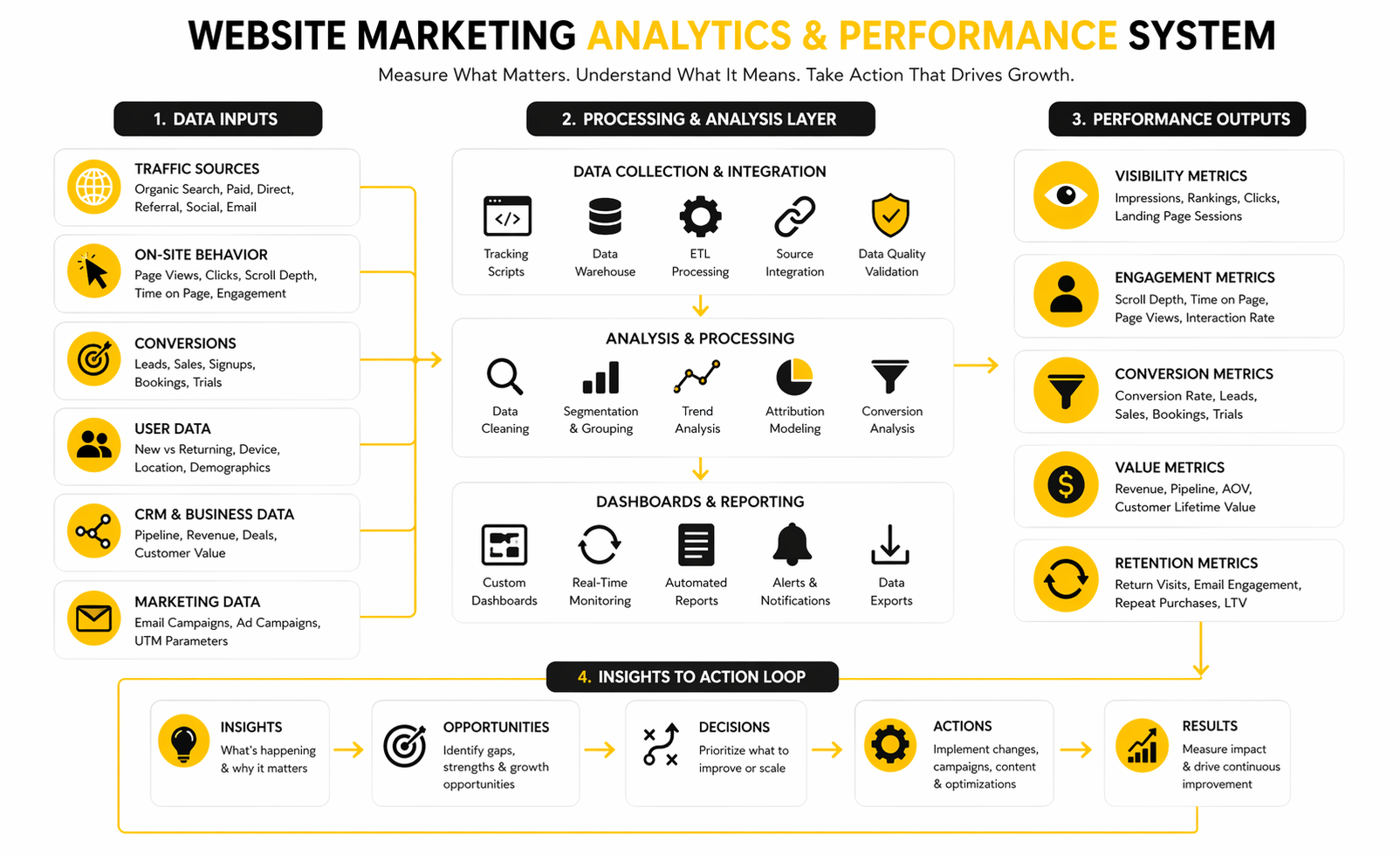
This is where website marketing becomes measurable in a way that supports decision-making. If visibility is rising but engagement is flat, you likely have an intent or content problem. If engagement is strong but conversion is weak, the friction is probably closer to the CTA, form, checkout, or trust layer. If conversion is healthy but downstream value is poor, the site may be attracting the wrong audience or overpromising before the handoff.
How to Interpret the Numbers Without Overreacting
One bad week does not mean the site is broken. One good month does not mean the strategy is solved. Website marketing needs pattern recognition, which means looking at trends, segments, and page types rather than reacting to isolated spikes.
That is especially important when external conditions shift. Seasonality, campaign changes, product launches, PR moments, ranking volatility, and even tracking errors can distort the picture. The right move is usually to validate the signal before changing the page.
A simple interpretation framework helps:
- If traffic drops, check source mix, rankings, campaign changes, and landing-page coverage.
- If engagement drops, inspect page clarity, performance, UX changes, and device differences.
- If conversion drops, look at trust signals, form friction, checkout issues, pricing presentation, and intent mismatch.
- If revenue drops but conversion holds, review average order value, lead quality, and post-click follow-through.
This is the difference between analytics as reporting and analytics as operational guidance. Website marketing improves faster when data tells the team what to inspect next instead of just documenting the damage after the fact.
Benchmarks Are Useful, but Your Baseline Matters More
Benchmarks can wake a team up, especially when they show that acquisition costs are rising, checkout friction is common, and poor accessibility is still widespread. But the real comparison that matters is not only against the market. It is against your own site last quarter, last month, and before the last round of changes.
That is where the real compounding happens. When website marketing is measured properly, even small gains become visible and repeatable. A faster landing page, a cleaner form, a stronger message hierarchy, or a better internal path can look modest in isolation and still create a meaningful business lift over time.
The next part will build on this by showing how to turn these signals into a practical optimization rhythm. That is where measurement stops being a reporting exercise and becomes a repeatable improvement engine.
Scaling Website Marketing Without Breaking It
Once the basics are working, the game changes. Early website marketing improvements usually come from obvious fixes like better messaging, faster pages, cleaner calls to action, and tighter tracking. But after that, growth gets harder because the risks shift from obvious weakness to hidden complexity.
This is where a lot of companies stall. They add more pages, more tools, more campaigns, and more content, but the system gets less coherent instead of more effective. The website may look bigger and busier, yet performance becomes harder to predict because the underlying strategy is no longer tightly managed.
The Real Tradeoff: Scale Versus Clarity
Scaling website marketing almost always introduces a tension between coverage and clarity. More pages can help capture more search demand, support more audience segments, and create more entry points into the funnel. At the same time, every new page creates more maintenance work, more opportunities for overlap, and more chances to confuse both users and search engines.
This matters because scale is not automatically an advantage. If a site grows without a strong content model, pages start competing with each other, internal linking gets messy, and core offers become harder to understand. At that point, the site is no longer becoming more useful. It is becoming noisier.
The smart move is to scale only where there is a clear strategic reason. That usually means expanding around buyer intent, product depth, comparison needs, category education, or high-value use cases. It does not mean publishing ten weak variations of the same page and hoping volume creates authority.
AI Makes Website Marketing Faster, but It Also Raises the Quality Bar
AI tools can speed up research, outlines, production workflows, and testing. That is useful. But in website marketing, speed without originality creates a bigger long-term problem than slow production ever did.
The issue is not that AI exists. The issue is that too many teams use it to generate interchangeable pages with no real point of view, no first-hand insight, and no meaningful differentiation. That kind of output may fill a content calendar, but it usually weakens the site because it adds bulk without increasing usefulness.
At a strategic level, AI should make your team sharper, not lazier. Use it to structure ideas, speed up drafts, summarize data, or support optimization work. But the published result still needs human judgment, commercial intent, editorial control, and enough specificity to be worth reading in the first place.
Strong Website Marketing Needs Governance, Not Just Creativity
This is the unglamorous part, but it matters a lot. As website marketing grows, the biggest performance gains often come from governance rather than from new ideas. That means clear page ownership, publishing standards, content review rules, measurement definitions, and decision rights across teams.
Without governance, the same patterns show up again and again. One team publishes pages that do not fit the conversion model. Another changes navigation without considering search impact. Someone launches a landing page that conflicts with a core product page, and analytics become impossible to interpret because naming conventions are inconsistent. None of that feels dramatic in the moment, but it quietly erodes performance.
A mature website marketing operation solves this with systems. It defines what each page type is for, what counts as success, who approves what, and how updates are tracked. That structure may sound restrictive, but it is usually what allows a site to grow without turning into chaos.
The Best Teams Build for Reuse, Not Reinvention
One of the clearest signs of maturity is when a company stops reinventing the same assets over and over. Strong website marketing creates repeatable templates for pages, proof blocks, messaging sections, offers, and follow-up sequences. That does not make the site generic. It makes execution faster and more consistent.
This is especially useful when multiple campaigns or audience segments are involved. Instead of building every landing page from scratch, teams create modular systems they can adapt with confidence. That is one reason some ecommerce and growth teams lean on tools like Replo, where speed and design flexibility matter, while other businesses prefer all-in-one operational setups like GoHighLevel when the real bottleneck is lead flow, automation, and CRM coordination.
The strategic point is bigger than the tool choice. Website marketing scales better when the team has a reusable operating model. Otherwise, every new initiative becomes a custom project, and custom projects do not scale cleanly.
Attribution Gets Messier as the System Improves
There is an awkward truth here that experienced marketers learn the hard way: better website marketing often makes attribution less clean, not more clean. As the site improves, more visitors return directly, convert after multiple visits, engage across multiple channels, and take actions that are influenced by pages they did not convert on immediately.
That can frustrate teams that want a simple last-click explanation for everything. But website marketing usually works as an assist system, not just a closer. A comparison page may influence a sale that gets credited to branded search. A resource center may build trust that later lifts demo conversions. A stronger homepage may improve paid campaign performance without getting direct credit for it.
This is why expert teams look beyond last-click reporting. They care about assisted impact, recurring landing paths, branded demand growth, pipeline quality, and repeat engagement. The website is rarely just a point of conversion. It is often the environment where the buying decision matures.
Personalization Has Limits, and Overuse Can Hurt
Personalization sounds sophisticated, and sometimes it is. But in website marketing, personalization is only useful when it improves relevance without increasing confusion, maintenance burden, or technical fragility. Too many teams personalize too early and end up making the site harder to manage and harder to measure.
A better sequence is simpler. First make the core experience strong for the majority of visitors. Then personalize selectively where intent differences are clear and commercially meaningful. That might mean tailoring pages by industry, returning visitor status, offer stage, or traffic source, but only when the team can support the added complexity.
This matters because every layer of personalization increases operational overhead. More variants mean more QA, more reporting complexity, more content maintenance, and more opportunities for mixed messaging. Website marketing should become more relevant as it scales, but it should not become so fragmented that nobody can manage it confidently.
Risk Usually Shows Up in the Middle, Not at the Edges
Most teams know how to notice obvious failure. They can see when traffic collapses or when a landing page clearly does not convert. The harder risk is the middle layer, where the site is doing just well enough to avoid alarms while still underperforming in expensive ways.
This is where slow decay happens. Page templates become heavier over time. Messaging gets diluted by committee edits. Internal links drift. Old offers stay live. Forms grow longer. Campaign traffic gets sent to pages that made sense six months ago but no longer reflect the sales process. Nothing looks broken in isolation, but the compounding drag becomes real.
That is why periodic pruning matters. Mature website marketing is not only about adding assets. It is also about removing redundancy, tightening structure, retiring weak pages, and keeping the system clean enough to trust.
Brand Strength Changes How Website Marketing Works
At a more advanced level, brand changes the economics of the whole system. A weak brand forces the website to do more explaining, more persuading, and more trust-building on every visit. A strong brand lowers friction because people arrive with more awareness, more confidence, and more willingness to keep exploring.
This does not mean brand replaces execution. It means brand changes how hard the site has to work. Strong website marketing therefore cannot be reduced to technical SEO, CRO, or content output alone. It also depends on whether the market already associates your name with a category, a promise, or a point of view worth remembering.
That is why content distribution and audience building still matter alongside on-site work. Tools such as Buffer for steady distribution or Dub for cleaner campaign tracking can support the broader ecosystem around the site. The website may be the core asset, but it gets stronger when the brand around it gets stronger too.
Expert-Level Website Marketing Is About Compounding, Not Constant Reinvention
This is the part many people miss. Great website marketing is usually not the result of one giant redesign or one lucky campaign. It comes from a disciplined series of improvements that make the site clearer, faster, more trusted, easier to navigate, and better connected to the rest of the business.
That also means the smartest strategic choice is often restraint. Do not add complexity unless it creates measurable value. Do not scale content unless it deepens usefulness. Do not chase every new tactic if the existing journey still has obvious leaks.
The final part will bring everything together with practical closing guidance and the FAQ. That is where we can simplify the big picture again and turn the full website marketing framework into something a business can actually act on.
Bringing the Whole Website Marketing System Together
At this stage, the big picture should be clear. Website marketing is not one tactic, one channel, or one redesign project. It is the coordinated system that turns attention into trust, trust into action, and action into measurable business value.
That is why the strongest websites rarely feel accidental. Their content supports search intent, their structure supports decision-making, their pages support conversion, and their follow-up supports revenue. When those parts are aligned, website marketing becomes easier to improve because every metric, page, and campaign has a clear role inside the broader system.
The final step is to think in ecosystems instead of isolated assets. Your website connects to analytics, CRM, automation, content production, distribution, scheduling, attribution, and customer communication. If those handoffs are weak, the site underperforms no matter how good the design looks on launch day.
FAQ
What is website marketing in simple terms?
Website marketing is the process of using your site to attract the right visitors, build trust, and move people toward a specific action. That action could be a sale, lead, booking, email signup, or another meaningful business outcome. The important part is that the website is not just sitting there online. It is actively doing marketing work.
Why is website marketing different from just having a website?
A website by itself is only infrastructure. Website marketing is what happens when that infrastructure is built and managed to create traffic, engagement, and conversion. Plenty of businesses have websites, but far fewer have sites that actually support growth in a deliberate, measurable way.
How long does website marketing take to show results?
That depends on the channel mix, the state of the site, and how strong the offer already is. Paid traffic and landing-page changes can show movement quickly, while SEO and authority-building usually take longer. The key is to separate short-term performance improvements from long-term compounding so you do not judge the whole strategy too early.
What matters more: SEO, design, or conversion optimization?
In practice, they matter together. SEO brings qualified visibility, design shapes trust and usability, and conversion optimization turns interest into action. If one of those is weak, website marketing loses force because the system becomes unbalanced.
How do I know if my website marketing is actually working?
You know it is working when the site is improving the business, not just producing prettier dashboards. That means better-quality traffic, clearer engagement patterns, stronger conversion paths, and better downstream outcomes like revenue, pipeline, or qualified leads. If you only track visits and impressions, you are seeing activity, not proof.
What are the biggest website marketing mistakes companies make?
The most common mistake is treating the website like a one-time project instead of an operating system. Other major mistakes include unclear messaging, weak page structure, poor mobile experience, bad follow-up after conversion, and chasing traffic before fixing obvious friction. None of those problems are glamorous, but they quietly kill performance.
Should every business invest in content for website marketing?
Most businesses should, but not in the same way. Content works best when it supports a clear commercial purpose, such as educating buyers, answering objections, improving search visibility, or moving people toward the next step. Publishing content without a strategic role usually creates noise instead of value.
Is website marketing more important for ecommerce or lead generation?
Both rely on it, but the mechanics differ. Ecommerce usually puts more pressure on product pages, category structure, merchandising, and checkout flow, while lead generation depends more heavily on trust, positioning, forms, and follow-up speed. In both cases, website marketing becomes stronger when the site matches how people actually buy.
How often should a company update its website marketing strategy?
The strategy should be reviewed regularly, but that does not mean reinventing everything every quarter. Most companies benefit from ongoing optimization, monthly performance reviews, and deeper strategic updates when offers, audiences, or acquisition channels change materially. A stable system with smart iteration usually beats constant rework.
Do small businesses need sophisticated tools for website marketing?
Not always. Small businesses usually need clarity, speed, tracking, and follow-up long before they need a giant stack of enterprise software. The smartest move is to use tools that solve the current bottleneck instead of buying complexity too early, whether that means page building, CRM automation, email, chat, or scheduling.
Can AI improve website marketing?
Yes, but only when it is used to sharpen execution instead of mass-producing bland output. AI can help with outlining, workflow speed, content support, testing ideas, and operational efficiency. It becomes a problem when it fills the site with generic pages that add volume without adding usefulness.
What should I fix first if my website is underperforming?
Start where intent and money are closest together. That usually means your homepage, core service or product pages, main landing pages, conversion paths, and follow-up flow. If those areas are weak, improving lower-priority pages first may feel productive, but it usually does not move the business very much.
Work With Professionals
Explore 10K+ Remote Marketing Contracts on MarkeWork.com
Most marketers spend too much time chasing clients, competing on crowded platforms, and losing a percentage of every project to middlemen. MarkeWork gives you a better way. Browse thousands of remote marketing contracts and connect directly with companies desperate to hire skilled marketers like you, without platform commissions and without unnecessary gatekeepers.
If you're serious about finding better opportunities and keeping 100% of what you earn, explore available contracts and create a profile for free at MarkeWork.com.