

https://chatgpt.com/backend-api/estuary/content?id=file_000000007e8471fda0044200b9b13658&ts=493690&p=fs&cid=1&sig=47fde12ae857475a8defd1958e0297e154e639c8c553cdfd4662853a8ce2b3ab&v=0
What a Brand Strategist Actually Does
A brand strategist turns business direction into a clear market position people can understand, remember, and choose. That sounds simple, but it usually means cutting through messy assumptions about the customer, the offer, the category, the competition, and the promise the business keeps making in public.
The job is not to make the brand “look better.” A good brand strategist helps answer harder questions: Who are we for? Why should they care? What do we want to be known for? What should we stop saying because it weakens the brand?
This matters because buyers are not comparing your brand in a vacuum. They are comparing you against alternatives, habits, price pressure, reviews, search results, social proof, creators, and whatever AI tools now summarize about your category. Edelman’s 2025 brand trust research surveyed 15,000 people across 15 countries, which shows how seriously trust now shapes brand choice and consumer expectations: Edelman Brand Trust report.
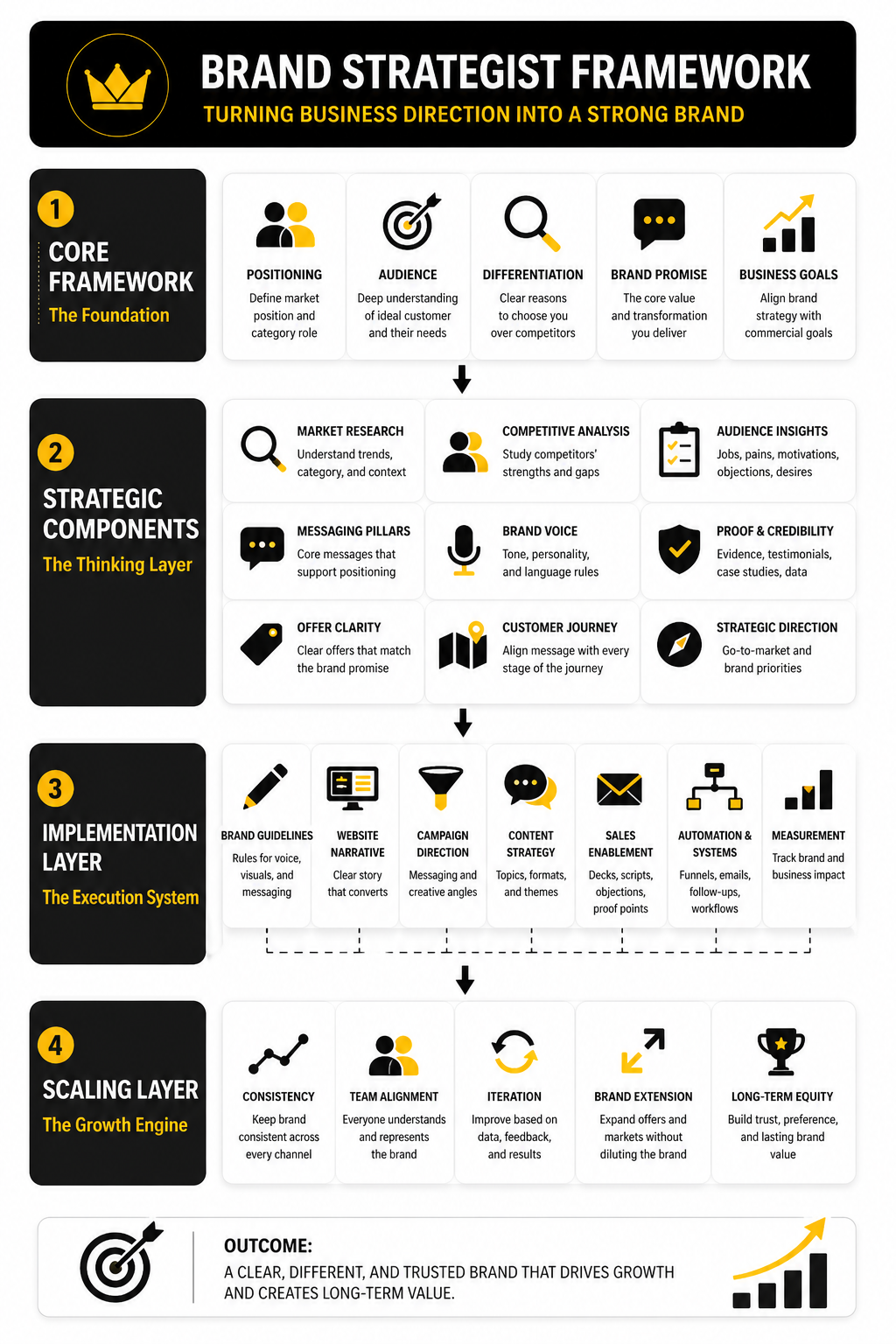
A brand strategist usually works across:
- Positioning
- Audience research
- Competitive analysis
- Messaging
- Brand voice
- Offer clarity
- Customer journey alignment
- Campaign direction
- Internal brand guidelines
- Go-to-market strategy
The best ones do not hide behind clever language. They make decisions sharper.
Brand Strategy Is Not Just Branding
Branding is often the visible layer: logo, colors, typography, design system, website feel, packaging, and creative assets. Brand strategy is the thinking underneath those choices. Without that thinking, the visuals may look polished but still fail to create preference.
This is where many businesses get stuck. They redesign the website, refresh the logo, and rewrite the tagline, but they never solve the positioning problem. The brand still sounds like every competitor, the offer still feels vague, and the sales team still has to explain too much.
A brand strategist should prevent that. They connect the visual identity to a sharper commercial idea. The point is not just “brand consistency” in a cosmetic sense; it is consistency around the reason people should choose you.
For example, if your business is trying to attract premium buyers, the strategist has to make sure the promise, proof, offer structure, tone, pricing signals, and customer experience all support that premium position. If any one of those pieces feels cheap, generic, or confused, the strategy breaks.
Brand Strategist vs Marketing Strategist
A marketing strategist usually focuses on how to reach, convert, and retain customers through channels, campaigns, funnels, content, email, paid media, partnerships, and sales enablement. A brand strategist focuses on what the business should stand for, how it should be positioned, and why the market should care before those campaigns are built.
The two roles overlap, but they are not the same. Marketing strategy often asks, “How do we get more qualified demand?” Brand strategy asks, “Why should this demand exist for us instead of someone else?”
That distinction matters more as acquisition costs rise and buyers become more selective. McKinsey has reported that consumers are showing weaker brand loyalty in several categories, with affordability and changing priorities influencing purchase behavior: McKinsey consumer trends. When loyalty is weaker, the brand has to work harder to stay mentally available and meaningfully different.
A practical way to separate the roles:
- A brand strategist defines the position.
- A marketing strategist builds the growth plan around that position.
- A designer expresses the position visually.
- A copywriter turns the position into persuasive language.
- A performance marketer tests the message in-market.
- A founder or leadership team protects the position through decisions.
When those roles work together, the brand becomes easier to sell. When they do not, marketing turns into noise.
Why Businesses Hire a Brand Strategist
Most businesses do not hire a brand strategist because everything is going smoothly. They hire one because growth has become harder to explain.
Sometimes sales are flat even though traffic is decent. Sometimes the company has outgrown its original audience. Sometimes competitors are copying the offer. Sometimes the founder knows the business is better than the website makes it look, but cannot explain the gap clearly.
A brand strategist is useful when the business needs sharper direction before spending more money on campaigns, content, ads, or a new website.
Common reasons include:
- The brand sounds too similar to competitors.
- The offer is strong but hard to explain.
- The company is entering a new market.
- The audience has changed.
- The business is repositioning from low-cost to premium.
- The website converts poorly because the message is unclear.
- The team disagrees on what the brand should stand for.
- Marketing output is increasing, but brand recognition is not.
- Sales calls reveal repeated confusion from prospects.
This is also where tools can help, but only after the strategy is clear. A funnel builder like ClickFunnels, an automation platform like GoHighLevel, or an email platform like Brevo can support execution. But none of them can fix weak positioning by themselves.
The Core Outputs of a Brand Strategist
A strong brand strategist should leave the business with decisions, not just documents. The deliverable can be a strategy deck, messaging guide, positioning framework, research summary, or brand playbook, but the real value is clarity the team can use every day.
The most useful outputs usually include a clear audience definition. Not a vague demographic like “small business owners,” but a sharper view of the customer’s situation, pain, motivation, buying trigger, objections, and desired outcome.
They also include a positioning statement. This does not always need to appear publicly, but internally it should make the brand’s market role obvious. The team should know what the brand is, who it serves, what problem it solves, and why it is different.
A practical brand strategist may also define:
- Brand promise
- Category frame
- Ideal customer profile
- Key competitors
- Differentiators
- Messaging pillars
- Proof points
- Brand voice
- Tagline direction
- Website narrative
- Campaign angles
- Content themes
- Sales language
The point is to remove guesswork. When someone writes a landing page, creates a sales deck, records a video, builds an onboarding email, or launches a campaign, the brand strategy should make the right message easier to find.
What Makes a Brand Strategist Valuable
A valuable brand strategist is not just creative. They are commercially grounded. They understand that the brand has to help the business win attention, earn trust, support pricing, reduce confusion, and create preference.
That means they should be comfortable with research. They should know how to study customer language, competitor claims, reviews, sales objections, category trends, and internal assumptions. Strategy that comes only from personal taste is fragile.
They should also be willing to simplify. Many brand projects become bloated because everyone wants to sound sophisticated. The better move is usually the opposite: say the important thing in a way the buyer immediately understands.
Kantar’s BrandZ research has repeatedly connected strong brands with business value, and its 2024 global ranking covered more than 4.3 million consumer interviews across 21,000 brands in 54 markets: Reuters coverage of Kantar BrandZ. The takeaway for smaller businesses is not that every brand needs to become Apple. It is that brand strength is not decoration; it is an asset that compounds when the market understands and remembers you.
A strong brand strategist helps create that compounding effect. They make the brand easier to recognize, easier to trust, and easier to choose.
How a Brand Strategist Turns Strategy Into Execution
A brand strategy is only useful when the team can actually use it. Pretty slides do not matter if the sales page, ads, emails, social posts, onboarding, and customer support still sound like five different companies. This is where a brand strategist earns their keep.
The implementation phase turns the strategy into practical decisions. It takes the positioning, audience insight, voice, promise, and proof points and translates them into assets people can use without asking for permission every five minutes. That matters because consistency is not created by intention; it is created by systems.
A smart brand strategist does not hand over a document and disappear. They help the business build the bridge between “this is who we are” and “this is how we show up every day.”
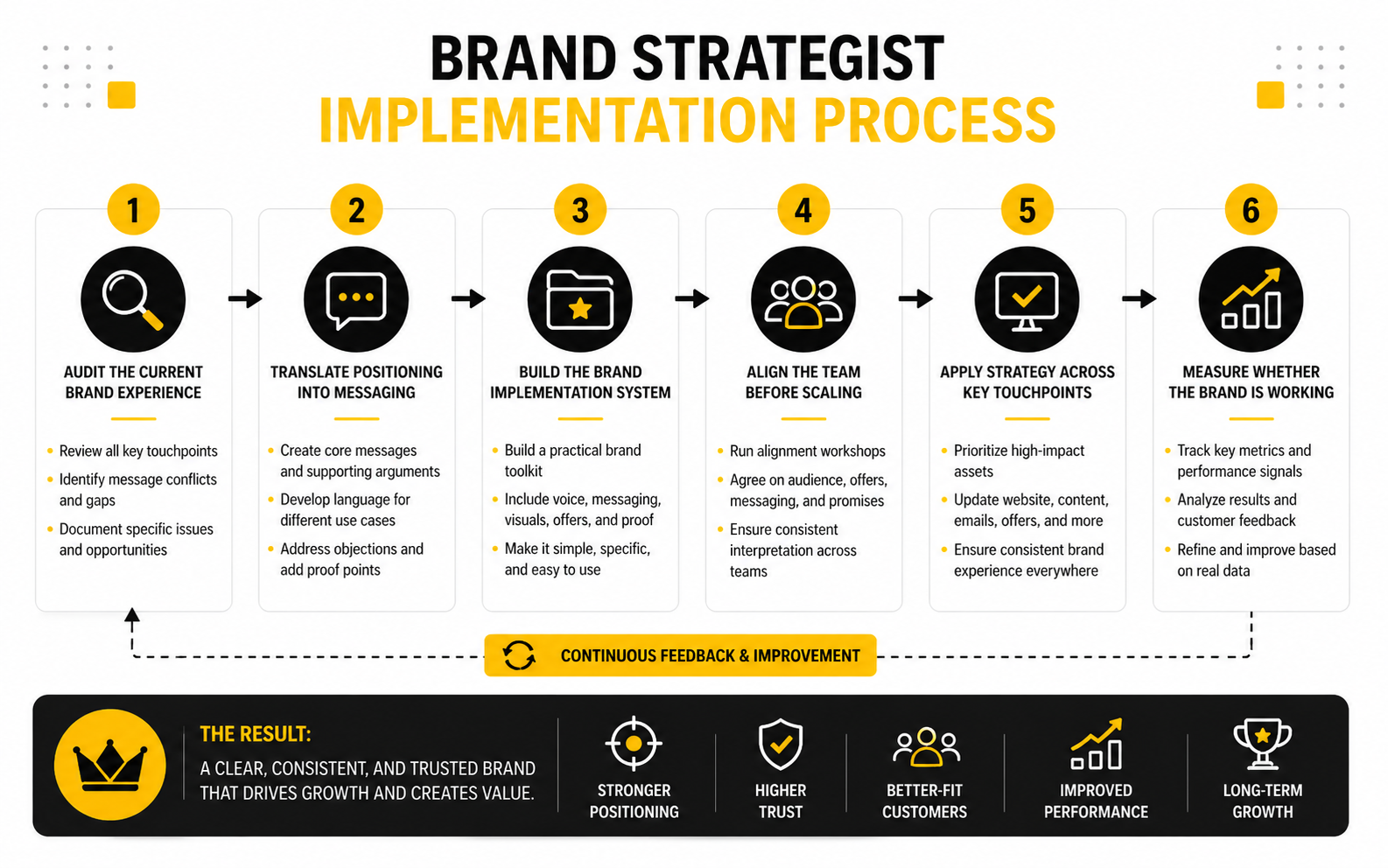
Step 1: Audit the Current Brand Experience
The first step is to look at what the market already sees. That means reviewing the website, landing pages, ads, emails, social profiles, sales decks, proposals, product pages, review responses, onboarding flows, and customer support language. The goal is not to nitpick; it is to find where the brand is leaking trust.
This audit usually reveals patterns fast. The homepage may promise simplicity while the sales deck feels technical. The ads may speak to one audience while the website speaks to another. The customer onboarding may be helpful, but the pre-sale messaging may overpromise what the experience can realistically deliver.
A brand strategist should document these gaps clearly. Not with vague feedback like “make it more premium,” but with specific notes about message conflict, weak differentiation, missing proof, confusing offers, inconsistent voice, and touchpoints that fail to support the chosen position.
Step 2: Translate Positioning Into Messaging
Once the gaps are clear, the next move is messaging. This is where the brand strategist turns strategy into language the business can actually use. The work should make it easier for anyone on the team to explain what the company does, who it helps, why it matters, and why it is different.
Messaging should not feel like a pile of slogans. It should include core statements, supporting arguments, objections, proof points, and practical language for different situations. A homepage headline needs a different job than a sales call opener, but both should come from the same strategic spine.
This is also where strong brands become easier to scale. When the message is clear, content creation gets faster, sales conversations get cleaner, and campaigns stop drifting into random angles. A brand strategist helps create that operating language.
Step 3: Build the Brand Implementation System
The implementation system is the practical toolkit that keeps the brand consistent after the strategy project ends. It should be simple enough for the team to use and specific enough to prevent brand drift. If the system is too abstract, nobody follows it.
A useful system usually includes:
- A positioning summary
- Audience profiles
- Messaging pillars
- Brand voice rules
- Approved phrases
- Words to avoid
- Visual identity rules
- Offer explanations
- Proof point library
- Landing page guidance
- Social content direction
- Sales enablement language
- Email and automation guidance
This is where execution tools can support the strategy. A team might build landing pages in ClickFunnels, manage lead follow-up in GoHighLevel, or run email campaigns through Brevo. But the tool is not the strategy; it is the container for the strategy.
Step 4: Align the Team Before Scaling the Brand
A brand can fall apart internally before it ever reaches the customer. If leadership, sales, marketing, support, and product all interpret the brand differently, the market will feel that confusion. A brand strategist helps the team align before more campaigns go live.
This usually means running workshops, reviewing key assets together, and forcing decisions that may have been avoided. The team needs to agree on what the brand will emphasize, what it will stop saying, which audience matters most, and what promises it can confidently make. Alignment sounds soft until you see how expensive misalignment becomes.
The World Federation of Advertisers’ benchmark on global and local brand consistency highlights the role of clear guidelines and governance in maintaining consistency across teams and markets: WFA brand consistency benchmark. For smaller businesses, the lesson is simple. You do not need corporate bureaucracy, but you do need clear ownership.
Step 5: Apply the Strategy Across Key Touchpoints
After the system is built, the strategy has to show up where buyers actually make decisions. This usually starts with the website because it is the central proof point for most brands. Then it expands into ads, email sequences, sales scripts, lead magnets, content, onboarding, and retention campaigns.
A brand strategist should help prioritize the touchpoints that matter most. Not every asset needs to be rebuilt at once. The highest-impact assets are usually the ones closest to revenue, trust, or customer experience.
For many businesses, that means starting with:
- Homepage messaging
- Core offer pages
- Sales deck or proposal
- Lead capture page
- Welcome email sequence
- Social profile positioning
- Customer onboarding language
- Testimonial and proof structure
This is the point where brand strategy becomes visible. The company no longer just talks about being clearer, sharper, or more premium. The customer actually experiences it.
Step 6: Measure Whether the Brand Is Working
Brand strategy should not be treated like a one-time creative exercise. Once the implementation is live, the business needs to watch what changes. A brand strategist can help define the signals that show whether the new direction is landing.
Some metrics are direct, like conversion rate, qualified leads, sales cycle length, close rate, repeat purchase rate, and average order value. Others are more qualitative, like better-fit inquiries, fewer confused prospects, stronger customer language, cleaner sales calls, and more consistent internal decision-making.
Customer experience matters here too. PwC’s 2025 Customer Experience Survey found that more than half of consumers had stopped using or buying from a brand after a bad experience: PwC customer experience survey. That is why implementation cannot stop at messaging; the promise has to match the actual experience.
The Process Is Not Linear Forever
A good brand strategist builds momentum, but they also build feedback loops. The first version of the strategy may be strong, but the market will still teach you things. Sales calls, customer reviews, support tickets, campaign performance, and search behavior all reveal where the brand needs refinement.
That does not mean changing the positioning every month. It means improving the expression of the strategy as real data comes in. Strong brands stay consistent in their core idea while adapting how they communicate it.
This is the difference between brand discipline and brand rigidity. Discipline protects the position. Rigidity ignores the market. A serious brand strategist knows the difference.
Statistics and Data
Data matters in brand strategy, but only when it changes what you do next. A brand strategist should not bury the team in dashboards, vanity metrics, or random benchmark screenshots. The goal is to understand whether the market is recognizing the brand, trusting it, choosing it, and staying with it.
The mistake is treating brand measurement like a softer version of performance marketing. Brand data is not always as immediate as ad clicks or checkout conversions. It often shows up through patterns: stronger direct traffic, better-fit leads, more branded search, higher close rates, shorter sales cycles, clearer customer language, and fewer objections around price or trust.
This is why measurement needs context. A low conversion rate may mean the offer is weak, but it may also mean the brand is attracting the wrong audience. A spike in traffic may look good, but if qualified leads do not improve, the brand may be getting attention without preference.
The Numbers a Brand Strategist Should Actually Track
A brand strategist should measure the full path from awareness to trust to action. That does not mean tracking everything. It means choosing signals that reveal whether the positioning is becoming easier to understand and easier to buy.
The most useful brand strategy metrics usually include:
- Branded search volume
- Direct traffic
- Returning visitors
- Organic traffic to core positioning pages
- Landing page conversion rate
- Lead quality
- Sales close rate
- Sales cycle length
- Customer acquisition cost
- Average order value
- Retention rate
- Repeat purchase rate
- Referral rate
- Review sentiment
- Social save and share rate
- Email reply rate
- Customer support themes
- Brand mention quality
The key is not the metric alone. It is the relationship between metrics. If branded search grows but conversion stays flat, the market may know the name but still not understand the offer. If conversion improves but retention drops, the message may be persuasive but misaligned with the real experience.
What Benchmarks Can and Cannot Tell You
Benchmarks are useful, but they are not commandments. A benchmark can show whether performance is unusually weak or unusually strong, but it cannot tell you what your brand should stand for. That decision still comes from audience insight, competitive context, commercial goals, and the company’s real strengths.
This is where many teams get lazy. They compare email open rates, ad click-through rates, website conversion rates, or social engagement against broad industry averages and assume the answer is obvious. But a premium consulting offer, a low-ticket ecommerce product, and a local service business should not be judged through the same lens.
A brand strategist should use benchmarks to ask better questions. If your landing page converts below a realistic category range, is the promise unclear? Is the proof weak? Is the offer too complicated? Is the traffic unqualified? The number points to the problem, but strategy explains why the problem exists.
Trust Is a Performance Signal
Trust is not fluffy. It affects whether people click, read, book, buy, refer, and forgive small mistakes. Edelman’s 2025 brand trust research frames trust as something earned through relevance, responsiveness, and clarity of action, not just big purpose statements: Edelman brand trust research.
For a brand strategist, that means trust should be treated as a measurable business signal. You can look at review quality, testimonial specificity, referral volume, objection patterns, refund reasons, demo attendance, and how often prospects ask for reassurance before buying. Those signals tell you whether the brand is making people feel confident or cautious.
This matters even more when buyers have too many choices. If the brand feels vague, inconsistent, or overhyped, the buyer does not need to debate it for long. They can just move on.
Customer Experience Data Shows Whether the Promise Holds
Brand strategy does not end when someone becomes a customer. The real test is whether the experience matches the promise. If the brand says “simple,” the onboarding cannot feel chaotic. If it says “premium,” the support cannot feel indifferent. If it says “fast,” delivery cannot be slow and confusing.
PwC’s 2025 Customer Experience Survey found that 52% of consumers had stopped using or buying from a brand after a bad product or service experience: PwC customer experience survey. That number matters because it proves a simple point: the brand is not just what you say before the sale. It is what the customer experiences after the sale.
A brand strategist should therefore look beyond campaign performance. Support tickets, churn reasons, onboarding completion, customer satisfaction, repeat purchases, and cancellation feedback all show whether the brand promise is credible. If the customer experience contradicts the positioning, the market will eventually believe the experience.
Brand Strength Should Support Commercial Outcomes
A strong brand should make growth easier, not just prettier. It should help the business earn attention more efficiently, convert better-fit buyers, defend pricing, and create repeat demand. Kantar’s 2024 BrandZ ranking connected brand value growth with consumer perception data across more than 4.3 million respondents and 21,000 brands: Kantar BrandZ 2024.
For smaller businesses, the useful lesson is not to obsess over enterprise-level brand valuation. The lesson is that perception has economic weight. When people understand what you are known for and believe the value is real, your marketing does not have to work as hard to explain everything from scratch.
This is why a brand strategist should connect brand metrics with revenue metrics. Branded search is useful, but it becomes more useful when compared with lead quality. Social engagement is useful, but it becomes more useful when compared with qualified inquiries. Website conversion is useful, but it becomes more useful when paired with retention and customer fit.
How to Read Brand Data Without Fooling Yourself
Brand data can mislead you if you read it too narrowly. A campaign may lift traffic because the creative is provocative, but that does not mean the brand is stronger. A post may get engagement because it is controversial, but that does not mean it attracts the right customers.
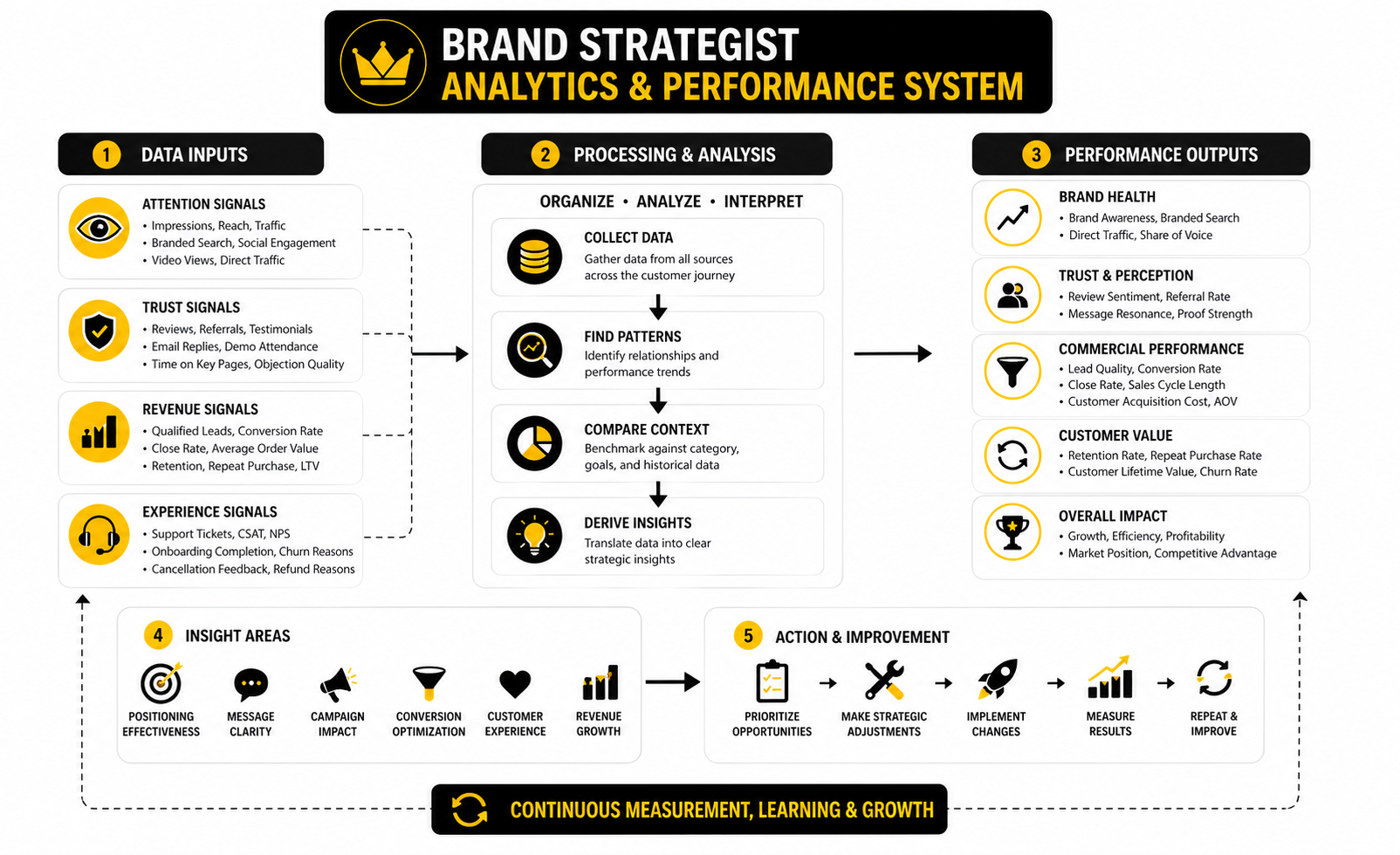
The cleaner approach is to separate signals into three groups:
- Attention signals: impressions, reach, traffic, branded search, social engagement, video views.
- Trust signals: reviews, referrals, testimonials, email replies, demo attendance, time on key pages, objection quality.
- Revenue signals: qualified leads, conversion rate, close rate, average order value, retention, repeat purchase, customer lifetime value.
A brand strategist should not optimize one group while ignoring the others. Attention without trust creates noise. Trust without revenue creates admiration but not growth. Revenue without retention usually means the brand is promising something the business cannot consistently deliver.
What the Data Should Make You Do
The point of measurement is action. If the numbers do not lead to better decisions, the dashboard is decoration. A brand strategist should help the team turn signals into practical adjustments.
If branded search is weak, the brand may need stronger distinctiveness, clearer thought leadership, better distribution, or more memorable campaign assets. If conversion is weak, the website may need sharper messaging, stronger proof, clearer offers, or less friction. If retention is weak, the problem may be product experience, onboarding, expectations, or customer success.
This is also where automation can help once the strategy is clear. You can track lead sources, follow-up quality, and pipeline movement in GoHighLevel, test landing page messages in ClickFunnels, or monitor campaign responses through Brevo. But again, the software only gives you visibility; the strategy tells you what the numbers mean.
The Best Measurement System Is Simple Enough to Use
A measurement system does not need fifty KPIs. It needs a few serious indicators that the team reviews consistently. The best setup is simple, repeatable, and tied to business decisions.
A practical monthly brand review might ask:
- Are more people searching for us by name?
- Are the right people landing on the right pages?
- Are more qualified leads converting?
- Are sales conversations getting easier?
- Are customers repeating the language we want to own?
- Are objections becoming weaker or more specific?
- Are reviews and testimonials reinforcing the position?
- Are customers staying after the promise is delivered?
That is how measurement becomes useful. Not as a report nobody reads, but as a decision system. A good brand strategist helps the business see what is working, what is drifting, and what needs to change before the market decides for them.
Advanced Brand Strategy Decisions
Once the basics are in place, the harder work begins. This is where a brand strategist has to make tradeoffs that affect growth, pricing, customer fit, creative direction, and long-term market position. The decisions are not always comfortable, but avoiding them creates a weaker brand.
A brand cannot be for everyone, sound like everyone, and still expect people to remember it. At some point, the business has to choose what it wants to be known for and what it is willing to ignore. That is where strategy becomes real.
The Tradeoff Between Clarity and Cleverness
Clever branding feels good in a workshop. Clear branding performs better in the market. The buyer does not have time to decode your internal metaphor, abstract tagline, or poetic category language when they are trying to solve a problem.
A brand strategist should protect clarity, especially on high-intent assets like homepages, landing pages, sales decks, and offer pages. There is room for personality, but personality should not make the message harder to understand. If the buyer has to reread the headline three times, the brand is making them work too hard.
This does not mean the brand should sound boring. It means the creative idea has to serve the commercial idea. The best strategy gives the brand a sharper voice without hiding the value.
The Risk of Over-Positioning
Positioning is powerful, but over-positioning can trap a brand. If the message becomes too narrow, the business may struggle to expand into adjacent offers, new audiences, or higher-value markets. A brand strategist has to know the difference between focus and a corner.
The danger usually appears when a company defines itself around a temporary feature, a trend, or one narrow customer pain. That can help in the short term, but it may weaken the brand when the market changes. A stronger position is usually built around a durable customer need, a credible difference, and a business capability the company can keep improving.
The practical move is to define the brand tightly enough to be memorable, but not so tightly that growth becomes awkward. That balance matters. Too broad and nobody remembers you; too narrow and the next stage of growth feels like a rebrand.
Brand Architecture Gets Harder as You Scale
A small business can usually survive with one brand, one offer, and one message. As the business grows, things get more complicated. New products, sub-brands, audiences, markets, partnerships, and channels can create confusion fast.
This is where brand architecture becomes important. The team needs to decide whether new offers should sit under the main brand, become named products, or develop their own identity. A brand strategist helps prevent a messy collection of disconnected names, logos, and promises.
The goal is not to create a complicated structure. The goal is to make buying easier. If the customer cannot understand how the offers relate to each other, the architecture is serving the company’s internal politics instead of the market.
Consistency Without Becoming Predictable
Consistency helps people recognize and trust a brand. But consistency does not mean saying the same sentence forever. It means the brand has a stable point of view, a recognizable voice, and a clear promise across changing campaigns and contexts.
This is where many growing teams get stuck. They either let every channel create its own version of the brand, or they over-control everything until the content feels lifeless. Neither works well.
The better approach is controlled flexibility. Give the team strong messaging pillars, voice principles, proof points, and decision rules, then let the execution adapt to the channel. The World Federation of Advertisers’ benchmark on global and local brand consistency highlights how guidelines and governance help maintain consistency while still allowing local adaptation: WFA brand consistency benchmark.
The Short-Term vs Long-Term Growth Tension
Performance marketing wants fast proof. Brand strategy often compounds more slowly. A serious brand strategist has to help the business manage both realities without pretending one replaces the other.
Short-term campaigns can generate demand, test offers, and create useful market feedback. Long-term brand building makes the business easier to recognize, trust, and choose before the buyer is ready to convert. If you only chase immediate response, you may train the market to notice you only when you discount, shout, or interrupt.
The stronger move is to connect both. Use performance channels to learn what messages create action, then feed that insight back into the brand system. Use brand campaigns to build memory and trust, then make conversion easier when buyers enter the market.
AI Makes Brand Strategy More Important, Not Less
AI can help teams move faster, but it can also make brands sound painfully similar. When everyone uses the same tools to generate content, the average output gets smoother and more generic. That creates a real opening for brands with sharper strategy, stronger proof, and a more distinctive point of view.
A brand strategist now has to think about how the brand shows up inside search summaries, AI recommendations, comparison content, reviews, help documentation, and community conversations. Buyers are not only visiting your website. They are asking tools, platforms, peers, and creators to explain the category for them.
That means the brand needs clearer source material. Product pages, FAQs, case studies, comparison pages, reviews, founder content, and support documentation all become part of how the market understands you. If your public footprint is vague, AI will not magically make it sharper.
Automation Can Scale the Brand or Damage It
Automation is useful when the message is clear. It is dangerous when the message is weak. Sending more emails, building more funnels, or creating more chatbot flows will not fix a brand that does not know what it stands for.
A platform like GoHighLevel can help teams manage follow-up, pipelines, automation, and client communication. ManyChat can support conversational marketing when the brand voice and customer journey are already defined. Buffer can help distribute content more consistently across social channels.
But scale exposes weak strategy. If the brand voice is unclear, automation spreads that confusion faster. If the offer is misaligned, funnels just push more people into the wrong expectation.
When a Brand Strategist Should Push Back
A good brand strategist is not hired to agree with everything. They should push back when the business wants to chase too many audiences, copy competitors, overpromise, dilute the offer, or make creative decisions that weaken trust. That pushback is part of the value.
They should also challenge data that is being interpreted too conveniently. A high-performing campaign may still damage the brand if it attracts poor-fit customers or sets expectations the business cannot meet. A beautiful visual identity may still fail if the message is unclear.
This is the difference between a decorator and a strategist. A decorator makes things look better. A brand strategist helps the business make better choices.
The Biggest Scaling Risk Is Brand Drift
Brand drift happens slowly. One campaign bends the voice. One sales deck uses outdated language. One new offer gets named without a system. One team member writes content based on personal preference instead of strategy. Then, after a few months, the brand feels scattered again.
The solution is not endless control. It is rhythm. The business needs regular reviews of key assets, customer feedback, sales objections, campaign performance, and competitive shifts. A brand strategist can help set that rhythm so the brand evolves without losing its center.
This is especially important because trust is fragile. Edelman’s 2025 brand trust research treats trust as a purchase consideration alongside quality and price: Edelman Brand Trust report. If the brand becomes inconsistent, unclear, or misaligned with the customer experience, that trust gets expensive to rebuild.
The Expert Move Is Strategic Restraint
The best brand decisions often involve restraint. Do not launch every offer. Do not speak to every audience. Do not use every channel. Do not adopt every trend. Do not rewrite the positioning every time a campaign underperforms.
A strong brand strategist helps the business separate real strategic signals from noise. Sometimes the right move is a sharper message. Sometimes it is a better offer. Sometimes it is a customer experience fix. Sometimes it is simply staying consistent long enough for the market to remember you.
That is not passive. It is disciplined. And in a noisy market, discipline is one of the most underrated advantages a brand can have.
Bringing the Brand System Together
At this stage, the work is no longer just strategy, messaging, execution, or measurement. It is an operating system for how the business shows up, earns trust, and grows without becoming scattered. A brand strategist helps connect those pieces so the brand does not depend on one person’s memory, taste, or mood.
That system should make daily decisions easier. The team should know what to say, what not to say, which customers matter most, what proof to use, how the voice should feel, and how success will be measured. When those decisions are clear, the brand becomes easier to manage and harder to copy.
This is the real payoff. The brand stops being a vague marketing asset and becomes a practical growth tool.
FAQ - Built for Complete Guide
What does a brand strategist do?
A brand strategist defines how a business should be positioned in the market so customers understand, remember, and choose it. They work on audience research, competitive analysis, messaging, brand voice, differentiation, and implementation. Their job is to turn business direction into a clear brand system the team can use.
Is a brand strategist the same as a designer?
No. A designer creates the visual expression of the brand, while a brand strategist defines the thinking behind it. The strategist decides what the brand should stand for, who it should speak to, and why it should matter. The designer then helps express that strategy through identity, layout, typography, color, and creative assets.
When should a business hire a brand strategist?
A business should hire a brand strategist when growth feels harder than it should. That may happen when the offer is strong but unclear, competitors sound similar, the audience has changed, or marketing is producing activity without enough traction. It is especially useful before a rebrand, website rebuild, new offer launch, or major go-to-market push.
What should a brand strategy include?
A useful brand strategy should include audience insight, positioning, category context, competitive differentiation, messaging pillars, proof points, brand voice, and implementation guidance. It should also connect to business goals, not just creative preferences. The final output should help the team make better decisions across marketing, sales, product, and customer experience.
How long does brand strategy take?
The timeline depends on the size of the business, the complexity of the market, and the depth of research required. A focused project for a smaller business may take a few weeks, while a larger repositioning project can take months. The important thing is not speed alone; it is whether the strategy is specific enough to guide real decisions.
How do you measure brand strategy?
Brand strategy can be measured through a mix of awareness, trust, and revenue signals. Useful indicators include branded search, direct traffic, qualified leads, conversion rate, close rate, sales cycle length, customer retention, referral volume, review sentiment, and customer language. The best measurement system shows whether the brand is becoming easier to find, understand, trust, and buy from.
Can a brand strategist help with sales?
Yes. A strong brand strategist can make sales easier by clarifying the offer, sharpening the message, improving proof, and reducing buyer confusion. They can also help create sales decks, proposal language, objection responses, and positioning statements. When the brand is clearer, sales teams spend less time explaining the basics and more time helping the right buyers move forward.
Does every business need a brand strategist?
Not every business needs a full brand strategy project immediately. Early-stage businesses may first need customer conversations, offer validation, and basic messaging before investing deeply. But once a business has traction, competition, and a need to scale, a brand strategist can prevent expensive confusion.
What makes a good brand strategist?
A good brand strategist combines research, commercial thinking, creative judgment, and practical execution. They should be able to simplify complex ideas, challenge weak assumptions, and turn insights into usable direction. The best ones do not just make the brand sound better; they make the business easier to understand and choose.
What tools does a brand strategist use?
A brand strategist may use research tools, survey platforms, analytics dashboards, interview notes, competitor tracking, CRM data, and content systems. Execution tools can include platforms like GoHighLevel, ClickFunnels, Brevo, Buffer, and ManyChat. But tools only help when the strategic direction is already clear.
Can AI replace a brand strategist?
AI can support research, content drafting, summarization, and workflow speed, but it cannot fully replace strategic judgment. A brand strategist has to understand tradeoffs, customer psychology, competitive context, business goals, and internal alignment. AI can help produce options; the strategist decides what is actually right for the brand.
What is the biggest mistake businesses make with brand strategy?
The biggest mistake is treating brand strategy like a document instead of a decision system. A strategy that sits in a folder will not change the business. It has to shape the website, offers, sales language, content, customer experience, hiring, campaigns, and measurement.
Work With Professionals
Explore 10K+ Remote Marketing Contracts on MarkeWork.com
Most marketers spend too much time chasing clients, competing on crowded platforms, and losing a percentage of every project to middlemen.
MarkeWork gives you a better way. Browse thousands of remote marketing contracts and connect directly with companies desperate to hire skilled marketers like you, without platform commissions and without unnecessary gatekeepers.
If you're serious about finding better opportunities and keeping 100% of what you earn, explore available contracts and create a profile for free at MarkeWork.com.