

Hiring a marketing agency used to be a fairly simple decision. You needed more leads, more visibility, or more help executing campaigns, so you brought in outside specialists and expected the machine to start moving. That world is gone.
Today, growth happens across a messy mix of search, paid media, email, content, CRM workflows, creative, analytics, and increasingly AI-assisted production. At the same time, marketing budgets have stayed tight at 7.7% of company revenue in Gartner’s 2025 CMO Spend Survey, while leaders are still being pushed to prove sharper efficiency, stronger attribution, and more reliable growth.
That is exactly why the right marketing agency matters more now, not less. A strong agency does not just “run ads” or “post on social” anymore. It helps a business connect strategy, execution, data, and decision-making in a market where journeys are more fragmented, buyer discovery is more self-directed, and AI is changing how teams produce and optimize work at scale through tools and workflows documented by Google’s research on the new decision-making process, BCG’s work on moving beyond the linear funnel, and McKinsey’s analysis of AI-powered personalization.
- Why Businesses Still Need A Marketing Agency
- The Modern Marketing Agency Framework
- The Core Services That Actually Move The Needle
- How Professional Agency Implementation Works In Practice
- Pricing Models, Reporting, And Relationship Management
- How To Choose The Right Marketing Agency For Your Business
The biggest reason businesses hire a marketing agency is not lack of ideas. It is lack of bandwidth, lack of specialist depth, and lack of a system that turns scattered activity into measurable progress. That problem has become more obvious as marketing leaders deal with flatter budgets, increasing channel complexity, and higher expectations around performance, which shows up clearly in Gartner’s 2025 budget data, Deloitte’s 2025 CMO Survey, and Nielsen’s Annual Marketing Report.
A good agency gives a business access to capabilities that are hard to build internally all at once. One team may need paid media strategy, conversion copy, landing page design, analytics setup, email automation, and creative testing in the same quarter. Building that entire bench in-house is expensive and slow, while working with a marketing agency can compress the learning curve and put experienced operators into motion faster.
There is also a more strategic reason agencies matter now: the customer journey no longer behaves like a neat funnel. Google describes modern buying behavior through the “4S” patterns of streaming, scrolling, searching, and shopping, while BCG argues that marketers need to stop treating journeys as linear because influence now happens across many touchpoints before conversion ever shows up in a dashboard. When a business is trying to make sense of that complexity, a marketing agency can serve as the connective tissue between channels, creative, data, and decision-making instead of letting each tactic drift in its own direction.
For B2B brands, the value can be even more pronounced. The 2024 Edelman-LinkedIn B2B Thought Leadership Impact Report shows that buyers increasingly prefer self-directed research and that strong expertise-led content can influence demand long before prospects are ready to talk to sales. That means a marketing agency is often not just an execution partner, but a force multiplier for market education, trust-building, and revenue creation.
The easiest way to understand a marketing agency is to stop thinking about channels first and start thinking about systems. The strongest agencies usually work through four connected layers: strategy, acquisition, conversion, and retention. When those layers are aligned, campaigns start compounding instead of producing isolated spikes.
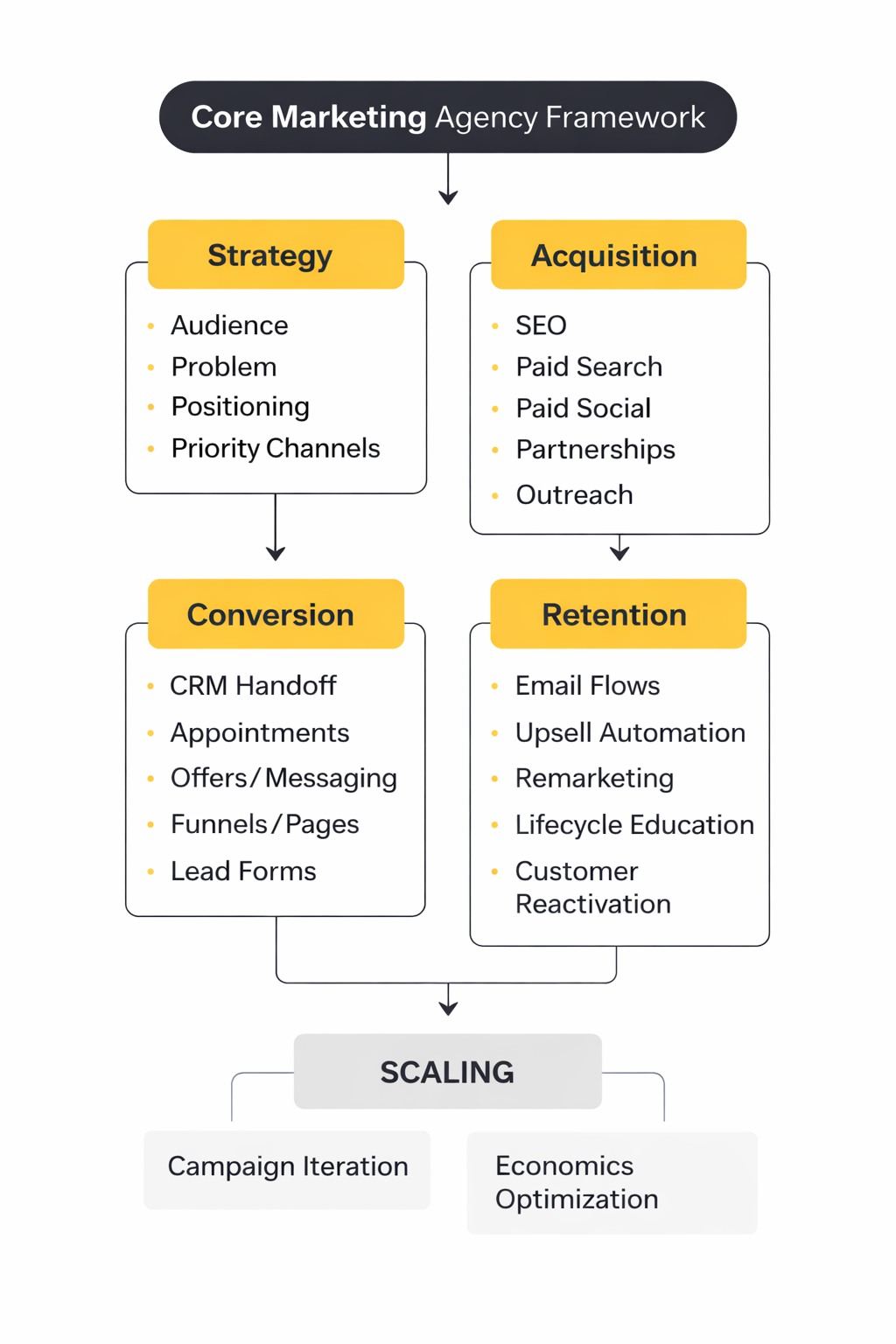
At the strategy layer, the agency clarifies who the business is trying to reach, what problem it solves, how it is positioned, and which channels deserve attention first. This sounds basic, but it is where weak engagements usually break down. Salesforce’s State of Marketing report and Adobe’s AI and Digital Trends research both point to the same issue: teams struggle when data, positioning, and customer understanding are fragmented, because execution gets faster while clarity stays blurry.
The acquisition layer is where visibility and traffic are built. That can include SEO, paid search, paid social, organic social, partnerships, content distribution, creator campaigns, or outbound systems depending on the business model. A serious marketing agency does not pick channels based on trendiness; it picks them based on buyer behavior, economics, and how quickly the company can gather useful feedback.
The conversion layer turns attention into action. This is where landing pages, offers, messaging, forms, CRM routing, appointment flows, and sales handoff all start to matter. If an agency is helping with funnel architecture, the real question is not whether it uses a platform like ClickFunnels, systeme.io, or Fillout; it is whether those tools support a clear conversion strategy, clean data capture, and a smoother buying path.
The retention layer is where many businesses leave money on the table. Email, remarketing, lifecycle automation, upsell flows, customer education, and reactivation work can dramatically improve the economics of acquisition when they are managed properly. That is why modern agencies increasingly connect campaign work with platforms like Brevo, scheduling systems like Cal.com, and social publishing tools like Buffer when those tools fit the business, because growth becomes far more durable when follow-up is built into the system instead of treated as an afterthought.
The practical takeaway is simple. A marketing agency is no longer just a vendor that produces deliverables. The right one acts more like an operating partner that helps a company make better decisions, execute faster, learn from data sooner, and build a growth system that does not collapse the moment one campaign stops working.
The easiest way to misunderstand a marketing agency is to judge it by the size of its service menu. Long lists look impressive, but they do not tell you whether the work connects to revenue. What matters is whether the agency can identify the few services that solve the actual bottleneck in your business right now.
For one company, that bottleneck is demand generation. For another, it is conversion. For another, it is follow-up, attribution, or creative that simply does not persuade anyone. A serious marketing agency starts there, because piling on more activity rarely fixes a weak system.
Every strong engagement starts with strategy, even when the client thinks they only need execution. If the offer is muddy, the market is too broad, or the message sounds like everyone else in the category, performance work gets expensive fast. The agency may still generate traffic, but it will be sending people into a story that does not land.
This is where positioning earns its keep. A marketing agency should be able to help define who the brand is for, what pain it solves, why the offer deserves attention, and how to express that in plain language. Without that foundation, even technically good media buying or content production will struggle to compound.
Strategy also affects speed. When the message is clear, creative gets easier, landing pages become sharper, and testing stops feeling random. That is why businesses that skip this step often end up paying for the same learning twice.
Content still matters, but not in the old “publish more blog posts and hope” way. The better play is to create content that matches real buying intent, answers hard questions clearly, and supports both discovery and trust. A good marketing agency knows the difference between content that fills a calendar and content that moves someone closer to action.
Search visibility fits into that same system. SEO is not just rankings; it is alignment between what people search, what your pages promise, and what your business can credibly deliver. If the agency treats SEO as a checklist instead of a commercial strategy, you usually get traffic reports without business impact.
This is also where specialist workflows can help. Some teams use structured research and scraping tools like Firecrawl to speed up content research, and then pair that with practical publishing workflows instead of bloated editorial processes. The point is not the tool itself. The point is producing useful content faster without lowering the bar.
Paid media is one of the clearest tests of agency quality because the feedback loop is brutally fast. Weak strategy gets exposed. Weak offers get exposed. Weak landing pages get exposed. When a marketing agency is good at paid acquisition, you can usually see it in the discipline of the account, not just the size of the spend.
That discipline starts with channel choice. Some businesses need Google Search because demand already exists. Others need paid social because awareness has to be created before conversion can happen. Others need a blend, with retargeting and branded search protecting the demand that earlier campaigns created.
Creative matters just as much as targeting now. A strong agency does not hide behind platform mechanics while running stale messages for months. It treats hooks, angles, offers, and landing page continuity as part of the same performance system.
Traffic without conversion is just expensive noise. That is why funnel architecture is one of the most underrated services a marketing agency can provide. If visitors arrive on a page that is vague, slow, cluttered, or disconnected from the promise in the ad, the campaign breaks before the sales team ever gets involved.
Good agencies simplify the path. They tighten the headline, remove friction, sharpen the call to action, and design the page around one clear next step. That might be a purchase, a booked call, a demo request, or an email opt-in, but it needs to be obvious.
For businesses building campaign-specific funnels, tools like ClickFunnels or systeme.io can make sense when speed matters more than custom development. If the goal is forms, qualification, and cleaner handoff into a CRM, tools like Fillout can also fit neatly into the system. The platform is not the hero here. Clear conversion logic is.
A surprising number of businesses hire a marketing agency for lead generation when the bigger leak is what happens after the lead arrives. If follow-up is slow, segmentation is weak, and nurture is inconsistent, acquisition gets blamed for problems created downstream. That is expensive and completely avoidable.
Lifecycle marketing is where agencies can create real leverage. Email onboarding, lead nurture, reactivation, abandoned-cart flows, pipeline reminders, and post-purchase follow-up all improve the value of traffic you already paid for. This is not glamorous work, but it often produces some of the cleanest gains in the entire engagement.
That is why a capable marketing agency usually thinks beyond campaign launch. It looks at the CRM, the automation rules, the calendar flow, and the sales handoff. Platforms like Brevo, Moosend, Copper, and Cal.com can all play useful roles when they are tied to a clear customer journey.
Social media is often oversimplified in agency pitches. It is not automatically a growth engine, and it is not worthless either. Its value depends on the business model, the buying cycle, and whether the content being distributed actually deserves attention.
For some brands, social is a trust layer that supports conversion happening elsewhere. For others, it is a discovery channel, a remarketing asset, or a way to stay visible during long sales cycles. A smart marketing agency understands that social rarely works in isolation and usually performs best when it is linked to content, email capture, retargeting, and direct response offers.
Execution still matters, of course. Scheduling tools like Buffer or niche social tools like Flick can help teams stay consistent, but consistency only matters when the message is aligned with the brand and the audience. Posting more often is not a strategy. Publishing with purpose is.
Once the service mix is clear, the real work begins. This is the part many clients underestimate. Good implementation is not a burst of activity in month one followed by generic reporting. It is a structured operating rhythm that keeps strategy, production, testing, and learning connected.
A professional marketing agency usually works in phases even if it does not label them that way. First comes diagnosis. Then architecture. Then launch. Then iteration. If one of those phases gets rushed, the whole engagement becomes harder than it needs to be.
The first job is understanding the current reality without sugarcoating it. That means looking at performance data, customer flow, traffic sources, conversion points, sales process, content assets, and technical setup. The agency is trying to answer a simple question: where is growth actually being constrained?
This stage matters because businesses often describe symptoms instead of causes. They may say leads are weak when the real issue is offer positioning. They may say ads are failing when the landing page is the problem. They may say content is not working when there is no distribution engine behind it.
A good marketing agency does not rush past this because it wants to look busy. It wants the first actions to be the right ones. That patience usually saves time later.
Once the bottlenecks are visible, the agency turns them into an operating plan. This is where priorities get set, responsibilities become clear, and the team decides what gets built first. The strongest plans are simple enough to execute and specific enough to measure.
This is also where expectations need to become concrete. Which channels are in scope? What does a qualified lead mean? What does success look like after 30, 60, or 90 days? How fast will creative be reviewed, pages be approved, and feedback be returned? Those details are not admin. They shape results.
If the agency is worth keeping, the plan will feel focused rather than inflated. You should be able to see why each task exists and how it connects to business goals. Anything that looks like decorative activity should be challenged immediately.
Launch is where weaker agency relationships often get messy. Assets are half-ready, tracking is not fully checked, messaging changes at the last minute, and nobody is sure who owns the next move. That creates false negatives because the campaign never really got a fair shot.
Professional implementation looks calmer. The offer is defined. The creative is matched to the audience. The page reflects the promise. The form works. The automation works. The reporting is in place before spend starts, not weeks later after confusion sets in.
This is also the moment when process tools can reduce drag. A marketing agency may use assistants for call handling, lead capture, or customer support routing with tools like Chatbase, internal documentation helpers like Guideless, or workflow aids like Wispr Flow to keep execution tighter. That can help, but only when the core strategy is already sound.
The best agencies do not confuse motion with optimization. Real iteration means forming a view about what is happening, testing the right variable, and learning fast enough to improve the next cycle. It is not endless tinkering just to justify retainers.
That means the agency should know whether the problem is traffic quality, click-through rate, conversion rate, lead quality, sales follow-up, or retention. Each issue demands a different response. Lumping them together under “performance” usually hides the truth.
This is where the relationship becomes either valuable or frustrating. A good marketing agency helps the client see the system more clearly over time. The account gets smarter. Decisions get faster. Reporting becomes more useful because it leads to action, not just commentary.
Once a marketing agency moves from planning into delivery, the work should become visible fast. Not flashy. Visible. You should be able to see what is being built, what is being tested, what is blocked, and what decisions are needed from your side.
That matters because vague activity destroys trust. If the agency cannot translate strategy into a clear operating rhythm, the engagement starts to feel like a black box. Good agencies do the opposite. They make execution understandable without forcing the client to manage every task personally.
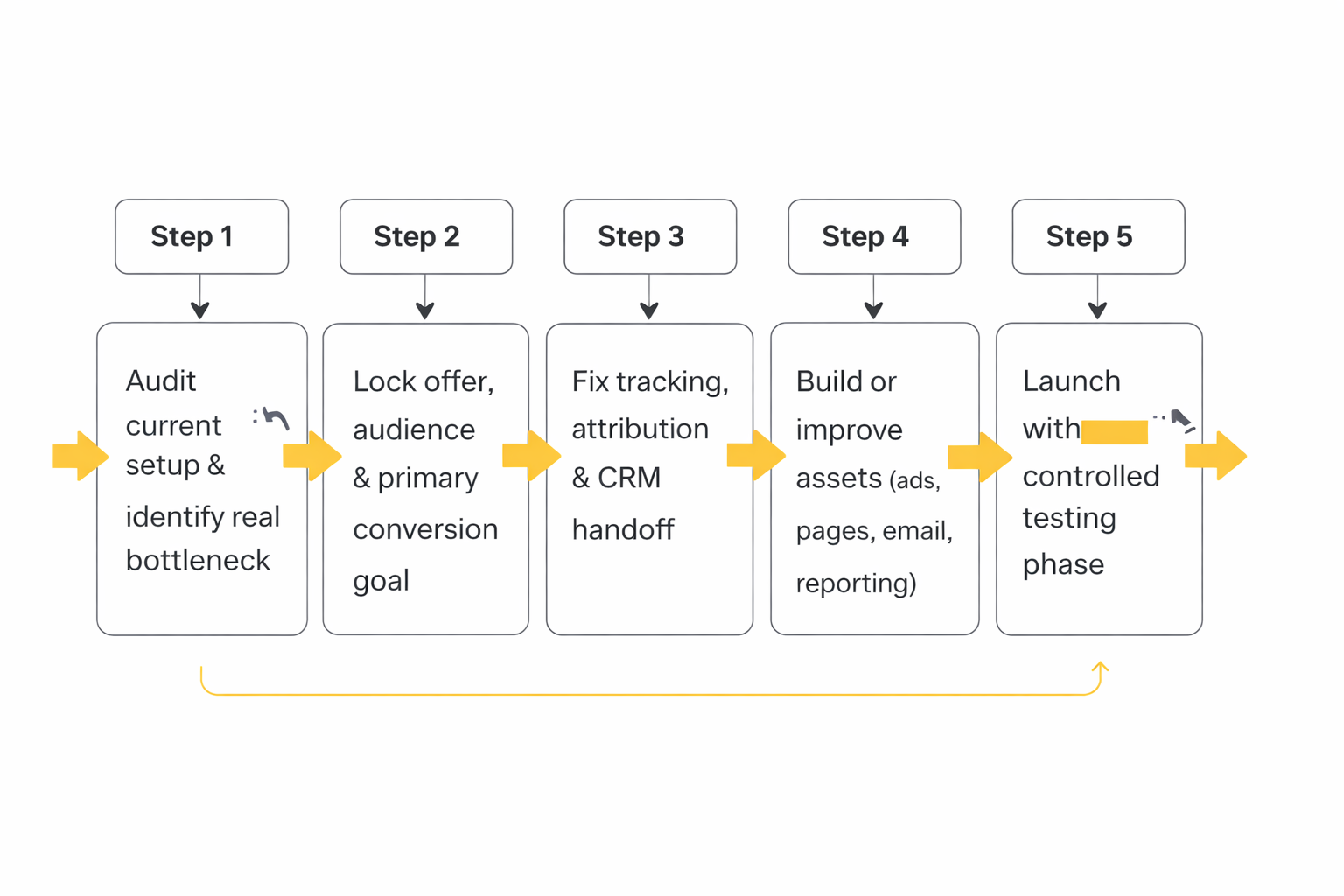
A practical rollout usually looks like this:
- Audit the current setup and identify the real bottleneck
- Lock the offer, audience, and primary conversion goal
- Fix tracking, attribution, and CRM handoff before scaling traffic
- Build or improve the core assets such as ads, pages, email flows, and reporting
- Launch with controlled testing rather than changing everything at once
- Review performance weekly and adjust based on signal, not panic
- Scale only after the funnel shows stable evidence of traction
The point is not to follow a perfect template. The point is to avoid random execution. A strong marketing agency creates enough structure to move quickly without turning the whole engagement into chaos.
The best agency relationships are rarely the quietest ones. They are the clearest ones. Clients should know when updates happen, what those updates cover, and what kind of feedback is actually useful.
In practice, that usually means a simple cadence. Weekly check-ins for active performance work. A monthly strategic review to look beyond campaign noise. Fast approvals on assets that directly affect launch timing. Nothing fancy, but very few engagements stay healthy without this discipline.
A marketing agency also needs the client to participate in the right places. Founders and internal leaders usually hold the sharpest knowledge about customers, objections, and sales conversations. If that insight never reaches the agency, the work can become technically polished but commercially weak.
This is where things get painfully real. Plenty of campaigns fail on paper because tracking is broken, lead routing is messy, or offline outcomes never make it back into the reporting loop. Then everyone argues about performance when the underlying data was unreliable from the start.
A competent marketing agency treats data hygiene as operational infrastructure, not an optional extra. That includes event tracking, conversion definitions, CRM stage mapping, form validation, UTM discipline, call scheduling, and lead-source visibility. None of that feels glamorous in a kickoff meeting, but it becomes critical the moment money starts moving.
Attribution also needs honesty. Not every sale can be tied neatly to one click, one ad, or one page. Buyer journeys are too fragmented for that. The smarter move is to combine platform data, first-party CRM outcomes, and directional business metrics so decisions get made with realistic confidence instead of fake certainty.
Creative is where many agency engagements either start compounding or stall out. A marketing agency can have clean dashboards and strong media buyers, but if the messaging is dull, the hooks are weak, or the offer lacks urgency, growth gets capped quickly. This is especially true in paid channels where creative fatigue shows up fast.
That is why creative should be treated as a testing system, not a one-time deliverable. New angles need to be developed from customer objections, sales calls, search intent, and campaign feedback. Then they need to be launched, reviewed, and either improved or replaced without drama.
The strongest agencies build this loop into the account from the start. They are not waiting three months to admit the messaging missed. They are learning in public, tightening the work, and giving the client a clear view of what is improving and why.
A lot of businesses hope the right tool stack will save a weak process. It will not. Better software can remove friction, but it cannot fix unclear positioning, poor follow-up, or sloppy decision-making.
Still, the right tools can absolutely help when they are mapped to the actual workflow. A marketing agency may use ScaledMail for outbound support, Dub for cleaner link tracking, Comp AI when operational compliance matters, or BetterPic when creative teams need faster professional headshots for brand assets and campaigns. These tools can be useful. They just should not be confused with strategy.
The practical test is simple. If a piece of software disappeared tomorrow, would the core execution model still make sense? If the answer is no, the process is too dependent on tools and not grounded enough in fundamentals.
One of the fastest ways to judge a marketing agency is to watch how it handles uncomfortable moments. Missed targets happen. Campaigns stall. Creative underperforms. Market conditions shift. None of that is unusual.
What matters is whether the agency can identify the problem without hiding behind jargon. Good operators explain what changed, what they believe it means, what they are testing next, and what level of confidence they have in that move. That creates trust even when results are mixed.
Weak agencies tend to do the opposite. They flood the client with activity, blame external factors for everything, and avoid hard decisions. That pattern is expensive because it delays the changes that should have happened earlier.
This is where expectations need to stay grounded. Some wins can happen quickly, especially when the business already has demand and the main issue is poor conversion or weak follow-up. In those cases, a marketing agency may improve performance in weeks simply by tightening the path from click to sale.
But durable growth usually takes longer than clients want and less time than skeptics assume. Messaging needs refinement. Testing needs enough volume to become useful. Sales feedback needs to loop back into marketing. New assets need time to prove whether they are real improvements or just temporary noise.
That is why the best agency relationships are built around evidence, not impatience. You want speed, absolutely. But you want informed speed. A marketing agency that can move fast while protecting signal is far more valuable than one that reacts wildly every time a weekly number dips.
Once the implementation process is clear, the next question becomes unavoidable: how should the relationship actually be structured? This is where many businesses make a costly mistake. They focus on price before they understand the delivery model, reporting standard, and level of accountability behind that price.
A cheaper marketing agency can end up costing far more if it needs excessive oversight, ships generic work, or reports on vanity metrics that never connect to business outcomes. A more expensive agency can be worth every cent if it reduces wasted spend, sharpens execution, and helps the company make better decisions faster. The number matters, of course, but the structure behind the number matters more.
Numbers are everywhere in marketing. Dashboards overflow with impressions, clicks, leads, open rates, conversions, and dozens of platform metrics that look important at first glance. The challenge is not collecting data. The challenge is understanding which numbers actually signal progress and which ones simply make activity look productive.
A capable marketing agency treats analytics as a decision system rather than a reporting ritual. The purpose of measurement is not to generate beautiful charts. It is to help the team understand what is working, what is breaking, and where the next improvement should happen.
Marketing has become increasingly measurable, but also more complicated. Privacy restrictions, fragmented platforms, and multi-touch customer journeys mean that a single number rarely tells the whole story anymore. This is why interpreting marketing data requires context, experience, and a disciplined approach to signal versus noise.
Not every metric deserves equal attention. Some numbers measure exposure, some measure engagement, and a smaller set measure commercial outcomes. A marketing agency should help the client focus on the few metrics that directly reflect business progress.
The most useful categories usually include:
- Traffic quality metrics such as click-through rate, cost per click, and search ranking visibility
- Conversion metrics including landing page conversion rate, cost per lead, or cost per acquisition
- Pipeline metrics such as lead qualification rate and sales acceptance
- Revenue metrics including customer acquisition cost and lifetime value
This hierarchy matters because improvements at the top of the funnel do not automatically translate into business results. You can double traffic and still produce the same revenue if the offer, funnel, or sales follow-up fails to convert that attention into customers.
Marketing leaders have been forced to focus on efficiency for exactly this reason. The Nielsen Annual Marketing Report highlights that more than two-thirds of global marketers now prioritize return on investment as their most important performance indicator. That shift reflects economic pressure as well as the growing ability to track outcomes across channels.
Benchmark numbers can be helpful, but they are often misunderstood. Industry averages exist, but they vary dramatically by sector, price point, and sales model. A B2B software funnel behaves very differently from an e-commerce campaign or a local services lead generation system.
For example, landing page studies summarized by WordStream research on conversion performance show average conversion rates around 2–5% across many industries. However, high-performing pages frequently reach 10% or more when the offer and audience are tightly aligned. The lesson is not that every page should hit that number. The lesson is that conversion improvement often depends more on messaging clarity than on technical tweaks.
Email engagement tells a similar story. Data summarized in the Campaign Monitor email marketing benchmarks shows open rates typically landing between 20–30% in many sectors, but high-performing campaigns exceed those numbers when segmentation and relevance improve. A marketing agency should not simply compare performance against averages. It should analyze whether the campaign structure allows improvement in the first place.
Benchmarks work best when they guide questions rather than dictate conclusions. If results differ from typical ranges, the next step is to investigate why, not panic or celebrate prematurely.
The most reliable analytics setups share a simple principle: every important action should be trackable from first interaction to final outcome. That does not mean perfection. Some data will always remain incomplete. But the system should still provide a realistic picture of performance.
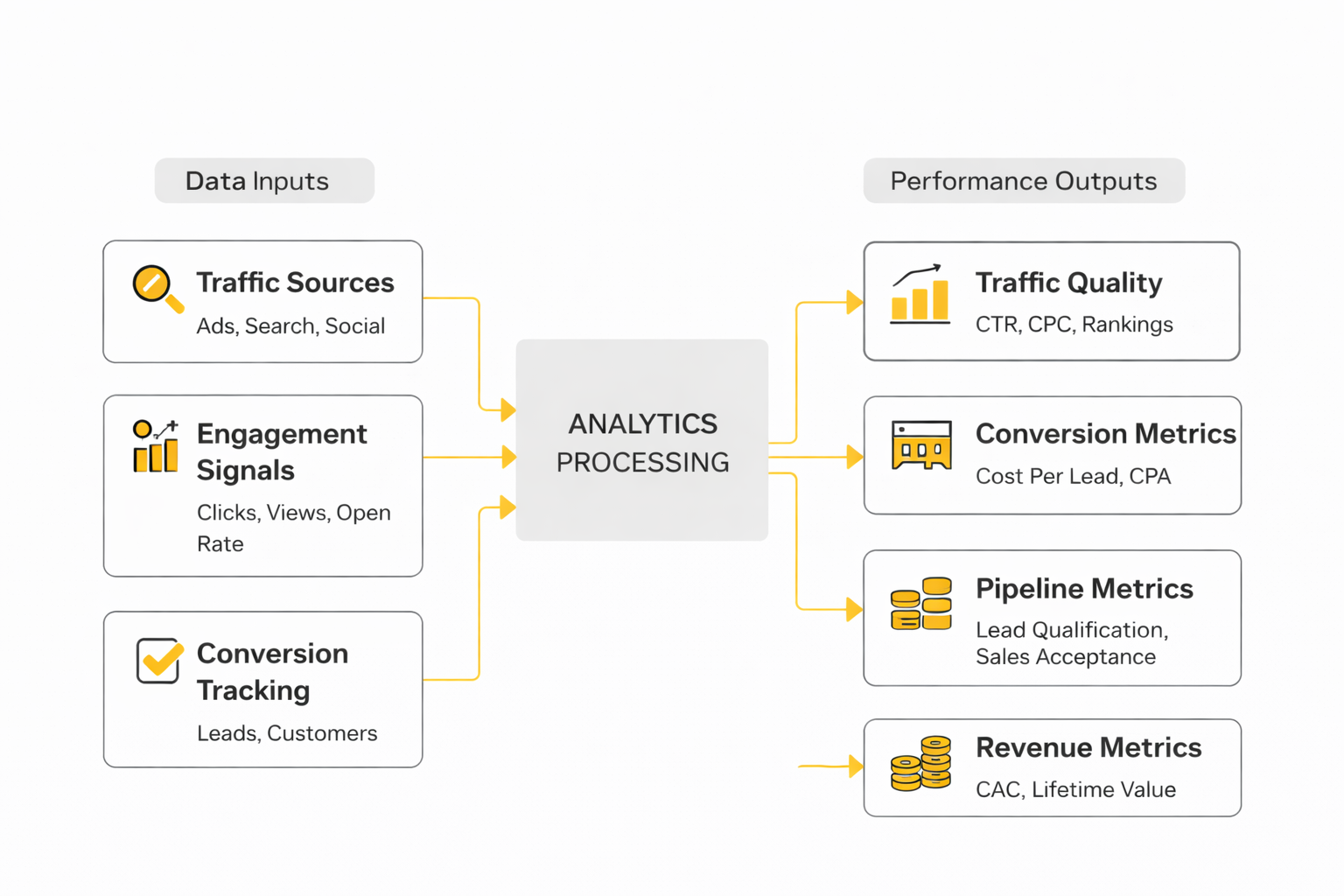
A functional measurement system typically connects several layers:
- Traffic sources showing where attention originates
- Engagement signals revealing how users interact with content or ads
- Conversion tracking identifying when a visitor becomes a lead or customer
- CRM integration tying marketing activity to real sales outcomes
- Lifecycle data measuring retention, upsell, and long-term value
When these layers connect properly, a marketing agency can evaluate the full customer journey rather than isolated fragments. A spike in traffic becomes meaningful only when the team can see how many visitors become qualified leads and how many of those leads eventually turn into revenue.
Tools play a role here, but they are secondary to the architecture of the measurement system. Marketing automation platforms such as Brevo or Moosend can track email engagement and lifecycle activity. CRM integrations with tools like Copper can connect marketing activity to pipeline progress. What matters is the consistency of the data flow between those systems.
A surprising number of marketing teams react to daily fluctuations as if every metric movement demands immediate action. That instinct often leads to overcorrection. Advertising platforms adjust, algorithms re-learn, and campaigns never gather enough stable data to reveal meaningful patterns.
Experienced operators take a different approach. They look for trends rather than individual spikes. They analyze whether a change is statistically meaningful or simply random variation. They also evaluate metrics together rather than in isolation.
For example, a drop in click-through rate might look concerning on its own. But if the campaign simultaneously improves conversion rate and lowers cost per acquisition, the change may actually represent stronger audience targeting. Context changes the interpretation entirely.
This analytical discipline is becoming even more important as marketing channels diversify. Research from the Salesforce State of Marketing report shows that organizations now manage more marketing data sources than ever before, which increases the risk of fragmented insights. A marketing agency adds value by turning that complexity into clear decisions instead of overwhelming the client with dashboards.
Data only matters when it leads to action. The role of analytics inside a marketing agency engagement is to guide specific improvements in strategy, creative, targeting, and follow-up.
When performance analysis reveals a weak point, the next step should be obvious:
- Low click-through rate suggests creative or messaging needs revision
- High click-through but low conversion points to a landing page or offer problem
- Strong leads but weak sales conversion highlights a handoff or qualification issue
- Healthy acquisition but poor retention signals a lifecycle marketing gap
Each signal should trigger a targeted experiment rather than a complete campaign reset. The goal is steady improvement through informed iteration. Over time, this approach compounds small gains across the entire funnel.
In practice, the most valuable insight often comes from connecting marketing data with real customer conversations. When analytics reveals a pattern and sales feedback explains why it happens, the marketing agency can refine messaging, targeting, and funnel design with far greater confidence. That feedback loop turns numbers into knowledge and knowledge into growth.
By the time you get to pricing, the important question is no longer “What does a marketing agency cost?” It is “What exactly am I buying, how will this be managed, and what has to be true for this engagement to produce a return?” Those are very different questions, and they usually lead to better decisions.
A lot of businesses get trapped here because they compare proposals as if they were buying the same thing in different packaging. They are not. One agency may be selling strategic leadership and cross-channel execution. Another may be selling task completion. Another may be selling confidence through presentation quality while quietly outsourcing the actual work. Price only makes sense when you understand the operating model behind it.
Most marketing agency engagements fall into a few familiar structures. Monthly retainers are common when the work is ongoing and spans strategy, execution, testing, and reporting. Project pricing works better when the scope is fixed, such as a website rebuild, tracking setup, or funnel launch. Performance-based pricing sounds attractive, but it often becomes messy unless the definitions, attribution rules, and sales handoff are unusually clean.
None of these models is automatically best. A retainer can be efficient if the company needs continuous iteration and fast access to specialists. A project fee can be smart when the deliverable is clear and the timeline is contained. Performance pricing can align incentives, but only when both sides agree on what counts as a qualified result and who controls the factors that affect it.
The real issue is fit. If your business is still figuring out positioning, offer structure, and channel mix, a rigid performance deal may create pressure for short-term tactics that hurt long-term results. If your system is already mature and you mainly need more efficient execution, a tightly scoped model may work just fine.
This is the part people learn the hard way. A low monthly fee can look efficient until you discover the agency has no real strategic depth, slow response times, junior-only staffing, weak reporting, and almost no ability to solve problems when campaigns hit friction. The invoice stays low while wasted spend, lost time, and internal frustration rise quietly in the background.
That tradeoff matters even more in a market where marketing leaders are under pressure to defend efficiency and prove contribution to growth, which is exactly why reports from Gartner, Deloitte, and Nielsen keep circling back to budget pressure, ROI discipline, and the need to do more with tighter resources. In that environment, underpowered execution is not just annoying. It is costly.
A better way to evaluate price is to ask what the agency helps you avoid. Does it reduce wasted media spend? Does it shorten the time from idea to launch? Does it tighten the handoff between marketing and sales? Does it help leadership make better calls faster? Those gains are harder to spot on a proposal sheet, but they are usually where the real value lives.
A professional marketing agency should be able to report clearly without hiding behind complexity. That means showing business-relevant metrics, explaining what changed, identifying what matters, and stating what actions come next. If a report looks polished but leaves the client unsure what to do, it failed.
This is where many relationships quietly break down. The agency sends a deck full of charts. The client nods along. Nobody addresses whether the leads are sales-ready, whether creative is weakening, or whether the landing page is now the main bottleneck. Reporting becomes a performance instead of a management tool.
Good reporting usually includes three layers. First, the core outcomes. Second, the drivers behind those outcomes. Third, the next decisions. That structure keeps the conversation honest. It also stops the team from getting distracted by vanity metrics that look positive while the commercial picture stays flat.
The quality of the relationship matters more than most businesses expect. Even a very capable marketing agency can struggle when the client is slow to approve work, unclear about priorities, or constantly changing direction. The reverse is also true. A focused client can sometimes pull strong performance out of a decent agency simply by creating clarity, speed, and accountability.
That is why relationship management should be treated as an operating system, not a soft skill. Roles need to be clear. Approvals need deadlines. Access needs to be handled early. Strategy conversations need space away from weekly campaign chatter. When this structure is in place, execution gets smoother and tension drops fast.
The strongest agency partnerships usually feel demanding in a good way. Both sides know what they owe each other. Both sides can challenge assumptions. Both sides can speak plainly when the data says something needs to change. That kind of working relationship is far more valuable than surface-level friendliness.
At some point, growing businesses face a bigger question: should this work stay with a marketing agency, move in-house, or become a hybrid model? There is no universal answer because it depends on stage, budget, leadership depth, and the type of marketing capability being discussed.
In-house teams usually win on brand familiarity, speed of internal communication, and day-to-day alignment with leadership. Agencies often win on specialist expertise, pattern recognition across clients, and the ability to bring multiple disciplines into one engagement without building a full department from scratch. Hybrid models are increasingly common because they let companies keep strategic ownership internally while using agency partners for channel execution, creative systems, analytics, or special projects.
This tradeoff has become more important as marketing gets more fragmented and more technical. Research from Salesforce, Adobe, and McKinsey keeps pointing to the same pressure: teams are expected to personalize more, move faster, and make better use of data at the same time. That is one reason many businesses do not fully replace agency support even after building an internal team. They keep specialist partners where the learning curve is steep and the pace of change stays high.
Scaling sounds exciting until it exposes the parts of the system that were barely holding together. A campaign that performs at a modest spend level may collapse when budget increases. A lead-generation engine that looks healthy at low volume may flood the sales team with weak opportunities once volume rises. A content strategy that feels manageable with one channel can turn chaotic when distribution expands.
This is where a good marketing agency earns its keep. Scaling is not just “more budget” or “more output.” It is controlled expansion with close attention to efficiency, operational capacity, and message consistency. If one layer of the system cannot absorb the growth, the whole thing starts leaking.
That is why experienced teams scale in stages. They watch whether customer acquisition cost stays reasonable, whether lead quality holds, whether fulfillment can keep up, and whether retention stays healthy after the initial conversion. Growth that cannot be operationally supported is not real growth. It is a delayed problem.
Some of the biggest risks in an agency relationship do not show up in month one. They appear later, after habits form and momentum creates blind spots. One common risk is dependency. If the agency controls all the strategy, all the platform access, all the reporting logic, and all the historical knowledge, the client becomes fragile. That is a dangerous place to be.
Another risk is false clarity. Dashboards can create the illusion that the system is understood when key parts of the buyer journey remain invisible or misread. This happens a lot when businesses over-trust platform reporting and underuse CRM feedback, customer interviews, and sales-call patterns.
Then there is strategy drift. The account may keep running, assets keep shipping, and meetings keep happening, but the work slowly loses connection to the actual business goal. That is why periodic strategic resets matter. A marketing agency should not just keep the machine running. It should periodically ask whether the machine is still pointed in the right direction.
If you are evaluating a marketing agency at a serious level, stop asking generic questions first. Do not start with “How many clients do you have?” or “What services do you offer?” Start with the commercial problem you need solved and see how the agency thinks.
Ask how it would diagnose the issue. Ask what data it would want first. Ask what it believes usually breaks in businesses like yours. Ask how it would know whether the problem is traffic, conversion, qualification, follow-up, or positioning. Those questions reveal far more than polished case-study slides.
You should also pay attention to how the agency handles uncertainty. Strong operators do not pretend every answer is obvious. They show you how they think, what they would test first, and where the real leverage probably is. That kind of honesty is a much better signal than overconfident promises.
The final test is simple: does this marketing agency make your growth system feel clearer or more confusing? The right partner should reduce noise, sharpen priorities, and make execution more intelligible over time. When that happens, the value goes well beyond campaigns. It changes how the business makes decisions.
By this point, the role of a marketing agency should look very different from the simple vendor relationship many businesses imagine at the beginning. When the engagement works, the agency becomes part of a broader growth system that connects strategy, execution, measurement, and learning into a repeatable engine.
The ecosystem usually includes several layers working together. Traffic channels bring attention. Landing pages and funnels convert visitors into leads or customers. Automation and CRM systems manage follow-up. Analytics platforms interpret performance signals. The marketing agency sits in the middle, aligning these pieces so they reinforce each other rather than operate as disconnected tools.
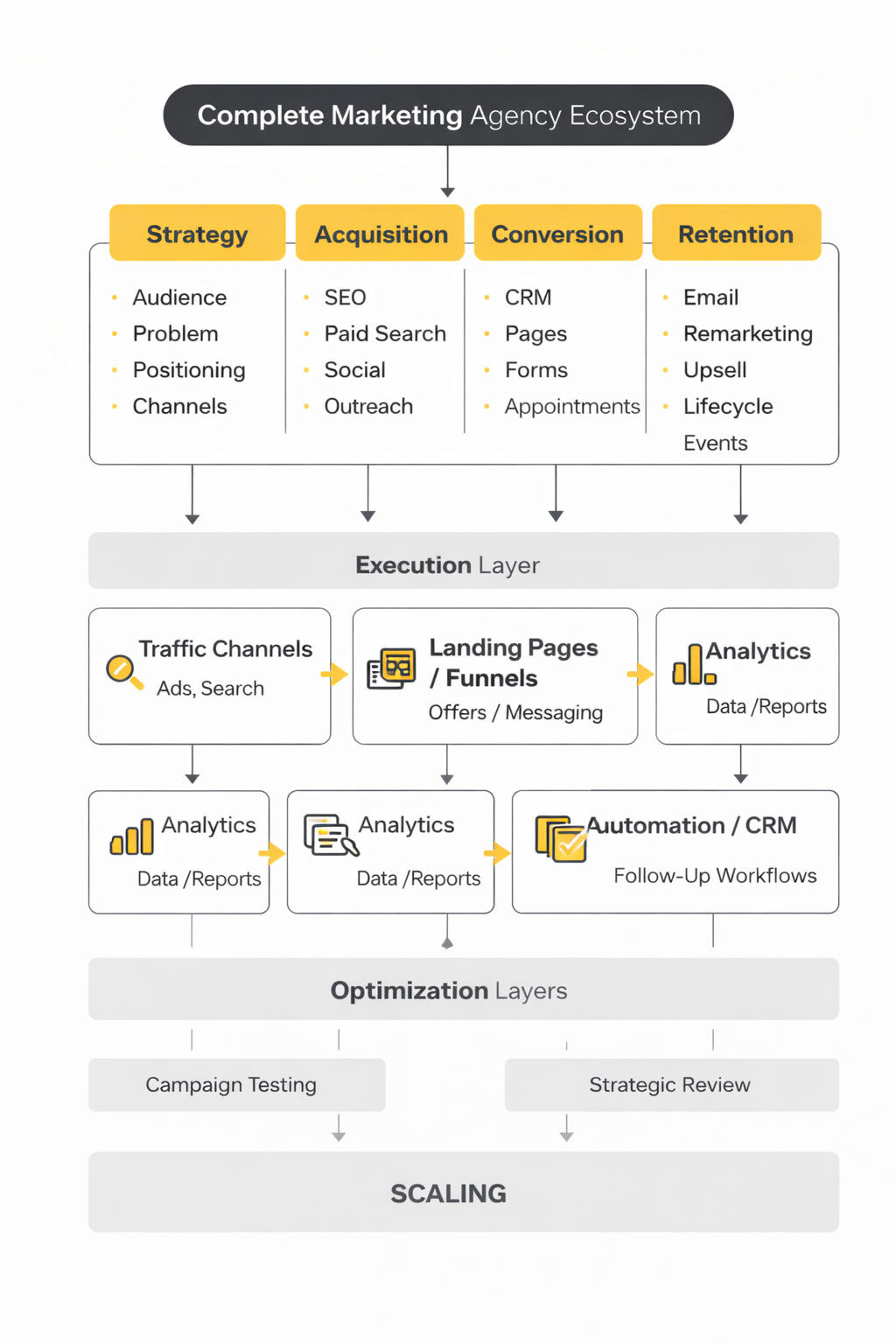
When the system is healthy, small improvements in one layer ripple through the rest. A clearer message improves click-through rates. Better landing pages increase conversion. Stronger follow-up raises revenue from the same traffic. Each layer compounds the others.
This compounding effect explains why experienced operators focus so much on the entire funnel instead of isolated tactics. Growth rarely comes from a single breakthrough channel. It usually comes from tightening the whole system until every step becomes slightly more efficient.
The real value of a marketing agency, then, is not just the campaigns it runs. It is the clarity it brings to how all of these moving parts should work together.
A marketing agency helps businesses attract, convert, and retain customers through a combination of strategy, content, advertising, funnel design, and analytics. The exact services vary, but the core objective is always the same: turn attention into measurable business growth.
Many agencies also handle campaign testing, performance optimization, and reporting so companies can see how marketing activity translates into revenue.
Pricing varies widely depending on scope, industry, and experience level. Small projects may cost a few thousand dollars, while ongoing retainers for growth-focused work can reach five figures per month.
What matters most is not the absolute price but the alignment between the agency’s capabilities and the business problem being solved.
Some improvements appear quickly, especially when the issue involves obvious conversion problems or weak follow-up systems. However, sustainable growth typically takes several months because messaging, targeting, and creative testing need time to produce reliable insights.
Many companies evaluate progress over 90-day cycles rather than expecting immediate transformation.
Businesses often hire a marketing agency when they need specialized expertise faster than they can hire internally. Agencies also make sense when the required skill set spans multiple disciplines such as paid media, analytics, creative, and automation.
As companies grow, they often combine internal marketing leadership with agency specialists for certain channels or projects.
A marketing agency may work across both online and offline channels including brand strategy, events, public relations, and traditional media. A digital marketing agency focuses primarily on online channels such as search, social media, paid advertising, email marketing, and analytics.
In practice, the lines between these categories continue to blur as most marketing activity now involves digital infrastructure.
Performance should be evaluated using business-relevant metrics rather than vanity indicators. Typical measurements include cost per acquisition, lead quality, pipeline contribution, and overall revenue impact.
A strong agency also explains how these numbers connect to campaign decisions and optimization strategies.
Nearly every sector can benefit from external marketing expertise, but the model is particularly common in software, professional services, healthcare, e-commerce, and local service industries.
These markets rely heavily on digital discovery, customer education, and data-driven campaigns, which align well with agency capabilities.
Most agencies rely on a stack of tools covering analytics, automation, advertising, and collaboration. For example, funnel-building platforms such as ClickFunnels or automation platforms like systeme.io are often used to build marketing funnels quickly.
Email and lifecycle campaigns may run through systems such as Brevo or Moosend. These tools help automate communication, manage customer relationships, and track engagement across the funnel.
The best choice usually comes from evaluating how the agency approaches real problems rather than how polished its presentations appear. Ask how it diagnoses issues, what data it would request first, and how it prioritizes experiments.
Clarity of thinking often matters more than the size of the agency.
Yes. Smaller companies often gain the most because they can access experienced specialists without hiring a full internal team. Agencies can accelerate learning, test channels quickly, and build systems that would otherwise take years to develop internally.
The key is choosing an agency that understands the economics and constraints of smaller businesses.
For many organizations, yes. A capable marketing agency can shorten the path to market insight, reduce wasted spend, and help the company build a repeatable growth system.
The long-term value usually comes not from individual campaigns but from the strategic clarity and operational discipline that the agency introduces.
Most marketers spend too much time chasing clients, competing on crowded platforms, and losing a percentage of every project to middlemen.
MarkeWork gives you a better way. Browse thousands of remote marketing contracts and connect directly with companies desperate to hire skilled marketers like you, without platform commissions and without unnecessary gatekeepers.
If you're serious about finding better opportunities and keeping 100% of what you earn, explore available contracts and create a profile for free at MarkeWork.com.